Original Research Article
Prevalence and determinants of cardiovascular disease in a rural area of
Kancheepuram district, Tamil Nadu: a cross sectional study
Vijayakarthikeyan M.
1*, Dhanuraja V.
2INTRODUCTION
Non-communicable diseases (NCDs) are group of chronic diseases that are not communicable. They are defined as diseases of long duration and slow progression. NCDs are the major cause of adult mortality and morbidity globally.1 NCDs are collectively responsible for almost 70% of all deaths worldwide. Almost three quarters of all NCD deaths,
and 82% of the 16 million deaths, occur in low and middle income countries of the world.2
Major NCDs are cardiovascular diseases, cancers, chronic respiratory diseases and diabetes. Important concern in NCDs is that it affects the most productive age group and To contain the increasing burden of NCDs, Ministry of Health and Family welfare, Government of India, has launched the National Programme on prevention and control of diabetes, cardiovascular diseases and stroke (NPDCS).3
ABSTRACT
Background: Cardio vascular disease (CVD) is the number 1 cause of death globally and an estimated 17.7 million
people died from CVD in 2015, representing 31% of all global deaths. In India CVD accounts for 25% of all deaths. The objectives of the study was to estimate the prevalence of CVD among the study population and to determine the association between CVD and various risk factors.
Methods: This is a cross sectional study carried out in the rural field practice area attached to SBMCH. The study
group were 400 adults (20-60 years). The data was collected using a structured questionnaire containing socio-demographic particulars, details regarding CVD risk factors and physical measurements. Data was entered in MS Excel and analysed using SPSS 15 software.
Results: Prevalence of CVD is 24.3% and of which hypertension (18%), coronary artery disease (6%), stroke (2.2%)
and valvular heart disease (1%). The prevalence of risk factors are age >40 (63%), tobacco use (17.8%), alcohol use (22.3%), physical inactivity (52%), unhealthy diet (61.4%), obesity (19.7%), diabetes (13.6%) and positive family history (21.4%). There is a strong statistically significant association between CVD and age (p=0.008, OR-1.968), tobacco use (p<0.0001, 10.029), obesity (p<0.0001, 13.462) and positive family history (p<0.0001, OR-13.964).
Conclusions: In this study prevalence of CVD is high. It is necessary to minimize the burden of growing CVD by
controlling the rates of the risky behaviours by lifestyle modification and by increasing awareness regarding CVD.
Keywords: Hypertension, CVD, Lifestyle modification, Risk factor
1
Department of Community Medicine, Vinayaka Mission Kirupananda Variyar Medical College and Hospital, Salem, Tamil Nadu, India
2Department ofCommunity Medicine, Tagore Medical College and Hospital, Kancheepuram, Tamil Nadu, India
Received: 13 November 2019
Revised: 11 December 2019
Accepted: 12 December 2019
*Correspondence:
Dr. Vijayakarthikeyan M., E-mail: [email protected]
Copyright: © the author(s), publisher and licensee Medip Academy. This is an open-access article distributed under
the terms of the Creative Commons Attribution Non-Commercial License, which permits unrestricted non-commercial use, distribution, and reproduction in any medium, provided the original work is properly cited.
Cardiovascular diseases (CVDs) are a group of disorders of the heart and blood vessels and they include coronary heart disease, cerebrovascular disease, peripheral arterial disease, rheumatic heart disease, congenital heart disease, deep vein thrombosis and pulmonary embolism. CVD is the number 1 cause of death globally and an estimated 17.7 million people died from CVD in 2015, representing 31% of all global deaths.4 CVD are the major cause of morbidity and mortality in India and accounting for 25% of all deaths and projected to increase to 50%.5
Cardiovascular diseases result from lifestyle related risk factors such as unhealthy diet, lack of physical activity harmful use of alcohol and tobacco use. Changes in lifestyles, behavioural patterns, demographic profile (aging population), socio-cultural and technological advancements are leading to sharp increases in the prevalence of NCD.
With this background the study was planned to find out the prevalence of NCD risk factors among adult population, in the rural field practice area of our institution with the objectives to estimate the prevalence of CVD in the study population and to find out the association between the risk factors for CVD and CVD.
METHODS
Study design and period
This is a population based cross sectional descriptive study. This study was carried out from April 2018-September 2018.
Study area
The study was carried out in a rural area of Padappai, which is the rural field practice area of the Rural Health and Training Centre attached to our Institution, located in Kancheepuram District of Tamil Nadu. The RHTC covers the population residing in 5 villages and among which serpenancherry village is chosen for this study. The population covered by the Rural Health and Training Centre is about 21187 as per 2011 census. Total number of houses in Padappai village is 1851 and the total population is 7198, consisting of 3709 males and 3489 females.
Study population
Study population identified were those belonging to the age group of 20–60 years residing in the study area permanently at the time of the study.
Sample size
The sample size for the study was calculated based on a previous study done by Kumar, which showed a prevalence of hypertension as 34% which is one of the cardiovascular diseases. Using the formula 4PQ/L², the
sample size was calculated with a relative precision of 10%.14 Adding 10% refusal rate, the sample size was calculated to be 396 which was rounded off to 400.
Inclusion and exclusion criteria
The inclusion criteria for the study were adult population of age group (20-60 years) residing in the study area, who were apparently healthy looking and willing to participate in the study. The exclusion criteria for the study were females who were pregnant, psychiatric patients, who are severely ill and those who rejected to participate in the study.
Sampling method
Systematic random sampling technique was used to identify the study subjects. Sampling Interval (N/n) is calculated as follows: [N= Total number of households in Padappai=1851, n=sample size=400. N/n=1851/400= 5]. Thus every 5th household is selected for identifying adult population between 20-60 years of age. If there were no persons of 20-60 years age group in that house, the next house with appropriate study subject (age group of 20-60 years) was selected. From that house, next 5th household was selected for the sample identification for the study.
Data collection
A standardised pretested structured questionnaire consisting of the socio demographic particulars, details regarding risk factors for cardiovascular disease and measurements (height, weight, waist circumference and BP). The data was collected using the standardized pretested structured interview schedule.
Data analysis
All the data collected were entered into the Microsoft Excel and analysis was carried out using SPSS 15 Software. The prevalence of cardiovascular disease was calculated using percentages. Statistical significance (chi square test and p value) and strength of association (odds ratio and 95% confidence interval) were tested between cardiovascular disease and selected risk factors.
Ethical clearance and informed consent
The study was carried out after obtaining approval from the Institutional Ethical Committee. The participants were briefed about the purpose of the study and informed consent was obtained prior to the data collection
Operational definition
Risk factors
Alcohol users were those who had consumed at least one standard drink of alcohol (30 ml of spirits, 285 ml of beer or 120 ml of wine) in the last 12 months.
Unhealthy diet is Low consumption of fruits and vegetables at less than five servings per day (one cup of raw leafy vegetables or half cup of other vegetables (cooked) was considered one serving. One medium-sized piece of fruit or half cup of chopped fruit was measured as one serving).
Physical activity low physical activity was defined as <150 minutes of moderate physical activity per week.
Overweight was defined as BMI equal to or more than 25 kg/m2.
Obesity as BMI equal to as or more than 30 kg/m2.
Waist circumference ≥94 cm in men and ≥80 cm in
women was taken as cut off point to define central obesity.
Cardiovascular disease
Hypertension was defined if systolic blood pressure was ≥140 mm of Hg and/or diastolic pressure ≥90
mm of Hg, or diagnosed cases taking
antihypertensive drugs.
Coronary artery disease patients diagnosed by a physician based on clinical signs, symptoms and investigations as per MONICA criteria and those
who are already under treatment for coronary artery disease.
Stroke patients diagnosed by a physician based on clinical signs, symptoms and investigations as per MONICA criteria and those who are already under treatment for stroke.
Valvular heart disease patients diagnosed by a physician based on clinical signs, symptoms and investigations and those who are already under treatment for valvular heart disease
.
RESULTS
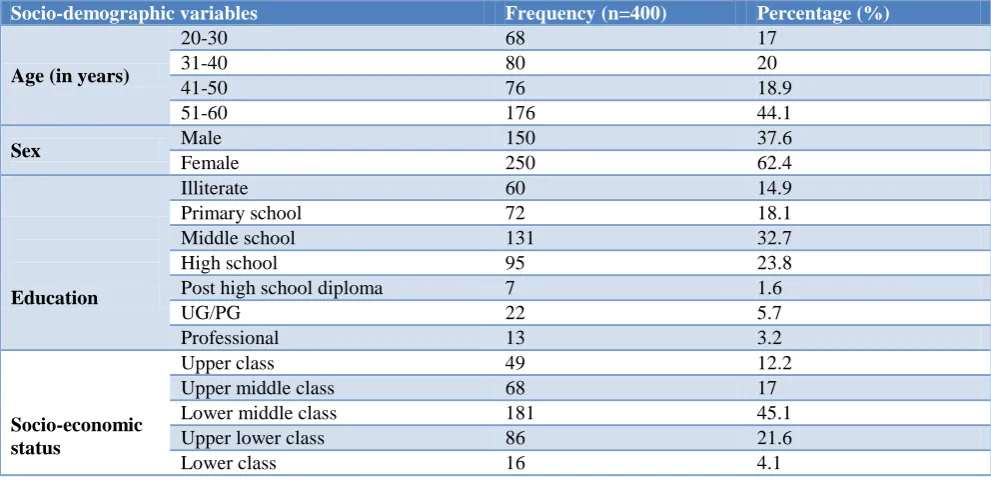
The socio-demographic characteristics of the study population are presented in Table 1. Among the study participants 37.6% were males and 62.4% were females. Around 44.1% belonged to 51-60 years of age, followed by 20% belonging to 31-40 years of age and only 17 of the subjects belonged to 20-30 age category. Nearly 32.7% of the study subjects had middle school education, 23.8% had high school education and 14.9% were illiterate. Socio economic status was classified based on BG Prasad scale. Around 45.1% belonged to class III socio economic status, 21.6% belonged to class IV socio economic status and 4.1% belonged to class V socio economic status.
Table 1: Socio-demographic characteristics of the study population.
Socio-demographic variables Frequency (n=400) Percentage (%)
Age (in years)
20-30 68 17
31-40 80 20
41-50 76 18.9
51-60 176 44.1
Sex Male 150 37.6
Female 250 62.4
Education
Illiterate 60 14.9
Primary school 72 18.1
Middle school 131 32.7
High school 95 23.8
Post high school diploma 7 1.6
UG/PG 22 5.7
Professional 13 3.2
Socio-economic status
Upper class 49 12.2
Upper middle class 68 17
Lower middle class 181 45.1
Upper lower class 86 21.6
Lower class 16 4.1
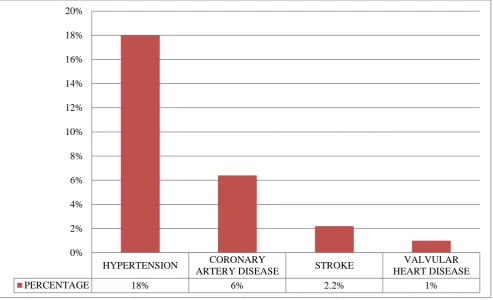
In this study the overall prevalence of the cardiovascular disease is 24.3% and among them the prevalence of hypertension (18%), coronary artery disease (6%), stroke (2.2%) and valvular heart disease (1%).
As we can see from Figure 1, the prevalence of risk factors for cardiovascular disease of the study participants tobacco use (17.8%), alcohol use (22.3), physical
inactivity (52%), unhealthy diet (61.4%), obesity (19.7%), diabetes mellitus (13.6%), family history of cardiovascular disease (21.4%) and age >40 years (63%).
Blood pressure category (Table 4). Nearly 13.8% are pre-hypertensive.13.3% have stage 1 hypertension and 4.77% of the study population suffer from stage 2 hypertension.
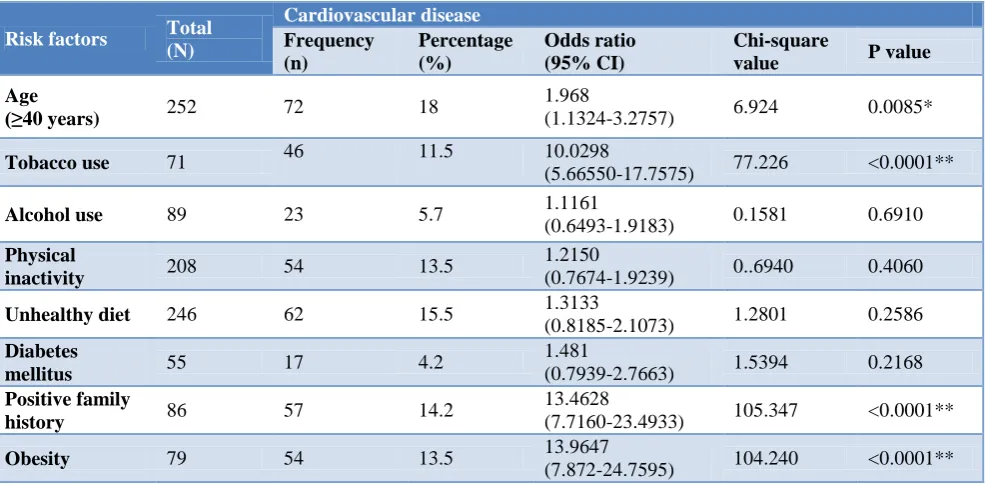
The statistical association between cardiovascular disease and various risk factors is seen in Table 5-7. As shown, it is evident that there is a strong statistical significant association between cardiovascular disease and tobacco use (odds ratio- 10.029, p value <0.0001 at 95% confidence interval (5.6655-17.7575)). Obesity (odds ratio- 13.964, p value-< 0.0001 at 95% confidence interval (7.7160—23.4933)), age >40 years (odds ratio-1.968, p value-0.0085 at 95% confidence interval (1.1324-3.2757)) and family history of cardiovascular disease (odds ratio-13.4628, p value- <0.0001 at 95% confidence interval (7.8722-24.7595)). There was no
association between other risk factors and cardiovascular disease.
Figure 1: Overall prevalence of cardiovascular disease among the study population.
Figure 2: Prevalence of various cardiovascular diseases among the study population.
Table 2: Risk factors for CVD among the study population.
Risk factors Frequency (N) Percentage (%)
Tobacco use 71 17.8
Alcohol use 89 22.3
Physical inactivity 208 52
Unhealthy diet 246 61.4
Obesity 79 19.7
Diabetes mellitus 55 13.6
Family history 86 21.4
24.3%
65.7%
CVD NO CVD
HYPERTENSION CORONARY
ARTERY DISEASE STROKE
VALVULAR HEART DISEASE
PERCENTAGE 18% 6% 2.2% 1%
Table 3: Association between risk factors and cardiovascular disease.
Risk factors Total
(N)
Cardiovascular disease
Frequency (n)
Percentage (%)
Odds ratio (95% CI)
Chi-square
value P value
Age
(≥40 years) 252 72 18
1.968
(1.1324-3.2757) 6.924 0.0085*
Tobacco use 71 46 11.5 10.0298
(5.66550-17.7575) 77.226 <0.0001**
Alcohol use 89 23 5.7 1.1161
(0.6493-1.9183) 0.1581 0.6910
Physical
inactivity 208 54 13.5
1.2150
(0.7674-1.9239) 0..6940 0.4060
Unhealthy diet 246 62 15.5 1.3133
(0.8185-2.1073) 1.2801 0.2586
Diabetes
mellitus 55 17 4.2
1.481
(0.7939-2.7663) 1.5394 0.2168
Positive family
history 86 57 14.2
13.4628
(7.7160-23.4933) 105.347 <0.0001**
Obesity 79 54 13.5 13.9647
(7.872-24.7595) 104.240 <0.0001**
DISCUSSION
CVDs in 2015, of these deaths, an estimated 7.4 million were due to coronary heart disease and 6.7 million were due to stroke. In this study the overall prevalence of the cardiovascular disease is 24.3%. There was a statistically significant association between risk factors like age >40 years, tobacco use, obesity and positive family history and cardiovascular disease.
In this study the prevalence of hypertension is 18% which was similar to the studies by Bhadoria et al (17%), Kokiwar et al (19%) and Kaur et al (21.4%).10-12 Studies done by Bhardwaj et al, Kumar et al, Zachariah et al and Reddy et al recorded the prevalence of hypertension as 36.4%, 34%, 54.5% and 8.6% respectively.13-16 The wide variation in the prevalence is due to the study setting.
Coronary artery disease prevalence in this study is 6% which is comparable to the studies done by Singh et al (6.1%), Mohan et al (11%) and Begom et al (13.9%).17-19 There is a significant variation in the prevalence of
coronary artery disease in studies by Ness et al, Aronow et al and Sarraf-Zadegan et al where the prevalence was 34%, 43% and 19.4% respectively.20-22 This variation is due to the socio-demographic characteristics of the study population.
In this study the prevalence of stroke is 2.2% which is similar to the studies conducted by Danesi et al, Ferguson et al, Ness et al.23-25 In the studies dies done by Das et al, Bharucha et al, Bonita et al, Khedr et al, the prevalence of stroke is 0.5%,0.8%,0.8% and 0.9% respectively.26-30
Prevalence of valvular heart disease in this study is 11% in Nkomo et al, Saxena et al and Paar et al studies the
prevalence were 1.8%, 2% and 2.2% respectively.30-32 0.1% and 0.2% were the prevalence recorded in studies by Bahadur et al and Marijon et al respectively.33,34
Limitation
In this study not all the cardiovascular diseases were taken into account.
CONCLUSION
In this study the prevalence of CVD and its risk factors was found to be high. Given that CVD accounting for one third of all deaths in India, this findings emphasis the need for primary prevention of CVDs by lifestyle modification. It is necessary to minimize the burden of growing CVD by controlling the rates of the risky behaviours at a very early stage of life. By means of adequate health education. Knowledge and awareness regarding CVD must be increased and the ideal candidates for creating awareness will be those belonging to adolescent age group through various available Medias.
The healthcare system needs to improve the level of awareness, treatment and control of CVDs in this population. NCD clinics must be conducted in all hospital to screen all persons over 30 years of age for NCDs as per the NPCDCS programme.
ACKNOWLEDGEMENTS
professors for guiding me throughout the study. A special mention to all my fellow post graduates, friends and family members for helping me to complete the study.
Funding: No funding sources Conflict of interest: None declared
Ethical approval: The study was approved by the Institutional Ethics Committee, Sree Balaji Medical College and Hospital
REFERENCES
1. Tunstall-Pedoe H. Preventing Chronic Diseases. A Vital Investment: WHO Global Report. Geneva: World Health Organization, 2005. Available at: http://wwwwho. int/chp/chronic_disease_report/en. Accessed on 6 October 2005.
2. World health organisation non communicable
disease report, 2017. Available at:
http://www.who.int/ncds/en/. Accessed on 6
October 2017.
3. Park K. Epidemiology of Chronic Non
communicable diseases and condition. Park's Textbook of Preventive and Social Medicine. 23rd ed. Jabalpur: Bhanot; 2015: 362.
4. World health organisation cardiovascular disease
report, 2016. Available at:
http://www.who.int/mediacentre/factsheets/fs317/en / and Accessed on 6 October 2016.
5. Gupta R, Joshi P, Mohan V, Reddy KS, Yusuf S. Epidemiology and causation of coronary heart disease and stroke in India. Heart. 2008;94(1):16-26. 6. Kishore J. National programme for prevention and control of diabetes, cardio vascular diseases and stroke. In, National Health Programme of India. 7. Vijayakarthikeyan M, Krishnakumar J, Umadevi R.
Cross-sectional study on the prevalence of risk factors for non-communicable disease in a rural area of Kancheepuram, Tamil Nadu. International J Community Med Public Health. 2017;4(12):4600-7. 8. Gillum RF, Fortmann SP, Prineas RJ, Kottke TE.
International diagnostic criteria for acute myocardial infarction and acute stroke. American Heart J. 1984;108(1):150-8.
9. Reményi B, Wilson N, Steer A, Ferreira B, Kado J,
Kumar K, Lawrenson J, Maguire G, Marijon E, Mirabel M, Mocumbi AO. World Heart Federation
criteria for echocardiographic diagnosis of
rheumatic heart disease—an evidence-based
guideline. Nature Reviews Cardiology.
2012;9(5):297.
10. Bhadoria AS, Kasar PK, Toppo NA, Bhadoria P,
Pradhan S, Kabirpanthi V. Prevalence of
hypertension and associated cardiovascular risk factors in Central India. Journal of family & community medicine. 2014;21(1):29.
11. Kokiwar PR, Gupta SS, Durge PM. Prevalence of hypertension in a rural community of central India. J Assoc Physicians India. 2012 Jun;60(6):26-9.
12. Kaur P, Rao SR, Radhakrishnan E, Rajasekar D, Gupte MD. Prevalence, awareness, treatment, control and risk factors for hypertension in a rural population in South India. International J Public Health. 2012;57(1):87-94.
13. Bhardwaj R, Kandori A, Marwah R, Vaidya P, Singh B, Dhiman P, Sharma A. Prevalence, awareness and control of hypertension in rural communities of Himachal Pradesh. J Assoc Physicians India. 2010;58:423-4.
14. Kumar KS, Ganapathi KC, Duraimurugan M,
Selavaraj R, Kokila K, Megala M. Prevalence, awareness, treatment and control of hypertension in a rural community of Salem, Tamil Nadu. IJCMPH. 2017;4(6):1976-81.
15. Zachariah MG, Thankappan KR, Alex SC, Sarma PS, Vasan RS. Prevalence, correlates, awareness, treatment, and control of hypertension in a middle-aged urban population in Kerala. Indian Heart J. 2003;55(3):245-51.
16. Reddy SS, Prabhu GR. Prevalence and risk factors of hypertension in adults in an Urban Slum,
Tirupati, AP. Indian J Community Med.
2005;30(3):84.
17. Singh RB, Sharma JP, Rastogi V, Raghuvanshi RS,
Moshiri M, Verma SP, Janus ED. Prevalence of coronary artery disease and coronary risk factors in rural and urban populations of North India. European Heart J. 1997;18(11):1728-35.
18. Mohan V, Deepa R, Rani SS, Premalatha G.
Prevalence of coronary artery disease and its relationship to lipids in a selected population in South India: The Chennai Urban Population Study (CUPS No. 5). J American Coll Cardiol. 2001;38(3):682-7.
19. Begom R, Singh RB. Prevalence of coronary artery disease and its risk factors in the urban population of South and North India. Acta Cardiologica. 1995;50(3):227-40.
20. Ness J, Aronow WS. Prevalence of Coexistence of Coronary Artery Disease, Ischemic Stroke, and Peripheral Arterial Disease in Older Persons, Mean Age 80 Years, in an Academic Hospital‐Based Geriatrics Practice. J American Geriatrics Society. 1999;47(10):1255-6.
21. Aronow WS, Ahn C. Prevalence of coexistence of coronary artery disease, peripheral arterial disease, and atherothrombotic brain infarction in men and women ≥62 years of age. American J Cardiol. 1994;74(1):64-5.
22. Sarraf-Zadegan N, Sayed-Tabatabaei FA,
Bashardoost N, Maleki A, Totonchi M, Habibi HR, et al. The prevalence of coronary artery disease in an urban population in Isfahan, Iran. Acta cardiologica. 1999;54(5):257-63.
23. Danesi M, Okubadejo N, Ojini F. Prevalence of stroke in an urban, mixed-income community in
Lagos, Nigeria. Neuroepidemiology.
24. Ferguson TS, Younger NO, Morgan ND, Tulloch-Reid MK, McFarlane SR, Francis DK, Grant A, Lewis-Fuller E, Wilks RJ. Self-reported prevalence of heart attacks and strokes in Jamaica: A cross-sectional study. The Jamaica Health and Lifestyle Survey 2007–2008. Research Rep Clin Cardiol. 2010;1:23-31.
25. Ness J, Aronow WS. Prevalence of Coexistence of Coronary Artery Disease, Ischemic Stroke, and Peripheral Arterial Disease in Older Persons, Mean Age 80 Years, in an Academic Hospital‐Based Geriatrics Practice. Journal of the American Geriatrics Society. 1999 Oct 1;47(10):1255-6.
26. Das SK, Banerjee TK, Biswas A, Roy T, Raut DK,
Mukherjee CS, et al. A prospective community-based study of stroke in Kolkata, India. Stroke. 2007;38(3):906-10.
27. Bharucha NE, Bharucha EP, Bharucha AE, Bhise AV, Schoenberg BS. Prevalence of stroke in the
Parsi community of Bombay. Stroke.
1988;19(1):60-2.
28. Bonita R, Solomon N, Broad JB. Prevalence of stroke and stroke-related disability: estimates from
the Auckland Stroke Studies. Stroke.
1997;28(10):1898-902.
29. Khedr EM, Fawi G, Abdela M, Mohammed TA,
Ahmed MA, El-Fetoh NA, et al. Prevalence of ischemic and hemorrhagic strokes in Qena Governorate, Egypt: community-based study. J Stroke Cerebrovascular Dis. 2014;23(7):1843-8.
30. Nkomo VT, Gardin JM, Skelton TN, Gottdiener JS,
Scott CG, Enriquez-Sarano M. Burden of valvular heart diseases: a population-based study. Lancet. 2006;368(9540):1005-11.
31. Saxena A, Ramakrishnan S, Roy A, Seth S,
Krishnan A, Misra P, et al. Prevalence and outcome of subclinical rheumatic heart disease in India: the RHEUMATIC (Rheumatic Heart Echo Utilisation and Monitoring Actuarial Trends in Indian Children) study. Heart. 2011;97(24):2018-22.
32. Paar JA, Berrios NM, Rose JD, Cáceres M, Peña R,
Pérez W, et al. Prevalence of rheumatic heart disease in children and young adults in Nicaragua. American J Cardiol. 2010;105(12):1809-14.
33. Bahadur KC, Sharma D, Shrestha MP, Gurung S, Rajbhandari S, Malla R, et al. Prevalence of
rheumatic and congenital heart disease in
schoolchildren of Kathmandu valley in Nepal. Indian Heart J. 2003;55(6):615-8.
34. Marijon E, Ou P, Celermajer DS, Ferreira B, Mocumbi AO, Jani D, et al. Prevalence of rheumatic heart disease detected by echocardiographic screening. New England J Med. 2007;357(5):470-6.
Cite this article as: Vijayakarthikeyan M, Dhanuraja