A True Random-Number Encryption Method Employing
Block Cipher and PRNG
Yi-Li Huang, Fang-Yie Leu, Jian-Hong Chen, William Cheng-Chung Chu
Department of Computer Science, Tunghai University, No. 1727, Section 4, Taiwan Boulevard, Taichung City, Taiwan
{yifung, leufy, g01350027, cchu}@thu.edu.tw
Abstract. In January 1999, distributed.net collaborated with the Electronic Frontier Foundation to break a DES (i.e., Data Encryption Standard) key, spending 22 hours and 15 minutes, and implying that the DES is no longer a secure encryption method. In this paper, we propose a more secure one, called the True Random Number Encryption Method (TRNEM for short), which employs current time, true random numbers and system security codes as parameters of the encryption process to increase the security level of a system. The same plaintext file encrypted by the TRNEM at different time points generates different ciphertext files. So these files are difficult to be cracked. We also analyze the security of the DES, AES (i.e., Advanced Encryption Standard) and TRNEM, and explain why the TRNEM can effectively defend some specific attacks, and why it is safer than the DES and AES.
Keywords: DES, AES, true random number, SSC, block cipher, wrapped ciphertext file
1.
Introduction
encrypt plaintext. In this study, we develop a data protection mechanism, named True Random Numbers Encryption Method (TRNEM for short), which encrypting plaintext by employing true random numbers is a secure encryption approach which is difficult to be cracked by using brute force attacks and ciphertext analyses.
The rest of this paper is organized as follows. Section 2 briefly describes the related studies of this paper, including AES, and DES, and their vulnerabilities. Section 3 introduces the encryption/decryption process of the TRNEM. The security and performance of the TRNEM and the comparison between the TRNEM and the AES are presented in Section 4. Section 5 concludes this paper and outlines our future studies.
2.
Common Block Cipher
Currently, the most common block cipher modes are the DES and AES.
2.1. Data Encryption Standard (DES)
DES [2] is a symmetric block cipher algorithm in which the encryption and decryption details are almost the same. The length of a key is 56 bits (the key is typically expressed as a 64-bit number, but the first eight bits are used for parity check). The DES encrypts a 64-bit plaintext block into a 64-bit ciphertext block. Its key generation process can be mainly divided into two steps, the initial permutation and the inverse permutation.
In the initial permutation step, the 64-bit input block is permuted to generate two outputs L0 and R0, each of which is 32 bits long. After 16 times of iteration, L0 and R0, respectively, become L16 and R16, which are then input to the inverse permutation process to recover these bitsto their original sequence. The result is the corresponding ciphertext block. DES [11] is unsafe because a brute force attack may succeed. Currently, one of its threats is the linear cryptanalysis [12] which collected 243 known plaintexts. The cracking time complexity ranges between 239 and 243 [13]. But the complexity can be reduced to 1/4 [14] with the help of a chosen-plaintext attack.
Three effective DES attacks, include differential cryptanalysis [15], linear cryptanalysis [12] and Davies' attack [16], which can break the 16 rounds of DES with the time complexity lower than that of a brute-force method.
2.2. Advanced Encryption Standard (AES)
In the SubBytes step, each byte is substituted by another one following the content of a predefined lookup table. The ShiftRows rotates a row of a state where a state is an AES calculation on a 4×4 column-major order matrix of bytes. The initial value of this matrix is a plaintext block. In the MixColumns step, a column-wise linear transformation is performed by multiplying a constant matrix and the state matrix to produce a new state matrix.
In 2009, the side-channel attack [18,19] successfully cracked an easy version of the AES. But the National Security Agency (NSA) reviewed all the AES finalists, and claimed that all of them were secure enough for U.S. Government non-classified data. But the weak version that has been successfully cracked and the number of encryption loop of this version are almost the same as those of original version. Cryptographers are worrying about the security of the AES. If the penetrating capabilities of some well-known attack are improved, this block encryption system may someday be cracked again.
2.3 Block Cipher Mode of Operation
An operation mode is mainly used to encrypt and authenticate delivered messages. An operational model defines the process of encrypting a data block, often based on a given initialization vector (IV for short) as an additional parameter to further enhance the security of the encrypted data.
If different IVs are given, the same plaintext will generate different ciphertext, even though the plaintext is encrypted by using the same key. The purpose is to avoid regenerating the same ciphertext.
The Cipher Block Chaining (CBC), the Propagating Cipher Block Chaining (PCBC), Cipher feedback (CFB), Output feedback (OFB) and Counter (CTR) are block cipher standards having been recognized by the National Institute of Standards and Technology (NIST). With the CBC mode, as shown in the following two statements, a plaintext block Pi is XORed with the ciphertext generated in the previous
encryption round. The XORed result and the encryption key K are then input to the Block-Cipher-Encryption function to produce the ciphertext where is the IV of the CBC mode.
With the PCBC mode, as illustrated in the following two statements, a plaintext block
Piis XORed with . The XORed result and the encryption key K are then
The following two statements show the encryption process of the CFB mode. The ciphertext generated in the previous round and the encryption K are input to the Block-Cipher-Encryption function. The result is then XORed with plaintext Pi to yield the
ciphertext where is the IV of the CFB mode.
In the OFB mode, Oi-1 and the encryption key K are input to the
Block-Cipher-Encryption function to produce Oi. Oiis then XORed with plaintext Pi to produce the
ciphertext Ciwhere O0 is the IV.
Similar to that of the OFB mode, the CTR mode ciphers a plaintext block with a stream-cipher method. It generates the next key-stream block by using a counter which is often a function of time with a very long repeating cycle. During encryption, the encryption key K and the counter are input to the Block-Cipher-Encryption function. The result is then XORed with plaintext Pi to produce the ciphertext Ci. After an encryption round,
the counter value is increased by one. The new value is used to encrypt the next plaintext block.
Although these modes provide a security system with data integrity and confidentiality, they are still vulnerable to known plaintext-ciphertext cryptanalysis attacks.
3.
The Proposed Method
In this section, we first define the parameters and codes used by the TRNEM.
3.1. The Parameters
The parameters are as follows.
File name: which is the name of the file being encrypted. Its length is 16 characters. If originally the length is longer than 16, we keep the first 16 characters and truncate the remaining ones. However, if the length is shorter than 16, we extend it by duplicating the file name n times until the length is equal to or longer than 16, n>1, and then extract the first 16 characters.
Filename_ext: which isthe filename extension of the file. Its length is also 16 characters. If originally it is longer than 16, we extral the first 16 and truncate the remaining ones. If the length is shorter than 16, we extend it with the same method as that used to extend its file name. However, if the length is zero, we put 16 *s as the filename_ext.
system security code, 1≦i≦16, and the length of SSC(i) is 128 bits.
△h:which is a variable of 11 bits long for indicating the length of a pseudo random number sequence (PRNS), i.e., 1≦△h≦2047.
K△h:which is an encryption key of 128 bits long. It is generated by the concatenation of 12 △hs, but discarding the last 4 bits.
KCT: which is a current-time encryption key defined as a bit sequence obtained by concatenating the following items, including △h, and current values of the system clock which contains nanosecond, second, minute, hour, and nanosecond of the clock, i.e., KCT=△h||nanosecond||second||minute|| hour||nanosecond ||△h , where “||” denotes concatenation. △h consists of 4 digits, nanosecond is 9 digits long, each of the remaining items is 2 digits in length and each digit is 4 bits long, i.e., |KCT| =128 bits (= 4+9+2+2+2+9+4=32 digits).
WI (Web-Index): We randomly select an URL as the WI from those dynamically crawled webpages (named crawled files), 1≦WI≦1023.
Sd (Start-distance): which isthe start point of the encrypting segment extracted from the WIth crawled file. The start point is the Sdth character of the file, 1≦Sd≦1023.
TRNS: which stands for True Random Number Sequence (TRNS). It is the segment extracted from the Sdth character of the WIth web’s content.
△L: which is the length of TRNS, 1024≦△L≦2047.
RIGy(X): which is the value of the y right-most bits of the key X, i.e., if X=x[1] x[2]… x[|X|], RIGy(X)= x[|X|-(y-1)]~x[|X|], where x[i] is the ith bit of X, i=1,2,…|X|, and y=8, 128 or 256, e.g., when y=256, RIG256(X)=x[|X|-255] ~x[|X|], and when y=8, RIG8(X)=x[|X|-7]~x[|X|]. If X is a character string, we treat it as a long bit string by sequentially substituting these characters by their ASCII codes, e.g., if X=abc, 616263 will be the corresponding bit string of 24 bits long.
LEFy(X): which is the value of the y left-most bits of X, LEFy(X)=x[1]~x[y]. For example, when y=128, LEF128(X)=x[1]~x[128], and when y=8, LEF8(X)= x[1]~x[8].
3.2. The Equations used to Generate Encryption Keys
The equations employed in this study are as follows.
△h = [( + RIG20 (file name)) * ( +
RIG20(filename_ext)) + ( + LEF20(file name)) *
( +LEF20(filename_ext))] mod 2047 +1 (1)
DA = HMAC( (1)⊕KCT|| (2)⊕KCT|| (3)+2 || (4)+2
(5)⊕KCT) (2)
which randomly varies each time when it is invoked. It is the first dynamic key employed by the TRNEM.
DB = HMAC( (6)⊕DA || (7)⊕DA || (8)+2KCT || (9) +2KCT,
DA+2 ) (3)
which randomly varieseach time when it is generated. It is the second dynamic key employed by TRNEM.Eqs. (2) and (3), that respectively generate dynamic keys DA and DB, together are called Equation-group 1.
CDA = [(( (10) ⊕DA)+2 SSC(11)) +2 (K△h⊕ (12))] ⊕( (13) +2K△h) (4)
CDB = [(( (14) ⊕DB) +2 (15)) +2 (DA⊕K△h)] ⊕ (16) +2 DA) (5)
Eqs. (4) and (5), that respectively produce the encrypted dynamic keys CDA and CDB, together are called Equation-group 2.
△L = [LEF12( (2)) * RIG12(DA) + LEF12( (3)) * RIG12(DB) + (LEF12(K△ h)+ LEF12(DA) +LEF12(DB)) * LEF12(SSC(4))] mod 1024 + 1024 (6)
WI = [LEF12(SSC(5)) * LEF12(DA) + LEF12(SSC(6)) * LEF12(DB) + (LEF12(K△h) + RIG12(DA) + RIG12(DB)) * LEF12(SSC(7))] mod 1023 +1 (7)
Sd = [LEF12(SSC(8)) * LEF12(DA) + LEF12(SSC(9)) * LEF12(DB) + (RIG12(K△h)2+ RIG12(DA)2+ RIG12(DB)2) * LEF12(SSC(10))] mod 1023 +1 (8)
Pk1= HMAC(SSC(11) +2 DA || SSC(12) +2 DA || SSC(13) ⊕DB || SSC(14) ⊕DB,
(SSC(15) +2 DB) ⊕DA) (9)
which as a pseudorandom key is the first pointing key employed by the TRNEM to generate the PRNS1, PRNS2 and CTRNS. Eqs. (6) ~ (9), that respectively generate △L, WI, Sd and Pk1, together are called Equation-group 3.
) , (k str
E : An encryption function defined as:
E
(
k
,
str
)
= k⊕s1|| k⊕s2|| k⊕s3||…|| k⊕sn, (10)where
str
s s s
1 2 3...
s
nis a string.TRNS(j) = HMAC(E(SSC(j), TRNS) || E(SSC(17-j), TRNS), SSC(j+7)+2DB), 1≦j≦4
△t = (RIG12(DA)3 + RIG12(DB)3 + LEF12(DA)3 + LEF12(DB)3+ RIG12(TRNS(1))3 + LEF12(TRNS(1))3) mod 1023 +1 (12)
which as a pesudorandom parameter is the length of PRNS2. △t together with △h are adopted to protect the CTRNS and ciphertext in the wrapped ciphertext file.
Pk2 = HMAC(TRNS(2) ⊕DA || TRNS(3) ⊕DB || TRNS(4) +2 DA, TRNS(1) ⊕DB) (13)
which as a pseudorandom key is the second pointing key employed by the TRNEM to generate the ciphertext.
Eqs. (10) ~ (13), that respectively produce
E
(
k
,
str
)
, TRNS(1) ~ TRNS(4), △t and Pk2,together are called Equation-group 4.
3.3. The TRNEM Encryption Process
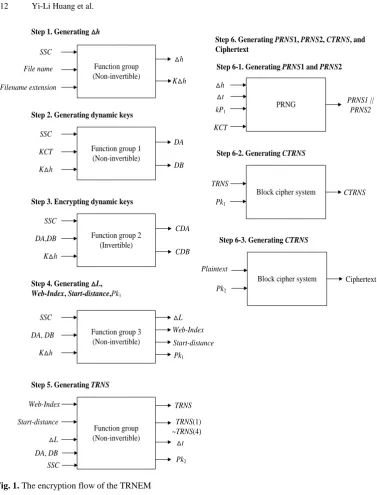
Fig. 1 illustratively summarizes the encryption flow of the TRNEM. The details are as follows.
Step 1: Generating △h and K△h. The TRNEM’s encryption process invokes the non-invertible △h generation equation defined above to read the file name of the file being encrypted. The file name, filename extension and SSCs are the parameters used to produce △h and K△h.
Step 2: Generating dynamic keys DA and DB. The TRNEM derives KCT from △h and current time (CT), and invokes Equation-group 1 which uses K△h, KCT and SSCs as its parameters to produce dynamic keys DA and DB.
Step 3: Encrypting dynamic keys. The TRNEM invokes Equation-group 2 which consisting of two invertible equations defined above employs the generated DA, DB, SSCs and K△h as the parameters to produce CDA and CDB so that the TRNEM can securely store CDA and CDB into the wrapped ciphertext file and decrypt DA and DB from CDA and CDB carried in the received wrapped ciphertext file.
Step 4: Generating △L, WI, Sd and Pk1. The TRNEM invokes Equation-group 3,
consisting of four non-invertible equations defined above, to respectively produce △L, WI, Sd and Pk1 by employing the generated DA, DB, SSCs and K△h as input
parameters.
Step 5: Generating TRNS(1) ~ TRNS(4), △t, and Pk2. The TRNEM randomly reads data
Function group (Non-invertible) SSC Filename extension File name △h
Step 1. Generating △h
Step 2. Generating dynamic keys
Step 3. Encrypting dynamic keys
Step 4. Generating △L,
Web-Index, Start-distance,Pk1
Step 5. Generating TRNS
Step 6-1. Generating PRNS1 and PRNS2
Step 6-2. Generating CTRNS
Step 6-3. Generating CTRNS
K△h
Step 6. Generating PRNS1, PRNS2, CTRNS, and Ciphertext
Function group 1 (Non-invertible) SSC
K△h KCT
DA
DB
Function group 2 (Invertible) SSC
K△h DA,DB
CDA
CDB
SSC
K△h
DA, DB Function group 3 (Non-invertible) △L Web-Index Start-distance Pk1 Function group (Non-invertible) Web-Index Start-distance △L DA, DB SSC
TRNS
TRNS(1) ~TRNS(4)
△t Pk2 PRNG △h kP1 KCT PRNS1 || PRNS2 △t
Block cipher system Pk1
CTRNS TRNS
Block cipher system Ciphertext Plaintext
Pk2
Fig. 1. The encryption flow of the TRNEM
Step 6: Generating PRNS1, PRNS2, CTRNS and ciphertext.
Step 6-1: Generating PRNS1 and PRNS2. The TRNEM grabs the time parameters from system clock to produce a new KCT. After that, KCT, △h, △t and Pk1are input to the
Step 6-2: Generating CTRNS. The CTRNS is produced by the adopted block cipher system (e.g., AES) with the TRNS as the plaintext and key Pk1 as an input parameter.
Step 6-3: Encrypting plaintext (generating ciphertext). A plaintext to be encrypted and key Pk2 are input to the adopted block cipher system to produce the corresponding
ciphertext.
Step 7: Generating a wrapped ciphertext file. The TRNEM concatenates PRNS1, CDA, CDB, CTRNS, the ciphertext generated in Step 6 and PRNS2 to produce a wrapped ciphertext file, the format of which is shown in Fig. 2.
PRNS1 C D A
C D B
Ciphertext PRNS2
△h Length of File
CTRNS
△L △t
Fig. 2. The format of the wrapped ciphertext file generated by the TRNEM
3.4. The TRNEM Decryption Process
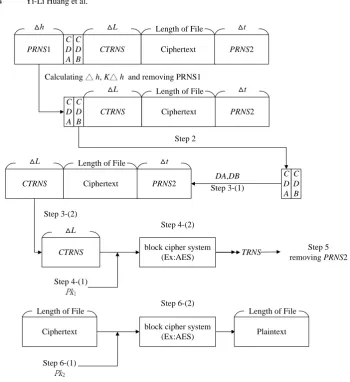
Fig. 3 illustrates the decryption process of the TRNEM. The details are described below.
Step 1: Calculating △h and removing PRNS1 from the received wrapped ciphertext file. To decrypt the ciphertext, a user needs to invoke the △h generation equation, which in turn reads the file name and filename extension of the designated file to produce △h, with which to delete PRNS1 from the wrapped ciphertext file. It further generates K△h.
Step 2: Retrieving and calculating DA and DB. Reads CDA and CDB from the wrapped ciphertext file and decrypts them by using the following two decryption equations, i.e., Eqs. (14) and (15), to obtain the dynamic keys DA and DB.
DA = [CDA⊕(SSC(13)+2K△h)]-2(K△h⊕SSC(12))-2 SSC(11) ⊕SSC(10) (14)
where -2 is the inverse operation of +2 [20].
DB = [CDB⊕(SSC(16)+2DA)]-2(DA⊕K△h))-2 SSC(15) ⊕SSC(14) (15)
Step 3: Calculating △L and retrieving CTRNS
(1) Invoking Eq. (6) which employs SSCs, K△h, DA and DB as its parameters to calculate △L.
C D A C D B
Ciphertext PRNS2 Length of File
CTRNS
△L △t
Calculating △h, K△ h and removing PRNS1
Step 2
Step 3-(2)
Ciphertext PRNS2 Length of File
CTRNS
△L △t
C D A C D B Step 3-(1)
DA,DB
CTRNS △L
Step 4-(1) Pk1
block cipher system
(Ex:AES) TRNS
Step 4-(2)
Step 5 removing PRNS2
Ciphertext Length of File
Step 6-(1) Pk2
block cipher system (Ex:AES) Step 6-(2)
Plaintext Length of File PRNS1 C D A C D B
Ciphertext PRNS2
△h Length of File
CTRNS
△L △t
Fig. 3. The decryption flow of the TRNEM
Step 4: Retrieving TRNS. Retrieve TRNS by inputting CTRNS and Pk1 to the adopted
block cipher system.
(1) Producing Pk1 by invoking Eq. (9) which employsDA, DB and SSCs as its
parameters.
(2) Invoking the adopted block cipher system to decrypt the CTRNS retrieved from the wrapped ciphertext file with Pk1so as to produce TRNS.
Step 5: Retrieving △t and removing PRNS2.
(1) Producing TRNS(1) ~ TRNS(4) by invoking Eqs. (10) and (11) which employ SSCs and TRNS as their parameters.
(2) Producing △t by invoking Eq. (12) which utilizes DA, DB and TRNS(1) as its parameters.
Step 6: Generating Pk2 and decrypting the ciphertext.
(1) Invoking Eq. (13) which uses TRNS(1)~TRNS(4), DA and DB as its parameters to produce Pk2.
(2) Decrypting the plaintext from the ciphertext by inputting Pk2 and the ciphertext to
the adopted block cipher system so as to revert the plaintext.
3.5. The Features and Advantanges of the TRNEM
The TRNEM has five features, including
(1) employing filename, filename extension, system security codes and a non-invertible equation to generate △h, making △h be one with high security;
(2) utilizing current time to produce dynamic keys DA and DB which are different when they are generated at different time points since current time continuously varies;
(3) using the DA and DB to fetch the true random numbers, with which to encrypt the plaintext so as to enhance the security of the ciphertyext;
(4) employing scalable parameters △h, △L and △t, with which to construct a wrapped ciphertext file. The purpose is enhancing the security of the ciphertext file; (5) the CDA, CDB and CTRNS are embedded in the wrapped ciphertext file to
effevtively protect the ciphertext.
Beside the mentioned security features, based on the Interent as its data pool, the TRNEM creates a true random number sequence to encrypt plaintext so that the ciphertext has a very high degree of security. Furthermore, the ciphertext is embedded in the position located between PRNS1 and PRNS2. Hackers cannot directly obtain the (plaintext, ciphertext) pairs from the wrapped ciphertext file, thus highly enhancing the security of the TRNEM.
4.
Security and Performance Analysis
In this section, we analyze the security levels of different TRNEM parameters and generated data, including△h, dynamic keys DA and DB, the TRNS, a wrapped ciphertext file, and Pk2. We also evaluate the security and performance of the TRNEM.
4.1. Security of △h
implying that △h has high randomness and security. Furthermore, the △h is an internal variable of the TRNEM. Hackers cannot derive it from the ciphertext and solve it.
Authough, hackers can try a lot of file names and filename extensions to respectively substitute for the original file name and filename extension contained in the encryption expression, attempting to analyze the possible △h. However, the length of the wrapped ciphertext file is △h+32+△L+|the plaintext| + △t bytes, in which 32 is the length of DA+DB, and △L and △t randomly change at each encryption, even the file name, filename extension and plaintext remain unchanged. △h is well protected due to the dynamic values of △L and △t. Now, we dare to say that △h and the protected system are very safe.
4.2. Security of Dynamic Keys DA and DB
There are two methods to obtain DA. First, hackers may directly generate DA by employing Eq. (2). However, SSC(1) ~ SSC(5), K△h and KCT are unknown to hackers and KCT continuously changes at each encryption. That means hackers cannot directly generate DA by employing Eq. (2). Second, hackers may crack CDA to obtain DA. However, according to Eq. (4), they need SSC(10)~SSC(13) and K△h. But these parameters are unknown to hackers. Furthermore, CDA is embedded in the wrapped ciphertext file. Hackers need △h to correctly fetch it. But △h is unknown to hackers. Thus, DA is secure. Similarly, to derive DB from CDB, hackers need SSC(14) ~ SSC(16), K△h and DA which are unknown to hackers, i.e., DB is secure.
4.3. Security of the TRNS
The TRNEM collects a webpage based on a randomly chosen WI, and accesses the content of the webpage from the position indicated by the Sd to the position pointed to by Sd +△L. In other words, |TRNS|=△L. But the characteristics and contents of different pages vary with time, and the page contents may be changed frequently. Under this circumstance, extracting web contents from a randomly chosen webpage can make a number sequence, i.e., the TRNS, truly random.
Hackers may obtain TRNS by decrypting CTRNS embedded in the wrapped ciphertext file. However, to fetch the CTRNS, parameters △h, △L, length of the plaintext and △t are required. But, hackers cannot obtain them from the wrapped ciphertext file. That is, hackers cannot correctly fetch CTRNS from this wrapped ciphertext file. Furthermore, if CTRNS is known by hackers, they still cannot decrypt CTRNS to obtain TRNS since PK1 is unknown to them. So, TRNS is secure.
4.4. Security of a Wrapped Ciphertext File
△t. Parameters △L and △t are different at each encryption even though the plaintext is the same. Hackers cannot obtain △h, △L and △t to unwrap the ciphertext, i.e., hackers cannot collect (plaintext, ciphertext) pairs when plaintext is known. They need to crack △h before solving other parameters, meaning that the ciphertext file is securely protected by the TRNEM.
4.5. Security of the Pk2
Pk2 as a pseudorandom key is the second pointing key employed by the TRNEM to
generate the ciphertext. The security of the ciphertext strongly depends on the security of Pk2 and the block cipher system. In the following, we would like to identify the
security level of Pk2. Theorem 1 proves that its security level is the same as that when it
is solved by using a blind guess method.
Theorem 1. If the key length of the TRNEM is n bits, then the probability of solving the correct value of Pk2 from the wrapped ciphertext file is 1/ 2n.
Proof. Pk2 as an internal pseudorandom key used by the TRNEM does not appear in the
wrapped ciphertext file. Hackers cannot directly break it. Two methodscan be used to break Pk2, excluding the blind guess approach. The first is that,according to Eq. (13),
i.e., Pk2 = HMAC(TRNS(2)⊕DA || TRNS(3)⊕DB || TRNS(4) +2 DA, TRNS(1)⊕DB),
only the one who knowsDA, DB, TRNS(1) ~ TRNS(3) can correctly generate Pk2.
However, the dynamic keys DA and DB are secure and the true random number sequences, i.e., TRNS(1) ~ TRNS(3), derived fromTRNS and DB are secure, too, based on the abovementioned description. The dynamic keys DA and DB, which are functions of KCT, vary randomly each time when it is generated, implying that the generated messages, TRNS and hence, TRNS(1) ~ TRNS(3) change randomly each time when they are produced so that Pk2is secure.
The second method is breaking the block cipher system to obtain plaintext from the ciphertext. However, the ciphertext embedded in the position located between PRNS1 and PRNS2 is secure, according to that described in section 4.4. That is, hackers cannot break Pk2 from the ciphertext. In the worst case, if the ciphertext is known by the
hackers, they need to break the block cipher system. But this is not an easy work since hackers require a massive amount of (plaintext, ciphertext) pairs given the same parent key. Hence they still cannot break the block cipher system to obtain Pk2.
There are no useful method to obtain Pk2 other than the blind guess approach.
Therefore, the probability of solving the correct value ofPk2 from the wrapped
ciphertext is 1/ 2n. Q.E.D.
4.6. Security of the TRNEM
ciphertext file can effectively defend the known plaintext attacks because hackers cannot correctly collect different (plaintext, ciphertext) pairs.
In fact, the TRNEM integrates time variables, i.e., the current time and TRNS. So the wrapped-ciphertext-file mechanism can effectively prevent the protected system from brute force attacks.
4.7. Generation Times of Parameters
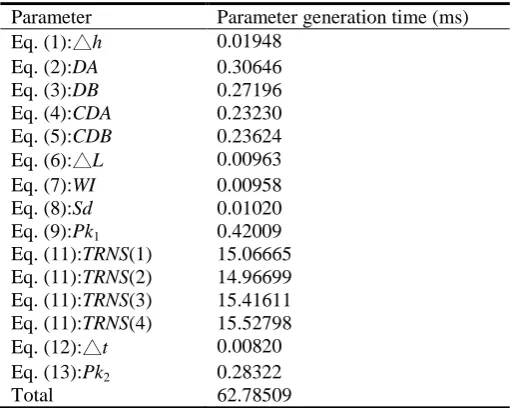
The TRNEM generates ciphertext by using a block cipher system (e.g., AES or DES). To generate a wrapped ciphertext file, we produce several parameters introduced above. Table 1 lists the times required to produce these parameters. We also used these parameters to produce the PRNS1, PRNS2, CDA, CDB and CTRNS. Table 2 lists the times required to produce them and the wrapped ciphertext file.
Table 1. The times required to produce different required parameters
Parameter Parameter generation time (ms)
Eq. (1):△h 0.01948
Eq. (2):DA 0.30646
Eq. (3):DB 0.27196
Eq. (4):CDA 0.23230
Eq. (5):CDB 0.23624
Eq. (6):△L 0.00963
Eq. (7):WI 0.00958
Eq. (8):Sd 0.01020
Eq. (9):Pk1 0.42009
Eq. (11):TRNS(1) 15.06665 Eq. (11):TRNS(2) 14.96699 Eq. (11):TRNS(3) 15.41611 Eq. (11):TRNS(4) 15.52798
Eq. (12):△t 0.00820
Eq. (13):Pk2 0.28322
Total 62.78509
Table 2. The time required to produce the wrapped ciphertext file
Item Generation time (ms)
PRNS1||PRNS2(length of△h+△t) 20
CDA 0.2323
CDB 0.23624
CTRNS(length of△L) 13
Ciphertext The same as the time required by AES or DES
Since the lengths of PRNS1||PRNS2 (i.e., △h+△t) and CTRNS (i.e., △L) are not fixed, we individually chose the max lengths of them to calculate their generation times. Ciphertext is encrypted by block ciphering. Its generation time is the same as those of the adopted block cipher system, e.g., AES and DES. The extra time required by the TRNEM is 95.78529 ms.
The difference between the decryption process and the encryption process of the TRNEM is that when decrypting the ciphertext file, DA and DB are acquired by invoking Eqs. (4) and (5), which further invoke the invertible equations to generate CDA and CDB where CDA and CDB are retrieved from the wrapped ciphertext file. TRNS is decrypted by inputting CTRNS and Pk1 to the adopted block cipher system
where CTRNS is also retrieved from the wrapped file. Since the formulas used to generate other parameters for decryption are the same as those when encrypting the plaintext file, the times required to produce △h, △L, Pk1, TRNS(1), TRNS(2), TRNS(3),
TRNS(4), △t and Pk2 are then individually the same as those when encrypting the file.
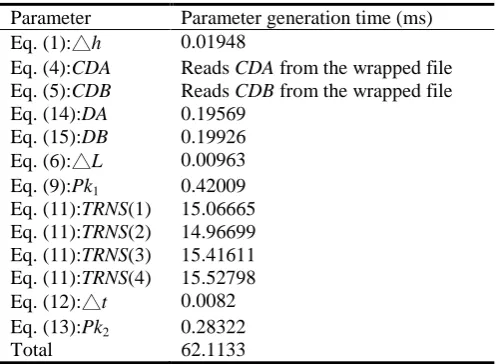
Table 3 lists the times required to produce parameters for decrypting CTRNS, and Table 4 shows the ciphertext decryption time.
Table 3. The times required to produce different parameters for decrypting the wrapped ciphertext file
Parameter Parameter generation time (ms) Eq. (1):△h 0.01948
Eq. (4):CDA Reads CDA from the wrapped file Eq. (5):CDB Reads CDB from the wrapped file Eq. (14):DA 0.19569
Eq. (15):DB 0.19926 Eq. (6):△L 0.00963 Eq. (9):Pk1 0.42009
Eq. (11):TRNS(1) 15.06665 Eq. (11):TRNS(2) 14.96699 Eq. (11):TRNS(3) 15.41611 Eq. (11):TRNS(4) 15.52798 Eq. (12):△t 0.0082 Eq. (13):Pk2 0.28322
Total 62.1133
Table 4. The times required to decrypt the CTRNS and the wrapped ciphertext file
Item Generation time (ms)
TRNS 13
plaintext The same as the time required by AES or DES
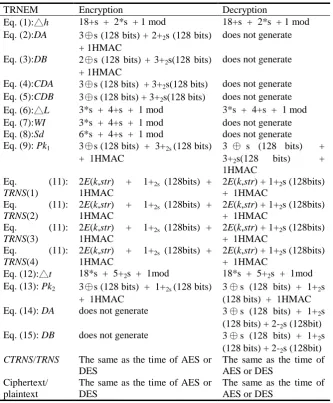
Table 5. All computational efforts in terms of different numbers of operations employed by the encryption/ decryption processes of the TRNEM
TRNEM Encryption Decryption
Eq. (1):△h 18+s + 2*s + 1 mod 18+s + 2*s + 1 mod Eq. (2):DA 3⊕s (128 bits) + 2+2s (128 bits)
+ 1HMAC
does not generate
Eq. (3):DB 2⊕s (128 bits) + 3+2s(128 bits)
+ 1HMAC
does not generate
Eq. (4):CDA 3⊕s (128 bits) + 3+2s(128 bits) does not generate
Eq. (5):CDB 3⊕s (128 bits) + 3+2s(128 bits) does not generate
Eq. (6):△L 3*s + 4+s + 1 mod 3*s + 4+s + 1 mod Eq. (7):WI 3*s + 4+s + 1 mod does not generate
Eq. (8):Sd 6*s + 4+s + 1 mod does not generate Eq. (9): Pk1 3⊕s (128 bits) + 3+2s (128 bits)
+ 1HMAC
3 ⊕ s (128 bits) + 3+2s(128 bits) +
1HMAC
Eq. (11):
TRNS(1)
2E(k,str) + 1+2s (128bits) +
1HMAC
2E(k,str) + 1+2s (128bits)
+ 1HMAC
Eq. (11):
TRNS(2)
2E(k,str) + 1+2s (128bits) +
1HMAC
2E(k,str) + 1+2s (128bits)
+ 1HMAC
Eq. (11):
TRNS(3)
2E(k,str) + 1+2s (128bits) +
1HMAC
2E(k,str) + 1+2s (128bits)
+ 1HMAC
Eq. (11):
TRNS(4)
2E(k,str) + 1+2s (128bits) +
1HMAC
2E(k,str) + 1+2s (128bits)
+ 1HMAC
Eq. (12):△t 18*s + 5+2s + 1mod 18*s + 5+2s + 1mod
Eq. (13): Pk2 3⊕s (128 bits) + 1+2s (128 bits)
+ 1HMAC
3⊕s (128 bits) + 1+2s
(128 bits) + 1HMAC Eq. (14): DA does not generate 3⊕s (128 bits) + 1+2s
(128 bits) + 2-2s (128bit)
Eq. (15): DB does not generate 3⊕s (128 bits) + 1+2s
(128 bits) + 2-2s (128bit)
CTRNS/TRNS The same as the time of AES or DES
The same as the time of AES or DES
Ciphertext/ plaintext
The same as the time of AES or DES
The same as the time of AES or DES
4.8. Performance Analysis
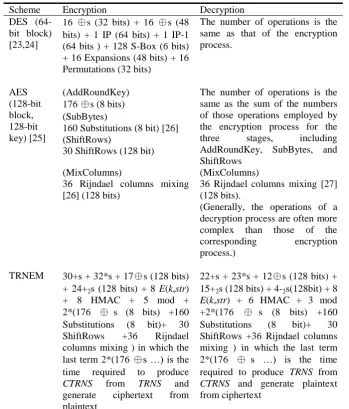
Table 6. The summary of the computational efforts required by the DES, AES and TRNEM to encrypt and decrypt a data file.
Scheme Encryption Decryption DES
(64-bit block) [23,24]
16 ⊕s (32 bits) + 16 ⊕s (48 bits) + 1 IP (64 bits) + 1 IP-1 (64 bits ) + 128 S-Box (6 bits) + 16 Expansions (48 bits) + 16 Permutations (32 bits)
The number of operations is the same as that of the encryption process. AES (128-bit block, 128-bit key) [25] (AddRoundKey) 176 ⊕s (8 bits)
The number of operations is the same as the sum of the numbers of those operations employed by the encryption process for the three stages, including AddRoundKey, SubBytes, and ShiftRows
(SubBytes)
160 Substitutions (8 bit) [26] (ShiftRows)
30 ShiftRows (128 bit)
(MixColumns)
36 Rijndael columns mixing [26] (128 bits)
(MixColumns)
36 Rijndael columns mixing [27] (128 bits).
(Generally, the operations of a decryption process are often more complex than those of the corresponding encryption process.)
TRNEM 30+s + 32*s + 17⊕s (128 bits) + 24+2s (128 bits) + 8 E(k,str)
+ 8 HMAC + 5 mod + 2*(176 ⊕ s (8 bits) +160 Substitutions (8 bit)+ 30 ShiftRows +36 Rijndael columns mixing ) in which the last term 2*(176 ⊕s …) is the time required to produce CTRNS from TRNS and generate ciphertext from plaintext
22+s + 23*s + 12⊕s (128 bits) + 15+2s (128 bits) + 4-2s(128bit) + 8
E(k,str) + 6 HMAC + 3 mod +2*(176 ⊕ s (8 bits) +160 Substitutions (8 bit)+ 30 ShiftRows +36 Rijndael columns mixing ) in which the last term 2*(176 ⊕ s …) is the time required to produce TRNS from CTRNS and generate plaintext from ciphertext
The following analyses show that TRNEM is more secure than the AES. First, the plaintext is encrypted by the pseudorandom key PK2 when the TRNEM employs the
adopted block cipher system. If the block cipher system is the AES, then the TRNEM is still more secure than it since, by Theorem 1, PK2 varies at each encryption, whereas the
Third, the AES suffers brute force attacks, e.g., the known plaintext/ciphertext attack [28], chosen plaintext attack, such as differential cryptanalysis attack [30], and linear cryptanalysis attack [21,22] since the AES is an combinatorial-logic style encryption method [29]. However, in the TRNEM, when a plaintext block is encrypted at different time points, different current time keyKCTsand hence different other keys, including DA, DB, Pk1, TRNS(1)~TRNS(4) and PK2, are produced, thus resulting in diffenent
wrapped ciphertext files. The value ofKCT randomly changes and has no regular rule. Hence, the following keys generated, including DA, DB, Pk1, TRNS(1) ~ TRNS(4) and
PK2, also randomly vary. Therefore, they can effectively defend the abovementioned
attacks. In summary,KCTand TRNSare the two keys making the TRNEM more secure than the AES.
As shown in Fig. 2, due to concatenating PRNS1, CDA, CDB, CTRNS and PRNS2, and the lengths of them are, respectively, △h, |CDA|, |CDB|, △L and △t. Therefore, the data transmission efficiency of the TRNEM is
| |
| |
ciphertext
hCDACDB L t ciphertext
5.
Conclusions and Future Work
This system utilizes a wrapping ciphertext approach, which prevents hackers from identifying the correct position of ciphertext. So the hackers cannot easily crack the protected ciphertext. Additionally, the TRNEM encrypts plaintext by using TRNS, which is highly random by randomly choosing a webpage and randomly accessing its content △h in length. Moreover, even though given the same plaintext, the TRNEM generates different ciphertext at different time points. This can effectively prevent hackers from issuing known plaintext/ciphertext attacks. So we dare to say that the TRNEM is very secure.
However, a portable encryption/decryption system, like DES and AES, does not create system parameters in it. To develop an algorithm, with which the system security codes in the TRNEM can be generated by the input password or parent key, is necessary and important. Furthermore, to enhance the performance of the TRNEM, the block cipher system adopted by the TRNEM does not need to be DEA or AES. To develop a secure and efficient encryption/decryption method, we plan to utilize the keys generated by the TRNEM, e.g.,K△h, DA, DB, PK1, PK2 and SSCs, as the parameters to establish a
new block cipher system, which is then substituted for the AES or DES to perform the block ciphering for the TRNEM. These constitute our further studies.
References
1. Wiki, Computer insecurity, http://en.wikipedia.org/wiki/Computer_insecurity
2. Category, G.M.:The PPP DES Encryption Protocol. RFC 2419,September 1998, Version 2 (DESE-bis)
3. Daemen, J., Rijmen, V.: The Design of Rijndael: AES The Advanced Encryption Standard. New York, USA, Springer-Verlag.(2002)
4. Prodanović, R., Simić, D.: Holistic Approach to Wep Protocol in Securing Wireless Network Infrastructure. Computer Science and Information Systems, vol. 3, issue 2, 97-113.(2006) 5. Bahrak, B., Aref, M.R.: Impossible Differential Attack on Seven-round AES-128. Published
in IET Information Security, vol. 2, Issue 2, 28 – 32. (2008)
6. Wiki, Linear cryptanalysis, http://en.wikipedia.org/wiki/Linear_cryptanalysis
7. Li, P., Sui, Y., Yang, H., Li, P.: The Parallel Computation in One-Way Hash Function Designing. International Conference on Computer, Mechatronics, Control and Electronic Engineering, Conference, vol. 1, 189 - 192. (2010)
8. Wang, M., Zhu, G., Zhang, X.: General Survey on Massive Data Encryption.International Conference on Computing Technology and Information Management, vol. 1, 150- 155.(2012) 9. Kaur, R., Kaur, A.: Digital signature. International Conference on Computing Sciences,
295-301. (2012)
10. Živković, Z.V., Stanojević, M.J.: Simulation Analysis of Protected B2B e-commerce Processes. Computer Science and Information Systems, vol. 3, issue 1, 77-91. (2006) 11. Wiki, DES, http//en.wikipedia.org/wiki/Data_Encryption_Standard
12. Matsui, M.: The First Experimental Cryptanalysis of the Data Encryption Standard. In Advances in Cryptology CRYPTO'94, Lecture Notes in Computer Science 839, Springer Verlag, 1-11. (1994)
13. Junod, P.: On the complexity of Matsui’s attack. Selected Areas in Cryptography, Lecture Notes in Computer Science 2259, 199-211. (2001)
14. Knudsen, L.R., Mathiassen, J.E.: A Choice Plaintext Linear Attack. DES Fast Software Encryption, 62-272. (2000)
15. Biham, E., Shamir, A.: Differential Cryptanalysis of the Data Encryption Standard - Advances in Cryptology.The Annual International Cryptology Conference, CRYPTO '92, 487-496. (1992)
16. Biham, E., Biryukov, A.: An Improvement of Davies' attack on DES. Journal of Cryptology, vol. 10, no. 3, 195-206. (1997)
17. National Institute of Standards and Technology, Advanced Encryption Standard, NIST FIPS PUB 197.(2001)
18. Bernstei, D.J.: Cache-timing Attacks on AES. Citeseer. 2005.04. http://cr.yp.to/antiforgery/cachetiming-20050414.pdf
19. Tromer, E., Osvik, D.A., Shamir, A.: Efficient Cache Attacks on AES, and Countermeasures. Journal of Cryptology, vol. 23, Issue 1, 37-71.(2010)
20. Huang, Y.L., Leu, F.Y., Wei, K.C.: A Secure Communication over Wireless Environments by using a Data Connection Core. Mathematical and Computer Modeling, vol. 58, issues 5–6, 1459–1474. (2013)
21. Matsui, M.: Linear cryptanalysis method for DES cipher, in Advances in cryptography - Eurocrypt 1993. Springer-Verlog, Berlin, 386-397.(1993)
22. Biham, E.: On Matsui's Linear Cryptanalaysis. Springer-Verlag 1998, 341-344.(1998) 23. Katz, J., Lindell, Y.: Introduction to Modern Cryptography, Chapman & Hall/CRC
Press.(2008)
24. Bellare, M., Rogaway, P.: Introduction to Modern Cryptography, Chapter 3, May 11, 2005. http://digidownload.libero.it/persiahp/crittografia/2005_Introduction_to_Modern_Cryptograp hy.pdf
26. Cui L., Cao, Y.: A New S-Box Structure Named Affine-Power-Affine. International Journal
of Innovative Computing, Information and Control, vol. 3, no. 3, 751-759. (2007)
27. Daemen, J., Rijmen, V.: AES Proposal: Rijndael. The First Advanced Encryption Standard Candidate Conference, NIST, 1999.
28. Wiki, Known-plaintext attack, http://en.wikipedia.org/wiki/Known-plaintext_attack
29. Qaosar,M., Ahmad, S.: A Combinational Logic Approach by using HDL to Implement DES Algorithm. Canadian Journal on Electrical and Electronics Engineering, vol. 3, no. 7, 384-389. (2012)
30. Biham, E., Shamir, A.: Differential Cryptanalysis of the Full 16-round DES. In E. F. Brickell, editor, Advanced in Cryptology-Crypto’92, vol. 740 of Lectures Notes in Computer Science, 487-496. (1992)
Yi-Li Huang received his master degrees from National Central University of Physics, Taiwan, in 1983. His research interests include security of network and wireless communication, solar active-tracking system, pseudo random number generator design and file protection theory. He is currently a senior instructor of Tunghai University, Taiwan, and director of information security laboratory of the University.
Fang-Yie Leu received his B.S., M.S. and Ph.D. degrees from National Taiwan University of Science and Technology, Taiwan, in 1983, 1986 and 1991, respectively, and another M.S. degree from Knowledge Systems Institute, USA, in 1990. His research interests include wireless communication, network security, Grid applications and Chinese natural language processing. He is currently a full professor of Tunghai University, Taiwan, the director of database and network security laboratory of the University, the chair of MCNCS and CWECS workshops, and the editorial board member of several international journals. He is also a member of IEEE Computer Society.
Jiang-Hong Chen graduated from Computer Science Department, Tunghai University, Taiwan, in 2012. He is now a master student of this department. His research interests include wireless communication and network security.
William C. Chu, the Director of Software Engineering and Technologies Center of Tunghai University, a professor of the Department of Computer Science, he had served as the Dean of Engineering College at Tunghai University, Taiwan. From 2008 to 2011, Dean of Research and Development office at Tunghai University from 2004 to 2007, Taiwan. In 1992, he was also a visiting scholar at Stanford University. His current research interests include software engineering, embedded systems, and E-learning. Dr. Chu received his MS and PhD degrees from Northwestern University in Evanston Illinois, in 1987 and 1989, respectively, both in computer science.