Available online on 15.11.2018 at http://jddtonline.info
Journal of Drug Delivery and Therapeutics
Open Access to Pharmaceutical and Medical Research© 2011-18, publisher and licensee JDDT, This is an Open Access article which permits unrestricted non-commercial use, provided the original work is properly cited
Open Access
Research Article
A validated stability indicating LC-MS compatible RP-HPLC assay and
dissolution methods for marketed formulation Stribild
U. Harini *, A. K. M. Pawar
Department of Pharmaceutical Analysis and Quality Assurance, A.U. College of Pharmaceutical Sciences, Andhra University, Visakhapatnam, Andhra Pradesh, India.
ABSTRACT
Objective: The prime objective of the current work is to develop a simple, rapid, efficient, economical and stability indicating LC-MS (liquid chromatography–mass spectroscopy) compatible RP - HPLC (reverse phase – high performance liquid chromatography) method for the analysis of emtricitabine (EMT), tenofovir disoproxil fumarate (TDF), cobicistat (COB) and elvitegravir (ELV) in bulk, marketed formulation (Stribild) and in In-vitrodissolution method.
Method: The chromatography was achieved on Unisol C18 column (250 × 4.0 mm, 3 µ) with a mobile phase combination of acetate buffer (adjusted with dilute glacial acetic acid to pH 4) and acetonitrile in gradient mode at a flow rate of 1mL/min and the detection was performed at 260 nm using PDA (photo diode array) detector. Forced degradation studies were performed and the % degradation under various stress conditions was calculated. The developed RP-HPLC method was applied for Stribild tablets to study the dissolution profile.
Results: The retention times for emtricitabine, tenofovir disoproxil fumarate, cobicistat and elvitegravir were 5.7, 12.1, 16.3 and 19.4 min respectively. The % degradation was below 20% which is within the limits. The percent drug release was found to meet USP specification, i.e. not less than 80% of amount of labeled drug EMT, TDF, COB and ELV dissolved in 30min.
Conclusion: The method was validated as per ICH guidelines and all the validation parameters were within the compendial requirements. The proposed method can be successfully adopted for the analysis of Stribild tablets in pharmaceutical industries. Keywords: Stribild, emtricitabine, tenofovir disoproxil fumarate, cobicistat, elvitegravir.
Article Info:Received 01 Oct, 2018; Review Completed 02 Nov 2018; Accepted 06 Nov 2018; Available online 15 Nov 2018 Cite this article as:
Harini U, Pawar AKM, A validated stability indicating LC-MS compatible RP-HPLC assay and dissolution methods for
marketed formulation Stribild, Journal of Drug Delivery and Therapeutics. 2018; 8(6):159-170 DOI: http://dx.doi.org/10.22270/jddt.v8i6.2037
*Address for Correspondence:
Dr. A. K. M. Pawar, Assistant Professor, Department of Pharmaceutical Analysis and Quality Assurance, A.U. College of Pharmaceutical Sciences, Andhra University, Visakhapatnam-530003, Andhra Pradesh, India.
1. INTRODUCTION
The human immunodeficiency virus (HIV) is a lentivirus (a sub group of retroviruses) that causes HIV infection and over time acquired immunodeficiency syndrome (AIDS). AIDS is a condition in humans in which progressive failure of the immune system allows life-threatening infections and cancers. STRIBILD, the first integrase inhibitor- based single tablet regimen containing emtricitabine (EMT), tenofovir disoproxil fumarate (TDF), cobicistat (COB) and elvitegravir (ELV) for HIV-1 infection, meets current WHO treatment guidelines for a complete fixed-dose, once daily highly active antiretroviral therapy (HAART) regimens. HAART is the name given to aggressive treatment regimens used to suppress HIV viral replication and the progression of HIV disease. Stribild is a pill combination of four active ingredients-150 mg of Elvitegravir, 150 mg of Cobicistat, 200 mg of Emtricitabine and 300 mg of
Tenofovir disoproxil fumarate (equivalent to 245 mg of
Tenofovir Disoproxil) and is taken once a day 1-3
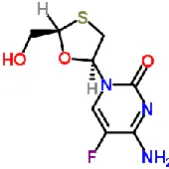
Emtricitabine: The chemical name of Emtricitabine (EMT) is 6-(3-Chloro-2-fluorobenzyl)-1-[(2S)-1 hydroxy-3-methyl butan-2-yl]-7-methoxy-4-oxo-1, 4-dihydro quinoline-3-carboxylic acid. Emtricitabine is the (-) enantiomer of a thio analog of cytidine, which differs from other cytidine analogs in that it has a fluorine in the 5-position. Emtricitabine is a nucleoside reverse transcriptase inhibitor (NRTI) for the treatment of HIV infection in
adults. It has a molecular formula of C8H10FN3O3 S and a
Figure 1: Structure of Emtricitabine
Tenofovir disoproxil fumarate: Tenofovir disoproxil fumarate (TDF) is a fumaric acid salt of the bis-isopropoxy carbonyl oxy methyl ester derivative of tenofovir. The chemical name of TDF is 9-[(R)-2- [[bis [[(isopropoxy carbonyl) oxy] methoxy] phosphinyl] methoxy] propyl] adenine fumarate. TDF belongs to a class of antiretroviral drugs known as nucleotide analogue reverse transcriptase inhibitors (NRTIs). It has a molecular formula of
C19H30N5O10P • C4H4O4 and a molecular weight of 635.51. It
is a white to off-white crystalline powder with a solubility of 13.4 mg/mL in water at 25 °C. It has the following structural formula
Figure 2: Structure of Tenofovir disoproxil fumarate
Cobicistat: The chemical name for Cobicistat (COB) is 1, 3-Thiazol-5-ylmethyl [(2R,5R)-5-{[(2S)-2- [(methyl {[2-(propan-2-yl)-1,3-thiazol-4-yl] methyl} carbamoyl) amino] -4 (morpholin-4-yl) butanol] amino}-1,6-diphenyl hexan-2-yl] carbamate. Cobicistat acts as an HIV integrase inhibitor. Cobicistat is the only other booster approved for use as a part of HAART, Cobicistat has no anti-HIV activity of its own. Cobicistat is a potent inhibitor of cytochrome P450 3A enzymes, including the important CYP3A4 subtype. It also inhibits intestinal transport proteins, increasing the overall absorption of several HIV medications. It has a
molecular formula of C40H53N7O5S2 and a molecular weight
of 776.0. It is adsorbed onto silicon dioxide. Cobicistat on silicon dioxide is a white to pale yellow solid with a solubility of 0.1 mg/mL in water at 20 °C. It has the following structural formula
Figure 3: Structure of Cobicistat
Elvitegravir: The chemical name of Elvitegravir (ELV) is 6- (3-Chloro-2-fluorobenzyl) - 1- [(2S)-1hydroxy-3-methyl butan-2-yl]-7-methoxy-4-oxo-1,4-dihydroquinoline-3-carboxylic acid. Elvitegravir is a drug used for the treatment of HIV infection. It acts as an integrase inhibitor.
It has a molecular formula of C23H23Cl F NO5 and a
molecular weight of 447.9. Elvitegravir is a white to pale yellow powder with a solubility of less than 0.3 µg/mL in water at 20 °C. It has the following structural formula
Figure 4: Structure of Elvitegravir
Objective
Literature survey reveals that there are very few RP - HPLC methods available for the estimation of EMT, TDF, COB and ELV individually, but with very poor resolution between the retention time of the four drugs and the degradation products obtained in the forced degradation studies and there is no dissolution method reported till to date for this quad pill. Hence there is a need to develop and validate a new LC-MS compatible stability indicating RP-HPLC method for developing assay and dissolution methods for
the marketed formulation Stribild 4-12
2. METHODS
2.1 Apparatus:
An Agilent Infinity 1260 HPLC system equipped with quaternary pumps G1311C, Degasser G4225A, Auto sampler G1329B, Thermostatted column compartment G1316A with PDA detector G4212B was used. The software used for data acquisition was Open LAB CDS EZ Chrom A.04.05. Lab India D5 8000 Dissolution test apparatus, Mettler Toledo ME 204 weighing balance, Magnetic stirrer, Kemi Hot air oven, Eutech 700 pH meter, Double distillation apparatus.
2.2 Chemicals:
Emtricitabine, Tenofovir disoproxil fumarate, Cobicistat, Elvitegravir working standards and Stribild tablets were kindly given as gift samples by Aurobindo Pharma Limited, Hyderabad. HPLC grade solvents include acetonitrile, water and methanol. Analytical grade chemicals include ammonium acetate, sodium hydroxide, hydrochloric acid, 30% hydrogen peroxide, ortho phosphoric acid, glacial acetic acid and potassium dihydrogen phosphate, tween 80 were purchased from E. Merck Limited, Mumbai, India. 2.3 Assay Method
2.3.1 Selection of Detection Wavelength:
point at 260 nm which represents the wavelength where the sample solution (Stribild) has an absorption maximum. Higher wavelength also helps in reducing interferences from common excipients used in the formulation.
2.3.2 Preparation of Buffer:
Accurately weighed 1.54 g of ammonium acetate and dissolved in 1000 mL of water. The pH was adjusted to 4.0 with 30% glacial acetic acid and filtered through 0.45 µ nylon filter and degassed.
2.3.3 Preparation of Diluent:
Diluent-1: HPLC grade methanol was used as 1st diluent.
Diluent-2: The second diluent was prepared by using a mixture of methanol: buffer in the ratio 60: 40.
2.3.4 Preparation of Blank:
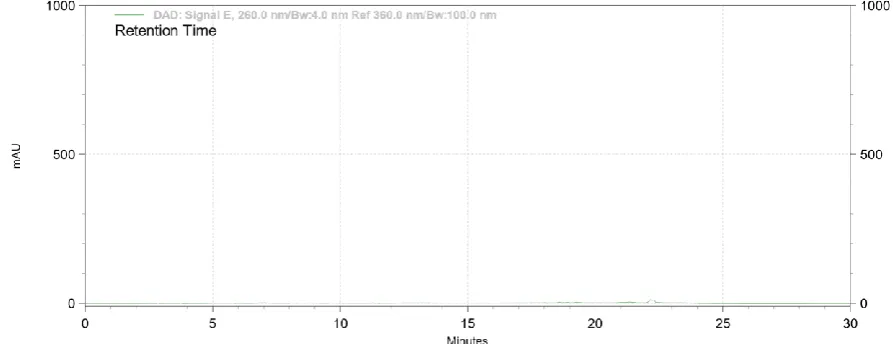
The diluent-2 prepared by using a mixture of methanol: buffer in the ratio 60: 40, was injected as blank solution. 3.3.5 Preparation of Placebo Solution:
300 mg of placebo was weighed and transferred to 50 mL volumetric flask to which 30 mL of diluent-1 was added and sonicated for 15min at room temperature and made up to final volume to prepare stock solution. The stock
solution was filteredthrough 0.45 μ nylon filter and 3 mL
of filtered solution was transferred to 50 mL volumetric flask and made up to final volume with diluent-2.
2.3.6 Preparation of Working Standard Solution: Accurately weighed and transferred about 20 mg of Emtricitabine, 30 mg of Tenofovir disoproxil fumarate, 15 mg of Cobicistat and 15 mg of Elvitegravir working standards into a 10 mL clean and dry volumetric flask and 5 mL of methanol was added and sonicated for 10 min to dissolve. The final volume was made up with methanol and filtered through 0.45 µ nylon filter. 1 mL from the above filtered stock solution was taken and made up to 10 mL with diluent-2. The final concentrations of EMT, TDF, COB and ELV were about 200 ppm, 300 ppm, 150 ppm and 150 ppm respectively.
2.3.7 Preparation of Sample Solution:
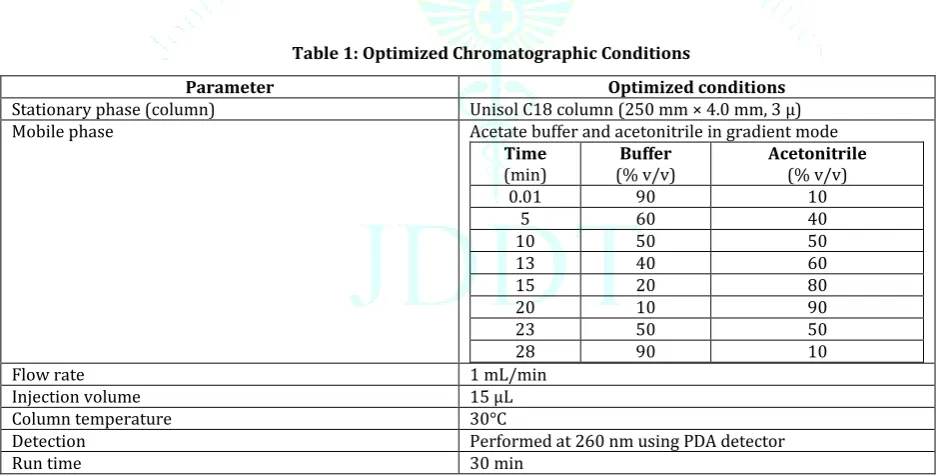
Ten tablets were weighed and average weight was calculated. The tablets were crushed with a mortar and pestle. A portion of powder equivalent to the weight of one tablet was accurately weighed and transferred to a 100 mL volumetric flask. Approximately 50 mL methanol was added and the mixture was sonicated for 15min with intermittent shaking, then 20 mL of water was added and sonicated for 30 min. The contents were restored to room temperature and diluted to final volume with methanol to furnish stock solution. The stock solution was filtered through 0.45 μ nylon filter and 10 mL of the filtered solution was transferred to a 50 mL volumetric flask and made up to volume with diluent-2. The final concentrations of EMT, TDF, COB and ELV were about 200 ppm, 300 ppm, 150 ppm and 150 ppm respectively. The optimized chromatographic conditions are mentioned in table 1.
Table 1: Optimized Chromatographic Conditions
Parameter Optimized conditions
Stationary phase (column) Unisol C18 column (250 mm × 4.0 mm, 3 µ)
Mobile phase Acetate buffer and acetonitrile in gradient mode
Time
(min) (% v/v) Buffer Acetonitrile (% v/v)
0.01 90 10
5 60 40
10 50 50
13 40 60
15 20 80
20 10 90
23 50 50
28 90 10
Flow rate 1 mL/min
Injection volume 15 µL
Column temperature 30°C
Detection Performed at 260 nm using PDA detector
Run time 30 min
2.4 Validation of the Developed Method
The developed and optimized RP-HPLC method was validated according to international conference on harmonization (ICH) guidelines Q2(R1) in order to determine the system suitability, linearity, limit of detection (LOD), limit of quantification (LOQ), precision, accuracy, ruggedness and robustness.
2.5 Forced Degradation Studies 2.5.1 Acid degradation:
Emtricitabine, Tenofovir disoproxil fumarate, Cobicistat and Elvitegravir working standard solutions (1mg/mL) were individually treated with 5mL of 0.1N HCl at room
temperature for 24 hours and then neutralized with 0.1N NaOH. The solutions were further diluted to required concentrations with diluent-2.
2.5.2 Alkali degradation:
2.5.3 Oxidative degradation:
Emtricitabine, Tenofovir disoproxil fumarate, Cobicistat and Elvitegravir working standard solutions (1mg/mL) were individually treated with 30% H2O2 at room temperature for 24 hours. The solutions were further diluted to required concentrations with diluent-2.
2.5.4 Thermal degradation:
Emtricitabine, Tenofovir disoproxil fumarate, Cobicistat and Elvitegravir working standards of 10mg were taken individually into petri dishes and kept in a hot air oven at 70° C for 24 hours. The stock solutions were prepared with diluent-1 and further diluted to required concentrations with diluent-2.
3.5.5 Photolytic degradation:
Emtricitabine, Tenofovir disoproxil fumarate, Cobicistat and Elvitegravir working standard solutions (1mg/mL) were prepared individually, and exposed to sunlight for 8hours on three consecutive days. Then they were further diluted to required concentrations with diluent-2.
2.6 Dissolution Method:
Application of developed RP-HPLC method for the dissolution studies of Stribild tablets.
2.6.1 Preparation of Dissolution Medium (2.0% polysorbate 80 in 0.01N HCl):
20g of polysorbate 80 was transferred to 1000mL of 0.01N HCl and mixed.
2.6.2 Dissolution parameters: Medium: 0.1 N Hydrochloric acid Volume: 1000 mL
Apparatus: USP Apparatus-II (paddle) with stainless steel helical sinkers
RPM: 100 rpm
Temperature: 37.0° ± 0.5°C
Time: 10, 20, 30, 40, 50 and 60 minutes
2.6.3 Preparation of Working Standard Solution: Refer to preparation of working standard solution in assay method-3.3.6.
2.6.4 Preparation of Sample Solution:
The parameters of dissolution apparatus were set as mentioned above. One Stribild tablet was placed into each of the six dissolution vessels, one vessel with dissolution medium without sample and the dissolution test was performed. At the specified time intervals, 10 mL of the sample solution was withdrawn from each dissolution vessel. The solution was filtered through 0.45 µ membrane filter. 10 mL of fresh dissolution medium maintained at 37.0°C ± 0.5°C was replaced after every time point sampling. 5 mL of this solution was transferred to 20 mL volumetric flask and diluted to volume with dissolution medium and mixed.
2.6.5 Procedure:
The same procedure and the optimized chromatographic conditions (refer table-1) developed for assay method was also applicable for dissolution method. The system suitability was evaluated by injecting 10 µL of working standard solution five times into the chromatograph. Then blank (dissolution medium), working standard and samples from six dissolution vessels collected at each specified time interval were made up to final concentration and injected into the chromatograph, the chromatograms were recorded and peak areas were measured. The amount of Emtricitabine, Tenofovir disoproxil fumarate, Cobicistat and Elvitegravir dissolved in dissolution medium at specific time intervals were calculated and the dissolution profile was studied.
3. RESULTS AND DISCUSSION
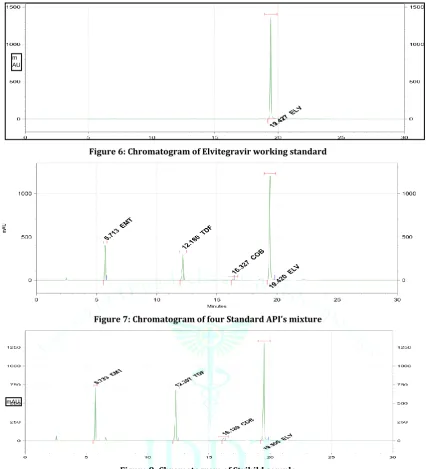
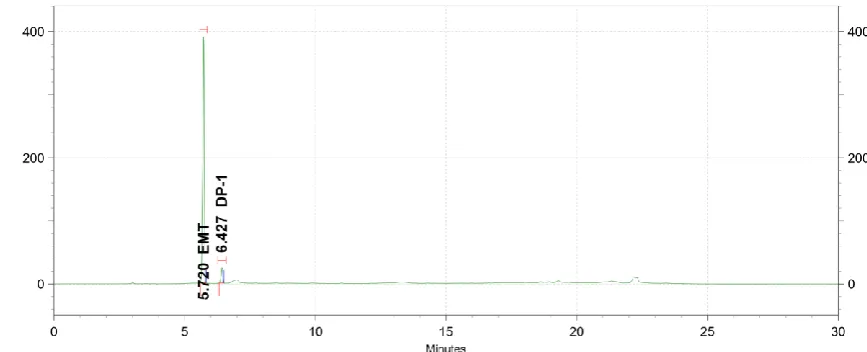
In order to achieve good resolution between all the four drugs, different buffers with pH-conditions such as phosphate buffer at pH 3.0 and trifluoro acetic acid and different proportions of solvents like methanol and acetonitrile were tested. However, in acetate buffer (adjusted with dilute glacial acetic acid to pH 4) and acetonitrile in gradient mode achieved good satisfactory results at a flow rate of 1.0 mL/min. The retention times of Emtricitabine, Tenofovir disoproxil fumarate, Cobicistat and Elvitegravir were found to be 5.7, 12.1, 16.3 and 19.4 min respectively. The chromatograms of blank, placebo, working standards of Emtricitabine, Tenofovir disoproxil fumarate, Cobicistat, Elvitegravir, four standard API’s mixture and Stribild sample solution were shown in figures 1 to 8.
Figure 2: Chromatogram of Placebo
Figure 3: Chromatogram of Emtricitabine working standard
Figure 4: Chromatogram of Tenofovir disoproxil fumarate working standard
Figure 6: Chromatogram of Elvitegravir working standard
Figure 7: Chromatogram of four Standard API’s mixture
Figure 8: Chromatogram of Stribild sample
4.1 Assay:
Analysis of Stribild tablets was performed by the proposed method and the percent assay of the formulation was
calculated in triplicate. The assay percentage of Emtricitabine, Tenofovir disoproxil fumarate, Cobicistat and Elvitegravir were found to be within limits in the sample Stribild tablets and the results are shown in table 2.
Table 2: Assay results of Stribild tablets
S.NO. Drug name Label claim (mg) Amount found(mg) Assay (%) *
1 Emtricitabine 200 199.2 99.6
2 Tenofovir 300 297.5 99.2
3 Cobicistat 150 148.7 99.1
4 Elvitegravir 150 150.8 100.5
* = Average assay% of 3 replicate injections
4.2 Method Validation: 4.2.1 System suitability:
10µL of standard solution was injected five times into the chromatograph, the chromatograms were recorded and the peak areas were measured. The column efficiency for EMT, TDF, COB and ELV peaks should not be less than
5000 plate counts and tailing factor should be between 0.80 to 2.0. RSD for peak areas from five replicate injections should not be more than 2.0%. Parameters such as number of theoretical plates, average area and peak tailing were determined and all the parameters were within the limits. Results are shown in table 3.
Table 3: System suitability data
Parameters EMT TDF COB ELV
Theoretical plates* 47155 10206 15700 25735
Tailing factor* 0.9 1.2 0.8 1.3
Average peak area* 185376024 169302341 8113118 624388448
Standard deviation 843249.78 554654.95 51989.9 5236220
% RSD 0.45 0.33 0.64 0.84
* = Average result of 6 replicate injections
4.2.2 Specificity:
The specificity of the analytical method was established by injecting the 100 μg/mL concentration solutions of diluent (blank), placebo, working standards and sample solution individually to investigate interference from the representative peaks. From the obtained chromatograms in figures 1 to 8 it can be inferred that there were no co-eluting peaks at the retention time of EMT, TDF, COB and ELV, which shows that peak of analyte was pure and the excipients in the formulation did not interfere with the analyte of interest.
4.2.3 Linearity:
Linearity was evaluated by analyzing different concentrations of the standard solutions of Emtricitabine, Tenofovir disoproxil fumarate, Cobicistat and Elvitegravir solutions. 6 working standard solutions ranging between 25-150, 37.5-225, 18.75-112.5 and 18.75-112.5 μg/mL were prepared and injected (n = 3). The response was a linear function of concentration over peak area and were subjected to linear least-squares regression analysis to calculate the calibration equation and correlation coefficient, the calibration curves are shown in figures 9 to 12.
Figure 9: Calibration curve for EMT Figure 10: Calibration curve for TDF
Figure 11: Calibration curve for COB Figure 12: Calibration curve for ELV y = 2E+06x - 4E+07
R² = 0.9999
0 50000000 100000000 150000000 200000000 250000000
0 50 100 150
Pe
a
k
A
re
a
Emtricitabine
y = 1E+06x + 3E+07 R² = 0.9998
0 50000000 100000000 150000000 200000000 250000000 300000000
0 50 100 150 200
pe
ak
A
re
a
Concentration (μg/mL) Tenofovir
y = 79402x + 2E+06 R² = 0.9995
0 2000000 4000000 6000000 8000000 10000000 12000000
0 50 100 150
P
e
ak
A
re
a
Concentration (μg/mL) Cobicistat
y = 5E+06x + 2E+08 R² = 0.9997
0 100000000 200000000 300000000 400000000 500000000 600000000 700000000 800000000
0 50 100 150
P
e
ak
A
re
a
4.2.4 Limit of detection and limit of quantification: Limit of detection (LOD) and limit of quantification (LOD) of Emtricitabine, Tenofovir disoproxil fumarate, Cobicistat and Elvitegravir were determined by calibration curve method. Solutions of EMT, TDF, COB and ELV were prepared in linearity range and injected (n = 3). Average peak areas were plotted against concentration. These were calculated by using following equations (ICH, Q2 (R1)). The LOD and LOQ values are reported in table 4.
LOD = 3.3 × σ/S and LOQ = 10 × σ/S
Where σ = the standard deviation of the response and S = slope of the calibration curve.
4.2.5 Precision:
Repeatability/method precision was determined in accordance with ICH guidelines. Six replicate injections
(n=6) of same concentration (100 μg/mL) were analyzed. Determinations were performed on the same day as well as on consequent days (reproducibility/ruggedness). % RSD for Emtricitabine, Tenofovir disoproxil fumarate, Cobicistat and Elvitegravir were found to be within acceptable limit of ≤ 2. Hence the method is precise, reproducible and rugged for 48 hours study and the results are summarized in table 5 and 6.
Table 4: LOD and LOQ data Drug name LOD (μg/mL) LOQ (μg/mL)
EMT 0.92 2.78
TDF 1.04 3.14
COB 0.66 2.01
ELV 0.37 1.12
Table 5: Method Precision (repeatability) data for EMT, TDF, COB and ELV Repeatability (Peak Areas)
S. NO. EMT TDF COB ELV
1 185374024 169302345 8102589 624389254
2 184956826 169123548 8154265 628975425
3 184685792 168548781 8078251 629457821
4 185168745 168745985 8054654 619658724
5 184142589 169974623 8169824 618957214
6 184298745 167489524 8015786 627854625
Mean 184771120.2 168864129.3 8095894.8 624882177.2
SD 486118.4 836120.6 58901.5 4672456.8
% RSD 0.26 0.49 0.72 0.74
Table 6: Intraday and Inter-day Precision data for EMT, TDF, COB and ELV Drug name Time interval % Assay * Statistical parameters
EMT 0hrs
8hrs Day 1 Day 2
101.4 101.7 101.4 101.6
Mean = 101.5 SD = 0.15 %RSD = 0.15
TDF 0hrs
8hrs Day 1 Day 2
100.7 100.2 101.1 101.6
Mean = 100.9 SD = 0.59 %RSD = 0.59
COB 0hrs
8hrs Day 1 Day 2
101.4 100.6 100.5 101.2
Mean = 100.9 SD = 0.44 %RSD = 0.44
ELV 0hrs
8hrs Day 1 Day 2
101.6 101.3 100.8 101.4
Mean = 101.3 SD = 0.34 %RSD = 0.34
* = Average assay of 6 replicate injections
4.2.6 Accuracy:
To the placebo solution, known amounts of standard Emtricitabine, Tenofovir disoproxil fumarate, Cobicistat and Elvitegravir corresponding to 50, 100 and 150% of target concentrations were added. Mean recovery (%) for
Table 7: Results of Accuracy for EMT, TDF, COB and ELV Drug
name Conc. (%) Amount taken* (μg/mL) Amount spiked* (μg/mL) Amount recovered* (μg/mL)
% recovery * Statistical parameters
EMT 100 50
150 30 30 30 15 30 45 45.2 59.5 75.6 100.4 99.2 100.8
Mean %: 100.1 SD: 0.83 %RSD: 0.83
TDF 100 50
150 50 50 50 25 50 75 74.8 100.6 125.9 99.7 100.6 100.7
Mean %: 100.3 SD: 0.55 %RSD: 0.55
COB 100 50
150 20 20 20 10 20 30 30.2 39.6 50.4 100.6 99 100.8
Mean %: 100.1 SD: 0.99 %RSD: 0.98
ELV 100 50
150 20 20 20 10 20 30 30.3 40.6 50.4 101 101.5 100.8
Mean %: 101.1 SD: 0.36 %RSD: 0.36 * = Average result of 3 replicate injections
4.2.7 Robustness:
The method remained unaffected by deliberate small changes in parameters like flow rate and column
temperature. Below tabulated % RSD values of % assays and retention times were within the tolerance limits and indicate that the method is robust. The results are reported in table 8.
Table 8: Robustness study results of EMT, TDF, COB and ELV
Drug name Parameter Change
in ratio %Assay * Statistical parameters
EMT Flow rate 0.9 mL
1.0 mL 1.1 mL
99.8 100.6 100.9
Mean %: 100.5 SD: 0.51 % RSD: 0.51 Column
temperature 28 °C 30 °C
32 °C
100.5 100.2 100.8
Mean %: 100.5 SD: 0.3 % RSD: 0.29
TDF Flow rate 0.9 mL
1.0 mL 1.1 mL
100.6 100.4 101.5
Mean %: 100.8 SD: 0.58 % RSD: 0.58
Column temperature 28 °C
30 °C 32 °C
100.6 100.4 100.7
Mean %: 100.6 SD: 0.15 % RSD: 0.15
COB Flow rate 0.9 mL
1.0 mL 1.1 mL
99.5 100.2 100.6
Mean %: 100.1 SD: 0.56 %RSD: 0.56
Column temperature 28 °C
30 °C 32 °C
100.8 101.6 101.3
Mean %: 101.2 SD: 0.40 %RSD: 0.40
ELV Flow rate 0.9 mL
1.0 mL 1.1 mL
100.7 101.6 101.9
Mean %: 101.4 SD: 0.62 %RSD: 0.62
Column temperature 28 °C
30 °C 32 °C
100.7 100.5 100.8
Mean %: 100.7 SD: 0.15 %RSD: 0.15 * = Average result of 3 replicate injections
4.3 Forced Degradation Studies:
For all the forced degradation samples, the purity angle formed was less than purity threshold, this indicates that there is no interference from degradants in quantitating Emtricitabine, Tenofovir disoproxil fumarate, Cobicistat and Elvitegravir peaks in Stribild tablets. There was no
Table 9: Forced degradation studies at different stress conditions
Stress Condition % Degradation Purity Angle Purity Threshold Pass/ Fail
Emtricitabine
Control --- 0.156 0.441 No
Acid 3.4 0.132 0.330 No
Alkali 16.8 0.144 0.341 No
Oxidation 18.6 0.285 0.546 No
Thermal 2.4 0.399 0.652 No
Photostability 3.6 0.124 0.332 No
Tenofovir disoproxil fumarate
Control --- 0.186 0.541 No
Acid 17.6 0.182 0.360 No
Alkali 18.7 0.244 0.421 No
Oxidation 3.1 0.212 0.584 No
Thermal 2.3 0.412 0.674 No
Photostability 2.8 0.184 0.392 No
Cobicistat
Control --- 0.136 0.481 No
Acid 10.8 0.122 0.230 No
Alkali 14.5 0.184 0.311 No
Oxidation 9.6 0.285 0.546 No
Thermal 9.8 0.364 0.782 No
Photostability 10.3 0.224 0.432 No
Elvitegravir
Control --- 0.256 0.441 No
Acid 13.2 0.232 0.338 No
Alkali 1.2 0.274 0.461 No
Oxidation 2.5 0.215 0.512 No
Thermal 1.4 0.297 0.552 No
Photostability 1.7 0.184 0.375 No
Figure 13: Chromatogram of acid hydrolysis of Emtricitabine
Figure 14: Chromatogram of alkali hydrolysis of Emtricitabine
Figure 15: Chromatogram of oxidation of Emtricitabine
Figure 16: Chromatogram of acid hydrolysis of Tenofovir disoproxil fumarate
Figure 17: Chromatogram of alkali hydrolysis of Tenofovir disoproxil fumarate
4.4 Dissolution Method:
The validated RP-HPLC method developed was successfully
applied for the In-vitro dissolution method for analysis of
Stribild tablets. The release rate of Emtricitabine, Tenofovir disoproxil fumarate, Cobicistat and Elvitegravir from immediate release Stribild tablets was determined using United State Pharmacopoeia dissolution testing apparatus II (paddle method). The percent drug release was found to meet USP specification, i.e. not less than 80% of amount of labeled drug EMT, TDF, COB and ELV dissolved in 30min.
Figure 19: In-vitro dissolution profile of Stribild tablets
There was no interference of blank with the standard and
sample chromatograms. The In-vitrodissolution profile of
cumulative percentage of drug released verses time is presented in figure 19.
4. CONCLUSION
A simple and rugged LC-MS compatible RP-HPLC method has been described for simultaneous determination of Emtricitabine, Tenofovir disoproxil fumarate, Cobicistat and Elvitegravir in active pharmaceutical ingredients, assay for marketed formulation (Stribild) and to study the dissolution profile in Stribild tablets without any additional pretreatment. The proposed method was validated in accordance with ICH guidelines by testing its parameters which include system suitability, specificity, precision, linearity, LOD, LOQ, accuracy and robustness. The method was very specific to separate the peaks of active pharmaceutical ingredients from the degradation products which were obtained with good resolution and purity angle less than purity threshold showing peak purity of the four drugs after forced degradation studies. Thus, stress induced studies prove the effectiveness of the proposed stability indicating RP-HPLC method which can be adopted in routine analysis of Stribild tablets in pharmaceutical industries.
Acknowledgments: The authors are thankful to A.U College of Pharmaceutical Sciences, Andhra University, Visakhapatnam, Andhra Pradesh, India, for providing facilities to carry out the research work.
Conflict of interest:The authors declare that there is no
conflict of interests regarding the publication of this paper.
REFERENCES
1) Gilead Sciences “New Drug Applications for Cobicistat and Elvitegravir for HIV Therapy Accepted by U.S. FDA”, April 21, 2014.
2) Aids info Drug Database,
Elvitegravir/Cobicistat/Emtricitabine / Tenofovir Disoproxil Fumarate. [Online], Available at: https://aidsinfo.nih.gov/ 3) Highlights of prescribing information. Stribild® (elvitegravir,
cobicistat, emtricitabine, tenofovir disoproxil fumarate) tablets, for oral use Initial U.S. Approval: 2012.
4) Vegesna Swetha, S. V. U. M. Prasad, Y. Asha Rani, Analytical method development and validation for simultaneous estimation of Cobicistat and Elvitegravir by using RP-HPLC in pure and Pharmaceutical Dosage Forms. Asian Journal of Pharmaceutical Analysis. 2017; 7(3):151-158.
5) Raveendra Babu V.V, Pankaj K. Sharma, Singhvi. I, Simultaneous Estimation of Tenofovir Disoproxil Fumarate, Cobicistat, Emtricitabine and Elvitegravir by Liquid Chromatography in Bulk and Tablet Dosage Form, Asian Journal of Chemistry, 2014; 26(18):6233-6237.
6) Khaleel. N, Abdul Rahaman. S K, A Validated Stability Indicating RP-HPLC Method for Simultaneous Estimation of Tenofovir Disoproxil Fumarate, Cobicistat, Emtricitabine and Elvitegravir in Bulk and Pharmaceutical Dosage Form, International Journal of Pharmacy, 2015; 5(3):991-1002. 7) Putchakayala Purnachandra Rao, Dondeti Mogili Reddy and
D. Ramachandran, Stability Indicating HPLC Method for Simultaneous Estimation of Emtricitabine, Tenofovir Disoproxyl Fumarate, Cobicistat and Elvitegravir in
Pharmaceutical Dosage Form, World Journal of Pharmaceutical Sciences, 2014; 2(12):1822-1829.
8) Chinnalalaiah Runja, Pigili Ravi Kumar and Srinivasa Rao Avanapu, A Validated Stability Indicating RP-HPLC Method for the Determination of Emtricitabine, Tenofovir Disoproxil Fumarate, Elvitegravir and Cobicistat in Pharmaceutical Dosage Form, Journal of Chromatographic Science, 2016, doi: 10.1093/chromsci/bmw004.
9) Mallikarjuna rao and Gowri Sankar Dannana, Simultaneous estimation of Emtricitabine, Elvetigravir, Cobicistat and Tenofovir by RP-HPLC, Indian Journal of Pharmaceutical Education and Research, 2016; 50(1):205-211.
10) Raghu Ram Jampala, V. Kiran Kumar, Appala Raju Nemala, Development and Application of Liquid Chromatographic Method for Simultaneous Determination of Elvitegravir, Tenofovir Disoproxil Fumarate, Emtricitabine and Cobicistat in Fixed Dosage Form, Pharmaceutical Methods, 2014; 5(1):7-13.
11) Srinivas Ganta, Vidyadhara. S, A New Simple Analytical Method for Simultaneous Estimation of Cobicistat and Elvitegravir by RP-HPLC-PDA in Their Tablet Dosage Forms, Journal of Global Trends in Pharmaceutical Sciences, 2017; 8(1):3584-3589.
12) Mangamma. K. et al, Development and Validation of a New RP-HPLC Method for Simultaneous Estimation of Emtricitabine, Tenofovir, Cobicistat, Elvitegravir and Its Comparison with A Reported Method, Indo American Journal of Pharmaceutical Sciences, 2017; 4(06):1599-1612
0 20 40 60 80 100 120
10 20 30 40 50 60