© Universiti Tun Hussein Onn Malaysia Publisher’s Office
IJIE
Journal homepage:http://penerbit.uthm.edu.my/ojs/index.php/ijie
The International
Journal of
Integrated
Engineering
Multi Response Optimization of Turning Process by
Considering its Cutting Parameters Implementing Grey
Relational Analysis
P. Venkateshwar Reddy
1*,
B. Veerabhadra Reddy
1, P. Srinivasa Rao
2, D.
Mohana Krishnudu
11Department of Mechanical Engineering, G. Pulla Reddy Engineering College, Kurnool, A.P., 518007 INDIA.
2Department of Mechanical Engineering, Vardhaman College of Engineering, Shamshabad, Hyderabad, 501218
INDIA.
*Corresponding Author
DOI: https://doi.org/10.30880/ijie.2019.11.08.011
Received 16 July 2019; 26 November 2019; Available online 15 December 2019
Abstract:Machining process is most broadly utilized in the manufacturing industries. The purpose of the present effort is to investigate the cutting parameters in turning process on the responses: ‘Material Removal Rate’, ‘Surface Roughness’ and ‘Tool Wear Rate’ in CNC turning of EN8 steel using tool made of tungsten carbide. Three factors namely ‘Cutting Speed’, ‘feed rate’ and ‘depth of cut’ with each of the three levels have been considered as the cutting parameters. In the present study using the Taguchi's DOE methodology, multi-response optimization is carried out using Grey Relational approach to optimize the responses. Taguchi’s L9 orthogonal
array is used to conduct the experiments. The obtained results are then analyzed by the Grey Taguchi. Grey Taguchi Method is implemented to find the optimal levels for the parameters. Validation test is performed to confirm the optimal levels.
Keywords:CNC Turning; Multi-response optimization; Grey Taguchi; ANOVA; EN 8; Tungsten Carbide
1. Introduction
Machining process is most broadly utilized in the manufacturing industries. Conventional machining methods are a standout amongst the most critical material removal techniques. The test that the designers regularly experience is to locate the optimal levels of parameters for the chosen response and furthermore to maximize the output by utilizing the current assets. EN8 is an exceptionally well known grade of carbon steel (medium), and is promptly machinable in several clauses. EN8 is appropriate for the production of any type of parts, for example, shafts, gears, axles, bolts and studs.
Some past works have been accounted on the machining qualities of steel grades. Xavior and Adithan [1] investigated on responses like TWR and SR during the turning process by considering various cutting fluids. Notwithstanding, it is additionally fundamental to think about productivity (MRR), nature of the machined part (surface roughness) and prerequisite of cutting force (from the information of cutting power, Fc) at the same time and enhance
and abrasive water jet machining. Ovalı and Mavi [5] experimented for the modelling the cutting forces of austempered grey cast iron using artificial neural networks. The authors concluded that the cutting force for the gray iron can be controlled by controlling the machining parameters. Kartal and Gokkaya [6] reviewed the turning process by abrasive water jet machining and the significance effects of the process parameters were discussed and reported. Abdullah et al., [7] examined to improve at the same time the two output responses in particular Surface Roughness and workpiece surface temperature. Optimal cutting parameters for the execution measures were obtained by Taguchi system. At present, the focus point of the researchers is moved towards the multi-objective optimization with a specific end goal to optimize all the responses. Multi-response optimization in the machining procedure is utilized to all the while accomplish a few objectives, for example, expanded product quality, enhanced production productivity and decreased production time. A few researchers looked into the multi-objective optimization by limiting the Surface Roughness, Machining Time, surface temperature, cutting power, tool wear and to expand the Material Removal Rate at the sam e time [8-15].
Taguchi technique is used for different engineering processes for optimizing its process parameters using design of experiments (DOE). It’s a very imperative instrument to distinguish the basic parameters which also predicts the optimal location of all course of action factors. This strategy has been usually inward bounded in the investigational design acknowledged with a giant range of machining forms [16-18].
Grey relational analysis (GRA) uses a particular scheme of data. It characterizes circumstances with no data as dark, and others with idealize data as white [16, 19]. At the end of the day, GRA converts the multi-objective problem in to a single objective optimization problem. So also, grey relational analysis has been utilized as a part of a lot of studies relating to machining activities for optimizing the related procedures [20-21]. Especially, GRA compacts with ranks but not with the real value of the grey relational grades [26].
During the present investigation, the impact of all the cutting parameters, namely, ‘cutting speed’ (Vc), ‘feed rate’
(f) and ‘depth of cut’ (t) has been examined on MRR, surface roughness and tool wear rate during the machining of EN8 Steel. GRA has been utilized for the concurrent optimization of cutting parameters so as to acquire ideal execution qualities in machining.
2. Materials and method
2.1 Work piece material
The present work is based on cylindrical workpieces made up of EN8 Steel with diameter x length of Ф32 mm x 130 mm dimensions were used and is shown in Fig. 1. Table.1 and Table.2 shows the composition and physical properties respectively of EN8. CNC lathe model LCTR-29 is used to machine the workpieces. Tungsten Carbide tool with rake angle, clearance angle and nose radius of +70, +60and 0.4mm respectively with tool holder PTGNR 2020
K16 model are engaged in the turning process.
2.2 Experimental Design using Taguchi method
Three parameters in particular ‘cutting speed’, ‘feed rate’ and ‘depth of cut’ were considered for the experimental trial plan. Every parameter has three levels. The L9orthogonal array was shaped in light of the three parameters
three-level design. The Taguchi design technique applies fractional factorial test plans called Orthogonal Arrays (OA) that serve to lessen the quantity of investigations to locate the fundamental parameters' consequences on output [22]. The determination of a reasonable OA relies upon the quantity of control parameters and their levels. To estimate the principle parameter impacts, the design should be Orthogonal and Balanced. Taguchi has arranged some orthogonal arrays that fulfill the over two properties for different number of the parameter – level combinations [23]. Attributable to cost and other test constraints, in the present case, a partial factorial plan with nine runs has been chosen out of the full factorial design, 3^3 = 27 runs. The combination of factors with its levels is recorded in Table 3.
Table 1-Composition of EN 8
Element Silicon Carbon Manganese Sulphur Phosphoru
s Composition
Percent
0.10-0.40 0.36-0.44 0.60-1.00 0.050 Max 0.050 Max
Table 2 - Properties of EN8
Physical Property Value
Density 7.8 g/cm³
Modulus of Elasticity 206000
Max. Stress 850 N/mm2
Yield Stress 465 N/mm2
Elongation % 1
Proof Stress (0.2%) 450 N/mm2
Table 3-Cutting Parameters with its levels considered in the work
S. No Process Parameters Level 1 Level 2 Level
1 Spindle Speed (rpm) 4 5 616
2 Feed Rate (mm/rev) 0 0 0.1
3 Depth of cut (mm) 0.3 0.4 0.5
2.3 Experimental setup
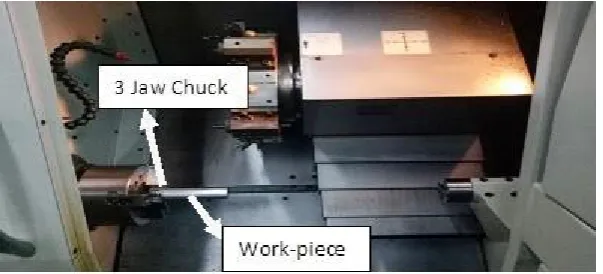
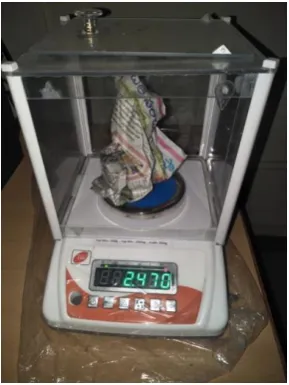
Experiments were carried out on CNC Lathe to carryout turning operation. A Tungsten Carbide tool was clamped in PTGNR 2020 K16 tool holder. In this 30 mm length of the workpiece is used to hold in a universal chuck to perform the experimentation. Experimental Setup which is used in the current study is shown in Fig.2. Weighing machine used to measure weight of tool with an accuracy of 0.01 mg is shown in Fig.3.
Fig. 2 - Experimental Setup used for the present study
3. Results and Discussion
The main aim of the present study is to optimize the turning parameters like ‘spindle speed’, ‘feed rate’ and ‘depth of cut’ to achieve high ‘Material Removal Rate’ (MRR), low ‘Surface Roughness’ (SR) and low ‘Tool Wear Rate’ (TWR) simultaneously. The instrument used in the study to measure surface Roughness is as shown in Fig.4, and its graphical illustration of method of testing surface roughness is shown in Fig.5. Surface roughness is tested at five different locations over the machined specimen and these are represented as P1, P2...P5 and the average of these is
Material Removal Rate (MRR) =initial weight of workpiece final weight of workpiecemachining time x density of workpiece
Tool Wear Rate (TWR) =initial weight of tool final weight of toolmachining time x density of tool
(1)
(2)
Fig. 3 - Weighing Machine used in the present study
Fig. 4 - Surface Roughness Measurement instrument
Table 4 - Experimental Design and output responses
Experime nt N o:
Spee d (rp m)
Fe ed (mm/re
v)
Depth of cut (mm)
Metal Removal
Rate (mm3/min) eSurfac
roughn ess
Tool Wear Rate (mm3/mi
n)
1 411 0.3 0.3 3600 3.5 0.18
2 411 0.2 0.4 3200 3.2 0.14
3 411 0.1 0.5 2000 2.7 0.12
4 513 0.3 0.5 7490 4.4 0.26
5 513 0.2 0.3 2996 4.1 0.18
6 513 0.1 0.4 1997 3.9 0.14
7 616 0.3 0.4 7195 3.4 0.31
8 616 0.2 0.5 5996 3.0 0.24
9 616 0.1 0.3 1798 2.9 0.18
3.1 Grey relational technique
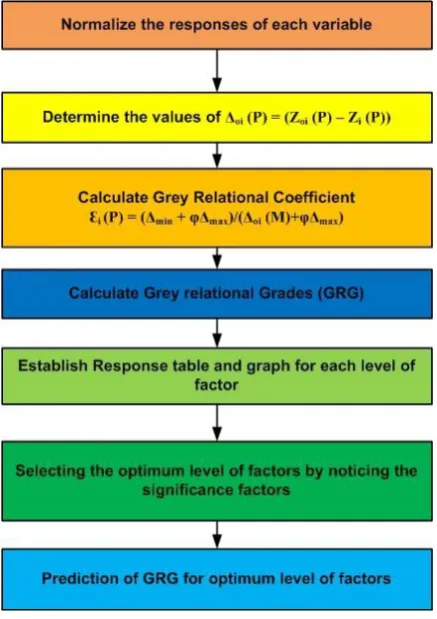
The Grey relational analysis is a strategy for changing over two or more output parameters into single output parameter in view of the final target to change over the multiple-objective into a single objective output and after that any of the optimization system like Taguchi technique can be utilized for single objective optimization. This is done by calculating the grey relational grade from the grey relational analysis. The strategy of grey relational analysis is explained in the sub sections [11, 24]. The flow chart of grey relational analysis is shown in Fig.6.
Fig.6 - Flow chart of Grey Relational Analysis (GRA)
3.1.1 Normalization of Experimental results
i
i
Zi(M) = 𝑖 min
max 𝑖 min
(3)
For Smaller the better type of response, the normalized value is Z (M) = 𝑎 𝑖 𝑖
max 𝑖 min
Where, Zi(M) is the normalizing data of the responses
The normalized values of the responses are shown in Table 5.
Table 5 - Normalized values of the outputs
(4)
Experimental Run No. Normalized values
Material Removal Rate Surface Roughness Tool Wear Rate
1 0.31 0.52 0.6842
2 0.24 0.70 0.8947
3 0.03 1 1
4 1 0 0.2631
5 0.21 0.17 0.6842
6 0.03 0.29 0.8947
7 0.94 0.58 0
8 0.73 0.82 0.3684
9 0 0.88 0.6842
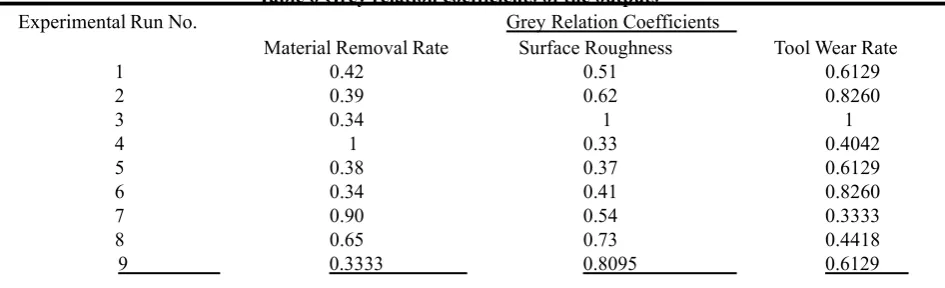
3.1.2 Grey Relation Coefficient
The grey relational coefficient values were calculated by equation 5. Ԑ (M) = ∆min φ∆max
∆oiM φ∆max (5)
Whereas∆ is called as quality loss function which is denoted and found out by∆ (P) = (Zoi(P) – Zi(P)),∆
and∆ 𝑎 are the min. and max. values of the differences∆ . The φ must be considered between 0 and 1 only and the
present case assumed as 0.5. Obtained Grey relation coefficients are tabulated in Table 6.
Table 6 Grey relation coefficients of the outputs
Experimental Run No. Grey Relation Coefficients
Material Removal Rate Surface Roughness Tool Wear Rate
1 0.42 0.51 0.6129
2 0.39 0.62 0.8260
3 0.34 1 1
4 1 0.33 0.4042
5 0.38 0.37 0.6129
6 0.34 0.41 0.8260
7 0.90 0.54 0.3333
8 0.65 0.73 0.4418
9 0.3333 0.8095 0.6129
3.1.3 Grey Relation Grade and order
The grey relational grades (GRG) were obtained by averaging the grey relation coefficients by using equation 6. By this GRG, the multiple responses are converted into single response.
1
Grey relation grade 𝑖 = ∑ 1 𝑖
Where n is the number of response Ԑi(M) is the grey relation coefficient.
Grey Relational Grades with their ranks (1strank for largest GRG) are shown in Table 7.
Table 7 Grey Relational Grades and their rank
Experimental Run No. Grey Relation Grade (GRG) Ran
1 0.5168 8
2 0.618 2
3 0.780 1
4 0.5791 6
5 0.4594 9
6 0.5273 7
7 0.5959 4
8 0.612 3
9 0.585253 5
3.2 Taguchi Analysis
Analysis of Means (ANOM) is utilized to decide the optimal level of the process parameters. The optimal level of input parameters can be seen from the ANOM chart as appeared in Fig. 7. For multi- objective optimization problems, the optimum levels of parameters can be acquired comparing to the greatest value for the GRG. The optimum combination of input parameters are seen at speed of 411 rpm, feed rate of 0.1 mm/rev and depth of cut of 0.5 mm. Table 8 speaks the responses for grey relational grades of means.
Fig.7 Main effect plot for Grey Relational Grades
Table 8 Response Table for Grey Relational Grades
Level Spe
ed Feed DOC
1 0.6385 0.63 0.5205
2 0.5220 0.56 0.5805
3 0.5978 0.56 0.6573
Max-Min 0.1165 0.06 0.1368
Rank 2.0000 3.0000 1.0000
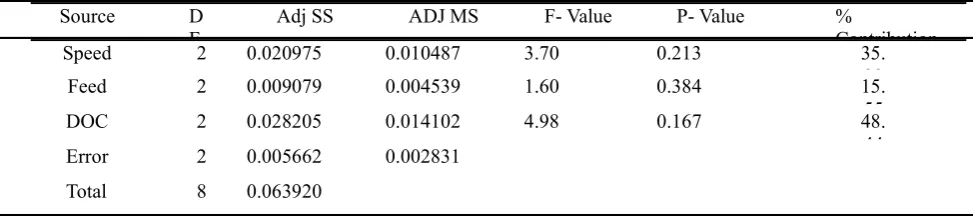
3.2.1 ANOVA of Grey Relational Grades
Table 9 ANOVA of GRG
Source D
F
Adj SS ADJ MS F- Value P- Value %
Contribution
Speed 2 0.020975 0.010487 3.70 0.213 35.
99
Feed 2 0.009079 0.004539 1.60 0.384 15.
55
DOC 2 0.028205 0.014102 4.98 0.167 48.
44
Error 2 0.005662 0.002831
Total 8 0.063920
3.3 Confirmation test
The final step is to check the legitimacy of the experimental results. The optimum levels of parameters were gotten from the response table for mean GRG's. At the optimum settings of parameters, the experimental GRG ascertained is 0.9384. The predicted estimation of GRG at similar ideal levels of the parameters was given as 0.9412 by Minitab 17. The % error is under 1 which is negligible and thus experimental results are approved.
4. Conclusions
Simultaneous Optimization of Material Removal Rate, Surface Roughness and Tool Wear Rate by turning of EN8 which was completed in CNC utilizing Taguchi based Gray Relational Analysis. L9orthogonal array was utilized for
experimentation. Speed, Feed rate and Depth of cut are the controllable parameters. Experimental results are broke down and the accompanying conclusions were drawn.
• Through normalization, the three responses have been converged to get a single response as Gray Relational Grades.
• From the response table for mean GRG's, the order of impact of the control parameters is built up to be Depth of cut > Speed > Feed rate.
• ANOVA was completed to comprehend the commitment level of every parameter on the output response. • The best combination (optimum) for multi response cutting parameters for CNC turning of EN8 are 414 rpm
Speed, 0.1 mm/rev Feed rate, 0.5 mm Depth of cut.
• Through confirmation test, the optimum prediction of GRG is validated.
References
[1] Xavior, M. A. and Adithan, M. (2009) 'Determining the influence of cutting fluids on tool wear and surface roughness during turning of AISI 304 austenitic stainless steel', Journal of materials processing technology, 209(2), pp. 900-909.
[2] Dagwa, I. M. 'Surface Roughness Optimization of some Machining Parameters in Turning Operations Using Taguchi Method'. Advanced Materials Research: Trans Tech Publ, 613-620.
[3] Asiltürk, I. and Akkuş, H. (2011) 'Determining the effect of cutting parameters on surface roughness in hard turning using the Taguchi method', Measurement, 44(9), pp. 1697-1704.
[4] Shukla, R. and Singh, D. (2017) 'Selection of parameters for advanced machining processes using firefly algorithm', Engineering Science and Technology, an International Journal, 20(1), pp. 212-221.
[5] Ovalı, İ. and Mavi, A. (2013) 'A study on cutting forces of austempered gray iron using artificial neural networks', Engineering Science & Technology, an International Journal, 16(1).
[6] Kartal, F. and Gokkaya, H. (2013) 'Turning with abrasive water jet machining-a review', Engineering Science & Technology, an International Journal, 16(3).
[7] Abdullah, A. A., Naeem, U. J. and Xiong, C. H. 'Estimation and optimization cutting conditions of surface roughness in hard turning using Taguchi approach and artificial neural network'. Advanced Materials Research: Trans Tech Publ, 662-668.
[8] Kalsi, N. S., Sehgal, R. and Sharma, V. S. (2016) 'Multi-Objective Optimization using Grey Relational Taguchi Analysis in Machining: Grey Relational Taguchi Analysis', International Journal of Organizational and Collective Intelligence (IJOCI), 6(4), pp. 45-64.
[10] Sivaiah, P. and Chakradhar, D. (2017) 'Multi-objective optimisation of cryogenic turning process using Taguchi-based grey relational analysis', International Journal of Machining and Machinability of Materials, 19(4), pp. 297-312.
[11] Vinayagamoorthy, R. and Xavior, M. A. (2014) 'Parametric optimization on multi-objective precision turning using grey relational analysis', Procedia Engineering, 97, pp. 299-307.
[12] Das, S. R., Kumar, A. and Dhupal, D. (2016) 'Experimental investigation on cutting force and surface roughness in machining of hardened AISI 52100 steel using cBN tool', International Journal of Machining and Machinability of Materials, 18(5-6), pp. 501-521.
[13] Ganta, V., Sagar, K. S. and Chakradhar, D. (2017) 'Multi objective optimisation of thermally enhanced machining parameters of Inconel 718 using grey relational analysis', International Journal of Machining and Machinability of Materials, 19(1), pp. 57-75.
[14] Singaravel, B. and Selvaraj, T. (2017) 'Multi criteria optimisation using analytic hierarchy process in turning operation', International Journal of Machining and Machinability of Materials, 19(3), pp. 218-229.
[15] Abdulkareem, S., Rumah, U. J., & Adaokoma, A. (2011). Optimizing machining parameters during Turning process. International Journal of Integrated Engineering, 3(1), 23-27.
[16] Zainudin, A., Sia, C. K., Ong, P., Narong, O. L. C., Azlan, M. A., & Lee, W. K. (2019). Performance Properties Optimization of Triaxial Ceramic-Palm Oil Fuel Ash By Employing Taguchi Grey Relational Analysis. International Journal of Integrated Engineering, 11(1).
[17] Ismail, N. A., Ismail, M. I. S., Radzman, M. A. M., Ariffin, M. K. A. M., & As' arry, A. (2019). Parametric Optimization of Robot-based Single Point Incremental Forming Using Taguchi Method. International Journal of Integrated Engineering, 11(1).
[18] Tzeng, C.-J., Lin, Y.-H., Yang, Y.-K. and Jeng, M.-C. (2009) 'Optimization of turning operations with multiple performance characteristics using the Taguchi method and Grey relational analysis', Journal of materials processing technology, 209(6), pp. 2753-2759.
[19] Chan, J. W. and Tong, T. K. (2007) 'Multi-criteria material selections and end-of-life product strategy: Grey relational analysis approach', Materials & Design, 28(5), pp. 1539-1546.
[20] Dewangan, S. and Biswas, C. K. (2013) 'Optimisation of machining parameters using grey relation analysis for EDM with impulse flushing', International Journal of Mechatronics and Manufacturing Systems, 6(2), pp. 144-158.
[21] Gopalsamy, B. M., Mondal, B. and Ghosh, S. (2009) 'Optimisation of machining parameters for hard machining: grey relational theory approach and ANOVA', The International Journal of Advanced Manufacturing Technology, 45(11-12), pp. 1068.
[22] Sreeraj, P. (2016). Optimization of Submerged Arc Welding process Parameters Using PCA-Based Taguchi Approach. International Journal of Integrated Engineering, 8(2).
[23] Logothetis, N. (1992) Managing for total quality: from Deming to Taguchi and SPC. Prentice Hall.
[24] Chinnaiyan, P., & Jeevanantham, A. K. (2014). Multi-objective optimization of single point incremental sheet forming of AA5052 using Taguchi based grey relational analysis coupled with principal component analysis. International journal of precision engineering and manufacturing, 15(11), 2309-2316.
[25] Al-Gheethi, A. (2019). Establish In-House: A Pre-treatment Method of Fat, Oil and Grease (FOG) in Kitchen Wastewater for Safe Disposal. International Journal of Integrated Engineering, 11(2).
[26] Kung, L. M., & Yu, S. W. (2008). Prediction of index futures returns and the analysis of financial spillovers— A comparison between GARCH and the grey theorem. European Journal of Operational Research, 186(3), 1184-1200.
[27] Krishnudu, D. M., Sreeramulu, D., & Reddy, P. V. (2018, April). Optimization the mechanical properties of coir-luffa cylindrica filled hybrid composites by using Taguchi method. In AIP Conference Proceedings (Vol. 1952, No. 1, p. 020058). AIP Publishing.
[28] Reddy, P. V., Reddy, B. V., & Rao, P. S. (2018). A Numerical Study on Tube Hydroforming Process to optimize the Process Parameters by Taguchi Method. Materials Today: Proceedings, 5(11), 25376-25381. [29] Reddy, P. V., Krishnudu, D. M., Pranavi, U., & Ramulu, P. J. (2019). Optimization of the Forming Parameters