Simulation and Modeling of Mixture Formation under
Variant Ambient Condition and Injection Pressure of
Biodiesel Spray
Adiba Rhaodah Andsaler, Amir Khalid, Norrizam Jaat
Automotive and Combustion Synergies Technology Group, Advanced Technology Centre (ATC),
Faculty of Engineering Technology, Universiti Tun Hussein Onn Malaysia, Parit Raja, Batu Pahat
86400 Johor, Malaysia.
Received 28 June 2016; accepted 30 August 2017, available online 30 August 2017
1.
Introduction
This study was conducted to investigate the effects of environmental conditions on the spray biodiesel in rapid compression machine by using Computational Fluid Dynamics software. The study was focused on characteristic of spray with different ambient pressure in constant volume chamber. Diesel engine is an engine that uses the heat of compression to initiate ignition and burning of fuel into the combustion engine which is also known as compression ignition. Meanwhile, spark ignition engines use spark plugs to start the burning as diesel engine has high thermal efficiency in internal and external combustion due to the high compression ratio. Spray is widely studied for various scientific and industrial applications [1-2]. Characteristics of fuel spray that injected into the internal combustion engine is important as it will affect the process of mixture formation and ignition as well as combustion and pollution formation. Fuel evaporates more quickly because of exposure to ambient air as well as increased in interaction surface. This increases the fuel-air mixing and the availability of oxygen so the mixture can ignite spontaneously [3].
The use of bio-fuel instead of diesel can reduce the environmental pollution also can reduce carbon emission for the used in the transport industry. Biodiesel is typically made from a variety of sources such as mixture of oil, grease and fats of vegetable or animal. However, there are also disadvantages associated with biodiesel as a low heating value, low flow properties, low volatility and high viscosity. In addition, the storage stability is low and the material compatibility issues. The combustion of biodiesel will release high NOx and biodiesel production
requires high in costs [4]. In an internal combustion engine, the process of atomization of the fuel spray is an important mechanism in which the fuel is mixed effectively with the gas combustion chamber. Spray plays an important role in combustion and emissions on an engine [5-7]. Fuel spray is usually dependent on the fuel injection pressure, fuel density, viscosity fuel, pressure and ambient temperature. Among these parameters, the effect of fuel density and viscosity of the fuel is very important parameter directly affects the spray cone angle [8-9].
This objectives of this study is to investigate the effects of environmental conditions on the spray biodiesel in rapid compression machine, how the atomization process being modelled and to study the characteristics of the spray with the ambient pressure difference in constant volume chamber. The objectives are going along with few scopes such as three different ambient pressures and temperatures in constant volume chamber. All the experiments conducted by using Computational Fluid Dynamics (CFD) software and the parameters considered are spray, spray length and fuel spray area.
2.
Methodology
Biodiesel produced must have a good ignition quality compared to diesel. Several studies conducted on flame quality biodiesel and diesel fuel is measured by the cetane number. Cetane number used in determining the rate triggered ignition and smoothness of the combustion process. At the cetane diesel engine work in determining the rate of combustion ignition. High cetane value will help in the process of combustion ignition, launch
operations and reduce the engine knocking in an engine.
Number cemetery for a machine depends on
characteristics such as: i. Engine design ii. Engine size iii. Maximum speed iv. Load conditions v. Atmosphere.
Biodiesel can be used directly as fuel in diesel engines by not involving drastic modifications to the engine. Diesel engine that operates according to the diesel cycle has a very broad market across the country for the purpose of transport and agriculture. Diesel cycle system provides many advantages and benefits compared to the use of the gasoline engine (Otto cycle) which refers to the generation of power and efficiency of the engine. Biodiesel is a type of organic oils produced by chemical methods to replace diesel oil. The chemical process is known as "transestersfication” in which from the nature materials such as soybean oil, sunflower, animal fat or vegetable [10]. Figure 1 shows the process "transestersfication".
Fig. 1 Transestersfication process [10].
2.1
Spray formation
Spray formation is very important aspect in compression-ignition engines, especially for diesel engine system, form and composition of spray affect the process of ignition and combustion of the fuel. Formation of spray will directly impact the quality of combustion through the use of air. Therefore, it optimizes the injection process and reduces pollutants and improves engine performance. Figure 2 below shows the characteristics of spray formation.
Fig. 2 Characteristics of spray formation [11].
One of the most important parameters in the formation of a liquid spray is the length of penetration through the
combustion chamber. For example, when the spray cone angle is greater; the fuel will meet at the top of the piston, and outside of the combustion chamber in an open chamber "direct ignition" diesel engine. This would lead to incomplete combustion and excessive smoke will be formed due to fuel blockage of air access is available in the combustion chamber [12]. Wide cone angle also cause the fuel to be sprayed into the cylinder wall, and not in the space required. Fuel is sprayed on the cylinder wall will come down to lubricant reservoir where it will shorten the life of the lubricant. Spray angle is also one of the variables that affect the rate of mixing air into the "jet fuel" near the outlet of the injector; it has a major impact on the overall combustion process [11].
2.2
Atomization process
Fuel atomization process consists of two steps, namely the major split near-nozzle and downstream secondary divisions. Liquid fuel out of the nozzle flow is considered continuous and unlimited distance. Then the major split occurred and the liquid fuel to fall into discrete droplets. Continuous liquid area called liquid core and liquid core length long which is known as a split. Split second refers to the disintegration of smaller droplets. Core destruction is caused by the instability of liquid on the surface of the liquid and ambient air conduction. The instability results in aerodynamic interaction between the liquid and the air. It is also due to cavitation and noise in the spray nozzle [12]. Chaos and upheaval between the two liquid-face air causes the generation of "ruffles" and "ligaments". This causes the spread of the liquid core. These results of such an outbreak, which almost nozzle spray angle measurements were assessed. Figure 3 below shows the fuel atomization process.
Fig. 3 Fuel atomization process [12].
2.3
Ignition delay
of exothermic reaction at the initiation pressure and time while second delay is the amount of stress or recovery time to recover from a weak increase in pressure [2]. Figure 4 is an illustration of "Ignition delay" in the temperature versus time.
0 1 2 3 4
-0.3 -0.2 -0.1 0 0.1 0.2 0.3
O2=21vol%
950K
850K
Ti=750K
t ms
p f
- p
a
M
P
a
Fig. 4 Illustration of Ignition delay [2]
2.4
Mixture formation
Mixture formation is about the physical processes that occur in diesel combustion control period "ignition delay". It is divided into three important parts of multihole injection, the movement of air (in the area of combustion) and the process of chemical decomposition and oxidation of the fuel.
There are two concepts providing a mix of internal and external. External mixture formation with the most simple concept that is equipped with a fuel system coupled with the gas and air mixing in the "intake manifold" engine. Mixing it will cause a loss of pressure and it is less appropriate than the injection. Meanwhile, for internal mixture formation, gas fuel injection directly into the combustion chamber [13-14]. This will lead to more complex concept produced which it involves low pressure and high pressure injection. The authors reported that, the simulation process of forming a mixture of diesel fuel with air under two types of injections in the 3-dimensional CFD, and compares to a hybrid spray, spray cone has an advantage in the formation of a mixture of fuel and air. With the spray cone, forming a better mix, "Sauter mean diameter" (SMD) and small bursts of faster velocity will increase engine performance [15].
Fig. 5 Mixture formation and ignition [16].
2.5
Computational fluid dynamics (CFD)
Computational fluid dynamics (CFD) software is used to perform the simulation in automotive engines, spray and combustion, and to act as a predictive tool for the design of an engine. It also depends on the dimensional accuracy of the modeled physics and chemistry. However, in this study, spraying and burning will be studied according to a predefined scope. Parameters that will be studied are the spray cone angle, spray tip penetration and spray area.Multi formulation "Lagrangian-Euler" has been used to simulate discrete interaction and continuous phase. Equation "Navier-Stokes" resolved to continue using gas phase turbulence model. Multiple formulations "Lagrangian-Euler" has been used to simulate the interaction of discrete and continuous phases. Equation "Navier-Stokes" settled for continuous gas phase using the k-ε turbulence model. At any time taken (ΔT = 1 ×[10] ^ (- 6) s), Euler approach defines parameters such as flow velocity components, pressure, density and temperature as a function of position (x, y, z) for the entire flow domain three dimensions. In the Lagrangian description, the droplets are assumed to be single-particle mass, velocity slowed by aerodynamic interaction between gas and droplets, mass reduction caused by evaporation and others. Both phases are exchanging momentum, energy and mass. Gas phase will affect the liquid is spread by using the temperature, gas velocity, and others, in grid cells where the drip passes at each time step as boundary conditions. In the method of "Euler-Lagrangian" it is assumed that the volume fraction of discrete phases is small compared with the continuous phase.
2.6
Boundary condition
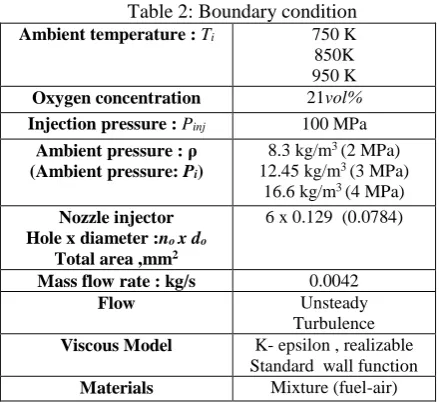
Boundary conditions in this study consider the parameter given and the connectivity between spray and injector in which this boundary condition applies in computational fluid dynamic (CFD) software. This study use CFD ANSYS Fluent software to do the numerical simulation. The boundary conditions used are in the Table 2 below.
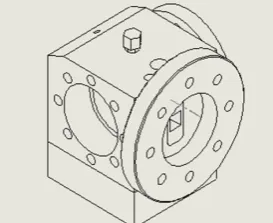
Fig. 6 The Model of the Constant Combustion Chamber.
chamber are cut into one per six pieces which only one nozzle hole is left in order to minimize the error during the simulation.
Table 2: Boundary condition
Ambient temperature : Ti 750 K
850K 950 K
Oxygen concentration 21vol%
Injection pressure : Pinj 100 MPa
Ambient pressure : ρ
(Ambient pressure: Pi)
8.3 kg/m3 (2 MPa) 12.45 kg/m3 (3 MPa)
16.6 kg/m3 (4 MPa) Nozzle injector
Hole x diameter :no x do
Total area ,mm2
6 x 0.129 (0.0784)
Mass flow rate : kg/s 0.0042
Flow Unsteady
Turbulence
Viscous Model K- epsilon , realizable
Standard wall function
Materials Mixture (fuel-air)
3.
Results and Discussion
Generally, the applications of simulation in ANSYS FLUENT 14.5 involve three main stages that have been considered which are pre-processing, solving and post-processing. Besides that, each stage is related and the sequence needs to be followed for better results. Commonly, pre-processing is to create geometry, which is usually done by using CAD tool for examples AutoCAD and Solid Work software and being imported into ANSYS. For the seconds step is mesh generation of a suitable computational domain to solve the flow equations and lastly is solving with post processing. For meshing, it can identify either the fine or coarse level of mesh. While in the post processing stage, the solution solving involves of the governing equation by using solver in CFD software also with data gathering and finally visualization of the data and result.
The main focus of this simulation study was to examine the data length of the liquid, spray penetration and spray pattern of the temperature and pressure prevailing in the constant volume chamber. The simulation tests were carried out at different ambient pressures; 4 MPa, 3 MPa and 2 MPa. It aims to identify the differences form of a spray, the spray area, spray angle and spray penetration at constant volume chamber, using biodiesel at different ambient pressures.
3.1
Form of spray in the constant volume
chamber
In this study, spray form is simulated into 3 conditions; 2 MPa, 3 MPa, and 4 MPa. Figure 7, 8, 9, 10, 11, and 12 show the difference of spray form at different ambient pressure by using 1 spray nozzle and 6 sprays of nozzle of injector.
Fig. 7 The structure of the particle sprays penetration form at ambient pressure of 4 MPa with 1 spray nozzle.
Fig. 8 The structure of the particle spray penetration form at ambient pressure of 4 MPa with 6 sprays nozzle.
Fig. 9 The structure of the particle sprays penetration form at ambient pressure of 3 MPa with 1 spray nozzle.
Fig. 10 The structure of the particle spray penetration form at ambient pressure of 3 MPa with 6 sprays nozzle.
Fig. 12 The structure of the particle spray penetration form at ambient pressure of 4 MPa with 6 sprays nozzle.
Based on the structure of particle spray penetrations shown, the spray form by using 4 MPa ambient pressure gives a good spray form compared to the 3 MPa and 2 MPa of ambient pressures. It is said that the increasing of ambient pressures will affect the spray form. Also, it will increase the fuel-air mixture thus time will increase for own flames.
3.2
Spray angle of constant volume chamber
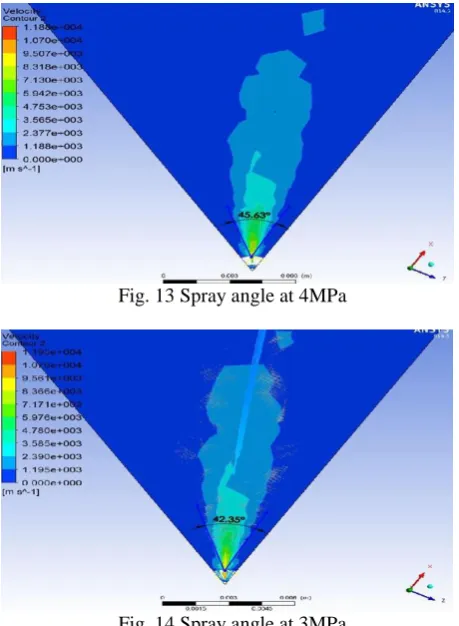
Spray angle also gives the important features to be considered in combustion development. Figure 13, 14, and 15 below show the spray angle in constant volume chamber by using different ambient pressures; 4 MPa, 3 MPa, and 2 MPa.Fig. 13Spray angle at 4MPa
Fig. 14 Spray angle at 3MPa
Fig. 15 Spray angle at 2MPa
Based on the figures above, spray angle at 4MPa gives the biggest angle which is 45.63° compared to spray angle at 3 MPa and 2 MPa which giving 42.35° and 40.85° respectively. Hence, lower ambient pressure gives smaller spray angle in constant volume chamber. Figure 16 below shows the increasing of spray angle regarding the increasing of ambient pressure in which this condition affects the combustion in constant volume chamber.
Fig. 16: Angle versus ambient pressure.
4.
Conclusions
The following conclusions are drawn from this study:
1. Ambient pressure affects the spray form in the constant volume chamber; the higher the pressure, the better the spray form. In addition, changes in ambient pressure also affects the velocity of injector spray; the higher the ambient pressure, the faster the velocity of injector spray.
2. Lower ambient pressure in constant volume chamber still intrude the biodiesel spray burst to be tiny droplets in which these can help in own flame. These conditions affect the spray form, and spray angle in the constant volume chamber.
References
[1] Khalid, A. , Jaat, N., Sapit, A., Razali, A., Manshoor, B., Zaman, I., Abdullah, A.A., 2015,”Performance and emissions characteristics of crude jatropha oil biodiesel blends in a diesel engine” International Journal of Automotive and Mechanical Engineering, Volume 11, Issue 1, Pages 2447-2457, DOI: 10.15282/ijame.11.2015.25.0206.
process of diesel ignition”, SAE Technical Papers, Society of Automotive Engineers of Japan, Inc. and SAE International, DOI: 10.4271/2011-01-1834. [3] Khalid, A., 2013, “Effect of Ambient Temperature
and Oxygen Concentration on Ignition and Combustion Process of Diesel Spray”, Asian Journal of Scientific Research, Volume 6, Issue 3, Pages 434-444, Asian Network for Scientific Information, DOI: 10.3923/ajsr.2013.434-444.
[4] Zakaria, H., Khalid, A., Sies, M.F., Mustaffa, N., Manshoor, B., “ Effect of storage temperature and storage duration on Biodiesel properties and characteristics”, Applied Mechanics and Materials, Volume 465-466, 2014, Pages 316-321, Trans Tech
Publications, Switzerland, DOI:
10.4028/www.scientific.net/AMM.465-466.316 [5] I. V. Roisman, L. Araneo, and C. Tropea,
2007,“Effect of Ambient Pressure on Penetration of a Diesel Spray,”International Journal of Multiphase Flow, Vol. 33, No. 8, Pp. 904–920. [6] Simon Martinez – Martinez, Fausto A. Sanchez –
Cruz, Vicente R.Bermudez And Jose M.Riesco-Avila, 2010,“Liquids Spray Characteristic In Diesel Engine”, In: Daniela Siano (Ed.). Fuel Injection. Intech: Sciyo. 20 – 48 Pages.
[7] Ozg¨Ur O˘guz Tas¸Kiran, 2011,”Experimental Study on Diesel Spray Characteristics and Autoignition Process”, Hindawi Publishing Corporation.
[8] Camille Hespel, Jean-Bernard Blaisot, Xandra Margot, S. Patouna, Armelle Cessou, Bertrand Lecordier, 2010,“Influence of Nozzle Geometry on
Spray Shape, Particle Size, Spray Velocity and Air Entrainment of High Pressure Diesel Spray”, THIESEL.
[9] Yue Wang, “Development of an Integrated CFD Approach for Internal Nozzle Flows and Sprays”, University of Wisconsin-Madison
[10]Romanski, J.; Nowak, P.; Kosinski, K.; Jurczak, J. (Sep 2012). "High-pressure transesterification of sterically hindered esters". Tetrahedron Lett. 53 (39): 5287–5289
[11]Romanski, J.; Nowak, P.; Kosinski, K.; Jurczak, J. (Sep 2012). "High-pressure transesterification of sterically hindered esters". Tetrahedron Lett. 53 (39): 5287–5289
[12]Abbas Ghasemi “Numerical simulation of ultra-high injection diesel and biodiesel fuel sprays” University of Windsor
[13]Pulkrabek, Willard W. Engineering Fundamentals of the Internal Combustion Engine. Upper Saddle River, NJ: Pearson Prentice Hall, 2004
[14]Khalid, A., Yatsufusa, T., Miyamoto, T., Kawakami, J., Kidoguchi, Y., “Analysis of relation between mixture formation during ignition delay period and burning process in diesel combustion”, SAE Technical Papers, 2009, SAE International
![Fig. 1 Transestersfication process [10].](https://thumb-us.123doks.com/thumbv2/123dok_us/8439646.1700876/2.595.312.522.504.571/fig-transestersfication-process.webp)