Journal of Technical Education and Training Volume 2 Number 2 (2010)
15
EFFECTS OF SEGMENTATION OF INSTRUCTIONAL
ANIMATION IN FACILITATING LEARNING
Ahmad Zamzuri Mohamad Ali
Faculty of Art, Computing and Creative Industry Universiti Pendidikan Sultan Idris
35900, Tanjong Malim, Perak, Malaysia Email: [email protected]
Ahmad Rizal Madar
Faculty of Technical Education Universiti Tun Hussein Onn Malaysia 86400, Parit Raja, Batu Pahat, Johor, Malaysia
Email: [email protected]
____________________________________________________________________
ABSTRACT
The aim of this study was to investigate the effects of segmented-animation, play-pause-animation and continuous-animation in facilitating learning of low prior knowledge learners. A courseware prototype entitled Transmission Media was developed for the research purpose. The courseware contains nine animations on various topics in Transmission Media. Pre-test and post-test experimental design was employed on three different groups respectively. The data collected were analyzed statistically by using one-way between-groups ANOVA with post-hoc comparisons. Apparently, the result suggests that segmented-animation was significantly more effective than play-pause-animation and continuous-animation in enhancing students’ learning performance. The result indicates that segmented-animation was beneficial for students in conducting adequate cognitive processes of the information depicted in the animation. Furthermore, the result shows that allowing students to decide the segmentation in play-pause-animation condition does not necessarily promotes better learning. This was due to low prior knowledge students’ inability in deciding the appropriate stop points in animation and/or play-pause-replay button design that might causes split attention effect resulting extraneous cognitive load throughout the learning process.
Key words: Cognition, continuous-animation, interactivity, mental model,
play-pause-animation, segmented-animation
Journal of Technical Education and Training Volume 2 Number 2 (2010)
16 1. Introduction
Utilization of animation has been a key component of the instructional courseware design nowadays. New advances in software technology have spurred the development of new means in conveying information in animation form. Defined as a series of rapidly changing computer screen display that represents the illusion of movement (Mayer, 2001; Rieber & Hannafin, 1988), animation plays potential role in supporting the visualization of a dynamic process such as not easily observable in real space and time scales, the real process that is practicaly impossible to realize in a learning situation, or the process that is not inherently visual (Betrancourt, 2005). Animation also plays potential role in reducing the cognitive cost of mental simulation thus saving cognitive resources for learning task especially for novice learners (Betrancourt, 2005). In its best uses, animation presents information in a more interesting, easier to understand and remembered way than static media (Norton & Sprague, 2001; Rieber, 1990). However, even with these advantages and theoretical support, research findings related to the effectiveness of the animation learning remains inconsistent (Lin & Dwyer, 2010; Ayres, Marcus, Chan & Qian, 2009; Ainsworth, 2008; Hegarty, 2004; Lin & Dwyer, 2004 ; Sperling, Seyedmonir, Aleksic & Meadows, 2003). The main reasons of inconsistencies may attributed to design limitations (Tversky, Morrison & Betrancourt, 2002; Liu, Jones & Hemstreet, 1998) and learners’ learning characteristics such as prior knowledge, spatial visualization ability, learning style, motivation, age, gender and so on (Spanjers, van Gog & van Merrienboer, 2010; Mayer & Moreno, 2002; Chuang, 1999). There are dozens of models and theories on learning characteristics; however this study only focused on novice or low prior knowledge learners. Prior knowledge has significant impact on learning efficiency (Huk, Steinke & Floto, 2003; Mayer, 2001). High prior knowledge students primarily benefit from animation learning in comparison with low prior knowledge students (Kalyuga, 2008; Lin, Ching, Hsu & Dwyer, 2006). This was due to the availability of relevant cognitive schemas that would influence the construction of event model in their cognitive structure which the low prior knowledge students don’t have (Zacks et al., 2007). Therefore, finding design solutions addressing information processing challenges might faced by novice or low prior knowledge students in animation learning seems important. It appears that current approaches to the design and use of animation can be ineffective due to the instructional designers’ failure in addressing these challenges posed for learners (Lowe, 2004).
2. Animation and Cognition
Journal of Technical Education and Training Volume 2 Number 2 (2010)
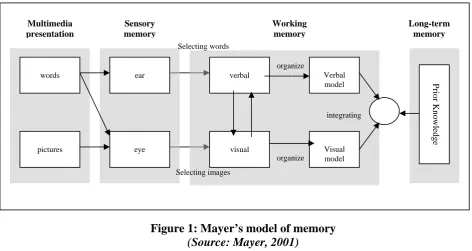
17 into visual mental model. The final process involves integrating the verbal mental model and visual mental model developed with prior knowledge to be stored in long-term memory. Successive learning occurs when learners are able to attend important aspects of the presented material, mentally organize it into meaningful cognitive structure and integrate it with relevant existing knowledge (Mayer & Moreno, 2003, 2002).
Meanwhile, Sweller’s Cognitive Load Theory (Sweller, 2002, 1994) describes learning structures in term of information processing system involving long-term memory which effectively stores all the information gained on more-or-less permanent basis in schema form. Information may only be stored in long-term memory after first being attended to and processed by working memory. Working memory however is extremely limited in both capacity and duration. This limitation under some condition may impede learning especially when learners failed to develop accurate mental model of the visual and verbal information in their working memory. Things may become more crucial for learners with low prior knowledge of the content presented (Muller, Eklund & Sharma, 2006). Cognitive Load Theory assumes that information should be structured to eliminate any avoidable overload on working memory in order to enhance learning outcome (Stiller & Jedlicka, 2010). Cognitive load is mainly divided into three disjoint categories namely extraneous, intrinsic and germane load (Sweller, 2010). Extraneous load is mainly concerned with the instructional procedure or presentation manner, meanwhile intrinsic load is mainly caused by complexity and difficulty of information (Sweller, 2010; Stiller & Jedlicka, 2010). By minimizing extraneous load and intrinsic load, students are more likely to engage in schema acquisition and automation that impose germane load (Stiller & Jadlicka, 2010). Maximizing germane load means fostering schema acquisition which is beneficial for learning (Caspersen & Bennedsen, 2007).
Figure 1: Mayer’s model of memory
(Source: Mayer, 2001) words
pictures
ear
eye
verbal
visual
Verbal model
Visual model Multimedia
presentation
Sensory memory
Working memory
Long-term memory
integrating organize
organize
Prior Knowledg
e
Selecting words
Journal of Technical Education and Training Volume 2 Number 2 (2010)
18 Based on Mayer’s and Sweller’s theories, animation presentation that enables students to extract necessary information from it in order to develop accurate mental model of the information presented is important for successive learning (Lowe, 1999). Continuous flow of changing information in animation may cause cognitive overload and hinders accurate mental model development (Betrancourt & Rebetez, 2007). This is due to inability of learners to process new information while simultaneously trying to remember and integrate important past information, thus creating extraneous load as working memory resources are focused on dealing with demands of the presentation, rather than focused on learning (Ayres, Marcus, Chan & Qian, 2009). However, it appears to be another view claiming that animation triggers passive information processing and may leads to overconfidence (Rozenblit & Keil, 2002). Study by Awan and Stevens (2006) revealed that confidence level of understanding in the animation condition was high in comparison with static media. They pointed out that higher confidence indicates lower mental effort that leads to the perception that animation is easy to process. This situation can keep learners from doing relevant cognitive processes on their own (Schnotz & Rasch, 2005), which may influence the effectiveness of animation learning (van Oostendrop, Beijersbergen & Solaimani, 2008). Therefore, need of studies in finding design solutions addressing these issues are important.
3. Segmented-Animation
Due to the speed and visual complexity of animation, learners may confused and overwhelmed throughout animation viewing as they were unable to properly process all incoming information before it disappears (Ayres, Marcus, Chan & Qian, 2009; van Oostendrop, Beijersbergen & Solaimani, 2008; Lowe, 2004; Wier & Heeps, 2003; Lowe, 1999). Therefore, designs that do not provide appropriate time for learners to focus their attention on the information being presented may be among the reason for failure of animation in assisting learning (Torres & Dwyer, 1991). Without appropriate time allocation, learners may fail to develop new or adapt to existing schemas effectively (Garhart & Hannafin, 1986). Whereas, the more time learners spend interacting with the instructional material, the better they will be able to register the information in the long term memory structure (Slater & Dwyer, 1996).
Segmented-animation with features that allow learners to control the segment viewing rather than passively view the whole animation continuously can be a design solution addressing this drawback (Plass, Homer & Hayward, 2009; Moreno, 2007; Mayer & Moreno, 2003; Mayer & Chandler, 2001). In segmented-animation design, the whole animation will be chunked into meaningful segments, including pause or time break after each segment and learner-control features to move from segment to segment. Thus, pause or time break between segments and learner-control features will allow learners to rehearse in order to extract necessary information from one segment before moving to the following segment. In addition, during the pauses learners can analyze the visual spatial structure of the content on the screen, something that can be difficult to do when a display continuously changes (Lowe, 2004).
Journal of Technical Education and Training Volume 2 Number 2 (2010)
19 interpreting and understanding the animation better (Aminordin, Ng & Fong, 2004; Fong, 2001). Comparison studies on segmented-animation and continuous-animation also revealed that segmented-animation appears to be more beneficial in enhancing students learning performance (Hasler, Kersten & Sweller, 2007; Moreno, 2007; Mayer & Chandler, 2001). However, in these studies segmentation was decided by the instructional author. Question arises; does the same result would be obtained if students were allowed to decide the segmentation? Interactivity with dynamic media has been proposed as a way to encourage students to engage in activities contributing to learning (Wouters, Tabbers & Paas, 2007). In addition, allowing higher degree of interactivity (such as traditional functions of VCR) should be considered in instructional design with assumption that students have the capabilities in managing their cognitive resources for each part of animation (Betrancourt, 2005). Therefore, allowing interactivity in the form of segmenting the animation at own pace may encourage students to focus on sub events or sub steps depicted in an animation that may promote effective animation learning (Spanjers, van Gog & van Merrienboer, 2010). A study by Hasler, Kersten and Sweller (n.d.) revealed that learner-paced animation group showed higher learning performance with relatively lower cognitive load compared to continuous-animation group despite the fact that the stop-play button was used very rarely by students. They suggested that mere presence of the stop-play button along the instructions in its use increased germane cognitive load, thus leading to enhanced learning performance. However, in their study animation was supported with concurrent narration. Question arises again; does the same result will be obtained if the animation was without narration? Since the stop-play button was used very rarely, there might be a possibility that the meaningful narration was the element that supports students learning as pointed out in Mayer’s multimedia design principles (Mayer, 2001). In addition, the intonation of the narration might have guided the students in deciding the meaningful stop points in the animation. Taking these arguments into consideration, this research was focused on studying the effects of interactivity level in segmenting the animation with concentration on animation with text instead animation with narration as study by Hasler, Kersten and Sweller (n.d.).
4. Method
4.1. Research Objective
Based on the literature overview above, the main objective of this research was to study the effectiveness of segmented-animation, play-pause-animation and continuous-animation on learning achievement of students with low prior knowledge. In detailed, the hypothesis or prediction derived from the literature overview done is play-pause-animation is significantly more beneficial in assisting learning of low prior knowledge students in comparison with segmented-animation and continuous-animation.
4.2. Teaching Material
Journal of Technical Education and Training Volume 2 Number 2 (2010)
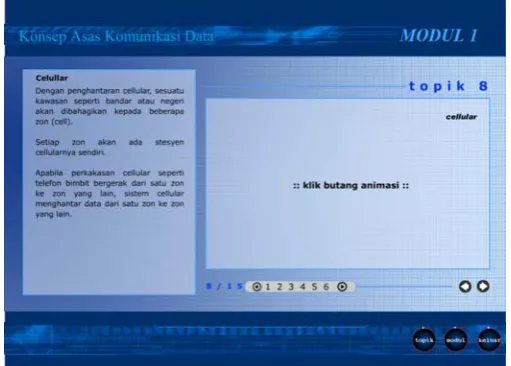
20 interface design and content presentation strategy in reducing cognitive load can be referred in Ahmad Zamzuri (2007, 2008). The proper content presentation design and strategy to reduce any intrinsic load and interface design to reduce any extraneous load is important to avoid factors that may interfere with schema acquisition of students throughout the study (Sweller, van Merrienboer & Paas, 1998).
Figure 2: Courseware interface
Journal of Technical Education and Training Volume 2 Number 2 (2010)
21
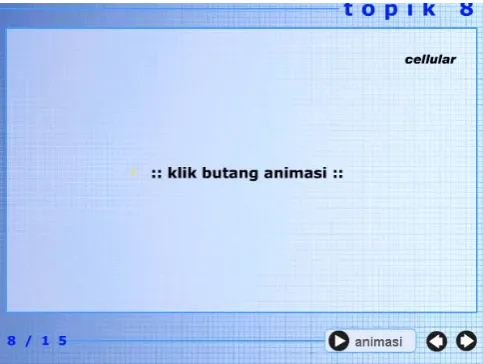
Figure 3: Segmented-animation mode
The second animation mode is continuous-animation (figure 4), which consist same animations but will be displayed continuously when the user clicked the start button.
Figure 4: Continuous-animation mode
Journal of Technical Education and Training Volume 2 Number 2 (2010)
22
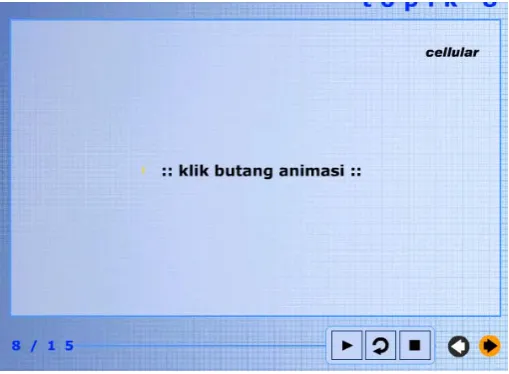
Figure 5: Play-pause-animation mode
4.3. Procedure
This experimental study investigates the effects of three different animation presentation modes on learning achievement of students with low prior knowledge. The independent variables were the segmented-animation, continuous-animation and play-stop-animation meanwhile the dependent variable refers to the post-test. The research sample were 101 polytechnic students from three intact classes, age ranged from 19 to 21, enrolled in Diploma in Information Technology course.
The study was conducted separately for all the groups in controlled lab environment. Pre-test was conducted before the commencement of study. Immediately then, students were required to explore the courseware. 30 seconds were allocated for them to explore the courseware on self-paced learning condition. Each student was allocated one personal computer. Post-test was conducted immediately after the exploring session.
4.5. Test Instrument
Pre-test and Post-test were employed on these groups that viewed the three different animation presentation modes respectively. Pre-test and Post-test were fill in the blank and essay test which was constructed based on Bloom’s Taxonomy. The test only focused on measuring three low cognitive ability of Bloom’s Taxonomy namely knowledge, comprehension and application. The test was examined by three different instructors and the average marks were considered as the final marks. High prior knowledge students were identified through the pre-test results. The high prior knowledge students, which were obviously low, were removed from the research sample. One-way between-groups ANOVA with post-hoc comparisons was employed to analyze the data collected statistically.
5. Results
Journal of Technical Education and Training Volume 2 Number 2 (2010)
23 (p>0.05) and therefore the population variances for each group were approximately equal. The output shows that there was no significant difference in the pre-test achievement of students in segmented-animation, play-pause-animation and continuous-animation modes F(2,98)=2.38, p>0.05. This result further assured that there was no pre-existing difference in prior knowledge by group. Total mean scores of prior knowledge were also obviously low (M=5.72, SD=4.35), which was necessary for the study.
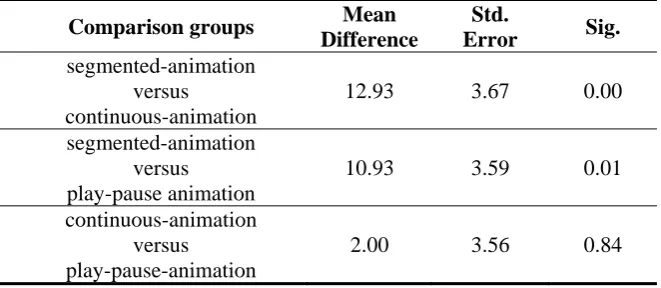
To examine whether there was any significant difference in the learning performance of students in the segmented-animation, play-pause-animation and continuous-animation modes, one-way between-groups ANOVA with post-hoc comparisons was employed on the post-test results. Levene’s test for homogeneity of variances was not significant (p>0.05) and therefore the population variances for each group were approximately equal. The output shows that there was significant difference in the post-test achievement of students in segmented-animation, play-pause-animation and continuous-animation modes F(2,98)=7.22, p<0.05. Results from the post-hoc Tukey HSD test in table 1 shows that there was significant difference between segmented-animation versus continuous-animation (p<0.05) and segmented-animation versus play-pause animation (p<0.05). Meanwhile it appears to be no significant difference between continuous-animation versus play-pause-animation (p>0.05).
Table 1: Summary of post-hoc Tukey HSD comparison between group test
Comparison groups Mean Difference
Std.
Error Sig.
segmented-animation versus
continuous-animation
12.93 3.67 0.00
segmented-animation versus play-pause animation
10.93 3.59 0.01
continuous-animation versus
play-pause-animation
2.00 3.56 0.84
Journal of Technical Education and Training Volume 2 Number 2 (2010)
24 Table 2: Summary of post-test results
Groups N Mean Std. Deviation
segmented-animation 32 69.00 14.61 play-pause animation 36 58.08 15.25
continuous-animation 33 56.07 14.42
6. Discussion
As pointed out earlier, animation has strong research and theoretical support towards effective learning. However, the characteristics of animation that changes over time might impose cognitive overload throughout the learning process. This situation might impede learning especially for students with low prior knowledge. Therefore segmentation was proposed as a potential solution to facilitate students’ cognition in animation learning (Moreno, 2007; Mayer & Moreno, 2003; Mayer & Chandler, 2001). This research finding was inline with the segmentation proposal. Overall, the research finding revealed that students in the segmented-animation mode performed better mean scores than students in other modes which were consistent with many other studies on segmentation (Hasler, Kersten & Sweller, 2007; Moreno, 2007; Mayer & Chandler, 2001). This finding further strengthen the assumption that animation that was chunked into meaningful segments and including pause or time break between segments will allow appropriate time for students to extract necessary information in order to develop more accurate mental model of the process depicted in the animation. With accurate mental model, formation of meaningful schemas to be registered in long-term memory is possible even for students with low prior knowledge. In addition, during the pauses learners can analyze the visual spatial structure of the animation at certain meaningful points which could be impossible if the animation continuously changes. Apparently, pauses play the role of static display at certain meaningful points in animation. Therefore, this situation might overcome the passive cognitive processing phenomena that leads to overconfidence and negative animation learning outcomes as pointed out by Awan and Stevens (2006).
Journal of Technical Education and Training Volume 2 Number 2 (2010)
25 in their study as well. However as pointed out earlier, there was a possibility that students in stop-play animation mode outperformed students in continuous-animation mode due to the support of concurrent meaningful narration and the narration’s intonation that assisted students in deciding the meaningful stop points. Comparison study on the effects of play-pause animation with narration and with text should entail to investigate this assumption. The second potential future study should be on play-pause button design strategies. Play-play-pause-animation might still have positive effect on learning if proper button design solution can be found, especially in minimizing extraneous cognitive load effects throughout the learning process. Among the potential button design strategies are mouse over buttons instead of mouse click buttons, one button with play and pause functions alternately instead of two separate buttons for play and pause, etcetera.
7. Conclusion
Development of computer animation is relatively time-consuming and costly. Therefore, to ensure maximum effectiveness of animation the instructional designer should ground their design based on current research findings and theories. They should not base their design on their own preferences that may or may not work well. Thus, this research finding suggests that segmented-animation presentation has advantage in promoting better animation learning, especially for students with low prior knowledge. Segmented-animation actually plays the role of both dynamic and static display. During the segment viewing, animation assists the learners in construction of an adequate mental model in the working memory. Thus, this supports the formation of more meaningful schemas to be registered in long term memory. Meanwhile, static display during the pauses promotes learners to do relevant cognitive processes on their own by integrating with previous developed schemas. Therefore, combination of passive and active cognition promoted by segmented-animation might play potential role for successive learning.
References
Ahmad Zamzuri Mohamad Ali (2007). Kesan koswer strategi animasi pelbagai kawalan pengguna terhadap prestasi kognitif dan ketekalan pelajar (Effects of various user-controlled animation strategy courseware on the students Cognitive and Retention Skills). Doctor of Philosophy Thesis (unpublished). Pulau Pinang, Malaysia: Universiti Sains Malaysia.
Ahmad Zamzuri Mohamad Ali (2008). Effective instructional courseware design to improve students’ cognitive skills: A practical guide for educators as
multimedia author. Proceedings of the 2ndInternational Malaysian Educational Technology Convention. 245-252.
Journal of Technical Education and Training Volume 2 Number 2 (2010)
26 instruction: Recent innovations in educational technology that facilitate
student learning. (pp. 37-67). Information Age Publishing.
Aminordin Che Lah, Ng, K.T. & Fong, S.F. (2004). Kesan paparan grafik dalam pembelajaran fenomena cuaca (Effects of graphic in learning weather phenomena). Proceedings of 17th Educational Technology Convention, Malaysia. 249-255.
Awan, R.N., & Stevens, B. (2006). Static animated diagrams and their effect on students perceptions of conceptual understanding in Computer Aided Learning (CAL) environments. In McEwan, T., Gulliksen, J., & Benyen, D. (Eds.). People and computers XIX-The bigger picture (pp. 381-389). London: Springer-Verlag.
Ayres, P., Marcus, N., Chan, C., & Qian, N. (2009). Learning hand manipulative tasks: When instructional animations are superior to equivalent static representations. Computers in Human Behavior, 25, 348-353.
Betrancourt, M. (2005). The animation and interactivity principles in multimedia learning. In Mayer, R.E. (Ed.), The Cambridge handbook of multimedia learning (pp. 287-296). New York: Cambridge University Press.
Betrancourt, M., & Rebetez, C. (2007). Building dynamic mental models from animation: Effect of user control on exploration behaviours. Proceedings of the 12th EARLI biennal Conference on Research on Learning and Instruction, Hungary.
Caspersen, M.E., & Bennedsen, J.(2007). Instructional design of a programming course: A learning theoretic approach. Proceedings of the 3rd International Workshop on Computing Education Research, Atlanta, Georgia, USA, 111-122.
Chuang, Y.R. (1999). Teaching in a multimedia computer environment: A study of the effects of learning style, gander, and math achievement. Interactive Multimedia Electronic Journal of Computer-Enhanced Learning. Retrieved May 14, 2010, from http://imej.wfu.edu/articles/1999/1/10/
Fong, S.F. (2001). Kesan animasi terhadap pembelajaran pengetahuan prosedur meiosis di kalangan pelajar pelbagai profil psikologi (Effects of meiosis process procedure animation on learning performance of students with different psychological profile). Doctor of Philosophy Thesis (unpublished). Pulau Pinang, Malaysia: Universiti Sains Malaysia.
Journal of Technical Education and Training Volume 2 Number 2 (2010)
27 Hasler, B.S., Kersten, B., & Sweller, J. (n.d.). The influence of learner control in
instructional animation. Retrieved 1 November, 2010 from http://beatrice.measosworld.ch/animation/
Hasler, B.S., Kersten, B., & Sweller, J. (2007). Learner control, cognitive load and instructional animation. Applied Cognitive Psychology, 21(6), 713-729. Hegarty, M. (2004). Dynamic visualization and learning: Getting to the difficult
questions. Learning and Instruction, 14, 343-351.
Huk, T., Steinke, M., & Floto, C. (2003). Computer animations as learning objects: What is an efficient instructional design, and for whom. Proceedings of IADIS International Conference www/internet, 1187-1190.
Kalyuga, S. (2008). Relative effectiveness of animated and static diagrams: An effect of prior knowledge. Computers in Human Behaviour, 24(3), 852-861.
Lin, C.L., & Dwyer, F. M. (2004). Effect of varied animated enhancement strategies in facilitating achievement of different educational objectives. International Journal of Instructional Media, 31(2), 185-199.
Lin, H., Ching, Y.H., Hsu, Y.C., & Dwyer, F. (2006). The effect of prior knowledge and navigation mode on learning from animation: A cognitive load
perspective. In Pearson, E. & Bohman, P. (Eds.), Proceedings of World Conference on Educational Multimedia, Hypermedia and Telecommunications (pp. 540-546).
Chesapeake, VA: AACE.
Lin, H., & Dwyer, F.M. (2010). The effect of static and animated visualization: A perspective of instructional effectiveness and efficiency. Educational Technology Research and Development, 58(2), 155–174.
Liu, M., Jones, C., & Hemstreet, S. (1998). Interactive multimedia design and
production processes. Journal of Research on Computing in Education, 30(3), 254-281.
Lowe, R.K. (1999). Extracting information from an animation during complex visual learning. European Journal of the Psychology of Education,14, 225-244. Lowe, R.K. (2004). Animation and learning: Value for money. In Atkinson, R.,
McBeath, C., Jonas-Dwyer, D., & Philips, R. (Eds), Beyond the comfort zone: Proceedings of the 21st ASCILITE Conference, Australia, 558-561.
Mayer, R.E., & Chandler, P. (2001). When learning is just a click away: Does simple user interaction foster deeper understanding of multimedia messages? Journal of Educational Psychology, 93(2), 390-397.
Journal of Technical Education and Training Volume 2 Number 2 (2010)
28 Mayer, R.E., & Moreno, R. (2002). Animation as an aid to multimedia learning.
Educational Psychology Review, 14(1), 87-99.
Mayer, R.E., & Moreno, R. (2003). Nine ways to reduce cognitive load in multimedia learning. Educational Psychologist, 38(1), 43-52.
Moreno, R. (2007). Optimising learning from animations by minimizing cognitive load: Cognitive and affective consequences of signalling and segmentation methods. Applied Cognitive Psychology, 21, 765-781.
Muller, D.A., Eklund, J., & Sharma, M.D. (2006). The future of multimedia learning: Essential issues for research. Retrieved 1 November, 2010 from
http://www.aare.edu.au/05pap/mul05178.pdf
Norton, P., & Sprague, D. (2001). Technology for teaching. Needham Heights: Allyn & Bacon.
Plass, J.L., Homer, B.D., & Hayward, E.O. (2009). Design factors for educationally effective animations and simulations. Journal of Computing in Higher Education, 21I(1), 31-61.
Rieber, L.P., & Hannanfin, M.J. (1988). Effects of textual and animated orienting activities and practice on learning from computer-based instruction. Computer in Schools,5(1/2), 77-89.
Rieber, L.P. (1990). Animation in computer based instruction. Educational Technology Research and Development, 38(1), 77-86.
Rozenblit, L., & Keil, F. (2002). The misunderstood limits of folk science: An illusion of explanatory depth. Cognitive Science, 26, 521-562.
Schnotz, W., & Rasch, T. (2005). Enabling, facilitating and inhibiting effects of animations in multimedia learning: Why reduction of cognitive load can have negative results on learning. Educational Technology Research &
Development, 53(3), 47-58.
Slater, R.B., & Dwyer, F. (1996). The effect of varied interactive questioning strategies in complementing visualized instruction. International Journal of Instructional Media, 23(3), 273-280.
Spanjers, I.A.E., van Gog, T., & van Merrienboer, J.J.G. (2010). A theoretical analysis of how segmentation of dynamic visualizations optimizes students’ learning. Educational Psychology Review (review article). Retrieved May 22, 2010 from
Journal of Technical Education and Training Volume 2 Number 2 (2010)
29 Spanjers, I.A.E., Wouters, P., van Gog, T., & van Merrienboer, J.J.G. (2010). An
expertise reversal effect of segmentation in learning from animations. Computers in Human Behavior (in press).
Sperling, R.A., Seyedmonir, M., Aleksic, M., & Meadows, G. (2003). Animations as learning tools in authentic science materials. International Journal of
Instructional Media, 30(2), 213-222.
Stiller, K.D., & Jedlicka, R. (2010). A kind of expertise reversal effect:
Personalisation effect can depend on domain-specific prior knowledge. Australasian Journal of Educational Technology, 26(1), 133-149.
Sweller, J. (1994). Cognitive load theory, learning difficulty and instructional design. Learning and Instruction, 4, 295-312.
Sweller, J., van Merrienboer, J.J.G., & Paas, F. (1998). Cognitive architecture and instructional design. Educational Psychology Review, 10, 251-296.
Sweller, J. (2002). Visualization and instructional design. Proceedings of the International Workshop on Dynamic Visualization and Learning, Germany, 1501-1510. Retrieved 24 May, 2010 from http://www.iwm-kmrc.de/
workshops/visualization/sweller.pdf
Sweller, J. (2010). Element interactivity and intrinsic, extraneous, and germana cognitive load. Educational Psychology Review, 22, 123-138.
Torres, J., & Dwyer, F. (1991). The effect of time in instructional effectiveness of varied enhancement strategies. International Journal of Instructional Media, 18, 26-31.
Tversky, B., Morrison, J.B., & Betrancourt, M. (2002). Animation: Can it facilitate? International Journal of Human Computer Studies, 57, 1-16.
van Oostendorp, H., Beijersbergen, M.J., & Solaimani, S. (2008). Conditions for learning from animations. Proceeding of the 8th International Conference on Learning Science, The Netherlands, 438-445.
Weir, G.R.S, & Heeps, S. (2003). Getting the message across: Ten principles for web animation. 7th IASTED International Conference on Internet and Multimedia and Applications, 121-126.
Wouters, P., Tabbers, H.K., & Paas, F. (2007). Interactivity in video-based models. Educational Psychology Review, 19 (3), 327-342.