*) Corresponding Author , E.mail: [email protected]
Asian Journal of Nanoscience and Materials, 2018, 1(4), 225-233.
Interaction Parameters for CuCl
2Plus Orange G (OG) at 19.1
oC
Using Carbon Glassy Electrode (CGE) in KCl Aqueous Solutions
Esam A. Gomaaa, *, Moustafa A. Diabb, Adel Z. El Sounbatib, , Hamed M. Abou
El-Nadera, Asmaa M. Helmyb
a Chemistry Department, Faculty of Science, Mansoura University, 35516-Mansoura, Egypt bChemistry Department, Faculty of Science, Damietta University, Damietta, Egypt.
Received: 01 July2018, Revised: 17 September2018 and Accepted: 23 September 2018.
ABSTRACT: The redox mechanisms were examined for copper chloride in the absence and presence of Orange G (OG) as organic ligand at 19.1°C using carbon glassy electrode (CGE). The supporting electrolyte was 0.1 M KCl whose effect of scan rate was also studied for the redox reactions for CuCl2 alone and in the presence of the ligand, orange G (OG). Stability constants for the
complex formed from the interaction of CuCl2+ Orange G (OG) were evaluated with the different
thermochemical data. Effect of different scan rates was done for cupric chloride in the absence and presence of the ligand Orange G (OG).The different scans are 0.1, 0.05, 0.02 and 0.01 V/Sec. The stability constants and Gibbs free energies of complexation were also estimated for the interaction of CuCl2 with Orange G (OG) in 0.1M KCl supporting electrolyte.
KEYWORDS: Solvation parameters, cyclic voltammetry, copper chloride, orange G (OG), glassy carbon electrode (CGE).
GRAPHICAL ABSTRACT:
1.0 0.5 0.0 -0.5 -1.0 -0.00040
-0.00035 -0.00030 -0.00025 -0.00020 -0.00015 -0.00010 -0.00005 0.00000 0.00005 0.00010 0.00015 0.00020 0.00025
3.32 x10⁻⁴
M CuCL2
4.98 x10⁻⁴ M CuCL 2
6.62 x10⁻⁴
M CuCL2
8.26x10⁻⁴ M CuCL 2
9.90x10⁻⁴ M CuCL 2
1.06 x10⁻³
M CuCL2
1.32 x10⁻³ M CuCL 2
1.64 x10⁻³
M CuCL2
1.96 x10⁻³ M CuCL 2
2.28 x10⁻³
M CuCL2
2.60x10⁻³ M CuCL 2
2.91x10⁻³M CuCL
media
C
u
rre
n
t (Amp
)
Potential (E/V) vs (Ag/AgCl
1. Introduction
Extraction of metal ions as pollutants from
aqueous solutions using electrochemical
methods is very interesting for
environmental aim [1-6]. Several metal ions
in solutions can be recorded and examined
226 Gomaa et all.
Asian Journal of
Nanoscience and
Materials
by the reduction of the different cathode
materials [6,7].
In this work, estimation and electrochemical
voltammetric analysis of copper ions in 0.1
M KCl was studied to explain the
characteristics for evaluating it in the
environmental samples. Bending copper
with ligands is a treatment for remediation
of Cu in vivo and vitro [7]. Long exposure
to copper causes many problems, irritation
in eyes, nose, mouth, causes headaches,
dizziness, vomiting and diarrhea. High
uptake copper causes kidney and liver
damages [7].
Copper is vital dietary, small amount of
metal is needed for well-being [8]. Copper
[9] is most third abundant metal in the body
[8-10].
In this work, estimation and electrochemical
voltammetric analysis of copper ions in
0.1M KCl was studied for explaining the
characteristics for evaluating it in the
environmental samples.
2. Experimental
The used chemicals, CuCl2, KCl, are of high
purity from Sigma Aldrich Co.Orange G
(OG) is of the type Ranken (Ranbaxy). The
volume of the experimental solution is 30
ml. Three electrodes cell was used to
connect to potential DY 2000 Potentiostat ,
Ag /AgCl, KCl sat., reference electrode,
carbon glassy electrode (CGE) was used as
working electrode, platinum wire was also
used as auxiliary electrode.N2 flow was
done to ensure oxygen removal.The carbon
glassy electrode (CGE) is prepared in our
laboratory from pure carbon piece, polished
with aluminum oxide on wool piece. Area
of electrode is 0.502 cm2.
3. Results and discussion
3.1. Electrochemical behavior of CuCl2 in
absence of Orange G (OG)
Studying the electrochemical behavior for
CuCl2 in 0.1M KCl supporting at19.1oC
was done in the range from +1V to -1V. In
the range -1 to +1V oxidation took place,
but scanning in the range of +1 and-1
permits and allows the copper reduction
processes and ligand reduction.The change
of Cu (II) to the Cu (I) state involves the
reduction of metal ion radius [11]. Cyclic
voltammogram between 1 and -1 V(Volt)
show redox processes explaining C(II) /
Cu(I) and Cu(I)/Cu(0) processes appearing
Gomaa et all. 227 Asian Journal of
Nanoscience and
Materials
1.0 0.5 0.0 -0.5 -1.0 -0.00040
-0.00035 -0.00030 -0.00025 -0.00020 -0.00015 -0.00010 -0.00005 0.00000 0.00005 0.00010 0.00015 0.00020 0.00025
3.32 x10⁻⁴ M CuCL 2
4.98 x10⁻⁴
M CuCL2 6.62 x10⁻⁴
M CuCL2
8.26x10⁻⁴ M CuCL 2
9.90x10⁻⁴
M CuCL2 1.06 x10⁻³
M CuCL2
1.32 x10⁻³ M CuCL 2
1.64 x10⁻³
M CuCL2 1.96 x10⁻³
M CuCL2
2.28 x10⁻³ M CuCL 2
2.60x10⁻³
M CuCL2 2.91x10⁻³
M CuCL media
C
u
rre
n
t (Amp
)
Potential (E/V) vs (Ag/AgCl
Fig. 1. Cyclic voltammograms of different concentration of CuCl2 in 0.1M KCl solutions at 19.1oC.
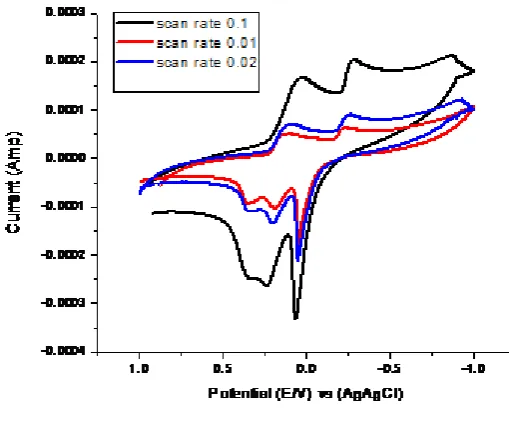
Scan rate was also studied for 6.62×10⁻⁴ M
of CuCl2, at 0.01,0.02,0.05 and 0.1V/S,
which are 100, 10, 20 ,50 mV/Second. All
redox waves were appeared to increase with increasing scan rates as shown in Fig. 2.
Fig. 2 Different scan rates of 6.62×10⁻⁴ M CuCl
228 Gomaa et all.
Asian Journal of
Nanoscience and
Materials
1.0 0.5 0.0 -0.5 -1.0 -0.0004
-0.0003 -0.0002 -0.0001 0.0000 0.0001 0.0002 0.0003
2.20 x10⁻³ M Orange
2.15 x10⁻³
M Orange 2.10 x10⁻³ M Orange
2.05 x10⁻³ M Orange
2.00 x10⁻³
M Orange 1.96x10⁻³ M Orange
1.92 x10⁻³ M Orange
1.88 x10⁻³
M Orange 1.84 x10⁻³ M Orange
1.55 x10⁻³ M Orange
1.35 x10⁻³ M Orange
2.91x10⁻³ Cucl 2
C
u
rre
n
t (Amp
)
Potential (E/V) vs (Ag/AgCl
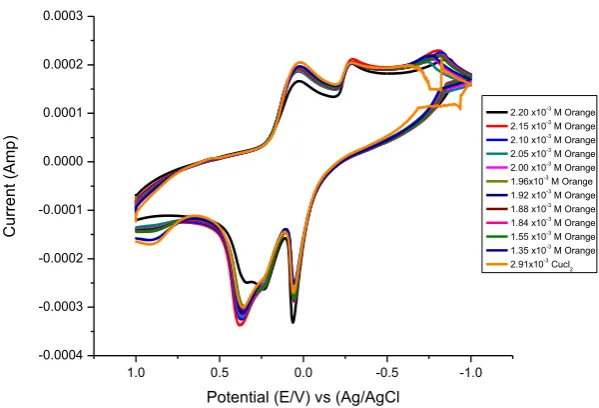
Fig. 3. Voltammograms of the interaction of different concentrations of Orange G (OG) with 1 mM CuCl2 in 0.1M KCl supporting electrolyte.
0.6 0.4 0.2 0.0 -0.2 -0.4 -0.6 -0.8 -1.0 -0.0004
-0.0003 -0.0002 -0.0001 0.0000 0.0001 0.0002 0.0003
0.0004 complex scan rate 0.1
(complex scan rate 0.01) (complex scan rate 0.02) (complex scan rate 0.05)
C
u
rre
n
t (Amp
)
Potential (E/V) vs (AgAgCl)
Fig. 4. Effect of different scan rates for 1:1 (Metal/OG) stoichiometries complexes.
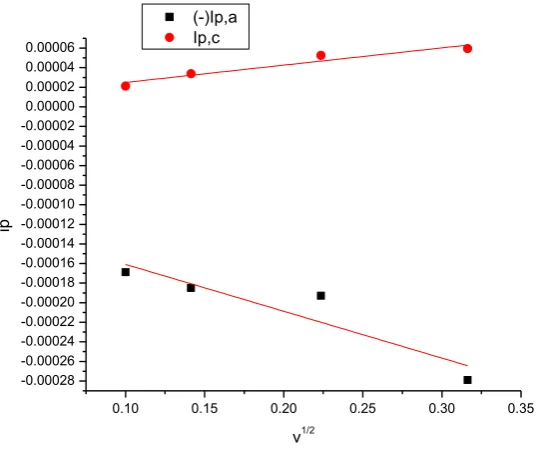
Diffusion reactions are supported from the
relation of an ip against v1/2.
3.2. Cyclic Voltammetry of CuCl2 in
presence of ligand Orange G
The electrochemical behavior of the complex, formed from the interaction of CuCl2 with Orange G, was studied cyclic
Gomaa et all. 229 Asian Journal of
Nanoscience and
Materials
activity in the range studied showed pattern at all Cucl2 concentrations that may
consider as the sum of individual processes [11-14].
[Cu (IIǀ) OG]+e- ⇄ [ Cu(I)OG] (1) Diffusion controlled reaction are appearing and proved from the relation between ip and v1/2.
0.10 0.15 0.20 0.25 0.30 0.35 -0.00010
-0.00008 -0.00006 -0.00004 -0.00002 0.00000 0.00002 0.00004 0.00006 0.00008 0.00010 0.00012
(-)Ip,a Ip,c
ip
v1/2
Fig. 5. The relation between ip and v1/2 for first redox couple waves in absence of (OG).
0.10 0.15 0.20 0.25 0.30 0.35
-0.00028 -0.00026 -0.00024 -0.00022 -0.00020 -0.00018 -0.00016 -0.00014 -0.00012 -0.00010 -0.00008 -0.00006 -0.00004 -0.00002 0.00000 0.00002 0.00004 0.00006
(-)Ip,a Ip,c
ip
v1/2
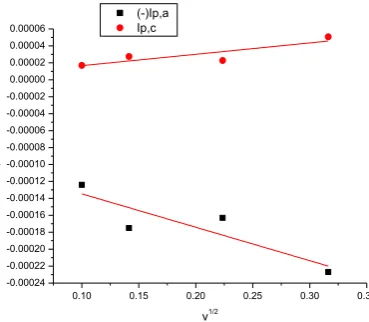
Fig.6. The relation between ip and v1/2 for second redox couple waves in the absence of (OG)
Voltammetric response of complexes explains the reduction and oxidation of metal centered processes.
Cyclic Voltammetry scanning of the complex formed from the interaction of
CuCl2 with orange G (OG) between +1 and
230 Gomaa et all.
Asian Journal of
Nanoscience and
Materials
The ratio between cathodic current of the peak and square root of scan (IPC/ν1\2) is
approximately constant.
0.10 0.15 0.20 0.25 0.30 0.35 -0.00014
-0.00012 -0.00010 -0.00008 -0.00006 -0.00004 -0.00002 0.00000 0.00002 0.00004 0.00006 0.00008 0.00010 0.00012 0.00014 0.00016
(-)Ip,a Ip,c
ip
v1/2
Fig. 7. The relation between ip and v1/2 for first redox couple waves in presence of (OG).
Reaction of CuCl2with gradual addition of
ligand orange G (OG) was recorded until 1:3 (M/Ligand) molar ratio was reached. Change in color and in electrochemical behavior was clear from the first addition. The changes increase when the ligand additions increase. Wave Cu (IIǀ)/Cu(I)
complexes appears at higher concentrations of orange G (OG).
The relations between iP and v1/2 for CuCl2
solutions in the absence and presence of Orange G (OG) for the first copper ion couple of redox reactions and second couple of redox reaction gave straight lines proving the reversibility of the system studied, (Figs.5-8).
0.10 0.15 0.20 0.25 0.30 0.35
-0.00024 -0.00022 -0.00020 -0.00018 -0.00016 -0.00014 -0.00012 -0.00010 -0.00008 -0.00006 -0.00004 -0.00002 0.00000 0.00002 0.00004 0.00006
(-)Ip,a Ip,c
ip
v1/2
Fig. 8. The relation between ip and v1/2 for first redox couple waves in presence of (OG).
The equations used for the cyclic voltamogram (CV) analysis and further
Gomaa et all. 231 Asian Journal of
Nanoscience and
Materials
Table1. Analysis data for the different cyclic voltammograms of copper chloride ions in absence of orange G (OG) in 0.1M KCl.
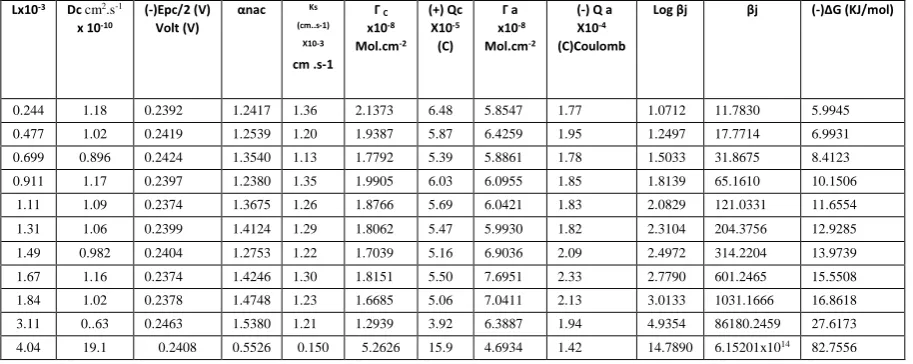
Table 2. Effect of concentration for ligand Orange G (OG) at 0.1 scan rate for 1mM CuCl2 at 19.1⁰C (Cu+1 ↔Cu0).
Lx10-3 Dc cm2.s-1
x 10-10
(-)Epc/2 (V) Volt (V)
αnac Ks (cm..s-1)
X10-3
cm .s-1 Γ C
x10-8 Mol.cm-2 (+) Qc X10-5 (C) Γ a x10-8 Mol.cm-2
(-) Q a X10-4
(C)Coulomb
Log βj βj (-)∆G (KJ/mol)
0.244 1.18 0.2392 1.2417 1.36 2.1373 6.48 5.8547 1.77 1.0712 11.7830 5.9945
0.477 1.02 0.2419 1.2539 1.20 1.9387 5.87 6.4259 1.95 1.2497 17.7714 6.9931
0.699 0.896 0.2424 1.3540 1.13 1.7792 5.39 5.8861 1.78 1.5033 31.8675 8.4123
0.911 1.17 0.2397 1.2380 1.35 1.9905 6.03 6.0955 1.85 1.8139 65.1610 10.1506
1.11 1.09 0.2374 1.3675 1.26 1.8766 5.69 6.0421 1.83 2.0829 121.0331 11.6554
1.31 1.06 0.2399 1.4124 1.29 1.8062 5.47 5.9930 1.82 2.3104 204.3756 12.9285
1.49 0.982 0.2404 1.2753 1.22 1.7039 5.16 6.9036 2.09 2.4972 314.2204 13.9739
1.67 1.16 0.2374 1.4246 1.30 1.8151 5.50 7.6951 2.33 2.7790 601.2465 15.5508
1.84 1.02 0.2378 1.4748 1.23 1.6685 5.06 7.0411 2.13 3.0133 1031.1666 16.8618
3.11 0..63 0.2463 1.5380 1.21 1.2939 3.92 6.3887 1.94 4.9354 86180.2459 27.6173
4.04 19.1 0.2408 0.5526 0.150 5.2626 15.9 4.6934 1.42 14.7890 6.15201x10¹⁴ 82.7556
The cyclic voltammetry analysis data given in Table 1 like the electron rate constant at the working electrode in analysis of CuCl2
alone and other analysis are done in presence of Organe G (OG) . Most of the data given in Table 2 are greater than that given in Table 1 indicating ligand effect of the cyclic voltammograms.All data in Tables 1 and 2 are calculated using equations explained previously in other work [11].
The complex stability constant which measure the strength and power of interaction between CuCl2 and Orange G
(OG) is very important. The complexation stability constant(B) for the interaction of CuCl2 with Orange G (OG) forming
complex in 0.1M KCl is calculated by applying equation (2) [15-17]. ks the electron transfer rate constant,The surface coverage for the electrode in the anodic part Γ C of measurements and surface coverage of working electrode during the anodic measurements Γ a,quantity of electricity at
M x10 -4 EPa (V) Epc (V)
∆EP ipa
X10-5 (A)
ipc X10-5
(A)
ipa/ipc (-)Eo
(V) Da
X10-10
cm2.s-1
Dc
x10-10
cm2.s
-1
(-)Epc/2
(V)
αna Ks
Cx10-4 cm.s-1 Γ Cx10-8 (mol.cm -2) (+) Qcx10-5 (C) Γ ax10-8 (mol.cm -2) (-) Q ax10-5 (C)
6.62 0.0033 0.37 0.370 0.26 0.717 0.364 0.188 0.0215 0.16 0.34 1.84 9.41 0.2385 O.7.2 0.0869 0.264
99.0 0.0102 0.31 0.321 3.12 2.53 1.234 0.150 1.3703 0.90 0.27 1.43 12.0 0.8412 2.55 1.0383 3.15
13.2 0.0113 0.30 0.311 0.11 2.15 0.530 0.144 0.1031 0.36 0.27 1.93 8.05 0.7135 2.16 378.65 11.5
16.4 0.0173 O.20 0.313 5.90 2.35 2.51 0.13 1.7848 0.28 0.26 1.66 6.67 0.780 2.37 1.9620 5.94
19.6 0.0311 0.28 0.312 11.2 3.32 3.38 0.12 4.5219 0.39 0.25 1.83 8.24 1.102 3.34 3.7353 11.3
22.8 0.0406 0.27 0.319 15.7 4.15 3.78 0.11 6.5594 0.45 0.25 1.72 9.17 1.381 4.19 5.2315 15.8
26.0 0.0426 O.01 0.042 19.9 5.35 3.72 0.02 8.1153 0.58 0.24 0.19 0.22 1.778 5.39 6.6287 20.1
29.1 0.0541 0.27 0.326 21.6 4.75 4.54 0.10 7.5679 0.36 0.24 1.67 8.67 1.579 4.79 7.1781 21.7
8.26 0.0063 0.32 0.326 1.99 1.25 1.58 0.15 0.7965 0.31 0.29 2.15 9.16 0.415 1.26 0.6607 2.00
6.62 0.0033 0.37 0.370 0.26 0.71 0.36 0.18 0.0215 0.16 0.34 1.84 9.41 0.238 O.7.2 0.0869 0.264
232 Gomaa et all.
Asian Journal of
Nanoscience and
Materials
the working electrode in anodic and
cathodic cyclic voltammograms
measurements indicate good complexation between CuCl2 and Orange G (OG)[14-18].
(Ep)m-(EP)C=2.303 RT/nF log βc+2.303 RT/nF log
(Cx)
(2)
Where(Ep)m is peak potential for the metal salt in absence of orange G(OG) and (Ep)C is the peak potential of the complex , R gas constant &Cx is the concentration, solution
of metal salt in presence of orange G (OG). The thermo chemical Gibbs free energy of interaction, salvation of CuCl2 + orange G
(OG)
were calculated [18-31] using equation (3). Thermochemical parameters for complex interactions between CuCl2 with Orange G
(OG) prove the stability of the complex formed (Table 1).
All data given in proving the reversible diffusion process of the system under consideration.
4 .Conclusion
Reversible diffusion interaction between CuCl2 and Orange (G) was concluded .The
stability constants and Gibbs free energies of complex interactions are increased with increase in ligand orange G (OG) concentrations indicating more interactions forming complex in the solutions.The electron transfer rate constant ks, surface coverage anodic (Γa) and cathodic (ΓC) are
mainly decreased by increase in orange G (OG) concentration , indicating more complexation. Also, the anodic and cathodic quantity of electrictity around the working electrode during measurement is increased with increase orange G concentration due to the complex formed.
Acknowledgments
Thanks to Prof. Dr.Mamdouh Abdel Mogib head of Chemistry Department , Mansoura University for
facilitating the co-operation between Mansoura University and Damietta University.
References
1. Hunsin M, Prmksakorn K.,
Damonglerd S , Vegnesk H, Duverneuit P (2005) Water Res 39:610-616.
2. Kaminaria NMS , Shult D R, Ponte MJ, Ponte HA, MarinaCE, Neta AC
(2007)Chem Eng J 126: 139-146 3. Basha CB, Bhadrinarayana NS,
Anantharaman N, Begam KM
(2008)J Hazard Mater 152:71-78. 4. Doulabes L , Nory K, StuchiS,
Comninellis Ch (2000) Electrochim Acta , 46 : 349-356.
5. Yang CC (2003) J Power Sources, 115:352-359.
6. Brandon NP, Pilone D, Kelson GH, Yin Q (2003) J Appl Electrochem 23 :853-862.
7. Osredkar Josko and Sustar Natasa
(2011)J Clinical Toxilology 2-18. 8. Pizarro Araya M, Olivares F,
Arredonda M, Gonzalez M (2006)
Biol Res 183-187.
9. Eva France Eva, Elena L′Opez-Torres Elena, Mendiola MA, Teresa M, Sevilla S (2000) Polyhedron,19: 441-451
10.Seleem HS,Emara AA,Shebl (2007)
J Corrdin Chem 58:1003—1019.
11.EL-Shereafy SE, Gamaa EA,. Yousif AH and Abou El-Yazed AS
(2017)Iranian Journal of Materials Science & Engineering 14 :11-20. 12.Ka Telhan Enna and Compton
Richard G(2015)ChemEloChem 2 : 64-67.
13.Eloul Shaltiel and Compton Richard G (2015) J. Phys. Chem. C,
Gomaa et all. 233 Asian Journal of
Nanoscience and
Materials
114:27540-27549.
14.Nicholson Richard S (1965) Analytical Chemistry 37: 1351-1355.
15.El-Askalany Abdel Moneum, Abou –EL-Magd Mohamed (1995) Chem Pharm Bull 42: 1791-1792.
16.Ibrahim KM, Gomaa EA , Zaky
RR, Abdel Hady M (2012)
American Journal of Chemistry 2:23-26.
17.Gomaa Esam A(2012) International Journal of Materials and Chemistry, 2 (1)(2012)16-18.
18.Gomaa Esam A (2012) Physics and Chemistry of Liquids 50:279-283. 19.Gomaa Esam A (2012) American
Journal of Polymer Science, 2 :35-47.
20.Gomaa Esam A(2012) American
Journal of Enivronmental
Engineering 2: 54-57.
21.Gomaa Esam A( 2012) Eur Chem Bull, 2:732-735.
22.Gomaa Esam A, Abou Ellef E M
and Mahmoud EA (2013) Eur Chem Bull 2:732-737
23.Gomaa Esam A (2012)International
Journal of Theoretical And
Mathematical Physics 3(:151,154. 24.Gomaa Esam A , Jahdali BA (2012)
Eduction,2(3:25-28.
25.Gomaa Esam A(1986) Indian J of Tech 24:725-726.
26.Gomaa Esam A and Beghit G (1990)
Asian J of Chem 21:444 449.
27.Gomaa Esam A(1984) Thermochim Acta, 80:355.
28.Gomaa Esam A(1989) Croatica Chimica Acta, 62:)475.
29. Gamaa Esam A, Mousa MA and El-Khouly AA (1985) Thermochim Acta 86:351.
30.Gomaa Esam A,. Morsi Mohamed A., Negm Amr E. and. Sherif Yara A (2017) Int J of Nanodimens 8:89-96.
How to cite this manuscript:Esam A. Gomaa*, Moustafa A. Diab, Adel Z. El Sounbati, Hamed M. Abou El-Nader, Asmaa M. Helmy. Interaction Parameters for CuCl2 Plus