Flexible Cotton Fabric Based Circuitry by Using Graphene Oxide for
ECG Applications
Syafiqah M. Jusob1, Nurul A. Abdul-Kadir1, Fauzan K. C. Harun1,2*, and Dedy H. B. Wicaksono3
1Faculty of Biosciences and Medical Engineering, UniversitiTeknologi Malaysia, 81310 UTM Johor Bahru,
Johor, Malaysia.
2Faculty of Electrical Engineering, Universiti Teknologi Malaysia, 81310 UTM Johor Bahru, Johor, Malaysia. 3Faculty of Life Sciences and Technology, Swiss German University,Kota Tangerang, Banten 15143,
Indonesia.
ABSTRACT
In the development of electrocardiography (ECG) systems for long term monitoring, flexible circuit is often required. However, polymer-based circuits usually required more complex fabrication process and possess limited flexibility. In this study, flexible electro-conductive pattern using cotton fabric as the substrate is proposed. The purpose of this study is to investigate the effect of mechanical disturbance to the cotton fabric-based conductive patterns. Reduced graphene oxide is used as the conductive material. The electro-conductive pattern is fabricated using wax patterning and pipetting methods. A 20 mm long and 1 mm wide electro-conductive pattern is fabricated and pipetted with 10 layers of conductive ink. The results show that 70 % of the electro-conductive pattern remained its conductance after 5 times of washing process. Besides, the conductive pattern remained higher than 60% of its conductance after 10 acute and obtuse folding cycles, respectively.The electroconductive line has been proven to possess a high stability against the mechanical disturbances which is one of the vital characteristics for a flexible circuit.
Keywords: Conductive Pattern, Cotton Fabric, ECG System, Flexible Circuit, Graphene
Oxide.
1. INTRODUCTION
In the development process of flexible ECG monitoring systems, flexible circuits integrated with printed circuits and flexible substrates are required in order to allow a better performance during long-term ECG measurement and to enhance patients comfort.
Several types of substrates such as polymers and papers have been used to satisfy the flexibility properties [1] [2]. Some of the researchers have developed ECG circuit designs which allow for multi measurement such as electromyogram [3], skin temperature monitor [4], and heart rate variability [5]. However, polymer-based circuits have complex fabrication process [4], and the use of polymer itself will cause environmental effects [6]. Alas, the conductive connections on the paper-based circuits may easily be affected as they are being folded or crumpled, making them inapt to be used for long term monitoring [2].
In this study, cotton fabric, a cellulosic material is proposed as a potential substrate material for the fabrication of flexible circuit because of its highly flexible property as compared to polymers and papers. Besides, cotton fabric is also easily available at an affordable price [7], biocompatible, and aesthetically acceptable [8].
2
The purpose of this study is to investigate the effect of mechanical disturbance to the cotton fabric-based conductive patterns. The conductive substrate used in this study is graphene oxide ink. One of the properties of graphene oxide is its ability as a substrate to be used for excellent coating purpose. However, reduction of graphene oxide is needed in order to increase the electronic conductivity [9].
2. EXPERIMENTAL PROCEDURE
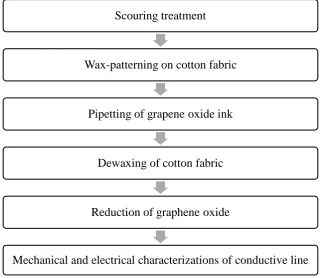
Several steps are needed to complete this study. Figure 1 show the processing steps involved in the fabrication of electroconductive patterns on cotton fabric.
Figure 1. The processing steps to fabricate electroconductive patterns on cotton fabric.
According to Figure 1, there are six processes to fabricate electroconductive patterns on the cotton fabric. The processes are scouring treatment, wax-patterning on cotton fabric, pipetting of graphene oxide, dewaxing, reduction of graphene oxide, and mechanical characterizations of conductive line. Further explanation is as follows.
First, scouring treatment is performed to remove the natural and man-made impurities present on the cotton fabric, such as dust, waxes, or lubricants which are used during the fabric fabrication process. This treatment is important in order to make the fabric more hydrophilic which allows a stronger bond produced between the fabric and the conductive ink. Initially, the cotton fabric is cut into 10 small pieces with dimension of 10cm x 10 cm. Next, 10mg ml -1anhydrous sodium carbonate (Na2CO3) is boiled in 1000 ml of Millipore purified water until the temperature reached 100°C. After the Na2CO3 is dissolved, the small piece of cotton fabric is immersed into the solution for 10 minutes. The fabric is then rinsed with Millipore purified water until the pH value of the rinsed water is changed to neutral range; pH of 6 to 7. Finally, the fabric piece is let to be dried at room temperature which is 25˚C [10]. The procedure is repeated for all fabric pieces each at a time until complete.
Scouring treatment
Wax-patterning on cotton fabric
Pipetting of grapene oxide ink
Dewaxing of cotton fabric
Reduction of graphene oxide
3 Next, a mixture of wax is first prepared by mixing candelillawax and beeswax at the ratio of 1 to 3. Wax-impregnated paper is fabricated by dipping a paper in the melted wax mixture for a few seconds and let to be dried at room temperature (25°C). Patterns of conductive lines are designed using Silhouette Studio software, and are cut on the wax-impregnated paper using digital craft cutter. The wax-impregnated patterned paper is fixed onto the scoured cotton fabric and then it is placed between two pieces of folded papers. Then, the wax is remelted using a laminating machine with the set temperature at 120°C. The melted wax will spread onto the surface of the cotton fabric which results in the formation of hydrophobic and hydrophilic regions.
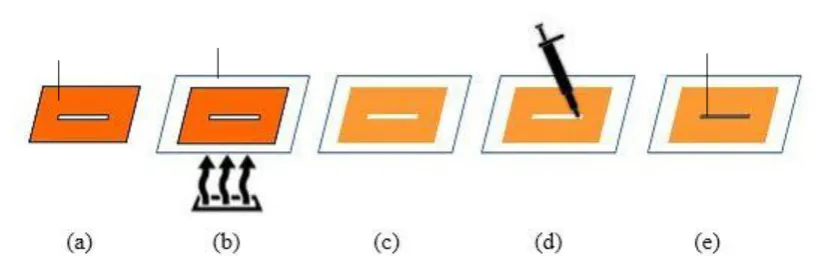
Graphene oxide-coated cotton fabric is fabricated by using pipetting method. 2.00 μl of graphene oxide ink is used to cover 1 mm high and 20 mm wide of the hydrophilic region of cotton fabric surface. Then, the cotton fabric is let to be dried for 45 minutes at room temperature (25°C). The pipetting and drying processes are repeated for 10 times to obtain samples with higher conductivity. Figure2 below shows the schematic illustration of fabrication of electroconductive patterns of cotton fabric.
Figure 2. Schematic illustration of the fabrication of conductive line on cotton fabric: (a) Aprepared wax-impregnated paper cut using digital craft cutter, (b) wax-wax-impregnated paper fixed onto the cotton fabric
and passed through heating treatment, (c) wax deposited on the cotton fabric and produced the formation of hydrophobic barrier and hydrophilic channel, (d) graphene oxide ink pipetted on the
hydrophilic channel, and (e) Afabricated conductive line.
After that, dewaxing processis done to remove the wax on the cotton fabric. 10g of 10mg ml-1 Na2Co3 is boiled in 1000 ml of Millipore purified water until the temperature reached 100°C. After the Na2CO3 is dissolved,a piece of cotton fabric is immersed in the solution and is taken out after 10 minutes. The fabric is then rinsed with Millipore purified water until the pH value of the rinsed water is changed to neutral range; pH of 6 to 7. Finally, the fabric is let to be dried at room temperature (25˚C) before being used in the next process.
Subsequently, grapheneoxide-coated cotton fabric is chemically reduced to convert the nonconductive graphene oxide into conductive reduced graphene oxide. Multi reduction is performed in this reduction process with ascorbic acid (C4H8O6) as the reducing agent. Six samples of graphene oxide-coated cotton fabric are immersed in 300 ml of 0.05 M C4H8O6 aqueous solution. Then, the solution is kept at 95 ˚C for 60 minutes under constant stirring. After that, the cotton fabric samples are rinsed with large amount of distilled water to remove the excessive of C4H8O6 solution [11] [12] and dried at room temperature (25°C).
Following that, washing process is performed to observe the effect of washing towards the conductivity of the reduced graphene oxide-coated cotton fabric. A solution is prepared by pouring 2 mg ml-1 of detergent powder into 500 ml of distilled water. After the detergent powder is dissolved, four samples are immersed in the solution for 20 minutes using a constant stirring process. Then, the samples are dried at room temperature (25°C) for 20 minutes. The washing and drying processes are repeated for five times. The resistance and conductance of
Wax-impregnated
paper
Cotton fabric Graphene
4
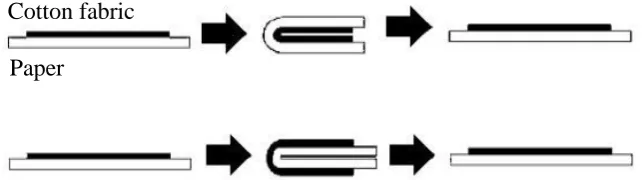
the samples are measured using an inductance (L), capacitance (C), and resistance (R) (LCR) meter after each process. Finally, folding process is performed to investigate the effect of mechanical folding on the electrical resistance of the fabricated electroconductive lines of cotton fabric. The cotton fabric sample is placed on a paper and then it is obtusely and acutely folded, as shown in Figure 3 before resistance could be measured. A fold is represented by folding of the conductive lines in acute and obtuse directions, and unfolding. The folding and unfolding procedures are repeated ten times, and the resistance and conductance of the sample are measured after each folding. The sample is placed at a fixed position on the paper and a line is drawn to ensure the folded part is consistent for every folding.
Figure 3. Schematic illustration of conductive line folding in acute and obtuse directions.
3. RESULTS AND DISCUSSION
Figure 4 shows the relative average conductance of electroconductive line against the frequency of washing. It can be seen at Figure 4 that the frequency of washing results in the decreasing values of conductance for the average of the samples. The changes can be explained through the weariness of the conductive lines of reduced graphene oxide. When the reduced graphene oxide on the conductive lines are deteriorated by the stirring movement of the water during the washing process, the amount of electrical charges which can pass through the lines are decreased. Based on Figure 4, the relative average conductance decreased slowly and is still at 80% after fourth time of washing, and drop significantly to 60% after fifth time of washing.
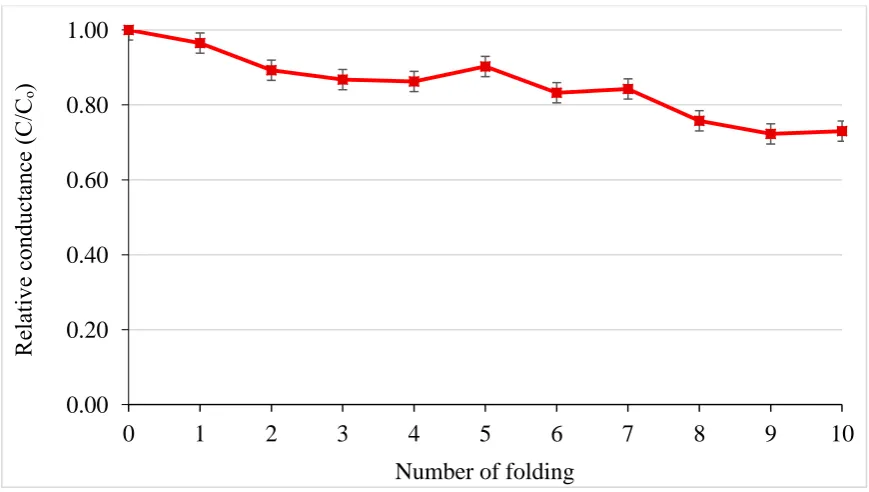
Figure 5 shows the relative average conductance of electroconductive line against the frequency of folding. From Figure 5, it can be seen that the frequency of folding results in the decreasing values of conductance for the average of the samples. From the results, it can be determined that folding technique could cause an interruption to the deposition of the conductive lines of reduced graphene oxide on the cotton fabric. When the reduced graphene oxide is disturbed during the folding technique, some of discontinuations occurred between the reduced graphene oxide particles along the folding line, causing a decreased amount of electrical charges which passed through the lines. As a result, the conductivity of the conductive lines decreased as the frequency of folding increased. Based on the Figure 5, it can be seen that the relative changes of average conductance decreased gradually, and is still higher than 70% after 10 times of folding.
Paper
Cotton fabric
5 Figure 4. Relative average conductance of electroconductive line against the frequency of washing, n=4.
Figure 5. Relative average conductance of electroconductive line against the frequency of folding, n = 4.
4. CONCLUSION
This study used a wax-patterning technique to fabricate hydrophilic region and hydrophobic boundary on the cotton fabric. A direct deposition of the graphene oxide ink on the hydrophilic region of the cotton fabric are performed to develop the electro conductive line. From the result, the electro conductive line has a high stability against mechanical disturbances such as washing and folding which is a crucial element of a flexible circuit. This study is a preliminary study for proof-of-concept on the possibility to develop a flexible system by integrating the cotton fabric circuit and the cotton fabric electrodes on clothing in the future. However, more studies need to
0.00
0.20
0.40
0.60
0.80
1.00
0
1
2
3
4
5
R
elative
conduc
tanc
e
(C/C
ₒ)
Number of washing
0.00
0.20
0.40
0.60
0.80
1.00
0
1
2
3
4
5
6
7
8
9
10
R
elative
conduc
tanc
e
(C/C
ₒ)
6
be conducted to assess the stability of the fabricated conductive lines as interconnection of electronic components for wearable system.
ACKNOWLEDGEMENT
The authors would like to express their appreciation to Ministry of Higher Education Malaysia and Universiti Teknologi Malaysia for supporting and funding this study under grants No. Q.J130000.2501.11H29 and Q.J130000.3001.01M13 and Collaborative Research in Engineering, Science & Technology Center (CREST) for their continuous support for this research.
REFERENCES
[1] F. Bossuyt, 4th Electronic System-Integration Technology Conference (ESTC) (2012). [2] W. J. Hyun, O. O. Park and B. D. Chin, Advanced Material 25 (2013) 4729.
[3] F. N. Jamaluddin, S. A. Ahmad, S. B. M. Noor and W. Z. W. Hasan, IEEE Student Conference on Research and Development (2014).
[4] M. Poliks, J. Turner, K. Ghose, Z. Jin, M. Garg and Q. Gui, IEEE 66th Electronic Components and Technology Conference (2016) 1623.
[5] M. Jagelka, M. Donoval, P. Telek, F. Horínek, M. Weis and M. Daříček. 26th International Conference Radioelektronika (2016).
[6] S. Lambert, C. J. Sinclair and A. Boxall. Reviews of environmental contamination and toxicology 227 (2014) 1.
[7] H. M. Lee, S. Y. Choi, A. Jung and S. H. Ko. AngewandteChemie International Edition in English (2013).
[8] D. Marculescu.Proceedings of the IEEE 91 (2003) 1995. [9] S. Pei and H. M. Cheng.Carbon 50 (2012) 3210.
[10] A. Nilghaz, D. Wicaksono, D. Gustiono, F. A. Abdul Majid, E.Supriyanto and M. R. A. Kadir. Lab on a Chip 12 (2012) 209.
[11] J. Zhang.Chemical Community 46 (2010) 1112.