Executive and Memory Function in Adolescents Born
Very Preterm
WHAT’S KNOWN ON THIS SUBJECT: Very preterm children display significant school problems that persist into adolescence. Executive functioning and memory play important roles in learning and school attainment.
WHAT THIS STUDY ADDS: This study confirms that adolescents born very preterm exhibit deficits in executive functioning and memory in a large contemporary sample. Severe brain injury and maternal education are strong predictors of performance on executive function and memory tasks.
abstract
BACKGROUND:Many preterm children display school difficulties, which may be mediated by impairment in executive function and memory.
OBJECTIVE:To evaluate executive and memory function among adoles-cents born preterm compared with term controls at 16 years.
METHODS:A total of 337 of 437 (77%) adolescents born in 1989 to 1992 with a birth weight⬍1250 g and 102 term controls were assessed with a battery of executive function and memory tasks. Multiple regression analyses were used to compare groups and to identify associations between selected factors and outcomes among preterm subjects.
RESULTS:Adolescents born preterm, compared with term controls, showed deficits in executive function in the order of 0.4 to 0.6 SD on tasks of verbal fluency, inhibition, cognitive flexibility, planning/orga-nization, and working memory as well as verbal and visuospatial mem-ory. After exclusion of adolescents with neurosensory disabilities and full-scale IQ ⬍ 70, significant group differences persisted on most tests. Preterm subjects, compared with term controls, were at in-creased risk of exhibiting problems related to executive dysfunction, as measured with the Behavior Rating Inventory of Executive Function, on the Metacognition Index (odds ratio [OR]: 2.5 [95% confidence inter-val (CI): 1.2–5.1]) and the Global Executive Composite (OR: 4.2 [95% CI: 1.6 –10.9]), but not on the Behavioral Regulation index (OR: 1.5 [95% CI: 0.7–3.5]). Among adolescents born preterm, severe brain injury on neonatal ultrasound and lower maternal education were the most con-sistent factors associated with poor outcomes.
CONCLUSIONS:Even after exclusion of preterm subjects with signifi-cant disabilities, adolescents born preterm in the early 1990s were at increased risk of deficits in executive function and memory.Pediatrics 2011;127:e639–e646
AUTHORS:Thuy Mai Luu, MD, MSc,aLaura Ment, MD,b,c Walter Allan, MD,dKaren Schneider, MPH,band Betty R. Vohr, MDe
aDepartment of Pediatrics, Sainte-Justine University Health
Center, Montreal, Quebec, Canada; Departments ofbPediatrics
andcNeurology, Yale University School of Medicine, New Haven,
Connecticut;dDepartment of Pediatrics, Maine Medical Center,
Portland, Maine; andeDepartment of Pediatrics, Warren Alpert
Medical School of Brown University, Providence, Rhode Island
KEY WORDS
very low birth weight, prematurity, executive function, memory
ABBREVIATIONS
D-KEFS—Delis-Kaplan Executive Function Scale
WISC-III—Wechsler Intelligence Scale for Children, 3rd edition PPVT-R—Peabody Picture Vocabulary Test, Revised FSIQ—full-scale IQ
NSI—neurosensory impairment CI—confidence interval MD—mean difference OR—odds ratio
www.pediatrics.org/cgi/doi/10.1542/peds.2010-1421
doi:10.1542/peds.2010-1421
Accepted for publication Nov 24, 2010
Address correspondence to Thuy Mai Luu, MD, MSc, Department of Pediatrics, Centre Hospitalier Universitaire Sainte-Justine, 3175 Chemin Côte-Sainte-Catherine, Montréal, Canada H3T 1C5. E-mail: [email protected]
PEDIATRICS (ISSN Numbers: Print, 0031-4005; Online, 1098-4275).
Copyright © 2011 by the American Academy of Pediatrics
FINANCIAL DISCLOSURE:The authors have indicated they have no financial relationships relevant to this article to disclose.
Funded by the National Institutes of Health (NIH).
achievement have been documented in adolescents born in the 1970s and ’80s.1–12During teenage years, deficits
in IQ scores for preterm children com-pared with term controls vary between 8 and 13 points.13 However, preterm
children with normal intelligence still face significant school difficulties.4
Executive functions, which refer to a set of high-level mental processes nec-essary to regulate behavior and cogni-tion for goal-directed accogni-tions, are thought to play an important role in school attainment.14They include
abil-ities such as working memory, inhibi-tion, planning and organizainhibi-tion, verbal fluency, and cognitive flexibility. Defi-cits in these domains have been ob-served in adolescents and young adults born preterm before the era of modern neonatology.3,15–18These
abili-ties depend on the integrity of the neu-ral network that connects the prefron-tal cortex to the brainstem, the cerebral lobes, and the limbic and sub-cortical regions.19Neuroimaging
stud-ies in preterm children have shown de-creased white matter volumes and impaired white matter gains com-pared with term controls, which indi-cates their increased vulnerability for executive dysfunction.20,21
Moreover, memory deficits, including verbal and visual memory, have been reported in very low birth weight chil-dren, especially among those with neo-natal cerebral injury, which suggests the residual sequelae of brain insults on memory function.3,22However, few
studies have expanded on this impor-tant finding.
The current study encompasses a sys-tematic assessment of executive func-tion and memory skills of a more con-temporaneous group of adolescents born preterm. The objective is to com-pare executive and memory functions of adolescents born preterm to term
graphic factors on these outcomes. We hypothesize that the preterm group will perform less well on tasks of exec-utive functioning and memory than term peers, even after exclusion of those with severe disabilities, and that selective deficits in executive and memory functions will be uncovered among preterm subjects after control-ling for receptive vocabulary.
METHODS
Study Population
Between September 1989 and August 1992, 505 very preterm infants with birth weight ⱕ 1250 g admitted to 3 hospital centers in Providence, Rhode Island; Portland, Maine; and New Ha-ven, Connecticut, were enrolled in the Multicenter Randomized Indomethacin Intraventricular Hemorrhage Preven-tion Trial and prospectively fol-lowed.23,24At age 16 years, 337 of 437
survivors were available for assess-ment (77%). Participants were repre-sentative of the eligible preterm sub-jects with respect to gestational age, birth weight, gender, antenatal ste-roids exposure, prophylactic indo-methacin, severe brain injury, and bronchopulmonary dysplasia. How-ever, participants were more likely to be multiples (participants: 21%; participants: 9%) and have white non-Hispanic mothers (participants: 73%; nonparticipants: 61%).
The term cohort was selected from the local community or from a telemarket-ing list of 10 000 families at 8 years. They were frequency-matched to the preterm group on zip code, age, gen-der and race. Of the 124 eligible con-trols, 102 were evaluated at 16 years (82%).
Written assent/consent was obtained from all families. The institutional boards of all participating universities approved the protocols.
sion by assessors trained to 90% inter-rater reliability. The assessors were unaware of the preterm children’s neonatal course.
Outcome Measures
Cognitive aspects of executive function were assessed with subtests of the Delis-Kaplan Executive Function Scale (D-KEFS).25 In the Verbal Fluency
subtest, subjects were asked to gener-ate as many words as possible start-ing with a given letter (phonological fluency) or belonging in a specific cat-egory (semantic fluency) in 1 minute, to examine language skills, initiation, and speed of processing. The Color-Word Interference subtest tapped into verbal inhibition and cognitive flexibil-ity: subjects had to read aloud color names printed in a different color ink or name the ink color of a different printed word. The Tower subtest, in which subjects had to displace disks from a starting to an ending position by following a set of rules, assessed spatial planning, rule learning, and in-hibition. All D-KEFS subtests yield a scaled score with a mean of 10⫾3. The Backward Spatial Span of the Wechsler Memory Scale, 3rd edition26
appraised visual working memory by having the examinee touch a sequence of blocks as demonstrated by the ex-aminer, but in the reverse order. Scaled scores are calculated with means of 10⫾3.
To assess behavioral manifestation of executive function in daily life, parents filled the Behavior Rating Inventory of Executive Function,27which measures
plan/rrganize (to plan and organize ahead for future events); organization of materials (to order and organize things); and monitor (to check own performance for proper goal attain-ment). These 8 scales form 2 indices, the Behavioral Regulation Index and the Metacognition Index. One general summary score, the General Executive Composite, also is derived from the 8 scales. A higher score reflects more problematic behavior. Scores ⱖ 65 are considered clinically significant.
Verbal memory was evaluated with the California Verbal Learning Test, Chil-dren’s Version.28 Subjects were
pre-sented with a list of words throughout 5 trials and had to recall as many words as possible after each trial (trials 1–5 total score measures immediate recall) and after a 20-minute period (long-delay free recall). The trial 1 to 5 total score is a T-score (mean: 50 ⫾10), whereas the long-delay free recall is azscore (mean: 0.0 ⫾1.0). The Rey-Osterrieth Complex Figure Test required subjects to copy a complex design and draw it again after 30 seconds (immediate recall) and after 35 minutes (delayed recall). The test examined visuospatial memory. Raw scores were obtained.
Other Variables
General intellectual ability was mea-sured using the Wechsler Intelligence Scale for Children, 3rd edition (WISC-III).29 Receptive vocabulary was
as-sessed with the Peabody Picture Vo-cabulary Test, Revised (PPVT-R).30
PPVT-R scores have been shown to be highly correlated with measures of in-telligence.30 The Pearson correlation
coefficient () in our own data (n ⫽ 410) for PPVT-R standard score and full-scale IQ (FSIQ) was 0.84 at 16 years.
Data on neonatal characteristics and neurologic status were retrieved from the study database. Parents and ado-lescents provided updated sociodemo-graphic information.
Statistical Analyses
Results on tests of executive and mem-ory function were compared between preterm and term subjects with ad-justment for potential confounders (male gender, maternal education, mi-nority status, and single-parent house-hold) using linear (for continuous vari-ables) or logistic (for categorical variables) regression. To identify se-lective deficits in executive function or memory not because of differential in-telligence between the 2 groups, the above analyses were repeated on the entire cohort controlling for PPVT-R score. The PPVT-R score was used as a proxy measure of intelligence instead of FSIQ because of the high correlation between FSIQ and executive and mem-ory function (⫽0.57– 0.70 on the dif-ferent executive function and memory measures). High correlation between FSIQ and scores on executive function tests was expected because some WISC-III subtests (similarities, digit span, block design, picture arrange-ment) tap at specific aspects of execu-tive function.31To determine whether
adolescents born preterm without se-vere disabilities also presented with deficits in executive function or mem-ory, comparative analyses between preterm and term controls were re-peated after exclusion of children with neurosensory impairment (NSI; hear-ing aids, services for the blind, cere-bral palsy, seizure, ventriculoperito-neal shunt) and FSIQ ⬍ 70. Multiple regression analysis was used to iden-tify perinatal and social factors that predicted scores on executive and memory tests at 16 years among all preterm subjects. Independent vari-ables were selected on the basis of the most common risk factors of adverse outcomes identified in the literature. The effect of prophylactic indometha-cin on outcomes also was explored. Analyses were conducted with SAS 9.1 (SAS Institute, Inc, Cary, NC).
RESULTS
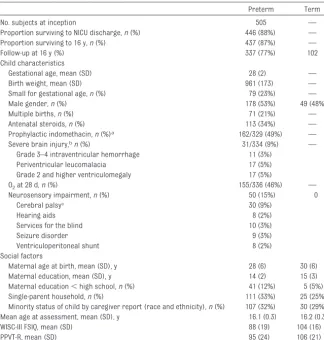
Sociodemographic and medical char-acteristics of the preterm and term co-horts are outlined in Table 1.
Mean FSIQ between the 2 cohorts dif-fered by 16 points (95% confidence in-terval [CI]: 12–20) in favor of the term group, with 15% of adolescents born preterm scoring in the significantly im-paired range (⬍70), compared with 2% of term controls. Among adoles-cents with NSI (n⫽ 50), some were either untestable or obtained the low-est possible score on all subtlow-ests of the WISC-III (n⫽ 2), the D-KEFS (n⫽ 15), or on all memory tasks (n⫽ 4). Their FSIQ ranged from 40 to 107.
Executive Functioning
Although adolescents born preterm scored within the normal ranges on tests of executive function (Table 2), they performed 0.4 to 0.6 SD below their term counterparts in all domains including phonological and semantic fluency, verbal inhibition (Color/Word Inhibition), cognitive flexibility (Color/ Word Inhibition Switching), spatial planning and rule learning (Tower), and visual working memory (Spatial Span). Among very preterm subjects, 6% to 18% exhibited significant impair-ment (score⬍2 SD) in executive func-tion, compared with only 1% to 3% of adolescents born at term. Controlling for PPVT-R revealed selective deficits among adolescents born preterm compared with term controls in all do-mains of executive function.
Memory
pairment was observed in a higher proportion of very preterm subjects compared with term controls. Sec-ondary analysis adjusting for PPVT-R
score did not alter findings thus highlighting selective deficits in memory function among adolescents born preterm.
Disabilities
Analyses were repeated with exclusion of subjects with NSI and FSIQ⬍70. Af-ter adjusting for PPVT-R scores, group differences were detected on phono-logical fluency (mean difference [MD]:
⫺1.0 [95% CI:⫺1.7 to⫺0.2]P⫽.01), verbal inhibition (MD: ⫺1.1 [95% CI:
⫺1.8 to ⫺0.4] P⬍ .005), immediate verbal memory (MD: ⫺4.2 [95% CI:
⫺6.5 to⫺1.9]P⬍.005), and delayed verbal memory (MD: ⫺0.5 [95% CI:
⫺0.7 to⫺0.3]P⬍.005), and on imme-diate visuospatial memory (MD:⫺2.8 [95% CI:⫺4.6 to⫺1.0]P⬍.005) and delayed visuospatial memory (MD:
⫺2.9 [95% CI:⫺4.7 to⫺1.1]P⬍.005). However, analyses did not reveal sig-nificant differences in semantic flu-ency, cognitive flexibility, spatial plan-ning/rule learning, and visual working memory.
Behavioral Manifestations of Executive Dysfunction
As shown in Table 4, parents reported on the Behavior Rating Inventory of Ex-ecutive Function that adolescents born preterm were more likely to exhibit clinically significant behavioral prob-lems as a result of executive dysfunc-tion in the Initiate and Working
Mem-No. subjects at inception 505 —
Proportion surviving to NICU discharge,n(%) 446 (88%) —
Proportion surviving to 16 y,n(%) 437 (87%) —
Follow-up at 16 y (%) 337 (77%) 102
Child characteristics
Gestational age, mean (SD) 28 (2) —
Birth weight, mean (SD) 961 (173) —
Small for gestational age,n(%) 79 (23%) —
Male gender,n(%) 178 (53%) 49 (48%)
Multiple births,n(%) 71 (21%) —
Antenatal steroids,n(%) 113 (34%) —
Prophylactic indomethacin,n(%)a 162/329 (49%) —
Severe brain injury,bn(%) 31/334 (9%) —
Grade 3–4 intraventricular hemorrhage 11 (3%)
Periventricular leucomalacia 17 (5%)
Grade 2 and higher ventriculomegaly 17 (5%)
O2at 28 d,n(%) 155/336 (46%) —
Neurosensory impairment,n(%) 50 (15%) 0
Cerebral palsyc 30 (9%)
Hearing aids 8 (2%)
Services for the blind 10 (3%)
Seizure disorder 9 (3%)
Ventriculoperitoneal shunt 8 (2%)
Social factors
Maternal age at birth, mean (SD), y 28 (6) 30 (6)
Maternal education, mean (SD), y 14 (2) 15 (3)
Maternal education⬍high school,n(%) 41 (12%) 5 (5%)
Single-parent household,n(%) 111 (33%) 25 (25%)
Minority status of child by caregiver report (race and ethnicity),n(%) 107 (32%) 30 (29%)
Mean age at assessment, mean (SD), y 16.1 (0.3) 16.2 (0.3)
WISC-III FSIQ, mean (SD) 88 (19) 104 (16)
PPVT-R, mean (SD) 95 (24) 106 (21)
aNot all children were randomly assigned to receive prophylactic indomethacin. bNumbers do not add up to 31 because some children had more than 1 injury.
cAmong children with cerebral palsy, 9 had spastic diplegia, 4 had spastic hemiplegia, and 17 had spastic quadriplegia.
TABLE 2 Results of Comparisons in Executive Function Between Very Preterm and Term Adolescents at 16 Years
Preterm Term Adjusted Mean
Difference (95% CI)
Adjusted Mean Difference (95% CI), Controlling for
PPVT-R Score
n Mean (SD)
Impairment (⬍2 SD)
n Mean (SD)
Impairment (⬍2 SD) D-KEFS verbal fluency
Letters scaled score 307 8.7 (3.6) 8.1% 100 10.8 (3.3) 0 ⫺1.5 (⫺2.3–⫺0.7)a ⫺1.0 (⫺1.7–⫺0.3)b
Category scaled score 301 9.7 (3.7) 6.3% 99 11.3 (3.1) 1.0% ⫺1.3 (⫺2.1–⫺0.5)a ⫺0.8 (⫺1.5–⫺0.0)b
D-KEFS color/word
Inhibition scaled score 302 7.9 (3.8) 17.6% 99 10.2 (2.6) 3.0% ⫺2.0 (⫺2.8–⫺1.2)a ⫺1.5 (⫺2.2–⫺0.8)a
Inhibition switching scaled score 302 8.4 (3.8) 15.6% 98 10.3 (2.9) 3.0% ⫺1.5 (⫺2.4–⫺0.7)a ⫺1.0 (⫺1.8–⫺0.3)b
D-KEFS Tower
Total achievement scaled score 301 8.5 (3.1) 9.3% 99 10.3 (2.2) 0 ⫺1.6 (⫺2.2–⫺0.9)a ⫺1.1 (⫺1.7–⫺0.5)a
WMS spatial span
Backward span scaled score 300 8.8 (3.9) 11% 95 11.0 (2.7) 0 ⫺1.7 (⫺2.5–⫺0.8)a ⫺1.0 (⫺1.8–⫺0.3)b
Impairment was defined as a score that fell 2 SDs below the standard mean. Gender, maternal education, minority status, and single-parent household were adjusted for. Mean differences were adjusted for PPVT-R scores to take into account the effect of differential intelligence between the 2 groups.
ory domains than were term peers. A higher proportion of very preterm sub-jects scored in the significant range on the Metacognition Index (odds ratio [OR]: 2.5 [95% CI: 1.2–5.1]), but not on the Behavioral Regulation Index (OR: 1.5 [95% CI: 0.7–3.5]). Overall, 19% of the very preterm cohort displayed
problems on the Global Executive Com-posite, compared with 5% of the term group, representing a fourfold in-crease in risk. After exclusion of chil-dren with NSI and FSIQ⬍70, preterm birth remained associated with in-creased risk of displaying problems in the initiate domain on the
Metacogni-tion Index and the Global Executive Composite.
Predictors of Poor Performance Among Adolescents Born Preterm
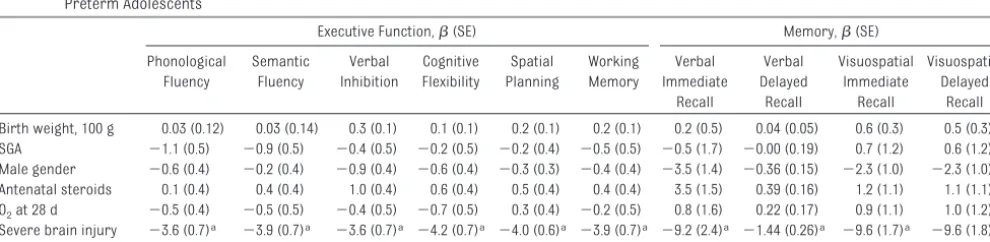
Severe brain injury on neonatal ultra-sound was the most significant factor associated with lower scores on all measures of executive and memory function (Table 5). The second most consistent finding was the relationship between higher level of maternal edu-cation and better results on all execu-tive functions, except for semantic flu-ency, and on delayed visual recall. Male gender, antenatal steroids expo-sure, being small for gestational age, birth weight, and oxygen requirement at 28 days were not related to any of the outcomes. Effects of indomethacin were explored separately with gender stratification and were not significant for any of the study outcomes (results available on request).
TABLE 3 Results of Comparisons in Memory Abilities Between Very Preterm and Term Adolescents at 16 Years
Preterm Term Adjusted Mean
Difference (95% CI)
Adjusted Mean Difference (95% CI), Controlling for
PPVT-R Score
n Mean (SD) Impairment
(⬍2 SD)
n Mean (SD)
Impairment (⬍2 SD) California Verbal Learning Test
Trials 1–5 total T-score 307 42.0 (12.2) 19.5% 99 50.1 (9.9) 4.0% ⫺7.1 (⫺9.7–⫺4.5)a ⫺5.2 (⫺7.5–⫺2.9)a
Long Delay Free Recallzscore 308 ⫺0.7 (1.4) 10.7% 99 0.3 (0.9) 1.0% ⫺0.8 (⫺1.–⫺0.5)a ⫺0.6 (⫺0.8,⫺0.3)a
Rey-Osterrieth Complex Figure Test
Immediate recall raw score 302 15.9 (9.2) — 101 22.4 (8.1) — ⫺5.6 (⫺7.6–⫺3.6)a ⫺3.9 (⫺5.7–⫺2.2)a
Delayed recall raw score 298 15.6 (9.1) — 101 22.2 (8.2) — ⫺5.7 (⫺7.6–⫺3.7)a ⫺4.0 (⫺5.7–⫺2.3)a
Impairment was defined as a score that fell 2 SDs below the standard mean. Gender, maternal education, minority status, and single-parent household were adjusted for. Mean differences were adjusted for PPVT-R scores to take into account the effect of differential intelligence between the 2 groups.
aP⬍.005.
TABLE 4 Proportion of Very Preterm and Term Adolescents That Scored In the Clinical Range on the BRIEF
Preterm Term Adjusted OR
(95% CI)
Behavioral regulation⬎64,n/N(%) 45/311 (14) 8/100 (8) 1.5 (0.7–3.5)
Inhibit 45/312 (14) 7/100 (7) 1.8 (0.7–4.2)
Shift 51/311 (16) 7/100 (7) 2.2 (1.0–5.2)
Emotional control 36/312 (12) 6/100 (6) 1.6 (0.6–3.9)
Metacognition⬎64,n/N(%) 69/311 (22) 10/100 (10) 2.5 (1.2–5.1)a
Initiate 59/311 (19) 8/100 (9) 2.5 (1.1–5.6)a
Working memory 88/311 (28) 16/100 (16) 1.9 (1.1–3.5)a
Planning/organization 72/310 (23) 13/100 (13) 1.8 (0.9–3.5)
Organization of materials 42/311 (14) 16/100 (16) 0.9 (0.5–1.7)
Monitoring 47/311 (15) 11/100 (11) 1.3 (0.6–2.6)
Global executive composite⬎64,n/N(%) 60/311 (19) 5/100 (5) 4.2 (1.6–10.9)a Gender, maternal education, minority status, and single-parent household were adjusted for. BRIEF indicates Behavior Rating Inventory of Executive Function.
aP⬍.05.
TABLE 5 Multiple Regression Analyses to Identify Neonatal and Social Factors Associated With Executive and Memory Function Scores Among Very Preterm Adolescents
Executive Function,(SE) Memory,(SE)
Phonological Fluency
Semantic Fluency
Verbal Inhibition
Cognitive Flexibility
Spatial Planning
Working Memory
Verbal Immediate
Recall
Verbal Delayed
Recall
Visuospatial Immediate
Recall
Visuospatial Delayed
Recall
Birth weight, 100 g 0.03 (0.12) 0.03 (0.14) 0.3 (0.1) 0.1 (0.1) 0.2 (0.1) 0.2 (0.1) 0.2 (0.5) 0.04 (0.05) 0.6 (0.3) 0.5 (0.3) SGA ⫺1.1 (0.5) ⫺0.9 (0.5) ⫺0.4 (0.5) ⫺0.2 (0.5) ⫺0.2 (0.4) ⫺0.5 (0.5) ⫺0.5 (1.7) ⫺0.00 (0.19) 0.7 (1.2) 0.6 (1.2) Male gender ⫺0.6 (0.4) ⫺0.2 (0.4) ⫺0.9 (0.4) ⫺0.6 (0.4) ⫺0.3 (0.3) ⫺0.4 (0.4) ⫺3.5 (1.4) ⫺0.36 (0.15) ⫺2.3 (1.0) ⫺2.3 (1.0) Antenatal steroids 0.1 (0.4) 0.4 (0.4) 1.0 (0.4) 0.6 (0.4) 0.5 (0.4) 0.4 (0.4) 3.5 (1.5) 0.39 (0.16) 1.2 (1.1) 1.1 (1.1) O2at 28 d ⫺0.5 (0.4) ⫺0.5 (0.5) ⫺0.4 (0.5) ⫺0.7 (0.5) 0.3 (0.4) ⫺0.2 (0.5) 0.8 (1.6) 0.22 (0.17) 0.9 (1.1) 1.0 (1.2)
Severe brain injury ⫺3.6 (0.7)a ⫺3.9 (0.7)a ⫺3.6 (0.7)a ⫺4.2 (0.7)a ⫺4.0 (0.6)a ⫺3.9 (0.7)a ⫺9.2 (2.4)a ⫺1.44 (0.26)a ⫺9.6 (1.7)a ⫺9.6 (1.8)a
Maternal education, y 0.4 (0.1)a 0.2 (0.1) 0.3 (0.1)a 0.3 (0.1)a 0.2 (0.1)a 0.5 (0.1)a 0.5 (0.3) 0.06 (0.03) 0.5 (0.2) 0.6 (0.2)a
coefficients represent the amount of increase or decrease in test scores for a 1-unit change in the predictor variable. SGA indicates small for gestational age.
aP⬍.005.
born preterm in the early 1990s, com-pared with term peers, display deficits across all measures of executive func-tion and memory. Selective deficits persist on tests of phonological flu-ency, verbal inhibition and memory af-ter exclusion of adolescents with sig-nificant neurosensory and cognitive disabilities. Not surprisingly, severe brain injury and lower level of mater-nal education are strong predictors of adverse cognitive sequelae.
Our assessment of executive function reveals significant impairment among very preterm subjects in abilities such as verbal fluency, verbal inhibition, cognitive flexibility, spatial planning, and spatial working memory. In addi-tion, problems with executive function translate into behavioral manifesta-tions at home as reported by parents: adolescents born preterm have more difficulties with initiation of activities or generation of new ideas and with working memory. A higher proportion of adolescents born preterm com-pared with term controls score in the clinical range on the Global Executive Composite, thus highlighting their higher propensity for overall executive dysfunction. Our findings indicate that deficits in a wide range of executive processes that have been documented in previous studies on a population of very preterm children at early and middle school age18,31–35persist in
ado-lescence. We used the D-KEFS, in which certain subtests also tapped at cogni-tive processes other than execucogni-tive function (language skills for the verbal fluency subtests and processing speed for the Tower subtest). Therefore, it is possible that the observed impair-ments were not solely because of defi-cits in executive function.35However,
our findings parallel that of other stud-ies in which different tasks were used to assess similar domains. Lower
per-among adolescents born at ⬍ 33 weeks’ gestation.36 Taylor et al3 also
have reported on a cohort with birth weight⬍750 g assessed at 16 years that displayed significant impairment in spatial planning, spatial and verbal working memory, vigilance, and set shifting. The authors controlled for verbal-semantic ability to identify ar-eas of relative executive dysfunction and found almost identical results, ex-cept for verbal working memory and vigilance, for which group differences were no longer significant. Similarly, our analyses included adjustment for receptive vocabulary and revealed rel-ative deficits that were mostly signifi-cant for verbal inhibition and spatial planning. Nosarti et al15 have
docu-mented persisting executive dysfunc-tion in areas such as verbal fluency, response initiation and inhibition, and cognitive flexibility in young adults. In our study there also is evi-dence for deficits in verbal and visuo-spatial memory in adolescents born preterm compared with term con-trols, which corroborates the work of Taylor et al.3,22
The global deficits in executive and memory function observed in adoles-cent born preterm are congruent with neuroimaging findings reported in this population. The neural circuitry that connects the prefrontal cortex to other areas of the brain, notably the poste-rior cortical and subcortical regions, is thought to be central in ensuring normal executive processes.19, 37
Therefore, damage to any of these components may lead to deficits in ex-ecutive function. Longitudinal studies on brain volume changes in our cohort have demonstrated that white matter volumes increased by 26% to 27% be-tween 8 and 12 years in term controls, compared with only 10% in preterm subjects.21 Differential decreases in
the frontal and deep gray regions.21In
addition, significant volume reduction in areas subserving executive pro-cesses, such as the prefrontal gyri, the cingulate gyrus, and the frontal-striatal and frontal-parietal white mat-ter pathways, have been observed in preterm children at 12 years.20Edgin et
al38provided evidence for a
relation-ship between early white matter pa-thology and later difficulties on tasks of executive function in very preterm children. In addition, alterations in gray and white matter distribution have been shown to be related to per-formance on tests of executive func-tion, accounting for up to 29% of the variance.36 Correlations between
changes in brain microstructures and executive function have also been noted by Gimenez et al,39,40who found
that decreased volumes of the tha-lamic gray matter and the genu of the corpus callosum were associated with poorer verbal fluency in very preterm subjects at 14 years. As for memory function, the neural substrate has been ascribed to the frontal and me-dial temporal (hippocampal) areas of the brain.41 Reduced volume for the
hippocampus has been document-ed,20,42 and correlations have been
found between reduced left hippocam-pal volume and poorer verbal memory skills among preterm subjects.43Thus,
perturbations in preterm brain devel-opment may explain the increased vul-nerability of adolescents born preterm for impairment in executive function and memory.
years.44 Higher maternal education
also was associated with increasing scores on tasks of executive function and visuospatial memory. Likewise,
Aarnoudse-Moens et al32 found that
maternal education accounted for 12% of the variance in a task of response inhibition. Because better executive functioning is correlated to higher school attainment,14 mothers with
higher maternal education probably
had strong abilities related to execu-tive function, thus laying a genetic ground for better performance in their offspring.
This study draws its strength from the comprehensive evaluation of executive function, which tapped at several dis-tinct cognitive abilities and explored behavioral consequences as viewed by the parents. Neuropsychological mea-sures were based on well
standard-ized, objective, and validated tools to reduce the potential for observer bias, because examiners, although unaware of neonatal course, were not com-pletely blind to preterm versus term status as they had been involved in previous assessment of the same co-hort. Despite an attrition rate of 23% with the known selection bias that may result (ie, underestimation of impair-ment),45 this rate is comparable to
other long-term follow-up studies.3,8,9,12
The study large sample size has al-lowed assessment of the impact of multiple relevant neonatal and demo-graphic factors on outcomes.
CONCLUSION
The neuropsychological sequelae of preterm birth extend into adolescence and involve higher-level cognitive pro-cesses such as executive function and memory. Even after correction for
re-ceptive vocabulary, relative deficits still remain, which may explain in part the lower scholastic attainment ob-served in the preterm population. With advances in neuroimaging techniques, correlational studies will allow addi-tional identification of the neural cir-cuitry underlying executive and mem-ory processes in preterm subjects. Thus, intervention strategies to ei-ther prevent injury to vulnerable ce-rebral regions or to stimulate devel-opment of compensatory circuitry can be explored.
ACKNOWLEDGMENTS
This work was supported by National Institutes of Health grant NS 27116.
We thank Victoria Watson, Susan Del-ancy, Jill Maller-Kessleman, Marje Ain-ley, and June Gagnon for neurodevel-opmental testing; and Karol Katz for data management.
REFERENCES
1. Botting N, Powls A, Cooke RW, Marlow N. Cognitive and educational outcome of very-low-birthweight children in early adoles-cence.Dev Med Child Neurol. 1998;40(10): 652– 660
2. Hack M, Taylor HG, Klein N, Mercuri-Minich N. Functional limitations and special health care needs of 10- to 14-year-old children weighing less than 750 grams at birth. Pe-diatrics. 2000;106(3):554 –560
3. Taylor HG, Minich N, Bangert B, Filipek PA, Hack M. Long-term neuropsychological out-comes of very low birth weight: associa-tions with early risks for periventricular brain insults.J Int Neuropsychol Soc. 2004; 10(7):987–1004
4. Saigal S, Hoult LA, Streiner DL, Stoskopf BL, Rosenbaum PL. School difficulties at adoles-cence in a regional cohort of children who were extremely low birth weight. Pediat-rics. 2000;105(2):325–331
5. Doyle LW, Casalaz D. Outcome at 14 years of extremely low birthweight infants: a re-gional study.Arch Dis Child. 2001;85(3): F159 –F164
6. Rickards AL, Kelly EA, Doyle LW, Callanan C. Cognition, academic progress, behavior and self-concept at 14 years of very low birth weight children.J Dev Behav Pediatr. 2001;22(1):11–18
7. D’Angio CT, Sinkin RA, Stevens TP, et al.
Lon-gitudinal, 15-year follow-up of children born at less than 29 weeks’ gestation after intro-duction of surfactant therapy into a region: neurologic, cognitive, and educational out-comes.Pediatrics. 2002;110(6):1094 –1102 8. Johnson A, Bowler U, Yudkin P, et al. Health
and school performance of teenagers born before 29weeks’ gestation.Arch Dis Child. 2003;88(3):F190 –F198
9. Grunau RE, Whitfield MF, Fay TB. Psychoso-cial and academic characteristics of ex-tremely low birth weight (ⱕ800 g) adoles-cents who are free of major impairment compared with term-born control subjects.
Pediatrics. 2004;114(6). Available at: www. pediatrics.org/cgi/content/full/114/6/e725
10. Dahl LB, Kaaresen PI, Tunby J, Handegard BH, Kvernmo S, Ronning JA. Emotional, be-havioral, social, and academic outcomes in adolescents born with very low birth weight.Pediatrics. 2006;118(2). Available at: www.pediatrics.org/cgi/content/full/118/ 2/e449
11. Farooqi A, Hagglof B, Sedin G, Gothefors L, Serenius F. Chronic conditions, functional limitations, and special health care needs in 10- to 12-year-old children born at 23 to 25 weeks’ gestation in the 1990s: a Swedish national prospective follow-up study.
Pediatrics. 2006;118(5). Available at: www. pediatrics.org/cgi/content/full/118/5/e1466
12. Whitaker AH, Feldman JF, Lorenz JM, et al. Motor and cognitive outcomes in
nondis-abled low-birth-weight adolescents: early determinants. Arch Pediatr Adolesc Med. 2006;160(10):1040 –1046
13. Watts JL, Saigal S. Outcome of extreme prematurity: as information increases so do the dilemmas.Arch Dis Child. 2006;91(3): F221–F225
14. St Clair-Thompson HL, Gathercole SE. Execu-tive functions and achievements in school:
shifting, updating, inhibition, and working memory.Q J Exp Psychol (Colchester). 2006; 59(4):745–759
15. Nosarti C, Giouroukou E, Micali N, Rifkin L, Morris RG, Murray RM. Impaired executive functioning in young adults born very
pre-term. J Int Neuropsychol Soc. 2007;13(4): 571–581
16. Allin M, Walshe M, Fern A, et al. Cognitive
maturation in preterm and term born ado-lescents.J Neurol Neurosurg Psychiatry. 2008;79(4):381–386
17. Saavalainen P, Luoma L, Bowler D, et al. Spa-tial span in very prematurely born
adoles-cents. Dev Neuropsychol. 2007;32(3): 769 –785
18. Aarnoudse-Moens CS, Weisglas-Kuperus N,
van Goudoever JB, Oosterlaan J. Meta-analysis of neurobehavioral outcomes in
19. Anderson P. Assessment and development of executive function (EF) during childhood.
Child Neuropsychol. 2002;8(2):71– 82 20. Kesler SR, Reiss AL, Vohr B, et al. Brain
vol-ume reductions within multiple cognitive systems in male preterm children at age twelve.J Pediatr. 2008;152(4):513–520, 520 e511
21. Ment LR, Kesler S, Vohr B, et al. Longitudinal brain volume changes in preterm and term control subjects during late childhood and adolescence. Pediatrics. 2009;123(2): 503–511
22. Taylor GH, Klein NM, Minich NM, Hack M. Ver-bal memory deficits in children with less than 750 g birth weight.Child Neuropsychol. 2000;6(1):49 – 63
23. Ment LR, Oh W, Ehrenkranz RA, et al. Low-dose indomethacin and prevention of intra-ventricular hemorrhage: a multicenter ran-domized trial. Pediatrics. 1994;93(4): 543–550
24. Ment LR, Oh W, Ehrenkranz RA, et al. Low-dose indomethacin therapy and extension of intraventricular hemorrhage: a multi-center randomized trial.J Pediatr. 1994; 124(6):951–955
25. Delis CD, Kapklan E, Kramer JH.Delis-Kaplan Executive Function System.San Antonio, TX: Psychological Corporation; 2001
26. Wechsler D.Wechsler Memory Scale, 3rd edition. New York, NY: Psychological Corporation; 1997
27. Gioia GA, Isquith PK, Guy SC, Kenworthy L.
BRIEF: Behavior Rating Inventory of Execu-tive Function.Lutz, FL: Psychological Assess-ment Resources; 2000
28. Delis CD, Kramer JH, Kramer E, Ober B.The
Corporation; 1994
29. Wechsler D.Wechsler Scale of Intelligence for Children, 3rd edition. New York, NY: Psy-chological Corporation Harcourt Brace Co; 1991
30. Dunn L, Dunn L.PPVT: Peabody Picture Vo-cabulary Test: Revised Form.Circle Pines, MN: American Guidance Service; 1981
31. Anderson PJ, Doyle LW. Executive function-ing in school-aged children who were born very preterm or with extremely low birth weight in the 1990s.Pediatrics. 2004;114(1): 50 –57
32. Aarnoudse-Moens CS, Smidts DP, Ooster-laan J, Duivenvoorden HJ, Weisglas-Kuperus N. Executive function in very preterm chil-dren at early school age.J Abnorm Child Psychol. 2009;37(7):981–993
33. Böhm B, Katz-Salamon M, Institute K, Sme-dler AC, Lagercrantz H, Forssberg H. Devel-opmental risks and protective factors for influencing cognitive outcome at 5 1/2 years of age in very-low-birthweight children.Dev Med Child Neurol. 2002;44(8):508 –516 34. Marlow N, Hennessy EM, Bracewell MA,
Wolke D. Motor and executive function at 6 years of age after extremely preterm birth.
Pediatrics. 2007;120(4):793– 804
35. Mulder H, Pitchford NJ, Hagger MS, Marlow N. Development of executive function and attention in preterm children: a systematic review. Dev Neuropsychol. 2009;34(4): 393– 421
36. Nosarti C, Giouroukou E, Healy E, et al. Grey and white matter distribution in very pre-term adolescents mediates neurodevelop-mental outcome. Brain. 2008;131(pt 1): 205–217
38. Edgin JO, Inder TE, Anderson PJ, Hood KM, Clark CA, Woodward LJ. Executive function-ing in preschool children born very preterm: relationship with early white mat-ter pathology.J Int Neuropsychol Soc. 2008; 14(1):90 –101
39. Giménez M, Junque C, Narberhaus A, Botet F, Bargallo N, Mercader JM. Correlations of thalamic reductions with verbal fluency im-pairment in those born prematurely. Neuro-report. 2006;17(5):463– 466
40. Narberhaus A, Segarra D, Caldu X, et al. Cor-pus callosum and prefrontal functions in adolescents with history of very preterm birth. Neuropsychologia. 2008;46(1): 111–116
41. Loeb C, Poggio GF. Neural substrates of memory, affective functions, and conscious experience.Adv Anat Embryol Cell Biol. 2002;166:1–111
42. Nagy Z, Ashburner J, Andersson J, et al. Structural correlates of preterm birth in the adolescent brain. Pediatrics. 2009; 124(5). Available at: www.pediatrics.org/ cgi/content/full/124/5/e964
43. Giménez M, Junque C, Narberhaus A, et al. Hippocampal gray matter reduction associ-ates with memory deficits in adolescents with history of prematurity.Neuroimage. 2004;23(3):869 – 877
44. Luu TM, Ment LR, Schneider KC, Katz KH, Al-lan WC, Vohr BR. Lasting effects of preterm birth and neonatal brain hemorrhage at 12 years of age. Pediatrics. 2009;123(3): 1037–1044
DOI: 10.1542/peds.2010-1421 originally published online February 7, 2011;
2011;127;e639
Pediatrics
Thuy Mai Luu, Laura Ment, Walter Allan, Karen Schneider and Betty R. Vohr
Executive and Memory Function in Adolescents Born Very Preterm
Services
Updated Information &
http://pediatrics.aappublications.org/content/127/3/e639
including high resolution figures, can be found at:
References
http://pediatrics.aappublications.org/content/127/3/e639#BIBL
This article cites 35 articles, 10 of which you can access for free at:
Subspecialty Collections
sub
http://www.aappublications.org/cgi/collection/fetus:newborn_infant_
Fetus/Newborn Infant following collection(s):
This article, along with others on similar topics, appears in the
Permissions & Licensing
http://www.aappublications.org/site/misc/Permissions.xhtml
in its entirety can be found online at:
Information about reproducing this article in parts (figures, tables) or
Reprints
http://www.aappublications.org/site/misc/reprints.xhtml
DOI: 10.1542/peds.2010-1421 originally published online February 7, 2011;
2011;127;e639
Pediatrics
http://pediatrics.aappublications.org/content/127/3/e639
located on the World Wide Web at:
The online version of this article, along with updated information and services, is
by the American Academy of Pediatrics. All rights reserved. Print ISSN: 1073-0397.