Advanced Machine Learning Techniques To
Assist Dyslexic Children For Easy Readability
Geeta Atkar, Dr.Priyadarshini J.
Abstract : “Dyslexia” is disorder normally occurred in children. In which they are unable to learn the things easily as like normal children. Such kids are considered as Dyslexic Children. Main objective of this paper is to assist such child for easy readability the paper focuses on reading disability of Hindi words. Children of age five to seven years are considered as target, which are having problem in reading. Here some of the software based techniques and some hardware based techniques are discussed. Total 600 sounds of Hindi two letters and three letters words are taken as an input. These audios are trained by using Dynamic Time wrapping algorithm. Their results are compared. After training whenever this system will be used as assistive system for dyslexic children. They should be easily read and recognize the word.
Keywords: K Nearest Neighbour, Dyslexia, Hidden Markov Model, K-Means, Dynamic Time Wrapping
—————————— ◆ ———————
1 INTRODUCTION:
“Dyslexia” word is used for learning disability in children. Children who are having dyslexia are normally facing difficulties in Reading, Speaking, Writing, recognizing alphabets and also other difficulties. Dyslexia is not disease. It’s a disorder with which person is born. Most of the time it runs in families. Main difficulty in dyslexia is difficulty in recognising phoneme. Most common issue with these children are they are having trouble in blending several sounds to make a word. These children cannot recognize common words as well. There are normally some issues children are facing. ADHD (Attention Deficit Hyperactivity Disorder) -Children with this disorder are facing problem in reading and other activities. In Executive functioning issue affects the functions like organization, thinking and working memory. Slow processing issue affects reading performance of kid .In this, children are facing difficulties in basic reading skills and getting meaning of it. APD (Auditory Processing Disorder)-It affects the child’s ability to sort through sounds he hears. Child faces the trouble in recognising difference between letters sounds. In visual Processing issue, children are complaining about blurry vision. They often reverse the letters while writing and facing difficulties to stay within lines. Dysgraphia is one of the issues which normally affect ability to spell, ability to form letters and numbers. Dyscalculia makes difficulties in mathematics. In Executive functioning issues which normally affects different areas of learning executive functions contains organizations, thinking and working memory. Slow processing speed is also one of the type which mostly affects reading performance of child. Children are facing difficulties in basic reading skills and getting meaning of it. The paper is focusing on reading disorder which occurs in dyslexic child. Children having dyslexia are in trouble to decode the words. Reading is nothing but ability to match sound with letters and then use that skill to read accurately and fluently. The paper focussing on dyslexic children having age between five to seven years.
2 PREVIOUS TECHNIQUES
There are number of techniques are designed for helping dyslexic children. Some of them are software based, some are hardware based. Both are discussed below
2.1 Software based techniques:
A. Assistive technology of reading inventions for children with reading impairment with one year follow-up [29]
Method: 35 children of aged between 10 to 12 years are participants. Here five minutes reading test is taken. Here data received from examination was analysed by content analysis. Also children are examined by sentence chain test, last non word, word reading test and which picture is correct test. For all these tests some application are used like prizmo program which capture text and reads loudly. Also TTS, Easy writer, Voice reader are used in this method. Two games are also developed like word puzzle; guess the word from few letters.
Drawback: Here to many applications are used which leads training less structured and sequential. Also traditional pedagogical instrument is used for examining reading test. Questionaries’ are not equipped as per described phenomenon
Solution: Reading concept is extended as gaming information not decoding words.
B. Using Gamification to motivate students with dyslexia [30]
Method: Class dojo is a platform in which teachers checks behaviour of child. Two main components are there first is awarding badges. Badges are either positive or negative depending on concentration, coping, handwriting, reading, independent work, self-confidence. Second one is reporting system which keeps records of awarded badges
Advantages: Here number of opportunities is there using gamification. Second one suggest exploratory approaches
Drawback: Its again traditional and time consuming method to assign badges
C. A multimedia English learning system using HMM to improve Phonetic awareness [31]
____________________________________
• Ms.Geeta Atkar, Vellore Institute of Technology, Chennai, India, PH: +91-9822342320. E-mail: [email protected]
1656
Method: Here adaptive clustering algorithm is used. Goal is to reduce phone recognition time complexity and recognition rate. Here phonemes are classified into clusters. During phoneme recognition algorithm first recognize which cluster is belongs to and then input phoneme is recognize by involving all HMM in specifies clusters. Let s1, s2, s3….sn are set of training patterns. Then feature extraction is done from those patterns. By using K means find out cluster of phoneme. Phoneme is recognised by HMM.
Workflow: Teachers records native speakers’ pronunciation in database. Students press play key and start pronouncing words loudly. Systems are compared and factors like sound, tempo, volume, pronunciation. System gives results from that it is found out that pronunciation is poor or better.
Advantages: It promotes phonetic ability of student. Error correction
Future: It can be applied to learning environment Asynchronous learning and students can.
D. “Dyslexia baca" mobile app - The learning ecosystem for dyslexic children [32]
Method: This tool is used for the students who are having problem in recognising letters like ‘p’, ‘q’, ‘b’, ‘d’, ‘m’ and ‘w’ in Malay language .It contains method by using balloons to get students attention and clap after success.IT run on mobile with multisensory approach. It includes identifying and memorizing alphabate.
Drawback: It provides feedback from expert not to dyslexic students
E. Digital Notebook [34]
Method: Here it introduces formation of letters and sound. If children is writing correct letter then star will be given to that children. If children is writing wrong letter then, app will activate touch screen for exercise. Here handwritten recognition algorithm is used like KNN, NN to classify correct recognition and incorrect recognition.
Drawback: This tool is developed for only children having writing difficulties.
Future: In future, it can be used for children having reading difficulties. In which letters can be recognized by children by reading. Correct and incorrect classes will be done by KNN, NN
F. IASD: Integrated Assistive system for Dyslexia [35] Method: This tool is developed for improving English language, phonological awareness, reading, and writing. Here, three approaches are used one is reading letter of alphabet, copying letter and read a paragraph loudly for two weeks. For this HMM techniques combined with game middleware for visualization of alphabet.
Advantage: More than 60% improvement is done on literacy of dyslexic child.
Disadvantage: Its time consuming learning and Need to implement complex HMM
F. Integrative Assistive System for Dyslexic Learners Using Hidden Markov.[36]
Method: This technique is developed for Aerobic language. It uses automatic speech recognition by using HMM. It helps children of age between 5 years to 10 years. Letters are introduced to children with correct writing style. By clicking on microphone icon children are recording their diction.t displays correct message or it asks to repeat for incorrect.
Drawback: This paper don not discuss any issues while using this app
Future: Success rate must be calculated after learning.
G. Automatic Detection of Off-Task Behaviors in Intelligent Tutoring Systems with Machine Learning Techniques [38]
This technique will automatically detects off tasks like irrelevant to learning, talking. Here LS(Least Square)machine learning algorithm is used to predict off task behaviour. Here 34 off tasks are found out. It contains tutoring software with animation and audio.
Drawback: Improving rate of children is less
H. The iLearn RW Game: Support for Students with Dyslexia in Class and at Home. In Games and Virtual Worlds for Serious Applications [38]
Method: This technique is used to resolve cognitive and behaviour difficulties .This technique is used for reading and writing. Gaming approach with interesting character. Game playing helps to visualize knowledge and improves performance. Nine different exercises like word segmentation, sentence completion are there. Here lesson planner is used to generate activities that children already know by using Machine learning and crowd sourcing.
Drawback: Effectiveness and model are not evaluated.
Future: Learning speed can be and rate of learning must be evaluated
I. Mobile Application to Support Dyslexia Diagnostic and Reading Practice [41]
Method: It consist of three stages
Phase 1: Identifying predictors, here features are classified by using decision tree.
on the button containing the word that does not rhyme. The results of which button they choose will be recorded.
Drawback: The biggest challenge faced in the development of the prototype application was the creation of the sound.
Solution: To assess lexa on cloud to be assessed by mobile devices.
J. Mobile Application to Support Dyslexia Diagnostic and Reading Practice [41]
Method: Here, some tests are taken. Assertive test: It finds number of failures in word recognition, Test of interference: It finds interference of environment, Test with dyslexic children, Usability test: It finds easiness, reliability, overview of tool.
Advantage: Here false positive is found out and overall reliability is improved.
Disadvantage: It must be assessed and monitored after relevant period time. Some of the Hardware based techniques are also discussed in the paper as given below.
K. A novel approach for lip Reading based on neural network [40]
Method: Recognition of spoken word on the basis of lip pattern. Here USB Camera is used for capturing video of person while speaking under frame rate distance from centre, lights, and frame per word. Here for classification of positive and negative samples haar cascade is used. Then intensity equalization is done by using value of pixel and lip boundaries. Next step is key point extraction is done p1,p2,p3,p4,p5.Where p1 is left corner point of lip, p2 is right corner point, p3 is middle point ,p4 is upper middle point, p5 is lower middle point. Then edge tracking is done for matching lip movements with database. For word identification neural network is used
Advantages: Here key point recognition is automatic. Here neither frame tracking nor inter frame tracking is required. It’s very important step in lip reading for practical application. Neural network leads to better performance due to handling large data, high speed also minimizes quantization errors
Drawback: At the stage of intensity equalization because of unbalance lightning, uneven illumination. A non-uniform intensity distribution is there
Solution: Here LVQ NN can be used to minimize quantization error
L DyslexML screening tool for dyslexia using machine learning [40]
Method: Here Children from native Greece and 32 children having learning and reading difficulties, which are diagnose as dyslexic by government agencies. Here large set of features are considered based on statistical properties. For classification native bays, SVM are used and performance is measure with mean, median saccade length, No of short and forward movement, No of fixation to screen. Two paragraphs are given to read .First is difficult and second is simpler. From these SVM, Native baye’s and K means are used to
find performance of children. No of fixation to the screen is calculated. If distance between two fixation is more (900 pixel) then there is less deficiency and if its less (100 pixel) then that child is having more deficiency. Here SVM is giving 97 % performance.
Advantage:
Here parameters used are not only direct eye tracking parameters but also gives relation between word properties
Challenges: DyslexML uses smaller feature set
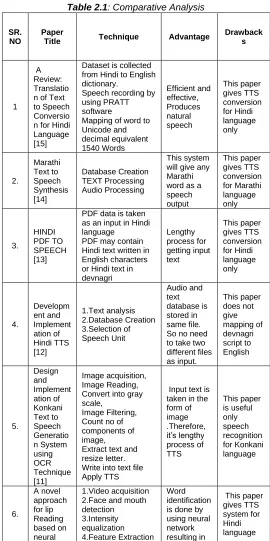
Solution: Basics are set for developing screening tool that can reach larger populationComparative analysis of some techniques are shown in table given below
Table 2.1: Comparative Analysis
SR. NO
Paper
Title Technique Advantage
Drawback s 1 A Review: Translatio n of Text to Speech Conversio n for Hindi Language [15]
Dataset is collected from Hindi to English dictionary.
Speech recording by using PRATT software
Mapping of word to Unicode and decimal equivalent 1540 Words Efficient and effective, Produces natural speech This paper gives TTS conversion for Hindi language only 2. Marathi Text to Speech Synthesis [14] Database Creation TEXT Processing Audio Processing This system will give any Marathi word as a speech output This paper gives TTS conversion for Marathi language only 3. HINDI PDF TO SPEECH [13]
PDF data is taken as an input in Hindi language
PDF may contain Hindi text written in English characters or Hindi text in devnagri Lengthy process for getting input text This paper gives TTS conversion for Hindi language only 4. Developm ent and Implement ation of Hindi TTS [12] 1.Text analysis 2.Database Creation 3.Selection of Speech Unit Audio and text database is stored in same file. So no need to take two different files as input. This paper does not give mapping of devnagri script to English 5. Design and Implement ation of Konkani Text to Speech Generatio n System using OCR Technique [11] Image acquisition, Image Reading, Convert into gray scale,
Image Filtering, Count no of components of image, Extract text and resize letter. Write into text file Apply TTS
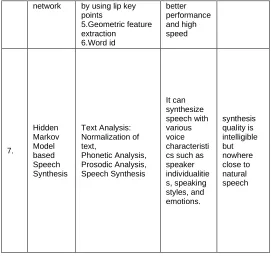
1658 network by using lip key
points
5.Geometric feature extraction
6.Word id
better performance and high speed
7.
Hidden Markov Model based Speech Synthesis
Text Analysis: Normalization of text,
Phonetic Analysis, Prosodic Analysis, Speech Synthesis
It can synthesize speech with various voice characteristi cs such as speaker individualitie s, speaking styles, and emotions.
synthesis quality is intelligible but nowhere close to natural speech
3 PROTOTYPE MODEL:
Here total 30 audios are taken as input which are spoken by 20 different people. Therefore, our dataset contain total200 words. Feature extraction from audio signals is done by MFCC and DTW algorithm finds DTW our best score.
A MFCC: Mel Frequency Cepstral Coefficients: Here energy of speech signal is increased to high frequency .The signal is segmented in to small fragments called as frames. Then frames are multiplies with hamming window to keep continuity in signal. Fast Fourier transform is used to convert time domain of signal into frequency domain. Discrete Cosine Transform is used to model features
B Dynamic Time Warping (DTW): This technique is normally used for measuring similarity between two sequences that may different in time or speed. As like, similarities in walking patterns would be detected. Suppose, in one video person is walking slowly and in other video same person is walking quickly. DTW can be used to get similarity. DTW has been used for multimedia, sounds, and graphics, any data that can be turned into a linear representation can be analysed with Dynamic Time Wrapping. A well-known application has been automatic speech recognition, to cope with different speeds of speaking. Generally, it is a method that allows a computer to get an optimal match between two given time series. With certain restrictions. That is, the sequences are "warped" non-linearly to match each other. Below figure shows flow of algorithm by using DTW technique.
Steps of DTW Algorithm:
1. Record audio using microphone 2. Training
a. Extract features(MFCC) from recorded samples
b. Create Dictionary of feature vectors 3. Operation
a. Isolate words from recorded audio b. Extract features for each word c. Load Dictionary of feature vectors d. Find word in dictionary that has best dtw
score
e. Display word with best score in Devanagari Script
Our training dataset contains of 3 directories of words containing 10 words in each directory. Each word is spoken 5 times by 4 different people, thus there are 20 different samples for each word.
Table 3.1: Directory 1 Dataset and Results
Table 3.2 : Directory 2 Dataset and Results
‘
Table 3.3 : Directory 3 Dataset and Results
Type of Sound
Number of Sounds
Correct
Recognition Accuracy
Known Audio 30 29 96.33%
Unknown Audio & Known Use
30 19 63.33%
Unknown
user 20 4 22%
4 CONCLUSIONS:
Hence, Paper focuses on review of software, hardware tools to assist dyslexic children. Also machine learning algorithms used like K Means, K nearest neighbour, Adaptive clustering, LS Algorithm, Support vector machine, Human Markov Model. Normally machine learning algorithms are used for extracting features of speech and finding out accuracy and performance improvement in children. Therefore, work will be focussing on children of having age between five to seven years who are having problem to read Hindi language words. Machine learning algorithms will be applied design technique to assist dyslexic children. Here two and three letters Hindi words are taken as a input to train the system by using dynamic Time Wrapping algorithm.
Once the system got trained with the words. Dyslexic child will be given word to read. If child speak wrong word first time, he/she will be given another chance to read. If same thing is repeated three times then System will speak out the word along with some picture will get display, so that child will get to know that word..The word spoken by child. In this way same session will be repeated for 20 minutes for child for different words. Here speech recognition technique of machine learning will be used to recognize. Here Dynamic Time Wrapping technique gives around 90% to 100%, if system is tested with same user and 30% accuracy, if system is tested with new user
5 REFERENCES:
[1]. John Colaco *, M.E. (Electronics and Telecommunication), Sangam Borkar ,”Design and Implementation of Konkani Text to Speech Generation System using OCR Technique, , International Journal of Scientific and Research Publications, Volume 6, Issue 9, September 2016. [2]. Archana Balyan, Amita Dev, Ruchika Kumari, S.
S. Agrawal, Development and Implementation of Hindi TTS, 978-9-3805-4416-8/15/$31.00c 2015 IEEE.
[3]. Snehali K.Nandurkar1, Zakir M.Shaikh2, HINDI PDF TO SPEECH, International Journal of Application or Innovation in Engineering & Management (IJAIEM), Volume 4, Issue 2, February 2015.
[4]. Darshna Badhe, 2 P. M. Ghate, Marathi Text to Speech Synthesis – Using Matlab®, IJCSN International Journal of Computer Science and Network, Volume 4, Issue 4, August 2015.
[5]. Kaveri Kamble, Ramesh Kagalkar, A Review: Translation of Text to Speech Conversion for Hindi Language, International Journal of Science and Research (IJSR), Volume 3 Issue 11, November 2014
[6]. Hassanin M. Al-Barhamtoshy , Diaa M. Motaweh, “Diagnosis of Dyslexia using Computation Analysis, IEEE,978-1-4673-8765-1/17/$31.00 ©2017 .
[7]. “Classifying Children with Reading Difficulties from Non-Impaired Readers via Symbolic Dynamics and Analysis of MEG Resting-State Data”, Stavros I. Dimitriadis, PanagiotisSimos, Nikolaos A. Laskaris, Spiros Fotopoulos, Jack M. Fletcher, David Linden,Andrew C. Papanicolaou IEEE International Symposium on Signal Processing and Information Technology (ISSPIT) ,2016.
[8]. “An Empirical Study of the Impact of E-Learning Tool developed for Dyslexic Children with Special Reference to Selective Schools in Tamil Nadu,
South India, Dr.V.Thulasibai1,
Dr.P.M.BeulahDevamalar, Dr.B.Senthil Kumar , Mr.Arun Marx4, International Conference on Advances in Electrical, Electronics, Information, Communication and Bio-Informatics ,2016. [9]. “Text To Speech System For Kannada
Language”, Anusha Joshi, DeepaChabbi ,Suman M and SupritaKulkarni, IEEE ICCSP,2015 Type of Sound Number of
Sounds
Correct Recognition
Accuracy
Known Audio 30 30 100%
Unknown Audio & Known Use
30 22 73.33%
Unknown user 20 6 30%
Type of Sound
Number of Sounds
Correct Recognition
Accuracy
Known Audio 30 30 100%
Unknown Audio & Known Use
30 21 70%
1660 [10]. IEEE transactions on audio speech and language
processing, Volume-21, NO-05, May 2013. [11]. Ossama Abdel-Hamid, Abdel-rahman Mohamed,
Hui Jiang, Li Deng, Gerald Penn, and Dong Yu, “Convolution Neural Networks for Speech Recognition”, ”, IEEE transactions on audio speech and language processing, Volume-22, NO-10, October 2014.
[12]. Rubi, Chhavi Rana, Rubi et al, “A Review on Speech Recognition with Deep Learning Methods” International Journal of Computer Science and Mobile Computing, Vol.4 Issue.8, pg. 301-307, August- 2015
[13]. M.A.Anusuya, S.K.Katti,“Speech Recognition by Machine: A Review”, (IJCSIS) International Journal of Computer Science and Information Security, Vol. 6, No. 3, 2009
[14]. Ronald D Davis, Eldon M Braun,” The gift of dyslexia : why some of the brightest people can't read and how they can learn”, English : 3rd edition.,London:Suvenir,2010
[15]. Geeta Atkar, Dr.Priyadarshini J., Dr. Maya Rathnasabapathy, “Review on advanced machine learning techniques for solving problem of dyslexia in children,IJETAR,ISSN-2394-3386,volume-04,issue-08,August 2017.
[16]. Luz Rello, Horacio Saggion, Ricardo Baeza-Yates, Eduardo Graells, “Graphical schemes may improve readability but not understandability for people with dyslexia, NAACL-HLT Workshop on predicting and improving text readability for target population, pages 25–32,June 2012.
[17]. looze rello, Recardo Baeza-Yates, “Good fonts for dyslexia”, ACM 987-1-4503-2405-2/13, October 2013
[18]. Khaled M. Alhawit, “Advances in artificial intelligence using speech recognition”, World academy of science, Engineering and technology, International journal of Computer and information Engineering, volume-09, NO-06, 2015.
[19]. Rubi,Chhavi Rana, “A review: speech recognition with deep learning methods, India, International Journal of Computer Science and Mobile Computing, Vol.4 Issue.5, pg. 1017-1024 , May- 2015.
[20]. Robert A. Stoddena, Kelly D. Robertsa, Kiriko Takahashia, Hye Jin Parka, and Norma, Jean Stoddena, “ Use of text to speech software to improve reading skills of high school struggling readers”, Procedia Computer Science, 359 – 362,2012
[21]. K.Nandhini, K.Nandhini, “Improving readability of dyslexic user through document summarization”, IEEE International conference on technology for education, 2011
[22]. K. Nandhini *, S.R. Balasundaram, “Improving readability through extractive summarization for learners with reading disability”, Egyptian Informatics Journal, Cairo University, 195–204, 2013
[23]. Siti Zulaiha Ahmad, Nik Noor Amalina Amirah Nik Ludin, Hawa Mohd Ekhsan, Arifah Fasha, Rosmani, Mohammad Hafiz Ismail, “Bejak
Membaka-Applying phonetics reading techniques and multisensory approach with interactive multimedia for dyslexia children, IEEE colloquium on humanities ,science and Engineering, December-2012
[24]. Siti Suhaila Abdul Hamid(&), Novia Admodisastro(&), Noridayu Manshor, Azrina Kamaruddin, and Abdul Azim Abd Ghani, “Dyslexia Adaptive Learning Model: Student Engagement Prediction Using Machine Learning Approach”, R. Ghazali et al. (eds.), Recent Advances on Soft Computing and Data Mining, Advances in Intelligent Systems and Computing 700, Springer International Publishing AG 2018. [25]. V. Slavuj*, B. Kovai* and I. Jugo, “Intelligent
Tutoring Systems for Language Learning”, Opatija, Croatia, MIPRO 2015, 25-29 May 2015 [26]. Suleyman Cetintas Luo Si Yan Ping Xin Casey
Hord, “Automatic Detection of Off-Task Behaviors in Intelligent Tutoring Systems with Machine Learning Techniques”, IEEE Transections on learning technologies,Vol 03, 2010
[27]. Ioannis Magnisalis Stavros
Demetriadis Anastasios Karakostas, “Adaptive and Intelligent Systems for Collaborative Learning Support: A Review of the Field”, IEEE Transections on learning technologies, Vol 04, issue 01, pp-5-20, 2011
[28]. Neeru Rathee1, ”Assistant Professor, MSIT, ICCTICT “A novel approach for lip Reading based on neural network
[29]. Emma Lindeblad, Staffan Nilsson, Stefan Gustafson & Idor Svensson, “Assistive technology as reading interventions for children with reading impairments with a one-year follow-up”, ISSN: 1748-3107 (Print) 1748-3115 (Online) Journal homepage: http://www.tandfonline.com/loi/iidt20, 07 Dec 2016.
[30]. Daniel Gooch1, Asimina Vasalou2, Laura Benton, Rilla Khaled3, “Using Gamification to Motivate Students with Dyslexia”, Learning Facilitation #chi4good, , San Jose, CA, USA CHI 2016 [31]. Yen-Shou Lai1, Hung-Hsu Tsai2 and Pao-Ta Yu3,
“A Multimedia English Learning System Using HMMs to Improve Phonemic Awareness for English Learning”, Educational Technology & Society, 12 (3), 266–281,2009
[32]. Daud, S. M., & Abas, H. (2013). "Dyslexia baca" mobile app - The learning ecosystem for dyslexic children. In Proceedings - 2013 International Conference on Advanced Computer Science Applications and Technologies, ACSAT 2013 (pp. 412-416). doi: 10.1109/ACSAT.2013.87.
[33]. Aziz, F. A., Husni, H., & Jamaludin, Z, “Translating Interaction Design Guidelines for Dyslexic Children's Reading Application”, II, 3-6, 2013
[34]. Pedler, J. (2007). Computer Correction of Real-word Spelling Errors in Dyslexic Text. London
University. Retrieved from
[35]. Ndombo, M. D. Integrative Assistive System for Dyslexic Learners Using Hidden Markov, Tshwane University of Technology, 2013
[36]. Lin, C., & Chai, H.-C. (2014). Using an E-Talk Pen to Promote Phonological Awareness on Communication Training (pp. 298-302).
[37]. Cetintas, S., Si, L. S. L., Xin, Y. P. x. Y. P., & Hord, C. (2010). Automatic Detection of Off-Task Behaviors in Intelligent Tutoring Systems with Machine Learning Techniques. IEEE Transactions on Learning Technologies, 3(3), 228-236. doi: 1O.11091TL T.2009.44.
[38]. Cuschieri, T., Khaled, R., Farrugia, V. E., Mart, P., & Yannakakis, G. N. (2014). The iLearnRW Game: Support for Students with Dyslexia in Class and at Home. In Games and Virtual Worlds for Serious Applications in IEEE (pp. 1-2
[39]. Neeru Rathee, “A novel approach for lip Reading based on neural network”, International Conference on Computational Techniques in Information and Communication Technologies (ICCTIC,2016
[40]. Thomais Asvestopoulou, Victoria Manousaki, Antonis Psistakis, “DysLexML: Screening Tool for Dyslexia Using Machine Learning”, arXiv: 1903.06274v1 [cs.CY] 14 Mar 2019