Research Article
Available online www.ijsrr.org
ISSN: 2279–0543
International Journal of Scientific Research and Reviews
Role of Evolutionary Computing Techniques for Knowledge Discovery:
A Survey
Mehta Mala
1*
and Chauhan Narendra
2
1
Dept. of Information Technology, Sardar Vallabhbhai Patel Institute of Technology (GTU), Vasad-388306, GJ, IN
2
Dept. of Information Technology, A D Patel Institute of Technology, V.V.Nagar-388120, GUJARAT, INDIA.
ABSTRACT
Evolutionary computing is an exciting development about building, applying and studying algorithms based on Darwin principle “Survival of fittest” and natural selection. Its root lies in evolutionary programming. Genetic Algorithm and Evolutionary strategies. Genetic programming is also considered a part of evolutionary computing. The techniques are used for optimization and efficient search. Data mining techniques have been widely used to mine knowledgeable information from databases. Due to large data collected into database, it is interesting to find out patterns from database, which is useful and understandable as well. The present article provides a survey which focuses on applicability and use of evolutionary computing techniques in field of data mining. Major two application areas which are also considered, is medical data mining and education data mining. An adequate bibliography is also included.
KEYWORDS
: Evolutionary Algorithm, Data Mining, Knowledge Discovery, Classification.*Corresponding author
Prof. Mala Mehta H.
Dept. of Information Technology, SVIT (GTU),
Vasad-388306, G U J A R A T , INDIA.
INTRODUCTION
As digital revolution is going on, it has made digitized information easy to store and capture as well.
Large information is collected and saved in databases as development in all areas related to computerization
is done. Data is stored at very fast rate in today’s world but to evaluate data faster techniques are needed
and no ad-hoc measures can be used to find any statistical conclusion and findings. Telecommunication
networks, manufacturing and production, World Wide Web, Medicine and Education fields are only few
examples of domains where large amount of data are stored in databases for analysis purpose.Data is of
no special use if it is not processed and analysed properly to find out knowledge form it. In early days,
typically manual processes were applied to analyse data. However, such traditional methods failed
completely when huge amount of data was gathered. Databases containing number of data in order 109
and dimension in order 103 are becoming increasingly common. When the scale of data manipulation,
exploration and inference goes beyond human capacities, people look to computing technologies for
automating the process1. Intelligent data analysismethods are a necessity of today’s world that discovers
useful knowledge. KDD is the term that refers to knowledge discovery in databases. Data mining is
considered just a part of this process. KDD focuses on overall process of knowledge discovery from
large volumes of data, including the storage and accessing such data, scaling of algorithms,
interpretation and visualization of results, modelling and support of overall human machine interaction1.
Data mining is considered as a form of knowledge discovery only in which specific data sets which is of
interest are gathered and studied carefully for analysis to find out useful patterns and discovering
knowledge out of them.
Evolutionary computing techniques are an exciting development in Computer Science. It amounts to
building, applying and studying algorithms based on the Darwinian principles of natural selection2.
Evolutionary computing (EC) has its roots in Evolutionary programming, Evolutionary strategies and
Genetic algorithms (GA)3. In nineties, these branches were considered as a part of EC. Later on, Genetic
programming also joined EC. Due to its powerful working Evolutionary Algorithms have emerged from
GA and has become most focused part of EC. Researchers found out this whole new branch of
algorithms, which can basically aid in solving combinatorial optimization problems known as
evolutionary algorithms4 but its applications are not just limited to pure optimization problems.
Ant-Colony optimization5,
Artificial-Bee Colony optimization6 and Swarm Intelligence7 are evolutionary algorithms developed
nature and behaviours of different species like birds flocking, fish schooling and bees’ working method.
Genetic algorithms are designed by taking idea from the human genetics. It follows Charles Darwin’s
“Survival of the fittest” kind of approach to achieve the optimal solution. Many evolutionary algorithms
have proved successful enough in getting desired results. However, to get most optimal answers hybrid
methods can also be proposed which can be a balanced mixture of ideas of two evolutionary
algorithms8.
Evolutionary algorithms can be considered as a branch of approximation algorithms where emphasis is
given much on proper heuristics rather than static approach. EAs are also considered as a part of soft
computing. Evolutionary Algorithms have played crucial role in various fields of data mining as well. In
data mining, gathered data can be of huge amount, after pre-processing, data has to be reduced further to
operate upon. Here, problem of feature reduction or instance reduction arises which are handled by EAs.
In classification and clustering methods, many EAs have been successfully applied to increase the
accuracy. Parameter optimization is also a field where EAs can show potential. In data mining, problem
of mixed data is faced where different kinds of data are to be handled; here also EAs have been
successfully applied.
Remainder of this paper is organized as follows: Section II describes the Evolutionary computing
techniques and data mining in detail. Section III presents literature survey on application of evolutionary
computing techniques in medical and education data mining. Section IV concludes the paper.
EVOLUTIONARY COMPUTING TECHNIQUES AND DATA MINING
The term evolutionary computation encompasses a host of methodologies inspired by natural
evolution that are used to solve hard problems10. Carlos and Moshe10 explained basic workings of six
types of evolutionary algorithms: genetic algorithms, genetic programming, evolution strategies,
evolutionary programming, classifier systems and hybrid systems. Basically, evolutionary computation
involves study of foundation and applications of computational techniques based on principles of natural
evolution. Evolutionary techniques can be perceived as either search methods or optimization methods.
Natural evolution has three basic mechanisms: reproduction, mutation and selection. Chromosomes
contain genetic information of individual and these mechanisms work on them. Reproduction process
introduces new individuals in population. Crossover creates new off springs from two parents
combining their genetic material. Mutation introduces small changes into inherited off springs. This
whole process follows Charles Darwin’s “Survival of the fittest’ strategy. It means that only the fittest
individuals will survive in the whole process.
In 1975, C.J.Holland first proposed genetic algorithm3. Genetic algorithm is an iterative search
and optimization method, which works on the human evolution process. Genetic algorithm has taken
inspiration from human genetics. Any genetic algorithm has basically four steps to perform. The first
step is initial population generation by choosing proper encoding method. After creating the initial
population, selection operator chooses the optimal value, based upon the fitness function. Fitness
function is application specific objective function which is to be maximized or minimized. Selection
operator’s job is to select the most optimal population(s) that can go ahead in the evolution and generate
best off springs for the future generations. Many different types of selection operators are available in
the literature11. After selecting the best population, crossover operator operates on the chromosomes that
are selected population, to generate new off springs. Crossover operators actually make permutations on
the chromosomes that result in new chromosomes. Different crossover operators’ efficiencies and
effects are different12. Mutation operator is included in genetic algorithm to provide population
diversity. Mutation operator necessarily gets whole process out of any local minima if realized by the
process. Mutation operator is necessary for genetic algorithm so that whole process of getting optimal
value does not stick into some valley. Generally, crossover is given more emphasis in traditional genetic
algorithm than mutation meaning that mutation is done in fewer amounts on chromosome than crossover
operation. Every time, the best fitness value is considered as global minimum or maximum and the
John koza10 developed a variant of genetic algorithms called genetic programming. Here, instead
of encoding possible solutions to a problem as a fixed-length character string, they are encoded as
computer programs. Programs here are expressed as parse tress, rather as lines of code. Set of possible
internal nodes are called function set, whereas terminal nodes make a set known as terminal set
consisting of variables or constants. Evolution in genetic programming proceeds along the general lines
of generic evolutionary algorithm, with genetic operators adapted to the tree representation.
Reproduction is carried out in both asexual and sexual ways. Asexual reproduction or cloning is similar
to elitist selection in GA. Sexual reproduction is crossover that starts out by selecting a random cross
over point in each parse tree and then exchanging the sub trees cut from these points, thus producing
two offspring trees. Mutation is performed less frequently in genetic programming and is worked by
removing a sub tree at a randomly selected point and inserting at that point a new random sub tree.
Problem in genetic programming is size of the tress. Cross over operators drastically increases the size
of trees and thus create problems for Getting optimal value does not stick into some valley. Generally,
crossover is given more emphasis in traditional genetic algorithm than mutation meaning that mutation
is done in fewer amounts on chromosome than crossover operation. Every time, the best fitness value is
considered as global minimum or maximum and the process terminates when it reaches to its stopping
criteria. John koza10 developed a variant of genetic algorithms called genetic programming. Here,
instead of encoding possible solutions to a problem as a fixed-length character string, they are encoded
as computer programs. Programs here are expressed as parse tress, rather as lines of code. Set of
possible internal nodes are called function set, whereas terminal nodes make a set known as terminal set
consisting of variables or constants. Evolution in genetic programming proceeds along the general lines
of generic evolutionary algorithm, with genetic operators adapted to the tree representation.
Reproduction is carried out in both asexual and sexual ways. Asexual reproduction or cloning is similar
to elitist selection in GA. Sexual reproduction is crossover that starts out by selecting a random cross
over point in each parse tree and then exchanging the sub trees cut from these points, thus producing
two offspring trees. Mutation is worked by removing a sub tree at a randomly selected point and
inserting at that point a new random sub tree. Problem in genetic programming is size of the trees. Cross
over operators drastically increases the size of trees and thus create problems for memory and speed.
Most implementations try to stop trees growing too large and deep but have disadvantage of reducing
genetic diversity in larger trees. Evolution strategies are not much studied. They were introduced by
problems. Here selection is performed after genetic operators have been applied. Crossover and
mutation operators are parts of ES. Two types of crossover operators are: discrete and intermediate.
Evolutionary programming (EP) was proposed to develop artificial intelligence. Finite state machines
were selected to represent individuals in evolutionary programming as they provide a meaningful
representation of behaviour based on interpretation of symbols. EP maintains a population of finite state
machines, each one representing particular candidate behaviour for solving problem at hand. The fitness
of an individual is calculated by presenting sequentially to FSM the symbols in environment and
observing predicted output. Quality of prediction is quantified according to given payoff function. Here
no cross over is used but five types of mutation operators are used10. Classifiers systems and hybrid
systems are also considered as a part of evolutionary computing techniques. However, classifiers
systems are considered as evolution-based learning systems. They are considered as a restricted version
of classical rule-based systems. It has three main parts: 1) rule and message System performs inference
and decides behaviour of system, 2) apportionment of credit system adapts behaviour by credit
assignment, and 3) genetic algorithm, which adapts system knowledge by rule discovery. Two main
approaches of application of evolutionary techniques in design of rule-based system are: Michigan
approach and Pittsburgh approach. In first approach, each individual represents a single rule, and
classifier list is represented by whole population. In Pittsburgh approach, genetic algorithm maintains a
population of candidate classifier lists, with each individual representing an entire list. In hybrid
systems, the attention is drawn to evolutionary-fuzzy hybrid systems more. A prime characteristic of
fuzzy logic is its capability of expressing knowledge in human way, allowing rules to be “human-friendly”. A fuzzy inference system uses fuzzy logic. System’s main components are: 1) fuzzier, 2)
inference engine, 3) defuzzifier and 4) knowledge base. Fuzzy rules are described by fuzzy logic.
Evolutionary-neural hybrid systems are also considered an important hybrid system which uses neural
networks.
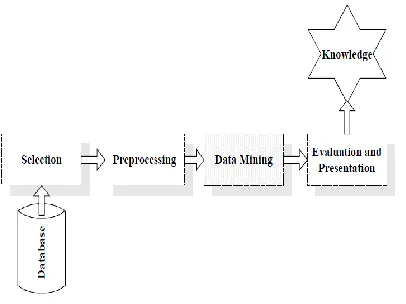
Data mining is basically a part of KDD process which is shown in figure 1. Digital revolution has
made digitized information easy to capture and fairly inexpensive to store. This has led to many new
dimensions open for research. Different fields like education, medical, financial and space engineering
gather huge amount of data for processing. Data mining is the process to mine useful patterns out of the
data. Data mining gives as output interesting patterns among different variables related to problem in
hand. Not only this, data mining is having many different tasks to do like clustering, classification and
and a target class, algorithm gives yes or no for that meaning that whether that object relates to that class
or not. Classification is supervised learning method; it is also known as inductive process. Clustering is
unsupervised learning method in which, no target class is given. In clustering, without any supervisor,
clusters are created based on similar properties of clusters. Association rule mining is interesting
procedure, in which, rule set is created in which deductive rules are generated which shows interesting
patterns among data objects. Data mining is most recent area of research and has gain immense
popularity among researchers. Data mining combined with evolutionary computing can yield motivating
result as evolutionary computing is a field which can be applied with the Darwinian principle of survival
of fittest and can find solutions where problem under consideration is considered as hard.
LITERATURE REVIEW
In 2015, T. Santhanam and M.S Padmavathi b proposed an application of k-means and genetic
algorithms for dimension reduction by integrating SVM for diabetes diagnosis13. Paper starts with a
brief introduction about medical mining. It also gives a very brief discussion about GA, K-means and
SVM. SVM is a supervised classification method which is considered as an efficient method for
classification. Whereas Genetic algorithm, is an evolutionary algorithm, which is based on Darwin’s “survival of the fittest strategy”, it explores global search space and provides best approximation results
by optimization. K-means algorithm is an unsupervised clustering algorithm. Paper further describes a
brief literature review. Following by k-means algorithm’s detail description. K-means clustering aims at
minimizing an objective function known as squared error function. Then authors have described
k-means algorithm steps. Next authors have described genetic algorithm in detail. Which says classical
model of GA includes three operations: 1) evaluation individual fitness, 2) formation of gene pool by
mutation. Support Vector Machine (SVM) is a supervised classification method, it is a classifier which
does classification based on hyper planes that separates cases of different class labels in
multidimensional space. There are two types of SVM: 1) linear SVM and 2) non-linear SVM.
Traditional SVM is based on QP (quadratic programming) but this process is very slow and needs a very
large memory. Thus SMO (Sequential Minimal Optimization) is formed to avoid QP routines.
Author has taken Pima Indian Diabetes data set as data source for his work. Which has 8 attributes and
768 instances, then author has proposed his method, in which, working principle of proposed method is
Proposed method consists of three steps: 1) data cleaning by replacing null values by mean, 2)
instance reduction on output from step 1 by K-means algorithm and 3) applying on output of step 2 GA
to reduce features. Finally, SVM is used to classify reduced data set.
In 2013, M.Akhil Jabbar and B.L Deekshatulu Priti Chandra proposed classification of heart
disease using k-nearest neighbour and genetic algorithm14.
Paper starts with brief introduction of data mining, nearest neighbour technique and evolutionary
algorithms. Authors also narrated briefly that heart disease is leading cause of death in India. Basic
concepts follow introduction section. It includes: 1) K nearest neighbour classifier, 2) genetic algorithm
and 3) heart disease. K nearest neighbour is a simple algorithm, which stores all cases and classifies new
cases based on simple measure. KNN is of two types; 1) structure less KNN and 2) structure based
KNN. Structure less KNN works by dividing data into two parts of training set and testing set. Then
author has given K nearest neighbour algorithm. There are generally three cases by which similarities
between samples can be measured. Accuracy of K-means algorithm depends on good selection of K.
Then GA is described in detail with its applications. One of the applications is in medicine field as well.
Flow chart of an evolutionary algorithm is given. Advantages and benefits of genetic algorithm are also
narrated. The basic components of GA are also discussed. These are cross over, selection, mutation and
fitness functions. Working and flow chart of genetic algorithm is also described. Heart disease and its
types are discussed with risk factors of it.
Proposed method is described, which is divided in two parts:
1) First part deals with evaluating attributes using genetic search.
2) Second part deals with building classifier and measuring accuracy of the classifier.
As shown in Figure 2, step 1 to 4 comes under part-1 and steps 5 and 6 come under part-2.
Classifiers accuracy is computed as number of samples correctly classified in test data divided by total
number of samples in the test data.
Authors have taken various 8 datasets for his work evaluation. These data sets are weather data set,
Pima data set, hypothyroid data set, breast cancer data set, liver disorder data set, primary tumor data
set, heart stalog data set and lymph data set. Results proved that proposed algorithm is efficient in
getting good results.
In 2000, Man Leung Wong, Wai Lam, Kwong Sak Leung Po Shun Ngan and Jack C.Y. Cheng
Authors have considered two medical databases for the research. One is fracture database including
6500 records and 8 attributes. Second is scoliosis database, which includes 20 attributes and 500
records. Task of discovering rules from two databases depend on representation of the rule, which is of
form “if antecedent then consequence”. On the basis of accuracy, rule can be exact, strong or weak.
Bayesian network is DAG (directed a cyclic graph), which is a mathematical model and can be used to
represent attributes as nodes. To discover rules from database, GGP (Generic genetic programming) is
used to represent grammar. A grammar is a representation form of rules. And on this grammar, different
GA operators like selection, crossover, mutation and dropping condition is applied. Support and
confidence factor are considered as evaluation criteria for rules. Evaluation of these rules is done by
support-confidence framework. Fitness function is developed in terms of support and confidence.
Support measures the coverage of a rule. Confidence factor is the confidence of the consequent to be
true under the condition that the antecedents are also true. Formulas are developed based on support and
confidence. A minimum threshold for support is determined. If support is less than this minimum
threshold than that confidence factor is ignored. Authors have employed token competition in rule
learning approach to search for a set of rules instead of just one rule. Each record in the training set can
provide a token. If a rule can match a record, it sets a flag to indicate that token is seized. Weaker rules
cannot get token. Fitness score of each individual is modified based on tokens it can seize.
Figure 2: Proposed algorithm14
That is why; the authors also modify fitness function. Then authors have narrated learning
Bayesian networks from discrete variables based on MDL (minimum description length) and EP
(evolutionary programming). Authors have then explained in detail MDL discretization policy. In that
also for learning this policy, genetic algorithms are used. Individual representation of chromosomes and
genetic operators are discussed.
Experiments are carried out on fracture database and scoliosis database. Results show that some
In 2013, Quang Hung Do and Jeng-Fung Chen presents Neuro-fuzzy approach in classification
of students’ academic performance16
. Accurately predicting students’ performance is useful in many
different contexts in educational environments. When admission officers review applications, accurate
predictions help them to distinguish between suitable and unsuitable candidates for an academic
program. The failure to perform and accurate admission decision may result in an unsuitable candidate
being admitted to the university. Since quality of educational institutional institution is mainly reflected
in research and training, quality of students admitted affects level of institutes. Accurate prediction
enables thus managers to improve student academic performance by offering students additional support
such as customized assistance and tutoring resource.
Then various classification approaches are discussed which are used to discover knowledge from
databases. Support vector machine, naïve Bayes classifier, neural network and decision trees are
explained in brief.
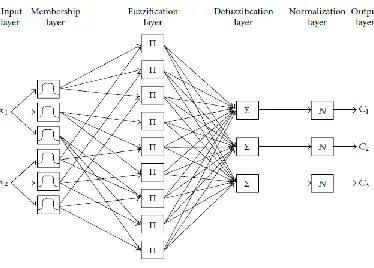
Neuro-fuzzy classifier architecture is then described and explained. A neuro-fuzzy classifier is as
shown in Figure 3.
A typical fuzzy classification rule Ri demonstrates relation between input feature space and
classes. In the NFC, the feature space is partitioned into multiple fuzzy subspaces by fuzzy if-then rules.
Figure 3: A Neuro-fuzzy classifier16
These fuzzy rules can be represented by a network structure. An NFC is a multiplayer
feed-forward network consisting of following layers: input, fuzzy membership, fuzzification, defuzzification,
normalization and output. In membership layer, membership function of each input is identified. In
fuzzification layer, each node generates a signal corresponding to the degree of fulfillment of fuzzy rule
for sample x. In defuzzification layer, weighted outputs are calculated each rule affects each class
obtained by picking maximum normalized output value. K-means clustering is applied to obtain initial
parameters to form fuzzy if-then rules. K-means clustering method aims to partition the input feature
space into a number of clusters in which each data point belongs to cluster with the nearest mean. To
optimize the parameters of NFC, SCG algorithm is applied. Cost function is determined from least mean
squares of difference between target value and calculated class value. Aim of SCG algorithm is to find
the optimal or near optimal parameter for cost function. SCG algorithm is then narrated and explained.
Application of proposed method is done on prediction of students’ academic performance level. First of
all, input and output variables are identified. Input variable were obtained from the admission
registration profile. For classification, data set is classified and class labels were identified as “good”, “average” and “poor’. Data set was obtained from university of transport technology, Vietnam.
Model was coded and implemented in MATLAB and simulation results were obtained. NFC
gives an accuracy of 84.51%, 93.2% and 85.17% for “good”, ”average” and “poor’ classification
respectively. This provides 90.03% accuracy for NFC. Results show that NFC can be used to classify
students into different groups based on their expected academic performance levels. The model achieved
an accuracy of over 90%, which shows that it may be accepted and good enough in comparison of other
traditional classifiers.
In 2016, Elham Taherifar and Toraj Banirostam proposed Assessment of Student Feedback from
the Training Course and Instructor' Performance through the Combination of Clustering Methods and
Decision Tree Algorithms17. The main purpose of the application of data mining in the article is to
explore the factors affecting the level of satisfaction of students with performance of teaching professor,
as well as courses. Data of this article is collected from the UCI website which has been collected in
2013, which corresponds to the data from the survey forms distributed among students of GAZI
University in turkey. Authors have the explained basic concepts of performance appraisal system,
student evaluation of teaching, educational data mining and the application of data mining in teaching
performance appraisal system. Related work is described in section 3. Educational data mining process
is explained in detail by authors in which, they have explained basic steps of data mining like
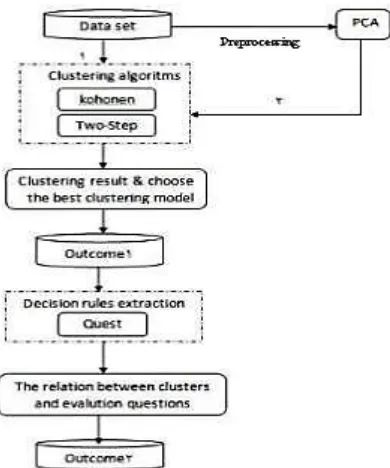
preprocessing, data mining and post processing. Proposed model is a hybrid model, which is described
in figure 4 below.
Two-step and kohonen algorithms run on 28-item data set. Then using PCA and extracted two
components of 28 items, clustering algorithm runs again, and their results are compared. The best
satisfaction of students can be predicted. In first step, two-step and kohonen algorithms are run and
results are obtained without applying PCA. Performance is evaluated in terms of silhouette value and
number of clusters. Then PCA is individually applied to both clustering algorithms and it is found out
that two-step method outperforms kohonen in both steps. PCA is proved effective in both algorithms.
Then evaluation of clustering results is done by analysis of results of PCA and two-step algorithm and
labeling the clusters according to analysis results. Forecasting of student satisfaction is done with Quest
decision tree algorithm. Classification rules are obtained by Quest and clusters are obtained by labeling
the clusters. Analysis of results of classification clusters are done by which in training set, correct
classification is 94.79% and in testing set, classification is 93.77%. Evaluation of work is done be
comparing with previous work, in which it is found that proposed method outperforms k-means+ D-tree
algorithm in two parameters Accuracy and Error rate.
Figure 4: Proposed model by Elham & Toraj17
CONCLUSION
Evolutionary computing techniques are powerful techniques that work on basis of Charles
Darwin’s “survival of fittest” policy. Its applications are immense. But if applied to mining field, it can
yield powerful and useful results for researchers. Here in this paper, brief survey of technical papers is
given which are concentrating on medical and education field
In education data mining, clustering and classification both can be applied for students grouping or students’ performance prediction.
In medical data mining, diabetes, heart disease and many other such diseases can be addressed and
novel and helpful results can be found. This paper puts emphasis on the fact that EC is powerful
tool to use in mining field.
REFERENCES
1. Mitra S, Pal S K, Mitra P. “Data Mining in Soft Computing Framework: A Survey”. IEEE
Transactions On Neural Networks. 2002; 13(1):3-14.
2. A. E. Eiben, M.Schoenauer. “Evolutionary Computation”. Information Processing Letters. Elsevier.
2002; 82(1):1-6.
3. Goldberg D E. “Genetic Algorithms in search, optimisation & machine learning” Addison-Wesley
Longman Publishing Co: United States; 1989; Available from: URL:
https://dl.acm.org/doi/book/10.5555/534133.
4. Mehta M H and Kapadia V V. “Intelligent Adaptive Mutation Based Genetic Algorithm for
Combinatorial Optimization Problems”. IEEE. ICECT. 2012; 3(1):563-66.
5. Fernandes C M, Rosa A C, Ramos V. “Binary Ant Algorithm”. ACM. 2007; 41-48.
6. Banharnsakun A, Achalakul T, Sirinaovakul B. “ABC-GSX: A hybrid method for solving the
Traveling Salesman Problem”. NaBIC. IEEE. 2010; 7-12.
7. Song M P, Gu G C. “Research on particle swarm optimisation: a review”. IEEE.2004; 2236-41.
8. Mehta M H and Kapadia V V. “Intelligent Adaptive Mutation Based Genetic Algorithm With
Catfish-PSO effect For Combinatorial Optimization Problems” IEEE. 2012; 1(1):111-115.
9. Qi Y. “Intelligent Data Mining Via Evolutionary Computing – A Thesis”. National University Of
Singapore, 2003; Available from: https://core.ac.uk/download/pdf/48625537.pdf
10. Andre’s C., Reyes P, Sipper M. “Evolutionary computation in medicine: an overview”.
AIM.ELSEVIER.2000; 19(1):1-23.
11. Razali N M, Geraghty J. “Genetic Algorithm Performance with different selection strategies in
solving TSP”.WCE.2011; 2(1):1134-39.
12. Otman A, Jafar A. “A comparative study of adaptive crossover operators for genetic algorithms to
13. Santhanama T A, Padmavathi M S B. “Application of K-Means and Genetic Algorithms for
Dimension Reduction by Integrating SVM for Diabetes Diagnosis”, PCS. Elsevier. 2015;
47(1):76-83.
14. Jabbar M A, Deekshatulu B L, Chandra P. ” Classification of Heart Disease Using K- Nearest
Neighbor and Genetic Algorithm”. PT. Elsevier. 2013; 10(1):85-94.
15. Wong M L, Lam W, Sak K, Po L, Ngan S, Cheng J C Y. “Discovering Knowledge from Medical
Databases Using Evolutionary Algorithm: Learning Rules and Causal Structures for capturing
patterns and Causality Relationships”. EIM. IEEE. 2000; 19(4):45-55.
16. Do Q H, Chen J F. “A Neuro-Fuzzy Approach in the classification of students’ Academic Performance”. CIN. Hindawi. 2013; 2013(1):1-7.
17. Taherifar E, Banirostam T. “Assessment of student feedback from the training course and instructor’s performance through the combination of clustering methods and decision tree algorithms”. IJARCSSE. 2016; 6(2):56-64.