O R I G I N A L R E S E A R C H
Oral Health Knowledge Level of Nursing Staff
Working in Semi-Intensive Heart Failure Units
This article was published in the following Dove Press journal: Journal of Multidisciplinary Healthcare
Stefano Cianetti1
Paola Anderini1
Stefano Pagano1
Paolo Eusebi2
Massimiliano Orso 2
Rosario Salvato3
Guido Lombardo1
1Surgical and Biomedical Sciences, Unit of
Pediatric Dentistry, University of Perugia, Perugia, Italy;2Health Planning Service, Department of Epidemiology, Regional Health Authority of Umbria, Perugia, Italy;3Department of Philosophy, Social and Human Sciences and Education, University of Perugia, Perugia, Italy
Purpose: Critical care units, such as heart failure units, house inpatients with a compromised general health status that requires rigorous prevention of further complica-tions. Oral health infections that gain access through the bloodstream or airway might represent such potential complications (eg, endocarditis pneumonia). Avoiding these critical occurrences requires that adequate oral health care be provided by nursing personnel. Here we assessed the knowledge of oral health care practices by nurses working in three Italian heart failure units in Umbria, Italy.
Design: This was a cross-sectional study.
Methods:Forty-four nurses were interviewed using a six-item modified Adams’ question-naire on the topic of oral health care. A multidisciplinary panel of experts established the criteria for answer correctness based on the most relevant dentistry literature evidence and judged each reply. The expected percentage of correctly replying nurses was 75%, and significant differences from this expected probability were calculated with one-sided bino-mial probability tests. Cronbach’sαmethod was used to establish the questionnaire’s internal consistency (reliability).
Results: For five out of six questionnaire items, the percentage of nurses who correctly answered was significantly lower than the expected value of probability. Lack of knowledge was found for usefulness of checking the patients’ mouths (p=0.003), the most relevant lesions affecting the mouth (p=0.0001), the tools/solutions for cleaning the mouth and dentures (p= 0.0416), and drugs that affect the mouth and their side effects (p<0.0001).
Conclusion: In this study, few nurses working in heart failure units showed both an adequate willingness to check inpatients and a good knowledge of oral health care (significantly lower than the expected 75%). Further studies that use validated question-naires and include more participants should be conducted to confirm and elaborate on our preliminary data.
Keywords:nursing education, heart failure, oral health care
Introduction
Cardiovascular diseases are the primary cause of death worldwide, with the highest prevalence for ischemic heart diseases. During the last decade, improved treatment for ischemic heart diseases has enhanced the survival rate of cardiology patients. Among
this population, one of the most severe diseases is heart failure.1Those affected by
heart failure are critical patients with several characteristics in common such as high mean age (79 years), high hospitalization rate (58.2% in the last year) and high
medication intake (≥7 drugs daily).2Individuals with heart failure are critical patients
who need to maintain a good general health status to minimize the risk of
Correspondence: Guido Lombardo Dentistry School, University of Perugia, Piazza L. Severi 1, Perugia 06132, Italy Tel +39 0755853514
Email [email protected]
Journal of Multidisciplinary Healthcare
Dove
press
open access to scientific and medical research
Open Access Full Text Article
Journal of Multidisciplinary Healthcare downloaded from https://www.dovepress.com/ by 118.70.13.36 on 24-Aug-2020
complications. Among possible complications are those deriving from oral microorganisms due to excessive plaque
accumulation caused by poor oral hygiene.3 The gingival
sulcus could represent a potentially permeable site for bac-teria to enter the bloodstream, particularly when the gum
tissue is inflamed. Indeed, in the case of gingivitis caused by
poor hygiene, the risk of bacteremia is almost three-fold
higher.4,5 The risk of general complications when plaque
damages the deeper periodontal tissues (periodontitis) has been widely considered in the literature. Periodontitis is related to an increased risk of several cardiovascular
dis-eases including heart infarction (1.28-fold),6arterial
hyper-tension (1.64-fold),7 and endocarditis (3,78-fold).5
Moreover, Joshy and co-authors reported an increased prob-ability of heart failure disease (1.97-fold) when patients
showed very poor oral health status (as measured by ≥20
missing teeth).8 Another aspect that enhanced the risk of
complications among cardiovascular patients (ie, heart
fail-ure inpatients) is their poor level of oral hygiene.9
Bacterial spread can also occur via the airway. The inner airways (bronchial and alveolar mucosa) may be infected by oral microorganisms through their direct diffusion from the upper airway (mouth), without any
blood involvement.10 A potential relationship between
periodontal disease and hospital-acquired infective
pneumonia was found,11 particularly in intensive care
units where patients are intubated and mechanically
ventilated.12
Among their required tasks, nurses also monitor the hygiene level of hospitalized patients and of supporting
them in their practices.13 In particular, nurses working in
the intensive care units are required to have oral hygiene
competency to avoid complications related to oral
microorganisms.12However, the few studies that investigated
nurses’ willingness to check and manage inpatients’ oral
hygiene described difficulty in fulfilling these tasks14,15and an increased risk of leaving inpatients without adequate sup-port in their daily oral hygiene. Both studies agreed that is important to offer possible solutions to this issue, such as offering nursing personnel training sessions on oral health
care and its advantages for patients’ general health.
Obviously, an analysis of the actual level of nurses’
knowl-edge on oral health topics (and care) is necessary to under-stand the gaps. This motivated our interest in carrying out
a study focused on understanding nurses’educational level of
oral health care. The decision to sample nurses working in heart failure units was motivated by the particular importance
of this type of cardiology unit. Although classified as a
semi-intensive ward, this setting could be considered an semi-intensive care unit based on the number of critical patients. However, unlike intensive care units where the level of oral health
knowledge was previously described,16,17 this aspect of
nurses’training has not been evaluated in heart failure units.
The evaluation of the nurses’ competence in oral
health care required a specific questionnaire.
A validated survey with this scope was not found in the literature. The only available questionnaire was that
created by Adams.18 Although not validated, this tool
was chosen because it incorporated the most relevant
aspects of nurses’ oral health care knowledge. A short
six-item version of this questionnaire was adopted after its validation in terms of reliability. It was not possible to test its validity due to the lack of a gold-standard questionnaire dealing with this topic. Therefore, our
study represents a preliminary investigation of nurses’
oral health care knowledge, but it highlights an under-valued clinical aspect of nursing practice.
Methods
Study Design
Observational cross-sectional study.
Study Population
Forty-four nurses working in three heart failure cardiology units who were caring for both dependent and independent patients gave their informed consent to participate in the study. The nurses worked in the three largest hospitals in Umbria (Italy), where heart failure units were located in the cardiology wards.
Setting
Three cardiology heart failure units were located in the University Hospitals of Perugia and Terni (Umbria)
Study Endpoints
Knowledge of the most relevant aspects of oral health care by nursing personnel and nursing staff working in semi-intensive cardiology heart failure units.
Ethical Committee Approval
After a complete evaluation of this study protocol, the insti-tutional ethics committee (CEAS Umbria, Italy) gave their approval for the trial (protocol no. 14891/18/L on date 15/ 11/2018) in accordance with the Declaration of Helsinki.
Journal of Multidisciplinary Healthcare downloaded from https://www.dovepress.com/ by 118.70.13.36 on 24-Aug-2020
Inclusion and Exclusion Criteria
Nurses working in heart failure units who gave written informed consent for study participation were included. Supporting nurses in clinical practice and temporary nurses working in the heart failure units (<3 months) were excluded.
Data Recording
For this study, Adams’ modified six-item questionnaire
was used to interview the participating nurses. Each ques-tionnaire was administered by the same dentistry unit nurse (P.A.) to all participating colleagues working in the three chosen cardiology wards during the months of April and May 2019.
The Questionnaire
A modified version of Adams’questionnaire was used in
this study.18 From the original version of Adams’
ques-tionnaire, only six items (questions and answers)
concern-ing aspects of oral health care were used. Our modified
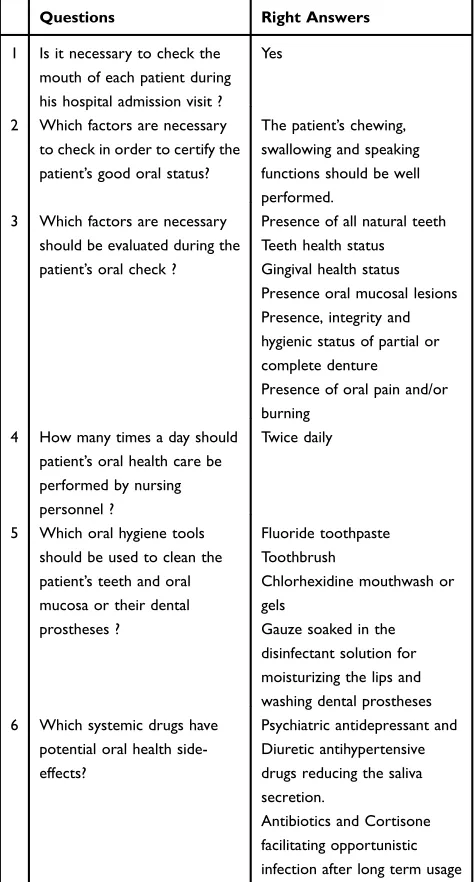
Adams’ questionnaire is shown in Table 1. Five items
were essay questions, and one required a dichotomous answer (yes or no). The nurses were asked to answer
each of the six questions in a specific pre-printed format.
Thirty minutes were allocated to answer all six questions. All completed questionnaires were then returned to the dentistry unit nurse. In addition to oral health care infor-mation, both personal and professional data such as age, sex, birthplace, type of employment (temporary or
perma-nent contract), number of years working in the field, and
professional qualifications were recorded for each nurse
(nursing assistant, licensed practical nurse, registered nurse, or master of science in nursing).
Data Extraction and Analysis
The criteria to assess answer correctness or incorrectness were established (before beginning nurse interviews) by a panel of multidisciplinary experts composed of one nurse (P.A.), two dentistry researchers (G.L. and P.S.), one professor in Dentistry (S.C.) and one professor in Didactic-Education (R. S.). All assessment criteria were established based on the most recent information on oral health and hygiene, as well as on guidelines and practice alerts for nursing personnel managing patients hospitalized in the intensive care unit or residents in long-term care homes.19–35All answers were read by the entire
multidisciplinary panel. The meaning of each answer wasfirst
discussed and then assessed correct or incorrect, relying on the
established evidence-based criteria. This adopted criteria for
each questionnaire item are reported inAppendix 1.
Statistical Analysis
Statistical analyses were carried out with STATA SE 13 (StataCorp, College Station, TX, USA). Counts and percen-tage frequencies were used to describe the questionnaire answers. A Wilson method was used for calculating 95%
binomial confidence intervals (95% CIs). Continuous
vari-ables are described with means and standard deviations. The impacts of age (above and below the mean of 43.7 years),
Table 1 The Shortened Six-Item Version of the Adams’ Questionnaire Including the Correct Answers
Questions Right Answers
1 Is it necessary to check the mouth of each patient during his hospital admission visit ?
Yes
2 Which factors are necessary to check in order to certify the patient’s good oral status?
The patient’s chewing, swallowing and speaking functions should be well performed.
3 Which factors are necessary should be evaluated during the patient’s oral check ?
Presence of all natural teeth Teeth health status Gingival health status Presence oral mucosal lesions Presence, integrity and hygienic status of partial or complete denture
Presence of oral pain and/or burning
4 How many times a day should patient’s oral health care be performed by nursing personnel ?
Twice daily
5 Which oral hygiene tools should be used to clean the patient’s teeth and oral mucosa or their dental prostheses ?
Fluoride toothpaste Toothbrush
Chlorhexidine mouthwash or gels
Gauze soaked in the disinfectant solution for moisturizing the lips and washing dental prostheses 6 Which systemic drugs have
potential oral health side-effects?
Psychiatric antidepressant and Diuretic antihypertensive drugs reducing the saliva secretion.
Antibiotics and Cortisone facilitating opportunistic infection after long term usage
Notes:Adapted with permission from Adams R. Qualified nurses lack adequate knowledge related to oral health, resulting in inadequate oral care of patients on medical wards.J Adv Nurs. 1996;24(3):552–560. Copyright © John Wiley & Sons Ltd.18
Journal of Multidisciplinary Healthcare downloaded from https://www.dovepress.com/ by 118.70.13.36 on 24-Aug-2020
length of experience distribution (above and below the mean of 17.6 years), and sex on the probability of getting correct
answers was tested by Fisher’s exact tests. The values of 43.7
and 17.6 for age and service years, respectively, were chosen because they were the mean values of the distributions. This choice was dictated by the need to maximize statistical power
and avoid subjective decisions. Cronbach’αwas calculated to
measure the degree of internal consistency of the six ques-tionnaire items. Item-by-item association was also tested by
Fisher’s exact tests. Considering the high level of knowledge
required of nursing staff working in critical health care, the expected minimal percentage of correct answers was set at
75% after a consensus was reached by the study’s entire
multidisciplinary panel of experts who have relevant exper-tise on oral health and mouth care. We used the one-sample proportion test to obtain the minimum required sample size to detect an alternative proportion of 0.75 (null hypothesis:
0.5) with 90% power and a 5% significance level, estimating
a sample size of 38 respondent nurses. To evaluate whether
the percentage of correct answers was significantly lower
than the expected probability of 75%, we performed a one-sided binomial probability test. A p-value of 0.05 was con-sidered significant in all analyses.
Results
Only 2 out of 44 nurses working in three heart failure cardiology wards refused to participate in this study (4.5% drop out rate). The remaining 42 nurses answered all 6 items in the administered questionnaire. The mean age of nursing professionals was 43.7 (SD 5.1) years. Among the entire sample of nurses included in the study (n=42), 23 were female (54.8%), and 20 (47.6%) began their nursing service more than 20 years ago. The mean value of the
overall length of service referring to the entire nurses’
sample was 17.6 (SD 5.4) years. Age was equally distrib-uted between males and females, 43.5 (SD 5.5) and 44.0 (SD 4.9) years, respectively.
The six items of the modified version of Adams’
ques-tionnaire were designed to test the knowledge level of nurses on oral health care. Prior to using the questionnaire for our survey, it was tested on 10 nurses (pilot study) in the heart failure unit at the University Hospital of Perugia to verify the completeness and comprehensibility of each question. All six questions were well understood by the 10
nurses tested, so no modifications were made to the
origi-nal text.
The first question, concerning the need to check the
mouth of each patient during their admission to the
cardiology unit, was correctly answered by 23 out of 42 nurses (54.8%, 95% CI=40.0 to 68.8%). The percentage of
nurses who gave correct answers was significantly lower
than the 75% expected (p=0.003). There was no effect of sex (p=0.076) or length of service (p=0.542) on the fre-quency of correct answers.
The second question focused on which oral physiologic functions should be checked in the mouth and was cor-rectly answered by 32 nurses (76.2%, 95% CI=61.5 to 86.5%). The most neglected observations were the phona-tory and smiling functions, which were not relevant to our
analysis. There were no statistically significant differences
between the measured versus expected percentages of nurses correctly answering (p=0.629). There was no effect of sex (p =0.468) or length of service (p=1.000) on the frequency of correct answers.
In the third question, participants were required to list the most relevant types of lesions affecting the mouth, and only 20 of 42 tested nurses (47.6%, 95% CI=33.4 to 62.3%) correctly answered by describing a complete evaluation on
caries, dental loss, gingival inflammation, and oral mucosa
lesions. A significantly lower percentage of nurses properly
responded than was expected (p=0.0001). Significant
differ-ences between the percentages of unlisted lesions were not
found. The nurses’lack of knowledge was most evident in
their inability to remember all four types of lesions. For this third question, sex (p=0.551) and length of service (p=0.212) did not affect the frequency of correct answers.
The fourth question concerned the adequate frequency of tooth brushing. Half (22/42 nurses, 52.4%, 95% CI=37.7 to 66.6%) indicated once a day and the remaining 20 said twice a day. None of the nurses deemed patient tooth brushing an unnecessary daily hygiene practice. Although neither of the answers might be considered incorrect, twice a day brushing is preferred to once and was assumed as correct. For this question, there was
a significantly lower percentage of nurses with the correct
answer than was expected (p=0.0001). There was no effect of sex (p=0.757) or length of service (p=0.764) on the frequency of correct answers.
The fifth question, regarding the equipment or tools
that should be used to clean the mouth, was correctly and completely answered by 27 out of 42 nurses (64.3%, 95% CI=49.2 to 77.0). The percentage of correctly replying nurses was lower than expected (p=0.0416). The aspects
most forgotten by nurses were the use of dental floss
(37.1%, 95% CI=48.7 to 25.5%) and prostheses cleaning (23.3%, 95% CI=8.7 to 32%). There was no effect of sex
Journal of Multidisciplinary Healthcare downloaded from https://www.dovepress.com/ by 118.70.13.36 on 24-Aug-2020
(p=1.000) or length of service (p=0.754) on the frequency of correct answers.
The sixth question required knowledge of the most relevant drugs affecting the mouth. Only 13 out of 42 nurses (30.9%, 95% CI=19.4 to 46.0%), correctly replied to this question, mentioning at least three out of four types
of drugs reported inAppendix 1. A slightly higher level of
knowledge was found for cortisone and antibiotic side effects compared to diuretic antihypertensive and psychia-tric antidepressants (p=0.03). Overall, nurses who gave correct replies concerning this item were statistically less than the 75% expected value (p<0.0001). There was no effect of sex (p=0.516) or length of service (p=0.360) on the frequency of correct answers.
In Synthesis
The expected percentage (75%) of correctly replying nurses
was only satisfied for the second question (Figure 1). The
mean percentage of nurses who replied with correct answers was 54.8% (95% CI=48.8 to 61). The two items where
nurses significantly departed from this mean value
percen-tage were the second question with an improved mean value (p=0.005) and the sixth question with an impaired mean value (p=0.003). These percentages of correct replies were completely unrelated to independent variables such as age (lower or higher than the mean of 43.7 years), sex, and length of service distribution (above and below the mean of 17.6 years), with p-values ranging from 0.514 to 1.
Questionnaire Internal Consistency
These first six items were strongly associated pairwise
according to Fisher’s exact tests. The second item was
the only one that did not correlate with the others. Moreover, the six answers showed a good degree of
inter-nal consistency as indicated by a Cronbach’αof 0.75 (95%
CI=0.63 to 0.87).
Discussion
To assess the nursing staff’s level of knowledge on oral
health care, thefirst objective was tofind a valid
measure-ment tool. A specific scale was chosen (a modified six-item
version of Adams’ questionnaire), and its reliability was
evaluated through a Cronbach’sαtest, which was adopted
in our previous questionnaire validation study.36This
ques-tionnaire showed satisfactory results in terms of internal coherence between its items. Indeed, with the exception of the second question, all the items showed pairwise
associa-tions, suggesting the answers would reflect similar levels of
nursing knowledge about oral health.
When the nursing staff was evaluated, the answers indicated a low level of oral health care knowledge. Few nurses considered it necessary to perform an oral check of inpatients during their hospitalization. This suggested a lack of willingness to consider mouth hygiene status, as though the mouth were not part of the total patient.
Moreover, disinterest in considering the mouth, reflected
a general low level of oral health among the nurses.
0% 10% 20% 30% 40% 50% 60% 70% 80% 90%
Item 1 Item 2 Item 3 Item 4 Item 5 Item 6
Figure 1Percentages of nurses correctly answering each of the six questionnaires items. The red dotted line represents the attendance percentage of those who responded correctly.
Journal of Multidisciplinary Healthcare downloaded from https://www.dovepress.com/ by 118.70.13.36 on 24-Aug-2020
Indeed, as demonstrated by the other questionnaire items, a high percentage of nurses answered incorrectly when they were asked about the correct daily frequency of brushing teeth or dental prostheses.
A poor level of nursing competency was found for
knowledge of the tools (toothbrush, dentalfloss or gauze)
or products (fluoride toothpaste or chlorhexidine) for
cleaning oral tissues. A small sample of nurses correctly replied (lower than 75% expected) when asked to indicate what lesions principally affect teeth, gums, and oral mucosa or to describe the drugs that might induce oral microbiome alterations.
This gap in knowledge, combined with low awareness
of the importance of daily management of inpatients’oral
hygiene, raised some concerns on the effectiveness of nurses in preventing systemic complications due oral infections. Nurses with a low degree of awareness in oral health care increase the risk for inpatients to be incorrectly supported in their oral hygiene practices in terms of both
frequency and quality.37Supporting inpatients in their oral
hygiene represents a practice where nurses are asked to habitually make independent daily decisions, without any
informed supervision. Therefore, as in all other“
decision-making” clinical situations, oral health care is based on
high levels of knowledge and practical experience.38
These concerns increase when oral competences were required of nurses working in a semi-intensive (eg, heart failure units) or intensive units where inpatients have a critical general health condition.
The mean percentage of nurses that correctly replied to the questions was 54.4%, much lower than the expected 75%. However, when the percentages calculated in each of the six items were compared among themselves, no
sig-nificant differences were found with the exception of both
the second and sixth items. The second question concerned the most relevant oral functions, and 76.2% responded correctly. A possible explanation for this high percentage could be that functions such as chewing and swallowing could be seen by nurses with direct practical experience but no dentistry background. Management and feeding of patients with either reduced swallowing and chewing are
habitual tasks, increasing nurses’ confidence with this
issue.39,40Conversely, only 30.9% correctly answered the
sixth question, which asked which drugs cause oral side effects. This low level of knowledge about the side effects of drugs could be explained by the fact that this type of
detailed pharmacologic competence could be not
completely expected from the nurses, considering the com-plexity of their clinical tasks.
The most relevant drugs that affect the oral cavity and microbiome are antibiotics, cortisone, antihypertensive diuretics, and psychiatric antidepressants. The analysis of
the nurses’responses on this topic showed that this
unde-sirable effect was better recognized for cortisone and anti-biotics than for the other two drug classes. We surmised that this was due to the fact that cortisone and antibiotics taken over an extended period of time can lead to dysmi-crobism in the oral cavity and other organs (eg, the
geni-talia and intestine),41,42 the detection of which would not
require special competence in oral health care. Conversely, antihypertensive diuretics and psychiatric antidepressants
cause changes to the microbiome by reducing salivaflow,
producing this side effect only in the oral cavity.32,33
Understanding this problem requires specific oral health
care knowledge, which is less expected from nursing personnel.
Our results agreed with those produced by similar investigations on this topic. In these studies (carried out in hospitalized patients or nursing home residents), mouth care performed by nursing personnel was a low priority and was correlated with poor oral health status in
patients.14,43–45 Factors such as excessive workload,
lim-ited staff, lack of adequate structure, and limlim-ited education on oral health were claimed by nurses as the most relevant reasons to explain their inadequate attention to oral hygiene.46–48
These above-mentioned obstacles affecting adequate oral health care underscore the need for better education in this topic. This idea was validated in the literature, which shows that appropriate education policies improve
both the knowledge background of nurses49–51 and their
support of inpatients in oral hygiene.51
Another positive strategy that has proven useful in supporting nursing staff in oral health management is expanding the professional team to include other
specia-lized figures such as a dental hygienist and dentist. This
strategy might also be a psychological comfort for nursing personnel who often claim there are limited chances for
positive inter-professional relationships.52 As a last
con-sideration, the introduction of new, easier dental proce-dures (ie, the Atraumatic Restorative Technique) and
innovative filling materials (ie, glass ionomer cements)
might allow for an interdisciplinary professional team (including the nursing staff) to temporarily manage dental
Journal of Multidisciplinary Healthcare downloaded from https://www.dovepress.com/ by 118.70.13.36 on 24-Aug-2020
caries in critical inpatients, reducing the risk of general
infective complications.53
Limitations
The expected percentage of correct answers indicating an adequate level of knowledge of oral health and mouth care topics was set as 75% by a multidisciplinary panel of experts relying solely on their clinical expertise and education. This subjective percentage was based on the fact that the literature did not describe a validated scale to assess the level of nursing education in oral health. In addition, due to the limited sample size, the obtained results should be considered as preliminary data to raise concerns about the degree of oral health knowledge demonstrated by nurses working in heart failure units. A further limitation was due that our study population only consisted of nurses working in cardiology heart failure units in Italy. We are uncertain whether the results would be comparable in other critical care set-tings in Italy and/or other countries. Further studies should be performed involving nurses working in other critical care hospital departments to investigate possible differences in their oral health knowledge and to explore potential factors that might explain heterogeneity.
Conclusion
This study evaluated nurses’awareness of the relevance of
oral hygiene management to avoid additional general health complications in inpatients hospitalized in heart failure units in the Umbria region of Italy. Their level of knowledge
in the oral health care field was also evaluated. For this
purpose we used a six-item questionnaire adapted from the
Adams’questionnaire. Low levels of interest in and
knowl-edge of oral health care among these nurses were found. These data should be considered preliminary, due to both the small sample size and the use of an incompletely validated questionnaire (only its reliability was demon-strated). However, our data raise concerns about the lack of a nursing role in the prevention of general complica-tions deriving from oral infeccomplica-tions, particularly when con-sidering the general health status of critical inpatients. Further studies should be carried out with a larger sample of nurses to assess their oral health knowledge using a questionnaire that is both reliable and valid.
Disclosure
The authors indicate no conflicts of interest in this
scien-tific work.
References
1. Agnetti G, Piepoli MF, Siniscalchi G, Nicolini F. New insights in the diagnosis and treatment of heart failure. Biomed Res Int.
2015;2015:265260. doi:10.1155/2015/265260
2. Radini D, Sola G, Zeriali N, et al. Objectives, organization and activities of a nurse-led clinic for outpatient cardiology care.G Ital Cardiol (Rome).2016;17(5):377–387. doi:10.1714/2252.24268 3. Sabharwal A, Gomes-Filho IS, Stellrecht E, Scannapieco FA. Role of
periodontal therapy in management of common complex systemic diseases and conditions: an update. Periodontol 2000. 2018;78 (1):212–226. doi:10.1111/prd.2018.78.issue-1
4. Tomás I, Diz P, Tobías A, Scully C, Donos N. Periodontal health status and bacteraemia from daily oral activities: systematic review/ meta-analysis.J Clin Periodontol.2012;39(3):213–228. doi:10.1111/ j.1600-051X.2011.01784.x
5. Lockhart PB, Brennan MT, Thornhill M, et al. Poor oral hygiene as a risk factor for infective endocarditis-related bacteremia.J Am Dent Assoc.2009;140(10):1238–1244. doi:10.14219/jada.archive.2009.0046 6. Rydén L, Buhlin K, Ekstrand E, et al. Periodontitis increases the risk of a first myocardial infarction: a report from the PAROKRANK study. Circulation. 2016;133(6):576–583. doi:10.1161/CIRCULATIONAHA.115.020324
7. Martin-Cabezas R, Seelam N, Petit C, et al. Association between periodontitis and arterial hypertension: a systematic review and meta-analysis. Am Heart J. 2016;180:98–112. doi:10.1016/j. ahj.2016.07.018
8. Joshy G, Arora M, Korda RJ, Chalmers J, Banks E. Is poor oral health a risk marker for incident cardiovascular disease hospitalisa-tion and all-cause mortality? Findings from 172 630 participants from the prospective 45 and Up Study. BMJ Open. 2016;6(8):e012386. doi:10.1136/bmjopen-2016-012386
9. Shetty D, Dua M, Kumar K, Dhanapal R, Astekar M, Shetty DC. Oral hygiene status of individuals with cardiovascular diseases and asso-ciated risk factors.Clin Pract.2012;2(4):e86. doi:10.4081/cp.2012.e86 10. El-Solh AA. Association between pneumonia and oral care in nursing home residents. Lung. 2011;189(3):173–180. doi:10.1007/s00408-011-9297-0
11. Bansal M, Khatri M, Taneja V. Potential role of periodontal infection in respiratory diseases - a review.J Med Life.2013;6(3):244–248. 12. Hua F, Xie H, Worthington HV, Furness S, Zhang Q, Li C. Oral
hygiene care for critically ill patients to prevent ventilator-associated pneumonia.Cochrane Database Syst Rev.2016;10:CD008367. 13. Accardi R, Castaldi S, Marzullo A, Ronchi S, Laquintana D, Lusignani M.
Prevention of healthcare associated infections: a descriptive study.Ann Ig.
2017;29(2):101–115. doi:10.7416/ai.2017.2137
14. Coker E, Ploeg J, Kaasalainen S, Carter N. Observations of oral hygiene care interventions provided by nurses to hospitalized older people.Geriatr Nurs.2017;38(1):17–21.
15. Kwok C, McIntyre A, Janzen S, Mays R, Teasell R. Oral care post stroke: a scoping review. J Oral Rehabil. 2015;42(1):65–74. doi:10.1111/joor.2014.42.issue-1
16. Emery KP, Guido-Sanz F. Oral care practices in non-mechanically ventilated intensive care unit patients: an integrative review.J Clin Nurs. 2019;28(13–14):2462–2471. doi:10.1111/jocn.2019.28.issue-13pt14
17. Pedersen PU, Larsen P, Håkonsen SJ. The effectiveness of systematic perioperative oral hygiene in reduction of postoperative respiratory tract infections after elective thoracic surgery in adults: a systematic review. JBI Database System Rev Implement Rep. 2016;14 (1):140–173. doi:10.11124/jbisrir-2016-2180
18. Adams R. Qualified nurses lack adequate knowledge related to oral health resulting in inadequate oral care of patients on medical wards.J Adv Nurs.
1996;24(3):552–560. doi:10.1046/j.1365-2648.1996.22416.x
19. Donnelly GF. Happy 30th anniversary–holistic nursing practice! Holist Nurs Pract.2016;30(1):1–2.
Journal of Multidisciplinary Healthcare downloaded from https://www.dovepress.com/ by 118.70.13.36 on 24-Aug-2020
20. Kikutani T, Tamura F, Nishiwaki K, et al. The degree of tongue-coating reflects lingual motor function in the elderly. Gerodontology.2009;26(4):291–296. doi:10.1111/ger.2009.26.issue-4 21. Dodds MW. The oral health benefits of chewing gum.J Ir Dent
Assoc.2012;58(5):253–261.
22. Kumar S, Tadakamadla J, Johnson NW. Effect of toothbrushing frequency on incidence and increment of dental caries: a systematic review and meta-analysis. J Dent Res. 2016;95(11):1230–1236. doi:10.1177/0022034516655315
23. Lertpimonchai A, Rattanasiri S, Arj-Ong Vallibhakara S, Attia J, Thakkinstian A. The association between oral hygiene and period-ontitis: a systematic review and meta-analysis.Int Dent J.2017;67 (6):332–343. doi:10.1111/idj.2017.67.issue-6
24. Needleman I, Hyun-Ryu J, Brealey D, et al. The impact of hospitalization on dental plaque accumulation: an observational study.J Clin Periodontol.
2012;39(11):1011–1016. doi:10.1111/j.1600-051X.2012.01939.x 25. Elkerbout TA, Slot DE, Rosema NAM, Van der Weijden GA. How
effective is a powered toothbrush as compared to a manual tooth-brush? A systematic review and meta-analysis of single brushing exercises.Int J Dent Hyg.2019. doi:10.1111/idh.12401
26. Yaacob M, Worthington HV, Deacon SA, et al. Powered versus manual toothbrushing for oral health.Cochrane Database Syst Rev.
2014;6:CD002281.
27. Pitts NB, Zero DT, Marsh PD, et al. Dental caries.Nat Rev Dis Primers.2017;3:17030. doi:10.1038/nrdp.2017.30
28. Walsh T, Worthington HV, Glenny AM, Marinho VC, Jeroncic A. Fluoride toothpastes of different concentrations for preventing dental caries.Cochrane Database Syst Rev.2019;3:CD007868. doi:10.1002/ 14651858.CD012521.pub2
29. Reichert S, Schlitt A, Beschow V, et al. Use of floss/interdental brushes is associated with lower risk for new cardiovascular events among patients with coronary heart disease. J Periodontal Res.
2015;50(2):180–188. doi:10.1111/jre.2015.50.issue-2
30. Dudoignon E, Alanio A, Anstey J, et al. Outcome and potentially modifiable risk factors for candidemia in critically ill burns patients: a matched cohort study.Mycoses.2019;62(3):237–246. doi:10.1111/ myc.2019.62.issue-3
31. Papadimitriou-Olivgeris M, Spiliopoulou A, Fligou F, et al. Association of KPC-producing Klebsiella pneumoniae colonization or infection with Candida isolation and selection of non-albicans species. Diagn Microbiol Infect Dis. 2014;80(3):227–232. doi:10.1016/j. diagmicrobio.2014.07.012
32. Cappetta K, Beyer C, Johnson JA, Bloch MH. Meta-analysis: risk of dry mouth with second generation antidepressants. Prog Neuropsychopharmacol Biol Psychiatry. 2018;84(Pt A):282–293. doi:10.1016/j.pnpbp.2017.12.012
33. Nederfors T, Nauntofte B, Twetman S. Effects of furosemide and bendroflumethiazide on salivaflow rate and composition.Arch Oral Biol.2004;49(7):507–513. doi:10.1016/j.archoralbio.2004.01.007 34. Armola RR, Bourgault AM, Halm MA, et al. 2008-2009
evidence-based practice resource work group of the American Association of Critical-Care Nurses. Upgrading the american association of critical-care nurses’evidence-leveling hierarchy. Am J Crit Care. 2009;18 (5):405–409. doi:10.4037/ajcc2009170
35. American association of critical care nurses. Available from:https://www. aacn.org/nursing-excellence/aacn-standards. Accessed January 24, 2020. 36. Paglia L, Gallus S, de Giorgio S, et al. Reliability and validity of the
Italian versions of the children’s fear survey schedule - dental sub-scale and the modified child dental anxiety scale. Eur J Paediatr Dent.2017;18(4):305–312. doi:10.23804/ejpd.2017.18.04.08
37. Ajwani S, Jayanti S, Burkolter N, et al. Integrated oral health care for stroke patients - a scoping review.J Clin Nurs.2017;26(7–8):891– -901. doi:10.1111/jocn.2017.26.issue-7pt8
38. Nibbelink CW, Brewer BB. Decision-making in nursing practice: an integrative literature review. J Clin Nurs. 2018;27(5–6):917–928. doi:10.1111/jocn.14151
39. Skoretz SA, Rebeyka DM. Dysphagia following cardiovascular sur-gery: a clinical overview.Can J Cardiovasc Nurs.2009;19(2):10–16. 40. Luk JK, Chan FH, Hui E, Tse CY. The feeding paradox in advanced dementia: a local perspective. Hong Kong Med J. 2017;23 (3):306–310. doi:10.12809/hkmj166110
41. Wilkinson EM, Ilhan ZE, Herbst-Kralovetz MM. Microbiota-drug interactions: impact on metabolism and efficacy of therapeutics. Maturitas.2018;112:53–63. doi:10.1016/j.maturitas.2018.03.012 42. Iizumi T, Battaglia T, Ruiz V, Perez Perez GI. Gut Microbiome and
Antibiotics. Arch Med Res. 2017;48(8):727–734. doi:10.1016/j. arcmed.2017.11.004
43. Wårdh I, Hallberg LR, Berggren U, et al. Oral health care-a low priority in nursing. In-depth interviews with nursing staff. Scand J Caring Sci.2000;14(2):137–142.
44. Chung JP, Mojon P, Budtz-Jørgensen E. Dental care of elderly in nursing homes: perceptions of managers, nurses, and physicians. Spec Care Dentist. 2000;20(1):12–17. doi:10.1111/j.1754-4505.20 00.tb00004.x
45. White R. Nurse assessment of oral health: a review of practice and education.Br J Nurs.2000;9(5):260–266. doi:10.12968/bjon.2000.9.5.6 359
46. Dharamsi S, Jivani K, Dean C, Wyatt C. Oral care for frail elders: knowledge, attitudes, and practices of long-term care staff.J Dent Educ.2009;73(5):581–588.
47. Berry AM, Davidson PM. Beyond comfort: oral hygiene as a critical nursing activity in the intensive care unit. Intensive Crit Care Nurs. 2006;22(6):318–328. doi:10.1016/j.iccn.2006.0 4.003
48. Hoben M, Clarke A, Huynh KT, et al. Barriers and facilitators in providing oral care to nursing home residents, from the perspective of care aides: a systematic review and meta-analysis.Int J Nurs Stud.
2017;73:34–51. doi:10.1016/j.ijnurstu.2017.05.003
49. Paulsson G, Fridlund B, Holmén A, Nederfors T. Evaluation of an oral health education program for nursing personnel in special hous-ing facilities for the elderly.Spec Care Dentist.1998;18(6):234–242. doi:10.1111/j.1754-4505.1998.tb01640.x
50. Khanagar S, Kumar A, Rajanna V, et al. Oral health care educa-tion and its effect on caregivers’knowledge, attitudes, and prac-tices: a randomized controlled trial. J Int Soc Prev Community Dent.2014;4(2):122–128. doi:10.4103/2231-0762.139843 51. Khanagar S, Naganandini S, Tuteja JS, et al. Improving oral hygiene
in institutionalised elderly by educating their caretakers in Bangalore City, India: a randomised control trial. Can Geriatr J. 2015;18 (3):136–143. doi:10.5770/cgj.18.145
52. Dale CM, Angus JE, Sinuff T, Rose L. Ethnographic investigation of oral care in the intensive care unit. Am J Crit Care. 2016;25 (3):249–256. doi:10.4037/ajcc2016795
53. Chieruzzi M, Pagano S, Lombardo G, et al. Effect of nanohydrox-yapatite, antibiotic, and mucosal defensive agent on the mechanical and thermal properties of glass ionomer cements for special needs patients. J Mater Res. 2018;33(6):638–649. doi:10.1557/jmr. 2018.36.
Journal of Multidisciplinary Healthcare downloaded from https://www.dovepress.com/ by 118.70.13.36 on 24-Aug-2020
Journal of Multidisciplinary Healthcare
Dove
press
Publish your work in this journal
The Journal of Multidisciplinary Healthcare is an international, peer-reviewed open-access journal that aims to represent and publish research in healthcare areas delivered by practitioners of different disciplines. This includes studies and reviews conducted by multi-disciplinary teams as well as research which evaluates the results or conduct of such teams or healthcare processes in general. The journal
covers a very wide range of areas and welcomes submissions from practitioners at all levels, from all over the world. The manuscript management system is completely online and includes a very quick and fair peer-review system. Visit http://www.dovepress.com/testimonials. php to read real quotes from published authors.
Submit your manuscript here:https://www.dovepress.com/journal-of-inflammation-research-journal
Journal of Multidisciplinary Healthcare downloaded from https://www.dovepress.com/ by 118.70.13.36 on 24-Aug-2020