Neuropsychiatric Disease and Treatment 2017:13 2405–2410
Neuropsychiatric Disease and Treatment
Dove
press
submit your manuscript | www.dovepress.com 2405
O r i g i N a l r e s e a r c h
open access to scientific and medical research
Open access Full Text article
sex differences in obesity and cognitive function in
a cognitively normal aging chinese han population
Wei li* Qi Qiu* lin sun ling Yue Tao Wang Xia li shifu Xiao
alzheimer’s Disease and related Disorders center, shanghai Mental health center, shanghai Jiao Tong University school of Medicine, shanghai, People’s republic of china
*These authors contributed equally to this work
Background: Sex differences in Alzheimer’s disease and mild cognitive impairment have been well recognized. However, sex differences in cognitive function and obesity in cognitively normal aging Chinese Han population have not attracted much attention.
Objective: The aim of this study was to investigate the relationship between sex, obesity, and cognitive function in an elderly Chinese population with normal cognitive function.
Subjects and methods: A total of 228 cognitively normal aging participants (males/ females =93/135) entered this study. Their general demographic information (sex, age, and education) was collected by standardized questionnaire. Apolipoprotein E (APOE) genotype and serum lipid levels were measured. The Montreal Cognitive Assessment (MoCA) was used to assess participants’ cognitive function.
Results: The prevalence of obesity in elderly women (18/133, 13.5%) was significantly higher than that in men (5/92, 5.4%, P=0.009). Regression analyses showed that obesity was associated with drinking alcohol (OR =13.695, P=0.045) and triglyceride (OR =1.436, P=0.048) in women and limited to low-density lipoprotein (OR =11.829, P=0.023) in men. Women performed worse on the naming score for MoCA than men (P,0.01). Stepwise linear regression analysis showed that education (t=3.689, P,0.001) and smoking (t=2.031, P=0.045) were related to the score of naming in female, while high-density lipoprotein (t=-2.077, P=0.041) was related to the score of naming in male; however, no correlation was found between body mass index and cognitive function in both male and female (P.0.05).
Conclusion: Our finding suggests that there are significant sex differences in obesity and specific cognitive domains in aging Chinese Han population with normal cognitive function.
Keywords: sex difference, obesity, cognitive function, lipids, elderly Chinese
Introduction
Sex differences in cognitive impairment in adulthood and aging have been well demonstrated.1 Accumulating epidemiological studies suggest that women are
disproportionately affected by Alzheimer’s disease (AD) in terms of both disease prevalence and severity.2 Compared to men with AD, female AD patients tend to
have a worse score on a variety of neuropsychological tasks,3 smaller hippocampal
volumes,4 and more total brain atrophy and temporal lobe degeneration.5 However,
sex differences in cognitive function in cognitively normal aging Chinese Han population have not attracted much attention. A population-based study shows that cognitive normal elderly men perform better than women in most cognitive abilities at baseline but have faster rates of decline in working memory,6 while other studies
suggest that women have a better performance than men in tasks requiring cognitive flexibility such as the discrimination reversal learning.7 So the relevant research
conclusions are contradictory.
correspondence: Xia li; shifu Xiao alzheimer’s Disease and related Disorders center, shanghai Mental health center, shanghai Jiao Tong University school of Medicine, Wangping road No 600, Xuhui District 200030, People’s republic of china
Tel +86 21 6438 7250 email [email protected]; [email protected]
Journal name: Neuropsychiatric Disease and Treatment Article Designation: Original Research
Year: 2017 Volume: 13
Running head verso: Li et al
Running head recto: Sex differences in obesity and cognitive function DOI: http://dx.doi.org/10.2147/NDT.S145245
Neuropsychiatric Disease and Treatment downloaded from https://www.dovepress.com/ by 118.70.13.36 on 25-Aug-2020
For personal use only.
Number of times this article has been viewed
This article was published in the following Dove Press journal: Neuropsychiatric Disease and Treatment
Dovepress
li et al
Obesity is a serious public health problem in China, and there is a significant difference between men and women in the prevalence of obesity and its influencing factors.8
Dozens of studies have shown that obesity is associated with decrements in cognitive function, independently of other cardiovascular risk factors.9 And, it is also proved to be a risk
factor for developing dementia.10 Based on these previous
studies, we hypothesize that there might also be some sex differences in the effects of obesity on cognitive function. For example, Hwang et al11 found that male mice are more
vulnerable than the females to the impacts of high-fat diet on weight gains, metabolic alterations, deficits of learning, and hippocampal synaptic plasticity. Another study based on the African Americans points out that obesity tends to be more problematic for women’s verbal memory performance, but for men, it is more problematic for their nonverbal memory performance.12 However, up to now, there have been no
similar studies in China.
There is evidence that apolipoprotein metabolism changes with age, and it also has been implicated in cognitive decline and obesity in the elderly.13 The majority of apolipoproteins
are constituents of lipoprotein particles, such as triglyceride (TG), cholesterol, very low-density lipoproteins, low-density lipoproteins (LDLs), and high-density lipoproteins (HDLs), which transport lipids between tissues for fuel and cholesterol metabolism.13 However, the relationships between
apolipo-proteins and the risk of cognitive impairment and obesity are not very consistent. For example, Reitz et al14 found that
LDL is a risk factor for cognitive decline, while there is no association between HDL and cognitive impairment, but then they also prove that HDL can lower the risk of cognitive impairment.15 Despres16 thought that HDL is a main feature
of the dyslipidemia associated with abdominal obesity, while Hokanson and Austin17 held up that high plasma TG
concen-tration is the core factor for obesity. Numerous studies have shown that lipid metabolism is influenced by sex differences18
and Apolipoprotein E (APOE) genotypes.19 However, it is not
well established how levels of these proteins differ with sex and whether the level of protein is related to healthy aging and cognition in later life. Therefore, the purpose of the present study is to address the sex differences in 1) cognitive function, 2) obesity, and 3) metabolic disturbances and their associated risk factors in aging Chinese Han population with normal cognitive function.
Subjects and methods
subjects
This was a cross-sectional investigation conducted in Shanghai from 2011 to 2012,20 and 228 cognitively normal
aging subjects were included in our study. They had under-gone a screening process that included medical history, physical and neurological examinations, laboratory tests, and MRI scans. And, the following information (age, sex, years of education, history of smoking, and drinking alcohol) was obtained by a face-to-face interview. Beyond that, all the study subjects also needed to meet the following crite-ria: 1) Han Chinese, .60 years old; 2) denied memory or any other cognitive impairment; 3) without major medical abnormalities, including central nervous system diseases, unstable, acute or life-threatening medical illness (eg, cancer and infection); and 4) was able to complete the entire inspec-tion. Individuals with a history of mild cognitive impairment, dementia, depression, and other disorders that might affect cognitive function were excluded. The Beijing version of Montreal Cognitive Assessment (MoCA) was used to assess their cognitive function. This screening test takes ~10–15 min to administer and consists of 30 items measuring eight cogni-tive domains (such as visuospatial abilities, naming, attention, language function, fluency, abstract ability, delay recall, and orientation), and it is considered to be a brief and easy screen-ing tool for accurately testscreen-ing cognitive dysfunction.21 The
assessment was performed by four psychometricians who had received concurrent training on MoCA.
Before this study was initiated, all the subjects had signed an informed consent and ethical approval was obtained from Shanghai Mental Health Center.
Measurement of anthropometric
variables, body mass index (BMi),
fasting blood glucose, and lipid profile
BMI was calculated as weight divided by height squared (kg/m2). In China, BMI ,18.5 was defined as lean, while
BMI $28 was defined as obesity.22 Based on these criteria,
our participants were classified as lean with BMI ,18.5 and obese with BMI $28.
Peripheral blood samples were collected between 7 and 9 am after an overnight fast. Ethylenediaminetetraacetic acid-containing tubes and clot activating gel-containing serum separator tubes were used for the isolation of DNA and biochemical parameters, respectively. Plasma glucose, TG, cholesterol, HDL, and LDL were measured by using Olympus AU2700 automatic biochemical analyzer (Beckman Coulter Inc., Carlsbad, CA, USA).
genotyping of aPOe
Genomic DNA was extracted from peripheral blood by using a Blood Genomic DNA Extraction Kit (Qiagen NV, Venlo, the Netherlands). Multiplex amplification refractory mutation
Neuropsychiatric Disease and Treatment downloaded from https://www.dovepress.com/ by 118.70.13.36 on 25-Aug-2020
Dovepress sex differences in obesity and cognitive function
system polymerase chain reaction was used to determine the APOE genotype. According to the method previously described,23 these subjects were divided into three groups,
E2 (e2/e2 and e2/e3), E3 (e3/e3), and E4 (e2/e4, e3/e4, and e4/e4).24
Data analysis
Demographic and biochemical indexes and MoCA score were analyzed by using independent t-tests for the con-tinuous variables and χ2 test for the categorical variables.
Furthermore, a one-way analysis of covariance was used for group comparisons, after adjusting for demographic and biochemical indexes. Cross-comparisons were performed to calculate the prevalence of obesity by sex groups. Correla-tions between demographic and biochemical indexes were examined by Pearson’s correlation coefficients. Finally, step-wise multiple regression analyses were used to examine the relationships between obesity, cognition, and other variables in male and female groups. Covariates in these stepwise for-ward entry models included those with significant differences shown in the univariate analyses. All statistical analyses used SPSS Version 17.0 with two-tailed P-values of 0.05.
Results
sex differences in the general
demographic data
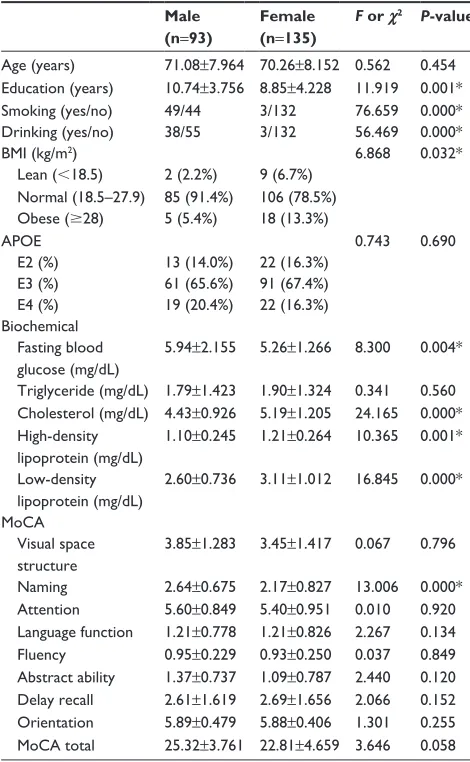
As shown in Table 1, the average years of education for male were higher than those of female (P,0.05). And, the percentage of smokers and drinkers in men was significantly higher than in women (P,0.001).
sex differences in aPOe genotypes,
BMi, and biochemical indexes
There was no statistical difference (P.0.05) in the APOE genotypes between male and female. However, the preva-lence of obesity (BMI $28) in female (9/135, 6.67%) was three times higher than that in men (2/93, 2.15%). After controlling education, smoking, and drinking, the difference was still significant (OR =0.374, P=0.044).
Higher cholesterol, HDL, and LDL plasma levels were found in female than in male (P,0.05). However, the plasma level of fasting blood glucose in female was lower than that in male (P,0.05), while there was no statistical difference (P.0.05) in TG between two groups.
Correlation analysis suggested that the BMI of male was correlated with HDL (r=-0.261, P=0.013), while age, edu-cation, smoking, drinking, APOE genotypes, fasting blood glucose, TG, cholesterol, LDL, and the total score of MoCA were not correlated with BMI (P.0.05).
We also found that the BMI of female was correlated with cholesterol (r=0.248, P=0.004) and LDL (r=0.190, P=0.029). Next, by using the stepwise multiple regression analysis, we proved that cholesterol was significantly associated with BMI in female (B=0.700, t=2.762, P=0.007).
Logistic regression analysis showed that obesity was significantly associated with LDL (OR =11.829, P=0.023) in the male population, while drinking (OR =13.695, P=0.045) and TG (OR =1.436, P=0.048) were risk factors for obesity in female.
sex differences in cognitive function
The covariance analysis (control of age and education) showed that the average score of male in naming was higher than that of female (P,0.05). Figure 1 shows the difference in the MoCA naming scores between men and women. Step-wise linear regression analysis showed that HDL (t=-2.077,
Table 1 sex difference in chinese han people with normal cognitive function
Male (n=93)
Female (n=135)
F or χ2 P-value
age (years) 71.08±7.964 70.26±8.152 0.562 0.454 education (years) 10.74±3.756 8.85±4.228 11.919 0.001*
smoking (yes/no) 49/44 3/132 76.659 0.000*
Drinking (yes/no) 38/55 3/132 56.469 0.000*
BMi (kg/m2) 6.868 0.032*
lean (,18.5) 2 (2.2%) 9 (6.7%) Normal (18.5–27.9) 85 (91.4%) 106 (78.5%) Obese ($28) 5 (5.4%) 18 (13.3%)
aPOe 0.743 0.690
e2 (%) 13 (14.0%) 22 (16.3%)
e3 (%) 61 (65.6%) 91 (67.4%)
e4 (%) 19 (20.4%) 22 (16.3%)
Biochemical Fasting blood glucose (mg/dl)
5.94±2.155 5.26±1.266 8.300 0.004*
Triglyceride (mg/dl) 1.79±1.423 1.90±1.324 0.341 0.560 cholesterol (mg/dl) 4.43±0.926 5.19±1.205 24.165 0.000* high-density
lipoprotein (mg/dl)
1.10±0.245 1.21±0.264 10.365 0.001*
low-density lipoprotein (mg/dl)
2.60±0.736 3.11±1.012 16.845 0.000*
Moca Visual space structure
3.85±1.283 3.45±1.417 0.067 0.796
Naming 2.64±0.675 2.17±0.827 13.006 0.000*
attention 5.60±0.849 5.40±0.951 0.010 0.920
language function 1.21±0.778 1.21±0.826 2.267 0.134
Fluency 0.95±0.229 0.93±0.250 0.037 0.849
abstract ability 1.37±0.737 1.09±0.787 2.440 0.120 Delay recall 2.61±1.619 2.69±1.656 2.066 0.152 Orientation 5.89±0.479 5.88±0.406 1.301 0.255 Moca total 25.32±3.761 22.81±4.659 3.646 0.058 Notes: Data shown as mean ± sD unless otherwise stated. *p,0.05.
Abbreviations: aPOe, apolipoprotein e; BMi, body mass index; Moca, Montreal cognitive assessment.
Neuropsychiatric Disease and Treatment downloaded from https://www.dovepress.com/ by 118.70.13.36 on 25-Aug-2020
Dovepress
li et al
P=0.041) was related to the score of naming test in male; while education (t=3.689, P,0.001) and smoking (t=2.031,
P=0.045) were related to the score of naming in female. How-ever, no correlation was found between BMI and cognitive function in both male and female (P.0.05).
Discussion
To our best knowledge, this is the first study to explore the sex differences in cognitive function and obesity in aging Chinese Han population with normal cognitive function. Most studies support that males have an advantage on spatial tasks, while females perform better on verbal tasks.25 However, in our
study, we found that men had better language functions, even when we had controlled for age, education, and other related factors. And, such inconsistencies might be attributable to the heterogeneity in study design, sex differences in the lipid profiles, and etiology of dementia as well as methods cognitive assessment. Previous studies26 were generally limited to global
cognition, but in our study, we also compared the differences between men and women in specific areas of cognition. Although there was no statistical difference (P.0.05) in MoCA total scores between men and women, we found that men had higher naming scores on MoCA than women. So we came to conclusion that although the language function of females is better than that of males, it is not obvious for the specific language task.25 By using stepwise linear
regres-sion analysis, we also found that HDL (t=-2.077, P=0.041) was related to the score of naming in male, while education (t=3.689, P,0.001) and smoking (t=2.031, P=0.045) were related to the score of naming in female. Contrary to our find-ing, Reitz et al14 pointed out that higher levels of HDL-C were
associated with a decreased risk of both probable and possible AD. Therefore, our conclusions were not very consistent and racial differences might have a bearing on the results.
The prevalence of obesity has been increasing in China, with more cases detected in the younger population.27 Obesity
is related to several diseases such as stroke, diabetes, and high blood pressure.28 Up to now, the association between obesity
and cognition is still controversial.29,30 In our study, we found
that elderly women had a higher BMI and prevalence of obesity than elderly men, which was consistent with a previ-ous study.31 There was evidence that the increased obesity
rates in women were significantly influenced by sex, as the result of physiological changes in hormonal status during and after menopause and sex, due to changes in individual and social behavior, such as modifications in socioeconomic status and adoption of unhealthy life.32,33 In our study, we
proved that drinking and high levels of TG would increase the risk of obesity in females. However, previous studies suggested that low levels of HDL but not TG were the risk factors for obesity in women. Thus, our results are partially consistent.34 Moreover, we found that high levels of LDL
were risk factors for obesity only in elderly men, which was consistent with previous research findings.35 Although many
studies have confirmed that obesity is an important risk factor for cognitive decline,36–38 Deckers et al39 pointed out that the
association between obesity and cognitive decline would be confounded by the effect of age on rate of decline. Similarly, we also did not find any link between obesity and cognitive function in both elderly men and women with normal cog-nitive function. Since this was only a cross-sectional study, these conclusions also need to be validated by a large sample of longitudinal studies.
There are several limitations in our study. First, this is only a cross-sectional study and cannot show direct causality of cognitive decline or obesity with serum lipid levels. Second, since our sample size is relatively small and these results are preliminary, further validation is needed. Third, serum lipid levels can be influenced by environmental factors, cultural status, and dietary habits; unfortunately, we failed to evaluate these factors. Fourth, the pathophysiological changes of AD may begin in midlife and studies conducted in the late life of participants may have a potential shortcom-ing that agshortcom-ing-related pathological changes may outweigh the risk related to lipids.
Conclusion
The present study proved that sex differences existed in specific cognitive domains and the rate of obesity in aging
Figure 1 sex difference in the score of naming.
Note: **P,0.05 male vs female.
7KHVFRUHRIQDPLQJ
1 1
6H[
0DOH )HPDOH
Neuropsychiatric Disease and Treatment downloaded from https://www.dovepress.com/ by 118.70.13.36 on 25-Aug-2020
Dovepress sex differences in obesity and cognitive function
Chinese Han population with normal cognitive function. Compared to men, elderly women had a worse ability of naming and a higher BMI and rate of obesity, making them more likely to suffer from chronic diseases, including AD; drinking and high levels of TGs would increase the risk of obesity in women, while LDL was a risk factor for obesity in men. Since this research is only a cross-sectional study and the sample size is valid, we still need a large sample of longitudinal studies to investigate the effects of sex differ-ences on lipid metabolism and cognitive function.
Acknowledgments
This work was supported by grants from the China Ministry of Science and Technology (2009BAI77B03) and National Natural Science Foundation of China (number 81671402).
Disclosure
The authors report no conflicts of interest in this work.
References
1. Li R, Singh M. Sex differences in cognitive impairment and Alzheimer’s disease. Front Neuroendocrinol. 2014;35(3):385–403.
2. Koran MEI, Wagener M, Hohman TJ; Alzheimer’s Neuroimaging Initiative. Sex differences in the association between AD biomarkers and cognitive decline. Brain Imaging Behav. 2017;11(1):205–213. 3. Henderson VW, Buckwalter JG. Cognitive deficits of men and women
with Alzheimer’s disease. Neurology. 1994;44(1):90–96.
4. Apostolova LG, Dinov ID, Dutton RA, et al. 3D comparison of hippocampal atrophy in amnestic mild cognitive impairment and Alzheimer’s disease. Brain. 2006;129(11):2867–2873.
5. Hua X, Hibar DP, Lee S, et al; Alzheimer’s Disease Neuroimaging Initiative. Sex and age differences in atrophic rates: an ADNI study with n=1,368 MRI scans. Neurobiol Aging. 2010;31(8):1463–1480. 6. Li LW, Ding D, Wu B, Dong X. Change of cognitive function in U.S.
Chinese older adults: a population-based study. J Gerontol A Biol Sci
Med Sci. 2017;1(72):5–10.
7. Miletto Petrazzini ME, Bisazza A, Agrillo C, Lucon-Xiccato T. Sex differences in discrimination reversal learning in the guppy. Anim Cogn. 2017;8(8):1117–1124.
8. Fang C, Liang Y. Social disparities in body mass index (BMI) trajec-tories among Chinese adults in 1991–2011. Int J Equity Health. 2017; 16(1):146–149.
9. Elias MF, Elias PK, Sullivan LM, Wolf PA, D’Agostino RB. Lower cognitive function in the presence of obesity and hypertension: the Framingham heart study. Int J Obes Relat Metab Disord. 2003;27(2): 260–268.
10. Stewart R, Masaki K, Xue QL, et al. A 32-year prospective study of change in body weight and incident dementia: the Honolulu-Asia aging study. Arch Neurol. 2005;62(1):55–60.
11. Hwang LL, Wang CH, Li TL, et al. Sex differences in high-fat diet-induced obesity, metabolic alterations and learning and synaptic plasticity deficits in mice. Obesity. 2010;18(3):463–469.
12. Wright RS, Cole AP, Ali MK, Skinner J, Whitfield KE, Mwendwa DT. Examining the influence of measures of adiposity on cognitive function in middle age and older African Americans. Arch Clin Neuropsychol. 2016;31(1):23–28.
13. Muenchhoff J, Song F, Poljak A, et al. Plasma apolipoproteins and physical and cognitive health in very old individuals. Neurobiol Aging. 2017;55(5):49–60.
14. Reitz C, Tang MX, Luchsinger J, Mayeux R. Relation of plasma lipids to Alzheimer disease and vascular dementia. Arch Neurol. 2004;61(5): 705–714.
15. Reitz C, Tang MX, Schupf N, Manly JJ, Mayeux R, Luchsinger JA. Association of higher levels of high-density lipoprotein cholesterol in elderly individuals and lower risk of late-onset Alzheimer disease. Arch
Neurol. 2010;67(12):1491–1497.
16. Despres JP. Dyslipidaemia and obesity. Baillieres Clin Endocrinol
Metab. 1994;8(3):629–660.
17. Hokanson JE, Austin MA. Plasma triglyceride level is a risk factor for cardiovascular disease independent of high-density lipoprotein choles-terol level: a meta-analysis of population-based prospective studies.
J Cardiovasc Risk. 1996;3(2):213–219.
18. Lew J, Sanghavi M, Ayers CR, et al. Sex-based differences in cardio-metabolic biomarkers. Circulation. 2017;135(6):544–555.
19. Tao QQ, Chen Y, Liu ZJ, et al. Associations between apolipoprotein E genotypes and serum levels of glucose, cholesterol, and triglycerides in a cognitively normal aging Han Chinese population. Clin Interv Aging. 2014;9(1):1063–1067.
20. Xiao S, Li J, Tang M, et al. Methodology of China’s national study on the evaluation, early recognition, and treatment of psychological problems in the elderly: the China Longitudinal Aging Study (CLAS).
Shanghai Arch Psychiatry. 2013;25(2):91–98.
21. Nasreddine ZS, Phillips NA, Bedirian V, et al. The Montreal Cognitive Assessment, MoCA: a brief screening tool for mild cognitive impair-ment. J Am Geriatr Soc. 2005;53(4):695–699.
22. Ji CY; Working Group on Obesity in China. Report on childhood obesity in China (1) – body mass index reference for screening overweight and obesity in Chinese school-age children. Biomed Environ Sci. 2005; 18(6):390–400.
23. Donohoe GG, Salomaki A, Lehtimaki T, Pulkki K, Kairisto V. Rapid identification of apolipoprotein E genotypes by multiplex amplifica-tion refractory mutaamplifica-tion system PCR and capillary gel electrophoresis.
Clin Chem. 1999;45(1):143–146.
24. Anderson GD, Temkin NR, Dikmen SS, et al. Haptoglobin phenotype and apolipoprotein E polymorphism: relationship to posttraumatic seizures and neuropsychological functioning after traumatic brain injury. Epilepsy Behav. 2009;16(3):501–506.
25. Andreano JM, Cahill L. Sex influences on the neurobiology of learning and memory. Learn Mem. 2009;16(4):248–266.
26. Lu Y, An Y, Yu H, et al. Sex-specific nonlinear associations between serum lipids and different domains of cognitive function in middle to older age individuals. Metab Brain Dis. 2017;4(3):21–24.
27. Xi B, He D, Hu Y, Zhou D. Prevalence of metabolic syndrome and its influencing factors among the Chinese adults: the China Health and Nutrition Survey in 2009. Prev Med. 2013;57(6): 867–871.
28. Kwast BE. Quality of care in reproductive health programmes: monitoring and evaluation of quality improvement. Midwifery. 1998; 14(4):199–206.
29. Elias MF, Goodell AL, Waldstein SR. Obesity, cognitive function-ing and dementia: back to the future. J Alzheimers Dis. 2012;30(2): 113–125.
30. Whitmer RA, Gunderson EP, Barrett-Connor E, Quesenberry CP Jr, Yaffe K. Obesity in middle age and future risk of dementia: a 27 year longitudinal population based study. BMJ. 2005;330(7504): 1360–1363.
31. Slagter SN, van Waateringe RP, van Beek AP, van der Klauw MM, Wolffenbuttel BHR, van Vliet-Ostaptchouk JV. Sex, BMI and age differences in metabolic syndrome: the Dutch Lifelines Cohort study.
Endocr Connect. 2017;4(18):207–210.
32. Krieger N. Genders, sexes, and health: what are the connections – and why does it matter? Int J Epidemiol. 2003;32(4):652–657.
33. EUGenMed Cardiovascular Clinical Study Group, Regitz-Zagrosek V, Oertelt-Prigione S, et al. Gender in cardiovascular diseases: impact on clinical manifestations, management, and outcomes. Eur Heart J. 2016;37(1):24–34.
Neuropsychiatric Disease and Treatment downloaded from https://www.dovepress.com/ by 118.70.13.36 on 25-Aug-2020
Neuropsychiatric Disease and Treatment
Publish your work in this journal
Submit your manuscript here: http://www.dovepress.com/neuropsychiatric-disease-and-treatment-journal
Neuropsychiatric Disease and Treatment is an international, peer-reviewed journal of clinical therapeutics and pharmacology focusing on concise rapid reporting of clinical or pre-clinical studies on a range of neuropsychiatric and neurological disorders. This journal is indexed on PubMed Central, the ‘PsycINFO’ database and CAS,
and is the official journal of The International Neuropsychiatric Association (INA). The manuscript management system is completely online and includes a very quick and fair peer-review system, which is all easy to use. Visit http://www.dovepress.com/testimonials.php to read real quotes from published authors.
Dovepress
Dove
press
li et al
34. Kuk JL, Ardern CI. Age and sex differences in the clustering of meta-bolic syndrome factors: association with mortality risk. Diabetes Care. 2010;33(11):2457–2461.
35. Millan-Nunez J, Mantilla-Morato T, Toro R, Millan-Perez JJ, Mangas-Rojas A; Scientific Committee of Hypertriglyceridemia Registry of Spanish Society of Arteriosclerosis (SEA). Cardiometabolic risk related to the association of hypertriglyceridemia-low HDLc. Curr Pharm Des. 2016;22(3):365–371.
36. McIntyre RS, Mansur RB, Lee Y, et al. Adverse effects of obesity on cognitive functions in individuals at ultra high risk for bipolar disor-der: results from the global mood and brain science initiative. Bipolar
Disord. 2017;19(2):128–134.
37. Rodriguez-Casado A, Toledano-Diaz A, Toledano A. Defective insulin signalling, mediated by inflammation, connects obesity to Alzheimer disease; relevant pharmacological therapies and preventive dietary interventions. Curr Alzheimer Res. 2017;3(16):167–171.
38. Beydoun MA, Beydoun HA, Wang Y. Obesity and central obesity as risk factors for incident dementia and its subtypes: a systematic review and meta-analysis. Obes Rev. 2008;9(3):204–218.
39. Deckers K, Van Boxtel MPJ, Verhey FRJ, Kohler S. Obesity and cogni-tive decline in adults: effect of methodological choices and confound-ing by age in a longitudinal study. J Nutr Health Agconfound-ing. 2017;21(5): 546–553.
Neuropsychiatric Disease and Treatment downloaded from https://www.dovepress.com/ by 118.70.13.36 on 25-Aug-2020