United Kingdom Vol. V, Issue 7, July 2017
Licensed under Creative Common Page 532
http://ijecm.co.uk/
ISSN 2348 0386
EFFECT OF INTERNAL PROCUREMENT PROCESSES
ON ORGANIZATIONAL PERFORMANCE
A CASE OF NAIROBI COUNTY, KENYA
Walter P. Karungani
KCA University, School of Business & Public Management, Nairobi, Kenya [email protected]
George Ochiri
KCA University, School of Business & Public Management, Nairobi, Kenya [email protected]
Abstract
This research was conducted to find out the impact of internal procurement process on
organizational performance in the Nairobi County Government. The research was conducted
based on a quantitative research design, positivist research philosophy and survey strategy.
Convenience sampling was used to select 87 respondents from procurement and finance
departments within the Nairobi County Government. Data was collected using questionnaires
and was analyzed using descriptive analysis and regression analysis. The findings of this
research reveal that internal procurement processes have a great influence on organizational
performance. Respondent’s perceptions are that internal procurement processes have a great
influence on the performance of the organization. Internal procurement processes like order
processing, information sharing and payment processing bring forth improved organizational
performance. The results also showed that internal procurement processes enhance purchase
quality, purchase controls in addition to managing self-interests in effect leading to improved
organizational performance.
Licensed under Creative Common Page 533
INTRODUCTION
Procurement has become increasingly important not only in private institutions but also in public sector organizations. Regarding the public sector, Odhiambo and Theuri (2015) argue that procurement plays a central role in service delivery as well as promoting social, environmental and industrial policies in a country. Procurement decisions made within public institutions are of significant impact because in many public institutions, huge amounts of tax payers’ money have been lost as a result of poor procurement decisions. Therefore, it has become increasingly important for stakeholders to monitor procurement processes to ensure that all decisions and actions undertaken within the entire process are not only transparent but also promote the general welfare of the state.
According to Ellram (2011) internal procurement processes include budgets, purchase request, quality management and payment processes. The manners in which the aforementioned processes are conducted within the procurement process have a great influence over the performance of an organization. The recent formations of the Public Procurement Oversight Authority in addition to reforms that have institutionalized procurement in public organizations have made procurement to become increasingly important in the Kenyan economy (Chebichii et al., 2014). As a result of such recent developments, it was important to find out the impact of internal procurement processes on organizational performance.
Statement of the Problem
Research studies have been conducted in the past to find out the impact of various dimensions of procurement on organizational performance. Chebichii et al. (2014) studied the impact of internal organizational communication channels on efficiency in procurement within public organizations. The findings of the research showed that internal communication on such aspects as quality controls, inventory management and staff training, development and performance significantly influenced efficiency of the procurement function and hence overall organizational performance. Onchoke and Wanyoike (2016) also examined the impact of inventory control as one of internal procurement processes on procurement performance in an organization. The findings of the research showed that inventory control positively impacts on procurement performance.
Licensed under Creative Common Page 534
Research Objective and Hypothesis
This objective of the study was to establish the effect of internal procurement processes on organizational performance.
(H1): Internal procurement processes did not affect organizational performance.
LITERATURE REVIEW
Empirical literature
A research by Onchoke and Wanyoike (2016) on the impact of internal procurement processes on organizational performance reveals that indeed internal procurement processes enhance organizational performance. Specifically, inventory control as one of the internal procurement processes plays a very important role in bringing forth enhanced organizational performance. The same sentiments are shared by whose research revealed that internal procurement process play a very important role in bringing forth enhanced organizational performance. In particular, the research revealed that internal resources and capabilities concerned with efficiency and integration play a very important role in bringing forth improved organizational performance. Siricha and Theuri (2016) also investigated the impact of internal procurement such as electronic procurement on the organizational performance of Kenya Ports Authority. The findings of the research revealed that internal procurement processes and in particular electronic procurement had a great influence on organizational performance. Specifically, the research’s findings showed that the integration of internal procurement processes played a very important role in enhancing organizational performance.
Licensed under Creative Common Page 535 production is aligned with new orders; purchasing is aligned with demand while shipping and scheduling are aligned with the requirements of customers. This contrasts with views of Lardenoije, Raaij and Weele (2005) who argue that internal procurement processes focus on financial aspects neglecting non-financial aspects in effect leading to overall poor organizational performance.
Internal procurement has also been found to greatly influence the manner in which an organization performance relative to competing firms. Internal procurement processes such as information sharing, payment processes and ordering procedure have a great influence on the effective of the procurement process and overall firm performance. According to Siricha and Theuri (2016) the effectiveness of internal procurement processes such as payment processing, order processing and information sharing has a direct positive impact on organizational performance. Therefore, to bring forth improved organizational performance, it is essential for the management to ensure that internal procurement processes are conducted at the highest level of effectiveness. Ordanini and Rubera (2008) also argue that improvement in such aspects of information sharing, order processing and payment process can bring forth enhanced organizational process particularly when internet technology is applied within the procurement process. In contrasts, Mugambi and Theuri’s (2014) study revealed that there is significant relationship between internal procurement processes and organizational performance. Empirical literature shows that internal procurement processes have a positive impact on organizational performance. Some of the internal procurement processes that enhance organizational performance include enhanced information sharing, ordering processes and payment processes. Further, the use of internet within the internal procurement process enhances the effectiveness of order processing, the quality and level of information sharing and payment processing in effect leading to improved organizational performance. The purpose of the study was to evaluate the effect of internal procurement processes on organizational performance in case of public sector.
RESEARCH METHODOLOGY
Sampling Design
Licensed under Creative Common Page 536 adequate knowledge on procurement practices within the Nairobi County Government effectively yielding high quality research outcomes. In the study, the sample frame is composed of 87 employees from the County Government’s procurement and finance departments. The 87 respondents include senior managers, directors, and support staff and middle level managers within the County Government.
Data Collection
The current research employed simple structured questionnaires to collect data from respondents regarding the impact of internal procurement process on organizational performance. The simple structured questionnaire was used because of the ease associating with filling in simple structured questionnaires. Therefore, a high response rate is possible with high quality data being collected.
Data Analysis
The data analysis was carried out using descriptive statistics. The data was entered into the excel software to yield a descriptive analytical perspective of internal procurement processes and the impact they have on organizational performance. Regression and correlation analyses were then conducted to determine the nature and extent of the relationship between internal procurement processes and organizational performance.
FINDINGS AND DISCUSSION
Out of 87 questionnaires distributed to respondents, 81 dully filled in questionnaires were collected from the respondents. Therefore, the response rate was 93.1%. According to Fowler (2013) the acceptable response rate for a social research is 70% and, therefore, 93.1% was an appropriate response rate for the purpose of current study. In a bid to find out how internal procurement processes impact on organizational performance, respondents were required to rate internal procurement processes based on performance.
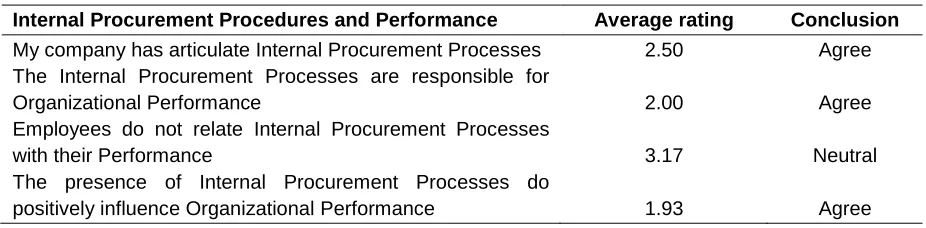
Table 1: Nature of Internal Procurement Processes in the Studied Organization
Internal Procurement Procedures and Performance Average rating Conclusion
My company has articulate Internal Procurement Processes 2.50 Agree The Internal Procurement Processes are responsible for
Organizational Performance 2.00 Agree
Employees do not relate Internal Procurement Processes
with their Performance 3.17 Neutral
The presence of Internal Procurement Processes do
Licensed under Creative Common Page 537 From the figure below, respondents agree with the assertion that articulate internal procurement processes bring forth improved organizational performance. The findings are in line with a research by Lia et al. (2006) who established that internal procurement process led to improved organizational performance. Respondents were also required to offer their opinion on the role of internal procurement processes in relation to organizational performance. The results were as shown in the figure below:
Figure 1: Role of Internal Procurement Processes on Organizational Performance
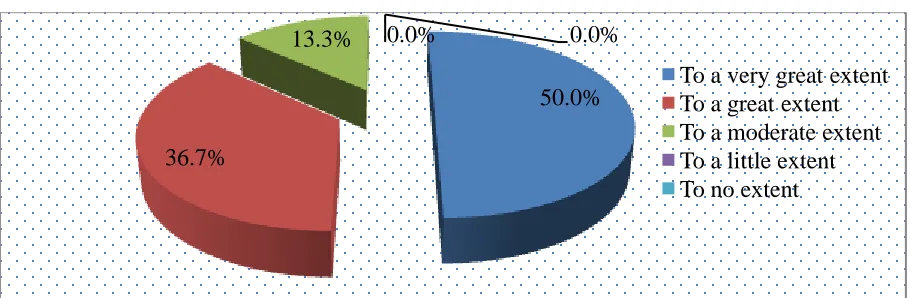
From the figure 1, internal procurement processes improved organizational performance by enhancing purchase quality, enhancing purchase controls and managing potential self-interests. The above findings are in line with a research by Kennedy and Kiarie (2015) whose research showed that internal procurement processes enhance organizational performance by integrating operational and support functions. Odhiambo and Theuri (2015) also believe that internal procurement processes bring forth enhanced organizational performance. Respondents were also required to indicate the extent to which internal procurement processes influence organizational performance. The findings were as illustrated in the figure below:
Figure 2: Extent to which Internal Procurement Processes Influences Performance
0.0% 5.0% 10.0% 15.0% 20.0% 25.0% 30.0% Equity in Equiping all departments
Supports entity goals and objectives For efficiency and effectiveness Manages possible self interests Enhances Purchase controls Enhances Purchase quality
7.4% 9.9%
12.3%
17.3%
24.7% 28.4%
50.0%
36.7%
13.3%
0.0%
0.0%
Licensed under Creative Common Page 538 From figure above, 50% of respondents believe that internal procurement process influence organizational performance to a very great extent while 36.7% believe that the influence is to a great extent.
Regression Analysis Results
The regression results of the ratings on influence of internal procurement processes on organizational performance against performance provided the results shown below.
Table 2: Model Coefficient and Statistical Significance
Model
Unstandardized
Coefficients
Standardized
Coefficients F Sig
B Std. Error Beta
(Constant) 0.878 0.357 2.46 0.016
Internal Procurement processes 0.325 0.097 0.202 3.35 0.002
As indicated in table above, the results of regression analysis yielded statistically significant results with a p-value of 0.002 and a coefficient of 0.325. That indicates that internal procurement processes does influence organizational performance.
SUMMARY AND RECOMMENDATIONS
In conclusion, the findings of this research reveal that internal procurement processes have a great influence on organizational performance. Respondent’s perceptions are that internal procurement processes have a great influence on the performance of the organization. Internal procurement processes like order processing, information sharing and payment processing bring forth improved organizational performance.
Licensed under Creative Common Page 539
REFERENCES
Black, K. (2012). Business statistics: For contemporary decision making. Hoboken: Wiley.
Chebichii, B.D., Sakwa, M., Biraori, O.E. & Wamalwa, W.R. (2014). ‘Effects of Internal Organization Communication Channels on Efficiency in the Procurement Function In Public Institutions in Kenya: Case of Kenya Seed Company’, International Journal of Recent Research in Commerce Economics and Management, 1(3), pp. 39-52.
Colton, D., & Covert, R. W. (2007).Designing and constructing instruments for social research and evaluation. San Francisco: Jossey-Bass.
Curtis, B., & Curtis, C. (2011).Social research: A practical introduction. Los Angeles: Sage.
Denscombe, M. (2014).The good research guide: for small-scale social research projects. London: McGraw-Hill Education.
Ellram, A. (2011). ‘Public Procurement practices, the collaborative approach, perspective procurement’, International Journal of Procurement, 13(2), pp. 25-29.
Engel, R. J., & Schutt, R. K. (2014). Fundamentals of Social Work Research. Los Angeles: SAGE.
Fowler, F. J. (2013). Survey research methods. Thousand Oaks: SAGE Publications
Kennedy, K.M. & Kiarie, D. (2015). Influence of procurement practices on organization performance in private sector in Kenya: a case study of Guaranty trust bank Kenya ltd’, International Journal of Business & Law Research, 3(2), pp. 44-60.
Lardenoije, E. J., Van Raaij, E. M., and Van Weele, A. J. (2005). Performance Management Models and Purchasing: Relevance Still Lost. Researches in Purchasing and Supply Management, the 14th IPSERA Conference, (pp. 687-97). Arch amps.
Lia, S., Ragu-Nathanb, B., Ragu-Nathanb, T.S. & Raob, S.S. (2006). ‘The impact of supplychain management practices on competitive advantage and organizational performance’, The International Journal of Management Science, 34 (1) pp. 107-124.
Linn, P.L., Howard, A. & Miller, E. (2004).Handbook for Research in Cooperative Education and Internships. London: Routledge.
Mugambi, W.K.,Theuri, S.F. (2014). ‘The Challenges Encountered By County Government in Kenya during Budget Preparation’, IOSR Journal of Business and Management, 16(2), pp 128-134.
Odhiambo, A.C. & Theuri, F.S. (2015). ‘Effects of Public Procurement Processes on Organization Performance’, International Journal of Scientific and Research Publications, 5(9), pp. 1-5.
Onchoke, B.N. & Wanyoike, D.M. (2016). ‘Influence of Inventory Control Practices on Procurement Performance of Agrochemicals Distributors in Nakuru Central Sub-County, Kenya’, International Journal of Economics, Finance and Management Sciences, 4(3), pp. 117-126.
Onchoke, B.N. & Wanyoike, D.M. (2016). ‘Influence of Inventory Control Practices on Procurement Performance of Agrochemicals Distributors in Nakuru Central Sub-County, Kenya’, International Journal of Economics, Finance and Management Sciences, 4(3), pp. 117-126.
Ordanini, A. & Rubera, G. (2008). ‘Strategic capabilities and internet resources in procurement A resource-based view of B-to-B buying process’, International Journal of Operations & Production Management, 28(1), pp. 27-52.
Ordanini, A. & Rubera, G. (2008). ‘Strategic capabilities and internet resources in procurement’, International Journal of Operations & Production Management, 28 (1), pp. 27-52.