Influence Of The Phases Of Waves On The
Frequency Down-Conversion In The Optical
Lattice At Sequential Interaction
R.J. Kasumova, N.V. Kerimli, G.A. SafarovaAbstract : A rigorous calculation of the characteristics of an optical superlatticethrough quadratic nonlinearity at simultaneous counter-interaction of the waveswas made in the constant-intensity approximation. The nonlinear quasi-phase-matched process with a reverse subharmonic wave is analyzed in this approximation, taking into account the phase relations of allinteracting waves. It is shown that the initial phases of the waves significantly affect the efficiency of frequency conversion, the optimum phase values are obtained. By choosing the optimal initial phases, it is possible to significantly increase the conversion efficiency. Recommendations on the design of an optical superlattice for obtaining the maximum conversion efficiency are given. The result is of practical interest for the development of backward second harmonic devices.
Keywords: couple mode, counter-sequential, domain, lithium niobate, RDS crystal, , superlattice, undepleted pump, —————————— ——————————
1.
INTRODUCTION
Achievements of nonlinear optics contributed to the progress of photonics. Indeed, it is possible to control and monitor the flow of photons by the methods of nonlinear optics. This is important in optical information processing systems, where photons are used as information carriers. In nonlinear optics, frequency conversions based on layered media take a special place. The possibility of simultaneous generation of coherent radiation at several wavelengths can be realized owing to sequential generation at several frequencies in an optical superlattice [1], [2], [3]. In such structures, it is possible to regulate by light radiation due to a change in the optical properties of such artificial structures. In quasi-phase-matched interactions, the birefringence effect no longer plays a decisive role, in these structures. It is possible to work with a high nonlinearity of the crystal, corresponding to a certain polarization of the waves, for example, in a lithium niobate crystal when three extraordinary waves interact.
Until now, the analysis of the system of couple-mode equations for sequential quasi-phase-matched interaction in the general case was carried out numerically [4], [5], [6]. In [4], [5], the influence of the ratio of nonlinear coupling coefficients on the harmonic conversion efficiency was considered. It is shown that with a sequential interaction of the co-directed waves, it is possible to carry out almost complete transfer of the pump wave energy at frequency 3
to wave energy at double frequency 2
[7]. With a counter-sequential interaction, this is impossible [8]. It should be noted that in case of opposite interaction, the decisive role is played by phase relations between the waves, which, in contrast to an undepleted pump (constant-field) approximation, can be taken into account in a depleted pump (constant-intensity) approximation [9]. Accounting for phase relations is important for development of optical superlattices. For example, a correctly calculated lattice period critically affects the phase-matched processes, the possibility of simultaneous generation at several frequencies, and hence the creation of highly efficient laser frequency converters.The frequency conversion efficieny for different forms of optical superlattices have been estimated in [10]. The Cherenkov-type second harmonic generation in periodically poled nonlinear crystals was considered in [11]. It is proposed a device to facilitate single-photon detection at communication wavelengths, where the sum-frequency generation in an optical lattice lithium niobate waveguide is used [12]. Simultaneously quasi-phase-matched generation at several frequencies in a periodically poled KTiOPO4 and LiTaO3 was experimentally observed in [13], [14]. In potassium titanyl phosphate at backward harmonics generation the highest conversion efficiency was ~0.6% at a pump energy per pulse of ~16
J [13]. The second and third harmonics output powers as a function of temperature have been investigated in [14]. The corresponding efficiencies were 10.2% and 41.4%, respectively. The analysis of quasi-phase-matched interaction in a regular domain structure (RDS) during the generation of the second and third harmonics, generation of the sum frequency, parametric interaction and intracavity frequency transformation in RDS crystals in the constant-intensity approximation was carried out by us in [15], [16] ,[17]. It was found that the coherent length of each layer-domain increases with growing layer-domain number. We also studied the case of sequential interaction of passing and counterpropagating waves in an RDS crystal, which leads to the simultaneous generation of the second and third harmonics. This paper is a continuation of these studies for the case of high-frequency pumping with a sequential three-wave interaction in the case of a counter-propagation geometry of waves.2.
THEORY
Let's consider the dynamics of the interaction of three waves with multiple frequencies 3
,2
and with high-frequencypumping at a frequency
3
. We believe that the interaction occurs in a periodically poled crystal with a quadratic nonlinearity. Note that in this case the direct process of energy transfer from the pump wave (3
) to the wave at the frequency
is excluded, due to the absence of the cubic nonlinearity of the medium. From the energy point of view, with high-frequency pumping, each pump photon provides a process with a three-fold higher energy value compared to the case of low-frequency pumping at a frequency
. So if ————————————————Author -R.J.Kasumova Physics Department, Baku State University, 23, acad. ZahidKhalilov str., AZ1148 Baku, Azerbaijan
Corresponding author-N.V.Kerimli Azerbaijan Medical University, Baku, Azerbaijan, e-mail: [email protected]
1478 one photon of pumping is sufficient for obtaining a photon at a
frequency
2
in the case of high-frequency pumping (at afrequency
3
), in the case of low-frequency pumping, two pumping photons are required (at a frequency
). With high-frequency pumping, the wave energy at a high-frequency
2
increases primarily due to the wave at a frequency3
. Indeed, the energy of the pump wave is divided between two other waves (at a frequencies
and2
). A wave at a frequency2
receives a greater increment of energy than a wave of the third subharmonic at a frequency
. Hence, with high-frequency pumping, the energy of the pump wave is converted into wave energy at a frequency2
efficiently, which was also noted in [4]. We assume that two co-directed waves at frequencies
1
,
3
3
, propagating along the positive axis, are present at the entrance to the left of the optical superlattice, and the wave at the frequency
2
2
is reverse. The system of coupled mode equations in the case of counter-geometry under study is as follows [4],
3
,
2
,
2 1 3 3 3 3 3 2 1 2 2 * 1 3 * 3 2 2 2 * 1 2 * 2 2 * 2 3 * 3 1 1 1 3 3A
A
g
i
A
dz
dA
A
g
i
A
A
g
i
A
dz
dA
A
A
g
i
A
A
g
i
A
dz
dA
(1)where
A
1,3 are the complex amplitudes of two direct waves carrying energy in the positive direction of thez
axis,A
2 is the complex amplitude of the backward wave transporting energy in the opposite direction,
j are the absorptioncoefficients at the respective frequencies
j,
j
1
3
,) 2 ( 2 2 2
2
cn
and (2)3 3 3
2
cn
are the nonlinearcoefficients that are determined through the refractive indices
2
n
andn
3) at frequencies
2 and
3, respectively, and )2 (
is the quadratic susceptibility of the each domain.3 , 2 / 2 )
(z g e g
g p pz i p
, 3 , 2 / 2 )(z g e g
g p pz i p
is the
periodic function, which allows a modulation of the quadratic susceptibility over the length of the interaction
z
with the period 2l;g
p is a Fourier series coefficient,g
2,3 areparameters affect the effective values of the coupling coefficient of the waves for
2,3 andz i
e z g
g ( ) 2,3 3
, 2
.
g
(
z
)
1
and takes on the boundary ofthe thickness of the layer consistent values
1
,
1
,
1
,....
. [4].Using g2,3 in (1) we get
p z p i pe
g ( 2,3 2 / ) .
The analysis shows that the main contribution to the sum is given by the expansion terms in which the phase mismatch of
the interacting waves is equal to the term
2
p
/
. As a result, simultaneously at different points of the optical superlattice, i.e. on the corresponding orders quasi-phase-matching, it is possible to realize two phase-matched processes: the process of generation (or amplification) of subharmonics. A similar consideration in theconstant-intensity approximation is correct when
maxA
1
2,3max~
1
(max is the maximum value of
2,3,
2,3max is the maximum value of 2,3). When analyzing in theconstant-field approximation, the inequality
maxA
1
2,3max
1
should be satisfied.The following boundary conditions for the general case of nonzero amplitudes of all interacting waves correspond to the described geometry of the problem:)
exp(
)
(
),
exp(
)
0
(
2 2 2 30 , 10 30 , 10 3 , 1 l li
A
L
z
A
i
A
z
A
(2)where z = 0 corresponds to the input to the left of the crystal,
30 , 10
A ,
10,30 are the initial amplitudes and phases of thewaves when entering the nonlinear medium on the left,
A
2l,l 2
are the initial amplitude and phase of the wave at the doubled frequency when entering the nonlinear medium to the rightz
L
. According to (2), we consider the case of parametric amplification. To the best of our knowledge, prior to this work, system (1) in the general case was solved only numerically. However, it can be solved analytically with respect to the complex amplitude of the wave at frequency 2
in the constant-intensity approximationI
1,3(
z
)
.
)
0
(
10,303 ,
1
z
I
const
I
Taking into account the boundary conditions (2), the solution of the system (1) can be written in the form:
sin
tan
cos
,
)
2
exp(
exp
2
)
exp(
cos
cos
)
(
10 12 2 10 30 3 * 3 10 2 2 2z
L
z
i
g
i
g
A
i
i
L
z
A
z
A
CIA l l
(3) where
2
12 2 2 2 13 2 3 2 3
3
2
g
g
,12
2 I10, 13
3 I10, 3
3 I30 .In the constant-field approximation, the expression for the complex amplitude A2CFA(z)does not change, only the
parameter changes
CFA
2
g
32
32
g
22
122
. From (3) it follows that the amplitude of the harmonic wave2
subharmonic. Note that
A
2 does not depend on the input intensity of the backward wave. Hence, the phase velocity of the reverse wave directly depends on the input values of the intensities of the waves interacting with it. The input value of the intensity of the backward wave affects only the amplitude value of this wave. As is well known, in the case of homogeneous media, the wave energy at frequency 3
can practically be transferred to the energy of waves
and 2
. A numerical account of the system of equations (1), carried out by the authors [4], showed that almost complete pumping can also be carried out in the case of co-directional propagating waves in a periodically poled crystal. Studying the counter-propagating waves interaction, one can imagine the following dynamics of the nonlinear process taking place. Two wave packets of direct waves (pump waves and the third subharmonic) interact with the wave packet of the reverse wave (waves at frequency2
). The spatial movement of the counter-direction propagating wave packets is accompanied by their energy exchange. As a result, the pump wave energy is transferred to the subharmonic energy. As is known, the efficiency of energy exchange is determined by how accurately the phase relation between the interacting waves is performed, which taken into account in the constant-intensity approximation. In a layered structure, as in an ordinary homogeneous quadratic nonlinear medium, the main difference in the nature of the interaction for counter and co-directed waves is related to the opposite direction of the energy transfer rate of the interacting waves. This leads to the dependence of the field of the backward wave at frequency
2
(through boundary conditions) on the full length of the optical superlattice. Note that a similar dependence on length was also observed in metamaterials [18]. Owing to the dispersion of the refractive index of the medium, the interacting waves have different phase velocities. As a result, in the process of wave propagation in the medium, a phase mismatch arises between the waves, which reduces the frequency conversion efficiency. To eliminate this undesirable fact, it is necessary to fulfill the quasi-phase-matchingconditions for subharmonics, which are associated with the parameters of the optical lattice. Note that the accuracy of the calculation of the parameters of the optical lattice will affect the efficiency of the considered nonlinear processes. In particular, during the manufacturing of optical superlattice careful control over the implementation of the values of the refractive indices at each of the three optical frequencies is necessary to achieve the phase-matching condition. Prior to this work, the quasi-phase-matching conditions in the literature were obtained from an analysis of the nonlinear process in the constant-field approximation. These conditions differ in the constant-intensity approximation. The change occurs in the phase of the interacting waves, where it is necessary to take into accountthe additional termunder square root 2
2. Taking into account the parameter
(at the condition 2,30), wehave 2,3/2 2222,3/4, where
212 2 2 2 13 2 3 2 3 2
3
g g . Hence the quasi-phase-matching conditions have the form
2
2
M
2
2 and3 3
3
2
M
, correspondingly. From here for the periods of modulations, we get4
/
)
2
(
2
/
2 2 1 22
2
M
k
k
and4
/
)
(
2
/
2 3 2 1 23
3
M
k
k
k
. (4)The backward wave efficiency
(
)
(
)
/
302
2
z
I
z
I
CIA
CIA
can be obtained from (3):
2
10 30 10 12 2 10 13 * 3
2 30
2 2
2
sin
sin
2
cos
cos
cos
)
(
A
A
g
g
C
L
z
A
A
z
l lCIA
,
2
cos
cos
2
sin
cos
cos
2
10 30
10 12 2 10 13 * 3
2 30
2
A
A
g
g
C
L
z
A
A
l l
(5)
where
C
sin
z
tan
L
cos
z
.
3.
RESULTS AND DISCUSSION
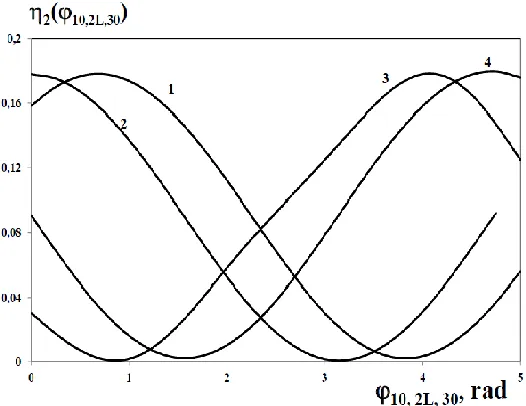
Let us graphically analyze, according to (3) and (5), the spatial dynamics of sequential counter-interaction with high-frequency pumping. Due to the lack of experimental data for the counter interaction with high-frequency pumping in the case of a reverse wave at a frequency
2
, calculations were performed under the following conditions. The third harmonic of the Nd: YAG laser (with
=355 nm, a pulse duration of 10 ns, the pumping spot area 0.5 mm2) was chosen as the pump source [19]. This allowed us to rely on the pumping power density of about 60 MW/cm2. We considered the wave interaction for a crystal of length 0.12 cm. In the case under study, according to (4), a large number of layer domains are located on the crystal length. Fig. 1 shows the dependences of the efficiency of conversion of the pump wave at frequency 3
to the backward subharmonic wave at frequency 2
on the initial phases of the interacting waves
2(
10)
(curve 3),)
(
2 2
l
(curves 2 and 4) and
2(
30)
(curves 1 and 5),calculated according to (5), for
M
2=M
3=1. The oscillationsof dependences are observed, the phase of which changes nonlinearly as a result of the interaction of waves. The analysis was carried out within the same period of oscillations. For each dependence, with the task parameters entered, the optimal initial phase of the wave is determined, at which the maximum conversion efficiency is achieved. As an example, we give two pairs of dependencies
2(
2l)
and) ( 30
2
for two sets of input parameters. According tocurve 2, the optimal value
2optl =1.5 when
10 =
30=0,and when
10 =4,
30=0, the value
2optl is 3.75 (curve 4).1480 l
2
=4.75. From the dependence
2(
10)
(curve 3), theefficiency maximum is reached for
10opt =2.25 with thefollowing combination of parameters
2l =5.34 and
30=0.
Fig. 1. Dependences of the efficiency of conversion of the pump wave at frequency 3
to the backward subharmonic wave at frequency 2
on the initial phases of the interactingwaves
2(
10) (curve 3),
2(
2L)
(curves 1 and 4) and) ( 30
2
(curve 2), calculated in the constant-intensityapproximation, for
M
2=M
3= 1 andI
10
I
2l
0
.
01
I
30.Thus, for each specific experiment, using (5), one can
calculate the required optimal value, for example,
2optL ,knowing the other two parameters
10 and
30. Thisanalysis of conversion efficiency was carried out at
30 2
10
I
0
.
01
I
I
l
. Further analysis showed that the initial values of the wave intensities also affect the conversion efficiency. The studies of quasi-phase-matched harmonic generation in RDS-crystals in the constant-intensity approximation showed that with an increase in the order quasi-phase-matching, the optimum values of the domain thicknesses increase [15-17]. This is due to the decrease in the intensity of the pump wave as it spreads in the RDS. When constructing an RDS, this fact is not taken into account and the lengths of the domains are taken equal, according to the analysis in the constant-field approximation. This leads to inefficient compensation of phase mismatch in the corresponding orders quasi-phase-matching. To exclude this undesirable fact, in the calculations for each specific experimentally realized case, it is necessary to make corrections for the thickness of the domains. The accuracy of determining the periods of quasi-phase-matching of the optical superlattice, according to the analysis in the constant-intensity approximation, is determined by the accuracy of refractive indices at frequencies of interacting waves for a specific sample of the designed optical superlattice, quadratic–order susceptibility of domain
(2) and intensities of interacting waves simultaneously. Thus, the results obtained can be used in the development of optical superlattices of promising materials with a high quadratic nonlinearity in the case of a counter-interaction with high pumping. Knowing the parameters of a real experiment (the wavelength of the pump radiation, the input intensities and the initial phases of the interacting waves), it is possible to determine the expected conversion efficiency 2.4.
CONCLUSION
We present the calculation of parameters of quasi-phase-matched structures by using the constant-intensity approximation. Arigorous analysis was performed for the case of high-frequency pumping with a backwardsub harmonic wave The effect of the phases of three interacting waves on the frequency conversion efficiency along the optical superlattice is investigated. It is shown that the phases of the interacting waves significantly affect the frequency conversion efficiency, the optimal values of the initial phases are obtained. The modulation periods of the optical superlattice are calculated. The expected conversion efficiency into the backward subharmonic wave have been calculated in optical superlattice. The ways of increasing the conversion efficiency in the optical superlattice are shown. The result is of practical interest for the development of backward harmonic devices.
REFERENCES
[2] J.U. Kang, Y.J. Ding, W.K. Burns, J.S. Melinger, ―Backward second-harmonic generation in periodically poled bulk LiNbO3‖, Optics Letters, vol. 22, no. 12, pp. 862-864, 1997. [3] A.S. Chirkin, V.V. Volkov, ―Interaction of light waves in
periodically inhomogeneous nonlinear crystals: new outlooks in nonlinear optics‖, Izv. Akad. Nauk SSSR (Moscow), vol. 62, pp. 2354-2360, 1998.
[4] A.S. Chirkin, V.V. Volkov, G.D. Laptev, and E.Yu. Morozov, ―Consecutive three-wave interactions in nonlinear optics. of periodically inhomogeneous media‖, Sov. Quantum Electron, vol. 30, pp. 847-858, 2000.
[5] Chao Zhang, Yong-yuan Zhu, Su-xia Yang, Yi-qiang Qin, Shi-ning Zhu, Yan-bin Chen, Hui Liu, and Nai-ben Ming, ―Crucial effects of coupling coefficients on quasi-phase-matched harmonic generation in an optical superlattice‖, Opt. Lett., vol. 25, no. 7, pp. 436-438, 2000.
[6] Q.W. Zhang, X. Zeng, M. Wang,, T.Y. Wang, X.F. Chen, ―Retrieving quasi-phase-matching structure with discrete layer-peeling method‖, Optics Express, vol. 20, no. 14, pp. 15826-15832, 2012.
[7] M.V Komissarova, A.P Sukhorukov, ―Properties of a parametric light amplifier in which the frequencies are multiples of one another‖, Quantum Electronics, vol. 23, no. 10, pp. 893-895, 1993.
[8] V.V. Volkov, A.S. Chirkin, ―Consecutive opposed interactions of light waves‖, Quantum Electronics, vol. 29, no. 1, pp. 82-83, 1999.
[9] Z.H. Tagiev, A.S. Chirkin, ―Fixed intensity approximation in the theory of nonlinear waves‖, Sov. Phys. JETP, vol. 46, pp. 669–680; (1977), Z.H. Tagiev, R.J. Kasumova, R.A. Salmanova, N.V. Kerimova, ―Constant-intensity approximation in a nonlinear wave theory‖, J. Opt. B: Quant. Semiclass. Opt., vol. 3, pp. 84-87, 2001.
[10] Toijam Sunder Meetei, Ramanathan Chandrasekaran, Rogothaman K. Prasath, Shanmugam Boomadevi, Krishnamoorthy Pandiyan. ―Estimation of second harmonic generation efficiency of various quasi-phase matching grating structures‖, J. of Nonlinear Optical Physics & Materials, vol. 26, 1750043 [11 pages], 2017. [11] Xiangling Fang, Haigang Liu, Xiaohui Zhao,
YuanlinZheng, Xianfeng Chen, ―Dynamically tailoring nonlinear Cherenkov radiation in PPLN by structured fundamental wave‖, J. of Nonlinear Optical Physics & Materials, vol. 26, 1750041 [10 pages], 2017.
[12] Rostislav V. Roussev, Carsten Langrock, Jonathan R. Kurz, and M.M. Fejer, ―Periodically poled lithium niobate waveguide sum-frequency generator for efficient single-photon detection at communication wavelengths‖, Optics Letters, vol. 29, no. 13, pp. 1518-1520, 2004.
[13] Xinhua Gu, Maxim Makarov, Yujie J. Ding, Jacob B. Khurgin, and William P. Risk, ―Backward second-harmonic and third-harmonic generation in a periodically poled potassium titanyl phosphate waveguide‖, Optics Letters, vol. 24, no. 3, pp. 127-129, 1999.
[14] G.Z. Luo, S.N. Zhu, J.L. He, Y.Y. Zhu, H.T. Wang, Z.W. Liu, C. Zhang, N.B. Ming, ―Simultaneously efficient blue and red light generations in a periodically poled LiTaO3‖, Appl. Phys. Lett., vol. 78, pp. 3006-3008, 2001.
[15] Z.H. Tagiev, R.J. Kasumova, ―Phase effects at second harmonic generation in the layer media‖, Opt. Comm., vol. 281, pp. 814-823; 2008; Z.H. Tagiev, R.J. Kasumova, G.A. Safarova, ―Third-harmonic generation in regular domain
structures‖, J. of Russian Laser Research, vol. 31, no. 4, pp. 319-331, 2010.
[16] R.J. Kasumova, A.A. Karimi, ―Phase effects during parametric conversion in layer structures‖, Optics and Spectroscopy, vol. 108, no. 4, pp. 624-627, 2010.
[17] R.J. Kasumova, ―Quasi-phase-matched sum-frequency generation in layered structures‖, J. of Appl. Spectroscopy, vol. 78, no. 5, pp. 659-667, 2011; R.J. Kasumova, ―Quasi-phase-matched intracavity laser frequency summation‖, Appl. Optics, vol. 51, no. 13, pp. 2250-2256, 2012.
[18] A.K. Popov, V.M. Shalaev, ―Negative-index metamaterials: second-harmonic generation, Manley-Rowe relations and parametric amplification‖, Appl. Phys. B., vol. 84, pp. 131-137, 2006; Z.H. Tagıev, R.J. Kasumova, L.S. Gadjieva, ―Phase effects at second harmonic generation in metamaterials‖, Journal of Russian Laser Research, vol. 32, no. 2, pp. 188-199, 2011.
[19] G. Visimberga, E.E. Yakimov, A.N. Redkin, A.N. Gruzintsev, V.T. Volkov, S. Romanov, G.A. Emelchenko, ―Nanolasers from ZnO nanorodsas natural resonance
cavities‖, Phys. Status Solidi C, vol. 7, no. 6, pp.