1827
Emotion Recognition And Classification Using
Eeg: A Review
Nandini K. Bhandari, Manish JainAbstract: Emotions result in physical and physiological changes which affect human intelligence and the world around us. Emotions which indicates inner feelings of a person is represented by EEG as a direct brain response to a stimuli. EEG-based emotion recognition is widely used in affect computing to improve communication between machines and human. In this paper we provide a comprehensive overview of methods proposed for emotion recognition using EEG published in last ten years. Our analysis is focused on feature extraction, selection and classification of EEG for emotion recognition. This survey will be a mile stone for researchers in enhancing the development of emotion recognition using EEG.
Index Terms: DEAP, CNN, EEG, Electroencephalograph, EMD, emotion recognition, neural network, SVM. —————————— ——————————
1
INTRODUCTION
Emotions play a vital role in our daily life because they affect human cognition, perception, interaction, decision making ability along with human intelligence [1]. However, they were ignored by human computer interaction (HCI) systems till last decade. The HCI systems along with digital media, find potential applications in biomedical engineering, neuroscience, neuromarketing and other alternate areas of life, which are mainly affected by emotions. Hence, with increasing demand of HCI, automatic human emotion recognition is gaining the attention of researchers. The emotion recognition can be done with the help of text, speech, gesture movements and facial expressions [2] but electroencephalogram (EEG) gives better outcome as it directly measures true feelings. EEG is non-invasive and have high temporal resolution [3]. A rapid development in new wearable, handy, low cost wireless headsets measuring EEG and classification of EEG signals without trained professionals has enormously increased its use in other areas like, sleep management, e-learning, video games, cyber world, healing etc. This literature survey has covered recent methods used in EEG based emotion recognition, which will be helpful to researchers working in this field. The remaining paper is organized as follows. Section II describes emotions, characteristics of EEG signals and basic steps used in emotion recognition. Section III describes about database used in most of the papers. Section IV deals about preprocessing methods used on raw EEG signals. Section V contains information about various processes used in feature extraction and classification. Section VI discusses about the various aspects related to review and section VII gives conclusions extracted from this survey.
2 EMOTIONS
ANDEEG
An emotion is complex physiological state which involves a person's experience, a physiological response and behavioral change.
A person’s inner emotional state may become apparent by subjective experiences (how the person feels), internal/ inward expressions (physiological signals), and external/ outward expressions (audio/visual signals) [4]. These are temporary signals, having short duration and intensity variation. According to Paul Ekman and Friesen [5], there are six universal emotions, independent of various cultures in the world. They are happiness, fear, anger, sadness, disgust and surprise. Plutchik has considered eight emotions: anger, fear, sad, disgust, surprise, curious, acceptance and joy [6]. These emotions are highly complex in nature, varying from person to person. This complexity makes emotion recognition a challenging task. The studies of emotion recognition use different types of emotions techniques for classification: a. Discrete emotions: Happiness, fear, anger, sadness, disgust and surprise. Researchers may take single emotion or opposite emotions for detection. One may use four emotions namely happy, sad, fear and anger.
b. Two emotions: Positive and negative.
c. Valance arousal model: Valance means from very positive to very negative, arousal means sleepy to exited and dominance gives strength of emotion [7].
EEG (Electroencephalogram)
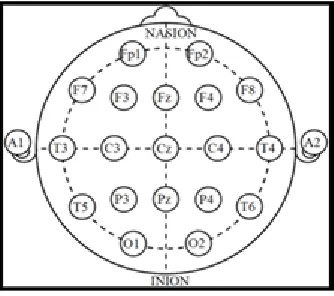
The human cortex is divided into frontal (F), temporal (T), central (C), parietal (P) and occipital (O) lobes. EEG signal is the voltage fluctuation obtained by ionic current flow with synaptic connections of neuron. In an adult, EEG signal measured from scalp is a sinusoidal signal of range 10-100μV. Useful information from brain is divided in five frequency bands namely, delta (0-4Hz), theta (4-8Hz), alpha (8-13Hz), beta (13-30Hz) and gamma (30-70Hz) [8]. Delta waves are obtained during deep sleep. Theta waves are associated with subconscious mind activities like sleeping and dreaming. Alpha waves occur during relaxed state and are more prominent in parietal and occipital lobe. Beta waves occur during focused mental activity. Gamma waves occur during hyper brain activity [9]. International 10/20 system [10] as shown in figure 1, is used for placing electrodes on skull to get EEG signals. The numbers 10 and 20 suggests, distance between neighboring electrodes (10% or 20% of total front-back or right-left distance of skull).
————————————————
• Nandini K. Bhandari is currently pursuing Ph. D Electrical and Electronics Engineering from Mandsaur University, Mandsaur. India. PH-+919922921252. E-mail: [email protected]
1828
Fig. 1: The international 10/20 system.
Alpha wave power change and asymmetric variation in frontal lobe EEG signal indicates the valance state. A valance state is also obtained by beta waves. Alpha waves from pre-frontal asymmetry and gamma waves from temporal asymmetry are useful in arousal recognition. Gamma waves changes or decrease in alpha wave in temporal lobes gives happiness or sadness. In general, we can summarize that maximum information about emotions is obtained from frontal and parietal lobes. The study of emotions show that men have individuality in EEG patterns where as women have more similarity in EEG patterns. The basic steps in emotion recognition process, as shown in figure 2 are as follows:
Fig. 2. Process of Emotion recognition.
a. Stimuli: User is exposed to stimulus like images, audio, audio-visual clips, games etc.
b. EEG recorder: Record the variation in voltage occurred in brain with the help of sensors or brain computer interface.
c. Preprocessing: Remove the artifacts and various noises, in the recorded EEG.
d. Feature extraction: Analyze the signal and extract the relevant features.
e. Classification: Use a training data, to train the classifier such that using those computed features one can predict the EEG signal.
3
DATABASE
A number of datasets are available on internet, which can
be used for EEG emotion recognition. Some of them are listed below:
i. SEED: This database [11] collected EEG data from 64 electrodes when each subject was watching 15 Chinese clips having emotions positive, negative and neutral. Eight females and seven males were participated for the three sessions, such that dataset contains 45 trials of EEG data for each subject. A feedback was taken from each subject while watching clip, to guarantee the observed emotion.
ii. DREAMER: This database [12], collected EEG data from 23 subjects (9 females and 14 males) using 14 electrodes. 18 clips were used having nine different emotions, i. e. anger, disgust, amusement, excitement, fear, sadness, happiness, calmness and surprise. Self assessment manikins were used for subjective assessment of valance, arousal and dominance.
iii. DEAP: EEG of 32 subjects [13] were recorded from 32 electrodes when each one was watching, forty one minute music videos. These subjects rated videos as valance, arousal, dominance like/dislike and familiarity. Some authors have used some other database, while some of them have created their own database using brain computer interface (BCI) system.
4
PREPROCESSING
THE
EEG
SIGNAL
To get only brain activity signals from raw EEG preprocessing of EEG signal is required. This process includes line noise removal, bad channel elimination and artifact removal. A multi-taper decomposition is used for line noise removal, where a shot sliding window is passed over EEG signal to transform it into frequency bands. Bad channel is detected by finding a correlation of a single channel with others. Artifact removal is one of the prime step in emotion recognition. Artifacts are generated by internal factors like eye movement, muscles contraction, electrical activities of heart and external factors like environment, electrode attachment, cable and recorder. We describe some commonly used methods in artifact removal: i: Linear regression: In linear regression [14], EEG signal is assumed to be sum of brain signal and artifact, and artifact is removed by subtracting regressed portion from contaminated EEG.
ii. PCA: Principal component analysis [15], orthogonally transforms correlated EEG data to uncorrelated principal components preserving variance of EEG data.
iii: ICA: Independent component analysis removes artifacts with assumptions that there is statistical independence between EEG and artifacts [16] and EEG signal remain stationary during analysis. Physiological and non-biological artifacts related independent components can be removed from EEG using automatic identification ICA algorithm.
iv. CCA i.e. canonical correlation analysis [17] removes artifacts by finding linear relation between EEG and its temporarily delayed version.
1829 signal into basic functions called intrinsic mode functions
(IF). These IFs are computed using Hilbert transform to get Hilbert spectrum. EMD work well on non-stationary signals like EEG where signal and artifacts are represented by one or more IFs. Ensemble EMD gives more robust results.
5
FEATURE
EXTRACTION
AND
CLASSIFICATION
Features are extracted from processed EEG signal. These features can be found using statistical, time domain, frequency domain or time frequency domain methods. A subset of features which can give best classification accuracy is selected. These features are further classified using machine learning or neural network methods such that similar features are grouped in one class. Various feature extraction and classification methods are discussed in this section.
a. Machine Learning based methods
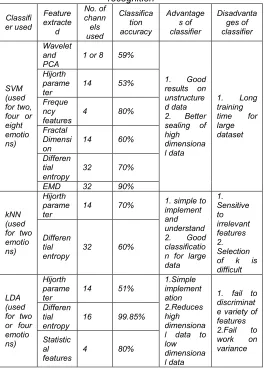
Machine learning is a part of computational learning in artificial intelligence. The aim of machine learning algorithms is to train themselves on available data and then accurately estimate the unseen tasks. These methods learn from small dataset. In the following paragraphs we have discussed some machine learning methods used in emotion recognition. In [19] low amplitude EEG signals generated because of self induced stimulus of subject while remembering an unpleasant event, were used for emotion classification. Wavelet was used to remove artifacts and get useful features which were further reduced by PCA. SVM classifier [20] was used for classification. This method had helped in detection of frequency bands affected by particular stimulus. Further it was observed, that channel T8 connected to right hemisphere was predominant in revealing the stimulus. R. Du et al [21] calculated Hjorth parameters for different frequency ranges from processed EEG signal. Optimal features were selected by applying balanced one way analysis of variance (ANOVA) on extracted features with p-value <0.05. Emotion classification was done on optimal features using SVM, LDA, deep learning, kNN and ensemble methods using WEKA software [22]. Outstanding results were obtained using voting ensemble algorithm. Group sparse canonical correlation analysis (GSCCA) algorithm [23] was proposed for automatic selection of EEG channels and emotion recognition. In this CCA method was modified to regularized weighted reduced rank regression model [24] using binary weights. A raw EEG signal used for processing had helped group sparse learning process to select channels. The results had signified that both frontal and side lobes of brain play an important role in emotion recognition. 80% accuracy was obtained with four channels, when features from all the frequency bands were used. A real time movie-induced emotion recognition method was developed in [25] to identify individual's emotions using brain waves. Using short time Fourier transform and spatial-temporal method, energy and power related features indicating brain activity were extracted and number of features were reduced using sparse linear discriminate analysis. A multiclass SVM classifier, LIBSVM [26], was used to classify eight emotions. Average classification accuracy for positive emotions was 86% and negative emotions was 65%.In [27], correlation
1830
Table 1: Machine learning methods used in emotion recognition Classifi er used Feature extracte d No. of chann els used Classifica tion accuracy Advantage s of classifier Disadvanta ges of classifier SVM (used for two, four or eight emotio ns)
Wavelet and
PCA 1 or 8 59%
1. Good
results on unstructure d data
2. Better
sealing of high dimensiona l data
1. Long
training
time for
large dataset Hijorth
parame ter
14 53%
Freque ncy features
4 80%
Fractal Dimensi on
14 60%
Differen tial entropy
32 70%
EMD 32 90%
kNN (used for two emotio ns)
Hijorth parame ter
14 70% 1. simple to implement
and understand
2. Good
classificatio n for large data 1. Sensitive to irrelevant features 2. Selection
of k is
difficult Differen
tial
entropy 32 60%
LDA (used for two or four emotio ns)
Hijorth parame ter
14 51%
1.Simple implement ation 2.Reduces high dimensiona l data to low dimensiona l data
1. fail to discriminat e variety of features
2.Fail to
work on
variance Differen
tial entropy
16 99.85%
Statistic al
features 4 80%
b. Neural network based methods:
Neural network is a parallel distributed processor built with simple processing units [40]. It has capacity to store experimental knowledge which is available whenever required for use. It has resemblance with brain in two aspects
i. Knowledge is obtained by the network from its surrounding through learning process.
ii. Inter neuron connections are used to store the obtained knowledge.
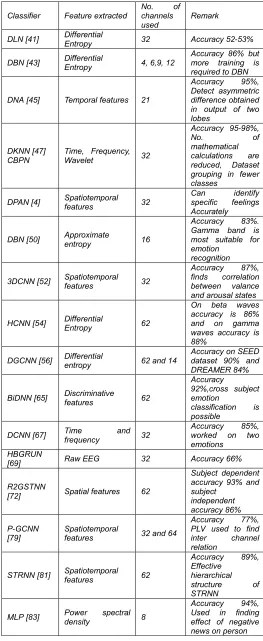
The neural networks are non-linear, adaptable, fault tolerant and have input output mapping. Hence, they can encode complex behaviour of non-linear EEG signals. In the following paragraphs we discuss emotion recognition and classification methods based on neural network. In [41], deep learning network (DLN) [42], was used to find correlation between unknown features of input signal. A DLN was composed of three stacked autoencoders and two softmax classifiers, to classify valance and arousal states. Power spectral densities obtained from 32 channel EEG, were given as input to the DLN. To extract salient components of input PCA was used. Additionally, covariate shift adaption of PCA was used to diminish non-stationary outcome of EEG. Classification accuracy 52 to 53% was obtained. In [43], critical frequency bands and critical channels for effective EEG based emotion classification,
1831 applied, to get sparse DE maps. Hierarchical convolution
neural network (HCNN) [55] was applied to transfer input DE maps from input layer to output layer. Each layer had projected the input into another space. These transformations were used in the last fully connected layer to recognize emotions. In HCNN, at each layer the output became more global and abstract, which had resembled the working of human visual cortex. The activation function along with pooling operation of HCNN had enhanced the non linear feature transformation giving better accuracy. In [56] dynamical graph convolution neural network (DGCNN) was proposed for studying nonlinear discriminative EEG features and functional relationship between channels. A graph was used to provide most discriminative features required for emotion recognition. DGCNN had adaptively learned intrinsic relationship between channels by training a neural network to develop an adjacency matrix which can be updated with changes in the graph model. A non-linear mapping in the network was realized by Relu activation function to get non-negative graph output. Diagonal elements in adjacency matrix had indicated the benefaction of EEG channels in emotion classification. Accuracy of 90% was achieved with SEED dataset by combining differential entropies of five frequency bands. In broad learning system (BLS) [57], inputs mapped in feature mode were enlarged in enhancement mode. Using the random mapping ability of BLS, a broad dynamical graph learning system (BDGLS) [58] was designed. Features extracted by DGCNN from irregular EEG signals were used in BDGLS for generating graphs, which were then expanded in broad space using enhancement nodes to get appropriate features for emotion recognition. In [59] emotionally salient regions called hotspots were defined using qualitative agreement (QA) [60] method, which had searched trends across continuous time evaluation for valance and arousal states. A group of bidirectional long short term memory regressors were trained for individual emotional traces and then combined for automatic emotion hotspot detection. Accuracy of 60.9% for arousal and 50.4% was obtained on RECOLA dataset [61]. In [62] hierarchical network with subnetwork nodes, was used for emotion recognition. Each subnetwork node [63] had hundreds of hidden nodes and each node worked as independent local feature extractor and classifier. The top layer of hierarchical network, similar to brain cortex, combined the features obtained from subnetwork nodes. The network had modified these features into mapping space, to have better learning of emotions. This NN based method had shown favorable results with single and multiple modality. According to neuroscience left and right hemisphere of human brain, show asymmetrical response to emotions. Right hemisphere recognizes negative emotions better than left one and left hemisphere understands positive emotions better [64]. A Bi-hemispheres domain adversarial neural network (BiDANN) [65], was used for emotion recognition. In BiDANN [66], two local and one global discriminator was designed in such a way that they worked adversarially with classifier to learn distinguished emotion features from the two hemispheres. This had reduced the difference between source and target domains on each hemisphere and gave better recognition model. The model had three parts viz. feature extractor, classifier and domain discriminator. Feature extractor was used for getting
1832 node-wise domain adversarial training [75] (NodeDAT) was
provided to regularize subject independent classification. Thus regularization had improved with minimum domain discrepancies, among source and target domains of each channel. An emotion aware distribution learning (EmotionDL) algorithm was proposed to deal noisy labels in dataset to improve accuracy. In [76], EEG phase space was reconstructed for each channel and then modified in angle space (AS). Non linear features obtained from AS had given valuable information about emotions. Most significant extracted features were given to two classifiers namely multilayer perception and Bayes to recognize emotions. The posterior probabilities of the two classifiers fed to Dempster-Shafer theory [77] were combined, to improve classification accuracy. In [78], a bi-hemisphere discrepancy model (BiHDM) was developed to understand asymmetric differences obtained in the output of two hemispheres, to classify emotions. Four recurrent neural networks (RNN) were engaged on spatial orientations of signal, to travel across the two hemispheres. The RNNs had enabled algorithm to find deep features of EEG, keeping spatial dependency inherent. A pair wise sub-network was implemented to get discrepancy data between two hemispheres and higher level attributes were extracted for classification. For dominant shift reduction between trained and test data, domain discriminator module generating domain invariant features was introduced. The overall algorithm performance was improved with domain discriminator. In [79], depending on spatiotemporal features and inbuilt information provided by functional connections of data, a multichannel EEG recognition algorithm based on phase locking value (PLV) graph convolution neural network (P-GCNN) was developed. It had used PLV [80] based brain matrix to evaluate multi channel EEG features as graphical signal. This P-GCNN had used PLV connectivity to find emotion related functional connectivity which was further used to determine intrinsic relationship between channels for different emotions. The network was trained to locate emotion effective features and classification accuracy about 77% was obtained. In [81] spatial-temporal recurrent neural network (STRNN) was proposed for obtaining features from spatial and temporal information of EEG. Traversal of spatial regions for each temporal slice in different directions, was used by multidirectional recurrent neural network (RNN) layer to get spatially co-occurant variations features. A bi-directional temporal RNN [82] was used to get discriminative features from temporal dependencies and these features were used for emotion recognition. It is observed that negative news on social media has increased mental illness among people. In [83], early recognition of negative emotion, while consuming negative news was done to overcome this problem . Eight symmetrical temporal channels were used for EEG recording. Seven features were extracted from EEG using Fourier and wavelet transform. SVM and multilayer perception (MLP) algorithm was used for emotion classification. MLP was a three layer neural network having three layers as input, hidden and output layer. MLP with power spectral density as feature input had given highest accuracy of 94%.
Table 2: Neural network based emotion recognition methods
Classifier Feature extracted
No. of
channels used
Remark
DLN [41] Differential Entropy 32 Accuracy 52-53%
DBN [43] Differential Entropy 4, 6,9, 12
Accuracy 86% but more training is required to DBN
DNA [45] Temporal features 21
Accuracy 95%,
Detect asymmetric difference obtained in output of two lobes
DKNN [47] CBPN
Time, Frequency,
Wavelet 32
Accuracy 95-98%,
No. of
mathematical
calculations are
reduced, Dataset grouping in fewer classes
DPAN [4] Spatiotemporal features 32
Can identify
specific feelings
Accurately
DBN [50] Approximate entropy 16
Accuracy 83%.
Gamma band is most suitable for emotion
recognition
3DCNN [52] Spatiotemporal features 32
Accuracy 87%,
finds correlation
between valance and arousal states
HCNN [54] Differential Entropy 62
On beta waves accuracy is 86% and on gamma waves accuracy is 88%
DGCNN [56] Differential entropy 62 and 14
Accuracy on SEED dataset 90% and DREAMER 84%
BiDNN [65] Discriminative features 62
Accuracy
92%,cross subject emotion
classification is
possible
DCNN [67] Time frequency and 32 Accuracy worked on two 85%,
emotions HBGRUN
[69] Raw EEG 32 Accuracy 66%
R2GSTNN
[72] Spatial features 62
Subject dependent accuracy 93% and subject
independent accuracy 86%
P-GCNN [79]
Spatiotemporal
features 32 and 64
Accuracy 77%,
PLV used to find
inter channel
relation
STRNN [81] Spatiotemporal features 62
Accuracy 89%,
Effective hierarchical
structure of
STRNN
MLP [83] Power density spectral 8
Accuracy 94%,
1833
6
DISCUSSION
AND
FUTUTRE
DIRECTION
EEG is a non invasive signal with strength about 10-100 μV and it is contaminated with noise. ICA based methods can remove all types artifacts when source signals are independent. Researchers have used one of the artifacts removal methods which are discussed in the paper but it is difficult to remove artifact using single method. In future one can combine traditional method with machine learning to get automatic artifact removal. SEED or DEEP database are commonly used by 70% researchers, which have used 64 or 32 electrodes. If exact number of channels required for emotion recognition are found then number of electrodes can be reduced in practical BCI systems. Machine learning techniques like LDA, kNN are simple to implement but the accuracy obtained by these techniques is about 55% for two state emotions. With SVM we can get emotion classification accuracy up to 70% for two class which has been reduced when user has used multiclass SVM for six emotions except [34]. Though neural network and deep learning has increased the performance of emotion recognition, technical and usability challenges are still in existence. It is observed that DBN have good classification ability. We recommend to use power spectral density or differential entropy features for DBN for better results. CNN architecture has capability to extract complex features of data at each layer to determine output. There is no limit on number of channels to be used in CNN as they are capable of handling large data. In future, CNN can be used as fundamental tool for feature learning and classification. In RNN connections between nodes form a directed graph along the temporal sequence. This is helpful in predicting temporal dynamic behavior. Most RNN studies have used two LSTM layers and one or two fully connected layers for classification. In future, one can vary the number of fully connected layers and find accuracy. It is observed that accuracy has increased above 80% with deep learning. Hybrid models have given promising results for EEG classification but further research is required to check the effectiveness of them. In the experimentation, number of subjects having variation in ages, gender should be increased such that, from training more features are obtained giving better classification accuracy during testing. For a deep neural network to do a good job, create a network and proceed it to optimize its architecture such that we get best solution for a particular problem.
7
CONCLUSION
In this paper we have surveyed the methods of emotion recognition using EEG. We have concentrated on machine learning and neural network methods. We summarize EEG signals, their preprocessing techniques, feature extraction and classification techniques used for emotion recognition. It is observed that deep learning methods are predominant in getting high level features automatically from non-invasive EEG signal and are less dependent on manually created features. Finally, we recommend more in depth research on deep learning network design for emotion recognition. A comparison of designed model for interpretation of raw versus de-noised EEG for emotion recognition can be done which is not yet done.
8 REFERENCES
[1] R. Damasio, Descartes' Error: Emotion, Reason and the Human Brain, New York, NY, USA: Harper Perennial, 2015.
[2] H. Gunes, B. Schuller, M. Pantic and R. Cowie, "Emotion representation, analysis and synthesis in continuous space: A survey," in Proc. IEEE conf. on Face Gesture, pp 827-834, 2011.
[3] R.Horlings, : Emotion recognition using brain activity. Ph.D. thesis, Delft University of Technology (2008).
[4] H. Kim and S. Jo, "Deep physiological affect network for the recognition of human emotions", IEEE trans. on Affective Computing, vol.14, no. 8, pp 99-113, 2018.
[5] Paul Ekman, W.V. Friesen and P. Ellsworth, Emotion in the human face: Guidelines for research and an integration of findings. Elsevier, 2013. [6] R. Plutchik, "The nature of emotions," American
Science, vol. 89, no.4, pp 344-350, 2001.
[7] P. J. Lang, "The emotion probe: Studies of motivation and attention," Amer. Physiologist, vol.50, pp 372-385, 1995.
[8] E.Niedermeyer and F. da Silva, Electroencephalography: Basic principles, clinical applications and related fields, Philadelphia, PA, USA: Lippincott Williams and Wilkins, 2005.
[9] O. Bos, "EEG-based emotion recognition: The influence of visual and auditory stimuli," Capita Selecta (MSc course), 2006.
[10]Trans Cranial Technologies, 10/20 System positioning - Manual, 2012[online], manual retrived Feb. 2016.
[11]W-L. Zheng and B-L. Lu, "Investigating critical frequency bands and channels for EEG-based emotion recognition with deep neural networks," IEEE trans. on Auton. Mental Development, vol.7,
no.3, pp 162-175, Sept. 2015.
https://archive.ics.uci.edu/ml/datasets/seeds
[12]S. Katsigiannis and N. Ramzan, "DREAMER: A database for emotion recognition through EEG and ECG signals from wireless low cost off the shelf devices," IEEE journal of Biomedal and Health informatics, vol. 22, no. 1, pp 98-107, Jan 2018. [13]S. Koelstra, C. Muhi, M. Soleymani, J-S. Lee, A.
Yazdani, T. Ebrahimi, T. Pun, A. Niiholt and I. Patras, "DEAP: A database for emotion analysis using physiological signals," IEEE trans. on Affective computing, vol. 3, no. 1, pp 18-31,Mar.2012. https://www.eecs.qmul.ac.uk/mmv/datasets/deap/ [14]G. L. Wallstorm, R. E. Kass, A. Miller, J. F. Cohn
and N. A. Fox, "Automatic correction of ocular artifacts in EEG: a comparison of regression based component based methods," Int. J. Phychophysiology, vol. 53, pp 105-119, 2004. [15]M.terBraack, B. deJongeand M. J. vanPutten,
"Reduction of TMS induced artifacts in EEG using principal component analysis," IEEE trans. Neural system Rehabilation eng., vol. 21, pp 376-382, 2013.
1834 component analysis," IEEE trans. Biomedical Eng.,
vol. 54, pp 1560-1572, 2007.
[17]Safieddine, A. Kachenoura, L. Albera, G. Birot, A. Karfoul, et al "Removal of muscle artifact from EEG data: comparison between stochastic (ICA and CCA) and deterministic (EMD and wavelet-based) approaches," EURASIP journal on Advancesin Signal processing," pp 210-220, Jan. 2012.
[18]S. M. Fakhr, M. Moshrefi-Torbati, M.Hill, C. M. Hill and P. R. White, "Signal processing techniques applied to human sleep EEG signals - a review," Biomedical signal proces. and control, vol. 10, pp 21-33, 2014.
[19]D. Iacoviella, A. Petracca, M. Spezialetti and G. Placcidi, "A classification algorithm for electroencephalography signals by self induced emotional stimuliu," IEEE trans. on Cybernetics, vol. 46, no. 12, pp 3171-3180, 2016.
[20]N. F. Guler and E. D. Ubevli, "Multiclass support vector machines for EEG siganl classification," IEEE trans. Information Technology in Biomedicine, vol. 11, no.2, pp 117-126, Mar. 2007.
[21]R. M. Mehmood, R. Du and H. J. Lee, " Optimal feature selection and deep learning ensmbles method for emotion recognition from human brain EEG sensors," IEEE Access, vol.5, pp 14797-14806, 2017.
[22]M. Hall, E. Frank, G. Holmes, B. Pfahringer, P. Reutemannand I. H. Witten, " The WEKA data mining software: an update," ACM SIGKDD Explorations newsletter, vol.11, no. 1, pp 10-18, 2009
[23]W. Zheng, "Multichannel EEG-based emotion recognition via group sparse cannonical correlation analysis", IEEE trans. on Cognitive and developmental systems, vol.9, no.3, pp 281-290, Sept 2017.
[24]D. La Torre, "A least-squares framework for component analysis," IEEE Trans. on Pattern Analysis and Machine Intelligence vol.34, no. 6, pp1041-1055, June 2012.
[25]Y-J. Liu, M.Yu, G. Zhao, J. Song, Y.Ge and Y. Shi "Real-time movie-induced discrete emotion recognition from EEG signals," IEEE trans.on Affective computing, vol. 9, no. 4, pp 550-562, 2018. [26]C-C. Chang and C-J. Lin, "LIBSVM: Alibrary for support vector machines," ACM trans.Intelligent system technology, vol. 2, no. 3, 2011
[27]D. D. Chakaldar and S. Chakraborty, "EEG based emotion classification using correlation based subset selection", Journal of Biologically Inspired Cognitive Architects, vol.24, pp 98-106, 2018. [28]Bhardwaj, A. Gupta, P. Jain, A. rani and J.
Yadav,"Classification of human emotions from EEG signals using SVM and LDA classifiers," 2nd IEEE Int. conf. on signal processing and integrated networks (SPIN), pp 180-185, Feb. 2015.
[29]Kaur, D. singh P. P. Roy, " EEG based emotion classification mechanism in BCI." Int. conf. on Computational intelligence and Data science, pp 752-758, 2018.
[30]E. S. Pane and A. D. Wibawa, "Channel selection of EEG emotion recognition using stepwise
discriminant analysis." Int. conf. on Computer Engg., Network and Intelligent Multimedia, pp 14-20, 2018. [31]R.Munoz, R, Olivares, C. Taramasco, R. Villarroel,
R. Soto, et al "Using black hole algorithm to improve EEG based emotion recognition", Computational Intelligence and Neuroscience,Hindwai pp 1-22, 2018.
[32]Hatamlou," Black hole: a new heuristic optimization approach for data clustering", Information Science, vol.222, pp 175-184, 2013.
[33]M. Soleymani, J. Lichtenauer, T. Pun and M. Pantic, "A multimodal database for affect recognition and implicit tagging," IEEE trans. on Affect computing, vol. 3, no. 1, pp 42-55, 2012.
[34]S. Taran and V. Bajaj, "Emotion recognition from single channel EEG signals using a two stage correlation and instantaneous frequency based filtering methods," Computer methods and Programs in Biomedicine, vol.173, pp 157-165, 2019.
[35]P. Li, H.Liu, Y. Si, C. Li, F. Li, et al, "EEG based emotion recognition by combining functional connectivity network and local activation," IEEE trans. on Biomed. Eng, pp 11-18, 2019.
[36]V. Gupta, M. D. Chopda and R. B. Pachori, "Cross-subject emotion recognition using flexible analytic wavelet transform from EEG signals," IEEE Sensors Journal, vol. 19, no.6, pp 2266-2275, March 2019. [37]C. Qing, R. Qiao, X. Xu and Y. Cheng, "Interpretable
emotion recognition using EEG signals", IEEE Access, vol. 7, pp 94160-94170, July 2019.
[38]W-L Zheng, J-Y. Zhu and B-L.Lu, "Identifying stable patterns over time for emotion recognition from EEG", IEEE trans. on Affective computing, vol.10, no.3, pp 417-429, July-Sept. 2019.
[39]Peng, F. long and C. Ding, "Feature selection based on mutual information critaria of max dependancy, max relevance and min redundancy", IEEE trans. on Pattern analysis and Machine intelligence, vol. 27, no. 8, pp 1226-1238, Aug. 2005.
[40]Simon Haykin, Neural Networks: A comprehensive foundation, Pearson, Prentice Hall Publications, 2001.
[41]J. Suwicha, S. Pan-Ngum and P. Israena,"EEG based emotion recognition using deep learning network with principal component based on covariate shift adaption," The Scientific World Journal, Hindawi, no.627892, pp 1-10, 2014. [42]E. Hinton, S. Osindero and Y. Teh, "A fast learning
algorithm for deep belief nets," Neural computation, vol.18, no.7, pp 1527-1554, 2006.
[43]W. L. Zheng and B. L. Lu, "Investigating critical frequency bands and channels for EEG-based emotion recognition with deep neural networks", IEEE transaction on Autonomous Mental Develop.,vol.7, no. 3, pp 162-175, Sept. 2015. [44]M. Langkvist, L. Karlsson and A. Loutfi,"Sleep stage
classification using unsupervised feature learning", Advanced Artificial Neural systems, pp 1-9, 2012. [45]P. K. Hristova, L. Bozhkov and P. Georgieva, "
1835 [46]B. Schrauwen, M. Wandermann, D. Verstraeten, J.
J. Steil and D. Stroobandt, "Improving reservoirs using intrinsic plasticity," Neurocomputing, vol. 71, pp 1159-1171, 2008.
[47]D. J. Hermanth, J. Anitha and L. H. Son, "Brain signal based human emotion analysis by circular back propagation neural network and Deep Kohonen neural network," Computer and Electrical Engineering, vol.68, pp 170-180, 2018.
[48]P. Martinez, Y. Bengio and G. N. Yannkakis, "Learning deep physiological models of affect," IEEE Computational intelligence magazine, vol. 8, no. 2, pp 20-33, 2013.
[49]S. Xingjian, Z. Chen, H. Wang, D-Y. Yeung, W-K. Wong and W-C. Woo, "Convolutional LSTM network: A machine learning approach for precipitation now casting," in Proc. 28th Int. conf. on Neural information processing systems (NIPS), MIT press, pp 802-810, 2015.
[50]T. Chen, S. Ju, X. Yuan, M. Elhoseny, F. Ren, M. Fan and Z. Chen, "Emotion recognition using empirical mode decomposition and approximation entropy," Computer and Electrical Engineering, vol. 72, pp 383-392, 2018.
[51]L. Li, W. Chen, X. Shaoand Z. Wang, "Analysis of amplitude-integrated EEG in the newborn based on approximate entropy," IEEE trans.Biomedical Eng., vol. 57, no. 10, pp 2459-2466, 2010.
[52]E. S. Salama, R. A. El-Khoribi, M. E. Shoman and M. A. W. Shalaby, "EEG based emotion recognition using 3D convolution neural network," Int. Journal of Advanced Computer Science and applications, vol. 9, no. 8, pp 329-337, 2018.
[53]D. Maturana and S, Scherer, "VoxNet: A 3D convolutional neural network for real time object recognition," IEEE/RSJ Int. conf. on Intelligent robots and systems, Hamburg, Germany, 2015. [54]Li, Z. Zhang and Huiguang, "Hierarchical
convolution neural network for EEG based emotion recognition," Springer Verilog trans. Cognitive Computation, vol. 10, no. 2, pp 368-378, April 2018. [55]Alex, I. Sutskever and G. E. Hinton, "Imagenet
classification with deep convolution neural network," Advances in neural information processing systems, 2012.
[56]T. Song, W. Zheng, P. song and Z. Cui, "EEG emotion recognition using dynamical graph convolution neural networks," IEEE trans. on Affective Computing, Early access article, 2018. [57]C. L.P. Chen and Z. Liu,"Broad learning system: an
effctive and efficient incremental learning system without the need of deep architecture," IEEE trans, on Neural networks and learning systems, vol. 29, no.1, pp 10-24, 2018.
[58]X. Wang, T. Zhang, X. Xu, L. Chen, X. Xing and C. L. P. Chen, "EEG emotion recognition using dynamical graph convolution neural networks and broad learning systems," Int. conf. on Bioinformatics and Biomedicine.
[59]S.Parthasarthy and C. Busso, "Predicting emotionally salient regions using qualitative agreement on deep neural network regressors", IEEE trans. on Affective computing, Apr.2018.
[60]R. Cowie and G. McKeown, "Statistical analysis of data from initial labelled database and recommendations for an economical coding system", Belfast, Northen Ireland, UK, SEMAINE Report D6b,Sept. 2010.
[61]F. Ringeval, A. Sonderegger, J. Sauer and D. Lalanne, "Introducing the RECOLA multimodal corpus of remote collaborative and affective interactions", In 2nd International workshop on Emotion representation, analysis and synthesis in continuous time and space (EmoSPACE 2013), Shanghai, China, April 2013.
[62]Y. Yang, W.-L. Zheng, B-L. Lu and Q. M. J.Wu, "EEG-based emotion recognitionusing hierarchical network with subnetwork nodes", IEEE trans. on Cognitive and developmaental systems, vol.10, no.2, pp 408 -419, June 2018.
[63]Y, Yang and Q, M, J. Wu, "Extreme learning machine with subnetwork hidden nodes for regression and classification", IEEE trans on Cybernatics, vol. 46, no. 12, pp 2885-2898, Dec. 2016.
[64]D. N. Greve, V. Haegen, Q. Cai, S. Stufflebeam, M. Sabuncu, B. Fishi and M. Brysbeart, "A surface based analysis of language lateralization and cortical asymmetry," Journal of Cognitive Neuroscience, vol.25, no. 9, pp 1477-1492, 2013. [65]Y. Li, W. Zheng, Y. Zong, Z. cui, T. Zhang and X.
Zhou, "A Bi-hemisphere domain adersarial neural network model for EEG emotion recognition," IEEE transaction on Affective Computing, Dec.2018. [66]Y.Li, W. Zheng, Z. Cui, T. Zhang and Y. Zong, "A
novel neural network model based on cerebral hemisperic asymmetry for EEG emotion recognition," Proc. 27th Int. joint conf. on Art. Intel. (IJCAI), 2018.
[67]J. X. Chen, P. W. Zhang, Z. J. Mao, Y. F. Huang, D. M. Jiang and Y. N. Zhang, "Accurate EEG based emotion recognition on combined features using deep convolution neural network," IEEE Access, vol.7, pp 44317-44328, 2019.
[68]W. L. Zheng, W. L. Lu and B. Lu, "Emotion meter: A multimodel framework for recognition of human emotions," IEEE trans. on Cybernetics, vol. 49, no. 3, pp 1110-1122, March 2019.
[69]J. X. Chen, D. M. Jiang and Y. N. Zhang. "A hierarchical bidirectional GRU model with attention for EEG based emotion classification," IEEE Access, vol. 7, pp 118530-118540, Aug. 2019. [70]Z. Yang, D. Wang, C. Dyer, X. He, A. Smola and E.
Hovy, "Hiererchical attention networks for document classification," Proc.HLT-NAACL, pp1480-1489, 2016.
[71]D. Bahdanau, K. Cho and Y. Bengio, "Neural machine translation by jointly learning to aline and translate," arXiv:1409.0473, 2016.
[72]Y. Li, W. Zheng, L. Wang, Y. Zong and Z. Cui, "From reginoal to global brain: a novel hierarchical spatial-temporal neural network model for EEG emotion recognition," IEEE trans. on AffectiveComputing, pp 1-10, 2019.
1836 Qian, "Using bidirectional LSTM recurrent neural
network to learn high-level abstractions of sequential features for automated scoring of non-native spontaneous speech," in Automatic speech recognition and understanding (ASRU) IEEE workshop, pp 338-345, 2015.
[74]P. Zhong, D. Wang and C. Miao, "EEG based emoyion recognition using regularized graph neural network," arXiv:1907.07835v2 [cs. CV] 26 Aug. 2019.
[75]Y. Ganin, E. Ustinova, A. Ajakan, P. Germain, H. Larochelle, F. Laviolette, M. Marchand and V. Lempisky, "Domain adversarial training of neural networks," Journal of Machine learning research, vol.17, no. 1, pp 2096-2030, 2016.
[76]Z. Soroush, K. Maghooli and S. K. Setarehdan, "Emotion recognition through EEG phase space dynamics and Dempster-Shafer theory," Machine Hypotheses, vol. 127, pp 34-45, 2019.
[77]T.C. Lin, "Partition belief median filter based on Dampster-Shafer theory for image processing," Pattern recognition, vol. 41, pp 139-151, 2008. [78]Y. Li, W. Zheng, Li Wang, Y. Zong, L. Qi and Z. Cui,
"A novel Bi-hemisphere discrepancy model for emotion recognition," arXiv:1906.01704v1 [q-bio.NC] 11, May2019.
[79]Z. Wang, Y. Tong and X. Heng, "Phase locking value based graph convolution neural networks for emotion recognition," IEEE Access, vol. 7, pp 93711-93722, 2019.
[80]J. R. C.Piqueira, "Network of phase-locking oscillators and possible model for neural synchronization," Communication nonlinear science neumerical simulation, vol. 16, no. 9, pp 3844-3854, 2011.
[81]T. Zhang, W. Zheng, Z. Cui, Y. Zong and Y. Li, "Spatio-temporal recurrent neural network for emotion recognition", IEEE trans. on Cybernetics, pp 839-847, Mar. 2019.
[82]R. J. Williams and D. Zisper, "A learning algorithm for continually running fully recurrent neural networks," Neural Computation, vol. 1, no. 2, pp 270-280, 1989.