Sex Ratio Evolution and
Resource Allocation in
the Multiple-Queen Ant
Leptothorax acervorum
George L. Chan
University of London
1997
A thesis submitted for the degree o f Doctor of Philosophy,
All rights reserved
INFORMATION TO ALL USERS
The quality of this reproduction is dependent upon the quality of the copy submitted.
In the unlikely event that the author did not send a complete manuscript and there are missing pages, these will be noted. Also, if material had to be removed,
a note will indicate the deletion.
uest.
ProQuest 10017441
Published by ProQuest LLC(2016). Copyright of the Dissertation is held by the Author.
All rights reserved.
This work is protected against unauthorized copying under Title 17, United States Code. Microform Edition © ProQuest LLC.
ProQuest LLC
789 East Eisenhower Parkway P.O. Box 1346
THE ANT
These are a species of four-winged insects, that have been famous from all antiquity
for their social and industrious habits; that are offered as a pattern of parsimony to the
profuse, and unremitting diligence to the sluggard.
Georges Louis Leclerc, 1707-1788,
Comte de Buff on,
Sex Ratio Evolution and Resource Allocation in the M ultiple-Queen
Ant
Leptothorax acervorum
Current evolutionary theories have attempted to explain the greater than random
variation in allocation o f resources to new queens and new males (sex allocation), as
w ell as allocation o f resources to new sexuals versus new workers (resource
allocation) in social Hymenoptera. Because o f relatedness asymmetries within social
insect colonies, queens and workers are in conflict over the optimal allocation o f
resources to brood. This thesis exam ines three populations o f the facultatively
polygynous ant species Leptothorax acervorum over several years. Data on colony
size, number o f colony queens, production o f new queens, new males and new
workers are examined for each colony sampled. I investigate the factors affecting how
resources are divided amongst brood in colonies, and consider which party controls
allocation o f these resources.
M onogynous and polygynous colonies differ in their allocation strategies. While
there are considerable differences between populations, monogynous colonies tend to
invest more resources into new sexuals with polygynous colonies investing in more
new workers to stock daughter buds. Evidence o f local resource competition also
supports colony budding as a reproductive strategy by some colonies. Sex allocation
decisions appear to reflect w ithin-colony relatedness in two study populations.
Environmental influences such as local nest site availability and resource abundance
also appear to influence allocation decisions at the colony level. Small colonies tend to
concentrate on colony growth with larger colonies producing more new sexuals.
There is no evidence of partial queen control over sex or resource allocation. Instead,
workers seem to respond to information about within-colony relatedness as well as
Contents
Chapter 1
Chapter 2
Chapter 3
Chapter 4
Chapter 5
Title Page
Abstract
Contents
List o f Tables
List o f Figures
Acknowledgements
Introduction ^
Split Sex Ratios in Leptothorax acervorum
An Inter-Population Comparison o f Sex Allocation
Strategies in Leptothorax acervorum
Resource Allocation in Leptothorax acervorum
Conclusion
References
Appendix A
Appendix B
Appendix C
Appendix D
1
3
4
5
8
10
12
25
55
99
139
148
153
161
165
Table 2.1. Numbers o f m onogynous, polygynous, and queenless 45 colonies collected in each year from Santon Warren.
Table 2.2. Population sex investment ratios for Santon Warren in all 45
three years sampled with 95% confidence intervals.
Table 2.3. Sex investment ratios for m onogynous and polygynous 46
colony class fractions in all three years with 95% confidence intervals.
Table 2.4. Comparison o f sex allocation patterns in Santon Warren 47
with 0.5 (queen's preferred) and 0.75 (workers' preferred) proportional investment in females.
Table 2.5. Comparison of sex investment ratios in polygynous colonies 48
from Santon Warren using dry weight investment ratios (M / F) and Boomsma's (1989) power-con version factor cost ratio, (M / F)O L
Table 2.6. Multiple regression model o f sex investment ratio testing for 49
the effects of log queen number and year.
Table 2.7. Multiple regression model o f sex investment ratio testing for 49
the effects of residual log queen number and year.
Table 2.8. Kendall rank-order partial correlation co efficien ts for 50
polygynous colonies between sex investment ratio and log queen number, controlling for colony size (number o f old workers) and total sexual productivity separately.
Table 2.9. Partial correlation coefficients between sex investment ratio 50
and log total sexual productivity with colony size (number of old workers) held constant.
Table 2.10. Multiple regression model o f log new queen and log new 51
male production, testing for the effects o f log total sexual productivity, colony class and year.
Table 3.1. Population sex investm ent ratios (SIR ) for all three 82
populations sampled with 95% confidence limits.
Table 3.2. Percentage o f polygynous colonies in each population, with 82
harmonic mean queen numbers.
Table 3.3. Sex investm ent ratios (95% co n fid en ce lim its) for 83
Table 3.4. Multiple regression model o f sex investment ratio testing for 84 the effects o f log queen number and population (Santon
Warren, Aberfoyle and Roydon Wood).
Table 3.5. Multiple regression model o f sex investment ratio testing for 84
the effects o f residual log queen number (rlqn) and population (pop) (Santon Warren, Aberfoyle and Roydon W ood).
Table 3.6. A comparison o f average intra-colony relatedness (±SE, 85
where available) and sex investment ratios (95% confidence limits).
Table 3.7. Relatedness values (r) with 95% confidence limits (95%CL) 86
in different classes o f colony in the Roydon W ood population.
Table 3.8. Multiple regression models o f log new queen and log new 87
male production, testing for the effects o f log total sexual productivity, colony class and population.
Table 3.9. Multiple regression models o f log new queen and log new 88
male production in Santon Warren, testing for the effects of log total sexual productivity, colony class and year.
Table 3.10. Multiple regression models o f log new queen and log new 89
male production in Aberfoyle, testing for the effects o f log total sexual productivity, colony class and year.
Table 3.11. Multiple regression model o f log new queen and log new 90
male production in Roydon Wood, testing for the effects of log total sexual productivity and colony class.
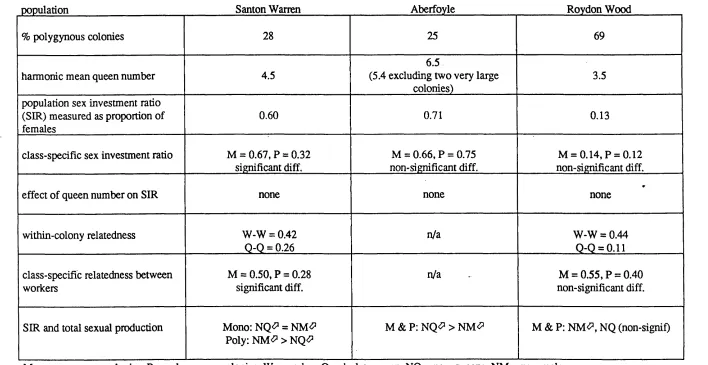
Table 3.12. Summary of the main parameters relating to sex allocation in 91
each study population.
Table 4.1. Santon Warren 1993. Mean sexual and worker production 121
schedules for monogynous and polygynous colonies.
Table 4.2. Santon Warren 1994. Mean sexual and worker production 122
schedules for monogynous and polygynous colonies.
Table 4.3. Santon Warren 1995. Mean sexual and worker production 123
schedules for monogynous and polygynous colonies.
Table 4.4. A berfoyle 1994. Mean sexual and worker production 124
schedules for monogynous and polygynous colonies.
Table 4.5. A berfoyle 1995. Mean sexual and worker production 125
schedules for monogynous and polygynous colonies.
Table 4.6. Roydon Wood 1995. Mean sexual and worker production 126
schedules for monogynous and polygynous colonies.
Table 4.7. Results from two-way ANO VA s looking at the effects o f 127
Table 4.8. Results o f a multiple regression m odel o f total sexual 129 production and colony size, with year and class as factors.
Table 4.9. Results o f a multiple regression model o f new worker 129
production and colony size, with year and class as factors.
Table 4.10. Results o f a multiple regression model o f total production 130
and colony size, with year and class as factors.
Table 4.11. Results o f a multiple regression model o f per capita total 130
sexual production and colony size, with year and class as factors.
Table 4.12. Partial correlation coefficients between colony size (number 131
o f old workers) and per capita production o f all sexuals, controlling for total colony productivity.
Table 4.13. Results o f a multiple regression model o f per capita new 131
worker production and colony size, with year and class as factors.
Table 4.14. Partial correlation coefficients between colony size (number 132
o f old workers) and per capita production o f new workers, controlling for total colony productivity.
Table 4.15. Results o f a multiple regression model o f per capita total 132
production and colony size, with year and class as factors.
Table 4.16. Regression o f % sexuals in brood with colony size (number 133
o f old workers).
Table 4.17. Partial correlation coefficients between colony size (number 133
o f old workers) and percentage o f sexuals in the brood, controlling for total colony productivity.
Table B. 1. Numbers o f ants o f three different castes sampled for weight 164
List of Figures
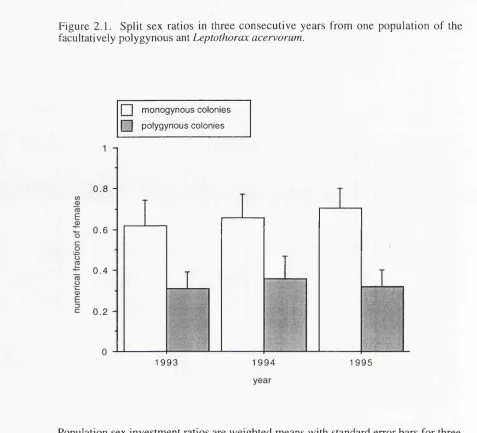
Figure 2.1. Split sex ratios in three consecutive years from one 52
population o f the facultatively polygynous ant Leptothorax
acervorum.
Figure 2.2. Relation between sex investment ratio and residual log queen 53
number in polygynous colonies.
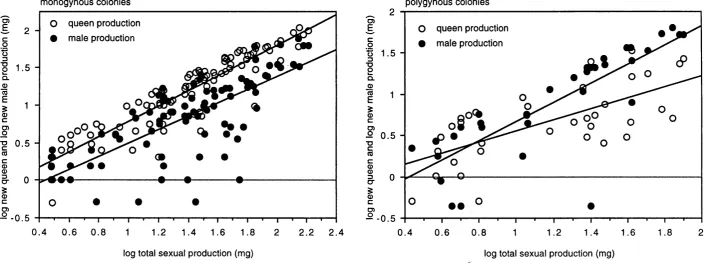
Figure 2.3. Relations between new male and new queen production and 54
total sexual production in monogynous and polygynous
colonies o f Leptothorax acervorum , in terms o f biomass
produced.
Figure 3.1. Population mean sex investment ratios for the three study 92
populations.
Figure 3.2. Change in population sex investm ent ratio (numerical 93
fraction o f females) with the degree o f polygyny in all three populations.
Figure 3.3. Sex investment ratios divided by class for each year and 94
population sampled.
Figure 3.4. Plot o f sex investment ratio against residual log queen 95
number in polygynous colonies.
Figure 3.5. Relations between new male and new queen production and 96
total sexual production in monogynous and polygynous
colonies o f Leptothorax acervorum from Santon Warren, in
terms o f biomass produced.
Figure 3.6. Relations between new male and new queen production and 97
total sexual production in monogynous and polygynous colonies from Aberfoyle, in terms of biomass produced.
Figure 3.7. Relations between new male and new queen production and 98
total sexual production in monogynous and polygynous c o lo n ies from R oydon W ood, in terms o f biom ass produced.
Figure 4.1. Mean colony size (with standard error bars) for all years in 134
all populations sampled.
Figure 4.2. Mean dry weight o f new workers produced by colonies 134
(with standard error bars) for all years in all populations sampled.
Figure 4.3. Mean dry weight o f all new sexuals produced by colonies 135
sampled.
Figure 4.5. Mean fraction o f total brood dry weight allocated to sexuals 136
by colonies (with standard error bars) for all years in all populations sampled.
Figure 4.6. Mean dry weight o f new workers produced by each old 136
worker (with standard error bars) for all years in all populations sampled.
Figure 4.7. Mean dry weight o f all new sexuals produced by each old 137
worker (with standard error bars) for all years in all populations sampled.
Figure 4.8. Mean dry weight o f all new brood produced by each old 137
worker (with standard error bars) for all years in all populations sampled.
Figure 4.9. Plot o f the proportion o f sexual brood against colony size 138
10
Ackno wled gements
I am extremely fortunate to have had the guidance during my PhD that should be
standard to all students. Andrew Bourke's constant support, patience and enthusiasm
in my work was unprecedented. Without his assistance, I may never have finished
my thesis work. I was always aware o f how fortunate I was, though may not always
have shown it. My thanks go to him as a teacher and a friend.
Other members o f the Ecology group helped in different ways. To Ian Owens and
Peter Cotgreave, special thanks for offering different angles on thesis writing and
supervision. I am also indebted to Tim Coulson for help with statistics, and helping
me keep sane over much of the course o f my degree. I respect his ability to balance
work with clowning around. I also thank all the other students with whom I endured
thesis writing. Terry Dennet was always helpful with photographic assistance.
Andrew Pomiankowski offered his own brand o f supervision from afar, which
was less to do with pure science and more to do with understanding what science was
all about. His new student Andrew Hingle was an enthusiastic and excellent friend
who helped with collection and census o f some populations o f ants. My old chum
Liam was bound to get his hands dirtied by my field work, and his love o f nature on
one hazy day in June was w elcom e. Gordon M ackenzie was a wonderful
entomologist who not only assisted me with collecting Scottish ants and allowed me to
collect at his study site, but enthused my interest in the insect world. His death was a
terrible loss.
Many friends also supported me during my PhD. I thank them for putting up with
my prolonged absence. Most especially, I thank B ig Jim for his constant source o f
interest and eccentricity. Andy W ilkes is one o f the most inspirational people I know
and I thank him for stirring my curiosity in fields outside of science. Gordon
Collins's constant e-m ails kept me buoyant in times o f boredom. For seeding my
The death o f my close friend Ben Themen was a tragedy. His passion for nature
and enthusiasm to defend and learn about it were the main source o f inspiration for my
com pleting this thesis. He would have been proud o f this work, and I share it with
him.
My thanks and love go to my family for supporting me throughout my time in
London. My mother is a constant tower o f strength, compassion and understanding.
What I have learned from her has helped me immensely in finishing this volume with
respect and patience.
Finally, Liz has endured my absence for far too long. Her understanding, care,
assistance and love may be more than I deserve. A thesis is never solely the work o f
one individual, and she may have helped me more than everyone combined.
George Chan, Institute o f Zoology, London,
Chapter 1
I
n t r o d u c t io n
§1. 1
Kin selection and H am ilton’s Rule
W illiam Hamilton's (1964) theory o f kin selection ushered in a scientific
revolution arguably unseen in evolutionary biology since Darwin's (1859) "Origin o f
Species". The intrinsic importance o f his theory was the promise of a means for
testing evolutionary hypotheses using quantitative data: the stuff of scientific research.
Hamilton's insight was to realise that a gene for altruistic behaviour could spread
through a population by influencing its bearers to direct their altruism towards other
individuals bearing copies o f itself. The likelihood of finding copies of a gene in other
individuals is dependent on the relatedness between those individuals, and on the
frequency o f the focal gene in the population as a whole. Relatedness is a measure of
genetic similarity between individuals. When a gene's average frequency in a group
o f potential recipients o f altruistic behaviour is regressed, across all groups in a
population, against the average frequency in a group containing a potential actor, the
sign and slope o f the regression line equals the regression relatedness for a given locus
(e.g. Pamilo and Crozier 1982). In evolutionary terms, fitness is gained from the
passing on o f multiple copies o f genes, with the obvious route for gene transmission
being from parent to offspring. Hamilton realised that an individual could gain fitness
benefits by helping any related individuals (not just offspring) to pass on copies of
genes which they share in common.
In its simplest form, kin selection is based on Hamilton's Rule which states that
rb - o O
must be satisfied for a gene for altruism to spread, where b is the benefit to an
individual for receiving an act o f altruism devalued by the relatedness (r) of the actor to
the recipient o f the behaviour, and c is the cost of performing the act. The currency in
which the cost and benefit are measured is the change in expected offspring number.
Thus, a gene for altruism can be favoured by natural selection if its bearers have a
higher than average inclusive fitness. That is, if the sum total o f an individual's
personal fitness (number o f offspring), as w ell as it's influence on the fitness o f
others, weighted by the relatedness between them, is greater on average than the
personal fitness o f individuals lacking a gene for altruism.
§ 1 . 2 F is h e r ’s se x ra tio th eo ry
The field o f sex ratio evolution considers how resources should be divided
between males and females. Because investment in these fractions can be estimated,
14 Introduction
showed that the sex investment ratio will be at equilibrium for the party controlling
allocation o f resources when investment in females and males brings equal fitness
returns per unit of energy expended. At this point,
( r p . V p . MSp) / c = . V m •
where r = regression relatedness o f the party controlling allocation to fem ales and
males, V= sex-specific reproductive value o f the sexes, M S = mating success o f the
sexes, and c = the cost ratio o f producing females : males (taken from Bourke and
Franks 1995, box 4.1). In terms of kin selection, the males and fem ales o f diploid
species are equally efficient at passing on genes for altruism, and therefore have equal
reproductive values. Mating success refers to the relative abundance o f potential mates
in a population. For diploid species, a parent investing in offspring is equally related
to both sexes. Assuming no sexual dimorphism (c = 1), the stable sex investment
ratio for diploid parents is:
(0.5 X 1 X MSp) / 1 = (0.5 X 1 X M Sm)
MSp
=MS}^,
that is when there are equal numbers of males and females in the population.
§ 1 . 3
The importance o f social insects fo r the study o f kin selection and
sex allocation
The Hymenoptera (ants, bees and wasps) represent an enigma in the study o f
social evolution. Darwin (1859) considered the greatest challenge to his theory of
evolution by natural selection to be the existence o f neuter workers in social insect
unfertilised, haploid eggs becom e males, and fertilised, diploid eggs develop into
fem ales. As a consequence, coefficients o f relatedness between colony members
differ from those found in diploid species. Specifically, females (including workers)
are related to sisters by r = 0.75, and to males by r = 0.25. (These values are
'life-for-life' relatedness coefficients. They differ from regression relatedness measures in that
they implicitly control for the sex-specific reproductive value o f the sexes. Thus,
fem ales, being diploid, have twice the reproductive value o f haploid males, and are
therefore twice as efficient at passing on copies o f genes, including those for
altruism). Hamilton realised that the extraordinarily high degree o f relatedness
between females in social insect colonies meant that workers could receive inclusive
fitness benefits by rearing highly related sisters instead of their own offspring.
Trivers and Hare (1976) com bined Fisher's (1 9 3 0 ) sex ratio theory with
Hamilton's kin selection theory to explain the unusual female-biased population sex
ratios in the Hymenoptera. Because o f workers' relatedness asymmetry (life-for-life
relatedness with females : life-for-life relatedness with males), the stable population
sex ratio at equilibrium will differ from 1 : 1 . In fact, the stable population sex ratio
for the party controlling sex allocation is predicted to equal its relatedness asymmetry.
This is because, rearranging the equation for Fisher's sex ratio equilibrium:
(rp . Vp . MSp) / c = . MSm
cMSm / MSp= /”p . Fp / rjv( • Fm.
R ecalling that 'life-for-life relatedness' = regression relatedness x sex specific
reproductive value, and that mating success = 1 / frequency o f a sex in the population,
we get:
cF / M = relatedness asymmetry.
16 Introduction
allocation in terms o f investment in sexuals, rather than numbers o f sexuals. Thus,
when there is one singly-mated queen per colony, and workers are sterile, the stable
sex investment ratio for workers is:
rp . Vp . M5'p =
rjvi
. Vm . MSm0.75 X 1 X MSp = 0.5 X 0.5 x M Su
3M5p =
MSm-Workers prefer three times as much investment in new female sexuals as in new male
sexuals. The stable population sex investment ratio for queens under the same
conditions is:
rp . Vp . M S p = . Vm • MSm
0.5 X 1 X M5p = 1.0 X 0.5 X MSm
MSp
=
MS
m-Therefore, at sex ratio equilibrium, queens prefer equal investment in the sexes, while
workers prefer a female-biased sex investment ratio. This results in a conflict of
interest between queens and workers over the optimal population sex investment ratio
to produce. Trivers and Hare (1976) argued that the strong female bias seen across
many populations o f social Hymenoptera was evidence o f worker control o f sex
allocation, and field studies have generally supported this (Trivers and Hare 1976;
Nonacs 1986a; Boomsma 1989; Bourke and Franks 1995; Crozier and Pamilo 1996).
§ 1 . 4
Split sex ratios and resource allocation in the application o f kin
selection and sex ratio theory to social insects
(single-queened) colonies, with each queen being singly-mated, and workers being
completely sterile. Furthermore, random mating was also assumed. Few field studies
have reported these exact conditions for a population o f social Hymenoptera.
N otably, H asegaw a (1994) found a population sex investm ent ratio o f 0.75
(proportion o f fem ales) for the ant species C olobopsis nipponicus, which satisfied
Trivers and Hare's basic conditions (also see Pearson et al. 1995; Banschbach and
Herbers 1996a, b). In natural populations o f social insects, these conditions are rarely
found. Indeed, it is often the deviations from normality, or in this instance, the
hypothetical situation that allows for theories to be tested. Multiple mating by queens,
polygyny (multiple queens) and worker reproduction all cause changes in
within-colony relatedness asymmetry with the result that the preferred sex investment ratios
o f workers also change. The relatedness asymmetry o f queens remains unaffected by
these changes, and their preferred sex investment ratio also remains unaffected. The
power of Trivers and Hare's theory is that these changes in sex allocation patterns can
be predicted, and evidence for the predictions can be sought in natural or laboratory
conditions. A greater understanding o f the biology o f Hymenopteran species, and
more importantly o f the genetic com position o f colonies and populations using
recently-developed molecular techniques such as the analysis of microsatellite DNA,
has allowed testing of these theoretical predictions.
Split sex ratios
Boom sm a and Grafen (1990, 1991) extended the predictive power o f sex
allocation theory for the social Hymenoptera by considering between-colony variation
in workers' relatedness asymmetry in a population. This variation may occur when
colonies differ in the numbers o f queens they contain, the mating frequencies of
queens, or if there is a degree o f worker male-production. If workers can assess the
relative relatedness asymmetry o f their colony, they should be selected to skew their
colony's brood sex ratio towards the sex to which they are more closely related than
18 Introduction
contribute different sex ratios to the same generation o f brood, split sex ratios (Grafen
1986) will occur.
Boom sm a and Grafen (1990, 1991) predicted that, under worker control o f sex
allocation, colonies with a relatedness asymmetry that is high relative to the population
average should raise entirely or strongly female-biased broods. Colonies with lower
than average relative relatedness asymmetry are expected to raise entirely or strongly
male-biased broods. Queens' relatedness asymmetry is not affected by queen number
or frequency o f mating, so split sex ratios are not expected under queen control o f sex
allocation. The strength o f Boomsma and Grafen's split sex ratio theory is that it
allows colony-level sex allocation patterns to be explicitly predicted. Furthermore,
these patterns are predicted to be associated with measurable parameters o f individual
colonies: namely number o f queen matings, or number o f colony queens.
Split sex ratio theory (Boomsma and Grafen 1990, 1991) is explicit about how
workers are expected to respond to relative relatedness asymmetry in a
frequency-dependent manner. From Fisher's (1930) sex ratio theory, it was seen that the stable
sex ratio equals a party's relatedness asymmetry because then there w ill be equal
fitness payoffs for producing either sex. However, for a party with high relative
relatedness asymmetry compared with the population average, fem ales w ill have
higher than average mating success and there will be greater fitness returns to that
party for the production o f females. The inverse argument holds true for a class with
lower than average relatedness asymmetry favouring male production. When the
population sex investment ratio reaches the relatedness asymmetry o f one o f the
classes, it stabilises because then there is no more incentive for that class to bias the
sex ratio any further as it receives equal fitness from both sexes. The other class
responds by producing single sex broods. The actual sex investment ratio predicted
for a class depends on the relative frequency o f classes in the population, and on the
relative relatedness asym m etries o f those classes. Thus, neither relatedness
asymmetry class may be able to return the population sex investment ratio to its own
population sex investment ratio resting between the specific relatedness asymmetries
o f the classes.
That colonies tend to produce single-sex broods more frequently than by chance
alone has been known for some time (e.g. Nonacs 1986a). Split sex ratios were first
shown to be correlated with worker relatedness asymmetry in a species o f ant with
multiple mating by Sundstrom (1994a). She showed that colonies o f the ant Formica
truncorum headed by a singly-mated queen produced strongly female-biased broods,
while colonies o f ants from the same population headed by a multiply-mated queen
produced male-biased broods as predicted by Boom sm a and Grafen (1990, 1991)
(also see Bourke and Chan 1994, Appendix D). Several studies have shown that sex
ratios change with queen number in ants (e.g. Ward 1983; Elmes 1987a, b; Herbers
1984, 1990; reviewed by Boomsma 1993). Split sex ratios arising from polygyny
and associated with the number of queens in a colony were reported in a paper from
this study. Chan and Bourke (1994, Appendix C) described a population o f the
species L eptothorax acervorum in which colonies with a single queen produced
significantly fem ale biased-broods, w hile polygynous colonies from the same
population produced male-biased broods. Evans (1995) found that split sex ratios in
the ant M yrmica tahoensis were linked to the degree o f within-colony relatedness. In
an elegant brood-manipulation experiment, he showed that the degree o f genetic
diversity amongst developing brood directly affected the sex allocation decisions of
workers. Split sex ratios have also been demonstrated in eusocial wasps by Quel 1er et
a i (1993), and in eusocial bees by Mueller (1991) and Mueller et al. (1994), and
Packer and Owen (1994).
Resource allocation
Studies o f social insect evolution have concentrated largely on the field o f sex
allocation. Recent extensions to the theory have made predictions about how
resources should be divided between the production o f sexuals and colony
2 0 Introduction
is predicted to arise between queens and workers over the proportion o f resources to
be allocated to the various fractions, and again, kin selection theory allow s these
predictions to be explicit and quantifiable.
Pamilo (1991a) argued that a queen’s preference for herself remaining her
colony's source o f fitness is greater than her workers' preference for whom should be
the colony's main source o f fitness. A queen is related to herself by r = 1, whereas
workers are related to her by r = 0.5. Thus, queens prefer to invest more resources
into colony maintenance to remain the colony's reproductive than do workers, who
prefer more investment in new sexuals. Another way o f looking at this conflict over
resource allocation stems from the basic sex allocation conflict. Since new workers
and new queens both develop from diploid brood, a queen prefers more diploid brood
to develop into new workers, whereas workers prefer more diploid brood to develop
into new queens. Several factors are predicted to affect the conflict over resource
allocation. First, if workers' relatedness asymmetry is relatively low, their preferred
sex investment ratio will be close to that o f queens', and the conflict over what
proportion o f diploid brood should develop into new queens and new workers will be
reduced. Second, if dispersing queens have little chance o f founding new colonies
independently, the natal colony becomes a more important source o f fitness to both
queens and workers. Thus, both queens and workers prefer investing in colony
maintenance in the form o f new workers. Finally, if independent colony founding is
likely, and colony survival prospects are low , workers are predicted to favour a
decreasing proportion o f sexuals as colony survival prospects increase. Queens are
predicted to favour an increasing proportion o f sexuals as survival prospects increase
under any conditions.
Sundstrom (1995) demonstrated worker control over resource allocation between
sexuals and colony maintenance in the ant species Formica truncorum, as predicted by
Pamilo's (1991a) model. She found that a monogynous population o f the species
reduced allocation to sexuals with increasing colony size (taken as an indicator of
polygynous population o f the same species failed to show any significant trend.
Backus (1995) examined division of resources between sexual and worker production
in two separate populations o f the ant species L eptoth orax longispinosus. Inter
population differences in resource allocation patterns appeared to stem from
differences in the degree o f ecological constraints, especially nest site limitation.
Banschbach and Herbers (1996a, b) also examined division o f resources between
colony growth and sexual output in two separate populations o f the ant M yrm ica
punctiventris. Considerable differences were found between populations in terms o f
resource allocation strategies which were put down to inter-population differences in
ecological constraints, social structures and queen-worker conflict, as well as colony
size.
This new field o f social insect research is likely to gain increasing attention, but
has largely been neglected because accurate data on the number o f new workers
produced by colonies have been difficult to collect for many reasons. Furthermore,
the division o f resources between colony growth and sexual output may be strongly
affected by the strength o f ecological constraints, which may be difficult to measure.
§ 1 . 5
Facultatively polygynous ants as tools fo r split sex ratio and
resource allocation studies
Facultatively polygynous ant species have monogynous and polygynous colonies
in the same population. Queens within colonies are usually related because o f the
readoption o f some daughter queens into the natal colony. Because relatedness
asymmetry is expected to vary with queen number, and sex and resource allocation are
expected to be affected by variable relatedness asymmetry, facultatively polygynous
ants are useful tools for studying these theories. Specifically, as the number of queens
per colony rises, workers relatedness asymmetry will fall to levels approaching the
2 2 Introduction
asymmetry should be high (around 0.75). Assuming that queen number is a reliable
predictor o f within-colony relatedness asymmetry, monogynous colonies are predicted
to favour fem ale-biased broods, and polygynous colonies to favour m ale-biased
broods. Overall, facultatively polygynous ant populations are strong candidates for
finding sex ratios split by queen number, and by association, relatedness asymmetry.
M onogynous and polygynous colonies within the same population are also likely
to adopt different strategies for the allocation o f resources to sexuals versus colony
maintenance. When queen and workers have very different relatedness asymmetries,
their conflict over resource allocation should be highest. According to Pamilo's
(1991a) m odel, a decreasing proportion o f sexual brood with increasing colony
survivorship (linked with increasing colony size) is evidence o f worker control o f
resource allocation. This is more likely to occur in monogynous, but not polygynous
colonies.
§ 1 . 6
The study species:
Leptothorax acervorum
It is becoming clear that patterns o f sex and resource allocation in social insects are
interesting at the colony as well as population level (e.g. Pamilo 1991a; Boom sm a
1993). As noted by Crozier and Pamilo (1996), studies o f colony-level sex allocation
patterns within populations, and comparisons between populations of the same species
which differ in aspects of sex allocation can reveal the processes underlying allocation
decisions in social insects. This thesis attempts such an in-depth study.
L ep toth orax acervoru m is a facultatively polygynous ant found throughout
Northern Europe, and is an ideal species for the study o f sex and resource allocation.
First, many aspects o f the life history o f the species have been detailed (Buschinger
1968, 1981; Heinze and Buschinger 1988; Bourke 1991, 1994; Bourke and Heinze
1994; Chan and Bourke 1994; Heinze et a i 1995a, b). In addition, allozym e and
and populations of this species (Douwes et a l 1987; Stille et a i 1991 ; Stille and Stille
1992, 1993; Heinze e t a l 1995a, b; Heinze 1995). Queens appear to be singly-mated,
and workers non-reproductive (Heinze et a l 1995a). Queen number usually varies
between one and around ten, and nest-mate queens are related (Stille e t a l 1991;
Heinze et a l 1995b). As a result, intra-colony relatedness varies between colonies
according to queen number (Heinze et a l 1995b). Sexuals almost certainly mate away
from the natal colony in mating swarms (Bourke and Heinze 1994), and lack o f
inbreeding in this species suggests that mating is random (Heinze e t a l 1995b).
Finally, L. acervorum colonies are small and large numbers o f whole colonies can be
collected from a single population. Each colony can easily be censused for queen and
worker numbers, as well as numbers o f new queens, new males and new workers
produced. This allows patterns of allocation to be examined at both the colony and the
population levels.
In the seminal 'Structure o f Scientific Revolutions', Thomas Kuhn (1962)
considered that, "Mopping-up operations are what engage most scientists throughout
their careers. They constitute what I am ... calling normal science. ...
normal-scientific research is directed to the articulation of those phenomena and theories that
the paradigm already supplies." Sex and resource allocation studies in the social
insects are the most direct means available for testing the predictions o f kin selection
theory, which currently underpins much o f modem evolutionary thought. The study
o f social evolution in Hymenoptera as normal science' is exciting because it lies so
close to the heart o f the modem evolutionary paradigm: kin selection.
§ 1 , 7
Aims and outline o f this thesis
This thesis was directed at examining the processes underlying sex allocation and
resource allocation in social Hymenoptera. A central question upon which most o f the
2 4 Introduction
Associated with this was the question o f how the number o f queens in a colony,
which is assumed to be linked with the degree o f relatedness within colonies, affects
the allocation decisions o f the parties in those colonies with single, or multiple queens.
Non-genetic factors were also considered for their effects on allocation decision
making processes. Samples from populations o f L. acervorum were collected from
the field and examined to see if their patterns o f allocation matched those predicted by
theory.
This study examined colony-level sex and resource allocation patterns across three
consecutive years in one population. Two other populations were also sampled and
examined for inter-population differences in sex and resource allocation. Importantly,
entire colonies were sampled for new sexual and new worker production. Previous
field studies have either sampled only part of the total brood production o f colonies, or
have not confidently censused entire colonies, because they may occupy several
nest-sites. In addition, new worker production has rarely been estimated alongside sexual
production. This thesis represents one o f the most detailed studies o f sex and resource
allocation at the colony and population levels yet attempted.
This thesis is organised as follow s. The fo llow in g chapter is a detailed
examination o f sex allocation in a single population o f L acervorum over three
consecutive years. Chapter three compares the sex allocation patterns from three
separate populations o f the same species, and considers what factors underlie different
sex ratio patterns within and between them. The fourth chapter exam ines the
allocation of resources between sexual production and colony maintenance in the form
o f new workers in the three study populations. I conclude with a summary o f
allocation patterns in the study species, and discuss whether kin-selection based
S p l i t S e x R a t i o s in
L
e p t o t h o r a x
a c e r v o r u m
§ 2 . 1
Introduction
Sex allocation theory considers how resources should optimally be allocated to
male and female offspring (Fisher 1930). In social Hymenopteran societies (ants,
bees and wasps), workers and queens invest resources into raising brood. Because of
the unusual haplodiploid system o f sex determination, Hymenopteran queens and
workers are not equally related to the brood they raise, and a parent-offspring conflict
arises over the optimal allocation o f resources to male and female fractions in the
brood (Hamilton 1964; Trivers 1974). Trivers and Hare (1976) first considered the
possibility that workers control the sex ratio in social insect colonies by favouring the
production o f female offspring to which they are more closely related than to males.
2 6 Split sex ratios in L. acervorum
Queens are predicted to favour an equal investment in sons and daughters as they
contribute an equal genetic fraction to both sexes. The sex ratio will be stable for the
party controlling sex allocation when it equals the ratio 'life-for-life relatedness with
females' : 'life-for-life relatedness with males'. Boom sm a and Grafen (1990, 1991)
termed this ratio the relatedness asymmetry.
Trivers and Hare's (1976) prediction o f a 3:1 fem ale to male population sex
investment ratio as favoured by workers has generally been supported in the literature
(Trivers and Hare 1976; Nonacs 1986a; Boomsma 1989; Pamilo 1990; Bourke and
Franks 1995; Crozier and Pamilo 1996). However, many populations of ants produce
sex ratios that are considerably different from the predicted 3:1 ratio, and individual
colonies have been shown to produce single-sex broods more frequently than would
be expected by chance alone (Nonacs 1986a).
Split sex ratio theory (Boom sm a and Grafen 1990, 1991) is a more recent
extension o f sex allocation theory which accounts for single-sex broods at the colony
level. The degree o f intracolony relatedness within a population will vary if there are
betw een-colony differences in either number o f colony queens, or frequency o f
matings by queens. These factors affect the workers' relatedness asymmetry with the
effect that they should bias their colony's brood sex ratio towards the sex to which
they are more closely related than the population average. Thus, under worker
control, polygynous (multiply-queened) colonies should produce relatively
male-biased broods compared with monogynous (single queen) colonies which should
produce female-biased broods. This is because in polygynous colonies, many queens
contributing to the brood lowers the workers' relative relatedness with fem ales
compared with males, and the advantage o f producing fem ale-biased broods is
reduced. The queens' relative relatedness to males and females does not change with
increasing queen number, so their preferred sex investment ratio remains equal.
There is rapidly mounting evidence in support o f split sex ratio theory in the
literature. In the ant species Formica truncorum^ Sundstrom (1994a) found that
containing multiply-mated queens in the same population produced m ale-biased
broods (see also Bourke and Chan 1994; Sherman and Shellm an-R eeve 1994;
Sundstrom 1994b). Chan and Bourke (1994) reported that sex investment ratio was
associated with whether colonies were m onogynous or polygynous in the ant
Leptoth orax acervorum . Evans (1995) found that sex ratio was directly linked to
colony relatedness asymmetry and not queen number in the polygynous ant M yrmica
tahoensis. Boomsma (1993) reported that male-bias in the brood tended to rise with
colony-queen number in other polygynous ant species (studies include Ward 1983;
Elm es 1987a, b; and Herbers 1984, 1990 in L ep to th o ra x species). Furthermore,
evidence o f sex ratio biasing associated with relative relatedness asymmetry has been
reported in social bees and wasps (Boomsma 1991; Mueller 1991; Mueller et a i 1994;
Queller et a i 1993; Packer and Owen 1994).
Workers' relative relatedness asymmetry is not the only factor predicted to
contribute towards sex ratio bias in social insects, and som e authors deny the
importance o f worker control (e.g. Alexander and Sherman 1977; Sherman and
Shellm an-Reeve 1994). Polygynous ant colonies are frequently known to inhabit
several nest-sites (polydomy), and reproduction can occur dependently if a queen, or
groups o f queens leave the natal colony with a fraction o f workers and establish a new
colony nearby the old one (colony budding). Male biased broods are expected to stem
from both polydomy (Pamilo and Rosengren 1983) and colony budding (Pamilo
1990) because related queens w ill com pete for local resources (local resource
competition: Clark 1978; Frank 1987; Pamilo 1991a). Thus there will be diminishing
returns on increasing production of new queens while the production of new males
will bring linear fitness returns. Alternatively, if an increase in queen number within a
colony means that queens can usurp more control o f the sex ratio in their conflict o f
interest with workers, polygyny is expected to be correlated with male-biased broods
(Herbers 1984, 1990). On the other hand, N onacs (1986a, b) predicted that
productive colonies will increase fem ale bias when local resources are abundant.
2 8 Split sex ratios in L. acervorum
mate competition (Frank 1987) causes diminishing returns on the increased production
o f males but not females, so female bias in brood sex ratios is expected to increase
with increasing sexual productivity.
An ideal species for the study o f sex allocation is the ant Leptothorax acervorum.
Chan and Bourke (1994) previously found sex ratios to be split by colony class
(m onogynous versus polygynous) in this species and for this study the sam e
population was examined over three consecutive years. There is a growing literature
about the life history o f this species (Buschinger 1968, 1981; Heinze and Buschinger
1988; Bourke 1991, 1994; Bourke and Heinze 1994; Chan and Bourke 1994; Heinze
et al. 1995a, b), including its genetic profile (Douwes et al. 1987; Stille et al. 1991;
S tille and Stille 1992, 1993; Heinze et al. 1995a, b; Heinze 1995). C olonies are
small, abundant and easily censused (Bourke 1991) allowing sex allocation to be
examined at both colony and population levels (Boom sm a 1993; Chan and Bourke
1994; Sundstrom 1994; Bourke and Franks 1995; Crozier and Pamilo 1996).
Colonies vary in queen number, and nest-mate queens are known to be related (Stille
e t al. 1991; Heinze et al. 1995a, b). W ithin-colony relatedness is known to be
associated with queen number in this species (Heinze et al. 1995a, b). Since split sex
ratio theory predicts that sex allocation decisions should be based on variable
within-colony relatedness (Boom sm a and Grafen 1990), sex ratios were compared between
colonies with different numbers o f queens. Furthermore, within polygynous
colonies, the effect o f queen number on sex allocation was examined to see whether
queens gained partial control over sex ratios at high queen to sexual brood ratios
(Herbers 1984, 1990). If there is non-random mating or dispersal of sexuals in this
population, colonies should change their sex investment ratios according to their
sexual productivity. Thus, if there is local mate competition, colonies should produce
more female biased sex ratios at higher levels o f sexual productivity as there will be
diminishing returns on increasing investment in males (Frank 1987). Similarly,
colonies with high levels o f sexual productivity are expected to produce increasingly
on new queen production (Frank 1987; Pamilo 1991a). Finally, the effects o f
resource abundance on sex allocation were examined by seeing if colonies with low
productivity levels produced more male-biased broods (Nonacs 1986a, b).
This study found split sex ratios in the ant species Leptothorax acervorum over
three consecutive years. M onogynous colonies produced strongly fem ale-biased
broods while polygynous colonies produced significantly more male-biased broods as
predicted by split sex ratio theory (Boom sm a and Grafen 1990, 1991). These sex
investment ratios were consistent with worker control over sex allocation based on
workers' variable relatedness asymmetry to males and females and not partial queen
control over sex allocation. There was no evidence o f local mate com petition or
resource abundance effects but diminishing production o f males in more productive
polygynous colonies suggested that local resource competition may occur, stemming
from a degree o f colony budding in this population. These results support the
previous study on this population (Chan and Bourke 1994) and show that this
population is consistent in its sex allocation strategies across years.
§ 2 . 2
Materials and methods
Study species and population
Leptothorax acervorum is a facultatively polygynous ant species commonly found
throughout temperate coniferous forests, boreal and alpine regions o f the British Isles
and Northern and Central Eurasia (C ollingw ood 1979, H einze et at. 1995b).
Polygyny occurs secondarily through readoption o f related nestmate queens (Douwes
et a i 1987; Stille et al. 1991; Heinze et al. 1995b). Each colony typically contains
between several dozen and hundreds o f workers, and there are rarely more than ten
mated queens per colony. Whole, single colonies are found inside cavities in rotting
twigs, under bark, or occasionally in the roots o f dead trees and under stones.
3 0 Split sex ratios in L. acervorum
allows an accurate census o f all adults and brood in every colony collected.
The study population o f L. acervorum was collected from Santon Warren,
Thetford Forest, Norfolk, U.K., and was sampled over three consecutive years (see
also Bourke 1991, 1993; Chan and Bourke 1994).
Collection and culture o f colonies
From Santon Warren, 47 colonies were collected on 17 June 1993, 49 colonies
were collected on 8 June 1994 and 102 colonies were collected over two days on June
13 and 20, 1995. Sampling o f populations was carried out before July so that no
brood had yet eclosed into adults (Chan and Bourke 1994).
Collection o f ants in the field involved breaking open dead twigs to find whole
colonies. Random sampling o f the population was assumed as all colonies found
were collected, and all collection within the population took place in the same general
region (including across-year sampling). Twigs containing colonies were then placed
inside plastic bags and returned to the laboratory. Colonies were removed from twigs,
aspirated and placed inside standard nests, and maintained in the laboratory based on
the methods o f Bourke (1991). Standard nests were made o f two rectangular glass
slides separated by a cardboard border with an opening in one end. Nests were kept
inside clear plastic dishes ( 1 0 x 1 0 x 2 cm) under natural lighting and at room
temperature. Colonies were fed on a regime o f water (damp cotton w ool), sugar
solution and mealworm larvae, renewed every 2-3 days.
Census o f colonies
Immediately after collection, colonies were censused for the first time. All adults
and pupae were counted from each colony by transferring individuals using fine
forceps, allowing an accurate measure o f each colony’s composition. Colonies were
maintained in the laboratory until all pupae had eclosed into adults before being
censused for a second time for all individuals present. Comparison o f the first with
and new males on top o f its original composition.
All mated colony queens had shed their wings (dealate). Som e alate (winged)
virgins may have shed their wings before the first census, but after collection from the
field. During the second census, all dealate queens were removed for ovarian
dissection according to the methods of Bourke (1991) to establish reproductive status.
Mated queens have spermathecæ (sperm receptacles) visibly full o f sperm (under a
com pound m icroscope), w hile virgin queens have clear spermathecæ. Other
dissection data collected included number o f yolky eggs present out o f total number of
eggs present, and approximate ovariole length was recorded (length categories ranged
from very small through small, small-medium, medium, medium-large, large, very
large and very-very-large). Corpora lutea (residual ovarian structures, by-products o f
egg production) were also counted. In cases where ovarian dissections were only
partially complete, but the spermatheca could not be found, these other data could be
used to establish whether a queen had been mated or not. Mated queens were counted
as colony queens while non-mated queens were taken to be newly eclosed and thus
were counted as part of the new queen production. This was justified because A.F.G.
Bourke (unpublished data) found that o f 72 queens collected from Santon Warren
between April and May (1990-1991), all were mated (reported in Chan and Bourke
1994). Furthermore, A.F.G. Bourke (unpublished data) found that L. acervorum
sexuals from Santon Warren do not mate in the natal colony (reported in Chan and
Bourke 1994).
Over three consecutive years, 198 colonies were collected from Santon Warren
containing 14 464 workers and 516 queens, the latter o f which were all dissected.
These colonies produced 24 521 new brood including workers, queens and males
(Appendix A).
Genetic composition o f the populations
The Santon Warren population was studied genetically by Heinze et at. (1995b)
3 2 Split sex ratios in L. acervorum
1992. As in other polygynous L. acervorum populations (Stille et a l 1991; Heinze et
a l 1995b), queens within colonies were related on average (queen-queen relatedness
was 0.26), indicating that many queens are readopted by their natal colony.
Worker-worker relatedness (± s.e.) was significantly higher in monogynous colonies (0.50 ±
0.06; % = 34 colonies) than in polygynous ones (0.28 ± 0.09; « = 19 colonies)
(Heinze et a l 1995b). I therefore infer that workers' relatedness asymmetry was truly
lower in polygynous colonies than in monogynous ones. Worker-worker relatedness
presumably fell below 0.75 in monogynous colonies despite the likelihood that queens
mate singly (Stille et a l 1991 ; Heinze et a l 1995b) because some had previously been
polygynous (Chan and Bourke 1994; Heinze et a l 1995a). The genetic data also
suggested that inbreeding was absent from the Santon Warren population (Heinze et
a l 1995b). Finally, low worker egg-laying rates imply that worker male production
was negligible (Bourke 1991).
L. acervorum males almost certainly mate both in large swarms and near nests
(Bourke and Heinze 1994). The lack o f evidence for inbreeding suggests that males
disperse w idely enough to render local mate competition among them unlikely.
However, there is strong evidence that polygynous L acervorum colonies reproduce
by budding (see, for example, Stille and Stille 1993; Bourke and Heinze 1994; Chan
and Bourke 1994), suggesting that local resource competition due to budding is
probable (see Chan and Bourke 1994).
Estimation o f mean dry weights
Samples o f callow workers, alate queens and males were taken from several
m onogynous and polygynous colonies from Santon Warren in 1993 and 1994
[Appendix B, Table B .l]. These were dried in an oven for 24 h, at 60 “C, and each
ant individually weighed on an electronic microbalance. Thorax length was measured
using a dissection microscope attached to a computer-based image analysis system
(NIH Image). Using a basic thorax length-dry weight comparison, the dry weight for
measurements [Appendix B]. Samples o f all three castes o f ant from several
monogynous and polygynous colonies in 1994 and 1995 were measured for thorax
length using this technique (except in polygynous colonies in 1995 where males and
queens were unavailable for measurement).
§ 2 . 3
R e s u lts
Population composition
This facultatively polygynous population produced 53% polygynous colonies in
1993, 24% in 1994 and 20% in 1995; the remaining colonies were m onogynous or
queenless (Table 2.1). Queenless colonies were classified as monogynous for all
analyses. This was justified because queenless colonies were more likely to have been
previously monogynous than polygynous. Furthermore, there was no difference in
mean sex investment ratios between queenless and monogynous colonies from 1994
(f-test: t = 0.67, d.f. = 29 p > 0.05) or 1995 (r-test: t = 1.45, d.f. = 65, p > 0.05),
when the number o f queenless colonies exceeded one. In polygynous colonies, queen
number had harmonic mean values o f 5.5 in 1993, 4.3 in 1994 and 3.8 in 1995.
Harmonic mean queen number is assumed to be a more reliable predictor o f within
colony relatedness because the change in relatedness o f adding successive queens is
weighted by the total number of queens already present (Wade 1985; Queller 1993).
The overall change in relatedness within a colony is greater when adding a second
queen to a m onogynous colony than when adding a tenth queen to a nine-queen
colony, and the harmonic mean reflects this. Mean log queen numbers were 0.846 in
1993, 0.736 in 1994 and 0.749 in 1995 (Appendix A) and these means were found
not to differ significantly (ANOVA: ^2,48 = 2.72, p > 0.05). The overall mean log
queen number was 0.749 with overall harmonic mean for this population being 4.5