© 2017 IJSRST | Volume 3 | Issue 7 | Print ISSN: 2395-6011 | Online ISSN: 2395-602X Themed Section: Scienceand Technology
Implementation of Maximum Power Point Tracking Algorithms for
Photovoltaic Systems
Sarath Chandra Burugala
1, Dr. K. Jithendra Gowd
2 1Department of Electrical and Electronics Engineering, Jawaharlal Nehru Technological University, Anantapur, Andhra Pradesh, India
2
Assistant Professor, Department of Electrical and Electronics Engineering, Jawaharlal Nehru Technological University, Anantapur, Andhra Pradesh, India
ABSTRACT
This paper proposes a New Particle swarm algorithm for improving the Optimization and performance of Maximum Power Point Tracking in PV System. The PSO technique has been applied for multi-junction solar cell system. The solar panels are made up of different type materials and give constant output from Boost converter. The main aim of PSO algorithm is to find out duty cycle to the Boost converter to maintain constant output voltage irrespective of power produced by solar panels. This proposed Particle Swarm Optimization (PSO) is also used to minimizing active power loss, voltage deviation and voltage stability index. A detailed simulation of the proposed method has been simulated in Matlab/Simulink. The simulation result shows that this design can be effectively realized in practical applications.
Keywords : Maximum Power Point Tracking (MPPT); Particle Swarm Optimization (PSO); Boost Converter.
I.
INTRODUCTION
Photovoltaic (PV) energy is accepted as a popular source of non-conventional energy due to a number of benefits, particularly low operational cost and less pollution. Throughout the world, photovoltaic power generation is becoming increasingly popular due to a combination of factors: low maintenance, minimal wear and tear of components due to the absence of moving parts, lack of audible noise, absence of fuel cost, and pollution-free operation after installation. Small-scale PV installations are very popular as lighting and water pumping solutions in developing countries, remote villages, and small rural and urban communities. These systems are also commonly used in developed countries that have a considerable amount of solar irradiation.
Energy has enhanced interest in electrical applications, from the time when it is premeditated as a significantly unrestrained and mostly accessible energy supply. Among several renewable energy schemes, PV power generation structures are projected to play a consequential part as an unpolluted power electric source since PV panels are suggested to install in roof-tops of house and porticos of buildings. The potency
obtained from the PV panel is mainly dependent on atmospheric conditions like temperature and Irradiation. Ergo the efficiency of the solar cell is 20% is relatively very low. To amend the efficiency and reliability of the PV system several tracking systems are cited in the literature. Thus, to acquire consummate benefit of the solar energy it is vital to determine the peak point of the PV system.
multi-junction (LMJ) solar cells and vertical multi-multi-junction (VMJ) solar cells.
A VMJ solar cell can get high open circuit voltage and competencies accede with conventional single junction solar cells. As well, VMJ cells has the potential to get more efficiency by utilizing most recent material placements, concentrator methods and verbally express of the art manufacture technologies, while the usefulness of LMJ solar cell is generally dependent on expert diffraction process. Solar cells in a multi-junction configuration are annexed in series to shape a string, and multiple strings [4] are tied in parallel [3] to compose a panel. LMJ solar cells are capable to combine to turn out a thoroughly synchronized system to procure gain of the multi-junction portion. The outputs from the solar cells oscillate with irradiation, temperature and the load associated to it. So, maximum power point tracking (MPPT) is proximately an essentiality component of a capable solar cell system.
MPPT are divided into three major groups. First group is called as conventional group namely Perturb and Observe and Incremental Conductance method. The draw backs of this group are its sluggish tracking faculty, steady state fluctuation at Maximum power point (MPP) and reduced competence. To overcome these drawbacks soft computing techniques are evolved. The techniques [7] that are included in this category are the Evolutionary Algorithms (EA), Fuzzy logic controller (FLC) and Artificial Neural Network (ANN). These groups have some shortcomings because of a few details like it requires periodic training and it utilizes adscititious recollection will become arduous to implement in bio inspired methods The third group appeared under the type of Evolutionary computing, Particle swarm optimization (PSO), Bacterial foraging algorithm, Ant colony optimization (ACO) and Genetic Algorithm (GA) are the techniques included under this category. Particle Swarm Optimization (PSO) predicated MPPT technique has been discussed in this paper where the obligation signal of four boost converters are modified on a customary substructure with a one MPPT controller to track the ecumenical maximum power point of the system.
II.
MODELLING OF THE PV SYSTEM
The schematic diagram of a single-phase grid-connected PV system, which is the main focus of this paper, is shown in Fig.1, the PV system consists of a PV array, a dc-link capacitor and single phase inverter and a filter.
A model of photovoltaic cell is shown in Fig.2. From the circuit it can be seen that the current produced by the solar cell is equal to that produced by the current source minus that which flows through the shunt resistor.
Figure 1. Equivalent circuit diagram of single-phase grid-connected PV system
Figure 2.Equivalent circuit of a solar cell
Using the equivalent circuit of a solar cell (Fig:2) and the pertinent equations, the non-linear (I-V) characteristics of a solar cells is given by the following equation:
* (
) + *
+ (1)
Where ‘I’ is the PV array output current (A), ‘V’ is the PV array output voltage (V). From equation (1) V is given by
V = ( ) (2)
The photocurrent depends on the solar radiation and
the cell temperature as stated in the following.
=( ( )) ( )(3)
Where Iscr is the PV array short circuit current at reference temperature and radiation (A), is the short circuit current temperature coefficient (A/K) and G is the solar radiation (mW/cm^2). The Fig.3 below gives the characteristics I-V and P-V curve for fixed level of solar irradiation and temperature.
Figure 3.PV array characteristics curve
Figure 4.Block diagram of Solar system with MPPT controller
Perturb and Observation Method (P&O):
P&O method is the most frequently used algorithm to track the maximum power due to its simple structure and fewer required parameters. This method finds the maximum power point of PV modules by means of iteratively perturbing, observing and comparing the power generated by the PV modules. It is widely applied to the maximum power point tracker of the photovoltaic system for its features of simplicity and convenience.
According to the structure of MPPT system shown in Fig.5 the required parameters of the power-feedback type MPPT algorithms are only the voltage and current of PV modules shown in Fig.6 is the relationship
between the terminal voltage and output power generated by a PV module. It can be observed that regardless of the magnitude of sun irradiance and terminal voltage of PV modules, the maximum power point is obtained while condition dP/dV = 0 is accomplished. The slope (dP/dV) of the power can be calculated by the consecutive output voltages and output currents, and can be expressed as follows,
( )
( ) ( )
( ) ( ) (6)
Where P(n) = V(n)I(n)
Figure 5.A structure of PV system with MPPT function
Figure 6.P-V characteristic of a PV module
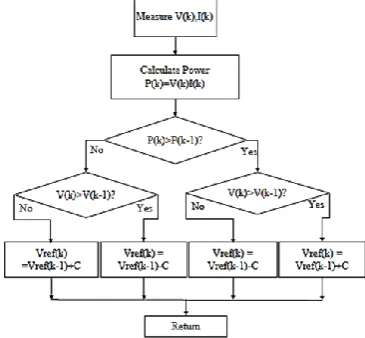
P&O method may result in top level efficiency; provide that a proper predictive and adaptive hill climbing strategy is adopted. The fig.7 shows flowchart for P&O method.
III.
PARTICLE SWARM OPTIMIZATION
TECHNIQUE
PSO is a swarm intelligence optimization algorithm, first suggested by Kennedy and Eberhart in 1995, and it has been emerging rapidly in recent years. It is represented according to the actions of bird flocks. Simple realization and fast convergence are some of its merits, and it is well applied to locate the global best possible solution in a nonlinear, discontinuous, non-differentiable curve [6]. In this algorithm [9], a number of particles are employed in an n-dimensional space. Each particle holds its position yi (scattered randomly) and velocity ai (ai= 0
in initiation). The position of a particle is controlled by its best position until now pbesti, and the best position of
all particles so far, position and velocity of particles is revised by using the subsequent equation:
+ rand()( - )+ rand()(gbes - )
(7) And
= + (8)
where, ait+1is the particle velocity. yit+1is the current
position of a particle. yi t
is previous particle position. yi
t+1
is new particle position. s is weight factor. z1, z2 is
learning coefficients, usually lies between 1 to 2. rand() is the variable generated randomly. pbesttiis the Pbest.
gbesttiis the Gbest.
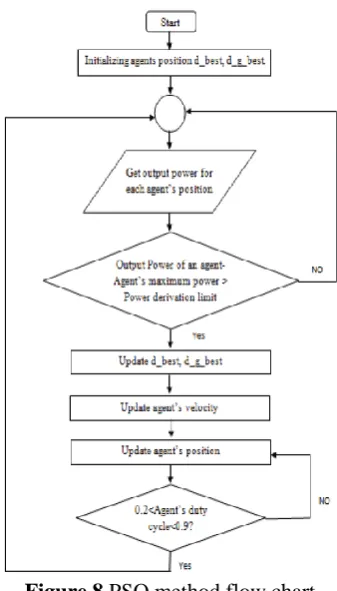
PSO algorithm flowchart of the proposed PV system is illustrated in Fig 8.
1) Fix the velocity and position limit when the parameters and particles are initialized.
2) For each particle the velocity and the position are initialized randomly.
3) For each particle the value of P best has been calculated.
4) G best value has been set when the best value of the particle has been reached.
5) The value of the velocity and the position has been updated automatically based on the G best.
6) repeat the steps 3 and 4 until the optimal solution is attained.
7) The optimized value has been determined at the last iteration based on G best.
Figure 8.PSO method flow chart
The minimum and maximum values of parameters used in each iteration for changing the velocity and updating the position of particle for PSO [5] algorithm is shown in Table. I.
Table I.PSO Parameters
Boost converters are connected in series to share a common load as shown in Fig.9. In this system the purpose of PSO is to generate duty cycles dc (1), dc (2), dc (3) and dc (4) individually to each Boost converter to give determined output.
IV.
SIMULATION RESULTS
The model consists of a DC-DC Boost converter operated with switching frequency of 5 KHz. According to the specifications of the converter it can operate with voltage ranges from 0 to 200V at each input of the converters. In the proposed system solar panels with different materials are used. Here four panels is made up of four different materials like GaInAsp, GaInp, GaInAs, GaAs and it is connected to seperate Boost converter.
The simulation results of the PV system using PSO optimization technique along with other MPPT techniques has been shown in Fig.12. Simulation results depicts that PSO based MPPT algorithm can rapidly and precisely determine the maximum power of each modules and the system accomplished a accurate sense of the maximum power output. Irrespective of the irradiation the proposed PSO tracks the maximum point and it gives corresponding duty cycle to the converters which are not possible by other MPPT techniques.
Figure 9. Schematic diagram of proposed system with PSO Algorithm
Figure 10. Solar Irradiance in W/m2
Figure 11. Solar Temperature in (0C)
Figure 12. Simulation results of Output power of the converter tracked using PSO based MPPT algorithm
with other Methods
V.
CONCLUSION
very high tracking speed. Hence PSO technique can be employed for MPPT of Solar PV panels
VI.
REFERENCES
[1] M.K.Alam,F.H.Khan and A.S.Imtiaz, "An efficient power electronics solution for lateral multi-junction solar cell systems," in Proc.IEEE IECON,pp.4373-4378,2011.
[2] L.Zhao,"High Efficiency Mechanically Stacked Multi-Junction Solar Cells for Concentrator Photovoltaics", Ph.D.dissertation, Katholieke University, Leuven Faculteit, Ingenieurswetensc happen, Arenbergkasteel, Belgium, Mar. 2011. [3] Cuce E,BaliT, Sekucoglu SA. Effects of passive
cooling on performance of silicon
photovoltaiccells.IntJLow-CarbonTechnol2011;6(4):299-308.
[4] Riffat SB,CuceE. A review on hybrid photovoltaic/thermal collectors and systems.IntJLow-CarbonTechnol2011;6(3):212-41.
[5] CucePM,CuceE.A novel model of photovoltaic modules for parameteresti-mation and thermodynamic assessment.IntJLow-CarbonTechnol2012;7 (2):159-65.
[6] CuceE,BaliT.Improving performance parameters of silicon solar cells using air cooling.In: Proceedings of the Fifth International EgeEnergySymposium and Exhibition.Denizli,Turkey;June27-30, 2010. [7] CuceE,BaliT.A comparison of energy and power
conversion efficiencies of mSi and pSiPV cells in Trabzon.In:Proceedings of the Fifth International Advanced Technologies Symposium,May13-15,2009.Karabuk,Turkey.
[8] CuceE,BaliT.Variation of cell parameters of ap SiPV cell with different solar irradiances and cell temperatures in humid climates.In:Fourth International Exergy, Energy and Environment Symposium.Sharjah,United Arab Emirates. April 19-23, 2009.
[9] Masters, GilbertM. Renewable and efficient electric powersystems. John Wiley &SonsLtd;2004.p.445-8.
[10] Tends In Photovoltaic Applications. Report IEA-PVPS; 2010.
[11] MessengerRoger, JerryV. Photovoltaic systems engineering. 2nded. CRCPress; 2003.
[12] EsramT,ChapmanPL.Comparison of photovoltaic array maximum power point tracking techniques. IEEE TransEnergy Convers2007;22:439-49. [13] Hohm DP, Ropp ME. Comparative study of
maximum power point tracking algorithms. Prog Photovolt: ResAppl2003;11:47-62.
[14] de Brito MAG, GalottoL, SampaioLP, deAzevedoeMeloG, CanesinCA. Evaluation of the Main MPPT techniques for photovoltaic applications. IEEE TransIndElectron 2013;60(3):1156-67.
[15] Eltawil MohamedA, Zhao Zhengming. MPPT techniques for photovoltaic applications. Renew Sustain EnergyRev2013;25:793-813.
[16] Noman AbdullahM, Addoweesh Khaled E,Mashaly Hussein M.A fuzzylogic control method for MPPT of PV systems. In: Proceedings of IECON—38th annual conference on IEEE Industrial ElectronicsSociety;2012.p.874-80. [17] CoelhoRobertoF, Concer Filipe M,Martins
Denizar C.A MPPT approach based on temperature measurements applied in PV systems. In: Proceedings of the 9th IEEE/IAS international conference on industry applications;2010.
[18] Kharb RK, ShimiSL, ChatterjiS, AnsariMF. Modeling of solar PV module and maximum power point tracking using ANFIS.RenewSustainEnergyRev2014;33:602-12. [19] Sayal.MPPT techniques for photovoltaic system under uniform insolation and partial shading conditions. In: Proceedings of 2012 Students Conference on Engineering and Systems(SCES);2012.p.1-6.
[20] Zhang C, Zhao D, Wang J, Chen G.A modified MPPT method with variable perturbation step for photovoltaic system. In: Proceedings of Power Electronics and Motion Control Conference;2009.p.2096-9.
[21] Piegari L, Rizzo R. Adaptive perturb and observe algorithm for photovoltaic maximum powerpoint tracking. IETRenewPowerGener2010;4(4):317-28.
algorithm.IEEETrans.Sustain.Energy2013; vol. 4(1):108-17.
[23] FarhatM, BarambonesO, SbitaL. Efficiency optimization of a DSP-based standalone PV system using a stable single input fuzzy logic controller. RenewSustain EnergyRev2015; 49:907-20.
[24] Bin-Halabi A, AdelAbdennour, Mashaly H. An accurate ANFIS-based MPPT for solar PVsystem. IntJAdvComputRes2014;4(2):588-95.
[25] Reisi Ali Reza, Moradi Mohammad Hassan, Jamasb Shahriar. Classification and comparison of maximum powerpoint tracking techniques for photovoltaic system: a review. RenewSustainEnergyRev2013;19:433-43.
[26] Atlam O,KolheM.Performance evaluation of directly photovoltaic powered DC PM(direct current permanent magnet)motor-propeller thrust system. Energy 2013;57:692-8.
[27] Farahat MA, Metwally HMB, Mohamed Ahmed Abd-El Fatah. Optimal choice and design of different topologies of DC-DC converter used in PV systems,at different climatic conditions in Egypt.2012;43:393-402. REN21.
[28] Renewables 2014 global status report.
〈http://www.ren21.net/wpcon
tent/uploads/2015/07/REN12GSR2015_Onlinebo ok_-low1.pdf〉[accessed 17.04.15]
[29] Mellit A, KalogirouS. ANFIS-based modeling for photovoltaic power supply system: a case study. RenewEnergy2011;36:250-5.
[30] XiaoW,ElnoshA,KhadkikarV,ZeineldinH.
Overview of maximum power point tracking technologies for photovoltaic powersystems. In: Proceedings of IECON 2011—37th annual conference on IEEE Industrial Electronics Society; 2011.p.3900-5.
[31] Siemens Solar Industries. Solar Module SM55. Available:〈 http://www.solar
quest.com/microsolar/suppliers/siemens/sm55.pdf