International Journal of Nanomedicine
Dove
press
O r I g I N a l r e s e a r c h
open access to scientific and medical research
Open access Full Text article
Preparation and characterization of polylactide/
poly(
ε
-caprolactone)-poly(ethylene
glycol)-poly(
ε
-caprolactone) hybrid fibers for potential
application in bone tissue engineering
Yuelong Wang1,2,*
gang guo1,*
haiFeng chen2
Xiang gao1
rangrang Fan1
DongMei Zhang1
liangXue Zhou2
1state Key laboratory of Biotherapy and cancer center, 2Department of Neurosurgery, West china hospital, West china Medical school, sichuan University, chengdu, People’s republic of china
*These authors contributed equally to this paper
correspondence: gang guo; liangXue Zhou
West china hospital, West china Medical school, sichuan University, Three People in south section of No. 17, chengdu, People’s republic of china Tel +86 28 8516 4063
Fax +86 28 8516 4060 email [email protected]; [email protected]
Abstract: The aim of this study was to develop a kind of osteogenic biodegradable composite graft consisting of human placenta-derived mesenchymal stem cell (hPMSC) material for site-specific repair of bone defects and attenuation of clinical symptoms. The novel nano- to micro-structured biodegradable hybrid fibers were prepared by electrospinning. The characteristics of the hybrid membranes were investigated by a range of methods, including Fourier transform infrared spectroscopy, X-ray diffraction, and differential scanning calorimetry. Morphological study with scanning electron microscopy showed that the average fiber diameter and the number of nanoscale pores on each individual fiber surface decreased with increasing concentration of poly(ε-caprolactone)-poly(ethylene glycol)-poly(ε-caprolactone) (PCEC). The prepared polylactide (PLA)/PCEC fibrous membranes favored hPMSC attachment and proliferation by providing an interconnected, porous, three-dimensional mimicked extracellular environment. What is more, hPMSCs cultured on the electrospun hybrid PLA/PCEC fibrous scaffolds could be effectively differentiated into bone-associated cells by positive alizarin red staining. Given the good cellular response and excellent osteogenic potential in vitro, the electrospun PLA/PCEC fibrous scaffolds could be one of the most promising candidates for bone tissue engineering. Keywords: electrospinning, PLA, PCEC, hPMSCs, bone tissue engineering
Introduction
Critical-size bone defects remain a major health care issue due to the difficulties in reconstructing large bone segments, and are caused by various diseases, such as trauma, abnormalities, congenital deficiency, or carcinological resection.1,2 The recent
gold standard for treatment remains bone grafting with autologous or allogeneic bone graft. The number of bone graft procedures in the US has been estimated to be over 1.5 million every year, making bone second only to blood on the list of transplanted materials.3 Available quantities are limited, however, and the harvesting procedure is
burdened by comorbidities.4,5 With an increasing demand for and decreasing supply
of traditional bone graft tissue, tissue engineering techniques are being developed and applied in clinical use as alternatives.6–9 Recently, combined cells with fibrous
scaffolds have been shown to be an effective way to treat bone defects and promote bone regeneration.10,11
The extracellular matrix (ECM) is a complex interconnected nano- and micro-ranged fibrous network, which could regulate various cellular functions such as adhe-sion, migration, proliferation, differentiation, and tissue morphogenesis.12 As such, the
International Journal of Nanomedicine downloaded from https://www.dovepress.com/ by 118.70.13.36 on 23-Aug-2020
For personal use only.
Number of times this article has been viewed
This article was published in the following Dove Press journal: International Journal of Nanomedicine
Dovepress
Wang et al
natural ECM is a multifunctional nanocomposite that has motivated researchers to design synthetic ECM substitutes. A number of different materials and methods have been used for developing scaffolds for ECM mimicking, with nano- or microfiber scaffolds used frequently.12 A variety of techniques
have been developed for polymer nano- or microfiber fabrica-tion in recent years, which include electrospinning, drawing, template synthesis, phase separation, and self-assembly.13–15
Electrospinning technology is a simple method by which to generate nonwoven fibrous articles, with fiber diameters rang-ing from tens of nanometers to microns.8,16,17 This method of
scaffold fabrication has gained importance in many specific targets, such as tissue engineering,1,18 wound dressing,19 and
drug delivery systems.20 The high surface-to-volume ratio
of the scaffolds, which created by ultrafine and continuous micron to nanofiber structures, contributes signifi cantly to improve the level of protein adsorption and subsequent cell attachment. In selecting different parameters, it is desirable to control not only the fiber diameter, but also the internal morphology.21 Nanoporous fibers are of interest for
applica-tions such as filtration or the preparation of functional tissue engineering substitutes by fiber templates.22
In general, a candidate of biodegradable and biocompat-ible polymer for biomaterials should possess appropriately mechanical properties, which are suitable for target applica-tions and guarantee inherent nontoxicity.23 In recent years,
hydrolysable and biocompatible co ploymers of polylactide (PLA),24 poly(glycolic acid),25 poly(ε-caprolactone) (PCL),19
poly(lactide-co-glycolide),20 poly(vinyl alcohol),26 and
poly(butylene succinate)27 have been used for biomedical
scaffolds. They have been gradually approved by the US Food and Drug Administration for internal use in the human body. PLA is one of the most widely used biocompatible and biodegradable biomedical materials.18 However, due to its
strong hydrophobicity, inherent brittle nature and low heat distortion temperature. PLA has been restricted its further applications in tissue engineering.18,28 As such, different
strategies have been developed to improve PLA. Some reports in the literature have stated that improvement of the properties is attributed to microphase structure difference generated as a result of formation of many stereocomplex crystallites, which acted as intermolecular crosslinks.28,29 The
physical method of modifying the properties is to blend the PLA with different kinds of polymers and/or other fillers of complementary property features, such as hydroxyapatite,18
PCL,30,31 poly(butylene succinate)32 and poly(ethylene
gly-col) (PEG).33 Recently, a paper reported that ABA triblock
copolymer of poly (D-lactide)-mid-block-poly (D-lactide) was used as a toughening agent for PLA through a blending
method.28 These PLA/triblock copolymer blends form a
mor-phology that can be described as stereocomplex crystallites serving as nanoreinforcements dispersed in a continuous amorphous phase matrix. In our laboratory, we obtained an amphiphilic triblock copolymer, Poly(ε -caprolactone)-poly(ethylene glycol)-poly(ε-caprolactone) (PCL-PEG-PCL, PCEC) by incorporating PEG into the PCL main chain.20
Earlier literature has reported that PCEC exhibited good potential in forming cell scaffold complexes because of its high biodegradation rate, amphiphilic nature, and biocom-patibility.8 Here, our hypothesis was that this ABA triblock
copolymer could also be used in improving PLA by the blending method.
Mesenchymal stem cells (MSCs), originating from various sources, are capable of differentiating into cells of different lineages under specific permissive conditions.3,34–36
MSCs have attracted a great deal of interest because they are one of the potential cell sources for tissue engineer-ing and regenerative medicine, can be transplanted across major histocompatibility complex barriers without the need for immune suppression, and are not subject to the ethi-cal considerations of embryonic stem cells.37,38 In order to
search for easily accessible sources of multipotent MSCs, various groups have looked into cells from different tissues, including bone marrow, umbilical cord blood, mobilized peripheral blood, and adipose tissues.35,37,39 MSCs derived
from such tissues have many disadvantages however, includ-ing insufficient supply of stem cells, decreased proliferation and differentiation capacity with age, and development of tumors after stem cell transplantation.40 Recently, human
placenta-derived MSCs (hPMSCs) have been discovered as a new source of stem cells.40,41 Obtaining the organ is not an
invasive procedure, as the placenta is expelled after the birth of the neonate. Cells of the placenta are fetal. Therefore, preservation of placenta at birth would provide a once-in-a-lifetime opportunity to preserve “young” autologous stem cells.40 Literature has shown that hPMSCs could remain
viable and reproducible during proliferation in vitro and could be differentiated in vitro into neuron-like cells (ectoderm), adipocytes, osteo- blasts, endothelial-like cells (mesoderm), and hepatocytes (endoderm) when cultured in specific induc-tion medium.8,41–43
In the present study, novel PLA/PCEC hybrid electro-spinning fibrous membranes with a nanoporous surface were obtained, and the chemical and physical properties of the PLA/PCEC hybrid scaffolds were investigated by Fourier transform infrared (FT-IR) spectroscopy, X-ray diffraction (XRD), differential scanning calorimetry (DSC), and scan-ning electron microscopy (SEM), among other methods.
International Journal of Nanomedicine downloaded from https://www.dovepress.com/ by 118.70.13.36 on 23-Aug-2020
Dovepress Pla/Pcec hybrid scaffolds in bone tissue engineering
The aim of this study was to develop this osteogenic biodegradable composite graft consisting of hPMSC material for site-specific repair of bone defects and attenuation of clinical symptoms.
Materials and methods
Materials
Semicrystalline-grade PLA 4032D (Mw=160,000) with approximately 2% of D-lactic acid monomer was pur-chased from NatureWorks LLC (Minnetonka, MN, USA). PEG (Mn=4,000), ε-caprolactone, and stannous octoate (Sn[Oct]2) were supplied by Sigma-Aldrich (St Louis, MO, USA). Dichloromethane (CH2Cl2) was purchased from KeLong Chemicals (Chengdu, People’s Republic of China). All the chemicals used in this experiment were analytical reagent grade.
synthesis and characterization
of Pcec copolymer
PCEC copolymer was synthesized in our laboratory. Briefly, PCEC copolymer was synthesized by introducing a known amount of ε-caprolactone and PEG (weight ratio =8:1) into a dry glass ampoule under N2 atmosphere, with Sn(Oct)2 (0.5% w/w of total feed stock) added as catalyst. During reaction, the system was stirred slowly, with the reaction temperature kept at 135°C. After 8 hours, the system was rapidly heated to 180°C under vacuum within 30 minutes. After being cooled to room temperature under N2 atmosphere, the mixtures were first dissolved in methylene chloride and then precipitated from the filtrate using excess analyti-cal reagent-grade cold petroleum ether.20 Finally, the mixtures
were filtered and vacuum-dried to constant weight, and kept in air-tight bags in desiccators before use.
Gel permeation chromatography ([GPC] 1100 series; Agilent, Santa Clara, CA, USA) was used to explore the molecular weights and distribution of PCEC copolymers. PCEC copolymer samples were dissolved in tetrahydrofuran (freshly distilled before use) at a concentration of 1–2 mg/mL. The mobile phase was tetrahydrofuran using a regularity elution at a flow rate of 1.0 mg/mL. The external and column temperatures were kept at 35°C. Proton nuclear magnetic resonance (1H-NMR) spectra (in CDCl
3) were recorded on a
Varian 400 spectrometer (Varian Medical Systems, Palo Alto, CA, USA) at 400 MHz, using tetramethylsilane as internal reference standard.
Preparation of PLA/PCEC nanofiber
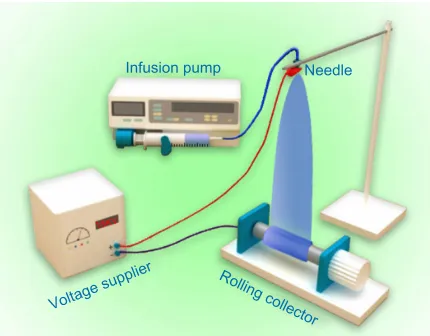
Figure 1 illustrates the setup of the electrospinning appa-ratus, which consisted of a high-voltage power generator
Infusion pump Needle
Rolling collector
Voltage supplier
Figure 1 schematic illustration of the electrospinning apparatus used in this study.
(High Voltage Technology Institute, Beijing, People’s Republic of China), an infusion pump (Smith Medical Instrument Company, Zhejiang, People’s Republic of China), and a 20 mL plastic syringe (BD, Franklin Lakes, NJ, USA) equipped with a stainless-steel blunt-ended needle with an inner diameter of 0.5 mm. Electrospun PLA/PCEC fibers were deposited onto rolling collector (0.5 m/second) for 60 minutes. A silicone tube was used to connect the syringe and a blunt-end needle, which was set up vertically. The concentration of PLA/PCEC solution was set at 8% (w/v), and PCEC content was 0, 25, 50, 75, and 100 wt%. For each PLA/PCEC suspension, 20 mL was fed into a plastic syringe, which was injected by the syringe pump at a flow rate of 7 mL/hour. The distance between the nozzle and the aluminum foil collector was adjusted to 12 cm. A voltage of 18 kV was applied to generate the PLA/PCEC jet. All experiments were carried out at 20°C±3°C and the environmental humidity was controlled to between 45% and 60%. The obtained PLA/PCEC membranes were left in a vacuum oven at 35°C for 48 hours to eliminate the solvent residue then kept in a desiccator for further characteriza-tion and treatment.
Nanofiber characterization
FT-Ir and XrD analysis
Attenuated total reflectance –FT-IR spectra of PLA/PCEC hybrid scaffolds were obtained with a Nicolet 6700 FT-IR machine (Thermo Fisher Scientific, Waltham, MA, USA). The crystallinity of PLA/PCEC composite membrane was analyzed by XRD (X’ Per Pro MPD DY 1291; Philips, Eindhoven, Netherlands) with Cu Kα radiation (λ =0.1542 nm; 40 KV; 40 mA) at a scanning rate of 4°/minute in the 2θ range from 10° to 60°.
International Journal of Nanomedicine downloaded from https://www.dovepress.com/ by 118.70.13.36 on 23-Aug-2020
Dovepress
Wang et al
Thermal properties
Melting temperature (Tm), crystallization temperature (Tc), and glass transition temperature (Tg) of dried PLA/PCEC hybrid membranes were characterized by DSC (NETZSCH 204; NETZSCH, Selb, Germany). Samples were first heated from 20°C to 180°C under N2 atmosphere at a heating rate of 20°C/minute, and quenched to −10°C at a rate of 10°C/ minute, after all reheated to 190°C at a rate of 10°C/minute. Thermogravimetric analysis (TG) and derivative temperature gravimetry (DTG) test was carried out with a TA Instrument (Q500; TA Instruments, New Castle, DE, USA). All samples were 8–10 mg and heated from 20°C to 600°C in an N2 atmosphere at a heating rate of 10°C/minute.
seM
The structural morphology of the electrospun PLA/PCEC hybrid scaffolds was investigated by SEM (JSM-5900LU; JEOL, Tokyo, Japan) and the diameters of the electrospun fibers in the composites were determined from SEM micrographs. The samples were coated with gold using a sputter coater (KYKY SBC-12; KYKY Technology Development Ltd, Beijing, People’s Republic of China) in advance.
Water contact angle measurement
Water contact angles of PLA/PCEC hybrid membranes were investigated by drop shape analysis (DAS100; KRÜSS, Hamburg, Germany) at room temperature. A drop of 3 µL of deionized water was dropped on the surface of fibrous membranes and photographed immediately. The contact angle (θ) was obtained from the height (h) and breadth (b) of the drop according to the following equation:
θ =2arctan2h
b (1)
Each scaffold was measured at least three times at dif-ferent positions and the results were averaged.
Mechanical properties
Mechanical properties, in terms of tensile strength and Young’s modulus, of the electrospun PLA/PCEC fibrous mats were measured at room temperature and relative humidity of 60% on a universal mechanical testing instrument (Instron 5567; Instron, Norwood, MA, USA). An Instron static load cell of 100 N was employed for all the tension tests. The speed of ten-sile testing was 5 mm/minute. All specimens of a rectangular shape with dimensions of 50×5 mm2 were cut from the
col-lected membranes with a thickness of 0.3–0.6 mm. The stress
and strain were calculated through the machine-recorded force and displacement based on the initial cross-section area and gauge length, respectively. The Young’s modulus was calcu-lated through linear regression analysis of the initial linear portion of the stress–strain curves.
cell culture examination
Isolation and culture of hPMscs
hPMSCs were isolated in our laboratory from placentas of healthy donor mothers during routine cesarean section births, with full informed consent. Briefly, placenta tissues were minced into a paste-like consistency and rinsed thor-oughly in phosphate-buffered saline (PBS); then the tissue pieces were kept in 50 mL tubes (BD) and digested with 1 mg/mL collagenase II (Sigma-Aldrich) for 2 hours at 37°C in an incubated shaker. The collagenase was inactivated by adding proliferation medium (Dulbecco’s Modified Eagle’s Medium-low glucose [DMEM–LG] [Life Technologies, Carls bad, CA, USA] with 10% fetal bovine serum [Life Tech-nologies] and 1% penicillin/streptomycin [Life Technolo-gies]). After centrifugation, the supernatant was discarded and the pellet was resuspended in proliferation medium and filtered through a 100 µm pore filter. Following this, the filtrate was centrifuged to obtain the hPMSCs, which were resuspended in proliferation medium, and cultured at 37°C under an atmosphere of 5% CO2 in humidified air. The cells were maintained up to passage 4 and collected by trypsin– ethylenediaminetetraacetic acid treatment.
Fluorescence microscopy observation and cell viability
To investigate cell attachment on the surfaces of PLA/PCEC hybrid membranes, the samples were fixed on the bottom of each well and sterilized using ethylene oxide steam for 24 hours at room temperature. hPMSCs were then seeded onto PLA/PCEC hybrid scaffolds containing 50 wt% PCEC at a density of 5×10³/mL and cultured with
prolifera-tion medium at 37°C under an atmosphere of 5% CO2 in humidified air. After incubation for 48 hours, hPMSCs were stained with the fluorescent dyes fluorescein isothiocyanate (FITC) (Sigma-Aldrich) and Dil Life Technologies and then observed by fluorescence microscopy.
The viability of hPMSCs cultured on the PLA/PCEC hybrid scaffolds with different PCEC concentration was determined by 3-(4,5-dimethylthiazol-2-yl)-2,5-diphenyl-2H-tetrazolium-bromide (MTT) assay (Roche Diagnostics, Mannheim, Germany). hPMSCs were cultured on the elec-trospun fibrous scaffolds, which were fixed on the bottom
International Journal of Nanomedicine downloaded from https://www.dovepress.com/ by 118.70.13.36 on 23-Aug-2020
Dovepress Pla/Pcec hybrid scaffolds in bone tissue engineering
of 24-well plates in advance, at 37°C under an atmosphere of 5% CO2 for 2, 4, and 6 days. Subsequently, 100 µL of 5 mg/mL MTT was added to each well and incubated at 37°C under an atmosphere of 5% CO2. After 4 hours, supernatant was removed, and 650 µL of dimethyl sulfoxide was added to each well for dissolving the blue formazan crystal, then the solution was transferred to 96-well plates. The absorbance of the contents of each well was measured at 570 nm using an enzyme-linked immunosorbent assay microplate reader (Bio-Rad Laboratories, Hercules, CA, USA).
hPMsc differentiation assay on the Pla/Pcec fibrous scaffolds
Cells were seeded on the hybrid PLA/PCEC scaffolds con-taining 50 wt% PCEC, which fixed on the bottom of 6-well plates in advance, at a density of 5×10⁵ cells/well and
cul-tured with proliferation medium. Two days after seeding, the proliferation medium was replaced with osteogenic differ-entiation medium (DMEM-LG containing 10% fetal bovine serum, 1% penicillin/streptomycin, 100 nM dexamethasone, 10 mM β-glycerophosphate, and 50 µg/mL ascorbic acid-2-phosphate). After 2 weeks of culture, specimens were rinsed with PBS twice and fixed in 10% buffered formalin, then were dehydrated in a graded ethanol series (30%, 50%, 70%, 80%, 90%, 95%, and 100%). Subsequently, the samples were rinsed twice with hexamethyldisilazane (Kelong Chemicals, Chengdu, People’s Republic of China) for 20 minutes and left to air dry overnight in a desiccator. After vacuum dry-ing and gold coatdry-ing, the samples were viewed by SEM. For alizarin red staining, the samples were gently washed in PBS and fixed with 10% formalin for 30 minutes and then stained
with alizarin red solution (Sigma-Aldrich) for 30 minutes. Calcium deposits were checked by microscope.
Results
characterization of Pla/Pcec
nanofibrous scaffolds
synthesis of Pcec copolymer
Biodegradable PCEC copolymer was prepared by ring-opening polymerization of ε-caprolactone (ε-CL) initiated by PEG-diol (HO-PEG-OH). Figure 2A shows the synthesis scheme of copolymer PCEC. GPC results ( Figure 2B) show that Mn and Mw of PCEC were 2.24×10⁴
and 4.61×10⁴, respectively. Only one single peak existed,
which indicated the mono-distribution of macromolecular weight and the absence of any homopolymer of ε-CL or PEG, and also implied that no transesterification or backbiting reactions occurred during polymerization.
FT-Ir and 1h-NMr analysis
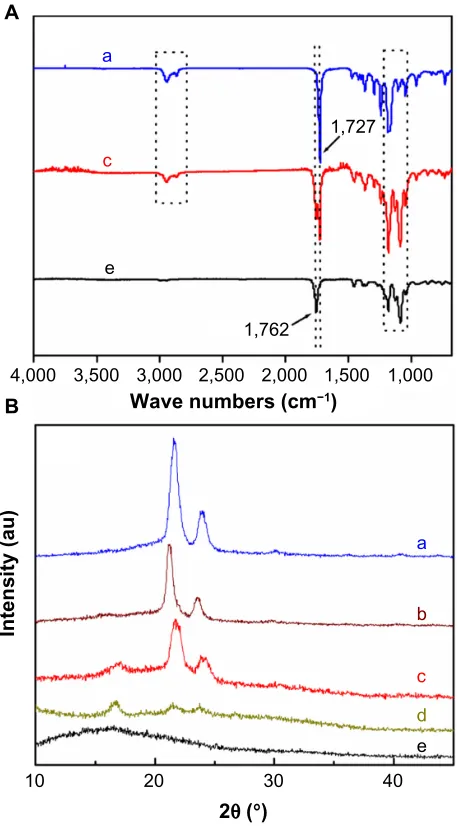
Figure 3A shows the FT-IR spectra of pure PLA fiber (Figure 3Ae), PLA/PCEC hybrid fiber (50 wt% PCEC) (Figure 3Ac), and pure PCEC fiber (Figure 3Aa). In the spectrum of the pure PCEC copolymer, the strong peaks at 1180 and 1240 cm-1 were assigned to the characteristic
of C−O−C stretching vibrations of repeated −OCH2CH2 units of PEG block and the −COO− band stretching vibra-tions, respectively. The characteristic band at 1,727 cm−1
corresponded to −C=O stretching vibrations of the ester carbonyl group. Two weak peaks at 2,870 cm−1 and 2,940 cm−1
represented vibration of carbon hydrogen (−CH2−) in PCL block main-chain, which also can be seen in Figure 2Ac.
0.00
103 104
Molar mass 10
5
CDCI3
a c d b
e f
g/mol 8 7 6 5 4 3 2 1 0ppm
0.25 0.50 0.75
W (log M)
1.00 1.25 B
A
2x O
O
C ε-Caprolactone
+
H OH
HO C C C d
135°C
f e b f e a c d
Poly(ethylene glycol) y OCH2CH2
CH2
H2H2
Sn(Oct)2
CH2 3
3 OCH2 CH2 x−1 y−1
O O
C OCH2CH2 OCH2CH2
Figure 2 synthesis scheme (A), gel permeation chromatography curve (B), and proton nuclear magnetic resonance spectra (C) of poly(ε-caprolactone)-poly(ethylene glycol)-poly(ε-caprolactone) copolymer.
Note: M, molecular weight, PPM, parts per million.
International Journal of Nanomedicine downloaded from https://www.dovepress.com/ by 118.70.13.36 on 23-Aug-2020
Dovepress
Wang et al
of PCL/PEG of PCEC copolymers was 6.2:1, calculated from
1H-NMR spectra according to Equations 2–4:
4 y 2 4 4
Id Ia
−
(
)
+= (2)
2 2 x 1 4
Ib Ia
−
[ ]
(
)
= (3)Mn PCEC)( =Mn PCL( )+Mn PEG( )=2 114
(
x)
+44 (4)ywhere Ia, Ib, and Id were integral intensities of methylene protons of −O−CH2− in PEG end unit at 4.23 ppm, meth-ylene protons of −CH2OOC− in PCL units at 4.06 ppm, and methylene hydrogen of homosequences of PEG oxyethylene units at 3.65 ppm, respectively.
XrD characterization
XRD profiles of PLA/PCEC hybrid membranes are shown in Figure 3B. From the pure PLA pattern, there was only broad diffusion scattering, which indicated that the pure PLA electrospun nanofibers were non-crystalline. From the pure PCEC pattern, two strong diffraction peaks at 21.5° and 23.8° were the crystalline peaks of PCEC copolymer matrix. From Figure 3Bb–d, two characteristic diffraction peaks could be found at around 21.5° and 23.5°; however, these were slightly weaker than the peaks of pure PCEC. A new peak around 17° appeared when PLA/PCEC hybrid scaffolds contained 25 (Figure 3Bd) and 50 (Figure 3Bc) wt% PCEC.
Thermal behavior
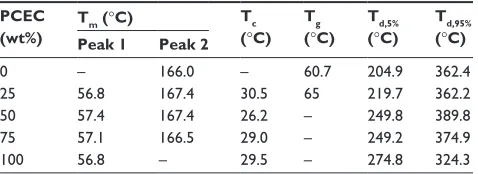
The DSC traces of all samples are shown in Figure 4A and B, and the values of Tm, Tc, and Tg are listed in Table 1. For PLA alone, Tg was observed at around 60°C, and melt-ing temperature was at about 166°C. For pure PCEC and PLA/PCEC hybrid membranes, Tg could not be observed by DSC, although two sharp melting peaks could be seen at 56.8°C–57.1°C and 166.5°C–167.4°C. Figure 5 presents the TG and DTG curves of PLA/PCEC composite, and the temperature at which 5 and 95% weight loss is listed in Table 1. The results revealed that the thermal stability of the PLA/ PCEC hybrid membranes containing 25, 50, and 75 wt% PCEC could be divided into two stages while the tempera-ture corresponding to 5 wt% decomposition increased from 204.9°C to 274.8°C with increasing PCEC concentration.
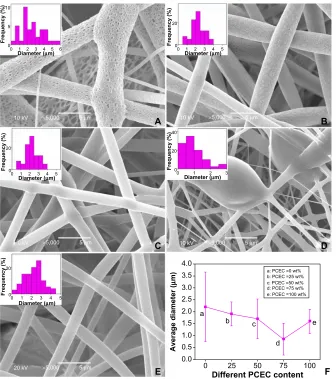
Morphological characterization
The morphology and the fibrous diameter distribution of electrospinning scaffolds were examined by SEM;
3,500 4,000
10 20 30
2θ (°)
40
A
B
Intensity (au)
e c a
e c
d a
b
3,000 2,500
Wave numbers (cm−1)
2,000 1,762
1,727
1,500 1,000
Figure 3 Fourier transform infrared spectra (A) and X-ray diffraction (B) patterns of polylactide/poly(ε-caprolactone)-poly(ethylene glycol)-poly(ε-caprolactone) (Pcec) nanofibrous membrane with 100 wt% (a), 75 wt% (b), 50 wt% (c), 25 wt% (d), and 0 wt% (e) PCEC concentrations.
In Figure 3Ae, the peaks at 1,762 cm−1 belonged to ester
carbonyl −C=O. The main characteristic bands of PLA and PCEC copolymer could be seen in the hybrid membranes.
A typical 1H-NMR spectrum of PCEC copolymer as well
as the detailed assignment of the different peaks is shown in Figure 2C. Peaks at approximately 1.40 ppm, 1.65 ppm, 2.30 ppm, and 4.06 ppm were assigned methylene protons of −(CH2)3−, −OCCH2−, and −CH2OOC− in PCL blocks, respectively. The spectrum shows that two weak peaks, “a” and “c,” were attributed to methylene proton of PEG end units, while peak “d” was attributed to methylene protons of PEG oxyethylene units, and x and y were, respectively, the corresponding block number of PCL and PEG in PCEC copolymers, as shown in Figure 2A. The actual weight ratio
International Journal of Nanomedicine downloaded from https://www.dovepress.com/ by 118.70.13.36 on 23-Aug-2020
Dovepress Pla/Pcec hybrid scaffolds in bone tissue engineering
Table 1 Melting temperature (Tm), crystallization temperature (Tc),
glass transition temperature (Tg), and temperature at which 5% (Td, 5%)
and 95% (Td, 95%) weight was loss of polylactide/poly(ε
-caprolactone)-poly(ethylene glycol)-poly(ε-caprolactone) (Pcec) hybrid electrospun nanofibers containing 0, 25, 50, 75, and 100 wt% PCEC
PCEC (wt%)
Tm (°C) Tc
(°C) Tg (°C)
Td,5% (°C)
Td,95% (°C)
Peak 1 Peak 2
0 – 166.0 – 60.7 204.9 362.4
25 56.8 167.4 30.5 65 219.7 362.2
50 57.4 167.4 26.2 – 249.8 389.8
75 57.1 166.5 29.0 – 249.2 374.9
100 56.8 – 29.5 – 274.8 324.3
20
A B
Heat flow Heat flow
Endo
40 60 80 e
d
c
b
a
e
d
c
b
a
100
Temperature (°C) Temperature (°C)
120 140 160 180 200 20 40 60
Exo
Figure 4 Differential scanning calorimetry curves of polylactide/poly(ε-caprolactone)-poly(ethylene glycol)-poly(ε-caprolactone) (PCEC) hybrid fibrous scaffolds with 100 wt% (a), 75 wt% (b), 50 wt% (c), 25 wt% (d), and 0 wt% (e) PCEC concentrations.
Notes: (A) heating process. (B) cooling process. Abbreviations: endo, endothermal; exo, exothermic.
these results are presented in Figure 6. For pure PLA, the polymer solution could be electrospun into fibers, but the diameter of fibers showed extensive distribution, ranging from 400 nm to 6 µm, and the average size was about 2.2±1.46 µm. Some fibers had a spindle-shaped structure, indicating that the electrospinning process was not very smooth, and each individual fiber surface had various nano-scale pores with diameters ranging from 70–300 nm. When PCEC contents were added to 25 wt% and 50 wt%, the composite could be electrospun into continuous fibers and the diameters did not vary so greatly, with the number of nanoscale pores on each individual fiber surface decreased. When PCEC content was increased to 75 wt% however, the diameter of each fiber decreased to 0.85±0.67 µm, while numerous beaded structures appeared again. Moreover, for pure PCEC, the diameter of each individual fiber was 1.6±0.51 µm, with each appearing to have a smooth and uniform surface.
Water contact angle
The results of water contact angle measurements for the PLA/PCEC hybrid fibrous membranes are shown in Figure 7.
It can be seen that contact angle values of the PLA/PCEC hybrid membranes were lower than those of pure PLA mem-brane, and that the values decreased from 126° to 93° with increasing PCEC.
Mechanical characterization
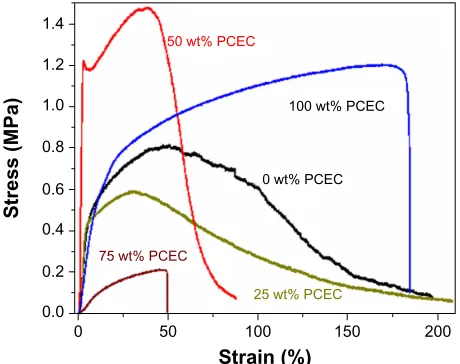
Mechanical behaviors of the electrospun PLA/PCEC hybrid membranes containing 0, 25, 50, 75, and 100 wt% PCEC were measured by tensile test. The representative strain– stress curves are shown in Figure 8, and the obtained data are listed in Table 2. It could be seen that the sample con-taining 50 wt% PCEC had the largest tensile strength, at 1.59±0.27 MPa, while the sample containing 75 wt% showed the lowest tensile strength, at 0.20±0.03 MPa. Meanwhile, the tensile modules of all samples showed the same variation tendency as tensile strength: the sample containing 50 wt% PCEC had the highest value, at 77.7±4.3 MPa, and the hybrid membrane containing 75 wt% PCEC had the lowest value, at 1.2±0.2 MPa.
Cell behavior on nanofibrous scaffolds
cells adhesion and MTT assay
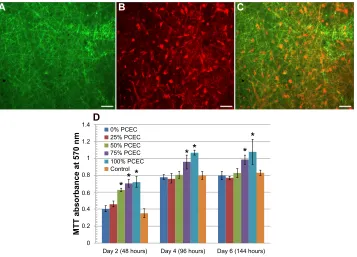
To test the usefulness of PLA/PCEC membranes as a porous scaffold to support cell growth, the hPMSCs were cultured on the PLA/PCEC membranes. After culture for 48 hours, the cell morphology was observed by fluorescence micrographs. As shown in Figure 9B and C, hPMSCs could attach and grow well on the scaffolds after 2 days of culture.
hPMSC proliferation on the five hybrid scaffolds were analyzed by MTT assay at days 2, 4, and 6 after seeding. As shown in Figure 9D, hPMSCs proliferated well on all the sub-strates compared with control. After 4 and 6 days of culture, hPMSCs seeded on PLA/PCEC hybrid membranes with 0, 25, and 50 wt% PCEC showed almost the same absorbance
International Journal of Nanomedicine downloaded from https://www.dovepress.com/ by 118.70.13.36 on 23-Aug-2020
Dovepress
Wang et al
100 0 20 40
Weight (%)
Deriv. weight change (%/minute)
80
60 100
e
b
d
c
a
e b
d
c
a
A B
200 300 400
Temperature (˚C) 500 600 100 200 Temperature (˚C)300 400 500 600
a: PCEC =100 wt% b: PCEC =75 wt%
c: PCEC =50 wt%
d: PCEC =25 wt% e: PCEC =0 wt%
a: PCEC =100 wt% b: PCEC =75 wt% c: PCEC =50 wt%
d: PCEC =25 wt% e: PCEC =0 wt%
Figure 5 Tg (A) and DTg (B) curves of polylactide/poly(ε-caprolactone)-poly(ethylene glycol)-poly(ε-caprolactone) (Pcec) composite membranes with different Pcec concentrations.
Abbreviations: Tg, thermogravimetric analysis; DTg, derivative temperature gravimetry.
0 0 5
Frequency (%)
10
1 2
10 kV ×5,000 5 µm 10 kV ×5,000 5 µm
10 kV ×5,000 5 µm 0 kV ×5,000 5 µm
20 kV ×5,000 5 µm
3
Diameter (4µm)5 6 0
0 20
Frequency (%)
1 2 3 Diameter (µ4m)5
0 0 20 40
Frequency (%)
1 2 3
Diameter (µm) 0
0 20
Frequency (%)
1 2 3 4 5 Diameter (µm)
0 0 20
Frequency (%)
1 2 3 4 5 Diameter (µm)
A B
D C
E F
0.0
0 25 50
Different PCEC content75 100
0.5 a
b c d
e 1.0
1.5 2.0
Average diameter
(
µ
m)
2.5 3.0 3.5 4.0
a: PCEC =0 wt% b: PCEC =25 wt% c: PCEC =50 wt% d: PCEC =75 wt% e: PCEC =100 wt%
Figure 6 scanning electron microscope photographs and the diameter distribution of the polylactide/poly(ε-caprolactone)-poly(ethylene glycol)-poly(ε-caprolactone) (Pcec) hybrid fibers containing (A) 0, (B) 25, (C) 50, (D) 75, and (E) 100 wt% of PCEC.
Note: (F) shows the decreasing of each fiber’s diameter with increasing PCEC concentration.
International Journal of Nanomedicine downloaded from https://www.dovepress.com/ by 118.70.13.36 on 23-Aug-2020
Dovepress Pla/Pcec hybrid scaffolds in bone tissue engineering
Table 2 Tensile strength, elongation rate, and Young’s modulus of the polylactide/poly(ε-caprolactone)-poly(ethylene glycol)-poly(ε-caprolactone) (PCEC) hybrid electrospun nanofibers with different concentrations of Pcec
PCEC (wt%)
Maximum tensile strength (MPa)
Elongation at break (%)
Young’s modulus (MPa)
0 0.87±0.18 182.3±31.8 14.0±4.2
25 0.59±0.12 206.4±9.8 13.4±3.4
50 1.59±0.27 87.9±9.1 77.7±4.3
75 0.20±0.03 46.3±5.8 1.2±0.2
100 1.23±0.12 183.2±9.1 6.5±0.6
0.0
0 50 100 150
Strain (%)
25 wt% PCEC 0 wt% PCEC 50 wt% PCEC
75 wt% PCEC
200 0.2
0.4 0.6 0.8
Stress (MPa)
1.0 1.2 1.4
100 wt% PCEC
Figure 8 strain–stress curves of electrospun polylactide/poly(ε -caprolactone)-poly(ethylene glycol)-poly(ε-caprolactone) (PCEC) fibrous membranes with different PCEC concentrations (0, 25, 50, 75, and 100 wt%).
0 80 90 100 110
Water contact angle
(
°)
120 130
a
b
c
d
e
20 40 60
PCEC concentration (wt%)
80 100 a: 0 wt% PCEC b: 25 wt% PCEC c: 50 wt% PCEC d: 75 wt% PCEC e: 100 wt% PCEC
Figure 7 Water contact angle of the polylactide/poly(ε-caprolactone)-poly(ethylene glycol)-poly(ε-caprolactone) (Pcec) hybrid membranes with different Pcec concentrations.
values compared with control; however, samples containing 75 and 100 wt% PCEC still showed higher absorbance values than control. It should be noted that cell counts after 6 days’ incubation had not dramatically increased compared with those of 4 days’ incubation.
Differentiation of hPMscs into osteogenic cells on nanofibrous scaffolds
To investigate the osteogenic differentiation of hPMSCs on PLA/PCEC membranes, alizarin red staining was used to qualitatively confirm calcium deposition, and SEM was used to investigate the morphology of hPMSCs after 2 weeks’ incubation with osteogenic differentiation medium. Through SEM imaging and alizarin red staining, it could be
seen that human hPMSCs attached and spread well on the electrospun hybrid PLA/PCEC fibrous scaffolds (Figure 10A) and could be effectively differentiated into bone-associated cells (Figure 10B).
Discussion
The placenta is believed to be a large reservoir of MSCs for therapeutic-scale manufacture. Stem cell lines obtained from the chorion of human placenta have been found to be similar to other MSCs,8,40-41 such as bone marrow MSCs and adipose
MSCs, which could remain viable and reproducible in vitro, could express markers of pluripotent stem cells (NANOG, OCT-4, SSA-3, etc) and surface markers of mesenchymal cells (CD73, CD90, CD105, etc), and could be differentiated in vitro into osteoblasts, adipocytes (mesoderm), neuron-like cells (ectoderm), and hepatocytes (endoderm) with culturing in differential media.1,41 Nazarov et al reported
that human chorionic mesenchymal stem cell could remain viable and reproducible for more than 100 doublings (55 passages), which is better than other MSCs.41 In this study,
we successfully prepared PLA/PCEC hybrid membranes by electrostatic spinning technique, and hPMSCs cultured on PLA/PCEC nanofibers showed good cell attachment and robust proliferation and could be induced into osteoblasts when treated with osteogenic differential media, as per a previous study.8
The design and fabrication of scaffolds are essential tasks for a functional vital engineered tissue.1,7,18 Electrospinning
has been proven to be an effective method of fabricating a provisional biomimetic scaffold composed of nano- to microscale fibrous meshes.12,16–17 Due to the biomimetic
ECMs of a nanofiber scaffold, it might have significant effects on cell behavior.2,10,18,19 In addition to the topographical
fea-tures of a scaffold, the mechanical properties of a scaffold are also an important aspect, which could be regulated by the design of the structure and the material itself. A designed scaffold should not only provide a surface for cell
prolif-International Journal of Nanomedicine downloaded from https://www.dovepress.com/ by 118.70.13.36 on 23-Aug-2020
Dovepress
Wang et al
0
Day 2 (48 hours) Day 4 (96 hours) Day 6 (144 hours)
0.2 0.4 0.6 0.8
** *
* * *
*
MTT absorbance at 570 nm
1 1.2
0% PCEC 25% PCEC 50% PCEC 75% PCEC 100% PCEC Control 1.4
A B C
D
Figure 9 Fluorescence micrographs of Pla/Pcec scaffolds and hPMscs cultured on Pla/Pcec scaffolds (A-C); MTT assays for proliferation of hPMscs combined with Pla/Pcec composite membranes (D).
Notes: (A) Green fluorescence images of FITC-stained PLA/PCEC scaffolds. (B) Red fluorescence images of Dil stained hPMSCs cultured on PLA/PCEC scaffolds. (C) composite of (A and B). scale bars represent 200 µm. (D) MTT assays for proliferation of hPMSCs combined with PLA/PCEC hybrid nanofibers with different PCEC concentrations cultured for 2, 4, and 6 days. Significance was assessed compared to the control for each time point assayed by one-way analysis of variance. Quantitative data are represented as mean ± sD, n=9. P-values less than 0.05 were considered significant (*P,0.05).
Abbreviations: FITC, fluorescein isothiocyanate; MTT, 3-(4,5-dimethylthiazol-2-yl)-2,5-diphenyl-2H-tetrazolium-bromide; PCEC, poly(ε-caprolactone)-poly(ethylene glycol)-poly(ε-caprolactone); Pla, polylactide; hPMsc, human placenta-derived mesenchymal stem cell; sD, standard deviation.
Figure 10 human placenta-derived mesenchymal stem cells (black arrow), seeded on polylactide/poly(ε-caprolactone)-poly(ethylene glycol)-poly(ε-caprolactone) nano fibers and treated with osteogenic differentiation medium, observed by scanning electron microscopy (A) and showing positive staining to alizarin red (B) after 2 weeks of culture.
Note: scale bars represent 100 µm.
eration but also maintain sufficient biomechanical support during tissue regeneration and structure degradation. This article presents a novel strategy for bone tissue engineering by culturing hPMSCs on PLA electrospun nanofibers modi-fied by ABA triblock copolymer PCEC.
Biodegradable PCEC triblock copolymers were synthe-sized by ring-opening copolymerization of PCL initiated by PEG using stannous octoate as catalyst. The 1H-NMR and
GPC results indicate that the PCEC block copolymers were prepared successfully, with a controlled macromolecular weight (Figure 2B and C). The results presented in Figure 3A
reveal that PCEC copolymer exhibited characteristic bands of both PCL and PEG segments, which confirmed the formation of PCEC copolymer. PLA/PCEC hybrid scaffolds exhibited characteristic bands of PLA and PCEC that indicated that the two polymers were blended together when dissolve in dichloromethane together. In Figure 3B, PLA is seen to be a type of semi-crystalline polyester polymer; however, in the process of forming the pattern of pure PLA membrane, no characteristic diffraction peaks occurred, which confirmed that the polymer matrix kept an amorphous structure, while the pattern of pure PCEC membrane revealed that PCEC had a crystalline pattern. Moreover, in the pattern of hybrid membranes (Figure 3Bc and d), peaks at 17.1° and 16.7° could be detected, which indicate that the PLA of PLA/PCEC hybrid membranes were no longer in an amorphous state, but converted into crystalline material.
As seen in Figure 4 and Table 1, the two melting tempera-tures of PLA/PCEC fibrous scaffolds were higher than those of pure PCEC. The reason might be that interactions between PLA and PCEC after incorporation of PCEC into PLA polymer when electrospun into fibers; however, the sample containing 25 wt% PCEC had a higher crystallization temperature, at 30.5°C, probably because of the homogeneous nucleation
International Journal of Nanomedicine downloaded from https://www.dovepress.com/ by 118.70.13.36 on 23-Aug-2020
Dovepress Pla/Pcec hybrid scaffolds in bone tissue engineering
effect of PCEC on the cold crystallization of PLA matrix. From the thermogravimetric analysis (Figure 5 and Table 1), the temperature at which 5% decomposition increase might have been because of the increasing of crystallinity when PCEC concentration was increased. All of those results have proved that thermal stability of PLA/PCEC hybrid membrane was better than that of pure PLA and pure PCEC membrane.
Morphology of the scaffolds was examined by SEM, and images are presented in Figure 6. For pure PLA, there were some spindle-shaped structures among the fibers, and the electrospinning process was not very smooth. This might be due to the intrinsic properties of PLA solution, such as surface tension and viscosity.44 Interestingly, the electrospun
fiber surface of PLA exhibited nanoscale pores, as also reported by Bognitzki et al, who rationalized that the rapid phase separation induced by the evaporation of the solvent and the subsequent rapid solidification during electrospin-ning might have accounted for this surface structure.22 With
increasing PCEC concentration, the process of electrospin-ning became smooth, with no spindle-shaped structures formed. We suspected that the low molecular weight (com-pared with the PLA) might affect the intrinsic properties of the hybrid solution, and PCEC might play the role of lubricant in the mixed solutions, which could reduce the solution viscosity. However, PLA/PCEC with 75 wt% concentration of PCEC could not turn into homogeneous fiber, and numer-ous beaded structures formed through electrospinning. We speculated that phase separation might be the main reason, which led to formation of amorphous PLA-rich and PCEC-rich phases. The water contact angle of PLA/PCEC hybrid scaffolds was found to gradually decrease from 126.5° to 93.9° with increasing PCEC concentration (Figure 7), which might have been due to the increasing number of hydrophilic phases of PEG and good distribution of fibers.
Mechanical properties, as importance factor of three-dimensional nanoporous scaffolds, were investigated in this study. Based on the results (Figure 8 and Table 2), the sample containing 25 wt% PCEC showed the highest elongation rate at break, while the sample containing 50 wt% PCEC dis-played highest tensile strength of all the samples. The results of tensile testing demonstrated that PCEC concentration had a great effect on mechanical properties of the samples. Some reports in the literature have reported that ABA triblock copolymer, such as PCEC used in this study, could modify the mechanical properties. The reason might be ABA triblock copolymer show capable of forming a stereocomplex with the PLA matrix, which was used as the sole strengthening agent to modify the physi cal strength of PLA.44,45 On the other
hand, we speculated that the increase of fiber crystallinity might play an effective role in improvement of mechanical properties of PLA/PCEC hybrid scaffolds.
To validate the cell response of PLA/PCEC hybrid scaf-folds, the behavior of hPMSCs cultured on the scaffolds was observed. We evaluated cells’ metabolic activity and viability by MTT assay (Figure 9D), cell morphology and cell inter-action with the hybrid scaffolds by fluorescent microscopic images (Figure 9A–C), and cell differential ability by SEM and alizarin red staining (Figure 10). The results revealed that hPMSCs interacted and integrated well with surrounding fibers, and could proliferate and spread well on the mem-branes. Moreover, after 2 weeks’ incubation in osteogenic differential medium, the hPMSCs cultured on PLA/PCEC fibrous scaffolds clearly showed matrix mineralization with alizarin red staining. On the whole, the PLA/PCEC elec-trospun scaffolds showed good cellular compatibility and favorable osteogenic potential in vitro, thus should be suitable candidates for application in bone tissue engineering.
Conclusion
In this study, PLA blending with different concentrations of ABA triblock copolymer PCEC were electrospun into nano- to microfibers, with numerous nanopores on the surface of a single fiber, and they exhibited improvement of morphol-ogy and mechanical properties compared to neat PLA fiber membrane. With the ratio of PCEC increasing from 0% to 50%, average diameter of fiber and water contact angle of membrane decreased, while mechanical properties and ther-mal characteristics clearly improved. The biocompatibility of the scaffolds to hPMSCs was demonstrated by MTT. Favorable interactions between hPMSCs on the scaffolds were demonstrated by cell morphology, proliferation, and differentiation studies. These results definitely prove the potential of these scaffolds for bone tissue engineering. In our further research, the mechanism of triblock copolymer improving PLA mechanical properties will be studied, and this type of bone tissue substitute will be explored in vivo.
Acknowledgments
This work was financially supported by National Natural Sci-ences Foundation of China (81372446), National S&T Major Project (2011ZX09102-001-10 and 2013ZX09301304-007), and Sichuan Provincial Science and Technology Department Support Project (2011SZ0222). The authors are grateful to Wang Hui, Xie Yani, and Wen Jiqiu (Analytical and Testing Center, Sichuan University) for their assistance with SEM observation, FT-IR analysis, and XRD analysis respectively.
International Journal of Nanomedicine downloaded from https://www.dovepress.com/ by 118.70.13.36 on 23-Aug-2020
Dovepress
Wang et al
Disclosure
The authors report no conflicts of interest in this work.
References
1. de Peppo GM, Marcos-Campos I, Kahler DJ, et al. Engineering bone
tissue substitutes from human induced pluripotent stem cells. Proc Natl
Acad Sci U S A. 2013;110(21):8680–8685.
2. Schubert T, Lafont S, Beaurin G, et al. Critical size bone defect recon-struction by an autologous 3D osteogenic-like tissue derived from
differentiated adipose MSCs. Biomaterials. 2013;34(18):4428–4438.
3. Salgado AJ, Coutinho OP, Reis RL. Bone tissue engineering: state of
the art and future trends. Macromol Biosci. 2004;4(8):743–765.
4. Dong SW, Ying DJ, Duan XJ, et al. Bone regeneration using an acellular extracellular matrix and bone marrow mesenchymal stem cells
express-ing cbfa1. Biosci Biotechnol Biochem. 2009;73(10):2226–2233.
5. Bueno EM, Glowacki J. Cell-free and cell-based approaches for bone
regeneration. Nat Rev Rheumatol. 2009;5(12):685–697.
6. Guo G, Yu J, Luo Z, et al. Synthesis and characterization of poly(methyl methacrylate-butyl acrylate)/nano-titanium oxide composite particles. J Nanosci Nanotechnol. 2011:11(6):4923–4928.
7. Green D, Walsh D, Mann S, Oreffo RO. The potential of biomimesis in bone tissue engineering: lessons from the design and synthesis of
invertebrate skeletons. Bone. 2002;30(6):810–815.
8. Zhang DM, Tong AP, Zhou LX, Fang F, Guo G. Osteogenic differen-tiation of human placenta-derived mesenchymal stem cells (PMSCs)
on electrospun nanofiber meshes. Cytotechnology. 2012;64(6):
701–710.
9. Fan RR, Zhou LX, Song W, et al. Preparation and properties of g-TTCP/
PBS nanocomposites and its in vitro biocompatibility assay. Int J Biol
Macromol. 2013;59:227–234.
10. Parizek M, Douglas TE, Novotna K, et al. Nanofibrous poly(lactide-co-glycolide) membranes loaded with diamond nanoparticles as
promising substrates for bone tissue engineering. Int J Nanomedicine.
2012;7:1931–1951.
11. Lutolf MP, Hubbell JA. Synthetic biomaterials as instructive
extracel-lular microenvironments for morphogenesis in tissue engineering. Nat
Biotechnol. 2005;23(1):47–55.
12. Borjigin M, Eskridge C, Niamat R, Strouse B, Bialk P, Kmiec EB. Electrospun fiber membranes enable proliferation of genetically
modi-fied cells. Int J Nanomedicine. 2013;8:855–864.
13. Bhattarai SR, Bhattarai N, Yi HK, Hwang PH, Cha DI, Kim HY. Novel biodegradable electrospun membrane: scaffold for tissue engineering. Biomaterials. 2004;25(13):2595–2602.
14. Vozzi G, Flaim CJ, Bianchi F, Ahluwalia A, Bhatia S. Microfabricated PLGA scaffolds: a comparative study for application to tissue
engineering. Mater Sci Eng C Mater Biol Appl. 2002;20(1–2):43–47.
15. Tu CF, Cai Q, Yang J, Wan YQ, Bei JZ, Wang S. The fabrication and characterization of poly(lactic acid) scaffolds for tissue
engineer-ing by improved solid-liquid phase separation. Polym Adv Technol.
2003;14(8):565–573.
16. Vasita R, Katti DS. Nanofibers and their applications in tissue
engineering. Int J Nanomedicine. 2006;1(1):15–30.
17. Liang D, Hsiao BS, Chu B. Functional electrospun nanofibrous
scaf-folds for biomedical applications. Adv Drug Deliv Rev. 2007;59(14):
1392–1412.
18. Abdal-hay A, Sheikh FA, Lim JK. Air jet spinning of hydroxyapatite/ poly(lactic acid) hybrid nanocomposite membrane mats for bone tissue
engineering. Colloids Surf B Biointerfaces. 2013;102:635–643.
19. Rujitanaroj PO, Pimpha N, Supaphol P. Wound-dressing materials with antibacterial activity from electrospun gelatin fiber mats containing
silver nanoparticles. Polymer. 2008;49(21):4723–4732.
20. Guo G, Fu SZ, Zhou LX. Preparation of curcumin loaded poly(ε
-caprolactone)-poly(ethylene glycol)-poly(ε-caprolactone) nanofibers
and their in vitro antitumor activity against glioma 9L cells. Nanoscale.
2011;3(9):3825–3832.
21. Alhosseini SN, Moztarzadeh F, Mozafari M, et al. Synthesis and char-acterization of electrospun polyvinyl alcohol nanofibrous scaffolds
modified by blending with chitosan for neural tissue engineering. Int J
Nanomedicine. 2012;7:25–34.
22. Bognitzki M, Czado W, Frese T, et al. Nanostructured fibers via
electrospinning. Adv Mater. 2001;13(1):70–72.
23. Somvipart S, Kanokpanont S, Rangkupan R, Ratanavaraporn J, Damrongsakkul S. Development of electrospun beaded fibers from
Thai silk fibroin and gelatin for controlled release application. Int J
Biol Macromol. 2013;55:176–184.
24. Pelto J, Björninen M, Pälli A, et al. Novel polypyrrole-coated polylactide scaffolds enhance adipose stem cell proliferation and
early osteogenic differentiation. Tissue Eng Part A. 2013;19(7–8):
882–892.
25. Boland ED, Telemeco TA, Simpson DG, Wnek GE, Bowlin GL. Utilizing acid pretreatment and electrospinning to improve
biocompat-ibility of poly(glycolic acid) for tissue engineering. J Biomed Mater
Res Part B Appl Biomater. 2004;71(1):144–152.
26. Zhang CL, Lv KP, Cong HP, Yu SH. Controlled assemblies of gold nanorods in PVA nanofiber matrix as flexible free-Standing SERS
substrates by electrospinning. Small. 2012;8(5):648–653.
27. Fan RR, Zhou LX, Li DX, Zhang DM, Wu M, Guo G. Preparation and characterization of composites based on poly (butylene succinate) and
poly (lactic acid) grafted tetracalcium phosphate. Journal of
Macro-molecular Science, Part B: Physics. Epub July 29, 2013.
28. Rathi S, Coughlin EB, Hsu SL, Golub CS, Ling GH, Tzivanis MJ. Effect of midblock on the morphology and properties of blends of ABA
triblock copolymers of PDLA-mid-block-PDLA with PLLA. Polymer.
2011;53(14):3008–3016.
29. Chiou BS, Jafri H, Avena-Bustillos R, et al. Properties of electrospun pollock gelatin/poly(vinyl alcohol) and pollock gelatin/poly(lactic acid)
fibers. Int J Biol Macromol. 2013;55:214–220.
30. Chen CC, Chueh JY, Tseng H, Huang HM, Lee SY. Preparation and
characterization of biodegradable PLA polymeric blends. Biomaterials.
2003;24(7):1167–1173.
31. Chen HL, Huang J, Yu JH, Liu SY, Gu P. Electrospun
chitosan-graft-poly (ε-caprolactone)/poly (ε-caprolactone) cationic nanofibrous mats
as potential scaffolds for skin tissue engineering. Int J Biol Macromol.
2010;48(1):13–19.
32. Chen GX, Kim HS, Kim ES, Yoon JS. Compatibilization-like effect of reactive organoclay on the poly(L-lactide)/poly(butylene succinate)
blends. Polymer. 2005;46(25):11829–11836.
33. Hu Y, Hu YS, Topolkaraev V, Hiltner A, Baer E. Aging of poly(lactide)/ poly(ethylene glycol) blends. Part 2. Poly(lactide) with high
stereoregularity. Polymer. 2003;44(19):5711–5720.
34. Horwitz EM, Le Blanc K, Dominici M, et al. Clarification of the nomenclature for MSC: The International Society For Cellular Therapy
position statement. Cytotherapy. 2005;7(5):393–395.
35. Hosseinkhani H, Hong PD, Yu DS, et al. Development of 3D in
vitro platform technology to engineer mesenchymal stem cells. Int J
Nanomedicine. 2012;7:3035–3043.
36. Uccelli A, Moretta L, Pistoia V. Mesenchymal stem cells in health and
disease. Nat Rev Immunol. 2008;8(9):726–736.
37. Brooke G, Rossetti T, Pelekanos R, et al. Manufacturing of human
placenta-derived mesenchymal stem cells for clinical trials. Br J
Haematol. 2009;144(4):571–579.
38. Bartholomew A, Sturgen C, Siatskas M et al. Mesenchymal stem cells suppress lymphocyte proliferation in vitro and prolong skin graft
survival in vivo. Exp Hematol. 2002;30(1):42–48.
39. Soleimani M, Nadri S. A protocol for isolation and culture of
mesen-chymal stem cells from mouse bone marrow. Nat Protoc. 2009;4(1):
102–106.
40. Matikainen T, Laine J. Placenta – an alternative source of stem cells. Toxicol Appl Pharmacol. 2005;207(Suppl 2):544–549.
41. Nazarov I, Lee JW, Soupene E, et al. Multipotent stromal stem cells
from human placenta demonstrate high therapeutic potential. Stem Cells
Transl Med. 2012;1(5):359–372.
International Journal of Nanomedicine downloaded from https://www.dovepress.com/ by 118.70.13.36 on 23-Aug-2020
International Journal of Nanomedicine
Publish your work in this journal
Submit your manuscript here: http://www.dovepress.com/international-journal-of-nanomedicine-journal The International Journal of Nanomedicine is an international,
peer-reviewed journal focusing on the application of nanotechnology in diagnostics, therapeutics, and drug delivery systems throughout the biomedical field. This journal is indexed on PubMed Central, MedLine, CAS, SciSearch®, Current Contents®/Clinical Medicine,
Journal Citation Reports/Science Edition, EMBase, Scopus and the Elsevier Bibliographic databases. The manuscript management system is completely online and includes a very quick and fair peer-review system, which is all easy to use. Visit http://www.dovepress.com/ testimonials.php to read real quotes from published authors.
Dovepress
Dove
press
Pla/Pcec hybrid scaffolds in bone tissue engineering
42. Portmann-Lanz CB, Schoebedein A, Huber A, et al. Placental mesen-chymal stem cells as potential autologous graft for pre- and perinatal
neuroregeneration. Am J Obstet Gynecol. 2006;194(3):664–673.
43. In ‘t Anker PS, Scherjon SA, Kleijburg-van der Keur C, et al. Isolation of mesenchymal stem cells of fetal or maternal origin from human
placenta. Stem Cells. 2004,22(7):1338–1345.
44. Yang JJ, Liang YR, Luo J, Zhao CZ, Han CC. Multilength scale studies of the confined crystallization in poly(L-lactide)-block-poly(ethylene
glycol) copolymer. Macromolecules. 2012;45(10):4254–4261.
45. Hébert JS, Wood-Adams P, Heuzey MC, Dubois C, Brisson J. Morphology of polylactic acid crystallized during annealing after
uni-axial deformation. J Polym Sci B Polym Phys. 2013;51(6):430–440.
International Journal of Nanomedicine downloaded from https://www.dovepress.com/ by 118.70.13.36 on 23-Aug-2020