University of Pennsylvania
ScholarlyCommons
Publicly Accessible Penn Dissertations
1-1-2014
Three Dimensional Dirac Semimetals
Saad Zaheer
University of Pennsylvania, [email protected]
Follow this and additional works at:http://repository.upenn.edu/edissertations
Part of theCondensed Matter Physics Commons, and theQuantum Physics Commons
This paper is posted at ScholarlyCommons.http://repository.upenn.edu/edissertations/1514
For more information, please [email protected]. Recommended Citation
Three Dimensional Dirac Semimetals
Abstract
We extend the physics of graphene to three dimensional systems by showing that Dirac points can exist on the Fermi surface of realistic materials in three dimensions. Many of the exotic electronic properties of graphene can be ascribed to the pseudorelativistic behavior of its charge carriers due to two dimensional Dirac points on the Fermi surface. We show that certain nonsymmorphic spacegroups exhibit Dirac points among the irreducible representations of the appropriate little group at high symmetry points on the surface of the Brillouin zone. We provide a list of all Brillouin zone momenta in the 230 spacegroups that can host Dirac points.
We describe microscopic considerations necessary to design materials in one of the candidate spacegroups such that the Dirac point appears at the Fermi energy without any additional non-Dirac-like Fermi pockets. We use density functional theory based methods to propose six new Dirac semimetals: BiO2and SbO2in the
β-cristobalite lattice (spacegroup 227), and BiCaSiO4, BiMgSiO4, BiAlInO4, and BiZnSiO4in the distorted
spinels lattice (spacegroup 74). Additionally we derive effective Dirac Hamiltonians given group representative operators as well as tight binding models incorporating spin-orbit coupling.
Finally we study the Fermi surface of zincblende (spacegroup 216) HgTe which is effectively point-like at Γ in the Brillouin zone and exhibits accidental degeneracies along a threefold rotation axis. Whereas compressive strain gaps the band structure into a topological insulator, tensile strain shifts the accidental degeneracies away from Γ and enlarges the Fermi surface. States on the Fermi surface exhibit nontrivial spin texture marked by winding of spins around the threefold rotation axis and by spin vortices indicating a change in the winding number. This is confirmed by microscopic calculations performed in tensile strained HgTe and Hg0.5Zn0.5Te
as well ask.ptheory.
We conclude with a summary of recent work on the physics of Dirac semimetals especially after the observation of the topological Dirac semimetals Cd3As2and Na3Bi and outline topics for future research.
Symmetry protected Dirac semimetals, on the other hand, have yet to be observed experimentally.
Degree Type
Dissertation
Degree Name
Doctor of Philosophy (PhD)
Graduate Group
Physics & Astronomy
First Advisor
Eugene J. Mele
Keywords
Subject Categories
THREE DIMENSIONAL DIRAC SEMIMETALS
Saad Zaheer
A DISSERTATION
in
Physics and Astronomy
Presented to the Faculties of the University of Pennsylvania
in
Partial Fulfillment of the Requirements for the
Degree of Doctor of Philosophy
2014
Supervisor of Dissertation
Eugene J. Mele Professor of Physics
Graduate Group Chairperson
Marija Drndic, Professor of Physics
Dissertation Committee
Mirjam Cvetic, Fay R. and Eugene L. Langberg Professor of Physics Charles L. Kane, Class of 1965 Endowed Term Chair Professor of Physics Justin Khoury, Associate Professor of Physics
THREE DIMENSIONAL DIRAC SEMIMETALS
c
COPYRIGHT
2014
Saad Zaheer
This work is licensed under the
Creative Commons Attribution
NonCommercial-ShareAlike 3.0
License
To view a copy of this license, visit
Dedicated to the memory of my great grandparents and their children, accomplished
religious scholars in their own right whose lives were so untimely cut short a century
ago, and to my parents who have, through enormous personal sacrifices, enabled
ACKNOWLEDGEMENTS
This dissertation could not have been completed without the help and support of
many wonderful people in my academic and personal life. First and foremost, I
would like to thank my advisor, Prof. Eugene Mele, for his mentorship, support,
and kindness. Prof. Mele allowed me unfettered freedom to pursue any problems or
projects I desired, and gave me complete ownership of our work from conception to
completion. Under his supervision, I have learned not only how to solve problems
but how to conceive research projects, chart a path for their solution, and bring them
to completion. Prof. Mele’s limitless generosity in giving me his time and attention
during our numerous discussions has benefitted me tremendously. His affability is
evidenced by the fact that I barely recall ever making an appointment to speak with
him, but I have knocked on his door countless times without being turned away. I do
not believe that many doctoral students are so lucky as to have had so much of their
advisors’ time. My lifelong regret will be not to have made sufficient use of it.
I am grateful for the fact that I worked under the combined supervision of Profs.
Charles Kane and Andrew M. Rappe in addition to Prof. Mele. I want to thank Prof.
Kane for the many hours of discussions during our Friday meetings and otherwise, for
asking foundational questions that underlie the bulk of my research on Dirac points,
and for patiently answering all of my questions. Prof. Kane’s presence in our group
and willingness to share so much of his precious time have been priceless assets during
my educational journey through Penn. I would also like to thank Prof. Andrew M.
Rappe for allowing me the opportunity to collaborate with his many gifted colleagues
and students, for hosting our group in the Chemistry quarters every Friday, and for his
on topological insulators and unique perspective and experience in materials design
were extremely useful during the herculean task of designing symmetry protected
Dirac semimetals.
I am highly indebted to my friend and colleague Prof. Jeffrey Teo who has
pa-tiently taught me everything I know about topological band theory and has inspired
many ideas discussed in this dissertation. I am also highly indebted to my friend
and colleague Dr. Steve Young, who not only performed almost all the numerical
calculations, but contributed heavily towards the analytical understanding of Dirac
points. I have been fortunate to have had a colleague in Steve who is an excellent
physicist as well as a remarkable chemist. I would also like to thank Mr. Daniel
Cellucci, Ms. Julia Steinberg, Dr. Dmitry Volja, and Dr. Sugata Chowdhury whom I
have collaborated with directly, and Dr. Fan Zhang and Ms. Madeleine Phillips who
have through numerous insights and useful discussions made research at Penn such a
pleasurable experience.
I would like to thank the physics department for their generosity, especially for
trust-ing me to TA advanced graduate level courses given my lack of preparation at times
and for my selfish desire to learn by teaching. I would like to thank Prof. Burt
Ovrut, Prof. Justin Khoury, Prof. Charles Kane, and Prof. Arjun Yodh for
allow-ing me to interact with students in their classes. I have learned a great deal from
these experiences. Finally, I would like to thank Prof. Tom Lubensky, Prof.
Ran-dall Kamien, Prof. Mark Trodden, and Prof. Mirjam Cvetic for their instruction on
various subjects in theoretical physics.
I would like to thank my family for their undying love and support. My mother, Ms.
sacrifices to enable me to pursue my dreams from a very young age. They gave me the
freedom to pursue any career paths I chose, and with enormous forbearance have lived
through the separation of their only son for the last fifteen years. My dearest sisters,
Dr. Misbah Zaheer, Ms. Muniba Zaheer, and Ms. Mashal Zaheer have constantly
supported me and never once failed to lend an ear to listen. I would especially like
to thank Dr. Zaheer for her hospitality and generosity in sharing her beautiful home
and family with me during numerous weekend visits to Virginia.
I am fortunate to have another set of parents in my aunt, Ms. Nuzhat Shaheen, and
her husband, Mr. Mohammad M. Khan. Aunt Nuzhat’s unending generosity and
graciousness in welcoming me to her home in New Jersey every weekend during the
past five years has blunted any sense of being away from my family. I have a second
home to call my own in the Khan household for which I am eternally grateful.
Last, I would like to thank my dear friends in Philadelphia. Mr. Hernan Piragua,
Mr. Prashant Subbarao, Ms. Stephanie Cheng, Mr. Garrett Hemann, Mr. Seleeke
Flingai, Ms. Kathleen Kozak, Dr. Rose Mutiso, Mr. Kory Johnson, Mr. Diomedes
Saldana-Greco, Mr. Ahmad Iqbal Chaudhary, Dr. Brendon Baker, Prof. Jacob
Abernethy, Ms. Liwei Xu, Mr. James Stokes, Mr. Zain Saleem, Mr. Ali Zaidi,
Mr. Barry Slaff, Mr. Barlow Holley, Dr. Adrian Balan, Mr. Mehmet Noyan, Ms.
Ashley Reichardt, Mr. Noah Rahman, Ms. Alexandra Savoy-Knitter, Ms. Mariam
Naeem, Ms. Asja Radja, and Ms. Joanna Flores have made living in Philadelphia a
memorable experience and I am going to miss them all very much. My dearest friends
from college who despite being scattered across the country continue to encourage
my work and inspire me everyday: Prof. Zeeshan Syed, Mr. Rehan Tahir, Dr.
Ebad Ahmed, Dr. Daanish Maqbool, Mr. Shakeel Avadhany, Mr. Arya Tafvizi, Mr.
ABSTRACT
THREE DIMENSIONAL DIRAC SEMIMETALS
Saad Zaheer
Eugene J. Mele
We extend the physics of graphene to three dimensional systems by showing that
Dirac points can exist on the Fermi surface of realistic materials in three dimensions.
Many of the exotic electronic properties of graphene can be ascribed to the
pseu-dorelativistic behavior of its charge carriers due to two dimensional Dirac points on
the Fermi surface. We show that certain nonsymmorphic spacegroups exhibit Dirac
points among the irreducible representations of the appropriate little group at high
symmetry points on the surface of the Brillouin zone. We provide a list of all Brillouin
zone momenta in the 230 spacegroups that can host Dirac points.
We describe microscopic considerations necessary to design materials in one of the
candidate spacegroups such that the Dirac point appears at the Fermi energy without
any additional non-Dirac-like Fermi pockets. We use density functional theory based
methods to propose six new Dirac semimetals: BiO2 and SbO2 in the β-cristobalite
lattice (spacegroup 227), and BiCaSiO4, BiMgSiO4, BiAlInO4, and BiZnSiO4 in the
distorted spinels lattice (spacegroup 74). Additionally we derive effective Dirac
Hamil-tonians given group representative operators as well as tight binding models
incorpo-rating spin-orbit coupling.
Finally we study the Fermi surface of zincblende (spacegroup 216) HgTe which is
along a threefold rotation axis. Whereas compressive strain gaps the band structure
into a topological insulator, tensile strain shifts the accidental degeneracies away from
Γ and enlarges the Fermi surface. States on the Fermi surface exhibit nontrivial spin
texture marked by winding of spins around the threefold rotation axis and by spin
vortices indicating a change in the winding number. This is confirmed by microscopic
calculations performed in tensile strained HgTe and Hg0.5Zn0.5Te as well as k· p
theory.
We conclude with a summary of recent work on the physics of Dirac semimetals
especially after the observation of the topological Dirac semimetals Cd3As2 and Na3Bi
and outline topics for future research. Symmetry protected Dirac semimetals, on the
TABLE OF CONTENTS
ACKNOWLEDGEMENTS . . . iv
ABSTRACT . . . vii
LIST OF TABLES . . . xi
LIST OF ILLUSTRATIONS . . . xiii
PREFACE . . . xiv
1 Introduction . . . 1
1.1 Types of Dirac points . . . 4
1.2 Weyl Semimetals . . . 8
2 Symmetry protected Dirac points in three dimensions . . . 12
2.1 Chern number and Dirac points . . . 14
2.2 Irreducible representations of double spacegroups . . . 18
2.3 Hamiltonian construction for symmorphic spacegroups . . . 23
2.4 Linear splitting of Dirac points . . . 29
3 Dirac points in three dimensional spacegroups . . . 37
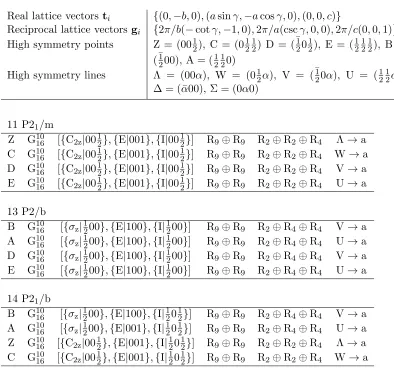
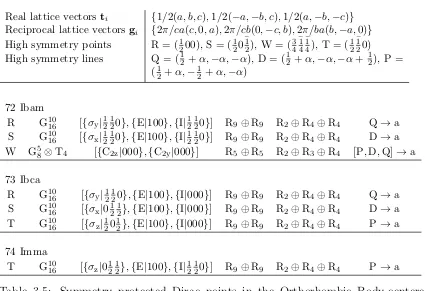
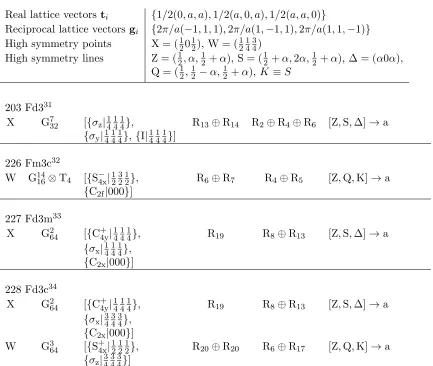
3.1 Tables of symmetry protected Dirac points . . . 40
3.2 Notes to Tables of Symmetry Protected Dirac Points . . . 61
4 Material realizations of Dirac semimetals . . . 65
4.1 Dirac points in the diamond lattice . . . 67
4.3 Chain model of 3D Dirac points . . . 79
5 Fermi surface of tensile-strained zincblende lattice . . . 87
5.1 Representations of the zincblende lattice . . . 88
5.2 Symmetry breaking in zincblende and Fermi surface . . . 90
5.2.1 Spin texture fromk·p theory . . . 94
5.2.2 Spin texture at the microscopic level . . . 100
6 Conclusions and Outlook . . . 104
APPENDIX . . . 109
LIST OF TABLES
2.1 Rotation eigenvalues of a p3/2 quadruplet for crystallographic rotation
symmetries. . . 16
3.1 Symmetry protected Dirac points in the Monoclinic Primitive Lattice 40
3.2 Symmetry protected Dirac points in the Monoclinic Base-centered Lattice 41
3.3 Symmetry protected Dirac points in the Orthorhombic Primitive Lattice 42
3.4 Symmetry protected Dirac points in the Orthorhombic Base-centered
Lattice . . . 45
3.5 Symmetry protected Dirac points in the Orthorhombic Body-centered
Lattice . . . 46
3.6 Symmetry protected Dirac points in the Orthorhombic Face-centered
Lattice . . . 47
3.7 Symmetry protected Dirac points in the Tetragonal Primitive Lattice 48
3.8 Symmetry protected Dirac points in the Tetragonal Body-centered
Lat-tice . . . 54
3.9 Symmetry protected Dirac points in the Trigonal Primitive Lattice . 56
3.10 Symmetry protected Dirac points in the Hexagonal Primitive Lattice 57
3.11 Symmetry protected Dirac points in the Cubic Primitive Lattice . . . 58
3.12 Symmetry protected Dirac points in the Cubic Face-centered Lattice 59
LIST OF ILLUSTRATIONS
1.1 Dirac, Weyl and insulating phases in the diamond lattice . . . 3
1.2 Dirac points in graphene . . . 4
1.3 3D Dirac semimetal in β-cristobalite BiO2 . . . 6
1.4 Schematic illustration of Dirac points arising due to band inversion and stabilized by rotation symmetry . . . 7
1.5 Fermi surface of an isotropic Weyl point . . . 10
2.1 Chern number modulon of a Dirac point occurring at a time reversal symmetric momentum in the presence of a 2π/n rotation symmetry. . 34
2.2 Rotational elements of the cubic point group . . . 35
2.3 Linear splitting of fourfold degenerate irreducible representations . . . 36
4.1 Brillouin zone (BZ) of the FCC lattice . . . 66
4.2 Band structure of β-cristobalite SiO2 . . . 70
4.3 The β-cristobalite structure of SiO2 (BiO2) . . . 71
4.4 Band structure of β-cristobalite AsO2 . . . 72
4.5 Band structure of β-cristobalite SbO2 . . . 73
4.6 Band structure of β-cristobalite BiO2 . . . 74
4.7 Band structure of an s-state model on the diamond lattice . . . 75
4.8 Brillouin zone (BZ) of the distorted spinels lattice . . . 76
4.9 The spinel lattice structure . . . 77
4.10 The distorted spinel lattice structure . . . 78
4.11 Bi chains parallel to the y-axis in the distorted spinel structure . . . . 79
4.13 Band structure of BiZnSiO4 in the distorted spinel structure . . . 81
4.14 Band structure of BiMgSiO4 in the distorted spinel structure . . . 82
4.15 Band structure of BiCaSiO4 in the distorted spinel structure . . . 83
4.16 Band structure of BiAlInO4 in the distorted spinel structure . . . 84
4.17 Projected density of states near the Dirac point in the ZnBiSiO4structure 85 4.18 Angular portion of the Dirac point wavefunctions of BiZnSiO4 . . . . 85
4.19 Depiction of the p-orbital nature of the Dirac point wavefunctions of BiZnSiO4 . . . 86
5.1 Band structure of HgTe . . . 88
5.2 Threefold accidental degeneracies in HgTe . . . 89
5.3 Band structure of HgTe under compressive strain along the (111) axis 92 5.4 Band structure of HgTe under tensile strain along the (111) axis . . . 93
5.5 Band inversion due to spin-orbit coupling in HgTe . . . 94
5.6 Band dispersion in tensile strained HgTe at the Fermi level as a function of momentum along the (111) axis . . . 95
5.7 k·p band structure along the (111) axis in zincblende . . . 96
5.8 Spin texture on the Fermi surface of tensile strained HgTe predicted byk·p theory . . . 97
5.9 Band structure of Hg0.5Zn0.5Te . . . 100
5.10 Band dispersion at the Fermi level in near the accidental degeneracies along the (111) axis in Hg0.5Zn0.5Te . . . 101
5.11 Spin texture on the Fermi surface of Hg0.5Zn0.5Te at theab initio DFT level . . . 102
PREFACE
This dissertation is based on research conducted at the University of Pennsylvania
during the period from 2010 through 2014. A bulk of ideas presented here have
already appeared in the following journal articles, which we attach as appendices at
the end of this dissertation for reference,
1. Dirac semimetal in three dimensions. (Young et al., 2012)
2. Spin texture on the Fermi surface of tensile-strained HgTe.(Zaheer et al., 2013)
3. Bulk Dirac points in distorted spinels.(Steinberg et al., 2014)
Certain passages that appear in Chapters 4 and 5 have been quoted verbatim from
the above papers.
Chapter 1 begins with an introduction to the idea of Dirac points, defines what we
mean by symmetry protected Dirac semimetals, and contrasts them with topological
Dirac semimetals and Weyl semimetals. Chapter 2 describes the underlying theory
behind the existence of three dimensional Dirac points. Section 2.2 introduces the
representation theory of spacegroups while Section 2.3 demonstrates methods to
con-struct Dirac Hamiltonians given a specific group representation. Brief references to
the contents of Chapter 2 have appeared in the journal articles and presentations
given by this author but a complete description of the underlying theory as it is
applied to three dimensional Dirac points in crystalline solids appears in this
disser-tation for the first time. Therefore, I have attempted to give as many details of the
Chapter 3 provides a complete list of all the Brillouin zone momenta in the 230
space-groups that can host Dirac points. Besides the high symmetry points, the list includes
other details about every little group to make our description self-contained and avoid
the need for reference books to go along with the reading of this dissertation. Group
character tables and representative operators are, however, omitted. Representation
theory of crystallographic spacegroups is a fascinating subject studied by many
au-thors, an unhappy consequence of which has been an abundance of notation used to
classify symmetry groups and their attributes. We have not attempted to create a
new naming convention however, and used notation chosen by Bradley and Cracknell
(1976).
Chapters 4 and 5 contain most of the results already published in the journal articles
mentioned above. To this end, the author is indebted to the efforts and
contribu-tions of his collaborators and has borrowed from their results to make the description
self-contained. We would be remiss without acknowledging that almost all the
den-sity functional theory calculations were performed by Dr. Steve Young, Ms. Julia
Steinberg, and Mr. Daniel Cellucci. Certain key details concerning the derivation of
k·p theories that were omitted in the journal articles listed above have been added
to Chapters 4 and 5.
Chapter 6 concludes with a review of some fascinating research on the physics of Dirac
points that has come to the fore after our seminal study (Young et al., 2012). We
discuss a number of unanswered questions with the hope of inspiring further research
Chapter 1
Introduction
This dissertation is devoted to the study of Dirac points in three dimensional solids
arising as a consequence of crystallographic symmetry. Following the discovery of
topological insulators in two (Kane and Mele, 2005a,b; Konig et al., 2007) and three
dimensions (Hasan and Kane, 2010; Fu et al., 2007; Moore and Balents, 2007; Roy,
2009; Zhang et al., 2009; Hsieh et al., 2009), there has been considerable interest,
besides numerous related topics, in the study of semimetallic phases that mediate
the phase transition (band inversion) between a topological and a normal insulator.
In a three dimensional solid, a band inversion tuned by a single parameter can be
described in terms of a pseudorelativistic Dirac-like Hamiltonian, where energy is
linearly proportional to momentum and the size of the mass term sets the band gap
while its sign distinguishes between the topology of the band insulator (Murakami,
2007; Young et al., 2011). We are interested in the special case when the mass
term equals zero, and the ensuing band degeneracy looks like a point with linearly
dispersing energy bands as a function of momentum.
Thus we define a Dirac semimetal as a material where the Fermi surface consists of
fourfold degenerate points at specific momenta in the Brillouin zone (BZ) and the
en-ergy bands disperse linearly as a function of momentum in the vicinity of these points.
Throughout the following pages, we assume that spin-orbit coupling is present and,
consequently, the fourfold degeneracy includes spin. This distinction is not absolutely
necessary and Dirac semimetals may well arise in systems where spin-orbit coupling
possibility in order to allow the Dirac semimetal to make contact with topological
insulating as well as normal insulating states. We make such restrictive assumptions
to focus on systems that lie at a multi-critical point between various insulating as
well as semimetallic phases; for example, breaking symmetries or tuning
phenomeno-logical parameters can turn a Dirac semimetal into a topophenomeno-logical insulator, a Weyl
semimetal, a quantum Hall insulator, as well as a quantum anomalous Hall
insula-tor (Xu et al., 2011) in addition to a normal insulainsula-tor. Figure 1.1 shows the various
topological insulating and semimetallic phases obtained by adding perturbations to
the Dirac semimetal state in BiO2. Therefore, it is a valuable exercise to try to
iden-tify crystallographic systems that exhibit Dirac points and design materials within
these systems that exhibit those Dirac points on the Fermi surface. This we have
attempted to do in this dissertation.
Our study has also been motivated by the remarkable electronic properties due to
the two dimensional Dirac points at the Fermi energy in graphene (Fig. 1.2). The
theoretical study of graphene goes back many decades (Wallace, 1947), but its
experi-mental realization ten years ago (Novoselov et al., 2004) sparked tremendous research
activity leading to many important advancements in condensed matter physics and
elsewhere (Castro Neto et al., 2009). Dirac points in graphene are protected by a
com-bination of time reversal and inversion symmetries. Although both time reversal and
inversion are symmetries of bulk graphene, the special points (zone corners) where
the Dirac points occur are not invariant under either time reversal or inversion
sepa-rately. However, the zone corners are invariant under a product of time reversal and
inversion and this product symmetry protects the Dirac point. We further note that
the Dirac points in graphene are not protected in the presence of spin-orbit coupling;
+
-+
+
-X
W
(2) (3) (4)
(1)
B
Figure 1.1: Dirac, Weyl and insulating phases in the diamond lattice indicated by conical bands shown on a Brillouin zone face. Figure 4.1 shows the full Brillouin zone of the diamond lattice. (1) States at the Dirac point at X span a four dimensional projective representation of the little group at X. (2) Four Weyl points on the zone face due to a small inversion breaking perturbation. The Chern number of each Weyl point is indicated. (3) Two Weyl points appear on the line from X to W for a
time-reversal-symmetry-breaking Zeeman fieldBoriented along that direction. Boriented
along other directions gaps the Dirac point because of broken rotation symmetry. (4) Gapped phase obtained by breaking the fourfold rotation symmetry or by applying a magnetic field in any direction except along ˆx, ˆy, or ˆz. The insulating phase can be a normal, strong or a weak topological insulator (Fu et al., 2007).
and Mele, 2005b). The three dimensional Dirac points discussed in this dissertation
are protected despite the presence of spin-orbit coupling.
It is natural to ask whether the physics of graphene can be extended to a three
dimensional solid. The degeneracy of bands that mediate the transition between the
topological and normal insulating phase in Bi2Se3 provides an example (Young et al.,
2011) of such a three dimensional Dirac point. But this Dirac point is not protected
by any symmetries. Therefore, we ask if it is possible to find a realistic system where
a three dimensional Dirac point is protected by a symmetry, as in graphene. A
phenomenological model of s-electrons on the diamond lattice provides an existence
proof for such a three dimensional Dirac point (Fu et al., 2007), underlying most of
Figure 1.2: Dirac points in graphene. Energy bandsE(k) in a phenomenological tight-binding model are plotted as a function of the two dimensional momentum coordinates
(kx, ky). Valence and conduction bands are degenerate at the zone corners and the
bands disperse linearly in k around those points. Degeneracy at the zone corner
is protected by the product symmetry PΘ where P and Θ are inversion and time
reversal symmetries respectively.
1.1. Types of Dirac points
Since the publication of our seminal study of symmetry protected Dirac points in a
three dimensional material (Young et al., 2012), a number of authors have investigated
other mechanisms under which Dirac points may arise (Wang et al., 2012, 2013). At
the outset, we outline differences and similarities between the research presented here
and results obtained by other authors.
• Symmetry protected Dirac points. These Dirac points occur at high
metry points in the Brillouin zone and are protected by crystallographic
sym-metries. Addition of a mass term to the effective Hamiltonian is analogous to
breaking a crystallographic symmetry and can give rise to strong topological,
weak topological, and normal insulating as well as the Weyl semimetal phase.
Such Dirac points have been shown to exist using density functional theory
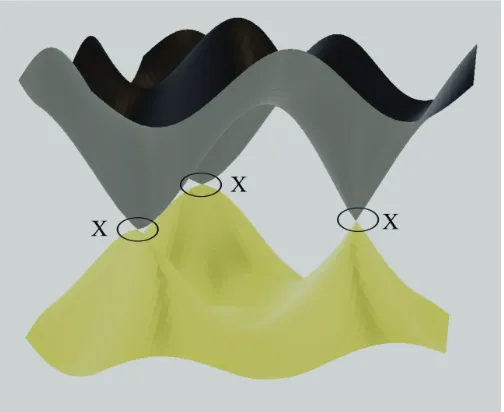
et al., 2012; Steinberg et al., 2014). Figure 1.3 shows the three Dirac points
on the Fermi surface of BiO2 on a specific plane in the BZ that connects the
three X points. Symmetry protected Dirac points are yet to be discovered
experimentally.
• Dirac points due to band inversion. These Dirac points can occur anywhere
in the BZ as long as inversion symmetry is present and a phenomenological
pa-rameter such as the strength of the spin-orbit coupling or tensile strain etc. is
tuned to a critical value. Addition of a mass term to the effective Dirac
Hamil-tonian is analogous to perturbing the value of a phenomenological parameter
and can give rise to strong topological, weak topological, and normal
insulat-ing as well as the Weyl semimetal phase. Examples of such Dirac points are
generally found during the phase transition between a topological and a normal
insulator (Young et al., 2011; Sa et al., 2012; Liu et al., 2014a). A bulk Dirac
point at the topological quantum phase transition was reported experimentally
in TlBi(S1−xSex)2 (Sato et al., 2011) upon the acquisition of a mass gap by the
surface Dirac cone as the bulk bands tuned into the normal insulating regime.
• Dirac points due to band inversion and symmetry. These Dirac points
occur along high symmetry lines in the BZ such as threefold or fourfold rotation
axes, but the occurrence of a high symmetry line is not sufficient to guarantee
their existence. A critical ingredient is the tuning of a phenomenological
pa-rameter such as spin-orbit coupling or tensile strain to a range of critical values
such that bands with distinct eigenvalues under said rotation symmetry
inter-sect with each other and are protected from hybridizing due to the orthogonality
of their representations under the rotation group. Addition of a mass term to
Figure 1.3: 3D Dirac semimetal in β-cristobalite BiO2. Although the Dirac points
are three dimensional, the conduction and valence bands E(kk, k⊥) are plotted as a
function of kk while k⊥ is fixed and defines a plane connecting the three X points in
the BZ (Fig. 4.1). Each band is twofold degenerate due to inversion symmetry. Dirac points appear at the center of the three zone faces of the BZ.
rotation symmetry protecting the degeneracy between inverted bands and can
give rise to a strong topological, weak topological, or a Weyl semimetal phase.
These Dirac points come in pairs, and cannot be gapped to obtain a normal
insu-lator under weak perturbations. Therefore, such Dirac points have been termed
topological. Figure 1.4 provides a schematic illustration of the mechanism
be-hind topological Dirac semimetals. Thus far, topological Dirac semimetals have
been predicted to exist in Cd3As2,Na3Bi,K3Bi and Rb3Bi (Wang et al., 2012,
2013), while Cd3As2 and Na3Bi have been found to exhibit bulk three
dimen-sional Dirac points experimentally (Neupane et al., 2014; Borisenko et al., 2013;
Liu et al., 2014b).
The focus of this dissertation is on symmetry protected Dirac points. In particular,
E(
k
)
k
zFourfold degeneracy
G
a
ppe
d s
ta
te
s
du
e
t
o l
a
c
k of
r
ot
a
ti
on
s
ym
m
e
try
Increasing band inversion
Figure 1.4: Schematic illustration of Dirac points arising due to band inversion and stabilized by rotation symmetry. Schematic conduction and valence bands plotted
as a function of kz where kz is an axis of rotation symmetry. Bands invert relative
to each other as a parameter is tuned from left to right. The bands intersect on a surface in three dimensional momentum space, but hybridize except on points where
the surface intersects the rotation axis kz because both bands belong to orthogonal
representations of the rotation group along kz.
Dirac cones among the representations of a specific spacegroup. Once the symmetry
criteria is established, we will discuss empirical design principles that could be applied
to elements of the periodic table to engineer a material such that the Dirac cone
appears at the Fermi energy and there are no additional non-Dirac-like states at
the Fermi level. We note that this approach is somewhat distinct from the path
taken to find topological insulators or topological Dirac semimetals where the ‘rules
of thumb’ include looking for materials with heavy atoms (strong spin-orbit coupling)
as well as the existence of orthogonal orbitals (s and p; p and d, or a combination
thereof) in the vicinity of the Fermi energy. The presence of s and p orbitals near
in the presence of strong spin-orbit coupling. For example, in HgTe and in CdTe
without spin-orbit coupling, valence orbitals nearest to the Fermi energy are p-like
whereas the conduction orbitals nearest to the Fermi energy are s-like. As spin-orbit
coupling is introduced, the s-singlet turns into as s1/2-doublet, whereas the p-triplet
splits into a p3/2-quadruplet and a p1/2-doublet. Ordinarily, one would expect the
s1/2 doublet to lie above the p-states in energy. This is exactly the case in CdTe.
However, the stronger spin-orbit coupling in HgTe pushes the s1/2-doublet below the
p3/2-quadruplet in energy resulting in an ‘inversion’ of the band order (Bernevig et al.
(2006) and Fig. 5.5). This ‘inversion’ of the band ordering is necessary to realize both
a topological insulator, and a topological Dirac semimetal (Fig. 1.4). Approaches to
find such systems are driven by looking for materials that could realize such a band
inversion.
The search for symmetry protected Dirac semimetals takes a different path as we
show in the Chapters that follow. Prior discussion has also made mention of Weyl
semimetals, which are another kind of three dimensional topological semimetals. In
the following Section, we describe Weyl semimetals and distinguish them from Dirac
semimetals.
1.2. Weyl Semimetals
Weyl semimetals derive their name from the similarity of their effective Hamiltonian
at the Fermi level with the Weyl Hamiltonian of particle physics (Wan et al., 2011;
Burkov and Balents, 2011). In three spatial dimensions, the massless Dirac
Hamilto-nian decouples into two copies of a Weyl HamiltoHamilto-nian each carrying opposite charge.
Such a two state Hamiltonian can also describe a point where two energy bands are
The Weyl Hamiltonian describing such a twofold degeneracy at a point k1 in the BZ
can be written as,
H(k) = (kx−k1x)σx+ (ky−k1y)σy + (kz−k1z)σz, (1.1)
where σi are the usual Pauli matrices. Within the two-state space, any perturbation
to this Hamiltonian will be proportional to a linear combination of the Pauli matrices.
Such a perturbation, however large, only shifts the degeneracy away fromk1 and can
never gap the system. Hence, the Weyl Hamiltonian of Eq. (1.1) is protected against
all perturbations. This fact can be quantified by assigning this particular Hamiltonian
a topological number, or a charge. In this case, the topological number is the first
Chern number of states on the Fermi surface (Fig. 1.5) of the Weyl Hamiltonian. The
Chern number of a Weyl Hamiltonian can be calculated using,
n = 1
2πi
Z
∂S
da· ∇ × hψEF(k)|∇|ψEF(k)i (1.2)
where the surface ∂S in k-space is defined by solving H(k)ψ(k) = EFψ(k) for fixed
EF. In a general basis, the Weyl Hamiltonian, H(k) = Pijvijkiσj, and the Chern
numbern = sgn(det[vij]). The Chern number of the Hamiltonian in Eq. (1.1) is +1.
In the presence of time reversal symmetry, every state at khas a Kramers partner at
−k. Therefore, a Weyl degeneracy located at a pointk1, described by Eq. (1.1), has
a counterpart at −k1. Under time reversal symmetry, the orientation of the surface
integral in Eq. (1.2) changes sign. However, time reversal is anti-unitary, so the Chern
number of the two Weyl points atk1 and−k1 is the same i.e. +1. On the other hand,
the presence of time reversal symmetry mandates that the total Chern number of the
k
zk
yk
x
E
F
Figure 1.5: Fermi surface of an isotropic Weyl point centered at the origin. A nonzero
Chern number implies the existence of a singularity (charge ±1) within the surface.
at points k2 and −k2 with Chern number−1.
We conclude that a Weyl semimetal in the presence of time reversal symmetry
ex-hibits at least four (or multiples of four) point-like twofold degeneracies at the Fermi
surface and the energy bands disperse linearly in all three directions around the Weyl
points (Hal´asz and Balents, 2012). If inversion symmetry is present, the orientation
of the surface integral in Eq. (1.2) changes sign so the Chern numbers at k1 and
−k1 have opposite sign because inversion is unitary. Therefore, when both inversion
and time reversal symmetry are present, k1 =k2, and instead of four distinct twofold
point-like degeneracies, we have two distinct fourfold point-like degeneracies described
by a massless Dirac equation unless k1 is time reversal symmetric in which case there
will be only one fourfold point-like degeneracy. Such a system will be described by
a massless Dirac Hamiltonian, and defines a Dirac semimetal. In summary, we note
the following differences between Weyl and Dirac semimetals,
• Weyl semimetals exhibit twofold whereas Dirac semimetals exhibit fourfold
• Unlike symmetry protected Dirac points, Weyl points either come in a pair
of two (if inversion symmetry is present) or two pairs of two (if time reversal
symmetry is present).
• Weyl points are topologically protected (nonzero Chern number) whereas Dirac
points are not protected (zero Chern number). However, the existence of a
nonzero topological number in the bulk signals the presence of surface states
due to the bulk boundary correspondence. Therefore, Weyl semimetals
ex-hibit topologically protected Fermi arcs on the two dimensional boundary of a
system (Wan et al., 2011; Burkov and Balents, 2011), whereas Dirac
semimet-als do not exhibit any topologically protected surface states. Topological Dirac
semimetals, described above, exhibit Fermi arcs because they are perturbatively
connected to topological insulators (Wang et al., 2012, 2013).
The central question addressed in this dissertation is whether there exists a
sym-metry that might protect a Dirac point because, as discussed above, a Dirac point
is a combination of two Weyl points with opposite Chern number and is not
pro-tected topologically. Note that it is also possible for Weyl points of the same Chern
number to be degenerate. In such a situation, the degeneracy can be stabilized by
a point group symmetry, as we will show explicitly for threefold rotation
symme-try in Section 2.3. Such semimetals are topological in nature and have been termed
Chapter 2
Symmetry protected Dirac points in three
dimensions
A Dirac point occurs when four energy bands are degenerate at a point k0 such
that each band disperses linearly to lowest order in k about k0 (Young et al., 2012).
In such a case, the low energy effective Hamiltonian can be written as a four band
Dirac Hamiltonian H(k) = P
ivi(ki −k0,i)γi centered at k0 where {γj} are 4×4
Hermitian matrices and vi are Fermi velocities. The central question underlying the
existence of a Dirac Hamiltonian at k0 is whether vi 6= 0 for alli. The space of 4×4
Hermitian matrices is spanned by a basis of 16 Hermitian matrices that consist of
the identity matrix, 5 Dirac matrices Γa, and their 10 commutators Γab = [Γa,Γb]/2i.
We choose a basis such that Γ(1,2,3,4,5) = {τ
x ⊗I, τz ⊗I, τy ⊗σx, τy ⊗σy, τy ⊗σz},
where {τi} and {σj} are the usual 2×2 Pauli matrices. If {σi} denotes the spin
degree of freedom, the time reversal operator can be chosen to be Θ = iσyK where
K denotes complex conjugation. It follows that the Dirac matrices Γa are even under
time reversal symmetry whereas their commutators Γab are odd. Therefore if k0 is
time reversal symmetric (k0 ≡ −k0up to reciprocal lattice translations), the matrices
γi must be linear combinations of the 10 commutators Γab. This is an example of a
symmetry constraining the space of possible 4×4 Hermitian matrices in a Dirac-like
Hamiltonian.
Other symmetries can further constrain which Dirac matrices might appear in the
the form,
H(k) =vx(kx−k0,x)γx+vy(ky −k0,y)γy +vz(kz−k0,z)γz (2.1)
where γi are chosen from the set {Γa,Γab}. In principle, the Dirac point at k0 can
be gapped by a mass term proportional to one of the matrices in the set {Γa,Γab}
unless that matrix violates a symmetry at k0. Therefore, if it can be shown that all
possible mass terms break at least one symmetry atk0, the Dirac point is protected
under all symmetry preserving perturbations. Thus one can identify the symmetry
groups which allow Dirac points to exist. This method is tedious because, as we
show later, it requires complete knowledge of regular and projective four dimensional
irreducible representations of spacegroup elements. Regular representations of
space-groups can be calculated by choosing representative operators of those elements of
a four dimensional irreducible representation of SU(2) that belong to the 32 point
groups. Projective representations ofSU(2) require knowledge of a factor system that
governs multiplication rules between all the unitary operators in the representation.
In the theory of spacegroups, the factor system arises from knowledge of translations
within a unit cell. But the existence of a unit cell and consequent spatial
periodic-ity restricts SU(2), or rather accurately SO(3), to a set of finite subgroups (the 32
point groups). Since we are concerned with spacegroups, direct calculation of the
finitely many projective representations (with all possible factor systems) of the 32
point groups appears to this author a simpler task than calculating possibly infinitely
many projective representations of SU(2).
Fortunately, this has been done by many authors during the last century (Bradley and
Cracknell (1976) and references therein). Our task is to understand the underlying
for four dimensional irreducible representations (FDIRs) among the double-valued
representations of all the 230 spacegroups and then apply certain group theoretic
criteria to classify a subset of the FDIRs which allow linear dispersion in all directions
and carry zero total Chern number. This method is equivalent to the more direct
path outlined earlier.
This Chapter is organized as follows. In Section 2.1, we describe the relationship
between the Chern number of a FDIR and rotational symmetries within the symmetry
group at the Dirac point. We develop a simple test based on rotation eigenvalues of
states along a rotation axis to predict whether a certain FDIR will carry nonzero total
Chern number. This we call the ‘Chern number test’. In Section 2.2 we introduce
the representation theory of spacegroups and prove that symmetry protected Dirac
points can only arise as projective representations of point groups on the face of
the Brillouin zone. In Section 2.3 we show explicitly that the cubic point groups
do not allow three dimensional Dirac points in their representations. The remaining
point groups do not have enough symmetry to exhibit FDIRs among their regular
representations, although the non-cubic point groups exhibit FDIRs among their
projective representations. In Section 2.4 we show that the Kronecker product of a
FDIR with the vector representation of the symmetry group can be used to ensure
that the FDIR splits linearly in all directions. This completes all steps necessary to
identify symmetry protected Dirac points in the 230 spacegroups.
2.1. Chern number and Dirac points
A Dirac point is guaranteed to have zero total Chern number if it is known to be a
combination of two Weyl points with opposite Chern numbers, but a given FDIR is
FDIR at a time reversal symmetric momentum can be calculated up to an integer
if the momentum in question lies on a rotation symmetry axis. This relationship
between Chern numbers and rotation eigenvalues can be used to test whether FDIRs
at time reversal symmetric momenta have nonzero total Chern number. Most FDIRs
occur on time reversal symmetric momenta, so the Chern number test applies. We find
that whenever the symmetry group at a time reversal symmetric momentum contains
threefold rotation symmetry, any FDIR at that point cannot have zero Chern number.
For FDIRs at non-time reversal symmetric momenta, the Chern number needs to be
calculated explicitly.
The total Chern number of the Fermi surface in systems with time reversal symmetry
must be zero. Therefore, if a Dirac point carries nonzero Chern number (a multi-Weyl
point), there must exist additional Fermi surface to cancel the excess Chern number.
Such Fermi surface might obscure the physics due to the Dirac point, although the
extent to which that might happen is a question yet to be addressed. We are going to
require that candidate FDIRs for Dirac points should have zero total Chern number.
Given a time reversal symmetric k0, the Chern number of a linearly dispersing FDIR
(if one exists) at k0 can be determined using the rotation eigenvalues of states on a
rotation symmetry axis that goes through k0. We label such a rotation symmetry
axis as ˆk. The four degenerate states that span the FDIR at k0 can be represented as
ap3/2 quadruplet. The states|ψ(k0+αkˆ)iare eigenvectors of the rotation operator,
whereα is a real parameter. For a 2π/n rotation symmetry, their eigenvalues will be
ei2πj/n where j ={±3/2,±1/2}. On a crystal lattice where n={2,3,4,6}the set of
possible rotation eigenvalues is finite, as shown in Table 2.1.
Since k0 is invariant under time reversal symmetry, rotation eigenvalues of states
n 2 3 4 6 j exp2πij/n expπij exp2πij/3 expπij/2 expπij/6
1/2 expπi/n i expiπ/3 expiπ/4 expiπ/6
3/2 exp3πi/n −i −1 expi3π/4 i
Table 2.1: Rotation eigenvalues of a p3/2 quadruplet for crystallographic rotation
symmetries.
Time reversed states for half integer spin are orthogonal to each other and cannot
be related by a phase. In a three dimensional metal, states at the same energy lie
on a closed surface in momentum space. If states on the North and South poles
of a constant energy surface (defined by points where the rotation symmetry axis
intersects the surface) are Kramers partners, it is not possible to relate them by
a phase that varies continuously over the surface. In other words, there exists a
Kramers degeneracy at the time reversal symmetric momentumk0. The existence of
this degeneracy implies that the constant energy surface must have a nonzero Chern
number. We defined the Chern number in Eq. 1.2 as,
nk0 = 1 2πi
XZ
∂S
d2k nˆk.∇k× hψi(k)|∇k|ψi(k)i (2.2)
where ∂S is a closed surface enclosing the point k0 in momentum space defined by
H(k)ψ(k) = EFψ(k) for fixed EF, ˆnk is the unit normal pointing out of the surface,
and the sum runs over all states ψ(k) on the surface ∂S with energy EF.
In a two band framework, the Chern number of a surface that bisects an n-fold
rotation axis is given by (p−q) mod n where expi2πp/n and expi2πq/n are rotation
eigenvalues of states on the North and the South pole. If these are related by time
reversal symmetry,q=−p, and the Chern number is 2p mod n. In ap3/2 quadruplet,
we have two pairs of Kramers partners on the North and South poles. Therefore, the
from the set {±3/2,±1/2}.
Figure 2.1 describes all the possibilities forpandp0. Ifn= 3,6 the fourfold degeneracy
can split into four single bands [Figs. 2.1(a) and (b)] only, and the Chern number is
2 mod n where n = 3,6. It is not possible for the fourfold degeneracy to split into
twofold degenerate bands with nonzero linear dispersion whenever threefold or sixfold
rotation symmetry are present. It is possible for the fourfold degeneracy to split into
a twofold degenerate band and a pair of nondegenerate bands [Fig. 2.3(c)] in which
case the Chern number will be 0 mod n for n = 3,6 but the twofold degenerate
band disperses quadratically as in zincblende (Section 5.1). The dispersion shown in
Figure 2.3(c) does not constitute a Dirac semimetal.
For twofold and fourfold rotation symmetries, the fourfold degeneracy can split into
either singlets or doublets [Figs. 2.1(c) and (d)] and in either case the Chern number
is 0 mod n for n = 2,4. Therefore, we can draw the following conclusions:
• In the presence of a threefold or sixfold rotation symmetry, the Dirac point
splits into four nondegenerate bands and carries nonzero Chern number.
• In the presence of twofold or fourfold rotation symmetry, the Dirac point splits
either into four nondegenerate bands or twofold degenerate bands and carries
zero Chern number.
Therefore, all time reversal symmetric momenta lying on a threefold or sixfold
sym-metry axis cannot host a Dirac point. The vast majority of BZ momenta which
host FDIRs are time reversal symmetric so the Chern number test is sufficient (see
Section 3.1). For non-time reversal symmetric momenta, the Chern number can be
calculated explicitly by choosing an appropriate Dirac Hamiltonian. Section 2.3 shows
momentum.
2.2. Irreducible representations of double spacegroups
We are interested in finding BZ momenta which host four dimensional irreducible
representations (FDIRs). The representation theory of spacegroups has been studied
extensively by many authors (Bradley and Cracknell (1976) and references therein).
Relevant facts such as little groups of each BZ momentum and their character
ta-bles along with the identification of single and double valued representations that
can occur with and without time reversal symmetry have been collected (Bradley
and Cracknell, 1976). Since we will make use of these ideas extensively, we devote
this Section to exploring how four dimensional representations arise at time reversal
symmetric momenta without a threefold symmetry. We begin with a description of
the representation theory of spacegroups. Our main conclusion is that symmetry
protected Dirac points can only exist in nonsymmorphic spacegroups and that on the
surface of the BZ. This does not rule out cases where Dirac points arise on rotation
symmetry axes inside the BZ due to band inversion (Wang et al., 2012, 2013).
The translational symmetry of a crystal lattice implies that we can index the
repre-sentations of a spacegroup G by a momentum k confined to the BZ. Therefore at a
momentum k, the Bloch states |ψ(k)i span irreducible representations of the little
group Gk which consists of operations in G that preservek. Since G is a spacegroup,
it consists of operations which can be denoted by {R|t}where R implements a
rota-tion andtimplements a translation of the lattice. The action of G on Bloch states can
be represented as, {R|t}ψ(k,x) =ψ(Rk,x−t). Rkand kare equivalent if Rk−k
equals a reciprocal lattice vector; we can then write {R|t}ψ(k,x) = exp−ik·tψ(k,x).
the little group Gk.
There are two kinds of spacegroups: symmorphic and nonsymmorphic. Symmorphic
spacegroups consist of point group rotations coupled with Bravais lattice translations.
Therefore every element{R|t}in a symmorphic spacegroup can be written as{R|t}=
{E|t}{R|0} under the multiplication rule of spacegroup operators,
{R1|t1}{R2|t2}={R1R2|R1t2+t1}, (2.3)
where E is the identity element. Note that {E|t}{R|0} 6= {R|0}{E|t}. Therefore
symmorphic spacegroups can be written as a semidirect product of a point group with
a translation group. There are 14 distinct Bravais lattices, each exhibiting specific
point group symmetry. All appropriate semidirect group combinations of the 32 point
groups with the 14 Bravais lattices yield 73 symmorphic spacegroups.
Nonsymmorphic spacegroups cannot be written as semidirect products of a point
group with a translation group. They contain spacegroup operators wherein
rota-tions are coupled with nonprimitive lattice translarota-tions like a screw axis or a glide
plane. The nonprimitive translations accompanying a specific point group operation
depend on a choice of coordinates. However, no choice of coordinates exists that will
render all point group operations independent of nonprimitive translations. A well
known example of a nonsymmorphic spacegroup in three dimensions is diamond. The
diamond lattice consists of two identical interpenetrating FCC lattices separated by
the vector 1/4(1,1,1) from each other. Inversion (I) of coordinates about a point
on one sublattice translates the origin of the other sublattice by a vector -1/2(1,1,1)
so the entire lattice must then be translated back by 1/4(1,1,1) to realize the initial
the accompanying translation vector is nonprimitive, the two individual operations,
inversion and translation by 1/4(1,1,1), cannot be decoupled from each other. It
is possible to redefine the coordinate system so that the exchange of sublattices in
diamond is accomplished by inverting about a bond center at 1/8(1,1,1). In this
case, inversion becomes a symmorphic operation, however certain other rotation and
mirror symmetries are rendered nonsymmorphic. There does not exist a choice of
coordinates for which all the point group operations in diamond can be written as
purely symmorphic operations. This is a defining characteristic of nonsymmorphic
spacegroups of which there are 157 in total.
Representations of a symmorphic spacegroup follow from those of the corresponding
point group. Recall that for a symmorphic operation,
{R|t}ψ(k,x) = {E|t}{R|0}ψ(k,x) =e−iRk·tψ(Rk,x).
We can draw two conclusions from this: first, representations of symmorphic
space-groups are obtained by multiplying representations of the Bravais lattice and the
corresponding point group; second, representations of the Bravais lattice group are
all one dimensional. Therefore higher dimensional representations of a symmorphic
spacegroup follow directly from those of the 32 point groups.
Among the 32 point groups, only the 5 cubic groups exhibit double-valued FDIRs.
However all cubic groups contain threefold rotation symmetry. It turns out that
cu-bic symmetry only appears at time reversal symmetric momenta in three dimensions.
Therefore even if there is a Dirac point at one of those momenta, it will have nonzero
Chern number due to the threefold symmetry as shown in Section 2.1. FDIRs in
rever-sal symmetric momenta. Therefore, we can conclude that symmorphic spacegroups
cannot host Dirac points.
Nonsymmorphic spacegroups exhibit FDIRs at points k even if the little group Gk
does not contain threefold rotations. Recall that in a nonsymmorphic spacegroup,
Gk cannot be written as a semidirect product of a point group with a translation
group at some points in the BZ. In other words, we cannot decouple the action of
nonsymmorphic operators on state vectors into a rotation and a translation.
Sup-pose the unitary matricesUk(R) represent the action of the nonsymmorphic operator
{R|t} on state vectors |ψ(k)i so that {R|t}ψ(k,x) = e−ik·tU
k(R)ψ(k,x). Then the
multiplication rule (Eq. 2.3) in terms of the matrices Uk can be written as,
e−ik·t2U
k(R1)Uk(R2) = e−ik·R1t2Uk(R1R2)
Uk(R1)Uk(R2) = e−i(R
−1
1 k−k)·t2U
k(R1R2). (2.4)
The phase appearing in Eq. (2.4) is 1 unless t2 is nonprimitive and R−11k−k is a
nonzero reciprocal lattice vector. t2 is nonprimitive (fraction of a lattice translation)
in some elements in nonsymmorphic spacegroups, whereasR−11k=gi+k, wheregi is
a reciprocal lattice translation, holds for momenta only on thesurface of the Brillouin
zone. Eq. (2.4) shows that the matrices Uk form a representation of the operators
{Ri}which corresponds to the rotation counterparts of the elements of the little group
Gk. In fact the set of point group operators {Ri} is always isomorphic to one of the
32 point groups. This holds for both symmorphic and nonsymmorphic little groups.
If, however, the phases in Eq. (2.4) are nonzero, the representation Uk is a projective
representation of a point group with the factor system given by e−i(R1−1k−k)·t2 where
t2 uniquely identifies R2 by association in the spacegroup element {R2|t2}, and R1
A projective representation Γ with factor system µ of a group is defined such that
Γ(g1)Γ(g2) = µ(g1, g2)Γ(g1g2), where {gi} are elements of the group. If µ(gi, gj) = 1
for all i, j, the representation Γ is one of the ordinary representations of the group.
Projective representations generalize the concept of group representation and include
among them all the ordinary representations of a group. A theorem by Schur provides
a prescription to determine projective representations. It stipulates that all projective
representations can be obtained from regular representations of a larger group called
the central extension group obtained by multiplying the original group with an
ap-propriate Abelian group. Therefore the problem of finding projective representations
reduces to finding regular representations of the central extension group and
restrict-ing the representative matrices of the larger group to the elements that correspond
directly to the elements of the original group. Finite groups have only a finite set
of possible factor systems. Thus, one can obtain all projective representations of a
finite group by choosing an appropriate central extension group corresponding to the
finitely many possible factor systems.
Finding the central extension group of a double point group is necessary to identify
irreducible representations of nonsymmorphic spacegroups. Fortunately this has been
done by prior authors in rigorous detail, as noted earlier, so we will be relying
exclu-sively on their results (Bradley and Cracknell, 1976). The extent of our efforts only
goes as far as understanding their theory and interpreting their results without error
(Chapters 3 and 4).
We have noted earlier that only the 5 cubic double groups exhibit four dimensional
representations among their ordinary representations. When we examine projective
representations of the 32 point groups, we find that some of the non cubic groups
key ingredient in realizing Dirac points in three dimensional crystals.
2.3. Hamiltonian construction for symmorphic spacegroups
In this Section we provide, with explicit examples, a method to determine the Dirac
Hamiltonian given a four dimensional irreducible representation of a point group.
Calculations shown in this Section have been repeated in Sections 4.1, 4.2, and 5.2.1
for spacegroups 227 (diamond), 74 (distorted spinels), and 216 (zincblende)
respec-tively. In three dimensions, there are 32 distinct point groups. For reference, we will
use Bradley and Cracknell (1976) for character tables and representative operators
in each irreducible representation. We show how to derive an effective Hamiltonian
given group representative operators if it is supposed that energy and momentum are
linearly related around a point of degeneracy. Among double valued regular
repre-sentations, the cubic group with inversion symmetry Oh, the cubic group O, and the
tetrahedral group with mirror planes Td have four dimensional irreducible
represen-tations. All the remaining 29 point groups have at most two dimensional irreducible
representations. We note that the procedure described in this Section can only be
used to constructregular representations of point groups, and only works for
symmor-phic spacegroups. For nonsymmorsymmor-phic spacegroups, we use representative operators
from Bradley and Cracknell (1976).
The groups O and Td are subgroups of the cubic group with inversion symmetry, Oh.
We begin our discussion by calculating the effective Hamiltonian in the vicinity of
a fourfold degeneracy at a point k0 assuming that the little group Gk0 is Oh. This
situation arises, for example, at Γ(k0 = 0) in spacegroups 221-230. Furthermore,
we assume that the point k0 is symmetric under time reversal. This assumption
representations occur at time reversal symmetric momenta.
In a four band framework, we can express the Hamiltonian in terms of sixteen
inde-pendent Hermitian operators Γµν = τµ ⊗σν ≡ τµσν1 where τµ = {I, τ1, τ2, τ3} and
σν = {I, σ1, σ2, σ3}. σi and τi are the usual 2×2 Pauli matrices. We choose basis
such that the time reversal operator Θ = iΓ02K = iσ2K, where K denotes complex
conjugation. Without loss of any generality, we assume a massless Dirac Hamiltonian
centered at k0,
H(k) = X
i=x,y,z
αikiγi (2.5)
where γi2 =Iand the matrices γi are linear combinations of the Dirac matrices Γµν.
Time reversal symmetry requires H(−k) = P
i=x,y,zαikiΘγiΘ
† which restricts the
matrices γi to be linear combinations of the following set,
{σ1, σ2, σ3, τ1σ1, τ1σ2, τ1σ3, τ2, τ3σ1, τ3σ2, τ3σ3}
The group Oh can be generated by multiplying elements of the cubic group O with
the inversion operation I. The cubic group O consists of the following symmetry
operations and their products: fourfold rotations about the three principal axes of a
cube; threefold rotations about four independent diagonal axes connecting the four
corners of a cube; and twofold rotations about the six independent axes bisecting
opposite edges. Figure 2.2 illustrates our choice of orientation and labeling of
sym-metry axes. The cubic group for particles with half integer spin is isomorphic to
an abstract group with 48 elements (Bradley and Cracknell, 1976). It can be
gener-ated by the following set of operations: C4+z, fourfold anticlockwise rotation about ˆz;
1We omit the tensor product sign
⊗and the identity matrixIfor brevity. Therefore,τµ≡τµ⊗I
¯
C4+x, fourfold anticlockwise rotation about ˆx; andC31+, threefold anticlockwise rotation
about an axis parallel to 1/√3(ˆx+ ˆy+ ˆz). The bar on ¯C4+x implies that its character
χ( ¯C4+x) =−χ(C4+x), although both ¯C4+x and C4+x act identically on real space vectors
such as k. The necessity of two distinct operators to implement fourfold rotations,
for example, is clear if we recall thatSU(2) is a double covering of the rotation group
SO(3). Two distinct elements in SU(2) with characters having opposite signs will
map to one unique element in SO(3).
In SU(2), any rotation by an angleθ about an axis ˆn can be represented byRˆn(θ) =
exp(i ~J · ˆnθ) where the generators J~ satisfy the angular momentum commutation
relations, [Ji, Jj] = iijkJk and J~·J~ = J(J + 1). In a two band system, J = 1/2
whereas in a four band systemJ = 3/2. Additionally, all elements ofSU(2) commute
with the time reversal operator, Θ =iσ2K, which implies the constraint {Θ, Ji}= 0
for i = x, y, z. This is true for the Pauli matrices which is why they can be used to
representJi and to generate the two dimensional irreducible representation ofSU(2).
In a four band system, we choose a convenient basis for the operators J~as follows,
Jx=
0 0 0
√ 3 2 0 0 √ 3 2 0 0 √ 3
2 0 1
√
3
2 0 1 0
, Jy =
0 0 0 −i
√
3 2
0 0 i
√
3
2 0
0 −i
√
3
2 0 i
i√3
2 0 −i 0
,
Jz =
3
2 0 0 0
0 −32 0 0
0 0 −12 0
0 0 0 12
. (2.6)
consider inversion symmetry. If inversion commutes with rotations, as it does for
all symmorphic spacegroups in three dimensions, any operator representing
inver-sion should commute with representations of SU(2). However, according to Schur’s
lemma, any nonzero unitary operator that commutes with all the elements of a finite
dimensional irreducible representation must be proportional to the identity matrix.
Therefore, if we add the operation of inversion to any irreducible representation of
SU(2), the corresponding unitary operator will be −I where I is the identity
ma-trix. In a four dimensional representation, inversion will take the form−Γ00. Schur’s
lemma does not apply for time reversal symmetry because it is antiunitary, hence
although time reversal commutes with SU(2), it is not proportional to the identity
matrix.
Consider the effect of inversion on a 4×4 massless Dirac Hamiltonian. Under inversion
H(−k) =P
i=x,y,zαikiIγiI† 6=−
P
i=x,y,zαikiγi if I commutes with γi. Therefore,
in-version symmetry restricts the Hamiltonian to be even in k in all directions. We
conclude that Dirac Hamiltonians are not allowed at momenta which are
symmet-ric under groups with inversion symmetry, such as Oh. The exception to this rule
occurs in nonsymmorphic spacegroups where inversion symmetry, if present, does
not commute with point group operations because of accompanying nonprimitive
lat-tice translations. For example, in the diamond latlat-tice inversion symmetry not only
changes the sign of coordinates but also exchanges the sublattices. The sublattice
exchange operation does not commute with all rotations, so the operator that
imple-ments inversion symmetry is not required to commute with irreducible representations
of SU(2). As we show later, a Dirac Hamiltonian is allowed in the diamond lattice
despite the presence of inversion symmetry because the diamond lattice is
Subgroups of Oh without inversion symmetry, such as the cubic group O, and the
tetrahedral group with mirror planes Td carry four dimensional irreducible
represen-tations among their regular represenrepresen-tations. We consider the cubic group O first.
As mentioned earlier, the generators of the cubic group are, C4+z = exp(iJz2π/4),
¯
C4+x =−exp(iJx2π/4), andC31+ = exp(i(Jx+Jy+Jz)2π/(3
√
3)). The first two
gener-ators yield sufficient enough constraints to uniquely identify the matricesγi as shown
below.
H(ky,−kx, kz) =
X
i=x,y,z
αikiC4+zγiC+
†
4z =αxkyγx−αykxγy+αzkzγz (2.7)
H(kx, kz,−ky) =
X
i=x,y,z
αikiC¯4+xγiC¯+
†
4x =αxkxγx+αykzγy−αzkyγz (2.8)
H(ky, kz, kx) =
X
i=x,y,z
αikiC¯31+γiC¯31+†=αxkyγx+αykzγy+αzkxγz (2.9)
The above equations lead to a number of constraints. [C4+z, γz] = 0 implies that γz
can be chosen from the set {σ3, τ3σ3}. [ ¯C4+x, γx] = 0 restricts γx to be σ1, while the
condition αxγx =αyC4+zγyC+
†
4z leads toγy =−σ2 and αx =αy. Finally the condition
αyγy =αzC¯4+xγzC¯+
†
4x impliesγz =σ3 andαy =αz. One can easily check that these four
γi also satisfy the constraints due to the threefold symmetry operatorC31+. Therefore,
the Hamiltonian is uniquely identified to be,
H(k) = αzI⊗(kxσ1−kyσ2+kzσ3). (2.10)
This Hamiltonian consists of two copies of the Weyl Hamiltonian each with a charge
−1. Thus it describes a ‘Multi-Weyl’ topological semimetal first discussed in Fang
et al. (2012). The sign of the Weyl charge depends on our choice of orientation but