222 | P a g e
A SMART BUILDING SYSTEM USING RASPBERRY
PI ,ZIGBEE AND GSM TECHNOLOGY.
Rohit Pardeshi
1, Parag Sanyashiv
2,
Prof. Girish Navale
3, Prof. Minal Nerkar
41,2,3,4
Computer, AISSMS’s Institute of Information Technology, Pune.(India)
ABSTRACT
The main aim of this technology is give security and reduce parking problem of less area of building. In day to
day life people are facing the parking problem at building, society, offices, etc. The main Moto of this technique
is only to reduce people problem regarding parking. Purpose of this technique is only that to solve the parking
related issue and give some security to the building. For security purpose we are using image processing
technique for vehicle (car, scooter, etc.) Driver. This technique is more useful to reduce the people problem.
Keywords: Raspberry Pi, Camera, Cam-Scanner, Rfid, Zigbee, Etc.
I.INTRODUCTION
Now-a-days, in our daily life, we face many issues related to car parking in society. Especially, the societies in
cities like Poona, Nagpur, etc. and Metropolitan cities like Mumbai, Chennai, Delhi etc. the issues of parking
and securing the entry of the society is the huge need. Many times a person unknown to the society enters with a
known vehicle, may be the person is relative of a owner in the society, but still it must be recognized at the entry
of the society gate.
To overcome such issues the smart intelligence technology can be used and thus that is the aim of this paper.
II. HISTORY AND BACKGROUND
We have seen in TV news or in the Newspaper about the crimes, such as robbery in a flat, car stolen from a
society even though it have surveillance by watchman. Also on other hand, there is lack of parking area,
unmanaged parking, and car traffic in a society when multiple car starts searching for a single car parking. The
Smart Building System will be reliable and helpful for the watchman as well as the owner to manage security
and parking issues.
III. SYSTEM DESIGN
The main objective of this paper is to show the proper parking area or to indicate whether the particular parking
area is vacant or not. This will overcome the efforts to find the free area again and again. The GSM and ZigBee
223 | P a g e
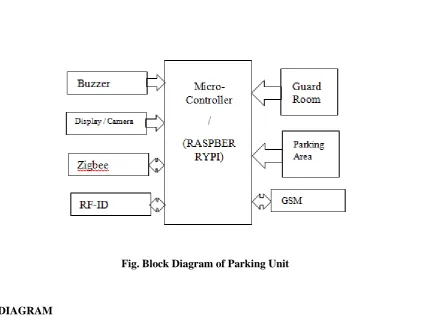
surveillance. Buzzer will be used to indicate a car entered in the society. The RF-ID will recognize the enteredcar and will show to owner details.
Fig. Block Diagram of Parking Unit
IV. DIAGRAM
Fig. Operational Diagram
Input: - It will check some parking area i.e. available parking area.
Operation: - It will check sine parking using GPS, GSM or location detection algorithm.
Output: - We will find out availability of parking.
V. SENSOR
224 | P a g e
Fig.Raspberry pi
The Raspberry Pi 3 Model B has a quad-core 64-bit ARM Cortex A53 clocked at 1.2 GHz. This makes the
Raspberry Pi 3 more 50% faster than the Raspberry Pi 2. In comparison with the Raspberry Pi 2, the RAM and
Graphics Capabilities Remains same provided by the VideoCore IV GPU. The Raspberry Pi 3 also includes
on-board 802.11n WiFi and Bluetooth 4.0.
VI. GPIO PORTS
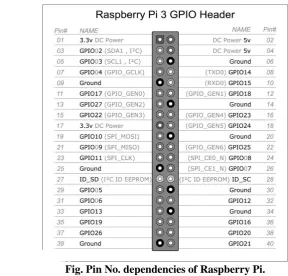
Thw further details expands on the technical features of the GPIO pins available on BCM2835 Ports.
GPIO pins can be configured as either general-purpose input, general-purpose output or as one of up to 6 special
alternate settings, the functions of which are pin-dependant.
The Raspberry Pi 3 consists of 3 GPIO banks on BCM2835.
Each bank has its own VDD input pin. The GPIO pins in Raspberry Pi supports the supply from 3.3V.
The selection of pins from Bank ‘0’ is available on the ‘P1’ header on Raspberry Pi. Voltage more than 3.3V
may damage the GPIO blocks
225 | P a g e
VII. GPIO PADS
The GPIO connections on the BCM2835 package are sometimes also referred as the peripherals datasheet as
"pads" - a semiconductor design term meaning "chip connection to outside world".
The pads can be configured via CMOS push-pull input/output driver’s buffers. The register based control
settings are available for
Internal pull-up / pull-down enable/disable Output to increase drive strength.
Input Schmitt-trigger filtering
VIII. SPECS
Unlike Raspberry Pi (First Model) and Raspberry pi 2 B+ model, the Raspberry Pi 3 has inbuilt Wi-Fi and Bluetooth, which reduces the external use of USB Wi-Fi/Bluetooth Dongle.
Socket On Chip: Broadcom BCM2837 (more 50% faster than the Raspberry Pi 2)
CPU: 1.2 Ghz quad-core ARM Cortex A53
GPU: Broadcom VideoCore IV @ 400 MHz
Memory: 1 GB LPDDR2-900 SDRAM
USB ports: 4
Network: 10/100 MBPS Ethernet, 802.11n Wireless LAN, Bluetooth 4.0
VIV. POWER-ON STATES
Every GPIO Port reverts to general purpose inputs on power on reset. The default pull states are also applied,
which are detailed in the alternate function table in the ARM peripherals datasheet.
VV. ALTERNATIVE FUNCTIONS
Almost every GPIO pin have alternative function. Peripheral blocks internal to BCM2835 can be selected to
appear on one or more of a set of GPIO pins.
VVI. SOFTWARES
The Raspberry Pi was always intended to run a variety of operating systems, and for the past four years, we’ve
seen just about everything. From the stock Debian distribution to much more esoteric options, ranging in
Windows 10 IoTCore .
226 | P a g e
Fig. ZigBee
The XBee-PRO OEM RF Module is engineered for IEEE 802.15.4 standards and supports the unique needs of
low-cost, low-power wireless sensor-networks. The modules require minimum power and provides reliable
delivery of data between two or more devices.
The module operate within the ISM 2.4 GHz frequency band and are pin for pin compatible with each other.
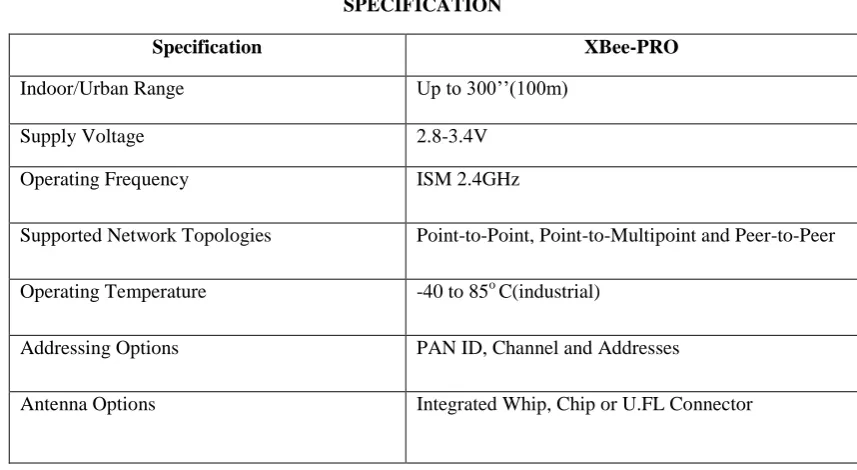
SPECIFICATION
Specification XBee-PRO
Indoor/Urban Range Up to 300’’(100m)
Supply Voltage 2.8-3.4V
Operating Frequency ISM 2.4GHz
Supported Network Topologies Point-to-Point, Point-to-Multipoint and Peer-to-Peer
Operating Temperature -40 to 85o C(industrial)
Addressing Options PAN ID, Channel and Addresses
Antenna Options Integrated Whip, Chip or U.FL Connector
WORKING OF ZIGBEE
The module can achieve transparent data transmission between most of the devices, and it can be able to form a
MESH network. The device has the characteristics of small volume, ultra-low power consumption which help it
work on low-power and low-cost. It can terminate the independent data transmission or can be easily embedded
to a variety of products to form a solution for short-range wireless data transmission.
The device can be used for of automatic control in various field and the network has the characteristics of
reliability, electric power-saving, low cost, security and large capacity. The target application domains are
227 | P a g e
agricultural automation and so on, such as lighting control automation, wireless data acquisition and monitoringsensor, oil field, mining, electrical mining and logistics management etc.
VI. IMAGE PROCESSING
The Digital Image Processing is used to process the image taken via camera at the entry gate. The Snapped
image will be processed and compared with the various images stored in the database. It will compare the
owner’s face and will give a green signal when recognized as correct person. It will also notify the free parking
area /open parking area available in the society/office.
VII. RESULT
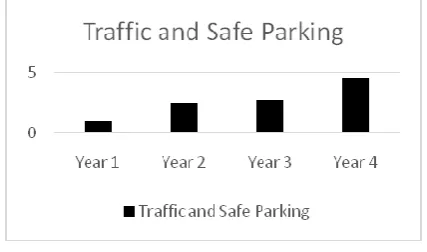
Using this type of Technology can reduce the efforts of the car owner as well as the watchmen. The surveillance
will also improve and the time-to-time track will be recorded with or without manual checking of car.
Fig. Graph of increasing ratio of safe Parking
VIII. CONCLUSION
It is concluded as, the parking related problem in less area of infrastructure will be solve by this technique. It
also gives to the security to the building infrastructure.
IX. REFERENCES
Journal Papers:
[1]J. M. Keneipp,Electronics and management of major parking and related transportation systems,
30th IEEE Vehicular Technology Conference.
[2].Daniel Calderone,Eric Mazumdar,Lillian J. Ratliff,S. Shankar Sastry,Understanding the impact of parking
on urban mobility via routing games on queue-flow networks,2016 IEEE 55th Conference on Decision and
Control (CDC).
[3]. Michael Strasser,Daniel Mauser,Sahin Albayrak,Mitigating traffic problems by integrating smart parking
228 | P a g e
[4].Pablo Sauras-Perez,Andrea Gil,Joachim Taiber,ParkinGain: Toward a smart parking application with
value-added services integration,2014 International Conference on Connected Vehicles and Expo (ICCVE)
[5].Yanhong Liu; Jinping Guo,The related research of urban park patch characteristic and thermal
environment,2011 International Conference on Remote Sensing, Environment and Transportation Engineering.