R E S E A R C H
Open Access
Impact of impulsive detoxication on the
spread of computer virus
Xianxiu Zhang
1,2*, Chuandong Li
1and Tingwen Huang
3*Correspondence:
[email protected] 1Chongqing Key Laboratory of
Nonlinear Circuits and Intelligent Information Processing, College of Electronic and Information Engineering, Southwest University, Chongqing, 400715, China 2Department of Mathematics,
Liupanshui Normal University, Liupanshui, Guizhou 553001, China Full list of author information is available at the end of the article
Abstract
We discuss the dynamical properties of a SIRS computer virus propagation model with impulsive detoxication and saturation effect. By the Internet, new antivirus software can be released immediately and take effect quickly after it is running. This leads to the circumstance that many infected computers can be cured in a short time. So impulsive detoxication is a vitally important way for prohibiting the spread of network viruses. The theoretical results show that: (a) the virus-free equilibrium is globally stable when the basic reproduction ratio (BRR) is less than unity, (b) the system is uniformly permanent when BRR exceeds unity, and (c) a supercritical bifurcation occurs when BRR equals unity. Several numerical examples also clearly display the results obtained. Finally, some feasible strategies of eradicating electronic viruses are advised.
Keywords: computer virus propagation model; impulsive detoxication; virus-free equilibrium; uniformly permanent; supercritical bifurcation
1 Introduction
While the popularized communication networks have brought great convenience to our daily work and life, they also provide a fast channel for the spread of computer viruses. During the last decades, massive outbreaks of network viruses have caused enormous fi-nancial losses.
For the purpose of effectively controlling virus diffusion, it is of practical importance to understand the way that malicious codes propagate over the Internet. Due to the com-pelling analogy between electronic viruses and their biological counterparts [, ], a multi-tude of computer virus epidemic models, ranging from SIS models [, ], SIR models [, ], SIRS models [], SEIR models [], SEIRS model [], SLBS models [–], SLAS model [], SIPS model [], to delayed models [, ] and stochastic models [, ], have been proposed. In our opinion, these models can help us better understand how the viruses diffuse on networks.
In the classical epidemic models, the incidence rateβ, which is the probability of trans-mission per contact, is assumed to be bilinear with respect to the numbers of susceptible and infected individuals []. To the best of our knowledge, in most of previous computer virus models, the incidence rateβis also simply supposed to be unvaried [, ]. How-ever, in reality, when the population are aware of the existence of computer viruses on networks, they will reduce the number of communication contacts per unit time to avoid
being infected, the more infectious computers being reported, the less contact with other computers, which is called the saturation effect. In an attempt to capture the saturation effect, Yuanet al.[] proposed a nonlinear incidence rate. As the transmission details of computer infections are quite complicated, their results have only limited applications. Recently, Yang and Yang [] also suggested a nonlinear incidence rate. However, its de-scription of saturation effect is not clear. Based on a large number of numerical examples, we use /( +αI(t)) (αis a positive constant andI(t) represents the percentage of infected internal computers at timet, respectively) to denote the saturation effect [], namely, use
β
+αI(t) to replaceβ. This seems reasonable.
In the prevalence of infectious diseases, it is impossible to rapidly disseminate the new remedy to a great many patients, and it often takes a lot of time to finish one or several courses of the remedy [–]. On the contrary, as new antivirus software can be re-leased immediately via the Internet and takes effect quickly after it started running, many of the infected computers can be cured in a short time []. To understand how impul-sive detoxication [] and saturation effects prohibit virus spread on networks, a novel impulsive computer virus propagation model is established in this paper. We theoretically analyze that the virus-free equilibrium is globally asymptotically stable when BRR is less than unity. It is shown that the system is uniformly permanent when BRR exceeds unity. In addition, by bifurcation theory we see that a supercritical bifurcation occurs when BRR equals unity. Both theoretical predictions and numerical examples show that impulsive detoxication can control virus diffusion effectively. Finally, considering the influence of varying model parameters on BRR, we propose some feasible strategies of deracinating malicious viruses. One should emphasize that there are few computer virus propagation models in the literature that consider the combined impact of impulsive detoxication and saturation effects.
The remainder of this paper is organized as follows: the new model is elaborated in Sec-tion ; it is theoretically studied in SecSec-tions , , and ; the influence of model parameters is discussed in Section ; finally, this work is summarized in Section .
2 Model formulation
In this section, we will formulate a computer virus propagation model with impulsive detoxication and saturation effects. As usual, we shall simply assume that every com-puter is in one of three states:susceptible,infected, andrecovered. Both susceptible com-puters and recovered comcom-puters are uninfected, however, the former has no immunity, while the latter has temporary immunity. LetS(t),I(t), andR(t) denote the percentages of susceptible, infected, and recovered internal computers at time t, respectively, then
S(t) +I(t) +R(t)≡.
For simplicity, in this paper, we do not consider the situation where the susceptible com-puters get recovered.
Considering the above discussions, we establish a mathematical model with the follow-ing assumptions:
(H) All newly accessed computer are susceptible. Furthermore, susceptible computers are accessed to the Internet at the constant rateμ> . And every computer on the Internet leaves the network with constant probabilityμ> .
(H) By running of previous antivirus software, every infected internal computer gets recovered with constant probabilityγ > .
(H) Every recovered internal computer loses immunity with constant probabilityδ> .
Moreover, the following additional hypotheses are raised.
(H) The latest antivirus software is disseminated att=kT,k∈N, where
N={, , , . . .},T> , is a constant.
(H) For dissemination of the latest antivirus software, aqfraction of infected internal computers get recovered at time instantkT, where <q< , andqis a constant.
From these assumptions, one has a novel computer virus propagation model, which can be represented by means of the impulsive differential equations
⎧
Obviously,is positively invariant for system (). The right-hand side of system () en-sures the existence, uniqueness, and piecewise continuity of its solution [].
3 Virus-free equilibrium and its stability
In this section, we shall prove the existence and global stability of the infection-free equi-librium under certain conditions.
First, we show the existence of the infection-free equilibrium, in which infectious com-puters are entirely absent from the internal comcom-puters permanently,i.e.,I(t)≡,t≥. In this situation, the growth of the removed computersR(t) simplifies to
Clearly, we have the following.
Theorem System()has a unique virus-free equilibrium(, , ).
Next, we explore the global asymptotically stability of the virus-free equilibrium to sys-tem (). Let us define
=
βT
(μ+γ)T–ln( –q). ()
Theorem If < ,the virus-free equilibrium(, )of system()is locally asymptotically stable.
Proof The linearized system of system () at (, ) is
⎧ ⎪ ⎪ ⎪ ⎪ ⎨ ⎪ ⎪ ⎪ ⎪ ⎩
dx(t)
dt = (β–μ–γ)x(t), dy(t)
dt =γx(t) – (μ+δ)y(t),
t=kT,
x(t+) = ( –q)x(t),
y(t+) =qx(t) +y(t), t=kT.
()
Denote
A(t) =
β–μ–γ
γ –μ–δ
,
B=
–q
q
.
We get the monodromy matrixMof the linearized equation:
M=Bexp
T
A(t)dt
=
( –q)exp((β–μ–γ)T)
∗ exp(–(μ+δ)T)
,
it is not necessary to calculate the exact form of (∗). Then the eigenvalues of (M), denoted byλandλ, are the following:
λ=exp
–(μ+δ)T< , λ= ( –q)exp
(β–μ–γ)T,
λ< if < . According to Floquet theory [], it is easy to see that (, ) is locally
asymptotically stable if < . The proof is thus completed.
To prove the main result of this section, we first show a lemma.
Lemma Consider the following impulsive differential equation:
dg(t)
dt =γm– (μ+δ)g(t), t=kT,k∈N,
where m is a positive constant.Then there exists a unique positive periodic solution of sys-tem()
¯
g(t) = γm
μ+δ +
qmexp(–(μ+δ)(t–kT))
–exp(–(μ+δ)T) , kT<t≤(k+ )T, ()
which is globally asymptotically stable.
Proof Let us solve the first equation in system (), then
g(t) = γm
μ+δ +
gkT+– γm
μ+δ
exp–(μ+δ)(t–kT), kT<t≤(k+ )T. ()
Letgk=g(kT+), we get the stroboscopic mappingFfor system () as follows:
gk+=F(gk) =qm+ γm
μ+δ+
gk– γm
μ+δ
exp–(μ+δ)T. ()
Obviously, the mappingFhas only one (positive) fixed point
g∗= γm
μ+δ +
qm
–exp(–(μ+δ)T),
which implies thatg¯(t) is unique T-period solution to system (). As
gk–g∗=exp–(μ+δ)T(gk––g∗) =exp–k(μ+δ)T(g–g∗),
g∗is globally asymptotically stable for equation (). The global asymptotical stability of
¯
g(t) holds without doubt.
Theorem The virus-free equilibrium(, )of system()is globally asymptotically stable if < .
Proof Let (I(t),R(t)) be a solution to system (). By Theorem , it suffices to prove that
lim
t→+∞I(t) = , t→lim+∞R(t) = ,
< can be rewritten as
( –q)exp(β–μ–γ)T< ,
letσ= ( –q)exp((β–μ–γ)T), then < , equivalently,σ< .
Via system (), we have
dI(t)
dt ≤(β–μ–γ)I(t), t=kT,k∈N,
I(t+) = ( –q)I(t), t=kT. ()
Let us consider the comparison system
dv(t)
dt = (β–μ–γ)v(t), t=kT,k∈N,
with initial conditionv(+) =I(+). Thenv(T+) =I(+)σ,v(nT+) =I(+)σn, which implies
thatlimn→∞v(nT+) = . Moreover, ifnT<t≤(n+ )T, then
v(t) =vnT+exp
t
nT
β–μ–γ+
T ln( –q)
dt
≤vnT+,
implying thatlimt→+∞v(t) = . By the comparison theorem in impulsive differential equa-tions [], we getlimt→+∞I(t) = . Thus, there isT> such thatI(t) <εfort≥T. Sub-stituting this equation into system (), we have
dR(t)
dt ≤γ ε– (μ+δ)R(t), t=kT,t≥T, R(t+)≤R(t) +qε, t=kT,t≥T
.
()
LetN= [T
T], we assume for the comparison system:
dw(t)
dt =γ ε– (μ+δ)w(t), t=kT,t≥T, w(t+) =w(t) +qε, t=kT,t≥T
,
()
with initial conditionw(NT+) =R(NT+). According to Lemma , it has a globally stable
periodic solution
¯
w(t) = γ ε
μ+δ+
qεexp(–(μ+δ)(t–kT))
–exp(–(μ+δ)T) , kT<t≤(k+ )T,k>N. By the comparison theorem [], there existsT>Tsuch that
R(t)≤w(t) <w¯(t) +ε, t≥T.
Considering the arbitrariness of ε, R(t)≥, and noting that limε→+w¯(t) = , we get
limt→+∞R(t) = . The proof is complete.
Via Theorem , we have the following.
Theorem The virus-free equilibrium(, , )of system()is globally asymptotically sta-ble if < .
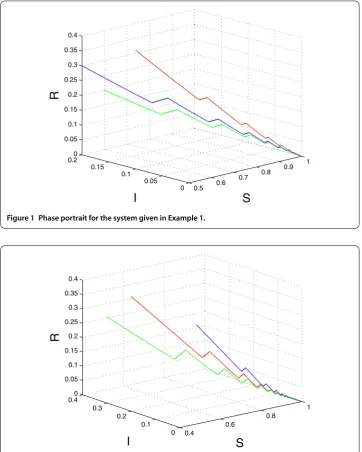
Example Consider system () with the parameter values (μ,β,γ,δ,α,q,T) = (., ., ., ., ., ., ), we have = . < . Figure depicts three typical orbits.
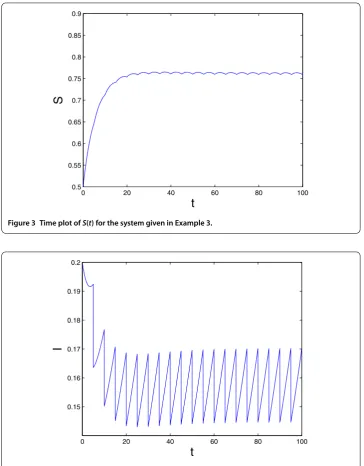
Example For system () with the parameter values (μ,β,γ,δ,α,q,T) = (., ., ., ., ., ., ), we get = . < . Figure displays three typical orbits.
Figure 1 Phase portrait for the system given in Example 1.
Figure 2 Phase portrait for the system given in Example 2.
4 Permanence
In the following, we study uniform permanence of system () and system (). First we give two definitions.
Definition System () is said to be virus permanent in, if for every solution (I(t),R(t)) to system () withI(+) > , there ism> such thatI(t)≥mfor all larget.
Definition System () is said to be uniformly permanent in, if there is a constantc> (independent of the initial data), such that every solution (I(t),R(t)) with initial condition (I(+),R(+))∈of system () satisfies
min
lim
t→∞infI(t),tlim→∞infR(t)
Theorem If > ,then there exists a positive constant m,such that any positive solu-Assume for the comparison system
with initial conditionu(+) =R(+). Via Lemma , it has a globally stable periodic solution
¯
u(t) = γm
μ+δ +
qmexp(–(μ+δ)(t–kT))
–exp(–(μ+δ)T) , kT<t≤(k+ )T,t≥t. () According to the comparison theorem [], there ist≥tsuch that
R(t)≤u(t) <u¯(t) +ε, t≥t. ()
Plugging into system (), we get
Case.t=kT, without loss of generality, lett=KT (Kis a positive integer). Then From the first equation and the third equation of system (), we have
Repeatedly integrating the first equation in system () and plugging the second equation in system () into the resulting equation, we get, for allt<t<t,
Via alternatively repeating arguments similar to the previous discussions, we getI(t)≥m
for allt>t.
A contradiction occurs. Let
Again, via alternatively repeating the discussions, we getI(t)≥mfor allt>t. Evidently,
m>m.
By the above discussions, we haveI(t)≥mfor allt>t. The proof is complete. From Theorem , we get the following.
Corollary System()is virus permanent if > .
Theorem System()is uniformly permanent if > .
Proof From the second equation and the fourth equation of system (), we get
dR(t)
dt ≤γm– (μ+δ)R(t), t=kT,t≥t,
R(t+)≤R(t) +qm, t=kT,t≥t. ()
Then we consider the comparison system
dh(t)
dt =γm– (μ+δ)h(t), t=kT,t≥t,
h(t+) =h(t) +qm, t=kT,t≥t, ()
with initial conditionh(t) =R(t). Via Lemma , for system () there exists a positive unique periodic solution
¯
h(t) = γm
μ+δ+
qmexp(–(μ+δ)(t–kT))
–exp(–(μ+δ)T) , kT<t≤(k+ )T,t>t, which is globally asymptotically stable.
According to the comparison theorem [], there ist≥tsuch that
R(t)≥ ¯h(t) –ε≥ γm μ+δ+
qmexp(–(μ+δ)T)
–exp(–(μ+δ)T) –ε=m, t≥t. () Letc=min{m,m}. From Theorem and the above discussion, system () is uniformly
permanent.
As a direct consequence of Corollary and Theorem , we have the following.
Corollary If > ,any positive solution of system()satisfies I(t)≥mand R(t)≥m, for t large enough.
From the first equation and the fourth equation of system () and using Corollary , we have dS(t)dt >μ+δm– (μ+β)S(t),t≥t; furthermore, we getlimt→∞S(t)≥μμ+δ+mβ. For a
sufficiently smallε> , letm=μμ+δ+mβ –ε> , there exists at>t, such thatS(t) >m
fort>t.
By combining Corollary and the above discussions, we get the following.
Theorem System()is uniformly permanent if > .
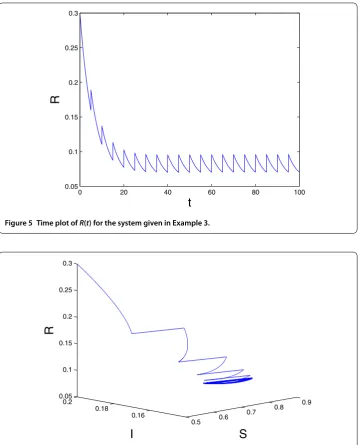
Figure 3 Time plot ofS(t) for the system given in Example 3.
Figure 4 Time plot ofI(t) for the system given in Example 3.
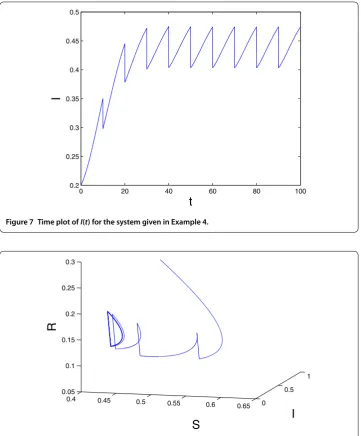
I(t), andR(t) and the phase portrait for the system with initial condition (S(),I(),R()) = (., ., .), respectively. We can see without difficulty that it conforms to the theoretical prediction. In other words, the computer viruses cannot be eradicated in this situation.
Example Consider system () with the parameter values (μ,β,γ,δ,α,q,T) = (., ., ., ., ., ., ). Then = . > . Figures and display the time plots
of I(t) and the phase portrait for the system with initial condition (S(),I(),R()) = (., ., .), respectively, again it meets the theoretical prediction. In fact, the viral preva-lence is quite high in this situation.
Figure 5 Time plot ofR(t) for the system given in Example 3.
Figure 6 Phase portrait for the system given in Example 3.
Based on many numerical examples, we speculate that system () has a stable viral pe-riodic solution if > .
5 Bifurcation analysis
Now, we investigate the existence of a viral periodic solution by means of the impulsive bifurcation theory in []. First, we present it as follows.
Consider the system
⎧ ⎪ ⎪ ⎪ ⎪ ⎨ ⎪ ⎪ ⎪ ⎪ ⎩
dx(t)
dt =f(x(t),x(t)), dx(t)
dt =f(x(t),x(t)),
t=kT,
x(t+) =θ
(x(t),x(t)),
x(t+) =θ(x(t),x(t)), t=kT,
Figure 7 Time plot ofI(t) for the system given in Example 4.
Figure 8 Phase portrait for the system given in Example 4.
wheref,f,θ, andθare sufficiently smooth,f(x(t), )≡θ(x(t), )≡. Suppose
dx(t)
dt =g(x(t)) =f(x(t), ), t=kT, x(t+) =θ(x(t)) =θ(x(t), ), t=kT,
()
has a stableT-periodic solution denotedxe(t). Thus,ζ(t) = (xe(t), )Tis a trivial periodic
solution to system (). We will use bifurcation theory [] to discuss the existence of viral periodic solution to system (). Let(t) = (φ(t),φ(t)) be the flow associated with system
(). We getX(t) = (x(t),x(t))T=(t,X), <t≤T, whereX=X().
We list the following notations []:
d= –
∂θ ∂x
∂φ ∂x
(T,x)
a= –
In the following, we quote without proof an important result from [], which is indis-pensable for the proof of Theorem .
Lemma Consider system()with <a< .
(c) IfBC= ,there is an undetermined case.
Theorem For system(), a supercritical bifurcation occurs at = .System()has a stable viral periodic solution which bifurcates from the virus-free equilibrium when increasingly goes across unity.
Proof Consider system (). We changeR(t),I(t) into (x(t),x(t)), respectively, thus
f
x(t),x(t)
=γx(t) – (μ+δ)x(t),
fx(t),x(t)=β( –x(t) –x(t))x(t)
+αx(t) – (μ+γ)x(t),
θ
x(t),x(t)=x(t) +qx(t),
θ
x(t),x(t)
= ( –q)x(t),
ζ(t) =xe(t), T= (, )T,
wherexe(t) = can be looked upon as a trivial periodic solution of system ().
Direct calculations yield
d= – ( –q)exp
(β–μ–γ)T,
a= –exp–(μ+γ)T> ,
b< , ∂φ(T,x)
∂t =
dxe(T)
dt = , ∂φ(T,x)
∂x
> , ∂φ(T,x)
∂x
> ,
∂φ(T,x) ∂x > ,
∂φ (T,x) ∂x∂x < ,
∂φ (T,x) ∂x < , ∂φ
(T,x)
∂t∂x = (β–μ–γ)exp
(β–μ–γ)T.
Since
∂θ ∂x = ,
∂θ
∂x = ( –q), ∂θ
∂x∂x = ,
∂θ ∂x
= ,
we have
B= –( –q)(β–μ–γ)exp(β–μ–γ)T,
C= –( –q)b
a
βTexp(β–μ–γ)T– ( –q)∂
φ (T,x) ∂x > .
= impliesd= andβ–μ–γ> , so we getB< , thenBC< . Clearly, <a< .
6 Discussions
By the previous discussions, some practicable and effective strategies should be followed to lower below unity for deracinating network viruses. For that purpose, in the
follow-ing, we study the effects of the changing model parameters on .
Theorem drops with increasingμ,γ and q,and rises with increasingβand T.
One can easily see this result from ().
Remark In the real situations,β,μ, andγ can be looked upon as constants, whileT
andqare easily manipulated. We consider the following two situations:
Case . β<μ+γ. Then < via (), the computer viruses can also be deracinated without impulsive detoxication.
Case . β≥μ+γ. By (), we have < if
T ln
–q>β– (μ+γ). ()
So we must manipulate T andq to meet () for eradicating computer viruses in this situation.
Remark We notice thatδandαare not in (), yet we know that they have significant impact on the spread of computer viruses. It ought to be considered as a demerit of the model, and we shall improve the model in the next research.
On the basis of the previous analysis, some practical and effective measures for contain-ing the virus prevalence is presented below.
() Strengthening the research of antivirus software and shortening the development cycle are conducive to reduce the impulsive detoxication periodTand to enhance the impulsive detoxication rateqand the recovery rateγ.
() The people must be often reminded to install antivirus software, so that the impulsive detoxication rateqand the recovery rateγ are raised.
() Let your computer leave the Internet when unnecessary, so that the recruitment rate μis increased, the incidence rateβis minimized.
7 Conclusions
Taking into account impulsive detoxication and saturation effects in the conventional SIRS model, a novel computer viruses propagation model has been established. The dynamical properties of this model have been investigated theoretically, and the results obtained have also been demonstrated by several numerical examples. Based on an analysis of the impact of varying model parameters on BRR, some effective measures for controlling electronic virus diffusion have been advised.
Competing interests
The authors declare that they have no competing interests.
Authors’ contributions
XZ conceived and designed the experiments. XZ performed the experiments. XZ, CL, and TH wrote the paper. All authors read and approved the final manuscript.
Author details
1Chongqing Key Laboratory of Nonlinear Circuits and Intelligent Information Processing, College of Electronic and
Information Engineering, Southwest University, Chongqing, 400715, China.2Department of Mathematics, Liupanshui Normal University, Liupanshui, Guizhou 553001, China. 3Texas A&M University at Qatar, c/o Qatar Foundation, P.O. Box 5825, Doha, Qatar.
Acknowledgements
This research is supported by the Natural Science Foundation of China (No. 61374078), NPRP grant # NPRP 4-1162-1-181 from the Qatar National Research Fund (a member of Qatar Foundation), Science and technology fund of Guizhou Province (LH [2015] No. 7612), China, and Chongqing Research Program of Basic Research and Frontier Technology (No. cstc2015jcyjBX0052), China.
Received: 6 June 2016 Accepted: 16 August 2016 References
1. Cohen, F: Computer viruses: theory and experiments. Comput. Secur.6(1), 22-35 (1987)
2. Murray, WH: The application of epidemiology to computer viruses. Comput. Secur.7(2), 130-150 (1988) 3. Kephart, JO, White, SR: Directed-graph epidemiological models of computer viruses. In: IEEE Computer Society
Symposium on Research in Security and Privacy, pp. 343-359 (1991)
4. Kephart, JO, White, SR: Measuring and modeling computer virus prevalence. In: IEEE Computer Society Symposium on Research in Security and Privacy, pp. 2-15 (1993)
5. McCluskey, CC: Complete global stability for an SIR epidemic model with delay-distributed or discrete. Nonlinear Anal., Real World Appl.11, 55-59 (2010)
6. Hattaf, K, Lashari, AA, Louartassi, Y, Yousfi, N: A delayed SIR epidemic model with general incidence rate. Electron. J. Qual. Theory Differ. Equ.2013, 3 (2013)
7. Muroya, Y, Enatsu, Y, Li, H: Global stability of a delayed SIRS computer virus propagation model. Int. J. Comput. Math.
91(3), 347-367 (2014)
8. Yuan, H, Chen, G: Network virus-epidemic model with the point-to-group information propagation. Appl. Math. Comput.206(1), 357-367 (2008)
9. Mishra, BK, Pandey, SK: Dynamic model of worms with vertical transmission in computer network. Appl. Math. Comput.217(21), 8438-8446 (2011)
10. Yang, L-X, Yang, X, Zhu, Q, Wen, L: A computer virus model with graded cure rates. Nonlinear Anal., Real World Appl.
14(1), 414-422 (2013)
11. Yang, L-X, Yang, X: A new epidemic model of computer viruses. Commun. Nonlinear Sci. Numer. Simul.19, 1935-1944 (2014)
12. Chen, L, Hattaf, K, Sun, J: Optimal control of a delayed SLBS computer virus model. Physica A427, 244-250 (2015) 13. Muroya, Y, Kuniya, T: Global stability of nonresident computer virus models. Math. Methods Appl. Sci.38, 281-295
(2015)
14. Yang, L-X, Yang, X: A novel virus-patch dynamic model. PLoS ONE (2015). doi:10.1371/journal.pone.0137858 15. Feng, L, Liao, X, Li, H, Han, Q: Hopf bifurcation analysis of a delayed viral infection model in computer networks. Math.
Comput. Model.56(7-8), 167-179 (2012)
16. Yang, X, Yang, L-X: Towards the epidemiological modeling of computer viruses. Discrete Dyn. Nat. Soc.2012, Article ID 259671 (2012)
17. Zhang, C, Zhao, Y, Wu, Y, Deng, S: A stochastic dynamic model of computer viruses. Discrete Dyn. Nat. Soc.2012, Article ID 264874 (2012)
18. Anderson, RM, May, RM: Infectious Diseases of Humans: Dynamics and Control. Oxford University Press, Oxford (1991) 19. Zhang, C, Zhao, Y, Wu, Y: An impulse model for computer viruses. Discrete Dyn. Nat. Soc.2012, Article ID 260962
(2012)
20. Yang, L-X, Yang, X: The pulse treatment of computer viruses: a modeling study. Nonlinear Dyn.76(2), 1379-1393 (2014)
21. Yuan, H, Guan, L, Guan, C: On modeling the crowding and psychological effects in network-virus prevalence with nonlinear epidemic model. Appl. Math. Comput.219, 2387-2397 (2012)
22. Yang, L-X, Yang, X: The impact of nonlinear infection rate on the spread of computer virus. Nonlinear Dyn.82(1), 85-95 (2015)
23. Capasso, V, Serio, G: A generalization of the Kermack-McKendrick deterministic epidemic model. Math. Biosci.42(1-2), 43-61 (1978)
24. Sabin, A: Measles, killer of millions in developing countries: strategies of elimination and continuing control. Eur. J. Epidemiol.7(1), 1-22 (1991)
25. Agur, Z, Cojocaru, L, Mazor, G, Anderson, R, Danon, Y: Pulse mass measles vaccination across age cohorts. Proc. Natl. Acad. Sci. USA90(24), 11698-11702 (1993)
26. Meng, X, Chen, L, Wu, B: A delay SIR epidemic model with pulse vaccination and incubation times. Nonlinear Anal., Real World Appl.11(1), 88-98 (2010)
27. Lakshmikantham, V, Bainov, DD, Simeonov, PS: Theory of Impulsive Differential Equations. World Scientific, Singapore (1989)
29. Lakmeche, A, Arino, O: Bifurcation of nontrivial periodic solutions of impulsive differential equations arising chemotherapeutic treatment. Dyn. Contin. Discrete Impuls. Syst.7(2), 265-287 (2000)
30. Yang, L-X, Draief, M, Yang, X: The impact of the network topology on the viral prevalence: a node-based approach. PLoS ONE (2015). doi:10.1371/journal.pone.0134507
31. Yang, L-X, Draief, M, Yang, X: Heterogeneous virus propagation in networks: a theoretical study. Math. Methods Appl. Sci. (2016). doi:10.1002/mma.4061