267
A Model Study For The Electric Pulse Frequency
Effects On The Solidification Behavior Of Al-5%Cu
Alloy
Qi Jingang, Li Yang, S.A Tukur, Zhao Zuofu, Wu Di, Dai Shan, Wang Jianzhong
Abstract: Electric pulse treatment (EPT) had recently proven to be an effective grain-refining technology; however, the quantitative understanding of the EPT mechanism is still unclear. This research work was based on electromagnetic field theory combined with the EPT mechanism proposed by Zhai et al. In this study, the two critical values of electro-pulse frequency under a certain pulse voltage were calculated; the crystal rain and the chill layer were formed during this non-equilibrium solidification. Thus, the electro-pulse frequencies and their influencing factors were modeled. The solidification behaviors were analyzed accordingly. The model exhibits that the time domain of EPM-induced grain refinement was found to be between the occurrence of crystal rain and the formation of chill layer. Furthermore, the proposed model was validated by the solidification structure changes of Al-5%Cu alloy.
Index Terms: model, electric pulse treatment (EPT), solidification structure, crystal rain, chill layer, Grain-refinement
————————————————————
INTRODUCTION
IN the production of metals and alloys, control of grain size is a key to improve the mechanical performance [1]. The pulsed electromagnetic field has been widely used in industry because of its high efficiency, economic benefits and cleanliness, and can affect the following aspects of the solidification microstructure of metal: refining solidification microstructure, eliminating macro-segregation, increasing content of alloying elements within grains, decreasing residual force, avoiding cracks and improving surface quality [1-3].
An Indian scholar named Mistra [4] published the earliest report about the effect of an electro-pulse field on solidification microstructure of metal in 1986, reported that direct pulse current could alter the cast microstructure, and then more and more workers immersed in the research of relative problems. Recently, a lot of theories have been put forward to interpret this phenomenon [5-14]. However, there was no unified understanding on the quantitative model investigation about the refinement of the solidified structure under the electric pulse treatment (EP, EPT). In 2007, Zhai et al [15] proposed that the phenomenon of grain refinement with EPT mainly results from that electric pulse gets crystal nuclear falling off from the wall and flowing into the liquid metal which leads to the refinement of as-cast structure. Zhai's research has showed that there was intrinsic requirement of EPT on grain refinement due to the formation of the crystal rain and designed the experiment to examined the accuracy of this mechanism. However, Zhai’s research had failed to determine both the critical condition of crystal rain’s formation and its relationship with pulse frequency, despite the technique parameter of pulsed frequency has actually a very significant effect on the final solidification structure and thus, it does not fully disclosed the alloy solidification kinetics characteristics under EPT condition. On the other hand, Oono Atsumi [16] posited that the chilling ________________________
Prof. QI Jingang, School of Material Science and Engineering, Liaoning University of Technology, Jinzhou, China 121001
Email: [email protected]
S.A Tukur, Department of Mechanical Engineering, Kano University of Science and Technology, Wudil, PMB 3244, Nigeria,
Email: [email protected]
Shamsu Auwal Tukur, Department of Mechanical Engineering, Kano University of Science and Technology, Wudil, PMB 3244, Nigeria,
layer solidified along the wall from bottom to top gradually, when the chilling layer was formed, it's hard to get the crystal nuclear fall off from the wall. Considering the two view points, the role of time-domain of the refinement under EPT should be from the beginning of the crystal rain to the chilling layer formation. Therefore, this study is aimed to quantitatively explain Zhai’s EPT mechanism using the electromagnetic theory on the model formation for both the crystal rain and the chilling layer under the condition of electric pulse treatment. The research work is expected to establish to the large extend the foundation for industrialized application of EPT.
1. EXPERIMENTAL PROCEDURE
In this research, a sample of Al-5%Cu alloy was made from pure aluminum (99.97% in mass percent) and electrolytic copper (99.99% in mass percent). Appreciable amounts of the Al-5%Cu alloy in a graphite crucible were molten and heated to 700°C, in a self-designed electric resistance furnace. After holding at 740°C for 10min, and later degassing refined with C2Cl6, subsequently the molten metal was poured with two columnar graphite electrodes into sand moulds with EPT applied at the same time. The parameters of the pulse electric field were selected: voltage was 300 V and 500V, single factor changing frequency of 3Hz, 8Hz, 15Hz and time was 120s. Fig.1 below shows the experimental setup. After solidification, the samples were cut along the center line, and then grinded, polished, and etched.
Electric pluse generator
Electrode Thermocouple
Sand mold
Fig. I Sketch of the electric pulse treatment experimental apparatus
2. MODEL ESTABLISHMENT
2.1 Force analysis of nuclear on the wall before chilling layer formed
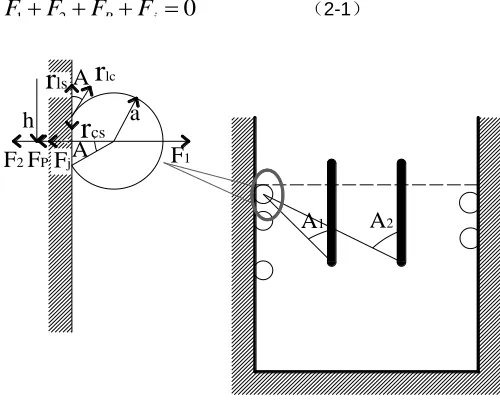
When the molten metal was poured into the mold, heterogeneous nucleation begins firstly on the wall, after then the nuclear would grow. Because of the segregation of solute and the super cooling rate, the shape of nuclear approaches sphere generally as shown in Fig 2. At this moment, the force on the nuclear consist of electromagnetic force F1 and F2 from 2 electrodes, pressure FP from melt, interfacial tension Fj, floatage and its gravity. If the horizontal forces are balanced, there is an equation:
1 2 P j
0
F
F
F
F
(2-1)A
1A
2r
csr
lcr
lsF
jF
PF
2F
1A
h
a
A
Fig. II Sketch map of crystal rain occurrence
In equation (2-1), F1, F2 can be considered as the Lorentz force from two conducting straight wires. Due to differences in the direction of current on the conducting electrode, the direction of F1 and F2 was shown in Fig 2; its value can be expressed as follows:
2 2 2
1 1
2 2
1 1
1
cos 2 ( )
2 ( ) ( ) 2
I d A I d
F
l r l r
l r d
(2-2)
2 2 2
2 2
2 2
1 1
1
cos
2 ( )
2 ( ) ( )
2
I d A I d
F
l r l r
l r d
(2-3)
269
1 2
2 2 2 2
1 1
cos cos
( ) ( )
2 2
d d
A A
l r l r
d d
(2-4)
On the other hand, in equation(2-1), the pressure on nuclear from metal melt improves with the increase of pool depth, its expression is:
2 2
1
sin
P
F
gha
A
(2-5)It can be seen that when h=a, the melt pressure on nuclear from the top minimized and therefore the nuclear most likely to fall off, the value of the force is:
3 2
1
sin
P
F
ga
A
(2-6)Furthermore, in equation (2-1), the interfacial tension Fj on nuclear can be expressed as follows [16, 18]:
4
1 cos
j lc
F
ar
A
(2-7)rls, rlc and rcs is respectively the interfacial tension from molten melt to wall, molten melt to nuclear, and wall to nuclear. A (wetting angle) is the contact angle between the nuclear to the base plane.
2.2 The critical pulse current generated by crystal
rain in solidification
According to the analysis from part 2.1, without considering the strong convection of liquid, the nuclear on the wall can fall off under the electromagnetic force, only when formula (2-8) works. Then the nuclear will enter into the melt and generate the crystal rain.
1 2 P j
F
F
F
F
(2-8)
From equation(2-2)(2-3)(2-6)(2-7)and(2-8)after simplification we can obtain equation(2-9)below:
3 21 2
1
2
2 2 2 2
1 1
1 1
2 4 1 cos (1 cos )
1 1
( ) ( ) ( ) ( )
2 2
lc
ar A ga A
I
d
l r l r
d l r d l r
(2-9)
Where, I1 denotes the critical pulse current generated by crystal rain in solidification.
2.3 The critical pulse frequency generated by crystal rain in solidification
The critical current I1 is the equivalent current when crystal rain occurs, and it will change with the changing of pulse frequency f. Pulse waveform used in the experiment is as shown in Fig 3. Amplitude variation of the EP device is from 200V to 1000V. Pulse edge is 4μs~5μs. Pulse width is 20ms. Pulse frequency is 0.5Hz~20Hz. In addition, the pulse waveform changes along the exponential relationship, as shown in equation (2-10).
t
Ce
t
Fig. III Sketch of the pulse waveform
The time in pulse edge is 1/500 of that in pulse width, so the entire waveform can be considered to meet the exponential relationship in equation (2-10). The equivalent current I1 can be expressed by f.
1
0 1
(1
)
( )
f
C
e
f
f t
I
t
t
(2-11)If is the pulse frequency. μ1 is the pulse width.
is just acoefficient constant. Using equation (2-11) and (2-9) after simplification, at last equation (2-12) was obtained below:
1
2 2 3 2
1 2
1
2 2 2
2 2 2 2
1 1
1 1
2 4 1 cos (1 cos )
1 1
1
( ) ( ) ( ) ( )
2 2
lc
t ar A ga A
f
d C e
l r l r
d l r d l r
Thus, the value of critical frequency fmin when crystal rain occurs is related to the wetting angle A, inserting depth of electrode d, size of mold l and the distance between electrodes r1. (2-12)is an equation of parabola about cosA with parabolic curve looking downward and thus, it has a maximum value, at the same time, considering the wetting angle is mainly determined by the nature of the wall and the
melt, therefore, when
2 1
cos
A
4
r
lc/ 2
a
g
, fmin gets the
maximum value, and at that time, the crystal rain is the most difficult to form. On the other hand, when the pool size l,
pulse width μ1 and the distance between electrodes r1 are constants, equation (2-12) can be simplified as follows:
2 2
2 1
2
(cos )
(cos )
( )
( )
t f
A
t f
A
f
B
Kd
o d
d
o d
d
(2-13)
B and K are both constants. o(d) is an infinitesimal quantity. It can be concluded that fmin is inversely proportional to the inserting depth d—the deeper the electrode is inserted, the smaller the critical frequency requires when crystal rain occurs—this is consistent with the results in literature [10]
. Before the chilling layer forms, fmin is proportional to the pulse time t. Furthermore, when l »r1, fmin→∞, which means it requires the greater pulse energies when the EPT is performed in a larger mold. While l tends to r1, the corresponding fmin is almost equal to zero, namely at that point, the crystal rain most likely to occur.
2.4 Force analysis of the nuclear on the wall under EP when the chilling layer formed
When the chilling layer forms, the nuclear on the wall is hard to fall off [16]. Thus, at this time even if more EP energies were applied to the metal solidification, the refining effect is limited. Due to the nuclear on the top is the most difficult to grow along the wall that nuclear requires a critical force. When the chilling layer formed, the force analysis of the nuclear on the top consist of electromagnetic force F1 and F2 from 2 electrodes, pressure FP from melt, interfacial tension Fj, adhesive force between the nuclear, floatage and its
Time / ms
C
ur
rent
/
a
271 gravity. If the forces were balanced, it can be interpreted
with an equation below:
1 2 P
+F
i j0
F
F
F
F
(2-14)A
1A
2a
h
A
F
1F
2F
PF
jr
lsr
lcr
csF
iA
Fig. IV Sketch map of chill layer formation
The adhesive force Fi in equation (2-1) can be expressed as follows:
3
3
2 3cos
cos
3
i i
A
A
F
g a
(2.15)μ is the coefficient of friction between nuclear. ρi is the nuclear density. a is the diameter of nuclear. A is the wetting
angle. In addition, the calculation of F1﹑F2、FP and Fj can refer part 2.1
2.5 The critical pulse frequency when the chilling layer formed
According to the analysis of part 2.4, the chilling layer forms gradually from the bottom to the top. When the nuclear on the top grow along the wall and others nearby grow, the chilling layer can be considered as forming, and it is hard to fall off. The crystal rain stops, and the frequency, at this point, can be regarded as the other critical one. Using equations (2-2), (2-3), (2-6), (2-7), (2-15) and replacing the variables of equation (2-14) and simplified to obtain equation (2-16) below:
3
2 2 3 2 3
1 i
2 2
2
2 2
2 2 2 2
1 1
1 1
2 3cos cos
2 4 1 cos g cos
3
1 1
1
( ) ( ) ( ) ( )
2 2
lc
A A
t ar A A ga
f
d C e
l r l r
d l r d l r
(1- )
(2-16)
2.6 Relationship between pulse frequency and refinement effects
Fig. V The Model-based Relationship of Pulse frequency and refinement effects of solidification structure
H
f
4
f
3
M
N f
F
Formation of Crystal Rain
Formation of Chill Zone
f
E
f
1 f2
Frequency
C B
A
O
Effective Zone of Electric Pulse Treatment
U
1>U
2U
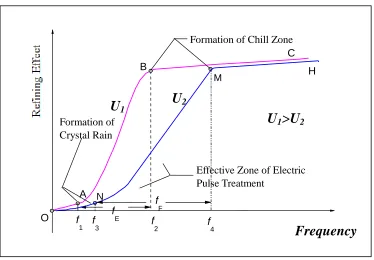
1Based on Zhai et al [15], under certain condition of the pulse voltage, the relationship between the pulse frequency and the refining effect was further studied through the mathematical model in the present work. The best refining frequency can be calculated by determining the parameters in the model. Since the general controlling parameters for the EP process is pulse voltage, and the corresponding current can be obtained from Ohm’s law. Therefore, the single pulse energy is determine by the peak voltage U, but the frequency doesn’t affect the single energy only the total output pulse energy and the average current can be affected. When the single energy is low, i.e. a low peak voltage, it doesn’t meet the requirement to get the nuclear on the wall to fall off even if a large pulse voltage was applied. As a result, the structure cannot be refined significantly. When the peak voltage exceeds a certain value, different pulse voltage is applied. With the increasing of
pulse voltage at the initial stage, the refining effect is not obvious; when the pulse frequency applied reaches a critical value f1 and f3 to get crystal rain, there is a significant increase in the degree of refinement with the increase of frequency; when the pulse frequency reaches the critical value f2 and f4 to get the chilling layer, the refinement is the same as that under the frequency f2 and f4. This conclusion was consistent with that of Fang Y [17]. When smaller pulse voltage (U2) was applied, the effective role in time-domain of frequency was bigger than that when bigger pulse voltage (U1) was applied., that is to say fF>fE, Where fE, fF is the time domain of refining effect of EPT for U1, U2 respectively.
3. MODEL VALIDATION
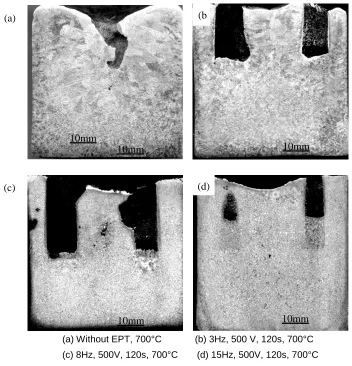
The results of EPM on Al-5%Cu is shown in Fig.6 and Fig.7.
(a) Without EPT, 700°C (b) 3Hz, 500 V, 120s, 700°C (c) 8Hz, 500V, 120s, 700°C (d) 15Hz, 500V, 120s, 700°C
Fig. VI Solidification macro-structure of AI-5%Cu alloy modified at various pulse voltages
10mm (a)
(c) (d)
10mm 10mm
10mm 10mm
273
(e) 0Hz, 0V, 0s, 700°C (f) 3Hz, 300 V, 120s, 700°C (g) 8Hz, 300V, 120s, 700°C (h) 15Hz, 300V, 120s, 700°C
Fig.VII Solidification macro-structure of AI-5%Cu alloy modified at various pulse voltages
It can be seen from Fig.6, the ingot without EPT shows a typical tricrystal zone- the columnar crystals are developed and coarse; the equiaxed zone was at the central area, at which point the size of crystal was 8 grains/mm2. When pulse frequency applied was 3Hz, the solidification structure was refined to a certain degree compared with that of without EPT—the number of grains per unit area was 31, which was 3.875 times that of without EPT. According to the deduction from the model in Fig.5, the frequency should have now reached or exceeded the critical frequency f1 on AB. When pulse frequency was 8Hz, solidification structure refinement was very obvious—the size was 93 grains/mm2 on BC. When pulse frequency was 15Hz, the refinement was the same as that of fewer than 8Hz, at which point the number of grains per unit area was 97. It can be inferred that, the pulse has now exceeded f2 in Fig.5 on BC. To compare the macro-structures in Fig.6 and Fig.7, it can be seen that
when pulse frequency was at 3Hz and 8Hz, the bigger the voltage was applied, the better the refinement was obtained. This is due to the single pulse energy determined by the pulse voltage. When the frequency was 15Hz, the chilling layer forms and the voltage does not affect the refinement too much. The experimental results verify the correctness of the solidification model and its deduction of Al-5%Cu under EPM.
4. CONCLUSIONS
The significant findings from this study include the following: I. For a fixed pulse voltage, the refinement pulse frequency should be between the critical frequency values from the formation of the crystal rain and the chilling layer. In between these zones the refinement effect increases with increase in frequency.
(h
) (f)
(g) (e)
10mm 10mm
Furthermore, the smaller pulse voltage will result in a bigger time-domain of frequency.
II. The critical pulse frequency for the formation of the crystal rain during solidification process under the EPT is related to pulse time t, wetting angle A, electrode insertion depth d, mold size l and electrode gap r1 parameters.
ACKNOWLEDGMENT
The authors gratefully acknowledge financial support from the National Natural Science Foundation of China (No. 51354001).
REFERENCES
[1] Qi Jingang, Dai Shan, Zhao Zuofu, et al (2011) Effects of electric pulse treatment during solidification on the solidification structure of Al-5%Cu alloy, Advanced Materials Research, 299-300: 572-575
[2] Bottinger, W. J., Coriell, S. R., Greer, A. L. (2000) Solidification Microstructures: Recent Developments, Future Directions ActaMetallurgica Sinica, 48 (1): 43 – 70
[3] Zhang, Z. Z., Song, G. S., Yang, G. C. (1999) Microstructure Characteristics of High Undercooled Bulk Nanocrystalline Fe-B-Si Eutectic Alloy, Acta Metallurgica Sinica, 35(7): 693 – 697
[4] Cui, J. Z. (2003) Solidification of Al Alloys under Electromagnetic Field Transactions of Nonferrous, Metals Society of China, 13(3): 473 – 483
[5] Misra, A. K. (1985) A Novel Solidification Technique of Metals and Alloys: under the Influence of Applied Potential, Metallurgical Transactions A, 16 A (7): pp. 1354 – 1355
[6] Nakada, M., Shiohara, Y.Flemings, M. C. (1990) Modification of Solidification Structures by Pulse Electric Discharging, ISIJ International, 30 (1): 27 – 33
[7] Barnak, J. P., Sprecher, A. F., Conrad, H. Colony. (1995) Grain Size Reduction in Eutectic Pb-Sn Castings by Electroplating, Scripta Metall. 32 (6): 879 – 884
[8] Takagi, T., Iwai, K., Asai, S. (2003) Solidified Structure of Al Alloys by a Local Imposition of an Electromagnetic Oscillating Force. ISIJ International, 43(6): 842 – 848
[9] Li, J. M., Li, S. L., Li, J. (1994) Modification of Solidification Structure by Pulse Electric Discharging. Scripta Metall Mater. 31 (12):1691 – 1694
[10]ZHANG Fucheng, ZHANG Ming, LV Bo,et al. (2007) Effect of High-Energy-Density Pulse Current on Solidification Microstructure of FeCrNi Alloy. Material
Science (MEDŽIAGOTYRA). 13(2)
[11]Conrad H., Karam N. and Mannan S. (1983) Effect of electric current pulses on the recrystallization of copper. Scripta Metallurgica, 17:411-416
[12]Conrad H., Karam N. and Mannan S. (1984) Effect of prior cold work on the influence of electric current pulses on the recrystallization of copper, ScriptaMetallurgica, 18: 275-280.
[13]Conrad H., Karam N., Mannan S., et al. (1988) Effect of electric current pulses on the recrystallization kinetics of copper, ScriptaMetallurgica, 22: 235-238
[14]Conrad H., Guo Z., Sprecher A. F. (1990) Effect of electropulse duration and frequency on grain growth in Cu, ScriptaMetallurgicaetMaterialia, 24:359-362
[15]Liao X L, Zhai Q J, Chen W J, et al. (2007) Acta Materialia, 55: 3103
[16]Oono Atsumi. Metal solidification, translated by Teng Y B, Zhang Z Z. Beijing: Mechanical Industry Press, 1983
[17]Fan Y, Liao x, Gan c h, Gong Y Y, et al. (2006) Special Casting & Nonferrous Alloys, 26(3): 192