Supporting Exercise Science students to respond to the
challenges of an authentic work-integrated learning (WIL)
assessment
DEB CLARKE1
CHELSEA LITCHFIELD ERIC DRINKWATER
School of Human Movement Studies, Charles Sturt University
Work integrated learning (WIL) is increasingly more evident in higher education programs throughout Australia, as it offers valuable experiences for students by providing them with opportunities to translate theory into practice and, as they assume increasing responsibility in the workplace, transition from student to professional practitioner. The benefits of WIL are well documented and attest to preparing work-ready graduates by developing both generic and explicit career skills that position them positively to gain future employment. The purpose of this research was to investigate the nature and degree of support required by Bachelor of Exercise Science students to successfully undertake a WIL action research project in blended mode, during a 360 hour professional placement. Using semi-structured telephone interviews, students who have completed the subject in its prior format, were invited to design structures and systems that, in their view, would scaffold their learning and aid in their completion of the WIL subject assessment requirements. Participant data revealed three emerging themes of support: organizational, pedagogical, and interpersonal. In response to the research results, an online learning environment has been created that will developmentally scaffold student learning, assist students to participate as emerging professionals in the exercise science occupational cultural community, and successfully action their disciplinary, practical, interpersonal and reflective knowledge in authentic professional contexts. (Asia-Pacific Journal of Cooperative Education, 2010, 11(3),153-167) Keywords: authentic assessment, case study, problem-based learning, professional partnerships, work-integrated learning
INTRODUCTION
Charles Sturt University (CSU) has branded itself as a university for the professions. According to the Vice Chancellor of CSU, the university is ‚priding itself on providing practical, employment-focused courses that ensure students graduate with the attributes and workplace skills required to step confidently into new employment opportunities‛ (Goulter, 2008, p. 1). To align with this vision, Bachelor of Exercise Science students are provided with the opportunity to accumulate 500 hours of work-integrated learning (WIL) to assist in gaining and applying professional knowledge and skills in professional contexts. This study investigates the support required by these students in WIL assessment and the development of their work readiness.
The Bachelor of Exercise Science is a three year program designed to prepare undergraduates for careers in areas such as exercise physiology, rehabilitation, fitness, psychology, and health promotion. The WIL requirements of this course are divided between two sequential,
Asia-Pacific Journal of Cooperative Education, 2010, 12(3), 153-167 154 scaffolded professional placement subjects requiring 140 hours and 360 hours of work-integrated learning respectively. Prior to the 2009 subject review, the assessment in the final year subject: a reflective report; lacked academic rigor for the university, authenticity for the student and tangible outcomes for the professional partner. In an effort to enhance student learning outcomes and nurture a productive and symbiotic relationship between CSU and exercise science related industry partners, the subject outcomes, syllabus and subsequent assessments were redesigned to create authenticity and to be constructively aligned (Biggs, 1995). The new subject, Work-Integrated Learning Project in Exercise Science, now adopts the theoretical frameworks of problem-based learning and action learning (Kemmis & McTaggart, 1998).
In response to these changes, during their 360 hours of professional placement, students are now required to complete a WIL project involving the design, implementation and evaluation of an action research assessment that has identifiable benefits for stakeholders in an industry/university partnership. This authentic task aims to assist students to fully participate as emerging professionals in the exercise science occupational cultural community (Lave & Wenger, 1991). This is achieved by investigating the operational requirements of the industry, assuming multiple roles and responsibilities, adopting ethical practice, and integrating their disciplinary, practical, interpersonal and reflective knowledge in authentic professional contexts (Clarke & Burgess, 2009). The subject further provides opportunities for students to articulate their personal and professional suitability for employment in the fields relating to exercise science. As the new subject was to be offered in blended mode during the summer session, (two significant scheduling and pedagogical changes) the past student cohort was consulted to inform the learning design of the new subject and suggest appropriate support structures and systems needed to scaffold student assessment. The scaffolding required is the focus of this research.
LITERATURE
Due to time constraints and increased pressure to publish, assessment in universities more frequently involves the use of forced choice tools that require students to select a response from a range of choices and simply recollect information. This call for the reproduction of cued knowledge only serves to support surface learning (Ramsden, 1992) and encourage lower order thinking (Bloom, 1956). In contrast, authentic assessment requires students to participate in meaningful, significant open-ended tasks that replicate real-to-life problems and contexts. Authentic assessment tends to focus on complex or contextualized tasks, enabling students to demonstrate their competency in a more genuine setting. As an example of authentic assessment, the Work Integrated Learning Project provides significant opportunities for the development and recognition of life-engaged learning beyond the university. Zegwaard, Coll and Hodges (2003) suggest that defining ‚what is to be assessed and the purpose (i.e., in terms of learning outcomes) of the work based learning is paramount‛ (p. 12). The assessment aims to assess students’ ability to synthesize and apply their knowledge of problem-based learning to the design, implementation and evaluation of an action learning project that has identifiable benefits for all stakeholders in the professional partnership. In order to create conditions conducive to engaging in this authentic assessment, Herrington and Herrington’s (1998) assessment characteristics were applied to the subject design. These characteristics are identified below:
Asia-Pacific Journal of Cooperative Education, 2010, 12(3), 153-167 155 1. Requires fidelity of context to reflect the conditions under which the performance
will occur, rather than contrived, artificial or de-contextualised conditions;
2. Requires the student to be an effective performer with acquired knowledge and to craft polished performances and products;
3. Requires significant student time and effort in collaboration with others;
4. Involves complex, ill-structured challenges that require judgment and a full array of tasks;
5. Requires the assessment to be seamlessly integrated with the activity; 6. Provides multiple indicators of learning; and
7. Achieves validity and reliability with appropriate criteria for scoring varied products. (pp. 309-310)
In responding to these characteristics, the researchers and past student cohort designed the assessment task so as to provide opportunities for future students to demonstrate their standard of achievement of the task outcomes in multiple ways, and created criteria for performance in the form of rubrics. Rubrics provide students with an explicit picture of the requirements of the task and offer feedback in relation to strengths of the completed task. When designing effective and creative assessment tasks, it is important to consider that authentic assessment involves students engaging in learning experiences that are viewed as important and worthy problems requiring the use of knowledge (Wiggins, 1990). Authentic assessment allows students to engage in the types of problem-solving and critical thinking skills required to respond to the uncertain and complex demands of their future professional practice. WIL assessment tasks allow for such conditions to be explored, as they are constructed around real-world problems. However, assessment of work-integrated learning is challenging, requiring the input of multiple voices: the student, the university representative and the professional partner. In order to gain feedback on the student’s standard of achievement, all stakeholders need to assist in constructing a professional profile of the student. According to Zegwaard, Coll and Hodges (2003), this could be achieved by gathering evidence from employers regarding the student’s achievement of desirable competences; by students negotiating placement objectives with the employer and the university; and through the preparation of a student portfolio ‚that serves as the basis for a student profile and subsequent employer reference‛ (p. 13).
RESEARCH DESIGN
The study adopted a qualitative case study approach (Yin, 2003) to investigate what support students require to assist them to undertake the WIL Project. Adopting this approach, allowed the researchers to make claims based on the multiple meanings of individual experiences (Denzin & Lincoln, 2000) and provided an opportunity for an in-depth examination of a phenomenon within its real life context, to gain a holistic understanding of the experience (Yin, 2003), in this case, the student experience of WIL. Thirty minute, semi-structured telephone interviews were conducted by the subject coordinator with seven students from a cohort of 41 who had satisfactorily completed the subject in the previous semester. These interviews were digitally recorded via speaker phone and an MP3 device. This sample of students was purposively selected as they had recent, first-hand experience of the existing professional placement requirements of the subject in its previous format, and had a diverse standard of academic achievements in this subject. Participants’ interest and
Asia-Pacific Journal of Cooperative Education, 2010, 12(3), 153-167 156 willingness to be involved in the research was gauged by a research assistant initially telephoning students using contact details gained through the CSU student database (CSU Human Research Ethics Committee: Approval number 2010/024). Students were provided with an information sheet and consent form to complete and provided with time to consider their participation in the research. The interview questions gathered demographic information, as well as data relating to the nature of students’ previous professional placements, their perceptions of the level of support offered by their professional placement supervisors, the range of occupational experiences in which they were engaged, the alignment between the subject’s assessment tasks and the professional placement expectations and opportunities, and their suggestions regarding the design of the assessment task (WIL project). Data were analyzed by each individual in the research team using intra- and inter-textual analysis (Maykut & Morehouse, 1994) and results compared. Three broad themes were apparent from the data analysis with each divided into sub-themes which are reported below.
RESULTS
The three broad themes which emerged from the interview data related to the nature and degree of support required by students to complete the WIL Project: 1) organizational support, 2) pedagogical support and; 3) interpersonal support.
1. Organizational support
Sourcing and selecting professional placements
Despite the sample size (n=7), students had participated in a breadth of professional experiences including instructing fitness classes, designing training programs for elite athletes, preparing lectures and seminars for talent identification camps, creating health promotion activities, completing sports administration and assisting an exercise physiologist. In relation to the design of the new subject, students who had completed the subject in its previous format suggested being supported to source and select their placements using the online modules. The participants suggested that these modules should cater for all types of professional placements by modeling relevant examples.
I think a bit more of an in-depth explanation of what you could do at all the places would be better because it’s all well and good to say, you know you can do it with an exercise physiologist or at a gym, but what does that mean … you don’t know what you’ll be expected to. (P1)
Some instructions to say this is what it is and this is how should you go about setting your placement up… (P2)
I think just in terms of finding information out about employers. I mean a lot of people come to the subject with not too much of an idea and I think maybe, a class at the start of the semester sort of explaining your opportunities out there and even a bit of a research task into what you might want to do …so that you’re not just going to the local gym that’s convenient but actually doing something that’s going to be really worthwhile. (P3)
In response to these comments from the students, an online learning module was created that outlined the diversity of placement possibilities, described the nature of the professional
Asia-Pacific Journal of Cooperative Education, 2010, 12(3), 153-167 157 activities that might be encountered during the placement, and explained the accreditation requirements. Figure 1below is an example of two screen captures from this module.
FIGURE 1:
Creating awareness of potential placement opportunities and their requirements
The intent of the new subject was for students to undertake 140 hours of professional placement with ‘healthy populations’ and 360 hours with clients identified as members of ‘other populations’ including clients with musculo-skeletal, cardiovascular, and respiratory illnesses. While the participant sample acknowledged the ease of accessing placements with healthy populations they remarked:
Asia-Pacific Journal of Cooperative Education, 2010, 12(3), 153-167 158 It would be pretty easy to find yourself the healthy hours. I think a few of them *students+ are going to struggle to find the 360 hours as everyone’s trying to find placements for the non-healthy population hours… so I think the uni needs to help find places. (P2)
In response to this participant feedback, the subject coordinator, who is also the coordinator of professional placement, has created an online database of professional placement contexts. This database will be placed online so students can gain an awareness of, and select from, a broad range of placements.
Participants recognized the benefits of the increase in hours to be completed during the WIL Project. Several of the research participants commented on the effect of the 500 hour requirement on their knowledge of the discipline, their confidence levels, and their relationships with the professional partners.
I think the increase in hours is really important because you could build a better relationship and interaction with your supervisor and, especially being in third year; it’s your final year, it’s so important to have a really good relationship with them because you could have them for referees when you’re actually out there applying for jobs, so it’s beneficial. (P3)
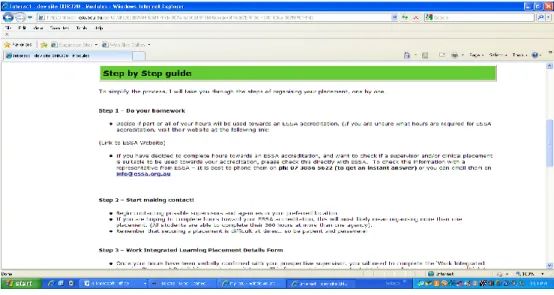
Figure 2 below showcases a screen capture from the online learning module to guide future students in their sourcing and selection of professional placements.
FIGURE 2:
Asia-Pacific Journal of Cooperative Education, 2010, 12(3), 153-167 159 Timing of the placement
The WIL Project for Exercise Science has been offered in the summer session by blended mode in order for students to reach a total of 360 hours. These organizational decisions provide students with the opportunity to complete sufficient hours to attain strong technical skills in exercise science. The research participants acknowledged the benefits of the positioning of the subject in summer session as identified below:
Creates more time over the summer and [they] will be able to do all the hours. There’s more hours if they weren’t sure what they wanted to do they’d be able to do it at a few different places and get a better experience at each one. (P6)
Now it’s in summer, from an organisational perspective I think that people can travel to Sydney and work in a clinical setting to get the right amount of hours rather than just go to gyms in the local area because we have other subjects on at the same time at uni. (P5)
The participants did, however, identify potential barriers to positioning the WIL Project in the summer session and selecting a placement away from their home/university town:
It will be hard for some students because some students work and they have to do their hours in the holidays and more hours mean they work less which would decrease their standard of living while they’re at university because they’ve got less money. (P4)
Like for people who had to travel long distances maybe the uni could help out there. Students could have an opportunity to apply for a scholarship … they could get a couple of dollars for living costs. (P7)
The research team has acknowledged the barrier to selecting a placement away from casual work commitments and accommodation, and have created opportunities for students to access a WIL scholarship.
2. Pedagogical support
Research participants identified an array of pedagogical considerations for designing the on-line learning environment to support the design, implementation and evaluation of the WIL Project.
Career planning
Research indicates that students find that most of their learning while on placement occurs in non-theoretical areas such as correction of misconceptions about workplace reality, new skills, time management, development of self-confidence and an increased awareness of career options (Cate & Jones, 1999). WIL experiences allow students to learn about career options, explore their abilities and determine their strengths and weaknesses. Participants in this study identified the need to increase their knowledge of the range of future employment opportunities available and how to access those that would replicate the authenticity of duties undertaken in their future careers.
Maybe a bit more information on what jobs are available at the end, because that’s sort of third year stuff so everyone is looking towards that. (P2)
Asia-Pacific Journal of Cooperative Education, 2010, 12(3), 153-167 160 I think doing a placement that shows you what you’ll be doing in your future is worthwhile. (P6)
In addition, participants requested that the subject requirements allow them to accumulate hours in multiple professional contexts.
I guess let me get a feel of which area I wanted to be in … I did Sports Development, marketing and promotions and because I was working in Operations: it was really helpful. (P3)
An online module has been developed on career planning. The aim of this module is to assist students to develop an awareness of employment opportunities and support their ability to prepare job applications and participate in interviews. Figure 3 below is an example of a learning sequence from this module.
FIGURE 3:
Module 3 – The Job Application Process Scaffolding
As the subject was to be facilitated by blended mode, participants suggested the need for a step-by-step process to assist future students to design their project:
A step-by-step way of them [students] actually designing their project ,so instead of just saying you need this information … just help them out in actually designing what to do. (P4)
To scaffold students’ design of the WIL Project, Pebblepad (an online folio tool) will be the pedagogical tool used. Pebblepad provides students with a sequentially progressive pathway for the development of an action plan. Figure 4 below outlines the requirements of
Asia-Pacific Journal of Cooperative Education, 2010, 12(3), 153-167 161 Assessment Two of the subject which is to be completed using the Pebblepad action plan tool.
FIGURE 4:
Assessment requirements
In order to further scaffold student learning, an online module has been created that steps students through the process of creating and sharing a Pebblepad action plan. The research participants suggested that as well as being supported to design the WIL Project, ‚they would also need to learn how to use the online tools that were new to them‛ (P4). Figure 5 below displays the introduction to the Pebblepad module.
FIGURE 5:
Asia-Pacific Journal of Cooperative Education, 2010, 12(3), 153-167 162 To further support students formulating a WIL Project which is of value to the professional partner and has the potential to succeed, Pebblepad allows the subject coordinator to provide instant online feedback on the action plan, once submitted through the system’s gateway. This will allow students to obtain timely and detailed feedback before implementing their WIL Project and assist in allaying their concerns regarding ‚what to do and how to do it‛ (P7).
Reflective practice
For WIL experiences to ensure quality, reflection needs to be continuous in nature, timely, derived from a variety of sources, an invited requirement, assessable, and valued as a tool to assist in the improvement of future practice (Clarke & Burgess, 2009). These descriptors of reflection are evidenced in the learning design of the WIL Project. Opportunities for meaningful reflection have been embedded in the assessment requirements of the subject. Assessment Three requires the student to prepare and post a fortnightly blog within the Pebblepad learning environment that provides considered comments on the i) tasks undertaken; ii) skills developed, rehearsed and refined; iii) episodes requiring conflict resolution; iv) status of the WIL Project outcomes; and v) factors that have facilitated and constrained the project’s progress. These reflections will be monitored regularly by the subject coordinator in an effort to provide ongoing support for the student and to evaluate their progress. Figure 6 below indicates the requirements of the assessment task and showcases the scaffolded nature of developing students’ ability to reflect through the use of guided questions.
FIGURE 6:
Assessment task 3 - Blog
Participants in the research sample provided positive support for the use of the blog tool: It’s good in the way that you can remember what you’ve done each day, otherwise you would just forget. It would be useful to use later when you are going for jobs so you can say I did this at a placement. (P1)
Asia-Pacific Journal of Cooperative Education, 2010, 12(3), 153-167 163 It’s a good chance … if you write everything down after you do it to reflect over what you’ve done. (P7)
Data from the interviews suggested that students were aware of the need to reflect on their overall success if doing the WIL Project. As part of the action research cycle (Kemmis & McTaggart, 1988), students are required to prepare a 2000-2500 word evaluation report that fully details the insights gained from designing and implementing their WIL Project. Figure 7 below is a screen capture of the requirements of the evaluative report.
FIGURE 7:
Scaffolding the reflective evaluation report On-line learning
The sample of participants strongly acknowledged supporting their learning through the use of online learning opportunities. They recognized the authenticity of these modes of information and communication technology as preparation for their future professional workplace, as well as providing the opportunity for students to work asynchronously.
I think definitely that’s the way things are going. Everything’s done online now, even between companies. Emails are sent and teleconferences, on line conferencing, so I think that will prepare us in this subject, it’ll prepare me better for after I finish and enter the workplace. (P3)
Asia-Pacific Journal of Cooperative Education, 2010, 12(3), 153-167 164 Participants, however, pointed to several potential constraints of online learning that they felt would impede their participation in and completion of the WIL Project:
If there’s a class you know you should be there … but with the online you don’t really know what pace everyone else is working at. (P1)
I think a limitation of online learning is that you’re by yourself … no motivation. I just prefer to have someone to bounce things off. (P1)
In direct response to these student concerns, the online learning environment will be supported by a subject forum on which students post questions and comments to be responded to by both their peers and the subject coordinator. Additionally, wikis will be created through which groups of students participating in similar professional placements (e.g. fitness instruction) can share their experiences, fears, concerns and solutions to problems.
Participants in the research sample also flagged the importance of re-learning how to navigate the online learning environment and adopt the use of several new tools. In response to the student voice, ‚We used the blog in Applied Psych but I think I forget what to do‛ (P6); the researchers have created a module that provides students with a step-by-step guide to engaging with the blog tool. Figure 8 provides an example of a learning activity that reacquaints students with the use of the blog tool in the online learning environment.
FIGURE 8:
Asia-Pacific Journal of Cooperative Education, 2010, 12(3), 153-167 165 3. Interpersonal support
Two key issues were coded within the theme of interpersonal support: i) the need for the subject coordinator to monitor student progress because of the blended learning environment, which was new to students; and ii) the desire to align the students’ learning objectives and career aspirations with those of the potential placement partner.
Monitoring student progress
Despite the willingness to engage in online learning environments, the participants still voiced the need for regular monitoring of their progress, some even suggesting face-to-face meetings midway through semester. Evaluating student progress will be undertaken using the blog tool in Pebblepad, as well as providing scheduled times throughout the project for students to contact the subject coordinator by email, phone or by using the subject forum. Times for and agendas of these virtual meetings will be negotiated between the student and the subject coordinator to best cater for the onsite learning needs of the student:
Checked up on each person just to see how they were going and if they were handling it alright. Just to let them know that you’re there if they do need help. (P1) Even if part of the class meet up sometimes towards the end or even halfway through placement, and say have a sort of 5 or 10 minute speech in front of the whole class and just say what you are doing. (P2)
Matching student and professional partner
The participants identified the necessity for creating an interpersonal and professional match between the student and the professional partner. Students viewed this as paramount to the success of the placement:
This is what I want to do, so where’s an employer that’ll match up with my vision. I think if you have that you’re going to get more out of your prac. (P3)
In an effort to match students with potential professional partners that provide opportunities for students to achieve their professional objectives, students are now required to complete an Information Sheet graded as a Satisfactory/Unsatisfactory assessment task. The Information Sheet requires students to provide details including name, contact details, courses studied, subjects that explicitly relate to the potential placement, experience in other professional placements in first year, goals and objectives for and expectations of this placement and ideas for the WIL Project. Creating strong communication links between students, the university and the professional partner will contribute toward ensuring that all are sufficiently informed of the requirements of the professional placement and prepared to undertake a collegial and negotiated partnership.
DISCUSSION AND CONCLUSION
It is apparent from the research data that students welcome the opportunity to participate in a WIL experience that will allow them to achieve strong technical proficiency in exercise science. The increased placement hours required and the broad range of activities in which students need to be involved (musculo-skeletal, cardiovascular and respiratory), provide both benefits and barriers to participation. As Lave and Wenger (1991) suggest, to become fully socialized into the community of practice, in this case Exercise Physiology, students
Asia-Pacific Journal of Cooperative Education, 2010, 12(3), 153-167 166 need exposure to the breadth of activities of the community’s practices as well as to the range of members of the community. It is evident that WIL has the potential to introduce students to these real-world practices through a cognitive apprenticeship (Brown, Collins & Duguid, 1989). Furthermore, as an example of an authentic assessment task (Biggs, 1995), WIL requires students to apply their knowledge to cope with real tasks and problems that naturally occur in the workplace. Therefore, WIL assists these students to respond to tasks which are relevant, contextual and involve the synthesis of knowledge and skills rather than merely the application of procedural and declarative knowledge (Biggs).
In regard to the nature and depth of support required by students to undertake WIL, the data generated from this case study identified the need for the thoughtful scaffolding of the learning experiences that contribute to student learning. As legitimate peripheral participants (Wenger, 1998) in the community of practice, these students are being gradually exposed to the nature of the profession through a considered plan of sequential, supported learning experiences that increase in the difficulty, responsibility, initiative and depth of knowledge required. For students to succeed in WIL, it is imperative that their learning be developmentally scaffolded as their professional placements are essentially test sites for future career skills, so the sequential progression of learning needs to be intentionally designed.
The data further supported the need for embedded conscious reflection during WIL. The cohort of student participants in this case study clearly flagged the desire to document their experiences during professional placement. Students can meaningfully reflect on i) their placement objectives, ii) their ongoing achievement of these objectives; and iii) the success of the WIL Project. These have been addressed through the use of the Information Sheet, blog and Final Evaluation Report. This practice is in accordance with the view of Schön (1987) who states that reflective practice involves thoughtfully considering one's own experiences in applying knowledge to practice, while being coached by professionals in the discipline. In WIL, students are supported by the professional partner, their subject peers and the subject coordinator to make sense of their professional context, their proposed strategies to implement their WIL Project and to evaluate their degree of success. Encouraging student reflection assists in their development as autonomous, qualified and self-directed professionals. In order to achieve those aims, there needs to be authentic discourse between the university, the student and the professional partner which ensures that the student’s goals for the WIL Project are well-defined and clearly understood by all involved from the commencement of the professional placement.
As the student voice has driven the learning design of the current iteration of WIL, there will doubtless be more to learn from evaluations over time. The results of this case study have clearly indicated that students are aware of their learning needs, particularly in regard to the nature of the organizational, pedagogical and interpersonal support required to aid them in satisfactorily completing the assessment for this project. Students acknowledge their need to liaise regularly with professionals in their field to monitor their progress; this is combined with their desire to create successful professional relationships with their professional placement supervisor. Students’ insights and candidness in their responses to the interview questions enabled the creation of a new infrastructure for the subject which is potentially more supportive of student needs and which is imperative for preparing students for success in any WIL activity.
Asia-Pacific Journal of Cooperative Education, 2010, 12(3), 153-167 167 ACKNOWLEDGEMENTS
This research was funded by a Charles Sturt University (CSU) Education for Practice Institute (EFPI) Fellowship.
REFERENCES
Biggs, J. (1995). Assessing for learning: Some dimensions underlying new approaches to educational assessment. The Alberta Journal of Educational Research, 41(1), 1-17. Bloom, B. S. (1956). Taxonomy of educational objectives. Boston, MA: Allyn & Bacon.
Brown, J. S., Collins, A., & Duguid, P. (1989). Situated cognition and the culture of learning. Educational Researcher, 18(1), 32-41.
Cate, C. & Jones, P. (1999). Learning outcomes and the educational value of cooperative education. Paper presented at the WACE/CEA International Conference on Cooperative Education, World Association for Cooperative Education, Boston, June, 199. Clarke, D, & Burgess, C. (2009). Using practice-based education to improve the student
experience, In Proceedings of 32nd HERDSA Annual Conference (pp. 72-80). Darwin, Australia: HERDSA, July, 6-9, 2009.
Denzin, Y. & Lincoln, Y.S. (Eds.), (2000). Handbook of qualitative research. London, UK: Sage Publications.
Goulter, I. (2008). CSU a national leader in work-integrated learning. Media release 17th
March, 2008, Charles Sturt University, Bathurst, Australia.
Herrington, A., & Herrington, J. (1998). Authentic assessment and multimedia: How university students respond to a model of authentic assessment, Higher Education, Research and Development, 17(3), 305-322.
Kemmis, S., & McTaggart, R. (Eds.). (1988). The action research planner (3rd ed.). Deakin
University, Geelong, Australia: Deakin University Press.
Lave, J., & Wenger, E. (1991). Situated learning: Legitimate peripheral participation. Cambridge, UK: Cambridge University Press.
Maykut, P., & Morehouse, R. (1994). Beginning qualitative research: A philosophic and practical guide. London, UK: Falmer Press.
Ramsden, P. (1992). Learning to teach in higher education. London, UK: Routledge. Schön, D. (1987). Educating the reflective practitioner. San Francisco, CA: Jossey Bass. Trigwell, K., & Reid, A. (1998). Introduction: Work-based learning and the students’
perspective. Higher Education Research & Development, 17(2), 141-154.
Wenger, E. (1998). Communities of practice: Learning, meaning and identity. Cambridge, UK: Cambridge University Press.
Wiggins, G. (1990). The case for authentic assessment. Washington, DC. ERIC Clearinghouse on Tests, Measurement and Evaluation. (ERIC Document Reproduction Service No. ED 328606).
Yin, R. (2003). Case study research: Design and methods. (3rd ed.). London, UK: Sage.
Zegwaard, K., Coll, R., & Hodges, D. (2003). Assessment of workplace learning: A framework. Asia-Pacific Journal of Cooperative Education, 2003, 4(1), 10-18.
Asia-Pacific Journal of Cooperative Education
ABOUT THE JOURNAL
The Asia-Pacific Journal of Cooperative education (APJCE) arose from a desire to produce an international forum for discussion of cooperative education, or work integrated learning (WIL), issues for practitioners in the Asia-Pacific region and is intended to provide a mechanism for the dissemination of research, best practice and innovation in work-integrated learning. The journal maintains close links to the biennial Asia-Pacific regional conferences conducted by the World Association for Cooperative Education. In recognition of international trends in information technology, APJCE is produced solely in electronic form. Published papers are available as PDF files from the website, and manuscript submission, reviewing and publication is electronically based. In 2010, Australian Research Council (ARC), which administers the Excellence in Research (ERA) ranking system, awarded APJCE a ‘B’ ERA ranking (top 10-20%).
Cooperative education/WIL in the journal is taken to be work-based learning in which the time spent in the workplace forms an integrated part of an academic program of study. More specifically, cooperative education/WIL can be described as a strategy of applied learning which is a structured program, developed and supervised either by an educational institution in collaboration with an employer or industry grouping, or by an employer or industry grouping in collaboration with an educational institution. An essential feature is that relevant, productive work is conducted as an integral part of a student's regular program, and the final assessment contains a work-based component. Cooperative education/WIL programs are commonly highly structured and possess formal (academic and employer) supervision and assessment. The work is productive, in that the student undertakes meaningful work that has economic value or definable benefit to the employer. The work should have clear linkages with, or add to, the knowledge and skill base of the academic program. INSTRUCTIONS FOR CONTRIBUTORS
The editorial board welcomes contributions from authors with an interest in cooperative education/WIL. Manuscripts should comprise reports of relevant research, or essays that discuss innovative programs, reviews of literature, or other matters of interest to researchers or practitioners. Manuscripts should be written in a formal, scholarly manner and avoid the use of sexist or other terminology that reinforces stereotypes. The excessive use of abbreviations and acronyms should be avoided. All manuscripts are reviewed by two members of the editorial board. APJCE is produced in web-only form and published articles are available as PDF files accessible from the website http://www.apjce.org.
Research reports should contain; an introduction that describes relevant literature and sets the context of the inquiry, a description and justification for the methodology employed, a description of the research findings-tabulated as appropriate, a discussion of the importance of the findings including their significance for practitioners, and a conclusion preferably incorporating suggestions for further research. Essays should contain a clear statement of the topic or issue under discussion, reference to, and discussion of, relevant literature, and a discussion of the importance of the topic for other researchers and practitioners. The final manuscript for both research reports and essay articles should include an abstract (word limit 300 words), and a list of keywords, one of which should be the national context for the study.
Manuscripts and cover sheets (available from the website) should be forwarded electronically to the Editor-in-Chief. In order to ensure integrity of the review process authors’ names should not appear on manuscripts. Manuscripts should be between 3,000 and 5,000 words, include pagination, be double-spaced with ample margins in times new-roman 12-point font and follow the style of the Publication Manual of the American Psychological Association in citations, referencing, tables and figures (see also, http://www.apa.org/journals/faq.html). The intended location of figures and diagrams, provided separately as high-quality files (e.g., JPG, TIFF or PICT), should be indicated in the manuscript. Figure and table captions, listed on a separate page at the end of the document, should be clear and concise and be understood without reference to the text.
EDITORIAL BOARD Editor-in-Chief
Dr. Karsten Zegwaard University of Waikato, New Zealand Copy Editor
Jennifer Buckle Asia-Pacific Journal of Cooperative Education
Editorial Board Members
Ms. Diana Ayling Unitec, New Zealand
Mr. Matthew Campbell Australian Catholic University, Australia Prof. Richard K. Coll University of Waikato, New Zealand Prof. Rick Cummings Murdoch University, Australia Prof. Leigh Deves Charles Darwin University, Australia Dr. Maureen Drysdale University of Waterloo, USA
Dr. Chris Eames University of Waikato, New Zealand
Ms. Jenny Fleming Auckland University of Technology, New Zealand Dr. Thomas Groenewald University of South Africa, Johannesburg, South Africa Ms. Kathryn Hays Massey University, New Zealand
Ms. Katharine Hoskyn Auckland University of Technology, New Zealand Dr. Sharleen Howison Otago Polytechnic, New Zealand
Dr. Rezaul Islam University of Dhaka, Bangladesh Dr. Nancy Johnston Simon Fraser University, Canada
Prof. Stephen F. Johnston University of Technology, Sydney, Australia Dr David Jorgensen Central Queensland University, Australia
Dr. Mark Lay University of Waikato, New Zealand
Assoc. Prof. Andy Martin Massey University, New Zealand Ms. Susan McCurdy University of Waikato, New Zealand Ms. Norah McRae University of Victoria, Canada Assoc. Prof. Janice Orrell Flinders University, Australia Ms. Levinia Paku University of Waikato, New Zealand
Ms. Sally Rae Auckland University of Technology, New Zealand Dr. David Skelton Eastern Institute of Technology, New Zealand Assoc. Prof. Neil Taylor University of New England, Australia Ms. Susanne Taylor University of Johannesburg, South Africa Dr. Franziska Trede Charles Sturt University, Australia Prof. Neil I. Ward University of Surrey, England
Mr. Nick Wempe Whitireia Community Polytechnic, New Zealand