Contact Information: N. Radziwill, Phone 304-456-2139, [email protected]. A. Shelton, Phone 304-456-2277, [email protected].
TWiki as a Platform for Collaborative
Software Development Management
Nicole M. Radziwill and Amy L. Shelton
National Radio Astronomy Observatory, P.O. Box 2, Green Bank, WV 24944 USA
ABSTRACT
The software development process in Green Bank is managed in six-week development cycles, where two cycles fall within one quarter. Each cycle, a Plan of Record is devised which outlines the team's commitments, deliverables, technical leads and scientific sponsors. To be productive and efficient, the team must not only be able to track its progress towards meeting commitments, but also to communicate and circulate the information that will help it meet its goals effectively. In the early summer of 2003, the Software Development Division installed a wiki web site using the TWiki product to improve the effectiveness of the team. Wiki sites contain web pages that are maintainable using a web interface by anyone who becomes a registered user of the site. Because the site naturally supports group involvement, the Plan of Record on the wiki now serves as the central dashboard for project tracking each development cycle. As an example of how the wiki improves productivity, software documentation is now tracked as evidence of the software deliverable. Written status reports are thus not required when the Plan of Record and associated wiki pages are kept up to date. The wiki approach has been quite successful in Green Bank for document management as well as software development management, and has rapidly extended beyond the bounds of the software development group for information management.
Keywords: software development, software engineering, project management, wiki, document management
1. INTRODUCTION
1.1. The Single Dish Development (SDD) Integrated Product Team
The Single Dish Development (SDD) group in Green Bank is a ten-member team responsible for the following software products for use with the Green Bank Telescope (GBT) 1: M&C, GBT Observe (GO), Interim Analysis and Reduction of Data System (IARDS) and DISH (aips++ products), Observing Application Programming Interface (API), Configuration API, GBT FITS Monitor (GFM) and its Plugins, and FITS Query Language (FQL). In 2004, the Observing and Configuration APIs will replace GO. The applications are unified by an enterprise architecture which ensures that source code reuse is prevalent, and all applications are algorithmically identical. 2
1.2. Work Types
Three distinct types of work are performed by SDD members: new development projects, in which software for new instrumentation or expanded observing modes is developed; continuing maintenance and enhancement (CM&E), which represents all incremental improvements that are not being directed by development projects; and operational support, which is the immediate response provided for software “emergencies” and other mission critical and time-sensitive needs. The proportion of operational support time varies from week to week. In order for time to qualify as operational support, there must be no workaround for the problem and the problem must be interfering with current observations, operations are at a standstill, or the fix is on the critical path for other delayed or in jeopardy project work. A good planning mechanism for software development tasks must accommodate each of these work types seamlessly.
1.3. Project Planning in Green Bank
The Green Bank Project Planning Committee, established in the spring of 2003, consists of Division Heads from all non-administrative units at the site, the Chief Commissioning Scientist, the Telescope Scheduler, the Site Director, and his Deputy. Building upon the success of finite duration software development cycles, which had been instituted a year earlier with great success, the Committee established eight work cycles a year (two per quarter) within which all divisions would be aligned to achieve six-month and annual site goals. This management process has been in place for over a year, 3 and has been refined to the point where identifying trade-offs between tasks to ensure that the site’s goals are met has become routine. The next step is to refine this process even further so that it can be used for active project control.
1.4. Projects Supported
The SDD currently supports four Priority 1 GBT Projects: Precision Telescope Control System (PTCS) 4, Ease of Use, Data Handling, and Software Continuing Maintenance & Enhancement (CM&E).5 In addition, there are observer support requirements for observing and data reduction, which also require resources on a weekly basis.
PTCS work involves a combination of improvements to the telescope control system (usually the antenna and active surface), support of new PTCS instrumentation (including inclinometers and accelerometers) and continuum data analysis and reduction tasks involving GFM. The Ease of Use project has focused on building Configuration and Observing APIs, which will make the GBT capable of executing its observations as Scheduling Blocks (a subsequent project, however, will be required to effect the transition). The Data Handling project involves making GBT data accessible to multiple data reduction packages, as well as building functionality for data reduction in IDL and Python. Software CM&E includes all activities which are essential for continued efficiency of operations, currently including migrating systems to Linux, building simulators, and systematically improving software within the control system.
2. THE PLAN OF RECORD (POR) and MODIFICATION REQUEST (MR)
Central to the management of software development in Green Bank are the Plan of Record (POR), which outlines the tasks that the SDD has committed to for a six-week period, and the Modification Request (MR) which is a complete description of a task or problem enumerated on the POR which is to be solved, and the solution strategy and validation approach which will be used as that solution is pursued.
2.1. Plan of Record
The POR is a dashboard for the entire development team, and provides useful status information to the scientific and engineering sponsors who are responsible for guiding software development work. This project planning artifact a) outlines the commitments that the SDD is required to meet each development cycle, b) describes the background tasks that should be worked on as commitments are met and time permits, and c) is used to log operational support tasks completed and ideas for future work. Commitments are tasks which must be completed within a particular development cycle. These commitments are derived from the individual project plans for each project, and are selected so that critical path items are given preference. Should a time-intensive operational support item arise, the Project Planning Committee decides which task or tasks on the POR should be deferred to the next cycle so that the operational support can be successfully addressed.
2.2. Modification Request
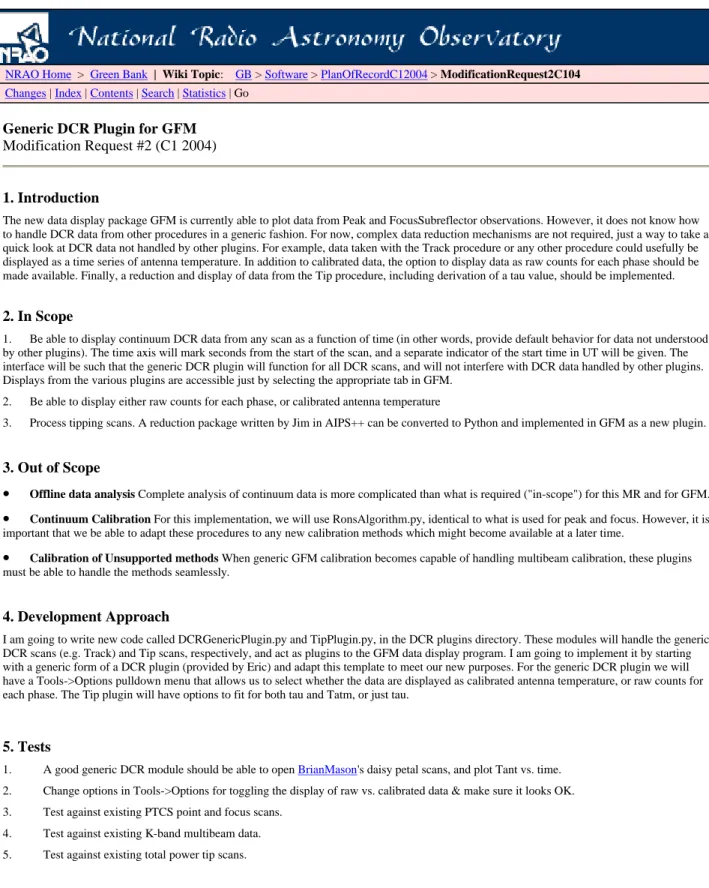
The intent of an MR is to accurately characterize the desired outcome for a software development task, and approach to achieving that outcome. An MR that is properly written can be reviewed months or years later, and the reader will clearly understand the problem which was solved, the approach taken to solve that problem, and the test cases used to verify that the work was implemented correctly. An example MR is shown in Figure 1.
NRAO Home > Green Bank | Wiki Topic: GB > Software > PlanOfRecordC12004 > ModificationRequest2C104 Changes | Index | Contents | Search | Statistics | Go
Generic DCR Plugin for GFM Modification Request #2 (C1 2004)
1. Introduction
The new data display package GFM is currently able to plot data from Peak and FocusSubreflector observations. However, it does not know how to handle DCR data from other procedures in a generic fashion. For now, complex data reduction mechanisms are not required, just a way to take a quick look at DCR data not handled by other plugins. For example, data taken with the Track procedure or any other procedure could usefully be displayed as a time series of antenna temperature. In addition to calibrated data, the option to display data as raw counts for each phase should be made available. Finally, a reduction and display of data from the Tip procedure, including derivation of a tau value, should be implemented.
2. In Scope
1. Be able to display continuum DCR data from any scan as a function of time (in other words, provide default behavior for data not understood by other plugins). The time axis will mark seconds from the start of the scan, and a separate indicator of the start time in UT will be given. The interface will be such that the generic DCR plugin will function for all DCR scans, and will not interfere with DCR data handled by other plugins. Displays from the various plugins are accessible just by selecting the appropriate tab in GFM.
2. Be able to display either raw counts for each phase, or calibrated antenna temperature
3. Process tipping scans. A reduction package written by Jim in AIPS++ can be converted to Python and implemented in GFM as a new plugin.
3. Out of Scope
• Offline data analysis Complete analysis of continuum data is more complicated than what is required ("in-scope") for this MR and for GFM.
• Continuum Calibration For this implementation, we will use RonsAlgorithm.py, identical to what is used for peak and focus. However, it is important that we be able to adapt these procedures to any new calibration methods which might become available at a later time.
• Calibration of Unsupported methods When generic GFM calibration becomes capable of handling multibeam calibration, these plugins must be able to handle the methods seamlessly.
4. Development Approach
I am going to write new code called DCRGenericPlugin.py and TipPlugin.py, in the DCR plugins directory. These modules will handle the generic DCR scans (e.g. Track) and Tip scans, respectively, and act as plugins to the GFM data display program. I am going to implement it by starting with a generic form of a DCR plugin (provided by Eric) and adapt this template to meet our new purposes. For the generic DCR plugin we will have a Tools->Options pulldown menu that allows us to select whether the data are displayed as calibrated antenna temperature, or raw counts for each phase. The Tip plugin will have options to fit for both tau and Tatm, or just tau.
5. Tests
1. A good generic DCR module should be able to open BrianMason's daisy petal scans, and plot Tant vs. time. 2. Change options in Tools->Options for toggling the display of raw vs. calibrated data & make sure it looks OK. 3. Test against existing PTCS point and focus scans.
4. Test against existing K-band multibeam data. 5. Test against existing total power tip scans.
3. WIKI IMPLEMENTATION GOALS
In the SDD strategic plan for 2003-2004 (established in November 2002), a key organizational target for 2003 was to implement knowledge management and document management, two pain points for the software organization in Green Bank. Because the wiki concept had been successfully implemented for these purposes, it was reviewed for applicability within Green Bank. The distinguishing mark of a wiki web site is that the web pages are editable by the wiki’s members, who can optionally be restricted by access controls. Because of its group-editable nature, and the fact that edits would be immediately accessible online, a wiki seemed to be a particularly applicable solution in the context of NRAO culture, which is strongly geared towards consensus building.
By establishing a wiki, the SDD wished to meet the following goals within the division:
• Eliminate the administrative overhead associated with weekly status reporting
• Provide a searchable repository for user documentation, programmers’ documentation, and MRs
• Make the process of writing, updating, and approving MRs more effective
• Provide a common workspace for software engineers to collaborate on problems
• Expand the awareness of each others’ tasks within the SDD to eliminate duplication of code and accelerate convergence to solutions
Wiki use was institutionalized for the remainder of the Green Bank site within weeks after its implementation for the SDD. With this decision, there were several additional goals that the Project Planning Committee wished to accomplish:
• Keep user documentation up to date by allowing any member of the community to edit when errors were uncovered, thus eliminating the need to send emails asking others to update documentation, and associated time cost
• Inform NRAO staff internal and external to Green Bank about project goals, work plans, and progress
• Provide a project context for staff throughout the site to better understand the importance of individual contributions to site-wide and Observatory-wide goals
• Encourage better communication between electronics staff, software staff, and telescope operators
• Provide up-to-date information to visiting observers and prospective observers, and
• Encourage collaboration between NRAO staff and members of other institutions and universities.
4. THE TWIKI APPLICATION
TWiki (http://www.twiki.org) is a free wiki engine written in Perl and distributed under the GNU GPL. A wiki web site using TWiki consists of several subdivisions, each called wiki webs. Once set up, a wiki site is nearly maintenance free, since most of the customization can be done by users who are granted privileges for each web. Many organizations have successfully implemented collaboration solutions based on TWiki, including Disney, Cingular Wireless, Motorola, SAP and Wind River, and the PPARC AstroGrid project in the astronomy domain. 6
Other alternatives considered were MoinMoin (http://moin.sourceforge.net), a Python-based wiki, and UseMod (http://www.usemod.com), a monolithic Perl script which runs a complete wiki. MoinMoin had excellent fonts, graphics and features, including its display of recently changed items in terms of time since the change was made, but did not seem easily extensible. UseMod was the easiest to install and run, however, its appearance was the least professional of the wiki engines and it seemed to be lacking in features.
TWiki was eventually selected for its ease of installation and administration, and the proliferation of TWiki plugins which extend its functionality. This has proven to be an excellent choice. The only characteristic of TWiki that has been criticized is the absence of true document parenting. Although a wiki page within a web can be created and appear as if it is a child of another, in fact, there is only a single-level hierarchy containing wiki webs and their topics.
5. THE EXPERIENCE AT GREEN BANK
In 2004, the GB wiki is being used for many diverse purposes, including a repository for project information, a container for software product information, and a platform for project management at the site and divisional levels. Its growth has been rapid, with typical accesses of between 600-700 pages per day. There are currently 50 users of the Green Bank wiki, located locally as well as in NRAO’s Socorro and Charlottesville locations. Figure 2 provides usage statistics from June 2003 through April 2004.
5.1. The Wiki in a Typical Development Cycle
The extent of wiki use can be made clear by examining its role throughout a typical development cycle, for which planning is initiated approximately three weeks prior to the cycle’s official start date. Project Managers throughout the Green Bank site are required to visit the Projects wiki and log their work requests for the upcoming six week period. On the Friday prior to the last week of the current development cycle, all requests must be logged or work will not be authorized for those projects. This provides a strong incentive for Project Managers to plan their work long before the commencement of a development cycle.
Once the requests are in, each Division Head is required to level the resources in his or her division, identify the conflicts, and assess (but not make decisions about) what trade-offs may be required. Early the next week, an open meeting is held to discuss and resolve conflicts. Difficult decisions are sometimes aided by reviewing the annual goals for the Green Bank site as a whole. By ensuring that the tasks within a development cycle are aligned with higher level goals, consensus is often achieved quickly regarding which tasks to keep and which to eliminate or defer.
Figure 2. Since its inception in June 2003, the Green Bank wiki has been steadily used. The dashed line represents the number of wiki users per month, scaled by a factor of 200 for easier visualization. There are currently 50 active users.
5.2. The Plan of Record (POR)
The results from this community meeting become the inputs to the upcoming development cycle’s POR. Resources such as previous cycles’ MRs, design documentation, and astronomers’ notes are often linked to the POR so that software engineers have ready access to the resources they may need to satisfy an MR. The POR represents the official list of resource-leveled commitments that the SDD is required to achieve in an individual development cycle.
NRAO Home > Green Bank | Wiki Topic: GB > Software > PlanOfRecordC32004 Changes | Index | Contents | Search | Statistics | Go
Software Plan of Record Cycle 3 2004 (April 1 - May 14)
Project TASK MR Sponsor Lead Status/Notes Done
CCB CCB Manager CCBClassDoc BrianMason MichaelLacasse
Brian is happy with the progress. There are still may items TBD, such as Log messages, sampling (Waiting for HW specs.), FITSIO, pinging CCB server, reconnecting to CCB, computing valid number of expected integrations, more testing of CCB demo server
Data
Integrate Numarray into GFM/DEAP
N/A NicoleRadziwill EricSessoms Completed. (gfm-test)
Data
Complete & Release second phase of DISH improvements
DishRequests RonMaddalena BobGarwood See DishRequests for specific notes. OK
Ka Commissioning
Support N/A BrianMason AmyShelton
I've fixed all software problems found as of 10am 4/22/2004; these are patched into M&Cv4.2. I have partially updated the DDL with Galen's sampler range values; further requests regarding these ranges require additional rework.
e-mail sign-off excerpt: hi Amy- my requests for this cycle were met. thanks, Brian PTCS* Add/Update antenna refraction model ModificationRe
quest4C304 RichardPrestage JoeBrandt Completed
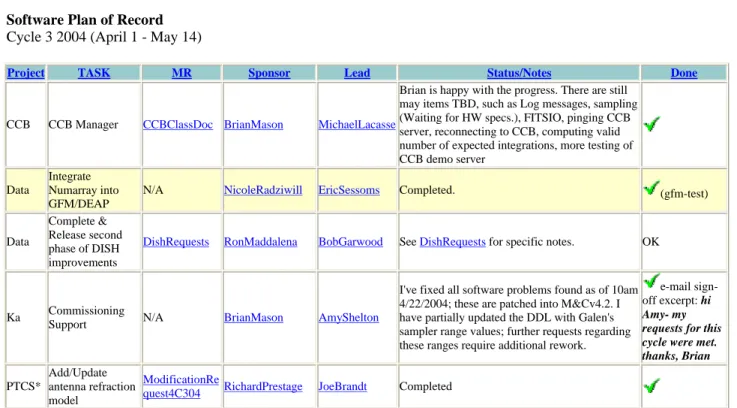
Figure 3. An excerpt from the Plan of Record for a software development cycle in early 2004 in Green Bank. 7
The POR is more than just a list of tasks, however. First, a software engineer will know what amount and type of documentation is required when he or she first reviews the cycle’s POR. The decision regarding what kind of documentation is required is first made by the Division Head or Deputy Division Head, who compiles the POR each cycle once consensus has been achieved regarding what tasks to work. In the “MR” column, if an MR is required for a particular task, the software engineer will see, for example, ModificationRequest1C204? which indicates that this is the first MR required in cycle 2 of 2004; the trailing question mark shows that the document has not yet been created on the wiki by the responsible party.
If some other word appears in the “MR” column, the software engineer knows that a different kind of documentation is required. In the example above, DishRequests is a wiki page containing user-provided requests for enhancements to
the Dish data analysis package. CCBClassDoc is a collection of class diagrams and other programmers’ documentation.
Second, the POR serves as a dashboard for project managers and project scientists to collaborate with software engineers, and for software engineers to collaborate with one another. Members of the SDD can find out what their peers are working on, and contribute asynchronously to the development and elucidation of MRs and programmers’ documentation. Scientific sponsors and project managers can add their comments directly to the online system as well, thus reducing the cycle time in communicating with software specialists and recording the results.
Finally, the online POR serves as an up-to-the-minute status display that nearly eliminates the need for individual weekly status reports. Individuals within the SDD, project managers, and scientific sponsors can all learn the status of any task by going to the POR page, and drilling down to more detailed reports when necessary. Because members of the community are able to assess progress on a daily rather than weekly basis, adjusting tasks and priorities to meet the goals of a development cycle can be done with greater responsiveness. This directly increases the productivity of the SDD and helps to ensure that effort is spent on the most critical tasks.
5.3. Approval Process
Approval of MRs is also done online using the current development cycle’s POR page as the main portal. Scientific sponsors for each task can access the POR in their browser, easily find their MRs, and log a check mark to the bottom of the MR page or make edits themselves to ensure accuracy before approving the MR (see Figure 4 for an example). Authenticity is guaranteed because the Green Bank wiki has been set up to accept edits only from registered users. Because of the simulated parenting between topics within a wiki web, MRs can be associated with the POR in which they originally appeared for easy cross-referencing.
Management of the POR and associated MRs is only one aspect of administration for the SDD. Also available on the Green Bank Software wiki are access to bug reporting capabilities, troubleshooting recovery procedures, software product documentation for all software packages being developed (from prototype to production stage), and calendars detailing telescope and maintenance time usage and software personnel whereabouts.8 The Software wiki provides “one-stop shopping” for anyone who needs to know the latest information about software development progress.
In addition to managing software development tasks online, the wiki is also used by Division Heads to prepare quarterly reports in a collaborative fashion, which greatly improves the efficiency of preparing this comprehensive document. Plus, all contributors have ready access to the project details and incremental status information that is used to compile the quarterly report. Centralizing activities such as this on the wiki has resulted in direct efficiency improvements not only within the software development organization, but throughout the Green Bank site.
6. CONCLUSIONS
Since its initial installation in June 2003, the wiki at Green Bank has experienced quick adoption, rapid growth, and as a result has been highly successful. This utility is being used to more effectively accomplish tasks within the software development group such as task assignments, status reporting, elucidating requirements, exploring designs, and achieving sign-off for developed work. Outside the SDD, the wiki is being used for site-wide project planning and management, writing quarterly reports, providing visitors and prospective observers with up-to-date information, and even keeping track of recreational activities in and around Green Bank.
The five major goals of installing the wiki for the SDD have all been met. Overhead associated with weekly status reporting has been reduced, detailed documentation about software development work is online and searchable, online MR writing and approval is becoming highly effective, software engineers collaborate more frequently on problems, and as a result there is much less duplication of work. Further development of the Green Bank wiki as a whole to achieve its goals is ongoing.
As a testament to the success of the Green Bank wiki and an ALMA software wiki9 which was established around the same time, an NRAO-wide wiki was established in the spring of 2004 to aid in communications between sites and projects. This site, which is only accessible internal to NRAO, is still being grown.
The POR/MR management model is highly effective for a work environment that blends operational support and continuing maintenance with new development, and requires adjustments in priorities on short timescales (~1 week). This management model would not be rigorous enough for projects which involve only new development work, however, since one premise of developing an MR is that requirements are straightforward and can be stated in less than a paragraph, which is clearly insufficient for developing complex new functionality.
Note also that this system of software development management is only effective when all members of the development team are highly committed, responsible, and willing to meet documentation requirements as a necessary accompaniment to code development. Fortunately, members of the SDD meet these requirements. Throughout 2004, they will continue to work on developing discipline and improving MR quality.
7. ACKNOWLEDGEMENTS
Many thanks are extended to Eric Sessoms, who originally noted that a wiki would be useful for our knowledge management and document management needs in May of 2003. We wish to thank all the members of the Green Bank Project Planning Committee (John Ford – Chair, Phil Jewell, Richard Prestage, Ron Maddalena, Carl Bignell, Dennis Egan, and Bob Anderson), who have enthusiastically sponsored the use of our wiki since its inception in June 2003, and in particular Richard Prestage, who started managing his project on the wiki immediately. Also, thanks to Jim Braatz who compiled the MR displayed as Figure 1.
The system would not be successful without its users, who have readily embraced this new tool and form of group communication. In particular, we would like to thank all other members of the SDD (Jim Braatz, Joe Brandt, Mark Clark, Ramon Creager, David Fleming, Bob Garwood, Paul Marganian, and Melinda Mello) who have adapted to the management of their work on the wiki well. The National Radio Astronomy Observatory is a facility of the National Science Foundation, operated under cooperative agreement by Associated Universities, Inc.
REFERENCES
1. P.R. Jewell and R.M. Prestage, "The Green Bank Telescope", in Proc. SPIE 5489 (this conference), 2004. 2. Prestage, R., P. Jewell, N. Radziwill and J. Lockman. “The GBT Software Integrated Product Team.”
NRAO Internal Memo, May 28, 2003.
3. http://wiki.gb.nrao.edu/bin/view/Projects/ProjectPlanningProcess
4. R.M. Prestage, K.T. Constantikes, D.S. Balser and J.J. Condon, “The GBT Precision Telescope Control System", in Proc. SPIE 5489 (this conference), 2004.
5. http://wiki.gb.nrao.edu/bin/view/Projects/WebHome 6. http://twiki.org/cgi-bin/view/Main/TWikiSuccessStories
7. http://wiki.gb.nrao.edu/bin/view/Software/PlanOfRecordC32004 8. http://wiki.gb.nrao.edu/bin/view/Software/WebHome