Chapter 7 Development of A TQM Implementation Model
7.1
Introduction
This chapter presents the development of a TQM implementation model for Chinese manufacturing firms. The development of this model was based on the TQM literature review, the structured interviews in ten Chinese manufacturing firms, the questionnaire findings from 212 Chinese manufacturing firms, and the general characteristics of Chinese manufacturing firms. This model provides users with a number of practices, drawn mainly from the ten Chinese firms’ experiences in general and their failures and problems in particular. The lessons learned from the ten structured interviews were used intensively to develop this model, which has been designed so that it can be taken from the body of the thesis and employed as a stand-alone document. The model can assist its users in evaluating the strengths and weaknesses of their TQM implementation, targeting their improvement areas, setting up an action plan for improvements, and tailoring a special part to the needs of their firms. The TQM implementation model developed in this study consists of:
- A framework of TQM that consists of the 11 elements of TQM and the four elements of overall business performance;
- A set of TQM implementation practices;
- A set of indicators of overall business performance;
- Processes of using this TQM implementation model in practice;
- Practical guidance providing guidelines to assist users in selecting and/or formulating the most effective TQM implementation plans.
Section 7.2 presents a framework of TQM. Section 7.3 provides a set of TQM implementation practices and their explanations. Section 7.4 presents a set of indicators of overall business performance. Section 7.5 involves processes of using this TQM implementation model in practice. Section 7.6 focuses on providing guidelines to assist users in selecting and/or formulating the most effective TQM implementation plans. Finally, a number of conclusions are provided in Section 7.7.
7. 2
A Framework of TQM
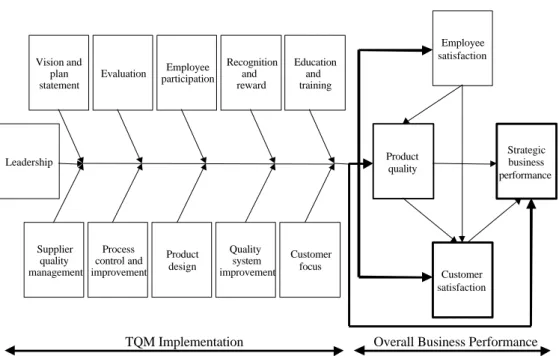
The framework of TQM was formulated on the basis of the theoretical model of TQM implementation constructs and overall business performance. The combination of the elements of TQM and overall business performance was the framework of TQM, which is displayed in Figure 7.1. Thus, the framework of TQM consists of the 11 elements of TQM and the four elements of overall business performance. This framework was based on the hypothesis that TQM implementation has effects on employee satisfaction, product quality, customer satisfaction, and strategic business performance. These hypotheses were confirmed by the questionnaire survey data from 212 Chinese manufacturing firms. Of the 11 TQM elements leadership is the most important, a finding obtained from the ten structured interviews in Chinese manufacturing firms. Of the four elements of overall business
performance, employee satisfaction has effects on product quality and customer satisfaction; it also has an indirect effect on strategic business performance through product quality and customer satisfaction. Product quality has effects on customer satisfaction and strategic business performance. As discussed previously, in the long run, customer satisfaction may have positive effects on strategic business performance. In this framework of TQM, the 11 TQM elements as a whole are regarded as enablers that can lead to improvements of overall business performance. In other words, overall business performance is the result of TQM implementation.
Figure 7.1 A Framework of TQM
7.3
TQM Implementation Practices
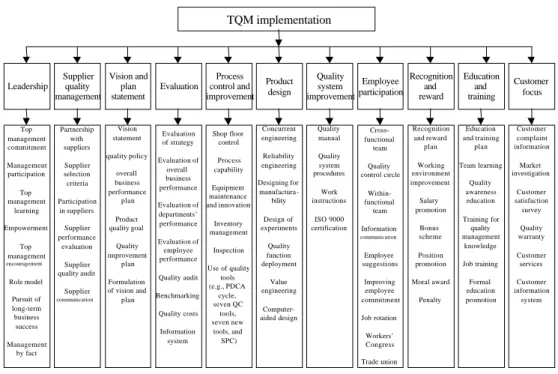
A set of TQM implementation practices and their explanations are presented in this section. In fact, implementing TQM is to implement the 11 TQM elements. There is a set of TQM implementation practices supporting the implementation of each element. Based on the literature review and the results obtained from the structured interviews in Chinese manufacturing firms, a number of TQM implementation practices were considered important for Chinese manufacturing firms. These practices are presented in Figure 7.2. In fact, a firm is a dynamic system; many activities are interrelated. Therefore, some practices presented in one element may be suitable for another. This section presents the explanations, suggestions, or potential benefits of these TQM implementation practices, which were based on existing TQM knowledge and the TQM implementation in the ten interviewed Chinese manufacturing firms. Such information may assist or encourage firms to use these practices
Customer satisfaction Employee satisfaction Strategic business performance Product quality Supplier quality management Process control and improvement Product design Customer focus Vision and plan statement
Evaluation participationEmployee
Recognition and reward Education and training Quality system improvement Leadership
to improve their TQM implementation efforts and overall business performance. It should be noted that each TQM practice is only briefly described in this section due to the text limitation. Thus, the descriptions of these TQM practices are not complete. In order to bridge the gap, more references were provided for these practices. Readers can refer to these references for a better understanding of these TQM practices.
Figure 7.2 A Model of TQM Implementation Practices
7.3.1 Leadership
Top Management Commitment
Top management commitment is the first step and prerequisite for a firm’s TQM implementation efforts. Lack of management commitment is one of the reasons for the failure of TQM efforts (Brown et al., 1994). Top managers need to demonstrate their commitment through their actions rather than words. Top management commitment can positively affect employees’ commitment to TQM and culturally change people involved. If top management views quality as more important than cost, more important than meeting product schedules, employees’ quality awareness is easily improved. To implement TQM, top managers should be committed to establishing a firm that continually views quality as a primary goal. If the organizational culture does not embody quality, any quality improvement effort is probably shallow and short-lived (Dale, 1999; Juran and Gryna, 1993).
Leadership Supplier quality management Customer focus Recognition and reward Vision and plan statement Employee participation Evaluation Quality system improvement Process control and improvement Product design Education and training TQM implementation Top management commitment Management participation Top management learning Empowerment Top management encouragement Role model Pursuit of long-term business success Management by fact Shop floor control Process capability Equipment maintenance and innovation Inventory management Inspection Use of quality tools (e.g., PDCA cycle, seven QC tools, seven new tools, and SPC) Concurrent engineering Reliability engineering Designing for manufactura -bility Design of experiments Quality function deployment Value engineering Computer-aided design Quality manual Quality system procedures Work instructions ISO 9000 certification Cross-functional team Quality control circle Within-functional team Information communication Employee suggestions Improving employee commitment Job rotation Workers’ Congress Trade union Recognition and reward plan Working environment improvement Salary promotion Bonus scheme Position promotion Moral award Penalty Education and training plan Team learning Quality awareness education Training for quality management knowledge Job training Formal education promotion Customer complaint information Market investigation Customer satisfaction survey Quality warranty Customer services Customer information system Evaluation of strategy Evaluation of overall business performance Evaluation of departments’ performance Evaluation of employee performance Quality audit Benchmarking Quality costs Information system Vision statement quality policy overall business performance plan Product quality goal Quality improvement plan Formulation of vision and plan Partnership with suppliers Supplier selection criteria Participation in suppliers Supplier performance evaluation Supplier quality audit Supplier communication
Top Management Participation
It is very difficult to improve product quality and quality management if top managers do not lead and participate. Quality improvement involves making decisions and creates something that did not exist before. It is not sufficient for top managers to stand on the sidelines and shout “improve product quality and intensify quality management”. There is no way that a manufacturing firm can implement quality improvement activities if the top managers are bystanders. Particularly in a firm with an autocratic general manager, there is a strong trend that employees act on something only in proportion to the manager’s degree of interest. Top management participation is crucial to a firm’s quality improvement efforts; it obviously helps in spreading quality consciousness throughout a firm (Dale, 1999; Ikezawa, 1993).
Top Management Learning
Top managers need to improve their managerial abilities through continuous learning. To implement TQM, they must first know what it is. Learning TQM is an important step toward implementing it. Top managers should be modest enough to learn from their employees and value the ability of their creativity. Top managers also need to learn from other organizations’ successful and unsuccessful experiences, as well as modern management methods from foreign firms. Above all, top managers should combine these insights into an approach that fits the specific conditions, problems, and challenges of their own firms. Through top management learning, a learning organization can be established. Finally, the effectiveness of leadership can be improved and the ability of decision-making enhanced (Anderson et al., 1994a; Bergman and Klefsjö, 1994; Dale, 1999; Ikezawa, 1993; Juran and Gryna, 1993).
Top Management Empowerment
Empowerment means giving permission to the workforce to unleash, develop, and utilize their skills and knowledge to their fullest potential for the firm. Empowerment has many benefits such as increasing employees’ motivation to reduce mistakes, increasing the opportunity for creativity and innovation, improving employee loyalty, and allowing top and middle management more time for strategic planning. It is necessary to utilize the strategy of moving toward more humanistic management as the specific objective of improving quality management. The masses have boundless creative power. Top management needs to empower employees to solve various problems and should rely on employees wholeheartedly (DuBrin, 1995; Juran and Gryna, 1993; Kolarik, 1995).
Top Management Encouragement
Top managers should strongly encourage employee involvement in quality management and improvement activities, attach great importance to employees’ suggestions, take responsibility for employees’ actions as well as those of the people who report to them, and be open and willing to listen to the voices of employees. When TQM is implemented, top managers must have more enthusiasm than their employees. This enthusiasm should be demonstrated by a positive attitude, especially when employees are unwilling. Top managers should trust employees and believe that they can do things better, as well as encourage them
to list the firm’s shortcomings and report their own working problems. Such employees should be praised instead of criticized. Top managers should implement TQM, adopting a humanistic approach that considers the value of human existence in a new age (Ikezawa, 1993; Kolarik, 1995).
Top Management’s Role Model
Top managers need to act as role models, leading by example. A Chinese proverb states “Example is better than precept”. Employees always look to top managers for a standard of correct behavior. The manner in which top managers conduct themselves is more influential than any instructions they may give or any discipline they may impose. Any infringement upon the firm’s rules and values can negatively affect employees’ satisfaction and commitment. It is vital that top managers handle matters impartially and set an example for their employees to follow. Their model role can positively affect employees’ commitment, satisfaction, participation, confidence, initiatives, and creativity (obtained from the ten interviews).
Pursuit of Long-Term Business Success
Top managers should pursue long-term business success instead of short-term benefits. They should focus on product quality rather than yields. Hasty pursuit of term profits, short-term sales, and short-short-term production often results in quality being relegated to third place behind concerns for costs and delivery time. TQM requires long-term commitment and endurance; there are no quick fixes. TQM implementation requires investment. In return, it can lead to an impressive increase of overall business performance. However, the findings from the ten interviewed firms showed that there are no simple ways to gear the profits. Only after much effort and commitment were the firms able to see the effects of their TQM implementation efforts. Top management must realize that improvement takes time. Things can be improved as TQM implementation continues (obtained from the ten interviews).
Management by Fact
One of the most important jobs of top management is to make decisions. It is impossible to make good decisions without suitable information; it is extremely important to have a decision-supporting information system to assist managers in making decisions. It is also vital to have an information system that can provide past, present, and future information appropriate for planning, organizing, and controlling the operations of a functional area in the firm. For example, a firm wants to improve its product quality. It must make decisions and determine what actions should be taken. Note that ‘take actions’ means to dig out the real causes of defects, to trace them all the way to their origins, and to prevent their recurrence. Generally, symptoms and causes need to be distinguished. To dig out causes requires fact-finding. Real causes cannot be guessed at, thus there is a definite need to observe the facts carefully. It is important to know that data show symptoms rather than real causes. Therefore, it is essential to manage a firm by fact rather than by imagination (Bergman and Klefsjö, 1994; Ikezawa, 1993).
7.3.2 Supplier Quality Management
Partnership with Suppliers
Supplier partnership can be defined as a mutual, ongoing relationship between a buying firm and a supplying firm involving a commitment over an extended time period, and entailing a sharing of information as well as a sharing of the risks and rewards of the relationship (Cali, 1993). In modern businesses, the interdependence of buyers and suppliers has increased dramatically. The emphasis on inventory reduction provides a further focus on product quality received from suppliers. In this regard, firms should try their best to establish long-term partnership relations with their suppliers. The basic purchasing policy should place priority on mutual trust and understanding, and aim at long-term stable business relationships on the basis of mutual survival and prosperity. Firms need to treat their suppliers as partners, as an extension of their own firms (Bergman and Klefsjö, 1994; Dale, 1999; Deming, 1986).
Supplier Selection Criteria
Firms must obtain from their suppliers information sufficient to judge whether they have the capability to provide products and services that meet all fitness-for-use requirements. The selection of suppliers must be based on the reputation of the supplier, the investigation of its manufacturing facility, and other relevant information about the supplier. Product quality should be regarded as one of the most important factors in selecting suppliers. Total costs (e.g., incoming inspection, internal and external failure costs) should be taken into account during the selection process. In the end, only those suppliers who can compete on quality, price, and close working relationships with a firm can be kept in its supplier list (Deming, 1986; Feigenbaum, 1991; Ishikawa, 1985).
Participation in Suppliers
Firms need to participate in supplier activities related to quality improvement. These activities may include, for example, supplier training and supplier quality improvement projects. Supplier training is undertaken by the purchaser in order to improve the suppliers’ quality of products, services, processes, and employees. Supplier quality improvement projects are also organized by the purchaser, to actively assist its suppliers in implementing quality management methods or providing technical assistance. Through participation in suppliers, the quality of suppliers’ products and services can be improved. Thus, non-value added incoming inspection activities can be reduced or avoided (Dale, 1999; Deming, 1986; Ishikawa, 1985).
Supplier Performance Evaluation
Firms should frequently evaluate the performance of products and services that they receive from suppliers, and give feedback on the performance of suppliers’ products and services. In order to conduct supplier performance evaluation, the firm should have a supplier information system that stores detailed performance information about different suppliers.
Supplier rating can be used in supplier performance evaluation. Supplier rating is an index of the actual performance of a supplier in terms of its product quality, service quality and delivery performance, among other criteria (Feigenbaum, 1991; Juran and Gryna, 1993).
Supplier Quality Audit
Supplier quality audit is an assessment of a supplier’s product and service quality, quality control capability, manufacturing practice, and quality assurance system. An audit consists of a visit to the supplier’s facility by a team of examiners from different departments such as quality, technology, production, purchasing, and R&D. This team conducts the supplier quality audit in various areas. Thus, supplier quality is monitored in order to ensure that products and services received from suppliers can meet requirements (Deming, 1986; Feigenbaum, 1991; Juran and Gryna, 1993).
Supplier Communication
Firms need to keep their suppliers informed of any change that they make in terms of design and production. Failure to provide adequate design change information to suppliers has been a distinct obstacle to supplier quality management. Such problems can be solved by setting up multiple channels of communication: Designers must communicate directly with designers, quality staff with quality staff, etc. In the single-channel approach, a specialist in the buyer’s firm must work through the purchasing personnel, who in turn speak with the salesperson in the supplier’s firm, to obtain information. Multiple channels are much better than the single channel (Dale, 1999; Feigenbaum, 1991; Juran and Gryna, 1993).
7.3.3 Vision and Plan Statement
Vision Statement
A vision statement comprises a detailed visualization of the desired future state of the overall business and serves as the target or objective for which all strategies, goals and standards are established. A vision statement should be clear and concise, which according to Hutchins (1990) should satisfy three fundamental criteria: It must address all levels, be stated in such a way that everyone believes in it, and be aggressive and growth-orientated. The vision statement should be communicated to employees so that they understand the firm’s values, aspirations, and purposes. An effective vision statement tends to encourage employee commitment to quality improvement and make the workforce aware of the firm’s philosophy. Once the vision statement is developed and agreed on, it should not be frequently changed. Otherwise, employees may be frustrated. Finally, top managers must become ‘vision salespersons’ and continually and consistently discuss and reinforce the vision of the firm (Bergman and Klefsjö, 1994; Dale, 1999).
Quality Policy
A quality policy is overall intentions and direction of an organization with regard to quality, as formally expressed by top management (ISO 8402, 1994). The quality policy involves
statements that should be brief, clear, and believable. It can be used as a touchstone for all employees to gauge whether actions are in conformance with the standards and values of the firm’s quality policy. The firm should set quality goals based on its quality policy, which should not be too often changed. Otherwise, employees may get frustrated (Burrill and Ledolter, 1999; Randall, 1995).
Overall Business Performance Plan
A firm should have overall business performance plans that describe its goals and objectives. Two kinds of overall business performance plans exist: Long-term and annual. In fact, long-term performance plans are formed based on a vision statement, whereas annual performance plans are formed based on long-range performance plans and are the sum of different departmental annual targets and goals. Overall business performance plans achieve nothing if firms do not have suitable strategies to realize them; they should be set in such a way that they are achievable. Setting unrealistic goals creates frustration and hurts employees’ morale. If reasonable objectives are set, successes are more easily reached. Various factors should be taken into account when overall business performance plans are made (Bergman and Klefsjö, 1994; Dale, 1999). Section 7.4 provides more information about overall business performance.
Product Quality Goal
In order to improve product quality, firms should have detailed product quality goals. Quality goals are statements of the desired quality results to be achieved within a specified time. Tactical goals are short range (e.g., 1 year) and strategic goals are long range (e.g., 5 years). Quality goals may include, for example, performance, reliability, durability, conformity rate, defect rate, internal failure costs, and external failure costs. Goals should be formulated in such a way that they can be realized through hard work. Setting unrealistic goals creates frustration and hurts morale. Based on continuous improvement, a high quality goal can finally be set up and can be realized practically (Feigenbaum, 1991; Juran and Gryna, 1993).
Quality Improvement Plan
Quality improvement plans are activities that establish the objectives and requirements for quality and the application of quality system elements (ISO 8402, 1994). The plans should be made in such a way that they can be implemented in practice, and should focus on eliminating the major problem areas. When quality improvement plans are drawn up, how to implement them should be well developed. Of course, firms need to arrange sufficient resources in order to ensure that the quality improvement plans can be implemented; they are useless if they cannot be implemented in practice. Note that merely drawing up plans at the start of every year without any follow-up action is insufficient. A firm that only makes plans and implements nothing will go nowhere (Burrill and Ledolter, 1999; Kolarik, 1995).
Formulation of Vision and Plan
A successful process of formulating visions and plans demands a holistic and cross-functional approach. The alignment of visions, strategies, plans, policies, objectives, measurements, and performance assessment at all levels is considered essential. Visions and plans cannot be formulated by imagination; the fuel for their formulation is the abundance, richness and quality of information available. Employees from different levels should be involved in making visions, strategies, policies and plans. This process helps employees think in terms of how their work supports the realization of the overall visions and various plans. A large gap should not exist between the vision and plan statement and a firm’s current practices. Otherwise, employees may be frustrated (Burrill and Ledolter, 1999; Mann, 1992).
7.3.4 Evaluation
Evaluation of Strategy
A strategy is the total pattern of the decisions and actions that position the firm in its environment and are intended to achieve its long-term goals (Slack et al., 1995). Strategies specify how the vision statement will be accomplished. Normally, there are three levels in the strategy hierarchy: Corporate, business, and department strategies (Meredith and Shafer, 1999). Various decision-supporting systems and relevant information available are essential to strategy evaluation, through which firms can seek opportunities to improve their strategies. More importantly, firms should adjust their strategies on the basis of the result of strategy evaluation, thus, keeping competitive advantages in the marketplace (Burrill and Ledolter, 1999).
Evaluation of Overall Business Performance
The objective of implementing TQM is to improve a firm’s overall business performance. Therefore, overall business performance should be evaluated regularly. Otherwise, the effects of implementing TQM remain unclear and more effective TQM implementation approaches cannot be formulated. Implementation depends on the evaluation of overall business performance. In other words, the analysis and investigation of overall business performance can provide adequate input for TQM implementation, identification of improvement areas, and areas caused attention. Overall business performance consists of employee satisfaction, product quality, customer satisfaction, and strategic business performance. The firm can use the latest information on overall business performance to compare with itself (e.g., previous performance, planned objectives), its competitors, and the best practices in the same industry. Through evaluation, firms identify the areas that need action or draw attention (Dale, 1999; Rummler and Brache, 1995).
Evaluation of Departments’ Performance
The realization of organizational overall objectives is highly dependent on different functional departments. Therefore, firms do need to regularly evaluate different departments’ performance in order to seek opportunities to improve organizational health. Thus, they must develop criteria for evaluating different departments’ performance. The criteria should
be drawn up objectively, rationally, and fairly. It is imperative that departmental objectives be aligned with the organizational objectives; otherwise, organizational objectives are difficult to achieve. The result of evaluation can be used as the input for subsequent recognition and reward. Note that the major aim of departmental evaluation is to seek improvement opportunities rather than criticism (from the ten interviews).
Evaluation of Employee Performance
Employee performance evaluation is a process by which a firm establishes measures (targets) and evaluates an individual employee’s behavior and accomplishments within a finite time period. Employees’ performance as a whole affects the success of the firm. Therefore, the firm needs to regularly evaluate employee performance against set targets. Individual targets should be established on the basis of job requirements, potential contributions to organizational objectives, teamwork, working attitudes, etc. The results of employee performance evaluation can serve as input for employees’ recognition, reward, dismissal, education, and training. Such information is also valuable for recruiting new employees and improving overall human resource management (from the ten interviews).
Quality Audit
A quality audit is a systematic and independent examination to determine whether quality activities and related results comply with planned arrangements and whether these arrangements are implemented effectively and are suitable to achieve objectives (ISO 8402, 1994). One purpose of a quality audit is to evaluate the need for improvement or corrective action. Through quality audits, problem areas are identified and necessary measures can then be taken to solve them. Quality audits can be conducted by people within or outside the firm. The outputs of quality audits are very valuable for quality improvement activities (Burrill and Ledolter, 1999; Randall, 1995).
Benchmarking
Benchmarking is the process of understanding one’s practice and performance, comparing them against that of competitors or best-in-class firms, learning how they practice and perform, and using that information to improve one’s own practice and performance. It is an effective catalyst for change and an effective tool for continuous improvement. Benchmarking can stimulate creativity and provide a stimulus that enables operations to better understand how they should be serving their customers. To conduct benchmarking, firms should know their own situation and identify what and who to benchmark. In order to use benchmarking effectively, the firm should have sufficient information from its competitors or best-in-class organizations. Thus, benchmarking can be conducted (Dale, 1999; Juran and Gryna, 1993; Kolarik, 1995; Slack et al., 1995).
Quality Costs
A firm needs to collect the data of quality-related costs, which it can use to seek improvement opportunities. There are four categories of quality-related costs: Internal failure, external failure, appraisal, and prevention. Internal failure costs are associated with
defects found prior to transfer of the products to the customer. External failure costs are associated with defects found after products are shipped to the customer. Appraisal costs are incurred in determining the degree of conformity to quality requirements. Prevention costs are those caused by quality planning, process control, quality audit, supplier quality assessment, and training (Juran and Gyrna, 1993). It should be noted that to have data on quality-related costs is not enough. Without carefully investigating the data of quality costs, actions cannot be effective and chronic quality problems cannot be eliminated. Through analyzing quality costs, more improvement opportunities can be identified (Dale, 1999; Dale and Plunkett, 1991).
Information System
A firm should have an inter-integrated computerized information system, which collects, stores, analyzes, and disseminates information for various specific purposes. Such an information system can manage large amounts of information and provide sufficient information for management to make decisions. Additionally, different departments can share resources through the information network. Thus, communication barriers between different departments are reduced. If information technology remains at a primitive level, an effective information system is impossible. Various information from suppliers, customers, employees, different functional departments, data on performance of competitors, and data on “best in class” organizations should be stored in the system. Information system can support the process of decision-making and evaluation. Note that information is gathered so it can be acted on. If it cannot be used, then it is worthless. There is plenty of data in a firm. Only useful information should be collected and stored in the information system. In addition, information stored in the system should be valid, complete, and accurate (Burrill and Ledolter, 1999; Turban et al, 1999).
7.3.5 Process Control and Improvement
Shop Floor Control
Shop floor is the combination of workshops, production lines, and certain other facilities. A firm needs to keep its shop floor neat and clean at all times. Every employee of the firm should be assigned responsibility for cleaning one’s own working area. In addition, the firm must pay sufficient attention to determining an appropriate temperature range and lighting intensity, reducing noise level, and improving air quality. Thus, employees can be in a good mood for work, are encouraged to care for the production facilities, and may be more productive and less liable to make mistakes. Good housekeeping can allow employees to notice and correct process problems more quickly. Good housekeeping can also counteract the accumulation of dust on moving parts and in lubricating oil, which may cause the parts to function erratically or jam, thereby giving rise to poor items (Feigenbaum, 1991; Juran and Gryna, 1993).
Process Capability
Process capability measures the extent to which a firm’s production systems can meet design specifications. As a machine wears out, its process capability may degrade to the point that it cannot hold the tolerances specified by engineering design. Therefore, the firm should study its process capability and calculate a process capability index in order to determine whether a process is stable, investigate any sources of instability, seek their causes, and take actions to eliminate them. Process capability information can provide designers with important information in setting realistic specification limits (Dale, 1999; Juran and Gryna, 1993; Feigenbaum, 1991; Kolarik, 1995).
Equipment Maintenance and Innovation
Maintenance is the term that refers to the way in which a firm tries to avoid failure by taking care of its physical facilities. A maintenance system can be divided into two parts: Breakdown maintenance and preventive maintenance. Breakdown maintenance means to execute repair when production equipment breaks down. Preventive maintenance, on the other hand, means to carry out maintenance activities regularly in order to prevent production equipment from breaking down. There are many benefits to conducting maintenance, such as enhanced safety, increased reliability, lower operating costs, longer life span, and higher ability to produce high quality products. All employees who use the operational equipment should take responsibility for maintenance tasks. In addition, it is also valuable to study how to use equipment effectively and efficiently. In order to improve the firm’s production capabilities and enhance its competitive advantages, the firm needs to innovate its production equipment regularly (Dale, 1999; Slack et al. 1995).
Inventory Management
Inventory (incoming materials, unfinished products, and finished products) management determines how many inventories to keep. A firm needs to strengthen its inventory management by establishing an effective computerized inventory management system, which can identify items’ quantity and location in the warehouse, automatically update stock records, generate purchase orders and inventory reports, forecast sales volumes and so on. Efforts should be made to reduce inventories and thus save capital. Purchasing materials can be optimized and reduced through various efforts such as improving relations with suppliers, organizing production effectively and efficiently, and enhancing the accuracy of forecasting. Organizing production effectively and increasing the accuracy of marketing forecast can optimize unfinished product inventories. The inventories of finished products can be reduced by improving relations with customers, organizing production according to orders, and improving the accuracy of forecasting customers’ purchasing (Slack et al., 1995).
Inspection
Inspection refers to activities such as measuring, examining, testing and gauging one or more characteristics of a product or service and comparing these with specified requirements to determine conformity (ISO 8402, 1994). Note that inspection actually does not build quality; quality is built into the process. Inspection itself is not a value-added process, but a waste of human resources and cause of extra cost. If quality can be ensured, it is not
necessary to implement inspections. In fact, defective products cannot be reduced merely by making improvements at the inspection stage, although such improvements may eliminate defects in delivered goods. When a defect shows up, the information should be sent back to the work stage so that processing can be corrected. Thus, defects occurring are prevented in the first place. At any rate, it is meaningless that processing produces defects, and all that inspection can do is find those defects (Feigenbaum, 1991; Juran and Gryna, 1993; Kolarik, 1995).
Use of Quality Tools
Quality tools23 play a key role in an organization-wide approach to continuous improvement, and their use is a vital component of any successful improvement process (Dale, 1999). The PDCA Cycle is composed of four basic stages: Plan, do, check, and act (Deming, 1986). It continues forever in a cycle of never-ending improvement. The seven QC tools are Pareto analysis, cause and effect analysis, stratification analysis, scatter diagram, check sheet, Histogram, and process control chart (Ishikawa, 1985). The seven new tools are relations diagram, affinity diagram, systematic diagram, matrix diagram, matrix data analysis, process decision program chart, and arrow diagram (Gitlow et al., 1989). Statistical process control (SPC) is the application of statistical methods to the measurement and analysis of variation in a process, and can judge the quality of processes. Such information can be used for process control and improvement (Dale, 1999; Kolarik, 1995; Zhang, 2000a). Note that some of these tools can also be applied to other purposes.
7.3.6 Product Design
Concurrent Engineering
Concurrent engineering emphasizes the establishment of cooperative relationships throughout the product design process. Representatives from the firm’s different departments, as well as external suppliers and customers, meet with the design staff to articulate the details of product design. Concurrent engineering can ensure that fewer problems occur during the subsequent production or assembly process. Note that the skills of the design engineers are critical to the success of new product design. Design engineers are required to have not only shop floor experience but also marketing experience. They need to go out into the marketplace and acquaint themselves with customers’ needs and expectations. Such information from only the marketing or sales department is not sufficient (Burrill and Ledolter, 1999; Dale, 1999; Juran and Gryna, 1993).
Reliability Engineering
Reliability is the ability of a product to function within given performance limits, under specified operation conditions, over a specified time period. Reliability deficiencies can result in impaired or lost performance, compromised safety and increased cost due to device repair, spare parts replenishment and maintenance. Reliability engineering helps to find the
23
cause of failures, set overall reliability goals, identify critical parts, review the design process, increase the failure resistance of the product and the tolerance of the product against failures, and achieve low failure rates (Bergman and Klefsjö, 1994; Feigenbaum, 1991).
Designing for Manufacturability
Designing for manufacturability focuses on simplifying a design to make it more producible. The emphasis is to reduce the total numbers of parts, of different parts, and of manufacturing operations (Juran and Gyrna, 1993). Key practices include the use of modular designs, avoidance of unnecessary parts, and design for ease of manufacturing and assembly. Designing for manufacturability reduces assembly errors and other sources of quality problems during manufacturing. To achieve such a goal, designers need to have additional experience in the manufacturing department to give them a better understanding of how to design parts for greater produceability. They should also spend time in field service work so that they are exposed to the actual conditions of use, the problems diagnosing field failures, and the difficulties encountered in making repairs (Feigenbaum, 1991).
Design of Experiments
Experimental design has been widely regarded as one of the most significant techniques used for new product design. Blake et al. (1994) state that “experimental design is a strategic weapon to battle competitors worldwide by designing robust products, reducing time to market, improving quality and reliability, and reducing life-cycle cost”. The main advantage of adopting experimental design is that one obtains an amazing amount of information about a new product using a limited number of experimental runs. Through analyzing the information obtained from experimental design, various parameters relating to a new product can be easily and accurately determined (Dale, 1999; Zhang, 2000d).
Quality Function Deployment
The key aim of quality function deployment is to try to ensure that the final design of a product or service actually meets the needs and expectations of customers. Quality function deployment consists of a set of tools for building the voice of the customer into product design. It is a team tool that captures customer requirements and translates those needs into characteristics of a product or service. Quality function deployment uses matrix charts to define and prioritize customer wants and needs, and to focus efforts on meeting the customer’s true desires (Dale, 1999; Juran and Gryna, 1993; Kolarik, 1995).
Value Engineering
The purpose of value engineering is to reduce costs and prevent any unnecessary costs before producing the product or service. Value engineering tries to eliminate any costs that do not contribute to the value and performance of the product or service. It is usually conducted by project teams consisting of designers, purchasing staff, operations managers, financial experts, etc. Value engineering requires innovative and critical thinking and ideas (Dale, 1999; Juran and Gryna, 1993).
Computer-Aided Design (CAD)
CAD can be interpreted as a method of designing a new product with the help of a computer. It is a system that enables design drawings to be constructed on a computer screen and subsequently stored, manipulated, and updated electronically. CAD systems provide the computer-aided ability to create and modify product drawings. The advantage of CAD systems is that their ability to store and retrieve design data quickly as well as to manipulate design details can considerably increase the productivity of the design activity. CAD systems can enhance the flexibility of the design activity, enabling modifications to be made much more rapidly. CAD can reduce the time-to-market, the number of designers needed to perform the same amount of work, and design errors. Through CAD, customized products can be made quickly and inexpensively (Juran and Gryna, 1993).
7.3.7 Quality System Improvement
Quality Manual
A quality manual is a document stating the quality policy and describing the quality system of an organization (ISO 8402, 1994). It includes the firm’s quality policy and addresses each of the requirements of ISO 9000 in broad terms related to the activities of the firm. In drawing up a quality manual, various people in the firm should be involved and relevant ISO 9000 standards referenced. The manual should be terse and easy to understand. Prior to issuing the manual, it should be subjected to review by responsible individuals to ensure clarity, accuracy, suitability, and proper structure. Finally, it must be reviewed and approved by the general manager (Bergman and Klefsjö, 1994; Burrill and Ledolter, 1999; Dale, 1999; Randall, 1995).
Quality System Procedures
Documented quality system procedures describe the activities of individual functional units needed to implement the quality system elements (ISO 10013, 1995). Thus, responsibilities and authorities of different functional departments are clearly defined by system procedures. To define quality system procedures, it is important to solve the interface issues among different departments. Quality system procedures should cover all the applicable elements of the quality system standard. They should describe the responsibilities, authorities, and interrelationships of the personnel who manage, perform, verify or review work affecting quality, how the different activities are to be performed, and the documentation to be used and the controls to be applied. As a rule, documented procedures should not enter into purely technical details of the type normally documented in detailed work instructions (Burrill and Ledolter, 1999; Dale, 1999; Randall, 1995).
Work Instructions
Work instructions consist of detailed work documents such as instructions for performing the job. A firm should develop various work instructions so that all tasks can be conducted in a consistent manner. Work instructions are referred to in the procedures and give precise details of how individual operations are to be carried out to enable them to be performed to the required quality. Work instructions should be easy to understand and not cause confusion. To achieve this, every department should be involved in drawing up relevant work instructions. Every activity in the firm should be examined in greater detail before the work instructions are made. Thus, the work instructions can be implemented in practice (Burrill and Ledolter, 1999; Dale, 1999; Randall, 1995).
ISO 9000 Certification
After the quality system documents have been established, the firm should implement its quality systems. In order to understand whether these documents can be effectively implemented the firm should conduct quality audits and management review, thoroughly assessing its quality systems. Such an assessment can identify the suitability of the quality systems to the firm and their conformance to the requirements of the ISO 9000 standard (e.g., ISO 9001, 2, or 3). As a result, the quality systems can be improved. Finally, the firm may prepare and plan for ISO 9000 certification. Note that the firm is operating in a dynamic environment. Many factors can affect the changes of the firm’s operations. Therefore, the firm must keep its quality systems continuously changing and improving (Burrill and Ledolter, 1999; Dale, 1999; Randall, 1995).
7.3.8 Employee Participation
Cross-Functional Team
A cross-functional team aims to solve or investigate cross-functional problems or improvement opportunities associated with many functions or departments. Sometimes people from external organizations, such as suppliers and customers, also participate. Top management usually delegates the team and is therefore committed to assigning it sufficient resources in the forms of time, money, and personnel. The team usually consists of professional staff and is normally disbanded after its task is finished. Team members are chosen according to their potential contribution. Through cross-functional teams, different people from different departments work together and learn from each other. Thus, problems can be easily solved. Cross-functional teams are effective in solving cross-functional problems (Dale, 1999; Mann, 1992).
Quality Control (QC)Circle
A QC circle is a small group of employees, usually from the same department, who volunteer to meet regularly (on working time or their own time) to discuss ways of improving the quality of their work (Lillrank and Kano, 1989). QC participants need to accept training for problem-solving techniques. The organizational environment should be
supportive for implementing QC circles. More importantly, top management and supervisors should support QC circles, provide necessary resources for their activities, and recognize and reward participants. The benefits of QC circles can be measured in economic terms or by improvements of products, processes, and working environments. Implementing QC circles can also bring some intangible benefits, found in the form of improved communication within work groups and between workers and supervisory layers of the firm, increased employee commitment and motivation, and employees’ enhanced understanding of the difficulties faced by the firm (Dale, 1999; Juran and Gryna, 1993; Robson, 1992; Vries and Water, 1992).
Within-Functional Team
A within-functional team aims to solve or investigate problems/opportunities within the same department and is normally disbanded after its task is complete. Team members are chosen according to their potential contribution. Within-functional teams are different from QC circles, dealing with certain important issues or urgent problems. The major objective of such a team is to discuss and identify problems encountered, obtain facts and data regarding these problems, and develop feasible solutions. Problems may relate to quality, productivity, safety, and so on. A within-functional team usually holds regular meetings during working time (Dale, 1999; Mann, 1992).
Information Communication
In order to stimulate employee participation, a firm should have an effective information communication channel. Information communication is a means by which employees share ideas, clarify thinking and create a common understanding. Communication can be conducted between different departments, top management and employees, supervisors and employees, and employees themselves. The firm needs to communicate its vision, strategies, policies, and business plans to its employees. Employees can access necessary information sources needed for conducting their jobs. Relevant information available is the basis for problem-solving and employee participation. Many changes take place daily in a firm and it is important that they are communicated effectively to employees. Various means can be used to communicate, such as regular meetings, Intranets, newsletters, posters, videos, and broadcasting (Dale, 1999; Juran and Gryna, 1993; Kolarik, 1995).
Employee Suggestions
Employees have normally been working at a position for a long time and are very familiar with their work. It is easier for them to identify their working problems, find the causes of the problems, and develop solutions. Therefore, employees should be encouraged to submit their suggestions, which should be listened to and valued by the management. Since the solutions are suggested by the employees directly involved with the problem, implementation is usually ensured. Note that suggestions cannot be useful if they are not evaluated or implemented. In this regard, the firm needs to establish such a system that suggestions are carefully examined. After evaluation, some suggestions should be practically implemented. Since most suggestion programs are oriented toward the lowest levels (the
workers who actually perform the work) in the firm, the role of the first-line supervisor is critical. Negative comments, attitudes, and feedback from the supervisor can quickly kill the interest and enthusiasm of employees. In addition, it is also important to recognize and financially reward employees who submit good suggestions (Bergman and Klefsjö, 1994; Dale, 1999; Juran and Gryna, 1993).
Improving Employee Commitment
The aim of improving employee commitment is to encourage employees to make more contributions to the success of the firm. Employee commitment can be established only on the basis of confidence among employees and management. Top management and supervisors should encourage and motivate employees to develop and utilize their full potential, trust and care for employees, encourage and support employees in job- and career-related development/learning objectives, respect and value employees’ talents and creativity, and treat employees as valuable resources of the firm. Every employee should be encouraged to function as a supervisor. Thus, employee commitment can be increased through responsibility (Ikezawa, 1993). More importantly, they should be treated equally, fairly, and rationally. Employee commitment can be cultivated step by step; it is an incremental process (Bergman and Klefsjö, 1994; Kolarik, 1995).
Job Rotation
Job rotation means periodically moving individuals between different sets of tasks to provide some variety in their activities. Job rotation can increase skill flexibility and make a contribution to reducing job monotony. Through job rotation, employees can learn more work skills, know more processes, and understand more about the importance of their current jobs. As a result, the workforce becomes more diversified and multi-skilled. Through job rotation, employees can have a better understanding of the influence of their jobs on the subsequent process. Thus, they can be stimulated to perform their current work better. Additionally, the partnership between employees (internal customers) is easily established (Slack et al., 1995).
Workers’ Congress
Workers’ congress stands for the principle of democratic management in China. Workers’ congresses are organized by the trade union in order to discuss various issues such as the firm’s strategies, business plans, financial budgets, funds for welfare and bonus provisions, changes of organizational structure, payment system, and training provisions. Through workers’ congress, management personnel are checked, examined, and supervised by employees. This expresses the status of the working people as masters of the firm. The principle of relying on the working class whole-heartedly is realized mainly through workers’ congress in the firm. Therefore, the role of workers’ congresses should be strengthened. The firm should increase the extent to which congress representatives can have a say in the firm’s decision-making. Thus, a system to manage and supervise top management can be established. The transparency in making important decisions can be ensured. Otherwise, top management’s abuse of power, illegal behavior, selfishness, and corruption cannot be easily terminated (from the ten interviews).
Trade Union
Chinese trade unions are ideologically regarded as “mass organizations of the working class led by the Communist Party”, functioning as a bridge between the Party and the masses. Their major functions are to protect the economic benefits of the workers, establish smooth labor-management relations, safeguard the workers’ democratic rights by giving the workers’ congress more say in firm management and decision-making, encourage employees to participate in firm management, and help employees exercise their full initiative and creativity. In this regard, trade unions play an important role in improving labor relations and further strengthening the status of workers as “the masters of the country”. Therefore, they should perform their duties strictly according to trade union law and other laws, instead of being only spokesmen or agents of management. Their real functions should be brought into full play (from the ten interviews).
7.3.9 Recognition and Reward
Recognition and Reward Program
Firms should institute a serious recognition and reward program. First, the recognition and reward must be consistent with organizational values and objectives. If individual or team efforts cannot contribute to the realization of the overall organizational objectives, they cannot be recognized and rewarded. Therefore, objectives of individuals or teams need to be continuously reviewed and updated. Second, criteria should be objective and measurable; otherwise, it is not easy to ensure that the recognition and reward can be conducted fairly. Third, the recognition and reward should be meaningful and fit the organizational culture. Otherwise, it is useless. Fourth, the program should be approved by the workers’ congress. Fifth, once the program is approved, it should be strictly implemented. Otherwise, recognition and reward activities cannot effectively stimulate employee commitment, enthusiasm, and creativity. Finally, recognition and reward can be provided at several levels: Individual, team, department, or business unit (Burrill and Ledolter, 1999; Cherrington, 1995; Ishikawa, 1985; Kolarik, 1995).
Working Environment Improvement
The firm needs to continuously improve working conditions in order to recognize employee quality improvement efforts. For example, a clean working environment, a cordial and friendly atmosphere, a factory canteen, showers, and sports provisions are important ways to show recognition for employees’ contributions to the firm. Firms also need to maintain a work environment conducive to the wellbeing, morale, and growth of all employees. The firm should improve workplace health, safety, and ergonomic factors; consider each person as an individual, a resource to benefit from rather than a commodity to be used. The firm should try its best to reduce employees’ working strains and protect their health by providing suitable equipment, devices, or tools (Deming, 1986).
Salary Promotion
Salary level is an important factor affecting employee satisfaction and contributions. The salary range should be sufficiently wide to allow for adequate differentiation of salary based on performance. The most important requirement for an effective merit pay incentive program is to measure performance against clearly defined objectives. However, other aspects of employees’ performance should also be considered, such as attendance, positive work attitudes, or initiatives. The firm should pay more for employees who have demonstrated knowledge, skills, and performance. Highly skilled employees must have high salaries; otherwise, their potential cannot be fully exercised. Salary promotion should be fair and rational. Otherwise, problems can be created. In a word, the firm should carry out diverse distribution forms with “to each according to his work” as the main form, and establish an effective incentive mechanism (Cherrington, 1995).
Bonus Scheme
In order to encourage employees (teams, departments, or business units) to make more contributions to the firm, a bonus scheme should be implemented. A bonus scheme offers monetary rewards to employees for meeting set targets. To ensure an effective bonus scheme, it is very essential to set up targets for different employees (teams, departments, or business units). These targets may be related to quality, yields, productivity, customer satisfaction, profits, and other performance measures. Note that such defined targets should be aligned with the overall organizational business objectives. The success or failure of a bonus scheme is highly dependent on the defined targets. Therefore, great attention should be given to identifying major factors impacting the effect of a bonus scheme. The firm should move toward more performance-oriented pay. The principle of “distribution according to work” should be thoroughly implemented (Cherrington, 1995).
Position Promotion
Position promotion must be based on, for example, employees’ capabilities, skills, performance, and contributions to the firm, and must not be based on the employees’ personal relationships with the director of the firm. An effective and rational position promotion mechanism should be established. If position holders cannot fulfill their duties due to lack of skills, capabilities, performance, or support from their colleagues, more qualified personnel should take over. Every employee in the firm can see the hope of promotion opportunities if he or she performs well. Thus, employees’ enthusiasm, creativity, and active participation are encouraged. In a word, the appointments and removals of managerial personnel must be done according to the principle of equal competition, fairness, and rationality (from the ten interviews).
Moral Award
Moral award can be used to recognize the quality performance of employees or teams. It may take the form of thank-you note, oral praise, a letter of praise, sending an employee to a seminar or a conference, presentation of individual or team achievements, award certification, award ceremony, etc. Note that moral award is more effective with intellectuals
than with manual line employees. Moral award should be fair and rational; otherwise, negative effects are created (from the ten interviews).
Penalty
In order to intensify the firm’s management and establish a strict responsibility system at different levels and stages, the firm needs to have various kinds of rules and regulations, which can force employees to abide by work discipline. Evidence shows that penalties are effective in enhancing employees’ commitment and responsibilities, adhering to various regulations, and sticking to work discipline. To have an effective penalty scheme the firm should set up penalty criteria, which should be approved by the workers’ congress. More importantly, the firm should implement the penalty scheme seriously and impartially. Otherwise, penalty cannot be effective and negative effects can be created. Note that penalties are special recognition and “reward” activities for employees who cannot perform their work well, or violate the firm’s rules and regulations (from the ten interviews).
7.3.10 Education and Training
Education and Training Plan
The firm’s education and training plan should be drawn up in line with the firm’s strategies, objectives, available resources, current employees’ skills, and employee job requirements (Dale, 1999). The firm needs to identify its short- and long-term training needs, design training programs that address technical and behavioral issues, and have an evaluation system in place to check whether the training and development programs meet its objectives. It is important to arrange sufficient resources to implement the plan; otherwise, it is useless. In short-term, education and training costs money, while in long-term, it saves money. The firm should view employees as resources that can yield economic returns, and trained employees as investments of the firm. Employees should be regarded as valuable, long-term resources worthy of receiving education and training throughout their careers. People are the only real source of the firm’s competitive advantage (Burrill and Ledolter, 1999; Cherrington, 1995).
Team learning
Team learning is a process through which a team creates knowledge for its members, for itself as a system, and for others. Teams learn through the collective learning of their members. Team learning can promote synergy whereby teams produce extraordinary results and the individual members grow more rapidly than they could have otherwise. In today’s competitive environment, it is especially critical that firms identify, develop and utilize individuals’ talents to the fullest. Employees are developed through teamwork. Employees’ skills are improved by working in teams. The firm needs to establish a good learning environment to encourage employees’ effective learning. Highly skilled employees can obtain more opportunities for position promotion and higher pay. Thus, employees can have high motivation to learn. In addition, team members should be given more opportunities to present their learning experiences publicly, making it much easier for them to share their experiences (DuBrin, 1995).
Quality Awareness Education
Quality awareness education is designed to ensure that employees have a common understanding of the importance of concepts including product quality, service quality, process quality, and customer satisfaction. It aims to ensure that employees know their roles within the firm, and to build a desired organizational quality culture. Quality awareness is a very important indicator in determining the final quality of a firm’s offerings. It is obvious that employees need to accept quality awareness education regularly. Newly recruited employees specially need to accept such education extensively (from the ten interviews).
Training for Quality Management Knowledge
Employees need to accept education and training on quality management knowledge. This includes, for example, TQM, ISO 9000, the seven QC tools, the seven management tools, statistical process control, quality function deployment, and experimental design. To achieve a good training result, the training program should be well designed. Different types of employees require different levels of training. Even for the same quality tool or technique, the learning objective is also different. The aim of training is to apply quality management knowledge in quality improvement activities. Therefore, it is critical to define the most appropriate quality management knowledge that is of particular benefit to the firm. More importantly, employees can use quality management knowledge that they have learned in their practical work (from the ten interviews).
Job Training
Job training is specific training for different employees to meet the requirements of their jobs. Every employee in the firm needs to accept necessary job training so that they can perform their jobs better. Different employees need different skills and should accept different training. Therefore, the firm needs to develop criteria for job requirements and identify characteristics and skills needed by employees. For example, design engineers need to have not only new product development techniques but also some knowledge of marketing, consumer behavior, production, etc. Note that the development of employees’ skills and capabilities should be harmonized with the development of technology in the firm. Job requirements should be continuously changed according to the new technology adopted. In order to make the firm more productive and competitive, managers should invest further in training employees, as this can result in more competent and, hopefully, more committed employees (from the ten interviews).
Formal Education Promotion
Today, a nationwide vocational and technical education and training network has been established. Various education and training institutions are available, such as worker-staff colleges and TV universities. These institutions enroll part-time and full-time trainees and usually offer only a two or three-year college associate diploma. Firms should encourage their employees to study in such institutions in their spare time. For example, after
employees successfully finish their studies, they can enjoy a higher salary scale. If possible, firms may partially or entirely cover their tuition fee (from the ten interviews).
7.3.11 Customer Focus
Customer Complaint Information
Customer complaint information is valuable for the firm in pursuing quality improvement and customer satisfaction. The firm needs to collect various pieces of complaint information from customers extensively, as well as create a central complaint registration system, which registers various complaints from customers. Customer complaints should be resolved effectively and promptly. All complaints received need to be aggregated and analyzed for use in improvement. The firm that does not respond to customer complaints creates a negative corporate image. Customers may share their negative experiences with other existing customers or potential customers. Bad news travels faster than good news! The firm should see complaints as opportunities to improve the quality of products and services. After customer complaints are received, the firm needs to identify the “vital few” serious complaints that demand in-depth study to discover their basic causes and to remedy those causes (Juran and Gryna, 1993; Kolarik, 1995).
Market Investigation
Faster and more flexible response to customers is now a more critical requirement. Without a sound and systematic process for listening to the customers, the firm cannot know what pleases the customers. Market investigation can help the firm ensure that there is a demand for the product and that the requirements and expectations of the customers can be met. Market investigation can obtain various suggestions for improving the quality of the firm’s products and services. It is also essential to anticipate future customer requirements and expectations in order to develop such products in advance. The firm should be sensitive to changing and emerging customer and market requirements, competitors’ offerings, and the factors that drive customer satisfaction and retention. Through market investigation, the strengths and weaknesses of the products and services of a firm and its competitors can be identified. Such information can be used for benchmarking so as to determine the improvement areas of one’s own firm. Obtaining valuable information through market investigation is vital to the success of the firm (Burrill and Ledolter, 1999; Juran and Gryna, 1993; Kolarik, 1995).
Customer Satisfaction Survey
The aim of the customer satisfaction survey is to obtain the customer satisfaction level with the products and services that the firm provides. Methods used to conduct the customer satisfaction survey include questionnaire surveys, formal and informal feedback from customers, personal interviews, telephone surveys, and seminars. Regular customer satisfaction surveys can track customer perceptions of the quality of a firm and its competitors. This information can be used to improve the quality of products, services, and processes. Finally, the firm needs to move from satisfying customers to delighting them. In order to successfully conduct a customer satisfaction survey, a measurement instrument
should be well developed, and should not be too frequently changed. Thus, the time dimension of customer focus efforts can be studied (Naumann and Giel, 1995).
Quality Warranty
A quality warranty is a form of assurance that a product is fit for use or, failing this, that the user can receive some kind of compensation-for example, free repair, replacement or return, or monetary compensation. In this sense, a quality warranty constitutes a system for reducing user costs of poor quality. In fact, the commitment to quality warranty reflects the quality of the firm’s products and services (Juran and Gryna, 1993). Firms must provide a quality warranty on products sold to customers (Dale and Plunkett, 1991).
Customer Services
The firm needs to provide necessary assistance for the customers before purchasing, during the process of purchasing, and after purchasing. In order to improve sales efficiency and customer service quality, it is crucial that the firm computerizes its sales system and establishes its service standards. The survey showed that total customer service contributes to total customer satisfaction. Therefore, the firm should strictly fulfill contracts signed with its customers. Customers are at a great advantage today. They are more knowledgeable about the availability and quality of products and services. They demand ever more detailed information about products and services. Therefore, it is important that the firm develops an Internet homepage in order to deliver customers’ required information promptly. It is also important to improve the skills of sales and service personnel. Service quality is increasingly becoming a more important factor affecting customer satisfaction, customer retention, and customer loyalty (Dale, 1999; Naumann and Giel, 1995).
Customer Information System
The firm should cater to the market and make timely adjustments in accordance with the customers’ needs and wants. To do so, it needs a continuous flow of information on customer requirements and expectations. Information about existing and potential customers is critical to success. Therefore, a customer information system should be established. Such a system can be mainly used for several purposes: Collecting data on customers, demographics (age, sex, income level), preferences; collecting and storing customer feedback from sales visits, reports, customer satisfaction surveys, customer complaints, customer conferences, etc.; storing customers’ order information; and recording various customer service activities (Burrill and Ledolter, 1999; Dale, 1999).
7.4
Overall Business Performance
7.4.1 Employee Satisfaction
The firm should regularly evaluate its employee satisfaction level in order to seek the solution to improving employee satisfaction24, commitment, and motivation. There are two ways to measure employee satisfaction. One is to obtain direct information from the employees. Thus, the firm should develop a measurement instrument that can be used for obtaining employee satisfaction information directly. In order to obtain relatively accurate information, employees should be asked to fill in survey questionnaires anonymously. The alternative way of assessing employee satisfaction can be conducted by a group of people from the top management team and different functional departments within the firm. These people can assess employee satisfaction according to their perceptions. These two methods of assessing employee satisfaction are based on a set of facets that may affect employee satisfaction in the firm. Through obtaining employee satisfaction data, areas with which employees are not satisfied can be identified. Such information can be used to improve the firm’s TQM implementation efforts. Also, employee satisfaction information can be used to study the time dimension of TQM implementation. Many facets (Spector, 1997) may affect employee satisfaction; they are listed as follows:
- Annual income (e.g., salary, bonus); - Equity, fairness, and equal opportunities; - Recognition and reward schemes; - Job security;
- Democratic management (e.g., involvement in setting the firm’s policies, strategies, and plans);
- Leadership style and ability;
- Top managers’ and supervisors’ conduct; - Relationships with top managers and supervisors; - Relationships with coworkers;
- Promotion opportunities;
- Nature of jobs (e.g., work loads, job content);
- Career development (e.g., training, retraining, and target setting); - Working conditions (e.g., safety, noise, and pollution).
7.4.2 Product Quality
24
To test the theoretical models, the global approach of employee satisfaction was adopted since this study examines global employee satisfaction in relation to other variables such as product quality, customer satisfaction, strategic business performance, and TQM implementation. However, in this TQM implementation model, the facet approach was used to find out which parts of the job produce satisfaction or dissatisfaction. This can be very useful to firms that wish to identify areas of dissatisfaction that they can improve. Both approaches can be used to get a complete picture of employee satisfaction (Spector, 1997).