2013
User Guide
User’s Guide
FDOT INTERCHANGE ACCESS REQUEST – USER’S GUIDE | i
Table of Contents
Preface ... 1
Purpose
... 1
Scope
... 1
Organization
... 2
Distribution, Updates and Contact
... 3
Chapter 1 IAR Process... 4
1.1 FHWA’s Interstate System Access Policy
... 4
1.1.1 FHWA’s Interest with Changes in Interstate System Access ... 4
1.1.2 FHWA’s Eight Policy Requirements ... 4
1.1.3 FHWA Policy Implementation ... 5
1.2 Florida Statutes, FDOT Rules, Policies and Procedures
... 5
1.2.1 Florida Statute ... 6
1.2.2 FDOT Rules ... 6
1.2.3 FDOT Policies ... 6
1.2.4 FDOT Procedures ... 6
1.3 Interchange Access Points
... 8
1.4 Stakeholders
... 8
1.4.1 Requester ... 8
1.4.2 Interchange Review Coordinator (IRC) ... 9
1.4.3 State Interchange Review Coordinator (SIRC) ... 9
1.4.4 FHWA ... 9
1.5 Types of Interchange Access Requests and Documentation
... 9
1.5.1 Methodology Letter of Understanding (MLOU) ... 9
1.5.2 Interchange Justification Report (IJR) ... 9
1.5.3 Interchange Modification Report (IMR) ... 10
1.5.4 Interchange Operational Analysis Report (IOAR) ... 11
1.5.5 Non Interstate Access Request (Non IAR) ... 11
1.6 Locked Gate Access
... 12
1.7 Acceptance Authorities
... 12
1.7 IAR Review Timeframe
... 14
Chapter 2 Methodology Letter of Understanding ... 15
2.1 Project Initiation
... 15
2.2 Methodology Meetings
... 15
2.3 Determination of the Need and Type of MLOU
... 15
2.4 Contents of MLOU
... 15
2.4.1 Project Purpose and Need ... 15
2.4.2 Area of Influence (AOI) ... 16
FDOT INTERCHANGE ACCESS REQUEST – USER’S GUIDE | ii
2.4.4 Coordination... 18
2.4.5 Data Collection ... 18
2.4.6 Travel Demand Model Selection and Forecasting ... 19
2.4.7 Alternatives ... 19
2.4.8 Traffic Operational Analysis ... 19
2.4.9 Safety Analysis ... 20
2.4.10 Performance Measures ... 20
2.4.11 Environmental Considerations ... 21
2.4.12 Design Exceptions and Variation ... 21
2.4.13 Signing and Pavement Markings Plan ... 21
2.4.14 FHWA Eight Policy Points ... 21
2.5 Review and Acceptance of MLOU
... 21
2.5 MLOU Qualifying Provisions
... 22
Chapter 3 Interchange Access Report ... 23
3.1 Documentation Requirements
... 23
3.2 Analysis of Existing Conditions
... 23
3.3 Considered Alternatives
... 23
3.4 Travel Demand Forecasting
... 24
3.5 Evaluation of Alternatives
... 24
3.6 Design Exceptions and Variations
... 25
3.8 Consistency with Master Plan
... 25
3.9 Funding Plan
... 26
3.10 Access Management Agreement for the Interchange Cross streets
... 26
3.11 Intergovernmental Coordination
... 27
3.12 Environment Considerations
... 27
3.12 Review of the Report
... 27
3.13 Processing for Acceptance Decision
... 27
Chapter 4 IAR Reevaluations ... 28
4.1 Reevaluation
... 28
4.2 Documentation
... 29
Chapter 5 Explanation of FHWA Policy Points ... 30
Appendix A Template for MLOU ... 1
Type of request: ... 2
IJR ... 2
IMR ... 2
IOAR ... 2
FDOT INTERCHANGE ACCESS REQUEST – USER’S GUIDE | iii
Provide a description of the area of influence along the main line and cross
street.
... 2
Exhibit/Figure # ... 2
Appendix B
Acronyms and Definitions ... 1
Figures
Figure 1-1 Interchange Access Request Process ... 7
Figure 2-1 Area of Influence along Mainline and Crossroad ... 17
Tables
Table 1-1: Acceptance Authorities ... 13
Table 1-2: FHWA Delegation of Authority for Acceptance of IARs on Interstate
System ... 13
Table 2-1: Required Alternatives ... 19
FDOT INTERCHANGE ACCESS REQUEST – USER’S GUIDE | 1
Preface
The Florida Department of Transportation (FDOT) and The Federal Highway Administration (FHWA) have a substantial investment in limited-access facilities, particularly the Interstate System. Any proposal to change the access to these facilities can potentially have an adverse impact on their ability to effectively and safely accommodate travel demand in a corridor. To ensure access decisions are properly
administered, both FHWA and FDOT have adopted policies and requirements regarding interchange access requests and approvals.
Purpose
FDOT
requirements and processes to be used by all Requesters in the development of an (IAR). Full compliance with the requirements and process defined in FDOT Procedure No. 525-030-160 is required for the consideration of any interchange access proposal. FDOT Procedure No. 525-030-160 and this User’s Guide are applicable to new or modified access to the following facilities:
Interstate Highway System; and
Non-Interstate limited access facilities on the State Highway System (SHS).
The purpose of this User’s Guide is to provide guidance on how to prepare documentations that support requests for new or modified access to the Interstate Highway System
and non-Interstate limited access facilities on the SHS. This User’s Guide also provides information on the IAR process which should consider the needs of the system at a regional level while maintaining the integrity of the highway network.
This User’s Guide should be used by local agencies, consultants, FHWA, FDOT, and staff from other agencies when developing and reviewing new or modified interchange access proposals. This User’s Guide precedes the 2002 Interchange Handbook, Policy Resource Document and Technical Resource Document.
Scope
The approval of an IAR is the first step in a two-step process. The first step constitutes an acceptance of the IAR. The acceptance of the IAR provides a determination of operational and engineering acceptability in accordance with the FHWA eight policy requirements and FDOT rules. It should be noted, however, that full compliance with the procedure and process outlined in the User’s Guide does not ensure acceptance of the IAR. The acceptance decision on each IAR will be based on interchange need and FDOT and FHWA policies. If the FHWA determines a project is acceptable, project development may occur contingent upon compliance with the National Environmental Policy Act (NEPA) .
This User’s Guide provides guidance on the preparing and processing of an IAR
FDOT INTERCHANGE ACCESS REQUEST – USER’S GUIDE | 2
The second step is the final FHWA approval of the NEPA document if one is required. Location Design Concept Approval (LDCA) and Records of Decision (ROD) are a Federal
Action, and as such, require that the NEPA procedures are followed. Approval is contingent upon compliance with applicable federal requirements, specifically the NEPA or FDOT Project Development and Environment (PD&E) manual. Completion of the NEPA process is considered acceptance of the general project location and concepts described in the environmental document. FHWA approval of NEPA
procedures is required for access change requests on Interstates. For non-Interstate limited access facilities on the SHS that do not have federal funding, a State Environmental Impact Report (SEIR) is required. The process for completing the NEPA/PD&E requirements can be foun
Organization
This User’s Guide is organized into five chapters and two appendices:
Chapter 1: IAR Process – This chapter discusses the FHWA and FDOT policies supporting the need for the IARs and related Florida statutes, rules and procedures. This chapter also discusses where the IAR process applies and the various types of IARs and examples. Finally, this chapter defines the various stakeholders involved in this process and have the authority to sign and accept the IAR.
Chapter 2 Methodology Letter of Understanding (MLOU) – This chapter provides guidance on
the preparation of the MLOU. Elements of the MLOU are discussed in detail.
Chapter 3: Interchange Access Report – This chapter provides guidance on developing documentation required for an IAR. The contents of the Interchange Access Report are discussed in detail.
Chapter 4: IAR Reevaluations – This chapter discusses three different conditions which triggers
reevaluations of the previously approved IARs. Documentations required to support reevaluations are also discussed.
Chapter 5: Explanation of FHWA Points – This chapter provides an explanation of what needs to
be included in the IAR to fullfill the FHWA eight policy points. All eight points are discussed.
Appendix A – MLOU Template
Appendix B – Acronyms and Definitions
The process for completing NEPA/PD&E procedure is beyond the scope of this User’s Guide and FDOT Procedure No. 525-030-160
FDOT INTERCHANGE ACCESS REQUEST – USER’S GUIDE | 3
Distribution, Updates and Contact
This document is available online at:
For updates, and questions regarding this User’s Guide and example studies contact: Florida Department of Transportation
Systems Planning Office, Mail Station 19 605 Suwannee Street
Tallahassee, Florida 32309
ATTN: State Interchange Review Coordinator (SIRC)
For more information regarding District Interchange Review Coordinators, visit http://www.dot.state.fl.us/planning/systems/sm/intjus/
Users of this Guide are encouraged to submit questions and requests for modifications to this User’s Guide to the SIRC at the above address. The User’s Guide will be updated to incorporate all current addenda and any other needed changes every three years, or as needed. This effort will be coordinated through the Interchange Review Coordinators (IRC) of each District and the Turnpike Enterprise. Users of this Guide are encouraged to check the web site prior to using this User’s Guide to ensure the latest process and technical requirements are being followed.
FDOT INTERCHANGE ACCESS REQUEST – USER’S GUIDE | 4
Chapter 1
IAR Process
1.1 FHWA’s Interstate System Access Policy
According to Title 23, United States Code, Highways Section 111 (23 U.S.C. 111), all agreements between the Secretary of the U.S. Department of Transportation (USDOT) and the state DOTs for construction of projects on the Interstate Highway System shall contain a clause providing that the state will not add any points of access to, or exit from, the project in addition to those approved by the Secretary in the plans for such a project without prior approval of the Secretary. The Secretary has delegated the authority to administer 23 U.S.C. 111 to the Federal Highway Administrator pursuant to 49 CFR 1.48(b)(10). A policy statement consolidating a series of policy memoranda including guidance for justifying and documenting the need for additional access to the existing sections of the Interstate Highway System, was published in the Federal Register on October 22, 1990 entitled “Access to the Interstate System”, and was then modified on February 11, 1998 and August 27, 2009.
1.1.1 FHWA’s Interest with Changes in Interstate System Access
It is in the national interest to preserve and enhance the Interstate Highway System to meet the needs of the 21st Century by assuring that it provides the highest level of service in terms of safety and
mobility. FHWA’s interest is to ensure all new or revised access points:
Are considered using a decision-making process that is based on information and analysis of the
planning, environmental, design, safety and operational effects of the proposed change;
Support the intended purpose of the Interstate Highway System;
Do not have an adverse impact on the safety or operations of the Interstate Highway System and connect to the local roadway networks or other elements of the transportation system; and
Are designed to applicable standards.
1.1.2 FHWA’s Eight Policy Requirements
The FHWA Eight Policy Points are required to be fulfilled to substantiate any access request that is
submitted for approval considerations. The policy points are outlined in the
and documenting the following requirements. As such, the eight policy points need to be documented appropriately in the IAR. The eight policy points are paraphrased as follows:
1. Need for the Access Point Revision
The access needs cannot be adequately satisfied by existing interchanges and/or local roads and streets in the corridor can neither provide the desired access nor can they be reasonably improved to satisfactorily accommodate the design year traffic demands.
FDOT INTERCHANGE ACCESS REQUEST – USER’S GUIDE | 5 2. Reasonable Alternatives
All reasonable alternatives for geometric design options, location and appropriate Transportation Systems Management and Operations (TSM&O) strategies have been considered.
3. Operational and Safety Analysis
IAR does not have a significant adverse impact on the safety and operations of the Interstate facility.
4. Access Connections and Design
An interchange that connects to a public road, which meets or exceeds design standards and provides for all traffic movements is provided.
5. Land Use and Transportation Plans
The IAR is consistent with local and regional land use and transportation plans.
6. Future Interchanges
Consistency with corridor and comprehensive network studies and master plans.
7. Coordination
Coordination with the area's development and other transportation system improvements. 8. Environmental Processes
Consideration and coordination with the NEPA document. The policy points are discussed in detail in Chapter 5.
1.1.3 FHWA Policy Implementation
The FHWA Florida Division Office will require that all requests for new or revised access submitted for FHWA consideration contain sufficient information to allow FHWA to independently evaluate the request and ensure all pertinent factors and alternatives have been appropriately considered. The level of acceptance for an IAR varies with the type of request and the area type. To streamline the review process the IAR is required to include a section that describes how the proposed access is consistent with all eight policy points.
1.2 Florida Statutes, FDOT Rules, Policies and Procedures
Several Florida statutes, FDOT rules, policies and procedures apply to access requests. FDOT provides specific direction for the development of IAR through rules, policies, and procedures outlined in this User’s Guide. This direction is provided to ensure statewide consistency in the technical analysis, documentation and review processes.
FDOT INTERCHANGE ACCESS REQUEST – USER’S GUIDE | 6
1.2.1 Florida Statute
Requests for new or modified interchanges must meet the requirements of the Authority to Establish and Regulate Limited-Access Facilities – authorizes transportation and expressway authorities of the state, counties, and municipalities to provide and regulate limited access facilities for public use.
1.2.2 FDOT Rules
Rule Chapter 14-97 F.A.C., SHS Access Management Classification System and Standards, provide guidance on adoption of an access classification system and standards to implement the State Highway System Access Management Act of 1988 for the regulation and control of vehicular ingress to, and egress from, the SHS. This includes interchange spacing standards and other criteria for
medians and driveways adjacent to the interchange.
The spacing of existing interchanges on existing highway facilities may preclude exact conformance, and do not require a design variation. Access management spacing
standards should always be a project goal. Therefore, a discussion on compliance with standards and mitigation strategies should be provided within the IAR.
New interchanges on existing facilities that do not meet spacing requirements outlined in Rule Chapter 14-97, FAC may require a design variation at the discretion of the IRC.
Interchanges for new limited-access facilities should be reviewed by the IRC during the planning and preliminary engineering phases for operational performance, safety, and compliance with Rule Chapter 14-97 F.A.C.
1.2.3 FDOT Policies
FDOT has implemented
Limited Access Highways on the State Highway System (SHS), to minimize the addition of new access points to limited access facilities in order to maximize operation and safety.
1.2.4 FDOT Procedures
Reference is made in this section to various procedures that must be considered, as appropriate, in the preparation of an IAR.
using design traffic criteria to forecast corridor traffic and project traffic. The selection of the most appropriate analysis method(s) must be coordinated with FDOT before conducting the study. District Planning Office will be responsible for carrying out the traffic forecasting process;
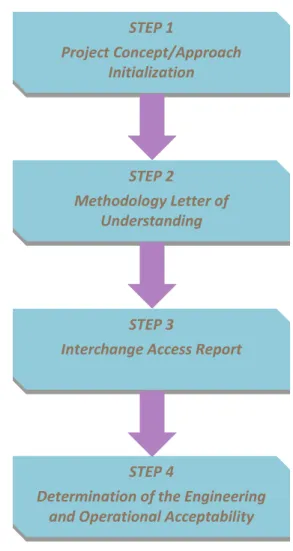
federal requirments and processes to be used for determination of engineering and operational acceptability associated with adding or modifying interchange access to limited access facility on the Florida’s SHS. Full compliance with the requirements and processes in this procedure is necessary. The IAR process follow the steps depicted in Figure 1-1.
FDOT INTERCHANGE ACCESS REQUEST – USER’S GUIDE | 7
Figure 1-1 Interchange Access Request Process
the responsibilities of the various offices within FDOT to develop and implement the Strategic Intermodal System (SIS). It also defines the requirements for coordination with the local government and Metropolitan Planning Organization (MPO) transportation planning process. Such coordination is needed to ensure IARs are consistent with the SIS Master Plan and Action Plan for the effected facilities.
specifies the PD&E requirements to secure project Location Design Concept Approval (LDCA) or Record of Decision (ROD). The manual identifies documentation requirements for social, environmental, and engineering studies required for a proposed transportation improvement, to support decisions involving the implementation of projects.
STEP 1 Project Concept/Approach Initialization STEP 2 Methodology Letter of Understanding STEP 4
Determination of the Engineering and Operational Acceptability
STEP 3
FDOT INTERCHANGE ACCESS REQUEST – USER’S GUIDE | 8
1.3 Interchange Access Points
Each entrance or exit point to the limited access facility is an access point. This includes but is not limited to:
locked gate access
access to ramps or collector-distributor roads
slip ramps to or from managed lanes
new access points or revised access points on the mainline
Interchange reconfiguration is considered to be a change in access even though the number of actual points of access may not change.
1.4 Stakeholders
A fundamental component of the IAR process is its management and coordination. Close coordination between stakeholders at various stages of the IAR process is necessary for a successful acceptance of the IAR. The various stakeholdes involved in the IAR process are described in this section.
1.4.1 Requester
A Requester may be the Department, a local government, or a transportation authority (toll authority, port authority, etc.). For projects initiated by private developers, local government becomes the Requester.
In all cases, the Requester has the responsibility for collecting any data required, documenting the need for the new or modified interchange access and developing the engineering and operational analysis required by the Acceptance Authority to make a decision on the IAR. Specifically, the Requester has to:
Reach agreement with the IRC and other applicable Acceptance Authorities on the type of IAR to better define study design or scope of work;
Develop, sign and submit to the IRC a Methodology Letter of Understanding (MLOU) documenting the agreed upon study methodology;
Develop and submit to the IRC a draft Interchange Access Report containing the data collection,
analysis and documentation agreed to in the MLOU;
Respond to all comments for corrections, requests for additional information and revisions to the
analysis or document; and
Develop, sign and submit an IAR to the IRC for an acceptance decision.
Each entrance or exit point is an access point
A Requester can be FDOT, local government, or transportation authority
FDOT INTERCHANGE ACCESS REQUEST – USER’S GUIDE | 9
1.4.2 Interchange Review Coordinator (IRC)
Each District and the Turnpike Enterprise appoints an IRC. The IRC is the primary point of contact for all Requesters, both inside and outside the Department, requesting new or modified interchanges on existing SIS limited access facilities within their Districts. The IRC also serves in a review and processing role for IARs.
For all IARs, the IRC establishes the basis for acceptance, the evaluation criteria, the level of coordination needed and the scope of the technical analysis and documentation. The IRC arranges a technical review of the engineering, operational, environmental and safety impacts of the IAR. The IRC determines if a request will continue in the access request process.
1.4.3 State Interchange Review Coordinator (SIRC)
The SIRC’s role is to provide guidance for rules, policies, procedures, and guidance related to IARs and coordinate with the FHWA and Districts’ IRCs, and the FTE IRC.
1.4.4 FHWA
The FHWA Transportation Engineer (TE) is the FHWA Division Office point of contact.
1.5 Types of Interchange Access Requests and
Documentation
The purpose of an IAR is to demonstrate that the project is needed and is viable based on traffic, engineering, safety, financial and other criteria. The MLOU and types of IARs are defined as follows:
1.5.1 Methodology Letter of Understanding (MLOU)
The MLOU provides a dialogue among the Requester, IRC, SIRC and FHWA to identify the parameters and primary areas of focus for preparing an IAR. The MLOU is intended to define the level of documentation and analysis required to prepare an IAR.
The MLOU is required for an Interchange Justification Report (IJR) and Interchange Modification Report (IMR). The MLOU is optional for an Interchange Operations Analysis Report (IOAR) and is determined on a case by case basis by the IRC. The decision to prepare an MLOU for
IOAR is based on the scope of the project and the level of traffic analysis effort. Such decision is reached after discussions between the Requester, IRC, SIRC and FHWA Transportation Engineer (TE). Appendix A provides an outline of a typical MLOU.
1.5.2 Interchange Justification Report (IJR)
An IJR must be prepared if the proposed action is intended to provide a new access to a limited-access facility. Such action requires the highest level of analysis and documentation to justify the need for and operational impacts of the proposed access.
An IJR is required for the following situations: IRC is the point of contact
for all Requesters
An MLOU is optional for IOAR and is determined on
FDOT INTERCHANGE ACCESS REQUEST – USER’S GUIDE | 10
New system to system interchange;
New service interchanges providing access between a non-limited access local roadway network (arterial, collector, or local road) and the Interstate;
New partial interchanges or new ramps to and from continuous frontage roads that create a
partial interchange within the existing limited access right-of-way.
1.5.3 Interchange Modification Report (IMR)
An IMR is needed if the Requester proposes a modification to an existing interchange. The extent and complexity of the proposed modification will determine the level of analysis and documentation required.
A Systems Interchange Modification Report (SIMR) may be needed when an IAR is for a series of closely spaced interchanges that are operationally interrelated is being analyzed. Such an effort may be used to support the development of a corridor PD&E study, either following or concurrently with the SIMR development. Since a problem or issue on one interchange in the SIMR could delay acceptance of all other interchange projects in that SIMR, the benefits of combining IMRs into a SIMR should be thoroughly weighed against the potential for project acceptance delays.
An IMR or SIMR will be required for the following situations (where examples are provided, they are not intended to be all inclusive):
Modification to the geometric configuration of an interchange.
- Adding new ramp(s)
- Abandoning/removing ramp(s)
Completion of basic movements at an existing partial interchange
Relocation of a ramp terminal to a different local road within a CD system
Relocation of existing ramp entrance or exit gore point along freeway mainline due to:
- Adding/transitioning/widening lanes to the entrance or exit ramp
- Addition of left-turn storage lanes, right-turn storage lanes, and through travel lanes at the
terminus of existing ramps
Managed Lanes access to an existing interchange
Any changes that result in an increase in the number of lanes at the gore point of an on ramp within a weaving area as determined by the HCM weaving methodologly.
FDOT INTERCHANGE ACCESS REQUEST – USER’S GUIDE | 11
1.5.4 Interchange Operational Analysis Report (IOAR)
An IOAR is prepared to document traffic and safety analysis of minor modifications to the existing access points.
The following types of interchange improvements require an IOAR:
Addition of a left turn lane onto an on-ramp. Addition of a right turn lane onto an on-ramp.
Addition of a lane (or lanes) to an existing on-ramp while maintaining existing lanes at gore point. Any proposal that results in shortening of an off-ramp.
Replacing a chanellized free-flow right turn lane with a signalized right turn lane.
Relocation of the gore point closer to the crossroad.
1.5.5 Non Interstate Access Request (Non IAR)
The following examples of improvements do not require access request and hence they are called non IAR:
Addition of left-turn storage lanes, right-turn storage lanes, or through travel lanes at the
terminus of existing off-ramps with the crossroad(no shift in gore point).
Relocation or shifting of the ramp termini (i.e., moving the ramp end that connects with the cross road) along the same roadway which does not result in a shortening of the off-ramp.
Extension of an acceleration lane, deceleration lane or recovery lane at the Interstate connection
point not within the weaving area of an adjacent interchange.
Extension of an on-ramp as an auxilliary lane ending at the next downstream Interchange.
Access (slip ramps) between Managed Lanes and General Use Lanes on the Interstate highway. (Reference the FHWA Interstate Access User Guide)
Implementation of ramp metering or other active control of vehicles entering the Interstate highway.
Construction of new signing, striping, and/or resurfacing of an Interstate on-ramp or off-ramp,
where geometric features are not changed.
Installation of roadside guardrail and concrete barriers (such as for resurfacing and safety
projects).
Addition of through lane(s) on cross road at a ramp terminal.
FDOT INTERCHANGE ACCESS REQUEST – USER’S GUIDE | 12
Relocation of an existing entrance or exit gore point along the freeway mainline further away from the interchange without decreasing the length of the acceleration/deceleration lane or impacting the weaving area with adjacent ramps.
“In-kind” bridge replacement/modification without changing laneage.
Although access request is not required for the above improvements that are performed in the Interstate System, coordination with the FHWA Florida Division Office is required for informational purposes. It is also the responsibility of the IRC to ensure operational and safety analyses for these improvements are conducted and documented.
1.6 Locked Gate Access
All requests for a locked gate access require submission of a General Use Permit through the District Maintenance Office. The IRC should review the request only after the Maintance Office is satisfied with the purpose and need for the locked gate access. The IRC will then forward the request to FHWA for determination of the engineering and operational acceptability after being satisfied with the
Maintanance Office recommendations.
Information and factors used by the District Maintance Office to make a recommendation for a locked gate access include but are not limited to:
Purpose and need for the locked gate access;
Review of possible access alternatives to confirm the feasibility of the proposed access; Number, type, duration, and frequency of vehicles proposed to use the locked gate; Ownership and lessee of the propery contiguous to the locked gate
1.7 Acceptance Authorities
The IRC has the primary responsibility for all coordination with the Requester for IAR, coordination with the SIRC and FHWA (when applicable) during all phases of the project. It is also essential for the IRC to seek inputs from all applicable divisions such as Design, Environmental Management, Traffic Operations, Construction, Right of in the IAR review process. Representatives from such divisions could also be involved in the meetings called by the IRC to discuss IAR projects.
Where the IAR affects a limited-access facility of more than one District (including Turnpike Enterprise), or if the interchange access is near a District boundary, all affected Districts IRCs should be involved in the IAR process. It is required that IARs developed by the Turnpike Enterprise or other Expressway Authority that involve the local District if the IAR affects a limited-access facility within the local District jurisdiction.
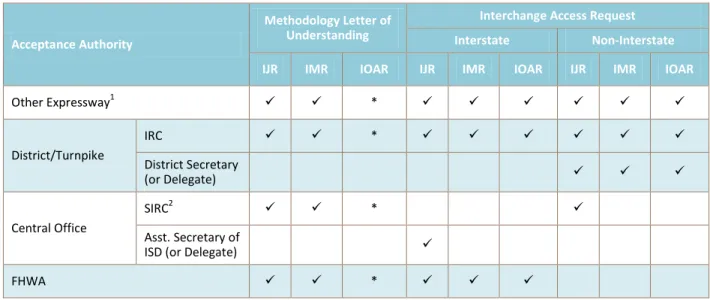
Acceptance Authorities (offices/agencies) for IARs are provided in Table 1-1. Acceptance authorities will be FHWA, the Assistant Secretary for Intermodal Systems Development, SIRC or the District Secretary (or delegate) as follows:
FDOT INTERCHANGE ACCESS REQUEST – USER’S GUIDE | 13
Table 1-1: Acceptance Authorities
Acceptance Authority
Methodology Letter of Understanding
Interchange Access Request
Interstate Non-Interstate
IJR IMR IOAR IJR IMR IOAR IJR IMR IOAR
Other Expressway1 * District/Turnpike IRC * District Secretary (or Delegate) Central Office SIRC2 * Asst. Secretary of
ISD (or Delegate)
FHWA *
Note: 1 Other expressway access requests are required when an Expressway Authority project connects with an Interstate or SIS facility. 2 Although the SIRC does not need to approve all final documents, they should be cc’d the final document for record keeping.
*An MLOU will be determined on a case-by-case basis based on discussions between the Requester, IRC, SIRC and FHWA Transportation Engineer (TE).
Table 1-2 identifies the types of IARs that can be accepted at the FHWA Florida Division Office and those that must be accepted at the FHWA Headquarters in Washington, D.C.
Table 1-2: FHWA Delegation of Authority for Acceptance of IARs on Interstate System
Proposed Type of Interchange Access Request
(not all inclusive) Accepted by FHWA HQ, Washington, D.C. Accepted by FHWA Florida Division IJR New interchange New Interstate Partial Interchange XX X X
IM
R
Modification of system to system interchange X X Major modifications of existing Interstate to crossroad
interchange X
Completion of basic movements at partial Interstate
interchanges X
Abandonment of Interstate ramps or interchanges X
IO
FDOT INTERCHANGE ACCESS REQUEST – USER’S GUIDE | 14
1.7 IAR Review Timeframe
The following review timeframes apply to all IARs:
SIRC to review and comment on the IAR within 15 business days.
IRC to submit the IAR 20 days before FHWA response due, as per Florida Federal-Aid Partnership Agreement, Topic Number 700-000-005c.
FHWA to make an IAR operational and engineering acceptability determination or forward to the FHWA Headquarter for approval within 15 business days, as per Florida Federal-Aid Partnership Agreement, Topic Number 700-000-005c.
FDOT INTERCHANGE ACCESS REQUEST – USER’S GUIDE | 15
Chapter 2 Methodology Letter of Understanding
2.1 Project Initiation
The IAR process begins with a formal determination of the need for the project. The determination of the need for the project helps to identify performance criteria or deficiencies that is to be addressed by the project. The determination of the need for the project involves coordination between Requester, IRC, SIRC and FHWA Division Office to refine the scope of the IAR and to verify the project is in the adopted MPO’s LRTP. Coordination will also identify performance objectives and measures and the need for FHWA to review the request. Coordination with project stakeholders is recommended even for non-IAR projects.
2.2 Methodology Meetings
When it is determined that the project is reasonable, the Requester and IRC may start drafting the methodology letter of understanding (MLOU). The objective of the MLOU is to reach a consensus among the Requester, IRC, SIRC and FHWA on the process and analysis to be followed in developing the IAR. The MLOU is to be signed by all parties to demonstrate agreement on the IAR process.
Methodology discussion meetings may be conducted to reach an agreement regarding the MLOU for the access request. The meetings may include the IRC, SIRC, FHWA, the Requester and any of the Requester’s technical or professional staff or consultants. Representatives from other affected or interested local agencies, regional planning councils and other state agencies may also be invited to the meetings by the IRC. It is also essential to discuss any anticipated exceptions or variations to FDOT or FHWA policies, criteria or standards to ensure they would not create a fatal flaw to the IAR acceptance.
2.3 Determination of the Need and Type of MLOU
The development of an MLOU is guided by the need for the project. It is recommended that the Requester gather all project data and information sufficient to determine the type of the IAR prior to preparing the MLOU. At this point, the IRC would determine the need and type of the IAR as per the guidance provided in Section 1.5 of this User’s Guide. It is important to emphasize that coordination with the Acceptance Authorities is required to ensure appropriate report type and documentations are determined before proceeding with the preparation of the MLOU.
2.4 Contents of MLOU
The contents of an MLOU are discussed is detailed in this section. The recommended format of the MLOU is provided in Appendix A.
2.4.1 Project Purpose and Need
Identification of the purpose and need for adding new or modifying access to a limited access facility is essential to providing appropriate
analysis and documentation to justify the acceptance of change in access. As such, the MLOU should clearly identify the objective, purpose and need for the project. The Requester should refer to Chapter 4
The need for an IAR is the same as the need for the
FDOT INTERCHANGE ACCESS REQUEST – USER’S GUIDE | 16
of th
noteworthy that the purpose and need for the project.
The purpose and need for the IAR should be the foundation for the purpose and need in the NEPA documentation. Specifically, the purpose of the access proposal should provide the answer as to why the project is considered, along with the necessary supporting evidence. Therefore, the purpose of an IAR should identify transportation problems, issues and concerns and provide guidance on developing alternative improvements that would address such problems. The purpose should focus on the national/regional transportation system because local economic development or improving the local roadway system functionality, though a factor, is not a primary focus for an IAR
The need for an IAR provides the rationale for how it addresses the transportation problems identified in the purpose statement. The need is supported by existing data and analysis to justify the project. Existing data, summaries from local transportation comprehensive plans, existing roadway geometry, and statistics such as speed, delay, crash, project volumes should be used as appropriate to support the need for the project.Utilization of readily available transportation information that does not require extensive data collection or traffic operations analysis is strongly recommended when developing purpose and need for the project.
2.4.2 Area of Influence (AOI)
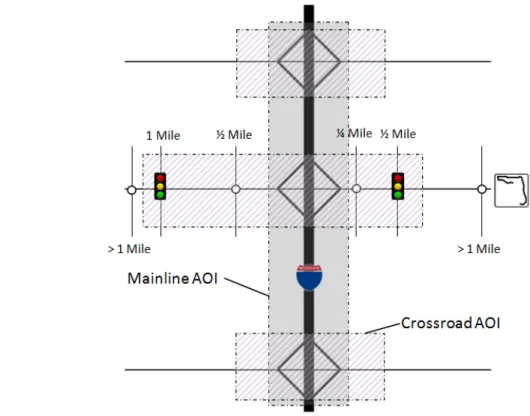
Once the purpose and need for the project has been identified, the next step is to identify the or analysis area of influence (AOI). Area of influence is defined as the area that is anticipated to experience significant changes in traffic operating characteristics as the result of the access proposal. The area of influence should reflect both current and anticipated operational and safety concerns associated with the access request. The area of influence for the IAR should be finalized in the MLOU phase. Figure 2-1 provides a typical area of influence.
The following guidelines can be used when defining the area of influence:
Area of Influence along Limited-access Mainline – In urban areas, the area of influence should
include at least the first adjacent interchange on either side of the proposed access change. In rural areas, where interchanges are far apart and the proposed access is isolated, extension to adjacent interchanges may not be necessary. However, the area of influence can be extended beyond these limits based on operational and safety impacts of the proposed change in access. The limits in this situation should be determined through discussion with the IRC, SIRC and FHWA (if applicable).
Area of Influence along Crossroad – The area of influence along the crossroad should extend up
to one-half mile in either direction of the proposed access change. If there are signalized intersections along the crossroad, the area of influence may extend beyond the half mile to include one signalized intersection in either direction as determined by the IRC. If the signals are elements of a coordinated system, the area of influence may be expanded to include analysis of all affected signals. If there is a DRI within the vicinity of the access change, the area of influence could be extended to include the DRI area of influence.
FDOT INTERCHANGE ACCESS REQUEST – USER’S GUIDE | 17
2.4.3 Analysis Years
At least three (3) traffic analysis years should be considered. These analysis years are existing year, opening year and design year. The need for analysis of interim years is decided and agreed on a case-by-case basis when developing the MLOU. Additionally, the analysis methodology and procedure for each analysis year must be agreed to by the Requester, IRC, SIRC and FHWA (if applicable) during the MLOU phase. The Requester must analyze build alternatives and the no-build alternative for all analysis years as defined in the MLOU. The analysis years are described below:
Existing Year – It is the year the IAR is prepared or a prior year where acceptable data is available.
The operational and safety aspects of the existing mainline, interchanges and the adjacent arterial system within the area of influence are determined and documented in the existing year analysis. This analysis is used to document existing condiditons and deficiencies and is used as the basis for comparison to the build and no-build alternatives.
Opening Year – Opening year is the first year in which the proposed improvements will be opened
to traffic. If the proposed improvements are to be phased, the opening year is the year the first phase of the project will be opened to traffic.
Interim Year(s) – Interim year is the opening year of the phased project. Phased interchange improvements require an additional interim analysis for the year each phase is anticipated to open to traffic.
FDOT INTERCHANGE ACCESS REQUEST – USER’S GUIDE | 18
Design Year – The design year for IMR and IJR is normally 20 years after the opening year. The design year is used for all subsequent project phases such as PD&E and design. If the proposed project phasing extends beyond the 20-year horizon, the Requester is required to show the improvements that will be in place in the design year and the interim 20-year. However, the FDOT will only consider alternative phases completed within 20-years. Design year for an IOAR is at least 10 years after opening year. Coordination with FHWA is required when establishing design year for IOARs.
Two additional analysis years are considered for travel demand forecasting. These are the base year and planning horizon year which are documented when preparing data and traffic forecasts. The outputs from the travel demand forecasting model for the base and
planning years are used as the basis to forecast opening, interim and design year travel demand. Techniques to interpolate or extrapolate travel demand model data to the the analysis years are documented in the MLOU.
Base Model Year – The base year is the year for which the selected travel demand forecasting model was calibrated. The most current version (as close to the existing year as possible) of the adopted travel demand forecasting model should be used.
Planning Horizon Year – The planning horizon year is the approved forecast or horizon year of the
selected travel demand forecasting model.
2.4.4 Coordination
Coordination with other agencies, such as MPOs and other affected entities is part of the IAR process. Proper coordination helps to avoid conflicts with other new or proposed changes in access or corridor improvements within the vicinity of the IAR. Additionally, coordination with other agencies could lead to adjustment of design concepts to meet permitting requirements in later phases of the project development. As such, the MLOU should identify all coordination efforts that will be peformed in the IAR process.
2.4.5 Data Collection
Data to be collected for the IAR analysis includes roadway geometrics, travel demand, and traffic control. Existing traffic data includes turning movement counts, origin-destination data, heavy vehicle information, and traffic control data; transit data; crash data; and information on bicycles and pedestrians. Efforts to use existing databases and studies is emphasized. However, field observations should be performed to confirm the reasonableness of the existing data. For further details on the data collection requirements, Requester should refer to the FDOT Traffic Analysis Handbook (to be released in February 2014).
In the event additional data collection is necessary after the MLOU has been approved, the Requester is required to develop a supplemental methodology as an addendum to the MLOU. The supplemental methodology for additional data collection should be approved by the IRC prior to the initiation of data
MLOU should include Base and Planning years of the
FDOT INTERCHANGE ACCESS REQUEST – USER’S GUIDE | 19
collection.The methodology should contain the purpose and need for additional data, the collection techniques, and limitations on use of data.
2.4.6 Travel Demand Model Selection and Forecasting
Model selection and development of demand volume projections should be done based on the
guidelines and techniques published in the
adopted regional travel demand model to be used in the analysis should be identifed in the MLOU. Any deviation from the use of the District’s and MPO’s approved models or methods should include documentation to support justification for such deviation. All assumptions used to determine future traffic demand should also be identified.
2.4.7 Alternatives
The MLOU should list all alternatives to be considered in the request. The alternatives outlined in the MLOU should be agreed to by the IRC, SIRC and FHWA (on interstate facilities). The alternatives and analysis years required are identified in Table 2-1. Details of all alternatives considered including those eliminated from further considerations should be documented in the IAR report. If alternatives were developed prior to the preparation of the MLOU, the Requester should describe them in the MLOU.
Table 2-1: Required Alternatives
Considered Alternatives Year of Analysis
Existing Opening Interim Design
No Build *
Bu
ild Preferred Alternative N/A *
Other Alternatives N/A *
: Required; *: May be required as determined by IRC and Acceptance Authorities; N/A: Not applicable
2.4.8 Traffic Operational Analysis
Defining the scope of traffic operational analysis is part of the MLOU. The scope of the traffic analysis should therefore be supported by the area type, existing traffic operating conditions, and analysis tools. Additionally, prior to finalizing the scope of the analysis, a coordination meeting of all stakeholders of the access request (Requester, IRC, SIRC, and FHWA) is strongly recommended. Such meeting is held exclusively to define the, purpose, and need; the goals and objectives of the study; and the operational analysis limits.
Area type is defined as Rural, Urban Areas or Urbanized Areas. The Requester should reference the FDOT Quality/Level of Service Handbook for more discussion about
the area type.
Knowledge of existing operational conditions is essential in determining if the existing facitlity is oversaturated or undersaturated. Such knowledge is useful in identification of the
Knowledge of existing condition is essential to
determining operating conditions
FDOT INTERCHANGE ACCESS REQUEST – USER’S GUIDE | 20
influence limits of analysis.
Proper selection of a traffic analysis tool and approach determines the success of any analysis effort. As such, the Requester must possess sufficient traffic analysis knowledge, understanding the limitations (strengths and weaknesses) of the traffic analysis tools selected. The Requester should be aware that no single tool can analyze and model all project scenarios. It is recommended that the analysis effort should correlate to the magnitude of the problem. The use of sophisticated tools and approaches should match the complexity of the problem that the analysis is intending to evaluate. Guidance for tool selection is provided in the FDOT Traffic Analysis Handbook.
2.4.9 Safety Analysis
The safety analysis methodology should be documented and agreed to in the MLOU.The objective of safety analysis is to examine the effects of the proposed new access or modified access on the performance of the facility. As such, the safety analysis should proactively aim at reducing or correcting potential safety problems in the planning and design phase of the projects before they are constructed. Additional focus of the safety analysis could be reducing delays caused by crash and near-miss incidents and and hence improve the reliability of the system.
At the direction of the IRC safety analysis can be performed by analyzing historical crash data within the safety area of influence. Road safety audits (RSAs) may also be utilize to analyze existing and proposed safety performance. For build alternatives analysis the Requester may use new tools for quantitative analysis of safety performance to predict crashes and compare the safety performance of the alternatives. Safety analysis tools that may be used are Highway Safety Manual published in 2010 and enhanced Interchange Safety Analysis Tool (ISATe). Additional tools that can be used to perform Safety Analysis are Interactive Highway Safety Design Model (IHSDM) and SafetyAnalyst.
2.4.10 Performance Measures
Performance measures are Measures of Effectiveness (MOEs) used to evaluate the operations and safety performance of an IAR. Identification of the performance measures in the MLOU enhances the focus of the analysis to quantify the benefits and impacts of the IAR. It is thus recommended that the performance measures be
chosen to fulfill the purpose and need for the access request. It is noteworthy that for the performance measures to be useful, they must ultimately provide information that can be used to make investment and management decisions.
Level of Service (LOS) Standards for New Interchanges
Interchange modifications should result in improved traffic operations . Florida LOS requirements are
defined in
given for limited access highways based on the area type and lane restrictions. It is worthy mentioning that proving the access proposal would meet minimum LOS standard does not guarantee acceptability. It is thus recommended to establish all MOEs that will be used to evaluate the performance of an IAR in the MLOU.
Performance measures have to be chosen to meet
FDOT INTERCHANGE ACCESS REQUEST – USER’S GUIDE | 21
2.4.11 Environmental Considerations
The requirements for documentation of the environmental considerations as part of an IAR vary by the project’s context. The purpose of providing known environmental information is to identification of fatal flaw conditions that may impact the NEPA decision. The MLOU should identify a status and schedule of the PD&E.
2.4.12 Design Exceptions and Variation
The geometry of the roadway is very important to the overall operation and safety of the highway network. The geometry of the roadway defines the design of other highway elements and is also affected by other traffic and enviromental variables such as volumes, speeds, right-of-way, enviromental
impacts, etc. As the result, the geometry of the roadway is an important part of the IAR. While detailed geometric design is performed in later phases of the project, geometric information conveyed in the IAR should be consistent with the FDOT design and PPM standards and of sufficient detail to allow a full evaluation of the FHWA’s eight policy point requirements. It should be noted that compliance with standards and criteria does not guarantee engineering and operational acceptability of the IAR. Rather, the acceptability determination is based on full evaluation of the eight policy points.
When developing the MLOU, the Requester should take the following into considerations:
For all new construction, reconstruction and resurfacing, restoration, and rehabilitation (3R)
projects on the SHS, FDOT design standards (i.e., FDOT Design Standards, Plan Preparation Manual, the Structures Manual, other design manuals, and Specifications) apply. For standards not specifically listed in these manuals, AASHTO design standards may apply.
When it becomes necessary to deviate from the Department’s criteria and standards, early documentation and approval are required. As such, the MLOU should identify any anticipated exceptions and variations to FDOT design standards.
2.4.13 Signing and Pavement Markings Plan
Signing and pavement markings provide the motorists sufficient information they need to make decisions and maneuvers through an interchange. It is very important to note that adequate signing is not a replacement for sound geometry design and engineering judgement. The MLOU should have a Requester commitment to prepare signing and pavement markings plan for the IAR.
2.4.14 FHWA Eight Policy Points
The MLOU should include a commitment to meet the FHWA eight policy points.
2.5 Review and Acceptance of MLOU
The review and consideration for acceptance of the MLOU is performed according to FDOT Procedure 525-030-16. Additional acceptance criteria may be requested by the IRC or FHWA for a project. For
Acceptability of an IAR is based on full evaluation of
FDOT INTERCHANGE ACCESS REQUEST – USER’S GUIDE | 22
proposals impacting more than one district (i.e., Turnpike proposals and proposals near District boundaries), all affected IRCs, SIRC, and FHWA should be signatories of the MLOU.
After IRC, SIRC and FHWA concur with the approach and need to proceed with the IAR as defined in the MLOU, the Requester, IRC, SIRC and FHWA (according to Table 1-2) should accept and sign the MLOU. The signed MLOU serves as the Notice to Proceed for the Requester unless otherwise stipulated by the IRC. Any work performed by the Requester prior to the acceptance of the MLOU is considered “at risk” and may not be accepted by the IRC.
2.5 MLOU Qualifying Provisions
The following qualifying provisions should be stated in each MLOU:
The Requester will provide full access to all modeling procedures, data, networks and outputs for
project traffic review during the IAR process.
FDOT INTERCHANGE ACCESS REQUEST – USER’S GUIDE | 23
Chapter 3
Interchange Access Report
The Interchange Access Report is developed as a stand alone document consistent with the requirements of the MLOU. Referencing information from other project documents such as a Feasibility Study or previous reports is discouraged. Relevant information from such documents should be provided in appropriate sections of the report. Most importantly, the report should be clearly written for a reviewer not familiar with the project to understand the intent of the IAR.
3.1 Documentation Requirements
The Interchange Access Report should address the following items in detail:
Executive Summary (8 Policy Points) Purpose and Need
Methodology
Existing Conditions
Future Conditions
Alternative Analysis Reccomendation
The documentation requirements will be determined by the IRC in cooperation with the Acceptance Authority during the MLOU development phase. When microsimulation analysis techniques are used a calibration report should be prepared and included in the IAR.
3.2 Analysis of Existing Conditions
The purpose of this analysis is to support the need for the project. Additionally, the analysis of existing conditions provides the baseline for comparison of build and no-build alternatives.
In this existing conditions analysis, the Requester also identifies any known environmental or cultural impacts that could be a fatal flaw to the access proposal or would result in significant mitigation efforts. This analysis includes navigable waterways, wetlands, public lands, contaminated sites, noise sensitive sites, historical or archaeological sites, threatened and endangered species, contamination, air quality, Section 4 (f) lands and impacts to neighborhoods or any other environmental or cultural factors.
3.3 Considered Alternatives
Once the existing conditions are known, the Requester develops potential improvement concepts which address the purpose and need for the project. It is recommended that the Requester schedule a
FDOT INTERCHANGE ACCESS REQUEST – USER’S GUIDE | 24
meeting or a workshop with the IRC and Acceptance Authority to review the considered alternatives. The IRC should invite representatives from other offices such as Design, Traffic Operation, Construction, etc. to review and vet the viability of the alternatives in addressing the need for the project.
The no-build alternative is the existing conditions plus any committed projects in the adopted MPO’s Transportation Improvements Program (TIP), Statewide Transportation Improvement Program (STIP), Local Government Comprehensive Plan (LGCP), MPO Long-Range Transportation Plan, FDOT's Adopted Five-Year Work Program, and SIS Modal Plan. The committed projects may also include mitigation improvement projects that are elements of approved development orders. Privately funded projects that relieve traffic on state and local highways may also be considered if agreed to by the IRC.
The IAR Build alternative includes strategies providing new access or modifying existing access to limited access facilities. The build alternative may incorporate elements of TSM&O, alternative travel demand modes or additional network improvements beyond those planned and programmed.
3.4 Travel Demand Forecasting
The development of forecasted future conditions involves the preparation of future traffic volumes for all agreed upon alternatives utilizing the travel demand projection models, input data and adjustment procedures as documented in the MLOU. If no model is available, historic traffic data may be used to develop design traffic.
The specific FDOT procedures and technical criteria for future year traffic forecasting are discussed in
detail in the
Documentation of the forecasted future conditions should include, at a minimum, the following:
Methodology techniques, model refinement and results of the network and project model validation efforts.
Travel demand forecasts within the area of influence for the proposed opening, interim (if applicable) and design years for all alternatives depicted on maps, line drawings and tables, as agreed to in the MLOU.
Summary of modifications to land use or socio-economic data files and networks for all analysis
years.
Model output smoothing techniques applied, the method used and the extent of adjustments.
Consistency with DRIs or other major developments affecting the traffic within the area of influence.
Techniques and traffic factors agreed to in the MLOU.
3.5 Evaluation of Alternatives
The evaluation of alternatives for an IAR is a thorough, technical investigation to compare the performance of alternative improvements that are developed to meet the need for the project.
FDOT INTERCHANGE ACCESS REQUEST – USER’S GUIDE | 25
Performance measures or MOEs that were identified in the MLOU are used to compare the alternatives. Guidance for selection of appropriate traffic analysis tools used for evaluation of alternatives is provided in the FDOT Traffic Analysis Handbook, and agreed to in the MLOU
The evaluation of alternatives should address, at a minimum, the following:
System and operational performance; Safety
Environmental impacts.
The safety and operational analysis performed in the evaluation of alternatives should demonstrate that the IAR does not have significant negative impact on the operation of the mainline and adjacent network. This analysis must be consistent with the MLOU. Additionally, the analysis should use sufficient data and its documentation should be of sufficient detail to allow independent review of the request.
If the project is to be constructed in phases, the analysis must demonstrate that each phase can function independently and does not affect the safety and operational efficiency of the facility.
3.6 Design Exceptions and Variations
Any request for Design Standard variations or exceptions must be submitted with sufficient engineering, safety, and operational analysis information in accordance with FDOT Plans Preparation Manual (PPM) and American Association of State Highway and Transportation Officials (AASHTO) Design Criteria. In addition, any requests for exceptions to policies, procedures and standards must be reviewed and have acceptance decisions when the Interchange Access Report is reviewed to ensure they will not compromise the operation.
Design Exceptions must be approved using the following process:
All known requests for exceptions must be fully documented and justified by the Requester
during the interchange access process.
All exceptions must be approved prior to completion of the PD&E process.
All exceptions must be approved either by the State Transportation Secretary or FHWA regardless
of the Acceptance Authority for the IAR. It is noteworthy that approval of an exception does not ensure acceptance of an IAR.
3.8 Consistency with Master Plan
The level of effort required in the development of an IAR is dependent on its consistency within the adopted Master Plan and other planning documents. The development of the IAR should be based on factors, analysis and concepts contained in the existing Master Plan. The safety and operational analysis performed for the IAR should show how the access proposal affects the Master Plan.
FDOT INTERCHANGE ACCESS REQUEST – USER’S GUIDE | 26
If the access proposal is not consistent with the adopted Master Plan, the IRC should examine the discrepancy and determine which access (proposed or Master Plan access) better serves the public interests and the function of the limited access facility. If both are needed, the DIRC should investigate how the interchanges can be interconnected to minimize operational and safety problems.
If the access proposal is not contained in the current Master Plan, the IRC should determine the reason and need for the proposed access and determine its impact on the mainline operations.
3.9 Funding Plan
A commitment of funding and inclusion of projects as part of the planning process prior to final approval of the access are part of the requirements for determination of the engineering and operational acceptability.
When the IAR is included in the FDOT 5 year Work Program or MPO Transportation Improvement Plan (TIP), subsequent phases of the project must be included in the Work Program. If this is not the case, the funding for successive phases must be identified. The TIP may include a project that is not fully funded only if full funding can be reasonably anticipated for the time period contemplated to complete the project as identified and fiscally committed in the LRTP.
For projects proposed by a developer, a financial plan prepared by the developer must provide the IRC with enough detail to determine the source of all funds available to finance the access proposal.
3.10 Access Management Agreement for the Interchange
Cross streets
When the IRC determines it is necessary, the Requester may be required to develop an Access Management Agreement with all necessary parties. The agreement will be between FDOT, the local government, the Requester, and individual property owners. It may be necessary to include other affected parties. This documented agreement will be based upon an access management plan for the property located up to a minimum distance from the end of the interchange ramps, depending on the access classification of the crossroad. The plan will provide reasonable access to the public road system and maintain the long term safety and operation of the interchange area. Any planned access to the SHS in this area will be processed in conformance with Rules 14-96 and 14-97 FAC. Failure to develop and have the agreement executed may result in FDOT stopping the IAR review process and/or FDOT denying the IAR.
Access management standards require more stringent regulation of driveway connections and median openings in interchange areas. Interchange areas are defined as either ¼ mile from the interchange if the crossroad is a controlled access facility, or up to the first intersection with an arterial road, whichever is less. The distance is measured from the end of the ramp which is furthest from the interchange. These distances may be increased at the discretion of FDOT to improve operations and safety of the facility.
FDOT INTERCHANGE ACCESS REQUEST – USER’S GUIDE | 27
Other Access Classes with posted speed limit over 45 mph – 660 ft minimum spacing
Other Access Classes with posted speed limit below 45 mph – 440 ft minimum spacing
3.11 Intergovernmental Coordination
It is important to consider coordination with other agencies during the IAR process. All coordination performed during the IAR process should be documented.
3.12 Environment Considerations
The IAR process and PD&E study must be coordinated to ensure all environmental issues that might impact the federal action are resolved before the IAR is submitted for a determination of engineering and operational accceptability.
3.12 Review of the Report
When completed, the report is forwarded to the IRC for review and comment as agreed to in the MLOU. Once the IRC’s comments are addressed, the report is forwarded to the SIRC (IOAR &IMR is optional) for review and comment. The Interchange Access Report is reviewed with respect to the FHWA Policy Criteria; the requirements of the MLOU, sufficiency, completeness, correctness, and consistency of the data, analysis and recommendations of the DRI (if required). The review will focus on the following items:
3.13 Processing for Acceptance Decision
After the IRC has confirmed the Access Report is consistent with FDOT policies, procedures, plans and standards, the Report is transmitted to the Acceptance Authority for a decision.
Should the Acceptance Authority deny IAR, the IAR is returned to the Requester (through IRC ) with a written description of comments and issues requiring resolution. It is the IRC’s responsibility to determine if the IAR should be pursued further and, if so, to resolve the comments and concerns with the Requester.
FDOT INTERCHANGE ACCESS REQUEST – USER’S GUIDE | 28
Chapter 4
IAR Reevaluations
4.1 Reevaluation
A reevaluation is performed to document compliance with the state and federal requirements and processes as the result of changes in the project since the approval of the original access request. Reevaluations are required for the following conditions:
• Change in access design concept
• Significant change in conditions (traffic characteristics or land use type)
• Failure of an IAR to progress into construction phase after eight (8) years since its approval. Changes in the project that would affect safety, operations, environment as compared to the approved project should be considered when determining the need and scope for the re-evaluation. It is therefore strongly recommended that the Requester coordinate with the IRC, SIRC and FHWA to determine the work effort required prior to proceeding with the reevaluation process.
Analysis and documentation prepared for an IAR reevaluation should fulfill the requirements identified in the FHWA eight policy points. The IAR reevaluation format is similar to the original IAR. Only items that have changed are analyzed against the previously approved IAR.
A new MLOU may not required for reevaluation if the Requester proposes to use the same methodology that was previously agreed to in the approved IAR. However, reevaluations triggered by 8-year time lapse would require an adminstrative addendum to the MLOU.
4.1.1 Change in Access Design Concepts
Changes in design features or design criteria that occur after an IAR is accepted may trigger the need for reevaluation of the IAR. Design changes can either occur as:
• Part of the NEPA or final design phases where the Requestor realizes better improvements can be made in the approved IAR concept or
• Part of the Alternative Technical Concept (ATC) proposed by the Design-Build (D/B) firm. When reevaluating the IAR due to design changes, the requester is
required to show that the new concept performs equal or better than the previously approved IAR concept at the design year. The analysis performed for reevaluation should at least use the same MOEs that were identified in the original MLOU.
Reevaluation analysis should use the same MOE
used in the approved IAR A new MLOU may be
required for reevaluation of an IAR.
FDOT INTERCHANGE ACCESS REQUEST – USER’S GUIDE | 29
4.1.2 Change in Conditions
Changes in projected traffic demand due to a proposed DRI or other land use changes that was not part of the original IAR can trigger a reevaluation if it is determined that the development traffic has changed substantially to affect the operation of the interchange. It is important to note that IAR reevaluations should be consistent with the DRI Development Order or other agreements.
4.1.3 Time Lapse before Construction
A reevaluation is required if an accepted IAR has not progressed to construction 8 years after receiving a determination of the engineering and operational acceptability. It is noteworthy that IAR reevaluation is different from the NEPA reevaluation. The time lapse that triggers NEPA reevaluation is 3 years after approval.
The reevaluation should demonstrate the project need is still viable by considering any changes in the project and conditions that would affect the safety, operations, environment or design criteria used in the original approval. The original access design and any approved design exceptions should be reviewed. Justification for the design exception or variation for any design elements that do not conform to the current design criteria must be performed during the reevaluation.
The reevaluation, due to time lapse, should update analysis years and traffic data used for the original access request. Other items to be updated in the reevaluations include funding plan, project schedule, and compliance to the FHWA eight policy points.
4.2 Documentation
Since each situation is different, the Requester is encouraged to contact the IRC and Acceptance Authority to discuss specifics and detemine whether a reevaluation is required. If reevaluation is required, the IRC should coordinate with the Acceptance Authority(s) to determine the type of reevaluation documents required to update the IAR. After additional coordination with the Acceptance Authority, the IRC notifies the Requester to update the Interchange Access Report. The notification should include specific items of the previously approved IAR that are to be updated.
The reevaluation document should be submitted to the Acceptance Authorities as an addendum to the original access report. The reviewers and Acceptance Authorities for the reevaluation document should be those which reviewed and accepted the original request. Once accepted the reevaluation document is signed and sent back to the Requester.
If it is determined that the changes in design or conditions are not substantial and it has been less than 8 years since the IAR was accepted, the Requester should proceed with the project and document the results of the preliminary reevaluation findings in the project files for records.
A reevaluation is required if 8 years have lapsed before IAR is constructed
FDOT INTERCHANGE ACCESS REQUEST – USER’S GUIDE | 30
Chapter 5
Explanation of FHWA Policy Points
Adequate access control to limited access facilities is critical to provide the highest level of services in terms of safety and mobility in these facilities. The new and rev