Mirror Mirror on the Ceiling:
Flexible Wireless Links for Data Centers
Xia Zhou, Zengbin Zhang, Yibo Zhu, Yubo Li
§, Saipriya Kumar,
Amin Vahdat
†, Ben Y. Zhao and Haitao Zheng
Department of Computer Science, U. C. Santa Barbara, USA
§Xi’an Jiaotong University, P. R. China
†U. C. San Diego, USA
{xiazhou,zengbin,yibo,saipriya,ravenben,htzheng}@cs.ucsb.edu, [email protected], [email protected]
ABSTRACT
Modern data centers are massive, and support a range of dis-tributed applications across potentially hundreds of server racks. As their utilization and bandwidth needs continue to grow, traditional methods of augmenting bandwidth have proven complex and costly in time and resources. Recent measurements show that data center traffic is often limited by congestion loss caused by short traffic bursts. Thus an at-tractive alternative to adding physical bandwidth is to aug-ment wired links with wireless links in the 60 GHz band.
We address two limitations with current 60 GHz wire-less proposals. First, 60 GHz wirewire-less links are limited by line-of-sight, and can be blocked by even small obstacles. Second, even beamforming links leak power, and potential interference will severely limit concurrent transmissions in dense data centers. We propose and evaluate a new wireless primitive for data centers,3D beamforming, where 60 GHz signals bounce off data center ceilings, thus establishing in-direct line-of-sight between any two racks in a data center. We build a small 3D beamforming testbed to demonstrate its ability to address both link blockage and link interfer-ence, thus improving link range and number of concurrent transmissions in the data center. In addition, we propose a simple link scheduler and use traffic simulations to show that these 3D links significantly expand wireless capacity compared to their 2D counterparts.
Categories and Subject Descriptors
C.2.1 [Network Architecture and Design]: Wireless com-munication
Keywords
Data centers, 60 GHz wireless, wireless beamforming
1.
INTRODUCTION
Modern distributed applications running in clusters and data centers can run at massive scale, with potentially tens
Permission to make digital or hard copies of all or part of this work for personal or classroom use is granted without fee provided that copies are not made or distributed for profit or commercial advantage and that copies bear this notice and the full citation on the first page. To copy otherwise, to republish, to post on servers or to redistribute to lists, requires prior specific permission and/or a fee.
SIGCOMM’12,August 13–17, 2012, Helsinki, Finland. Copyright 2012 ACM 978-1-4503-1419-0/12/08 ...$10.00.
of thousands of servers spread across hundreds of racks. The bandwidth requirements of these applications can range from the relatively modest (e.g., hundreds of Mb/s per server [44]) to substantial (e.g., tens of Gb/s per server for high-end sci-entific computing [24]). Delivering such bandwidth comes at substantial cost for the requisite switching infrastructure. As a result, a number of recent efforts have investigated techniques for deploying more efficient data center network topologies [11, 14, 20, 21, 22].
While these alternate topologies offer a range of benefits over the current state of the art, we argue that there are a number of inherent challenges with the deployment ofany wired network technology. First, any large-scale network consists of multiple “stages,” meaning a multiplicative factor in the number of fibers/wires required for every server in the cluster. The process of planning, routing, deploying, testing, and then repairing tens of thousands of fibers at the scale of a building incurs substantial cost (both in capital and operational expenditures). Based on our experience, this manual overhead often delays the operational time of large clusters by weeks or months. Lost machine depreciation and lost opportunity costs for leveraging additional capacity can produce millions of dollars in hidden cluster costs.
Second, wired deployments typically cannot anticipate band-width requirements to every rack, and thus must distribute a fixed amount of fiber to every rack spot. This means that we must overdeploy fiber for the “worst case” of communi-cation requirements rather than the average case, increasing the cost and maintenance of networking infrastructure.
Third, deployed networks are extremely costly and com-plex to modify, partially due to the characteristics of multi-stage network topologies. For example, doubling the number of top of rack servers in a Clos topology network [14, 21] ei-ther requires rewiring half the existing fiber (impossible since fibers are often bundled together) or pre-deploying twice the higher-stage network switches than otherwise required (an expensive proposition). Similarly, moving a rack later based on computation needs requires running additional fiber to match. Our experience has shown that adding fiber to a pre-existing cluster is a complex process that incurs sub-stantial delays, and sometimes simply intractable.
Of course, the key benefit of a wired network, whether electrical or optical, is the tremendous amount of bandwidth it can deliver. While the highest end of data center comput-ing is likely to continue to require wired network deploy-ments, in this paper we focus on the subset of applications, and perhaps the majority of applications as borne out by re-cent measurement studies [15, 16, 25], with more modest or
(a) Rack-based DC (b) Container-based DC
TX RX
(c) 2D Beamforming
TX RX
(d) 3D Beamforming Figure 1: Radio transceivers are placed on top of each rack (a) or container (b). Using 2D beamform-ing (c), transceivers communicate with neighborbeamform-ing ones directly, but forward traffic in multiple hops to non-neighboring racks. Using 3D beamforming (d), the ceiling reflects the signals from each sender to its receiver, avoiding multi-hop relays.
more localized/bursty bandwidth requirements. That is, we focus on the subset that do not require (near) non-blocking all-to-all communication at data center scale.
In particular, we focus on high-throughput, beamform-ing wireless links in the 60 GHz band. The unlicensed 60 GHz band provides multi-Gbps data rates and can be im-plemented with relatively low-cost hardware. Because 60 GHz signals attenuate quickly with distance, multiple wire-less links can be deployed in a single data center. In our efforts to expand the effective bandwidth of 60 GHz links, we hope to create a new primitive that can be used to either augment existing networks with on-demand network links, or potentially replace wired links in data centers with mod-est bandwidth requirements. We build on pioneering efforts of earlier work that proposed 60 GHz links to alleviate hot spots in the data center [23, 26].
However, earlier efforts face a number of limitations. First, even beamforming directional links will experience signal leakage, and produce a cone of interference to receivers near or behind the intended target receiver. This limits the num-ber of links that can be active concurrently in densely oc-cupied data centers, and reduces the aggregate throughput offered by these wireless links.
Second, these links require direct line-of-sight(LOS) be-tween sender and receiver, and can be blocked by even small objects in the path. This limits the effective range of 60 GHz links to neighboring top-of-rack radios. Since hotspots occur regularly at both edge and core links [15], augmenting core links would require multiple hops through a line-of-sight 60 GHz network. Half-duplex, directional antennas mean that these multi-hop links will suffer at least a 50% throughput drop, higher-levels of potential congestion, and additional delays required to frequently adjust antenna orientation.
To address these issues, we investigate the feasibility of 60 GHz 3D beamforming as a flexible wireless primitive in data centers. In 3D beamforming, a top-of-rack directional antenna forms a wireless link by reflecting a focused beam off the ceiling towards the receiver. This reduces its interference footprint, avoids blocking obstacles, and provides an indirect line-of-sight path for reliable communication. Such a system requires only beamforming radios readily available today, and near perfect reflection can be provided by simple flat metal plates mounted on the ceiling of a data center.
3D beamforming has several distinctive advantages over prior “2D” approaches. First, bouncing the beam off the ceiling allows links to extend the reach of radio signals by avoiding blocking obstacles. Second, the 3D direction of the
beam significantly reduces its interference range, allowing more nearby flows to transmit concurrently. Third, the re-duced interference extends the effective range of each link, allowing our system to connect any two racks using a single hop, and mitigating the need for multihop links.
In this paper, we propose a 3D beamforming system for 60 GHz wireless transmissions in data centers. The 3D beam-forming idea was first introduced by Zhang et al. in [46]. In this paper, we greatly extend the prior work, and use measurements of a local 60 GHz testbed to quantify and compare the performance of 3D and 2D beamforming links. We find that 3D wireless beamforming works well in prac-tice, and experiences zero loss in signal or throughput from reflection. We also describe a link scheduler for 3D beam-forming systems that maximizes concurrent links while also taking into account accumulative interference and antenna alignment delays. Finally, we use a detailed simulation of data center traffic hotspots to quantify the performance of 3D beamforming systems. Our results show that while 2D links can only support a small portion of hotspot traffic links, 3D beamforming can connect all rack pairs in a single hop, and can significantly reduce overall data completion time for wired networks across a range of bisection bandwidths.
While wired networks will likely remain the vehicle of choice for the high-end of distributed computing, we believe that efforts such as 3D beamforming can expand the ap-plicability and benefits of wireless networking to a broader range of data center deployments.
2.
60 GHZ: LIMITATIONS AND SOLUTIONS
While modifying the topology of wired data centers is costly, complex, and sometimes intractable, administrators can introduce flexible point-to-point network links with the addition of wireless radios. Prior work has proposed the use of 60 GHz links to augment data center capacity [23, 26, 35, 38]. Figures 1(a)-(b) show a common deployment sce-nario, where wireless radios are placed on top of each rack or container to connect pairs of top-of-rack (ToR) switches. In practice, however, data center managers remain skep-tical on deploying wireless linksdespite their potential ben-efits [1]. In this section, we summarize prior work in this space, and use detailed experiments on a 60 GHz testbed to identify and quantify key limitations of current proposals.
2.1
60 GHz Links in Data Centers
Existing designs [23, 26, 27, 38] adopt 60 GHz wireless technologies for several reasons. First, the 7GHz spectrum
RX1 TX RX2 TX RX1 RXk RXk intra-row communication inter-row communication 0 .6 m 3.6m 1.2m 2.4m
(a) Experiment Setup
0 5 10 15 20 25 30 35 RX1RX2RX3RX4RX5RX6RX7 0 0.2 0.4 0.6 0.8 1
RSS degradation (dB) RSS degradationData rate loss Fraction of data rate loss
(b) Intra-row Blockage 0 5 10 15 20 RX1 RX2 RX3 RX4 RX5 0 0.2 0.4 0.6 0.8 1
RSS degradation (dB) Fraction of data rate loss
RSS degradation Data rate loss
(c) Inter-row Blockage Figure 2: Impact of link blockage using 2D beamforming. (a) Our experiment setup to examine antenna blockage for intra- and inter-row links. T X represents the transmitter, andRXk is the target receiver which is blocked byk antennas. (b-c) The RSS degradation and data rate loss for intra- and inter-row scenarios.
available in this band can deliver the multi-Gbps data rates required by data centers. Second, 60 GHz links operate at a high carrier frequency, which limits the interference they generate [45], and is highly beneficial to data centers with dense rack deployments. Third,60 GHz links can use beam-forming to enhance link rate and further suppress interfer-ence [23, 27]. Beamforming is a physical layer technique to concentrate transmission energy in a specific direction. To-day, 60 GHz beamforming radios are readily available and affordable, either as directional (horn) antennas [23] or an-tenna arrays [8]. They use either mechanical or electronic mechanisms to achieve fine-grain directional control [23, 40]. A 60GHz Testbed. As an experimental platform for 60 GHz wireless projects, we have built a small 60 GHz wireless testbed. To build a bidirectional 60 GHz link, we set two Gigalink 6451 radios from HXI Millimeter Wave Products [5] to operate using frequency division on two frequency bands near 60 GHz, centered at 58.2 GHz and 61.9 GHz. A simple On-Off-Keying modulation method delivers up to 1.25Gbps of bandwidth,but actual throughput is limited to 1 Gbps by the radio’s fiber-optic Gigabit Ethernet interface.
These radios were originally designed for long distance wireless links, and each is equipped with a 60 GHz transceiver and a 41dBi directional antenna transmitting at 10dBm power. To modify them for short distance data center links in our experiments, HXI engineers modified the radio amplifier to reduce output power to 0dBm. We also replaced 41dBi an-tennas with a 25dBi standard gain horn antenna from Flann Microwave [3], with 3dB beamwidth of 10◦. For our mea-surements, we read RSS values from an SNMP-based soft-ware monitor running on the radio.Since currently available 60 GHz radios all transmit at a single fixed data rate, we de-rive link throughputby converting RSS values to data rates according to the 802.11ad standard [6].1
2.2
Current Limitations
Despite the many tangible benefits of adding 60 GHz links to a data center, there are two notable limitations with
cur-1
The 802.11ad standard defines a set of data rates (385Mbps-6.76Gbps).Followingitsreceiver sensitivity table, which guaran-tees 1% packet error rate and assumes 10dB noise figure and 5dB additional implementation loss, we derive the required SNR for each data rate. We then compute the measured SNR from each measured RSS and noise, and use the above mapping to derive the data rate supported by each measured RSS value.
rent designs. Here we discuss each in detail and use data from our testbed to quantify its impact.
Link Blockage. Link blockage is a limiting factor for 60 GHz links. The 5mm wavelength of these links means that any object larger than 2.5 mm can effectively block signals or reflect them, producing multipath fading and de-grading transmission rates [37]. In today’s data centers, this is problematic because racks are organized in a grid, and transceivers and antennas on one rack can easily block trans-missions on another rack. This has led to current designs limiting themselves to connecting neighboring racks [23, 27] (see Figure 1(c)).
We measure the severity of the problem by placing multi-ple antennas between two 60 GHz endpoints, and observing performance degradation on the link. We examine cases for both intra- and inter-row rack communications (see Fig-ure 2(a)). In our intra-row case, antennas are separated by a fixed distance of 0.6m (roughly one rack width). Thus, a link blocked bykantennas,i.e. T X→RXk, has a distance of (k+ 1)·0.6m. We vary the number of blocking antennas in the experiment, and show the difference in performances with and without blocking antennas. Figure 2(b) shows the RSS degradation and data rate loss. Clearly, even when there is only one blocking antenna (link distance = 1.2m), RSS degradation can be as high as 10dB. Since the signal strength is still high, RSS degradation does not reduce data rates. As the number of antennas increases, the RSS degra-dation becomes more severe and data rates drop quickly: 3 antennas (link distance = 2.4m) can cause a 25dB RSS degradation and 50% data rate loss, while 6 blocking anten-nas (link distance = 4.2m) can cause a 30dB RSS degrada-tion and nearly 90% data rate loss.
For inter-row communications, antennas are separated by a fixed distance of 3.6m (one rack length of 1.2m plus one row separation of 2.4m) [23]. Results in Figure 2(c) show similar trends as the intra-row case, except that the impact of blockage is slightly lower. This is because the RF beam emitted by the horn antenna propagates in a cone-shape. The closer the first blocking antenna is to the transmitter, the more the signal it blocks from the receiver. Overall, our measurement results clearly demonstrate that link blockages cause severe problems for 60 GHz transmissions.
To reduce link blockage, one option is to intelligently place radios on each racks, which might be effective for some rack pair connections. To connect racks dynamically, how-ever, the radios must tune to different directions and still
TX
5dB/0% 5dB/0% 18dB/38% 18dB/38% 20dB/49% 15dB/23% 18dB/38% 18dB/38% 9dB/0% 9dB/0% 10dB/0% 16dB/33% 16dB/33% 10dB/0% 10dB/0% 3dB/0% 3dB/0% SINR degradation(dB)/Data rate loss(%)0 .6 m 1.2m 2.4m 1dB/0% 1dB/0%
RX
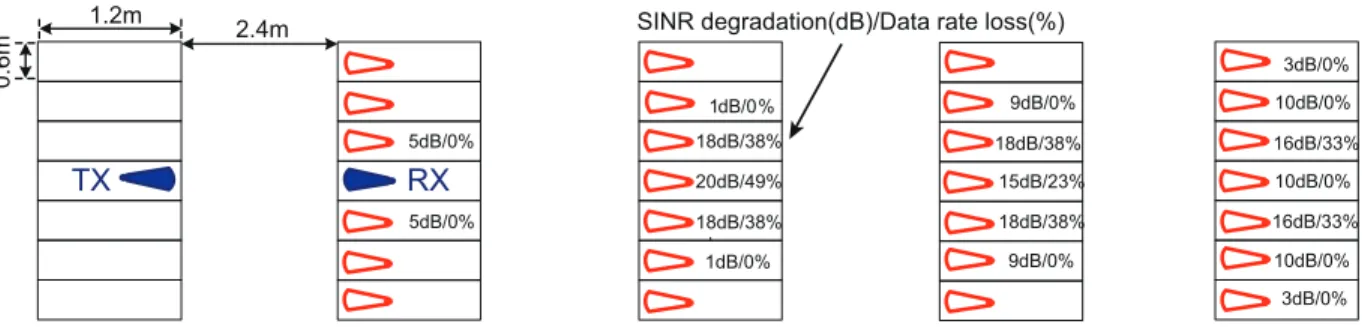
Figure 3: Our experiment to examine the impact of link interference using 2D beamforming. We place a transmitterT Xin the middle of a rack row as the interfering transmitter, a receiverRX in the next rack row as its receiver, and four additional rack rows as victims. Each victim radio, in red, points its antenna to the rack of its neighboring row to the left, representing the receiver of an inter-row link of link distance 3.6m. In each rack we list the SINR degradation and data rate loss due to the interference fromT X. We omit the results at racks whose SINR degradation is less than 1dB.
block transmissions. Another option is to place racks in hexagons [41]. It leads to inefficient space use, and yet still does not solve the fundamental link blockage problem. Finally, one can build multi-hop connections between non-neighboring racks. This, however, increases end-to-end de-lay, dramatically reduces throughput, and produces poten-tial bottlenecks at racks that are congested by forwarding traffic from multiple links.
Radio Interference. Despite the use of beamforming to bound the transmission energy in a “narrow” direction, radio interference remains an issue for these systems. Radio design artifacts will still produce signal leaks outside of the intended direction [29, 40]. When placed in a dense rack formation, leakage produces harmful interference between nearby links and limits the density of concurrent links.
Using our testbed, we measure the impact of interference produced by a single transmission, in the presence of an-tenna blockage. As shown in Figure 3, we place a 60GHz transmitter (TX) in the middle of the data center, and mea-sure the RSS at 27 racks (in red) located in four neighboring rows. At each of these 27 racks, the radio points its antenna to the rack of its immediately left row, representing the re-ceiver of an inter-row link with link distance of 3.6m and SNR of 31dB. This experiment allows us to measure the interference experienced by each of the 27 inter-row links when TX is transmitting, from which we compute the SINR degradation and data rate loss due to interference. Results in Figure 3 show that despite the fact that TX’s interference signal is blocked by various antennas, 15 inter-row links be-hind the destination still observe 5-20dB degradation in their SINR. 8 of these links suffer 20-49% data loss.
The spread of radio interference significantly limits the number of concurrent wireless links in a data center. One option is to separate the links in the frequency domain. But this reduces the per-link capacity, since the total available bandwidth is fixed across the frequency range. Alternatively, data center managers can increase the spacing between racks to reduce interference. But this leads to inefficient space and power usage, and weakens long-distance links.
2.3
Solution: 3D Beamforming
To address these limitations, we propose3D beamforming, a new beamforming approach that leverages ceiling reflec-tions to connect racks wirelessly. An example is shown in
Figure 1(d), where a transmitter bounces its signal off of the ceiling to the receiver. This creates an indirect line-of-sight path between the sender and receiver, bypassing obstacles2
and reducing interference footprint.
To align its antenna for a transmission, the sender only needs to know the physical location of the receiver rack, and point to a position on the ceiling directly between the two racks. This is because all racks (and their 60 GHz radio antennas) are of the same height.
3D beamforming requires three hardware components: • Beamforming Radios: We reuse beamforming radios [8,
23] and adjust beam directions in both azimuth and ele-vation by placing the horn antennas on rotators. Existing rotators can achieve an accuracy of 0.006◦-0.09◦[4, 7]. • Ceiling Reflectors: Reflectors on the ceiling act as
spec-ular mirrorsto reflect signals. Our experiments confirm prior work [12, 36] showing that flat metal plates offer perfect specular reflection without degrading energy or changing path loss characteristics.
• Electromagnetic Absorbers: We place electromagnetic ab-sorbers [12] near each antenna to prevent any local reflec-tion and scattering. These inexpensive absorbers require no maintenance.
3D beamforming largely addresses both of the main limi-tations with existing 2D 60 GHz proposals. First, by bounc-ing beams off a reflective ceilbounc-ing, it dramatically reduces the interference region for wireless links and allows deployment in densely packed data centers. Second, the reflective path avoids obstacles and creates effective line-of-sight paths be-tween most or all rack pairs in a common 250-rack data cen-ter. Addressing these issues means we can connect most or all rack pairs using single-hop 60 GHz links, thus maximizing bandwidth and eliminating forwarding delays. It also means a large number of links can be active in a small area without causing mutual interference and limiting performance.
In this paper, we present first steps in building flexible wireless links using 3D beamforming. We identify and ad-dress practical issues in the physical and link layers, and describe experience and experimental results from a local 60
2
Here we assume that there are no obstacles between top of racks (or containers) and the ceiling. For instance, this might require mounting the radios above cable trays, though we leave a detailed study of physical deployment to future work.
(a) Radio (b) Metal Reflector
ceiling
height
reflector
8 feet
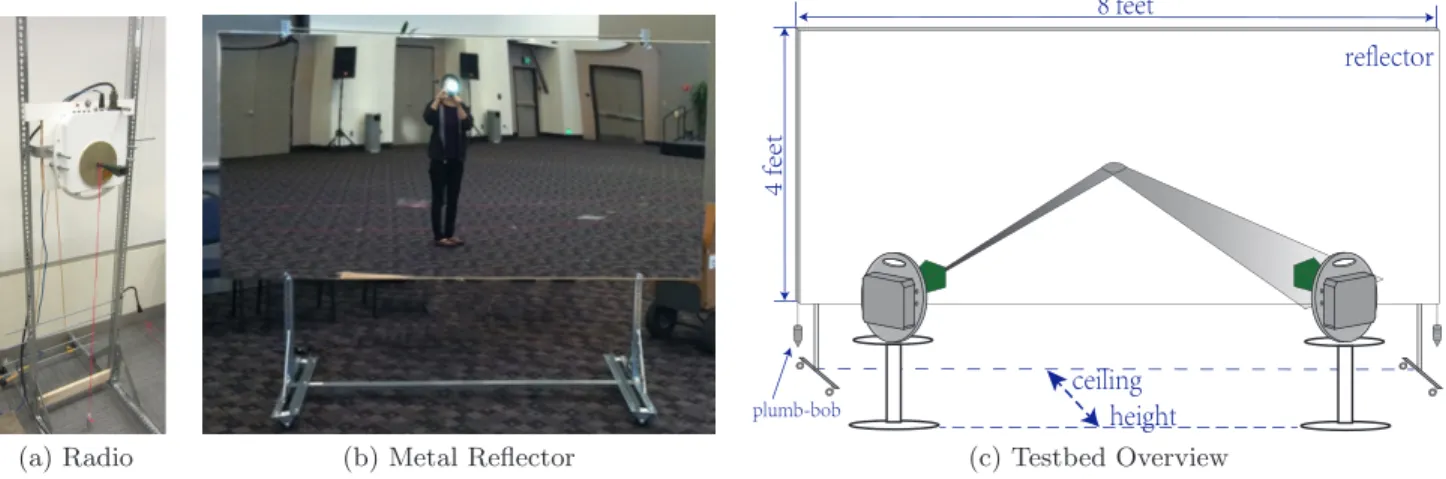
4 feet plumb-bob (c) Testbed OverviewFigure 4: Our 3D beamforming testbed. (a) The 60GHz radio with horn antenna, mounted on top of a mobile platform with adjustable height. (b) A 4ft×8ft, mirror-quality stainless steel reflector mounted vertically on a mobile platform. (c) An illustration of the experiment configuration.
GHz 3D beamforming testbed. We limit our discussion of 3D beamforming as a general link-layer primitive, and leave for future work other issues such as routing, traffic man-agement, and wired/wireless co-scheduling. We believe this work addresses a few of the key concerns associated with large-scale wireless data center deployments, principally en-abling substantially more bandwidth to be delivered more flexibly in the data center. However, many open questions remain before we expect to see large-scale deployments.
3.
MICROBENCHMARK RESULTS
Using detailed hardware experiments, we now examine the key properties of 3D beamforming, and compare them to 2D systems. We focus specifically on physical performance char-acteristics of our approach, and its sensitivity to factors such as radio density, rotator accuracy, and reflection material. 3D Beamforming Testbed. As shown by Figure 4, our local testbed consists of two 60GHz beamforming radios from HXI (described in Section 2), a 4ft×8ft metal reflector, and RF absorbers from ETS-Lindgren [2]. We test two types of reflectors: commercial-grade mirror-quality stainless steel plates and off-the-shelf cheap galvanized steel sheets from our local home improvement store. To assist with rapid experimentation, we mount the reflector vertically on a mo-bile platform that stands in parallel to a line connecting the center of the two radio transceivers. We vertically align platform using multiple hanging plumb-bobs. The corre-sponding ceiling heighthis the perpendicular distance be-tween the reflector and the line. To prevent reflected signals from producing more reflections at the receiver side, we place RF absorbers under the antenna. The absorber is a surface tiled with small pyramids 7.5cm thick. It does not block 3D transmit/reflection paths, but eliminates additional re-flections. Finally, instead of using rotators, we manually calibrate the orientations of the horn antennas, using high precision laser pointers for guidance. We also manually in-troduce calibration errors to emulate the use of rotators of different precision (Section 3.3).
We performed detailed experiments in two indoor envi-ronments: a 10m×10m conference room and a 20m×26m pavilion room.
3.1
Validating Physical Properties
Our first question is a basic one: “does 3D beamforming work, and what is the impact of reflection on signal strength and interference characteristics?”
Property 1: Extended Link Connectivity. Our first experiment looks at link connectivity. Intuitively, using ceil-ing reflection, 3D beamformceil-ing will bypass obstacles in the horizontal plane, eliminating the antenna blockage problem of its 2D counterpart. More importantly, since ceiling re-flectors should produce no loss [12, 36], it should produce an indirect LOS path following the free-space propagation model [23, 32]:
Pr=
PtGtGrλ
2
(4π)2(L2+ 4h2) (1)
wherePtandPrare the transmit and receive power,Gtand Grare the transmit and receive beamforming antenna gains, λ is the radio wavelength, L is the distance between the sender and receiver, andhis the distance from the antenna to the ceiling. To verify our hypothesis, we measure RSS at different link distances for both 2D (with no obstacles) and 3D beamforming. We also vary the ceiling heighthbetween 2m and 3m.
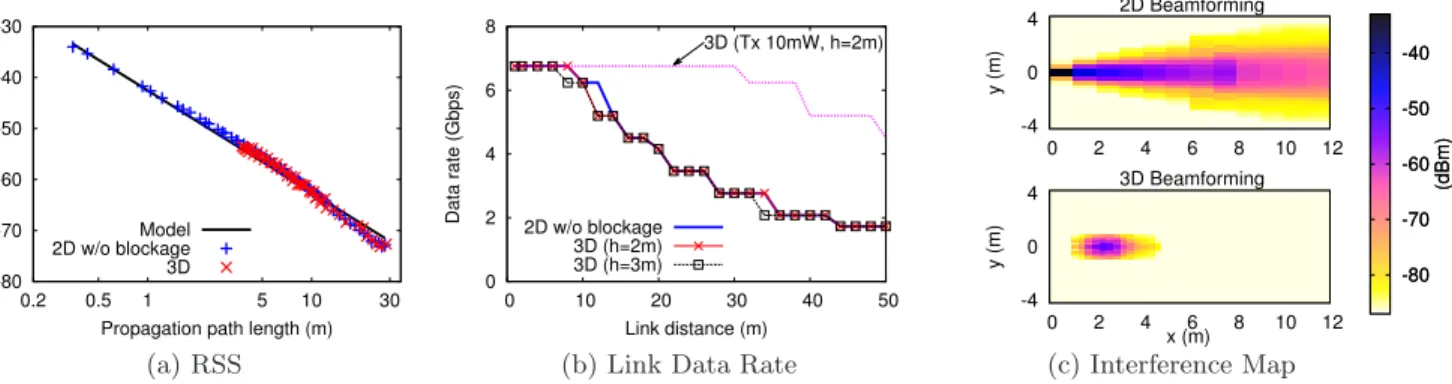
The results confirm our hypothesis. Figure 5(a) plots the measured RSS as the function of the propagation path length, i.e. L for 2D and√L2+ 4h2 for 3D beamforming.
As a point of reference, we also plot the free-space model in (1). We make three key observations. First, our measure-ment results match the model, confirming that both beam-forming methods follow the free-space propagation model, and that the reflector introduces no energy loss. Second, a mirror-quality stainless steel plate and a cheap galvanized steel sheet both offer perfect reflection. Third, we found no visible difference between the results collected in the two rooms.
We also verify 3D beamforming’s ability of bypassing ob-stacles in the 2D plane by placing absorbers along the line connecting the two radios. The height of the absorber is similar to that of the horn antenna. We observe no differ-ence in RSS even for the longest link distance achievable in the two rooms (30m).
-80 -70 -60 -50 -40 -30 0.2 0.5 1 5 10 30 RSS (dBm)
Propagation path length (m) Model 2D w/o blockage 3D (a) RSS 0 2 4 6 8 0 10 20 30 40 50 Data rate (Gbps) Link distance (m) 3D (Tx 10mW, h=2m) 2D w/o blockage 3D (h=2m) 3D (h=3m)
(b) Link Data Rate
-4 0 4 0 2 4 6 8 10 12 y (m) -80 -70 -60 -50 -40 (dBm) -4 0 4 0 2 4 6 8 10 12 y (m) 2D Beamforming 3D Beamforming x (m) -80 -70 -60 -50 -40 (dBm) (c) Interference Map
Figure 5: Measured propagation characteristics of 3D beamforming, transmit power at 0dBm. (a) Ceiling reflection introduces no energy loss; (b) Despite having a longer propagation path, 3D beamforming can still maintain similar data rate as 2D beamforming without blockage; (c) 3D beamforming can significantly reduce the interference footprint. The sender and receiver are at (0, 0), (2.4, 0) respectively.
We also examine the link throughput of the two beam-forming methods. Because the HXI radios transmit at a single data rate (1Gbps), we examine a wider range of data rates using the measured RSS and the 802.11ad’s receiver sensitivity table. Figure 5(b) shows the resulting link through-put as a function of the link distanceL. Because the room where we performed experiments was of a limited length (30m), we derived the data rates for longer links using the RSS values generated by the propagation model. We see that even at a very low transmit power (0dBm), 3D beam-forming can reach 6+Gbps when two endpoints are sepa-rated by 10m or less.At a link distance of 50m, it still offers nearly 2Gbps of throughput. If we set the transmit power to the standard level of 10dBm, link throughput, shown as the dotted line in the same figure, increases to 6.76Gbps at 30m and 4.5Gbps at 50m. Furthermore, compared to 2D beamforming, 3D achieves nearly the same data rate despite having a longer propagation path (see Eq. (1)).
Property 2: Reduced Radio Interference. Our sec-ond experiment examines the interference footprint of both 2D and 3D beamforming. For both methods, we first set up a target transmission link X, then keep the transmit-ter intact and move the receiver around to measure link X’s power emission map. We divide the measurement space into 0.3m×0.15m grids. In each grid, we rotate the receiver antenna to locate the direction with the maximum signal strength, subtract this strength by the receiver antenna gain, and use the result as the maximum interference that linkX produces to this location.
Figure 5(c) shows the measured interference footprint for both 2D (w/o blockage) and 3D beamforming, when the ceiling height h=2m. The sender and the receiver of the target linkX are placed at position (0m, 0m) and (2.4m, 0m) on the map, respectively. For 2D beamforming, the directional wave still propagates freely in its beam direction, affecting other receivers along the path. The signal leakage also contributes to the level of interference. In contrast, 3D beamforming bounds the interference region to a much smaller area, and limits the impact of signal leakage. We also verified that the measured interference footprint aligns with the propagation model and the antenna pattern of the 10o horn antenna [28, 29]. We omit those results due to space limitations.
3.2
Multiple Radios per Rack
In practice, a single rack can host many servers (e.g., 20-80), and is likely to request multiple simultaneous data con-nections with other racks. With a single 60 GHz radio, these transmissions will be performed in order, with the antenna re-orienting between transmissions. A much more desirable scenario is to put multiple radios on each rack to support parallel transmissions and reduce head-of-line blocking. For today’s standard racks with size (4ft×2ft) and 60GHz radio size (1ft×1ft), we can place up to 8 radios per rack.
We quantify these benefits by using simulations to com-pute the number of concurrent wireless links supported for two data center configurations. The first configuration has size 15m×42m and contains 250 racks, similar to the layout used in [23]. Racks are grouped into 5×5 clusters, and each cluster is a row of 10 racks with no inter-spacing. Aisles separating the clusters are 3m (between columns) and 2.4m (between rows). The second deployment uses shipping con-tainers [10]. It consists of 2×2 container clusters. Each clus-ter has 8 containers in a row with inclus-ter-spacing of 0.61m. Overall, the data center has size 15m×50m, and contains 256 racks.
We configure wireless links as follows. We assignmradio transceivers per rack and allow each transceiver to associate with one link. Given the size of our deployments, we use 60GHz radios with 10dBm transmit power and standard 10◦ horn antenna, so that every rack pair connects in 1-hop at 5+Gbps in both directions. We build bi-directional links by randomly selecting rack pairs, forming arbitrary rack to rack communication. We determine the number of concurrent links as follows. We admit links one by one in a random order, compute their cumulative interference to each other, and only admit a link if all links after admis-sion achieve their stand-alone data rates as if there were no interference. In other words, these concurrent links do not interfere with each other. We consider two cases: when all the links operate on a single 2.16GHz channel, and when three 2.16GHz channels (for the US 60GHz band) are avail-able. Our simulator uses the free-space propagation model (defined by Eq.(1)), which we verified via experiments in Section 3.1. We compute interference as the total energy accumulated from all concurrent transmissions, accounting for the impact of both antenna orientation and radiation pattern [28, 29].
0 100 200 300 400 500 1 2 3 4 5 6 7 8 # of concurrent links
# of radios per rack 3CH,h=3m
3CH,h=2m 1CH,h=3m 1CH,h=2m
(a) Impact of # of Radios per Rack
0 100 200 300 400 500 1 2 4 6 8 10 12 # of concurrent links
Distance from antenna to ceiling h (m) 8 radios/rack,3CH 8 radios/rack,1CH
(b) Impact of Ceiling Heighth Figure 6: The number of concurrent links using 3D beamforming,
vary-ing the number of radios per rack and ceilvary-ing heighth, using one (1CH)
or three channels (3CH). 0 3 6 9 12 15 0 2 4 6 8 10 RSS degradation (dB)
Rotator error (degree) Link distance = 3m Link distance = 10m
Figure 7: RSS degradationcaused by antenna rotator error (mea-sured by antenna mis-alignment angle), using 3D beamforming.
Figure 6(a) plots the number of concurrent links sup-ported as a function of the number of radios per rack. The two topologies lead to similar results and thus we only show the result for the first. We make two key observations.First, with a single radio, an average of 55 randomly formed links can operate simultaneously on a single channel. When us-ing three channels, about 88 links (70% of the total links) can operate simultaneously3
. This result shows that we can simultaneously connect the majority of rack pairs wirelessly using a wire-like connection with 5+Gbps of bandwidth.
Second, the number of concurrent links grows linearly with the number of radios per rack. With eight radios and three channels, an average of 390 randomly formed bi-directional links can operate simultaneously, a 440% improvement over the single radio scenario. This also means that on average, each rack can communicate with four other racks simultane-ously, while each bi-directional link achieves at least 5Gbps. This type of flexible and extended connectivity is particu-larly useful for popular data center jobs such as the “shuffle phase” of MapReduce and local multicast.
Impact of Ceiling Height h. From Figure 6(a), we
also observe that increasing the ceiling height h from 2m
to 3m leads to more concurrent links. This is because a larger hmakes each beam arrive at its receiver at a larger elevation angle, effectively reducing the interference region. Increasinghbeyond 4m, however, leads to performance loss (Figure 6(b)). This is because increasingh also lengthens the signal propagation path and hence degrades the received signal strength. This loss starts to dominate whenhexceeds 4m, creating a sweet spot ofhbetween 3-4m.
3.3
Sensitivity to Hardware
Finally, we examine the sensitivity of performance to dif-ferent types of hardware and materials.
Sensitivity to Rotator Accuracy. The first question is whether the performance of 3D beamforming will degrade significantly if antenna directions are not calibrated accu-rately, e.g. due to rotator error. We verify this sensitiv-ity using testbed experiments. To produce rotation errors, we first set up a link with accurately calibrated antennas and measure its received signal strength. We then rotate the receive antenna at 1◦ intervals while recording signal strengths. We repeat this experiment at various link
dis-3
The number of concurrent links does not grow proportionally with the number of channels because interference patterns are not uniform across links. Such negative effects should gradually diminish in larger data center topologies.
tances and for the case of rotating the transmit antenna. Results in Figure 7 show that a misalignment within 1◦leads to negligible impact on the signal strength, and an error of 5◦ only leads to a RSS degradation of 3.6dB. These results also closely match prior work on Kelleher’s universal horn pattern [28]. Thus many existing rotators [7, 4] are suffi-ciently precise for our needs. Finally, we also verified that 2D and 3D beamforming have the same sensitivity to rota-tor errors, i.e. they receive the same level of performance degradation from rotator misalignments.
Impact of Reflector Materials. Throughout our ex-periments, our results show that both the cheap, lightweight steel plate and the mirror-quality stainless steel plate offer perfect reflection. This means that 3D beamforming does not require specialized polished metal surfaces, and can be deployed using low-cost metal sheets. Finally, we also tested the suitability of other building materials as reflectors, in-cluding standard smooth concrete and plaster walls. The results confirm results from prior studies [30]. For con-crete walls, we observe a small signal strength degradation compared to the metal reflectors (roughly 3dB). For plaster walls, the degradation increases to 5dB. While more detailed study is necessary, these initial findings raise the possibility that we may be able to deploy 3D beamforming links with-out modifying data center ceiling materials.
4.
SCHEDULING 60 GHZ LINKS
By forming high-throughput wireless interconnects on-demand, 3D beamforming can deliver additional burst bandwidth to data center applications without pre-provisioning wired ca-pacity among all rack pairs. Prior 60 GHz data center pro-posals constrained links to neighboring racks, greatly limit-ing the distance and number of wireless links [23]. In con-trast, 3D beamforming connects pairs of racks in large data centers in a single hop using indirect line-of-sight paths.
But to fully utilize the benefits of 3D beamforming, we must carefully schedule transmission links to maximize ef-ficiency and minimize wireless interference. In this section, we identify the key challenges of scheduling 3D beamforming links in data centers, and present a centralized link scheduler to support flexible bandwidth allocation.
4.1
Challenges
Our link scheduler must address three key challenges:
First, designing our scheduler requires an accurate inter-ference model for 3D beamforming links. Given the reflective nature of our beamforming links, the interference a receiver
experiences is no longer dominated by energy leakage from the nearest transmitter. Instead, because of the dense de-ployment of these links in data centers, the main source of interference is the accumulation of signals from the many transmitting neighbors. Thisaccumulative interference ef-fect is significant and must be accounted for. Our initial simulations show that if we use conventional pairwise inter-ference models that ignore accumulative interinter-ference [34], up to 30% of our scheduled links will fail.
Second, our scheduler needs to handle short-lived traffic bursts [15, 25], and thus must be online. To maximize the number of concurrent transmissions and minimize job exe-cution time, our scheduler must be efficient and lightweight,
i.e.introduce minimal overhead in control traffic and schedul-ing delay.
Third, scheduling account for antenna rotation delay. This is particularly important when using horn antennas. Using today’s rotators [4, 7], rotation delay ranges between 0.01 and 1 second, which is likely in the range of (and longer than) the full transmission times of some links. Further-more, since the amount of rotation carried by a mechanical rotator directly affects its lifetime and reliability, we need to minimize such overhead.
Assumptions. We further assume that the centralized scheduler has full knowledge of the rack traffic demands to be carried by the 60GHz network. It receives link requests, gen-erates link schedules periodically, and notifies the scheduled racks with the channel, the radio, and the beam direction they should use. We assume that control messages are sent via a separate control channel independent of the 60GHz wireless network. In practice, the scheduler can either use a provisioned wired network, or use a dedicated local WiFi network for control signaling. We leave the detailed design of control channels as future work.
4.2
Scheduler Design
We propose a greedy scheduling algorithm that addresses these challenges. Our scheduler’s primary goal is to schedule as many concurrent links as possible, thus maximizing chan-nel usage and minimizing transmission time. To do so, it de-rives a “conflict degree” for each link from its accumulative interference, described below. Finally, within the framework of this scheduler, we seek to reduce rotational delay by con-sidering radio orientation in assigning links to radios. We will now describe the components of the scheduler in detail, starting with the estimation of link conflicts.
Conflict Estimation. At the core of the algorithm, we must estimate conflicts to not only calculate the conflict degrees of each link, but also to determine whether a specific radio link can be added to the existing active links without affecting their current link rates. In a nutshell, conflict esti-mation is based on the calculation of Signal-to-Interference-Noise-Ratio (SINR) for each link.
The scheduler derives the signal and interference using model prediction since the 3D beamforming’s propagation environment in data center is very predictable. This avoids additional measurement overhead. The calculation is based on the free-space propagation model (Eq. (1)) verified by our experiments, and also the antenna orientations. We ap-ply Kelleher’s universal horn pattern [28, 29] to model the radiation pattern of the horn antenna.
To compute conflict degrees, the scheduler considers each
possible pair of link requests assuming they operate on the same channel. LetDi, Djdenote two link requests, we then calculateDi’s SINR value SINRijin the presence ofDj as:
SIN Rij= Si N+Iji
, (2)
whereSi is the signal strength received atDi’s receiver,N is the noise level, andIjiis the interferenceDj’s transmitter creates onDi’s receiver. Di andDj conflict if either has a SINR below the threshold of its required data rate. Thus, the conflict degree ofDiis the number of link requests that conflict withDi when considered in this way.
To determine if a candidate radio linkLican be admitted given the presence of scheduled linksLon the same channel, the scheduler calculates SINRk,L′ for eachLk ∈ L′ = L∪ {Li}as the following: SIN Rk,L′ = Sk N+P j:Lj∈L′\{Lk}Ijk , (3) where the notation is identical to those in Eq. (2). If each SINRk,L′ satisfies the corresponding data rate requirement,
thenLican be scheduled on this channel. This accounts for the interference accumulated by multiple links, and ensures that scheduled links can be active simultaneously without conflict.
Conflict-Degree based Greedy Scheduling. With the goal of minimizing the job completion time, the schedul-ing problem can be mapped to a traditional graph colorschedul-ing problem that aims to use the minimal number of colors to color all nodes. In our case, the colors map to 60 GHz fre-quency channels and time slots. We employ techniques from the graph coloring literature [19] in a greedy fashion, where we schedule rack-level requests in an order based on their
conflict degrees. The conflict degree di of an unscheduled request Di is defined as the number of other unscheduled requests denoted by setDC, such that ifDiand any request inDC are on the same channel, at least one cannot achieve the required data rate.
There is an issue of link preemption in the scheduler. Given long-lived links that provide less than ideal link us-age, should the scheduler preempt them, i.e. pause them, in order to schedule competing links? In a non-preemptive model, the scheduler keeps the unfinished links untouched, and checks which new ones can be added. This policy en-sures that scheduled links will not be disturbed until they complete, thus minimizing the antenna rotation delay and control overhead by interrupting an ongoing link transmis-sion. In a preemptive model, the scheduler pauses ongoing links, treats them as new requests with the remaining un-sent traffic, and schedules them together with new link re-quests. Since previous link requests must compete with new requests, this policy could lead to interruptions to ongoing active links. The benefit, however, is that such a policy could increase the number of concurrent, active links. While we evaluate both policies in Section 5, our default scheduler is non-preemptive.
We note that more complex policies can be added to our scheduler, such as alternative ranking metrics that prioritize job by their deadlines in deadline-driven data centers [43]. In such priority-based scheduling policies, care must be taken to avoid link starvation by gradually increasing the priority of jobs as their waiting time increases. We leave the design of those metric-based schedulers as future work.
Assigning Radios to Links. To minimize the antenna rotation overhead, the scheduler assigns scheduled links to unassigned radios during scheduling. It applies a simple policy. First, if an idle radio on the rack is already pointing to the desired destination rack, the scheduler assigns the link to this radio. Second, if multiple candidate/idle radios exist, the scheduler checks the existing orientations of these antennas and selects the one that is closest in angle to the desired angle for the new link’s destination rack.
5.
ADDRESSING TRAFFIC HOTSPOTS
In this section, we use network simulations to quantify 3D beamforming’s ability to deliver additional bandwidth to data center environments, and its advantages over its 2D counterpart. We consider the case of using wireless links to cover traffic hotspots on top of an existing wired network in data centers. Specifically, we seek to answer three key questions:
1)Does adding 3D beamforming links to existing wired net-works significantly increase available bandwidth for hotspots? 2)How significant are the benefits of 3D beamforming over 2D beamforming, and where are they most visible?
3)Will antenna rotation delay of today’s rotators be a per-formance bottleneck for 3D beamforming?
While we answer these questions using results from syn-thetic traffic traces, we hope trends identified by our study will serve as useful guidelines for practical deployment of 3D beamforming systems.
5.1
Simulation Setup
For our traffic hotspot simulations, we use the data center and radio configurations described in Section 3.2. It consists of 250 racks and a total of 5000 servers. The distance be-tween the antenna and the ceiling (h) is 2m. We use 60GHz radios with 10dBm transmit power and 10◦ horn antennas. There are three channels of width 2.16GHz, and each radio can operate on one channel at a time. We derive data rates following the specifications of the IEEE 802.11ad standard. For this data center size, every possible pair of racks is able to form a 1-hop link at 5+Gbps using 3D beamforming.
There are 8 radios positioned at the top of each rack. To account for the rotation delay, we assume each antenna uses a rotator from FLIR [4]. The pan speed is 300◦/second and the tilt speed is 60◦/second. We also examine the case where the rotation is instantaneous, which represents the best possible (ideal) performance for 3D beamforming links. Traffic Generation. Existing traces [15, 16, 23, 25] do not map data sources to rack locations. So to produce hotspots, we used synthetic traffic generated based on pop-ular workloads [18]. We simulate a simple scenario, where 400 of the 5000 total servers in the data center each sends a fixed data payload to 200 other servers. The 400 servers are chosen randomly from any rack in the data center. Each data payload is 128MBytes, and each of the 400 transmit-ters chooses a set of 200 servers to receive its data. We refer to a complete cycle where each server sends a single payload to each of its 200 destinations as a single round.
To produce controlled traffic hotspots, we introduce a slight bias in server selection. This might emulate a slight preference for certain machines based on their properties such as compute power, uptime, memory size, or network
proximity to storage servers. We identify 50 random servers in the data center as “preferred” servers. In each round, each of the 400 transmitters chooses 200 receivers to receive their data, randomly, but with a small bias. As we choose each of the 200, there is a 10% chance that the receiver server is one of the 50 preferred servers. Once we have chosen 200 unique receivers for each of the 400 transmitters, we ag-gregate these server-pair traffic loads based on their server locations to produce traffic demands at the rack level. We repeat the above procedure to generate 10 rounds of rack-level workloads.
We assume an underlying wired network offering 1Gbps network bisection bandwidth. We also explore larger values ranging from 2 to 6Gbps, which are typical given the over-subscription of today’s data centers [14]. Since our goal is to understand how 3D beamforming addresses traffic hotspots, one issue that arises is how traffic demands are split across wired and wireless network links. Without advocating any particular allocation policy, we assume that the traffic is split between the two networks by setting a fixed “deadline” for wired links to finish their portion of the transmission. This allows us to define the portion of traffic sent over the wired network a priori, thus deriving the amount of “overflow” traffic allocated to the 60 GHz network. To compute job completion time, we assume that wired and wireless links send data in parallel.
5.2
Impact of Adding 2D/3D Beamforming
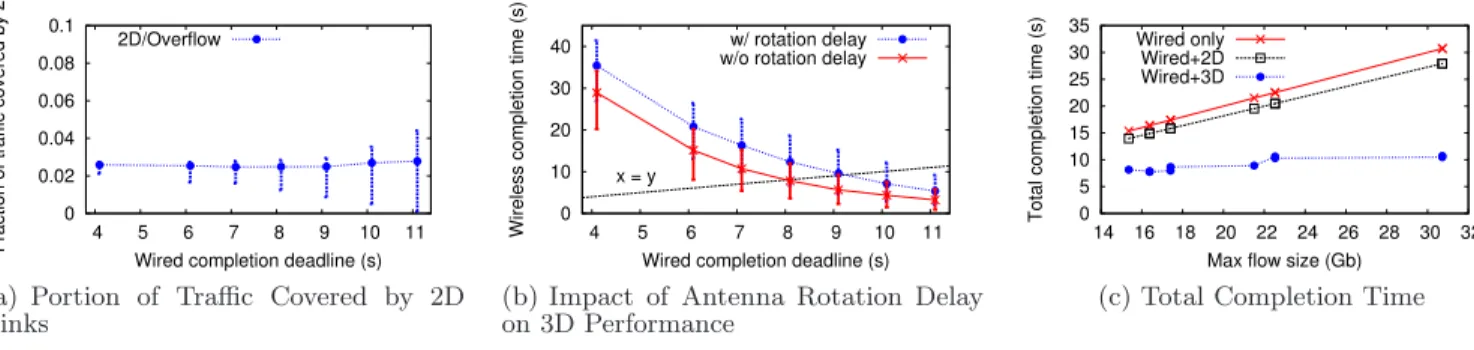
Coverage of 2D Links. One of the primary limitations with 2D beamforming is potential blockage issues that result in lower signal strength and loss in data throughput. Prior proposals limited 2D beamforming links to connecting neigh-boring racks that have no potential blockage issues. Our first experiment looks considers portion of the total overflow traf-fic can be sent over 2D links, where overflow traftraf-fic is the traffic that cannot be sent by the wired network by the spec-ified deadline. Figure 8(a) plots this as a ratio of total traffic across neighboring links,i.e. traffic that can be sent across 2D links, over total overflow traffic. In all of our graphs, we plot error bars covering the 90% confidence interval.Less than 3% of overflow traffic can be addressed using 2D links, regardless of how much traffic is sent across the wired network. We note that this figure might increase, depend-ing on how well the data center managers scheduled jobs to increase rack affinity and limit hotspots to neighboring racks, but this would introduce an additional constraint in job scheduling. Note that we do not plot similar values for 3D links, because 3D links can connect all possible rack pairs in our scenario with a single hop, thus coverage is 100%. Impact of Antenna Rotation Delay. Next, we look at 3D performance, and try to understand the impact on end-to-end latency by antenna rotation delays. In Figure 8(b), we plot the wireless completion time, i.e. time required to send overflow traffic over the 3D links, against the wired completion deadline. A longer wired deadline means more traffic will go over the wired network and less overflow traffic will be left for wireless links. We also draw the line “y=x” to show the minimum time to complete transmissions if we used the ideal traffic allocation between wired and wireless. By plotting 3D links with and without rotational delay, we see that all transmissions are completed in 9 seconds in a realistic system, but can be improved to 8 seconds if we
0 0.02 0.04 0.06 0.08 0.1 4 5 6 7 8 9 10 11
Fraction of traffic covered by 2D
Wired completion deadline (s) 2D/Overflow
(a) Portion of Traffic Covered by 2D Links 0 10 20 30 40 4 5 6 7 8 9 10 11
Wireless completion time (s)
Wired completion deadline (s) x = y
w/ rotation delay w/o rotation delay
(b) Impact of Antenna Rotation Delay on 3D Performance 0 5 10 15 20 25 30 35 14 16 18 20 22 24 26 28 30 32
Total completion time (s)
Max flow size (Gb) Wired only
Wired+2D Wired+3D
(c) Total Completion Time
Figure 8: Performance of 2D and 3D beamforming links in conjunction with a wired network with 1Gbps bisection bandwidth. (a) Less than 3% of overflow traffic can be addressed using 2D links, while 3D links can cover 100%. (b) The time required for 3D to send all the overflow traffic vs. the wired completion deadline, using today’s rotators or ideal rotators with zero delay. (c) Adding 3D beamforming cuts the total job completion time by half.
completely eliminate antenna rotation delays. This is the effective upper bound on how well we can perform given perfect radio assignment, and shows that antenna rotation delay is only a small component in end-to-end performance. Total Completion Time. Next, in Figure 8(c), we plot the effective completion time (if both wired and wireless net-works transmitted simultaneously with optimal traffic split) for different rounds of our simulation, assuming a 1Gbps bi-section on the wired network. Regardless of the size of the biggest flow, 3D wireless is generally able to reduce total transmission time by half. Since 2D links can only address a small portion of the overflow traffic, its impact on comple-tion time is limited.
Next, we ask the question, “will 3D beamforming links become less useful for wired networks with higher bisection bandwidth?” We vary the underlying bisection bandwidth of the wired network between 1 Gbps and 6 Gbps, and in each case, compute the minimal completion time if we per-formed the ideal traffic split between the wired and wire-less networks. Figure 9 shows that even as the wired net-work grows in bisection bandwidth, adding 3D beamforming can still reduce total transmission time significantly (rang-ing from more than 50% to slightly less than 40% as wired bandwidth ranges from 1 Gbps to 6 Gbps). This is not sur-prising. Since the demand in our hotspot scenario is fixed, a wired network with larger bisection bandwidth consumes more traffic, leaving less overflow traffic for the 60 GHz links.
5.3
Impact of Scheduler Policies
We now evaluate the net impact of different design choices in our link scheduler.
Preemption vs. No Preemption We discussed the is-sue of preempting existing links in Section 4. To understand which policy is more preferable, we compare the job com-pletion time when applying these two policies with the same workload as above. Non-preemptive is the default policy used in prior experiments, where once a link is scheduled, it utilizes the radio until it finishes. The preemptive policy considers all radios on a rack when scheduling requests, and where deemed appropriate by the scheduler, will pause an existing link to give its radio to a higher priority link request. We plot the completion time of the wireless traffic load in Figure 10(a). The results match our expectations. A non-preemptive policy reduces the completion time by up
Wired completion time (s) 4 6 7 8 Rotator usage reduction via
intelligent radio assignment 27% 22% 22% 21% Table 1: Intelligent radio assignment leads to mod-erate reduction in rotator usage.
to 25% compared to the preemptive policy. This is be-cause rescheduling the paused link introduces significant ad-ditional overhead (and more antenna rotation), thus reduc-ing overall efficiency.
Intelligent Radio Assignment. Finally, we evaluate the impact of using intelligent radio assignment during link scheduling. Figure 10(b) plots the completion time for the wireless traffic load for our default scheduler (including in-telligent radio assignment) and a basic scheduler, which uses random choice to choose between available radios. Neither scheduler uses link preemption.
The results are varied, depending on the traffic load on the wireless network. When the large majority of traffic is sent through the wired network, only the strongest of the hotspots remain for the wireless network. In this case, there will be high contention for radios at a small number of racks, and very little choice in terms of radio assignment. Thus the optimization shows small benefit. When a larger portion of the traffic is delegated to the wireless network, more racks carry moderate traffic that leaves some number of radios free for assignment. In this case, optimizing radio assign-ment provides some moderate benefit, which is ultimately bounded by the overhead of antenna rotation delay, shown in Figure 8(b).
We also compare the amount of rotations performed by each rotator using the two schedulers. Results in Table 1 show that depending on the traffic load given to the wireless network, intelligent radio assignment can reduce the rotator usage by up to 27%.
Summary. Our findings in this section can be summa-rized as follows. First, we find that in data centers with ran-dom traffic patterns, 2D beamforming restricted to neigh-boring racks can only address a very limited (∼3%) por-tion of traffic hotspots, compared to 100% for single hop 3D beamforming links. Second, we find that for many scenar-ios involving bursty traffic hotspots, using 3D beamforming links in conjunction with the existing wired network can gen-erally reduce completion time by half or more. Finally, we
0 5 10 15 20 25 30 1 2 3 4 5 6
Total completion time (s)
Wired bisection bandwidth (Gbps) Wired only
Wired+2D Wired+3D
Figure 9: Overall impact of adding beamforming links.
0 10 20 30 40 50 4 5 6 7 8
Wireless completion time (s)
Wired completion deadline (s) Preemptive Non-preemptive
(a) Preemption vs. Non-preemption
0 10 20 30 40 50 4 5 6 7 8
Wireless completion time (s)
Wired completion deadline (s) Random Radio Assignment Intelligent Radio Assignment
(b) Intelligent Radio Assignment Figure 10: Impact of different scheduling policies.
find that when sizable payloads are involved, e.g. 128MB, antenna rotation delays only contribute a small portion of the overall completion time, and much of that can be recov-ered using simple heuristics such as choosing radios that are closer to the desired transmission angle.
6.
DEPLOYMENT CHALLENGES
In this section, we briefly discuss some key challenges of deploying 3D beamforming in data centers.
Physical Rack/Reflector Placement. 3D beamform-ing performs the best when there are no obstacles between the top of rack/container and the ceiling. When physically arranging racks/containers as well as ceiling reflectors, data center managers should avoid obstacles such as cables and cooling pipes. This is not an issue for container-based data centers [10]. For other types of data centers, raised floors can be used to house cables and pipes in the ground. Any suspended cable trays can be concealed within aluminum-plated ducts, essentially lowering the reflection point from the ceiling. When unavoidable, one can also plan multi-hop transmissions or reflect off walls to route around obsta-cles. An open question is whether physical rack and reflector placement can be jointly optimized with network communi-cation patterns.
Reflector Curvature. We observe in our experiments that the performance of 3D beamforming is sensitive to the curvature of the reflector. Reflected by a flat surface, the beam propagates following the free-space model. When the surface becomes slightly concave, we observe a visible in-crease in the measured RSS value. Similarly, we observe a drop when the surface becomes convex. This could be the result of reflection creating multipath signals to the re-ceiver, which could degrade the link performance. Ideally, the reflector should be kept as flat as possible. Yet an open question is whether one can manipulate reflector curvature to further improve 3D beamforming performance.
Rotator Reliability. To communicate with different racks, each transceiver must adjust its beam direction in both azimuth and elevation. For radios with horn antennas, this requires a mechanical rotator to rotate the antenna, leading to extra rotation delay and the issue of rotator re-liability. Today’s off-the-shelf pan-tilt rotators can provide roughly 3-5 million cycle durability [4] or 15,000-hour life-time [9]. Clearly, the failure rates of these components must be weighed against their performance when choosing be-tween horn antennas and antenna arrays.
Antenna Arrays. The above concerns on the rotator
de-lay and reliability can be addressed by replacing horn
anten-nas with switched beam smart antenanten-nas or antenna arrays. Antenna arrays use electronic beam rotation, with delay as low as 50ns in existing 16-element arrays [40]. However, they still do not eliminate issues of link blockage or inter-ference. In addition, antenna arrays produce more signal leakage than horn antennas, leading to weaker link signal strength and stronger interference to neighboring flows [46]. One potential solution is to configure beam patterns to steer away from neighboring links or to nullify interference [33]. We leave exploration of these issues for future study.
7.
RELATED WORK
Data Center Networks. Most prior work addresses traffic congestion through network architecture design and traffic scheduling [11, 13, 14, 18, 21, 22], or modeling net-work traffic characteristics [15, 16, 25, 17]. 60 GHz wireless was first proposed to data center networking in [35] as a so-lution to reduce the cabling complexity. Recent proposals use wireless links to augment [23, 26] or replace [38] wired links. In this work, we identify two practical issues of exist-ing approaches, and propose a new beamformexist-ing paradigm to effectively address these issues.
While prior work has applied the principle of radio signal reflection to connect non line-of-sight links [35] or to reduce WiFi interference [31], we generalize it to 60GHz links. Our key contribution is to use ceiling reflection in the data center to extend connectivity and suppress interference. We also used detailed hardware experiments to validate our design. Optical circuit switching [20, 39, 42] is an alternative for adding burst bandwidth to data centers. Optical circuit switching promises tremendous bandwidth but the technol-ogy incurs relatively substantial cost and does not offer some of the benefits of wireless augmentation of data center band-width, namely reduced cost and deployment complexity. 60GHz Wireless Technology. Prior work mainly fo-cuses on radio and antenna design issues [8, 40], and signal propagation and reflection modeling [37, 45, 12, 30, 36]. To-day, there is a wide selection of commercial 60GHz radio products [5]. One recent effort [40] developed a 16-element on-chip antenna array, allowing each radio to switch a beam to any of the 32 predefined directions within 50ns. Our work leverages readily available hardware, and focuses on design-ing new wireless interconnects explicitly for data centers.
8.
CONCLUSION
Traffic in today’s data centers is unpredictable, often pro-ducing traffic hotspots that result in congestion and delay. Instead of overprovisioning the wired network for bursts by
rewiring a data center network at scale, we advocate the use of 60 GHz wireless beamforming links to alleviate traffic hotspots as they occur.
Our work addresses limitations of 60 GHz beamforming that arise from signal blockage and interference caused by signal leakage. Our insight is that by aiming 60 GHz beam-forming links at a reflective ceiling, we can achieve indirect line-of-sight between most or all rack pairs in a data cen-ter, while minimizing interference. The net effect is that 3D beamforming greatly expands the reach and capacity of 60 GHz links, making them feasible as flexible and reconfig-urable alternatives to wired cabling. Our testbed measure-ments confirm that 3D beamforming links suffer zero energy loss from reflection, and effectively avoid blocking obstacle and reduce interference footprint.
While wired networks will continue to serve high-end data center needs, we believe that efforts such as 3D beamforming can provide significant benefits to a broad range of data cen-ter deployments, by potentially reducing deployment com-plexity and reducing cost compared to a fully provisioned wired network.
9.
ACKNOWLEDGMENTS
The authors thank Romit Roy Choudhury and the review-ers for their feedback, and Daniel Halperin and Lei Yang for their insights on 60 GHz hardware. This work is supported in part by NSF grant CNS-0905667.
10.
REFERENCES
[1] Data center managers not fixed on wireless.
http://searchdatacenter.techtarget.com/tip/ Data-center-managers-not-fixed-on-wireless. [2] ETS-Lindgren.http://ets-lindgren.com/Absorbers. [3] Flann Microwave.http://www.flann.com/.
[4] FLIR.http://www.flir.com/mcs/products/.
[5] HXI Milimeter Wave Products.http://www.hxi.com/. [6] IEEE P802.11ad/D0.1: Enhancements for very high
throughput in the 60 GHz band. Draft 0.1, June 2010. [7] NSI.http://www.nearfield.com/.
[8] SiBeam.http://sibeam.com/whitepapers/. [9] Sidus.http://www.sidus-solutions.com/. [10] Sun modular datacenter s20/d20 overview.
http://download.oracle.com/docs/cd/E19115-01/mod.dc. s20/index.html.
[11] Abu-Libdeh, H., et al.Symbiotic routing in future data centers. InProc. of SIGCOMM (2010).
[12] Ahmadi-Shokouh, J., et al.Reflection coefficient measurement for house flooring materials at 57-64 GHz. In
Proc. of GLOBECOM (2009).
[13] Al-fares, M., et al.Hedera: Dynamic flow scheduling for data center networks. InProc. of NSDI (2010).
[14] Al-Fares, M., Loukissas, A., and Vahdat, A.A scalable, commodity data center network architecture. InProc. of
SIGCOMM (2008).
[15] Benson, T., Akella, A., and Maltz, D. A.Network traffic characteristics of data centers in the wild. InProc. of IMC (2010).
[16] Benson, T., et al.Understanding data center traffic characteristics.ACM CCR 40(2010), 92–99.
[17] Chen, Y., Ganapathi, A., Griffith, R., and Katz, R.
The case for evaluating MapReduce performance using workload suites. InProc. of MASCOTS(2011). [18] Curtis, A., Kim, W., and Yalagandula, P.Mahout:
Low-overhead datacenter traffic management using end-host-based elephant detection. InINFOCOM(2011). [19] Diestel, R.Graph Theory, 4th ed. Springer-Verlag,
Heidelberg, 2010.
[20] Farrington, N., et al.Helios: A hybrid electrical/optical switch architecture for modular data centers. InProc. of
SIGCOMM (2010).
[21] Greenberg, A., et al.VL2: A scalable and flexible data center network. InProc. of SIGCOMM (2009).
[22] Guo, C., et al.BCube: a high performance, server-centric network architecture for modular data centers. InProc. of
SIGCOMM (2009).
[23] Halperin, D., et al.Augmenting data center networks with multi-gigabit wireless links. InProc. of SIGCOMM
(2011).
[24] Kamil, S., et al.Communication requirements and interconnect optimization for high-end scientific applications.IEEE TPDS 21 (2009), 188–202. [25] Kandula, S., et al.The nature of data center traffic:
measurements & analysis. InProc. of IMC (2009). [26] Kandula, S., Padhye, J., and Bahl, V.Flyways to
de-congest data center networks. InProc. of HotNets
(2009).
[27] Katayama, Y., et al.Wireless data center networking with steered-beam mmwave links. InWCNC (2011). [28] Kelleher, K.The Microwave Engineers’ Handbook and
Buyers’ Guide, 5th ed. New York: Horizon Press, 1964.
[29] Knop, C., and Wiesenfarth, H.On the radiation from an open-ended corrugated pipe carrying the HE11 mode.IEEE
Trans. on Antennas and Propagation(1972), 644 – 648.
[30] Langen, B., Lober, G., and Herzig, W.Reflection and transmission behavior of building materials at 60 GHz. In
Proc. of PIMRC (1994).
[31] Liu, X., et al.DIRC: Increasing indoor wireless capacity using directional antennas. InProc. of SIGCOMM (2009). [32] Manabe, T., Miura, Y., and Ihara, T.Effects of antenna
directivity on indoor multipath propagation characteristics at 60GHz. InProc. of PIMRC (1995).
[33] Nikolaidis, G., et al.Cone of silence: adaptively nulling interferers in wireless networks.SIGCOMM CCR(2010). [34] Qiu, L., et al.A general model of wireless interference. In
Proc. of MobiCom(2007).
[35] Ranachandran, K., et al.60GHz data-center networking: wireless =>worryless? NEC Technical Report (2008). [36] Sato, K., et al.Measurements of reflection and
transmission characteristics of interior structures of office building in the 60-GHz band.IEEE Trans. on Antennas
and Propagation 45, 12 (1997), 1783 –1792.
[37] Sch¨onthier, J.WP3-study “the 60 GHz channel and its modelling”.Tech. Report IST-2001-32686 (2003).
[38] Shin, J.-Y., et al.On the feasibility of completely wireless data centers.Technical Reports, Cornell University(2011). [39] Singla, A., et al.Proteus: a topology malleable data
center network. InProc. of HotNets(2010). [40] Valdes-garcia, A., et al.Single-element and
phased-array transceiver chipsets for 60-GHz Gb/s communications.IEEE Communications Magazine(2011). [41] Vardhan, H., et al.Wireless data center with millimeter
wave network. InProc. of GLOBECOM (2010). [42] Wang, G., et al.c-through: part-time optics in data
centers. InProc. of SIGCOMM (2010).
[43] Wilson, C., Ballani, H., Karagiannis, T., and Rowstron, A.Better never than late: Meeting deadlines in datacenter networks. InProc. of SIGCOMM (2011). [44] Yang, F., Shanmugasundaram, J., and Yerneni, R.A
scalable data platform for a large number of small applications. InProc. of CIDR(2009).
[45] Yong, S.-K., Xia, P., and Valdes-Garcia, A.60 GHz Technology for Gbps WLAN and WPAN: From Theory to
Practice. WILEY, 2011.
[46] Zhang, W., Zhou, X., Yang, L., Zhang, Z., Zhao, B. Y., and Zheng, H.3D beamforming for wireless data centers.