Procedia - Social and Behavioral Sciences 197 ( 2015 ) 1512 – 1519
1877-0428 © 2015 The Authors. Published by Elsevier Ltd. This is an open access article under the CC BY-NC-ND license (http://creativecommons.org/licenses/by-nc-nd/4.0/).
Peer-review under responsibility of Academic World Education and Research Center. doi: 10.1016/j.sbspro.2015.07.103
ScienceDirect
7th World Conference on Educational Sciences, (WCES-2015), 05-07 February 2015, Novotel
Athens Convention Center, Athens, Greece
Innovation in education: Students’ perceptions of implementing ICT
in learning in second-cycle institutions in Ghana
Buabeng-Andoh Charles
a* , Yidana Issifu
baPentecost University College, P.O. Box KN 1739, Accra, Ghana bUniversity of Education,Winneba, P.O. Box 25, Winneba, Ghana
Abstract
This study was conducted to investigate secondary school students’ perceptions’ and ICT usage. A total of 3380 students from 24 public and private schools from four regions in Ghana participated in this study. Descriptive statistics, Analysis of variance were used to analyze the findings. The study revealed that students’ ICT usage to support learning was low. The analysis showed that students’ perceived value, expectancy of success and perceived cost were high. Male students value implementing ICT in learning more positively than female students. Also, public school students value using ICT in classrooms more positively than private school students. Generally, students’ perceptions of ICT usage were positive.
© 2015 The Authors. Published by Elsevier Ltd.
Peer-review under responsibility of Academic World Education and Research Center.
Keywords:perceived value; expectancy of success; perceived cost; students; secondary schools
1.Introduction
ICT is becoming increasingly important in our daily lives and in our educational system. For example, ICT has challenged the conventional teaching methods, transformed instructional practices and contributed to emerging new instructional methods (Tezci, 2011, Kubiatko, 2009). With its prospects, ICT has become an important component of educational reform and an integral part of school curriculum (Papanastasiou & Angeli, 2008). As stated by World Bank (2007), many governments have invested in ICT to improve its integration into education. In spite of all these
*Buabeng-Andoh. Tel.: +233-269196730
E-mail address:[email protected]
© 2015 The Authors. Published by Elsevier Ltd. This is an open access article under the CC BY-NC-ND license (http://creativecommons.org/licenses/by-nc-nd/4.0/).
investments, many studies have found that students do not use ICT in their learning effectively (Woreta, Kebede & Zegeye, 2013; Sarfo & Ansong-Gyimah, 2011; Tezci, 2011; Drent & Meelissen, 2008).
Research studies have found that possessing positive attitudes toward ICT impacts computer usage. According to Teo (2008), students’ positive attitudes toward computer technology have a direct positive influence on their innovative use of ICT. Woodrow (1991, p. 165) points out “awareness of student attitudes towards computers is a critical criterion in the evaluation of computer courses and the development of computer-based curricula”.
Although, many researchers conducted studies on students’ perceptions, they concentrated on a few number of students (Conole, de Laat, Dillon & Darby, 2008; Tang & Austin, 2009; Keller & Cernerud, 2002; McLachlan, Craig, Coldwell, 2010). It is obvious that conducting a new research involving a large number of students who represent different gender groups and schools to identify perceptions and ICT usage is important to deal with the gap. Research findings from students’ perceptions and ICT usage may have important implications for administrators, departments, students, and employers and may enhance educational delivery to students, students’ learning experience in secondary school, and students’ application of knowledge and skills in the real world of work. Therefore, we reason that it is necessary to investigate students’ perceptions and ICT usage in education.
2. Theoretical Framework and literature review
Wigfield (1994); Wigfield and Eccles (2000) proposed an expectancy-value model of motivation. The theory is used for understanding and predicting people’s behaviour in the process of adopting innovations. Expectancy-value theory suggests that person’s decision to do a particular task depends on the belief that there are advantages in executing the task and belief that they can succeed. In other words, the expectancy of success and perceived value must be high.
Based on the work of Wozney, Venkatesh and Abrami (2006), expectancy-value theory is adopted to study students’ perceptions in the use of ICT in learning. According to this theory, person’s perceived value and expectancy of success determine their intention to perform a job. In other words, students are likely to use ICT in learning if the perceived value and expectancy of success of the innovation are high and if these values are perceived to offer more than the perceived costs of innovative use of ICT.
In this study, expectancy, value and cost are the three variables used to analyze students’ attitudes toward pedagogical use of ICT. Though, the construct “cost” has not received as much research attention as the expectancy of success and perceived value components of the theory but it is believed to be an important aspect involved in decision making (Wigfield & Cambria, 2010; Pintrich & Schunk, 2002). Thus, the expectancy, value and cost variables of the theoretical framework have independent effects on behaviours, therefore, these variables are necessary to understand students’ perceptions in implementing ICT. In this study, expectancy of success examines the perceived contingency between behaviour (i.e. self-efficacy) and the outcome. Value examines students’ perceptions of usefulness or benefits of technology. Cost examines students’ perceptions of costs as barriers to the pedagogical use of ICT. In this study, the pedagogical use means students’ application of ICT to support their learning. These items combined with the research questions are used to investigate possible differences in perceptions with regards to gender and school type.
To successfully initiate and implement educational technology in school’s program depends strongly on the teachers’ and students’ attitudes (Selwyn, 1999; Woodrow, 1991). Research has shown that students’ perceptions and their readiness to accept computer technology in teaching are critical to the success of their learning (Teo, 2008). Students’ perceptions of technology are essential if computers are efficiently incorporated into teaching and learning process in schools. In a study conducted by Dorup (2004), he found that students prefer the use of ICT in learning, and they showed positive attitudes towards the technology. However, Kennewell (2001) posited that students’ positive attitudes could be influenced by classroom organization, classmates, teachers, resources, etc. Several studies on students’ attitudes towards ICT and their relationships with gender have revealed conflicting results.
Kubiatko and Halakova (2009) conducted a study on high school students’ perception of using in studying biology. The study revealed that male students have more positive attitudes toward the use ICT than female students. Further, the study of Papaioannou and Charalambous (2011) found that male students had more positive attitudes toward ICT than their female colleagues. However, Seyal, Rahim and Rahman (2002) study on computer attitudes of 268 students revealed no significant differences in attitudes with regards to gender. Also, Mizrachi and Shoham (2004) studied students’ computer attitudes in schools. The study found no significant differences in
attitudes with regards to gender. However, more computer use leads to more positive computer attitudes.
A report by European Commission (2001) found that, as students’ experiences with computers increased, their attitudes towards ICT became more positive; however, using ICT in traditional way of teaching negatively affected students’ attitudes. Therefore, it would seem progressively imperative to consider learners’ perceptions of ICT and the way they use ICT in schools, since they are key stakeholders in the educative process too. Investigating what turns students on (and off) in regard to ICT in the classroom can inform teachers’ practice perhaps leading to the development of a more collaborative educative process. Therefore, this study sought to investigate students’ perceptions and their use of ICT in schools.
Based on theoretical review and the purpose of this study, three research questions were addressed in this study as follows:
3. Research Questions
(1) What are students’ ICT usages in secondary schools?
(2) What are students’ perceptions of ICT integration into learning?
(3) Are there differences in students’ perceptions with regards to gender and school type?
4. Methodology
In this study, 24 public and private secondary schools were selected from four regions. The selection of schools was based on student-computer ratio (MoE, 2009) and the information provided by the school heads. The schools comprised three public secondary schools and three private secondary schools in each region. The categorization of the schools was urban schools, semi-urban schools and rural schools. A total of 4350 questionnaires were received, representing 96.7% return rate from 4500 questionnaires distributed to students. Of these, 132 questionnaires were deemed unusable, due to data incompleteness, and were subsequently dropped from the data set leaving 4218 questionnaires for data screening. Of these, 838 questionnaires were detected as outliers and deleted from the data set leaving 3380 questionnaires for the data analysis. A table of values of sample size determination developed by Krejcie and Morgan (1970) was used to determine the sample size of respondents in each school. The questionnaire consists of 35 items and was categorized into three sections. Section A consists of nine demographic items, section B consists of six students’ use of ICT and Section C consists of 23 items of factors that related to students’ use of ICT.
5. Data Analyses
SPSS 16 was used to perform all the analysis. Descriptive statistics was used to analyze the demographics of the participants, research questions 1, 2 and 3. Further, Analyses of Variance (ANOVA) was used to study the differences in perceptions with regards to gender and school type.
6. Research Findings
Of 3380 respondents, 51.5% were females and 48.5% were males. The age of the students ranged from 13 to over 20 years. 47.3% were between 17 and 18 years old. 6.4% were over 20 years old. 62.6% of the students were enrolled in public schools while 37.4% were enrolled in private schools. 33.0% of the students came from urban, 37.3% from semi-urban and 29.7% from rural schools. In terms of program of study, 42.7% offer Arts, 20.9% study Science, 18.2% study Business, and 14.1% study Home Economics and 3.8% study other programs.
In terms of ICT experience, 26.2% had between 3-4 years ICT experience, 26% with more than six years experience, 15.9% had between 5-6 years experience, 18% had 1-2 years ICT experience, while 12.9% had less than 1 year ICT experience.
Research Question 1: Students’ ICT usage in learning.
As seen in Table 1, majority of the respondents used ICT to communicate with peers through collaborative and inquiry-based learning (64.2%) more than other types of ICT application. However, respondents’ use of ICT to support their learning varies as follows: 34.3% never use ICT, whereas 20.5% use ICT daily. The overall pedagogical use of ICT for learning purposes was found to be low (mean = 2.74, standard deviation = 1.51).
Research Question 1: Student’s pedagogical use of ICT in learning
As seen in Table 1, 64.2% of the respondents used ICT to communicate with peers more than other types of ICT application. However, respondents’ use of ICT to support their learning varies as follows: 34.3% never use ICT, whereas 20.5% use ICT daily. The overall pedagogical use of ICT for learning purposes was found to be low (mean = 2.74, standard deviation = 1.51).
Table 1: Students’ pedagogical use of ICT
Item Percentage (%) Mean Std
Never Once a
month Once a week Twice a week Daily
Download learning
materials 35.1 18.1 18.8 13.9 13.0 2.51 1.42 Give presentation of class
work 47.0 17.7 17.0 10.2 7.1 2.12 1.30 Complete assignments 37.4 14.6 17.2 10.7 17.5 2.55 1.52 Communicate with peers 25.8 8.1 12.2 13.6 38.4 3.31 1.66 Browse relevant website 31.8 12.1 13.4 14.3 26.5 2.91 1.63 Process and analyze data 35.1 15.4 20.4 12.9 15.1 2.57 1.46 Solve problems 27.7 15.0 18.3 12.7 25.8 2.94 1.56 Overall pedagogical use 34.3 14.4 16.8 12.6 20.5 2.74 1.51 Std = standard deviation, Cronbach alpha = .83
Research question 2: Students’ perceptions of ICT integration into learning?
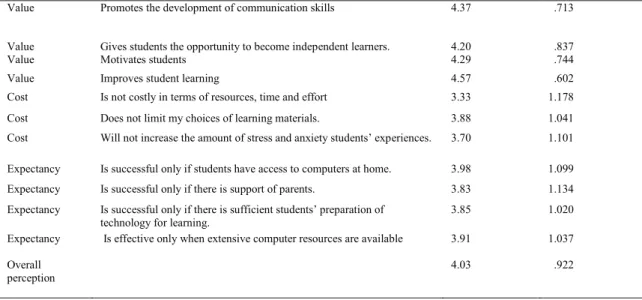
Thirteen items were used to assess students’ perceptions of the use of ICT in teaching and learning process. As seen in Table 2, students’ perceived value (overall mean = 4.31, overall std = .728) of the use of ICT in learning was more positive than expectancy of success (overall mean = 3.89, overall std = 1.07) and perceived cost (overall mean = 3.64, overall std = 1.11). Overall, the students’ perceptions of ICT integration into learning were positive.
Table2. Mean scores of students’ perceptions of ICT usage
Category Item Mean Std
Value Increases academic performance 4.26 .744
Value Promotes the development of communication skills 4.37 .713
Value Gives students the opportunity to become independent learners. 4.20 .837
Value Motivates students 4.29 .744
Value Improves student learning 4.57 .602
Cost Is not costly in terms of resources, time and effort 3.33 1.178
Cost Does not limit my choices of learning materials. 3.88 1.041
Cost Will not increase the amount of stress and anxiety students’ experiences. 3.70 1.101
Expectancy Is successful only if students have access to computers at home. 3.98 1.099
Expectancy Is successful only if there is support of parents. 3.83 1.134
Expectancy Is successful only if there is sufficient students’ preparation of
technology for learning. 3.85 1.020
Expectancy Is effective only when extensive computer resources are available 3.91 1.037
Overall
perception 4.03 .922
Std = standard deviation, cronbach alpha = .75
Research question 3: Differences in students’ perceptions with regards to gender and school type.
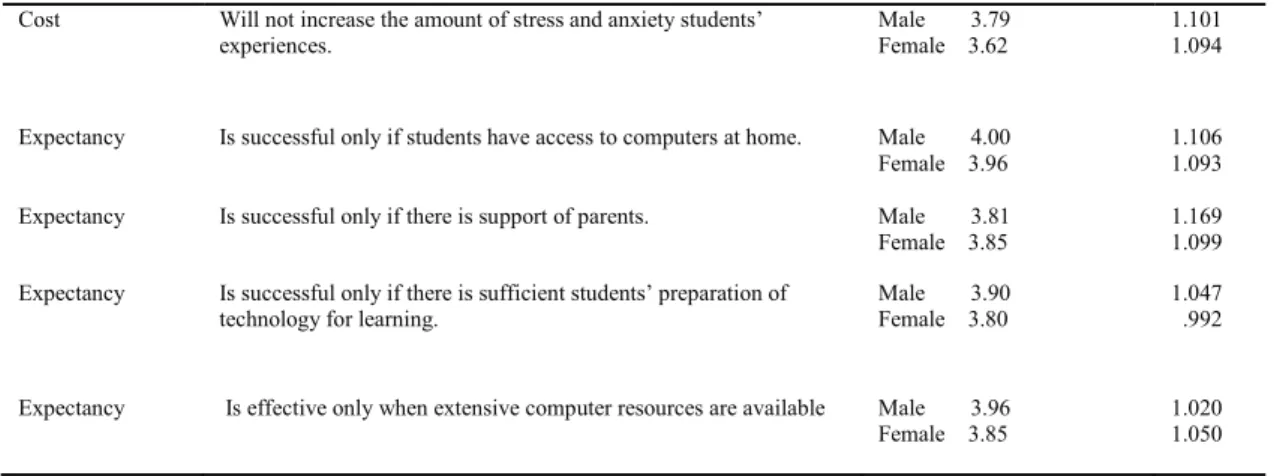
The value, cost and expectancy of success items were assessed to verify whether male and female students would differ in their response to these belief items. As Table 3 reveals, male students gave more positive responses to all of the value and cost items. Further, one-way analyzes of variance were conducted to verify the differences. Statistical significant difference was found in the following statements: ICT increases academic performance (F (1, 3360) = 5.281; p < .05), ICT promotes student collaboration (F (1, 3345) = 6.509; p < .05), ICT promotes the development of communication skills (F (1, 3356) = 20.496; p < .05), ICT motivates students (F (1, 3315) = 14.581; p < .05), improves student learning (F (1, 3357) = 11.472; p < .05), is not costly in terms of resources, time and effort (F (1, 3354) = 11.728; p < .05), ICT does not limit my choices of learning materials (F (1, 3343) = 27.632; p < .05), and ICT will not increase the amount of stress and anxiety students’ experiences (F (1, 3352) = 19.802; p < .05).
Table 3. Mean scores of students’ perceptions of ICT usage based on gender
Category Item Mean Std
Value Increases academic performance Male 4.29
Female 4.23
.759 .729
Value Promotes student collaboration Male 4.22
Female 4.15 .733 .726
Value Promotes the development of communication skills Male 4.42
Female 4.31 .709 .712
Value Gives students the opportunity to become independent learners. Male 4.20
Female 4.19
.868 .807
Value Motivates students Male 4.34
Female 4.24 .735 .749
Value Improves student learning Male 4.61
Female 4.54 .580 .620
Cost Is not costly in terms of resources, time and effort Male 3.40
Female 3.26 1.192 1.161
Cost Does not limit my choices of learning materials. Male 3.98
Cost Will not increase the amount of stress and anxiety students’
experiences. Male 3.79 Female 3.62 1.101 1.094
Expectancy Is successful only if students have access to computers at home. Male 4.00
Female 3.96 1.106 1.093
Expectancy Is successful only if there is support of parents. Male 3.81
Female 3.85 1.169 1.099
Expectancy Is successful only if there is sufficient students’ preparation of
technology for learning. Male 3.90 Female 3.80 1.047 .992
Expectancy Is effective only when extensive computer resources are available Male 3.96
Female 3.85 1.020 1.050
Similarly, as seen in Table 4, students in public schools gave more positive responses to all of the value items. In addition, one-way analyzes of variance were conducted to verify the differences. Statements where the difference was statistically significant were the following: ICT promotes student collaboration (F (1, 3345) = 5.743; p < .05), ICT promotes the development of communication skills (F (1, 3356) = 48.764; p < .05), ICT motivates students (F
(1, 3315) = 18.928; p < .05) and ICT improves student learning (F (1, 3357) = 15.391; p < .05).
Table 4. Mean scores of students’ perceptions of ICT usage based on school type
Category Item Mean Std
Value Increases academic performance Public 4.26
Private 4.25 .766 .706
Value Promotes student collaboration Public 4.21
Private 4.15 .723 .742
Value Promotes the development of communication skills Public 4.43
Private 4.25 .698 .724
Value Gives students the opportunity to become independent learners. Public 4.20
Private 4.18
.851 .813
Value Motivates students Public 4.33
Private 4.22 .717 .782
Value Improves student learning Public 4.61
Private 4.52 .564 .657
Cost Is not costly in terms of resources, time and effort Public 3.25
Private 3.47 1.207 1.115
Cost Does not limit my choices of learning materials. Public 3.98
Private 3.72
1.001 1.084
Cost Will not increase the amount of stress and anxiety students’
experiences. Public 3.78 Private 3.58 1.073 1.134
Expectancy Is successful only if students have access to computers at home. Public 3.95
Private 4.03 1.146 1.016
Expectancy Is successful only if there is support of parents. Public 3.74
Private 3.99
1.192 1.009
Expectancy Is successful only if there is sufficient students’ preparation of
technology for learning. Public 3.86 Private 3.83 1.039 .988
Expectancy Is effective only when extensive computer resources are available Public 3.91
Private 3.90 1.036 1.038
7. Discussion
The findings of the study found that students used ICT to communicate with peers through collaborative and iniquiry-based learning more than any other application. The finding of this study confirms Irfan and Noor’s (2012) study which found that students’ Internet applications for communication skills are at the proficient level. However, this study revealed that students’ use of ICT to support their learning was low.
Students’ perceptions of the use of ICT investigated in this study were values, expectancy of success and costs. The results of the study showed that students’ perceived value, expectancy of success and perceived cost were high. This finding supports expectancy-value theory that values, expectancies of success and costs influence users’ performance, persistence and choice of activities (Wigfield & Cambria, 2010, Wigfield & Eccles, 2000). Overall, students’ perceptions of ICT usage were positive as shown by the mean score.
The findings of this study found that male and female students differed in their views on perceived value and perceived cost. Male students gave more positive responses to all of the value and cost items than female students. The findings of this research are consistent with other previous studies (Kubiatko and Halakova 2009) which found gender differences in students’ perceptions of ICT usage. Further, the study found that public and private school students differed in their views on perceived value items. Students in public schools gave more positive responses to all of the value items than their counterparts in the private schools. This suggests that public school students integrate ICT into their learning more than the private school students.
8. Conclusion
The aim of the study was to investigate secondary school students’ ICT usage, their perceptions regarding ICT integration and the differences n their perceptions of ICT implementation in learning with regards to gender and school type. The analysis of the data revealed that even though students’ have made effort to integrate ICT into their learning, the pedagogical use of ICT is low. Though, male and female students differed in their perceptions of ICT usage, the overall students’ perceptions in the use of ICT were positive. This finding concludes that perception plays a substantial role in students’ ICT integration into learning. Finally, private and public school students differed in their views on perceived value of ICT integration. It can be concluded from this finding that even though most private school students acknowledge the value of ICT in learning, many do not integrate it into their studies. Research findings from students’ perceptions and ICT usage may have important implications for administrators, departments, students, and employers and may enhance educational delivery to students, students’ learning experience in secondary school, and students’ application of knowledge and skills in the real world of work.
References
Conole, G., de Laat, M., Dillon, T., & Darby, J. (2008). ‘Disruptive technologies’, ‘pedagogical innovation’: What’s new? Findings from an in-depth study of students’ use and perception of technology. Computers & Education, 50, 511-524.
Dorup, J. (2004). Experience and attitudes towards information technology among first year medical students in Denmark: Longitudinal questionnaire survey.Journal of Medical Internet Research, 6(1), e10.
Drent, M., & Meelissen, M. (2008). Which factors obstruct or stimulate teacher educators to use ICT innovatively? Computers & Education, 51, 187-199.
European Commission. (2001). Survey report: Students' perceptions of the use of ICT in
university learning and teaching. Retrieved from http://www.spotplus.odl.org/downloads/Survey_report_final.pdf
Keller, C., & Cernerud, L. (2002). Students’ Perceptions of E-learning in University Education. Journal of Educational Media, 27(1-2), 55-67. Kennewell, S. (2001). Using affordances and constraints to evaluate the use of information and communications technology in teaching and
learning. Journal of Information Technology for Teacher Education, 10(1–2), 101–116.
Krejcie, R. V., & Morgan, D. W. (1970). Determining sample size for research activities. Educational and Psychological Measurement, 30, 607-610.
Kubiatko, M., & Halakova,Z. (2009). Slovak high school students’ attitudes to ICT using in biology lesson. Computers in Human Behavior, 25, 743–748.
McLachlan, C., Craig, A., & Coldwell, J., (2010). Student perceptions of ICT: A Gendered Analysis, in ACE 2010 : Proceedings of the Twelfth Australasian ComputingEducation Conference, Australian Computer Society, Sydney South, N.S.W.
Mizrachi, D., & Shoham, S. (2004). Computer attitudes and library anxiety among undergraduates: a study of Israeli B.Ed students. International Information and Library Review, 36 (1), 29-38.
MoE. (2009). E-Readiness Assessment report on second-cycle institutions in Ghana. Ministry of education.
Papaioannou, P. & Charalambous, K. (2011). Principals’ attitudes toward ICT and their perceptions about the factors that facilitate or inhibit ICT integration in primary schools of Cyprus. Journal of Information Technology Education, 10, 333-347.
Papanastasiou, E.C., & Angeli, C. (2008). Evaluating the use of ICT application in education: Psychometric properties of the survey of factors affecting teachers teaching with technology (SFA-T3). Educational Technology & Society, 11(1), 69-86.
Pintrich, P.R., & Schunk, D.H. (2002). Motivation in education: Theory, research, and applications. Upper Saddle River, NJ: Prentice Hall. Sarfo, F.K., Ansong-Gyimah, K. (2011). Ghanaian Senior High School students’ access to and experiences in the use of Information and
Communication Technology. Education In technological world: Communicating Current and Emerging Research and Technological Efforts, 216-222.
Selwyn, N. (1999). Students’ attitudes towards computers in sixteen to nineteen education. Education and Information Technologies, 4(2), 129– 141.
Seyal, A. H., Rahim, M., & Rahman, M. N. A. (2002). A study of computer attitudes of noncomputing students of technical colleges in Brunei Darussalam. Journal of End User Computing, 14 (2), 40-47.
Tang, T.L.-P., & Austin, M.J. (2009). Students’ perceptions of teaching technologies, application of technologies, and academic performance. Computers & Education, 53, 1241–1255.
Teo, T. (2008). Pre-service students’ attitudes toward computer use: A Singapore survey. Australasian Journal of Educational Technology, 24(4), 413-424.
Tezci, E. (2012). Factors that influence pre-service teachers’ ICT usage in education. European Journal of Teacher Education, 34(4), 483-499. Wigfield, A., & Eccles, J.S. (2000). Expectancy-value theory of achievement motivation. Contemporary Educational Psychology, 25, 116-119. Wigfield, A. (1994). Expectancy-value theory of achievement motivation: A developmental perspective. Educational Psychology Review, 6,
49-78.
Wigfield, A., & Cambria, J. (2010). Expectancy-value theory: Retrospective and prospective. In T.C. Urdan & S. A. Karabenick (Eds), The decade ahead: Theoretical perspectives on motivation and achievement (Advances in motivation and achievement, Vol. 16, pp. 35-70). Bingley, UK: Emerald Group Publishing Limited.
Woodrow, J. E. (1991). A comparison of four computer attitude scales. Journal of Educational Computing Research, 7(2). 165-187.
Woreta, S. A., Kebede, Y., & Zegeye, D. T. (2013). Konwledge and utilization of information communication technology (ICT) among health science students at the University of Gondar, North Western Ethiopia. BMC Medical Informatics and Decision Making, 13 (31), 2-7. Wozney, L., Venkatesh, V., & Abrami, P. C. (2006). Implementing computer technologies: Students’ perceptions and practices. Journal of