Available online: https://edupediapublications.org/journals/index.php/IJR/ P a g e | 1405
Effects of ICT assisted Real and Virtual learning on the
performance of secondary school students
Monisha Deka & Ananta Kumar JenaPh.D. Scholar Department of Education Assam University,Silchar-788011,Assam,India
Assistant Professor Department of Education Assam University,Silchar-788011,Assam,India
Email: [email protected] ;Email: [email protected]
Abstract
The study aimed to assess the effect of ICT
assisted real and virtual learning
performance over the traditional approach
of secondary school students.
Non-Equivalent Pretest-Posttest Quasi
Experimental Design used to assess and
relate the effects of independent variables
virtual learning on dependent variables
(i.e. learning performance). Extraneous
variables minimized through ANCOVA,
and in fact, the findings generalized on the
whole population. Class IX of school
1(n=55) assigned to traditional approach,
Class IX of school 2 (n=60) assigned for
real learning approach(YouTube and
Wikipedia), and Class IX of school 3
(n=55) assigned for virtual learning
approach (i.e. Skype, Video
Conferencing,& Recorded Audio-Video
lecture) among the secondary school
students (e.g. Class- IX) of two selected
schools. It resulted that there was
statistically significant difference among
the pretest and posttest mean of the
learning performance of ICT assisted Real
learning (YouTube & Wikipedia) Group,
ICT assisted Virtual learning (Skype &
video lecture) Group over Traditional
learning Group of students.
Key words: ICT, performance, real learning,
secondary school students, virtual learning
Introduction
In this 21st century we are living in
knowledge based global world where there
is a rapid advancement of science and
technology (Almekhlafi, 2006). Recently,
youtube, Wikipedia, animation, skype and
imo software or technology used for
distance learning within at minimum time
and at maximum lowest cost (Zhan & Mei
2013). These virtual learning processes are
operating through ICT for making learning
meaningful and high retention
(Al-Salameh,2011). Currently, it is in question,
whether virtual learning is applicable in
secondary education of India or it is
limited within the developed countries.
The online ICT is an effective tool, which
provides knowledge and information to the
Available online: https://edupediapublications.org/journals/index.php/IJR/ P a g e | 1406
(Cevik,Haslaman, Celik 2015). Online ICT
provides knowledge, skill and competency
through Wikipedia, Wikimedia, online pdf
file, online html file, video-conferencing,
audio- conferencing, and
mobile-conferencing, Skype, and through direct
online smart kits (Chen,Chang,
Chien,Tijus, and Chang, 2015). In recent
days; researchers, educators, scholars,
students are mostly using internet as the
ICT assisted learning.
Virtual learning is a system of delivering
learning materials to students via the web
or recorded audio and video lectures
(Tulbure,2012). This system includes
assessment, students direct participation,
student tracking, collaboration and
communication tools. Virtual learning
environment allows participants to learn or
acquire knowledge in a collaborative, co-
operative learning activities and
interactions. Virtual learning environment
includes a course syllabus, pre- requisites
registration, skilful mentor or instructor,
and distant learning applications (Fu,
2013). This normally includes materials
such as copies of lectures in the form of
text, audio/video presentations and the
supporting visual presentations
(Gurol,Kayisli,Basal,2010).. Virtual
classroom includes different types of
communication system, multi-
dimensional communication process,
threaded discussions, chat – rooms, twitter,
Skype, wikis, blogs, 3D visual learning
spaces in reading (Hayes, & Allinson,
1994). Such type of reading needs
collaboration and co-operation of students
to share the information among each other.
Literature found that recently, virtual
learning models, teacher- educators, and
researchers are using in their classroom
(Jena, 2015a). Hayes, Allinson, Hudson,
& Keasey, 2003) found that online
learning improve the achievement of the
students and it effects directly the
perception. However, (Rahmani, 2012)
argued that online co- operative learning is
a constructive controversy, it trusts with
more effectiveness then constructive
controversy for student achievement.
Face-to-face and on-line learning has significant
effect on student’s achievement (Jena,
2015b). Similarly, Johannesen,2013).
found that online collaborative learning
activities help to solve problem and
develop solving skills. In fact,
achievement and emotion affect students’
decision for online learning (Koc, 2005)
and participation, interaction and academic
achievement are highly related with virtual
or online learning environment (Dascalu,
& Trăuşan-Matu,2015). The current study
Available online: https://edupediapublications.org/journals/index.php/IJR/ P a g e | 1407 contributions of different studies on ICT
and virtual learning; those directly
influence the achievement of the learners
(Nam, 2014). Here, learning performance
is a dependent variable needs learners’
interest, attitude, cognitive styles, learning
styles and pace of learning (Neeru, 2015)..
Wiki and online animation presentation
enhances real learning and learners
achieve high achievement and long
retention (Palak, & Walls, 2009).).
Similarly, the real learning environment is
only possible through online collaborative
YouTube learning effects the academic
achievement of students. In an
experimental study, Rao, 2014) found that
smart classroom is better for low –
achievers and high- achievers than
traditional classes. Sadler-Smith, &
Badger,1998 found power-point
presentation has significant effect on the
achievement of the learner. Similarly,
using interactive white-board in teaching
and learning through smart classroom
establish teacher – students attention
towards getting meaningful learning
(Sang, Valcke, Braak, and Tondeur, 2010).
In the above literature, it is very difficult to
determine that whether ICT assisted real
learning environment has certain effect on
achievement of the learners or not.
Hypothesis
1: There is no significant effect of ICT assisted real and virtual learning performance over the traditional approach of secondary school students.
Methodology
Non-Equivalent Pretest-Posttest Quasi
Experimental Design used to assess and
relate the effects of independent variables
virtual learning on dependent variables
(i.e. learning performance). Extraneous
variables minimized through ANCOVA,
and in fact, the findings generalized on the
whole population. 170 class IX students
were the participants of three secondary
schools randomly selected out of 1000
secondary schools of Silchar. Class IX of
school 1(n=55) assigned to traditional
approach, Class IX of school 2 (n=60)
assigned for real learning
approach(youtube and wiki), and Class IX
of school 3 (n=55) assigned for virtual
learning approach (i.e. Skype, Video
Conferencing,& Recorded Audio-Video
lecture) among the secondary school
students (e.g. Class- IX) of two selected
schools. Before instruction, the researcher
had administered pre test on Geography,
cognitive style and learning style
questionnaire. The overall design of the
study is shown in the Box 1.
Available online: https://edupediapublications.org/journals/index.php/IJR/ P a g e | 1408 Sl.
no
Group Pre Intervention Test Treatment Post Intervention
test
1 Traditional(n=55) Achievement Test Traditional Achievement Test
2 Real learning (n=60) Achievement Test Wikipedia & YouTube Achievement Test
3 Virtual learning(n=55) Achievement Test Skype & Video conferencing Achievement Test
Participants
170 Participants included all the secondary
schools of Silchar Town and all the
secondary students studying in Class IX.
The present study is a Quasi-Experimental
Design assessing the effect of independent
variable (i.e. real learning, virtual
learning) on dependent variable (i.e.
learning performance). For that purpose,
the researcher had randomly selected three
English medium secondary schools of
Silchar Town. Similarly, out of more than
twenty-five secondary schools having five
thousand students, the researcher had
randomly selected 170 students to conduct
the experiment.
Instrumentation
Achievement test on Geography
An achievement test on Geography (Deka
& Jena,2015) for Class IX was developed
by following all the standardized criteria.
The contents were selected after discussing
with the school administration and
accordingly the blueprint was developed. It
is proposed that a 25 mark multiple-choice
items having a correct response, two
wrong responses and a strong distracter
will frame for each item followed by
measuring the correction of guessing, item
difficulty, and item discrimination power.
This achievement test on Geography is a
standardized test of academic potential.
The normative group for the test
randomized among the cross-cultural
group of Indian who accurately reflect the
diversity of that group of respondents of
the test. In psychology, the normative
group for a test used to assess the
achievement among the parents of 14 to
-15year-olds in India was the sample of
parents of 14- to 15-year-olds from various
demographic groups in India. Content
Validity Ratio (C.V.R.) and Cronbach,
was .61 and .86. respectively.
Procedures
The recent study is Information and
Communication Technology (ICT)
Available online: https://edupediapublications.org/journals/index.php/IJR/ P a g e | 1409
over traditional approach. Before
experiment; the traditional and the ICT
assisted virtual learning group received the
pre test, cognitive style questionnaire,
learning style inventory to respond. After
collection of the data through the
questionnaire, the researcher had scored
and divided virtual learning classes into
four groups. Before instruction, one-hour
training session was provided to the
students to familiarize with the ICT,
software and hardware. After instruction,
the same achievement on geography was
administered as the post – test of the study.
After collecting the data, the scoring and
analysis was prepared.
Activity I- Traditional Treatment
Class IX of School- I was counted as the
traditional group for the traditional
treatment. The researcher had prepared the
traditional lesson plans for classroom
transaction. In this process, the researcher
had followed the traditional methodology
to teach Geography. Before instruction, a
pre-test on geography, cognitive style
questionnaire and learning style inventory
was administered and after instruction, a
post-test or achievement test was
administered.
Activity II – Real Learning Treatment
The CBSE affiliated Class IX students of
School II assigned for real learning
treatment and earlier to that traditional
lesson plans developed on all the concepts
of India – Size and Location, Physical
Features of India, Drainage and climate for
classroom transaction. The details of the
syllabus, contents and concepts showed in
table 3.15. Before instruction, a pre-test on
Geography, cognitive style questionnaire
and learning style inventory was
administered among 60 participants of ICT
assisted real learning experimental group I
[i.e. 20 deep learners (n=20), strategic
learners (n=25) and surface learners
(n=15)] and no students were found
apathetic learner. Deep learners’ were
divided into four groups with four laptops
to each group, and in the same way
strategic learners were divided into five
groups and a laptop was provided to each
group. A total of 15 students of surface
learners were divided into three groups
facilitated with three laptops to each group
and followed by that pre technical
instruction on how to connect internet, on
how to browse Online Wikipedia and on
how to run the YouTube to learn the
course of contents. Accordingly, the
chapter I, II,III and IV students learnt
through Online Wikipedia and YouTube
Available online: https://edupediapublications.org/journals/index.php/IJR/ P a g e | 1410 more than fifty hyperlinks learners used to
acquire the knowledge from the online
Wikipedia sources.
Activity III- videoconferencing
Class IX students of school- III was
counted as the ICT assisted virtual learning
group. Before instruction, a pre-test on
geography, cognitive style questionnaire
and learning style inventory was
administered and after instruction, a
post-test or achievement post-test was administered.
ICT assisted virtual learning instruction
was provided through Skype, Video
Conferencing, and Recorded Audio-Video
lecture. During instruction, the researcher
divided the class into four groups (i.e. deep
learner, surface learner, strategic learner,
apathetic learner) without their concern.
The researcher created a virtual learning
environment through Skype, Video
Conferencing, and Recorded Audio-Video
lecture and the students were provided
freedom to ask questions to the experts
who were present online.
Analysis and Results
Hypothesis 1: There is no significant effect of ICT assisted real and virtual learning performance over the traditional approach of secondary school students.
Table 1 pretest and posttest mean and SD of learning performance of participants of ICT assisted Real learning (YouTube & Wikipedia) Group, ICT assisted Virtual learning (Skype & video lecture) Group and Traditional learning Group
Groups/Types of learners/Methods of instruction N Pretest Posttest
Mean SD Mean SD
ICT assisted Real learning(YouTube & Wikipedia) Group
Deep learners 20 31.35 2.74 87.65 9.09
Strategic learners 15 29.68 5.25 80.36 12.60
Surface learners 15 30.80 5.14 77.93 10.78
ICT assisted Virtual learning( Skype & video lecture) Group
Deep learners 20 34.70 3.01 83.25 9.15
Strategic learners 20 31.50 4.75 79.70 11.78
Surface learners 15 29.87 2.67 76.13 10.53
Traditional learning Group
Deep learners 20 38.75 8.01 52.15 7.76
Strategic learners 20 31.90 3.52 56.30 5.85
Surface learners 15 28.87 5.50 43.47 7.92
Total 170 31.05 5.58 71.49 17.47
Table 1 shows the pretest and posttest
mean and SD of learning performance of
ICT assisted Real learning (YouTube &
Available online: https://edupediapublications.org/journals/index.php/IJR/ P a g e | 1411 learning (Skype & video lecture) Group
and Traditional learning Group. Deep
learners’ (N=20) posttest learning
performance in ICT assisted Real learning
through YouTube & Wikipedia resulted
(m = 87.65 ± 9.09) better over the pretest
(m=31.35 ± 2.74). Similar to that, the
posttest mean and SD of strategic learners’
(N= 15) (m= 80.36 ±12.60) and surface
learner (m= 77.93± 10.78) showed higher
than their pretest (m=29.68 ±5.25) and
(m= 30.80± 5.14) respectively. This
showed that the YouTube and Wikipedia
intervention had a great effect upon the
learners’ performance. ICT assisted virtual
learning performance, after the Skype &
video lecture intervention, resulted that
deep learners’ (N= 20), strategic learners’ (N= 20) and surface learners’ (N= 15) post
test mean and SD score (m= 83.25± 9.15),
(m= 79.70± 11.78) and (m= 76.13 ± 10.53)
resulted better over the pre test (m= 34.
70± 3.01), (m= 31.50 ± 4.75) and (m =
29.87 ± 2.67) respectively. It showed that
the posttest mean & SD of the students
were much better than the pre test mean &
SD due to the Skype and video lecture
intervention. Not only that, it was
observed that, in traditional learning
group, the deep learners’ (N=20) pretest
(m= 38.75 ± 8.01) and posttest (m=52.12 ±
7.76); strategic learners’ (N= 20) pretest
(m= 31.90± 3.52) and posttest (m= 56.30 ±
5.85); and the surface learners’ (N= 15)
pretest (m= 28.87± 5.50) and posttest (m=
43.47± 7.92) did not show much improve,
as the participants were exposed to the
lecture method. The overall posttest mean
& SD of the participants (N= 170) was
(m= 71.49± 17.47) found better over the
pretest (m= 31.05 ± 5.58).
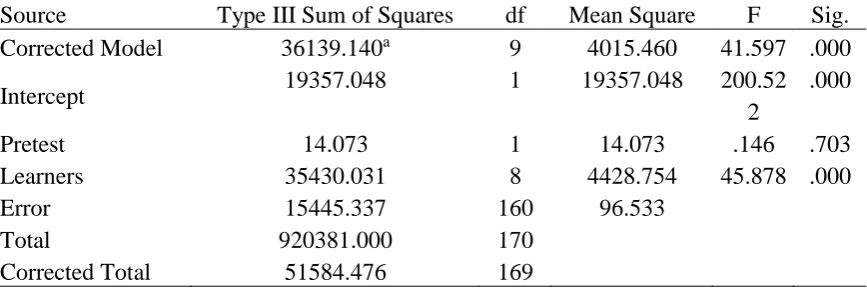
Table 2 ANCOVA of pretest and posttest mean and SD of learning performance of ICT
assisted real learning Group, ICT assisted Virtual learning Group and Traditional learning Group
Source Type III Sum of Squares df Mean Square F Sig.
Corrected Model 36139.140a 9 4015.460 41.597 .000
Intercept 19357.048 1 19357.048 200.52
2
.000
Pretest 14.073 1 14.073 .146 .703
Learners 35430.031 8 4428.754 45.878 .000
Error 15445.337 160 96.533
Total 920381.000 170
Corrected Total 51584.476 169
Available online: https://edupediapublications.org/journals/index.php/IJR/ P a g e | 1412 SPSS used in univariate analysis to find
out the ANCOVA among the pretest and
post-test scores of the participants of ICT
assisted real learning group, ICT assisted
virtual learning group & traditional
learning group. Here, post-test of three
methods were dependent variable and
pre-test was the co-variate. It was resulted that
there was a significant difference among
the three methods [i.e. f=df2, 4428.754 p
(0.000) < α (0.05)], while there was no
significance difference among the pre-test
score of three groups [f=df 1 96.533 p
(.000) > ∝ (0.05)] where the estimated R²
= .701 and adjusted p² =.684 (see table 2).
Hence, the null hypothesis was rejected
and there was statistically significant
difference among the pretest and posttest
mean of the learning performance of ICT
assisted Real learning (YouTube &
Wikipedia) Group, ICT assisted Virtual
learning (Skype & video lecture) Group
and Traditional learning Group of students.
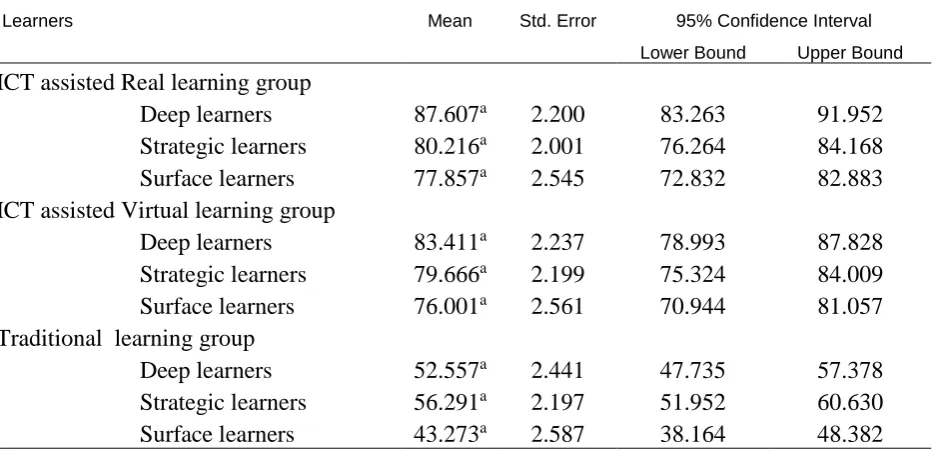
Table 3 Estimated marginal posttest mean of learning performance of ICT assisted Real learning Group, ICT assisted Virtual learning Group over Traditional learning Group
Learners Mean Std. Error 95% Confidence Interval
Lower Bound Upper Bound
ICT assisted Real learning group
Deep learners 87.607a 2.200 83.263 91.952
Strategic learners 80.216a 2.001 76.264 84.168
Surface learners 77.857a 2.545 72.832 82.883
ICT assisted Virtual learning group
Deep learners 83.411a 2.237 78.993 87.828
Strategic learners 79.666a 2.199 75.324 84.009
Surface learners 76.001a 2.561 70.944 81.057
Traditional learning group
Deep learners 52.557a 2.441 47.735 57.378
Strategic learners 56.291a 2.197 51.952 60.630
Surface learners 43.273a 2.587 38.164 48.382
a. Covariates appearing in the model are evaluated at the following values: pretest = 32.05.
Table 4 The F test among ICT assisted real and virtual learning and traditional learning approach
Sum of Squares df Mean Square F Sig.
Contrast 35430.031 8 4428.754 45.878 .000
Available online: https://edupediapublications.org/journals/index.php/IJR/ P a g e | 1413 Table 3 reveals the estimated marginal
posttest mean of learning performance ICT
assisted real learning Group, ICT assisted
virtual learning Group over Traditional
learning Group where covariates appearing
in the model are evaluated at the following
values: pretest = 32.05. The F tests among
ICT assisted real, virtual, and traditional
learning approach was made, and this test
was based on the linearly independent pair
wise comparisons among the estimated
marginal means(see table 4)
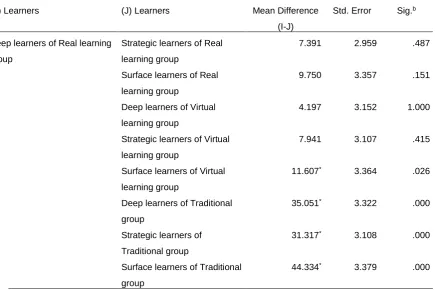
Table 5 Bonferoni multiple comparison among the post – test of learning performance ICT assisted real learning Group, ICT assisted virtual-learning Group over Traditional learning Group
(I) Learners (J) Learners Mean Difference
(I-J)
Std. Error Sig.b
Deep learners of Real learning
group
Strategic learners of Real
learning group
7.391 2.959 .487
Surface learners of Real
learning group
9.750 3.357 .151
Deep learners of Virtual
learning group
4.197 3.152 1.000
Strategic learners of Virtual
learning group
7.941 3.107 .415
Surface learners of Virtual
learning group
11.607* 3.364 .026
Deep learners of Traditional
group
35.051* 3.322 .000
Strategic learners of
Traditional group
31.317* 3.108 .000
Surface learners of Traditional
group
44.334* 3.379 .000
Table 4 interprets Bonferoni multiple
comparison among the posttest of learning
performance ICT assisted real learning
Group, ICT assisted Virtual learning
Group over Traditional learning Group.
The mean difference between deep
learners and strategic learners of real
learning group (7.391 p< 0.05), and the
mean difference between deep learners and
surface learners of real learning group
(9.750 p< 0.05) was significant. Contrast
to that, the mean difference between deep
learners of real learning, and virtual
learning group (4.197 p> 0.05) found no
significant whereas the mean difference
between deep learners of real learning and
strategic learners of virtual learning group
Available online: https://edupediapublications.org/journals/index.php/IJR/ P a g e | 1414 mean difference between deep learners of
real learning and surface learners of virtual
learning group (11.607 p< 0.05) showed
significant. Similarly, the mean difference
between deep learners of real learning and
traditional learning group (35.051 p<
0.05), the mean difference between deep
learners of real learning and strategic
traditional learning group 31.317 p < 0.05,
and the mean difference between deep
learners of real learning and surface
traditional learning group 44. 334 p < 0.05
observed significant ( see graph 1).
Graph 4.1 interprets the posttest estimated
marginal means among ICT assisted real
learning, ICT assisted virtual learning and
traditional learning approach. The X – axis
is showing the various groups to which
instructions provided and the Y- axis
interprets the estimated marginal means of
the nine groups of students. It was seen
that the real learning groups (Deep,
Strategic, and Surface) score was
maximum comparatively virtual learning
groups (Deep, Strategic and Surface) too
scored more than the traditional (Deep,
Strategic and Surface) groups.
Graph-1 Post- test estimated marginal means among ICT assisted real and virtual learning
and traditional learning approach
Findings & Discussion YouTube learning performance of
Secondary School Students showed
Available online: https://edupediapublications.org/journals/index.php/IJR/ P a g e | 1415 cognitive styles like; perceiving, feeling,
introversion and intuition has the
hierarchical significant relationship with
YouTube learning performance
(Yilmaz-Soylu, & Akkoyunlu, 2002).. However,
extroversion, sensing, thinking, judging,
has no significant relationship with
YouTube learning performance. The
finding of the study is highly supported by
Streufert, & Nogami, 1989). did not
support and found that online instruction is
not related to development of the learners.
Like YouTube learning performance,
Skype learning performance is also related
with cognitive styles. It is found that
Cognitive Styles have a hierarchical
significant relationship with students
Skype learning performance but judging,
thinking, sensing, extroversion has
surprisingly no hierarchical relationship
with Skype learning performance. This
result was supported by (Senapaty, 2004).
and it was rejected by (Sternberg & Zhang,
2001). From the present study it has been
found that YouTube learning in Indian
context still needs lots of improvement and
development as India is still lacking in the
field of technology, whereas, in the
developed nations it has been seen that the
use of technology in classroom is very
much widely followed, as for instance it is
seen that in United Kingdom it is regarded
as rising of standards in their teaching and
learning process (Susan Nolen-Hoeksema,
Martin, Joan, Girgus (1986). The use of
digital technology in classroom helps in
improving the delivery of education in a
very efficient way, it also helps to improve
the standard of education (Witkin, Moore,
Goodenough, & Cox, 1977).The variables
in the present study like thinking; judging,
sensing, and extraversion are found to be
not related with the YouTube learning
performance and Skype learning
performance, therefore in this regard the
researcher guesses that such variables as
thinking; judging, sensing, and
extraversion are very ambiguous and
therefore the researcher could not put a
clear view as why these variables are not
related with the YouTube learning and
Skype learning performance (Tabatabaei &
Mashayekhi, 2013). These needs a very
high cognitive process and may create
problem to understand the YouTube or
Skype learning performances. The
cognitive styles of Secondary School
Students differ from the elementary school
students as these may occur due to higher
mental growth, age differences etc.
Conclusion
The present scenario of YouTube learning
Available online: https://edupediapublications.org/journals/index.php/IJR/ P a g e | 1416 context has been found that it has to be
improved more as compared to the other
advanced countries of the world (Talbot,
1989). It is found that YouTube learning is
given importance only in some schools of
particular areas or states whereas other
areas are not benefited or provided such
technologies with. It has been seen in the
classroom that students cannot benefit
much in some difficult or recent topics as
there is lack of knowledge of the teachers
teaching them or sometimes the teacher is
not properly trained so in such cases the
students will be more benefitted if lectures
from abroad are arranged or given to them
directly from abroad or the specialist of
those particular areas as they can directly
make conversation with the particular
person at that particular time or even later
on to clarify their doubts they can even
record their lecture for future use
(Tempelar, Rienties and Giesbers, 2015). It
is the duty of the stakeholders to take
necessary precaution in this regard,
especially in those remote, and backward
areas where technology is far to be reached
(Wei, & Chou, 2015). As because it has
also been seen that it is also not much
expensive one as many students can learn
at a same time together from the same
place, and the equipments required are also
not so costly.
Educational implications
It has been seen that for making YouTube
learning successful in the classroom the
teachers should be well trained and should
have the necessary knowledge to run the
equipments and about the benefits of using
such techniques in the classroom. It will
also help in the professional development
of the teacher and most importantly on the
issues of technology in relation to the
context of innovative pedagogy. They
should accept the fact that students learn
more easily when they are seeing it
practically rather than just sitting and
listening to the teacher ideally. It is also
the duty of the teacher to make the
students skilful in operating the devices
properly so that they themselves can see
and learn the study materials whenever the
need is felt by them. In the way both the
teacher and student will be benefited as
this will help them to grow their content
knowledge, and have a better and clearer
view about all the topics to be learnt or
discussed. The study is delimited to only
secondary school students further research
can be undertaken among elementary
level, degree and university level students.
It can also be studied upon the physically
disabled children. Again here the study is
undertaken using YouTube and Skype
Available online: https://edupediapublications.org/journals/index.php/IJR/ P a g e | 1417 emo, etc should be chosen for further
investigation.
References
[1] Almekhlafi, A.G. (2006). The
Effect of Computer Assisted Language
Learning (CALL) on United Arab
Emirates English as a Foreign Language (EFL) School Students’ Achievement and Attitude. Journal of Interactive Learning
Research, Association for the
Advancement of Computing in Education
(AACE), 17(2), 121-142.
[2] Al-Salameh, E.M.(2011). A Study
of Al-Balqa’ Applied University Students
Cognitive Style, International Education
Studies, 4( 3) 189-193.
[3] Altun, A., & Cakan, M. (2006).
Undergraduate Students’ Academic
Achievement, Field
Dependent/Independent Cognitive Styles
and Attitude toward Computers.
Educational Technology & Society, 9 (1), 289-297.
[4] Cevik, D.Y; Haslaman ,T; Celik S;
(2015). The effect of peer assessment on
problem solving skills of prospective
teachers supported by online learning
activities Studies in Educational
Evaluation, 44, 23-35.
[5] Chen, C. L. D., Chang, Y. H.,
Chien, Y. T., Tijus, C., and Chang, C.
Y (2015). Incorporating a smart
classroom 2.0 Speech-Driven PowerPoint
System (SDPPT) into university teaching,
Available online: https://edupediapublications.org/journals/index.php/IJR/ P a g e | 1418
[6] Dascalu,M., Trăuşan-Matu,S.
(2015). Visualization of polyphonic
voices inter-animation in CSCL chats
Ştefan Trăuşan-Matu1,2,3, Mihai
DascaluRevista Romana de Interactiune
Om-Calculator 8 (4) 2015, 303-320.
[7] Deka,M. & Jena,A.K.(2015).
Achievement test on geography,
Assam University, Silchar.
[8] Fu,J.S.(2013). ICT in Education: A
Critical Literature Review and Its
Implications. International Journal of
Education and Development using
Information and Communication
Technology (IJEDICT), 9(1)112-125.
[9] Gurol,T.S.A., Kayisli,K., Basal,A.
(2010). Hidden programme and
application development in web-based
education, Procedia - Social and
Behavioral Sciences 2 (2),5114–5119.
[10] Hayes, J., & Allinson, C. W.
(1994). Cognitive style and its relevance
for management practice. British Journal
of Management, 5, 53–71.
[11] Hayes, J., Allinson, C. W., Hudson,
R. S., & Keasey, K. (2003). Further
reflections on the nature of
intuition-analysis and the construct validity of the
Cognitive Style Index: Comment. Journal
of Occupational and Organizational
Psychology, 76, 269 –278.
[12] Jena, A.K (2015a). Animation
model to conceptualize ATP generation: a
mitochondrial oxidative phosphorylation,
European Journal of Science and
Mathematics Education. 3(3),61-76.
[13] Jena,A.K. (2015b). Effects of web
reading, online animation models, online
flash models, and online youtube learning
in digestive system,The Online Journal of
Distance Education and e-Learning, 3, 4
28-43.
[14] Johannesen, M (2013). The role of
virtual learning environments in a
primary school context: An analysis of
inscription of assessment practices,
British Journal of Educational
Technology 44(2), 302–313.
[15] Koc, M.(2005). Implications of
learning theories for effective technology
integration and preservice teacher
training: A critical literature review,
Journal of Turkish Science Education, 2,2-18.
[16] Messick, S. (1976). Personality
consistencies in cognition and creativity.
In S. Messick (Ed.), Individuality in
learning (pp. 4 –23). San Francisco:
Jossey-Bass.
[17] Nam,C.W.(2014).The.effects of
trust and constructive controversy on
student achievement and attitude
in online cooperative learning
environments. Computers in Human
Available online: https://edupediapublications.org/journals/index.php/IJR/ P a g e | 1419
[18] Neeru,S. (2015). Scientific
Creativity in relation to Cognitive Style
and Achievement in Science of
Secondary School Students, An
International Journal of Education and
Applied Social Sciences,6(1) 25-29.
[19] Palak, D., & Walls, T. R.(2009).
Teachers‟ beliefs and technology
practices: A Mixed-methods approach.
Journal of Research on Technology in
Education, 41(4), 417-441.
[20] Rahmani,J. (2012). Learning Styles
and Academic Achievement: a Case
Study of Iranian High School Girl's
Students Procedia - Social and Behavioral
Sciences,51, 1030 – 1034.
[21] Rao,B. V. (2014). A Study of
Academic Achievement in Mathematics
in Relation to Cognitive Styles and
Attitude Towards Mathematics, Global Journal for Research Analysis,3(1) 7-8.
[22] Sadler-Smith, E., & Badger, B.
(1998). Cognitive style, learning and
innovation. Technology Analysis &
Strategic Management, 10, 247–265.
[23] Sang, G., Valcke, M., Braak, J. and
Tondeur, J., (2010). Student teachers’ thinking processes and ICT integration:
Predictors of prospective teaching
behaviors with educational technology,
Computer and Education, 54, 103-112.
[24] Senapaty, H.K.(2004). Integrating
Digital Technology into Constructivist
Learning Environment. Paper presented
in the International Conference held at
Saurastra University, Rajkot, Gujarat,
India, 5(1) 465- 474.
[25] Sternberg, R. J., & Zhang, L. F.
(2001). Thinking styles across cultures:
Their relationships with student learning.
In R. J. Sternberg & L. F. Zhang (Eds.),
Perspectives on thinking, learning and
cognitive styles (pp. 227–247). Mahwah,
NJ: Erlbaum.
[26] Streufert, S., & Nogami, G. Y.
(1989). Cognitive style and complexity:
Implications for I/O psychology. In C. L.
Cooper & I. Robertson (Eds.),
International review of industrial and
organizational psychology (pp. 93–143).
Oxford, United Kingdom: Wiley.
[27] Susan Nolen-Hoeksema, Martin E.
P, Joan S. Girgus (1986). Learned
helplessness in children: A longitudinal
study of depression, achievement, and
explanatory style. Journal of Personality and Social Psychology 51(2)435-442.
[28] Tabatabaei, O., & Mashayekhi, S.
(2013). The Relationship between EFL Learners’ Learning Styles and their L2
Achievement. Procedia-Social and
Behavioral Sciences, 70, 245-253.
[29] Talbot, R. P. (1989). Valuing
differences in thinking styles to improve
individual and team performance.
Available online: https://edupediapublications.org/journals/index.php/IJR/ P a g e | 1420
[30] Tempelaar, D. T.; Rienties, B. and
Giesbers, B. (2015). Stability and
sensitivity of Learning Analytics based
prediction models. In: Proceedings of 7th
International conference on Computer
Supported Education (Helfert, Markus ;
Restivo, Maria Teresa; Zvacek, Susan and
Uho, James eds.), 23-25 May 2015,
Lisbon, Portugal, CSEDU, pp. 156–166.
[31] Tulbure,C. (2012). Learning styles,
teaching strategies and academic
achievement in higher education: A
cross-sectional investigation, Procedia - Social
and Behavioral Sciences, 33, 398- 402.
[32] Wei, H.W.,& Chou, C.(2015). Can
more interactivity improve learning
achievement in an online course? Effects
of college students' perception and actual
use of a course-management system on
their learning achievement. Computers &
Education, 83, 10-21
[33] Witkin, H. A., Moore, C. A.,
Goodenough, D. R., & Cox, P. W. (1977).
Field dependent and field independent
cognitive styles and their educational
implications. Review of Educational
Research, 47, 1– 64.
[34] Yilmaz-Soylu, M. & Akkoyunlu,
B. (2002). The effect of learning styles on
achievement in different learning
environments. The Turkish Online
Journal of Educational Technology; 8(4)
43-50.
[35] Zhan, Z ; & Mei Hu (2013).
Academic self-concept and social
presence in face-to-face
and online learning: Perceptions and
effects on students' learning
achievement and satisfaction across
environments. Computers &