The Process of Fixed Asset Management
Of
INTERNSHIP REPORT ON
The Process of Fixed Asset Management of Brac Bank Ltd
Guided by
Mr. Tareq Mahbub
Mr. Abdullah Al Mamun (Mlion)
Assistant Professor Assistant Manager (FAM)
BRAC Business School Brac Bank Lltd.
By
Md. Ashfaqur Alam
ID-08104101
BRAC Business School
Brac University
Date of Submission:
Letter of Transmittal June, 2013
Mr. Tareq Mahbub Assistant Professor BRAC Business School, BRAC University.
Subject: Submission of internship report
Dear Sir,
I would like to take this opportunity to thank you for the guidance and support you have provided me during the course of this report. Without your help, this report would have been impossible to complete. With deep gratitude, I also acknowledge the help provided by Mr. Mr. Abdullah Al Mamun, Assistant Manager, Brac Bank Limited, for providing me utmost supervision during my internship in the organization.
To prepare the report I collected what I believe to be most relevant information to make my report as analytical and reliable as possible. I have concentrated my best effort to achieve the objectives of the report and hope that my endeavor will serve the purpose. The practical knowledge and experience gathered during my report preparation will immeasurably help in my future professional life.
I would really be grateful if you enlighten me with your thoughts and views regarding the report. Also, if you wish to enquire about an aspect of my report, I would gladly answer your queries. Thank you again for your support and patience.
Yours Sincerely, Md. Ashfaqur Alam ID-08104101
Acknowledgement
I would like to express my profound gratitude to all those who have been instrumental in the preparation of this internship report. I wish to place on records, my deep gratitude for the support, direction, and supervision in every aspect from, BBL officials, my faculty, and friends.
I would like to express my deep sense of thankfulness to my organizational supervisors Mrs. Pushpita Bardhan for providing me with immense support and enormous courage throughout my Internship program and helping me to accumulate necessary information. I would also like to show my gratitude to Mr. Abdullah Al Mamun (Mlion) and Mr. Mohammad Al Mamun, from “Asset Management” for their enormous help and endless support throughout the training period. To get accustomed with the nature of a very dissimilar industry was quite a challenge for me; without his guidance, it would not have been possible for me to continue and then end up with a successful internship.
I would also like to show my utmost gratitude to all the officials of BBL limited; especially the teams that I have worked in and all the others teams in the Marketing function. I would like to mention the name of Mr. Rakib Hasan (Junior officer, FAM) for facilitating me with all the internal information that helped me to prepare the company overview and industry analysis; the information that I as an intern had no access to. I cannot but mention Mr. Amin Haque (Senior Officer, FAM) with utter thankfulness for providing me with the previous internal research reports that helped me to design my own study and then analyzing it.
Finally and most importantly, I would like to concede the guidance of Mr. Tareq Mahbub
Assistant Professor, BRAC Business School for his expert advice and help in preparing this report.
Executive Summary
BRAC Bank Limited is one of the largest operational ventures of BRAC which was established by Sir Fazle Hasan Abed and the chairman of the bank is Mr. Muhammad A. (Rumee). After facing so many obstacles and legal obligations BBL started its operation from July 04, 2001. It has been established with an aim to alleviate poverty and empowering poor and bringing changes in their lives. The bank also continuously works to uphold the “Three P” agenda that includes Planet, People and Profit as a part of its sustainable and glorious banking journey. With the passage of time BRAC Bank Limited has become the fastest growing bank in Bangladesh. And now it has become the market leader in the Small Medium Enterprises (SME) business. Here BBL has targeted the missing middle the middle or small business people. BBL by starting its journey in 2001 now it has152 branches, 12 Apon Shomoy, 313+ ATMs, 30 CDMs, 399 SME unit offices , 11 CRM center and almost 8000employees. Along with SME banking it is continuously broadening its horizon into Retail banking, corporate banking, Probashi banking and other arenas of banking. Its main focus is to set a standard as the absolute market leader by bringing efficiency, friendliness and modernized automated service on a profitable basis so that, BBL is providing 100% integrated on-line banking. BBL is one of the members of the Global Alliance for Banking on Values (GABV).
Among with 20 different departments there is one department named fixes asset management department and that particular department has taken the responsibility of every single fixed asset of every particular location of BRAC Bank Limited. Fixed asset management department is responsible for buying, replacing, maintain, repairing the old one, keeping record of every particular asset, asset validity checking, and finally send the asset in auction when the validity is over of any particular asset. To do this asset management department use some software, and put tag number to every single asset. They recruit some interns for this purpose. They send those interns in different locations for the collecting details information about every single asset. And after that they input those in different software for the purpose of identifying the validity, condition, and most importantly preparing tag for every single asset. This is how
the Fixed Asset Management Department is maintaining the balance of fixed asset and helps to prepare an error free financial statement by providing more accurate free information.
Table of content
Title
Page No.
Chapter 01
1.1
Introduction
01
1.1.1 Origin of the report: 01
1.1.2 Objectives 02
1.1.3 Methodology 03
1.1.4 Scope of the report 03
1.1.5 Limitation of the Report 04
1.2
COMPANY OVERVIEW
04
1.2.1 Historical Background of the Company
04
1.2.2 Values- CRYSTAL
05
1.2.3 Shareholding structure and company chronicle
06
1.2.4 Board of Directors
10
1.2.5 Vision, Mission, Goal
10
1.2.7 LOGO Meaning
12
1.2.8 CORPORATE RESPONSIBILITY
13
1.2.9 BRAC BANK SUBSIDIARIES
14
1.2.10 ORGANIZATIONAL STRUCTURE
16
1.2.11 DIVISION OF BRAC BANK
17
1.3
SWOT ANALYSIS
18
Chapter 02
2.1
Nature of the Job
22
2.2
Specific Responsibilities of the Job
24
2.3
Benefits associated with the management of
fixed asset in BRAC Bank Limited
32
2.4
Process of Fixed Asset Management in BRAC
Bank Limited
35
2.5
Auction policy
37
2.5.1 Types of Auction 38
2.5.2 Approval for Auction 38
2.5.3 Responsibilities of Auction Committee 39
Chapter 03
3.1
Findings
443.2
Recommendations
46Chapter 01:
1.1 Introduction
1.1.1 Origin of the report:
This report is a requirement of the internship program for the completion of my BBA Program. The topic of the report has been designated by the on- field supervisor, Md. Al-Mamun and has been approved by my institutional supervisor, Mr. Tareq Mahbub. I have tried to the best of my effort to make it an excellent report. I have served this organization (Brac Bank Ltd.) as an intern under the Fixed Asset Management Department for three months (twelve weeks).this report includes all the detailed description of my job description over there and that gives the total view of my internship project in a whole.
At the time of my internship, I got the opportunity the visit all the Brac Bank branches all over the country. But, due to limitation of human resource and time, eventually it was not possible to physically visit all of the branches in Bangladesh. But, I have visited all the branches in Dhaka city and also the branches nearby Dhaka. Though not all of them, but I got the chance to visit many of the bank branches across the country such as Tangail, Norshingdi, Narayanganj, Bogra, Kishoreganj, Gazipur, Rajshahi, Natore, Chapainababganj, Nowga, Jaipurhat, Sirajganj, Kusthia, Comilla, Brahmanbaria etc.
Primarily, I was assigned with the task of Fixed Asset Verification. For this, at first we had to choose a Branch and we collect all the information of Fixed Asset of that particular branch and then we put these information into a software named “IFS” (International Financial Service) in order to prepare non-identical or completely distinguishing tags or barcodes in other words for each and every particular fixed asset and finally affixing these barcode in different fixed assets. The main purpose of asset tagging is to identify the assets and match with the resister book so that BBL can identify the actual financial picture of profit and loss account as well as in the balance sheet.
In this manner, I, along with the team members have visited total 30 branches of BBL and accomplished the fixed asset tagging of those branches.
1.1.2 Objectives
The objective of this report can be divided into two parts. One is the general or broad objective and the other is the specific or narrowed down objectives.
General objective
The general objective of the report is to identify how fixed asset management department of BBL is managing their fixed assets.
Specific objectives
The Specific objectives are as follows:
Getting introduced to the fixed asset of an organization
Understanding the importance of fixed for a business
Ensuring the assets visibility by visiting the location physically and verifying the fixed assets.
Helping to identify the accurate calculated value of the fixed assets.
Cross-checking the already enrolled assets to the actually available assets in the visited places.
Revising the re-allocation of the assets.
Helping the branches to keep track with the available fixed assets in those particular branches.
Helping the bank to prepare the accurate financial statement of a particular branch as well as the company in a whole.
1.1.3 Methodology
For preparing the report, data and information have been collected from both the primary and secondary sources.
o Observation during the total internship period and Involvement with the operational process of fixed asset management.
o Discussion with officials of BRAC Bank Limited (BBL). Secondary Sources of Data:
o Relevant BRAC Bank Limited (BBL) papers and published documents
o Directory of operating instructions (DOI)
o “Annual Report 2011 and 2012” of BRAC Bank Limited (BBL)
o Official website of Brac Bank Ltd.
1.1.4 - Scope of the report
In this report, the overall fixed asset management process of fixed asset management department belonging from finance department of BRAC Bank Limited will be described and discussed. As I was personally involved with the task and I have visited different branches of different areas of BBL, I have clear idea about how they identify their fixed assets, categories of fixed assets, how they collect asset data, their ways of input data in software’s for creating tag for different assets and finally what did they do valuation of different assets.
1.1.5 - Limitation of the Report
At the time of preparing this report, I had to face some difficulties or some restrictions. All these problems, difficulties, or restrictions will be discussed as the limitation of the report preparation. The limitations of my studies are being described below:
Confidentiality in terms of discloser of the internal financial information.
Some critical information was there which were not easily understandable.
1.2 COMPANY OVERVIEW
This chapter emphasizes on the historical background of the company under study, overview of the company, their product and services, customer base and market condition of BRAC Bank Ltd.
1.2.1 Historical Background of the Company
BRAC started as a development organization dedicated to alleviating poverty by empowering the poor to bring about change in their own lives. In Bangladesh It was founded in 1972 and over the course of evolution, it has established itself as the pioneer in recognizing and tackling many different realities of poverty of which BRAC BANK is one of the largest operational commercial ventures with a vision:
“Building a profitable and socially responsible financial institution focused on Markets and Business with growth potential, thereby assisting BRAC and stakeholders build a "just, enlightened, healthy, democratic and poverty free Bangladesh”.
BRAC Bank Limited is a scheduled commercial bank in Bangladesh. It was established in Bangladesh under the Banking Companies Act, 1991 and incorporated as private limited company on 20 May 1999 under the Companies Act, 1994. BRAC Bank was established with a view to be a unique organization in Bangladesh. The primary objective of the Bank is to provide all kinds of banking facilities. At the very beginning, the Bank faced some legal obligations. The High Court of Bangladesh suspended the activities of the Bank and at that point, it could even fail to start its operations till 03 June 2001. Eventually, the judgment of the High Court was set aside and dismissed by the Appellate Division.
BRAC Bank is one of the fastest growing banks of the country, with 152 branches, 12 Apon Shomoy, 313+ ATMs, 30 CDMs, 399 SME Unit Offices and 7,695 (as on 15th July 2012) employees working for the organization. BRAC Bank’s operation now cuts across all segments and services in financial industry. With more than 1 Million Customers, the bank has already proved to be the largest SME financier in just 11 years of its operation in Bangladesh and
continues to broaden its horizon into Retail, Corporate, SME, Probashi and other arenas of banking. In the year 2010, BRAC Bank has been recognized as Asia’s most Sustainable Bank in Emerging Markets by the Financial Times and IFC.
Recently BRAC Bank has achieved the International award for “Excellence in Retail Financial Services”.
1.2.2 Values
-
CRYSTAL
C
stands for being Creative, Be a person of innovative ideas in solving issues, thinking different ideas to reach one destination; do new associations between existing ideas or concepts for the organization’s overall growth.R
stands for being Reliable, Be worthy of reliance or trust at work so everyone could depend on you.Y
stands for remaining Youthful, Be a person of freshness and vibrant characteristic at work. Feel young at HEART and project enthusiasm during performing duties.S stands for being Strong; Be a person of willing to move forward and apply conscious choice, willpower, discipline and passion at work.
T
stands for being Transparent, Be transparent at work at all level both internally and externally. Show openness and honesty through communication to bring transparency.A
stands for being Accountable, Be accountable for own actions and take responsibilities for the outcome of the actions; be responsible and answerable towards customers, organization, regulatory bodies, as well as the society.L
stands for being Loyal, Be loyal to the organization by being compliant at work, taking ownership and create belongingness which will carry your brand as your pride.1.2.3 Shareholding structure and company chronicle:
Being a fully operational Commercial Bank, BBL focuses on pursuing unexplored market niches in the Small and Medium Enterprise Business, which hitherto has remained largely untapped within the country The following tables give the “Company Chronicle” and “Shareholding Structure” of BRAC Bank Limited.
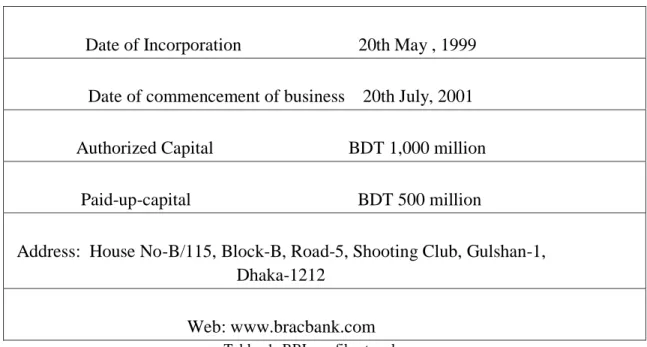
Date of Incorporation 20th May , 1999 Date of commencement of business 20th July, 2001 Authorized Capital BDT 1,000 million
Paid-up-capital BDT 500 million
Address: House No-B/115, Block-B, Road-5, Shooting Club, Gulshan-1, Dhaka-1212
Web: www.bracbank.com
Table -1: BBL profile at a glance
BRAC Bank, being the youngest bank took a step to break away from usual tradition and tapped into the true community entrepreneurial initiatives. The bank established its first SME Unit Office at 1st January 2002 and from then the bank has disbursed over BDT 14,500 Crores in loans to more than 320,000 small and medium entrepreneurs. The management of the Bank believes that this sector of the economy can contribute the most to the rapid generation of employment in Bangladesh. Since inception in July 2001, the Bank's footprint has grown to 100 branches, 60 SME service centers, 3 SME / Krishi branches, 424 SME unit offices and more than 300 ATM sites across the country. The corporate chronicle and information are described as follows:
Corporate Chronicle and information:
Registered office at 1, Gulshan Avenue, Gulshan- 1 in Dhaka-1212 Company registration number: C – 37782(2082) of 1999
Inauguration of Banking Operations at 4th July in 2001 First SME unit office at 1st January in 2002
Signing with IFC as investor at 8th May in 2004 First ATM Installed at 3rd April in2005
Commencement of Share Trading in DSE & CSE at 31st January in2007 Launching Credit Card at 6th February in 2007
Introduced Probashi Banking at 14th April in 2007 Launched Off-shore Banking at 21st June in2010
Co- branded ATM Booth Launching with Rupali Bank Limited at 25th September in 2010 Launching of Planet Card at 23rd October 2010
2500 remittance deliver point
E-commerce Launching for Online Shopping Facilities at 8th December 2010 Table -2: Company Chronicle
BRAC Bank Ltd. signed an assistance contract with Infosys and 3i InfoTech for changing bank’s IT platform at 1st august 2006 and from then BRAC Bank running countrywide true online banking system. The system allows their customers to do transaction all over the country and be the strongest IT support commercial bank in Bangladesh. The bank cheques are all marked with Barcodes that makes each cheque unique and disallows it to be duplicated. All the signature and customer information with their pictures can be verified from any console at any branches of the bank. BRAC Bank has its own data center in Gulshan-1 from where all the networking and data storing activities were done by the professional IT team members. The bank also has its own digester recovery center in Mirpur -11. If all the server of the data center will remain down then all the banking system is recovered by the backup power of the digester recovery center. The most important thing is that the bank is updating its online banking operations by using the modern update IT instruments as well as technology. The bank introduced “24x7 Phone Banking” operations at 9th September 2006.
SHARE HOLDING STRUCTURE:
Name of Shareholder % of Shareholding
BRAC 38.79%
International Finance Corporation 5.38%
ShoreCap International Limited 6.99%
Non-Resident Bangladesh 0.45%
Mutual Funds 4.07%
1.2.4 Board of Directors:
The Board of Directors of BRAC Bank Limited includes: Mr. Muhammad A (Rumee) Ali
(Nominated By BRAC) Chairman
Mr. Shib Narayan Kairy Director
Mr. Quazi Md.Shariful Ala
(Nominated By BRAC) Director
Ms. Nihad Kabir Independent & Depositor Director
Dr. Hafiz G.A. Siddiqi Depositor Director
Ms. Tamara Hasan Abed Director
Mr. Syed Mahbubur Rahman Managing Director and CEO
1.2.5 Vision, Mission, Goal
Corporate Vision
“Building profitable and socially responsible financial institution focused on Market and Business with Growth potential, thereby assisting BRAC and stakeholders to build a just, enlightened, healthy democratic and poverty free Bangladesh”.
Corporate Mission:
Sustained growth in Small & Medium Enterprise sector
Continuous low-cost deposit Growth with controlled growth in retail assets
Corporate Assets to be funded through self-liability mobilization. Growth in Assets through syndications and investment in faster growing sectors.
Continuous endeavor to increase non-funded income
Achieve efficient synergies between the bank’s branches, SME unit offices and BRAC field offices for delivery of remittance and Bank’s other products and services.Objectives
The objective of BRAC Bank Limited is specific and targeted to its vision and to position itself in the mindset of the people as a bank with difference. The objectives of BRAC Bank Limited are as follows:
To establish, maintain, carry on, transact and undertake all kinds of investment and financial business including underwriting, managing and distributing the issue of stocks, debentures, and other securities
To finance the industry, trade and commerce in both the conventional way and by offering customer friendly credit service.
To work as a team to serve the best interest of our owners.
Building a strong customer focus and relationship based on integrity, superior service.
To creating an honest, open and enabling environment.
To value and respect people and make decisions based on merit.
To strive for profit & sound growth.
To value the fact that they are a member of the BRAC family – committed to the creation of employment opportunities across Bangladesh.
To relentless in pursuit of business innovation and improvement.
To base recognition and reward on performance.
To finance the international trade both in import and export.
To develop the standard of living of the limited income group by providing Consumer Credit.
1.2.6 Goals:
BRAC Bank will be the absolute market leader in the number of loans given to small and medium sized enterprises throughout Bangladesh. It will be a world - class organization in terms
of service quality and establishing relationships that help its customers to develop and grow successfully. It will be the Bank of choice both for its employees and its customers, the model bank in this part of the world.
1.2.7 LOGO Meaning
The logo of BRAC Bank has been prepared keeping in mind the goal of the organization. The square structure of the logo means solid and strong.
The Golden Color in the lower portion of the logo means the Golden Bangladesh & her fertile land. The Blue color in the upper portion means the sky with enormous & unlimited opportunity. The white colored curve means Growth and Progress. White circles in the blue color mean the flashing sun that gives light to everywhere.
1.2.8 CORPORATE RESPONSIBILITY
Since the inception, as a responsible corporate body BRAC Bank Ltd. has undertaken various initiatives considering the interest of customers, employees, shareholders, communities and environment. These initiatives go beyond the statutory obligation/mandatory compliances to voluntary activities that promote sustainable development.
A significant portion of earning of the bank is routed through the ownership structure of the Bank for building just enlightened poverty free Bangladesh – is the vision that the founder Chairman and Chairperson of BRAC, Sir Fazle Hasan Abed dearly and closely follows through. BRAC Bank’s vision is linked with social responsibility which focuses on the ‘triple bottom line’: People, Planet and Profit. Being guided by this vision, BRAC Bank provides continuous support to the environment and communities that it operates in.
BRAC Bank CSR Initiatives in 2012:
Amor Ekushey Grontho Mela
Bangla version of BRAC Bank Website
Patriotic poem cd
Computer Donation: Bagmara High School, Nawabgonj; Sallah Samabaya High
School, Kalihati, Tangail
Employment of Acid Victims
Lifetime support to Bir Protik Taramon Bibi
Scholarship for Adomyo Medhabi with Prothom Alo
Scholarship for poor students of BRAC University
Scholarship for Afghan Student
Scholarship for the children of poor Journalists in Patuakhali region
Supported Libya returnees in association with BRAC
Donated to IRRI for their research activities
Computer donation to Presidency University
Daur 2012
1.2.9 BRAC BANK SUBSIDIARIES
bKash is designed to provide financial services via mobile phones to both the unbanked and the banked people of Bangladesh. The overall bKash value proposition is simple: a safe, convenient place to store money; a safe, easy way to make payments and money transfers. The bKash mobile wallet, a VISA technology platform which is fully encrypted to ensure most secure transactions, will be the customer account where money can be deposited and out of which money can be withdrawn or used for various services. It has a special focus to serve the low income people of the country and promote sustainable micro-savings by providing financial services that are convenient, affordable and reliable. In Bangladesh, where 15% of people are not connected to formal financial system, providing financial services using this mean can make the service more accessible and cost effective for the vast population of Bangladesh.
BRAC Equity Partners Ltd (EPL) is a brokerage house and a merchant bank, with 51% of its stake owned by BRAC Bank. BRAC EPL formally commenced operation under a new management team on October 1, 2009. The predecessor of the company, known as Equity Partners Limited (EPL) and its affiliate Equity Partners Securities Ltd (ESPL), was formed in early 2000 as a merchant bank and brokerage company subsequently. Since the acquisition by BRAC Bank, BRAC EPL is providing the stock brokerage and investment services as BRAC EPL Stock Brokerage Ltd & BRAC EPL Investments Ltd. Products and services provided by BRAC EPL Stock Brokerage Ltd. are:
Open Beneficiary Accounts (BO) for individuals
Provide margin lending
Trade for institutional investors, both domestic and international
Provide stop-gap liquidity support, especially to foreign institutional investors
Assist to create and follow an investment strategy
BRAC Saajan Exchange Limited, an Exchange Company incorporated in England and Wales, is a subsidiary of BRAC Bank Limited, Bangladesh. The Company has been formed through acquisition of the former Saajan Worldwide Money Transfer Limited, United Kingdom. BRAC Bank owns 87.485% share in BRAC Saajan Exchange.
The main purpose of introducing BRAC Saajan Exchange is to have a footprint in UK and elsewhere in Europe to cater to the needs of Non-Resident Bangladeshis (NRBs) community which has a population of over one million. Non-resident Bangladeshis (NRBs) in UK now has a secured, fast, online transfer option available for sending remittance to their loved ones in Bangladesh from UK.
1.2.10 ORGANIZATIONAL STRUCTURE
Organ gram of BRAC Bank Limited:
Source: Collected from BRAC Bank computer
Board of Directors
Managing Director & CEO Support Manager
Board Audit Committee
Deputy Managing Director & Chief Operations Officer
Head of Retail Banking Head of SME Banking Head of Corporate Banking Head of Probashi Banking
Head of Treasury & Financial Institutions Head of Marketing & Corporate Affairs Head of Enterprise Risk Management Head of Credit Head of Human Resources Head of Financial Administration
Company Secretary & Head of Regulatory &
Internal Control Head of Impaired Assets Management Manager, Complaint Handling Call Credit Inspector
1.2.11 DIVISION OF BRAC BANK
If the jobs are not organized considering their inter relationship and are not allocated in a particular division it would be very difficult to control the system effectively. If the division is not fitted for the particular works, there would be haphazard situation and the performance of a particular department would not be measured. BRAC Bank Limited does these works very well.
Division of BRAC BANK LTD:
BRAC Bank Limited consists of five major business divisions namely:
1.3 SWOT ANALYSIS
A SWOT analysis is “a technique for matching organizational strengths and weaknesses with environmental opportunities and threats to determine the organization’s right niche”. SWOT analysis is an important tool for evaluating the company’s Strengths, Weaknesses, Opportunities, and Threats. It helps the organization to identify how to evaluate its performance and scan the macro environment, which in turn would help the organization to navigate in the turbulent ocean of competition. With this tool, we will be able to determine, though not perfectly, since we are not internal members of this organization, the internal strengths and weaknesses of BBL as well as the opportunities and challenges that the changing external environment provides.
Strength:
o BRAC Bank has a strong financial back-up in the industry. Ample sources of finance which means it is in a better position to serve the market with its products & also it has the financial resources to grow its business even higher.
o BRAC is the parent organization of BRAC Bank Limited that is already established as a reputed brand name in its own industry. It ultimately helps BRAC Bank to get well familiar in the country within a short period of time.
o BRAC Bank is more emphasized on the SME sector of Bangladesh. Before BRAC Bank there was no private commercial bank which has focused on this sector.
o BRAC Bank Limited is providing diversified product and services to the market.
o It has a huge manpower and network all over the Bangladesh that helps BRAC Bank to
knock at the door of some customers which were out of banking touch.
o BRAC Bank has a strong technology system behind its all functions and activities.
Weakness:
o One of the major weaknesses that I have found during my internship period was their
huge manpower, but comparatively weak monitoring system. It is seen that BBL takes many initiatives but they cannot implement all their steps in a proper way because of its weak monitoring system.
o Higher interest than some other commercial private banks in Bangladesh is another weak point of BRAC Bank Ltd.
o Majority of its asset portion has come from its SME division. They have disbursed more than 50% of their total loans in SME sector; that is why they have higher default rate. o Remuneration package offered by BBL for its employee is lower than other private
banks. So many employees don’t get motivated while working on BBL. Ultimately it causes higher employee turnover.
o Branch size of is another strong weak point of BBL. It has a huge number of customer
base so most of the time its branches get jam packed at pick hour.
Opportunity:
o BBL can offer more services to its debit and credit card.
o As BBL shifted its focusing field from product centric to customer centric it may allow them to explore some new group of customers.
o BBL can start taking some deposit to its SME customers as they have a huge customer
from its SME service.
o Large market share in SME sector Bangladesh has given BBL immense opportunity build
strong relationship with its customers. Most of the times customer does take repeat their loans that are taken under SME division.
o Average ages of BBL employees are less than 30. So BBL can bring more outputs in terms of uniqueness and dynamics from these young bloods more than other private commercial banks.
o High competition with foreign banks is a treat for BBL. Majority people like to hold the credit card of SCB and HSBC in our country.
o Some new banks are coming in the market. These new banks can take customers from
BBL. Customer will have more choices regarding selection of his\her desired banks.
o Majority of private commercial banks are now focusing on the SME sector. So they are
hiring employee from BBL also. As a result SME division of BBL has a higher employee turnover rate.
o Political volatility is another threat for BBL.
o Sometimes Bangladesh Bank imposes some strict rules and regulation to the private banks. These rules may become obstacles for the new innovative banking ideas and facilities that BBL could offer to its customers.
Chapter 02:
2.1 Nature of the Job
The brief of the internship duties has already been discussed. Here, in this section, the nature of job will be elaborated.
BRAC Bank Limited (BBL), the leading private commercial bank has been organizing different projects on a regular basis and the project named “Fixed Asset Management” is one of them. Being one of the sub units of finance division Asset Management Team of BBL has proposed a project in the name of “Fixed Asset Management” to the management committee and after getting the approval as well as the budgetary cost allocation for the project they went for recruiting new people, both fresh bloods and experienced people for the Project. Mostly Interns have been recruited for this particular project. Being a private commercial bank, BRAC
Bank Limited started to tag its fixed assets since year 2008 so that it can identify all the fixed assets into location wise category. At that time, the BBL maintained a manual asset registered book to reconcile the assets, which was very much complicated and had possibilities to do errors. During that time, the bank used piece of papers on which they used to write down the code names as well as the number of the fixed asset and affixing it on the assets. As a result, there were possibilities to affix same code on many assets, as the code generation technique was manual.
Later in the year 2010, the bank introduced Enterprise Resource Planning (ERP) software and started to use a particular application of the software named IFS (International Financial Service) and by using that Application the Bank maintains an asset register book to reconcile the assets in an effective and efficient way. For identifying the locations without difficulties BRAC Bank Limited uses different SOL Number for each and individual location, such as the bank uses SOL No.“0000”for the Head Office. Now anyone can easily identify how many fixed assets are visible in a particular Branch, AB (Alternative Banking) Center, ATM (Automatic Teller Machine) Booth, Apon Shomoy, ROC (Regional Operation Center) and CRM (Credit Risk Management) by putting the SOL in the IFS. One can also easily know the purchase date as well as the value of any particular asset by tracing the barcode number of that asset. Earlier the barcode that are affixed to the fixed asset is purchased from the third party but now BBL has its own barcode printer to print the barcode.
There were a total of four teams each consisting of two members assigned for this job in that period. Each of the teams was assigned with particular locations to accomplish the task. I along with my team member have visited a total of 30 locations throughout the country, mostly in Dhaka city and completed the task of cross-checking the fixed asset actually present in the locations with the list in the system. We also have affixed barcode stickers to the assets that were not mentioned in the database and updated the central database accordingly.
Fixed asset tagging process of BRAC Bank Limited is described in the followings:
Collect Asset List Using IFS & Compile it
Print the Fixed Asset Code Using IFS
Visit Particular Location & Tagged each individual Asset
Collect Untagged List of Asset Information
Split/ Move Asset in IFS & prepare Tag for this asset
Provide the Tag in Concern Location through Courier Service
Principally, the job all the interns of Fixed Asset management Team have to do is affixing the barcode tags on the fixed asset after matching the fixed asset with the asset list and collect the serial numbers as well as the model of the IT equipments such as Monitor, CPU, Laptop, AC, Money counting machine, UPS, Printer, Scanner, Fax machine, ATM machine, Online UPS, Generator etc. BRAC Bank Limited provides a unique pin number to each and every employees of the bank. In case of Monitor, CPU, Laptop, UPS etc appliances we had to collect the user PIN of the employees who were using that IT equipments.
2.2 Specific Responsibilities of the Job
Compared to the other local commercial bank, BRAC Bank Limited (BBL) is the only private commercial bank where a lot of employees are working to fulfill the organization’s goal as the bank treats its employees as the assets rather than burden for the organization.
The bank recruited inters to fulfill a number of objectives and several specific responsibilities of the jobs are:
Identification of untagged fixed assets of the bank:
BRAC Bank Limited started to tag its fixed assets manually from the year 2008, so that the bank can identify the location wise fixed assets. Later, when the Enterprise Resource Planning (ERP) software had been introduced within the bank, all the works became automated and hence error free. Initially, we collect the list of the fixed asset by putting the SOLs in the IFS application. Then the tags of those fixed assets were printed using the barcode printer.
Whenever we used to visit the location we had to take the list of the fixed asset as well as the tag of that particular location with us. At first I had to identify the untagged fixed assets, then affixing a barcode on each of the individual fixed assets after matching the asset with the description of list of fixed asset.
Identification of location wise fixed assets:
On each of the locations inside and outside Dhaka there is an IT specialist who gave us the proper guidelines so we could accomplish the works appropriately. The main objective of this project is to identify the fixed assets based on the location of the fixed asset. For instance whenever we had to visit a branch, fist we had to make sure that the fixed asset list as well as the tag of those assets was with us, without those things it would not be possible to identify the fixed asset on a location wise basis. A sample of the sheets that we used to collect information is given as followings:
Object ID Description Brand Model Serial No. Pin No Base value
ACR0001223 AC 2.5 ton General General
2.5 ton
37678 3767 15,000
PCD0004501 Monitor Acer CNC3432 3224 48,000
CPU Acer SGH47474GJ
UPS0002300 UPS Socomec DT651 2N767776 3224 4,000
We had to collect the brand names, model numbers, product serial numbers, and the user PIN of the assets. The detail information about the location that we have visited is given at the end of appendix.
Affixing barcode on all the fixed assets: Barcode is a tag on which the asset’s number is sticked with the specific the description as well as the particular location of the assets. Beside this, there is a Logo with the name of BRAC Bank on that barcode which represents that the owner of the assets is BRAC Bank Limited. Earlier the barcode that are affixing on the fixed asset is purchased from the third party but now BBL has its own barcode printer to print the barcodes.
The sample of a barcode is given as followings:
Object des: AC General 2.5 ton Location: Gulshan Branch
Reconciliation of the assets with the asset register book in IFS
We had to tag all the fixed assets of almost 135 locations including Branches, SME Unit Offices, ATM Booths, Apon Shomoy, AB centres, ROC (Regional Operations Center), CRM (Credit Risk Management) of BRAC Bank Limited within two months. After that we had to prepare two Excel Sheets; one is for the tagged assets and the other one is for the untagged assets. Untagged assets were those assets that are completely new or transferred from other locations and had no existence on that particular location in the IFS. After preparing those Excel Sheets with all the update information’s regarding the fixed assets then we had to reconcile the fixed assets with the asset register book in IFS software. We also had to enter the serial number as well as the model of the IT equipments (such as monitor, CPU, Laptop, AC, Money counting machine, UPS, Printer, Scanner, Fax machine, ATM machine, Online UPS, Generator etc.) in the IFS. In
case of Monitor, CPU and UPS we had to collect the user pin number of the employees who were using those IT equipment.
Management of Fixed Asset & Disclosure in Financial Statements
Capital/ Fixed Asset:
A long-term tangible or intangible piece of property that a company owns as well as uses in the production of its income which is over TK. 20,000 and the duration of which is more than one year; which will be depreciated over the useful life is termed as capital/ fixed assets. Fixed assets must be classified in a company's balance sheet as intangible, tangible, or investments. Some examples of BRAC Bank’s fixed assets are:
Office Equipment Construction & Renovation Works
Furniture Photocopy Machine
Air Conditioner Vehicle
Printer, Scanne Generator
IT Hardware & Software Any other items as per the criteria of Capital/ Fixed items.
The benefits that a business obtains from a fixed asset extend over several years. For example, a company may use the same piece of production machinery for many years. The characteristics of fixed asset are:
The relevant cost of fixed asset
The cost of a fixed asset includes all amounts incurred to acquire the asset and any amounts that can be directly attributable to bringing the asset into working condition. The costs of repairs that are carried out simply to maintain existing performance will be treated as expenses of the accounting period in which the work is done. Directly attributable costs may include: -Delivery costs
-Costs associated with acquiring the asset such as stamp duty and import duties -Costs of preparing the site for installation of the asset
The cost of subsequent expenditure on a fixed asset will be added to the cost of the asset provided that this expenditure enhances the benefits of the fixed asset.
Useful Life of Fixed Asset
A business may not wish to keep an asset until the end of its physical life. There may be a point when it becomes unproductive to use the asset even though there is still some physical life left. Most fixed assets suffer physical deterioration through usage and the passage of time. Although care and maintenance may succeed in extending the physical life of an asset but eventually it will reach a condition where the benefits have been obsolete. The economic life of the asset will be determined by such factors as technological progress and changes in demand. For purposes of calculating depreciation, it is the estimated economic life rather than the potential physical life of the fixed asset that is used.
Depreciation
The consumption of a fixed asset is referred to as depreciation. Depreciation involves allocating the cost of the fixed asset over its useful life. A portion of the benefits of the fixed asset will be used up or consumed in each accounting period of its life in order to generate revenue. To calculate profit for a period, it is necessary to match expenses with the revenues according to the matching principles of accounting. Moreover to calculate the depreciation charge for an accounting period the following factors are relevant:
-The cost of the fixed asset
-The estimated useful life of the asset -The estimated residual value of the asset -Residual Value of Fixed Asset:
At the end of the useful life of a fixed asset the business will dispose of it and any amounts received from the disposal will represent its residual value. This again, may be difficult to estimate in practice. However, an estimate has to be made. The cost of a fixed asset less its estimated residual value represents the total amount to be depreciated over its estimated useful life. Objectives of Fixed Asset Management in BRAC Bank Limited (BBL):
There are several objectives of managing the fixed asset and those objectives are described in followings:
1. To ensure the assets visibility by physically being the location. 2. To identify and calculate the value of the assets.
3. To match the assets location as well as visibility with the register book.
5. Ensure the assets visibility by physically being the location:
Asset Management Team of BBL has organized different projects on couple of year’s interval. Usually they recruit intern from different universities to ensure the assets visibility as well as assets fitness. I along with two interns had to go for official tour in around 135 locations in all the divisions of Bangladesh within two months. BRAC Bank provides us financial as well as IT specialist supports in our official tour to ensure the assets visibility by physically being the location. For example- whenever we visited the particular locations we found some assets were missing in Bhola branch, Bogra ROC, Rangpur CRM, Arshin Gate Apon Shomoy. In that situation we had to identify the missing assets from the asset list and report to our supervisor regarding that missing fixed assets. All the locations details is given in the end of the appendix part.
Identify & calculate the value of assets
Fixed Asset Management Team calculated each of the particular branch’s assets individually so that the managers of each individual branch are able to know the exact amount of assets that they have in their branch. After each year when the head office calculated the profit and loss of each individual branches then it is very important to know the accurate fixed asset value of the branch.
For example- if anything happens like a branch is not using a fixed assets but it is seen in the IFS that the fixed assets were entered into that branch which will increase the value of the fixed asset of that particular branch. In that case, whenever the internal auditor prepares profit and loss statements as well as balance sheet based on that overstate value of the fixed assets then it will provide inaccurate profit & loss statement as well as balance sheet of that branch.
Cross-check the asset’s location with the register book
We had to tag all the fixed assets of almost 135 locations including Branches, SME Unit Offices, ATM Booths, Apon Shomoy, AB centre’s, ROC (Regional Operations Center), CRM (Credit Risk Management) of BRAC Bank Limited within two months. After that we had to prepare two Excel Sheets; one is for the tagged assets and the other one is for the untagged assets. Untagged
assets were those assets that are completely new or transferred from other locations and had no existence on that particular location in the IFS.
For example- first of all we had to match the location then reconcile the fixed assets with the asset register book in IFS software. We also had to enter the serial number as well as the model of the IT equipments (such as monitor, CPU, Laptop, AC, Money counting machine, UPS, Printer, Scanner, Fax machine, ATM machine, Online UPS, Generator etc.) in the IFS. In case of Monitor, CPU and UPS we had to collect the user pin number of the employees who were using those IT equipments
.
Actual financial picture in financial statements:
Assets are very important factor in financial statements. Overvalued or undervalued of the assets creates inaccurate financial picture of any company. It is very important to know the accurate financial picture of the company because depending on that financial analysis the management of the bank takes many important decisions.
2.3 Benefits associated with the management of fixed asset in BRAC Bank
Limited
Managers know about the assets
As the fixed asset management team calculates each of the particular branch’s assets individually that is why the managers of each individual branch are able to know the exact quantity as well as the value of assets that they have in their branches. If there were any mismatching between the assets list and visibility of the asset of a particular branch then we
had to inform it to the branch manager. This will increase or decrease the value of the fixed asset of that particular branch. In that case, whenever the internal auditor prepares profit and loss statements as well as balance sheet based on that overstate or understate value of the fixed assets then it will provide inaccurate profit & loss statement as well as balance sheet of that branch.
Getting Insurance benefit against fixed asset
As the manager can get the accurate information regarding the value of the assets so he is able to minimize the avoidable risk factor by getting the insurance coverage against the fixed assets. Through this type of project BBL can ensure the quantities as well as the values of the fixed assets for a particular location and also ensure whether the banks provides more insurance premium for getting the insurance coverage against the fixed assets of a particular branch. Calculating the written down value (WDV)
Written down value is the value that we get after deducting the depreciation amount from the book value that means the purchase price of the asset. Asset Management Team is solely responsible to calculate the written down value. They provide all the information regarding the fixed asset within the BRAC Bank Limited.
If the written down value of an asset is more than the repair & maintenance cost of that asset and can get farther service from that asset if they repair it then the Asset Management Team decided to do repair and maintenance.
Branch’s balance sheet
Fixed asset is an item that is placed in the assets part of the balance sheet. So it is very important to know the accurate figure of the fixed asset for the management as well as the stakeholders of BRAC Bank. Through this type of project BRAC Bank Limited ensures that the
fixed assets are placed in the proper locations and the quantities as well as the values of the assets are matches with the IFS software. Overstate or understate value of the fixed assets in any branch’s balance sheet is going to misguide the management as well as the stakeholders of the bank and also weigh down the goodwill of the bank.
Transfer asset to branches
In case of transferring the assets, Asset Management Team of the BRAC Bank just gives the approval to transfer the assets through an e-mail. As the team is not transferring the assets by physically being the location that is why through this type of project work they can ensure the exact locations of the fixed assets.
Revaluation of fixed assets
Revaluation of fixed assets is a process of increasing or decreasing the carrying value of fixed assets to account for major changes in the fair market value of the asset. Financial Accounting Standards (FAS) for fixed assets require fixed assets to be initially recorded at cost model and the revaluation model.
In the cost model the fixed assets are carried at their historical cost less accumulates depreciation and accumulated impairment losses. There is no upward adjustment to value due to changing circumstances.
New purchase and repair maintenance
Fixed asset management sub unit of BBL recorded all the assets that are being purchased newly as well as make important decisions regarding the repair and maintenance of the existing assets that are being already used in the branches. In case of repair and maintenance of an asset BBL at first inform the asset management department and then the Asset Management Team decides whether this asset should repair or not by calculating that asset’s written down value. If the Asset Management Team identify that the written down value of an asset is less than the repair and maintenance cost of that asset then the Asset Management Team decided not to do any additional cost like repair& maintenance cost on that asset and send it for auction. If the written down value of an asset is more than the repair & maintenance cost of that asset and can get farther service from that asset if they repair it then the Asset Management Team decided to do repair and maintenance.
Vendor Enlistment Criteria of BRAC Bank
BRAC Bank Limited (BBL) purchased any kind of fixed assets under the direct supervision of procurement department. The procurement department followed some criteria to enlist a vendor with the bank. Vendor/ suppliers enlistment form is given in the appendix part form no. 1. The bank is looking for the following documents to be enlisted are:
Photocopy of “Trade License”
Photocopy of VAT Registration certificate
Photocopy of TIN certificate
Bank solvency certificate/documents such as Balance Sheet, Bank Statement etc
Experience certificate if available
Details descriptions of products/services with catalogue/brochures if available
Existing Clients list
Organization Structure with the names of contact persons with contact details
Service Centers Networks if available
Manufacturer’s Authorization Documents (if applicable)
Any other relevant documents
2.4 Process of Fixed Asset Management in BRAC Bank Limited
Fixed asset management of the BRAC Bank Limited is a sub unit department of finance division where the entire fixed assets are being managed in such a way, so that the company can easily identify the assets location on which the assets are located as well as written down value of the assets any time. The bank has ERP (IFS) Software for managing the fixed asset.
Step-A: For acquisition of new Assets the following steps have been followed in the IFS: o Generally anyone can create the MR (Material Requisition) and send it to the
department head or delegated person to authorize that MR.
o IT Team then justified the MR and send it to the procurement dept. for providing budgetary cost of that MR; after that Payment processing & Compliance team allocates the budget for that MR.
o Division head then approves the MR and send it to the store team for converting that
MR into PR (Procurement Requirement).
o If it is within the financial limit of the approver, then procurement team creates PO; otherwise the procurement team takes necessary financial approval as per delegation. o Procurement team then creates the PO (Purchase Order) & Purchase the Assets
according to the procurement policy.
o After delivering the assets & submitting of the final bill Fixed Asset Team creates object ID in IFS.
o Store team receives & Issue that object in the IFS and Payment Team pays the final bill. o Fixed Asset team activates all new objects that were purchased in last month & charge
Step-B: For Disposal off of the old/unused Asset the following steps have been followed o According to the Auction policy GA&IS (General Administration & Infrastructure
Services) /IT takes necessary approval for the auction.
o GA&IS, Fixed asset and auction committee member should complete the auction and calculate profit or loss on auction based on written down value (WDV).
o Fixed asset team then disposes off each and every asset based on previously provided
list using IFS Sale option.
Step-C: for charging Depreciation the following steps have been followed in IFS
According to the BBL’s guidelines ERP team sets the Object group wise depreciation rate in the IFS.
Asst. manager of Fixed Asset team Creates depreciation proposal in IFS.
Officer of Fixed Asset team Charges depreciation manually and check it with depreciation proposal.
Sr. manager of Fixed Asset team Authorized and post depreciation proposal in IFS.
2.5 Auction policy
A comprehensive and precise auction policy is required to dispose off the waste/unused/non- repairable assets of the bank. This will enable to reconcile bank’s assets by exercising transparency at all levels and guide to implement compliance and control issues that are pre- requisite to ensure good corporate governance.
Objectives
The auction policy has been formulated to attain the following objectives. The following objectives are:
To set out standard guidelines and procedures for disposing off the waste/ unused/non-repairable assets of the bank.
To incorporate the legitimate method of reconciling the bank’s properties by preventing unnecessary wastage and financial loss.
To set out the systematic approach for assessing, evaluating and identifying the bank’s properties that to be disposed off.
2.5.1 Types of Auction
Considering the time, location, situation and properties to be disposed off in two types in BRAC Bank Limited and those are:
1. Spot Auction
Spot auction is to be conducted when the Capital Assets which were purchased less than TK.50, 000 and book value is nil during the time of auction.
If there is a time constrain or possibility of turning into waste or losing the high market value or possibility of incurring additional costs for conducting deliberate auction irrespective of purchase and book value of the assets. For example three are many unused/ waste items/ scrap during the shifting of branches in case of which a deliberate auction is not practicable option. 2. Deliberate Auction
In case of deliberate auction, capital assets which were purchased more than TK. 50,000 and the book value is nil during the time of auction. Here the time and situation is also favorable. However the auction committee will decide upon the types of auction after assessing and evaluating the overall situation and obtaining the prior permission from the management committee.
2.5.2 Approval for Auction
To obtain the permission for auction, GIS/ Branch/ Unit office will prepare the “Auction Assessment and Approval Form” and get it approved by the management committee. In case of time constrain (may be in case of spot auction), decision of auction may be taken verbally but
t-facto approval of the management committee must be sought after the completion of the auction.2.5.3 Responsibilities of Auction Committee
GIS shall initiate the Auction Assessment and Approval form
Invitation for bidding is to be requested from different vendors either through newspaper ad or using existing vendor channel of the bank as appropriate
Committee will open all quotations in presence of the members of the Auction committee
Committee may conduct open bidding or close bidding as decided by the management committee
Provisions for receiving security money (amount will be decided by auction committee as per the expected auction value) may be incorporated if deemed necessary in form of cash or pay order from the bidder
Generally determine the highest bidder
Receive money as cash or cash cheque or pay order in the name of BRAC Bank Ltd. and hand over the auctioned items to the concern bidder or bidders
Deposit the cash/ cheque / pay order in near by branch of BRAC Bank Ltd. for credit to appropriate income account of the bank
Prepare “Auction report” and forward to Management Committee
Hand over the signed copies to respective department for future records of items sold in auction with the sale value to meet future requirement of Tax Authority and internal/ external audits.
2.6 Basis of Accounting
The financial statements of the BRAC Bank Limited are prepared on a going concern and accrual bases under historical cost convention and in accordance with Generally Accepted Accounting Principles (GAAP).
1. Property, Plant, and Equipment Recognition (PPR)
The cost of an item of property, plant, and equipments (Fixed Assets) shall be recognized as an asset if, and only if it is probable that future economic benefits associated with the item will
flow to the entity and the cost of the item can be measured reliably. Property, plant and equipments have been accounted for at cost less accumulated depreciation. Cost includes expenditure that is directly attributable to the acquisition of the items.
Subsequent costs of the enhancement of existing assets are recognized as a separate asset, only when it is probable that future economic benefits associated with the item will flow to the bank and the cost of the item can be measured reliably. All other repairs and maintenance are charge to the profit & Loss account during the financial period in which they are incurred. 2. Depreciation
Land is not depreciated. Depreciation is charged on the items of property, plant and equipment using straight-line method. Depreciation has been charged from the following month of acquisition, whereas no depreciation on the assets disposal off has been charges from the month of disposal. Depreciation on premises other than freehold land and other fixed assets is recognized in profit or loss on a straight line basis over the expected useful economic lives of the assets based on coast, or in the case of assets which have been revalued, on the revalued amount.
The estimated useful lives for the current and comparative period are as follows: Category of Assets Estimated useful life (Years)
Buildings 20
Furniture & fittings 5-10
Motor Vehicles 5
Leasehold Improvement 6-7
IT Equipments 4
Depreciation on additions to property, plant, & equipment is charged from the month in which such assets are capitalized and adjustments to accumulated depreciation for disposals off are made up to the month in which the relevant assets are disposed off. The rate of depreciation on various classes of property, plant and equipment are as follows:
Asset Category Rates (%) Asset Category Rates (%)
Building & other constructions 2 Telephones, fax & mobiles 20
Furniture & fixtures 12.5 Electrical & office equipment 20
Office decoration 15 Cookeries & cutleries 10
Computers & accessories 25 Vehicles 20
Air coolers & ceiling fans 20 Software & system 33
3. Sale of Fixed Assets
Sale prize of fixed assets are determined on the basis of the fair value of the assets. Gain or loss on the sales of assets is recognized in profit and loss account according to the provision of ISA 16 property, plant and equipments.
4. Revaluation
The fair value of land and building is usually its market value. This value is determined by appraisal normally undertaken by professionally qualified valuers. The fair value of items of plant and equipment is usually their market value is determined by appraisal. The frequency of revaluation depends upon the movements in the fair value of the items of property, plants and equipment being revalued.
Increase in the carrying amount as a result of revaluation is credited to Shareholders equity under the heading of revaluation surplus; decrease in the carrying amount as a result of revaluation is recognized as an expense. However, a revaluation decrease is charged directly against any related revaluation surplus to the extent that decrease does not exceed the amount held in the revaluation surplus in respect of those same assets.
5. Impairment
If the recoverable amount of an asset is less than its carrying amount, the carrying amount of the assets should be reduced to its recoverable amount. That reduction is an impairment loss. An impairment loss is recognized as an expense in the income statement.
6. Others
Useful life and method of depreciation of property, plant and equipments are reviewed periodically. As useful lives of assets do not differ significantly as it was previously estimated. Bank management does not consider revaluing its assets by the meantime. As per Bangladesh Accounting Standards (BAS)-17 “lease” all fixed assets taken on lease has been accounted for as finance lease whereas those were being recognized as operating lease in the earlier years.
Chapter 03:
3.1 Findings
Throughout my internship period, I have got the opportunity to observe some unseen things of BRAC Bank Limited (BBL). BRAC Bank is one of the most modern IT supported banks which is updating its IT equipments as well as technology day by day with the flow of modern IT. The lists of the findings are described in followings:
Data Center is the room where all the data has been stored by using the IBM & Dell servers. There is a mini-laptop on each individual server to monitor the activities of the servers. The most surprising thing is that those servers were never stopped for a single second after installing it. There are two generators as well as large size UPS for insuring the uninterruptible power supply in the Data Center and for maintaining a minimum temperature within the data center there are gigantic size floor Air Conditioning systems which absorbed the heat of the IT equipments.
The bank not only uses the modern IT equipments but also uses the modern technology for monitoring as well as maintaining those IT equipments. Whenever a server goes down then it will automatically give indication or signal on the monitor’s screen as well as the sound systems in the Data Center.
Digester Recovery Center is a center which works in emergency as a back up in running the banking activities very smoothly. If all the server of the data center will remain down then all the banking system is recovered by the backup power of the digester recovery center.
Knowing the procedure of managing the fixed assets, charging depreciation on the fixed assets and disposal off the fixed assets at the end of the economic life in an effective and efficient way.
Enterprise Resource Planning (IFS) is software that helps the bank to enhance the daily activities more effectively and efficiently. When BRAC Bank purchased an asset then Asset Management Team creates an object ID for that asset save it in the acquisition mode in the IFS and in the end of that month Asset Management Team turns the acquisition mode into investment mode. When they turn on the investment mode thereafter the following month the depreciation is automatically calculated on monthly basis in the IFS. It is also very easy to know the written down value of any fixed assets by entering the object ID number of that asset into the IFS without a single error.
Each and every individual vault of the branch is secured by insurance coverage. For running daily banking activities very smoothly each and every individual branch has to maintain a minimum liquid balance in the vault on a daily bases therefore to minimize that avoidable risk associated with the money the bank ensured insurance coverage of the vault.