UCLA
UCLA Electronic Theses and Dissertations
Title
Automated Testing and Debugging for Big Data Analytics
Permalink
https://escholarship.org/uc/item/5jg400qz
Author
Gulzar, Muhammad Ali
Publication Date
2020
UNIVERSITY OF CALIFORNIA Los Angeles
Automated Testing and Debugging for Big Data Analytics
A dissertation submitted in partial satisfaction of the requirements for the degree Doctor of Philosophy in Computer Science
by
Muhammad Ali Gulzar
c
Copyright by Muhammad Ali Gulzar
ABSTRACT OF THE DISSERTATION
Automated Testing and Debugging for Big Data Analytics
by
Muhammad Ali Gulzar
Doctor of Philosophy in Computer Science University of California, Los Angeles, 2020
Professor Miryung Kim, Chair
The prevalence of big data analytics in almost every large-scale software system has generated a substantial push to build data-intensive scalable computing (DISC) frameworks such as Google MapReduce and Apache Spark that can fully harness the power of existing data centers. However, frameworks once used by domain experts are now being leveraged by data scientists, business an-alysts, and researchers. This shift in user demographics calls for immediate advancements in the development, debugging, and testing practices of big data applications, which are falling behind compared to the DISC framework design and implementation. In practice, big data applications often fail as users are unable to test all behaviors emerging from interleaving dataflow operators, user-defined functions, and framework’s code. “Testing based on a random sample” rarely guar-antees the reliability and “trial and error” and “printf” debugging methods are expensive and time-consuming. Thus, the current practice of developing a big data application must be improved and the tools built to enhance the developer’s productivity must adapt to the distinct characteristics of data-intensive scalable computing.
By synthesizing ideas from software engineering and database systems, our hypothesis is that we can design effective and scalable testing and debugging algorithms for big data analytics with-out compromising the performance and efficiency of the underlying DISC framework. To design such techniques, we investigate how we can build interactive and responsive debugging primitives
that significantly reduce the debugging time, yet do not pose much performance overhead on big data applications. Furthermore, we investigate how we can leverage data provenance techniques from databases and fault-isolation algorithms from software engineering to pinpoint the minimal subset of failure-inducing inputs efficiently. To improve the reliability of big data analytics, we investigate how we can abstract the semantics of dataflow operators and use them in tandem with the semantics of user-defined functions to generate a minimum set of synthetic test inputs capable of revealing more defects than the entire input dataset.
To examine the first hypothesis, we introduce interactive, real-time debugging primitives for big data analytics through innovative and scalable debugging features such as simulated break-point, dynamic watchbreak-point, and crash culprit identification. Second, we design a new automated fault localization approach that combines insights from both the software engineering and database literature to bring delta debugging closer to a reality in the big data applications by leveraging data provenance and by constructing systems optimizations for debugging provenance queries. Lastly, we devise a new symbolic-execution based white-box testing algorithm for big data applications that abstracts the implementation of dataflow operators using logical specifications instead of mod-eling their implementations and combines them with the semantics of any arbitrary user-defined function.
We instantiate the idea of an interactive debugging algorithm as BIGDEBUG, the idea of an
automated debugging algorithm as BIGSIFT, and the idea of symbolic execution based testing
as BIGTEST. Our investigation shows that the interactive debugging primitives can scale to
ter-abytes—our record-level tracing incurs less than 25% overhead on average and provides up to 100% time saving compared to the baseline replay debugger. Second, we observe that by com-bining data provenance with delta debugging, we can identify the minimum faulty input in just under 30% of the original job execution time. Lastly, we verify that by abstracting dataflow op-erators using logical specifications, we can efficiently generate the most concise test data suitable for local testing while revealing twice as many faults as prior approaches. Our investigations col-lectively demonstrate that developer productivity can be significantly improved through effective
and scalable testing and debugging techniques for big data analytics, without impacting the DISC framework’s performance. This dissertation affirms the feasibility of automated debugging and testing techniques for big data analytics—techniques that were previously considered infeasible for large-scale data processing.
The dissertation of Muhammad Ali Gulzar is approved. Jingsheng Jason Cong
Todd Millstein Madan Musuvathi
Harry Guoqing Xu Miryung Kim, Committee Chair
University of California, Los Angeles 2020
TABLE OF CONTENTS List of Figures . . . xi List of Tables . . . xv Acknowledgments . . . xvi Vita . . . xviii 1 Introduction. . . 1 1.1 Problem Formulation . . . 3
1.2 Interactive Debugging Primitives for Big Data Analytics . . . 4
1.3 Automated Debugging for Big Data Analytics . . . 5
1.4 White-box Test Generation for Big Data Analytics . . . 6
1.5 Contributions . . . 7
1.6 Roadmap . . . 7
2 Related Work . . . 9
2.1 Challenges in Big Data Analytics . . . 9
2.2 Debugging for Big Data Analytics . . . 10
2.3 Automated Debugging for Big Data Analytics . . . 12
2.4 Testing For Big Data Analytics . . . 15
3 Interactive Debugging Primitives for Big Data Analytics . . . 21
3.1 Introduction . . . 21
3.3 Motivating Scenario . . . 26
3.4 Debugging Primitives . . . 28
3.4.1 Simulated Breakpoint . . . 30
3.4.2 On-Demand Watchpoint with Guard . . . 32
3.4.3 Crash Culprit and Remediation . . . 33
3.4.4 Forward and Backward Tracing . . . 35
3.4.5 Fine-Grained Latency Alert . . . 37
3.5 Tool Interfaces . . . 38
3.6 Evaluation . . . 41
3.6.1 Scalability . . . 43
3.6.2 Overhead . . . 44
3.6.3 Crash Localizability Improvement . . . 46
3.6.4 Time Saving through Crash Remediation . . . 47
3.7 Discussion . . . 48
4 Automated Debugging for Big Data Analytics. . . 50
4.1 Introduction . . . 50
4.2 Motivating Example . . . 51
4.3 Approach . . . 55
4.3.1 Phase I: Test Driven Data Provenance . . . 57
4.3.2 Phase II: Prioritizing Backward Traces . . . 60
4.3.3 Phase III: Optimized Delta Debugging . . . 61
4.4 Tool Interfaces . . . 63
4.5.1 Fault Localizability . . . 69
4.5.2 Debugging Time . . . 70
4.5.3 Debugging Program Faults . . . 74
4.5.4 Optimization and Prioritization Effect . . . 77
4.6 Discussion . . . 79
5 White-box Testing For Big Data Analytics . . . 80
5.1 Introduction . . . 80
5.2 Background: Symbolic Execution . . . 81
5.3 Motivating Example . . . 82
5.4 Approach . . . 86
5.4.1 Big Data Application Decomposition . . . 86
5.4.2 Logical Specifications of Dataflow Operators . . . 87
5.4.3 Path Constraint Generation . . . 89
5.4.4 Test Data Generation . . . 92
5.5 Tool Interfaces . . . 93
5.6 Evaluation . . . 96
5.6.1 Big Data Application Support . . . 98
5.6.2 Joint Dataflow and UDF Path Coverage . . . 98
5.6.3 Fault Detection Capability . . . 100
5.6.4 Testing Data Reduction . . . 102
5.6.5 Time and Resource Saving . . . 103
5.6.6 Bounded Depth Exploration . . . 104
5.7 Summary . . . 105
6 Conclusion . . . 106
6.1 Summary . . . 106
LIST OF FIGURES
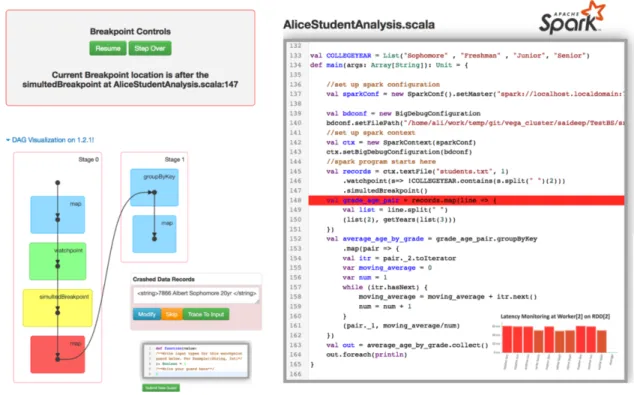
3.1 BIGDEBUG’s web-based interactive user interface . . . 22
3.2 Architecture of Spark withBIGDEBUG . . . 24
3.3 Scala word count application in Apache Spark . . . 24
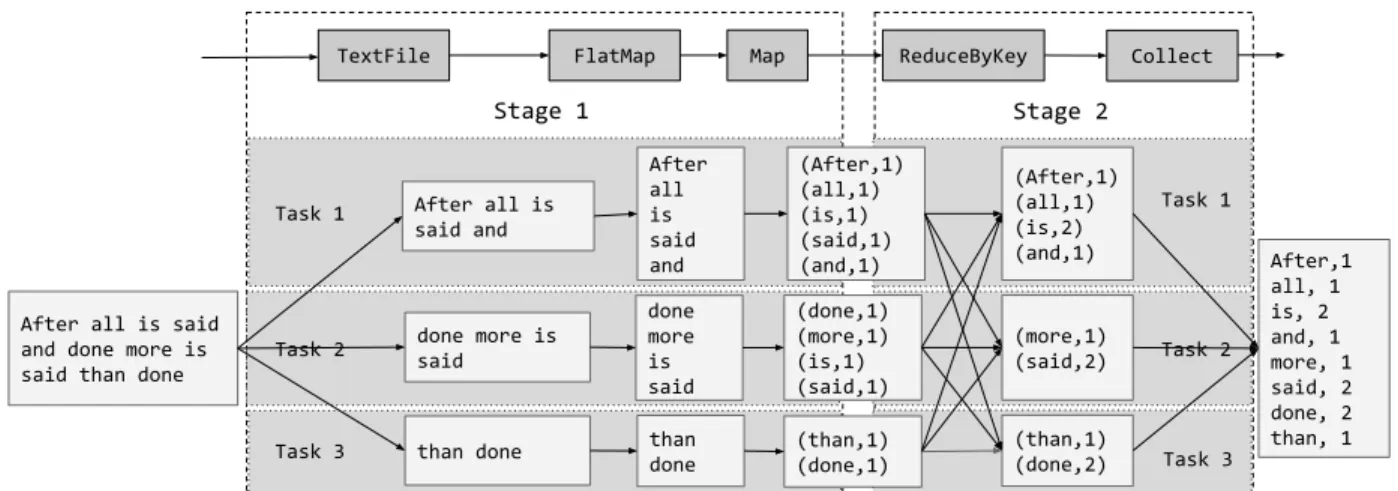
3.4 Data transformations in word count with 3 tasks . . . 25
3.5 Election poll log analysis program in Scala . . . 26
3.6 Realtime code fix for filter . . . 27
3.7 BIGDEBUG’s API . . . 28
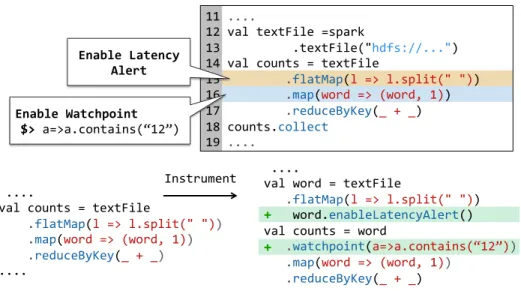
3.8 BIGDEBUGinstruments a program automatically based on debugger control commands entered by a user. . . 29
3.9 Illustration of simulated breakpoint . . . 30
3.10 An intermediate record “23s” at the map transformation causes a crash. BIGDEBUG reports the crash culprit, “23s” to the user and a user supplies the corrected record, “23”. 33 3.11 A logical trace plan that recursively joins data lineage tables, back to the input lines . . 35
3.12 When latency monitoring is enabled, straggler records are reported to the user. . . 37
3.13 College student data analysis program in Scala . . . 38
3.14 BIGDEBUGextends Spark’s user interface to provide runtime debugging features . . . . 39
3.15 A user can edit the guard predicate using an editor. . . 40
3.16 Options provided by the crash remediation UI . . . 40
3.17 Top most straggling records are visualized in bar chart showing the delays relative to average . . . 41
3.19 Latency monitoring overhead, time saving through crash remediation, and
localizabil-ity improvement . . . 46
4.1 Alice’s program that identifies, for each state in the US, the delta between the minimum and the maximum snowfall reading for each day of any year and for any particular year. Measurements can be either in millimeters or in feet. The conversion function is described at line 23. . . 52
4.3 Test function checking the validity of each output record—all snowfall deltas greater than 6000 millimeter are suspicious or incorrect. . . 52
4.2 (a) shows how intermediate and final results are constructed using the transformations in Alice’s program. In (b), delta debugging considers the initial scope of the inducing input to span a complete dataset but it eventually finds the precise fault-inducing input. In (c), data provenance over-approximates the set of fault fault-inducing input records because of thegroupByKeyoperation in the initial program. . . 53
4.4 A logical trace plan that recursively joins data lineage tables back to the input lines. . . 57
4.5 A decrease in the scope of potential fault-inducing input when the test function is pushed down. The workflow computes the sum of all the numbers in the input dataset. 59 4.6 A Spark program that computes the sum of all the numbers in the input dataset. . . 59
4.7 A decrease in fault-inducing input by overlapping backward traces of two faulty out-puts emerging from the same fault-inducing input. . . 60
4.8 A Spark program written in Scala that finds the total layover time of all passengers spending less than 45 minutes per airport at each hour. . . 63
4.9 BIGSIFT’s web-based interactive user interface . . . 64
4.10 BIGSIFT’s API . . . 64
4.11 BIGSIFT’s histogram visualization of key-value based output records . . . 65
4.13 Performance comparison . . . 71
4.14 Reduction in the number of runs . . . 72
4.15 Fault localization time ofBIGSIFT and DD for S1 w.r.t the location of seeded fault in input data. . . 73
4.16 Effect of test function push down (TD). . . 74
4.17 A branch is removed in subject program W4 to inject a code fault . . . 75
4.18 Benefits from Trace Overlapping (a) and Smallest Job First (b) . . . 77
4.19 Benefits of Bitmap Based Memoization w.r.t fault localization time (a) and number of DD runs (b) . . . 78
5.1 Symbolic PathFinder produces a set of path constraints and their corresponding effects 81 5.2 Alice’s program estimates the total number of trips originated from “Palms.” . . . 82
5.3 Dataflow operators’ paths by BIGTEST. Solid and dotted boxes represent transforma-tions and path constraints, respectively. . . 83
5.4 BIGTESTidentifies path constraints for both non-terminating and terminating program paths while symbolically executing the program. . . 84
5.5 BIGTESTextracts UDFs corresponding to dataflow operators through AST traversal. . . 87
5.6 (a) a normal invocation ofreducewith a corresponding UDF. (b) an equivalent iter-ative version with a boundK . . . 87
5.7 A UDF with string manipulation . . . 89
5.8 An iterative version of aggregator UDF . . . 90
5.9 Output SMT query constructed by BIGTEST to reflect JDU path constraint C11 of Table 5.1 from motivating example. . . 92
5.10 A Spark program that identifies the courses with less than two failing students. . . 93
5.12 JDU path coverage ofBIGTEST,SEDGE, and the original input dataset . . . 97
5.13 JDU path coverage ofBIGTESTin comparison to alternative sampling methods . . . . 98
5.14 The number of JDU paths covered and the test execution time whenk%of the data is randomly selected and thef irst k%of data is selected for subject program Commute-Type. . . 99 5.15 Reduction in the size of the testing data byBIGTEST . . . 102
5.16 Test running time of entire data on large-scale cluster vs. testing on local machine with
BIGTEST . . . 103
5.17 Breakdown ofBIGTEST’s running time . . . 103
5.18 BIGTEST’s performance when the degree of upper bound (K) on loop iteration and
LIST OF TABLES
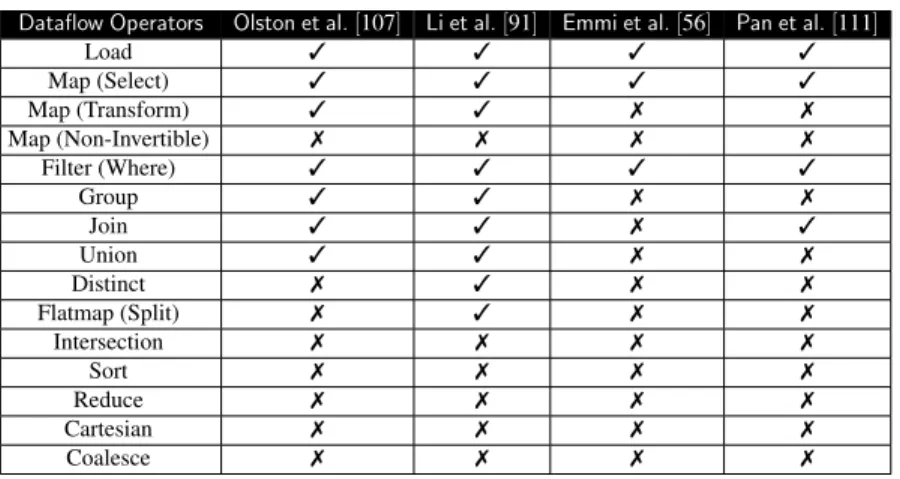
2.1 Support of dataflow operators in related work . . . 19
3.1 Performance evaluation on subject programs . . . 42
4.1 Subject programs with input datasets . . . 67
4.2 BIGSIFT with various optimizations. TP, SJF, and MEM stand for test driven prove-nance, smallest job first, and test results memoization, respectively. . . 68
4.3 Fault localization time improvement . . . 72
4.4 Performance and fault localization of BIGSIFT on 4 versions of subject program W4 each with difference coding fault. . . 75
5.1 Generated input data where each row represents a unique path. VariablesT,Z,V, and Kare defined in Figure 5.3. . . 85
5.2 CI represents a set of incoming constraints from the input table I, where each con-straint c ∈ CI represents a non-terminating path. c(t) represents that record t ∈ I must satisfy constraint c. f defines the set of path constraints generated by symboli-cally executingudf andf(t)represents the path constraint of a unique path exercised by input tuplet. . . 88
5.3 Subject Programs . . . 96
5.4 Fault detection capabilities of BIGTESTandSEDGE . . . 101
ACKNOWLEDGMENTS
I am very thankful to my Ph.D. advisor, Miryung Kim, for her exceptional support and encour-agement throughout the six years of graduate school. I was beyond fortunate to have Miryung, who facilitated my learning and spent countless hours reviewing my drafts and brainstorming new research ideas. Over the years, she paved ways for me to succeed by opening new opportunities through collaborations, research awards, and fellowships. I am profoundly grateful to have worked with her and to be a part of her academic genealogy.
Working with exceptional collaborators has been the most fulfilling experience of my graduate school career. I am honored to have collaborated with Todd Millstein, Tyson Condie, Harry Xu, Madan Musuvathi, Jason Cong, and Quanquan Gu. I am very thankful to them for serving on my Ph.D. committee, providing valuable feedback on my research, and encouraging me with their sup-port. I am grateful to Matteo Interlandi from whom I have learned how to break-apart large-scale systems and for being a good friend who is always available to hear my ideas and give excellent advice. I am also thankful to George Varghese for encouraging me to apply for fellowships and awards, and to Ravi Netravali for helping me with the academic job search. I also want to thank Xiaofeng, Carlos, Nipun, and Biplob for hosting me as a summer intern at Google and NEC Labs.
I would also like to thank my fellow students at UCLA i.e., Tianyi, Saswat, Michael, Se-unghyun, Shagha, Jason, Aish, Siva, Qian, John, Fabrice, Lana, Taqi, Lingxiao, Christian, Jiyuan, and Usama for making graduate school a lot more fun and exciting. Furthermore, I would also like to blame many of my friends in the US and Pakistan for making me spend many days traveling with them. It made me feel guilty and, consequently, more productive in research.
Last but not least, I dedicate this dissertation to my parents (Gulzar and Salma), my wife (Ainne), and my siblings (Hina, Mehak, and Hamza). Their unconditional and continuous support has been critical through the ups and downs of graduate school life. Their generosity and under-standing have shielded me from all the distresses and distractions of life and helped me focus. If it weren’t for them, I would not have been able to achieve this milestone.
The work presented in this dissertation is supported by Google Ph.D. Fellowship, NSF grants CCF-1764077, CCF-1527923, CCF-1460325, CCF-1723773, ONR grant N00014-18-1-2037, In-tel CAPA grant, and Samsung grant.
VITA
Sept 2014 – June 2020 Graduate Student Researcher/Teaching Assistant, Department of Computer Science, University of California, Los Angeles.
June 2019 – Sept 2019 Software Engineering Intern, Google Inc, Mountain View CA.
June 2018 – Sept 2018 Software Engineering Intern, Google Inc, Mountain View CA.
June 2016 – Sept 2016 Summer Research Assistant, NEC Labs America, Princeton NJ.
June 2014 B.S. in Computer Science, Lahore University of Management and Sciences, Lahore, Pakistan.
PUBLICATIONS
White-box Testing of Big Data Analytics with Complex User-defined Functions. Muhammad Ali
Gulzar, Shaghayegh Mardani, Madanlal Musuvathi, and Miryung Kim. In Proceedings of the 2019 27th ACM Foundations of Software Engineering (ESEC/FSE) 2019.
Automated Debugging in Data-intensive Scalable Computing. Muhammad Ali Gulzar, Matteo
Interlandi, Xueyuan Han, Mingda Li, Tyson Condie, and Miryung Kim. In Proceedings of the 2017 Symposium on Cloud Computing (SoCC) 2017.
BigDebug: Debugging Primitives for Interactive Big Data Processing in Spark. Muhammad Ali
Gulzar, Matteo Interlandi, Seunghyun Yoo, Sai Tetali, Tyson Condie, Todd Millstein, and Miryung Kim. In 2016 IEEE/ACM 38th International Conference on Software Engineering (ICSE) 2016.
Perception and Practices of Differential Testing. Muhammad Ali Gulzar, Yongkang Zhu, and Xiaofeng Han. In Proceedings of the 41st International Conference on Software Engineering: Software Engineering in Practice (SEIP) 2019.
PerfDebug: Performance Debugging of Computation Skew in Dataflow Systems. Jason Teoh,
Muhammad Ali Gulzar, Harry Xu, and Miryung Kim. In Proceedings of the 2019 Symposium on Cloud Computing (SoCC) 2019.
LogLens: A Real-Time Log Analysis System. Biplob Debnath, Mohiuddin Solaimani, Muhammad
Ali Gulzar, Nipon Arora, Cristian Lumezanu, Jianwu Xu, Bo Zong, Hui Zhang, Guofei Jiang, and Latifur Khan. In 2018 IEEE 38th International Conference on Distributed Computing Systems (ICDCS) 2018.
Optimizing Interactive Development of Data-Intensive Applications. Matteo Interlandi, Sai Deep
Tetali, Muhammad Ali Gulzar, Joseph Noor, Tyson Condie, Miryung Kim, and Todd Millstein. In Proceedings of the Seventh ACM Symposium on Cloud Computing (SoCC) 2016.
HeteroRefactor: Refactoring for Heterogeneous Computing with FPGA. Jason Lau*, Aishwarya
Sivaraman*, Qian Zhang*, Muhammad Ali Gulzar, Jason Cong, and Miryung Kim. (* are equal co-first authors ordered alphabetically by their last names). In 2020 IEEE/ACM 42nd International Conference on Software Engineering (ICSE) 2020.
Adding Data Provenance Support to Apache Spark. Matteo Interlandi, Ari Ekmekji, Kshitij Shah,
Muhammad Ali Gulzar, Sai Deep Tetali, Miryung Kim, Todd Millstein, and Tyson Condie. The VLDB Journal 2018.
CHAPTER 1
Introduction
Big data analytics has been playing a vital role in the growth of technology and research in many fields, such as health, education, security, and science. For example, in 2013, Twitter analyzed approximately 100 terabytes of data daily to improve its service by recommending the right prod-ucts, detecting spans, and suggesting follower [95]. Needless to say that this unprecedented growth in data has attracted substantial attention to build systems that are capable of analyzing massive quantities of data. To leverage exiting data center environments, data-intensive scalable comput-ing (DISC) frameworks (e.g., Hadoop MapReduce[52], Apache Spark[145], FlumeJava[35], and Cosmos[34]) run on cloud environments and capable of scaling to petabytes of data. Typically, de-velopers write their big data analytics application on these frameworks in a language like Python, Scala, or Java. The application ingests large-scale data as input, applies a series of operations on the data, and writes the final results in a data storage.
As the popularity of big data analytics grew, the demographics of the big data application developers shifted from expert system builders to business analysts, statisticians, economists, and medical professionals, mostly the people who may not possess to right skills to understand the internals of a DISC system [57]. For such users, the debugging and testing challenges severely impede their progress. Developer productivity tools have been a key area of research for traditional software and have matured over the past three decades. However, recently published experience reports conclude that theproductivity tooling support (especially debugging and testing) has not kept up with the explosive pace of distributed system development[18, 69, 54].
The following comparison accentuates the distinct characteristics of big data applications and their particular development challenges. Developers typically test their big data application in
a local development workstation with a small sample data, downloaded from a tera-byte scale data warehouse [122]. They cross fingers and hope that the application works in an expensive production cloud. However, big data applications “rarely work the first time” [57]. When the application fails, or the results look suspicious, developers inspect giga-bytes of post mortem logs collected across the cloud in order to identify the source of the error. Once the application is fixed, they re-submit the application to the production cloud. This process is repeated until all failing corner cases are adequately handled, and the application terminates successfully with a correct output. Compared to traditional software, debugging big data applications takes several hours while consuming expensive resources in a cloud environment. We list the concrete challenges in this process below.
• Root-cause analysis is exceedingly expensive due terabyte scale input data. When a big data application shows symptoms of errors or suspicious output, it is incredibly challenging to isolate the precise root cause among billions of entries in the input.
• Sample-based testing is inadequate, and full-scale testing is time consuming. Since the
developer has never explored the entire input data, she cannot make any assumptions about it. Using a small sample of the entire input does not provide adequate code coverage, and testing on the entire input data is prohibitively expensive, as each run may take several hours.
• Big data application executing on the cloud looks vastly different than the one submitted by the user. To run a big data application on a cloud, DISC frameworks transform the original application by breaking it into computation units calledtasks. Each of these tasks executes in parallel on each worker node in the cluster to achieve maximum parallelization. Debugging big data applications is time-consuming as the tasks executing on worker nodes look different than the application submitted by the developer.
• DISC frameworks are complex, with minimum visibility into the application execution. DISC
frameworks comprise of hundreds of complex systems components such as query optimizer, task scheduler, and network communication, each containing millions of code lines. Due to this huge codebase, it is difficult for an average user to comprehend the internal machinery
Traditional debugging and testing techniques in their current state are prohibitively inefficient and ineffective for big data analytics running on the cloud. Conventional breakpoint debugging is infeasible for big data applications, as pausing computations on thousands of worker nodes would be wasteful. Similarly, a variable at a watchpoint may have millions of instances across the cluster that are hard to inspect manually. The post-mortem logs generated by DISC frameworks barely contain insightful debugging information since a sizable portion of these logs reflects physical metrics (e.g.,task times, data I/O sizes, memory usage, and GC usage). Even if a user identifies a faulty intermediate data record, it is nearly impossible to trace the fault back to input data manually since the input data might have gone through a series of complex transformation and aggregation operators. Traditional test selection and generation approaches rely on techniques such as sym-bolic execution to understand the semantics of a program. However, it is infeasible to apply such techniques to the huge codebase of the DISC framework that implements the dataflow operators used in big data applications.
1.1
Problem Formulation
To overcome the limitations of traditional debugging and testing techniques for big data applica-tions, we devise the following hypothesis:
Overall Hypothesis: By designing interactive and automated debugging and testing
tech-niques that are specifically customized towards big data analytics running on a DISC framework, we can reduce the number of inputs required for testing and reduce time for debugging with mini-mal performance overhead.
To design such techniques, we must address three essential user concerns on accelerating the development of reliable big data applications. First, we must provide efficient and interactive debugging primitives that do not compromise the throughput of a big data application running on a large-scale cluster. Second, we must swiftly and automatically isolate the minimum input of a program that resulted in a crash, failure, or suspicious output. Lastly, we must detect most of the
faults efficiently while testing big data applications to avoid setbacks during expensive production runs.
The key insight in this dissertation is that by synthesizing ideas from databases and big data systems research, we can design effective and scalable automated testing and debugging tech-niques that barely affect the performance and efficiency of the underlying DISC framework. With our hypothesis and key insight, this dissertation evaluates the feasibility of each technique by materializing them into real-world tools that were previously considered infeasible for big data applications. The following sub-sections enumerate this dissertation’s contributions individually, drawing up research questions specific to the sub-field alongside the corresponding hypothesis that needs to be validated with thorough evaluations.
1.2
Interactive Debugging Primitives for Big Data Analytics
Debugging of big data application is post-mortem, and the primary source of information is an execution log that does not present the logical view—which intermediate outputs are produced from which inputs. Alternate approaches such as testing on a small subset of big data is ineffective as developers can easily miss errors, for example, when the faulty data is not part of the downloaded subset. To improve current state of debugging of big data applications, we investigate the following hypothesis:
Sub-Hypothesis (SH1): Based on the deterministic and immutable nature of big data
ap-plications, we can design a set of interactive debugging primitives that do not compromise the throughput of the DISC framework running on a cluster and reduce the debugging time signifi-cantly.
We designBIGDEBUG[66] that reinvents the traditional step-through debugging primitives with
simulated breakpoint which creates the illusion of a breakpoint even though the program is still
running in the cloud. It enables users to inspect millions of program states in distributed worker nodes usingguarded watchpoints, which dynamically retrieve records that match a user-defined
guard predicate. BIGDEBUGalso supports fine-grained forward and backward tracingat the level
of individual record to identify the root cause of a crash. It also provides fine-grained latency monitoringto notify a user which records are taking much longer than other records.
We investigate this hypothesis (SH1) about interactive debugging by asking three research evaluation questions on performance overhead, scalability, and effectiveness. Over a diverse set of scale-up and scale-out experiments,BIGDEBUGintroduces a maximum of 1.5X overhead, a
signif-icant proportion of which traces back to record-level latency monitoring. Second,BIGDEBUGhas
minimum impact on the DISC framework’s ability to scale. Lastly,BIGDEBUGreduces the
debug-ging time by 50% compared to the baseline replay debugger. At the production scale, BIGDEBUG
has the potential of saving several debugging hours and expensive computing resources.
1.3
Automated Debugging for Big Data Analytics
When a big data application produces a failure or an incorrect result, the developer may want to pinpoint the root cause by investigating the relevant subset of failure-inducing input record among billions of input records. DISC frameworks provide increased expressiveness through user-defined functions, which further increases the complexity of debugging. To address this problem, we pose the following hypothesis:
Sub-Hypothesis (SH2): A combination of data provenance technique from databases and
a test-based fault-isolation technique from software engineering can help developers pinpoint the minimal subset of failure-inducing inputs.
We design,BIGSIFT[65], that automatically finds a minimum set of fault-inducing input records
responsible for a faulty output. It uses test-driven data provenance to prune out input records irrel-evant to the given faulty output records, significantly reducing the initial scope of failure-inducing records before applying a test oracle based systematic search called Delta Debugging [147].
Our evaluation shows thatBIGSIFTimproves the accuracy of faulty inputs by several
improves performance by up to 66X compared to Delta Debugging, an automated fault-isolation technique [147]. For each faulty output, BIGSIFT localizes fault-inducing data within 38% of the
original job running time, which is previously unheard of, as debugging is expected to take longer than the runtime of a program. By making automated debugging feasible for big data applications,
BIGSIFT has the potential to significantly shorten the lifecycle of production bugs.
1.4
White-box Test Generation for Big Data Analytics
At the scale of big data, rare and buggy corner cases frequently show up in production [148]. Unfortunately, the standard industry practice for testing these applications remains running them locally on randomly sampled inputs, which obviously does not flush out bugs hiding in corner cases. Prior studies show that a majority of catastrophic failures in big data applications can eas-ily be prevented by performing local testing on error handling code in the user-defined functions (UDFs) [141]. To address the testing need of big data applications, we investigate the following hypothesis:
Sub-Hypothesis (SH 3): By abstracting the implementation of dataflow operators and by
modeling the semantics of user-defined functions in tandem, we can generate a small set of test inputs that are capable of revealing more defects than the entire input dataset.
To this end, we design a new white-box test generation approach, BIGTEST[67], that reasons
about the combinedbehavior of UDFs with relational and dataflow operations. Instead of sym-bolically executing the DISC framework’s code, BIGTEST models the semantics of dataflow and
relational operators using logical specifications and combines them with the symbolic represen-tation of the UDFs. The resulting represenrepresen-tation of a big data application is used to produce a miminum set of synthetic input records.
We evaluateBIGTESTon three criteria: fault-detection capability, test data size, and path
cover-age. Our experiment results show thatBIGTESTreveals 2X more manually injected faults than prior
of magnitude smaller than the entire dataset, yet it achieves an additional 34% path coverage than the entire dataset. Consequently, BIGTEST achieves the CPU time savings of 194X on average,
compared to testing on the entire production data. Through BIGTEST, we show that automated,
exhausted, and effective local testing is feasible for big data applications.
1.5
Contributions
We list the contribution of this dissertation below:
• We design the first set of interactive debugging primitives for big data applications in Apache Spark. This work on interactive debugging primitives brings traditional breakpoint and watchpoint based debugging practices to reality without posing significant performance over-head. We realize these concepts in a real-world tool called BIGDEBUG, which is equipped
with an interactive user-interface [64].
• We make automated debugging feasible for large-scale big data applications. This work on automated debugging for big data applications isolates the minimum set of fault-inducing inputs among billions of input records. We also built a web-based notebook environment where a developer can inspect the output of a big data application running on the cluster and monitor debugging progress [68].
• We design a symbolic execution-based testing technique for big data analytics. Test data generated by BIGTEST saves several hours of testing effort and expensive cloud resources.
We also put forward a benchmark of 35 faults real-world big data applications to support future research in testing and debugging for big data applications [2].
1.6
Roadmap
The rest of this dissertation is organized as follows. Chapter 2 presents related work on debug-ging and testing practices for traditional software and their counterpart in data-intensive scalable computing. Chapter 3 introduces interactive debugging primitives for large-scale data processing
in Apache Spark. Chapter 4 describes a fully automated approach to isolate the root cause of a failure in a big data application. Chapter 5 describes a new white-box testing technique for big data applications to eliminate the possibility of runtime failures. We conclude this dissertation in Chapter 6 with a vision of future research directions.
CHAPTER 2
Related Work
Data-Intensive Scalable Computing (DISC) systems have become an integral part of a wide va-riety of production services [95, 127, 124] and are regularly used for day-to-day data analysis tasks performed by data scientists [57, 87, 53]. This widespread adoption is mostly attributed to scalability and performance characteristics of current DISC systems such as Googles MapRe-duce [52], Apache Spark [145], Microsoft Scope [34]. Due to the widespread usage of DISC tems, the focus of recent research effort shifted to the big data analytics running on top of these sys-tems. Recent progress including end-user declarative languages (e.g., Boom [17], PigLatin [109] DryadLinq [141]) and new visualizations (e.g., Northstar [88] and Wrangler [84]) have lowered the entry barrier for data analysis work [44].
2.1
Challenges in Big Data Analytics
Zhou et al. manually categorize 210 randomly sampled failures of a big data platform at Mi-crosoft [148]. The study finds that 36.2% of in-field failures (i.e., escalations) are caused by system-side defects, including the logical and design errors of big data applications. Job fail-ures and slowdowns are common in big data applications, accounting for 45% and 27% of the escalations. Fisher et al. perform a qualitative study by interviewing 16 data analysts at Microsoft and investigate the pain points of big data analytics tools [57]. Their research finds that a cloud-based computing solution makes it far more difficult to debug. Data analysts often find themselves digging through trace files distributed across multiple VMs, which is often time-consuming and unfruitful. In a very comprehensive survey of user concerns, Bagherzadeh et al. analyse 112K
StackOverflow question posts related to big data [24]. Their investigation discovers that debug-ging data-centric software is among the top 3 topics of questions (7.4%) outranking performance, which comes at rank 12thwith 3.6%.
Kim et al. study 800 data scientists at Microsoft and find the validation of big data analytics to be a major challenge in addition to a lack of techniques that can boost data scientists’ confi-dence in their work [87, 86]. Gunawi et al. analyse 597 unplanned outages of 37 internet services based on cloud computing and find software bugs contributing to 15% of those outages, clearly indicating the inadequate testing [69]. Alvaro et al. publish an extensive experience report on the lack of testing and debugging techniques for distributed systems as today’s developers of big data application continue to use GNU GDB-debugger, which should not be the defacto method [18]. Shang et al. elaborate the unique challenges related to verifying and debugging big data analytics executions that can not be addressed easily by traditional approaches [122]. Similar studies on the state of the practices of data-centric software development emphasize the need for testing and debugging methodologies [54, 79, 20]. Gathani et al. interview 20 database users to understand the preferred practices of debugging database queries [59]. Their user interviews reveal that“printf”
and“trial and error”are the standard debugging practices as the users are most familiar with such techniques. All the above mentioned empirical studies on the challenges of developing big data analytics applications motivate this dissertation’s focus to design debugging and testing techniques for big data applications.
2.2
Debugging for Big Data Analytics
Execution Log Analysis of DISC Systems. Several approaches help developers debug big data
applications by collecting and analyzing execution logs. Boulon et al. monitor Hadoop clusters at runtime and store the log data [115]. Their system collects logs for understanding a runtime failure but does not provide realtime debug primitives. Shang et al. compare the execution log captured on the cloud with the logs obtained using a local mode [122]. Their system abstracts the execution
cloud deployments. Tan et al. analyze Hadoop logs to construct state-machine views of the program execution to help a developer understand a Hadoop execution log [125]. Their approach computes the histogram of the duration of each state and detects anomalies in the program execution. Xu et al. parse console logs and combine source code analysis to detect abnormal behavior [139]. Fu et al. map free-form text messages in log files to logging statements in source code [58]. Compared to our work in Chapter 3, none of these post-mortem log analysis approaches help developers debug big data applications in realtime, as their analysis is mostly based on logs comprising of metrics about the system’s health (e.g.,memory usage, GC, execution times, etc.).
Debuggers for Big Data Applications. Inspector Gadget [108] is a framework proposal for
mon-itoring and debugging data flow programs in Apache Pig [109]. The proposal is based on informal interviews with ten Yahoo employees who write big data applications. While Inspector Gadget proposes features such as step-through debugging, crash culprit determination, tracing, etc., it sim-ply lists desired debug APIs but leaves it to others to implement the proposed APIs. The tracing API of Inspector Gadget targets coarse-grained off-line tracing using a centralized server, falling behindBIGDEBUG’s (Chapter 3) ability to trace individual records at runtime.
Arthur is a post-hoc instrumentation debugger that targets Spark and enables a user to replay a part of the original execution [50] selectively. However, a user can only performpost-mortem
analysis and cannot inspect intermediate results at runtime. It also requires a user to write a custom query for post-hoc instrumentation. To localize faults, Arthur requires more than one run. For example, to remove crash-inducing records from the original input, a program crashes, and Spark reports failed task IDs in the first run. In the second run, a user must write a custom post-hoc instrumentation query (a new data flow graph) with those failed task IDs and run it to recompute the intermediate results for the failed tasks. In the third run, a user removes the crash-inducing records and re-runs the job again. In contrast, BIGDEBUG performs all three steps (i.e., run the
applications, debugging the crash-inducing record and re-run the application) in the same run in real-time.
model for viewing the running tasks and enables a user to attach a debugger to a remote process on the cluster. This approach works in DryadLINQ because all communications between tasks are through the disk. Such an approach could work for Hadoop or MapReduce that persist in intermediate results in the file system but does not work for an in-memory processing framework such as Spark. TagSniff introduces a new programming abstraction (i.e.,Tag and Sniff) that allows users to insert debugging probes in a big data application [45]. Using Tag API, a user can set a conditional breakpoint, log the intermediate data, or skip the record. The data captured through Tag can further be inspected using a Sniff API. In comparison to our work in Chapter 3, these approaches are not interactive and rely heavily on manual program refactoring by the developer.
Replay Debugger. Replay debugging for distributed systems has been extensively studied [105,
89] through systems such as liblog [60], R2 [70], and DCR [16]. These systems are designed to re-play general distributed programs, and thus record all sources of non-determinism, including mes-sage passing order across nodes, system calls, and accesses to memory shared across threads. Their goal is to reproduce errors using the captured events. Frameworks like D3S [96], MaceODB [49] and Aguilera et al. [14] are distributed debuggers for finding framework performance bugs, not application bugs. These replay debuggers incur significant overhead at runtime and even larger slowdown at replay time. In contrast, our debugging primitives in Chapter 3 leverage the struc-ture of a data flow graph to replay sub-compensations and re-generate an incremental program snapshot in realtime to support breakpoint debugging, leveraging the deterministic nature of DISC framework.
2.3
Automated Debugging for Big Data Analytics
Data Dependence Analysis For Fault Detection. Detecting bugs in program input by
analyz-ing data dependence has been well explored both in software engineering anddatabases. In the database, data provenance (also known as data lineage) is a tool used to explain how query results are related to input data [48]. Herschel et al. recently survey several data provenance techniques
tem logistics [75]. They also propose three challenges in data provenance, one of which is related automation of provenance-based debugging, which this dissertation addresses. Data provenance has been successfully applied both in scientific workflows and databases [74, 47, 27, 19]. How-ever, our experiments in Chapter 4 show that data provenance alone is often unable to compute the minimum input failure-inducing set.
RAMP [112] and Newt [97] added data provenance support to DISC systems; both are capable of performing backward tracing of faults to isolate failure-inducing inputs. However, most data provenance approaches alone are often not able to compute the minimum input failure-inducing set. Chothia et al. [39] is a provenance system implemented over a differential dataflow system, like Naiad [100]. Their approach is more focused on how to provide semantically correct expla-nations of outputs through replay by leveraging the properties of a differential dataflow system. More recently, Wu et al. design a new database engine, Smoke, that incorporates lineage logic within the dataflow operators and constructs a lineage query as the database query is being devel-oped [113]. With lineage query known upfront, Smoke promises interactive data provenance speed with low overhead. Lamp takes the challenges of data provenance by incorporating the notion of importance through automated differentiation of the program [98]. It is capable of quantifying the importance of inputs through a parallel derivative calculation at runtime. Ikeda et al. present provenance properties such as minimality and precision for individual transformation operators to support data provenance [81, 80]. However, their definition of minimality (minimum provenance) is based on reproducing the same output record rather than producing a faulty output. Therefore, these techniques do not guarantee a minimum set of fault-inducing inputs, whereas our work in Chapter 4, uses the notion of test failure to identify the most precise faulty input.
In software engineering, dynamic taint analysis utilizes information flow to detect security bugs [106, 119] and is also used to perform software testing and debugging [41, 85]. For example, Penumbra leverages dynamic taint analysis to identify failure-relevant inputs automatically [42]. Program slicing is another technique that isolates statements or variables involved in generating a certain faulty output [137, 13, 72]. These techniques use either static and dynamic approaches to
localize relevant code regions. Chan et al. identify failure-inducing input data by leveraging dy-namic slicing and origin tracking [36]. In the domain of big data analytics, a single UDF is invoked millions of times on input data records. Recording data lineage information at the granularity of a program statement can easily blow up the storage and add significant runtime overhead. Therefore, traditional taint analysis is not feasible for big data applications.
Automated Debugging Through Repetitive Re-runs. Delta debugging (DD) is a well-known
technique for finding the minimal failure-inducing input that causes the program to fail [147, 146, 43]. It has been used for a variety of applications to isolate the cause-effect chain or fault-inducing thread schedules [43, 38]. DD requires multiple executions of the program, which alone is not tractable for DISC system workloads. HDD tries to minimize the number of executions involved in DD by selecting only valid input configuration under the assumption that the input is in a well defined hierarchical structure(e.g.,HTML or XML) [103]. In our context, this assumption rarely holds because the input dataset is mostly unstructured. DD is a black-box procedure that does not consider the semantics of data-flow operators and thus cannot prune input records known to be irrelevant. In comparison, our work in Chapter 4 uses data provenance to prune out irrelevant inputs before applying DD, which significantly reduces program re-runs and the debugging time.
Intervention-based Explanation Systems. Several systems have recently addressed the
limi-tations of traditional data provenance to explain anomalous results by computing subsets of the lineage having an “influence” on the outlier result. Systems of this category delete candidate so-lutions i.e., groups of tuples, from the input and evaluate whether the outlier has changed. This process is called intervention, which is iteratively repeated to find the most influential groups of tuples, usually referred to as explanations [101, 118, 138]. Scorpion finds outliers in the dataset that have the most influence on the final outcome [138]. It restricts itself to queries with aggregates over singles tables (i.e.,no joins are involved). It uses predefined partitioning strategies to isolate the most influential partition (configuration of input) and generates the predicates representing this partition of data. Carbin et al. solve the similar problem of finding the influential (critical) regions in the input dataset that have a higher impact on the output using fuzzed input, execution traces,
and classification [33]. Roy et al. mix intervention with causality to overcome the limit of Scor-pion in generating explanations over a single table only [118]. Finally, Data X-ray extracts a set of features representing input data properties and summarizes the errors in a structured dataset [136]. It considers the properties of data only and does not reason about how a given program takes the input records and outputs faulty output records. These systems target a specific set of queries and structured data, and therefore their approaches do not apply to generic programs containing, for example, arbitrary UDFs. Furthermore, these approaches are commonly coupled with a DBMS, which limits their scalability.
2.4
Testing For Big Data Analytics
Symbolic Execution. Symbolic execution is a widely used and studied technique in the domain
of software engineering [28, 77, 116]. The technique allows a programmer to generate logical constraints that can be used to prove if the program satisfies certain specifications. Tools such as KLEE [30], Pex [128], and JavaPathFinder [135] have brought symbolic execution to the forefront of systematic program testing. In software testing, symbolic execution is traditionally used to discover uncovered program regions in their test cases and use constraint solvers to generate test data that would reveal faults in previously uncovered program region [29, 31, 32, 61, 99, 104, 123].
SQL-integrated applications construct and execute a database query and use the results of a query in the subsequent logic of the program. Popular approaches to test such applications rely on using a variant of symbolic execution to generate both application input and database state. Emmi et al. solve this problem by performing the concolic execution of a program embedded with an SQL query [56]. They symbolically execute the program until the query is executed and replace the query with its pre-defined symbolic constraints. Their approach only caters to a very basic format of an SQL query, which only uses projection, selection, insert and delete operations
(e.g., SELECT ... FROM ... WHERE). Pan et al. also perform database state generation
but with different coverage criteria goals [111]. Their method is similar to the one adopted by Emmi et al. However, they also include support for one more relational operatori.e.,join. Both
of these techniques cannot deal with big data applications composed of complex and expressive dataflow operators such as reduceByKey or distinct and arbitrary user-defined functions (see Table 2.1).
Qex is a symbolic execution tool for SQL that follows the traditional symbolic execution based test generation playbook [133]. Qex is loaded with custom theories for each relational operator. For a given SQL query, Qex translates it into an SMT query, which is simplified into constraints using Z3 and used as selection criteria on the input data. Cosette also generates a symbolic representation of a relational query which is used further to either: (a) prove equivalence among two queries or (b) generate test data (counterexamples) that explain conflicting answers from two queries [40]. Both approaches present specifications for dataflow operator that is used by our work in Chapter 5. One of the most problematic limitations of symbolic execution is the explorations of an enor-mous number of program paths emerging from the large codebase. In past, several heuristics-based approaches address this path explosion problem [120, 94, 29, 23]. For example, Burnim et al. leverage static analysis to guide symbolic execution towards uncovered paths [29]. Such heuristics could help prioritize specific program paths. As with any other heuristics-based ap-proach, these techniques produce many false negatives as they prioritize exploring certain program paths. Consequently, it may lead to low test quality (or fault detection rate) of the generated test suite. Symbolically executing a big data application in isolation (without the framework codebase) requires abstracting dataflow operator. Our work in Chapter 5 overcomes the limitations of the tra-ditional symbolic execution testing approaches mentioned above by using the logical specification of dataflow operators to generate appropriate symbolic constraints.
Rosette is a framework for designing a solver-aided language [129] to ease the process of translating each language construct into symbolic constraints. This dissertation and Rosette share some similarities in that they both translate higher-order types such as tuples or arrays into lower-level constraints. For side-channel analysis, Bang et al. address a similar problem (as of this dissertation) of solving constraints that cross boundaries between different theories (numerics, integer, and string constraints) [25]. Such cross-theory constraints are known to be challenging
to solve with Z3 [51] or CVC4 [26]. They extend SPF by modeling strings into bit-vectors and by integrating numeric model counting in ABC [22], an automata-based string constraint solver, to perform model counting for both numeric and string constraints. Such extensions of ABC and SPF could be used to generate satisfying assignments for string-based constraints in the constraints solving phase ofBIGTEST, presented in Chapter 5.
Regression Test Selection and Augmentation. Regression testing has been extensively studied in
software testing. Safe regression testing allows users to select only those test cases that exercise the updated regions of a program and reveal all possible faults associated with these updates. Rother-mel et al. summarize several regression testing techniques and evaluate them under a controlled environment [117]. Their evaluation is based on four key metrics: (1)inclusiveness, measuring the extent by which the chosen test cases lead to a different output; (2)precision, measuring the ability of a technique to avoid selecting test cases that would not lead to a different output; (3)efficiency, quantifying the practicality of the technique in terms of its computational cost; and (4)generality
checking if a technique is applicable on a diverse set of language constructs. Harrold et al. use the difference between the control flow graphs (CFGs) of two versions of a program to select the test cases most relevant to program modifications [73]. For each test case, this technique requires a list of statements or CGF nodes covered by the test case.
Test prioritization helps the developers run their test cases to maximize fault detection in a minimum amount of time. Elbaum et al. evaluate 14 different ways of prioritizing test cases to achieve a higher rate of fault detection [55]. Their work prioritizes a test case on the metrics of code coverage, fault exposing potential, or fault proneness. Several test prioritization methods may be reused to prioritize input data records in big data applications under testing to reach the maximum coverage. However, almost all of the above techniques require coverage profile or fault, exposing the potential for each input record. As mentioned earlier, collecting and generating such information is infeasible and expensive at large scale. However, using the logical specification of dataflow operators defined in Chapter 5, we can abstract the coverage profile of the framework’s code in terms of the equivalence classes of corresponding operators.
Testing Large Scale Systems. Alvaro et al. publish an experience report on the state of testing of distributed systems [18], finding existing approaches to be ad-hoc, suitable for highly skilled ”superuser”, and fundamentally unscalable. They put forward a motion for the systems community to build end-user testing tools to increase the faults tolerance of distributed software (e.g.,big data applications), resonating with the goal of this dissertation. Our prior empirical study on the use of differential testing for large-scale, end-to-end systems instead of traditional unit testing and find unit testing either incomplete or infeasible in practice due to the system’s complexity [63]. They further observe that more than 40% of tests in real-world production software take between 15 minutes to several hours, stressing fuzz testing infeasibility on large-scale, long-latency systems. Other studies at Microsoft and Google concur exceedingly long-running test times (in the order of hours) on their products, such as Microsoft Windows [76, 132].
Testing SQL and Data Analytics. Miao et al. generate database rows to explain the output
difference between the two queries [102]. They leverage hard-coded specifications of relational operators and model their impact on the data provenance via input constraints. Such constraints are used to generate synthetic data, facilitating the reasoning behind output difference among two queries. Gupta et al. pivot their test generation technique for SQL queries guided by mutation testing of relational operators [71]. They define a set of mutations for selected relational operators such as join and specify rules needed for each type of join to kill the mutant. Relational database applications rarely use user-defined function (UDF) that are prevalent in big data applications. Even though the tools mentioned above assist in identifying faults in the relational query, they may not reveal the faults emerging from UDF alone and from the interaction of UDF and dataflow operators.
Testing Map-Reduce Programs. Csallner et al. propose the idea of testing commutative and
associative properties of Map-Reduce programs by generating symbolic constraints [46]. Their goal is to identify determinism in a Map-Reduce program that may arise because of a non-associative or a non-commutative user-defined function in areduceoperation. They also produce counterexamples as evidence by running a constraint solver over symbolic path constraints. Xu et
Dataflow Operators Olston et al.[107] Li et al.[91] Emmi et al.[56] Pan et al.[111] Load 3 3 3 3 Map (Select) 3 3 3 3 Map (Transform) 3 3 7 7 Map (Non-Invertible) 7 7 7 7 Filter (Where) 3 3 3 3 Group 3 3 7 7 Join 3 3 7 3 Union 3 3 7 7 Distinct 7 3 7 7 Flatmap (Split) 7 3 7 7 Intersection 7 7 7 7 Sort 7 7 7 7 Reduce 7 7 7 7 Cartesian 7 7 7 7 Coalesce 7 7 7 7
Table 2.1: Support of dataflow operators in related work
al. extend the work by Csallner et al. by adding a few more Map-Reduce program properties [140]. In addition to non-determinism, they also test (1)selectivity, to verify the ratio between the size of an input and an output of an operator; (2)statefulness, to verify if the current computation of an operator depends on a previous computation; and (3) partition interference to know if other partitions interfere with the results in the current partition. Unlike BIGTEST(Chapter 5), both of
these techniques only test high-level properties of individual dataflow operators used in a Map-Reduce program. These approaches do not provide adequate coverage of user-defined functions and overlook logical faults in a big data application.
Li et al. propose a combinatorial test data generation approach that extracts input domain information automatically from data schema or original input and bound the scope of possible in-put combinations [92]. Such an approach can easily blow up with an excessive number of inin-put combinations for input fields with relaxed constraints such as price or first name). A more gen-eralized work by Olsten et al. test big data applications written in Pig Latin by generating testing data [107]. Compared to random sampling, their approach provides concise data selected from an input dataset that promises the full statement coverage of a big data application. They model each dataflow operators into a set of equivalence classes. For example, a filter operator translates into two equivalence classes where the first-class contains data records passing the filter, and the second one includes the records failing the filter. The dataflow operators they support are listed in Table 2.1. Their approach does not consider the semantics of UDFs directly and fails to generate
test data when applied to non-invertible UDFs in operators such astransform.
Li et al. extend Olsten et al’s approach in their tool SEDGE by supporting additional dataflow
operators such as distinctandsplit. They use symbolic execution on dataflow operators to produce path constraints. SEDGE considers UDFs as black-box procedures and uses them to
generate data for uncovered equivalence classes. The high-level constraints generated by their tool may not provide the full statement coverage of the UDFs, which are crucial in testing expressive big data applications such as Spark programs. Table 2.1 shows a side by side comparison of the related work in terms of dataflow operators which they support.
In practice, local testing of big data application is popular and, to a certain extent, shows promise in detecting code faults. However, it is critically important to have the right test input data to expose program behaviors that usually surface only at scale. Yuan et al. study 198 user-reported failures on popular DISC systems and find that majority of the failures in these reports can be reproduced with three or fewer nodes, showing the efficacy of local testing [142]. Li et al. perform an extensive analysis of failure in big data applications at Microsoft [93]. A key conclusion of their study is to improve the state of local testing using a small yet carefully selected/generated subset of input. In Chapter 5, we follow up on this recommendation and introduce a test generation technique for big data application, making local testing highly effective.
CHAPTER 3
Interactive Debugging Primitives for Big Data Analytics
Debugging the massive parallel computations that run in today’s data-centers is time-consuming and error-prone. This chapter explores the following research question on debugging: what are
the necessary debugging primitives for interactive big data analytics? To address this question,
we investigate the sub-hypothesisSH1: Based on the deterministic and immutable nature of big data applications, we can design a set of interactive debugging primitives that do not compromise the through-put of the DISC framework running on a cluster and reduce the debugging time sig-nificantly. In this chapter, we re-think the traditional step-through debugging and propose a set of interactive, expressive, and real-time debugging primitives for big data applications, meeting the requirements of low overhead, scalability, and fine granularity.
3.1
Introduction
Currently, developers do not have easy means to debug big data applications. The use of cloud computing makes application development feel more like batch jobs, and the nature of debugging is, therefore, post-mortem. Developers are notified of runtime failures or incorrect outputs after many hours of wasted computing cycles on the cloud.
We designBIGDEBUGto provide interactive, real-time debugging primitives for big data
appli-cations. BIGDEBUGprovides simulated breakpoints and watchpoint, which create the illusion of a
breakpoint with the ability to inspect selected program state in distributed worker nodes. BIGDE
-BUG also supports fine-grained forward and backward tracing at the level of individual records by
Figure 3.1:BIGDEBUG’s web-based interactive user interface
in case of a crash, BIGDEBUGprovides a real-time quick fix and resume feature where a user can
modify code or data at runtime. It also provides fine-grained latency monitoring to notify a user which records are taking much longer than other records. All the features in BIGDEBUGare
avail-able through a web-based user interface, as shown in Figure 3.1, which provides a live stream of debugging information.
In the most conservative experimental setting,BIGDEBUGtakes 2.5 times longer than the
base-line Spark whereBIGDEBUGis enabled with record-level tracing, crash culprit determination, and
latency profiling, and every operation at every step is instrumented with breakpoints and watch-points. If we disable the most expensive record-level latency profiling, BIGDEBUG introduces an
overhead less than 34% on average. BIGDEBUG’s quick fix and resume feature allows a user to
recover appropriately from a crash and resume the rest of the computation, resulting in up to 100% time-saving. BIGDEBUGnarrows down the scope of failure-inducing data by orders of magnitude
through fine-grained tracing of individual records within the distributed data processing pipeline.
data-parallel processing in Apache Spark and why we chose Spark. Section 3.3 introduces a set of interactive debugging primitives with a running example. Section 3.4 describes the design and implementation of individual features. Section 3.5 presents a demonstration of BIGDEBUG.
Section 3.6 describes evaluation settings and the results. Section 3.7 discusses the next research direction.
3.2
Background: Apache Spark
Apache Spark [145] is a large scale data processing platform that achieves orders-of-magnitude better performance than Hadoop MapReduce [3] for iterative workloads. BIGDEBUGtargets Spark
because of its wide adoption—with over800developers and200companies leveraging its capabilities— and support for interactive ad-hoc analytics, allowing programmers to explore the data as they re-fine their data-processing logic. Spark’s high-level programming model provides over80types of data manipulating operations and supports language bindings for Scala, Java, Python and R. Fur-thermore, a variety of domain specific extensions have been built on Spark, including MLLib [4] for machine learning, GraphX [62] for graph processing, SparkSQL [21] for relational queries, and statistical analysis in R. Spark can consume data from a variety of data sources, including dis-tributed file systems (like HDFS [121]), object stores (like Amazon S3 [1]), key-value stores (like Cassandra and HBase), and traditional RDBMS (like MySQL and Postgres).
The Spark programming model can be viewed as an extension to the MapReduce program-ming model that includes direct support for traditional relational algebra operators (e.g., group-by, join, filter), and iterative computations through a “for” loop language construct. These extensions offer orders-of-magnitude better performance over previous Big Data processing frameworks like Apache Hadoop [3] for iterative workloads like machine learning. Spark also comes with a relaxed fault tolerance model—based on workflow lineage [27]—that is built into its primary abstraction: Resilient Distributed Datasets (RDDs) [144], which exposes a set of data processing operations calledtransformations(e.g., map, reduce, filter group-by, join) andactions(e.g., count, collect).
Master Worker Worker Driver Worker 2- Get workers User Program 1- Run Program 3- Connect to workers and assign tasks 3 3 3 4 4 4 4- Send the result to the driver 5- Show output to the user BigDebug Controls : Debugger Instance : Communication Channel
Figure 3.2: Architecture of Spark withBIGDEBUG
Spark programmers leverage RDDs to apply a series of transformations to a collection of data records (or tuples) stored in a distributed fashion e.g., in HDFS [121]. Calling a transformation on an RDD produces a newRDD that represents the result of applying the given transformation to the input RDD. Transformations are lazily evaluated. The actual evaluation of an RDD occurs when an action is called. At that point the Spark runtime executes all transformations leading up to the RDD, on which it then evaluates the action e.g., the count action counts the number of records in the RDD. A complete list of transformations and actions can be found in the Spark documentation [6].
1 //WordCount.Scala
2 val textFile = spark.textFile("hdfs://...") 3 val counts = textFile
4 .flatMap(line => line.split(" ")) 5 .map(word => (word, 1))
6 .reduceByKey(_ + _).collect()
Figure 3.3: Scala word count application in Apache Spark
Figure 3.3 shows a word count program written in Spark using Scala. In this program, the frequency of each unique word in the input text file is calculated. It splits each word using a space as a separator, and maps each word to a tuple containing the word text and 1 (the initial count). ThereduceByKeytransformation groups the tuples based on the word (i.e., the key) and sums up the word counts in the group. Finally, thecollectaction triggers the evaluation of the RDD referencing the output of thereduceByKeytransformation. The result of the collectaction is a list of tuples—containing each unique word and its frequency—that is returned to the driver
After all is said and done more is said than done
than done done more is said After all is said and After all is said and done more is said than done (After,1) (all,1) (is,1) (said,1) (and,1) (done,1) (more,1) (is,1) (said,1) (than,1) (done,1) (After,1) (all,1) (is,2) (and,1) (more,1) (said,2) (than,1) (done,2) After,1 all, 1 is, 2 and, 1 more, 1 said, 2 done, 2 than, 1
FlatMap Map ReduceByKey Collect
TextFile Task 1 Task 3 Task 1 Task 3 Task 2 Task 2 Stage 1 Stage 2
Figure 3.4: Data transformations in word count with 3 tasks
The Spark platform consists of three modules: a driver, a master, and a worker. A master node controls distributed job execution and provides a rendezvous point between a driver and the workers. The master node monitors the liveliness of all worker nodes and tracks the available resources (i.e., CPU, RAM, SSD, etc.). Worker nodes are initiated as a process running in a JVM. Figure 3.2 shows an example Spark cluster containing three worker nodes, a master node, and a driver. A Spark job consists of a series of transformations that end with an action. Clients submit such jobs to the driver, which forwards it to the master node. Internally, the Spark master translates a series of RDD transformations into a DAG ofstages, where each stage contains some sub-series of transformations until a shuffle step is required (i.e., data must be re-partitioned). The Spark scheduler is responsible for executing each stage in topological order, withtasksthat perform the work of a stage on input partitions. Each stage is fully executed before downstream dependent stages are scheduled. The final output stage evaluates the action that triggered the execution. The action result values are collected from each task and returned (via the master) to the driver program, which can initiate another series of transformations ending with an action.
Figure 3.4 represents the execution plan (stage DAG) for our word count example in Figure 3.3. The input text is divided into three partitions. The driver compiles the program into two stages. Stage1applies the flatmap andmaptransformations to each input partition. A shuffle step is then required to group the tuples by the word. Stage2processes the output of that shuffle step by