A DATA-DRIVEN APPROACH TO POWER SYSTEM DYNAMIC STATE ESTIMATION
A Thesis by
DEEPIKA KUMARI
Submitted to the Office of Graduate and Professional Studies of Texas A&M University
in partial fulfillment of the requirements for the degree of MASTER OF SCIENCE
Chair of Committee, Shankar P. Bhattacharyya Co-Chair of Committee, Raktim Bhattacharya Committee Members, Krishna Narayanan
Ulisses Braga Neto Head of Department, Miroslav M. Begovic
August 2017
ABSTRACT
State estimation is a key function in the supervisory control and planning of an electric power grid. Typically, the independent system operator (ISO) runs least-squares based static state estimation once every few minutes. Inherently, however, a power system is mostly in a transient state owing to load fluctuations, outages and network switching. In such a scenario, dynamic state estimation facilitates real-time monitoring and control of the system. Dynamic state estimation is implemented using Kalman filtering techniques. Popular estimators for nonlinear systems include the extended Kalman filter (EKF) and unscented Kalman filter (UKF). Practical implementation, however, is inhibited by the lack of an accurate system model and the high computational complexity of Kalman filtering methods.
I address the former issue of model unavailability and rely instead on measurement data from phasor measurement units for dynamic state estimation (DSE). I build an esti-mator for DSE which uses only measurement and input information, and operates without knowledge of the underlying system model. The algorithm considered uses a Gaussian process (GP) approximation of the state transition and observation functions in the imple-mentation of a UKF-based state estimation.
I analyze the performance of the estimator for different scenarios using root mean squared (RMS) error as the metric. The estimator, when evaluated on the IEEE 14-bus test case, gives a minimum accuracy rate of over 94% over all considered scenarios.
ACKNOWLEDGMENTS
I would like to thank my advisor, Prof. Shankar P. Bhattacharyya, whose support and insight greatly accelerated the completion of this work. It has been a godsend relief to be able to count on his patience and guidance throughout the course of my study.
I am grateful to Professors Narayanan, Braga-Neto and Bhattacharya for agreeing to be on my thesis committee and for their wonderful feedback.
I would also like to thank my parents and my sister, Meenakshi for supporting me emotionally and financially in my endeavour.
I am grateful to Prof. Le Xie, who gave me the inspiration and material to do this research. His course taught me the concepts I needed to push forward with this work.
Many thanks to the Texas A&M University staff, professors and particularly graduate student advisors for a wonderful, and comfortable learning experience at A&M.
Thank you, Deepika Kumari
CONTRIBUTORS AND FUNDING SOURCES
Contributors
This work was supported by a thesis committee consisting of Professors Bhattacharyya, Narayanan and Braga-Neto of the Department of Electrical and Computer Engineering and Professor Bhattacharya of the Department of Aerospace Engineering.
The PSAT toolbox used to simulate the IEEE 14 bus system was provided by Dr. Federico Milano of University College Dublin School of Electrical and Electronic Engi-neering. The GPML toolbox used to fit the Gaussian Process to data was developed by Professor Carl Edward Rasmussen of University of Cambridge and Dr. Hannes Nickisch from Philips Research, Hamburg, Germany.
All other work conducted for the thesis was completed by the student independently. Funding Sources
There are no outside funding contributions to acknowledge related to the research and compilation of this document.
NOMENCLATURE
ISO Independent System Operator
SCADA Supervisory Control and Data Acquisition
DSE Dynamic State Estimation
UKF Unscented Kalman Filter
PMU Phasor Measurement Unit
GP Gaussian Process
RMS Root Mean Squared
PSAT Power System Analysis Toolbox
GPML Gaussian Processes for Machine Learning
SE State Estimation
EKF Extended Kalman Filter
TABLE OF CONTENTS
Page
ABSTRACT . . . ii
ACKNOWLEDGMENTS . . . iii
CONTRIBUTORS AND FUNDING SOURCES . . . iv
NOMENCLATURE . . . v
TABLE OF CONTENTS . . . vi
LIST OF FIGURES . . . viii
LIST OF TABLES . . . ix
1. INTRODUCTION . . . 1
1.1 Background . . . 2
1.2 Outline . . . 2
2. POWER SYSTEM DYNAMICS . . . 4
2.1 Transmission Line Dynamics . . . 4
2.2 Line Breakers . . . 5 2.3 Generators . . . 5 2.3.1 Slack generator . . . 5 2.3.2 PV generator . . . 6 2.3.3 Synchronous generator . . . 6 2.4 Controls . . . 9 2.4.1 Turbine governor . . . 9
2.4.2 Automatic voltage regulator . . . 11
2.5 Load . . . 12
2.6 Power Flow . . . 12
3. DYNAMIC STATE ESTIMATION . . . 14
3.1 Notation . . . 14
3.2 Why DSE? . . . 14
3.4 Kalman Filtering . . . 15
3.4.1 Unscented transform . . . 16
3.4.2 Unscented Kalman filter . . . 17
4. GAUSSIAN PROCESSES AND GP-UKF . . . 19
4.1 Gaussian Processes . . . 19
4.1.1 Advantages of GP models . . . 19
4.1.2 Limitations of GP . . . 20
4.1.3 GP for machine learning . . . 20
4.2 GP-UKF . . . 22
4.2.1 Learning prediction and observation models . . . 22
4.2.2 The algorithm . . . 23
5. EVALUATION OF GP-UKF DYNAMIC STATE ESTIMATOR . . . 25
5.1 Simulation Data . . . 25
5.1.1 Collecting training data . . . 25
5.2 Training the Gaussian Process Model . . . 25
5.2.1 Exact inference . . . 25
5.2.2 The hyperparameters . . . 27
5.3 Training Phase . . . 27
5.4 Validation Phase . . . 27
5.5 Testing Conditions . . . 29
5.5.1 Scenario 1: Topology change . . . 29
5.5.2 Scenario 2: Parametric uncertainty . . . 30
5.5.3 Scenario 3: Noisy measurements . . . 30
5.5.4 Scenario 4: Load perturbations . . . 34
6. CONCLUSIONS . . . 36
6.1 Contributions . . . 36
6.2 Limitations and Future Research . . . 37
REFERENCES . . . 38
APPENDIX A. SIMULATION DETAILS OF NETWORK COMPONENTS . . . 41
LIST OF FIGURES
FIGURE Page
2.1 Theπmodel for transmission line [1] . . . 4
2.2 Park-Concordia model for synchronous machine [1] . . . 6
2.3 PSAT type I turbine governor [1] . . . 10
2.4 IEEE std model I AVR [1] . . . 11
5.1 IEEE 14-bus system with legend [2] . . . 26
5.2 Training phase: Estimated (in red) and true (in blue) states - rotor angle and speed of synchronous machines at buses 1, 3, 2, 8 and 6 respectively. . 28
5.3 Sum squared error over all samples for the state variable δ (generator at bus 1) for different values ofλ . . . 29
5.4 Scenario 1: Estimated (in red) and true (in blue) states - rotor angle and speed of synchronous machines at buses 1, 3, 2, 8 and 6 respectively . . . 31
5.5 Scenario 2: Parametric uncertainty . . . 32
5.6 Scenario 3: Estimated (in red) and true (in blue) states - rotor angle and speed of synchronous machines at buses 1, 3, 2, 8 and 6 respectively. . . . 33
5.7 Scenario 4: Estimated (in red) and true (in blue) states - rotor angle and speed of synchronous machines at buses 1, 3, 2, 8 and 6 respectively. . . . 35
LIST OF TABLES
TABLE Page
2.1 Synchronous generator parameters . . . 8
2.2 Synchronous generator variables . . . 8
2.3 Synchronous generator variables . . . 10
2.4 AVR parameters . . . 12
3.1 DSE variables for time instantk . . . 14
A.1 Simulation details of PQ loads . . . 41
A.2 Simulation details of static synchronous compensators . . . 41
A.3 Simulation details of PV generator . . . 42
A.4 Simulation details of synchronous generators . . . 42
A.5 Simulation details of turbine governors . . . 42
A.6 Simulation details of AVRs . . . 43
B.1 Initialization of bus variables . . . 44
1. INTRODUCTION
State Estimation is a key functionality in power system operation as it provides the critical information for other fundamental processes like contingency analysis, load fore-casting, optimal power flow and economic dispatch. Traditional state estimators compute the weighted least squares (WLS) estimate [3] of the network state using the data provided by the SCADA system. This static estimate is based on a steady-state model of the sys-tem, and does not consider the dynamic behaviour of the system. This scheme has been effective in estimating the state of transmission network in steady-state. Previously, it was the only state estimation deployed since SCADA measurements were too infrequent to consider dynamic state estimation (DSE).
With the rapidly rising deployment of phasor measurement units (PMUs), measure-ment acquisition can occur at rates of 10 to 60 samples per second. A power network equipped with PMU technology allows the estimator to capture transient behavior of the system. DSE has an edge over static SE primarily due to the predictive capability of Kalman filtering. The step-ahead prediction possible with DSE could open up new av-enues in preventive control and, improved bad data detection and identification ([4], [5]). The main obstacles to the practical implementation of DSE are the difficulty in modeling large power networks with nonlinear dynamics and the high computational complexity of Kalman filtering methods. I address the former issue of model unavailibilty. I build an estimator for DSE which uses only measurement and input information, and operates without knowledge of the underlying system model.
1.1 Background
Consider a power transmission network withn buses. Static SE aims to estimate the network state which is given by:
Xnet:= [θ1 V1 θ2 V2 · · · θn Vn]T (1.1)
whereθiandViare respectively the voltage phasor magnitude and phase angle at busi, for i= 1,2, ....n.
The dynamic state of the system is a different set of variables comprising rotor angles, speeds, transient and subtransient voltages. The vector formed by stacking the state vari-ables of all the generators connected to the network, is the dynamic state vector of the system. Suppose the network haskgenerators, with theithgenerator having a stateXi
dyn. Then, the dynamic state of the network is as follows.
Xdyn:= [Xdyn1 Xdyn2 · · · Xdynk ]T (1.2)
1.2 Outline
The relevant variables of my model are as follows. xk →state at time k
uk →control input at time k zk →observation at time k
The general form of the process function is the following.
xk =g(uk−1, xk−1) +k (1.3)
The observation function is represented in a similar fashion.
zk=h(xk) +δk (1.5)
δk ∼ N(0, Rk) (1.6)
Here, k and δk represent the process noise and measurement noise respectively. The objective is to find an estimatexˆk, givenuk−1,xˆk−1 andzk, in the absence of knowledge of mapping functions,g, andh.
Becauseg andh are nonlinear, even ifxk−1 is Gaussian, xk is not necessarily Gaussian. To proceed, g and h must be linearized. The extended Kalman filter (EKF) performs linearization using Taylor series expansion around the most recent estimate. UKF applies a more accurate, stochastic approximation using unscented transform. Unlike EKF, UKF does not require complex Jacobian computations.
The unknown functionsg andh are approximated using GPs. GP is an easily adapt-able non-parametric Bayesian modeling tool for supervised learning problems. Often, non-Gaussian processes can be approximated by a mixture of GPs. The use of a Gaus-sian process (GP) to model nonlinear dynamics is inspired by the fact that averaging over nonlinear regression models tends to a GP model [6].
The hyperparameters of the GP are learned from past measurements and corresponding state estimates. The learned GP, in conjunction with the unscented Kalman filter, facili-tates sequential state estimation. The resulting GP-UKF algorithm was first introduced by Ko, Klein, Fox & Hahnel in 2007 [7]. The trained estimator is tested by repeatedly sim-ulating cases from different scenarios - Network switching, parametric uncertainty, load perturbations and noisy measurements on IEEE 14-bus test case.
2. POWER SYSTEM DYNAMICS
2.1 Transmission Line Dynamics
The power transmission grid is predominantly a network of three-phase transmission lines carrying alternating current. A balanced phase transmission line is often represented using an equivalent pi circuit. The equivalent circuit for such a transmission line between bus k and bus m is shown in Fig. 2.1. Line resistance is the main cause of power loss in the transmission line and is modeled by resistor R. The line inductance jX depends on the arrangement of conductors, spacing between them and their material. The shunt capacitanceB/2models the leakage of ac currents. It is the result of potential differences between the conductors as well as that between the conductors and ground. The capaci-tance element can be neglected for a short transmission line, one whose length is less than 80 km.
The real and reactive powers entering buskare given by the equations below.
Pk =Vk2(gkm+gk0)−VkVm(gkmcos(θk−θm) +bkmsin(θk−θm)) (2.1) Qk =−Vk2(bkm+bk0)−VkVm(gkmsin(θk−θm)−bkmcos(θk−θm)) (2.2)
Similarly, the real and reactive powers leaving busmare given by the following equations.
Pm =Vm2(gkm+gm0)−VkVm(gkmcos(θk−θm)−bkmsin(θk−θm)) (2.3) Qm =−Vm2(bkm+bm0) +VkVm(gkmsin(θk−θm) +bkmcos(θk−θm)) (2.4)
The apparent power flow isS =pP2+Q2.
2.2 Line Breakers
Circuit breakers are automatically operated switches meant to protect devices from excess current flow. They divert current flow from the line in case of a fault in the line or overloading. The breaker can be placed anywhere along the transmission line. When it is opened, current flow in that line drops to zero. This causes steep transients in the state of the system.
2.3 Generators 2.3.1 Slack generator
The slack generators are responsible for balancing the power system in terms of power generation, load demand and losses. Additionally, the voltage at the corresponding buses is kept constant at16 0o pu. Hence, the slack generator is modeled as aV θ bus, having a constant bus voltage magnitude and phase angle. The network must possess at least one slack generator, since it provides the reference voltage for the rest of the system. If there are multiple slack generators, only one of them is used as the reference. Only the single
Figure 2.2: Park-Concordia model for synchronous machine [1]
slack bus model has been considered for simulation. 2.3.2 PV generator
A PV generator fixes the voltage magnitude and power injected at the bus where it is connected as follows.
P =Pg, V =Vo 2.3.3 Synchronous generator
The rotor of synchronous generator rotates in synchronization with the waveform of the generated voltage. It is the primary dynamic component of my simulated network. The generator dynamics are simulated using the Park-Concordia model for synchronous machines, shown in Fig.2.2. Two axes are defined with respect to the rotor. The direct axis, ord-axis is along the direction of magnetic flux generated by the field current. The quadrature axis, or q-axis leads the d-axis by 90o. The machine voltage expressed as
components along thedandqaxes is related to the network phasorV6 θoas follows.
vd =V sin(δ−θ) (2.5)
vq =V cos(δ−θ) (2.6)
A simple oscillation stabilizer is used to stabilize the field voltage. It uses a feedback of the rotor speed and active power produced by the machine as given in the following equation.
v∗f =vf +Kω(ω−1)−KP(P(x, V, θ)−Po) (2.7)
Here,Kω is the speed feedback gain,KP is the active power feedback gain, andPois the initial electric power generated by the machine.
In Table 2.1, we define the parameters of the machine.
x= δ ω e0q e0d e00q e00d , u = Pm Pe v∗f , z= θ V P Q (2.8)
In Eq. (2.8), xrepresents the state of the generator dynamics,u is the control input and
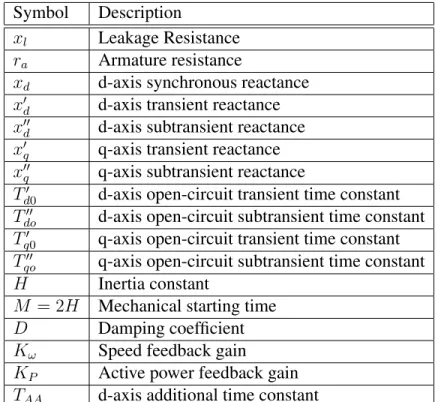
z comprises the observed variables. The variables involved in the these vectors are de-scribed briefly in Table 2.2. The sixth order dynamics of the Park-Concordia model for
Symbol Description
xl Leakage Resistance ra Armature resistance
xd d-axis synchronous reactance x0d d-axis transient reactance x00d d-axis subtransient reactance x0q q-axis transient reactance x00q q-axis subtransient reactance
Td00 d-axis open-circuit transient time constant Tdo00 d-axis open-circuit subtransient time constant Tq00 q-axis open-circuit transient time constant Tqo00 q-axis open-circuit subtransient time constant H Inertia constant
M = 2H Mechanical starting time D Damping coefficient Kω Speed feedback gain
KP Active power feedback gain TAA d-axis additional time constant
Table 2.1: Synchronous generator parameters
Symbol Description
δ Rotor angle
ω Rotor speed
e0q q-axis transient voltage e0d d-axis transient voltage e00q q-axis subtransient voltage e00d d-axis subtransient voltage Pe Electrical demand(load) power Pm Mechanical power input v∗f Field voltage
θ Bus voltage phase angle V Bus voltage magnitude
P Net active power injection at bus Q Net reactive power injection at bus
synchronous generators is described by the following set of differential equations. ˙ δ= Ωb(ω−1) ˙ ω = (Pm−Pe−D(ω−1))/M ˙ e0q = (−fs(e0q)−(xd−x0d− Tdo00 T0 do x00d x0 d (xd−x0d))id+ (1− TAA T0 do vf∗)/Tdo0 ˙ e0d= (−e0d+ (xq−x0q− Tqo00 T0 qo x00q x0 q (xq−x0q))iq)/Tqo0 ˙ e00q = (−e00 q+e 0 q−(x 0 d−x 00 d+ Tdo00 Tdo0 x00d x0d(xd−x 0 d))id+ TAA Tdo0 v ∗ F)/T 00 do ˙ e00d = (−e00d+ed0 + (x0q−x00q +T 00 qo T0 qo x00q x0 q (xq−x0q))iq)/Tqo00 (2.9)
The power balance equation is as follows.
Pe= (vq+raiq)iq+ (vd+raid)id (2.10)
Coupling equations between the generator and the bus are given in Eq. (2.11). 0 = vq+raiq−e0q+ (x
0
d−xl)id 0 = vd+raid−(xq−xl)iq
(2.11)
The slack generator is simulated using the fifth order model which assumes that e0d = 0 andxq=x0q.
2.4 Controls
2.4.1 Turbine governor
Turbine governors provide the primary frequency regulation for synchronous genera-tors. Turbine governors are simulated using the type I model in PSAT [2]. The parameters of the type I turbine governor of Fig. 2.3 are defined in Table 2.3.
Figure 2.3: PSAT type I turbine governor [1]
Symbol Description
R Droop
Tmax Maximum turbine output Tmin Minimum turbine ouptut Ts Governor time constant Tc Servo time constant
T3 Transient gain time constant
T4 Power fraction time constant
T5 Reheat time constant
Table 2.3: Synchronous generator variables
The set of equations corresponding to Fig. 2.3 are provided below. Tin∗ =Torder + 1 R(ωref −ω) Tin= Tin∗, Tmin ≤Tin∗ ≤Tmax Tmax, Tin∗ > Tmax Tmin, Tin∗ < Tmin ˙ t1 = (Tin−t1)/Ts ˙ t2 = ((1− T3 Tc t1−t2)/Tc ˙ t3 = ((1− T4 T5 )(t2+ T3 Tc t1)−t3)/T5 (2.12)
Figure 2.4: IEEE std model I AVR [1]
In Eq. (2.12), the variableTmechis equivalent to the mechanical power input to the gener-ator,Pmin Table 2.1.
2.4.2 Automatic voltage regulator
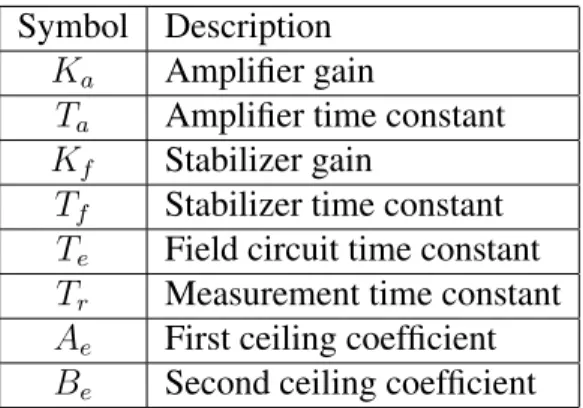
AVR provides the primary voltage regulation in power system. The IEEE standard model I AVR is illustrated in Fig. 2.4. The parameters used to model the AVR are specified in Table 2.4.
The ceiling function,Se(vf)which characterizes the saturation of the exciter, is given by:
Se(vf) = Ae(eBe|vf|−1) (2.13)
Symbol Description Ka Amplifier gain
Ta Amplifier time constant Kf Stabilizer gain
Tf Stabilizer time constant Te Field circuit time constant Tr Measurement time constant Ae First ceiling coefficient Be Second ceiling coefficient
Table 2.4: AVR parameters
˙ vm = (v−vm)/Tr ˙ vr1 = (Ka(vref −vm−vr2− Kf Tf vf)−vr1)/Ta vr = vr1, vrmin ≤vr1 ≤vrmax vrmax, vr1 > vrmax vrmin, vr1 < vrmin ˙ vr2 =−( Kf Tf vf +vr2)/Tf ˙ vf =−(vf(1 +Se(vf))−vr)/Te (2.14) 2.5 Load
The load considered is a PQ load, which is characterized by constant active and re-active powers. After finding the initial power flow solution, i.e. before the time-domain simulation, these are converted to constant impedances.
2.6 Power Flow
is to find the solution to a set of nonlinear equations of the form: ˙
x=0 =f(x, y) 0 =g(x, y)
(2.15)
where the algebraic expressions g (g ∈ Rm) represent the power flow/balance equa-tions, andf (f ∈ Rn) represents the differential equations. Correspondingly,y(y∈ Rm) comprises algebraic variables such as bus voltages and power flows whilex (x ∈ Rn) is the vector of state variables. The solution to the power flow problem is obtained using the Newton-Raphson method [8]. In brief, the algorithm involves iteratively updating the Jacobian of Eq. 2.15 and solving the following linear problem:
∆xi ∆yi =− Fi x −Fyi Gi x Giy −1 fi gi xi+1 yi+1 = xi yi + ∆xi ∆yi (2.16)
whereFx =∇xfx,Fy = ∇yfy, Gx =∇xgxandGy =∇ygy. The algorithm is stopped once the increments∆xand∆ybecome lower than some pre-decided tolerance level, or if the maximum number of iterations is reached.
3. DYNAMIC STATE ESTIMATION
3.1 Notation
The relevant variables defined at sample timek are given in Table 3.1.
xk The state vector
uk The control input vector
zk The incoming measurement vector ˆ
xk|k A filtered vector: state estimate updated using current measurement ˆ
x(k+1)|k A predicted state estimate
Table 3.1: DSE variables for time instantk
3.2 Why DSE?
It has been established that PMU sensing can pave the way for dynamic state estima-tion. However, I am yet to justify the necessity of DSE. The prime advantage of Kalman filtering based DSE is the ability to predict the state of the system. This predictive capa-bility can further be used in preventive control strategies, and load forecasting. When it comes to bad data detection, specifically gross measurement errors, DSE offers promis-ing options. For instance, the detection can be performed by comparpromis-ing the measurement values with the corresponding prediction. A few such DSE ’pre-filtering’ methods have been proposed (Nishiya et al. [4], Leite da Silva [5]). It might also make the system robust to short periods of unobservability, since, pseudo-measurements can be obtained from the predictionxˆk|(k−1).
3.3 Limitations of DSE
There are two main obstacles to the physical implementation of DSE in large scale power systems. Firstly, it is challenging to find a model that is sufficiently accurate yet simple enough for practical application. Additionally, the computational complexity of Kalman filtering approach is proportional ton3,nbeing the size of state vector. This work addresses the former concern, i.e, the lack of an accurate model by relying instead on PMU data. The algorithm can be sped up by utilizing sparse matrix operations and parallelizing computations (Karimipour et al. [9]).
3.4 Kalman Filtering
Consider a dynamic system modeled by a set of nonlinear equations. xk =g(xk−1) +k−1
k−1 ∼ N(0, Qk−1)→Process Noise
(3.1)
The measurements at time instantk are represented as a vector of non-linear functions of the state variablesx.
zk=h(xk) +δk
δk∼ N(0, Rk)→Measurement Noise
(3.2)
Initially, non-linear estimation problems were solved by a variant of the Kalman filter, namely the Extended Kalman Filter (EKF). EKF uses an approximate linearization of the system based on the Taylor series expansion ofg(x). It also uses the Jacobian matrices of nonlinear functionsgandh, which may require complex computation and may not always exist. Subsequently, extensions and generalizations have been developed for the Kalman filtering of nonlinear systems. One such algorithm is the Unscented Kalman Filter. When
g and h are highly nonlinear, EKF can perform poorly [10]. The UKF is seen to more accurately determine the mean and covariance, for certain systems [11]. Moreover, UKF does not involve Jacobian calculations which are far from trivial for a complex system. 3.4.1 Unscented transform
Consider then-dimensional estimate xas having a Gaussian distribution with mean µ and covariance Σ. Unscented transformation involves sampling the distribution over the estimate at specific ’sigma’ points. The sampling is not random, but rather has a specific algorithm that results in a sample mean and covariance of µandΣ respectively. Specifically, the sampling is:
X0 =µ
Xi =µ+ (p
(n+λ)Σ)i fori= 1,2, ..., n Xi =µ−(p(n+λ)Σ)i−nfori=n+ 1, ...,2n
(3.3)
where,(p(n+λ)Σ)iis theithcolumn of the matrix square root andλis a weight param-eter that controls how far apart the sample points lie.
The sampled points are subsequently passed throughg (orh), thereby analyzing how the noise-free system changes the shape of the Gaussian. The parameters of the resulting Gaussian approximation are extracted from the mapped pointsYi =g(Xi)as follows.
µ0 = 2n X i=0 wiYi (3.4) Σ0 = 2n X i=0 wi(Yi−µ0 )(Yi−µ0 )T (3.5)
where the weightswi are chosen according to the following equations.
w0 = λ
n+λ (3.6)
wi = 1
2(n+λ)f or i = 1,2, ...2n (3.7) 3.4.2 Unscented Kalman filter
Let the initial state mean and covariance bemo andΣo respectively. The UKF algo-rithm has two stages.
Prediction
• Sample the posterior distribution of the previous estimate at2n+ 1sigma points:
Xk−1 = (µk−1 µk−1+γ p
Σk−1 µk−1−γ p
Σk−1) (3.8)
• Pass sigma points,Xk−1 through process functiong :Xk¯ =g(Xk−1)
• Compute the predicted state by extracting a Gaussian distribution from X¯k with mean and covariance:
ˆ µk = 2n X i=0 wmi X¯i k (3.9) ˆ Σk = 2n X i=0 wmi ( ¯Xi k−µˆk)( ¯Xki−µˆk)T +Qk−1 (3.10) Update
• Sample the posterior distribution of the prediction at2n+ 1sigma points:
ˆ Xk = (ˆµk µkˆ +γ q ˆ Σk µkˆ −γ q ˆ Σk) (3.11)
• Pass the sigma points,Xˆkthrough observation functionh:Zˆk =h( ˆXk)
• Compute the predicted observation by extracting a Gaussian distribution from Zˆk with mean and covariance:
ˆ zk = 2n X i=0 wimZˆki (3.12) Sk = 2n X i=0 wic( ˆZki −zˆk)( ˆZki −zˆk)T +Rk (3.13) (3.14)
• Compute the cross covariance between the sigma points,XˆkandZˆk.
ˆ Σx,zk = 2n X i=0 wci( ˆXi k−µˆk)( ˆZki −zˆk)T (3.15) • Kalman gain: Kk= ˆΣx,zk S −1 k • State estimate: µk = µkˆ +Kk(zk−zkˆ) (3.16) Σk = Σˆk−KkSkKkT (3.17)
4. GAUSSIAN PROCESSES AND GP-UKF
4.1 Gaussian Processes
Modeling time-series data is challenging, because it is difficult to determine a model which can capture the nonlinearities of the data without overfitting. The use of Gaussian process (GP) to model nonlinear dynamics is inspired by the fact that averaging over non-linear regression models tends to a GP model. Gaussian processes have been used as a nonlinear regression tool in many applications. For instance, Girard et al. used GPs for multiple-step ahead prediction for time-series data [12]. In fact, GPs have proved to be successful tools in complex nonlinear problems like tracking 3D human figures (Siden-bladh et al. [13]).
4.1.1 Advantages of GP models
The application of a GP model to machine learning problems is inspired by the follow-ing features.
• They are an easily adaptable non-parametric Bayesian modelling tool for supervised learning problems.
• Given the hyperparameter values (spread of the Gaussian kernel and the peak lo-cation), they can be optimized exactly. This allows for fine-tuning of the trade-off between fitting of data and smoothing.
• They are especially reliable on small datasets because of this fine-tuned smoothing and reasonably low computational burden.
4.1.2 Limitations of GP
They do not scale well. The computational burden is O(n3), so if the number of
features exceeds a few dozens, they might not be an efficient strategy. However, there are tricks for dimensionality reduction which might improve their applicability to high-dimension data.
4.1.3 GP for machine learning
Consider a general noisy observation of the form:
yi =f(xi) +, xi ∈ <n (4.1)
where ∼ N(0, σn2)is noise andyiis a scalar Let
X = [x1,x2, ...,xn] y = [y1, y2, ..., yn].
Then the distribution onyis given by Eq. (4.2).
p(y|X,Θ) =N(0, K(X, X) +σn2I) (4.2)
K(X,X)is a kernel matrix such thatKij =k(xi,xj),k being a kernel function based on
the measure of closeness between input vectors. The kernel function used to describe the GPs in this thesis, is the squared exponential kernel given below.
k(x,x0) =σf2exp(−(x−x
0)W(x−x0)T
In Eq. (4.3),W is a diagonal matrix of the length scaling factors for each input dimension. Learning GP Hyperparameters
The GP hyperparameterΘ = [W, σ2
f, σ2n]can be learned by maximizing the log likelihood of the training outputs given the inputs.
Θmax =argmax
Θ log(p(y|X,Θ)) (4.4)
The optimization problem in Eq. (4.4) can be solved in a number of ways, such as using conjugate gradient descent [14].
log p(y|X,Θ) =−1 2y T Ky−1y− 1 2log|Ky| − n 2log2π (4.5) whereKy =K(X,X) +σn2I.
Each of the three terms has a recognizable interpretation. The first term is the only one involving the targety, and is responsible for data fitting. The termlog|Ky|/2serves as a complexity penalty, andn log2π/2is a normalization constant.
The partial derivative of the objective function with respect to the hyperparameters is given below. ∂ ∂θj log p(y|X,Θ) = 1 2y T Ky−1∂Ky ∂θj Ky−1y−1 2tr(K −1 y ∂Ky ∂θj ) = 1 2tr((αα T −K−1 y ) ∂Ky ∂θi ) (4.6) whereα =K−1 y y OnceK−1
y is known, the computational complexity of Eq. (4.6) isO(n2)per hyper-parameter. Due to the relatively small computational overhead of computing derivatives, gradient based optimizer is apt for training the GP.
GP prediction
At a test pointx∗, the predicted observationy∗ has a Gaussian distribution with mean,
GPµ(x∗, D) = k∗T[K+σn2I]
−1y (4.7)
and covariance matrix,
GPΣ(x∗, D) = k(x∗,x∗)−k∗T[K+σn2I]−1k∗ (4.8)
where,k∗ =k(x∗,X). 4.2 GP-UKF
The GP-UKF algorithm is fundamentally similar to UKF but with one major differ-ence. In place of g, I use the GP approximation GPg and in place of the observation function, GPh. To determine these approximations, I collect training data. These exam-ples are used to learn the hyperparameters that define the GP.
4.2.1 Learning prediction and observation models
The training data comprises the following. Prediction data set: Dg =h(X, U), X0i Observation data set: Dh =h(X, Z)i
where X is the matrix of ground truth states, X0 = [∆x1,∆x2, ....∆xk]is the matrix of state transitions when applying the controls inU. Z is the matrix of observations.
GP approximation of functionsg andhareGPg andGPhrespectively. xk =GPµg([xk−1, uk−1], Dg) +k zk =GPµh(xk, Dh) +δk k ∼ N(0, GPΣg([xk−1, uk−1], Dg)) δk ∼ N(0, GPΣh(xk, Dh)) (4.9)
Each GP has a single global noise parameterσn. A separate GP must be learned for each output dimension. The resulting separate variances are collected on the diagonal of a Variance matrix.
4.2.2 The algorithm Data:
• (µk−1,Σk−1, uk−1, zk)
• Prediction model training data: Dg • Observation model training data: Dh Result:µk,Σk
Sigma pointsXk−1 = (µk−1 µk−1+γ √ Σk−1 µk−1−γ √ Σk−1); fori= 0, . . . ,2ndo ¯ Xi k =GPµ(uk−1,Xk−i 1, Dg); end Qk =GPΣ(uk−1, µk−1, Dg); ˆ µk =P2i=0n wmi X¯ki; ˆ Xk = (ˆµk µˆk+γ p ˆ Σk µˆk−γ p ˆ Σk); fori= 0, . . . ,2ndo ˆ Zi k =GPµ( ˆXki, Dh); end Rk =GPΣ(ˆµk, Dh); ˆ zk=P2i=0n wimZˆki ; Sk =P2i=0n wci( ˆZki −zˆk)( ˆZki −zˆk)T +Rk; ˆ Σx,zk =P2i=0n wi c( ˆXki−µˆk)( ˆZki −zˆk)T ; Kk = ˆΣx,zk S −1 k ; µk = ˆµk+Kk(zk−zˆk); Σk = ˆΣk−KkSkKkT ;
5. EVALUATION OF GP-UKF DYNAMIC STATE ESTIMATOR
5.1 Simulation Data
The estimator has been evaluated on the IEEE 14-bus test case shown in Fig. 5.1. The complete data for the IEEE 14 bus system is given in Appendix A.
Firstly, the system must be initialized. This is done by running power flow operation on PSAT for the system. This finds the steady state solution for the various currents, voltages and power flows within the system. The results of power flow are listed in Appendix B.
5.1.1 Collecting training data
It is desirable to collect training data which reflects the dynamic behavior of the system. The idea is to simulate a sudden change in network topology which will cause the system to go into transient state. Multiple such stimulants can be given over a short period to get small amounts of varied data. A simple scenario that was utilized for this purpose involved opening both circuit breakers on the lines between bus 2 and bus 3, and between bus 2 and bus 4 at time, t = 1 second.
5.2 Training the Gaussian Process Model
The training data is used to ’infer’ the posterior distribution on the process and ob-servation functions, i.e. p(g|Dg) and p(h|Dh) respectively. The GPML toolbox [15] is equipped with a few inference methods.
5.2.1 Exact inference
By imposing a Gaussian likelihood on the training data, it is possible to perform exact inference of the posterior. In fact, the inference problem reduces to simply computing the mean and covariance of a multivariate Gaussian distribution. This can be done using basic
matrix algebra.
5.2.2 The hyperparameters
Covariance function
A covariance function kψ : X x X → R with hyperparameters ψ is defined for every GP f. It computes the covariance kψ(xi,xj) = E[(f(xi) − m(xi))(f(xj)− m(xj))]
between inputsxiandxj. The covariance function used is the squared exponential function
with automatic relevance detection, along with an additive measurement noise component. Mathematically, the covariance function is given as:
k(x,y) =σf2exp((x−y)TP−1(x−y)) +σn2δ(x−y) (5.1)
where the relevance matrix isP = Λ2,Λ =diag(λ), λ ∈ RD
+. Thus, the hyperparameters
to be trained areψ ={λ, σf, σn}. 5.3 Training Phase
The trained estimator is first evaluated on the training data. The data for training is generated by opening circuit breakers on two lines - one between bus 2 and bus 4 and the other between bus 2 and bus 3, both at t = 1 second. The corresponding RMS error is plotted in Fig. 5.2f. The maximum training error reached is 1.53%. Thus, the GP model fits the training data with a 98.4% accuracy.
5.4 Validation Phase
Validation is a technique used to decide between models or external fixed parameters. The data is split into training samples and validation sets. The trained estimators are evaluated based on the errors observed with the validation set. The estimator with the best performance is picked for testing. This strategy is used to pick between a handful of inference models, mean functions and covariance functions. It is also used to pick a
(a) Synchronous generator at bus 1 (b) Synchronous generator at bus 2
(c) Synchronous generator at bus 3 (d) Synchronous generator at bus 6
(e) Synchronous generator at bus 8 (f) RMS error
Figure 5.2: Training phase: Estimated (in red) and true (in blue) states - rotor angle and speed of synchronous machines at buses 1, 3, 2, 8 and 6 respectively.
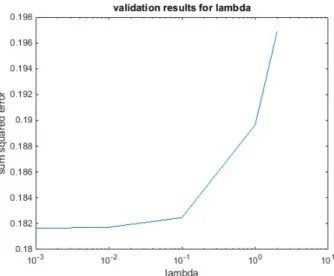
good value for the weight parameter λ. Recall that, λ determines the spacing between consecutive samples in the procedure for unscented transform. Larger λ values would mean that samples are farther apart and capture more outlier data. However, these might perform poorly since outlier scenarios are rarer. Thus, there is a trade-off between fitting and generalization. This point is highlighted in the Fig. 5.3. Based on the validation error observed for different states, a value ofλ= 0.1is picked.
Figure 5.3: Sum squared error over all samples for the state variableδ(generator at bus 1) for different values ofλ
5.5 Testing Conditions
5.5.1 Scenario 1: Topology change
Once I arrive at a set of learned hyperparameters, I start to evaluate the performance of the particular GP. To do this, I simulate scenarios which differ in general pattern from the training data. The first such scenario is a topology change using circuit breakers. Specifically, the opening of a breaker on the line between bus 2 and bus 4 at t = 1 second.
Additionally, the circuit breaker on the line between bus 2 and bus 3 is opened at t = 10 seconds. The measurement data is collected over a span of 20 seconds. These are then sequentially fed as input to the estimator. At each time step, a new estimate of the state is generated. The time sequence of state estimate is plotted and compared against the true state supplied by PSAT. The relative RMS error over all the states is plotted and the maximum error is determined. At each time step, the relative error between the true and estimated value is calculated for every state variable. The RMS value of these relative errors is plotted against time in Fig. 5.4f. The error is seen to reach a maximum of 5.4%. 5.5.2 Scenario 2: Parametric uncertainty
In order to evaluate the robustness of the trained estimator to changes in generator pattern, I introduce parametric uncertainty in generator parameters. One such experiment involves changing the parameters of the synchronous generator at bus 8. The estimator is trained on dynamic behaviour data obtained upon opening breakers between bus 2 and bus 3, and between bus 2 and bus 4 at t = 1 second. The testing scenario is the same as that used in scenario 1, but with perturbed generator parameters. For the synchronous machine at bus 8, the inertia constant is increased by 50% and damping ratio is halved. The performance of the estimator is illustrated in Fig. 5.5. The RMS error over the state variables reaches a maximum of 5.4%, giving an accuracy of 94.6% in RMS terms. 5.5.3 Scenario 3: Noisy measurements
The IEEE standard for synchrophasor measurement does not specify noise character-istics or distribution. Typically, zero-mean additive Gaussian noise is assumed. A wide range of SNRs has been used to simulate noisy PMU measurements. Publications such as, [16], [17], [18], [19] use a standard deviation of 0.002, 0.02, 0.15, 0.03 pu respectively. An SNR of 92 dB has been used by Xie et al. [20]. A more recent paper by Brown et al.
(a) Synchronous generator at bus 1 (b) Synchronous generator at bus 3
(c) Synchronous generator at bus 2 (d) Synchronous generator at bus 8
(e) Synchronous generator at bus 6 (f) RMS error
Figure 5.4: Scenario 1: Estimated (in red) and true (in blue) states - rotor angle and speed of synchronous machines at buses 1, 3, 2, 8 and 6 respectively
(a) Estimated (in red) and true (in blue) states
-rotor angle and speed of generator at bus 8 (b) RMS error
Figure 5.5: Scenario 2: Parametric uncertainty
To see the impact of noisy measurements on the estimation scheme, noise is added to the voltage measurement at bus 8. An SNR of 65 dB is considered when adding zero-mean Gaussian noise to the measurement. This is done in addition to the opening of breakers on lines between bus 2 and bus 4 and that between bus 2 and bus 3 at 1 second and 10 seconds respectively. The RMS error over all the states for estimation with SNR 65 dB for bus 8 voltage measurement is given in Fig. 5.6f. The RMS error is below 2.2% after the initial estimation steps.
(a) Synchronous generator at bus 1 (b) Synchronous generator at bus 3
(c) Synchronous generator at bus 2 (d) Synchronous generator at bus 8
(e) Synchronous generator at bus 6 (f) RMS error
Figure 5.6: Scenario 3: Estimated (in red) and true (in blue) states - rotor angle and speed of synchronous machines at buses 1, 3, 2, 8 and 6 respectively.
5.5.4 Scenario 4: Load perturbations
Changes in the loading conditions could be another cause for change in the system state. A good estimator would be able to predict the state even in the presence of load perturbations. To evaluate the performance of the GP-UKF estimation scheme, I employ the following methodology. First, I train the estimator as usual using the data collected over a time span of 20 seconds. During this period, I open the breakers on lines between bus 2 and bus 3, and between bus 2 and bus 4 at time, 1 second. Once the GP has been has been optimized to the training data, I test the estimator under altered conditions. In addition to the opening of breakers as described above, the load profile at bus 2 is changed in the following manner. Starting at t = 0, the active load at bus 2 is increased linearly at a rate of 0.217 p.u./s. The load is held constant once it reaches a value of 0.217 p.u. The estimated rotor angle and rotor speed is compared with the true values generated by PSAT as shown in Fig.5.7. The RMS value over the relative errors of all states is plotted in Fig. 5.7f. An overall accuracy of at least 96% is indicated by the RMS error.
(a) Synchronous generator at bus 1 (b) Synchronous generator at bus 3
(c) Synchronous generator at bus 2 (d) Synchronous generator at bus 8
(e) Synchronous generator at bus 6 (f) RMS error
Figure 5.7: Scenario 4: Estimated (in red) and true (in blue) states - rotor angle and speed of synchronous machines at buses 1, 3, 2, 8 and 6 respectively.
6. CONCLUSIONS
The current standard for state estimation, based on a snapshot of the system, is per-formed every few minutes. No relevance is given to how the system evolves over time. Dynamic state estimation has been studied and envisioned as a realizable alternative. The predictive capabilities of Kalman filtering techniques provide information for preventive control. Additional benefits are improvements in observability analysis, bad data detec-tion and detecdetec-tion of topology errors. Up until a decade ago, state estimadetec-tion relied on SCADA measurements which were too far apart to perform dynamic state estimation. But with the widespread deployment of PMUs, system operators are privy to vast amounts of measurement data delivered every few milliseconds. However, dynamic state estimation remains an impractical functionality because it is difficult to find good models for large transmission networks.
This thesis investigates a data-driven approach to dynamic state estimation which could circumvent the need to model large, complex systems.
6.1 Contributions
This thesis studies and investigates the application of the GP-UKF algorithm for dy-namic state estimation based solely on measurement and input data. By employing this algorithm, I avoid determining a model for the system, while retaining the benefits of Kalman filtering. The algorithm is evaluated on a simulated IEEE 14 bus test system.
Network topology changes. The estimator performs reasonably well when network switching occurs through the operation of breakers placed on specific lines. It is able to estimate the state of the network with an accuracy of 94.6%.
simulated as a test case. The estimator performed just as well as it did with the network switching alone.
Noisy measurement.The measurements were corrupted with additive white Gaussian noise with SNR = 65 dB. The estimator performed at an accuracy rate of 97.8% when the noise was added to a single measurement.
Load perturbation. To determine how the estimator performs with the system under load perturbation, the active PQ load at a single bus is changed continuously over a short interval. The GP-UKF estimate matched the true state with a 96% accuracy.
Over all the scenarios and states, the largest error seen was in the tune of 5.5%. The estimation scheme is moderately accurate with the added advantage of not requiring a dynamic model of the system.
6.2 Limitations and Future Research
The estimation has shown some promising results, however it is not without some concerns. Each run of dynamic state estimation on an Intel i7-6500U CPU @2.50 GHz takes on average 1.5 seconds. PMU measurements are captured every few milliseconds. Parallel GPU implementation could cut this processing time by 90%, but that might still not be at par with the measurement rate. Some form of dimensionality reduction may become necessary to operate at an optimum rate.
The implementation itself is not without a few issues. Larger systems with renewable penetration might behave differently than the IEEE 14-bus test system. However, this thesis aims to initiate research into a more data-driven approach to state estimation in power networks, so that we may fully exploit the capabilities of PMU sensing technology.
REFERENCES
[1] F. Milano, “Power system analysis toolbox,”Documentation for PSAT version 2.0.0, February 2008.
[2] F. Milano, “An open source power system analysis toolbox,”IEEE Transactions on Power Systems, vol. 20, pp. 1199 – 1206, August 2005.
[3] F. C. Schweppe and J. Wildes, “Power system static state estimation - part i, ii iii,” IEEE Transactions on Power Apparatus and Systems, vol. 89, pp. 120–135, January 1970.
[4] K. Nishiya, J. Hasegawa, and T. Koike, “Dynamic state estimation including anomaly detection and identification for power systems,”Proc. lEE, vol. 129, no. 5, pp. 192– 198, 1982.
[5] A. M. Leite da Silva, M. B. do Coutto Filho, and J. M. C. Cantera, “An efficient dy-namic state estimation algorithm including bad data processing,”IEEE Transactions on Power Systems, vol. 2, no. 4, pp. 1050–1058, 1987.
[6] J. Wang, A. Hertzmann, and D. M. Blei, “Gaussian process dynamical models,” Ad-vances in Neural Information Processing Systems 18, pp. 1441–1448, 2006.
[7] J. Ko, D. J. Kleint, D. Fox, and D. Haehnelt, “GP-UKF: Unscented Kalman filters with Gaussian process prediction and observation models,” Proc. of the IEEE/RSJ International Conference on Intelligent Robots and Systems (IROS 2007).
[8] W. F. Tinney and C. E. Hart, “Power flow solution by Newton’s method,” IEEE Transactions on Power Apparatus and Systems, vol. PAS-86, pp. 1449–1460, November 1967.
[9] H. Karimipour and V. Dinavahi, “Extended Kalman filter-based parallel dynamic state estimation,” IEEE Transactions on Smart Grid, vol. 6, no. 3, pp. 1539–1549, 2015.
[10] S. Julier and J. Uhlmann, “A new extension of the Kalman filter to nonlinear sys-tems,”Proc. of AeroSense: The 11th International Symposium on Aerospace/Defense Sensing, Simulation and Controls, 1997.
[11] F. Gustafsson and G. Hendeby, “Some relations between extended and unscented Kalman filters,” IEEE Transactions on Signal Processing, vol. 60, no. 2, pp. 545– 555, 2012.
[12] A. Girard, C. E. Rasmussen, J. Q. Candela, and R. Murray-Smith, “Gaussian process priors with uncertain inputs - application to multiple-step ahead time series forecast-ing,”Proc. NIPS, vol. 15, pp. 529–536, 2003.
[13] H. Sidenbladh, M. J. Black, and D. J. Fleet, “Stochastic tracking of 3D human figures using 2D motion,”European Conference on Computer Vision, pp. 702–718, 2000. [14] C. Rasmussen and C. Williams,Gaussian processes for machine learning. The MIT
Press, 2005.
[15] C. E. Rasmussen and H. Nickisch, “The gpml toolbox version 4.0,” October 2016. [16] D. Shi, D. Tylavsky, and N. Logic, “An adaptive method for detection and
correc-tion of errors in PMU measurements,” IEEE Transactions on Smart Grid, vol. 3, pp. 1575–1583, December 2012.
[17] E. Ghahremani and I. Kamwa, “Local and wide-area PMU-based decentralized dy-namic state estimation in multi-machine power systems,” IEEE Transactions on Power Systems, vol. 31, no. 1, pp. 547–562, 2016.
[18] Q. Huang, L. Shao, and N. Li, “Dynamic detection of transmission line outages using hidden Markov models,”IEEE Transactions on Power Systems, vol. 31, no. 3, pp. 2026–2033, 2015.
[19] N. Zhou, “A cross-coherence method for detecting oscillations,” IEEE Transactions on Power Systems, vol. 31, no. 1, pp. 623–631, 2016.
[20] L. Xie, Y. Chen, and P. R. Kumar, “Dimensionality reduction of synchrophasor data for early event detection: Linearized analysis,”IEEE Transactions on Power Systems, vol. 29, p. 2784â ˘A ¸S2794, November 2014.
[21] M. Brown, M. Biswal, S. Brahma, S. J. Ranade, and H. Cao, “Characterizing and quantifying noise in PMU data,” Power and Energy Society General Meeting (PESGM), 2016.
APPENDIX A
SIMULATION DETAILS OF NETWORK COMPONENTS
Bus Power voltage Active Reactive Vmax Vmin
number rating(MVA) rating(kV) power(p.u.) power(p.u.) (p.u.) (p.u.)
11 100 13.8 0.035 0.018 1.2 0.6 13 100 13.8 0.135 0.058 1.2 0.6 3 100 69 0.942 0.19 1.5 0.8 5 100 69 0.076 0.016 1.2 0.6 2 100 69 0.217 0.127 1.2 0.8 6 100 13.8 0.112 0.075 1.5 0.6 4 100 69 0.478 0.04 1.2 0.6 14 100 13.8 0.149 0.05 1.2 0.5 12 100 13.8 0.061 0.016 1.2 0.6 10 100 13.8 0.09 0.058 1.2 0.6 9 100 13.8 0.295 0.166 1.2 0.6
Table A.1: Simulation details of PQ loads
Bus Power Voltage Voltage Qmax Qmin Vmax Vmin number rating rating magnitude
(MVA) (kV) (p.u.) (p.u.) (p.u.) (p.u.) (p.u.)
6 100 13.8 1.07 0.24 -0.06 1.0701 0.6
3 100 69 1.01 0.4 0 1.0101 0.6
8 100 18 1.09 0.2517 -0.06 1.0901 0.6
Bus Power Voltage Active Voltage Qmax Qmin Vmax Vmin number rating rating power magnitude
(MVA) (kV) (p.u.) (p.u.) (p.u.) (p.u.) (p.u.) (p.u.)
2 100 69 0.4 1.045 0.5 -0.4 1.0451 0.8
Table A.3: Simulation details of PV generator
Entity Gen1 Gen2 Gen3 Gen4 Gen5
Bus number 1 3 2 8 6 xl 0.2396 0 0 0.134 0.134 ra 0 0.0031 0.0031 0.0014 0.0014 xd 0.8979 1.05 1.05 1.25 1.25 x0d 0.2998 0.185 0.185 0.232 0.232 x00d 7.4 6.1 6.1 4.75 4.75 xq 0.646 0.36 0.36 0.715 0.715 x0q 0.4 0.13 0.13 0.12 0.12 x00q 0 0.3 0.3 1.5 1.5 Td00 0.03 0.04 0.04 0.06 0.06 Tdo00 0.646 0.98 0.98 1.22 1.22 Tq00 0.033 0.0990 0.099 0.21 0.21 Tqo00 10.296 13.08 13.08 10.12 10.12 M 2 2 2 2 2 D 1 1 1 1 1
Table A.4: Simulation details of synchronous generators
Bus ωref R Tmax Tmin Ts Tc T3 T4 T5
number (p.u.) (p.u.) (p.u.) (p.u.) (s) (s) (s) (s) (s)
2 1 0.02 1.2 0.3 0.1 0.45 0 12 50
1 1 0.02 1.2 0.3 0.1 0.45 0 12 50
Entity Gen1 Gen2 Gen3 Gen4 Gen5 Bus number 1 3 2 8 6 Vr,max 7.32 4.38 4.38 6.81 6.81 Vr,min 0 0 0 1.395 1.395 Ka 200 20 20 20 20 Ta 0.02 0.02 0.02 0.02 0.02 Kf 0.002 0.001 0.001 0.001 0.001 Tf 1 1 1 1 1 Tc 0.2 1.98 1.98 0.7 0.7 Tr 0.001 0.001 0.001 0.001 0.001 Ae 0.0006 0.0006 0.0006 0.0006 0.0006 Be 0.9 0.9 0.9 0.9 0.9
APPENDIX B
INITIAL POWER FLOW SOLUTION
This section gives the initialization of the network variables based on the steady-state solution of system equations.
Bus Voltage Voltage Active Reactive number magnitude phase power power
(p.u.) angle (rad) (p.u.) (p.u.)
1 1.06 0 2.3258 -0.14978 2 1.045 -0.0871 0.183 0.36124 3 1.01 -0.22267 -0.942 0.08373 4 1.012 -0.1785 -0.478 -0.04 5 1.016 -0.15273 -0.076 -0.016 6 1.07 -0.25161 -0.112 0.1501 7 1.0493 -0.23091 0 0 8 1.09 -0.23091 0 0.25163 9 1.0328 -0.25853 -0.295 -0.166 10 1.0318 -0.26223 -0.09 -0.058 11 1.0471 -0.25897 -0.035 -0.018 12 1.0534 -0.26645 -0.061 -0.016 13 1.047 -0.2671 -0.135 -0.058 14 1.0207 -0.28018 -0.149 -0.05
Symbolic Gen1 Gen2 Gen3 Gen4 Gen5 variable δ 0.21704 -0.22363 0.24427 -0.2315 -0.25217 ω 1 1 1 1 1 e0q 1.0515 1.0954 1.1676 1.3104 1.2708 e0d - 0.00024 0.19109 0.00027 0.00023 e00q 1.0476 1.0687 1.1119 1.2008 1.171 e00d 0.08692 0.00037 0.29742 0.00059 0.00052
![Figure 2.1: The π model for transmission line [1]](https://thumb-us.123doks.com/thumbv2/123dok_us/1359439.2681900/13.918.311.634.680.846/figure-π-model-transmission-line.webp)
![Figure 2.2: Park-Concordia model for synchronous machine [1]](https://thumb-us.123doks.com/thumbv2/123dok_us/1359439.2681900/15.918.323.629.139.457/figure-park-concordia-model-for-synchronous-machine.webp)
![Figure 2.3: PSAT type I turbine governor [1]](https://thumb-us.123doks.com/thumbv2/123dok_us/1359439.2681900/19.918.198.747.152.257/figure-psat-type-i-turbine-governor.webp)
![Figure 2.4: IEEE std model I AVR [1]](https://thumb-us.123doks.com/thumbv2/123dok_us/1359439.2681900/20.918.195.752.135.408/figure-ieee-std-model-i-avr.webp)
![Figure 5.1: IEEE 14-bus system with legend [2]](https://thumb-us.123doks.com/thumbv2/123dok_us/1359439.2681900/35.918.156.769.249.904/figure-ieee-bus-system-with-legend.webp)