A PAN EUROPEAN INITIATIVE TO FORMULATE A
FRAMEWORK FOR BLENDED LEARNING TARGETING
CONTINUING PROFESSIONAL DEVELOPMENT IN THE
CONSTRUCTION INDUSTRY
John Wall
1, Vian Ahmed
2, Alan Hurst
3, Harald Garrecht
4, Andreas
Luckey
4, Frank McNamee
5, Alaattin Kanoglu
61
Department of Building Technology, Waterford Institute of Technology, Ireland [email protected]
2
School of Construction and Property Management, University of Salford, UK.
3
School of Architecture, Design and the Built Environment, Nottingham Trent University, UK
4
Department of Architecture and Civil Engineering, Hochschule Karlsruhe, Germany
5
Multimedia Instructional Design Ltd., Waterford, Ireland
6
Faculty of Architecture, Istanbul Technical University, Istanbul, Turkey
Abstract
Learning is a complex set of inter-related cognitive processes. In higher education changes that can be identified are the need to become more flexible in the delivery of lifelong learning opportunities to meet the needs of construction professionals and integrating e-learning technology in the delivery of these programmes. The evolution of ICT continues at a rapid rate and technological standards continue to evolve to allow for adaptability, interoperability and reuseability of online material. For higher education, the intensive resource requirements required in the development of e-learning content and the challenges in accommodating different learning styles, developing an e-learning programme can be a resource intensive exercise for higher education. Coupled with this, many e-learning initiatives have been less than successful for a number of reasons. A network of educational institutions in Europe has come together to develop a framework focused on the lifelong learning needs of engineers and other professionals in the construction industry while participants remain in employment. The main objective of this network is to establish a platform where different instructional strategies to accommodate different learning styles and cognitive processes will be developed. Other target groupings include other higher-level institutes outside of the partner institutes and professional and industrial representative bodies in the construction industry who may integrate the lessons learned into their programmes. The major expected outputs are a database of learning resources that may be integrated into CPD learning programmes delivered in a blended learning format. A methodology to formulate this framework is outlined.
Introduction
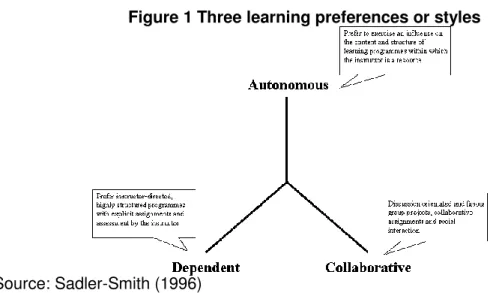
Different learners have different cognitive processes, learning style preferences and past experiences that they apply when learning takes place (Honey and Mumford, 1982; Kolb, 1984 and Riding, 1996). A review of learning styles highlights the importance in recognising that people are disparate and that everyone has their own learning style preference. An individual’s learning style will affect the manner in which information is processed during learning and thinking, having a considerable effect on the learning effectiveness and efficiency (Riding, 1996). Sadler-Smith (1996) referred to the learner as having 3 dimensions of learning preferences outlined in Figure 1.
Figure 1 Three learning preferences or styles
Source: Sadler-Smith (1996)
An understanding of how learning takes place, learning theories and consideration of learning styles can help in answering some of the issues with respect to how learning takes place (Ertmer and Newby, 1993; Buch and Sena, 2001 and Ahmed et al., 2004). The preferred learning style of the individual is important for learning to be more effective when one is considering using technology based learning for a new skill, increasing knowledge and sharing information (James-Gordon and Bal, 2001). Different cognitive style groups benefit from different types of multimedia presentation (Ghinea and Chen, 2003). A learning style inventory is used to reveal a specific preference in an individual in the identified modes of learning (Rayner and Riding, 1998).
In characterising employee-learning needs Rosenberg (2001) identified three key areas: (i) access, (ii) comprehensive approach to access and (iii) information. To address this, providers of learning opportunities to engineers also have three requirements, (i) the right information, (ii) an open culture and (iii) effective technology (Rosenberg, 2001).
All individuals learn in different ways from listening, watching, questioning, doing and helping others to learn (Rogers and Freiberg, 1994). A study by Brosnan and Burgess (2003) highlighted that 76% of professionals surveyed engaged in using the Internet to support their professional learning. In a situation where construction professionals and professional bodies are open to using technology to address their continuing professional development (CPD) requirements, the key question this project addresses is how can educational providers develop a framework or structure to meet these needs.
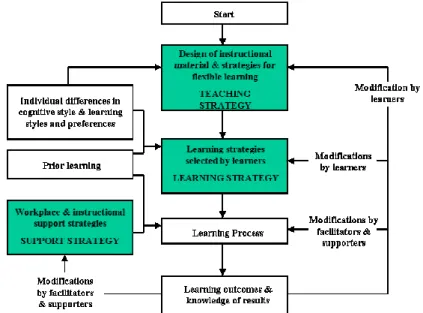
There are important challenges to be addressed in the delivery of programmes using technology to deliver the learning if the potential benefits it can offer to individuals and organisations are to be maximised (Sadler-Smith and Smith, 2004). Sadler-Smith and Smith (2004) contend that there are three separate categories of strategy development that are necessary in order to accommodate individual differences in styles and preferences in the design and implementation of flexible learning in the workplace; (i) teaching strategy, (ii) learning strategy and (iii) support strategy. These are outlined in Figure 2.
Individual differences in the way people learn and the mode of delivery interact to affect the learning process and its outcomes. Prior knowledge is one moderating variable upon the process and therefore on the outcome. The teaching strategy, learning strategy and support strategy are included as potential interventions at different stages of this flexible delivery process. Knowledge of results is considered as operating as feedback to the teaching, learning and support strategies being adjusted contingent upon the efficacy or otherwise of the learning process and its outcomes (Salder-Smith and Smith, 2004).
Figure 2 Relationships between teaching, learning and support strategies
Source: Sadler-Smith and Smith (2004) page 400
The instructor has a key role to play in facilitating the process. Tham and Werner (2005) highlight studies that indicate that instructors in an online environment must fulfil many roles or “hats”. These hats include:
A technological hat – educators must understand the application software and also the implications of technology for adopting different strategies in teaching. Using the available technology to enhance student learning is not an easy undertaking.
A pedagogical hat – with a virtual classroom the tool/applications used to monitor or raise the intellectual skills of students requires the instructor to adopt the right tools and not simply use the tools that are available. Creativity is key to design of a course that brings students closer in an online environment.
A social hat – in an online environment for the instructor to establish a rapport with students the technical communication tools should be used to establish a friendly cohesive and comfortable learning environment.
This research will endeavour to address the concerns of staff in higher education through the formulation of a strategic framework for deploying blended learning, that overcomes the barriers that exist, yet takes account of the importance of understanding learning and embracing technology in the delivery of CPD programs to address the construction industry. An appreciation and understanding of the technologies that are available to develop e-learning content is a key consideration in addressing these concerns.
Technologies in E-Learning
Technological advances and the Internet have opened up new opportunities for educational providers to configure traditional classroom and technology assisted learning to promote and encourage access to CPD learning opportunities (Klein and Ware, 2003). The facilities and capabilities offered by e-learning and technology in the delivery of training are considerable. One can now create instructional material, courseware, help systems, electronic performance support systems and provide job aids that enable the learner to do much more that just listen or read. More and more people are using the Internet to send e-mail, instant messaging, browsing, finding
entertainment information and reading news – “ … today’s students think of the Internet the way their parents and their grandparents – and even their older siblings – viewed electricity: ubiquitous and only noticeable when not available” Bruce (2003) page 24.
One key element of infrastructure that educational organisations use in the delivery of these programme is a learning management system. While there are a range of learning management systems available in the marketplace, all of them aim to deliver four main features; (i) delivery of learning content, (ii) tracking of participant performance, (iii) management of online learning and (iv) provision of tools for participant collaboration (Watson and Ahmed, 2004). Davis (2004) suggests that building the infrastructure for online learning requires that many factors be considered.
Learning how to integrate new technologies in an instructional setting, when to use it and why it should be used always lags the introduction of the technology itself (Kilby, 2001). Coupled with this, the costs that can be incurred in the development of e-learning the range of estimates vary, from small financial resources required to huge financial commitment (Mayer, 2003). The range of estimates from 50 hours to 2000 hours for developing one hour of on-line content obviously have consequences on the development and deployment of content.
In the past, large investments in technology-based initiatives in education have had less than satisfactory results (Harden, 2002). One reason for these failures has been the overemphasis on the technology without giving proper attention to the educational issues (Harden, 2002). In looking at a model or framework to avoid the lessons of the recent past Zemsky and Massy (2004) refer to one of the myths of e-learning as “if we build it they will come”. However, Chee (2002) refers to this type of approach to e-learning as:
Content + Delivery = Delivered Content
and delivered content on its own is not enough to achieve learning. Often it is in an eagerness to embrace technology that an understanding of the fundamentals of learning and how it occurs is overlooked (Hamid, 2002; Pailing, 2002 and Woodill, 2003). Gilboy (2001) stated that when the focus is taken away from the content but rather the management of the learning experience and pedagogy are considered a more appropriate view of learning is:
Pegagogy+Content+Community = Valued Learning Experience.
To avoid failure with any e-learning project one must ensure that the project is sustainable in a given socio-economic environment or business context as well as recognising the importance of instructional design considerations (Romiszowski, 2004).
Pan European Initiative
Waterford Institute of Technology in Ireland, the Nottingham Trent University in the UK, Fachhochschule Karlsruhe in Germany, Multimedia Instructional Design in Ireland and Istanbul Technical University in Turkey are collaborating in formulating a framework for deploying blended CPD aimed at the construction industry. These partners have secured funding as part of FP6 through the Minerva Action, which aims to promote European co-operation in the field of Information and Communication Technology (ICT) and Open and Distance Learning (ODL) in education. This network is taking up this challenge in a European context focusing on the construction industry.
The rational behind this project is to create an innovative international learning resource that will be widely accessible to construction management professionals thereby facilitating improved knowledge and skills within the industry. The construction industry is dynamic and standards and practices vary throughout Europe. The construction industry is a key driver in the economic progress and development of
the EU and will facilitate the delivery of economic prosperity as Europe grows. It is universally recognised that there is a need for CPD and lifelong learning opportunities aimed at construction professionals. However lifelong learning programmes aimed at construction managers in the workplace must be suited to their particular needs.
Deploying a Strategic Framework
This network is focused on the management of the learning experience, through implementing well-established pedagogical practices when integrating technology as part of the delivery of learning. One key innovation for the future of this network is to develop modules on-line to offer a “blended solution” to construction management teaching and learning. There is an opportunity with the creation of these learning resources to create a diverse, international network of learning resource developers, repositories and users who if they can effectively organise and coordinate their activities will be able to produce a library of high-quality, pedagogically sound inexpensive material that will make the investment in infrastructure pay off in the educational experience of the students. The framework would be open to other interested parties such as educational institutions or professional bodies to collaborate and develop and deploy content to facilitate easier access for busy construction professionals. It is anticipated that this resource will be made available to all relevant people involved in construction. In the longer term if these developments take place the need for a new pan-European construction organisation focused on supporting the learning and training needs of the construction industry should be established.
Other higher level institutes external to the partners will be invited to become involved in the network as the project progresses. In order to achieve the longer term goal of developing a database of learning objects, a sharing of costs and benefits will be encouraged to sustain this initiative after the Socrates funding has finished. Professional bodies in each of the partner countries with which each institute would have established links will facilitate access to and ensure the availability of the material in Europe to construction management professionals.
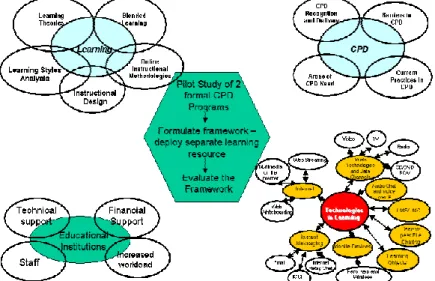
Figure 3 Framework for Project Methodology
This research work is based on the assumption that technology can be matched to meet individual learning styles as part of a blended learning programme – the challenge this work addresses is formulating a strategic framework to apply. The parameters for this framework can be considered as opposing forces as represented in figure 3. The key drivers in formulating this framework in the delivery are issues around learning, the technologies to deliver e-learning and the various issues in educational institutions. In attempting to strike a balance between learning, the
technologies available to deliver learning and the issues that educational institutions must address it is clear that collaboration on the development of SCORM (Sharable Content Object Reference Model) compliant learning resources offers potential advantages in sharing the risk/reward potential and may then be customised by individual institutions as part of ‘blended learning programmes’ focused on construction managers needs.
Research Approach
This network is taking up this challenge in a European context focusing on the construction industry. As part of this research work, two case studies, a MSc Project Management in Construction in the University of Salford in the UK and MSc Construction Project Management in Waterford Institute of Technology in Ireland will be evaluated in detail using a case study approach. As the University of Salford’s programme is a well-established, distance learning programme, using e-learning technologies and Waterford Institute of Technology’s programme is newly established, blended learning programme, it is anticipated that there will be interesting lessons to learn from both of these evaluations in proposing a strategic framework for deploying e-learning to address CPD needs.
The overriding objectives of this research element are to identify; (i) what is good about the current programmes, (ii) what could be improved in the programme, (iii) how technology can be matched to learners needs as part of a blended learning approach and (iv) how important is the role of the tutor in the delivery of the programme. The lessons learned from this work will be integrated into a separate learning resource that is being developed as part of this European Initiative. A twin evaluation approach will be used to formulate the framework involving; (i) staff evaluation and (ii) participant evaluation.
Development of a Separate Learning Resource
The main objective in developing a separate learning resource is to establish a platform where different instructional strategies will be developed to accommodate different learning styles and cognitive processes. This will build on the knowledge gained as part of the evaluation of the masters’ programmes in the University of Salford and Waterford Institute of Technology. A separate web address or URL
http://www.cpd-construction.com has been registered. It is envisaged that this will be used as the hosting platform for the resources developed. An open source learning management system (LMS) will be used to host the learning resources developed. A schematic of the elements that this will incorporate is outlined in Figure 4.
Figure 4 Schematic of Learning Resource Elements
A database of learning material will be developed. A guide on the learning material, outlining circumstances where this material may be integrated effectively into CPD programmes will be formulated. Professional bodies, charged with responsibility for CPD in the construction industry, will be invited to engage with both the development and deployment of this resource. To sustain this initiative in the longer term, the ambition is to grow this online collaborative network.
Pedagogical and Didactical Approaches
It is anticipated that as part of the online instructional methodologies the pedagogical and didactical approaches that will be tested will include:
Online tutorials and conferencing
Online simulations
Online tests and assessment
Problem based learning techniques.
This methodology will address the following research questions:
1. How can an understanding of learning theories, learning style analysis and an appreciation of instructional technologies matched to meet the different cognitive processes of learners enhance the learning experience of individuals?
2. What are the barriers that must be overcome within the construction industry and higher education in the use of technology in the delivery of CPD?
3. How can technology be harnessed by higher education to offer a blended learning approach to meet the CPD needs of the construction industry bringing industry and education closer together?
Conclusion
The emphasis in the past with e-learning has been on the “e” i.e. the electronic technology (Hamid, 2002). Learner attitudes, technological advances and technological constraints, the skills of instructors in working with technology, the content to be learned, the quality of the instructional material and the interactions that take place between students and the instructor and the students themselves are all factors that need to be considered in developing learning material using technology (Landen, 1997 and Martinez et al., 2004). To promote the use of e-learning the emphasis needs to be less on the technology and more on the “experience”, “engagement” and other high level contexts (Hamid, 2002).
Consideration of the pedagogy is vital when attempting to understand the application of e-learning in practice (Mehanna, 2004). Matching cognitive and learning styles with instructional presentation strategies may have an important role to play in enhancing the learner’s learning experience (Ford and Chen, 2001). In a situation where learning is a complex set of inter-related cognitive processes, where the evolution of ICT continues at a rapid rate and where technological standards continue to evolve to allow for adaptability, interoperability and reuseability, developing a framework to address the lifelong learning needs while participants remain in employment is a complex undertaking that this project will address. The major expected outputs are a database of learning material hosted on a dedicated resource that may be integrated into CPD learning programmes delivered in a blended learning format. The primary target group for implementing this development is managers wishing to up-skill in the construction industry. Other target groupings include other higher-level institutes outside of the partner institutes and professional and industrial representative bodies in the construction industry.
Bibliography
Ahmed V., Mahdjoubi L., Feng X. and Leach M., The learning of CAD for
construction: technical abilities or visual?, International Journal of IT in Architecture,
Brosnan K. and Burgess R. C., Web based continuing professional development –
a learning architecture approach, Journal of Workplace Learning, Vol. 15, No. 1,
2003, pp 24- 33
Bruce J. D., Beyond Bandwidth, Educause Review, January/February 2003, pp 23 – 31 Buch K. and Sena C., Accommodating Diverse Learning Styles in the Design and
Delivery of On-line Learning Experiences, International Journal of Engineering
Education 2001, Vol. 17, Iss. 1, pp 93-98
Chee Y. S., Refocusing learning on pedagogy in a connected world, On the Horizon, Vol. 10, No. 4, 2002, pp 7-13
Davis A., Developing an Infrastructure for On-line learning, Athabascan University, 2004, available to download at http://cde.athabascau.ca/online_book/ accessed 20th July 2004
Ertmer P.A. and Newby, T.J., Behaviorism, Cognitivism, Constructivism:
Comparing Critical Features from and Instructional Design Perspective, Performance
Improvement Quarterly, Vol. 6, Iss. 4 1993, pp 50-72
Ford N. and Chen S. Y., Matching/mismatching revisited: an empirical study of
learning and teaching styles, British Journal of Educational Technology, 2001, Vol.
32, No. 1, pp 5 – 22
Ghinea G. and Chen S. Y., The impact of cognitive styles on perceptual
distributed multimedia quality, British Journal of Educational Technology, Vol. 34, Iss.
4, 2003 pp 292-406
Gilboy K., Collaborative e-learning: The Right Approach, 2001, available at http://www.ottergroup.com/otter-with-comments/right_approach.html accessed 7th July 2004
Hamid A. A., e-learning Is it the “e” or the Learning that matters?, The Internet and Higher Education, Vol. 4, 2002, pp 311-316
Harden R.M., Myths and e-learning, Medical Teacher, Vol. 24, No. 5, 2002, pp469-472
Honey P. and Mumford A., The Manual of Learning Styles, Peter Honey Maidenhead Berkshire, 1982
James-Gordon Y. and Bal J., The effects of technology-based learning on design
engineers and the organisation, Industrial and Commercial Training, Vol. 33, No. 5,
2001, pp 167-174
Kilby T., The direction of Web-based training: a practitioner’s view, The Learning Organisation, Vol. 8, No. 5, 2001, pp 194-199
Klein D. and Ware M., E-Learning: new opportunities in continuing professional
development, Learned Publishing, Vol. 16, No. 1, January 2003, pp 34-46
Kolb D. A., Experiential Learning: Experience as the Source of Learning and
Development, Prentice Hall Englewood Cliffs, NJ, 1984
Landen M., The role of technology in education and training, Industrial and Commercial Training, Vol. 29, No. 7, 1997, pp 230-235
Mayer R. E., The promise of multimedia learning: using the same instructional
design methods across different media, Learning and Instruction, Vol. 13, 2003, pp
125-139
Mehanna W. N., e-Pedagogy: the pedagogies of e-learning, Association for Learning Technology Journal, Vol.12, No. 3, September 2004, pp 279-293
Pailing M., E-learning: is it really the best thing since sliced bread?, Industrial and Commercial Training, Vol. 34, No. 4, 2002, pp 151-155
Rayner S. and Riding R., Towards a Categorisation of Cognitive Styles and
Learning Styles, Educational Psychology Vol. 17 pp 5 –528
Riding R., Learning Styles and Technology-Based Training, University of Birmingham, 1996, Department of Education and Employment UK
Romiszowski A. J., How’s the E-learning Baby? Factors Leading to Success or
Failure of an Education Technology Innovation, Education Technology, Jan-Feb
Rosenberg M. J., E-learning strategies for delivering knowledge in the digital age,
2001, McGraw Hill
Sadler-Smith E., Learning styles: a holistic approach, Journal of European Industrial Training, 1996, Vol. 20, No. 7, pp 29 – 36
Sadler-Smith E. and Smith P. J., Strategies for accommodating individuals’ styles
and preferences in flexible learning programmes, British Journal of Educational
Technology, Vol. 35, No 4, 2004, pp 395 – 412
Tham C. M. and Werner J. M., Designing and Evaluating E-Learning in Higher
Education: A Review and Recommendations, Journal of Leadership and
Organizational Studies, 2005, Vol. 11, Iss. 2, pp15-26
Watson J. and Ahmed P. K., Learning in the age of global information technology: development of a generic architecture for an advanced learning management
system, Campus-Wide Information Systems, 2004, Vol. 21, No 1, pp 4 -21
Woodill, G., Where is the Learning in Learning?: A critical analysis of the
e-learning industry, Operitel Corporation, available at URL www.operitel.com accessed
23rd April 2004
Yin R., Case Study Research – Design and Methods, Third Edition, 2003
Zemsky R. and Massy W. F., Thwarted Innovation What Happened to e-learning
and Why, A Final Report for The Weatherstation Project of The Learning Alliance at
the University of Pennsylvania in cooperation with the Thomson Corporation, available to download at
http://www.irhe.upennedu/Docs/June2004/ThwardedInnovation.pdf accessed 2nd
July 2004
Curriculum Vitae
John Wall: Programme Leader Master of Science in Construction Project
Management, Waterford Institute of Technology. Project Coordinator of European funded Minerva Project looking on continuing professional development of
construction management. Currently undertaking PhD in the use of e-learning in construction.
Vian Ahmed: Programme Director MERIT Programme University of Salford.
Completed doctorate in e-learning field in 2000.
Alan Hurst: Programme Coordinator of Master of Science in International Construction Management in Nottingham Trent University. Project leader for development of Internet delivery of part time building degree course.
Harald Garrecht: Vice President at Karlsruhe University of Applied Sciences. He is professor for building physics and materials in building constructions at Karlsruhe University of Applied Sciences. He studied civil engineering in Karlsruhe and obtained his Ph.D. at University of Karlsruhe.
Andreas Luckey: A lawyer by profession, he is the German coordinator of the international masters program in International Construction Management, Hochschule Karlsruhe.
Frank McNamee: Managing Director of Multimedia Instructional Design. He has been involved in the successful delivery of a number of e-learning projects.
Alaattin Kanoglu: Professor of Construction Management Division, Istanbul Technical University. He has presented numerous conference and journal papers related to IT applications in the construction industry.