Title Effectiveness of general practitioner training to improve suicide awareness and knowledge and skills towards depression
Author(s) Coppens, Evelien; Van Audenhove, Chantal; Gusmão, Ricardo; Purebl, György; Székely, András; Maxwell, Margaret; Koburger, Nicole; Arensman, Ella; Hegerl, Ulrich
Publication date 2017-09-25
Original citation Coppens, E., Van Audenhove, C., Gusmão, R., Purebl, G., Székely, A., Maxwell, M., Koburger, N., Arensman, E. and Hegerl, U. (2018) 'Effectiveness of General Practitioner training to improve suicide awareness and knowledge and skills towards depression', Journal of Affective Disorders, 227, pp. 17-23. doi:10.1016/j.jad.2017.09.039
Type of publication Article (peer-reviewed)
Link to publisher's
version http://dx.doi.org/https://doi.org/10.1016/j.jad.2017.09.039Access to the full text of the published version may require a subscription.
Rights © 2017, Elsevier B.V. All rights reserved. This manuscript version is made available under the CC-BY-NC-ND 4.0 license.
https://creativecommons.org/licenses/by-nc-nd/4.0/
Embargo information Access to this article is restricted until 12 months after publication by request of the publisher
Embargo lift date 2018-09-25
Item downloaded
from http://hdl.handle.net/10468/6127
Author’s Accepted Manuscript
Effectiveness of General Practitioner training to
improve suicide awareness and knowledge and
skills towards depression
Evelien Coppens, Chantal Van Audenhove, Ricardo
Gusmão, György Purebl, András Székely, Margaret
Maxwell, Nicole Koburger, Ella Arensman, Ulrich
Hegerl
PII:
S0165-0327(17)30455-X
DOI:
http://dx.doi.org/10.1016/j.jad.2017.09.039
Reference:
JAD9247
To appear in:
Journal of Affective Disorders
Received date: 1 March 2017
Revised date:
14 July 2017
Accepted date: 23 September 2017
Cite this article as: Evelien Coppens, Chantal Van Audenhove, Ricardo Gusmão,
György Purebl, András Székely, Margaret Maxwell, Nicole Koburger, Ella
Arensman and Ulrich Hegerl, Effectiveness of General Practitioner training to
improve suicide awareness and knowledge and skills towards depression,
Journal of Affective Disorders,
http://dx.doi.org/10.1016/j.jad.2017.09.039
This is a PDF file of an unedited manuscript that has been accepted for
publication. As a service to our customers we are providing this early version of
the manuscript. The manuscript will undergo copyediting, typesetting, and
review of the resulting galley proof before it is published in its final citable form.
Please note that during the production process errors may be discovered which
could affect the content, and all legal disclaimers that apply to the journal pertain.
Effectiveness of General Practitioner training to improve suicide awareness and knowledge and skills
towards depression
Evelien Coppens1, Chantal Van Audenhove11, Ricardo Gusmão2, György Purebl3, András Székely3, Margaret Maxwell4, Nicole Koburger5, Ella Arensman6, & Ulrich Hegerl5,7
1
LUCAS, Centre for Care Research and Consultancy, University of Leuven, Belgium 2
CEDOC, Departamento de Saúde Mental, Faculdade de Ciências Médicas da Universidade NOVA de Lisboa, Portugal
3
Institute of Behavioural Sciences, Semmelweis University Budapest, Hungary 4
Nursing, Midwifery and Allied Health Professions Research Unit, Faculty of Health Sciences and Sport, University of Stirling, United Kingdom
5
Depression Research Centre, German Depression Foundation, Leipzig, Germany 6
National Suicide Research Foundation & Department of Epidemiology and Public Health, University College Cork, Ireland
7
Department of Psychiatry and Psychotherapy, University of Leipzig, Germany [email protected]
ABSTRACT
Background
General Practitioners (GPs) are well placed as gatekeepers for managing depression and suicidal ideation but not always well prepared. Capacity building has therefore been recommended as a useful strategy for suicide prevention. This study aimed to examine whether GPs’ knowledge and attitudes towards and confidence to deal with depression and suicide improve after following a training program.
Methods
As part of the OSPI-Europe multilevel intervention, a standardized training on depression and suicide was provided to 208 GPs in three European countries. Core outcomes were assessed using the Depression
Attitude Questionnaire, the Attitude towards Suicide Prevention Scale, and the Morriss Confidence Scale. Data were collected before and after training, and at three to six months follow-up.
Results
At baseline, GPs demonstrated various stigmatizing attitudes towards depression and low optimism about the therapeutic treatment of depression. They showed moderately positive attitudes towards suicide prevention but felt little confident in dealing with depression and suicide in daily practice. The training resulted in improved knowledge, attitudes and confidence regarding depression and suicide and their prevention and treatment. At follow-up, only the increase in confidence to deal with depression and suicide was sustained.
Limitations
The Depression Attitude Questionnaire has rather weak psychometric properties. Other external factors may have contributed to the observed training effects as the study included no control group.
Conclusions
The OSPI-Europe training program was able to improve the GPs’ attitudes towards suicide prevention, several attitudes towards depression and its treatment as well as the GPs’ confidence to deal with depression and suicide in everyday practice. At follow, only the GPs’ confidence to deal with depression and suicide was preserved.
Key words: depression,general practitioner, prevention, suicide, training
INTRODUCTION
According to the World Health Organization, worldwide over 800000 people die by suicide every year (WHO, 2014). About 90% of all suicides occur in the context of psychiatric disorders, with depression being the most prominent risk factor (Hegerl et al., 2009; Mann et al., 2005; Yoshimasu et al., 2008). Commonly, persons who died by suicide had contact with healthcare services in the year before their death, with higher rates of contact for primary care providers than for mental health services (Luoma et al., 2002).
It has repeatedly been reported however that about half of patients with depression in primary care are not diagnosed as such and hence do not receive adequate treatment (Cepoiu et al., 2008; Fernandez et al., 2007). Reported barriers to the detection and adequate treatment of depression include patient-related factors such as vague somatic complaints, co-morbidity, lack of insight and reluctance to psychiatric diagnosis or medication treatment (Richards et al., 2004; Simon et al., 2004; Telford et al., 2002). In addition, several General Practitioner (GP) related factors have been reported to hinder adequate depression management such as limited knowledge of depression, unease to inquire about psychosocial issues, and negative attitudes towards depression (Richards et al., 2004).
Assessment of suicide risk receives even less attention by GPs. When suicide completers or attempters contact their GP in the period preceding their attempt, suicidal thoughts or behaviors are addressed in only a small minority (Houston et al., 2003; Luoma et al., 2002; Marquet et al., 2005; Richards et al., 2004). In only 3% of those who died by suicide, the GPs’ patient record reports about suicide risk (Houston et al., 2003). When the GP is consulted after a suicide attempt, suicidal thoughts and risk of future attempts are explored in only half of the cases (Richards et al., 2004). Suicide warning signs may not be blatant enough to arouse the GP’s concern, as suicidal people ask for help in indirect and ambivalent ways (Schulberg et al., 2004). The majority of GPs lack sufficient knowledge about suicide and perceive themselves as poorly skilled in dealing with suicidal patients (Aoun, 1999; Hawgood et al., 2008; Palmieri et al., 2008). GPs should become more sensitive to subtle suicide warning signs and take the lead in making such issues debatable (Bennewith et al., 2002; Marquet et al., 2005).
Unfortunately, formal training in suicide prevention is absent for most graduate programs of medicine and the large majority of GPs have not undertaken postgraduate training in this area (Bajaj et al., 2008; Hawgood et al., 2008; Palmieri et al., 2008). Training programs for GPs aiming to improve their capacity to detect and treat depression and suicide risk are one of the few evidence-based strategies in the field of suicide prevention and therefore widely recognized as worthwhile and highly recommended (Hegerl et al., 2006; Hegerl et al., 2009; Kaplan et al., 2001; Mann et al., 2005; Miret et al., 2013; Zalsman et al., 2016; WHO, 2012).
In the last decades, several studies evaluating the effectiveness of education programs for GPs showed promising results, with trainings producing increased knowledge and self-efficacy, more favorable attitudes towards depression, improved detection and treatment practices, and increased use of non-medical treatment of depression (Gerrity et al., 2001; van Os et al., 2002). Moreover, intensive GP training has been found to improve patient outcomes and to reduce suicides rates (Henriksson and Isacsson, 2006; Rutz, 2001; van Os et al., 2004). Few studies, however, have been conducted within an international perspective and hardly any study demonstrated the effects of GP training in the longer term.
The current study draws upon data of the Optimizing Suicide Prevention Programs and their Implementation in Europe (OSPI-Europe), a large scale European research project (7th Framework Program of the EU) that ran from 2008 till 2013. The overall aim of the project was to evaluate the effectiveness of a multilevel suicide prevention program. One of the levels of the program concerns the training of GPs’ suicide awareness and knowledge and skills towards depression in four different regions in Europe (Hegerl et al., 2009). The evaluation of this activity, which relies on a single group pre-post research design, is the main focus of the current paper. The present study aims to examine: (1) whether the GPs’ attitudes towards depression and suicide prevention, and confidence to deal with suicide and depression improve after following an education program; and (2) whether the newly acquired competencies are maintained after three to six months follow-up.
METHOD
Participants
As part of the OSPI-Europe multilevel intervention, a standardized training program about depression and suicide was provided to 304 GPs in four OSPI-Europe intervention regions: Amadora (Portugal), Leipzig (Germany), Limerick (Ireland), and Miskolc (Hungary). In Ireland, a large number of GPs received the OSPI-Europe training program (n=96) however due to limited capacity no evaluation could be conducted of the participating GPs.
Intervention
The content of the training program provided participants with an overview of the extent of depression and suicidal behavior, symptoms of depression, warning signs and risk factors associated with suicidal behavior, diagnosis and treatment of depression, and dealing with acute suicidal crisis. The program included role-playing to explore suicidal behavior in patients. In each country, the training program was delivered to GPs by a trained professional. The training duration and the type of trainer slightly differed across countries. In Germany, GPs received a four-hour training program which was delivered by trained psychiatrists who had participated in a seven-hour train-the-trainer (TTT) program. In Hungary, a core group of GPs was enrolled in a seven-hour TTT training delivered by psychiatrists with extensive training experience and expertise in liaison psychiatry. A follow up session of the TTT training was offered to the trained GPs to improve their training abilities on the subject. Accordingly, the trained GPs provided a-four hour training to other GPs. In Portugal, GPs received an eight-hour training program delivered by a psychiatrist who received a sixteen-hour TTT training. In each country, the TTT program provided the trainers with all information and resources needed to deliver the training sessions to the GPs (presentation slides, extensive background information, essentials of training, and suggestions on delivery). To optimize interaction and learning, the training sessions were taught in small groups of maximum 15 participants.
Instruments
Effects of the training on the GPs attitudes and level of confidence were measured using three questionnaires.
The Depression Attitude Questionnaire scale (DAQ) assessed the GPs’ attitudes towards depression and its treatment (Botega et al., 1992). The DAQ comprises 20 statements about depression concerning etiology, course, treatment options, and role of the GP, mental health specialist and practice nurse. In this study, GPs were asked to rate each statement on a five-point Likert scale ranging from ‘strongly disagree’ (score 1) to ‘strongly agree’ (score 5) with higher scores representing more positive attitudes. Although, the DAQ is widely used in studies of qualified health professionals examining attitudes towards depression, uncertainty exists about its psychometric properties and its underlying factor structure (Haddad et al., 2012;
2015). In different studies, differing factor-structures have been found and the DAQ’s internal consistency is modest indicating that the items are imperfect measures of a single construct. Recently, the revised DAQ (R-DAQ) has been developed and tested, incorporating nine items of the original DAQ. Results suggest that the R-DAQ addresses important weaknesses in the original measure whilst retaining items that appeared valid (Haddad et al., 2015). At the time the present study was carried out, the R-DAQ was not yet available. For the current analyses, we therefore focus on the GPs’ responses on the nine DAQ items that are part of the R-DAQ.
The Attitude towards Suicide Prevention Scale (ASPS) assessed the GPs’ attitudes towards suicide prevention (Herron et al., 2001). The ASPS consists of 14 items rated on a five-point Likert scale ranging from ‘strongly disagree’ (score 1) to ‘strongly agree’ (score 5) with higher scores representing more positive attitudes. The questionnaire has an acceptable internal consistency (Cronbach’s alpha is .77) and a high test-retest reliability (r=.85). For the analyses, the total scale score was used which was calculated by summing all item scores.
The Morriss Confidence Scale (MCS) assessed the GPs’ confidence in dealing with depression and suicide (Morriss et al., 1999). The MCS contains 4 items which are measured on a ten-point Likert scale ranging from ‘not at all confident’ (score 1) to ‘very confident’ (score 10). The scale score is calculated by summing all item scores.
Finally, several GP characteristics were recorded including country, gender, age, number of years in profession, attendance to previous trainings in depression or suicide prevention, and experience with depression and suicide in professional practice. We also assessed the treatment that GPs usually recommend for patients with depression: pharmacological treatment, psychological treatment, or both.
Procedure
Prior to training, the participating GPs received an introductory letter with information on the study and an invitation to participate. At the day of training, informed consent was obtained for all measure rounds. Prior to and immediately after training, GPs were asked to fill in the three questionnaires. In Germany and Hungary, GPs received the questionnaires three months later either by post or email and were asked to
complete them once more. When the questionnaires were not returned within three to six weeks, a reminder was sent. In Portugal, questionnaires were delivered to GPs personally by a research assistant after three to six months. The assistant went back to those GPs who failed to return the questionnaires in time.
Statistical analyses
Statistical analyses were carried out using SPSS 19 and SAS 9.1. First, the GPs characteristics were examined by exploring descriptive statistics. Second, separate ANOVAs examined whether baseline scores on the DAQ, the ASPS and the MCS varied according to age, gender, country, previous training in depression or suicide, and previous experience with suicide. Analyses were carried out on the nine R-DAQ item scores and scale score of the ASPS and the MCS. Finally, a linear mixed-effects model procedure was used to test whether the R-DAQ item scores and the scale scores of the ASPS and the MCS had changed after training and to evaluate the sustainability of the training effects. Importantly, a linear mixed model corrects for possible confounds related to drop-out (Little, 2001). Within the model, timing (pre, post, and follow-up) was entered as a repeated measure to account for the dependency between the repeated test scores. Country was entered as a fixed factor to assess whether learning effects differed across countries.
RESULTS
Response rate
Across the three intervention countries, baseline data were collected from 208 GPs who attended training. Immediately after training the response rate reached 91.8%, while at three to six months follow-up 55.8% of GPs responded on the questionnaires.
Participants’ characteristics
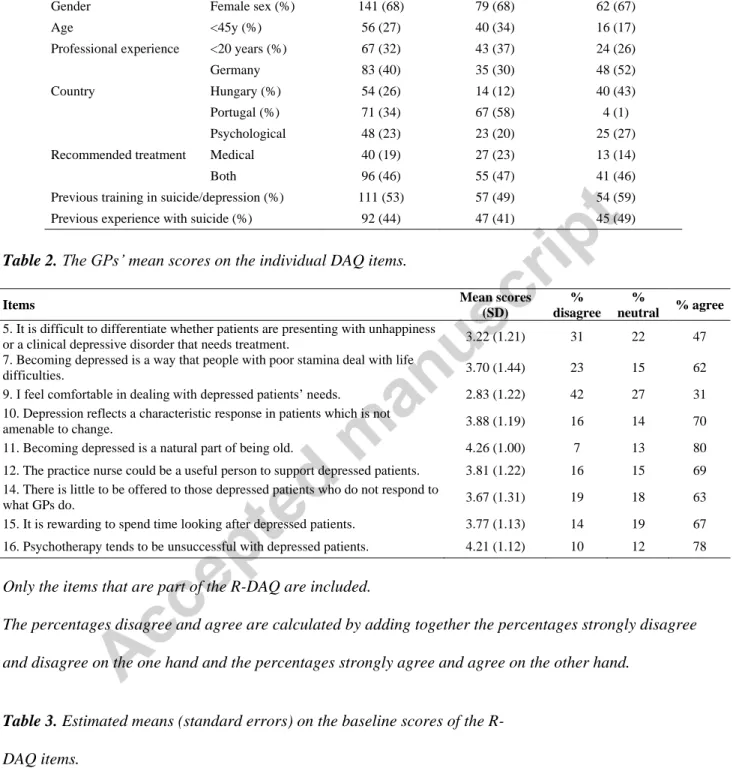
Table 1 presents the characteristics of the GPs who participated in the study. Most of the participating GPs were female, older than 45 years, with more than 20 years of experience. The number of participating GPs slightly differed across countries with Germany counting most participating GPs. About half of the GPs had previously completed a training program either on depression or suicide. On average, GPs reported one
suicide case among their patients in the last five years and had seen 42 patients with depression in their daily practice in the last month. Concerning the treatment of depressive patients, almost half of GPs recommends a combination of psychological and pharmacological treatment, while one fifth recommends pharmacological treatment.
Importantly, the group of GPs who dropped out at follow-up (drop-out group) differed significantly from the group of GPs who participated in all moments of data collection (follow-up group). The drop-out group was older than the follow-up group [X²(2)=10.22, P<0.01], and included more German and Hungarian GPs [X²(2)=68.60, P<0.001].
Baseline results
DAQ
Table 2 presents the GPs’ responses on the nine R-DAQ items. Overall, GPs’ attitudes towards depression were rather negative. Moreover, GPs’ scores on six R-DAQ items varied according to country: items 5, 7, 12, 14, 15, and 16 [with respectively F(2,200)=3.09, P<.05; F(2,200)=3.47, P<.05; F(2,197)=18.52, P<.001;
F(2,198)=10.48, P<.001; F(2,198)=9.76, P<.001; and F(2,198)=5.51, P<.01]. Table 3 presents the estimated means for these items per country and reveals that Hungarian GPs generally show the least favorable attitudes towards depression. For the other variables no relevant effects were observed.
ASPS
On a scale ranging from 14 to 70, GPs obtained a total score of 49.78 (SD=6.90), suggesting they had moderately positive attitudes towards suicide prevention. Table 4 presents the GPs’ mean scores on the individual ASPS statements. An ANOVA performed on the total ASPS scores showed a significant effect of age [F(2,168)=4.60, P<.05], with GPs younger than 45 years having more favorable attitudes towards suicide prevention (EM=52.08, SE=0.96) than GPs between 45 and 59 years (EM=49.12, SE=0.69) and GPs older than 60 years (EM=47.57, SE=1.41). For the factors gender, country, previous experience with suicide, and previous training in depression or suicide no significant effects were observed.
Finally, on a scale ranging from 4 to 40, GPs acquired a total score of 20.88 (SD=7.39), suggesting they felt little confidence in dealing with suicide and depression in their professional life. Scores on the individual items are presented in Table 5. An ANOVA showed a significant variation of scale scores across country, gender and previous training in depression or suicide [with F(2,193)=10.33, P<.001; F(1,193)=4.45, P<.05; and F(1,193)=8.42, P<.01 respectively]. Estimated means further revealed that Portuguese GPs (EM=23.06,
SE=0.86) felt most confident in dealing with depression and suicide in daily practice, followed then by Hungarian GPs (EM=22.26, SE=0.99) and German GPs (EM=18.04, SE=0.81). Moreover, male GPs (EM=22.50, SE=0.93) showed more confidence than female GPs (EM=20.12, SE=0.64), and GPs who followed a training on depression or suicide earlier (EM=22.30, SE=0.71) showed more favorable scores than those who did not (EM=19.28, SE=0.76). No variation in scale scores was found for the factor previous experience with suicide.
Training effects
DAQ
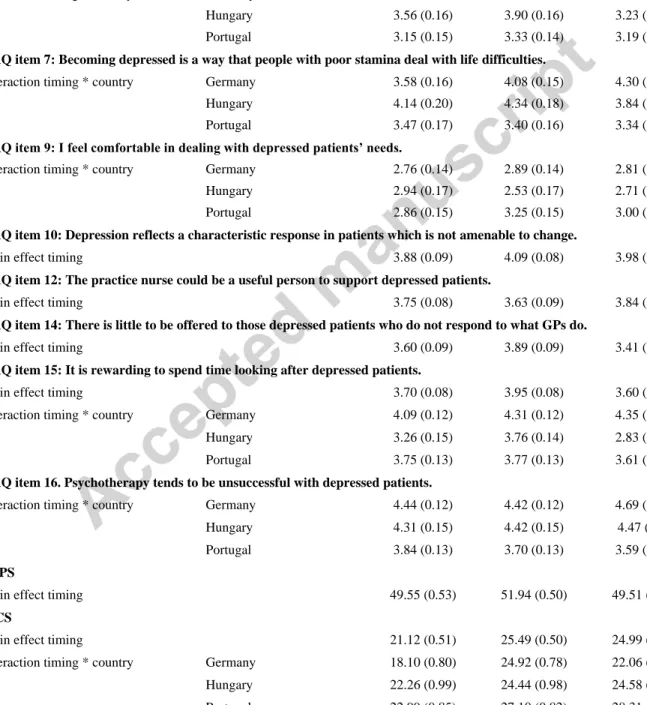
On each of the nine R-DAQ item scores, a linear mixed model analysis was carried out to examine whether attitudes had changed after training. Table 6 presents the estimated means and standard errors of the significant main and interaction effects. A significant main effect of timing was found for three items: item 10 (depression is not amenable to change) [F(2,152)=3.63, P<0.05], item 12 (the practice nurse is useful to support depressive persons) [F(2,153)=3.47, P<0.05], and item 14 (there is little to be offered for those who do not react on what GPs do) [F(2,146)=14.04, P<0.001]. Planned comparisons reflected more positive attitudes on item 10 and item 14 immediately after training [t(205)=2.52, P<0.05 and t(205)=3.94, P<.001 respectively] but attitudes fell back to baseline level after three to six months follow-up [t<1 for both contrasts]. For item 12, however, planned comparisons showed no improvement of attitudes immediately after training [t(204)=1.90, P=0.06].
For items 5 (it is difficult to differentiate between unhappiness and depression) and 15 (it is rewarding to look after depressive persons) the main effect of timing was overruled by a significant two-way interaction between timing and country [F(4,155)=3.31, P<0.05 and F(4,146)=4.40, P<0.01 respectively].
Planned comparisons revealed a significant improvement in attitudes on item 5 for German and Hungarian GPs [t(204)=2.57, P<0.05 and t(204)=2.42, P<.05 respectively] which was maintained three to six months later [t(204)=3.52, P<0.01 for German GPs and t(204)=2.41, P<0.05 for Hungarian GPs]. The attitudes of Portuguese GPs on item 5 remained unchanged after training [t(204)=1.39, P=0.17]. Similarly, for item 15 the attitudes of German [t(205)=1.99, P<0.05] and Hungarian GPs [t(205)=3.76, P<0.001] but not those of Portuguese GPs [t<1] changed after training in the favorable direction. However, at follow-up the positive attitudes of the German [t(205)=1.56, P=0.12] and Hungarian GPs [t(205)=1.76, P=0.08] were not maintained. For items 7 (becoming depressed is a way that people with poor stamina deal with life difficulties), 9 (I feel comfortable in dealing with depressed patients’ needs), and 16 (psychotherapy tends to be unsuccessful with depressed patients), the interaction between country and timing was significant [F(4,174)=3.79, P<0.01; F(4,151)=4.61, P<0.01; and F(4,174)=2.52, P<0.05 respectively]. After training, only German GPs showed more positive attitudes on item 7 [t(204)=3.41, P<0.001] – attitudes that were preserved at follow-up [t(204)=3.65, P<0.001]. Hungarian [t(202)=2.92, P<0.01] and Portuguese GPs [t(202)=3.04, P<0.01] showed an improvement in attitudes on item 9 which disappeared again at follow-up [t<1 for both contrasts]. The attitudes of German GPs on item 9 did not improve after training [t(202)=2.92,
P=0.27]. For item 16, none of the planned comparisons showed significant improvements.
ASPS
Results showed a main effect of timing [F(2,127)=26.26, P<0.001] indicating that the training program had a significant effect on GPs’ attitudes towards suicide prevention (Table 6). Planned comparisons further revealed that immediately after training, scores on the ASPS were significantly higher than prior to training [t(191)=6.69, P<0.001]. However, at follow-up, scale scores fell back to baseline level [t<1].
MCS
The training program had a significant effect on the GPs’ confidence in dealing with depression and suicide [F(2,141)=49.50, P<0.001] (Table 6). Immediately after training, the GPs’ level of confidence significantly improved [t(200)=10.09, P<0.001] and this improvement was still present after three to six months follow-up [t(200)=9.08, P<0.001].
Importantly, the factor timing interacted significantly with country [F(4,142)=7.20, P<0.001] suggesting that the magnitude of the training effect was different in the three countries (Table 6). Planned comparisons showed an increase in confidence for German [t(198)=9.55, P<0.001], Hungarian [t(198)=2.49, P<0.05], and Portuguese GPs [t(198)=5.51, P<0.001], with German GPs showing the most pronounced training effects. After three to six months follow-up, the training effects were maintained in German [t(198)=4.55, P<0.001] and Portuguese GPs [t(198)=7.42, P<0.001] but not in Hungarian GPs [t(198)=1.79, P=0.08].
DISCUSSION
Summary
Prior to training, GPs had several stigmatizing attitudes towards depression and its treatment, as was measured with the DAQ. The majority of GPs perceived depression as a natural part of being old, a way that people with poor stamina deal with life difficulties, and a characteristic that is not amenable to change. Moreover, GPs showed little optimism about the treatment of depression. They were convinced that there is little to be offered to those depressed patients who do not respond to what GPs do, and believed that psychotherapy is largely unsuccessful with depressed patients. Half of GPs found it hard to differentiate between unhappiness and a clinical depressive disorder. The GPs’ attitudes towards suicide prevention, as measured with the ASPS, were fairly positive. A relatively large proportion of GPs were convinced that suicide prevention measures are valuable and deserve more attention and funding. More than half of GPs believed that suicide prevention is partly their responsibility and they perceived working with suicidal patients as rewarding. Nevertheless, most GPs did not feel comfortable assessing someone for suicide risk. Baseline results of the MCS further confirmed that the GPs’ confidence in dealing with depression and suicidal behavior in their professional life is relatively low. The GPs’ baseline competencies did not vary according to gender, country, previous experience with suicide, and previous training in depression or suicide.
Overall, the training program was effective in strengthening the skills of GPs. Attitudes towards depression and suicide prevention, and confidence to deal with depression and suicide did improve significantly after training. In particular, on four items of the R-DAQ (items 5, 10, 14 and 15) as well as on
the ASPS and the MCS, GPs showed more favorable responses post training. Three to six months later, the GPs’ increased confidence to deal with depression and suicide was maintained whereas their attitudes towards depression and suicide prevention had returned to baseline level.
Importantly, training effects differed significantly across countries with German and Hungarian GPs showing the strongest enhancement in attitudes, knowledge, and skills post training. More specifically, German and Hungarian GPs demonstrated an improvement in attitudes towards depression and a boost in confidence to deal with suicidal behavior on three R-DAQ items (German GPs on items 5, 7, and 15; Hungarian GPs on items 5, 9, and 15) as well as on the MCS. By contrast, Portuguese GPs only showed an improvement on one R-DAQ item (item 9) and the scale scores of the MCS. After three to six months follow-up, most training effects were preserved in German GPs but not in Hungarian and Portuguese GPs. The German GPs’ improved results remained intact for two items of the R-DAQ (items 5 and 7) as well as for the scores on the MCS. In Hungary, only the scores on item 5 of the R-DAQ were preserved and in Portugal solely the scores on the MCS.
Across countries, there were small differences in the training procedure, which may account for some of the observed variability across countries. Germany GPs received a four-hour training delivered by trained psychiatrists, Hungarian GPs received a four-hour training provided by trained GPs, and Portuguese GPs received a sixteen-hour training given by a trained psychiatrist.
In addition, synergistic interactions with other levels of the OSPI-Europe interventions may explain for some of the observed differences across countries (Harris et al., 2016). The full OSPI-Europe program consists of five intervention levels: training primary care professionals (level 1), a depression awareness campaign including public health events (level 2), training community-based professionals (level 3), supporting patients and families (level 4), and reducing access to lethal means (level 5). Harris et al. (2016) studied synergetic interactions between the different levels of the OSPI-Europe program and found that in Germany the support for people living with or affected by depression (level 4) interacted with the public health campaign (level 2) and the GP training (level 1). German members of self-help groups were able to recruit GPs to participate in the training with their enthusiastic dissemination of OSPI-Europe activities. In
Hungary, the activities improved communication between GPs and psychiatrists. These synergistic interactions may have resulted in more pronounced effects of training in German and Hungarian GPs.
Strengths and limitations
The strength of this study is that the training program for GPs was implemented in four European countries and involved an overall high number of participants. The effectiveness of the training was evaluated by querying GPs in three countries at three points in time. The study represents one of the few multicenter studies in the field of suicide prevention using standardized training materials across countries. The training program was effective in increasing GPs’ competencies in depression and suicide prevention regardless of whether GPs had received any training on these topics previously. Nevertheless, a few limitations need to be mentioned. First, due to limited staff capacity no evaluation could be carried out on GPs in Ireland. Second, although the study showed good response rates at follow-up, significant differences were found between GPs who dropped out of the study versus GPs who participated in all three data collection rounds. In particular, drop-out was higher for German and Hungarian GPs as well as for older GPs. By carrying out a linear mixed model we corrected for possible confounds related to drop-out (Little et al., 2001). Third, the original DAQ – of which the psychometric properties are known to be weak and the wording of some items is rather complex – was used to measure a change in attitudes towards depression. At the time the present study was carried out, the DAQ was the instrument used most widely to examine qualified health professionals’ attitudes towards depression as it contains several relevant items capturing important dimensions of GPs’ attitudes. In 2015, a few years after this study took place, a revised version of the DAQ was published, demonstrating adequate content and construct validity (Haddad et al., 2015). Several items of the original DAQ are retained in the R-DAQ and are the focus of attention in the current article. Fourth, our conclusions are based on a pre-post comparison without a control group. Therefore, we cannot rule out the possibility that apart from the training program other external factors contributed to the observed change in competencies in GPs. Participating GPs were possibly self-selected and highly interested in depression and suicide. Finally, although the training materials were standardized across countries, the training procedure was not, with the training duration and the type of trainer being slightly different across countries. Therefore, some of the
observed variability in learning effects among countries might be caused by differences in training procedures. Future studies on GP training, should assess the fidelity of the training intervention and incorporate fidelity data when analyzing outcomes.
Comparison with existing literature
In the last decades, several studies evaluating the effectiveness of education programs for GPs have shown promising results, with trainings producing increased knowledge and self-efficacy, more favorable attitudes towards depression, improved detection and treatment practices, a more deliberate use of medical versus non -medical treatment, improved patient outcomes, and reduced suicides rates (Gerrity et al., 2001; Henriksson et al., 2006; Rutz, 2001; van Os et al., 2002, 2004). Our findings further confirm that training programs are a capital gain in making GPs more sensitive for depressive symptoms and suicidal ideation. Few studies were carried out within an international perspective, demonstrating a clear improvement of the GPs’ competencies, and few studies examined the effects of GP training in the longer term. Our study addresses both of these components.
Our finding that the GPs’ level of confidence to deal with depression and suicide in daily practice remained intact at follow-up replicates earlier results showing that attitudes and knowledge require regular retraining whereas confidence virtually remains intact (Coppens et al., 2014).
Implications for research and practice
The current findings suggest that participation in a training program on depression and suicide by GPs is effective in improving GPs’ attitudes towards depression and suicide prevention and their confidence. Although a randomized control trial may yield stronger evidence, our study adds to the evidence base supporting awareness and skills training on depression and suicide among health professionals as recommended by WHO (2014). As argued by Gask et al. (2013), education alone is not sufficient but should be complemented with procedures and resources to persuade those GPs who are most in need of training (Gask et al., 2013). Also, new training formats like webinars or online formats are possibly more adapted to the needs of GPs. Additional research examining which training formula or what training resources are most suitable for GPs is warranted.
Future studies, examining the attitudes of health professionals and determining the impact of interventions, should use the R-DAQ instead of the DAQ (Haddad et al., 2015). Moreover, the impact of GP training in depression and suicide on other outcomes such as changes in GPs’ intention to explore depressive symptoms and suicidal signs and GPs’ way of treating patients should be assessed either by self-report questions or by checking medical records. Health gains in people struggling with depression and suicidal ideation, and patient satisfaction with GP consultations for depression or suicidal ideation are also valuable to evaluate in the future.
Finally, examining why training effects are strong immediately after training but disappear after three to six months should be subject for further research. It is important to ascertain whether training effects are due to actual learning processes or to social desirability.
AUTHOR DISCLOSURE
Acknowledgments
The authors wish to thank Claire Coffey, researcher at the National Suicide Research Foundation, University College Cork, who contributed to the implementation of this study in Ireland as well as Katrin Gottlebe, Nadine Sonnabend and Anita Maehner, who were involved in the project and training program in Germany. We further wish to thank all GPs who participated in the OSPI-Europe training sessions and took time to complete the questionnaires as well as all trainers involved in the OSPI-Europe project.
Funding
The OSPI-Europe project has received funding from the European Community's Seventh Framework Program (FP7/2007-2013) under grant agreement n° 223138.
Ethical approval
The OSPI-Europe research project is executed in accordance with the principles laid down in the Helsinki Declaration (2000). The research protocol was approved by the ethics commissions of all participating countries.
Author contribution
Ulrich Hegerl coordinated the OSPI-Europe project and was involved in designing the study and writing the study protocol. The evaluation methodology was compiled by Ella Arensman and Ricardo Gusmão. The local activities in Germany (including training delivery and data collection) were coordinated by Nicole Koburger and supervised by Ulrich Hegerl; in Hungary by Andras Székely and György Purebl; in Ireland by Ella Arensman; and in Portugal by Ricardo Gusmão. Evelien Coppens and Chantal Van Audenhove were responsible for the statistical analyses of the data and prepared the manuscript. All authors contributed to the drafting and critical revision of the manuscript.
CONFLICT OF INTEREST
The authors have declared no competing interests.
REFERENCES
Aoun, S., 1999. Deliberate self-harm in rural Western Australia: results of an intervention study. Aust. N. Z. J. Ment. Health. Nurs., 8, 65-73.
Bajaj, P., Borreani, E., Ghosh, P., Methuen, C., Patel, M., Crawford, M.J., 2008. Screening for suicidal thoughts in primary care: the views of patients and General Practitioners. Ment. Health Fam. Med., 5, 229-235.
Bennewith, O., Stocks, N., Gunnell, D., Peters, T., Evans, M., Sharp, D. 1992. General practice based intervention to prevent repeat episodes of deliberate self-harm: cluster randomized controlled trial. BMJ, 324, 1254-1261.
Botega, N.J., Blizard, R., Wilkinson, D., Mann, A., 1992. General Practitioners and depression – first use of the depression attitude questionnaire. Intern. J. Methods Psychiatr. Res, 4, 169-180.
Cepoiu, M.J., McCusker, J., Cole, M., Sewitch, M., Belzile, E., Ciampi, A., 2008. Recognition of depression by non-psychiatric physicians. A systematic literature review and meta-analysis. J. Gen. Intern. Med., 23, 25-36.
Coppens, E., Van Audenhove, Ch., Iddi, S., Arensman, E., Gottlebe, K., Koburger, N., et al., 2014. Effectiveness of community facilitator training in improving knowledge, attitudes and confidence in relation to depression and suicidal behavior: results of the OSPI-Europe intervention in four European countries. J. Affect. Disord., 165, 142-150.
Fernandez, A., Haro, J.M., Martinez-Alonso, M., Demyttenaere, K., Brugha, T.S., Autonell, J., et al. 2007. Treatment adequacy for anxiety and depressive disorders in six European countries. Br. J. Psychiatry, 190, 172-173.
Gask, L., 2013. Educating family physicians to recognize and manage depression: where are we now? Can. J. Psychiatry, 58, 449-455.
Gerrity, M., Williams, J., Dietrich, A.J., Olson, A., 2001. Identifying physicians likely to benefit from depression education. Med. Care, 39, 856-866.
Haddad, M., Menchetti, M., Walters, P., Norton, J., Tylee, A., M ann, A., 2012. Clinicians’ attitudes to depression in Europe: a pooled analysis of Depression Attitude Questionnaire findings. Fam. Pract., 29, 121-130.
Haddad, M., Menchetti, M., McKeown, E., Tylee, A., Mann, A., 2015. The development and psychometric properties of a measure of clinicians’ attitudes to depression: the revised Depression Attitude Questionnaire (R-DAQ). BMC Psychiatry, 15, 7.
Harris, F.M., Maxwell, M., O’Connor, R., Coyne, J.C., Arensman, E., Coffey, C., et al., 2016. Exploring synergetic interactions and catalysts in complex interventions: longitudinal, mixed methods case studies of an optimised multi-level suicide prevention intervention in four European countries (OSPI-Europe). BMC Public Health, 16, 268.
Hawgood, J.L., Krysinska, K.E., Ide, N., De Leo, D., 2008. Is suicide prevention properly taught in medical schools? Med. Teach., 30, 287-295.
Hegerl, U., Althaus, D., Schimdtke, A., Niklewski, G., 2006. The alliance against depression: a 2-year evaluation of a community-based intervention to reduce suicidal behavior. Psychol. Med., 36, 1225-1233.
Hegerl, U., Wittenburg, L., Arensman, E., Van Audenhove, Ch., Coyne, J.C., McDaid, D., et al., 2009. Optimizing suicide prevention programs and their implementation in Europe (OSPI-Europe): an evidence-based multi-level approach. BMC Public Health, 9, 428.
Henriksson, S., Isacsson, G., 2006. Increased antidepressant use and fewer suicides in Jämtland county, Sweden, after a primary care educational programme on the treatment of depression. Acta Psychiatr. Scand., 114, 159-167.
Herron, J., Ticehurst, H., Appleby, L., Perry, A., Cordingley, L., 2001. Attitudes towards suicide prevention in front-line health staff. Suicide and Life Threat. Behav., 31, 342-347.
Houston, K., Haw, C., Townsend, E., Hawton, K., 2003. General Practitioner contacts with patients before and after deliberate self-harm. Br. J. Gen. Pract., 53, 365-370.
Kaplan, M., Adamek, M., Martin, J., 2001. Confidence of primary care physicians in assessing the suicidality of geriatric patients. Int. J. Geriatr. Psychiatry, 16, 728-734.
Little, R.J., 2001. Statistical analysis of repeated-measures data with drop-outs, in: Guiloff, R.J. (Ed.), Clinical Trials in Neurology. Springer, London, UK.
Luoma, J.B., Martin, C.E., Pearson, J.L., 2002. Contact with mental health and primary care providers before suicide: a review of the evidence. Am. J. Psychiatry, 159, 909-916.Mann, J.J., Apter, A., Bertolote, J., Beautrais, A., Currier, D., Haas, A., et al., 2005. Suicide prevention
strategies - a systematic review. JAMA, 294, 2064-2074.
Marquet, R.L., Bartelds, A.I., Kerkhof, A.J., Schellevis, F.G., van der Zee, J., 2005. The epidemiology of suicide and attempted suicide in Dutch General Practice 1983-2003. BMC Fam. Pract., 6, 45.
Miret, M., Ayuso-Mateos, J.L., Sanchez-Moreno, J., Vieta, E., 2013. Depressive disorders and suicide: epidemiology, risk factors, and burden. Neurosci. Biobehav. R., 37, 2372-2374.
Morriss, R., Gask, L., Battersby, L., Francheschini, A., Robson, M., 1999. Teaching front-line health and voluntary workers to assess and manage suicidal patients. J. Affect. Disord., 52, 77-83.
Palmieri, G., Forghieri, M., Ferrari, S., Pingani, L., Coppola, P., Colombini, N., et al., 2008. Suicide intervention skills in health professionals: a multidisciplinary approach. Arch. Suicide Res., 12, 232-237.
Richards, J., Ryan, P., McCabe, M., Groom, G., Hickie, I., 2004. Barriers to the effective management of depression in general practice. Aust. N. Z. J. Psychiatry, 38, 795-803.
Rutz, W., 2001. Preventing suicide and premature death by education and treatment. J. Affect. Disord., 62, 123-129.
Schulberg, H.C., Bruce, M., Lee, P., Williams, J., Dietrich, A., 2004. Preventing suicide in primary care patients: the primary care physician’s role. Gen. Hosp. Psychiat., 26, 337-345.
Simon, G.E., Fleck, M., Lucas, R., Bushnell, D., 2004. Prevalence and predictors of depression treatment in an international primary care study. Am. J. Psychiatry, 161, 1626-1634.
Telford, R., Hutchinson, A., Jones, R., Rix, S., Howe, A., 2002. Obstacles to effective treatment of depression: a general practice perspective. Fam. Pract., 19, 45-52.
van Os, T.W., van den Brink, R.H., Jenner, J.A., van der Meer, K., Tiemens, B.G., Ormel, J., 2002. Effects on depression pharmacotherapy of a Dutch General Practitioner training program. J. Affect. Disord., 71, 105-111.
van Os, T.W., van den Brink, R.H., Tiemens, B.G., Jenner, J.A., van der Meer, K., Ormel J., 2004. Are effects of depression management training for General Practitioners on patient outcomes mediated by improvements in the process of care? J. Affect. Disord., 80, 173-179.
World Health Organization, 2012. Public health action for the prevention of suicide: a framework. World Health Organization, 2014. Preventing suicide: a global imperative.
Yoshimasu, K., Kiyohara, C., Miyashita, K., 2008. Suicidal risk factors and completed suicide: meta-analyses based on psychological autopsy studies. Environ. Health Prev. Med., 13, 243-256.
Zalsman, G., Hawton, K., Wasserman, D., van Heeringen, K., Arensman, E., Sarchiapone, M., et al., 2016.
Table 1.GPs’ characteristics.
Characteristic Level Baseline
(n=208)
Follow-up group (n=116)
Drop-out group (n=92)
Gender Female sex (%) 141 (68) 79 (68) 62 (67)
Age <45y (%) 56 (27) 40 (34) 16 (17)
Professional experience <20 years (%) 67 (32) 43 (37) 24 (26)
Country Germany 83 (40) 35 (30) 48 (52) Hungary (%) 54 (26) 14 (12) 40 (43) Portugal (%) 71 (34) 67 (58) 4 (1) Recommended treatment Psychological 48 (23) 23 (20) 25 (27) Medical 40 (19) 27 (23) 13 (14) Both 96 (46) 55 (47) 41 (46)
Previous training in suicide/depression (%) 111 (53) 57 (49) 54 (59)
Previous experience with suicide (%) 92 (44) 47 (41) 45 (49)
Table 2.The GPs’ mean scores on the individual DAQ items.
Items Mean scores
(SD)
% disagree
%
neutral % agree 5. It is difficult to differentiate whether patients are presenting with unhappiness
or a clinical depressive disorder that needs treatment. 3.22 (1.21) 31 22 47
7. Becoming depressed is a way that people with poor stamina deal with life
difficulties. 3.70 (1.44) 23 15 62
9. I feel comfortable in dealing with depressed patients’ needs. 2.83 (1.22) 42 27 31
10. Depression reflects a characteristic response in patients which is not
amenable to change. 3.88 (1.19) 16 14 70
11. Becoming depressed is a natural part of being old. 4.26 (1.00) 7 13 80
12. The practice nurse could be a useful person to support depressed patients. 3.81 (1.22) 16 15 69 14. There is little to be offered to those depressed patients who do not respond to
what GPs do. 3.67 (1.31) 19 18 63
15. It is rewarding to spend time looking after depressed patients. 3.77 (1.13) 14 19 67 16. Psychotherapy tends to be unsuccessful with depressed patients. 4.21 (1.12) 10 12 78
Only the items that are part of the R-DAQ are included.
The percentages disagree and agree are calculated by adding together the percentages strongly disagree and disagree on the one hand and the percentages strongly agree and agree on the other hand.
Table 3. Estimated means (standard errors) on the baseline scores of the R-DAQ items.
Items Germany Hungary Portugal
5. It is difficult to differentiate whether patients are presenting with unhappiness or a
clinical depressive disorder that needs treatment. 3.04 (0.13) 3.56 (0.16) 3.18 (0.15)
7. Becoming depressed is a way that people with poor stamina deal with life
difficulties. 3.61 (0.16) 4.13 (0.20) 3.48 (0.17)
GPs do.
15. It is rewarding to spend time looking after depressed patients. 4.09 (0.12) 3.25 (0.15) 3.80 (0.13) 16. Psychotherapy tends to be unsuccessful with depressed patients. 4.43 (0.12) 4.31 (0.15) 3.85 (0.13)
Only the items of the R-DAQ for which GPs’ baseline scores varied across country are included.
Table 4.The GPs’ mean scores on the individual ASPS items.
Items Mean scores
(SD)
% disagree
%
neutral % agree
1. I recent being asked to do more about suicide 2.22 (1.23) 63 21 16
2. Suicide prevention is not my responsibility 1.98 (1.12) 74 12 14
3. Making more funds available to the appropriate health services would make no difference to the suicide
rate
2.38 (1.26) 63 15 22
4. Working with suicidal patients is rewarding 4.02 (1.03) 7 24 69
5. If people are serious about taking their own lives they do not tell anyone 2.96 (1.42) 43 14 43
6. I feel defensive about suicide prevention 2.22 (1.14) 64 21 15
7. It is easy for people not involved in clinical practice to make judgements
about suicide prevention 3.53 (1.18) 20 22 58
8. If a person survives a suicide attempt then this is a ploy for attention 2.26 (1.20) 64 16 20
9. People have the right to take their own lives 2.68 (1.31) 45 21 34
10. Since unemployment and poverty are the main cause of suicide there is little that an individual can do
to prevent it
1.95 (1.09) 76 14 10
11. I do not feel comfortable assessing someone for suicide risk 2.96 (1.21) 35 25 40
12. Suicide prevention measures are a drain on resources which would be more
useful elsewhere 1.83 (0.98) 81 12 7
13. There is no way of knowing who is going to take his/her own life 2.16 (1.08) 70 16 14 14. What proportion of suicides do you consider preventable (% most - all) 3.15 (0.84) 25 34 41
The percentages disagree and agree are calculated by adding together the percentages strongly disagree and disagree on the one hand and the percentages strongly agree and agree on the other hand.
Table 5. The GPs’ mean scores on the individual MCS items.
Items Mean scores (SD)
1. I feel confident that I could relate and install help seeking behaviour to someone suffering from
depression or suicide 5.93 (2.13)
2. After seeing a person once, I would be confident that I could recognise potential suicidal risk 4.07 (2.28) 3. I feel confident that I could differentiate a mild depression from a suicide risk 5.43 (2.52) 4. After seeing a person once, I would be confident that I could recognise a person with
Table 6. Estimated means (EM) and standard errors (SE) at baseline, after training and after three to six months follow-up for the significant main effects of timing and the significant interaction effects between timing and country.
Baseline EM (SE) After training EM (SE) At follow-up EM (SE) DAQ item 5: It is difficult to differentiate whether patients are presenting with unhappiness or a clinical depressive disorder that needs treatment.
Main effect timing 3.24 (0.09) 3.52 (0.08) 3.36 (0.11)
Interaction timing * country Germany 3.02 (0.13) 3.33 (0.13) 3.68 (0.16)
Hungary 3.56 (0.16) 3.90 (0.16) 3.23 (0.25)
Portugal 3.15 (0.15) 3.33 (0.14) 3.19 (0.12)
DAQ item 7: Becoming depressed is a way that people with poor stamina deal with life difficulties.
Interaction timing * country Germany 3.58 (0.16) 4.08 (0.15) 4.30 (0.17)
Hungary 4.14 (0.20) 4.34 (0.18) 3.84 (0.25)
Portugal 3.47 (0.17) 3.40 (0.16) 3.34 (0.14)
DAQ item 9: I feel comfortable in dealing with depressed patients’ needs.
Interaction timing * country Germany 2.76 (0.14) 2.89 (0.14) 2.81 (0.17)
Hungary 2.94 (0.17) 2.53 (0.17) 2.71 (0.26)
Portugal 2.86 (0.15) 3.25 (0.15) 3.00 (0.14)
DAQ item 10: Depression reflects a characteristic response in patients which is not amenable to change.
Main effect timing 3.88 (0.09) 4.09 (0.08) 3.98 (0.10)
DAQ item 12: The practice nurse could be a useful person to support depressed patients.
Main effect timing 3.75 (0.08) 3.63 (0.09) 3.84 (0.10)
DAQ item 14: There is little to be offered to those depressed patients who do not respond to what GPs do.
Main effect timing 3.60 (0.09) 3.89 (0.09) 3.41 (0.12)
DAQ item 15: It is rewarding to spend time looking after depressed patients.
Main effect timing 3.70 (0.08) 3.95 (0.08) 3.60 (0.10)
Interaction timing * country Germany 4.09 (0.12) 4.31 (0.12) 4.35 (0.16)
Hungary 3.26 (0.15) 3.76 (0.14) 2.83 (0.24)
Portugal 3.75 (0.13) 3.77 (0.13) 3.61 (0.13)
DAQ item 16. Psychotherapy tends to be unsuccessful with depressed patients.
Interaction timing * country Germany 4.44 (0.12) 4.42 (0.12) 4.69 (0.14)
Hungary 4.31 (0.15) 4.42 (0.15) 4.47 (0.20
Portugal 3.84 (0.13) 3.70 (0.13) 3.59 (0.12)
ASPS
Main effect timing 49.55 (0.53) 51.94 (0.50) 49.51 (0.59)
MCS
Main effect timing 21.12 (0.51) 25.49 (0.50) 24.99 (0.61)
Interaction timing * country Germany 18.10 (0.80) 24.92 (0.78) 22.06 (0.92)
Hungary 22.26 (0.99) 24.44 (0.98) 24.58 (1.37)
When both the main effect of timing and the two-way interaction between timing and country were significant, only the EM and SE of the two-way interaction are reported.
HIGHLIGHTS
People with suicidal ideation and depression often seek help in primary care.
Mental health disorders are diagnosed by GPs in a limited number of patients.
Suicidal behavior is explored by GPs in a minority of patients.