ScholarWorks
Walden Dissertations and Doctoral Studies Walden Dissertations and Doctoral StudiesCollection
2017
Educators' Perceptions of Best Practices for
Increasing Literacy Among High-Poverty Students
Giuseppe Di Monte
Walden University
Follow this and additional works at:https://scholarworks.waldenu.edu/dissertations Part of theEducational Administration and Supervision Commons
This Dissertation is brought to you for free and open access by the Walden Dissertations and Doctoral Studies Collection at ScholarWorks. It has been accepted for inclusion in Walden Dissertations and Doctoral Studies by an authorized administrator of ScholarWorks. For more information, please [email protected].
Walden University
COLLEGE OF EDUCATION
This is to certify that the doctoral study by
Giuseppe Di Monte
has been found to be complete and satisfactory in all respects, and that any and all revisions required by
the review committee have been made.
Review Committee
Dr. Pamela Harrison, Committee Chairperson, Education Faculty Dr. Kathryn Swetnam, Committee Member, Education Faculty
Dr. Anita Dutrow, University Reviewer, Education Faculty
Chief Academic Officer Eric Riedel, Ph.D.
Walden University 2017
Educators’ Perceptions of Best Practices for Increasing Literacy Among High-Poverty Students
by
Giuseppe Di Monte, Jr.
MA, John’s Hopkins University, 2005 BS, East Stroudsburg University, 2000
Project Study Submitted in Partial Fulfillment of the Requirements for the Degree of
Doctor of Education
Walden University April 2017
The local problem addressed in this study was the low reading achievement of high-poverty fourth-grade students in a small rural school in the Mid-Atlantic region of the United States. The purpose of this instrumental case study was to examine the
perceptions of the campus principal and teachers at a sampled high-poverty and high achieving elementary school to determine best practices for meeting literacy needs of high-poverty students. This knowledge is important because student success in reading achievement contributes to overall academic success. The neo-sociocultural conceptual paradigm of Wertsch, del Rio, and Alverez, which links cognitive and cultural learning processes, was used as the conceptual framework for the investigation. The research questions centered on educators’ perspectives of micro and macro sociocultural practices that contribute to high-poverty literacy. Interviews were conducted with 9 purposefully selected teachers and the principal. Inductive and comparative data analysis was used to elicit 15 major themes identified as micro and macro literacy improvement practices for high-poverty students. These practices included high quality professional development, instructional equity, and professional coaching. Using study results, a training program was designed for literacy specialists on how to implement inclusive literacy coaching strategies through the use of equity-based practices. The project study may contribute to positive social change by providing educators with strategies for increasing high-poverty students’ literacy success in elementary schools. Improved literacy may increase high-poverty students’ graduation rates, college preparation, career readiness, and chances for upward social mobility.
Educators’ Perceptions of Best Practices for Increasing Literacy Among High-Poverty Students
by
Giuseppe Di Monte, Jr.
MA, Johns Hopkins University, 2005 BS, East Stroudsburg University, 2000
Project Study Submitted in Partial Fulfillment of the Requirements for the Degree of
Doctor of Education
Walden University April 2017
This study is dedicated to my family who made great sacrifices and contributions to my strength as a researcher, practitioner, and scholar. I also dedicate this study to my students, staff, and community; may you always reach your goals.
I acknowledge and thank the Walden University faculty members and student colleagues, professional colleagues, family members, and the many friends who helped me reach this point in my academic career. I also acknowledge and thank Dr. Pamela Harrison, my committee chair; Dr. Kathryn Swetnam, my committee member; and Dr. Anita Dutrow, URR committee member for the support they provided me in completing my project study.
i
List of Tables ... vi
Section 1: The Problem ...1
The Local Problem ...3
Background of the Problem ...4
Rationale ...8
Evidence of the Problem at the Local Level ... 8
Evidence of the Problem from the Professional Literature ... 12
Definition of Terms...17
Significance of the Study ...18
Significance of the Study for Educators at the Local Site ...19
Significance of the Study for the Education Profession ...21
Implications for Positive Social Change ...22
Research Questions ...22
Review of the Literature ...25
Conceptual Framework ...26
High-Poverty Factors That Inhibit Literacy Achievement ...30
Literacy Instructional Factors ...33
Macro Factors That Influence School Literacy Achievement ...36
Micro Factors That Influence School Literacy Achievement ...38
Best Practices That Influence School Literacy Achievement ...40
Implications...42
ii
Qualitative Research Design and Approach ...46
Participants ...51
Procedures for Gaining Access ...51
Criteria for Sample Selection ...51
Criteria for Participant Selection ...54
Researcher Participant Relationship ...55
Protection of Participants ...56
Data Collection ...57
Research Questions and Data Sources ...57
Interview ...58
Role of the Researcher ...62
Past Roles ...62 Current Role ...62 Relationships to Participants ...63 Potential Bias ...63 Data Analysis ...64 Evidence of Quality ...65
Triangulation and Discrepant Cases ...66
Researcher Bias ...67
Limitations ...69
Data Analysis Results ...70
iii
Research Sub-Question 1 ...75
Research Sub Question 2 ...81
Research Sub Question 3 ...87
Research Sub Question 4 ...92
Connections to the Literature ...96
Classroom Best Practices (Micro Factors) ...96
Systems and Structures (Macro Factors) ...99
Project Deliverable Based on Findings ...102
Summary ...104
Section 3: The Project ...106
Rationale ...107
Review of the Literature ...109
Project Genre ...110
Project Content...116
Summary of Project Genre and Content Literature ...122
Project Description...122
Needed Resources and Existing Supports...127
Potential Barriers and Solutions...128
Proposal for Implementation and Timetable...131
Roles and Responsibilities ...132
Project Evaluation ...133
iv
Far-Reaching ...138
Conclusion ...139
Section 4: Reflections and Conclusions ...142
Project Strengths and Limitations ...143
Recommendations for Alternative Approaches ...145
Scholarship, Project Development, and Leadership and Change ...146
Project Development and Evaluation ...146
Leadership and Change ...148
Analysis of Self as Scholar ...150
Analysis of Self as Practitioner ...151
Analysis of Self as Project Developer ...152
Reflections on the Importance of the Work ...154
Implications, Applications, and Directions for Future Research ...155
Recommendations for Practice ...158
Recommendations for Future Research ...159
Conclusion ...160
References ...163
Appendix A: Project ...187
Appendix B: Interview Protocol for the Principal at the Study Site ...256
Appendix C: Interview Protocol for Teachers at the Study Site ...258
Appendix D: Codes for Campus Principal’s Perceptions of Microfactors that Influence Literacy Instruction ...260
v
Literacy Instruction ...261 Appendix F: Codes for Campus Principal’s Perceptions of Macrofactors that
Influence Literacy Instruction ...262 Appendix G: Codes for Teachers’ Perceptions of Macrofactors that Influence
vi List of Tables
Table 1. Grade 4 Literacy Achievement Proficiency for All Students as Compared to High-Poverty Students (NAEP Scaled Scores-U.S. Averages) ... 6 Table 2. Grade 4 Literacy Achievement Proficiency for All Students as Compared to
High- Poverty Students (NAEP Scaled Scores-Maryland) ... 6 Table 3. District Comparison of Grade 4 Literacy Achievement Proficiency for All
Students and High-Poverty Students-PARCC ... 7 Table 4. District Longitudinal Literacy Achievement Proficiency for All Grade 3-5
Students and High-Poverty Students Grade 3-5: State Assessment ... 8 Table 5. 2015-2016 Demographics of High-Poverty Local School Environment by Grade Level ... 9 Table 6. Literacy Achievement Proficiency for Grade 3-5 Students (All Students as
Compared to High-Poverty Students) at the Local Site ... 10 Table 7. High-Poverty Demographic and Local Longitudinal Literacy Achievement
Proficiencyfor Grade 3-5 High-Poverty Students: State Assessment ... 11
Table 8. Demographics of High-Poverty Sampled School Environment (School A) Compared to Local School ... 52 Table 9. Demographics of Local School Compared to High-Poverty Sampled School
(School A) by Grade Level ... 53 Table 10. Literacy Proficiency of Local School Compared to Sampled School (School
vii
Compared to Sampled School (School A)-PARCC 2015 ... 54 Table 12. Teacher Interview Participant Pseudonyms, Position Title, and Experience
Levels ... 55
Table 13. Themes Generated for Perceptions of Best Practices that Influence Literacy
Section 1: The Problem
Children living in poverty in the United States experience challenges to literacy learning. According to the National Center for Children in Poverty (NCCP, 2015), 16 million U.S. children live in families with incomes below the poverty line of $23,550 a year for a family of four. Children living in poverty may experience reduced health, nutrition, working vocabulary, and cognition and more stress and depressive symptoms compared to other children (NCCP, 2015). They may be exposed to food, for instance, with less nutritional value due to their families’ low income and limited food options (Morgan, 2011). Children living in high poverty have been found to have more untreated ailments, greater exposure to lead, and a higher incidence of asthma than middle-class children (Gorski, 2013). It may well be that each of the factors associated with poverty influence literacy learning for students.
Researchers have found that the health factors associated with living in poverty have the potential to negatively influence poor children’s learning (Reglin, Akpo-Sanni, & Losike-Sedimo, 2012). Darling-Hammond (2013), for instance, found that these factors were correlated to lower attention, reasoning, learning, and memory among poor children. Lower attention, reasoning, and memory may be cursory for poor achievement in literacy.
Children living in high-poverty environments are particularly at risk for failure in school (Gorski 2013; Morgan, 2011; Vera, 2011). They may be less engaged in the social, instructional, and environmental opportunities provided by their schools (Gilboy, Heinerichs, & Pazzaglia, 2015). Because of stressors from living in high poverty such as
high stress, poor nutrition, and poor health conditions, children may carry cognitive problems that can make school more of a challenge (Morgan, 2011). Typically, by fourth grade, high-poverty students score well below their more advantaged peers on national assessments (Morgan, 2011; Vera, 2011). Additionally, students who live in high-poverty school districts particularly experience poorer facilities (Durlak, Weissberg, Dymnicki, & Schellinger, 2011) and have less equipped human and physical resources available to them (Ecker & Sifers, 2013). Lack of human resources may include a higher staff to student ratio and/or teaching staff with lower experience levels when compared to more affluent schools (Morgan, 2011). Ill-equipped physical resources include a lack of technology, poor building infrastructure, lack of media resources, and other physical needs for teaching and learning (Ladd, 2012). Ill-equipped and lower-resourced schools compound the achievement gap for high-poverty students, according to Ladd (2012). Compounded achievement gap pressures may be a contributing cause for the problem.
Reducing the achievement gap and improving student literacy can foster social equality, which should be the goal for all learning institutions, according to Mohamed, Petras, Ismail, and Eng (2013). Social and physical conditions present in schools can influence student achievement, both positively and negatively (Ecker, & Sifers, 2013; Ladd, 2012; Morgan, 2009). Educators often struggle to address the achievement gap between high-poverty students and more advantaged students (Mohamed et al., 2013). According to Morgan (2011), however, educators can facilitate, mediate, and eliminate the effects of the social implications of high poverty on students’ academic achievement. Cognitive capacity, literacy, and intelligence are teachable skills that students, regardless
of their socioeconomic background, can achieve (Willingham, 2011).
High-poverty students may experience learning environments that do not
regularly address or meet literacy learning needs that some schools provide for students. Ashby, Burns, and Royle (2013) posited that children deserve access to a rich and diverse literacy curriculum with the expectation that they will obtain the necessary literacy skills for lifelong learning and success. Roe, Smith, and Burns (2011) affirmed that schools provide students with the foundational reading skills, fluency skills, analysis
proficiencies, and comprehension abilities necessary for proficiency in reading. In order to do this effectively, educators must identify the specific problem. In the following subsection, I discuss the problem I researched as part of my project study. The local problem is discussed with background supported by archival data at the national, district, and local level.
The Local Problem
The local problem addressed in this study was the low reading achievement of high-poverty fourth grade students in a small rural school in the Mid-Atlantic region of the United States. Despite small class sizes, highly qualified teachers, and a Common Core-curriculum, high-poverty students’ literacy proficiency levels were more than 20% below that of the general student population, as reported on the 2015 Partnership of Assessment for Readiness of College and Careers (PARCC) literacy subtest as reported by the Maryland State Department of Education (MSDE, 2015). In 2011-2015, high-poverty students at the local setting were, on average, 10% less proficient on state level literacy achievement measures when compared to their more advantaged peers (MSDE,
2015). The data suggest a gap in performance that depict high-poverty student literacy concerns at the local school.
Background of the Problem
In comparing the achievement of high-poverty students and low-poverty students, free and reduced-price meals student (FARMS) identification was used to identify high-poverty students. Students receiving federal meals live in households with a substantially lower income when compared to the national income median (United States Census
Bureau, n.d.).
In 2015
,
children from families with incomes at or below 130% of thepoverty level were eligible for free meals; those with incomes between 130% and 185% of the poverty line were eligible for reduced-price meals (United States Department of Agriculture, 2014). To be consistent with national and state level statistics, I designated students who fell at or below 130% of the poverty level and who received FARMS support as being high-poverty in my study.
At the local setting in 2015, 50% of high-poverty students scored 3 or greater on a 5 point scale on the PARCC literacy assessment as compared to nearly 70% for the general population. In removing Level 3 tier scores during data scrutiny, the percentage of high-poverty students scoring proficient dropped to 25% compared to 55% for the general population. Fourth grade high-poverty students demonstrated poor performance on literacy measures with less than 45% of students meeting 3 to 5 tier scores.
International student assessment data from the Program for International Student Assessment (PISA) study suggest that school location and the median wealth of a school location affect how much students’ socioeconomic status affects their test results (Marks,
Cresswell & Ainley, 2013). The problem of low literacy achievement for high-poverty students in high-poverty educational settings was also recognized in the 2015 U.S. national data from the National Center for Education Statistics (NCES, 2015). High-poverty literacy achievement gaps evidenced in state level archival data, local archival data, and the current literature represent a problem in the achievement of students and may be the result of the teaching and learning process in U.S. Schools. (Ladd, 2012, MSDE, 2015; NCES, 2011). A call for schools and school policy to address and renew efforts that incorporate strategic and purposeful pedagogy to remediate literacy
instruction for high-poverty students surfaced in educational discussion and emulated the discussion at local school settings (Ladd, 2012). The low student literacy achievement represented in the data suggest an expansive problem exists for high-poverty students.
National Assessment of Education Progress’s (NAEP) Nation’s Report Card from 2015 (NCES, 2015) showed that 9-year-old students’ reading scores had increased since 1970. However, other U.S. data indicate that not all 9-year-old students in the country are achieving federal reading standards. NAEP data from 2007-2015 highlight
significant discrepancies in scores for students in poverty when compared to more advantaged student groups (National Center for Education Statistics, 2015). The data indicate over a 25-point deficit in scaled scores for high-poverty students when compared to all students.
In several national studies, researchers identified fourth grade as the critical point in which student future literacy success can be predicted (Richards-Tutor, Baker, Gersten, Baker, & Smith, 2016; Willingham, 2012). For the purpose of this study, I compared the
high-poverty achievement gap for Grade 4 on the NAEP. The NAEP is administered in school districts across the United States every other year (NCES, 2015). NAEP reading scale scores range from 0- 500. Scores reported from each demographic indicate
significant discrepancies from year to year. The data collected from the National Center for Education Statistics website are summarized in Table 1.
Table 1
Grade 4 Literacy Achievement Proficiency for All Students as Compared to High-Poverty Students (NAEP Scaled Scores-U.S. Averages)
________________________________________________________________________
Year All students High-poverty
students 2007 232 205 2009 232 206 2011 235 207 2013 236 207 2015 237 209
The high-poverty achievement gap is also evident in the Maryland state level data collected from the NCES (2015) and is depicted in Table 2. On average, a 27.4 scaled score deficit by high-poverty students from 2007-2015 is evident.
Table 2
Grade 4 Literacy Achievement Proficiency for All Students as Compared to High- Poverty Students (NAEP Scaled Scores-Maryland)
________________________________________________________________________
Year All students High-poverty
students 2007 235 207 2009 236 210 2011 242 215 2013 242 216 2015 237 207
Similarly, the local district struggled to address high-poverty student reading needs by the end of fourth grade, as evident in reading assessment scores. I used the PARCC assessment system data to demonstrate trends (MSDE, 2015). A student score of 3-5 on a 5-point scale indicates literacy proficiency. A review of PARCC data indicates that high-poverty students were less likely to score in the upper 4-5 tiers (see Table 3).
Table 3
District Comparison of Grade 4 Literacy Achievement Proficiency for All Students and High-Poverty Students-PARCC ________________________________________________________________________ Scoring 3, 4, or 5 Scoring 4 or 5 ________________________________________________________________________ All Students 77.3% 49.4% High-Poverty Students 57.4% 25.7%
Note. 3=Partially Met Expectations; 4=Met Expectations; 5=Exceeded Expectation
(MSDE, 2015)
Longitudinal analyses of data show an increase in the number of high-poverty students from 2011-2014 combined with an overall decrease in elementary school literacy performance. Poverty rates at the district level increased from 10% to over 25% in this 5-year span (MSDE, 2015). The decline in literacy achievement was greater for high-poverty students (see Table 4).
Table 4
District Longitudinal Literacy Achievement Proficiency for All Grade 3-5 Students and High-Poverty Students Grade 3-5: State Assessment
________________________________________________________________________
Year All students High-poverty students
________________________________________________________________________
2011 93.9% 86.4
2012 93.8% 87.4%
2013 92.5% 83.7%
2014 91.9% 83.0%
The decline in scores during the 5-year span decreased at similar rates (by approximately 3%) for both student groups. Declines in literacy proficiency, with close to an 8% drop in average literacy assessment scores from 2011-2015 indicate trends and patterns of lower performance.
Rationale
Evidence exists for the problem at the local level from several data sources. The problem is also evident in the research literature. The compounding poverty factors that impact literacy achievement provide the rationale for the problem.
Evidence of the Problem at the Local Level
U.S. demographic family income trends and projections suggest that U.S. schools are significantly challenged with meeting the needs of a growing impoverished student body (National Education Association, 2014). With increased poverty rates for children in the United States, and shifts in geographical demographics that transformed middle income locales to low income locales, the task of effectively closing learning gaps and promoting positive achievement outcomes for all learners is more urgent (National
Education Association, 2014). In the United States, an increase in economic inequality exists between high-income families and low-income families (Putnam, 2015), with a majority (51%) of public school students coming from low-income families (Putnam, 2015). The local school exhibited growing poverty rates from 2011-2015, with the number of students receiving FARMS increasing from 12% to 40% (MSDE, 2015).
The problem for this study existed at a rural mid-Atlantic elementary school serving close to 400 students. During the 2015-2016 school year, the demographic population of the school was 85% White, 10% Hispanic, 7% Black, 5% Multiple races, and 3% other races. In 2015, 15% of students received special education services, and 3% received English Language Learning (ELL) services (MSDE, 2015). Nearly 41% of students lived in high poverty and received FARMS. Table 5 provides a breakdown of high-poverty demographics by grade-level.
Table 5
2015-2016 Demographics of High-Poverty Local School Environment by Grade Level
Grade level High-poverty population
PK 62.07% K 54.85% 01 33.96% 02 39.13% 03 31.03% 04 42.08% 05 31.11% (MSDE, 2015)
From 2013-2016, the local setting focused its school improvement efforts on reducing the literacy achievement gap for students from high-poverty backgrounds. During this 3-year period, the FARMS population of students increased from 29% to over 40% (MSDE, 2015). At the local setting, in each year from 2011-2014, the subgroup of fourth grade high-poverty students scored far below all students on state reading
assessments; 64% scored in the proficient range in reading as compared to 90% of the general population (MSDE, 2015). School leaders recognized that literacy achievement for high-poverty students was below the performance of grade-level peers from more advantaged groups. In 2014, state assessments identified the current status of school achievement among students in the state. Similar to national, state, and district trends, as the percent of the local student population that is considered high-poverty increased (MSDE, 2015), literacy achievement for all students declined. The decline has been at an even higher rate for high-poverty students as indicated from the MSDE (2015) school assessment results (see Table 6).
Table 6
Literacy Achievement Proficiency for Grade 3-5 Students (All Students as Compared to High-Poverty Students) at the Local Site
All students High-poverty students
2011 95.2% 91.9%
2012 94.4% 87.9%
2013 91.6% 78.1%
2014 88.3% 76.9%
The percentage differences for both groups (general and high-poverty) from 2011-2014 indicate a 15% decrease in scores among high-poverty students during this time. The data reinforce the trend of negative changes in literacy scores.
As the high-poverty student population grew, the collective performance for all students on literacy measures declined. The data from Table 6 suggest that the gap in performance grew quickly and influenced the entire student population. For example, a 5% or greater decline in scores occurred each year from 2011-2014. Moreover, FARMS students’ literacy scores declined at a greater rate compared to the general population (see Table 7).
Table 7
High-Poverty Demographic and Local Longitudinal Literacy Achievement Proficiency for Grade 3-5 High-Poverty Students: State Assessment
________________________________________________________________________
Percent population Literacy achievement
high-poverty high-poverty students
________________________________________________________________________ 2011 12.4% 91.9% 2012 18.6% 87.9% 2013 22.4% 78.1 2014 33.3% 76.9% (MSDE, 2015)
School leaders identified apparent themes and strategies and uncovered specific learning prerequisites as part of professional development for staff. District and school
leaders hoped that job-embedded professional development consistent with effective community of practice design could remediate the problem (Mayer, Woulfin & Warhol, 2015). The local school performance paralleled that of the larger educational
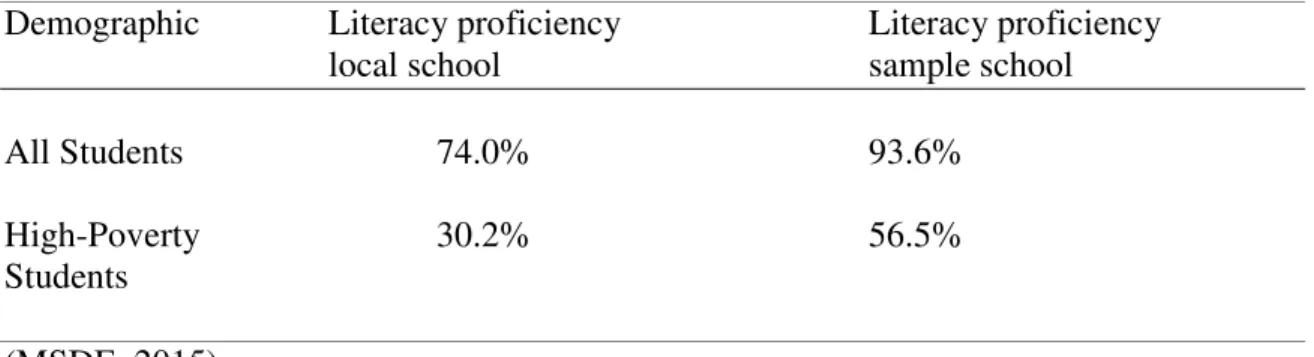
community: the achievement gap for high-poverty students remained despite a renewed effort and attention to the data. Stakeholders drilled down to determine trends and possible solutions with PARCC assessment data. The data further substantiated the achievement gap in fourth grade literacy where students demonstrated 74% proficiency while only 48% of high-poverty students scored proficient (MSDE, 2015).
The NAEP and state data suggest that poverty possesses a strong negative influence on achievement at the local setting. Despite the strategies the school community employed from 2012 to 2015, the local institution demonstrated an
achievement gap for high-poverty students. Notwithstanding small class sizes of no more than 23 students for reading, 100% highly qualified teachers, and common core
implemented curriculum, high-poverty students by the end of fourth grade struggled to meet literacy achievement standards. This trend depicted a substantial gap in practice that validated this study.
Evidence of the Problem from the Professional Literature
Krashen (2011) stated, “Poverty is clearly the most serious problem. In fact, it may be the only serious problem in American education” (p. 18). The literature suggests that the gap in literacy achievement is the result of compounding poverty factors, which reinforces exploration of additional solutions, strategies, or practices to remediate literacy needs (Rosenberg, 2012; Willingham, 2012). Some researchers found that differential
educational risk factors exist in rural areas for high-poverty students that are not considered factors in urban settings (Greenough & Nelson, 2015; Ullici & Howard, 2015). Therefore, the problem has unique rural nuances that required attention. Rural nuances include generational factors that may not be typical in the urban setting as well as monolithic community issues that give rise to cycles of poverty (Ramalho & Urick, 2013).
When students do not possess comprehension and fluency skills by the end of third grade, students can become tracked in intervention systems that have not always worked to meet their individual needs (Richards-Tutor et al., 2016). Little intervention, if any, is as effective as ensuring students reach literacy standards through early school years (Hagans & Good III, 2013). Ladd (2012) documented that children from
disadvantaged households perform less well in school than those from more advantaged households. Through qualitative case study measures, Loyd and Hertzmans (2010) found that high-poverty rural settings maintain high residential instability and mobility, which leads to worsened literacy scores over time and lower fourth-grade scores compared to more affluent surroundings. Also, in a review of experimental studies, poverty is
associated with lower test scores in reading achievement (De Marco & Vernon, 2013). A review of the literature indicates that most research on poverty is typically focused on major urban settings (Greenough & Nelson, 2015; Ullucci & Howard, 2015). It is significant, however, that across the United States more than half of high-poverty students in elementary school live in nonurban settings (United States Department of Agriculture, 2014). Using less typical socioeconomic characteristics such as immigration
status, race, and parent education, Lloyd and Hertzman (2010) found that schools with higher affluence regardless of diversity make greater literacy gains. Concentrated urban neighborhood affluence is associated with better fourth-grade outcomes and improvement in scores over time. Lower rural wealth concentrations result in lower test scores and lower improvement over time. The empirical correlation between poverty and underachievement suggests that poverty is a stronger demographic influence than the other demographic descriptors of race or special services (Loyd & Hertzman, 2010).
The empirical relationship between poverty and lower literacy scores for
elementary students was also apparent in the literature review (Hagans & Good III, 2013; Krashen, 2011). The research suggested that many low-income children struggle to acquire early reading skills (Tivnan & Hemphill, 2015). Studies focused on the individual student, the school, the district, the state, and/or the country used various measures of family socioeconomic status or different definitions of high-poverty
including income-related measures such as family income, education level of the parents, occupation type of the parents, or employment status. In each, poverty negatively
influenced student achievement (Ladd, 2012). Poverty as a socioeconomic factor is the strongest predictor of low performance for students (Hagans & Good III, 2013; Krashen, 2011). Moreover, the research substantiates that poverty negatively influenced student achievement for over 20 years (Korenman, Miller, & Sjanstad, 1994).
Preferences and behaviors of teachers may contribute to the problem. Some teachers with strong credentials are reluctant to teach in schools with large concentrations of high-poverty students (Clotfelter, Ladd, & Vigdor, 2011). Colclough (2012)
discovered that teachers today are not lower performing or less committed when
compared to teachers of the past; instead, gaps in teaching and student performance grew over time based on socioeconomics of the school environment. Moreover, the gap in performance for high-poverty students persists at rates much greater in high-poverty schools as compared to schools with higher affluence and could be the result of variance in teaching practices and teaching capacity among the different environments.
In a quantitative study that discussed early school skills for high-poverty students, 60% of children from high-poverty households scored below even a basic level in reading at the end of the primary grades (Hagans & Good III, 2013). For high-poverty students in rural areas, the achievement in early school years remained low despite more than 3
decades of federal investment in programs to remediate or preventreading failure (De
Marco & Faegans, 2013). The evidence of low achievement surfaced on nationally normed literacy assessments and interventions, where minority status and poverty linked to lower oral reading fluency scores (Paleologos & Brabham, 2011). Hagans and Good III (2013) discovered that students in high poverty underperform regardless of monetary
investment or prescribed research-based interventions. Likewise,Colclough (2012)
determined that students from well-funded schools with higher socioeconomic backgrounds outscore schools with lesser monetary resources.
The inequities resulting from poverty in learning environments cause students to struggle and disengage from school (Wang & Machado, 2015). Possible sources of disengagement include rural factors such as geographical isolation and other
to learn the same amount of knowledge and skills than counterparts in urban settings.
In a correlational study, De Marco and Vernon-Faegans (2013) discovered that disadvantage in rural communities can influence child learning development. To measure children’s lowered receptive language abilities, De Marco and Vernon-Faegans (2013) explored impeded language acquisition and discovered that lower neighborhood safety in poor areas correlated to lower childhood vocabulary. Low performance also resulted from poor early reading development in low-income rural homes (De Marco & Vernon-Faegans, 2013; Dinehart & Manfra, 2013; Hagans & Good III, 2013). Thus, rural high-poverty low-language childhood experiences negatively influence childhood literacy (De Marco & Vernon-Faegans, 2013).
The influence of high-poverty on academic achievement was significant in the case of language and literacy competence (Hartas, 2011). Moreover, the data, findings in the literature base, and scope of the problem globally, nationally, and locally suggest that high-poverty teaching and learning factors contribute to the identified gap in practice. High-poverty literacy gaps could contribute to future school and societal problems, such as lowered graduation rates and unpreparedness for college and careers (Mette &
Scribner, 2014). This phenomenon is of great importance for the education profession as teaching, learning, and social change actions continue to target and address high-poverty achievement gaps.
The review of the problem of lower literacy achievement for high poverty learners in the literature provided me with extensive and well-documented evidence of the
urgency in closing the achievement gap for students in poverty be made priority for school reform. In the literature, school officials are called on to ensure educational equity for the underprivileged (Tivnan & Hemphill, 2015). While educational institutions and researchers alike have worked on intentional processes that readdress school policies for disadvantaged students, the literature suggests dramatic changes in the way that schools do business to meet high-poverty learning demands (Stone-Johnson, 2013).
Definition of Terms
The following list includes key terms and definitions used in my project study:
School culture:The assumptions, beliefs, routines, practices, and norms that influence the teaching and learning process at a school (DuFour & Marzano, 2012).
Communities of practice: A group of people who share a history of experience. Although a systemic vision for the community of practice may be in place, not all
members share a common trajectory or agree on a collaborative mission (Wenger, 1998).
Collaboration: The work that teachers do with time and tools that engage them in life-long learning that improves teaching and learning practice. Collaboration typically occurs in the form of teaching teams, but individual members must be committed to working together to change long-standing assumptions, expectations and practices (Carrol, Fulton, & Doerr, 2010).
Emergent literacy: The process of acquiring reading-related skills during the formative pre-school years beginning with a pre-kindergarten child’s awareness of language, understanding and recognizing letters as symbols, foundations of print, and
naming and sounding letters by the end of pre-kindergarten (Whitehurst & Lonigan, 1998).
Learning community: The school community inclusive of students, teachers, instructional support staff, support staff, parents, school leaders, and other stakeholders who work directly or indirectly with the teaching and learning process (DuFour & Marzano, 2012).
Learning systems: The curriculum implementation, professional development processes, teacher actions, leadership actions, school goals, student expectations, student engagement, collaborative processes, decision making systems, and stakeholder
relationships in a school (Mette & Scribner, 2014).
Learning structures: The physical school facility, school schedule, team meeting structures, leadership structures, and lesson plan structure and delivery that support teaching (Tivnan & Hemphill, 2015).
Macro factors: The global historical, political, and societal structures that influence student learning (Fletcher, Grimley, Greenwood, and Parkhill, 2013).
Micro factors: The institutionalized historical, political, and societal forces that regularly influence day-to-day classroom interactions between the teacher and student (Fletcher et al., 2013).
Significance of the Study
This study is significant to the educators at the local site because it addresses the problem with plausible changes in practice that may benefit student literacy learning. Moreover, the study has significance for the broader educational profession, including
teacher and administrator preparation. Finally, positive social change is possible as a result of the findings from this study.
Significance of the Study for Educators at the Local Site
This study is significant to the local teachers and school leaders in their reform efforts toward reaching higher literacy achievement for students by the end of fourth grade. Reforming an established learning community where collaborative practices regularly address the specific needs of each and every student is a monumental
undertaking (DuFour & Marzano, 2012). The pursuit of student excellence in literacy achievement regardless of student socioeconomic status proves to be difficult for many schools (De Marco & Vernon-Faegans, 2013). Regardless of such difficulties, schools
discover ways to meet high-poverty literacy needs. Schools possess the capability to
enhance practices that improve the literacy achievement of students regardless of high-poverty factors (De Marco & Vernon-Faegans, 2013; Krashen, 2011). This project study contributes to the local learning community and provides best practices to consider for continuous reform efforts that may improve high-poverty literacy.
Students at the local school can benefit from the study. The study outcomes potentially influence instruction and increase reading achievement for high-poverty students as well as the general population. Students who meet literacy standards by the beginning of fourth grade are more likely to succeed in school and in future college and career pathways (Foorman, Koon, Petscher, Mitchell, & Truckenmiller, 2015). The local community of educators may be able to implement strategies discussed in this project study to increase the achievement for high-poverty students who are typically
underserved. In meeting the reading achievement needs of the local fourth grade students, future success in school, college, or careers is increased (Mette & Scribner, 2014).
While the reduction of poverty in society is beyond the scope of educational institutions, mitigating the influence of high poverty on academic achievement is within educational means (Ladd, 2012). The overall significance is that the local school can do something to eliminate or reduce achievement gaps caused by poverty. With the learning of literacy skills for students, especially by the end of fourth grade, considered highly complex and measured as a strong predictor of future communicative, cognitive and social capacities (Ferraz, Pocinho, Pereira, & Pimenta, 2015), it is the responsibility of educators to meet student literacy needs. This study and the suggested outcomes may provide local school leaders and teachers with the effective protocols for meeting such literacy needs for students.
At the local setting, the ability to use the project outcomes to enhance its community of practice could be beneficial for student literacy achievement.
Administrators may be able to use the outcomes for improved professional development and instructional leadership. Classroom teachers may be able to use the project for improved instruction. Local teacher specialists may also find the project outcome useful in delivering improved adult professional learning strategies. Finally, students would benefit through enhanced instruction that correlates to greater literacy achievement. Overall learning community improvement could increase the likelihood that eventually all high-poverty students would meet literacy standards by the end of fourth grade.
Significance of the Study for the Education Profession
Educator capacity is described as the most effective measure to close test score gaps for high-poverty students (Lauen, 2013). Further study in methods to improve educator aptitude for high-poverty students improves educator capacity (Darling-Hammond, 2013). The implications and findings discussed in this study for the
education profession comprise of a contribution of information to the research base and in the field for implemented practice. The findings and project are of benefit for local teachers, district leaders, school administrators, teacher preparation programs, and other school districts for improved capacity in meeting high-poverty student literacy needs. Teachers are afforded additional strategies, practices, and reflective opportunities. District leaders and administrators could use the findings to support future decision-making for curriculum implementation, literacy interventions, and other fiscal and physical resource decisions. Teacher preparation programs may use the findings to increase teacher preparation competencies. Moreover, schools in the United States confronted with high-poverty literacy achievement gaps, could use this research to enhance their communities of practice.
The pursuit of pedagogical best practices that address the needs of an ever-changing student population, especially students who were typically underserved, is a primary responsibility of the education profession (Kaniuka, 2012; Tam, 2015). The implications from this project study contribute to the education profession and support the pursuit of additional pedagogic best practices. Teachers need the information to continue to grow in teaching and instruction practices in their classrooms. Teacher
preparation programs need this information to maintain excellence in the field and provide new teachers with more competency and experience before entering the classroom. Administrators who are leading teachers need the information to support informed decision-making that close achievement gaps. Finally, schools in the United States need this information, to further support, implement, or transform communities of practice to meet ever-changing high-poverty student literacy needs.
Implications for Positive Social Change
Quality education creates positive social change by providing a foundation by which members of society can minimize the effects of sociocultural and opportunity disparities and differences (Gorski, 2013). The achievement gap for high-poverty students as well as other disadvantaged student groups requires critical dialogue and a search for the best practices that school communities can use to defend students from disadvantages (Philpott & Dagenais, 2012). Providing structures and effective tools for communities that promote increased teacher collaborative capacity and student literacy performance enhances the education of students and enhances future social change. Therefore, the resultant positive social change from this project study include potential expansion of college and career readiness, a rise in graduation rates, an escalation in earning power, and upward social mobility for all students and especially high-poverty student in local, national, and global learning communities.
Research Questions
The local problem addressed in the study was the low reading achievement of high-poverty fourth grade students in a small rural school in the Mid-Atlantic region of
the United States. The purpose of the study was to explore the perceived best practices at a learning environment that support high achievement for high-poverty students and gather an understanding of the educator perceptions of the mechanisms that can solve the literacy achievement gap. The guiding research question to determine the design,
methodology, and scope of the study was: What are principal and teacher perceptions of best practices that increase fourth grade literacy achievement for high-poverty students in a high-achieving elementary school? At the local level, this addresses the specific
problem of low-literacy achievement for high-poverty students. Moreover, the
overarching question also aligns to the problem at the global, national, and district level. Ambiguity exists in the literature on the specific school-based strategies in support of increased achievement for high-poverty students (Ferraz et al., 2015; Ladd, 2012). Various instructional interventions have led to little impact of chronic achievement gaps. Therefore, an exploration of the perceived best practices at a learning environment experiencing high achievement for high-poverty students was necessary to provide specific practices for other school communities. An understanding of the educator
perceptions of the mechanisms that can solve the literacy achievement gap was a strategic goal for this study.
Schools exist that demonstrate success in raising literacy achievement for high-poverty students. A qualitative study that explored the perceptions of current practice in such a school, specifically a high-poverty, high-achieving learning community,
influences future practices at the local learning community. An examination of effective professional practice in the high-achieving elementary school environment promotes
professional growth for teachers and increases literacy achievement for low-income students in the local setting. The research to determine which best practices were essential for increased teacher capacity also leads to improved student literacy
achievement. Researchers and practitioners suggest that the instructional decisions and opportunities for students that occur in schools are the result of institutionalized micro and macro social, cultural, and political factors (Fletcher et al., 2013). An analysis of principal and teacher perceptions of these micro and macro factors at a high-poverty high-achieving learning environment delivered plausible outcomes to reshape and redesign future best collaborative practices as a solution to low reading achievement. Specific research questions were as follows:
RQ 1: What are the campus principal’s perceptions of the classroom best practices (micro factors) that contribute to high levels of literacy achievement for students in poverty at a high achieving elementary school?
RQ 2: What are teachers’ perceptions of the classroom best practices (micro factors) that contribute to high levels of literacy achievement for students in poverty at a high achieving elementary school?
RQ 3: What are the campus principal’s perceptions of the systems and structures (macro factors) that influence high-level literacy instruction for students at a high achieving elementary school?
RQ 4: What are the teacher perceptions of the systems and structures (macro factors) that influence high-level literacy instruction for students at a high achieving elementary school?
Review of the Literature
To find relevant current studies to support the problem, I searched the literature using the following databases: Academic Search Complete, ERIC and the Simultaneous Education Research Complete, Open Library, ProQuest, SAGE Research Complete, and the Google Scholar engine assigned to the Walden University Library. By combining
keywords and Boolean phrases such as literacy achievement, high-poverty, and learning
community with the terms best practices, shared leadership, collaboration, educational leadership, school reform, school renewal, teacher capacity, and reading interventions, I yielded significant results. In the second stage, I reviewed the abstracts of the works and narrowed the scope of literature by selecting the most relevant works to the research question. Seminal works were chosen for inclusion in the literature review based on their potential contribution to the conceptual framework of the paper, relevance to
sociocultural principles, school literacy improvement, learning community best practices, and high-poverty implications for student learning. Works addressing attempts by
practicing educators to promote school literacy reform efforts through learning
community best practices based on social change values were reviewed, analyzed, and synthesized in a self-designed matrix to elicit themes. Works that addressed the
interdependence of micro and macro sociocultural factors in schools as they related to the research question were reviewed, analyzed, and synthesized in a similar amalgamation matrix. The combination and synthesis of the descriptive studies established a
connection to the conceptual framework and suggested approaches for improving literacy instruction.
The literature review begins with a discussion of the sociocultural conceptual framework that grounds the study. This is followed by an analysis of the problem through thematically grouped and organized review of the sources in terms of theoretical constructs and topics of importance: high poverty as a factor in inhibiting achievement; literacy learning; micro factors that influence school literacy improvement; macro factors that influence school literacy improvement; and a discussion on the suggested best practices. By organizing the review in this way, the scholarly literature is funneled from higher-level concepts and broader problem implications to the specific studies and critical analysis where literacy learning for high-poverty students is based.
Conceptual Framework
The professional research of scholars and the opinions of practitioners suggest that the instructional decisions and opportunities for students that occur in schools are the result of institutionalized micro and macro social, cultural, and political factors (Fletcher et al., 2013). Researchers indicate that the lower achievement of high-poverty students is related to such dynamics and worthy of a scholarly endeavor (Dexter & Stacks, 2013; Kaniuka, 2012; Matsumura & Wang, 2014; Shippen, Miller, Patterson, Houchins, & Darch, 2014). Originally discussed by Vygotsky (1978) as part of the social
constructivism theory and expounded by neo-sociocultural theorists (Wertsch, del Rio, & Alverez, 1995), the conceptual framework driving this study is the sociocultural
framework. The framework is summarized as an awareness of circumstances surrounding individuals and how their behaviors are affected by their surrounding
teaching and learning as an empathetic art that relates the social and cultural differences of students to curriculum. Teaching must include the prerequisite knowledge of students and a hyper-awareness of sociocultural factors to plan learning pathways that meet student sociocultural needs. The sociocultural framework combines teaching practices alongside knowledge of students’ high-poverty backgrounds and cultures to support engaged practitioners in self-reflective learning that improves both teaching practice and student achievement (Fletcher, 2015). Derivatives of the framework as discussed in the literature include the socioecological theories, social constructivist, socioemotional theories, and other wider socially derived theories (Berkovich, 2013; Colclough, 2013; Fletcher et al., 2013; Lam, 2014; Lenters, 2013; Wilcox, 2013).
Students and adult learners make meaningful connections with school environments when commonality exists between school cultural contexts and the
experiences of personal lives. The ability to improve reading instruction for high-poverty students requires an exploration of the explicit skills of competent reading with wider school and community structures that influence reading achievement (Fletcher et al., 2013). Fletcher et al. (2013) postulated a sociocultural systematic learning model framework that isolated the conditions in which children can improve reading achievement among the macro factors and micro factors that contribute to the social milieu that is present in school. Wertsch et al. (1995) posited that learners, adult or child, must be immersed in this social milieu before anything can be learned and materialized in the brain. The construction of knowledge is an active participation of collaboration
between learner, teacher, and environment within the attributes micro and macro factors (Lam, 2014; Wilcox, 2013).
The micro factors relevant to this project study included: educator efficacy, beliefs, teacher capacity, student expectations, instruction, and decision-making (Berkovich, 2013; Colclough, 2013; Fletcher et al., 2013; Lam, 2014; Lenters, 2013; Wilcox, 2013). The macro factors relevant to the study included: school culture, school climate, political forces, social positioning, organizational conditions, and accountability measures (Berkovich, 2013; Colclough, 2013; Fletcher et al., 2013; Lam, 2014; Lenters, 2013; Wilcox, 2013). The sociocultural macro and micro factors regulate student literacy achievement through the relationships between school, student, and community (Fletcher, 2015). In order for students to achieve at a high level, micro and macro factors must be situated around high quality instruction that emphasizes sustained connected learning opportunities for both students and staff (Matsumura & Wang, 2014). School
improvement initiatives concentrated on social practices inherent to individuals and communities correlate to significant achievement outcomes (Jesson & Limbrick, 2014; Lenters, 2013).
The logical connection among the key elements of the framework includes the research on teacher perception and beliefs in regards to student expectation and achievement (Banks et al., 2013; Griffith, Massey, & Atkinson, 2013; Kaniuka, 2012; Wilcox, 2013). A sociocultural comfort zone exists for learners and teachers (Banks et al., 2013; Ferguson, 2014). Moreover, in order for student achievement to rise, both teachers and students need to step outside of this comfort zone. In doing so, educators
and students make use of the sociocultural or social practices in the teaching and learning approaches to literacy (Lenters, 2013). Literacy is best conceptualized socially as an ideological process encompassing skills of learning to decode print and comprehend written language through connections. These connections are the direct result of the social, political, cultural and linguistic complexities inherent to the beliefs of individuals, schools, and communities that shape perceptions and the use of literacy skills (Lenters, 2013). High-poverty students and teachers interact in ways that are symbolic of these complexities. Teachers and students influence each other as expectations for
achievement are built in the teacher-student relationship. For example, low expectations may lead to lower achievement while high expectations may lead to higher achievement.
In a longitudinal qualitative case study grounded in the sociocultural framework, Fletcher et al. (2013) discovered influential factors that affect school improvement and postulated that professional perceptions leading to high-level literacy achievement are rooted in the sociocultural components. Learning community collaborative practice, ongoing professional development, and implementation of reading programs derived from school data, school wide support, and many others were included. It was of significance that researchers discovered that elementary reading instruction and
sociolinguistics permeate each of the influential factors (Fisher, Frey, & Nelson, 2013).
Effective reading instruction was presented as the most important sociocultural factor in elementary student achievement and teacher professional development (Broadley, 2012). Thus, literacy instruction for students in high poverty is influenced by sociocultural forces inside instruction (micro) and forces outside of instruction (macro). To fully
understand how micro and macro factors inhibit literacy learning, the sociocultural factors explicit to high poverty must be examined.
High-Poverty Factors That Inhibit Literacy Achievement
Educators’ views toward poverty and the systematic decisions made based on subconscious biases were found to further perpetuate low achievement for high-poverty students (Banks, Dunston, & Foley, 2013; Sparks & Reese, 2013). In an exploratory mixed-methods study, Banks et al. (2013) found that negative attitudes existed about the expectations of achievement for students who live in high poverty. In a like study, Sparks and Reese (2013) examined sources of variation for language development and discovered that lower verbal abilities in high-poverty students hindered academic progress. Variations in language correlated to increased identification of high-poverty students for speech language and special education services. Moreover, high-poverty student literacy learning is linked to complex systematic and institutional norms that may perpetuate bias and false identification of students for special services (Sparks & Reese, 2013).
In a study of school and socioeconomic social factors, Reglin et al. (2012) found that indirect factors related to high-poverty inequalities in education are related to the social and cultural disparities between the richer and poorer segments of society. Parental involvement, parent-child interactions, along with the family’s general attitude towards learning and academic success bears a negative influence on student
performance (Topor, Keane, Shelton & Calkins, 2010). Data indicated that teaching quality and resources spent in high-poverty areas were reduced when compared to more
affluent neighborhoods or school districts (Ladd, 2012). Students who live in high-poverty homes typically attend high-high-poverty schools and are further disadvantaged from social and fiscal inequality factors. Furthermore, the literature recommended that special attention be given to high-poverty students and high-poverty schools to further reduce disparities and barriers to learning and achievement (Kaniuka, 2012; Tam, 2015).
A longitudinal study completed by Dexter & Sacks (2013) linked a lack of pre-school learning development as a negative influence on literacy. Children who have underdeveloped literacy skills experience difficulty in catching up to their peers. Dexter and Stacks (2013) quantified that early kindergarten students who possess low emergent literacy skills have greater than an 80% chance of being a low reader with low
comprehension by third grade. Children not reading well by the end of first grade have a 90% chance of remaining low readers (Dexter & Stacks, 2013). Early comprehension delays increase the likelihood that high-poverty students will encounter more learning problems in school as the initial reading gaps continue to widen over time (De Marco & Vernon-Faegans, 2013).
Several important indirect contextual factors contribute to the phenomena of the low academic achievement in high-poverty students. Elements include pre-literacy gaps from social and contextual poverty factors, social diversity challenges, negative social influences of student poverty, and inadequate teacher preparation, experience, or professional development to address substantial need in high-poverty schools (Dinehart & Manfra, 2013). There was also evidence that the low literacy performance of high-poverty students results in low engagement and lesser fine-motor skills in early
elementary years (Dinehart & Manfra, 2013). Low engagement and reduced fine-motor skills from early life poverty indicate that the early indirect literacy factors relate to later lower engagement in the learning process.
A review of the research also suggests that rural schools have challenges in maintaining a faculty of highly experienced teachers compounded by limited access to high quality professional development (Porche, Pallante, & Snow, 2012). The social attributes of professional development were reported to be of high value for teacher growth (Fisher, Frey, & Nelson, 2013). The absence of such professional social attributes for high-poverty rural schools compound improvement efforts, because the sociocultural factors that underpin an informal network for educators typically provide for a continuous cycle of growth significant to student and school sociocultural needs (Ramalho & Urick, 2013). Moreover, rural teachers may not be adequately prepared to effectively collaborate with one another due to prohibiting sociocultural factors like lack of trust, which was indicated as a typical characteristic of rural high-poverty locales (Bausmith & Barry, 2011; Ramalho & Urick, 2013).
Collaboration amongst teachers was empirically addressed and considered a strategy to improve teacher capacity and instructional repertoire (Bausmith & Barry, 2011; Lenters, 2013). For example, in an explanatory mixed methods study, Broadley (2012) investigated a model that provided collaborative connectedness for rural teachers in Australia. The connectedness allowed faculty to experience a cycle of social growth that resulted in improved professional development and capacity building. The research of Porche et al. (2012) indicated that teachers were more willing to try new
methodologies when collaborative opportunities were included as a macro factor in school professional development. D’Ardenne et al. (2013) indicated that teachers crave a high level of collaboration with each other to share critically and interrogate practice through reflection. Such collaboration could potentially shift learning community culture and build individual teacher capacity (Anderson, Mascall, Stiegelbauer, & Park, 2012; Fletcher et al., 2013; Matsumura & Wang, 2014).
Outcomes of education are mediated by the local, social, and economic contexts of the school community (Colclough, 2013). The literature indicated that poverty’s adverse effect on quantity and quality of instruction further reduces and prevents high-poverty students from the social benefits of public education (Jesson & Limbrick, 2014). The complex interactions between the social and cultural circumstances of poverty
among the same social and cultural contexts of school are barriers to high-poverty student learning (Jesson & Limbrick, 2014). This is a contradiction in the belief that the
education system should serve as a social allocation that breaks down inequality (Colclough, 2013). Moreover, the literature suggests that education’s influence on reducing social inequalities is no longer as strong as it once was, and the positive influence that once existed has been degraded due to social and political factors (Elliot, 2014 Lenters, 2013; Paleologos & Brabham, 2011).
Literacy Instructional Factors
The broader problem of low achievement for high-poverty students in schools is underpinned in sociocultural factors that influence literacy instructional factors. Literacy learning, which includes fluency and comprehension, was presented as a concurrent
theme throughout the literature base. Furthermore, five domains of literacy were
discussed: phonemic awareness, phonics, vocabulary development, reading fluency, and reading comprehension (Ferguson, 2014; Ferguson, 2013; Fletcher, 2015; Foorman et al., 2015; Jesson & Limbrick, 2014, Lenters, 2013). By isolating the five domains in both quantitative and qualitative methodology, researchers found that high poverty’s social and cultural contextual factors influence student achievement in these literacy domains (Ferguson, 2014; Ferguson, 2013; Jesson & Limbrick, 2014, Lenters, 2013). The
experimental studies of Richards-Tutor et al. (2015) and Shippen et al. (2015) focused on strengths of reading intervention that used literacy domains as the diagnostic
measurement. In each study, it was discovered that high-poverty negatively influenced literacy scores. Therefore, high poverty’s social and cultural complexities must be considered when programming for literacy instruction.
De Marco and Vernon-Faegans (2013) discovered that inadequate explicit reading instruction within the literacy domains results from minimal professional conversation focused on generational and situational poverty implications. Tam (2015) suggested that isolative teaching practice, inadequate use of formative assessment for explicit feedback for students, and inexperience analyzing student achievement data leads to unfocused instructional conversation. Isolationism by teachers with a lack of targeted instructional decisions was listed as a contributing factor for lowered student literacy (Kaniuka, 2012). Isolationism and the absence of explicit teaching practices might contribute to the
Increased professional competence was empirically correlated to the
augmentation of sociohistorical and sociocultural barriers to student achievement in reflective professional development for teachers (Hargreaves & Harris, 2011). Researchers found that professional development derived from reflective and collaborative approaches result in increased positive literacy performance (Collie, Shapka, & Perry, 2012; Hargreaves & Harris, 2011; Stone-Johnson, 2013). When educators align culture and collaborative tasks to address and explore complex student literacy learning phenomena, equitable plans of actions with improved teaching practices result (Mette & Scribner, 2014). The implications of teacher collaboration toward equity may be the pathway to greater competence for teaching literacy to students.
Collaborative discourse as a learning community practice has also gained attention at the U.S. national level (DuFour & Marzano, 2012). With the arrival of the Common Core and Race to the Top legislation, a new mutual level of accountability is
expected for student performance in global 21st century literacy skills. Older educational
technologies and strategies combined with new 21st century literacy tools have forced
schools and districts to rely on strong collaboration, partnerships within and among teaching teams, and egalitarian approaches for professional growth (DuFour & Marzano, 2012). The implications of low literacy achievement for high-poverty students in the education profession were grounded in these heightened ethical responsibilities and accountability measures.
Macro Factors That Influence School Literacy Achievement
I synthesized the literature to determine the macro factors that influence school literacy improvement. The macro factors are school culture, school climate,
social/political forces, social positioning, organizational conditions, and accountability measures (Berkovich, 2013; Colclough, 2013; Fletcher et al., 2013; Lam, 2014; Lenters, 2013; Wilcox, 2013). Education is described as an open system, embedded in a complex social context with macro factors within and outside of district boundaries (Berkovich, 2013). Macro factors are represented in the state and national political forces that drive educational decision-making. Macro factors affect the many hidden institutional distinctions that perpetuate the work that schools do, in both high performing and low performing schools (Berkovich, 2013, Colclough, 2013, Lam 2014). In fact, in regression studies that addressed higher-performing low-income students, the school ecosystem and societal macro system were reported to influence all facets of instruction (Wilcox, 2013).
The research indicates that several interrelated school climate factors make a difference in school literacy achievement: (a) a high understanding of student populations (b) intensive literacy instruction; (c) technology rich instruction; (d) a collaborative approach to curriculum; and (e) the ability to adapt and deploy resources, (f) the use of performance data, and (g) connections with families (Berkovich, 2013, Colclough, 2013, Lam 2014 Wilcox, 2013). Empirically, school culture was considered an influential constituent in all areas of student achievement because learning expectations result from the lived and hidden culture that exists in a school (Wilcox, 2013). Lam (2014) reported