Procedia Computer Science 89 ( 2016 ) 7 – 16
1877-0509 © 2016 The Authors. Published by Elsevier B.V. This is an open access article under the CC BY-NC-ND license (http://creativecommons.org/licenses/by-nc-nd/4.0/).
Peer-review under responsibility of organizing committee of the Organizing Committee of IMCIP-2016 doi: 10.1016/j.procs.2016.06.003
ScienceDirect
Twelfth International Multi-Conference on Information Processing-2016 (IMCIP-2016)
An Energy-Efficient Clustering Algorithm for Edge-Based
Wireless Sensor Networks
K. Muni Venkateswarlu
∗, A. Kandasamy and K. Chandrasekaran
National Institute of Technology Karnataka, Mangalore 575 025, IndiaAbstract
To employee clustering algorithms in multi-hop data forwarding mechanism, Hot-spot problemwill cause unbalanced energy dissipation among the cluster heads in the network. Unequal clustering technique promotes even energy dissipation only in inter-cluster communications not in intra-cluster communication.An Energy-efficient Clustering Algorithm (EECA)is introduced to avoid these problems in edge-based wireless sensor networks. The main aim of the presented algorithm is to avoid hot-spot problem by balancing uniform energy utilization among networked cluster heads. EECA constructs uneven size clusters in different levels to enable uniform energy expenditure among cluster heads. Data delivery is one of the important and unavoidable energy consuming operation in any sensor networks. To balance energy consumption load among data transmission routes, a multi-hop data forwarding protocol is introduced. Here, source node selects a relaying node who has minimum hop count to base station with more energy reserves and relayed less number of packets. Extensive experimental results prove that the presented algorithm overcome the congestion problem in the network by uniform distribution of energy consumption and enhances network’s lifetime. © 2016 The Authors. Published by Elsevier B.V.
Peer-review under responsibility of organizing committee of the Twelfth International Multi-Conference on Information Processing-2016 (IMCIP-2016).
Keywords: Edge-Base Station; Energy-Efficient; Network Lifetime; Unequal Clustering Algorithm; Wireless Sensor Network.
1. Introduction
Wireless Sensor Network (WSN) is a collection of distributed tiny sensor devices, with sensing, computation and communication capabilities. These tiny nodes are conditioned in processing power, communication channel bandwidth and memory. Sensing devices are gathered to build disjoint groups called,Clusters. Clustering mechanism support network scalability, adaptability, resource sharing and conservation and, efficient resource utilization. In general, clusters are formed based on energy resources of sensor nodes and node’s position with its Cluster Head(CH). Clustering techniques are one of the solutions to reduce energy wastage in WSNs. Clustering algorithms proposed in the literature are mainly focused to reduce communication cost and to employee effective resource allocation1. Clustering paradigm simplify route discovery process in large scale networks and also it limits number of control messages exchanged during network operations. As the sensor nodes are always connected to their CHs, it is sufficient to establish a data route with CHs in the network2.
The primary goal of hierarchical paradigm is to efficiently utilize network resources to improve network performance. Clustering scheme has important applications in high-density networks, because it is easy to manage a set
∗Corresponding author. Tel.: +91-812-332-1443. E-mail address:[email protected]
© 2016 The Authors. Published by Elsevier B.V. This is an open access article under the CC BY-NC-ND license (http://creativecommons.org/licenses/by-nc-nd/4.0/).
8 K. Muni Venkateswarlu et al. / Procedia Computer Science 89 ( 2016 ) 7 – 16
of cluster representatives than managing whole network. Sensor nodes forward the sensed data to their CH. Each CH aggregates the received data and forwards it to destination either directly or via multi-hop data transmission through relaying CHs. In a hierarchical network, network communication is composed of intra-cluster and inter-cluster data traffic. From the literature it is observed that multi-hop data transmission between the source and sink is more reliable and energy-efficient3. However, the clustering paradigm causes imbalanced energy dissipation among clusters in the
network. CHs close to destination spend their energy sooner with heavy relaying data and die faster this is known as,
Hot-spot problem. Trade-off between intra-cluster and inter-cluster data communication needs to be handled carefully to enhance energy-efficiency and it depends not only on cluster size but also on distance between the cluster formed and sink node1, 4.
An unequal clustering technique, Energy-efficient Clustering Algorithm for Edge-based WSNs (EECA), is investigated in this paper to overcome hotspot problem. EECA goal is to improve network lifetime by distributing energy expenditure between intra and inter-cluster communications.
2. Related Work
Literature related to WSN design spaces, clustering algorithms and routing techniques are discussed in this section. Low Energy Adaptive Clustering Hierarchy (LEACH)5 is one of the well-known clustering protocols for WSNs. Each node is assigned with some probability and is used to become a CH for each data transmission round, and the role of being a CH is rotated among cluster members. LEACH distributes communication load uniformly among sensor nodes in the network. However, single hop routing algorithm does not fit in the requirements of real world applications. Lindsey and Raghavendra (2002)6 proposed a chain-based clustering algorithm, Power-Efficient Gathering in Sensor Information Systems (PEGASIS) which as an extension of LEACH. PEGASIS is designed to reduce intra cluster communication overhead in hierarchical paradigm. PEGASIS forms chains with near by neighboring sensor nodes in greedy fashion. A leader node is elected from each chain to forward data to sink node. Like LEACH, PEGASIS is also a single hop routing protocol.
To balance energy consumption among CHs,7, proposed an unequal clustering algorithm, Energy-efficient Unequal Clustering (EEUC) to form different size clusters. The size of the cluster depends on distance from the base station and the size of the cluster grows with the distance. Thus, the CHs close to BS preserve some amount of energy for inter-cluster communication. The author also proposed an energy aware multi-hop routing algorithm for inter-cluster communication in EEUC mechanism. Besides, EEUC creates huge and varied number of CHs based on parameters likercomp,cetc from round to round and does not guarantee different CH for each round.
Atleast to our knowledge, Mao and Hou (2007)8presented first edge-based routing protocol for WSN. To perform network operations, BeamStar uses the network’s infrastructure. BeamStar considers a base station with directional antenna which has power control capabilities in the network. Such a BS is used to scan the network to provide location information to the sensor nodes with various transmission levels in different beamwidth values. With the location details, sensor nodes forward sensed information to the BS using controlled broadcasting technique. The data is transmitted using simple forwarding rules provided by the edge-base station. To transmit data transmission flooding is used which is not a realible data delivery technique and will waste valuable energy resources. To check network health BeamStar exchanges lot of control messages.
Kuong Ho et al. (2009)9 proposed another routing protocol called, CHIRON, for edge-based WSNs. It uses PEGASIS to transmit data between the source and sink and, BeamStar technique to provide location details to sensor nodes. CHIRON performs better than BeamStar with respect to network delay time and lifetime. CHIRON’s uses that same data transmission technique of PEGASIS6 to deliver data. However, CHIRON’s data forwarding scheme is not reliable since it forwards data randomly towards destination. Also, raise in network size results in long chain formation and increases network delay.
Cluster-based BeamStar (CBS)10is proposed to overcome the drawbacks of BeamStar8. CBS uses the same idea of BeamStar to give location details to sensor nodes, but with a refined scanning process. CBS uses network resources efficiently for inter-cluster communication and scan time. CBS uses the same technique of LEACH5routing protocol to transmit data among sensor nodes and a node with high residual energy will be selected as a CH for each cluster. However, CBS radius selection strategy constructs huge number of rings as the network size grows and congest the network.
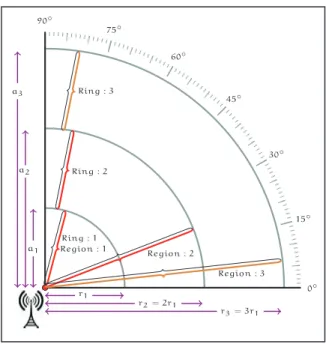
Fig. 1. Sector Formed by Power Controlled Directional Antenna. Fig. 2. Network Level Partitioning Mechanism.
3. Network Design Space
While network being deployed, BS broadcasts an advertisement at given power levels in the network. RSSI (Received Signal Strength Indication) is used to computes its approximate distance to BS by each sensor node which also helps the sensor node to select proper power level to communicate with the BS and in final CH selection process. BeamStar considers a base station with directional antenna which has power control capabilities in the network. To scan a given a sector area, transmission power level (r) and beam-width (θ) of the directional antenna are used. Figure 1 depicts an area scanned by the BS for a given valuerandθ. By adjustingrandθ BS can reach any part of the network. With variousrandθvalues, network can be divided into different levels as shown in Fig. 2. For eachr
andθ, network is scanned and provide location information to sensor nodes.
4. An Energy-Efficient Clustering Algorithm
This section presents an Energy-Efficient Clustering Algorithm to balance energy consumption and elevates lifetime of an edge-based wireless sensor network.
4.1 Inter-cluster multi-hop data routing
Initially, all the sensor nodes in the network are arranged hierarchically to build clusters. Since the nodes from the first ring communicate directly with the BS, they will not participate in clustering technique.
CH fromith ring receives data traffic from its cluster members as well as the relaying data traffic from CHs in
(i+1)thring and transmits the combined traffic to the CH in(i−1)thring. Data forwarding continues hop-by-hop until the data reaches the destination node.
Every CH forwards its information to the BS via descending cluster heads in the lower levels. This promotes minimum hop routing with atmostihops in between the source CH and the BS if the CH is fromithlevel.
10 K. Muni Venkateswarlu et al. / Procedia Computer Science 89 ( 2016 ) 7 – 16
4.2 Cluster radius computation
Elevating lifetime of a given network with energy constraints is very challenging. The basic principle to save networks energy is through,Clustering techniques. The energy is distributed uniformly by rotating the role of CH among sensor nodes in the network. But, CH rotation distributes energy dissipation between CHs and their members only and it fails to balance energy dissipation among CHs in inter-cluster communication. Extensive research on clustering is found in the literature to distribute energy uniformly in inter-cluster communication based on energy reserves in the network7.
The main aim of the the proposed work is to improve networks lifetime by avoiding hot-spot problem. The presented cluster formation and CH selection mechanism promotes even energy dissipation among CHs and increases WSN lifetime. A multi-hop routing scheme is proposed here to forward data between the source and sink nodes with a little burden network resources.
To form unequal clusters, radius of a cluster is a function of distance to destination. In otherwords, radius is a function of number of levels away from the BS in the sensor network which rises with BS distance. Radius of a cluster based on its distance with BS is computed as fellows:
Rch = 1−dmax−dlevel r1 2 2L n−1 (Ltotal−1)/Ln ∀ i >1 (1)
wheredmaxrepresents the maximum distance between the sensor nodes and the BS,dlevelis the distance between the
level numberLnand the BS,r1represents the radius of first level,Ltotalgives the total number of levels in the network
andLn is the sensor nodes level number.
4.3 CH selection phase
In the beginning of the process, with some probabilityP, huge number of Tentative CHs (T-CHs) are chosen from each level. Where,Pvaries dynamically since the percentage of CHs differ from level to level with thresholdTis being application specific. For a given level numberLn, Equation (2) represents a probability value PLn . Non-competing
nodes go into sleep mode, when the T-CHs compete each other for final CHs role.
PLn =1−
Ln Lt ot al ∀
i >1 (2)
whereLnis line number andLt ot alis total number of levels in the network.
Fig. 3 Neighboring CH Identification.
CH’s competition radiusRch for each T-CH is evaluated from the equation (1).
Each T-CH broadcasts a message,COMPETE−CLUSTER−HEAD−MSGmessage with details(Node−ID),Ln,Rch and Spent energyEse. Each T-CH maintains a
set,Neighbor−Tentative−CHto save its neighborhood T-CHs information. T-CHs
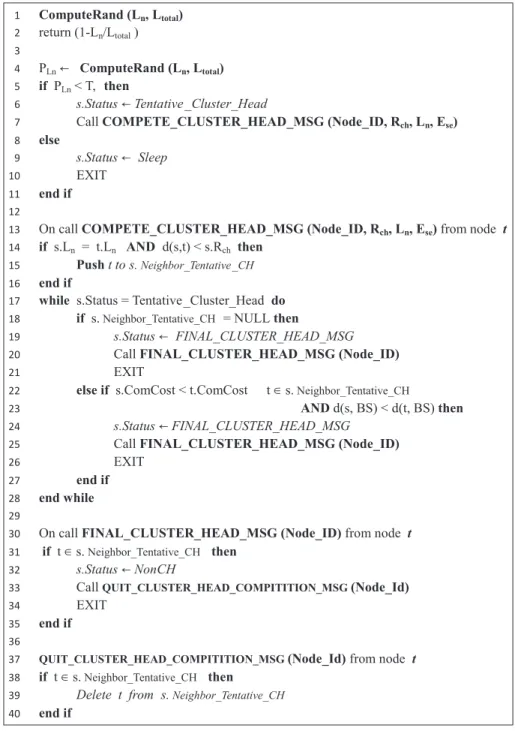
is a neighbor of T-CHtifsis int’s competition diameter ortis ins’s competition diameter. Figure 3 demonstrates the process to find neighborhood T-CHs. Final CHs are selected based on the neighboring nodes set Neighbor−Tentative−CH. If the neighborhood set is NU L L for a T-CH t, then t becomes final CH. Otherwise, t will check Neighbor−Tentative−CH set to find a T-CH with lowest communication cost. If t’s communication cost is least, then t will win the competition and broadcasts FINAL−CLUSTER−HEAD−MSGmessage. T-CHs receive FINAL−CLUSTER−HEAD−MSG, will give-up the competition by broadcastingQUIT−CLUSTER−HEAD−COMPETITION−MSG. If a T-CH t
receivesQUIT−CLUSTER−HEAD−COMPETITION−MSGfrom its neighbors,
t will removesfrom itsNeighbor−Tentative−CHset. When a T-CH becomes a final CH, then it will ensures there is no other CH in its radiusrch. This completes
CH selection process and the same is explained in detail for an arbitrary sensor nodesin the pseudo code given in Fig. 4.
Fig. 4. CH Selection Pseudo Code.
4.4 Cluster Formation Phase
Once all the final cluster heads are selected, each CH broadcasts a message, CH−ADV −MSG. Then the non competing sleeping nodes wake-up and join nearest CH which has high RSSI by transmitting JOIN−CH−MSG
12 K. Muni Venkateswarlu et al. / Procedia Computer Science 89 ( 2016 ) 7 – 16
Table 1. Simulation Parameters.
Parameter Value
Simulation Area (0,0)∼(1000,1000)m
BS Location (0,0)
Number of nodes 100, 200 & 400 Simulation Time 25000 seconds Initial energy 18720 joules
Packet Rate 1 per second
Round Time 25 seconds
Eelec 50 nJ/bit
Eamp 10 pJ/bit/m2
ED A 5 nJ/bit/signal
Data Packet Size 2000 bits
RadiusR 200 meters
Number of Runs 10
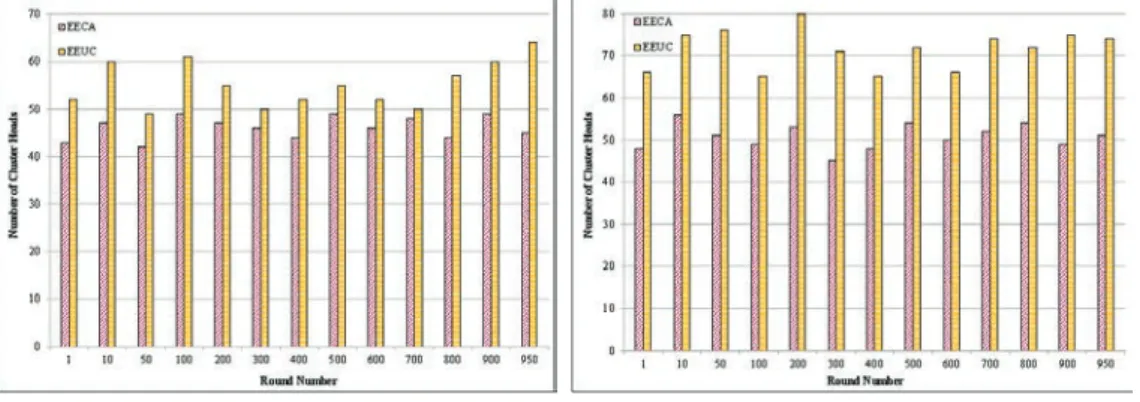
Fig. 5. Number of CHs Selected in each Round.
5. Experimental Setup
In the following section, EECA performance is analyzed through extensive experimental work done with CASTALIA simulator11. For this experimental work, an ideal MAC layer and error-free communication links is considered. Radio hardware energy dissipation model shown in7 is used here. EECA characteristics are analyzed in comparison with Energy-Efficient Unequal Clustering Mechanism (EEUC)7. Table 1 presents the experimental parameters used for the simulation work.
Figure 5 represents number of CHs selected for in each data forwarding round by EECA and EEUC. It is noted from the figure that, EECA creates consistent number of CHs for each data forwarding round. Whereas EEUC forms huge and varied number of clusters compared to EECA. The considered layered network design scheme helps to build consistent number of CHs in each data transmission round.
5.1 Energy consumption
EECA’s energy expenditure characteristics are analyzed in this section.
Figure 6 depicts the total amount of energy dissipated by CHs in different data forwarding rounds using EECA and EEUC algorithms. From the figure it is observed that EECA’s energy consumption is low and consistent.
The amount of energy consumed by sensor nodes in EECA and EEUC network is presented Fig. 7. It is observed for the results that the energy dissipation is less with EECA sensor nodes. Irregular number of clusters and uneven cluster caused more energy wastage in EEUC network.
Fig. 6. Total Amount of energy Consumed by CHs.
Fig. 7. Total Amount of Energy Consumed by Sensor Nodes.
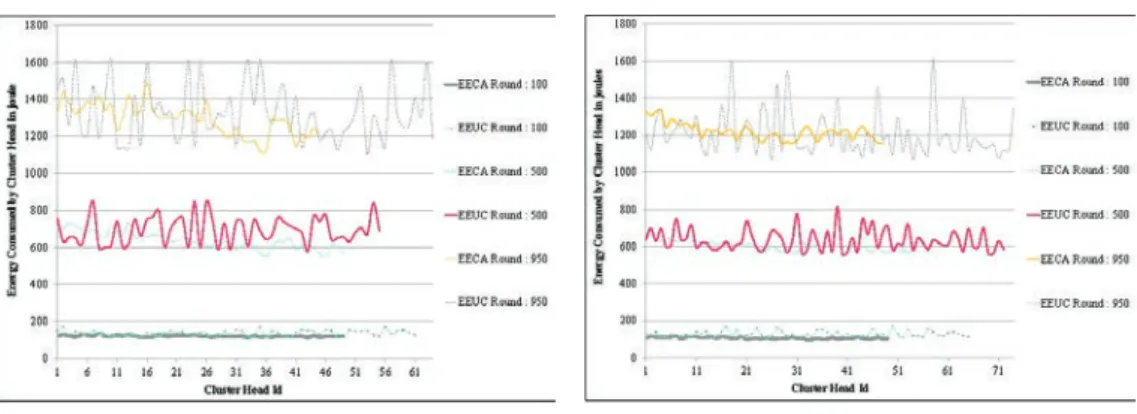
Fig. 8. Amount of Energy Consumed by CHs at Random Rounds.
EECA CH rotation scheme distributes energy expenditure among sensor nodes with its intelligent CH rotation mechanism. Energy consumed by both EECA and EEUC CHs is illustrated in Fig. 8. Form the figure it is inferred reduced energy utilization in EECA CHs.
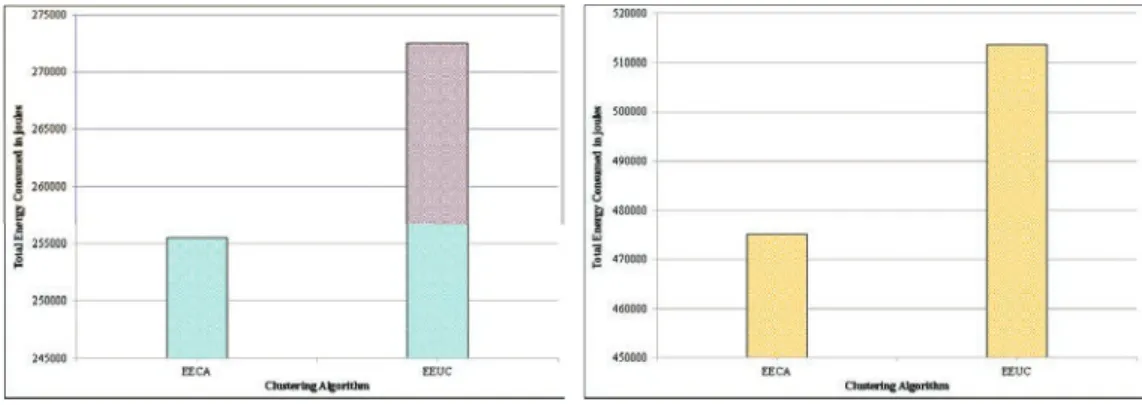
Figure 9 depicts total amount of energy utilized by EEUC and EECA. EECA’s energy conservation is observed from the results.
14 K. Muni Venkateswarlu et al. / Procedia Computer Science 89 ( 2016 ) 7 – 16
Fig. 9. Total Energy Consumed by EEUC and EECA Networks.
Fig. 10. Variance in Amount of Energy Spent by CHs.
Figure 10 illustrates the variance in the amount of energy consumed by EECA and EEUC CHs. Low variance is noticed from the figure in EECA CHs energy expenditure.
5.2 Lifetime computation
Network lifetime characteristics are analyzed in the following section for the introduced algorithm.
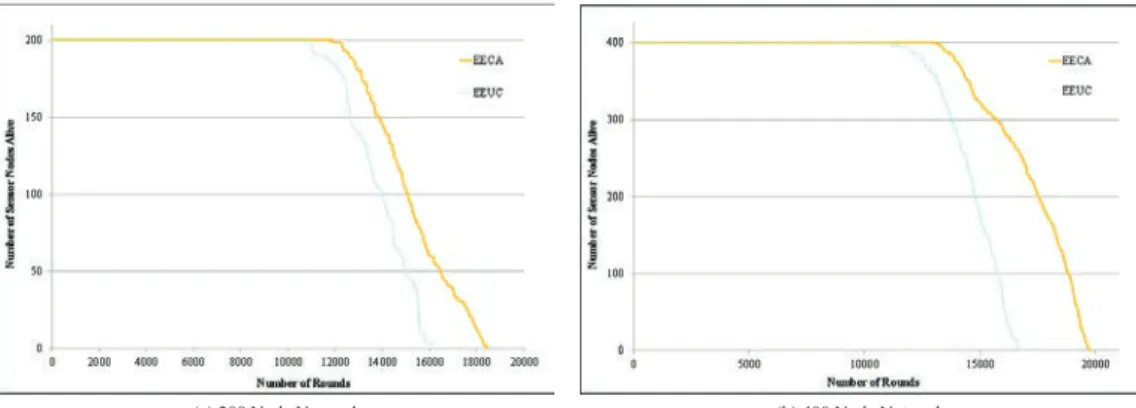
Lifetime of EECA and EEUC networks is presented in Fig. 11 when one percentage of nodes die. From the results it is clear that EECA prolongs network lifetime approximately by 11.5%, 7.1% and 14.5% in 100, 200 and 400 node network when compared to EEUC.
Figure 12 represents EECA and EEUC network lifetime when 5% of nodes die in the network. It is noticed from the figure that, consistent energy consumption in each cluster and even traffic distribution in data forwarding paths enhances EECA network lifetime. It is evaluated from the results that, EECA enhances its network lifetime by 13.1%, 8% and 12.1% in 100, 200 and 400 node network when compared to EUEC.
Average lifetime of EECA and EUEC CHs is presented in Fig. 13. It is analyzed from the experimental results that the proposed unequal clustering scheme EECA increases CHs’ lifetime by 0.4% to 11.5%, 3.3% to 9.8% and 2.11% to 17.4% in 100, 200 and 400 node network respectively.
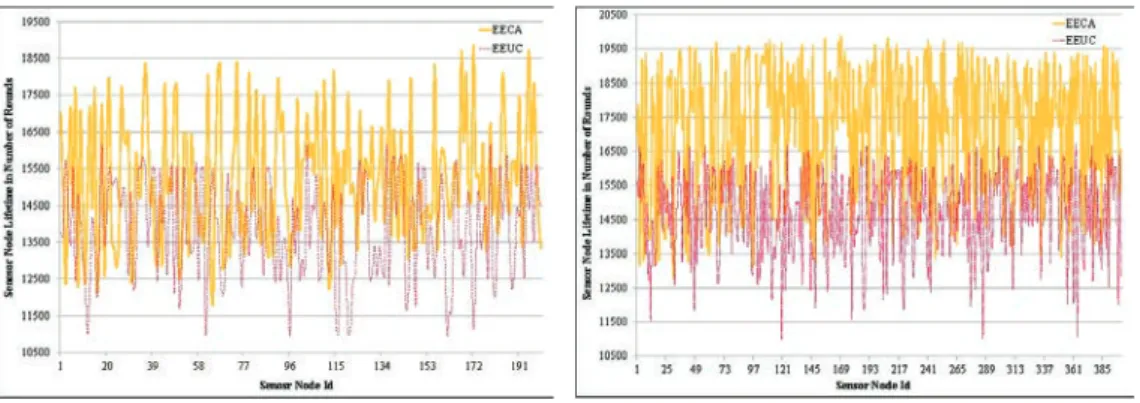
Lifetime of sensor nodes for EECA and EEUC schemes in 200 and 400 node network is illustrated in Fig. 14. From the figure it is clear that the lifetime of EECA sensor nodes is much better than EUEC sensor nodes with the introduced CH rotation mechanism.
Fig. 11. Number of Sensor Nodes Alive in the Network.
Fig. 12. Lifetime of Sensor Nodes in the Network.
16 K. Muni Venkateswarlu et al. / Procedia Computer Science 89 ( 2016 ) 7 – 16
Fig. 14. Lifetime of Sensor Nodes in the Network.
6. Conclusions
Unequal clustering techniques have been proposed in the recent past to overcome hot-spot problem in multi-hop data transmission. But, unequal clustering algorithms generate large number of clusters in random sizes at different levels of the network which raises hop-count between the source and sink. Also, the irregularity in cluster sizes leads to uneven energy consumption in sensor nodes which influences network lifetime. To novel Energy-Efficient Clustering Algorithm is proposed to the effect of uneven energy dissipation due to irregular size clusters. EECA creates unequal clusters and the cluster size increases with the distance to BS. This forms small size clusters near BS to reserve some amount of energy resources for inter-cluster communication which balances energy dissipation among CHs and overcomes hot-spot problem. Also, with the introduced multi-hop data routing algorithm the network load is distributed uniformly among data transmission routes. Experimental results witness that the presented schemes balances energy expenditure and improves network lifetime.
References
[1] V. Kumar, S. Jain and S. Tiwari, Energy Efficient Clustering Algorithms in Wireless Sensor Networks: A Survey,International Journal of Computer Science, vol. 8(2), (2011).
[2] M. Veyseh, Energy Efficient Clustering and Routing Protocols for Wireless Sensor Networks,Master’s Thesis, San Jose State University, San Jose, CA, (2005).
[3] T. Liu, Q. Li and P. Liang, An Energy-Balancing Clustering Approach for Gradient-Based Routing in Wireless Sensor Networks,Computer Communications, vol. 35(17), pp. 2150-2161, (2012).
[4] S. Lee, H. Choe, B. Park, Y. Song and C. K. Kim, Luca: An Energy-Efficient Unequal Clustering Algorithm Using Location Information for Wireless Sensor Networks,Wireless Personal Communications, vol. 56(4), pp. 715-731, (2011).
[5] W. Heinzelman, A. Chandrakasan and H. Balakrishnan, An Application-Specific Protocol Architecture for Wireless Microsensor Networks, IEEE Transactions on Wireless Communications, vol. 1(4), pp. 660-670, (2002).
[6] S. Lindsey and C. Raghavendra, PEGASIS: Power-Efficient Gathering in Sensor Information Systems, In:Proceedings of IEEE Aerospace Conference, vol. 3, pp. 1125-1130, (2002).
[7] C. Li, M. Ye, G. Chen and J. Wu, An Energy-Efficient Unequal Clustering Mechanism for Wireless Sensor Networks, In IEEE International-Conference on Mobile Adhoc and Sensor Systems Conference, 2005,Washington, DC, USA, IEEE Press, pp. 604-611, (2005). [8] S. Mao and Y. Hou, BeamStar: An Edge-Based Approach to Routing in Wireless Sensor Networks,IEEE Transactions on Mobile Computing,
vol. 6(11), pp. 1284-1296, (2007).
[9] C. Kuong Ho, H. Jyh Ming and H. Chieh Chuan, CHIRON: An Energy Efficient Chain-Based Hierarchical Routing Protocol in Wireless Sensor Networks, InWireless Telecommunications Symposium, (WTS 2009), pp. 1-5, (2009).
[10] H. L. Wang and Y. Y. Chao, A Cluster-Based Data Routing for Wireless Sensor Networks, InProceedings of ICA3PP, LNCS,Springer, vol. 5574, pp. 129-136, (2009).