Citation:
Lara-Bercial, S and Mckenna, J (2018) No Coach, No Maximum Gain: The central role of the coach
in the deliberate personal development of youth performance athletes. Revista de Psicologia del
Deporte, 27 (3). pp. 47-52. ISSN 1132-239X
Link to Leeds Beckett Repository record:
http://eprints.leedsbeckett.ac.uk/4818/
Document Version:
Article
Creative Commons: Attribution-Share Alike 4.0
The aim of the Leeds Beckett Repository is to provide open access to our research, as required by
funder policies and permitted by publishers and copyright law.
The Leeds Beckett repository holds a wide range of publications, each of which has been
checked for copyright and the relevant embargo period has been applied by the Research Services
team.
We operate on a standard take-down policy.
If you are the author or publisher of an output
and you would like it removed from the repository, please
contact us
and we will investigate on a
case-by-case basis.
Correspondencia: Sergio Lara-Bercial. E-mail: [email protected] *Leeds Beckett University. England
This research has been carried out, in part, thanks to the Project PsyTool “Sport Psychology as a Strategic Tool for Prevention and training on Grassroots Sports” Erasmus+ Sport Programme. Application Nr.: 567199-EPP-1-2015-2-ES-SPO-SCP.
No Coach, No Maximum Gain: The central role of the coach in the
deliberate personal development of youth performance athletes
Sergio Lara-Bercial* and Jim McKenna*
NO COACH, NO MAXIMUM GAIN: THE CENTRAL ROLE OF THE COACH IN THE DELIBERATE PERSONAL DEVELOPMENT OF YOUTH PERFORMANCE ATHLETES
KEYWORDS: Personal development, positive youth development, life-skills development, psychosocial development, youth sport, grassroots sport, youth coach.
ABSTRACT: This study aimed to understand the role of the coach in the personal development of young athletes in a performance setting. Three major mechanisms were identified: high expectations and demands; genuine care; and the transformational coach. The study corroborates that, in addition to the coach, the performance environment also contains features that may lead to organic or incidental positive and negative development. In this regard, it is suggested that the current debate around whether development must be explicitly or implicitly sought could be progressed by the inclusion of the overarching term ‘deliberate’. Personal development in sport may happen explicitly or implicitly, yet the evidence presented in this paper suggests that coaches should be deliberate in their attempts to foster it.
Due to its specific features and ubiquity, sport has been proposed as a vehicle to achieve a broad range of objectives. Influential bodies like UNICEF (2017), the International Olympic Committee (2017), and the European Commission (2017) have all emphasised the role sport can play beyond the acquisition of physical and sport skills in supporting the psychosocial development of Children and Young People. A major area of criticism of this view of ‘sport as vehicle’, however, has revolved around the uncritical belief within policy circles that sport is a universal panacea to cure all that is wrongwith CYP. Researchers have stressed that sport is no magic bullet and that it only serves as a container of developmental experiences (Coalter, 2013). It is, however, the nature of those experiences, and more importantly, the social processes driving them that appear to make the difference and determine whether sport is transformative or not (Coakley, 2011).
A burgeoning body of research in this area has highlighted a variety of determinants of whether the sport experience leads to personal development. These include: the programme atmosphere and culture; a community orientation; the available programme resources and assets; the quality of interpersonal relationships; intentional programming; the quality of the programme activities; respect and support for individuality; and time spent in the environment. (For a full review see Holt et al., 2017). Notably, the common denominator found in many of these studies is the central role of the coach as an originator of and/or modulator for all factors. However, very few studies have focused specifically on understanding the coach-led mechanisms that foster positive development (Pierce, Gould and Camiré, 2017)
This is a problematic state of affairs. A lack of knowledge and understanding of the specific coach-led processes that foster personal development in regular sport makes it difficult for practitioners to purposefully have an impact at this level.
Recently, projects like the Erasmus+ co-funded PsyTool and iCoachKids have emphasised the role of the coach as an educator and a ‘producer’ of values and developed training tools to support coaches at grassroots level (Cruz, García-Mas, Stambulova, Lucidi, Márquez, Serpa and Jaenes, 2017; Lara-Bercial et al., 2018; Lara-Bercial, Porem, Gamito, Lubowa and Rosado, 2017b). Yet research efforts have lagged behind applied work. This study aimed to fill this gap in the literature.
Method
The findings presented in this paper are part of a larger investigation into the personal development outcomes of participation in a youth basketball performance development setting in the North of England (Lara-Bercial and McKenna, in preparation). Ethical approval was gained through Leeds Beckett University’s Local Research Ethics Committee. While the full study considered the entire spectrum of developmental outcomes and the broad range of underlying mechanisms, the current article focuses on the specific findings related to the central role of the coach in facilitating positive development. The full research design is briefly described below.
a broad range of stakeholders and served the purpose of generating a deeper understanding of their perceptions about personal development through sport. The findings of this stage helped create an observational framework to guide the efforts of the researcher during the ethnographic second stage of the study.
Participants
Criterion sampling was used to select this particular club (Sparkes and Smith, 2014). Criteria included: participants dedicating 6 hours or more to the sport; a performance-based environment; a declared humanistic philosophy and proven track record of valuing athletes as people first; the inner-city club location which provided a diverse demographic profile; and the club’s outstanding winning record (e.g., over 60 national titles in the last 20 years). The sample for stage one included a mix of current and former coaches, parents and players to allow for a more nuanced and complete understanding. Specifically, the sample contained current club coaches (n=5), former (n=8) and current club parents (n=10) and former (n=6) and current players (n=10; 5 from under 13 squad and 5 from under 16).
Procedure and Data Analysis
Coaches and former parents and players took part in in-depth semi-structured interviews. Interviews lasted an average of 70 minutes (range of 35 to 121), were tape-recorded and conducted mostly face-to-face. All interviews were transcribed verbatim, producing over 350 pages of double-spaced text. By contrast, current parents and players’ PTs were identified through a series of Focus Groups (FGs). FG participants were purposefully selected in conjunction with the team coaches. Four FGs took place. Two with U13 (n=5) and U16 parents (n=5), and two with U13 (n=5) and U16 (n=5) players. These lasted an average of 52.25 minutes (range of 40-72). The FGs were also tape-recorded
and transcribed verbatim producing over 80 pages of double-spaced text. The interviews and FGs were analysed using a deductive-inductive iterative process aligned with the principles of thematic analysis (Braun and Clarke, 2006). The emphasis was placed on the identification, not only of the outcomes, but also the generative mechanisms that led to them.
During the second phase of the study, the researchers tested and refined the existing PTs. This was achieved through the lead author’s immersion in the setting for a period of one full season. Using a variety of ethnographic techniques such as interviews, casual conversation, document examination and participant observations, the day to day workings of the basketball club were investigated leading to the confirmation, refinement, expansion or refutation of the PTs. The researcher attended 32 practices and 16 matches involving the U13 and U16 squad over the course of the season. All observations and interactions were originally jotted down as fieldwork notes and subsequently transcribed using a PC word processor. Over 250 pages of double spaced data were generated.
Results
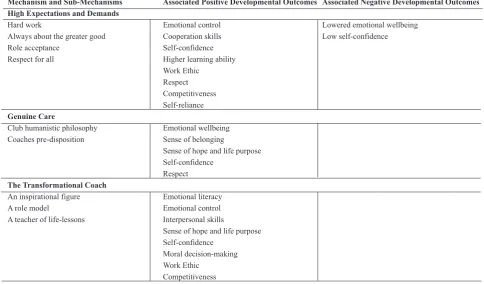
The study confirmed that coaches’ attitudes and actions were perceived as paramount to personal development. The analysis of the role of the coach focused particularly on the coach-related mechanisms linked to positive and negative developmental outcomes. Three major groups of mechanisms and sub-mechanisms were identified in the analysis: high expectations and demands; genuine care; and the transformational coach. Each of these mechanisms was linked to a variety of developmental outcomes giving rise to a network of PTs which interact to foster positive development. These links are presented in table 1 below. Due to restrictions of space these PTs are covered in a summarised manner. Sergio Lara-Bercial and Jim McKenna
48
Revista de Psicología del Deporte / Journal of Sport Psychology. 2018, Vol 27, Suppl 3, pp. 47-52 Mechanism and Sub-Mechanisms Associated Positive Developmental Outcomes Associated Negative Developmental Outcomes High Expectations and DemandsHard work Emotional control Lowered emotional wellbeing
Always about the greater good Cooperation skills Low self-confidence
Role acceptance Self-confidence
Respect for all Higher learning ability
Work Ethic Respect Competitiveness Self-reliance Genuine Care
Club humanistic philosophy Emotional wellbeing Coaches pre-disposition Sense of belonging
Sense of hope and life purpose Self-confidence
Respect The Transformational Coach
An inspirational figure Emotional literacy
A role model Emotional control
A teacher of life-lessons Interpersonal skills
Sense of hope and life purpose Self-confidence
Moral decision-making Work Ethic
[image:3.595.55.540.475.759.2]Competitiveness
Table 1 shows the three major groups of mechanisms and the involved sub-mechanisms or manifestations of the mechanism. The positive and negative developmental outcomes are shown as resulting from the combination of one or more of the mechanisms and sub-mechanisms. Outcomes should not be read as having a linear relationship with the sub-mechanism in the same line of text.
High Expectations and Demands
It was consistently reported that the heightened and regular level of demands and expectations placed on players by coaches acted as a catalyst for personal development. “Having to be on your toes” supported players becoming more self-reliant, responsible, organised and resilient (Sophie, Alfie’s mum). A supported ‘sink or swim’scenario was observed, whereby players had to learn to cope with the demands of elite sport as they went along. Parents like Sam, father of Noah from the U15 squad, felt that this level of demand “create(s) a whirlwind of emotions that players need to be able to control”and thus also facilitates the development of emotional literacy and control.
Putting common goals above personal ones, prioritising the greater good and learning to work as a team was also expected and demanded. A significant element of learning to cooperate was the coaches’ ability to foster an understanding of individual roles, team hierarchy and how each player could make a contribution to the whole in different ways. Former parent Patrick, pointed at the process of understanding and accepting the pecking order as a key: “They need to understand where they stand in the team and get on with it, and do the best they can with the time they have for the benefit of the team. They have to let go of their egos”. In addition, parents and players talked about how the constant demands placed on them by the coaches made them better learners. Coaches setting goals with the youngsters, and constantly teaching and providing feedback were thought to stimulate the young players’ ability to learn. Emily, mother of Oliver’s, put it this way: “[they] are constantly being taught, they have no choice but to become better learners”. This was echoed by Jerome who said “[they improve] their concentration span. For Jayden it has gone through the roof”.
For most players being exposed to this level of challenge and support, although at times hard to deal with, was overall a positive experience that fostered a ‘feel-good’ vibe about themselves. They thought that the fact that coaches pushed them meant they believed in their capacity to do well and to improve, and this gave them an emotional and motivational boost. This was not always the case though, and for some players, the constant demands of performance sport and the inherent pressure became too burdensome. Their emotional wellbeing and self-confidence was compromised until they ended up leaving the club to continue playing in a less demanding environment. Parents, players and coaches seemed to be aware of what they were letting their kids into. Chloe, one of the mums, said “They are constantly competing for spots for the weekend’s games, they have to battle it out on the court to make sure they get picked. It you can’t take it, you shouldn’t play National League”.
Genuine Care
Parents and players stressed the sincere caring disposition of the club coaches as central to personal development. Sophie (mother of Alfie’s) explains:
“Coach George and Coach Dean have been tremendous for
Alfie. They have turned a shy and timid boy into a happy and confident lad just by guiding him carefully and showing him a lot of love”.
Coaches appeared to relish their role as a ‘surrogate parent’ or ‘carer’ and deliberately took steps to fulfil it. They espoused very strong philosophies in relation to the potential for sport to contribute to personal development and saw supporting this as a core element of their job, not as a by-product of good coaching. Club founder, Coach Jack put it like this: “It is part of the ethos of the club, we provide basketball opportunities for children and young people and their wellbeing is paramount”. Genuine care created a climate wherein players felt respected, valued and part of a bigger family that catered for their emotional and spiritual needs. This led to a greater sense of belonging, hope and life purpose, and to an enhanced sense of respect for others.
The Transformational Coach
Coaches were described as inspirational figures by most respondents. Coaches were cognisant of this fact. Coach James, for instance, argued that players thought of coaches as ‘sensei-like’and treated them with a high level of respect. Parents often explained how their children took everything their coach said literally as ‘the gospel’(Damian, former parent) and stressed the high amount of power afforded to coaches. Parents felt that the messages given to their sons by coaches about topics like work-ethic, emotional control, moral decision-making, life purpose and self-reliance ‘stuck’ with them. Emily, mother of an U16 player jokingly said: “It drives me nuts; I can tell him something a million times and he won’t do it, but if the coach tells him, it’s like the law!”.
Coaches were also defined as role models which exhibited valuable behaviours such as work-ethic, respect and care that rubbed off on the players. This was facilitated by the coaches’ demeanour and personal behaviours (i.e., level of personal preparation, regular behaviours and attitudes, constant demands for focus and intensity, and overt set expectations for teams and players). Sophie, Alfie’s mum, said that for her son his coaches were “wonderful role models”that had transformed him into a different child. This was particularly important, according to Coach Dean’s wife Jean, for players who came from single-parent families: “12 out of 14 of the kids [this season] come from divorced families. Dean is like a father to them”.
During the observation period, coaches were also seen to be deliberate facilitators of learning. They used teachable moments, not only to coach basketball skills, but to teach life-lessons. Coaches regularly used basketball related occurrences or themes to explain broader topics such as cooperation, work ethic in school and the workplace, preparation, self-reliance or the value of honesty or being humble and respectful.
A Double-Edge Sword
Discussion
Adapting principles of Realist Evaluation (Pawson and Tilley, 1997; Pawson, 2013), this study aimed to create a better understanding of the role of the coach in the processes leading to personal development of young athletes through sport. Findings confirmed that, although the inherent features of performance sport could naturally lead to a broad range of outcomes, coaches played a significant part in generating and modulating these mechanisms to ensure positive and long-lasting effects. These findings are relevant in light of the current debate about the benefits of explicit (taught) versus implicit (caught) approaches to personal development through sport which has intensified over the last ten years.
Literature in this area has evolved from a stance which favoured explicit approaches built around intentional programming and discrete skill-building activities (Gould and Carson, 2008) to recognising the potential for implicit learning. For instance, Turnnidge, Côté and Hancock (2014) concluded that both approaches are valid yet contain distinctive features, strengths and weaknesses. Evidence shows how the two approaches coexisted in this club. Findings also support the notion put forth by Holt et al. (2012) that some developmental outcomes may lend themselves better to being acquired in a natural and organic manner. The challenge, they argue, is to understand which developmental outcomes require explicit teaching and which ones are likely to emerge from the programme atmosphere and structure. For instance, in this case, self-responsibility and resilience were, at least partially, acquired through the inherent competitive and challenging nature of the setting. Nonetheless, Carson and Gano-Overway (2017) have emphasised that coaches should, where possible, lean towards an explicit approach given that recent literature has shown how intentional programming achieves a greater return in generating developmental outcomes (Bean and Forneris, 2016).
The findings of this study, however, steer the present debate towards the need to gain a clearer understanding of what is meant by ‘explicit’ and ‘implicit’ teaching and acquisition of personal developmental outcomes. It is also important to explore if these two terms are the most appropriate to describe the processes involved in personal development through sport. This is specially so in relation to the role of the coach. In previous literature,
explicithas been linked to the teaching of discrete skills (e.g., goal setting, time management), typically in workshop-based sessions. By contrast, implicithas been used to refer to learning that happens without formal mediation by another person, just by being present in the setting (Gould and Carson, 2008; Turnnidge et al., 2014). However, drawing from the business literature, there may be a term that better encapsulate the different ways in which coaches can affect personal development in a youth performance sport.
Based on their analysis of hundreds of companies, Kegan and Lahey (2015) coined the term ‘Deliberately Developmental Organisations’ to represent those organisations which embraced a belief that people’s strongest motivation in professional environments is to grow personally and professionally. They proposed that companies prosper when they deliberately create the conditions for growth to happen. These conditions go beyond the organisation of one-off development days or sending colleagues on continuous professional development courses; becoming a DDO is much more about “fashioning an
organisational culture in which support of people’s development is woven into the daily fabric of working life and the company’s regular operations, daily routines, and conversations”(p. i).
From this perspective, it can be argued that coaches in this study were described by parents, players and themselves as
Deliberately Developmental Coaches (DDCs) who were purposeful in using a series of structures and artefacts that led to the creation of a characteristic atmosphere were young people could flourish on and off the court. The three major mechanisms identified in the analysis, namely high expectations and demands, genuine care and the transformational coach contributed to this deliberateness in different ways. Findings reveal that the high expectations and demands placed upon the young athletes were the most common deliberate attempt by the coaches to emphasise and reward target behaviours and attitudes. Notably, while deliberate, coaches moved along a continuum of ‘explicitness’ in the way they tried to impact development at different times. This ranged from very explicit developmental interventions (i.e., teachable moments, team meetings, one-to-one conversations), to completely implicit learning where the atmosphere and culture set by the coach stimulated the desired outcomes (i.e., responsibility, self-reliance, etc).
Notwithstanding coaches’ deliberateness, in line with previous research (Holt et al., 2017), the study revealed how the setting itself contained certain features that accounted for some of the heightened expectations and demands. These include regular internal competition for team selection and playing time, the constant threat of de-selection from the programme and the pressure of playing National League games all over the country on a weekly basis. These naturally occurring events did not require a deliberate approach by coaches but were a permanent fixture of the setting consistent with the notion of subconscious learning described by Light (2010) in his study of an Australian swimming club. While present in a non-coach-led way, the study revealed that these organic elements must be accounted for and managed appropriately and proactively by the coach for they have the potential to lead to negative outcomes such as lowered emotional wellbeing, decreases in self-confidence and eventually dropout.
The other two coach-led mechanisms elicited by the study (i.e., genuine care and the transformational coach) seemed to provide the required buffering to offset both the coach-orchestrated and setting-dependent high expectations and demands. Genuine caring relationships have been consistently identified by the general and sport-based positive youth development literature as key to successful outcomes. For instance, in their Personal Assets Framework for Positive Youth Development in Sport, Côté, Turnnidge and Evans (2014) clearly state the role of positive supportive interactions in generating positive development. Similar claims have been made by various other authors in a variety of contexts (Agnew and Pill, 2016; Coalter, 2013). Moreover, Lara-Bercial and Mallett (2016), in their study of Olympic Serial Winning Coaches found that, even at the highest level of competition, having a genuine caring disposition towards athletes was not incompatible with upholding high standards.
In addition to the coaches genuine caring disposition, parents and players described them as having a transformational effect. Descriptions of the coaches were aligned with the Bass and Riggio (2006) conceptualisation of Transformational Leadership (TFL), particularly the widely accepted operationalisation of this notion through the 4 Is (e.g., Idealized influence, inspirational Sergio Lara-Bercial and Jim McKenna
motivation, intellectual stimulation, and individualized consideration). Turnnidge and Côté (2017) have recently developed a professional development workshop using TFL principles to support coaches display more transformational behaviours. Many of the twelve behaviours proposed by Turnnidge and Côté as transformational coaching behaviours were observed amongst the coaches in this study.
Importantly, genuine care and transformational coaching did not only protect against the deleterious effects of youth performance sport, but also implicitly led to personal development outcomes. As suggested by previous research (Holt et al., 2017), these were predominantly modulated by the coach as a role model. Examples include coaches’ displays of a caring attitude contributing to players being able to care for each other and coaches work ethic rubbing off on the players. This is again evidence of how ‘deliberateness’may manifest explicitly and/or implicitly depending on the outcomes sought or the needs of the group, the individual or the context. No perfect combination of explicit and implicit approaches exists for the impact is context and person dependent. However, the impact of the coach seems to be clearly mediated by a combination of the state-trait of coaches (i.e., genuine care, inspirational figure) and their tangible actions (e.g., upholding standards, use of teachable moments). Coaches being in possession of an overarching framework for personal development underpinned by a humanistic and holistic philosophy were shown to be pre-conditions to their becoming
‘Deliberately Developmental’.
Future research in this area could consider the individual characteristics of both coaches and athletes and how these may mediate different approaches and developmental outcomes. Also, given that basketball is a team sport, similar studies in individual sports could elicit different findings and are thus worth exploring. Finally, the role of coach education in supporting coaches’ understanding of this phenomenon could be investigated and recommendations for future coach development initiatives could be made. Projects like PsyTool (Cruz et al., 2017) and iCoachKids (Lara-Bercial, et al., 2017a) have shown significant promise in this respect.
In conclusion, this study established that positive personal development can occur as a result of young athletes’ participation in a performance development programme. It also confirmed that this type of setting can also produce negative outcomes. The central role of the coach in determining the types of outcomes achieved by young athletes was underlined, as were the key coach-led mechanisms involved. The study corroborated the current view that positive development may occur naturally due to the inherent features and conditions of the performance environment, but that the use of deliberate strategies and personal attitudes by coaches can significantly enhance this process. Findings revealed that the current terminology of ‘explicit’ versus ‘implicit’ can misguide conceptions of developmental coaching practice. The newly coined term ‘deliberate’ is proposed as a more accurate description of the nature of the coach-led processes involved in personal development.
SIN ENTRENADOR, SIN GANANCIA MÁXIMA: EL PAPEL CENTRAL DEL ENTRENADOR EN EL DESARROLLO PERSONAL DELIBERADO DE LOS ATLETAS DE RENDIMIENTO JUVENIL
PALABRAS CLAVE: Desarrollo personal, desarrollo psicosocial, desarrollo de habilidades para la vida, desarrollo positivo de jóvenes, deporte juvenil, deporte de base, entrenador de base.
RESUMEN: Este estudio analiza el papel del entrenador Deportivo en el desarrollo personal de atletas jóvenes en un club de alto rendimiento. La investigación se centra en encontrar los mecanismos activados por el entrenador que fomentan el desarrollo personal. Tres categorías de mecanismos fueron identificadas: expectación y exigencia elevada; cuidado genuino; y el entrenador transformativo. La investigación corroboró también que, además del papel jugado por el entrenador, existen una serie de características intrínsecas del ambiente de alto rendimiento que pueden ocasionar desarrollo positivo y negativo de modo orgánico o incidental. En este sentido, los autores sugieren que el debate actual sobre desarrollo explícito o implícito a través del deporte podría avanzar gracias a la inclusión del término ‘deliberado’. El desarrollo personal puede ocurrir explícita o implícitamente, pero las evidencias presentadas en este artículo sugieren que los entrenadores deberían, en la medida de lo posible, ser deliberados a la hora de promoverlo.
SEM COACH, SEM GANHO MÁXIMO: O PAPEL CENTRAL DO TREINADOR NO DESENVOLVIMENTO PESSOAL DELIBERADO DE ATLETAS DE DESEMPENHO JUVENIL
PALAVRAS-CHAVE: Desenvolvimento pessoal, desenvolvimento psicossocial, desenvolvimento de habilidades para a vida, desenvolvimento positivo de jovens, esportes juvenis, esportes de base, treinamento de base.
Sergio Lara-Bercial and Jim McKenna
52
Revista de Psicología del Deporte / Journal of Sport Psychology. 2018, Vol 27, Suppl 3, pp. 47-52References
Agnew, D., & Pill, S. (2016). "I Think It's Going To Save Lives" Sport Administrator Perspectives on Youth Development Through Sport. Sport Journal, 3-1. Bass, B.M., and Riggio, R.E. (2006). Transformational leadership(2nd ed.). New York: Psychology.
Bean, C. and Forneris, T. (2016). Examining the Importance of Intentionally Structuring the Youth Sport Context to Facilitate Positive Youth Development. Journal of Applied Sport Psychology, 28(4), 410-425. doi: 10.1080/10413200.2016.1164764
Braun, V. and Clarke, V. (2006). Using thematic analysis in psychology. Qualitative Research in Psychology, 3(2), 77-101. doi: 10.1191/1478088706 Carson, S. and Gano-Overway, L.A. (2017). Coaching Life Skills Development: Best Practices and High School Tennis Coach Exemplar. International
Sport Coaching Journal, 4(2), 206 -219. doi: 10.1123/2016-0080
Coakley, J. (2011) Youth sports: What counts as “positive development?” Journal of Sport and Social Issues, 35, 306–324. doi: 10.1177/0193723511417311
Coalter, F. (2013). ‘There is loads of relationships here’: Developing a programme theory for sport-for-change programmes. International Review For The Sociology Of Sport, 594-612. doi:10.1177/1012690212446143
Côté, J., Turnnidge, J. and Evans, M.B. (2014). The dynamic process of development through sport. Kinesiologia Slovenica, 20(3), 14–26.
Council of the European Union and the Representatives of Governments of Member States (2017). European Union Work Plan for Sport 2017-2020. Brussels, Belgium: Council of the European Union.
Cruz, J., García-Mas, A., Stambulova, N., Lucidi, F., Márquez, S., Serpa, S. and Jaenes, J.C. (2017) PsyTool design and theoretical background. In Proceedings ISSP 14th World Congress Sport Psychology, Sevilla.Madrid: Dykinson.
Gould, D. and Carson, S. (2008). Life skills development through sport: current status and future Directions. International Review of Sport and Exercise Psychology, 1(1), 58-78. doi: 10.1080/17509840701834573
Holt, N. L., Neely, K. C., Slater, L. G., Camiré, M., Côté, J., Fraser-Thomas, J., and ... Tamminen, K. A. (2017). A grounded theory of positive youth development through sport based on results from a qualitative meta-study. International Review Of Sport and Exercise Psychology, 10(1), 1-49. doi:10.1080/1750984X.2016.1180704
Holt, N.L., Sehn, Z.L., Spence, J.C., Newton, A.S. and Ball, G.D.C. (2012): Physical education and sport programs at an inner city school: exploring possibilities for positive youth development. Physical Education and Sport Pedagogy, 17(1), 97-113. doi:10.1080/17408989.2010.548062 Keegan, R. and Laskow-Lahey, L. (2015). An Everyone Culture: Becoming and deliberately developmental organization. Boston: Harvard Business
Review Press.
Lara-Bercial, S., and Mallett, C. J. (2016). The Practices and Developmental Pathways of Professional and Olympic Serial Winning Coaches. International Sport Coaching Journal, 3(3), 221-239. doi:10.1123/2016-0083
Lara-Bercial, S., North, J., Fix, M., Schipper-van Veldhoven, N., Rankin-Wright, A.J., Piggott, D., O’Leary, D., Quinn, S., Van der Haegen, K., Dupuis, M., Navarro, R., García, S., Lara, P., Dudeniene, L., Statkeviciene, B., Petrovic, L., and Balogh, J. (2017a). iCoachKids European Coaching Children Curriculum: An output of project iCoachKids. Leeds: Leeds Beckett University
Lara-Bercial, S., Porem, R., Gamito, J.M., Lubowa, P. and Rosado, A. F. (2017b). PsyTool Online Educational Platform–Using e-learning to develop a network of agents of change in youth sport. In Proceedings ISSP 14th World Congress Sport Psychology, Sevilla. Madrid: Dykinson
Light, R. L. (2010). Children’s Social and Personal Development Through Sport: A Case Study of an Australian Swimming Club. Journal of Sport and Social Issues, 34(4) 379–395. doi: 10.1177/0193723510383848
Pawson, R. (2013). The Science of Evaluation: A Realist Manifesto. London: Sage. Pawson, R. and Tilley, N. (1997). Realistic Evaluation. London: Sage.
Sport and Development (2017). Downloaded on 18th December 2017 from https://www.sportanddev.org/en/learn-more/what-sport-and-development Pierce, S., Gould, D. and Camiré, M. (2017). Definition and model of life skills transfer. International Review of Sport and Exercise Psychology, 10(1),
186-211. doi:10.1080/1750984X.2016.1199727
Turnnidge, J., and Côté, J. (2017). Transformational Coaching Workshop: Applying a Person-Centred Approach to Coach Development Programs. International Sport Coaching Journal, 4(3), 314-325. doi:10.1123/iscj.2017-0046
Turnnidge, J., Côté. J. and Hancock, D. (2014). Positive Youth Development From Sport to Life: Explicit or Implicit Transfer? Quest, 66(2), 203-217. doi:10.1080/00336297.2013.867275