Exploiting External/Domain Knowledge to Enhance Traditional Text Mining Using Graph-based Methods
A Thesis
Submitted to the Faculty of
Drexel University by
Xiaodan Zhang in partial fulfillment of the requirements for the degree
of
Doctor of Philosophy June 2009
© Copyright 2009 Xiaodan Zhang All Rights Reserved.
ACKNOWLEDGEMENTS
I wish to express my greatest thanks to my advisor, Xiaohua (Tony) Hu, whose encouragement, guidance, and support from the initial to the final stage of my thesis development. Tony gave me several research topics to explore the research areas in which I am interested at the beginning, which finally led to my current thesis topic. After I decided on my research topic, he proposed many great ideas to improve my work. Tony would send me a couple of recently published papers related to my work almost every week, which broadened my mind very much. Tony sets very strict academic requirements for his students. But he is also a very generous friend in life. I enjoyed working with Tony closely over the past five years.
This thesis would not have been possible without the help and support from my committee. They are Dr. Il-Yeol Song, Dr. Eileen Abels, Dr. Lisa Ulmer, Dr. Chaomei Chen, and Dr. Yuan An. I thank them for their great suggestions and comments on my thesis development. I really appreciate the time and work from Dr. Abels for her proof reading of my dissertation. I especially thank Dr. Song for his instructions and recommendations on my thesis organization, presentation skills and career development, which will benefit me in the future with no doubt. I am heartily thankful to Dr. Ulmer for her financial support. I really enjoyed working with her for her great leadership and personality.
I am grateful to all my friends and to my fellow PhD students with whom I spent five great years at Drexel. I would like to mention George Abraham, Palakorn Achananuparp,
Xin (Bruce) Chen, Yunan Chen, Thippaya Chintakovid, Deima Elnatour, Caimei Lu, Shanshan Ma, Ornsiri Thonggoom, Xuheng (George) Xu, Daniel Wu, He Zhao, Nan and Weizhong Zhu. We had a wonderful time together. I especially thank Xiaohua Zhou for being my best friend in Philadelphia. Davis and I have worked very closely and coauthored over ten papers.
I owe my deepest gratitude to my grandparents (Shixian Chen and Zhizhong Zhang) and my aunt (Jing Zhang) for their love and support without which my achievements would not have been possible. I am also deeply indebted to my wife Xuguang (Yaya) Zhang for her constant love and sacrifice. Yaya has influenced my life very positively and fundamentally ever since we met. She always encourages me to pursue a higher quality work and provides me her best support.
The research related to this thesis was supported in part by NSF Career Grant IIS 0448023, NSF CCF 0514679, Pennsylvania Department of Health Tobacco Settlement Formula Grant (No. 240205 and No. 240196), and Pennsylvania Department of Health Grant (No. 239667).
CONTENTS
Contents ... i
List of Tables ... vii
List of Figures ... ix
Abstract ... x
Chapter 1: Introduction ... 1
1.1 Research Questions and Framework ... 2
1.2 Text Clustering and Summarization ... 5
1.3 Incorporation of Semantic Knowledge and Document Section Knowledge to Enhance Text Clustering and Summarization ... 5
1.4 Incorporation of Document Linkage Knowledge to Enhance Traditional Text Clustering... 6
1.5 Incorporation of External Knowledge to Enhance Traditional Text Clustering ... 7
1.5.1 Integration of MeSH ontology Knowledge... 7
1.5.2 Integration of Wikipedia Knowledge ... 8
1.6 The Organization of the Thesis ... 8
Chapter 2: Literature Review ... 9
2.1 Graph Representation ... 10
2.1.1 Document-Level Graph Representation ... 10
2.1.2 Sentence-Level Graph ... 11
2.2 Graph Ranking ... 12
3.3 Graph Learning ... 13
3.4 Graph Similarity and Subgraph Detection ... 16
3.5 Exploiting External Knowledge ... 17
3.5.1 Exploiting Wikipedia Knowledge... 17
3.5.2 Exploiting MeSH Ontology ... 20
Chapter 3: IncoRporation of document semantic and section knowledge to enhance text clustering and summarization ... 22
3.1 Introduction ... 22
3.2 Term-level Graph Representation ... 25
3.2.1 MeSH Ontology ... 25
3.2.2 MeSH Concept Indexing ... 26
3.2.3 MeSH Co-occurrence Graph ... 28
3.2.4 Noise Reduction ... 28
3.2.7 MeSH Abstract-Title Graph ... 29
3.2.8 Term Global Importance ... 31
3.2.9 Term Local Importance ... 32
3.2.10 A Graph-based Document Clustering ... 34
3.2.11 An Efficient and Effective Algorithm for Identifying k Core Term Clusters and k Document Clusters. ... 35
3.3 Data Sets ... 38
3.3.2 OHSUMED23 ... 38
3.4 Term Global Ranking Evaluation ... 39
3.4.1 Evaluation Method ... 39
3.4.2 Term Ranking Results and Analysis ... 39
3.5 Term Clustering Evaluation ... 43
3.6 Document Clustering Evaluations ... 45
3.6.1 Evaluation Method ... 45
3.6.2 Clustering Results and Analysis ... 46
3.7 Conclusion and Future Work ... 49
3.8 Research Question Tested ... 50
Chapter 4: Incorporation of document linkage knowledge to enhance text clustering 51 4.1 Introduction ... 51
4.2 An MRL-RL–based Graph Learning algorithm ... 54
4.2.1 The Basic Model ... 54
4.2.2 Iterative Relaxation Labeling ... 56
4.2.3 Content-based Clustering ... 57
4.2.4 Link-based Clustering ... 61
4.2.5 Issue of Convergence ... 62
4.3 Data Sets ... 62
4.3.1 WebKB4 ... 62
4.3.3 CORA—CORA7 and CORA18 ... 64
4.3.4 TDT2_10, LATimes10, Reuters10, and 20NG ... 64
4.3.5 DBLP3 ... 65
4.3.6 A Merged Dataset of WebKB4, CORA7, and DBLP3 ... 65
4.4 Experimental Settings ... 66
4.4.1 Evaluation Methodology ... 66
4.4.2 SETTINGS ... 67
4.5 Experimental Results and Analysis ... 69
4.5.1 Evaluation of Explicit Links Effects ... 69
4.5.2 Evaluation of Implicit Link Effects ... 73
4.5.3 Evaluation of the Joint Effects of Explicit and Implicit Links ... 75
4.5.4 Evaluation of Similarity Link Effects ... 76
4.5.6 Evaluation of Neighborhood Effects ... 78
4.5.7 Uniform Priors vs. Empirical Priors ... 83
4.5.8 Pure Link vs. Pure Content ... 84
4.5.9 Thresholding and Scaling Effects ... 87
4.6 Conclusion ... 91
4.7 Research Question Tested ... 92
Chapter 5: Incorporation of Wikipedia knowledge into textclustering ... 94
5.1 Introduction ... 94
5.2 A Framework of Wikipedia-based Clustering ... 97
5.2.2 Concept Mapping Schemes... 98 5.2.3 Exact-Match Scheme ... 98 5.2.4 Relatedness-Match Scheme ... 100 5.2.5 Category Mapping ... 103 5.2.6 Agglomerative Clustering ... 103 5.2.7 Partitional Clustering ... 104 5.3 Experiments ... 105 5.3.1 Wikipedia Data ... 105 5.3.2 Clustering Dataset ... 105 5.3.3 Evaluation Metrics ... 106
5.3.4 Clustering Schemes under Comparison ... 106
5.3.5 Agglomerative Clustering Results ... 107
5.3.5 Partitional Clustering Results ... 110
5.4 Conclusion and Future Work ... 112
5.5 Research Question Tested ... 113
Chapter 6:Incorporation of Biomedical ontology knowledge into text clustering .. 115
6.1 Introduction ... 115
6.2 Ontology-based Similarity Measures ... 117
6.2.1 Path-based similarity measure ... 117
6.2.2 Information-content-based measure ... 120
6.2.3 Feature-based measure ... 121
6.4 Experimental Results and Analysis ... 123
6.4.1 Datasets ... 123
6.4.2 Evaluation Methodology ... 124
6.4.3 Experiment Settings ... 125
6.4.4 Result Analysis ... 126
6.5 Conclusion and Future Work ... 129
6.6 Research Question Tested ... 131
Chapter 7 Conclusions and FutureWork ... 132
7.1The Summary of Term-level Graph ... 132
7.1.1 The Representation of a Text Corpus as a Term Graph ... 132
7.1.2 The Utilization of MeSH Ontology Graph for Biomedical Domain ... 133
7.1.3 The Utilization of Wikipedia Concept and Category Graph for General Domain ... 133
7.2 The Summary of Document-Level Graph ... 135
7.4 The Contribution of the Thesis ... 135
7.4 Future Work ... 136
Chapter 8:Appendix ... 138
List of References ... 140 Vita 147
LIST OF TABLES
Table 3.1 The ranking of title and abstract terms of a PubMed document, calculated
by PageRank ... 31
Table 3.2 The document sets and their sizes ... 37
Table 3.3 Schemes and the top forty ranked terms. ... 41
Table 3.4 Term cluster identified by our algorithm and the PageRank ranking on a filtered term co-occurrence graph ... 44
Table 3.5 Term cluster identified by our algorithm using the PageRank ranking on abstract-title graph ... 44
Table 3.6 The clustering results on Disease10 (PageRank). ... 46
Table 3.7 The clustering results on OHSUMED23 (PageRank); the notations are the same as in table 3.6. ... 46
Table 4.1 Link Datasets ... 66
Table 4.2 Clustering Schemes ... 68
Table 4.3WebKB4 link-based vs. content-based clustering ... 70
Table 4.4 Wikipedia link-based (73 classes) vs. content-based clustering ... 71
Table 4.5 Wikipedia link-based (5 classes) vs. content-based clustering ... 71
Table 4.6 CORA7 link-based vs. content-based clustering ... 73
Table 4.7 CORA18 link-based vs. content-based clustering ... 73
Table 4.8 DBLP 3 link-based vs. content-based clustering ... 74
Table 4.9 Link-based clustering on the merged dataset ... 75
Table 4.11 Neighborhood settings ... 78
Table 4.12 DBLP3 neighborhood effects ... 82
Table 4.13 Pure link-based vs. content-based clustering. ... 85
Table 4.14 NMI score: The comparison between spk_tfidf_l and spk_tfidf_l_scaling without thresholding. ... 89
Table 5.1 Wikipedia term-concept (article) matrix ... 101
Table 5.2 Clustering schemes based on different combinations of vectors ... 107
Table 5.3 Agglomerative clustering results on three datasets ... 108
Table 5.4 Partitional clustering results on three datasets ... 111
Table 6.1 The document sets and their sizes ... 124
Table 6.2 Document indexing schemes ... 124
Table 6.3 Clustering results of Disease10... 126
Table 6.4 Clustering results of OHSUMED23 ... 127
LIST OF FIGURES
Figure 1.1 Framework of a graph-based text mining system ... 2
Figure 1.2 The research framework ... 4
Figure 3.1 The concept mapping from MeSH entry terms to MeSH descriptors ... 27
Figure 3.2 A term co-occurrence graph between two documents ... 28
Figure 3.3 An abstract-title term graph between two documents. ... 30
Figure 3.4 Term rank–based document clustering ... 35
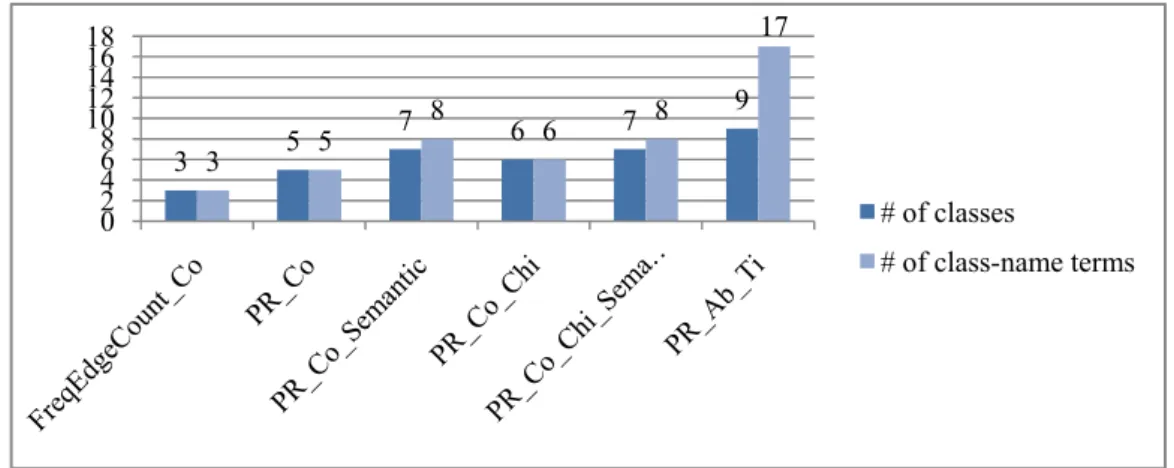
Figure 3.5 Term global ranking.. ... 40
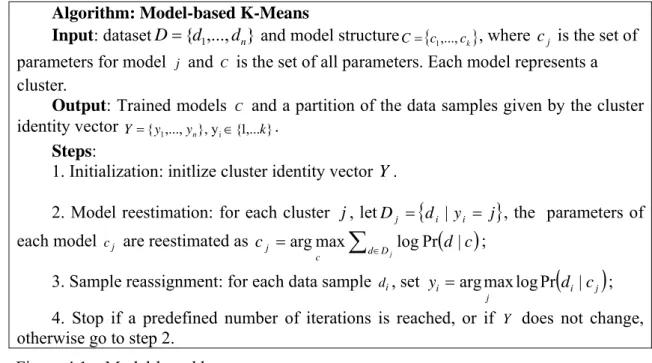
Figure 4.1 Model-based k-means. ... 58
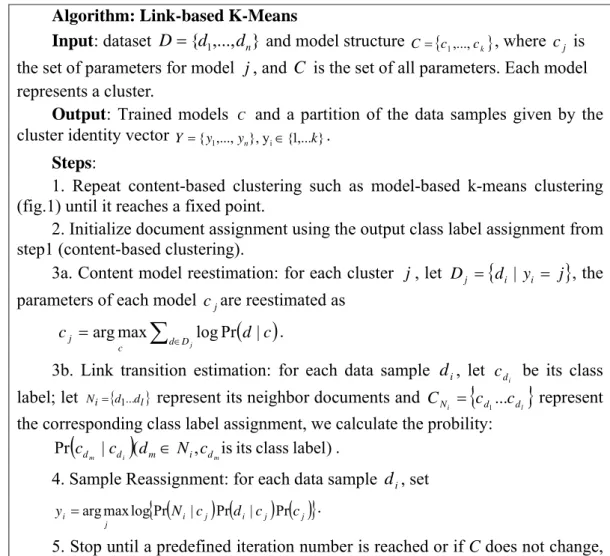
Figure 4.2 Link-based k-means ... 60
Figure 4.3 Co-citation link-based clustering.. ... 74
Figure 4.4 WebKB4: neighborhood effects on link-based clustering.. ... 79
Figure 4.5 Wiki73: neighborhood effects on link-based clustering. ... 80
Figure 4.6 CORA7: neighborhood effects on link-based clustering... 81
Figure 4.7 CORA18: neighborhood effects on link-based clustering. ... 82
Figure 4.8 Uniform priors vs. empirical priors. ... 83
Figure 4.9 Thresholding effects. ... 88
Figure 4.10 Scaling effects. ... 90
Figure 5.1 The framework of leveraging Wikipedia for document clustering ... 99
ABSTRACT
Exploiting External/Domain Knowledge to Enhance Traditional Text Mining Using Graph-based Methods
Xiaodan Zhang Xiaohua Hu
Finding the best way to utilize external/domain knowledge to enhance traditional text mining has been a challenging task. The difficulty centers on the lack of means in representing a document with external/domain knowledge integrated. Graphs are and versatile tools, useful in various subfields of science and engineering for their simple illustration of complicated problems. However, the graph-based approach on knowledge representation and discovery remains relatively unexplored. In this thesis, I propose a graph-based text mining system to incorporate semantic knowledge, document section knowledge, document linkage knowledge, and document category knowledge into the tasks of text clustering and topic analysis. I design a novel term-level graph knowledge representation and a graph-based clustering algorithm to incorporate semantic and document section knowledge for biomedical literature clustering and topic analysis. I present a Markov Random Field (MRF) with a Relaxation Labeling (RL) algorithm to incorporate document linkage knowledge. I evaluate different types of linkage among documents, including explicit linkage such as hyperlink and citation link, implicit linkage such as coauthor link and co-citation link, and pseudo linkage such as similarity link. I develop a novel semantic-based method to integrate Wikipedia concepts and categories external knowledge into traditional document clustering. In order to support these new
approaches, I develop two automated algorithms to extract multiword phrases and ontological concepts, respectively. The evaluations of news collection, web dataset, and biomedical literature prove the effectiveness of the proposed methods.
In the experiment of document clustering, the proposed term-level graph-based method not only outperforms the baseline k-means algorithm in all configurations but is superior in terms of efficiency. The MRF-based algorithm significantly improves spherical k-means and model-based k-means clustering on the datasets containing explicit or implicit linkage; the Wikipedia knowledge-based clustering also improves the document-content-only–based clustering. On the task of topic analysis, the proposed presentation, sub graph detection, and graph ranking algorithm can effectively identify corpus-level topic terms and cluster-level topic terms.
CHAPTER 1:
INTRODUCTION
Traditional text mining algorithms are usually based on the bag of words (BOW) approach. A notorious disadvantage of the BOW model is that it ignores the semantic relationship among words. In text clustering, for example, if two documents use different collections of core words to represent the same topic, they can be assigned to different clusters, even though the core words they use are probably synonyms or semantically associated in other forms. Another disadvantage of the BOW model is that it’s hard to retain the structure information of a document. For example, a title term may contain more topic information of a document than an abstract term or a body term does. Finally, BOW models tend to use only document contents and ignore the linkage information between documents. Therefore, the major problems in text mining center on finding a new method of representing knowledge, and on utilizing the new representation to enhance traditional text mining. To solve these problems, I propose a graph-based text mining system that extends from knowledge extraction and knowledge representation to knowledge integration.
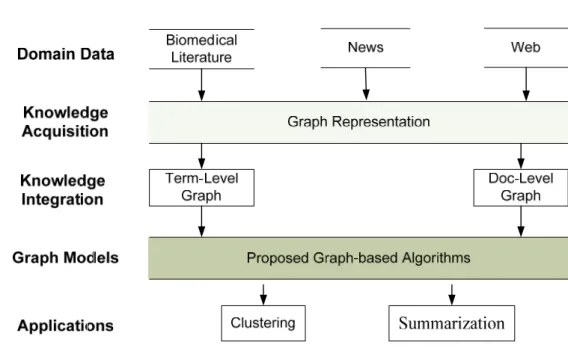
Based on existing research and real world applications, I propose a graph-based text mining system as shown in figure 1.1. A graph-based text mining system is a of graph representation and graph-based techniques including graph ranking, sub graph detection, graph learning, and graph similarity. Graph representation treats a text as a graph in terms of data processing level: document, paragraph, sentence, and word. Graph ranking ranks a node based on its global or local importance. Subgraph detection
finds the sub graph that either represents the central part of a large graph or contains the desired edges and nodes. Graph learning estimates the label of a graph node using a neighbor’s class distribution. Graph similarity defines the distance between two sub graphs. The following subsections give an introduction to the thesis work.
Figure 1.1 Framework of a graph-based text mining system
1.1 Research Questions and Framework
In general, the thesis will address four research questions. First, Where and how can we domain knowledge through a graph representation, and how can we effectively utilize
knowledge? The graph representation of a text collection is the first step of graph-based
text mining. The definition of graph node, as well as graph edge, has a large impact on algorithms applied. I aim to develop methods to incorporate domain knowledge into the graph edges of term-level and document-level graph representation. The utilization of graph representation knowledge for applications such as text clustering and is not trivial. We want to find an approach to effectively identify a topic-specific sub-graph from a term-level sub-graph representation. The new approach can employ the
sub-term graph to cluster documents. For term-level graph representation, an approach to utilize existing graph representation such as an ontology map or a Wikipedia category is needed. This approach does not simply replace existing terms using ontology terms, develops new metrics to integrate this knowledge into original representation. For document-level graph representation, our desire is to find a generic approach that document content and linkage knowledge, that is not ad hoc or data dependent. This approach not only works on general domains such as news stories and web pages, but it also brings significant improvement to very specific domains such as biomedical The new approach does not require extensive tuning when applying to new applications new domains.
Second, What is the best way to enhance clustering by learning from neighbors?
How do different document link types and graph link types affect text clustering? It has
not been studied how different types of links affect document clustering. Different types of links usually have different link patterns and encode different types of human knowledge, and therefore they can have different impacts on text clustering. The findings of a comparison of different link effects can serve as a guide for domain experts in choosing links for different applications and domains. Therefore, we want to make a comprehensive study on how different types of linkage affect text clustering.
Third, How can we utilize Wikipedia or MeSH ontology to improve traditional text
clustering? To answer this question, we need to test if the proposed methods improve
document clustering without using external knowledge. Wikipedia ontology and MeSH ontology represent the general domain and the biomedical domain, respectively. Both of
them are well known in the text mining community, and both show characteristics of an ontology, such as concept, attributes of concept, and relationship between concepts. Therefore, we conduct our experiments using these two ontologies.
Fourth, Do the proposed graph representations and graph-based algorithms
improve traditional text clustering and topic analysis? To answer this question, we need
to test if the proposed graph representations and graph-based methods outperform the ones without knowledge integration. To do this, we will evaluate the new methods on text clustering and summarization.
Figure 1.2 The research framework
In summary, my research framework for graph-based text mining is shown in figure 1.2. The first step is knowledge acquisition through graph representation from different
domains, including biomedical literature, news, and the web. Second, I develop graph-graph-based algorithms to utilize the attained knowledge. And last, I evaluate the methods in the task of clustering and summarization.
1.2 Text Clustering and Summarization
Text clustering (also referred to as document clustering) is closely related to the concept of data clustering. Document clustering is a more specific technique for unsupervised document organization, automatic topic extraction, and fast information retrieval or filtering. For example, a web search engine often returns thousands of pages in response to a broad query, making it difficult for users to browse or to identify relevant information. Clustering methods can be used to automatically group the retrieved documents into a list of meaningful categories. Text summarization (also referred to as document summarization) automatically summarizes one or multiple documents. For example, given a class of documents, a term-based text summarization algorithm extracts some topical terms representing the central ideas of these documents. In this thesis, I test the proposed graph-based text mining methods on these two types of applications.
1.3 Incorporation of Semantic Knowledge and Document Section Knowledge to Enhance Text Clustering and Summarization
For real world applications, it is most often the case that only topical words are of and the nontopical ones will be excluded as “noise.” Therefore, given a document set, problem is to eliminate data noise and catch core term clusters. These core term clusters contain cluster class-specific core terms that are very useful for text mining tasks such as the feature selection of text classification, the model selection of text clustering, and the
topical sentence selection of text summarization. The problem with traditional methods is that they are black box statistical models and thus hard to interpret. However, through the proposed graph-based methods, these processes are not only visible, but also provide information. For example, each term has its global ranking score, as well as its level to local term community, which is a semantically related and graphically connected sub-term graph. However, eliminating noise is not always as simple as introducing a representation. For example, if we simply build an edge between two terms when they co-occur in an abstract, then from graph theory, the general words will be treated as words because they tend to co-occur with most of the other terms. Therefore the edge definition is very crucial for graph-based text mining. In this thesis, document section importance information, as well as contextual information, is integrated into the graph edge. Moreover, I combine both global graph ranking methods and cluster detection algorithms to catch the core term clusters.
1.4 Incorporation of Document Linkage Knowledge to Enhance Traditional Text Clustering
Traditional text mining is based on text content only. However, various types of links between text documents, including explicit link, implicit link, and pseudo links, convey topic similarity or topic transferring patterns, which can be very useful to document clustering. These links usually encode human knowledge. In this thesis, I study how to utilize link information to enhance traditional content-based text clustering and evaluate the effects of different types of linkage on document clustering. I employ MRF (Markov Random Field) and RL (Relaxation Labeling) to develop a link-based graph learning
algorithm for this purpose.
1.5 Incorporation of External Knowledge to Enhance Traditional Text Clustering
In traditional text clustering methods, documents are represented as “bags of words” without considering the semantic information of each document. For instance, if two documents use different collections of core words to represent the same topic, they may be falsely assigned to different clusters due to the lack of shared core words, even though the core words they use are probably synonyms or semantically associated in other forms. This can also be referred to as a data sparsity problem. The most common way to solve this problem is to enrich document representation with the background knowledge in an ontology. In this thesis, I develop novel methods to integrate ontology as external knowledge into the document clustering process.
1.5.1 Integration of MeSH ontology Knowledge
MeSH (Medical Subject Headings) is the National Library of Medicine’s controlled vocabulary thesaurus. It consists of sets of terms naming descriptors in a hierarchical structure that permits searching at various levels of specificity. Previous studies took term semantic similarity as an important measure to incorporate domain knowledge into clustering processes such as clustering initialization and term reweighting. However, not many studies have focused on how different types of term similarity measures affect the clustering performance for a certain domain such as MeSH. In this thesis, I conduct a comparative study on how different semantic similarity measures of term, including path-path-based similarity measure, information-content-based similarity measure, and
feature-based similarity measure, affect document clustering. We evaluate term reweighting as an important method to integrate domain ontology into the clustering process.
1.5.2 Integration of Wikipedia Knowledge
I present a novel text clustering method to solve a data sparsity problem by enriching document representation with Wikipedia concept and category information. I develop two approaches, exact match and relatedness-match, to map text documents to Wikipedia concepts, and further to Wikipedia categories. Then the text documents are clustered based on a similarity metric that combines document content information and concept information, as well as category information.
1.6 The Organization of the Thesis
Chapter 2 reviews the related works on graph representation, graph ranking, graph and knowledge integration. In chapter 3, I present a term-level graph mining algorithm the incorporation of semantic knowledge and document section knowledge to enhance clustering and summarization. I also evaluate the proposed graph-based methods on biomedical literature. In chapter 4, I propose a MRK-RL–based graph learning for the integration of linkage knowledge into a document clustering process. I also evaluate how different link types affect document clustering. The evaluation is performed on ten different datasets. In chapter 5, I develop two approaches to incorporate Wikipedia knowledge. In Chapter 6, I define a term-reweighting scheme to incorporate ontology
knowledge using ontology-based similarity measures. Chapter 7 summarizes the thesis discusses future work.
In the following sections, I review the key components of the graph-based text mining system and the incorporation of external/domain knowledge into text mining.
2.1 Graph Representation
The graph representation of a text collection is the first step of graph-based text mining. The graph representation can be differentiated based on the level of text processing. The definition of graph node, as well as graph edge, has a big impact on algorithms applied. In this thesis, the graph representation is categorized by the definition of graph nodes. The graph nodes can be documents, paragraphs, sentences, terms, and so on. Document-level and sentence-level graphs are the two graph node types that are mostly used.
2.1.1 Document-Level Graph Representation
In a document-level graph, each document is represented as a graph node, and the relationship between the two documents is referred to as a link. The document-level graph is probably the most studied text mining graph. WWW network and citation network are two typical examples of document-level graphs. In WWW network, a web page hyperlinks or is hyperlinked to other web pages. In a citation network, an author’s work cites, or is cited by, other authors’ works. There are many well known algorithms built on document-level graphs, such as PageRank (Page et al. 1998) and Hyperlink-Induced Topic Search (HITS) (Kleinberg, 1998). For a document-level graph, the central task is figuring out how to use link information to improve the document content–based text mining.
2.1.2 Sentence-Level Graph
In a sentence-level graph, each sentence is represented as a graph node, and the relationship between the two sentences is denoted as an edge or link. The sentence-level graph is usually applied in a text summarization task. LexRank (Erkan and Radev 2004) is one of such applications in which a PageRank paged method is run on the sentence graph to select top ranked sentences as summarization.
2.1.3 Term-Level Graph
A term-level graph usually treats each term as a node and the relationship, such as co-occurrence, between two terms as a graph edge. Given the topic of representation of a group of documents as a term-level graph, there are some emerging works on text classification, text clustering, and text summarization (Erkan and Radev 2004; Markov et al. 2006; Yoo et al. 2006).
Markov et al. (2006) represent a web document as a graph using semantic and location of text and then using a frequent subgraph extraction algorithm (Kuramochi and Karypis 2004) to extract the most frequent document subgraphs. Then, these subgraphs are used for document classification. However, in essence, this approach is equal to extracting one-gram, two-gram, tri-gram, etcetera, from a document. Though it considers the semantic information of text, each document is still represented by term graphs. In contrast, we represent the whole document set as a term graph. Based on this representation, both the local and global importance of a term can be considered. Yoo et al. (2006) presented a bipartite graph–based document clustering algorithm. Mutual reinforcement strategy is applied to iteratively assign terms and documents to their
corresponding clusters. In their approach, a document is represented by co-occurrence concept pairs, which was demonstrated for dimension reduction. However, without very aggressive concept pair filtering, it would actually increase the dimension (square the number of concepts). Hotho et al. (2002) introduced the semantic document clustering approach that uses background knowledge. The authors apply a manually constructed ontology during the construction of vector space representation by mapping terms in documents to ontology concepts and then aggregating concepts based on the concept hierarchy, which is called concept selection and aggregation (COSA). As a result of COSA, they resolve the synonym problem and introduce more general concepts to vector space to identify related topics.
Opposed to existing studies, our work focuses on the graph representation of a collection of documents and on utilizing terms’ global and local importance information for document clustering.
2.2 Graph Ranking
Graph ranking can be divided into global ranking and local ranking. The global method ranks each node by calculating its importance to the whole graph. PageRank (Page et al. 1998) and HITS (Kleinberg 1998) are two typical global ranking methods. These algorithms have been proven to be very effective on ranking web document importance. The consideration of social reference information usually makes them rank the most important web pages on top. With PageRank, for example, a web page gets a high PageRank score when there are many other PageRank high-ranking web pages pointing it, and when these web pages are also referred by other pages with high scores. In
local method ranks a graph node’s importance according to its contribution to the local network or cluster. Local method grows a cluster or community from several seed nodes. The ideal situation is that the globally important nodes are identified first, and then their locally important dense clusters are identified. However, very few works address this Therefore, in this thesis, I study how to utilize global and local ranking methods to text mining tasks.
In recent years, there have been many studies relating to PageRank and HITS. Topic-sensitive PageRank (Haveliwala 2002) uses the URLs present in the various categories in the Open Directory Project (ODP) to add prior information to the PageRank algorithm. Topic distillation (Bharat and Henzinger 1998) computes the relevance score between a query and a node (a web document) in the graph. If the relevance score is less than the threshold, the node will be eliminated. Then all the nodes’ ranking will be regulated based on this similarity score. Weighted PageRank (Xing and Ghorbani 2004) adds weight score based on the number of inlinks and outlinks. HubRank (Chirita et al. 2004) assumes the pages with a bigger out-degree should have a bigger hub rank and, similarly, pages with bigger in-degree should have a bigger authority rank.
3.3 Graph Learning
The dependency between graph nodes can infer important knowledge about node A formal expression of the dependency graph model is named the Markov network. In model, a graph node is assumed to be dependent only on its immediate neighbors; its label is thus estimated through maximizing this neighbor-level graph. Each node’s class label is iteratively updated until the whole graph labeling process converges. This
procedure is called iterative labeling. Although this technique has been extensively in text classification, there is still much room to improve and evaluate it on other text mining tasks such as clustering.
In recent years, link-enhanced text classification and clustering have received more and more attention from the text mining community. I will make a brief review of the methods that integrate linkage between documents.
A group of researchers have examined the hyperlink effects in text classification (Angelova and Weikum 2006; Chakrabarti et al. 1998) and unsupervised text clustering (Angelova and Siersdorfer 2006) using MRF-RL–based methods (Markov Random Field Relaxation Labeling). Chakrabarti et al (1998) found that the method is very effective in improving text classification without using neighbors’ text. Ghani et al. (2001) discovered that neighbors’ text is helpful when a document is similar to most of documents it connects to, namely, an “encyclopedia” scenario. Later on, MRF-RL–based methods were applied (Oh et al. 2000; Angelova and Weikum 2006; Angelova and Siersdorfer 2006) for link-based document classification and clustering, respectively. All of them used some heuristics, such as setting up a similarity threshold to refine link graphs, making the link pattern closer to the “encyclopedia” scenario. However, improperly omitting links between documents may cause serious information loss and thus distort the clustering results. There are also some works (Cohn and Hofmann 2001; Getoor et al. 2001; Lu and Getoor 2003; Slattery and Mitchell 2000) that studied the use of hyperlinks from different angles with regard to text classification. Slattery and Mitchell (2000) employed FOIL (First Order Inductive Learner), a relational learner, to exploit the relational structure of
web and a HITS–style algorithm (Kleinberg 1998) to exploit the hyperlink topology. Lu and Getoor (2003) used a structured logistic regression model for capturing content and links for text classification. Getoor et al. (2001) applied a probabilistic relational model to model both link structures and contents for web page classification. Cohn and Hofmann (2001) applied a factorized model to combine the link model and the content model. However, these generative linear models require optimizing the parameters that how much links should affect clustering, which can be very challenging.
Moreover, a group of studies developed some heuristic similarity metrics that combined link information with text information for clustering web search results et al. 2003; He et al. 2001; Menczer 2004; Modha and Spangler 2000; Strehl et al. 2000; Wang and Kitsuregawa 2002; Weiss et al. 1996). Modha and Spangler (2000) proposed algorithm called TORIC k-means that clusters hypertext documents using the of three vectors: inlink vector, outlink vector, and text vector. Each cluster is annotated using six information nuggets: summary, breakthrough, review, keywords, citation, and reference. Similarly, in He et al. (2001), the web document similarity measure includes three types of information: hyperlink structure, textual information, and co-citation In particular, a weighted graph incorporating the above information was constructed, and then a normalized-cut–based algorithm was applied to clustering documents. Although approach provided an interesting perspective of clustering web documents, it faces the drawback of the nonlinear graph-based clustering algorithm: time and space complexity. Weiss et al. (1996) proposed a clustering method combining the shortest path information and content similarity information to enhance text classification. Strehl et al. (2000)
evaluated web-based clustering for heuristic similarity measures in conjunction with several clustering techniques. Wang and Kitsuregawa (2002) evaluated contents-link– contents-link–coupled web page clustering. Recently, Menczer (2004) found that lexical similarity displays a smooth exponential decay over a range of several links, and the link-link-cluster conjecture has been empirically validated by showing that two pages are significantly more likely to be related if they are within a few links from each other. Moreover, Halkidi et al. (2003) devised a system called THESUS, which utilized all incoming links’ semantics for clustering web documents.
These approaches were usually targeted on the hyperlinks from the web search results. These findings may not hold for the other types of links. Moreover, most of these approaches rely on heuristic similarity metrics using both text and link information. The proper choice of parameters assigning suitable weights to words and links can be very data dependent and requires a lot of tuning.
3.4 Graph Similarity and Subgraph Detection
The calculation of the similarity of two graphs is far more complicated than that of two vectors, because the graph contains shape information. The computation often suffers serious computational complexity. There are some emerging graph similarity measures and subgraph detection algorithms in recent years, including a distance metric based on maximal common subgraph (Bunke and Shearer 1998), graph distances using graph (Wallis et al 2001), a metric combining maximum common subgraph and minimum common super-graph (Fernández and Valiente 2001), an edit distance from graph spectra (Robles-Kelly and Hancock 2003), and SimRank based on graph neighborhoods (Jeh and
Widom 2002).
Overall, classical algorithms for computing the maximal common subgraph of two graphs are based on maximal clique detection or backtracking. These algorithms are conceptually simple but have a high computational complexity. For example, the worst-case time complexity of the method is
nnm
O , where n and m denote the number of
nodes of the two graphs under consideration
3.5 Exploiting External Knowledge
3.5.1 Exploiting Wikipedia Knowledge
The central task for exploiting Wikipedia knowledge is to build connections between Wikipedia and external data sources and then to use the achieved Wikipedia information to enhance traditional text mining.
Recently, there is a growing amount of research concerning how to utilize Wikipedia to enhance text mining tasks such as information retrieval (Li et al. 2007; Milne 2007), text classification (Gabrilovich and Markovitch 2006; Wang and Domeniconi 2008), and clustering (Banerjee et al. 2007; Hotho et al. 2002).
Milne (2007) developed a search engine that works on the basis of the thesauri derived from Wikipedia. The hyperlinks, redirect links, and hierarchical relations within Wikipedia are exploited to build the thesauri that are specific to individual collections. Based on the thesauri, the search engine can expand queries automatically, and guide to improve their queries, during the search process. Li et al. (2007) uses Wikipedia category information to improve weak ad hoc queries. After the initial search with a weak
query, the returned articles are re-ranked based on the linear combination of their original ranking score and Wikipedia category score. Then a certain number of terms are selected from top-ranked articles to expand the search query.
Phan et al. (2008) presents a framework for discovering hidden topics from large-scale data collections to resolve the data sparsity problem in short text classification. Instead of using human category information in Wikipedia, they use Gibbs sampling and Latent Dirichlet Allocation (LDA) to sample topics from both large-scale data collection and a sparse testing dataset. Each testing document is classified based on a vector combining both content and topic information. Although the approach provides a different perspective on using large-scale text collection, it does not fully utilize useful human knowledge information embedded in Wikipedia, such as the category, link information, etcetera. Moreover, the sampling process can be very time consuming and the sampled topics are time sensitive to Wikipedia snapshots.
Gabrilovich and Markovitch (2006, 2007) propose a method to improve text classification performance by enriching document representation with Wikipedia concepts. The mapping between each document and the Wikipedia concepts is achieved through a feature generator that acts like a retrieval engine. It receives a text fragment, which can be words, sentences, paragraphs, or the whole document, and outputs the most relevant Wikipedia articles to the text fragment. The titles of the retrieved Wikipedia articles are further filtered, and those with high discriminative capacity are used as additional features to enrich the representation of the corresponding documents. evaluation shows that their method can greatly improve classification performance.
However, the multi-resolution feature generation procedure they apply for mapping Wikipedia concepts requires high processing efforts, since each document needs to be scanned multiple times. And it produces too many Wikipedia concepts for each When the text fragments used for retrieving Wikipedia articles are generic words or sentences, this procedure only introduces noise. Although the authors apply a filtering to eliminate extraneous features, it further increases the processing efforts and time. In method of relatedness-match, we only use document words to retrieve Wikipedia articles. Each document word is weighted based on their Term Frequency – Inverse Document Frequency (TF–IDF) value. Thereby, Wikipedia concepts retrieved by important words with high TF–IDF value are ranked higher than those retrieved through unimportant Wikipedia has also been applied for text clustering. Banerjee et al. (2007) uses a method similar to that applied in Gabrilovich and Markovitch (2006) for clustering short texts. But different from Gabrilovich and Markovitch (2006), it uses query strings created from document texts to retrieve relevant Wikipedia articles. The titles of top-ranked Wikipedia articles serve as additional features for clustering Google News.
The method applied in both Banerjee et al. (2007) and Gabrilovich and Markovitch (2006) only augments document representation with Wikipedia concepts, without considering the hierarchical relationship embedded in Wikipedia. In our method, we also integrate Wikipedia category information into document representation based on the hierarchical structure of Wikipedia. We believe that integrating high-level category information can further improve clustering performance by introducing more background knowledge into the clustering process.
The Wikipedia category information has also been utilized in Hotho et al. (2002) and Wang and Domeniconi (2008) for text clustering and classification, respectively. They also extend the Wikipedia concept vector for each document with synonyms and associative concepts based on the redirect links and hyperlinks in Wikipedia. Their methods, to a great extent, leverage the abundant structural information within Wikipedia. However, they all rely on an exact phrase matching strategy for mapping text documents to Wikipedia concepts. This strategy is limited by the terms appearing in the documents and the coverage of Wikipedia concepts or article titles. For instance, if the topical terms used in a document are not exactly the same as any Wikipedia concept but are synonymous to some of them, then the Wikipedia concepts that have the same meaning with the topical terms would not be mapped to the documents. In this chapter, to solve this problem, we adopt another mapping strategy called relatedness-match, which does not merely use Wikipedia article titles for matching but also considers the content of entire Wikipedia articles during the matching process.
3.5.2 Exploiting MeSH Ontology
MeSH (Medical Subject Headings) has a subject term tree, and each subject term usually corresponds to multiple entry terms. I hope to utilize the tree structure to calculate term similarity and then incorporate the similarity information into text clustering.
Ontology-based similarity measure (also referred to as semantic similarity) has some advantages over other measures. First, ontology is created manually by a human being for domain and thus is more precise; second, compared to other methods such as latent semantic indexing, it is much more efficient computationally; Third, it helps integrate
domain knowledge into the data mining process. Comparing two terms in a document using ontology information usually exploits the fact that their corresponding concepts within ontology usually have properties in the form of attributes, level of generality, or specificity, as well as their relationships with other concepts (Pedersen et al. 2007). It is worth noting that there are many other term semantic similarity measures, such as latent semantic indexing, but this is out of scope of this study. Our focus is on term semantic similarity measures using ontology information.
There have been many studies utilizing ontology similarity for text mining. They mainly fall into three categories: path-based similarity measure, information-content-based similarity measure, and feature-information-content-based similarity measure. Path-information-content-based similarity measure (Wu and Palmer 1994; Li et al. 2003; Leacock and Chodorow 1994; Mao and Chu 2002) usually utilizes the information of the shortest path between two concepts, of the generality or specificity of both concepts in ontology hierarchy, and of their relationships with other concepts. Information-content-based similarity measure (Pedersen et al. 2007; Resnik 1999; Lin 1993) associates probabilities with concepts in the ontology. Feature-based similarity measure assumes that each term is described by a set of terms indicating its properties or features. Then, the more common characteristics the two terms have, and the less non-common characteristics they have, the more similar the terms are (Varelas et al. 2005; Knappe et al. 2006).
CHAPTER 3:
INCORPORATION OF DOCUMENT SEMANTIC
AND SECTION KNOWLEDGE TO ENHANCE TEXT
CLUSTERING AND SUMMARIZATION
3.1 Introduction
Proper document representation is very important for document clustering. Conventional document clustering tends to represent a document as a bag of words and then cluster documents using vector cosine similarity or other similarity measures. One main limitation of these document clustering methods is that they are usually black box clustering, invisible to end users and lacking the ability to interpret clustering results.
Steinbach et al. (2000) argues that each document class has a “core” vocabulary of words, and the remaining “general” words may have similar distributions in different classes. Thus, two documents from different classes can share many general words (e.g., stop words) and thus be treated similarly in terms of vector cosine similarity. The ideal situation is that we use only the distinguishable terms to cluster documents in a much lower dimensionality to improve accuracy and efficiency. However, to discover these distinguishable core terms is not a trivial problem when we have no knowledge about the document class in advance. If these class specific core terms are successfully identified, they can be used not only for document clustering but also for the interpretation of document clustering results.
Motivated by the discussion above, we developed an approach to representing a collection of documents as a term co-occurrence graph or an abstract-title term graph.
Global ranking methods such as PageRank (Page et al. 1998) and HITS (Kleinberg 1998) are applied to the graph to detect the class-specific core terms. Then, an efficient is designed to grow some semantic related and graphically connected core term clusters from these top-ranked terms. A document is then assigned to its closest term cluster.
PageRank- and HITS-based algorithms have been very popular for improving web document retrieval (a directed hyperlink graph) and text summarization such as LexRank (Erkan and Radev 2004) (an undirected sentence similarity graph). Let’s take a look at PageRank, for example. If a web page has more inlinks from the web pages with a higher PageRank score, the web page gets a higher PageRank score. However, when such algorithms are used to identify the globally important terms within an undirected term co-occurrence graph for a document collection, they face the problem of term noises. The top-ranked terms can be either class-specific core terms, or class-unspecific general terms, because those general terms have very dense connections with other terms. Moreover, an undirected graph contains no reference information (i.e., who cites who). Ideally, we should keep the links between the class-specific core terms and remove the links that are from the class-unspecific general terms. Therefore, we can remove the “noise” of the general terms, and let the ranking of the class-unspecific general terms go down and the class-specific core terms go up. Then we simply pick up a set of the top-ranked terms to initialize the “core” of a cluster.
In this chapter, two types of term graph representations are presented to discount the effects of the general terms and to strengthen the impacts of the class-specific core terms. One approach is to construct an undirected corpus-level term co-occurrence graph, where
each term is a vertex, and each edge represents the frequency of co-occurrence. A corpus-corpus-level graph is a graph for an entire dataset, not for a single document. The frequency of co-occurrence is the number of documents where the two terms co-occur. Statistical filtering and semantic filtering are applied sequentially to remove the “noisy” co-occurrence edges. The edges between the two terms are thus filtered out if they are not statistically dependent on each other and semantically related. The other approach is to construct a directed corpus-level abstract-title term graph with the abstract terms pointing to the title terms. Title terms are usually more indicative of the class information than are the abstract terms. By constructing the corpus-level term graphs this way, the class-core terms can have more inlinks (edges) and thus have a better ranking by PageRank or HITS.
Moreover, we develop an efficient and effective algorithm to detect the highest density k term subgraphs from the top ranked terms. Each dense term subgraph
corresponds to one document cluster and captures the core semantic relationship information about the document cluster. Then, the distance between each document and the k term subgraphs is calculated. A document is assigned to the closest term subgraph.
Experiments are conducted on two PubMed document sets: Disease10 and In detail, we make the following three main comparisons and evaluations: (1) evaluation the term’s global ranking: a filtered term co-occurrence graph vs. an abstract-title graph; evaluation of the term clustering results: a filtered term co-occurrence graph vs. an abstract-title graph; and (3) evaluation of the document clustering results: a filtered term
graph-based clustering vs. an abstract-title term graph-based clustering vs. a spherical k-k-means clustering.
From the experimental results, we have the following main findings: (1) the semantic and statistical filtering of a term co-occurrence graph improve both class-specific term global ranking and the corresponding document clustering results; (2) an abstract-title term graph is more effective than a term co-occurrence term graph with statistical and semantic filtering for improving the class-specific core term global ranking score and the corresponding document clustering quality, because it encodes document’s section importance information as the external knowledge; (3) clustering documents using an abstract-title graph achieves competitive results to those of the spherical k-means; and (4) our clustering method is more efficient than spherical k-means.
The rest of the chapter is organized as follows. In section 3.2, we present two graph-based document representations and provide an efficient and effective graph-graph-based document clustering algorithm. Section 3.3 introduces two datasets. Extensive experimental evaluations on PubMed articles are conducted, and the results are reported in sections 3.4, 3.5, and 3.6. Finally, we conclude the chapter with our major findings and future work in section 3.7.
3.2 Term-level Graph Representation
3.2.1 MeSH Ontology
Biomedical literature is usually composed of many complicated biomedical concepts with name variations. For example, a compound usually has more than ten synonyms.
Therefore, biomedical scientists manually developed an ontology called Medical Subject Headings (MeSH) [www.nlm.nih.gov/mesh].
MeSH mainly consists of a controlled vocabulary and a MeSH Tree. The controlled vocabulary contains several different types of terms, such as descriptor, qualifiers, publication types, geographics, and entry terms. Descriptor terms are main concepts or
main headings. Entry terms are the synonyms or terms related to descriptors. For
example, “Neoplasms” as a descriptor has the following entry terms: {“Cancer,” “Cancers,” “Neoplasm,” “Tumors,” “Tumor,” “Benign Neoplasm,” “Neoplasm, Benign”}. As a result, descriptor terms are used in this research. MeSH descriptors are organized in a MeSH Tree, which can be seen as the MeSH Concept Hierarchy. In the
MeSH Tree there are fifteen categories (e.g., category A for anatomic terms), and each category is further divided into subcategories. For each subcategory, corresponding descriptors are hierarchically arranged from most general to most specific. In addition to their ontology role, MeSH descriptors have been used to index PubMed articles. For this purpose, about ten to twenty MeSH terms are manually assigned to each article (after reading full papers). On the assignment of MeSH terms to articles, about three to five MeSH terms are set as “Major Topics” that primarily represent the article. This indicates that submitting a Major Topic MeSH term query to PubMed usually retrieves a dataset with ground truth.
3.2.2 MeSH Concept Indexing
The terms in each document are mapped to the entry terms in MeSH, and then the selected entry terms are mapped into MeSH descriptors to remove synonyms.
In detail, our indexing system matches the terms in each document to the entry terms in MeSH and then maps the selected entry terms into MeSH descriptors. Instead of searching all entry terms in the MeSH against each document, we select 1- to 5-gram words as candidates for MeSH entry terms. Then, only those candidate terms are chosen that match with MeSH entry terms. We then replace those semantically similar entry terms with the descriptor term to remove synonyms. Next, some MeSH descriptors are filtered out that are too common or have nothing do with the contents of the PubMed articles (e.g., English abstract or Government supported). By automatically studying ten years of PubMed abstracts, from 1994–2003, using Zipf’s Law (Zipf 1935), a stop term list is generated for this purpose. Figure 3.1 illustrates the mapping procedure.
In short, the purpose of the two-step mapping is to remove synonyms, to solve name variations, and to reduce the dimension of a document representation.
MeSH entry term sets are extracted from documents “Doc1” and “Doc2” using the MeSH
ontology, and then the entry terms are replaced with descriptors based on the MeSH ontology. Both MeSH descriptors and entry terms are multi-grams.
3.2.3 MeSH Co-occurrence Graph
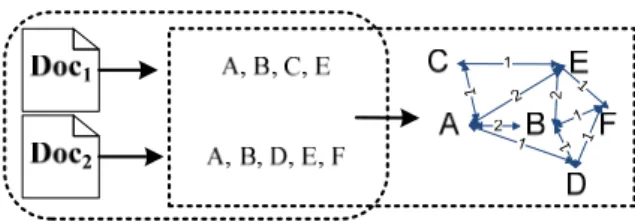
An edge is constructed if two concepts (MeSH descriptors) co-occur in a document. The edge weight is the number of documents in which the two concepts co-occur (figure 3.2). Although the example in figure 3.2 is only for the two documents, the method can be used to build a graph for a whole collection of documents.
2
1
1 1
1
Figure 3.2 A term co-occurrence graph between two documents: Doc1 and Doc2. The edge weight is the number of documents where two terms co-occur.
3.2.4 Noise Reduction
The PageRank algorithm does well in identifying globally important web pages on the WWW network, since it ranks a web page using its social reference information (i.e., it is cited by whom). However, when it is applied to a term co-occurrence graph, it faces the noise problem (i.e., the general terms can receive high ranking easily, as they tend to co-co-occur with most of the class-specific core terms). Should the impacts of “general
be discounted, it would contribute to strengthening the effects of “core terms.” Therefore, the following two filtering strategies are applied sequentially. First, employ a chi-square statistical filtering to remove each edge between nonsignificant concept pairs. Then, each edge between every two concepts that never appear in the same sentence clause. In detail, statistical filtering and semantic filtering are defined as the following two sections.
Statistical Filtering. In order to validate the strength of the relatedness of concept pairs,
the edges are filtered out if their chi-square value falls below a critical value (P=0.001 with degree of freedom 1, 10.83). Other statistical measures, such as mutual information, are disregarded as there is no critical value table to follow.
Semantic Filtering. A pair of two concepts is determined as semantically related if they
appear in the same clause of an English sentence. An edge between two co-occurring concepts is thus filtered if they are not semantically related.
3.2.7 MeSH Abstract-Title Graph
As discussed in previous sections, discovering how to discount the impacts of the general terms is essential to detecting the class-specific core terms. But filtering methods are not the only strategies that we can apply. If a term graph is well constructed, we may not heuristics such as filtering. We argue that the different sections of a document have different importance levels for assigning the terms’ global ranking scores. For example, terms in a document title usually contain a much bigger percentage of topical terms than those in a document abstract. Therefore, we view a document abstract as an explanation a document title. In other words, an abstract term “cites” the title terms. Based on this intuition, a directed abstract-title term graph is constructed with each abstract term
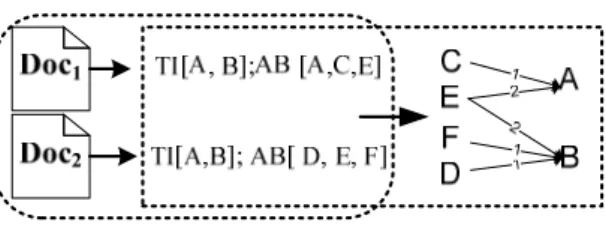
to each title term (see figure 3.3). This makes the class-specific core terms receive more inlinks. In figure 3.3, we explain how to construct an abstract-title graph using the two documents. An abstract term E co-occurs with the title term A and B in two documents. Thus, a directed edge is constructed with E pointing to A and B. Edge weight 2 means {E} and {A, B} co-occur twice. It is possible that a term appears both in the title and abstract section, which is equivalent to an author’s citing his own work. In practice, we many terms occur in both title and abstract, not necessary simultaneously, which makes some abstract (title) terms receive inlinks from other abstract (title) terms. This fact actually guarantees the run of PageRank-based algorithms because PageRank requires the graph should not be a bipartite graph, that is, there should be some links among abstract (title) terms.
Figure 3.3 An abstract-title term graph between two documents: Doc1 and Doc2, with abstract terms pointing to title terms. TI stands for title terms. AB means abstract terms. The edge weight is the number of documents where an abstract term co-occurs with a title term.
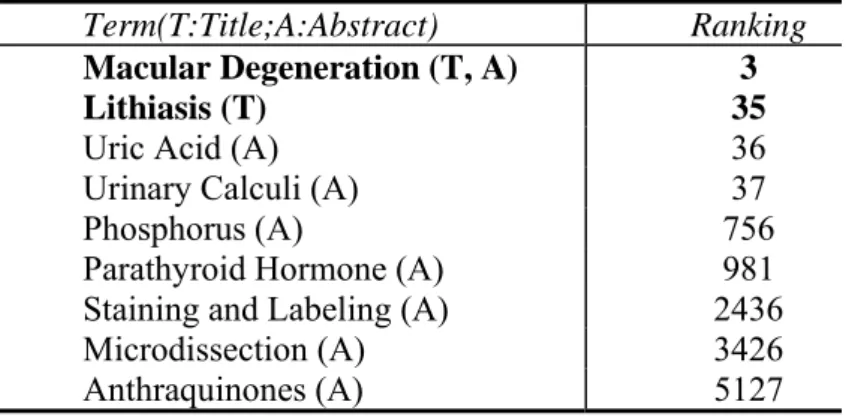
Table 3.1 shows the rankings of the title terms (in bold font) and the abstract terms a PubMed document belonging to the macular degeneration class. As we see, the title two terms that are very topic specific receives higher rankings. Note that although our method is quite effective for improving the class-specific terms’ ranking, it cannot make
general terms rank below class-specific terms, since it is possible that a class-unspecific general term could appear in both the title and abstract. However, our approach takes advantage of the fact that most title terms are topic-specific terms and therefore are effective in improving these terms’ global ranking.
Table 3.1 The ranking of title and abstract terms of a PubMed document, calculated by PageRank
Term(T:Title;A:Abstract) Ranking
Macular Degeneration (T, A) 3
Lithiasis (T) 35
Uric Acid (A) 36
Urinary Calculi (A) 37
Phosphorus (A) 756
Parathyroid Hormone (A) 981 Staining and Labeling (A) 2436
Microdissection (A) 3426
Anthraquinones (A) 5127
3.2.8 Term Global Importance
The ranking of terms by global ranking methods such as PageRank and HITS indicates their global importance. Ideally, we only need to pick the top-ranked class-specific core terms to initialize the “core” of clusters. The success of PageRank lies on its integration human knowledge (inlinks). Unless the graph is not a bipartite graph, PageRank can be applied. Therefore, they can be applied to both symmetric term co-occurrence graphs and asymmetric abstract-title graphs. However, when applied to a symmetric graph, they have to deal with the fact that the class-unspecific general terms tend to co-occur with most of the class-specific core terms and thus receive very high rankings. The function of these
terms is very similar to a large portal website such as Yahoo that is cited by a great deal other web pages. Figuring out how to discount the effects of these class-unspecific terms can contribute to discovering the distinguishable class-specific core terms. We expect a statistical filtering and a semantic filtering would help solve this problem. For example, which is the closer concept pair, {“Human,” “Migraine Disorder”} or {“Headache,” “Migraine Disorder”}? By chi-square, {“Headache,” “Migraine Disorder”} is more significant than {“Human,” “Migraine Disorder”}, because “Human” tends to co-co-occur with most other terms, while “Headache” tends to co-co-occur with “Migraine Disorder.” Therefore, if the chi-square value of {“Human,” “Migraine Disorder”} is the threshold, the edge between the two terms will be filtered out.
As discussed before, hyperlinks contain more useful information than undirected co-occurrence links because they encode human choices beyond the document content. Motivated from this observation, an abstract-title term graph with abstract terms pointing to title terms is constructed to integrate the document section importance information into the links between terms. As a result, title terms have more inlinks than abstract terms and thus receive higher PageRank scores. Assigning title terms higher ranking scores also assigns topic-specific terms higher ranking scores, since a document title usually contains more topic specific terms than a document abstract.
3.2.9 Term Local Importance
A term’s local importance is defined to be the density with which it connects to other If a topic-specific term is densely connected to a number of other terms that are also related to this topic, then a core term cluster is formed.
We believe that the top ranked terms form several dense areas within a co-occurrence term graph or an abstract-title term graph. Therefore, we start from the top ranked terms to detect core term clusters.
For this purpose, we develop a measure called In_Cluster_Degree (ICD) (equation 3.1) to calculate a term’s local importance:
(3.1)
where
Weight(Edgeti,Ck)is the sum of co-occurrences of term tiwith each connectedterm in term cluster Ck and Num(Edgeti,Ck)means the number of links connecting term tito
cluster Ck.
In practice, the top ranked terms by PageRank are selected sequentially to detect k
core term subgraphs (clusters). For a top ranked term ti, our algorithm first generates a
term list where all the terms are linked to term ti. This term list forms a temporary term
cluster (subgraph) and is sorted in a descending order based on their ICD values, that is, the link frequency to other terms. Terms below a predefined threshold are put back into the term pool for reassignment. Terms over the threshold and term ti are kept to form a
core term cluster. If no term is over the threshold, term tiwill be put back into the term
pool. Once k core term clusters are detected, the remaining terms are assigned to the k
term clusters according to their ICD values. The details of calculating a term’s local importance and its corresponding term cluster’s density will be explained in section 3.8 with a solid example.
) ( ) ( ) , ( _ _ , , k i k i C t C t k i Edge Num Edge Weight C t Degree Cluster In
3.2.10 A Graph-based Document Clustering
After k term clusters are identified, each document is assigned to its closest term cluster
by maximizing equation 3.2:
_ _ ( , ) ) , ( ,d k i k j C t Degree Cluster In C d Closeness DocCluster j (3.2)In equation 3.2, the closeness between document dj and cluster Ck is calculated by
summing up the In_Cluster_Degree of each term ti,dj. Algorithm:
Input:
G : a term graph,
D: a document set.
K: a pre-defined cluster number.
M: the minimum number of core terms in each cluster.
Q: a term cluster quality threshold.
Output: K core term clusters and their corresponding K document clusters.
/* calculate term salient score and assign to a term vertex list v_list
and sort the v_list in a descending order by terms’ salience score */
1: v_list <- globalRank (G);
2: v_list <- sort (v_list, SalienceScore, des);
/* Detecting K core term clusters */
3: while (the number of detected term clusters is less than K) do
4: for each term vertex Ti in v_listdo //start from the first term in v_list //get a non-used term cluster from clusterPool
5: cluster_k <- getFreeTermCluster(clusterPool);
6: if (cluster_k is nil) return // all k clusters are detected
7: cluster_k.add(Ti);
8: Ti_list <- findConnectedTerms (Ti);
//sort terms in Ti_list descendingly by In_Cluster_Degree(ICD)
9: Ti_list <-Sort (Ti_list, ICDScore,des)
10: for each Tj in Ti_list do //start from the last term
11: if (ICD(Tj)/ICD(Ti)>= Q) do
12: cutoff_index <- j;
//add all the terms over cutoff_index in Ti_list to cluster_k;
14: cluster_k.add(getTermsOver (cutoff_index)); // if the detected term cluster is too small, it will not be counted.
15: if (size(cluster_k) < M) do
16: cluster_k.clear();
17: free(cluster_k); //put back cluster_k to clusterPool
18: assign remaining terms to k term clusters by maximizing ICD.
/*match each document to its closest term cluster by the maximization of equation(2) */
19: For each document dm in D do
20: cluster_k<-findClosestCluster( dm)
21: cluster_k.add(dm);
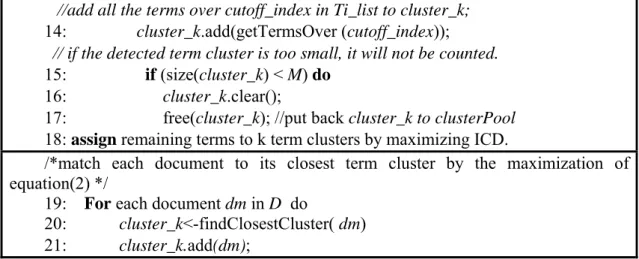
Figure 3.4 Term rank–based document clustering
3.2.11 An Efficient and Effective Algorithm for Identifying k Core Term Clusters and k Document Clusters.
Figure 3.4 above shows the procedure of document clustering. Below we explain each step in great detail. Compared to our previous algorithm (Zhang, et al. 2007b), which is designed for a title-abstract graph and its corresponding term co-occurrence graph, this algorithm is more general and suitable for any type of term graph. Note that this algorithm requires only one term graph as input, while our previous algorithm uses two graphs as inputs. This change makes the algorithm more efficient, less effected by term noise in term co-occurrence graph, and able to achieve better performance.
Step 1(lines 1–2): The global importance score of each term vertex is treated as its
salience score. The larger the score is, the higher the ranking. First, a global ranking algorithm such as PageRank is run on a term co-occurrence or an abstract-title term graph
until it converges. Once the score is determined, the terms are sorted in a descending order according to their salience scores—or global importance.
Step 2 (lines 3–18): To detect k term clusters (as shown in figure 3.4), our algorithm
checks each term sequentially using the sorted list generated from step 1. Herein, the procedure is explained by a detailed example. If the number one top-ranked term is “Hepatitis B, Chronic,” then all the terms that have links to the term “Hepatitis B, Chronic,” including the term itself, are treated as a candidate term cluster. These terms are further sorted by their In_Cluster_Degree (ICD) in descending order (Ti_list, line 9).
Starting from the lowest ranked term (line 10), the ICD of each term in Ti_list is denominated by the ICD of the term with the largest ICD value—the ICD of “Hepatitis B, Chronic” (which connects to every other term). This value is then checked against a predefined threshold Q, say 0.5 (line 11). If this value is over 0.5, then the current term
and all the terms ranking above it form a new term cluster (lines 12–14). If only the terms including “Lamivudine,” “Hepatitis B virus,” and “Hepatitis B, Antigens” are over the threshold, then these terms together with term “Hepatitis B, Chronic” form a new core dense subgraph (core term cluster). The terms below the threshold Q are put back