Imperial College London
Department of Computing
Stateful Data-Parallel Processing
Raul Castro Fernandez
Submitted in part fulfilment of the requirements for the degree of Doctor of Philosophy in Computing of Imperial College London
Abstract
Democratisation of data means that more people than ever are involved in the data analysis process. This is beneficial—it brings domain-specific knowledge from broad fields—but data scientists do not have adequate tools to write algorithms and execute them at scale. Processing models of current data-parallel processing systems, designed for scalability and fault tolerance, are stateless. Stateless processing facilitates capturing parallelisation opportunities and hides fault tolerance. However, data scientists want to write stateful programs—with explicit state that they can update, such as matrices in ma-chine learning algorithms—and are used to imperative-style languages. These programs struggle to execute with high-performance in stateless data-parallel systems.
Representing state explicitly makes data-parallel processing at scale challenging. To achieve scalability, state must be distributed and coordinated across machines. In the event of failures, state must be recovered to provide correct results. We introduce state-ful data-parallel processing that addresses the previous challenges by: (i) representing state as a first-class citizen so that a system can manipulate it; (ii) introducing two dis-tributed mutable state abstractions for scalability; and (iii) an integrated approach to scale out and fault tolerance that recovers large state—spanning the memory of multi-ple machines. To support imperative-style programs a static analysis tool analyses Java programs that manipulate state and translates them to a representation that can execute on SEEP, an implementation of a stateful data-parallel processing model. SEEP is eval-uated with stateful Big Data applications and shows comparable or better performance than state-of-the-art stateless systems.
Acknowledgements
I want to thank Dr. Peter Pietzuch for making this thesis possible: for giving me the opportunity to work in his group; for his careful supervision at different levels over four intense years; and for his contagious enthusiasm in research, that motivated me day after day. I am proud to have learnt what I know about research from him.
I want to thank Matteo, Eva and Paolo, who helped in countless ways. Our off-topic con-versations challenged and motivated me, and ultimately helped me to become a better researcher. I also want to thank Richard Mortier and Cristian Cadar who carefully read and helped me to improve this document after a great discussion.
I thank my parents and my brother for trusting every decision I made, they have helped me to become the person I am today.
I am proud of having Jorge, Christian, Victor, Patri and many other wonderful people by my side. They have always been and will always be there. Thanks to the London crowd for their support during my time in that fantastic city. They made everything easier. Special thanks to Laura, with whom I shared most of these four years. She listened every time to whatever I had to say, helped every time and her smile made everything possible. We suffered together and she always understood and supported my goals and passion. For that I will always be grateful.
I want to thank to the fantastic people with whom I shared office all these years. They managed to make working in office 346 a pleasant experience. Special thanks to Ioannis, Andreas, Lukas, April, Luo, Alexandros, Dan and Matthias for the work done together (Matthias, Alex), the off-topic conversations, and the post-deadline whiskies that eased all the moments of hard work
I want to thank Mike, Sara and Alvaro with whom I shared most of my time during my undergraduate studies. I have learnt invaluable skills from all of them, and I am lucky to have opportunities to keep doing so in the future.
I also want to thank the LinkedIn team with whom I spent a fantastic Summer in 2014. Dong, Joe, Chris, Jun, Neha, Jay and Mammad all helped me with their invaluable advice and their technical expertise.
The idea of pursuing a PhD stems from goals and passion. I want to thank those who have motivated me fueling these. Sometimes they have done that over years, other times over coffee conversations, but they all mean something if included below:
Alvaro Agea started everything, he is the reason why I am doing what I do today. Peter Pietzuch is responsible for recovering my hope in research. Vittorio challenged and motivated me in ways he probably does not even imagine. Kevin Cuturi, Peter Alvaro, Martin Kleppmann, Anand Rajaraman, Chris Re, Itxaso and Dave all contributed in one way or another to this thesis.
To you black gold, for always accompanying me, during the highs and the lows of this adventure. Forever thank you.
Declaration of Originality
This thesis presents my work in the Department of Computing at Imperial College Lon-don between October 2011 and September 2015. I declare that the work presented in this thesis is my own, except where otherwise acknowledged.
Copyright Declaration
The copyright of this thesis rests with the author and is made available under a Creative Commons Attribution Non-Commercial No Derivatives licence. Researchers are free to copy, distribute or transmit the thesis on the condition that they attribute it, that they do not use it for commercial purposes and that they do not alter, transform or build upon it. For any reuse or redistribution, researchers must make clear to others the licence terms of this work
Contents
Abstract 3 Acknowledgements 5 Declaration of Originality 7 Copyright Declaration 9 1 Introduction 11.1 The Big Data Era . . . 2
1.2 Current Challenges of Big Data Processing . . . 6
1.3 Problem Statement . . . 10
1.4 Research Contributions . . . 11
1.4.1 Stateful Dataflow Graphs . . . 12
1.4.2 Imperative Big Data Processing . . . 13
1.5 Publications . . . 13
1.6 Thesis Structure . . . 14
2 Background 16 2.1 Big Data Landscape . . . 17
2.2 Scalable Big Data Processing . . . 21
2.2.1 Scheduled Systems . . . 22
2.2.2 Materialised Systems . . . 24
2.2.3 Dynamic Scalability: Elasticity . . . 26
2.2.4 Distributed Programming Models . . . 27
2.3 Fault Tolerant Big Data Processing . . . 29
2.3.1 Log Data: Materialising Intermediate Results . . . 30
2.3.2 Log Data: Independent Checkpoints . . . 31
2.3.3 Log Operation: Lineage-Based Failure Recovery . . . 33
2.3.4 Discussion . . . 33
2.4 Data-Parallel Processing Languages . . . 34
2.4.1 Stateless Programming Models . . . 35
2.4.2 Distributed Programming Models (DPM) . . . 36
2.5 Summary . . . 37
3 Stateful Dataflow Graphs 39 3.1 The Stateful Dataflow Graph Model . . . 40
3.2 Task Elements (TE) . . . 43
3.3 State Elements (SEs) . . . 45
3.3.1 Partitioned State . . . 46
3.3.2 Partial State . . . 47
3.4 Execution of Stateful Dataflow Graphs . . . 49
CONTENTS 13
4 Scalability and Fault Tolerance of Stateful Dataflow Graphs 51
4.1 State as a First-Class Citizen . . . 52
4.2 Integrating Scale Out and Fault Tolerance . . . 56
4.2.1 Primitives for State Management . . . 57
4.2.2 Elasticity: Scaling Out Dynamically . . . 61
4.2.3 Fault Tolerance . . . 63
4.3 Cloud Deployment . . . 66
4.3.1 Bottleneck Detection . . . 68
4.3.2 VM Provisioning . . . 68
4.4 Summary . . . 69
5 Imperative Big Data Processing 70 5.1 Overview of the Translation Process . . . 71
5.2 Annotations to Disambiguate State Semantics . . . 72
5.3 Translation from Java to SDG . . . 74
5.4 Limitations . . . 76
5.5 Summary . . . 77
6 Evaluation 80 6.1 Performance . . . 81
6.2 Fault Tolerance . . . 91
6.3 Comparison with State-of-the-Art . . . 98
6.4 Use Case: Smart Grid Analytics . . . 99
6.4.3 Experimental Evaluation . . . 107 6.4.4 Summary . . . 113 6.5 Summary . . . 113
7 Conclusion 116
7.1 Thesis Summary . . . 117 7.2 SDG in Practice: Big Data Integration . . . 119 7.2.1 The Problem of Data Integration . . . 120 7.2.2 Big Data Integration Based on Stateful Data-Parallel Processing . . 123 7.2.3 Evaluation . . . 125 7.3 Future Work . . . 128
Bibliography 129
List of Figures
1.1 MapReduce dataflow model composed of map and reduce tasks. . . 7
1.2 Dryad dataflow model forming a DAG. . . 7
1.3 Spark dataflow model with iteration. . . 8
2.1 Task and data parallel models. . . 18
2.2 Data Partitioning for scalable processing. . . 19
2.3 Stateless and stateful processing models. . . 20
2.4 A glimpse of the evolution of dataflow graphs for expressing processing models. . . 23
2.5 Stream versus batch processing models. . . 25
2.6 Fault tolerance through redundant computation. . . 29
3.1 An SDG in comparison to traditional stateless dataflow graphs. . . 39
3.2 Example of SDG for the CF algorithm. . . 42
3.3 Data stream of tuples. Tuples are ordered according to a timestamp and contain a key and a payload. . . 44
3.4 Different distributed state abstractions. . . 45
3.5 Types of partial state accesses. . . 48 15
4.1 State is formed by processing state (SE), routing state and buffer state. . . 53
4.2 Stateful dataflow graph and execution graph. . . 55
4.3 Example of scale out of stateful TEs. . . 62
4.4 Parallel,m-to-nstate backup and restore. . . 66
4.5 Integration with stream processing system. . . 67
5.1 Translation of an annotated Java program to an SDG. . . 71
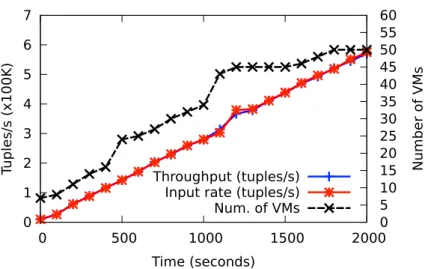
6.1 Query for the Linear Road Benchmark. . . 82
6.2 Dynamic scale out for the LRB workload with L=350 (closed loop work-load). . . 83
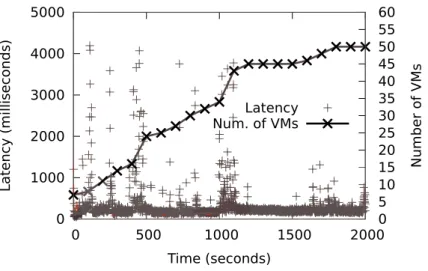
6.3 Processing latency for LRB workload. . . 84
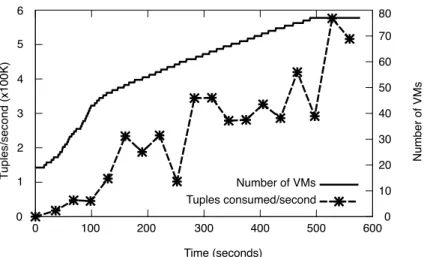
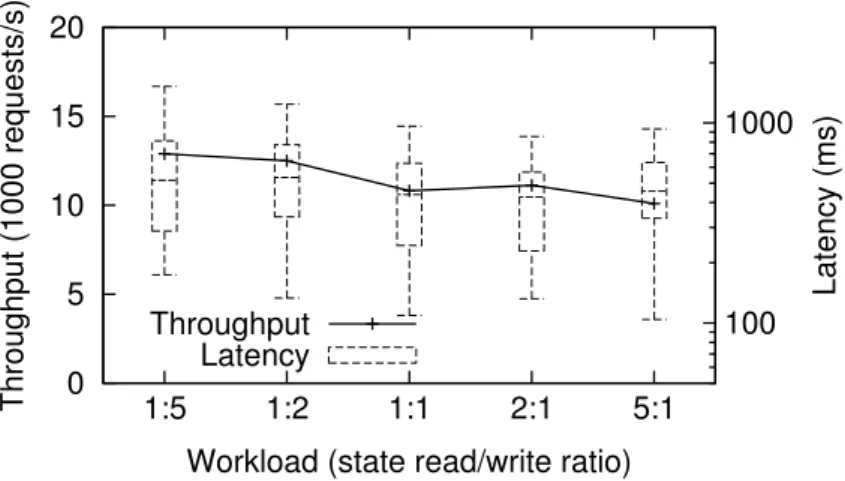
6.4 Dynamic scale out for a MapReduce style workload (open loop workload). 85 6.5 Throughput and latency with different read/write ratios (online collabo-rative filtering). . . 86
6.6 Throughput and latency with increasing state size on single node (key/ -value store). . . 87
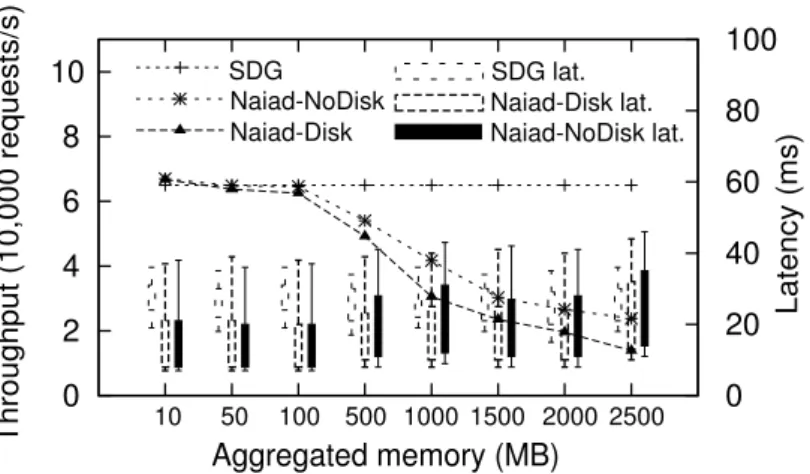
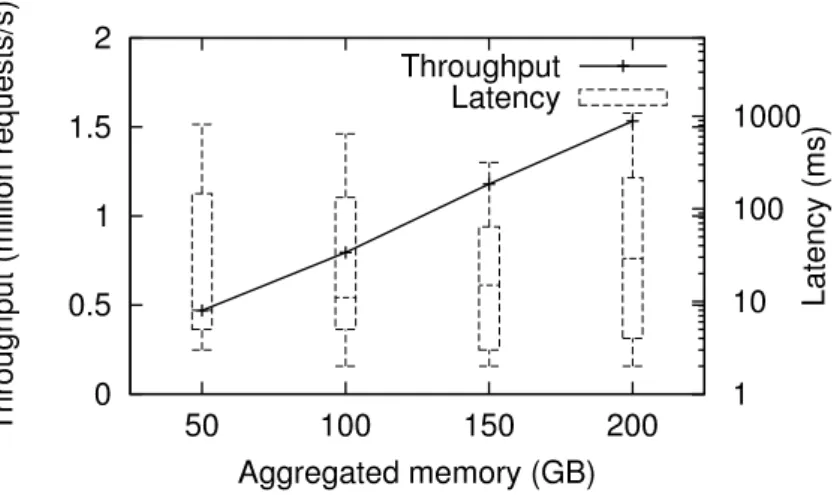
6.7 Throughput and latency with increasing state size on multiple nodes (key/ -value store). . . 88
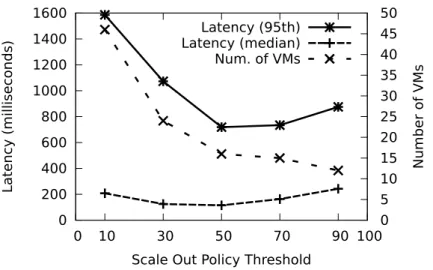
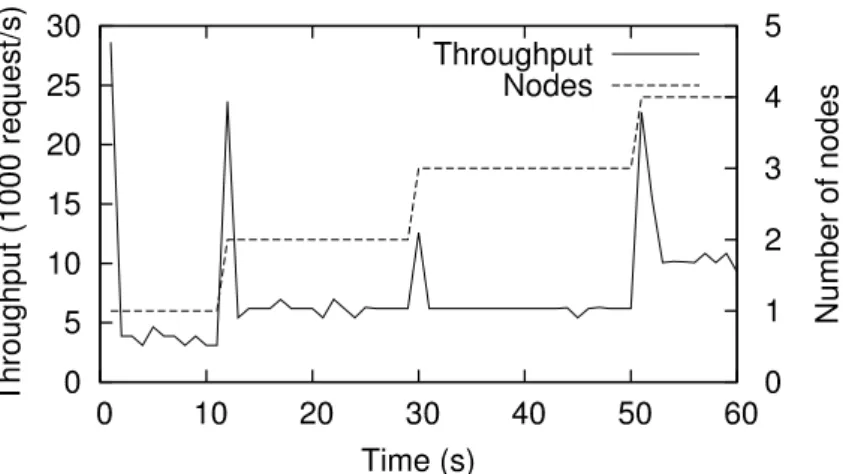
6.8 Impact of the scale out thresholdδon processing latency. . . 89
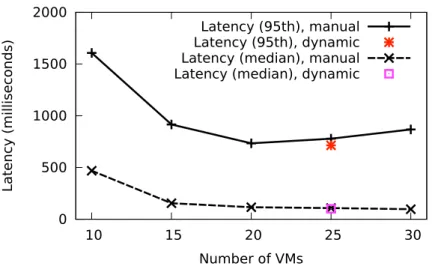
6.9 Comparison between dynamic and manual scale out. . . 90
6.10 Runtime parallelism for handling stragglers (collaborative filtering). . . . 91
6.11 Recovery time for different fault tolerance mechanisms. . . 92
6.12 Recovery time for different R+SM checkpointing intervals. . . 93
LIST OF FIGURES 17
6.14 Recovery times with differentm-to-nrecovery strategies. . . 95
6.15 Comparison of sync. and async. checkpointing. . . 96
6.16 Impact of checkpointing frequency on latency. . . 97
6.17 Impact of checkpoint size on latency. . . 97
6.18 Latency with different window sizes (streaming wordcount). . . 98
6.19 Scalability in terms of throughput (batch logistic regression). . . 99
6.20 Load measurements (five minute window) indicating change of more than 5 watts. . . 101
6.21 The stateful dataflow graph of our solution. . . 103
6.22 Throughput and speedup as a function of the number of houses. With a constant throughput, growing the size of the dataset implies a lower speedup. . . 109
6.23 Throughput and speedup over RT as a function of the number of ma-chines. We increase the speedup by scaling out the system to aggregate throughput. . . 110
6.24 Latencies for both queries with baseline and distributed deployment. . . . 110
6.25 Throughput and speedup as a function of the number of houses for query 2.111 6.26 Distributed deployment of query 2. Scaling out the query aggregates throughput and increases the speedup. . . 111
6.27 Time series over 4 days showing a low prediction error for plugs over 5-minute windows. Note that the 10th and 50th percentile lines overlap with the x-axis. . . 112
6.28 Time series over 4 days showing a low prediction error for houses over 5-minute windows. . . 112
of magnitude (note the logarithmic scale). One month worth of data for 40 houses is processed in 17 minutes. . . 113
7.1 Data integration with Liquid. . . 122 7.2 Architecture of the Liquid data integration stack. . . 123
Chapter 1
Introduction
Today, most digital services and products depend on the analysis of large volumes of data. We find online content through search engines that use gigantic indexes of all the addressable web pages in the Internet to produce results [Eco]. Online recommen-dations which suggest to us content that we may find interesting, are built from the aggregated data of many users. Other examples are natural language interfaces that permit us to send voice commands to mobile devices such as Microsoft Cortana [Mic], Apple Siri[App]or Google Now[Goo]. The list of services that use data to increase user-perceived value goes on and on. Yet, these are just a few examples of cases where data analysis is useful. Internet companies have based their business models on the commer-cialisation of user data, for example, with the use of sophisticated ad-targeting platforms. In a broader sense, science benefits from new sources of data to access new insights that permit to make progress faster. Examples can be found in bioinformatics[Sav14], social sciences[CHKS14]and, more generally indata-driven science[HTT09]that emphasises data analysis as an integral part of the scientific process.
As data analysis becomes part of the day-to-day activities of data scientists, the demand for more sophisticated analysis platforms increases. The need to analyse large volumes of data triggered several breeds of systems that scale their distributed infrastructures to clusters or public clouds. These systems, however, do not support imperative program-ming languages. The main reason is that they all build on top of stateless data-processing models that make representing state explicitly difficult. In this thesis, we present stateful
data-parallel processing, a new processing model that permits an explicit representation of state and therefore enables analysis programs in imperative languages.
1.1 The Big Data Era
Many organisations have relied on data analysis to provide services and products for decades. These analyses have traditionally been performed indata warehousesthat store data and facilitate its analysis[CD97]. However, the unprecedented volume of data gen-erated and collected in the last decade has outpaced the capabilities of traditional data management technology. Big Data encompasses new problems in data management: (i) it introduces scalability challenges in the data management solutions of traditional organisations; and (ii) it creates new opportunities that spark new, innovative ways of uncovering hidden value. This new angle to an old problem has produced a renewed interest in data management technology. One particular example is the appearance of
data-parallel processing systemsthat leverage distributed shared-nothing architectures to permit the analysis of ever-growing amounts of data. The design of these systems in particular, and of data analysis technology in general, is motivated by the changes in the data management landscape that occurred over the last decade.
We identify three trends that have converged to shape modern data analysis systems: (i) the combined storage cost decrease and the global adoption of the Internet allowed to store large volumes of data cheaply; (ii) the development of new hardware and software systems to facilitate Big Data analysis; and (iii) the availability of cost-efficient pools of computing resources enabled by the commercialisation of cloud computing. These three trends have fostered innovation and enabled new products and services based on data. This, in turn, has attracted more people—with new, more complex applications in mind—to the data analysis life-cycle, thus creating more and more data. This creates new challenges that hinder the full extraction of value from data analysis, as summarised below.
Data becomes cheap
hyper-1.1. The Big Data Era 3 links to a write-intensive platform where millions of people upload all types of content, such as posts in social networks or multimedia content such as music or video. Unlike in the read-only era where the content hosted in the Internet grew slowly, the write-intensive era generates petabytes of information daily [hkb]. This data is valuable for companies that are motivated to acquire more and more data. By carefully analysing this data, it is possible to detect user-behaviour patterns, which can increase the quality of services and products. This reinvestment of value further increases user engagement, which in turn, boosts data growth.
These large volumes of data can be stored due to the decrease in storage prices. There are two factors that contribute to this cost reduction: (i) reduced hardware costs makes terabyte devices a commodity; and (ii) the development of distributed file systems, which work on cheap off-the-self high-storage servers, enable the aggregation of the storage capacity of multiple machines.
Data becomes cheap due to the storage cost reduction, and companies are willing to store more data for increased future value. In this situation, the bottleneck in data analysis shifts from data generation and storage to data processing. This need motivates the development of sophisticateddata-parallel processing systemsdesigned to process an always increasing amount of data.
Quick evolution of data-parallel processing systems
In order to cope with this new processing bottleneck, organisations must find scalable data processing technologies that allow them to process large volumes of data. Addition-ally, such solutions must account for future data growth, and for this reason, it is crucial that they are cost-efficient. In particular, scaling up—adding more powerful hardware— is not a viable solution, as data grows faster than Moore’s law[JGL+14]with costs rising quickly. One cost-efficient alternative to scaling up is relying on shared-nothing archi-tectures composed of off-the-self servers [Sto86]. These aggregate the computational resources of many machines, thus providing a powerful and cost-efficient platform. New hardware infrastructure demands new software that can take advantage of the new characteristics. This software has two crucial requirements. One is scalability: it must scale to aggregate the throughput of distributed machines. Second, the software must
be fault-tolerant. With an increasing number of machines running in parallel, there is a higher probability of hardware failure [GGL03, GJN11, PWB07], so software must avoid data loss in the event of failure. Data-parallel processing systems appear as a scalable and fault tolerant solution to process large volumes of data in shared-nothing architectures, with MapReduce[DG04]as one of the early examples. However, with new organisations that want to analyse large volumes of data, new complex applications and workloads appear that accelerate the development of more sophisticated data-parallel processing systems.
Continuous data growth fosters the development of cost-efficient data-parallel processing systems that run on shared-nothing architectures. The main requirements for these systems are scalability and fault-tolerance. The broad range of workloads and application use cases give rise to many specialised systems.
Large-scale computing platforms at our fingertips: Cloud computing
Analysing Big Data with data-parallel processing systems requires large clusters of ma-chines to provide results in a timely manner. These clusters are difficult to operate and expensive to maintain, which used to limit Big Data analysis to organisations with the re-sources to build and operate large clusters. The appearance ofcloud computing[AFG+10]
opened the possibility for small organizations and individuals to analyse Big Data. Cloud computing allows users to provision computing resources on demand and only pay for consumed resources, avoiding the costs of operating and maintaining large clusters. In-stead of building data centres, organisations can buy resources from public cloud ven-dors, such as Amazon AWS[Amaa]or Rackspace[Rac], and deploy their data analysis solutions to perform analysis at scale. An additional advantage of the cloud model is its
elasticityproperty: users have an initial pool of resources that they can grow or shrink, adjusting the used resources to current demand. The vision for computing as an utility is as old as computing[CK09], but it is not until the past decade that vendors have created a product out of that vision, and brought it to the general public.
The abundance of data and the appearance of cloud computing creates new opportuni-ties to extract value from data. This causes the appearance of applications with more complex requirements, and encourages more people—with varied backgrounds—to be-come part of the data analysis process. With all these new stakeholders involved in data
1.1. The Big Data Era 5 analysis, there is a race to find data-parallel processing systems that better capture the requirements of new applications, e.g. that efficiently support iteration as used in many machine learning applications. With the involvement of domain experts in the data analysis process, the programming models of data-parallel processing systems evolve to make programming these systems more accessible.
Easy and cost-efficient access to large pools of computing resources and data makes Big Data analysis accessible to more people. As a result, domain experts demand more complex applications. Under this scenario, data-parallel processing systems must evolve to provide support for more complex applications, and the programming languages of these systems become more important.
However, current data-parallel processing models hinder analysis opportunities because they are stateless. In a stateless model, dataflow graphs are composed of nodes that rep-resent computation and edges that reprep-resent the data communication between nodes. This simple model facilitates achieving fault tolerance and scalability—properties fun-damental to these systems. However, the lack of state precludes the straightforward representation of algorithms that are stateful, thus limiting the number of applications that can be expressed efficiently. Most importantly, a lack of state means that these mod-els do not support high-performance execution of applications that require fine-grained updates.
Consider the case of an application that trains a machine learning model to classify emails. Additionally, the application requires to classify on-demand, i.e. with low-latency to not affect user experience, new incoming emails. Such an application must access state—the trained model in this case—with low latency, and be able to update it with fine-granularity (for the required user) as soon as possible to maintain afresh view of data.
The stateless models of current data-parallel processing platforms are a hurdle towards the democratisation of data [AAA+], the trend of more people getting involved in the generation, collection and analysis of data. When the analysis requires domain expertise, experts find it difficult to represent stateful algorithms in the stateless models supported by current systems.
In this thesis, we propose a new data-parallel processing model called stateful data-parallel processing that allows explicit state, therefore permitting a wide range of ap-plications with fine-grained access to state to execute with scalability and fault tolerance in distributed clusters of machines. In addition, stateful data-parallel processing makes it possible to incorporate imperative-style languages.
Next, we give a summary of the technical challenges that give rise to the aforementioned hurdles: how to provide scalability and fault tolerance in stateful data-parallel processing. After that, we state the research contributions and conclude with an outline of this thesis.
1.2 Current Challenges of Big Data Processing
This section provides an overview of data-parallel processing systems structured along two different aspects. First, it summarises how the stateless dataflow representation used by these systems has evolved to incorporate new features such as branching and loops, as demanded by more complex applications. Second, it walks through the evolu-tion of dataflow models towards higher-level constructs. Overall this secevolu-tion emphasises modern system requirements and exposes the shortcomings of their stateless processing models.
Data-parallel processing: Systems
Data-parallel processing systems designed to run on shared-nothing architectures have evolved over the last decade to incorporate new features for new use cases and work-loads. All these systems receive as input applications that are represented as a dataflow graph—a directed acyclic graph (DAG), where nodes perform computation and edges represent the flow of data across the nodes. Dataflow graphs are a good representa-tion to identify elements that can run in parallel and to recover from faults as explained below.
The MapReduce model[DG04]proposed by Google in 2004 offers a computation model formed by map and reduce tasks. Map tasks apply a function to the input data and sort the output results, and reduce tasks aggregate the map task outputs. The main benefit of this model is that map and reduce tasks can run in parallel by partitioning the
1.2. Current Challenges of Big Data Processing 9 into scalable distributed file systems, where MapReduce runs periodically to execute batch-oriented applications. Batch-oriented processing systems focus on high through-put instead of low latency, i.e. an application may take hours to complete. Over the last years, many applications appeared that require low latency processing, or increase their value with lower latency. For example, applications such as fraud detection, online rec-ommendation and monitoring alert generation, require low latency processing of large volumes of data to be useful.
Another challenge of data-parallel processing systems is to offer more general dataflow mod-els and abstractions that allow them to adapt tovaried workloads. One size does not fit all means that different systems and architectures are proposed to cope with applications that demand, for example, low-latency processing.
This shift in the workload requirements triggered the development of new systems based on stream-processing [AAB+05, CCD+03a]that process data in a fine-grained fashion, permitting to achieve low-latency results. Similar to batch-oriented processing systems, scalability and fault tolerance are the two key properties that drive their designs. For this
reason, they also represent applications with dataflow graphs, such as Twitter Storm[TTS+14a], Apache Samza[Apac]or Google Millwheel[ABB+13]. However, the techniques required
to achieve scalability and fault-tolerance in stream-processing differ from batch-oriented systems due to the different processing model. For example, materialising all intermedi-ate results as in MapReduce would introduce too much overhead, precluding low lintermedi-atency processing.
Data-parallel processing systems have evolved to respond to two new trends. First, they adapt to new applications by offering more expressive models that allow arbitrary DAGs and loops. Second, they adapt to support application workloads that require latencies ranging from hours to seconds.
Data-parallel processing: Languages
The other major aspect of data-parallel processing systems that has experienced strong evolution is the programming language for writing applications. The main reason is again related to the desire for including better support for more complex applications. For example, the MapReduce model offers a Java template that requires implementing
a map and reduce task per job, where inputs and outputs are fixed.
There have been many approaches to abstract this low-level Java interface. For example, Apache Pig [ORS+08] introduces a limited set of operators that facilitate the composi-tion of different map reduce jobs. Apache Hive [HCG+14] offers a SQL interface on top of the MapReduce model: declarative SQL queries are rewritten as multiple MapRe-duce jobs. Similar efforts exist for Dryad [YIF+08] and Spark [XRZ+13, AXL+15]. All these approaches offer different interfaces, but they are fundamentally limited by the native stateless processing model of the underlying platforms, i.e. they cannot execute stateful algorithms efficiently—all state is represented as data that must flow through the dataflow graph. In addition, expressing a stateful algorithm through a stateless pro-gramming interface is not natural for most developers.
In parallel with the evolution of the stateless processing models, domain experts and data scientists have relied on frameworks such as Matlab or R, and imperative program-ming languages such as Java, Python or C++to write data analysis algorithms. All these frameworks and languages have one important characteristic in common: they all rep-resent and manipulate state with fine granularity, which permits domain experts to write algorithms concisely. However, the shortcoming of these frameworks is that they are not designed for large scale data analysis.
Despite an evolution of the interfaces exposed to developers on top of stateless dataflow mod-els, the lack of state in data-parallel processing systems constrains the range of applications that can be executed with high-performance. This slows down the development of more complex applications that would benefit from explicit state.
1.3 Problem Statement
In summary, the shortcomings of current data-parallel processing systems are:
• No support for state. Stateless processing models prevent implementation of stateful applications that can be executed with high performance. Most stateless dataflow models were proposed for the first breed of batch-oriented data-parallel
1.4. Research Contributions 11 processing systems. As new workloads demand low-latency results, there is a need to support fine-grained updates to state, which is not supported by current models.
• No support for imperative languages. The lack of support for mutable state
prevents the implementation of imperative-style programming languages on top of data-parallel processing systems. Such a programming model would allow a broader range of domain scientists to analyse large amounts of data.
In spite of the benefits of a stateful model, there are two reasons why current data-parallel processing systems do not support state. State makes it difficult to achieve scal-ability and fault tolerance because it has to be managed to not become a bottleneck and it has to be recovered after failures for correct results. For this reason, a stateful data-parallel processing system must address these two issues, which are the subject of this thesis:
• Scalability. Data-parallel processing systems must scale out to aggregate the through-put of multiple machines. The presence of state makes scaling out more challeng-ing because the system must know how to handle the state (for example, partition it) in a way that preserves the application semantics, yet aggregates throughput. • Fault-Tolerance. To achieve fault-tolerant data-parallel processing, a system needs
to keep track of how much data has been processed, and recover intermediate re-sults that may be lost in the event of failure. Adding state means that a system needs to control not only how much data has been processed, but it also needs to account for state. When updates to state occur in a fine-grained way, the in-formation that the system must preserve increases, which further complicates the problem.
1.4 Research Contributions
We introducestateful dataflow graphs (SDG), a new dataflow abstraction that, in addi-tion to data and computaaddi-tion, represents state explicitly in the dataflow. SDGs therefore
can: (i) represent stateful algorithms concisely, for example, those that perform fine-grained updates; and (ii) capture the state used in imperative-style languages, therefore allowing the implementation of algorithms in imperative languages. We refer to this as
imperative big data processing.
To achieve scalability and fault tolerance in the presence of state, we introduce two different distributed mutable state abstractions that allow the distributed execution of stateful tools. To deal with failures and scalability, we introduce an integrated approach for scale out and fault tolerance that relies on a set of state management primitives.
1.4.1 Stateful Data
fl
ow Graphs
Stateful dataflow graphs separate data, state and computation and represent them ex-plicitly in a dataflow graph. A data-parallel processing platform that implements SDGs must provide high-throughput and low-latency data processing. To achieve these prop-erties, state is exposed as a first class citizen to the system, which allows to define state management primitives that can manage the state directly. For example, there are prim-itives to checkpoint the state—making it external to the system—or to partition it ac-cording to a partitioning function.
We introduce an integrated approach to scale out and fault tolerance that relies on the observation that a node failing and a node scaling out are equivalent from a state man-agement perspective. The integrated approach then uses the state manman-agement primi-tives to achieve fault tolerance, recovering the state after a node fails. Additionally, the system uses the state management primitives to provide elasticity, which we define as dynamic scalability—the system scales out dynamically to adapt to varying workloads or algorithms requirements.
Stateful Dataflow Graphs expose state as a first class-citizen to the system. This makes it possible to introduce state management primitives that can be used to achieve scalability and fault tolerance, as required by data-parallel processing systems designed to run on shared-nothing architectures.
1.5. Publications 13
1.4.2 Imperative Big Data Processing
Making state explicit in SDGs provides an opportunity to represent the state found in im-perative programming languages. We introduce an approach that transforms imim-perative Java programs into SDGs via static code analysis. The idea is that developers can write Java code, where they define state as attributes and different methods that receive input and use the state and logic to implement algorithms. A task then takes this Java class as input and produces an SDG, which works as an intermediate representation between user programs and the execution platform.
The SDG is then executed by the stateful data-parallel processing system. The com-pute nodes always access state locally, i.e. they do not perform remote state access to keep latency low. To allow compute nodes to scale out, two distributed mutable state abstractions are provided that permit the state to scale. To leverage opportunities for parallelism, users can annotate the state in a Java program withpartitioned or partial
annotations, indicating the distributed mutable state abstraction to use in each case. These annotations depend on the semantics of the algorithm: partitioned means that the state can be partitioned, while partial means that the state must be replicated.
Imperative big data processing allows the concise representation of algorithms by allowing the use of state and permits algorithms to be written in widely adopted languages, such as Java, C/C++, Python or Matlab.
1.5 Publications
During the course of the thesis, the following related publications have been authored:
• Liquid: Unifying Nearline and Offline Big Data Integration. Raul Castro Fer-nandez, Peter Pietzuch, Joel Koshy, Jay Kreps, Dong Lin, Neha Narkhede, Jun Rao, Chris Riccomini, Guozhang Wang. In 7th Biennial Conference on Innovative Data Systems Research, (CIDR), Monterey, CA, USA, (2015)[FPK+15]
• Making State Explicit for Imperative Big Data Processing. Raul Castro Fernan-dez, Matteo Migliavacca, Evangelia Kalyvianaki and Peter Pietzuch. USENIX An-nual Technical Conference (USENIX ATC), Philadelphia, PA, USA, (2014)[FMKP14]
• Grand Challenge: Scalable Stateful Stream Processing for Smart Grids. Raul Castro Fernandez, Matthias Weidlich, Peter Pietzuch and Avigdor Gal. 8th ACM International Conference on Distributed Event Based Systems (DEBS), Mumbai, India, (2014)[FWPG14a]
• Integrating Scale Out and Fault Tolerance in Stream Processing using
Oper-ator State Management. Raul Castro Fernandez, Matteo Migliavacca, Evangelia Kalyvianaki and Peter Pietzuch. ACM International Conference on Management of Data (SIGMOD), New York, NY, (2013)[CFMKP13]
• Towards Low-Latency and In-Memory Large-Scale Data Processing. Raul
Cas-tro Fernandez and Peter Pietzuch. Doctoral Workshop of the 7th ACM Interna-tional Conference on Distributed Event Based Systems (DEBS), 06/2013, Arling-ton, Texas, USA, (2013)[FP]
1.6 Thesis Structure
The remainder of the thesis is organised as follows:
Chapter 2 presents background and related work. This chapter introduces a number of dimensions by which different systems and methods proposed in the literature are classified. We justify both the choice of these dimensions as well as the classification of the systems. This section acts both as a technical background of content and concepts used in the thesis as well as a related work section that puts the advances of past decades into perspective.
Chapter 3 describes Stateful Dataflow Graph (SDG), the new abstraction proposed to bridge program expressiveness and system performance. This chapter explains the char-acteristics of the model in depth, as well as the assumptions on which it is based.
1.6. Thesis Structure 15
Chapter 4introduces the state management primitives and the integrated approach for scale out and fault tolerance. This chapter then focuses on system aspects and presents different techniques to achieve fault-tolerance under varying assumptions, and explains how to implement these techniques efficiently to maintain high-throughput and low-latency processing.
Chapter 5focuses on the programming model of stateful data-parallel processing. We introduce an imperative programming model based on Java, and describes Java2SDG
which is a compiler that takes annotated Java programs as input and produces SDG that execute in a stateful data-parallel processing platform. We explain the translation process performed by Java2SDG based on static code analysis as well as the code syn-thesis stages required to generate executable code. We also evaluate the efficiency of the programs translated by the compiler.
Chapter 6 is the evaluation chapter. It describes SEEP, a prototype implementation of a stateful data-parallel processing system, and evaluates its performance with several applications and benchmarks. This chapter answers practical questions related to the scalability, fault-tolerance and feasibility of stateful data-parallel processing and shows real usages of the model for smart grid analytics and in the context of a data-driven Internet company.
Chapter 7summarises the contributions of the thesis and presents some future research lines.
Chapter 2
Background
We classify approaches aimed at overcoming the deluge of data into two families of Big Data processing systems: data-parallel processing systems, which are the focus of this thesis, and distributed programming models (DPM), such as distributed shared mem-ory [TSF90]or message passing models[GLDS96], that have characteristics closely re-lated to our contributions.
Data-parallel processing systems are a response to large and ever-increasing volumes of data[DG04]. They are designed to work on shared-nothing clusters formed of off-the-self servers, which are cheaper to maintain and operate [HB09]. Distributed program-ming models have seen a major adoption in HPC deployments [HDF11] that are built from specialised hardware with tailor-made software to achieve high performance. Typ-ical applications of HPC deployments are scientific applications[Nat, Sch10, KEGM10]. The rise of the Internet and data volumes have accelerated the adoption and innovation of data-parallel processing systems to a point where the differences with the goals of DPM become blurry. The fast-paced evolution of these systems in both industry and academia uncovers new opportunities and challenges. This thesis studies one such opportunity— with our contribution of stateful data-parallel processing—and we use this chapter to present background on the area.
The focus of this thesis is on data-parallel processing systems. The adoption of these sys-tems has exploded across new domains other than the original Web companies[WESM+10,
2.1. Big Data Landscape 17 LYYZ10], due to the reasons that we introduced in §1: (i) new domains generate data that needs analysis to capture its value; (ii) data-parallel processing systems can run on commodity servers without specialised hardware; and (iii) cloud computing means that more people can cheaply access large computational resources for intensive data processing.
To help domain experts that need the processing capabilities of data-parallel processing systems, these systems must: (i) be scalable to harness distributed computational re-sources; (ii) be fault-tolerant to continue operation when failures occur; and (iii) offer a stateful processing model that permits writing stateful algorithms and execute them with high-performance.
In this chapter, we highlight an important mismatch between data-parallel processing and DPM models. On the one hand, stateless data-parallel processing systems are scal-able and fault tolerant, but they cannot execute stateful algorithms with high perfor-mance; on the other hand, distributed shared memory support stateful algorithms, but they rely on developers to capture the parallelisation opportunities, and their support for fault tolerance is limited.
We structure this chapter as follows. First, we start with an overview of basic concepts and definitions that are used throughput the thesis §2.1. Then, we survey how mod-ern Big Data technology achieves scalability (§2.2), and fault tolerance (§2.3), and to describe their programming models (§2.4). We finish the chapter with a summary §2.5.
2.1 Big Data Landscape
Stateless data-parallel processing systems and DPM models are similar in that they both need to be scalable and fault tolerant[BBC+02]. They, however, differ in the techniques employed to achieve these properties and, most importantly, in the programming models they expose to developers.
It is possible to differentiate Big Data processing models based on how they achieve scalability—i.e. how they expose parallelism to developers—and based on whether they expose computation state or not. Processing models have traditionally been divided
2.2. Scalable Big Data Processing 21
Ideally a processing model for Big Data processing should offer the freedom of DPM models, i.e. with explicit access to state and imperative style code instead of constrained functions. It also should handle data parallelism, task definition and fault tolerance for users.
2.2 Scalable Big Data Processing
With increasing amounts of data and application complexity processing becomes a bot-tleneck that leads to longer job completion times. One way of addressing this is through more powerful hardware. Thisscale upstrategy is however bounded by Moore’s law[Sch97]
and economies of scale: a small increase in hardware power may mean much higher costs.
There are two trends to combat limitations of Moore’s law: multi-core architectures and distributed systems. The first approach seeks to develop software that can leverage the parallel resources of multiple available cores. Today it is easy to find off-the-self machines with tens of cores, and the number is only expected to rise [EBSA+11]. The massive parallelism gains of these architectures can help achieving higher performance for certain workloads.
The other approach is to use distributed systems. Instead ofscaling uphardware for in-creased throughput, it is possible to add more machines of similar hardware character-istics and write software that can aggregate their resources—this is ascale outapproach.
The focus of this thesis is on distributed systems. It is important to note, however, that all advances towards better software for multi-core and distributed systems contribute towards performance gains—these two approaches are orthogonal and complementary. In the context of data-parallel processing systems, one can distinguish two different modes for achieving data parallelism. One applies in the case of scheduled systems, where a scheduler is responsible for assigning a task and a pointer to data to machines in the cluster[DG04, IBY+07, ZCD+12]. The other mode applies tomaterialisedsystems, where tasks are scheduled only once and stay on the same machine, continuously pro-cessing incoming data[PLS+06]. We found this classification useful because each mode requires different techniques to achieve scalability.
We next discuss the techniques to achieve scalability in scheduled and materialised sys-tems as well as those employed by distributed programming models.
2.2.1 Scheduled Systems
In a scheduled data-parallel processing system, a logically centralised scheduler assigns tasks from the dataflow to nodes in a cluster. Any node in the cluster can receive any task and a pointer to the input data for execution. To avoid costly network, however, the scheduler assigns tasks following the principle ofdata locality [ZBSS+10], i.e. it sends tasks to where the data resides.
Schedulers of data-parallel processing systems are data-driven [ZCD+12, IBY+07, MSS+11]. The scheduling plan is given by the data dependencies expressed in the dataflow. Each node in the graph becomes a logical unit of scheduling, and executes in parallel in the cluster through tasks that implement such logic.
One assumption of scheduled systems is that input data is sharded across multiple ma-chines [DG04, IBY+07, ZCD+12]. This is the usual setting in data-intensive scenarios, where data is stored in a distributed file system (DFS)[GGL03], such as HDFS [HDF]. Batch-oriented workloads benefit in such scenarios because tasks can run in parallel on each of the shards of data. For this reason, scheduled systems are typically employed in batch-oriented systems.
Batch-oriented data-parallel processing systems such as Spark or Flink, are designed for high-throughput processing. These systems do not satisfy particular latency require-ments, but rather focus on minimising completion time[KTGN10]. To maximise through-put, they process data in a coarse-grained fashion[DG04, ZCD+12], therefore optimising the computation-to-communication ratio. Costs due to network transfers as well as se-rialisation and desese-rialisation of data are amortised when data is delivered inbatches— collections of individual data elements.
Dataflow systems for batch-oriented data parallel processing evolved from the simple, constrained model of MapReduce—composed of onlymapandreducetasks—to the arbi-trary DAGs of Dryad[IBY+07], Spark[ZCD+12]or Stratosphere[ABE+14], which permit
to be efficient [OWZS13]. As long as this happens, the scheduler can manage more machines to further partition the job. With very short-lived tasks, the overhead of the scheduler can dominate, becoming a bottleneck and limiting the scalability of the system. Stragglers are common in large-scale deployments. They can be caused by skewed work-loads, interference by other tasks in the same machine or software deficiencies[ZKJ+08, MMI+13]. To mitigate the negative effects of stragglers, schedulers use techniques such as work-stealing[DLS+09]that dynamically re-balance the load across the cluster, reas-signing work from a straggler node to other nodes.
One fundamental assumption made by scheduled systems is that the dataflow graph is state-less, so that the scheduler can assign tasks without keeping state across scheduling decisions. This is also a basic requirement of work-stealing techniques, which must reassign tasks as needed to balance the work in the cluster.
2.2.2 Materialised Systems
We refer to materialised systems as those that perform a single scheduling stage, or
placement during deployment where a task is assigned to a machine[PLS+06]. In nor-mal circumstances, tasks await to receive data of a fine granularity that is processed with results sent immediately downstream [NRNK10, TTS+14b]. Each task is a ver-tex in the dataflow graph, and tasks communicate according to the data dependencies in the dataflow. The sources—i.e. tasks in the dataflow without input edges—receive data from some external system and thesinks—i.e. tasks in the dataflow without output edges—produce the final results to some external system. Although there is no sched-uler, a logically centralised service performs the allocation and the monitoring of the deployment.
To achieve data-parallelism, a node in the dataflow graph is materialised on multiple machines that execute in parallel. Since all tasks are materialised, it is necessary to provide tasks in the cluster withrouting informationso that they can communicate with other tasks.
A second generation of systems put an emphasis on distributed execution. Systems such as S4 [NRNK10] or Storm [TTS+14b] use a dataflow abstraction to achieve scalabil-ity, as explained previously. These systems were built by web companies (Yahoo and Twitter, respectively) that needed the scalability and fault tolerance due to their large deployments.
Last, systems such as Millwheel [ABB+13], Samza [Apac] and Chronostream [WT15]
are examples of stateful systems that permit the use of state in their applications.
Scalability.
Materialised systems that use stateless dataflow graphs achieve data-parallelism by run-ning multiple tasks in different nodes and propagating the necessary data between down-stream and updown-stream tasks [NRNK10, TTS+14b, AAB+05]. Partitioning the stream typ-ically has lower overhead, as this only involves performing round-robin assignment or look-ups in a data structure with routing information.
However, materialised systems suffer some of the same problems of scheduled systems, such as stragglers, which are more of a concern in materialised settings, where tech-niques relying on work-stealing are less applicable. Materialised systems are well suited for applications that can exploit pipeline parallelism, e.g. jobs where the computational cost of each task is high. When this is not the case, a scheduled system may be more efficient because it always uses all resources available in the cluster.
2.2.3 Dynamic Scalability: Elasticity
In the previous discussion, we assumed that both scheduled and materialised systems decide on a number of nodes that perform data-parallel computation statically. In some scenarios, dynamic scalability, referred to aselasticity, is needed instead.
Elasticity is the ability of a system to scale computational resources dynamically, i.e. with-out affecting system availability. This property is important for applications that execute on public clouds, where computation is sold as utility. An elastic system can adapt to changes in the workload, avoiding costly over-provisioning of resources. Elasticity is not
2.2. Scalable Big Data Processing 27 a new concept in systems design[KC03], but it is a less explored property of data-parallel processing systems which only recently started to gain more atttention[MBF14]. Elasticity can also be beneficial for data-parallel processing systems in data centres. In such deployments, systems usually share clusters through some form of resource man-agement, as offered by YARN [VMD+13], Mesos [HKZ+11], or Omega[SKAEMW13]. Applications running on shared resources come and go. For the cluster to be fully utilised—i.e. used in a cost-effective manner—it is necessary to assign idle resources to applications. Elasticity can help accommodate idle resources of applications with varying needs. Achieving elasticity is challenging from an operational point of view. It has implications on both fault tolerance and application semantics.
The mechanisms for achieving elasticity differ according to the data-parallel processing model. In scheduled systems, it is necessary to repartition the underlying data to the new available machines and then schedule more instances of the processing tasks on the new nodes. It is more challenging to achieve the same in materialised systems: they need additional information on how to route data to new nodes, while keeping the system operational and available.
2.2.4 Distributed Programming Models
We structure this section according to two relevant distributed programming models: message passing and distributed shared memory.
Message passing. In message passing systems, different processes—potentially distributed— communicate exclusively via messages. On receipt of a message, a process chooses to perform an action. Developers must define the task granularity and define and enforce the dependencies between tasks. This model supports explicit state in the computation, but it requires to specify all the tasks and their dependencies beforehand.
The two major examples of message passing models are Parallel Virtual Machine (PVM)[Gei94]
and Message Passing Interface (MPI) [GLDS96]. More modern implementations of the message passing model are based on communicating sequential processes (CSP)[Hoa78]
Orleans [BGK+11], a recent system, uses the actor abstraction and provides an infras-tructure that encapsulates state to provide fault tolerance.
Other variants of message passing restrict the model to offer additional guarantees. Py-dron[MAAC14], extends the Python language with an additional API with communica-tion primitives to permit one-sided communicacommunica-tion where a master process coordinates a set of workers. The Julia programming language [BEKS14] embeds in its standard library a one-sided communication library and distributed collections to facilitate dis-tributed computing.
Distributed shared memory. In distributed shared memory (DSM) systems, the system offers developers the abstraction of a single memory address space[Gei94]. This allows programs to access remote memory as if it was local. Updates to the logical memory view may need to be sent to underlying physical memories that comprise the shared abstraction. In this case, the system handles all necessary remote communication. Unlike message passing systems, DSM systems hide communication issues for develop-ers. However, they must still control and protect concurrent access to shared memory. Some systems that implement the DSM model are Treadmarks and Kerrighed[KCDZ94, MLV+04].
Tuple spaces[Gel85]are an abstraction on top of DSM systems. Linda[Gel89]is a rep-resentative example of structured DSM systems. It offers developers the abstraction of atuple space, with the aim of helping coordinate access to shared memory, thus reduc-ing the necessary concurrency control and facilitatreduc-ing programmability. There are also commercial systems that provide a tuple space abstraction, such as Javaspaces[ss]and Tibco Activespaces[Tib].
Unfortunately all these systems suffer scalability problems due to the overheads of per-forming remote memory accesses over a network[NL91]. Some recent systems, such as Piccolo[PL10]or Oolong[MPL12], implement the DSM abstraction as a highly scalable key/value store, and they show that it is possible to implement scalable systems based on this paradigm.
There are more recent proposals to overcome the scalability limitations of DSM sys-tems. For example, Partitioned Global Address Space[CEGNY03]optimises DSM so that
ing some data after failures. This introduces an overhead in the data processing path, but it does not require redundant computation, which makes it feasible for large scale systems.
Fault tolerance methods for data-parallel processing systems must also be designed for low runtime overhead. They usually follow two methods called log data and log op-eration [RG02]. Log data methods store intermediate results so that these can be re-covered in the event of a failure. In contrast, log operation methods keep provenance information—i.e. the operations applied on the data—so that these can be replayed on the input data after a failure. Both methods have different trade-offs and are used in data-parallel processing systems.
We structure the discussion in this section along these two methods for fault tolerance. For log data, we describe systems that materialise intermediate results (§2.3.1), and systems that perform checkpoints (§2.3.2). Forlog operation, we describe lineage-based fault tolerance (§2.3.3).
2.3.1 Log Data: Materialising Intermediate Results
Systems such as MapReduce[DG04], Dryad [IBY+07]or Samza [Apac]materialise re-sults after computation. MapReduce is designed to operate on a distributed file system (such as HDFS) from where it reads the input data. Once map tasks finish process-ing results, they materialise the output results to their local disks before the scheduler schedules the reduce tasks. This means that throughput suffers as reducers cannot start processing output data until it has been correctly materialised to disk.
In general, materialising results has a large cost in terms of performance, as results must be stored in reliable storage, typically hard disks, which have restricted write bandwidth. For this reason, data-parallel processing systems often deploy RAID disks configurations to reduce the performance impact of the strategy.
How do these systems react to a failure?
After a crash failure, a central component—for example, a scheduler in the case of sched-uled systems—re-schedules the failed task on a new node, where it starts reading its
in-2.3. Fault Tolerant Big Data Processing 31 put data again. Instead of recomputing everything, the newly re-scheduled task can read the materialised results of the previous scheduled task. The central scheduler controls where all data is stored, and therefore coordinates this process.
In large deployments with frequent machine failures, it is advantageous to materialise results—in spite of the impact on performance—as this avoids recomputing all data from scratch. Note that the output of a long-running batch job can be connected to the input of a downstream job, further complicating the structure of long-running applications, which makes recomputation even more expensive.
2.3.2 Log Data: Independent Checkpoints
Similar to the materialisation of intermediate results, checkpointing backs up computed results to some form of storage from where they can be recovered after a failure[ZSK04]. The main difference between both approaches is that, while materialisation is a sequen-tial process that occurs on the critical data processing path, checkpointing occurs chronously with data processing. One benefit of checkpointing is that, due to its asyn-chronous nature, the overhead on the runtime is typically smaller than in the case of materialisation. However, its implementation and operation are more complex, so there is normally a design tension between both approaches.
During normal operation, a data processing system consumes data that may update some state as part of the processing. Independently, a checkpoint process takes snapshots of the state and performs abackupto storage, from where it can be recovered in case the node fails.
According to how often checkpointing happens, it can be classified as follows:
Active replication. The data processing on the critical path is replicated to a parallel system that performs exactly the same computation[GS97]. This means that at least two times the resources (in some cases, it could be replicated x times) are used to compute the results. After detecting a failure, the system hands over the processing to the other active system. In this case, there is always a backup of the data that is continuously maintained by replicating the processing. As mentioned earlier, active replication is
typically not used in data-parallel processing systems due to its high resource cost.
Passive replication. In passive replication, a checkpoint process takes snapshots of the state, and they are backed up periodically to persistent storage or maintained in memory on a different machine [Bir85]. The checkpointing process occurs concurrently with data processing. For this reason, it is necessary to enforce that snapshots are taken atomically—without concurrent modifications of the state.
In addition to maintaining a backup of stored snapshot, it is necessary to track "in-flight" data when implementing a passive replication approach. In-flight data are updates to state and produced results that are not part of any checkpoint yet, i.e. the updates that arrive between checkpoints. In the event of a failure, this in-flight data must be either discarded completely—so that all computation restarts from the last checkpoint—or ac-curately tracked so that it can be incorporated in the latest checkpoint, while keeping correct results without data lost.
Due to the need to track in-flight data, a checkpointing mechanism may follow a stop-the-world approach[MMI+13]where all output buffers of a processing node are flushed before a snapshot of the node state is taken. This approach increases processing latency, but it enforces that no in-flight data exist that can complicate recovering a failed process.
Perhaps the most well-known and widely implemented protocol to take coordinated and correct checkpoints is Chandy-Lamport[CL85](also called thesnapshot algorithm) that is implemented by systems such as Piccolo[PL10]or Flink[Apaa].
How do these systems recover after a failure?
When a failure occurs, the failed process is instantiated elsewhere by the recovery mech-anism. After initialisation, it reads the latest available checkpoint and handles the po-tential in-flight data as necessary. For example, it can first reconstruct the state from the checkpoint, and then request replay of in-flight data, i.e. any data that was produced af-ter the last checkpoint was taken. It is also part of the recovery mechanism to coordinate the communication with the failed node—which must stop during the recovery process.
2.3. Fault Tolerant Big Data Processing 33
2.3.3 Log Operation: Lineage-Based Failure Recovery
The main approach of lineage-based recovery in the context of data-parallel processing systems is implemented by Spark [ZCD+12], through its Resilient Distributed Dataset (RDD) abstraction. RDDs keep lineage information, i.e. the operations that were neces-sary to compute the RDD. Maintaining the lineage has no impact on performance in the case of coarse-grained operations because it only requires adding the operations to the lineage graph—however, this model becomes expensive for fine-grained updates. After a failure, the system discovers the failed RDDs and checks their lineage graphs to start the re-computation. At this point, the recovery process tracks which previous RDDs are available, if any, so that it can apply the smallest number of operations to recover the failed RDDs.
The aspect that makes this process feasible for Spark, in terms of both runtime perfor-mance and fast recovery, is the fact that re-computation can happen in parallel—it is not necessary to recover RDDs to the same node that failed. Instead, once the system knows the operations that must be reapplied, it can do so on partitioned chunks of the input data.
2.3.4 Discussion
The choice of a fault tolerance model depends on two main factors: (i) runtime overhead, which refers to how much of an impact a fault tolerance mechanism has on the normally running system; and (ii) recovery speed, which refers to how fast the system can get back to normal operation after a failure. Typically choosing between these two factors requires making a trade-off. Logging data has a higher runtime overhead than logging operations but provides better recovery times when small input data leads to much output data. Logging operations has a small runtime overhead, but the complexity is higher, and it is more difficult to achieve short recovery times. One particular situation that is beneficial for logging operation approaches is when operations are coarse-grained because keeping lineage is inexpensive.
in the context of Silo, a multi-core in-memory database system. Such analysis seems necessary in order to understand the best technique for the problem at hand.
Among systems that perform data logging, there is also the decision of whether to materi-alise results or checkpoint state. Data-parallel processing systems today are, as discussed before, stateless, and are designed in general for batch-oriented computation, which typ-ically takes longer to complete. For these reasons, systems typtyp-ically employ a strategy of materialising intermediate results, as the additional overhead of the operation is amor-tised by the long running tasks.
Overall, there is a large design space from which to select a fault tolerance approach, which is typically determined by the driving design decisions made on the target system.
2.4 Data-Parallel Processing Languages
The ideal programming language would permit developers to write algorithms in the most natural form and not worry about runtime considerations, such as parallelisation or fault tolerance. Unfortunately, automatic parallelisation[VRDB10]is a hard problem and there is no approach to date that fully achieves this goal.
Instead, programming languages for data processing systems make a trade-off: they choose between expressiveness and ease of use. It is possible to place existing program-ming languages on a spectrum in which, at one extreme, are languages that constrain the use of state but capture opportunities for data parallelism—these are the stateless programming languages of data-parallel processing systems; on the other end of the spectrum, are languages of distributed shared memory systems, in which algorithms make explicit use of state, but require more input from developers to achieve scalability and fault tolerance.
We do not provide a detailed description of all programming languages for data process-ing. Instead, we focus on both sides of the spectrum, with emphasis on the differences between stateless programming models of data-parallel processing systems and stateful models of distributed programming models.
2.4. Data-Parallel Processing Languages 35
2.4.1 Stateless Programming Models
Stateless dataflow graphs expose functional and declarative interfaces. Developers can use higher-order functions that the system can partition [BEH+10]. This permits to write concise code and yet it can leverage data-parallelism without explicit intervention by developers.
SQL-Based Programming Models
Relational databases—which are by far the most widely used data processing systems— have relied for decades on the expressiveness and ease of use of SQL, a declarative language that permits developers to describe the desired results, without expressing the transformations on data.
The last decade has witnessed several efforts to offer SQL-like interfaces on top of state-less dataflow models. For example, Hive [HCG+14] is one of the first approaches for writing SQL code that is translated into MapReduce programs, therefore exploiting the scalability and fault tolerance properties of the paradigm. Shark [XRZ+13] and Spark SQL [AXL+15] do the same on top of Spark, and Impala [KBB+15] provides its own stateless data-parallel processing system.
Hadapt [BPASP11] brings the expertise of relational query optimisation to the data-parallel processing domain. HAWQ[CWM+14], Redshift[GAT+15]are further examples of similar approaches. HAWQ is similar to Hadapt, and the differences of both engines are mostly in language features. Redshift departs from the previous in that its target deployment infrastructure is cloud-hosted services, where users can connect and write their queries.
Imperative-Style Interfaces
In parallel to the previous SQL-based programming languages, another breed of models appeared that provide structures that resemble those found in imperative-style program-ming languages. Pig Latin[ORS+08]is a domain specific language that introduces spe-cial operators that can be written as part of statements. A Pig program consists of a series
of statements that are executed in order and permit developers to write ad-hoc queries, which are then translated to the MapReduce platform. A major application of Pig is to write complex extract-transform-load (ETL) oriented programs. Another language with a similar goal to Pig is Sawzall[Gri08].
An approach that takes a different direction is FlumeJava [CRP+10]. It offers special collections—included as a library of the Java programming language—that gives de-velopers the illusion of manipulating state when in fact this is translated into stateless MapReduce jobs.
A different approach is the proposed by CIEL[MSS+11]with its Skywriting language. In Skywriting, users indicate the engine to execute tasks synchronously or asynchronously, within the dataflow graph of operators. This flexibility of controlling task creation, yet relying on data-driven scheduling provides is in the middle of the aforementioned spec-trum.
2.4.2 Distributed Programming Models (DPM)
Unlike data-parallel processing systems that choose to provide an easy-to-use language at the expense of constraint expressiveness, DPM takes the opposite approach. They allow access to state, which is typically represented through a distributed shared memory abstraction, and permit fine-grained imperative operations.
The drawback of these models is that they also require users to indicate which parts of the code are meant to execute in parallel. In some cases, users must also be explicit about communication patterns, e.g. indicate when a shuffle is necessary. Advances in DPM are towards removing some responsibilities from the users, and we discuss relevant examples.
Piccolo[PL10]offers an imperative programming model in which users can write state-ful programs. Piccolo’s main abstraction is a key/value store that realises a distributed shared memory model. Unlike data-parallel processing systems, Piccolo requires devel-opers to specify the tasks that form the computation, and it is not clear how a developer can write a pipeline.
2.5. Summary 37 Recently there are languages that embed distributed programming abs