Synchronous chat reference services have emerged as viable alternatives to the traditional face-to-face (FtF) library reference encounter. Research in virtual refer-ence service (VRS) and client–librarian behavior is just beginning with a primary focus on task issues of accu-racy and efficiency. This study is among the first to apply communication theory to an exploration of relational (socioemotional) aspects of VRS. It reports results from a pilot study that analyzed 44 transcripts nominated for the LSSI Samuel Swett Green Award (Library Systems and Services, Germantown, MD) for Exemplary Virtual Reference followed by an analysis of 245 randomly se-lected anonymous transcripts from Maryland AskUsNow! statewide chat reference service. Transcripts underwent in-depth qualitative content analysis. Results revealed that interpersonal skills important to FtF reference suc-cess are present (although modified) in VRS. These include techniques for rapport building, compensation for lack of nonverbal cues, strategies for relationship development, evidence of deference and respect, face-saving tactics, greeting and closing rituals. Results also identified interpersonal communication dynamics pre-sent in the chat reference environment, differences in client versus librarian patterns, and compensation strategies for lack of nonverbal communication.
Introduction
Library resources and accompanying services to library clients have undergone rapid transformation since the intro-duction of Web browsers in 1993. Access to electronic infor-mation through library Web pages has proliferated and, since 1999, Web-based library reference services have emerged as vital alternatives to the traditional face-to-face (FtF) or tele-phone reference encounter. Synchronous, (i.e., chat reference or Ask a Librarian services) and asynchronous (i.e., e-mail) virtual reference services (VRS) have grown in number and become common features of both public and academic library home pages (Johnson, 2004). Chat services enable
users to interact with librarians in real time via a Web inter-face, similar to instant messaging (IM). Chat software usu-ally includes enhancements that allow the librarian to push Web pages or co-browse electronic resources with users and to choose prepared scripts to save time. Chat users can access the service from any location with an Internet connection, usually, but not always, remote from the physical library.
Information seekers can now choose to get reference assistance in a variety of formats and, increasingly, they are turning to e-mail and chat services for the convenience of remote access and for the extended hours of operation (Ruppel & Fagan, 2002). Although the proliferation of these new methods for service delivery highlights the need for research focused on understanding client and staff behavior and impact on issues of satisfaction and success, their assessment poses new challenges for researchers. Research in VRS evaluation is in its early stages with most studies focusing on questions of accuracy and efficiency. According to Kasowitz, Bennett, and Lankes (2000), the studies of digital reference thus far “have been mostly descriptive, focusing on individual services and their constituents” (p. 355). However, this study takes a different approach and is among the first projects to apply communication theory to an exploration of relational (socioe-motional) aspects of synchronous chat reference service.
Reference encounters are goal-directed information-seeking environments (see also Ramirez, Walther, Burgoon, & Sunnafrank, 2002). In the traditional in-person interaction, the client has come to the library with a query or information need and has employed an information-seeking strategy that enlists the help of a librarian. Relational aspects have been shown to be critical to client’s perceptions of successful FtF reference interactions (Dewdney & Ross, 1994; Radford, 1993, 1999). However, additional research is needed in the virtual reference environment. The purpose of this study is to discover whether these findings can generalize to the virtual reference environment, to provide an empirical basis for developing guidelines for providing service excellence, and to gain greater insight into understanding chat client behavior. Several authors have called for increased attention to this area (see, for example, Kasowitz, Bennett, & Lankes, 2000;
Encountering Virtual Users: A Qualitative Investigation
of Interpersonal Communication in Chat Reference
Marie L. Radford
School of Communication, Information and Library Studies, Rutgers, The State University of New Jersey, 4Huntington Street, New Brunswick, NJ 08901-1071. E-mail: [email protected]
Received April 7, 2005; revised May 12, 2005; accepted May 23, 2005 © 2006 Wiley Periodicals, Inc.
•
Published online 25 April 2006 in Wiley InterScience (www.interscience.wiley.com). DOI: 10.1002/asi.20374McClure & Lankes, 2001; Nilsen, 2004; Novotny, 2001; Ronan, 2003; Whitlatch, 2001). Ruppel and Fagan (2002) note that there is a lack of qualitative study and recommend that there be an analysis of chat reference conversations.
Chat reference encounters provide an interesting and unique context for study. Unlike FtF interactions in which library clients will choose to seek out familiar librarians, with whom they have established an ongoing relationship (see Radford, 1998), chat reference makes it possible to return to the same service time and time again, but there is only a small chance that a client will interact (or will be able to discern that they are interacting) with the same librarian again. Thus, like many FtF reference interactions, the virtual interaction is a “fleeting encounter” with little opportunity for relationship development (see Howell, Reeves, & Van Willigen, 1976). However, unlike FtF interactions, VR encounters produce an artifact, a complete transcript of the session that captures the dialogue, and in some systems, time stamps each response. These transcripts allow researchers to perform content analy-ses that are difficult and obtrusive in FtF encounters.
In this article I report on and compare the results of two research projects. The first was an exploratory pilot study that qualitatively analyzed 44 chat reference transcripts sub-mitted for consideration for the LSSI Samuel Swett Green Award (Library Systems and Services, Germantown, MD) for Exemplary Virtual Reference. The 44 transcripts under-went in-depth qualitative analysis, which resulted in the con-struction of a preliminary category scheme that identified interpersonal dimensions that facilitated or were barriers to communication. The richness of the results led me to expand the research to analyze a larger, more representative sample. The second project built on the findings of the pilot study, performing a similar analysis for a random sample of 245 anonymous transcripts drawn from a statewide chat refer-ence service, Maryland AskUsNow! Analysis resulted in the refinement of the pilot study findings, greatly enlarging the category scheme, especially in the areas that dealt with barriers. As one might expect, comparison of results from transcripts that were deemed as contenders for an award, contrasted to those that were selected randomly, yielded interesting differences that will be explored below.
Literature Review
There is a large body of research that studies the content (task) aspects of the traditional FtF reference encounter (for example, see overview in Baker & Lancaster, 1991). There is a smaller, but growing number of studies in interpersonal dimensions of FtF reference encounters in a variety of library contexts (see, for example: Chelton, 1997, 1999; Dewdney & Ross, 1994; Radford, 1993, 1998, 1999; Ross & Dewdney, 1998).
Literature on VRS is rapidly proliferating (Sloan, 2004), but many services are only just beginning to conduct studies of VR user behavior, with academic library service evaluation far outnumbering studies in the public library (Nilsen, 2004),
or studies of statewide services. Evaluations of efficiency and effectiveness in task dimensions such as correctly answering the questions posed are appearing in the literature in increas-ing numbers (e.g., see Carter & Janes, 2002; Foley, 2002; Gross & McClure, 2001; Kaske & Arnold, 2002; White, Abels, & Kaske, 2003). However, few research studies have appeared on relational dimensions of virtual reference. Re-searchers who are among the few who have investigated user perceptions and interpersonal dimensions include: Carter and Janes (2002), Janes and Mon (2004), Ruppel and Fagan (2002), Radford (2006), and Nilsen (2004).
Carter and Janes (2002) analyzed more than 3000 e-mail transcripts from the Internet Public Library (IPL; http:// www.ipl.org). They found that unsolicited “thank you” mes-sages were received for 19.7% of the interactions. Janes and Mon (2004) performed a follow-up study of 810 IPL e-mail reference transcripts and found a 15.9% “thank you” rate. These researchers argue that this rate is an indicator of qual-ity service from the user’s point of view. In addition, Janes and Mon took a grounded theory approach and performed a content analysis, developing a coding scheme for quality factors, user behavior, and outcomes. They identified quality factors (i.e., helpfulness, expertise, speed, precision, com-pleteness, instruction, and clarity); outcomes (i.e., actions, specific results, willingness to return, or recommend the service to a friend); and user social and emotional aspects (i.e., person, affect, let you know, and bother). Their analysis focused on both content and relational dimensions, finding evidence of interpersonal dimensions in their findings regarding user social and emotional aspects as well as in the quality factor relating to helpfulness.
Ruppel and Fagan (2002) compared user’s perceptions of virtual reference service and the traditional reference desk in a study of the use of an instant messaging (IM) chat refer-ence service. They concluded, “New library services gener-ally succeed when the ‘best’ aspects of traditional services are incorporated. Transferring effective reference behaviors from the traditional desk environment to the IM service is challenging, given the absence of facial expressions and body language” (p. 9).
Nilsen (2004) reported on 42 MLS student’s perceptions of VRS encounters. Results indicated that relational factors are important to the clients and Nilsen concludes, “simply answering user queries is not enough. User satisfaction with reference services depends on consistent use of best refer-ence behavior” (p. 16).
In addition to the literature in the library and information science (LIS) field, there is a substantial body of research on relational aspects of virtual communication environments in the computer-mediated communication (CMC) literature. Walther and D’Addario (2001) note that CMC “encom-passes both impersonal, task-focused activities as well as relational development and maintenance activities” (p. 325). Exemplified by a seminal article by Rice and Love (1987), there have been a number of research projects that have focused upon the relational, or “socioemotional” content in
electronic communication. In their study of computer con-ferencing, Rice and Love defined “socioemotional content” as “interactions that show solidarity, tension relief, agree-ment, antagonism, tension, and disagreement” (p. 93) as contrasted to “task-dimensional content” as defined as “interactions that ask for or give information or opinion” (p. 93). They challenged a basic assumption that CMC dia-logue “transmit less of the natural richness and interaction of interpersonal communication than face-to-face interaction” (p. 87). They found that 30% of the sentences sent were of socioemotional content and their results suggest that more active and more experienced users tended to send more mes-sages of this type.
Other researchers have also found that users in CMC environments increasingly adapt their relational, socioemo-tional behavior (through use of emoticons, punctuation, all capital letters, etc.) to compensate for the lack of nonverbal cues (see Carter, 2003; Rezabek & Cochenour, 1998; Walther, 1992; Walther & D’Addario, 2001). Walther (1992, 1994) has developed the social information processing model (SIP) positing that over time CMC users “will actively develop social relationships no matter what the os-tensible purpose of their interaction” (Walther & D’Addario, 2001, p. 325). Ramirez et al. (2002) studied information-seeking strategies in the context of those information-seeking social information about others. They assert that:
CMC liberates communicators to seek information in new and unique ways. Contrary to some widely held beliefs about the nature of CMC as a tool that constrains behavior, we contend that it frees communicators to pursue informa-tion in qualitatively significant ways. CMC offers unique manifestations of strategies available through other commu-nication forms. CMC—and by extension the Internet—also offers several advantages otherwise unavailable in FtF inter-action, including the ability to employ several strategies during the interaction itself. (pp. 218–219)
Danet, Ruedenberg-Wright, and Rosenbaum-Tamari (1997) noted that CMC was becoming more playful than serious. This trend has continued to grow as more and more people have come to use e-mail and instant messaging (IM) on a daily basis, estimated to be 174 million people in 2003 (Metz, Clyman, & Todd, 2003, p. 128). It is especially no-table in the communication of adolescents who use IM as a preferred mode for social messaging, as opposed to task-related messaging (Metz et al., 2003). The impact of IM use on library VRS dialogue is clearly evident in these results and is expected to grow.
The present study extends the work described above and reports one of the first evaluations of transcripts randomly selected from a statewide VRS.
Theoretical Perspective
According to Watzlawick, Beavin, and Jackson’s seminal work Pragmatics of Human Communication (1967), all messages have both a content (task) and relational
dimen-sion. This theoretical framework differentiates between the content aspects of information exchange and the relational (affect, interpersonal) aspects. Watzlawick et al.’s frame-work has formed the basis of numerous empirical studies, in-cluding my investigations of FtF reference interactions in academic libraries (Radford, 1993, 1996, 1999). Building on my earlier work (Radford, 1993, 1999) in FtF reference en-counters working with the Watzlawick et al. theoretical per-spective, and taking into account the review of the LIS and CMC literature, the present study applies this approach to a different type of interaction. Thus, the following research questions were developed:
1. What relational dimensions are present in chat reference transcripts?
2. Are there differences in the relational dimensions/ patterns of chat clients and librarians? If so, what are they? 3. How do clients and librarians compensate for lack of
nonverbal cues in chat reference?
4. What is the relationship between content and relational dimensions in determining the quality of chat reference encounters?
Methodology
The Green Award Pilot Study
For the pilot study, the entire population of 44 transcripts submitted for consideration for the LSSI Samuel Swett Green Award was analyzed. The award was open to all ref-erence staff able to submit an electronic transcript of a VR transaction, using any VR software. Reference staff could submit their own transcript or that of a colleague. The award was named for Samuel Swett Green, who is generally re-garded as an early founder of reference services in the United States. The bimonthly award was sponsored by LSSI and came with a $500 cash prize. Through a blind jury process, five transcripts were selected as winners from November 2002 to December 2003, at which time the award was discontinued. Participants were librarians from across the United States who self-selected by submitting transcripts for consideration for the award or who were selected by col-leagues who deemed their work worthy for consideration. All identifying information (e.g., librarian and user names, e-mail addresses, and IP addresses) was removed prior to sending the transcripts out to the jury. Thus, demographic data is not available for participants with the exception of the five award winners whose names were announced by LSSI. The transcripts underwent in-depth qualitative analysis through repeated reading, identification, comparison, and categorization of issues, patterns, and themes. The category scheme and coding method was developed in a manner sim-ilar to that used in a previous study involving large quantities of qualitative data (see Radford, 1993, 1999). I drew upon a modified version of the stages of analysis suggested by McCracken (1988) and adapted the constant comparative method (see also Kaske & Arnold, 2002). Following Watzlawick et al. (1967), I focused attention upon the
relational, interpersonal, socioemotional aspects of the tran-scripts to address the research questions. Issues of content/ task, of whether or not the answers given were correct or complete, although critically important in evaluation of chat reference practice, were not a focus of this research. Librar-ian and client responses were sorted into different categories to address research question 2. The unit of analysis is a con-versational turn, although it may be parsed into different lines on the transcript, and although more than one category may appear per turn. Transcripts were carefully coded to track counts and percentages of the presence and numbers of occurrences of categories. Two additional coders analyzed 22 (50%) of the transcripts to ensure intercoder reliability. There was a high level of agreement (.95 and .98 initially), with discussion and adjustments made to resolve areas of disagreement, resulting in 100% agreement.
Maryland AskUsNow! Study
The transcript data for the main research project was drawn from a statewide chat reference service, Maryland AskUsNow! The sample was selected by using the software vendor, 24/7 Reference, “Reports” feature to capture the transcripts of every session recorded from November 2003 to February 2004, a population of 12,029 sessions. From this population, a random sample of 245 sessions was selected, all deemed usable.
Participants included Maryland librarians and others work-ing throughout the national 24/7 Reference cooperative and their VR clients. To protect the participant’s privacy each tran-script was stripped of any identifying features prior to analysis, including the client’s name, e-mail address, and IP address, and librarian’s identifying initials, name, and library location. As in the pilot study, transcripts were carefully coded to track counts and percentages of the presence and numbers of occurrences of categories. Each transcript was carefully and repeatedly read with each conversational turn coded by re-ferring to the pilot study coding frame. As in the pilot study, it was possible for a turn to be coded into more than one cat-egory. When turns did not fit into existing categories, a new category would be added. In this way, the pilot study coding scheme was further refined. Many new categories were added, especially in the area of barriers for both librarians and clients, which had not shown up in the Green Award data. Throughout the process, category entries were continu-ally compared with one another. Like categories were com-bined when entries were found to be similar. Phi coefficients for intercoder reliability based upon a random sample of 20% of the transcripts analyzed by two additional trained coders were .96 and .93 with discussion and adjustments made to resolve areas of disagreement.
Results and Discussion
The Green Award Pilot Study revealed that many inter-personal aspects important to FtF reference success are present (although modified) in the chat environment. These
include techniques for rapport building, compensation for lack of nonverbal cues, strategies for relationship develop-ment, evidence of deference and respect, face-saving tactics, greeting and closing rituals. See Appendix A for the complete Green Award pilot study category scheme. The Maryland AskUsNow! study results confirmed the findings of the pilot study and further developed the category schemes. Because the Maryland data was obtained through random selection rather than self-selection, the category schemes for rela-tional barriers for both librarians and clients are much more developed than that of the pilot study. See Appendix B for the complete Maryland AskUsNow! category scheme.
Major Themes
For both librarians and clients, two major themes: rela-tional facilitators and relarela-tional barriers were found to be present in both data sets (see also Radford, 1993, 1999). Within the relational facilitators theme, the same five sub-themes were found for both librarians and clients, although with different frequency orders. Within the relational barri-ers theme, the same two subthemes were found for librarians and clients. All themes and subthemes are defined in Table 1, relational facilitator themes and definitions and Table 9, relational barriers themes and definitions. These definitions draw upon the work of Goffman (1956, 1972), Radford (1993, 1999), and Ross and Dewdney (1998).
TABLE 1. Relational facilitators: Themes and definitions.
Major Theme Definition
Relational facilitators Interpersonal aspects of the chat conversation that have a positive impact on the librarian–client interaction and that enhance communication (see also Radford, 1993, 1999).
Subtheme
Greeting ritual A hello message, marking the beginning of an interpersonal interaction by exchanging “salutations” (see Goffman, 1972, p. 76).
Rapport building Aspects of the interaction that “involve[s] conversation encouraging give and take, establishment of mutual understanding, and development of relationships” (Radford, 1999, p. 25).
Deference Showing courtesy and respect for the other’s experience, knowledge and point of view. Regularly conveying one’s appreciation and confirming the relationship between participants (Goffman, 1956).
Compensation for lack The use of text characters or characteristics of nonverbal cues such as punctuation, emoticons, font, or
abbreviations to compensate for nonverbal cues not present in face-to-face communication.
Closing ritual A goodbye message that signals the end of interpersonal encounters, “some form of farewell display performed during leave-taking” (Goffman, 1972, p. 79).
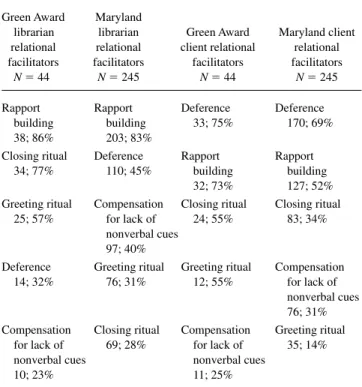
TABLE 2. Comparison of Green Award and Maryland librarian and client relational facilitators.
Green Award Maryland
librarian librarian Green Award Maryland client relational relational client relational relational facilitators facilitators facilitators facilitators
N⫽44 N⫽245 N⫽44 N⫽245
Rapport Rapport Deference Deference
building building 33; 75% 170; 69%
38; 86% 203; 83%
Closing ritual Deference Rapport Rapport
34; 77% 110; 45% building building
32; 73% 127; 52%
Greeting ritual Compensation Closing ritual Closing ritual
25; 57% for lack of 24; 55% 83; 34%
nonverbal cues 97; 40%
Deference Greeting ritual Greeting ritual Compensation
14; 32% 76; 31% 12; 55% for lack of
nonverbal cues 76; 31% Compensation Closing ritual Compensation Greeting ritual
for lack of 69; 28% for lack of 35; 14%
nonverbal cues nonverbal cues
10; 23% 11; 25%
Relational facilitators theme. Relational facilitators are defined as interpersonal aspects of the chat conversation that have a positive impact on the librarian–client interaction and that enhance communication (see also Radford, 1993, 1999). As can be seen in Table 2, within facilitators, five subthemes were found to be present for both librarians and clients (although found in different order by percentage of in-stances): rapport building, deference, compensation for lack of nonverbal cues, greeting ritual, and closing ritual. Each of these themes is defined, with examples from the transcripts in the tables to follow.
Table 3 is provided to demonstrate how more than one category of facilitator can be found in one conversational turn and in one transcript. Researcher’s comments are in brackets. Table 3 gives an example of a portion of a tran-script from the Green Award group that exemplifies multiple facilitators in chat conversational turns and in transcripts.
Rapport building subtheme. In a previous article (Radford, 1999), I discussed the importance of building rapport in li-brarian–client FtF interactions that “involves conversation encouraging give and take, establishment of mutual under-standing, and development of relationships” (p. 25). In the Green Award transcripts, evidence of rapport building was found in 38 (86%) of the librarian’s and 32 (73%) of the client’s discourse. For the Maryland study, rapport building was found in 203 (83%) of the librarian’s and 127 (52%) of the client’s discourse. Within the rapport building subtheme, several finer categories included instances of self-disclosure, in which the librarian or user provides information about themselves; offers of reassurance in which the librarian–user makes encouraging remarks; use of interjections, humor;
and informal language; offers of confirmation in which the librarian–user demonstrates interest and approval (see also Mathews, 1983); and times when the participant seeks reas-surance. See Table 4 for examples.
These examples demonstrate how conversational give and take, similar to FtF encounters, occurs in chat. Familiar patterns of conversation are present in these chat conversa-tions as can be seen in the Table 4 examples. Especially in-teresting examples of the clients asking overtly for reassur-ance that in the case of 4C, the librarian will wait while they try something, and, in the case of 4E, that librarians in the brick and mortar library will not think that the client is a criminal because of an overdue book (see also Radford & Radford, 2001; Radford, 1999 on fear of librarians).
Deference subtheme. Evidence of deference, defined as showing courtesy and respect for the other’s experience, knowledge, and point of view were found in 14 (32%) of librarian’s and 33 (75%) of client’s discourse in the Green Award group and, for Maryland, 110 (45%) for librarian’s and 170 (69%) for client’s discourse. Clients showed their respect for the librarians by use of thanks, praise, self-deprecating remarks, apologies, polite expressions, enthusi-asm, and agreement to try what is suggested. Librarians TABLE 3. Relational facilitators theme: Representative example.
Multiple facilitators (Green Award 08)
Librarian: We have a book here called the Gale Encyclopedia of Multicultural America: Primary Documents. You may want to check when you go to the other libraries to see if they have it. {The use of the word “may” indicates deference to the user, a suggestion rather than a command. The librarian is also beginning the Closing Ritual by talking about future steps.}
Client: Awesome! This gives me a great starting point for Saturday’s research! Thank You VERY MUCH!!!!!!!!{The word “Awesome!” and the next sentence both end with exclamation points for emphasis, indicating deference through praise and the expression of admiration. The “Thank You” provides more deference. With the use of “VERY MUCH!!!!!!!!” the user is compensating for the lack of nonverbal cues by using all capitals and repeated punctuation, again for emphasis. Also the closing ritual is begun by the client, in responding to librarian’s suggestion for the next step and in the use of “Thank You.”} Librarian: You’re very welcome! A transcript of this session will be
sent to you if you need any of the information we’ve talked about. {The librarian defers to the client by using the polite expression “You’re very welcome!” with the exclamation point for emphasis. Also, the librarian offers confirmation to the user by use of “if you need” and “we’ve talked about.” Here the user is included as a partner in the encounter.}
Client: Okay! thanks again! bye!{The client again defers to the librarian by agreeing to do what has been suggested, offering more thanks with exclamation point and concluding the closing ritual by use of informal language “bye!”}
Librarian: Bye.{The librarian also finishes the closing ritual and mirrors the client’s informal language with the use of “Bye”} Note. All excerpts from the transcripts throughout this article are provided verbatim. Mistakes in grammar, punctuation, and spelling have deliberately not been corrected so that the nature of the chat conversation is accurately preserved.
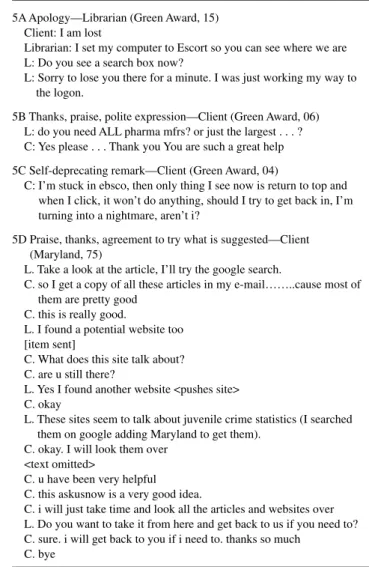
a superior position. He asserts that people engage in “little salutations, compliments, and apologies which punctuate so-cial intercourse and may be referred to as ‘status rituals’ or ‘interpersonal rituals’” (p. 477) that define their relation-ships. The librarian–client interaction is an asymmetrical (Goffman, 1956) or, to use Watzlawick et al.’s (1967) term, complimentary, relationship in which the librarian can be seen as having a higher societal status (similar to the teacher in a teacher–student relationship) and thus would be ex-pected to be shown more deference (see also Chelton, 1997). In both the Green Award and the Maryland transcripts more deference is paid to librarians by clients, although librarians also engage in paying respect to clients, engaging in rituals to reassure the client, and to establish a more collegial or equal relationship. See Table 5 for examples.
Compensation for lack of nonverbal cues subtheme. As noted above, many nonverbal cues that are present in FtF encounters are not present in the VRS environment. This subtheme is defined as the use of text characters or charac-teristics such as punctuation, emoticons, font, or abbrevia-tions to compensate for lack of nonverbal cues present in TABLE 4. Rapport building subtheme: Representative examples.
4A Self-disclosure—Client (Green Award, 07)
Librarian (L): Do you need assistance with searching those databases, or do you want to try to find them yourself?
Client (C): I’m not sure where to go to find information L: okay, are you on campus?
C: yeah.
4B Self-disclosure—Librarian (Green Award, 07)
L: I have also tried a similar search in Academic Universe, if you are finished with the dow jones, we can look there as well
C: ok
L: I am going to try to send you my search results page, but I am not sure if it will work
C: it worked
4C Seeking reassurance—Client, providing reassurance—Librarian (Green Award, 04)
C: Which one should I choose?
L: if you click on “full text” you should see the text on your screen without any separate software
C: I’m going to try that, can you hang on while I try that? L: Sure thing, I’ll be right here
4D Humor—Librarian (Green Award, 04) L: hmmm, this is a pickle . . . C: I don’t see the article though < text omitted >
L: yikes! I think that pickle comment I made may be an understatement :-). You should be able to see the full text on your screen and I am really not sure why you are not.
4E Seeking reassurance, humor—Client, providing reassurance— Librarian (Maryland 50)
C. do how much do i have to pay
L. According to their page, you shouldn’t have to pay more than $6 L. let me send you the page
[item sent]
C. are u sure because someone told me that the longer it takes you 2 return the book and pay the fine, it keeps piling up n u might b paying the fine for the rest of your life lol.
L. you may still want to call your local library and be sure C. oh ok
<text omitted>
C. i am kind of scare they might think I am a criminal L. I’m sure they won’t think
that-L. they will be glad to get the book back C. oh ok lol
<text omitted> L. Just give them a call L. It’ll be fine C. ok
4F. Use of informal language—Librarian (Maryland 164) C. What is a vertical angle?
L. [A librarian will be with you in about a minute]
L. [Welcome to Maryland AskUsNow! I am looking at your question now. It will be just a moment.]
L. Hi, NAME. Is this for school? C. yes
L. ok. Let me do some search. will be back in a few. C. ok thanks
TABLE 5. Deference subtheme: Representative examples. 5A Apology—Librarian (Green Award, 15)
Client: I am lost
Librarian: I set my computer to Escort so you can see where we are L: Do you see a search box now?
L: Sorry to lose you there for a minute. I was just working my way to the logon.
5B Thanks, praise, polite expression—Client (Green Award, 06) L: do you need ALL pharma mfrs? or just the largest . . . ? C: Yes please . . . Thank you You are such a great help 5C Self-deprecating remark—Client (Green Award, 04)
C: I’m stuck in ebsco, then only thing I see now is return to top and when I click, it won’t do anything, should I try to get back in, I’m turning into a nightmare, aren’t i?
5D Praise, thanks, agreement to try what is suggested—Client (Maryland, 75)
L. Take a look at the article, I’ll try the google search.
C. so I get a copy of all these articles in my e-mail……..cause most of them are pretty good
C. this is really good.
L. I found a potential website too [item sent]
C. What does this site talk about? C. are u still there?
L. Yes I found another website <pushes site> C. okay
L. These sites seem to talk about juvenile crime statistics (I searched them on google adding Maryland to get them).
C. okay. I will look them over <text omitted>
C. u have been very helpful C. this askusnow is a very good idea.
C. i will just take time and look all the articles and websites over L. Do you want to take it from here and get back to us if you need to? C. sure. i will get back to you if i need to. thanks so much
C. bye showed their courtesy and respect for clients by use of polite
expressions, thanks, apologies, and use of self-deprecating remarks.
Goffman (1956) observes that many interpersonal inter-actions are asymmetrical in nature, in which one person is in
transcripts. In Table 7, example 7A shows an unscripted greeting, and 7B shows scripted greetings in brackets and unscripted greeting. The robotic nature of the scripted greet-ings prompts the client to ask, “Are you a person?” The librarian quickly establishes rapport with the client by reply-ing with humor, “I believe I’m a person. Are you?:)” The client had grown impatient with scripts, and with waiting for a human response. Note also the use of slang (dawg) and alternative spelling (“K” for okay, and “wanna” for want to). As the greeting ritual continues, the client reveals a second question about Johnny Depp. The librarian responds with “Btw, I like Johnny Depp too”—a self-disclosure coupled with the use of the shortcut “Btw” (by the way) that further developed rapport with the client. The client then answers “lol cool.” The client is lol (laughing out loud) that the librarian could also like Johnny Depp and thinks this is “cool.” This greeting ritual is an example of how interper-sonal relationships are formed in the chat environment and how the librarian cultivated a positive tone and open rapport with the client.
Closing ritual subtheme. Closing rituals that are non-scripted occurred in 34 (77%) of the librarian’s and 24 (55%) face-to-face communication. Four categories of strategies
were found that both librarians and clients employed, al-though in slightly different order of frequency: emoticons, use of repeated punctuation, use of all capital letters, and the use of abbreviations. See Table 6 for examples, including use of emoticons (both use of :( for unhappy face, and :) for happy face), punctuation, repeated punctuation, and abbrevi-ations (LOL or lol ⫽laughing out loud).
In examples 6A and 6B the clients and librarians “mirror” the informal behavior of one another. In 6A, the librarian first uses the emoticon :( to signal that he or she is sad that the interaction is coming to an end and the client then re-sponds with another emoticon :) to indicate with a smile that he or she may be back soon. In 6B, the client uses the abbviation LOL and the librarian joins in the laughter by re-sponding with a LOL. Research has shown that people in FtF interactions often mirror the nonverbal behavior of oth-ers, smiling or laughing together, or nodding simultaneously (see, for example Andersen & Guerrero, 1998; Baveles, Black, Lemery, & Mullettt, 1986).
In example 6C, the librarian uses the ellipsis (. . .) to in-dicate that more is coming and that the client should wait for it. This is an effective and an efficient way to compensate for the lack of visual cues that the librarian is continuing to search for additional information.
Greeting ritual subtheme. Scripted as well as nonscripted greetings and closings can be frequently seen in the tran-scripts. The greeting ritual subtheme emerged in the cases of nonscripted greetings in 25 (57%), for librarians and 12 (55%) for clients in the Green Award and 76 (31%) for librarians and 35 (14%) for clients in the Maryland
TABLE 7. Greeting ritual subtheme: Representative examples. 7A Greeting ritual (Green Award, 10)
Librarian: Hi there, how can I help you?
Client: Hi, I would like to know which database holds the most full-text articles regarding psychology.
7B Greeting ritual (Maryland, 128) C: how can i get a library card?
L: [A librarian will be with you in about a minute.] C: Yo
C: Are you there dawg? C: I wanna talk to you
L: [Librarian XXX—A librarian has joined the session.] C: yo
L: [CUSTOMER NAME, welcome to Maryland AskUsNow! I’m looking at your question right now; it will be just a moment.] C: I need help darling
C: K dawg C: are you a person?
L: Hello, XXXX, if I understand your question, you’d like to know how to get a library card. Is that correct?
L: I believe I'm a person. Are you? L: :)
L: Do you have a question?
L: Or is your question about the library card? C: yes
C: that is correct <text omitted>
C: and know how to find out if Johnny Depp has a band and if so how can I get their cd
L: One moment and I’m going to check your library’s homepage. I’m from a library in xxx state.
L: I’m going to answer your first question first, k?
C: and know how to find out if Johnny Depp has a band and if so how can I get their cd hat one is also waiting to be answered
L: Btw, I like Johnny Depp too. C: Ok
C: lol cool TABLE 6. Compensation for lack of nonverbal cues subtheme:
Representative examples.
6A Use of emoticons—Client & librarian (Green Award, 10) Librarian: do you want to keep this window up, or say goodbye:( L: You’re welcome
L: hang on
Client: I may need some more help later, so watch for me!:) 6B Use of abbreviations—Client & librarian and repeated punctuation— Client (Green Award, 12)
C: Thank God my speech is only for five minutes (lol) L: LOL. Great. Are you okay now?
C: I am fine thank you for all of your help you have been great it would of took me forever by myself!!!!
6C Use of ellipsis to indicate that more is coming—Librarian (Maryland, 18) L. Thank you. Please hold…
L. I believe that you can access it through Sailor. Please hold while I get the details for you. . .
<text omitted>
L. I will send you the final page. . . [item sent]
L. Did you get the item I sent?
C. I’ll try this. Thanks for your help. What a great service! <text omitted>
TABLE 8. Closing ritual subtheme: Representative example. Closing Ritual (Green Award, 06)
Client: Okay . . . that’s great . . . I think I found all I need to know Librarian: I got Merck as #1, the Pfizer, then Briston-Myers, the Abbott,
then American Home
L: OK—hope you use us again! You’ll get a transcript with at least some of the pages I sent accessible
C: Thank you so much for being patient with me . . . and for helping me. I am sure that I can navigate from here on.
L: OK, call back if u need anything else later
of client’s discourse in the Green Award, for Maryland, a much lower instance of 69 (28%), for librarians and 83 (34%) for clients. In chat reference, it might be expected that the encounter would end immediately after the query was an-swered; however, in some cases the closing rituals were quite long and more social in nature. See Table 8 for an example.
Relational Barriers Theme
Barriers are defined as relational aspects that have a neg-ative impact on the librarian–client interaction and that im-pede communication (see also Radford, 1993, 1999). Within barriers there were two subthemes for librarians and clients (although found in different percentage of instances, and in different order in the case of Maryland clients): relational disconnect/failure to build rapport and closing problems (Table 9).
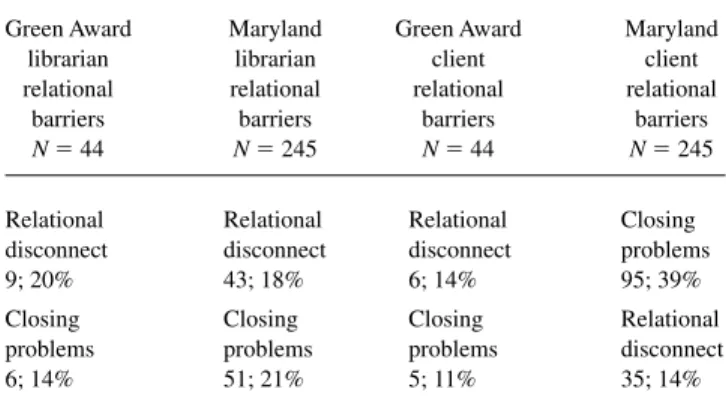
As Table 10 shows, relational disconnect/failure to build rapport was the most common barrier except for the Maryland clients’ in which 39% of the transcripts were coded as having closing problems, most of these due to the abrupt departure of the client. It is difficult to discern the reasons for the abrupt departures, perhaps clients left their computers for unknown reasons, became interested in a preliminary Web page that the librarian pushed to them, or became impatient.
Relational disconnect/failure to build rapport subtheme.
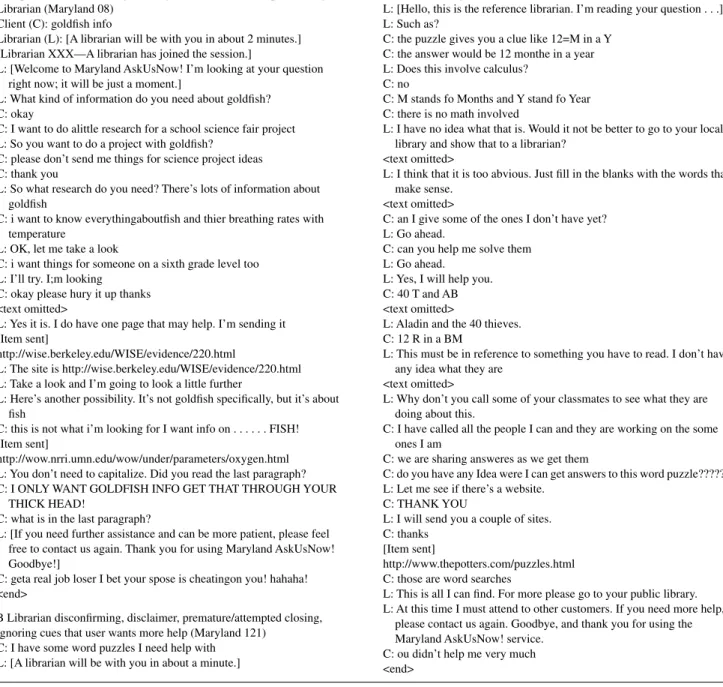
In Table 11, example 11A shows a client (self-disclosed to be in sixth grade) who exhibits many negative behaviors. The client starts out very polite, but soon tells the librarian to hurry up. The librarian is trying to help the client quickly, but when a Web site on fish instead of goldfish is sent, the client becomes more impatient and capitalizes the word FISH resulting in a flaming effect. The librarian responds to the flame by giving the client a reprimand in the next line: “You don’t need to capitalize.” The client replied with a longer rude flame and exits with a stream of abuse. The librarian pushes a goodbye script, ending the interaction and asking the user to return when he or she can be more patient. This interaction clearly exemplifies how emotional content can have a negative impact on the success of an interaction.
Example 11B shows a librarian who reassures a client (self-disclosed in omitted text to be in seventh grade) that she or he will help with a homework assignment. The librar-ian seems stumped by the question (although says that the answers are “obvious,” a disconfirming statement). The librarian then tries to refer the client to fellow students and then to the public librarian, negative closure strategies found in research by Ross and Dewdney (1998) in FtF interactions. The librarian pushes an inappropriate Web site to the client who points out that it is not useful. The librarian gives the disclaimer that states that is all that could be found and pushes a goodbye script. The client ends the interaction with the sad comment, “[y]ou didn’t help me very much.” Clearly, the client is dissatisfied with the assistance that was provided, although the librarian had provided the reassur-ance that he or she could help.
Closing problems subtheme. Librarian closing problems exhibit more of the characteristics of “negative closure.” Ross and Dewdney (1998) “identified ten strategies of neg-ative closure that library staff use to end the reference trans-action, apart from providing a helpful answer” (p. 154). In the transcripts, negative closure occurs as premature clos-ing, abrupt endclos-ing, disclaimer, and ignoring cues that the client wants more help. Example 11B, above, contains one example. See Table 12, example 12A for another in which TABLE 9. Relational barriers: Themes and definitions.
Major theme Definition
Relational barriers Interpersonal aspects of the chat
conversation that have a negative impact on the librarian–client interaction and that impede communication (see also Radford, 1993, 1999). Subtheme
Relational disconnect/ Failing to encourage give and take, failure to build rapport establish mutual understanding, and
engage in relationship development (see Radford, 1999, p. 25). Closing Problems Ending the chat interaction without a
closing ritual or exchange of farewell or goodbye (see Goffman, 1972). Negative Closure Strategies “that library staff use to end
the reference transaction, apart from providing a helpful answer” (Ross & Dewdney, 1998, p. 154).
TABLE 10. Comparison of Green Award and Maryland librarian and client relational barriers.
Green Award Maryland Green Award Maryland
librarian librarian client client
relational relational relational relational
barriers barriers barriers barriers
N⫽44 N⫽245 N⫽44 N⫽245
Relational Relational Relational Closing
disconnect disconnect disconnect problems
9; 20% 43; 18% 6; 14% 95; 39%
Closing Closing Closing Relational
problems problems problems disconnect
11A Impatient, rude, insulting, flaming, derisive—Client, reprimanding— Librarian (Maryland 08)
Client (C): goldfish info
Librarian (L): [A librarian will be with you in about 2 minutes.] [Librarian XXX—A librarian has joined the session.]
L: [Welcome to Maryland AskUsNow! I’m looking at your question right now; it will be just a moment.]
L: What kind of information do you need about goldfish? C: okay
C: I want to do alittle research for a school science fair project L: So you want to do a project with goldfish?
C: please don’t send me things for science project ideas C: thank you
L: So what research do you need? There’s lots of information about goldfish
C: i want to know everythingaboutfish and thier breathing rates with temperature
L: OK, let me take a look
C: i want things for someone on a sixth grade level too L: I’ll try. I;m looking
C: okay please hury it up thanks <text omitted>
L: Yes it is. I do have one page that may help. I’m sending it [Item sent]
http://wise.berkeley.edu/WISE/evidence/220.html
L: The site is http://wise.berkeley.edu/WISE/evidence/220.html L: Take a look and I’m going to look a little further
L: Here’s another possibility. It’s not goldfish specifically, but it’s about fish
C: this is not what i’m looking for I want info on . . . FISH! [Item sent]
http://wow.nrri.umn.edu/wow/under/parameters/oxygen.html L: You don’t need to capitalize. Did you read the last paragraph? C: I ONLY WANT GOLDFISH INFO GET THAT THROUGH YOUR
THICK HEAD!
C: what is in the last paragraph?
L: [If you need further assistance and can be more patient, please feel free to contact us again. Thank you for using Maryland AskUsNow! Goodbye!]
C: geta real job loser I bet your spose is cheatingon you! hahaha! <end>
11B Librarian disconfirming, disclaimer, premature/attempted closing, ignoring cues that user wants more help (Maryland 121)
C: I have some word puzzles I need help with L: [A librarian will be with you in about a minute.]
[A librarian has joined the session.]
L: [Hello, this is the reference librarian. I’m reading your question . . .] L: Such as?
C: the puzzle gives you a clue like 12=M in a Y C: the answer would be 12 monthe in a year L: Does this involve calculus?
C: no
C: M stands fo Months and Y stand fo Year C: there is no math involved
L: I have no idea what that is. Would it not be better to go to your local library and show that to a librarian?
<text omitted>
L: I think that it is too abvious. Just fill in the blanks with the words that make sense.
<text omitted>
C: an I give some of the ones I don’t have yet? L: Go ahead.
C: can you help me solve them L: Go ahead.
L: Yes, I will help you. C: 40 T and AB <text omitted>
L: Aladin and the 40 thieves. C: 12 R in a BM
L: This must be in reference to something you have to read. I don’t have any idea what they are
<text omitted>
L: Why don’t you call some of your classmates to see what they are doing about this.
C: I have called all the people I can and they are working on the some ones I am
C: we are sharing answeres as we get them
C: do you have any Idea were I can get answers to this word puzzle?????? L: Let me see if there’s a website.
C: THANK YOU
L: I will send you a couple of sites. C: thanks
[Item sent]
http://www.thepotters.com/puzzles.html C: those are word searches
L: This is all I can find. For more please go to your public library. L: At this time I must attend to other customers. If you need more help,
please contact us again. Goodbye, and thank you for using the Maryland AskUsNow! service.
C: ou didn’t help me very much <end>
TABLE 11. Relational disconnect subtheme: Representative examples.
the librarian sends the user off to search in Google as the li-brary is about to close. In Example 12B, the client makes an abrupt closing. From reading the transcripts, it is impossible to determine what happened to cause this closing. It is pos-sible that the client is engrossed in reviewing the Web site that the librarian sent, or left his/her computer.
Summary and Conclusion
This study is among the first to apply the theoretical per-spective of Watzlawick, Beavin, and Jackson (1967) to an analysis of the interpersonal dimensions of chat reference. This research demonstrates the complexity of virtual reference
interactions and the value of application of communication theory and constructs to investigations of these encounters. These transcripts provided a rich data source; only a small fraction of the data could be shared here. Major findings were as follows:
•
A wide variety of socioemotional/relational aspects were found in the chat reference transcripts for clients as well as librarians and in both Green Award and Maryland data sets. This finding resonates with that of other researchers (e.g., Walther & Burgoon, 1992; Walther, 1992, 1993). Walther (1996) argues that when users have time “to exchange infor-mation, to build impressions, and to compare values” that “CMC is no less personal than FtF” (p. 33).•
There were similarities as well as differences in the patterns of clients and librarians. Similarities can be seen in the numerous overlapping category themes. One difference is in the areas of deference in which clients displayed more def-erence to librarians as would be expected in a complimen-tary relationship in which the librarian is in a culturally defined “superior” position (see Watzlawick et al., 1967, p. 69). Another difference is apparent in the barriers theme in which the barriers created by clients (e.g. rudeness, impa-tience) were, for the most part, very different from those cre-ated by librarians (e.g., negative closure). These differences were especially seen in the analysis of the Maryland tran-scripts from the statewide service, which resulted in greatly expanded categories for barriers for both librarians and clients, as might be expected in contrast to the Green Award candidate transcripts.•
There was a rich array of strategies for compensation for lack of nonverbal cues, with clients showing more informality and willingness to use chat shortcuts, abbreviations, and emoti-cons (see also Rice & Love, 1987; Ronan, 2003). Some mirroring of informality on the client’s part is seen in the librarian transcripts, including the use of emoticons, the ellipsis to indicate “more to come,” and integration of some shortcuts. The Maryland sample had higher percentages of use of these nonverbal compensation strategies for both librarians and clients (see Table 2). This finding may reflectthe comparatively higher number of adolescents using the statewide service who are more familiar with the use of in-stant messaging shortcuts (see also Metz et al., 2003). The higher percentages of use of these strategies for librarians can be interpreted as corresponding to the increased use by clients. As seen in the transcripts, when the clients use emoti-cons and shortcuts, the librarians usually respond by mirror-ing these behaviors (see Table 6, examples 6A, 6B and Table 7, example 7B). This behavior corresponds to FtF behavior, for example, when librarians adopt a less formal style when interacting with clients who are less formal (see also Radford, 1999).
Research question 4 was “What is the relationship be-tween content and relational dimensions in determining the quality of chat reference encounters?” This research ques-tion still remains largely unanswered, although the relaques-tion- relation-ship between relational and content quality can be inferred in some cases (see Table 11, examples 11A, 11B), it is im-possible to have a clear answer to this question without ask-ing the participants, as is planned for future research.
One theoretical implication of this study is that models of VRS must include the relational as well as content/task di-mensions (see also Radford, 1993, 1999). Watzlawick et al. (1967) assert, “a communication not only conveys informa-tion, but that at the same time it imposes behavior” (p. 51). There are many implications for practitioners of chat refer-ence from these results. An important implication is that be-cause these interpersonal dimensions are present in virtual reference environments, chat librarians and clients need to be aware of their impact on the reference process and skilled in the basics of interpersonal communication. Practitioners are not only answering questions, they are also building re-lationships with clients in every virtual reference encounter (see also Radford, 1993, 1999). In the way that they respond to clients, they are teaching clients how to use the service and what behaviors are expected. These findings have been used to develop research-based guidelines1for practitioners and users of VRS (see Radford, 2006; Radford, Barnes, & Barr, 2006; Radford & Thompson, 2004a, 2004b).
Limitations
As noted above, to protect the privacy of the clients and li-brarians, all identifying characteristics were stripped from the transcripts. This necessity has resulted in a lack of demo-graphic data. This research project is thus limited to what can be seen and inferred from the transcript discourse without any input from the participants. In addition, this research is regarded as exploratory. The results from the pilot study are TABLE 12. Closing problems subtheme: Representative example.
12A Premature closing, running out of time, sends to Google—Librarian (Green Award 11)
Librarian (L): Looks like the History Channel site might be a good one. Client (C): whenever I try these sites it won’t let me go back
C: I keep trying to go back but it only goes back on our chat area L: I don’t know why it is doing that. After our session, you can go to
the Homework Zone yourself and click on the sites. The address for the History Channel is xxx. Also I found a site on the history of education. I will try to send you there.
C: thank you
L: I think the easiest thing is for you to do the search yourself since we are closing in a few minutes. GO back to google and in the search box type in “segregation in education in the 1930’s.” The fourth hit was a history of education in the US. Looks like some good info. 12B Abrupt closing—User (Maryland)
C: information on streptococcus mutans [A librarian will be with you in about a minute.] [Librarian XXX—A librarian has joined the session.]
L: Hi XXXX. What kind of information do you need about this? C: how does streptococcus mutans attack?
L: Let me look and see if I can find some information. C: ok
L: Customer, I found a website from a dental college that seems to explain this issue. I’m going to send you the link in just a second . . . [Item sent]
http://www.ncl.ac.uk/dental/oralbiol/oralenv/tutorials/mutans.htm L: Can I help you with anything else?
L: Customer, are you still there? Can I help you with anything else? [A transcript of this session will be emailed to you after we disconnect–
it will contain the text of our chat and links to all of the websites we visited.]
[Thank you for using Maryland AskUsNow! If you have any further questions, please contact us again.]
<end>
1It should be noted that practitioner guidelines have been issued by
other authors (see, for example, Lipow, 2003) and associations such as the International Federation of Library Associations and Institutions (IFLA; 2004) and the Reference and User Services Association of the American Library Association (RUSA; 2004). The IFLA official Standing Committee on Reference Work has issued digital reference guidelines for practitioners (IFLA; 2004) “to promote digital reference best practices on an interna-tional basis.”
not generalizable because the sample was self-selected. Al-though the random sample from Maryland was designed to be representative and as such generalizable to that service, no generalizations to other chat reference services are claimed.
Future Directions
Much more research needs to be done to understand and improve the quality of chat encounters. As Ronan (2003) notes: “One of the biggest challenges in providing reference services in real-time is learning to communicate effectively with remote users and to translate the interpersonal skills used at the physical reference desk into the virtual environ-ment” (p. 43). Much rich data have been revealed in the chat transcripts and provide many avenues for detailed examina-tion. Findings regarding the compensation for lack of non-verbal cues could be analyzed in more depth, for example, looking at the phenomenon of mirroring of emoticons and use of informal language and their impact on the encounter. In addition, each turn was time stamped, but time lags were not examined in relationship to abrupt closings. Perhaps clients departed abruptly because they did not receive a librarian’s response within a certain timeframe. These and many more intriguing areas for research have been sug-gested by these results.
More empirical research is needed as many unanswered or partially answered questions remain. As noted above, the impact of interpersonal dimensions on perceptions of suc-cess can only be partially answered by looking at transcripts. Future research will involve online surveys, FtF interviews, and focus groups with librarians, clients, and also people who do not use these services to provide more definitive answers regarding the relationship of content and relational dimensions to quality. The survival of VR services may be at stake as alternative fee-based question answering services (such as Google Answers) have begun to proliferate. If clients turn away from the free library services and their use declines, funding and human resources may be withdrawn. Another direction for future research is to investigate other virtual library contexts. These results reflect data from a statewide service and transcripts submitted for an award. It would be fruitful to examine transcripts from university, cor-porate, and other statewide VR services to see if similar pat-terns emerge. It is also important to follow up on a variety of findings, to see, for example, the impact of staff education in interpersonal aspects of chat. This research demonstrates the value of applying communication theory to the VRS context and gives a sense of the insights that can be gained. It is hoped that future projects will build on these findings to extend our knowledge and understanding of the virtual reference encounter, to improve communication, to increase effectiveness, and to enhance systems design.
Acknowledgments
An earlier, shorter version of this paper was presented at the Virtual Reference Desk 6th Annual Conference, 2004
and has been published in the conference print proceedings (Radford, 2006).
The author is grateful to LSSI and Steve Coffman for permission to analyze the Green Award transcripts and to Joseph Thompson and Maryland AskUsNow! for permis-sion to analyze the Maryland transcripts, for selecting the random sample, and for cleansing all identifying informa-tion. In addition, the author thanks Andrew Beccone, Aimee McLagger, and Anna Filatova for their help coding and or-ganizing the transcripts. Many thanks also to Tefko Sarace-vic for reading the manuscript and for making detailed and insightful suggestions and to the anonymous JASIST review-ers for their constructive comments. Finally, the author thanks the anonymous librarians and VRS clients whose transcripts were analyzed.
References
Anderson, P.A., & Guerrero, L.K. (1998). Handbook of communication and emotion: Research, theory, applications, and contexts. San Diego, CA: Academic Press.
Baker, S.L. & Lancaster, F.W. (1991). The measurement and evaluation of library services (2nd ed.). Arlington, VA: Information Resources Pr. Bavelas, J.B., Black, A., Lemery, C.R., & Mullett, J. (1986). “I showhow
you feel”: Motor mimicry as a communicative act. Journal of Personality and Social Psychology, 50, 322–239.
Carter, D.S., & Janes, J. (2002). Unobtrusive data analysis of digital refer-ence questions and service at the Internet Public Library: An exploratory study. Library Trends, 49(2), 251–265.
Carter, K.A. (2003). Type me how you feel: Quasi-nonverbal cues in computer-mediated communication. Etc, 60 (1), 29–39.
Chelton, M.K. (1997). The “overdue kid:” A face-to-face library service encounter as ritual interaction. Library and Information Science Re-search, 19(4), 387–399.
Chelton, M.K. (1999). Behavior of librarians in school and public libraries with adolescents: Implications for practice and LILS education. Journal of Education for Library and Information Science, 40(2), 99–111. Danet, B., Ruedenberg-Wright, L., & Rosenbaum-Tamari, Y. (1997).
HMMM . . . WHERE’S THAT SMOKE COMING FROM?” Writing, play and performance on Internet Relay Chat. Journal of Computer-Mediated Communication, 2(4). Retrieved May 13, 2005, from http:// www.ascusc.org/jcmc/vol2/issue4/danet.html
Dewdney, P., & Ross, C.S. (1994). Flying a light aircraft: Reference service evaluation from the user’s viewpoint. Reference Quarterly, 34(2), 217–230. Foley, M. (2002). Instant messaging reference in an academic library: A
case study. College and Research Libraries, 63(1), 36–45.
Goffman, E. (1956). The Nature of deference and demeanor. American Anthropologist 58(3):475–499.
Goffman, E. (1972). Relations in public: Microstudies of the public order. New York: Basic Books.
Gross, M., & McClure, C. (2001). Assessing quality in digital reference services: Overview of key literature on digital reference. Information Use Management and Policy Institute, Florida State University. Retrieved May 13, 2005, from http://dlis.dos.state.fl.us/bld/Research_Office/ VRDphaseII.LitReview.doc
Howell, B.J., Reeves, E.B., & van Willigen, J. (1976). Fleeting encounters— A role analysis of reference librarian-patron interaction. Reference Quarterly, 16, 124–129.
International Federation of Library Associations and Institutions (IFLA). (2004). Digital reference guidelines. Retrieved May 13, 2005, from http://www.ifla.org/VII/s36/pubs/drg03.htm
Janes, J., & Mon, L. (2004, January). The thank you study: User satisfaction with digital reference. Paper presented at the ALISE Conference, San Diego, CA.
Johnson, C.M. (2004). Online chat reference: Survey results from affiliates of two universities. Reference and User Services Quarterly, 43(3), 237–247.
Kaske, N., & Arnold, J. (2002, June). An unobtrusive evaluation of online real time library reference services. American Library Association, Annual Conference, Atlanta, GA. Retrieved May 13, 2005, from http:// www.lib.umd.edu/groups /digref/kaskearnoldunobtrusive.html Kasowitz, A., Bennett, B., & Lankes, R.D. (2000). Quality standards for
digital reference consortia. Reference and User Services Quarterly, 39(4), 355–363.
Lipow, A.G. (2003). The virtual reference librarian’s handbook. New York: Neal-Schuman.
Mathews, A.J. (1983). Communicate! A librarian’s guide to interpersonal relations. Chicago: ALA.
McClure, C.R., & Lankes, R.D. (2001). Assessing quality in digital reference services: A research prospectus. Information Institute of Syracuse. Re-trieved on May 13, 2005, from http://quartz.syr.edu/quality/Overview.htm McCracken, G. (1988). The long interview. Newbury Park, CA: Sage. Metz, C., Clyman, J., & Todd, M. (November 11, 2003). IM everywhere.
PC Magazine, 22(20), 128–136).
Nilsen, K. (2004). The library visit study: User experiences at the virtual reference desk. Information Research, 9(2) paper 171. Retrieved on May 13, 2005, from http://InformationR.net/ir/9-2/paper171.html
Novotny, E. (2001). Evaluating electronic reference services: Issues, approaches and criteria. The Reference Librarian, 74, 103–120. Radford, G.P., & Radford, M.L. (2001). Libraries, librarians, and the
discourse of fear. The Library Quarterly, 71(3), 299–329.
Radford, M.L. (1993). Relational aspects of reference interactions: A quali-tative investigation of the perceptions of users and librarians in the acad-emic library. Unpublished doctoral dissertation (DAI A54/07, 2368), Rutgers, The State University of New Jersey.
Radford, M.L. (1996). Communication theory applied to the reference encounter: An analysis of critical incidents. Library Quarterly, 66(2), 123–137.
Radford, M.L. (1998). Approach or avoidance? The role of nonverbal com-munication in the academic library user’s decision to initiate a reference encounter. Library Trends, 46(4), 699–717.
Radford, M.L. (1999). The reference encounter: Interpersonal communica-tion in the academic library. Chicago: ACRL, A Division of the American Library Association.
Radford, M.L. (2006). Interpersonal communication in chat reference: Encounters with rude and impatient users. In R.D. Lankes, E. Abels, M. White, & S.N. Haque (Eds.), The virtual reference desk: Creating a reference future (pp. 41–73). New York: Neal-Schuman Publishers. Radford, M.L., Barnes, S.B., & Barr, L.R. (2006). Web research: Selecting,
evaluating, and citing (2nd ed.). Boston: Allyn & Bacon.
Radford, M.L., & Thompson, J. (2004a). “Yo Dude! Y R U Typin So Slow?” Paper presented at the Virtual Reference Desk 6th Annual Conference, Cincinnati, OH. Retrieved May 13, 2005, from http://www. vrd2004.org/proceedings/presentation.cfm?PID⫽325
Radford, M.L., & Thompson, J. (2004b, June). “Hmmm... Just a moment while I keep looking:” Interpersonal communication in chat reference. Paper presented at the RUSA 10th Annual Reference Research Forum, American Library Association, Orlando, FL.
Reference and User Services Association (RUSA). (2004). RUSA guide-lines for behavioral performance of reference and information services professionals. Retrieved on May 13, 2005, from http://www.ala.org/ ala/rusa/rusaprotools/referenceguide/guidelinesbehavioral.htm Ramirez, A., Walther, J.B., Burgoon, J.K., & Sunnafrank, M. (2002).
Information-seeking strategies, uncertainty, and computer-mediated communication. Toward a conceptual model. Human Communication Association, 28(2), 213–228.
Rezabek, L.L., & Cochenour, J.J. (1998). Visual cues in computer-mediated communication: Supplementing text with emoticons. Journal of Visual Literacy, 18, 201–215.
Rice, R.E., & Love, G. (1987). Electronic emotion: Socio-emotional con-tent in a computer-mediated communication network. Communication Research, 14(1), 85–108.
Ronan, J. (2003). The reference interview online. Reference and User Services Quarterly, 43(1), 43–47.
Ross, C.S., & Dewdney, P. (1998). Negative closure: Strategies and counter-strategies in the reference transaction. Reference and User Services Quarterly, 38(2), 151–163.
Ruppel, M., & Fagan, J.C. (2002). Instant messaging reference: Users’ eval-uation of library chat. Reference Services Review, 30(3), 183–197. Retrieved on May 13, 2005, from http://www.lib.siu.edu/~jfagan/papers/ imref.html
Sloan, B. (Ed.). (2004). Digital reference services: Bibliography. Retrieved on May 13, 2005, from http://alexia.lis.uiuc.edu/~b-sloan/digiref.html Walther, J.B. (1992). Interpersonal effects in computer-mediated interac-tion: A relational perspective. Communication Research, 19(1), 52–90. Walther, J.B. (1993). Impression development in computer-mediated
inter-action. Western Journal of Communication, 57, 381–398.
Walther, J.B. (1994). Anticipated ongoing interaction versus channel effects on relational communication in computer-mediated interaction. Human Communication Research, 20, 473–501.
Walther, J.B. (1996). Computer-mediated communication: Impersonal, interpersonal and hyperpersonal interaction. Communication Research, 23(1), 3–43.
Walther, J.B., & Burgoon, J.K. (1992. Relational communication in computer-mediated interaction. Human Communication Research, 19, 50–88.
Walther, J.B., & D’Addario, K.P. (2001). The impacts of emoticons on mes-sage interpretation in computer-mediated communication. Social Science Computer Review, 19 (3), 342–347.
Watzlawick, P., Beavin, J., & Jackson, D.D. (1967). Pragmatics of human communication. New York: Norton.
White, M.D., Abels, E.G., & Kaske, N. (2003). Evaluation of chat reference service quality. D-Lib Magazine, 9(2), 1–13.
Whitlatch, J.B. (2001). Evaluating reference services in the electronic age. Library Trends, 50(2), 207–217.
Appendix A
Green Award Category Scheme (Pilot Study)
Green Award Librarian Relational Facilitators— Frequency Order (N⫽44 Transcripts)
LF 1. Rapport building (38; 86%)
A. Self-disclosure—Providing information about self (15; 34%)
1. Offering personal opinion/advice/value judgment (11; 25%)
2. Admitting lack of knowledge (7; 16%) B. Offering reassurance (32; 73%) 1. Encouraging remarks (31; 70%) 2. Praise (6; 14%) 3. Enthusiastic remarks (2; 5%) C. Interjections (12; 27%) D. Humor (9; 20%)
E. Use of informal language (15; 34%) F. Offering confirmation (26; 59%) 1. Inclusion (19; 43%) 2. Approval (3; 7%) 3. Empathy (1; 2%) G. Seeking reassurance/confirmation (11; 25%) LF 2. Closing ritual (34; 77%) Note:Scripted (17; 50%) LF 3. Greeting ritual (25; 57%) Note:Scripted (44; 100%)