MANAGING PERMANENT ESTABLISHMENT RISKS IN MULTINATIONAL ENTERPRISES IN POST-BEPS ERA
Master’s Thesis
Alexandra Shtromberg
Aalto University School of Business
Winter 2019
Aalto University, P.O. BOX 11000, 00076 AALTO www.aalto.fi Abstract of master’s thesis Author Alexandra Shtromberg
Title of thesis Managing Permanent Establishment Risks in Multinational Enterprises in post-BEPS era
Degree Master of Science
Degree programme Degree programme Thesis advisor(s) Tomi Viitala
Year of approval 2019 Number of pages 77+XVII
Language English
Abstract
The objective of this thesis is to identify the main PE risks faced by multinational enterprises at different stages of value chain with a focus on distribution and to suggest ways to address these risks to ensure tax compliance in multiple jurisdictions. The term “PE risk” in this paper means the risk of failure to comply with applicable regulations in identifying permanent establishment in situations where certain business activities of the enterprise are held outside the country of its tax residence.
The thesis is done by conducting a literature review and structuring the results under risk management methodology. This research focuses on the substance of the PE concept under the OECD Model Tax Convention. It does not cover procedural aspects of profit attribution to PE nor dispute resolution mechanisms.
Previous research has uncovered the challenges in balancing roles of the PE concept in ensuring both sufficient tax revenue and flexibility for taxpayers. The complexity theoretical approaches to the PE concept in the OECD Model is multiplied by diverse sources of law that may define the presence of PE on a case-by-case basis: supranational regulations (e.g., the EU law), bilateral and multilateral tax treaties, domestic laws, and often unpredictable case law. Comprehensive tax risk management framework should ensure that MNE will not overlook risks that are likely to happen due to communication failures, agency problems, or misunderstanding of applicable regulations. Keystones of an efficient tax risk management framework are effective business model tax risk assessment based on accurate and detailed document management and clear communications on tax compliance goals and risks among multiple stakeholders.
Keywords permanent establishment, double taxation, BEPS, Action 7, OECD Model Tax Convention
I TABLE OF CONTENTS
1. INTRODUCTION ... 1
1.1. Background of the study ... 1
1.2. Research objective, questions and structure ... 1
1.3. Methodology ... 3
1.4. Literature review ... 4
2. PERMANENT ESTABLISHMENT CONCEPT IN INTERNATIONAL TAXATION 6 2.1. Introduction ... 6
2.2. Background of PE regulation ... 6
2.3. Sources of PE regulation ... 8
2.4. Principles and goals in regulation of international taxation... 11
2.5. PE concept under OECD Model Tax Convention ... 13
2.6. Impact of BEPS Actions and MLI on PE concept ... 19
2.7. PE concept at supranational level: EU case ... 22
2.8. PE concept in national laws: Finland case ... 24
2.9. Conclusions ... 26
3. ADDRESSING PE RISK THROUGH TAX RISK MANAGEMENT FRAMEWORK 28 3.1. Introduction ... 28
3.2. Tax governance and tax compliance as basis for PE tax risk management ... 28
3.3. Tax risk management: background ... 31
3.4. PE risk management as a part of tax risk management framework ... 34
3.5. Risk identification ... 37
3.6. Risk analysis ... 38
3.7. PE risk ranking, prioritisation and assessment: three key PE risks in a value chain 40 3.7.1. Employee mobility ... 40
3.7.2. Warehousing ... 43
3.7.3. Dependent agent model ... 44
3.8. Risk treatment through tax controls framework for PE ... 45
3.8.1. Design and implement controls ... 45
3.8.2. Monitoring and testing. ... 48
3.9. Conclusions ... 49
4. MANAGING DEPENDENT AGENT PE RISK ... 51
II
4.2. Background of dependent agent PE concept ... 51
4.3. Current provisions on dependent agent PE under Article 5(5) of OECD Model Tax Convention ... 54
4.4. PE risk identification: key risk elements of OECD Model Tax provisions ... 56
4.4.1. “Person” ... 56
4.4.2. “Acting” ... 57
4.4.3. “On behalf of an enterprise”... 57
4.4.4. Habitual conclusion or principal role leading to the conclusion of contracts .... 58
4.4.5 Contracts... 60
4.4.6. Independent agent in the ordinary course of business... 63
4.4.7 Special provisions ... 67
4.5. Dependent agent PE risk ranking, prioritisation and assessment ... 69
4.6. Risk analysis ... 70
4.7. Risk treatment ... 70
4.7.1. PE risk communications across stakeholders ... 71
4.7.2. Document management ... 72
4.7.3. Assessment of business arrangements ... 73
4.8. Conclusions ... 74 5. CONCLUSIONS ... 76 ABBREVIATIONS ... I REFERENCES ... II OECD ... II Academic literature ... IV Materials of consulting companies ... IX Source of law and government information ... XII Other ... XII ANNEX 1. Structure of Article 5 “Permanent Establishment” of OECD Model Tax
1
1. INTRODUCTION
1.1. Background of the study
The primary ways to define the right to tax an enterprise on its profits arising from the territory of a specific country are to consider whether the foreign company as a resident or having a permanent establishment (PE).1 The concept of permanent establishment (PE) determines whether an enterprise has sufficient activity in another territory to create a taxable presence there and thus to justify that country’s taxation of the business profits.2
Governments aim to prevent companies from artificial channelling of the profits to entities in low-tax jurisdictions, as corporate tax revenue losses can amount to 4-10% of all global tax revenues (USD 100-240 bn annually).3 The reasons for these losses are aggressive tax planning schemes and challenges brought by domestic laws and their practical implementation by tax administrations.4 Globalisation and digitalisation advancements make it easier to find legislative loopholes and plan the tax avoidance schemes. In recent years, Action 7 of OECD Base erosion and profit shifting (BEPS) projects have resulted in a significant expansion of the PE definition, and especially in lowering the threshold for PE created by dependent agents.5
As a result, MNEs are facing a growing need to assess where PE risks come from and what PE risks are materializing, as well as the need to develop approaches to managing PE risk, either by ensuring that no PE arises, or by assessing the level of profit that could be attributable to it. This would allow MNEs to satisfy diverse and sometimes unpredictable requirements of local tax authorities. PE risk management also becomes one of the priority services provided by consulting and audit companies.6 For this reason, identifying and managing PE risks is vital for multinational enterprises to stay compliant with the diversity of local laws and tax treaties when operating globally.
1.2. Research objective, questions and structure
1Antti Tokola, “The Implementation of the Controlled Foreign Company Rules in the EU Anti-Tax Avoidance
Directive in Finland, Luxembourg and the Netherlands – The Effects on the Holding Company Structures of Finnish
Groups” [2018] 72(3) Bulletin for International Taxation 173
2Yasin Uslu, “An Analysis of “Google Taxes” in the Context of Action 7 of the OECD/G20 Base Erosion and Profit Shifting Initiative” [2018] 72(4a) Bulletin for International Taxation IFBD accessed 20 October 2018, citing
International Tax Glossary, Glossary IBFD.
3OECD, OECD/G20 Base Erosion and Profit Shifting Project. Explanatory Statement (2015) 4
<http://www.oecd.org/ctp/beps-explanatory-statement-2015.pdf> accessed 20 October 2018
4OECD, OECD/G20 Base Erosion and Profit Shifting Project. Explanatory Statement (2015) 4
<http://www.oecd.org/ctp/beps-explanatory-statement-2015.pdf> accessed 20 October 2018
5 OECD, BEPS Action 7 Additional Guidance on Attribution of Profits to Permanent Establishments. Discussion
Draft (2017) 5 <https://www.oecd.org/tax/transfer-pricing/beps-discussion-draft-additional-guidance-attribution-of-profits-to-permanent-establishments.pdf> accessed 20 October 2018
6Michael Cooper, “BEPS: Permanent Establishments” (PwC, October 2015)
2
The research objective of this thesis is to identify the main PE risks faced by multinational enterprises at different stages of value chain, with a focus on distribution, and finally to suggest ways to address these risks to ensure tax compliance. The term “PE risk” in this paper refers to the risk of failure to comply with regulations on identifying taxable presence in the form of PE when certain business activities of the enterprise are held outside the country of its tax residency. To reach this objective, this research paper should answer the following research questions:
1. What are the rationale and key features of permanent establishment concept under OECD Model Tax Convention on Income and on Capital (“OECD Model Tax Convention”), which is a model for countries concluding bilateral tax conventions?
2. What are the main principles of tax risk management and specific stages of managing PE-specific tax risks? How do they help MNEs to identify, analyse and mitigate PE risks in the enterprise?
3. How can MNEs (on the example of consumer electronics manufacturing industry) address the risk of dependent agent PE in the tax risk management framework?
The research model is restricted to identifying whether PE is present in certain business arrangements and planning tax control framework that would enhance timely PE identification in different business arrangements following the process starting from R&D of consumer electronics to its distribution to consumers. This research does not cover the detailed analysis of attribution of profits to PE7 or other procedural or dispute resolution aspects connected with identifying PE, nor the secondary effects of a PE, such as the impact of the PE status on income classification or determining tax withholding obligations of the employer.8 The primary source of analysis on the PE concept is the OECD Model Tax Convention. Other sources are referred to in order to support the general approaches of the OECD Model in interpreting the notion of PE, and to guide MNEs on what they should take into account when operating in multiple markets simultaneously. This thesis focuses on PE risks faced by multinational enterprise operating in the sphere of producing consumer electronics and their risks arising from employee mobility and transportation and distribution arrangements.
The novel contribution of this research project is in exploring the post-BEPS regulatory environment through legal methodology and risk management methodology. It provides MNEs
7Article 7 of OECD Model Tax Convention states that “profits of an enterprise of a Contracting State shall be
taxable only in that State unless the enterprise carries on business in other Contracting State through a permanent establishment situated therein. If the enterprise carries on business as aforesaid, the profits that are attributable to the
permanent establishment in accordance with the provisions of paragraph 2 may be taxed in that other State”.
3
with an understandable and practically oriented guidance on reading the provisions of OECD Model Tax Convention and then implementing concrete steps to ensure compliance with them. It also incorporates a diversity of opinions from the business/industry sector, tax consulting sector, and academia on existing taxation regimes of PE.
This thesis consists of three chapters covering PE concept, its tax risk management and case study on dependent agent PE risk management in consumer electronics industry. The first chapter of the thesis focuses on exploring the general concept of PE, its role in international taxation, and the scope of its application. This allows us to understand the rationale of the PE concept and the general trend of its development in soft law and binding legislative norms as well as the main sources of legal uncertainty surrounding the PE concept. The second chapter concentrates on the analysis of tax risk management frameworks and how they help to deal with PE risks at different stages of tax risk management. This analysis is based on the key risk features of the PE concept identified in the first chapter and provides a systemic approach for assessing, prioritising, and treating PE risks. Chapter three provides an example of the practical application of PE tax risk management steps in addressing dependent agent PE risk under changes to Article 5 of OECD Model Tax Convention (BEPS Action 7). The structure of the thesis aims to gradually acquaint the reader with the challenges of interpreting the general PE concept and using risk management frameworks for dealing with it before moving to a deeper analysis of a dependent agent PE as one of the types of PE. This will allow the reader to see how legal research can be applied practically by sharing systematised knowledge among functions of an MNE. It also makes knowledge management a necessary component of tax controls framework and tax governance in general.
1.3. Methodology
Research of complex PE concept requires usage multiple methods that will allow to explore practical implications of applying a legal fiction (PE as a “fixed place of business”) to dynamic and versatile business arrangements. To map PE risks, it is important to identify and analyse key compound elements of PE concept under Article 5 of OECD Model Tax Provision, also through the prism general concepts of law (“person”, “agent”, “in the name of”). For this reason, the primary method of research is legal method. In this research, legal method will include comparative legal method used in analysing specifics of agency relationship in common and civil law countries (chapter 3). To understand the rationale behind OECD Model Tax Convention provisions on PE, teleological method is used to analyse the goals and principles of regulation of
4
international taxation in general9, and of PE concept in specific. In addition to that, descriptive method is used to analyse the common business arrangements in the value chain of the MNE before exploring its PE risks. Analytical method is a primary method to identify PE risk management strategies in chapter 2 and testing its application in chapter 3. My recommendations on risk treatment stages are also based on observational research method due to my practical experience in tax consulting and in developing internal controls framework.
1.4. Literature review
There is growing research on the substantial provisions of Article 5 of OECD Model Tax Provision. The starting point for PE research is Skaar's “Permanent Establishment: Erosion of a Tax Treaty Principle” (1991) that has created a basis for a critical research of PE concepts, elements and role in taxation. More recent research is represented by works of M.Lang, H. Pijl, E. Reimer, M. Kobetsky, J.-F. Dutriez, J. Schwarz. However, analysis of most recent post-BEPS changes from the perspective of business, not of a legislator or tax authorities, is addressed most in publication of Big Four companies and the smaller tax consulting companies. Namely, publications collected in “Dependent Agents as Permanent Establishments” (ed. M. Lang) provide a detailed analysis of history of dependent agent PE concept but do not cover post-BEPS reality as it was published in 2014. Most recent academic publications either address challenges of PE in digital economy on general level, or look into highly detailed aspects of PE, such as PE risks in certain warehousing activities. It shows the lack of conceptual analysis of changes brought by OECD Model Tax Convention 2017 and implications it will have for tax functions of MNEs.
When it comes to tax risk management side of PE analysis, the research focuses almost exclusively on tax risk management performed by tax authorities. Its deliverables are practical guidance for tax authorities, such as Risk Management Guide for Tax Administrations published by European Commission10 HMRC Internal Manual on Tax Compliance Risk Management11, Australian Tax Office Tax Risk Management and Governance Review Guide.12 However, practical steps on ensuring tax compliance from a taxpayer's perspective are rarely anywhere, except for publications of audit and consulting companies that create demand for tax risk
9Vienna Convention of the Law of Treaties 1969, Article 31(1).
10 European Commission Fiscalis Risk Analysis Project Group, Risk Management Guide for Tax Administrations
(2006)
<https://ec.europa.eu/taxation_customs/sites/taxation/files/resources/documents/taxation/tax_cooperation/gen_overv iew/risk_management_guide_for_tax_administrations_en.pdf > accessed 20 October 2018
11 HM Revenue & Customers, Tax Compliance Risk Management (12 April 2016, updated 13 March 2017)
<https://www.gov.uk/hmrc-internal-manuals/tax-compliance-risk-management> accessed 20 October 2018
12 Australian Government Australian Taxation Office, Tax risk management and governance review guide (18 April
2018) <https://www.ato.gov.au/Business/Large-business/In-detail/Key-products-and-resources/Tax-risk-management-and-governance-review-guide/> accessed 20 October 2018
5
management consulting services. In second and third chapters of thesis, I will analyse how enterprises can apply the same risk management methodology as tax administrations, first on the example of general PE risk management and then by addressing dependent agent PE risk specifically.
Even though materials of consulting and auditing companies (primarily, Big Four accounting firms – EY, Deloitte, KPMG, PwC) do not represent the academic research, I cover their findings on PE tax risk management in detail for a couple of reasons. First, their research and scope of the services they offer set the trend and demand for services of tax risk management around the world. Second, findings of the external audit they conduct have a direct effect on the company, and thus, can have a significant preventative effect regarding tax avoidance. Third, “Big Four” and tax consulting companies regularly explore opinions of companies on managing tax risks in different jurisdictions and industries, and thus, provide most up-to-date information insights on how MNEs reach tax compliance goals.
Due to confidentiality of the tax function, my research is theoretical, and does not include any practical review of internal documentation of companies. Instead, I am exploring the tax strategy documentation of Electrolux at the stage of researching tax risk management framework in chapter 2. There are a couple of reasons for choosing Electrolux as a target company for practical examples. First, it is a consumer electronics company with headquarters in Stockholm, Sweden, which allows to analyse it under the umbrella of the EU law concepts and Nordic law. Second, it is known for its high level of corporate social responsibility: as of September 2018, it retained a leading position in Dow Jones Sustainability Indices.13 Third, its corporate communications materials provide detailed insights on goals and principles of tax risk management in the company, as well as structure of its internal controls.
13Electrolux Group, “Electrolux retains position as industry leader in Dow Jones Sustainability Indices” (13
September 2018) <https://www.electroluxgroup.com/en/electrolux-retains-position-as-industry-leader-in-dow-jones-sustainability-indices-26095/> accessed 20 October 2018
6
2. PERMANENT ESTABLISHMENT CONCEPT IN INTERNATIONAL
TAXATION 2.1. Introduction
The goal of this chapter is to look into concept of permanent establishment under OECD Model Tax Convention and explore how it is further interpreted in regulatory sources (on the example of Finland). This introductory overview will help to define main elements of PE concepts, its sources and current trends of its development, especially challenges imposed by digitalisation and globalisation. This will create a solid basis for mapping tax risks arising from PE arrangements (chapter 2) and case analysis of distribution arrangement (chapter 3).
First, I will start with analysis of sources that define PE at international and national levels. Then, I will identify the “global” concept of PE and its main elements. Next, I will look under changes to PE concept brought by BEPS Action 7. Finally, I will give concrete examples on interpretation of PE concept on the example of the Finnish law.
2.2. Background of PE regulation
PE is one of the most extensively analysed and constantly developing international tax concepts. Goal of PE can be summed up to allocating taxing rights between states and providing a threshold to exercise substantive jurisdiction.14It is sometimes also called “the nexus rule” as it allows to determine jurisdiction to tax a non-resident enterprise when it carries activities in the other state (source state) through PE.15 This way, it ensures a compromise between residence-state taxation and source-state taxation.16
“Concept of PE is still as valuable as it was more than 100 years ago”17– this statement shows the long history of PE and non-decreasing importance of this concept. First attempts to regulate PE go back to the late 1800s, in the tax treaty between Austria-Hungary and Prussia18, as a way to react to growing interaction between the Central European
14Karoline Spies, “Permanent Establishment versus Fixed Establishment: The Same or Different?” [2017]
71(12) Bullet for International Taxation 706
15 OECD, Tax Challenges Arising from Digitalisation – Interim Report 2018: Inclusive Framework on BEPS,
OECD/G20 Base Erosion and Profit Shifting Project (OECD Publishing, 2018) 168 <https://doi.org/10.1787/9789264293083-en> accessed 20 October 2018
16 Arvid Skaar, Permanent Establishment: Erosion of a Tax Treaty Principle (Kluwer Law International, 1991)
31
17 Chris Finnerty et al, Fundamentals of International Tax Planning (IFBD, 2007) 48
18 Michael Kobetsky, International Taxation of Permanent Establishments: Principles and Policy
7
countries19 and economic development trends of industrial evolution era.20 It appears almost since the first tax treaties in the beginning of the 20th century, at that time becoming equal to physical presence requirement.21 After the First World War, cross-border activities began to grow, as well as willingness of tax authorities to tax such transactions. This led the League of Nations to start developing PE concept in late 1920s to avoid impediments for trading relationships.22 At that time, PE was defined as a list of examples of situations or business models that gave rise to taxation rights for the source state, namely “the real centres of management, affiliated companies, branches, factories, agencies, warehouses, offices, depots”.23 These lists aimed to ensure source principle of taxation when jurisdiction to tax is based on the economic connection of an item of income to a country.24 In 1956 the Organization for European Economic Co-operation (OEEC) issued the first report to clarify PE concept. 25 In 1950s, PE was already defined on a more general level as “a fixed place of business in one of the territories in which the business of the enterprise is wholly or partly carried on”.26 Back then, the pillars of modern PE concept were framed in two mutually reinforcing movements, namely the definition of PEs and the attribution of profits to them. 27 Goals of promoting international commerce and reaching administrative simplicity further limited the rights of source countries and facilitated fragmentation of activities to avoid having a taxable presence.28
Analysis of history of PE concept development allows to understand one of its key challenges in the 21st century. Namely, PE concept was created and developed as a
19 Arvid Skaar, Permanent Establishment: Erosion of a Tax Treaty Principle (Kluwer Law International, 1991)
15
20 Arvid Skaar, Permanent Establishment: Erosion of a Tax Treaty Principle (Kluwer Law International, 1991)
65
21Vishesh Dhuldhoya, “The Future of the Permanent Establishment Concept” [2018] 72 (4a) Bulletin for
International Taxation IBFD (accessed 5 March 2018)
22Lara Friedlander and Scott Wilkie, “Policy Forum – The history of tax Treaty Provisions and why it is important to know about it” [2006] 54 (4) Canadian Tax Journal 909
23 Raffaele Petruzzi, “The Dependent Agent Permanent Establishment as an Extension of the Permanent
Establishment Concept of Article 5(1) of the OECD Model Convention” 35 in Michael Lang (ed), Dependent Agents as Permanent Establishments (Linde Verlag, 2014)
24Michael Kobetsky, International Taxation of Permanent Establishments: Principles and Policy
(Cambridge University Press, 2011) 29
25Raffaele Petruzzi, “The Dependent Agent Permanent Establishment as an Extension of the Permanent
Establishment Concept of Article 5(1) of the OECD Model Convention” 35 in Michael Lang (ed), Dependent
Agents as Permanent Establishments (Linde Verlag, 2014)
26Raffaele Petruzzi, “The Dependent Agent Permanent Establishment as an Extension of the Permanent Establishment Concept of Article 5(1) of the OECD Model Convention” 35 in Michael Lang (ed), Dependent Agents as Permanent Establishments (Linde Verlag, 2014)
27Adolfo Martín Jiménez, Preventing the Artificial Avoidance of PE Status (United Nations, September 2014)
21 <http://www.un.org/esa/ffd/tax/2014TBP2/Paper_PE_Status.pdf > accessed 20 October 2018
28Adolfo Martín Jiménez, Preventing the Artificial Avoidance of PE Status (United Nations, September 2014)
8
legislative reaction to industrial revolution and therefore emphasises permanence and physically located business sites.29 Even though the scope of PE taxation was gradually narrowed down to the detriment of source country,30 later discussion will show that this trend is not as simple to evaluate as it may seem. Namely, digitalisation erodes the basic idea of PE as a physically fixed place, and at the same time, globalisation allows enterprises to become more skilful in implementing cross-border tax planning arrangements. Also, history analysis allows to identify the internal conflict of PE role in ensuring tax revenue and at the same supporting cross-border trade.
Definition of PE differs country to country. However, there are certain sources that allow to define main criteria of PE at the international level. Notion of stability of the taxpayer's activities is a key to interpret PE concept as it justifies taxing in the source country on the profits attributed to such activities. 31 In other words, the home state will prevail, unless the taxpayer has a permanent establishment in the host state.32 However, for MNE entering the new markets, understanding the basic idea of PE concept is not enough. In other words, MNE needs to clearly comprehend the hierarchy of sources of hard and soft law defining PE concept, be able to define which source applies and which trends define its application. For these reasons, I will proceed with overview of PE concept sources and its main principles and explore the complex interplay between role of double taxation agreements and domestic law in defining PE threshold.
2.3. Sources of PE regulation
The starting point for analysis is Model Tax Convention on Income and on Capital (further referred to as “OECD Model Tax Convention” or “OECD Model”). OECD Model is the basis for countries to negotiate and apply bilateral tax treaties (more than 3,000 already33) between countries, assist business and at the same time help to prevent tax evasion and avoidance.34 The 2017 edition of the OECD Model is a result of consolidation of the
29 Arvid Skaar, Permanent Establishment: Erosion of a Tax Treaty Principle (Kluwer Law International, 1991)
70
30 Arvid Skaar, Permanent Establishment: Erosion of a Tax Treaty Principle (Kluwer Law International, 1991)
101
31Esther Villa, “Multinational groups and permanent establishment issues” [2006] 7(2) Business Law
International 184
32Esther Villa, “Multinational groups and permanent establishment issues” [2006] 7(2) Business Law
International 184
33 Tax treaties: update to OECD Model Tax Convention released (OECD, 18 December 2017)
<http://www.oecd.org/tax/treaties/tax-treaties-2017-update-to-oecd-model-tax-convention-released.htm> accessed 27 October 2018
34OECD, Model Tax Convention on Income and on Capital: Condensed Version 2017 (OECD Publishing,
9
treaty-related measures under OECD/G20 BEPS Project that exploited loopholes in tax rules to artificially shift profits to tax heavens.35 The OECD Commentary of the Model Tax Convention (Model Tax Convention on Income and on Capital), further referred to as the OECD Commentary, OECD Report on the Attribution of Profits to Permanent Establishments, 2008 and 2010; OECD Transfer Pricing Guidelines for Multinational Enterprises and Tax Administrations, 2010; and supplementary BEPS report are the starting point to define concept of PE.36 The income of a PE can be allocated according to the OECD Report on The Attribution of Profits to Permanent Establishments of 2010. Double taxation agreements (DTAs) in its turn provide case-by-case interpretation of PE concept implemented in international taxation situations (see Chart 1). It is ultimately important to clearly define and understand this concept to guarantee that source states do not lose revenue that otherwise they could have collected, if DTA did not exist.37 DTAs fall under the scope of Vienna Convention of the Law of Treaties which imposes good-faith requirement (Article 31(1)) on interpretation of treaty terms in the range of reasonably foreseeable meanings. However, MNEs should be prepared for deviations due to linguistic peculiarities, wording of PE definition (especially when DTAs are drafted in several languages) and practice of its application.38 It is important to remember that PE principle interpretation reflects the political views prevalent in international community.39 Developing countries have additional goals when negotiating and signing DTAs. They aim to provide foreign investors with security regarding taxation regime, not only relief from double taxation.40 All in all, content of DTA's is significantly influenced by language, peculiarities of legal system and case law, political and economic goals of the state in question.
35 Base erosion and profit shifting (OECD, 2018) <http://www.oecd.org/tax/beps/> accessed 20 October
2018
36 General Guidelines for the Attribution of Income to Permanent Establishment (VERO, 30 April 2018)
<https://www.vero.fi/en/detailed-guidance/guidance/59583/general-guidelines-for-the-attribution-of-income-to-permanent-establishment2/> accessed 10 October 2018, further referred to as “General Guidelines for the Attribution of Income to Permanent Establishment 2018”
37 Luis M. Almeida and Perrine Toledano, Understanding how the various definitions of Permanent
Establishment can limit the taxation ability of resource- rich source countries (CCSI Briefing Note, March 2018) 5 <http://ccsi.columbia.edu/files/2018/03/Optimizing-the-PE-clause-for-resource-riche-source-state-CCSI-2018-2.pdf > accessed 20 October 2018
38 Reimer, Ekkehart, Stefan Schmid, and Marianne Orell, Permanent Establishments: A Domestic Taxation,
Bilateral Tax Treaty and OECD Perspective (5th edn, Kluwer Law International, 2016) OECD MC-15.
39 Arvid Skaar, Permanent Establishment: Erosion of a Tax Treaty Principle (Kluwer Law International, 1991)
13
40 Lee-Ann Steenkamp,"The permanent establishment concept in double tax agreements between developed
and developing countries: Canada/South Africa as a case in point." [2014] 13(3) The International Business
&Economics Research Journal 539 citing Eric Neumayer, “Do double taxation treaties increase foreign
10
Chart 1. Application of double taxation agreements41
When there is no bilateral treaty between home and source states, domestic law provisions will define whether PE exists. Only in cases when all attempts to interpret PE concept based on language or context of DTAs have failed, one may revert to domestic law.42 Jurisdictions may take either quantitative (focus on the extent of activities, turnover, number of transactions, duration) or qualitative (focus on commercial nature of activity) approach to assessing presence of PE.43 In some countries, OECD definition of PE is incorporated in domestic legislation, but domestic laws frequently are more onerous than a DTA definition of a PE might be, under equivalent economic circumstances, as business community notes.44 OECD Member countries considerably vary in domestic tax law provisions on PEs.45 Noticeable deviations include definitions of service PEs, adding further examples in the list of possible PEs and differences in interpreting what constitutes
41 Luis M. Almeida and Perrine Toledano, Understanding how the various definitions of Permanent
Establishment can limit the taxation ability of resource- rich source countries (CCSI Briefing Note, March 2018) 5 <http://ccsi.columbia.edu/files/2018/03/Optimizing-the-PE-clause-for-resource-riche-source-state-CCSI-2018-2.pdf > accessed 20 October 2018
42 Ekkehart Reimer, Stefan Schmid, and Marianne Orell, Permanent Establishments: A Domestic Taxation,
Bilateral Tax Treaty and OECD Perspective (5th edn, Kluwer Law International, 2016) OECD MC – 6
43 Arvid Skaar, Permanent Establishment: Erosion of a Tax Treaty Principle (Kluwer Law International, 1991)
276
44Fuad S. Saba, “Permanent Establishment Risk in the Global Mobility Context” (Global Tax Network, July
2014) <https://www.gtn.com/newsletter-2014-07.php> accessed 20 October 2018
45 OECD Directorate for Financial, Fiscal and Enterprise Affairs, Committee on Fiscal Affairs, Discussion
Draft on the Attribution of Profits to permanent Establishments DAFFE/CFA(2001)28/CONF (OECD, 2001) 4
<https://www-oecd-ilibrary-org.libproxy.helsinki.fi/docserver/9789264184527-en.pdf?expires=1537903768&id=id&accname=ocid194948&checksum=467C7F57420C8FE5F6A3322C2A
11
preparatory or auxiliary activities.46 Also, states may define activities that constitute two or more PEs under tax treaty as just one PE under applicable domestic law.47 It shows that MNE should take into account not only literal wording of PE concept but also the theory, history and politics behind PE concept in the state where it is functioning. Later in this chapter, I will explore domestic law sources of PE regulation in more detail on the example of Finland.
Analysis of sources of PE concept regulation shows that we can consider OECD Model Tax Convention as a starting point for defining PE concept, as it will allow to map us possible points of discrepancies in state-specific application. However, before I turn to current definition, I would like to start with analysis of principles of international taxation that define both the approach to PE concept and direction in which it evolves.
2.4. Principles and goals in regulation of international taxation
The overarching reason for introduction of PE concept is “the avoidance of double taxation in order to reduce tax obstacles to cross-border services, trade and investment”. It means that existing double taxation risks is the primary tax policy concern.48 Main part of OECD Model defines extent of income taxation by each of two Contracting States and ways to eliminate international juridical double taxation.49
Certain tax policy considerations and principles have historically defined evolution of taxation systems, namely:50
• Neutrality: “Taxation should seek to be neutral and equitable between forms of business activities.”
• Efficiency: minimisation of compliance costs.
• Certainty and simplicity: clear and simple to understand tax rules, as complexity favours aggressive tax planning.
46 Ekkehart Reimer, Stefan Schmid, and Marianne Orell, Permanent Establishments: A Domestic Taxation,
Bilateral Tax Treaty and OECD Perspective (5th edn, Kluwer Law International, 2016) OECD-MC7-8
47 Ekkehart Reimer, Stefan Schmid, and Marianne Orell, Permanent Establishments: A Domestic Taxation,
Bilateral Tax Treaty and OECD Perspective (5th edn, Kluwer Law International, 2016) OECD-MC7-8
48 OECD.Model Tax Convention on Income and on Capital: Condensed Version 2017 (OECD Publishing,
2017) 13 https://doi.org/10.1787/mtc_cond-2017-en. 2017> accessed 20 October 2018, further referred to as
2017OECD Model Tax Convention on Income and on Capital
49 2017 OECD Model Tax Convention on Income and on Capital 15
50OECD, "Fundamental principles of taxation", in Addressing the Tax Challenges of the Digital Economy
12
• Flexibility: dynamic taxation systems keeping pace with technological and commercial developments.
• Equity: horizontal equity meaning that taxpayers in similar circumstances have a similar tax burden, vertical equity meaning variation of taxation regime based on volume of income, and inter-nation equity, aiming to guarantee each country an equitable tax revenue share from cross-border transactions.51
These principles are strongly based on goals of OECD – enhancing tax transparency, addressing tax avoidance, promoting tax policies for strong, sustainable and inclusive growth, supporting tax as a tool for development.52 The lack of clarity would discourage MNEs from engaging in countries with unclear taxation rules and will therefore discourage and delay foreign investment.53 Also practicability is a guiding principle and a benchmark for interpreting treaty terms.54 OECD members state that simplicity, administrability and sound tax policy are their primary goals.55
In continuation of OECD Model goals, PE concept serves three main goals. First, it is a part of a broader picture of ensuring international justice in assigning substantial profits to the respective source state.56 Second, it ensures neutrality between the different forms of establishments that foreign investors can choose as PE concept puts foreign investors at an equal footing with a local entrepreneur.57 Third, PE concept aims at minimising unneeded compliance and administration costs of auditing entities that are not present in a respective state.58 All in all, main objective of PE is to reconcile interests of international justice and practical feasibility to simplify cross-border taxation. Understanding underlying principles
51 OECD, "Fundamental principles of taxation", in Addressing the Tax Challenges of the Digital Economy
(OECD Publishing, 2014) 30-31 <https://doi.org/10.1787/9789264218789-5-en> accessed 20 October 2018
52 OECD Work on Taxation (OECD Centre for Tax Policy and Administration,2018) 7-8
<https://www.oecd.org/tax/centre-for-tax-policy-and-administration-brochure.pdf> accessed 20 October 2018
53BIAC response to the OECD Model Tax Convention: Revised Proposals Concerning the
Interpretation and Application of Article 5 (Permanent Establishment) (BIAC, 31 January 2013) 5 <http://www.oecd.org/ctp/treaties/PERMESTBIAC.pdf> accessed 9 November 2018
54 Reimer, Ekkehart, Stefan Schmid, and Marianne Orell, Permanent Establishments: A Domestic Taxation,
Bilateral Tax Treaty and OECD Perspective (5th edn, Kluwer Law International, 2016) OECD MC - 87
55 Robert Feischreiber, and Margaret Kent, "Attribution of Profits to a Permanent Establishment" [2000] 2
Corporate Business Taxation Monthly 15
56 Ekkehart Reimer, Stefan Schmid, and Marianne Orell, Permanent Establishments: A Domestic Taxation,
Bilateral Tax Treaty and OECD Perspective (5th edn, Kluwer Law International, 2016) OECD MC-11
57 Ekkehart Reimer, Stefan Schmid, and Marianne Orell, Permanent Establishments: A Domestic Taxation,
Bilateral Tax Treaty and OECD Perspective (5th edn, Kluwer Law International, 2016) OECD MC-12
58 Ekkehart Reimer, Stefan Schmid, and Marianne Orell, Permanent Establishments: A Domestic Taxation,
13
helps us to comprehend how these goals can be achieved and what changes to legislation we can expect.
Any failure to correctly address rapidly evolving business arrangements under PE model can lead to following situations:
(i) minimal taxation (if taxable income resides in a low-tax jurisdiction);
(ii) double non-taxation of profits (if the domestic law treaties of the source and residence countries do not cover this situation), which could be considered treaty abuse; or
(iii) double taxation (worldwide taxation in one country and source taxation in the other).59
Analysing principles of PE concept regulation and consequences of establishing an ineffective PE threshold shows how important it is for international community to regulate PE taxation coherently, and for MNEs to keep up with the regulatory trends. OECD Model Tax Convention sets the general standard how states define PE in tax treaties and domestic law,60 so I will focus on how it sets PE threshold.
2.5. PE concept under OECD Model Tax Convention
I have explored the significant role of OECD Model Tax Convention that sets the goals, principles and mechanisms of international taxation. I will address the wording of OECD Model together with positions provided in OECD Commentary, as both these documents have a status of OECD Recommendations – soft low obligations imposed by OECD on its Member States.61
Under Article 5 of OECD Model Tax Convention on Income and on Capital, permanent establishment is defined as “a fixed place of business through which the business of enterprise is wholly or partly carried on”.6263 Main role of PE concept is “to determine the right of a Contracting State to tax the profits of an enterprise of the other Contracting
59Jean-François Dutriez, “Attribution of Profits to a Permanent Establishment of a Company Engaged in
Online Sales of Goods through a Local Warehouse” [2018] 25(3) International Transfer Pricing Journal 185
60Model Tax Convention on Income and on Capital: Condensed Version 2017 (OECD, 18 December 2017)
<http://www.oecd.org/ctp/treaties/model-tax-convention-on-income-and-on-capital-condensed-version-20745419.htm> accessed 10 November 2018
61 Ekkehart Reimer, Stefan Schmid, and Marianne Orell, Permanent Establishments: A Domestic Taxation,
Bilateral Tax Treaty and OECD Perspective (5th edn, Kluwer Law International, 2016) OECD MC – 20
62 2017 OECD Model Tax Convention on Income and on Capital 30
14
State”, as Article 7a of OECD Model prevents a Contracting State from taxing the profits of an enterprise of the other Contracting State unless it carries on its business through PE established therein.64 In other words, PE creates taxable presence for purposes of corporate income taxation (“CIT”). The language in Article 5(1) suggests that there is a PE when objective criteria are satisfied, living no room for taxpayer choice.65 By this definition, OECD Model creates a legal fiction (an assertion for regulatory purposes) of PE as a “separate and independent enterprise” or of a “distinct and separate enterprise.”66 It indicates a particular level of business activity in the Source State, starting from archetypal “physical” PE.67 PE is not a legal entity in the source state, but is an “extension” of an entity legally existing in the residence (home) state.68
Chart 2. PE concept
When analysing PE concept, general questions that MNE should answer when planning activities abroad and that are answered by OECD Model Tax Convention, are:
• What is a fixed place of business? • Whose place of business?
• What constitutes a dependent agent and what scope of its activities fall under PE?
64 2017 OECD Model Tax Convention on Income and on Capital 116
65 Clifton Fleming, “A Note on the Zimmer Case and the Concept of PermanentEstablishment” [2011] Tax
Treaty Case Law around the Globe 109 SSRN <https://ssrn.com/abstract=2079317> accessed 20 October 2018
66 Charles Lincoln, “Approaches to Attribution of Profits in International Corporate Permanent
Establishments’ Taxable Separate Entities” [2017] 22(30) Trinity Law review SSRN 2
<https://ssrn.com/abstract=2919387> accessed 20 October 2018
67 Leonardo Castro, "Problems Involving Permanent Establishments: Overview of Relevant Issues in Today's
International Economy." [2011] 2 Global Business Law Review 126-127
68 Jean-François Dutriez, “Attribution of Profits to a Permanent Establishment of a Company Engaged in
15
• What attention should be given to inconsistent use of clauses in a bilateral and multilateral treaties?69
Under Article 5 Commentary, PE definition consists of following conditions:
1. Existence of a “place of business”. Under Article 5, it is any premises, facilities or installations at the factual disposal of the enterprise used to carry on business. Any substantial, physical object (including parts of the enterprise) which is commercially suitable to be a basis for a business activity will fall under “place of business”. 70“Place” can be any location, constituting a coherent unit both in commercial and geographical senses in relation to a particular business.71Under tradition approach, “place” means one or more tangible assets used to carry business, and cannot include exclusively a bunch of intangible assets, such as an internet site.72 The need for a geographical link (“location test”73) and a certain duration are important elements of PE concept, but their actual application is flexible and sometimes inconsistent.74 In practice, digital economy development challenges the traditional concept of “place” as will be discussed further. Term “business” allows to exclude passive investments from PE concept scope, as well as active income received on an occasional and low-scale basis.75 One may get confused by misleading terminological difference between “enterprise” and “business”. Even though “enterprise” may refer to legal entity as institution and its status and “business” means concrete activities performed by the enterprise and its employees, this distinction is not consistent.76 In such situation, taxpayer should be ready to refer to DTAs, domestic law and case law for a sufficient level of detail. The concept of “place of business” as shown in 2.2., emerged historically at the time of industrial revolution and is now challenged by
69Craig Elliffe, “Meaning of ‘Permanent Establishment’ in Article 5 of Double Tax Conventions” [2010]
16(1) New Zealand Journal of Taxation Law and Policy SSRN <https://ssrn.com/abstract=1625603> accessed 20 October 2018
70 Arvid Skaar, Permanent Establishment: Erosion of a Tax Treaty Principle (Kluwer Law International, 1991)
123
71 OECD, 2002 Reports Related to the OECD Model Tax Convention, Issues in International Taxation, No. 8
(OECD Publishing, 2002) 77 <https://doi-org.libproxy.helsinki.fi/10.1787/9789264099920-en> accessed 20 October 2018
72 Ekkehart Reimer, Stefan Schmid, and Marianne Orell, Permanent Establishments: A Domestic Taxation,
Bilateral Tax Treaty and OECD Perspective (5th edn, Kluwer Law International, 2016) OECD MC-37-38
73 Arvid Skaar, Permanent Establishment: Erosion of a Tax Treaty Principle (Kluwer Law International, 1991)
151
74 OECD, 2002 Reports Related to the OECD Model Tax Convention, Issues in International Taxation, No. 8
(OECD Publishing, 2002) 76 <https://doi-org.libproxy.helsinki.fi/10.1787/9789264099920-en> accessed 20 October 2018
75 Ekkehart Reimer, Stefan Schmid, and Marianne Orell, Permanent Establishments: A Domestic Taxation,
Bilateral Tax Treaty and OECD Perspective (5th edn, Kluwer Law International, 2016) OECD MC-40
76 Ekkehart Reimer, Stefan Schmid, and Marianne Orell, Permanent Establishments: A Domestic Taxation,
16
globalisation and digitalisation trends, as further discussion will show. However, it remains the starting criterion to define PE threshold, which MNEs should analyse with care, especially its temporal and locational aspects.
2.“Fixed” nature of the place of business. Business profits are taxed in the source state only when an enterprise reaches a certain degree of permanence (not purely temporary nature) at a fixed place, to which an enterprise has a link and where business activities have certain intensity.7778“Fixed” reflects the strong link between the land and the taxing powers of the state in many distributive rules of OECD Model, in order to establish jurisdiction of the source state, simplify cross-border activities and empower source state tax authorities with control and audit powers.79 In other words, goal of a “fixed place” concept is to provide certainty both for taxpayers and for tax authorities and at the same time to guarantee enforceability of tax liabilities.80 A place of business may, however, amount to PE even when it exists only for a very short period of time just due to the short-term nature of activities in general.81 It shows that concept of “fixed” requires qualitative analysis by authorities, that are to define PE threshold on case-by-case basis, and may come to unpredictable conclusions.
3.“At the disposal of enterprise”. This condition is not explicit in OECD Model Tax Convention, but is stated and explained in its Commentary which elaborates on use of “through” wording of OECD Model.8283 This criterion implies both test of the control of taxpayer over deemed PE and functional integration of PE into the business model of the enterprise.84 Either legal title or factual circumstances can constitute the basis for control.85 Namely, mere fact of having a certain amount of space at its disposal for business activities is sufficient to constitute a place of business, even if the enterprise has no formal legal
77 Harald Moshammer and Michael Tumpel, Attribution of Profits to a Dependent Agent PE in Michael Lang
(ed) Dependent Agents as Permanent Establishments (Linde Verlag, 2014) 243
78 2017 OECD Model Tax Convention on Income and on Capital 121 (Commentary to Article 5, Para 22)
79 Ekkehart Reimer, Stefan Schmid, and Marianne Orell, Permanent Establishments: A Domestic Taxation,
Bilateral Tax Treaty and OECD Perspective (5th edn, Kluwer Law International, 2016) OECD MC - 37
80Tobias Hagemann, “Attribution of Profits Derived Before or After the Existence of a Permanent Establishment under Tax Treaty Law” [2017] 10(29) Journal of Management and Financial Sciences 197
81 2017 OECD Model Tax Convention on Income and on Capital 122 (Commentary to Article 5, Para 28)
82 Ekkehart Reimer, Stefan Schmid, and Marianne Orell, Permanent Establishments: A Domestic Taxation,
Bilateral Tax Treaty and OECD Perspective (5th edn, Kluwer Law International, 2016) OECD MC - 58
83 Harald Moshammer andMichael Tumpel, Attribution of Profits to a Dependent Agent PE in Michael Lang
(ed) Dependent Agents as Permanent Establishments (Linde Verlag, 2014) 243
84 Ekkehart Reimer, Stefan Schmid, and Marianne Orell, Permanent Establishments: A Domestic Taxation,
Bilateral Tax Treaty and OECD Perspective (5th edn, Kluwer Law International, 2016) OECD MC -58, 62
85 Ekkehart Reimer, Stefan Schmid, and Marianne Orell, Permanent Establishments: A Domestic Taxation,
17
right to this space.86 In general, the taxpayer will be deemed to have place of disposal at his disposal only when he can employ it at his discretion.87
All in all, threshold for considering a certain arrangement to be “at the disposal of enterprise” is low, as it is based on factual business arrangements, that are difficult not to find in any cross-border operation. In practice, it also causes uncertainties. Namely, IFBD Research Staff point out that OECD explains the concept of the place being “at the disposal of the enterprise” through examples that cannot cover all the possible real-life example and thus do not replace the need to provide a definition of “at the disposal”.88 4. “Permanent”. The term “permanent establishment” itself contains the fourth feature, permanence as temporal stability of business arrangement.89 This concept is relative, and is assessed together with such factors as location of the activity and number of clients.90 Some believe that OECD Model Tax Convention provides a rule of thumb, under which there is no PE when place of business was maintained for less than 6 months.91 In practice, when assessing “permanence” in relation to their business arrangements, taxpayers should be ready to face the case when DTAs do not contain any explicit time rules on what constitutes “permanency”.92 This makes the permanence criterium the most vague among those we analysed, creating a basis for unpredictable interpretation by legislators and tax authorities.
It is also important to highlight the role of causal connection in determining existence of PE. Only the economic connection, expressed through a causal link between a PE and the income, should be determining for allocation to a PE.93 As the causation principle is independent from time restrictions, there is a question whether income is caused by a PE, respectively the activity carried on therein.94 However, causal connection is more
86 2017 OECD Model Tax Convention on Income and on Capital 118 (Commentary to Article 5, Para 11)
87 Ekkehart Reimer, Stefan Schmid, and Marianne Orell, Permanent Establishments: A Domestic Taxation,
Bilateral Tax Treaty and OECD Perspective (5th edn, Kluwer Law International, 2016) OECD MC - 60
88 Interpretation and Application of Article 5 (Permanent Establishment) of the OECD Model Tax
Convention (IFBD, 2012) 4 <http://www.oecd.org/tax/treaties/49782184.pdf> accessed 9 November 2018
89 Ekkehart Reimer, Stefan Schmid, and Marianne Orell, Permanent Establishments: A Domestic Taxation,
Bilateral Tax Treaty and OECD Perspective (5th edn, Kluwer Law International, 2016) OECD MC-50
90 Arvid Skaar, Permanent Establishment: Erosion of a Tax Treaty Principle (Kluwer Law International,
1991) 226
91Chris Finnerty et al, Fundamentals of International Tax Planning (IFBD, 2007) 40
92 Reimer, Ekkehart, Stefan Schmid, and Marianne Orell, Permanent Establishments: A Domestic Taxation,
Bilateral Tax Treaty and OECD Perspective (5th edn, Kluwer Law International, 2016) OECD MC -51
93Tobias Hagemann, “Attribution of Profits Derived Before or After the Existence of a Permanent Establishment under Tax Treaty Law” [2017] 10(29) Journal of Management and Financial Sciences 205
94Tobias Hagemann, “Attribution of Profits Derived Before or After the Existence of a Permanent Establishment under Tax Treaty Law” [2017] 10(29) Journal of Management and Financial Sciences 205
18
important at the stage of profit attribution as it comprises procedural aspect of PE concept, which is outside the scope of this research.
Article 5 of OECD Model Tax Convention also defines following:
• Examples of PE (a place of management, a branch, an office, a workshop, or place of extraction of natural resources; building site or construction or installation project lasting more than 12 months). Namely, the list stated in Article 5(4) identifies four types of requirements: elements related to the primary activity (use and maintenance), location-related elements (facilities, stocks, fixed places of business), object-related elements (goods, information, merchandise) and elements describing intended activity (storage, display and delivery).95
• List of preparatory or auxiliary arrangements that do not fall under PE scope, primarily based on purpose criteria (to combat international tax planning that erodes the sovereignty of the market country96). For correct application of PE concept, it is vitally important to distinguish such activities from the core business activities.97
• Dependent agent concept as a separate type of PE (further addressed in chapter 3 of the thesis on example of distribution models).
PE concept under Article 5 of OECD Model Tax Convention can be split into several types, based on nature of activities performed by PE and nature of relationship between company and its PE. Schwarz identifies two types of PE: physical PE and agency PE.98 Consulting community proposes a more detailed classification of PE, which can provide MNEs with more detailed understanding whether their business arrangements or steps in value chain fall under scope of PE.99100
95 Reimer, Ekkehart, Stefan Schmid, and Marianne Orell, Permanent Establishments: A Domestic Taxation,
Bilateral Tax Treaty and OECD Perspective (5th edn, Kluwer Law International, 2016) OECD MC - 89
96 Peter Hongler and Pasquale Pistone, Blueprints for a New PE Nexus to Tax Business Income in the Era of
the Digital Economy (WU International Taxation Research Paper Series No. 2015 – 15) 12 SSRN
<https://ssrn.com/abstract=2591829> accessed 20 October 2018
97 Peter Hongler and Pasquale Pistone, Blueprints for a New PE Nexus to Tax Business Income in the Era of
the Digital Economy (WU International Taxation Research Paper Series No. 2015 – 15) 13 SSRN
<https://ssrn.com/abstract=2591829> accessed 20 October 2018
98Jonathan Schwarz, Schwarz on Tax Treaties” (2nd edn, Wolters Kluwer, 2011) 133
99For service PEs, see 2017 OECD Model Tax Convention on Income and On Capital 154-155 (Commentary
to Article 5, Para 132)
100For construction PE classification, see also Raffaelle Petruzzi and Raphael Holzinger, “Profit Attribution
19
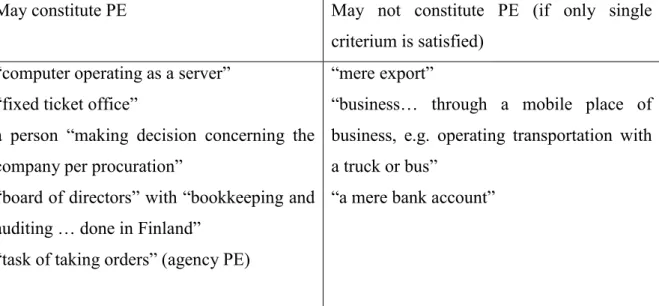
Chart 3. Practically oriented breakdown of PE definition under OECD Model Tax Convention101
Based on the public comments received on the 2017 draft update,102 an additional paragraph was added to separate PE treatment for profit taxation from the treatment of a foreign company for VAT/GST purposes, including from the cases when a foreign enterprise has registered for VAT/GST purposes.103 However, this research focuses only on PE concept for income tax purposes.
Analysis of compound elements and types of PE allows us to structure observations on changes to PE concept, as well as identify risks that stem from incoherent interpretation of PE across jurisdictions. The main goal of explicit definition of PE is to provide certainty and simplicity (see 2.4). However, challenges in modern economy create the need to amend the definition of PE, and thus, put the legal certainty at risk. Most recent and notable case of PE concept reform are BEPS actions that will be analysed below.
2.6. Impact of BEPS Actions and MLI on PE concept
101 PwC, The Past, Present and Future of Permanent Establishment (September 2017) 9
<https://www.pwc.in/assets/pdfs/publications/2017/the-past-present-and-future-of-permanent-establishment.pdf> accessed 20 October 2018
102Draft contents of the 2017 Update to the OECD Model Tax Convention: Comments received on the
11 July 2017 public release (OECD, 11 August 2017) 8 <http://www.oecd.org/ctp/treaties/public-comments-on-draft-contents-2017-update-OECD-model.pdf> accessed 10 November 2018
103 OECD Council approves the 2017 update to the OECD Model Tax Convention (OECD, 23 November
2017) < http://www.oecd.org/ctp/treaties/oecd-approves-2017-update-model-tax-convention.htm> accessed 20 October 2018
20
“You can see BEPS as a set of rules, or you can see it as a milieu, a general change in the way tax is viewed,” business community notes.104 BEPS action reflects the willingness of tax authorities to come up with a common approach to address new tax avoidance technologies that were enabled by globalisation and digitalisation. Namely, newer business models such as digital marketplaces, online catalogues and portals allow taxpayers to generate income in a country with minimal or no physical presence in that country.105 These new challenges have opened up ways for MNEs to minimise their tax burdens and created the need for prompt action to prevent regulatory gaps. 106 The OECD/G20 countries adopted an Action Plan in 2013 as part of the BEPS Project.107 It was the first time that all OECD and G20 countries united to design common responses to challenges of international taxation.108 In October 2015, more than 12,000 pages of comments and 13 reports had been published.109 This work resulted in publishing 15 actions to equip governments with domestic and international instruments to address tax avoidance.110 These instruments are aimed to enforce the core principle of BEPS initiative - “Taxation where value is created”.111
BEPS Actions resulted in amending OECD Model Tax Convention and its interpretation. Namely, Article 5 of OECD Model Tax Convention and Commentary to it underwent a number of changes in 2017 to clarify interpretation of the Article, in light of Report on Action 7 of the OECD/G20 Base Erosion and Profit Shifting Project.112 Goal of OECD was to update definition of permanent establishment (PE) to prevent abuses that allowed to
104Chris Wright, “BEPS in the boardroom: Cracking down on multinational tax avoidance” (CPA Australia,
1 February 2017) <https://www.intheblack.com/articles/2017/02/01/beps-cracking-down-tax-avoidance> accessed 20 October 2018
105Clinton Alley and Joanne Emery, “Avoidance of Permanent Establishment and Multilateral Modifications of Tax Treaties” [2017]11 Journal of International Taxation 41
106 Jean-François Dutriez, “Attribution of Profits to a Permanent Establishment of a Company Engaged in
Online Sales of Goods through a Local Warehouse” [2018] 25(3) International Transfer Pricing 187
107 Closing tax gaps - OECD launches Action Plan on Base Erosion and Profit Shifting (OECD, 19 July 2013)
<http://www.oecd.org/tax/closing-tax-gaps-oecd-launches-action-plan-on-base-erosion-and-profit-shifting.htm> accessed 20 October 2018
108 OECD/G20 Base Erosion and Profit Shifting Project Explanatory Statement (OECD, 2015) 4
<http://www.oecd.org/ctp/beps-explanatory-statement-2015.pdf> accessed 20 October 2018
109 OECD, Top 10 FAQs about BEPS (OECD)
<https://www.oecd.org/ctp/top-10-frequently-asked-questions-about-beps.pdf> accessed 20 October 2018
110 BEPS Actions (OECD) <http://www.oecd.org/ctp/beps-actions.htm> accessed 20 October 2018
111Johanna Hey, “Taxation Where Value is Created” and the OECD/G20 Base Erosion and Profit Shifting Initiative”
[2018] 72 (4/5) Bulletin for International taxation 203
112 Preventing the Artificial Avoidance of Permanent Establishment Status, Action 7 - 2015 Final Report
(OECD, 5 October 2015) 13 < http://www.oecd.org/ctp/preventing-the-artificial-avoidance-of-permanent-establishment-status-action-7-2015-final-report-9789264241220-en.htm> accessed 10 May 2018
21
avoid the tax nexus.113114 As a result, BEPS Action 7 has lowered PE threshold (conditions under which a business model will be considered PE) which is evident from following changes:
• adoption of a broader agency PE rule;115
• a narrower interpretation of the “preparatory and auxiliary” exception; 116
• revision of dependent agent PE concept aimed to address the avoidance of Article 5 through "commissionaire arrangements";117
• the adoption of an anti-fragmentation rule118. Goal of this addition was to prevent enterprises to split their business activities in the same countries in smaller pieces to claim PE exceptions due to “preparatory or auxiliary nature” of such fragmented activities. 119
Some believe that lowered threshold is predictable based on amendments made to the Commentaries on the OECD Model over the years. Such signals were the addition of the painter example, the incorporation of provisions in the OECD Commentary on e-commerce, arrival of the optional services PE clause and the OECD’s work on the Discussion Draft on PEs of 2012.120 However, it is increasingly likely under article 5 of the
OECD Model (2017) PE will be identified in cases where none would have been considered it before.121 Namely, changes brought by BEPS Actions introduce reference to
113 OECD/G20 Base Erosion and Profit Shifting Project Explanatory Statement (OECD, 2015) 8
<http://www.oecd.org/ctp/beps-explanatory-statement-2015.pdf> accessed 20 October 2018
114 Preventing the Artificial Avoidance of Permanent Establishment Status, Action 7 - 2015 Final Report
(OECD, 5 October 2015) 13 < http://www.oecd.org/ctp/preventing-the-artificial-avoidance-of-permanent-establishment-status-action-7-2015-final-report-9789264241220-en.htm> accessed 10 May 2018
115Preventing the Artificial Avoidance of Permanent Establishment Status, Action 7 - 2015 Final Report
(OECD, 2015) 15 <https://www.oecd-ilibrary.org/docserver/9789264241220-en.pdf> accessed 21 October 2015
116Preventing the Artificial Avoidance of Permanent Establishment Status, Action 7 - 2015 Final Report
(OECD, 2015) 15 <https://www.oecd-ilibrary.org/docserver/9789264241220-en.pdf> accessed 21 October 2015
117Clinton Alley and Joanne Emery, “Avoidance of Permanent Establishment and Multilateral Modifications
of Tax Treaties” [2017] 11 Journal of International Taxation 38-49
118 BEPS Action 7 Additional Guidance on Attribution of Profits to Permanent Establishments (OECD, 22
June -15 September 2017) Para 40 <
https://www.oecd.org/tax/transfer-pricing/beps-discussion-draft-additional-guidance-attribution-of-profits-to-permanent-establishments.pdf> accessed 20 October 2018
119 Permanent establishments: Recent trends and developments (EY, 2015) 22
<https://www.ey.com/Publication/vwLUAssets/ey-permanent-establishments/$FILE/ey-permanent-establishments.pdf> accessed 20 October 2018
120Vishesh Dhuldhoya, “The Future of the Permanent Establishment Concept” [2018] 72 (4a) Bulletin for
International Taxation IBFD (accessed 5 March 2018)
121Shee Boon Law , “Profit Attribution to Permanent Establishments – A Tax Treaty Perspective on the “Single Taxpayer” Approach” [2018] 72(3) Bulletin for International Taxation IFBD