Grant Agreement 269977 PUBLIC 1 / 76
Project no. 269977
APARSEN
Alliance for Permanent Access to the Records of Science
Network
Instrument:
Network of Excellence
Thematic Priority: ICT 6-4.1 – Digital Libraries and Digital Preservation
D 2 6 . 1
R
E P O R T A N D
S
T R A T E G Y O N
A
N N O T A T I O N
,
R
E P U T A T I O N A N D
D
A T A
Q
U A L I T Y
Document identifier: APARSEN-REP-D26_1-01-1_0 Due Date:
Submission Date:
2012-02-28 2012-10-31
Work package: WP26
Partners: AWI, CERN, ESA, FORTH,
GLOBIT, KNAW-DANS,SBA, STFC WP Lead Partner: Alfred Wegener Institute
Document status URN
Released
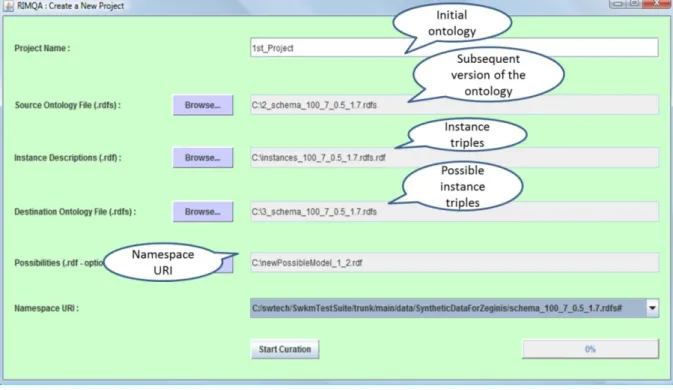
Grant Agreement 269977 PUBLIC 2 / 76
Abstract:
APARSEN is a Network of Excellence that aims to bring together an extremely diverse set of practitioner organisations and researchers in order to bring coherence, cohesion and continuity to research into barriers to the long-term accessibility and usability of data, by exploiting the project partners' diversity by building a long-lived Virtual Centre of Digital Preservation Excellence.
The broad topic of annotation, reputation and data quality is an important area in the context of the permanent access to scientific data, not least, because excellent science can build only on high or at least known quality data. Annotation, in general terms, is information added to data and it may be argued that all kinds of metadata are special types of annotation. High quality data is an essential condition of excellent science.
There are strong relations between annotation, reputation and data quality: For example, high quality should result in high reputation; high reputation should permit to assume high quality. In the context of preservation this suggests that the data must be annotated concerning quality and reputation, to facilitate appraisal (whether and what to preserve) and re-use (establish reliability). Establishing broad and deep context, detailed critique and amendment through annotation contributes further to establish trust in data, enables their review, being added to or being merged into larger scale datasets and finally, higher level data products being derived from them.
It may be argued that all kinds of metadata are just special types of annotations. This report will not much delve into the matter of metadata but concentrate on other kinds of annotation (e.g. annotation for ' comprehension and study', ' interpretation and divulgation', 'cooperation and revision'), outlined in chapter 1.1. The chapters 1.2 and 1.3 on reputation and quality deal with the status of these special topics, hinting at their relation with preservation. Chapter 2 and its corresponding sub-chapters give an overview of perspectives on and some innovative research examples on these three subjects. Chapter 3 presents results of an internal survey to show how partners of the APARSEN network deal with annotation, reputation and data quality today.
Finally, based on a critical evaluation of the findings, a research strategy is described in general and for each of the three subjects.
In-line with the DoW, this report does not contain new, original research findings by this project nor can it already contain a final consensus on the alignment of the partners’ research agendas. It focuses on trustworthy records of research data.
Grant Agreement 269977 PUBLIC 3 / 76
Delivery Type Report
Author(s) Hans Pfeiffenberger, Heinz Pampel, Angela Schäfer, Veronica Guidetti, Christoph Bruch, Yannis Tzitzikas, Stefan Pröll, Rudolf Mayer, Salvatore Mele, Patricia Herterich, Sünje Dallmeier-Tiessen, Marjan Grootfeld, René van Horik
Approval Simon Lambert Summary
Keyword List Data quality, Data annotation Availability Public
Document Status Sheet
Issue Date Comment Author
0_0 14 Jan 2012 First draft Hans Pfeiffenberger, Heinz
Pampel, Angela Schäfer, AFPUM 0_1 12 Apr 2012 First draft + ESA Input Veronica Guidetti, ESA
0_2 14 May 2012 change of structure Christoph Bruch, Hans Pfeiffenberger, AFPUM 0_3 06 Jun 2012 additions
Yannis Tzitzikas, FORTH-ICS Stefan Proell, Rudolf Mayer, SBA Salvatore Mele, Patricia Herterich, Sünje Dallmeier-Tiessen, CERN 0_4 22 June 2012 additions; change of structure Hans Pfeiffenberger, AFPUM
Marjan Grootfeld, DANS 0_5 25 July 2012 insertion of additions from Hans'
version from 6 July 2012 Christoph Bruch, AFPUM 0_6 14 Aug 2012 confirmation of most of the editions
still in change mode Christoph Bruch, AFPUM
0_7 04 Sept 2012 Text review. Minor adjustments René van Horik, DANS
0_8 28 Sept 2012 Minor adjustments Christoph Bruch, AFPUM
0_9 08 Oct 2012 Some additions and adjustments,
Review of “research agenda” Hans Pfeiffenberger, AFPUM
0_10 29 Oct 2012 Internal review Heikki Helin
Grant Agreement 269977 PUBLIC 4 / 76
Project information Project acronym: APARSEN
Project full title: Alliance for Permanent Access to the Records of
Science Network
Proposal/Contract no.: 269977
Project Co-ordinator: Simon Lambert/David Giaretta
Address: STFC, Rutherford Appleton Laboratory
Chilton, Didcot, Oxon OX11 0QX, UK Phone: +44 1235 446235
Fax: +44 1235 446362
Mobile: +44 (0)7770326304
Grant Agreement 269977 PUBLIC 5 / 76
CONTENT
1 ANNOTATION, REPUTATION AND DATA QUALITY: CONCEPT AND STATUS ... 7
1.1 Annotation ...7
1.1.1 User-generated annotations ... 10
1.1.2 Automatic annotation ... 11
1.1.3 Metadata in Digital Preservation ... 12
1.1.4 References and further reading ... 12
1.2 Reputation ... 13
1.2.1 Citation, persistent identifiers and research data repositories ... 13
1.2.2 Research data journals ... 14
1.2.3 Commenting and recommendation functions ... 15
1.2.4 Visibility ... 16
1.3 Data quality ... 16
1.3.1 Interweaving publications and research data ... 17
1.3.1.1 Peer review and reproducibility ... 18
1.3.1.2 Enhanced publications, executable papers and rich internet publications ... 19
1.3.1.3 Problems, challenges and chances ... 19
1.3.2 Reproducibility by using scientific workflow management systems ... 20
1.3.3 Long term preservation of scientific experiments ... 23
1.3.4 Conclusions and outlook of executable publications and scientific workflow management systems ... 24
2 ANNOTATION, REPUTATION AND DATA QUALITY: APPROACHES BY APARSEN PARTNERS... 25
2.1 Annotation and annotation services ... 25
2.1.1 Example: Alfalab (DANS) ... 25
2.1.2 Example: Data Preservation in High Energy Physics" (DPHEP) ... 26
2.1.2.1 Activity: HEPData integration in INSPIRE ... 26
2.1.2.2 References and further reading: ... 28
2.1.3 Example: Research and development activities of FORTH-ICS ... 28
2.2 Reputation ... 32
2.2.1 Example: STD-DOI and DataCite (Helmholtz Association) ... 32
2.2.2 Example: ODE project (several APARSEN partners) ... 33
2.2.3 Example: EASY (DANS) ... 34
2.3 Data quality ... 34
2.3.1 Example: MaNIDA - Coordinated provision of quality information (Helmholtz-Association) ... 35
2.3.2 Example: Earth System Science Data Journal (Helmholtz-Association) ... 38
2.3.3 Example: Remote sensing domain (ESA) ... 39
2.3.3.1 Context... 39
2.3.3.2 Activity ... 40
2.3.3.3 Useful references ... 41
3 RESULTS OF AN INTERNAL SURVEY ... 42
3.1 Data repositories landscape ... 43
3.1.1 Data repository systems ... 44
3.1.2 Ingest and accessibility ... 47
3.2 Annotation services ... 48
3.3 Reputation ... 51
3.4 Data quality ... 53
4 ANALYSIS AND UPCOMING RESEARCH STRATEGIES ... 56
4.1 Critical analysis ... 56
4.2 Research strategies ... 57
4.2.1 Annotation and annotation services ... 58
4.2.2 Reputation ... 59
Grant Agreement 269977 PUBLIC 6 / 76
5 CONCLUSIONS AND RECOMMENDATIONS ... 60
6 LIST OF FIGURES ... 61
7 LIST OF TABLES ... 61
8 LIST OF ILLUSTRATIONS ... 61
9 REFERENCES ... 62
Grant Agreement 269977 PUBLIC 7 / 76
1
Annotation, reputation and data quality: Concept and status
The broad topic of annotation – in general terms: information added to data –, reputation and data quality is an important area in the context of the permanent access to scientific data, not least, because excellent science can build only on high or at least known quality data.
There are strong relations between annotation, reputation and data quality: For example, high quality should result in high reputation; high reputation should permit to assume high quality. In the context of preservation this suggests that there must be annotation to the data about quality and reputation, to facilitate appraisal (whether and what to preserve) and re-use (establish reliability).
Establishing broad and deep context, detailed critique and amendment through annotation contributes further to establish trust in data, enables their review, their ability to be added or merged into larger scale datasets and finally, to derive higher level data products from them.
It may be argued that all kinds of metadata are just special types of annotations. This report will not much delve into the matter of metadata but concentrate on other kinds of annotation, such as annotation for ' comprehension and study', ' interpretation and divulgation', 'cooperation and revision'.
The overarching question in the context of APARSEN then is: What, beyond the primary data itself, must be preserved to retain richness of expression, in particular in terms of quality and provision and preservation of reputation.
1.1 Annotation
In many cases explanations/annotations necessary to understand and reuse a particular set of research data cannot be provided in a standardised form. This may result from a lack of knowledge concerning appropriate standardised metadata schemas. There is also a possibility that no suitable metadata schema exists. Obviously it is desirable to establish more standardized forms of data annotation in order to
a) facilitate reuse – especially across subject boundaries, b) help streamline the process of annotating and
c) reduce the complexities of long term data preservation.
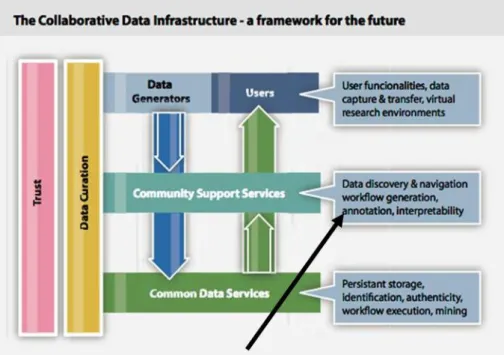
But certainly there will always be cases where information closely related to a dataset cannot be encoded in metadata, as evident from the examples provided in section 2.1 Annotation and annotation services. It was therefore decided within APARSEN to follow the example of the High Level Expert Group on Scientific Data and use the term annotation instead of metadata, as in illustration 1.
Grant Agreement 269977 PUBLIC 8 / 76
Illustration 1 Collaborative Data Infrastructure1
In everyday linguistic usage, an annotation is a note that a person makes while reading any form of text. Annotation can in the simplest form be just underlining or highlighting to mark important words or passages, or adding explanatory comments or assessments to certain passages.
These annotations to text may be created for the private purpose of the reader, e.g. to quickly identify important parts of the text on subsequent reading. Annotations can also be shared between several users, e.g. in collaborative writing, editing or commenting. Three different aspects of annotation are identified in Agosti et al.2:
- comprehension and study: annotating a text is used to investigate and understand a concept better. These annotations are mostly private, as the consumer of the annotation is the creator. It is noted though, that other people reading an annotated text could as well benefit from existing annotations.
- interpretation and divulgation: annotations are used to comment and explain a text, to make it more comprehensible or to exchange ideas on a topic, such as an expert in literature annotation a demanding piece of art. Here, annotations are intended to be public, i.e. the consumers are people other than the creator.
- cooperation and revision: annotations are used to review someone else’s work, i.e. annotations are a way to share ideas and opinions to improve the original work. Here, annotations are used collectively.
1
High Level Expert Group on Scientific Data (2010). Riding the wave. How Europe can gain from the rising tide of scientific data. Final report, European Union, 31. http://cordis.europa.eu/fp7/ict/e-infrastructure/docs/hlg-sdi-report.pdf
2
Agosti, M., Ferro, N. Annotations: Enriching a digital library. (2003). Research and Advanced Technology for Digital Libraries, Volume 2769 of Lecture Notes in Computer Science, Springer
Grant Agreement 269977 PUBLIC 9 / 76
The latter forms of annotation have seen a significant use with the emergence of digital distribution and publishing forms, when the annotations to a text can easily be shared with a larger user base. Thus, annotations are a topic prominent in digital library research.3
In the context of the APARSEN project, annotation is understood as “information added to data and it may be argued that all kinds of metadata are special types of annotation”4
. This is a definition similar to the one presented by e.g. Shabajee et al.5: “we define annotation as metadata created after the creation of the content. It is this post hoc nature (“a note added to anything written”, Oxford English Dictionary, 1998) that represents a considerable expansion of its usefulness, as a means of adding value to content, because it now allows people other than the original content author to add metadata descriptions.”
These definitions and deliberations on annotation have their roots in text and text-related (e.g. facsimile) content. In recent years however, the concept has been transferred to mean also information added to data. The most prominent use is in genome annotation6, where GenBank, the data repository for nucleotide sequence, defines7:
“Feature annotation is the addition of biological features such as genes and associated coding regions, structural RNA, variation information, exon, introns, etc. to your submitted sequence.” In other words: Annotation here adds meaning to an otherwise meaningless sequence of molecule “names”. GenBank observes that “Adding feature annotation will also frequently provide an additional tool for reviewing the quality of primary nucleotide sequence data.” and “…annotating protein-coding regions will frequently highlight potential errors in the nucleotide sequence, such as insertion/deletions (in/dels) or improper or uncertain base calls that result from the sequencing reads.”
Usually, this annotated sequence entry will also link back at the original article which describes it and, in particular, the method of generating the annotation. These methods, in turn, can be expressed as workflows, see section 1.3.1.2, employing large number (e.g. 20) of tools to arrive at just a single annotation. Since the field of genomics and bioinformatics is in fast development, it can happen that at the time of review of the article, one of the tools is no longer available in the version used and reviewers require authors to re-do their annotation with the available, newer version of that tool. In summary, GenBank relies on articles to provide documentation and journals can do no more (at this time) than require reproducibility at the time of review.
We will subsequently discuss both user-generated and automatically generated annotations.
3
Marshall, C. C. Annotation: from paper books to the digital library. (1997). In Proceedings of the second ACM international conference on Digital libraries, ACM.
Agosti, M., Ferro, N. Annotations: Enriching a digital library. (2003). Research and Advanced Technology for Digital Libraries, Volume 2769 of Lecture Notes in Computer Science, Springer
Gazan, R., Social annotations in digital library collections. (2008).D-Lib Magazine, 14(11/12)
Arko, R., Ginger, K., Kastens, K., Weatherley, J. (2006), Using annotations to add value to a digital library for education. D-Lib Magazine, 12(5)
4
Description of work package 26 within the APARSEN Application, p. 47.
5 Shabajee, P., Miller, L. (2002). Adding value to large multimedia collections through annotation technologies and tools:
Serving communities of interest. In Proceedings of the Museums and the Web Conference.
6 Stein, L.;Genome annotation: from sequence to biology; Nature Reviews Genetics 2, 493-503, doi:10.1038/35080529 7
Annotating your Sequence for Submission - The GenBank Submissions Handbook.
Grant Agreement 269977 PUBLIC 10 / 76
1.1.1 User-generated annotations
Many of today’s Digital Library systems incorporate some sort of annotation tool that allows the user to create personal or shared annotations to the documents available in the collection.
An early investigation on how these tools could be implemented was performed in Marshall et al.8, starting with a study on how university students annotate their text books. The study draws on a few implications for annotation tools in digital library systems, such as to allow for “in situ annotation, distinguishable from the source”, allow for well-known annotation forms such as underlining, highlighting and other, individual forms of annotations, or “smooth transitions between public and private annotations”.
Marshall et al.9 focus on the latter aspect. It is noted that on paper, sharing of personal annotations is often not intentional, e.g. when photo-copying materials that were annotated by the original owner/user, and that a huge percentage of annotations made in digital documents are personal, and not shared. Gazan10 argues that another way in which initially private annotations are shared is e.g. when students buy used text books, which have been annotated by the previous owner(s). The author further argue that these annotations, even though the reason why they were created may be unknown, attracts more attention from the reader, and thus can help in making learning less of a solitary effort.
Agosti11 identifies a number of annotation signs and discussed their implementation in the OpenDLib digital library system. Arko et al.12 discuss how annotations in a digital library for education can be improved to foster student collaboration and understanding of subjects. It is noted that one shortcoming is the lack of a common framework for these annotations, and therefore proposes a framework for metadata records, of which annotation metadata is a key service. The metadata records are based on the architecture in the National Science Digital Library (NSDL).
Gazan13 also touches issues of authority of (unknown) annotators that inform, challenge and often confuse subsequent readers. While the trustworthiness of these annotators might be questionable at first thought, at least the fact that they took the time to read and annotate the text, which gives the subsequent reader additional perspectives from which to evaluate the usefulness of the text. This is somewhat similar to social computing in the Web 2.0, where digital objects are most often also annotated by peers (comments, ratings, ...), rather than experts. Aggregate peer authority, i.e. the concordance of multiple peers, can become a source of trust. The author argues that Digital Library system have to embrace such approaches for their systems.
A storage solution for annotations, specifically for semantic web, was developed in the Annotea project of the W3 Consortium14. An RDF based format is defined, which lets users easily create, merge and mix annotations with other metadata. This metadata can then be stored locally, or in dedicated
8
Marshall, C. C. Annotation: from paper books to the digital library. (1997). In Proceedings of the second ACM international conference on Digital libraries, ACM.
9
Marshall, C. C., Brush, A. B. From personal to shared annotations. (2002). In CHI ’02 extended abstracts on Human factors in computing systems, ACM.
10
Gazan, R., Social annotations in digital library collections. (2008).D-Lib Magazine, 14(11/12)
11
Agosti, M., Ferro, N. Annotations: Enriching a digital library. (2003). Research and Advanced Technology for Digital Libraries, Volume 2769 of Lecture Notes in Computer Science, Springer
12Arko, R., Ginger, K., Kastens, K., Weatherley, J. (2006), Using annotations to add value to a digital library for education.
D-Lib Magazine, 12(5)
13 Gazan, R., Social annotations in digital library collections. (2008).D-Lib Magazine, 14(11/12) 14
Koivunen, M.(2005). Annotea and semantic web supported collaboration. Workshop on User Aspects of the Semantic Web (User-SWeb) at European Semantic Web Conference
Grant Agreement 269977 PUBLIC 11 / 76
Annotea servers, so that they can also be utilised by other users. The Annotea project also provided an editor for annotations, Amaya15; another implementation is provided as a browser-extension for Firefox16.
1.1.2 Automatic annotation
In several information retrieval domains, automatic annotation is a concept of automatically attaching metadata to objects. One prominent example is automatic image annotation, where the goal is to automatically assign a set of captions and descriptive keywords describing the content of the image17. Often approaches to this task are by a statistical machine learning model that can predict a set of annotations for an image given a training set of images already annotated. The learning is based on characteristic features extracted from the images. Automatic image annotation has the advantage that users can query for images using the natural-language keywords, rather than having to specify abstract image properties such as colours or texture. Similar approaches exist also for other types of media. Agosti et al.18 also suggest that textual data inside a digital library could be automatically annotated by the topics (categories) being assigned to certain subsections of the document, and that the document can then be organised not only by its original structure, but segmented into these topics.
Data provide an even wider potential to derive annotation: In the case of geospatial data, e.g. it is quite useful to associate place names with geographical co-ordinates, or vice versa. This “cross-walk” function is mediated be so-called gazetteers19. Since place names can change over time (or actually places such as islands can even move over long times20) or are actually challenged due to political reasons (Malvinas vs. Falkland Islands; Taiwan vs. Republic of China) it will be a non-trivial task to decide whether and how to provide the cross-walk: “Just in time” on search at a portal or search engine or as a persistent annotation in the repository?
Similarly, names of parameters measured and names and classification of objects observed will not be unambiguous: Whether is advisable or even possible to use a modern name for a parameter when the ancient one also indicates a different method of measurement or “translating” a species name to a “better” one, according to modern interpretation, is clearly questionable, as can be seen from the many names and classification for whales21 and other species, currently known by the Encyclopaedia of Life. In any case, re-assignment of such annotations even if possible through a simple database call, may sometimes be of major scientific relevance, should not be done lightly and the original annotation will probably need to be preserved as a matter of authenticity and provenance.
15 http://www.w3.org/Amaya 16 http://annozilla.mozdev.org 17
Li, J., Wang, J.Z. (2008) Real-time computerized annotation of pictures. IEEE Trans. Pattern Analysis and Machine Intelligence (TPAMI). 30(6)
18 Agosti, M., Ferro, N. Annotations: Enriching a digital library. (2003). Research and Advanced Technology for Digital
Libraries, Volume 2769 of Lecture Notes in Computer Science, Springer
19 Wikipedia: List of gazetteers http://en.wikipedia.org/wiki/Gazetteer#List_of_gazetteers 20
The island “Trischen”, formerly known as “Buschsand” moves at 30 m per year - http://de.wikipedia.org/wiki/Trischen
21
Grant Agreement 269977 PUBLIC 12 / 76
1.1.3 Metadata in Digital Preservation
For digital preservation, metadata is of particular importance, as it is information that supports and documents the digital preservation process. Woodyard22 identifies four tasks for preservation metadata:
- List the technical details about files and structure of the resource and how to use it.
- Record the history of all actions performed on the resource, including any changes or decisions made about it.
- Prove the authenticity through technical means and account for the continued custody of the resource.
- Retain information on who has the responsibility and rights to perform preservation actions on the resource.
There are several tools that generate automatic annotations for files. Format identification (and validation) can be performed by tools such as JHOVE23, Droid24 and the UDFR (Unified Digital Format Registry)25. Extraction of metadata from files is supported by the National Library of New Zealand Metadata Extraction Tool26.
The PREMIS (Preservation Metadata: Implementation Strategies) working group has published the PREMIS data dictionary27, which defines a number of metadata fields that should be used for describing digital objects.
1.1.4 References and further reading
Agosti, M., Ferro, N. Annotations: Enriching a digital library. (2003). Research and Advanced Technology for Digital Libraries, Volume 2769 of Lecture Notes in Computer Science, Springer Arko, R., Ginger, K., Kastens, K., Weatherley, J. (2006), Using annotations to add value to a digital library for education. D-Lib Magazine, 12(5)
Gazan, R., Social annotations in digital library collections. (2008).D-Lib Magazine, 14(11/12)
Koivunen, M.(2005). Annotea and semantic web supported collaboration. Workshop on User Aspects of the Semantic Web (User-SWeb) at European Semantic Web Conference
Li, J., Wang, J. Z. (2008) Real-time computerized annotation of pictures. IEEE Trans. Pattern Analysis and Machine Intelligence (TPAMI). 30(6)
Marshall,C. C. Annotation: from paper books to the digital library. (1997). In Proceedings of the second ACM international conference on Digital libraries, ACM.
Marshall,C. C., Brush, A. B. From personal to shared annotations. (2002). In CHI ’02 extended abstracts on Human factors in computing systems, ACM.
22
Woodyard, D. (2002). Metadata and preservation. Information services & use, 22(2).
23 http://hul.harvard.edu/jhove 24 http://www.nationalarchives.gov.uk/PRONOM/Default.aspx 25 http://www.udfr.org 26 http://meta-extractor.sourceforge.net/ 27
Grant Agreement 269977 PUBLIC 13 / 76
PREMIS Editorial Committee. (2008). Premis data dictionary for preservation metadata. Technical report, March.
Shabajee, P., Miller, L. (2002). Adding value to large multimedia collections through annotation technologies and tools: Serving communities of interest. In Proceedings of the Museums and the Web Conference.
Woodyard, D. (2002). Metadata and preservation. Information services & use, 22(2).
1.2 Reputation
Preparing research data for proper preservation and reuse entails effort and costs. The willingness of researchers to bear this burden is closely linked to associated rewards. Increasingly, important scientific bodies assert not only that indeed rewards are due but also that this act is a scholarly achievement of its own.28
Consequently, one approach to enable rewards for data publication is to add and maintain functions to research data repositories to capture and preserve information which associates scientific reputation with individual data sets.
Once reputation for research data sets becomes an accepted currency in the competition among scientists, then research data repositories will to some extend have to act like journals. In this context this refers first to the dissemination activities typically associated with research journals. This will immediately lead to a desire to enhance the reputation of the data repository, respectively of the data sets available via the repository, through e.g. selectivity or else, explicit or implicit ranking.
Selectivity in journals is meant to transfer reputation built by a journal to each of the items published from then on. This mechanism will to some extent be made use of by data repositories as well. Ranking within the holdings of one repository does establish reputation on a scale calibrated by the repository through the process employed, in particular through pre-screening of the items submitted and selectivity regarding the clientele allowed to submit judgments.
As mentioned in various places within this report, and taken up here again: Annotation, reputation and data quality are closely interlinked. In this section a fourth category, visibility, needs to be made explicit because reputation cannot be achieved without it.
1.2.1 Citation, persistent identifiers and research data repositories
Once the quality or ranking of a dataset is established, the further build-up of its reputation and – even more important – the transfer of this reputation to the reputation of its creator is dependent on the ability to cite data sets, unambiguously and persistently.
28 Most recently in June and July 2012: „Science as an open enterprise“, The Royal Society Science Policy Centre report
02/12, http://royalsociety.org/policy/projects/science-public-enterprise/report/ and „Empfehlungen zur Weiterentwicklung der Wissenschaftlichen Informationsinfrastrukturen in Deutschland bis 2020“, Wissenschaftsrat, Drs. 2359-12, Berlin http://www.wissenschaftsrat.de/download/archiv/2359-12.pdf
ODE-report D3.2 Baseline Report: http://www.alliancepermanentaccess.org/wp-content/uploads/downloads/2011/11/ODE-WP3-DEL-0002-1_0_public_final.pdf
ODE-report D4.1 Executive summary of Report of Integration on Data and Publication:
Grant Agreement 269977 PUBLIC 14 / 76
In science, technology, medicine (STM) publishing practice, most articles are cited as a whole, while in the “book-sciences” it is clearly necessary to refer to individual pages, if not lines. In analogy, considering the potential size or complexity of data sets, it is desirable to provide the possibility to cite subsets. Beyond this there is a problem quite outside of reasonable analogy with journal articles: that of enhancements (read: correction of minor errors) and extensions (e.g., in coverage of space and time) of datasets. Should those retain the same citation? Should versioning be employed in one way or another? How to reflect this through identifiers?
These questions have been discussed, e.g. for an important corpus of economic data by Green29 and by others30, but are still not being answered consistently and unanimously. In the case of enhancement and extensions, practical limitations are brought forward, such as by Green: “In the case of dynamic datasets the volume of change can be so large or frequent to make tracking back impossible to manage.”
It goes almost without saying that these functions can best be implemented – reliably and impartially – by professional research data repositories. Research data which are expected to gain reputation should therefore be made available via suitable data repositories, not individual web- or ftp-sites. The great majority of research data is not yet stored in such repositories. This may change drastically as cultural habits of research change – in particular, whether or not to cite datasets and to “count” them on an equal footing with articles for evaluations. For that change to actually happen and to take hold, the above questions need to be fully answered and adequate practices be implemented firmly and transparently by repositories.
1.2.2 Research data journals
Research data certainly do not stand on their own – in most cases they serve as the facts underlying journal articles of scholarly books. Today, if at all, they are referred to from these texts via links or haphazard wording within the text or they are provided as “supplemental information”, available from the online systems of publishers. The customary processes of quality assurance, such as peer review of articles, do not extend to these external sources or supplements, creating mounting concern.31 One could extend these concerns about journals by saying that using data of uncertain reputation is beginning to undermine the reputation of journals themselves.
The new breed32 of data journals is focused on the publication of original research data sets and corresponding explanations (e.g. Earth System Science Data (ESSD))33. These journals create an opportunity to gain reputation for the researcher by publishing high quality “annotations” to their high quality data.
29
Green, T. (20099; “We Need Publishing Standards for Datasets and Data Tables“, OECD Publishing White Papers, OECD Publishing, doi:10.1787/787355886123
30
Lawrence, B., Jones, C., Matthews, B., Pepler, S., Callaghan, S. “Citation and Peer Review of Data: Moving Towards Formal Data Publication”, International Journal of Digital Curation, 2011, Vol. 6, No. 2, pp. 4-37, doi:10.2218/ijdc.v6i2.205
31
Maunsell, J., „Announcement Regarding Supplemental Material“, Journal of Neuroscience, 30(32):10599-10600, 2010. http://www.jneurosci.org/cgi/content/full/30/32/10599
32
Overviews have been worked out in APARSEN WP33, “Report on Peer Review of Research Data in Scholarly Communication” http://www.alliancepermanentaccess.org/index.php/knowledge-base/member-resources/documents-and-downloads/?did=82 and ODE WP4, Kotarski R, Reilly S, Schrimpf S, Smit E, Walshe K (2012). Report on best practices for citability of data and on evolving roles in scholarly communication”, http://www.alliancepermanentaccess.org/wp-content/uploads/downloads/2012/08/ODE-ReportBestPracticesCitabilityDataEvolvingRolesScholarlyCommunication.pdf
33
Grant Agreement 269977 PUBLIC 15 / 76
There is a clear distinction between classical "article journals", data repositories and the new "data journals". Data journals not only focus exclusively on the making available of research data, they also provide quality assurance mechanisms specifically geared towards research data. The journal mentioned above, Earth System Science Data (ESSD), is an example for such a policy.
"The [journals] peer-review secures that the data sets:
- are at least plausible and contain no detectable problems; - are of sufficiently quality and their limitations are clearly stated;
- are open accessible (toll free), well annotated by standard metadata (e.g., ISO 19115) and available from a certified data center/repository;
- are customary with regard to their format(s) and/or access protocol, however not proprietary ones (e.g., Open Geospatial Consortium standards), expected to be useable for the foreseeable future."34
By thus “wrapping” a peer reviewed article around data, it becomes a matter of obeying good scientific practise to cite it. Journals exclusively devoted to data publishing avoid the danger of “data briefs” in classical journals or similar means, which might let data publications appear second class citizens in scholarly publishing, diminishing their reputation. This function may help in the interim, until data citation is a matter of course. In the following section on quality it will be made clear that peer review is not applicable to all data, so the other function of data journals, providing reputation to creators, is not available to all.
An interesting lemma arising for preservation is the necessity to establish and preserve a bilateral link between the dataset in its repository and the data journal article (perhaps technically declared as an annotation to the dataset).
1.2.3 Commenting and recommendation functions
Commenting or recommending data in repositories is another approach of adding reputation to data sets. The data review functionality that is part of the EASY system developed and implemented by the Dutch Data Archiving and Networked Services (DANS) is an example. EASY enables users to appraise data sets by awarding one to four stars.35 This and similar examples are obviously modelled after the successful and useful precedent of Amazon and similar commercial entities.
An advantage of the review function is that the appraisals can be measured easily. The simplicity of the system also entails a disadvantage. The system does not record the reasons for the appraisals. This problem is well known from classical articles: A high citation rate is normally assumed to indicate high quality and relevance of the article. This measurement does not however record the semantic context of the citations. The article might as well get a lot of attention for a negative reason, e.g. bad practice or erroneous conclusions (The article about “cold fusion” was one of the most-cited articles ever in physics).
Whatever the mechanism and its measurements, its results will need to be preserved along with the data itself, to preserve reputation. An interesting migration challenge might arise when a repository changes its mechanisms or when data need to be transferred (handed on) or replicated to other repositories.
34
http://www.earth-system-science-data.net/general_information/about_this_journal.html (14 August 2012)
35
Grant Agreement 269977 PUBLIC 16 / 76
1.2.4 Visibility
The building-up of reputation is closely linked to visibility. Therefore, research data repositories do not only have a function as providers of tools enabling users to appraise data sets. They can also increase their visibility. This is achieved via several avenues:
- Research data repositories make data sets visible to search engines.
- Data sets can be linked via annotations or metadata. Based on these links users of one data set can be guided to related data sets.
- The power of this referral function is greatly enhanced if a research data repository is cooperating with journals whose author deposit data related to their articles in this particular repository. In this way the audience of the journals become potential audience for the data repository thus raising the chance of being discovered for all data sets of this repository. - Annotations may very well contain information which could be used to measure appraisals of
a data set. In fact, annotations have the potential of being much more helpful to measure reputation than streamlined systems like the above described data review tool of EASY, because the user can explain what he thinks is important concerning a data set. The yet unsolved challenge is the automatic extraction of these hidden appraisals.
The perhaps boldest move with respect to visibility is the recent announcement of Thomson Reuters to create its “Data Citation Index”. Considering that in many cases journal articles are included in evaluations only if published in a journal on Thomson Reuters’ master journal list, Thomson’s selection criteria36 will challenge repositories in many ways, in particular in the long term to make datasets not just citable, but take care that the number of citations is actually non-negligible.
1.3 Data quality
The term quality is related to fitness for a purpose. Conversely, if quality of data is (completely) unknown, the data are not fit for any purpose of re-use. Therefore, it may not be justified (except perhaps for historical reasons) to preserve unqualified data. Were today’s repositories to be judged by this argument, it might turn out that much if not most of their contents is in dire straits.
Whatever the practice to create, measure, assure or otherwise determine quality, it will entail creating evidence which practices have been applied by whom and when and, of course, an estimate of error. Both evidence and estimate need to go along with the data itself and be preserved with it – the former perhaps for a limited time, after which no further scrutiny is to be expected, the later for as long as the data itself, because it will be needed on re-use of the data, in calculations of error propagation.
Today, we see (e.g. in the examples in chapter 2) these principles realized fully for very few data. However, the topic of data quality is experiencing an explosive growth of attention, from funding bodies37 and scientific societies38 to data practitioners39. Consequently, the means to preserve quality-related information in a structured way will be in high demand, soon.
36
„Repository evaluation, selection and coverage policies for the data citation index within Reuters web of knowledge” (2012) http://wokinfo.com/media/pdf/DCI_selection_essay.pdf
37 EUROHORCs-ESF Task Force, “EUROHORCs and ESF Vision on a Globally Competitive ERA and their Road Map for
Actions”, 2009. http://www.eurohorcs.org/SiteCollectionDocuments/ESF_Road%20Map_long_0907.pdf
38 „Science as an open enterprise“, The Royal Society Science Policy Centre report 02/12,
http://royalsociety.org/policy/projects/science-public-enterprise/report/
39
Grant Agreement 269977 PUBLIC 17 / 76
As to the practices or processes to establish quality two essentially different approaches can be identified40:
“If … a potentially large number of articles are expected to rely on a (comprehensive or exceptional) dataset — also known as re-use of data — there is no way around the need to make sure, as far as possible, that this dataset itself is reliable. There may be communities of practise, e.g., in remote sensing or monitoring of environmental data, which work by established practises of documenting, testing and calibration of instruments, complemented by methods of (semi-)automatic validation of results. As long as those instruments and methods are operated by experienced, professional staff it may suffice for quality assurance to affirm just that, and by making all necessary documentation available. One might think of a priori quality assurance, here.
However, especially in pure research, there are many innovative and evolving and therefore less thoroughly documented and tested methods, which nevertheless produce substantial results, i.e., valuable data. It is this subset, which needs to be subject to quality assurance a posteriori. How can this, to put it loosely, "quality assessment with somewhat incomplete and/or ingenious documentation/proof" be done? One "obvious" answer is: Peer review, a method already practised and reasonably well understood by the parties involved.”
Were dataset just to be seen as stand-alone items, both approaches extend metadata or data themselves by entries for error estimates and create “auxiliary” documents and other evidence. These items can be treated as it has already been discussed in the more general sections on annotation and reputation. The Royal Society report „Science as an open enterprise” begins with the words: “Open inquiry is at
the heart of the scientific enterprise. Publication of scientific theories - and of the experimental and observational data on which they are based - permits others to identify errors, to support, reject or refine theories and to reuse data for further understanding and knowledge. Science’s powerful capacity for self-correction comes from this openness to scrutiny and challenge.”41 These reflections challenges us to widen the field of view to include the research and publication processes as a whole, to include to processes of reception and scrutiny and its technical means in the presence of huge amounts or complex data.
The following sections provide an array of current thinking into the merging of data and computation into the research and publication process as it influences and provides quality and describe or at least hint at some of the challenges emerging for preservation.
1.3.1 Interweaving publications and research data
Most recent research is based upon data that also exists in digital format or even is “born digital” and is never printed. The validity and coherence of research data is a crucial factor determining the quality of experiments and the resulting publications. Considering the flood (“deluge”) of data, publications can no longer be seen as standalone resources that include all necessary properties and information about the research topic anymore. The data collected and analysed during the research process belong to the publication as well and have therefore to be reviewed in their own right. Tools that support peer review processes of publications and data increase the data quality immediately. This awareness
American Geophysical Union, (2012) Vol. 93, No. 19, p. 189, doi:10.1029/2012EO190008
40
Pfeiffenberger, H., Carlson, D., “"Earth System Science Data" (ESSD) — A Peer Reviewed Journal for Publication of Data”, D-Lib Magazine (2011) Vol 17, No.1/2, doi:10.1045/january2011-pfeiffenberger
41
The Royal Society (VI.2012): Science as an open enterprise, Science Policy Centre report, 02/12, London, The Royal Society. royalsociety.org/uploadedFiles/Royal_Society_Content/policy/projects/sape/2012-06-20-SAOE.pdf
Grant Agreement 269977 PUBLIC 18 / 76
fosters the quality of data as it encourages scientists to deliver highly maintained data sets. A further concept is the close combination of research publications and the data they are based on. There exist different ideas for allowing researchers to rerun experiments and analyse the claims the original research stated. So-called executable papers integrate research data directly into the corresponding publications. This allows other researchers to conveniently reuse data, retrace the scientific workflow, or verify results, thus enhancing the quality of data by inherent quality control. Scientific workflow management systems (SWMS) allow the reproduction of complex experiments in a broader context, as they allow researchers to model their experiments in a formal way. SWMS further allow automated runs of experiments and therefore introduce exact reproduction in defined environments. This further enhances the data quality and can easily be integrated into existing workflows.
The following section gives an introduction to executable papers, which allow researchers to rerun experiments that lead to a publication and therefore validate and test the hypothesis under examination.
1.3.1.1 Peer review and reproducibility
Research data have to meet stringent data quality standards in order to be useful to the research community. Data quality can be achieved by many different factors, some of which have already been introduced in this section. Additional to technical instruments and methods to improve the quality of data, the concept of reviewing is an essential tool for assessing the quality of research. A fundamental requirement for reviewing scientific experiments and theories is the possibility of reproducing the statements made by scientists in their publications. The validity of an experiment can only be judged if it is possible to rerun a specific experimental setup under the same preconditions. This essential standard applies to digital data more than ever, as the majority of research data is already digitally available. The need for replicating scientific experiments by providing the underlying data has also been addressed by governments who encourage scientists to make their data available to peers42. But data is only verifiable if it is accessible, understandable and coherent. This has to be ensured by using standardized data formats and by checking for compliance with best practices of the field. The quality of data can be enhanced further if reviewers are supported by tools enabling them to rerun experiments and verify research results. The easier the access, usage and application of data and the corresponding methods that were used, the lower are barriers for reviewing personnel and readers.
Peer review has a long tradition in research as the number one tool for increasing the quality of research by assessing the contributions made by fellow researchers. The same is valid for data quality, although it is even more difficult to judge as this often requires very specialized knowledge. Using standard data formats increases the general data quality, but manual work is still required. Therefore tool support is an essential factor for decreasing barriers for assessing and reusing research data.
42 House of Commons; Science and Technology Committee (28 July 2011): Peer review in scientific publications, Eighth
Report of Session 2010-12, HC856, London: The Stationery Office Limited,
Grant Agreement 269977 PUBLIC 19 / 76
1.3.1.2 Enhanced publications, executable papers and rich internet
publications
There exist different approaches that allow the integration of research data into publications in order to enhance the quality of the overall outcome. Concepts such as enhanced papers43 and rich Internet publications44 enhance the understandability of publications by augmenting them with supplementary content. Enhanced papers are publications that are augmented with links to additional multimedia content, such as full-text articles, comments, images and other sources available online and also to research data. Rich Internet publications feature multimedia content and interactive elements that support the visualization of research results, such as interactive maps or tools for data analysis. Both concepts are valuable, but do not allow rerunning experiments on original data. This issue is tackled by executable papers45 which allow executing and therefore rerunning scientific workflows. These are especially useful to increase data quality as they enable peers to detect quality problems regarding the research data. Connecting publications closer with their constituting data enhances the validation of experiments and fosters the reuse of this data. Both factors influence the quality of research in a positive way. An overview of these approaches is given in the APARSEN “Report on peer review of research data in scholarly communication”46.
1.3.1.3 Problems, challenges and chances
Reviewing digital research data raises several new questions and problems in comparison with traditional paper-based peer reviews of scientific work. The responsibility for the data quality is distributed amongst different parties.
From the researcher’s perspective, submitting research data along with the actual paper or report has positive effects on the data quality itself and the overall quality of the research outcome. The awareness that their research data is peer reviewed imposes even more accuracy and carefulness in the preparation of the data. It promotes the proper preparation of the data for the review process and thus enhances reusability. This in turn fosters peers and scientists from related research areas to engage in verification and also falsification of results, as it is easier to rerun experiments on the very same data. By the same token, these advantages are associated with higher costs. Researchers need more time and effort in order to prepare the data for practical reuse. This includes the delivery of data in the proper formats and requires comprehensive documentation of the data sets. As the experimental data might require considerable storage space the distribution of the data sets can also become an issue. Intellectual property rights linked to research data pose another challenge. They have to be respected and treated in a way that complies to the requirements of researchers, reviewers and publishers. If the research results are to be publicly available – as sometimes demanded by funders –, the consideration
43
Sierman, B., Schmidt, B., Ludwig, J. (2009) Enhanced Publications : Linking Publications and Research Data in Digital Repositories. Surf EU-Driver. Amsterdam University Press, Amsterdam.
44
Breure, L., Voorbij, H., Hoogerwerf, M. (2011) Rich internet publications: Show what you tell. Journal Of Digital Information, Vol 12 (Nr. 1).
45
Elsevier (14. Dec. 2010) Elsevier Launches Executable Paper Grand Challenge, press release, http://www.elsevier.com/wps/find/authored_newsitem.cws_home/companynews05_01788
David, K., Santos, E., Mates, P., Vo, H.T., Bonnet, P., Bauer, B., Surer, B., Troyer, M., Williams, D., Tohline, J., Freire, J., Silva, C. (2011). A provenance-based infrastructure to support the life cycle of executable papers. Proceedings of the International Conference on Computational Science, ICCS 2011
46
Pampel, H., Pfeiffenberger, H., Schäfer, A., Smit, E., Pröll, S., & Bruch, C. (2012). Report on Peer Review of Research Data in Scholarly Communication. Retrieved from http://epic.awi.de/30353/
Grant Agreement 269977 PUBLIC 20 / 76
of property rights becomes even more obvious. This also entails that provenance information has to be generated and stored in order to be able to trace the custody and authorship of data. The same is valid for authenticity and integrity information of data. Authenticity and integrity refer to the completeness, validity and correctness of data.47 It has to be ensured that transmitted experimental data are protected against deliberate or accidental manipulation. Privacy protection is another legal issue that regularly needs close attention when dealing with certain kinds of research data.
From the reviewer’s perspective the complexity of scientific data is a major problem because assessing the quality and validity of data often requires domain specific knowledge for correct interpretation. This special know-how is often limited to a very small designated community. Substantial documentation can help to enhance the understanding of research data but it does not fully solve the problem of complexity. Understanding the relationships among data in a set requires deep analysis by the reviewers. Comprehensive data delivery puts another burden on the reviewers, as they have to take complex data analysis into account.
Many journals require blind or double blind peer review processes. This paradigm is essential for unbiased research and it needs to be applied to research data in the same manner as it is applied to publications. It has to be ensured research data remains uniquely identifiable. This requires the usage of persistent identifiers48 and mechanisms to discover and access research data. On the positive side, having access to research data increases the insights which reviewers can gain. This dramatically enhances their ability to judge the contribution of some research to a specific research area. In many cases it also allows rerunning experiments, verification of the output and check the underlying data pool for consistency. This facilitates the discovery of errors in the data basis and the detection of sugar coated data with a much higher confidence.
Publishers can provide access to original research data to their consumers and customers. From the publishers' perspective, this constitutes a new service which can possibly be exploited commercially. The direct linkage between the research outcome and the underlying data grounding enables enhanced peer review capabilities that go beyond simple downloads of research data. Publishers also need to adapt their infrastructure if they want to provide (sustainable access to) comprehensive research data in addition to traditional papers.
As described in the APARSEN-“Report on Peer Review of Research Data in Scholarly Communication”49, repositories are responsible for receiving the researcher’s data output, storing the data sets in adequate formats and perform quality checks on these data. Another important task is their long term preservation in order to keep them accessible for future research. Preservation is aggravated as research data are provided in many different formats which are often combined to complex research objects.
1.3.2 Reproducibility by using scientific workflow management systems
E-Science as a relatively new scientific paradigm has become more and more important in many fields of research. Most of modern experiments are simulated in computational environments and involve various steps for their execution. These in silico experiments are often denoted as scientific workflows.
47
See APARSEN-Report "Report on Authenticity and Plan for Interoperable Authenticity Evaluation System" (2012), version 2.4. http://aparsen.digitalpreservation.eu/pub/Main/ApanWp24/APARSEN-REP-D24_1-01-2_4.pdf
48
See APARSEN-Report "Persistent Identifiers Interoperability Framework" (2012)
http://www.alliancepermanentaccess.org/wp-content/uploads/downloads/2012/04/APARSEN-REP-D22_1-01-1_8.pdf
49
Pampel, H., Pfeiffenberger, H., Schäfer, A., Smit, E., Pröll, S., & Bruch, C. (2012). Report on Peer Review of Research Data in Scholarly Communication. Retrieved from http://epic.awi.de/30353/
Grant Agreement 269977 PUBLIC 21 / 76
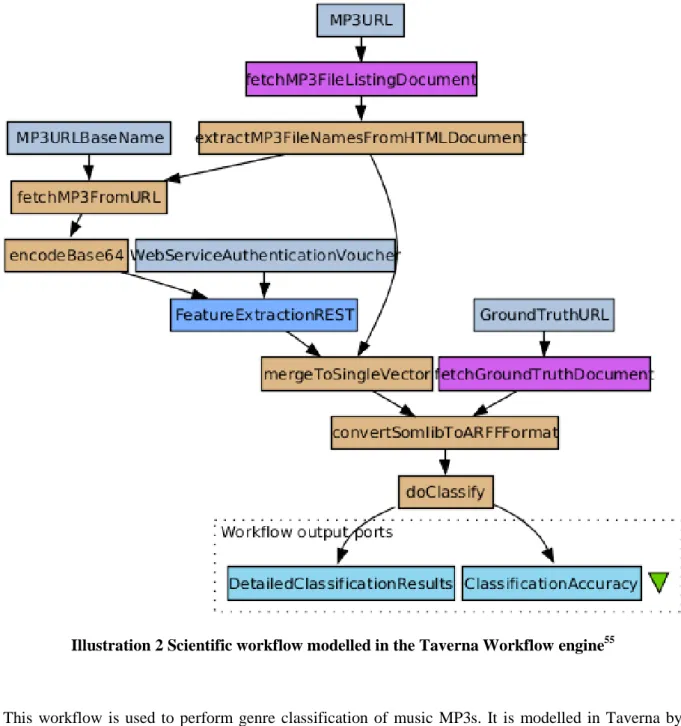
Scientific workflow is defined as the computer-assisted or automated execution of a scientific process, in whole or part, which usually streamlines a collection of scientific tasks with data channels and dataflow constructs to automate data computation and analysis to enable and accelerate scientific discovery. Such a workflow consists of various steps that require different computational processing units, the usage of various tools and the exchange between diverse systems. Specialized infrastructures and management tools are needed in order to orchestrate complex experiments. This class of applications is denoted as Scientific Workflow Management Systems (SWMS). Lin et al.50 define scientific workflow management systems as "systems that completely define, modify, manage, monitor, and execute scientific workflows through the execution of scientific tasks whose execution order is driven by a computerized representation of the workflow logic". In contrast to Virtual Research Environments, which focus on collaboration between researchers and the sharing of computational resources51, SWMS highlight the workflow paradigm and the orchestration of services. Taverna Workbench52 is an open source project that allows to design and run workflows. It is a general purpose workflow engine, which can be used for various applications. Taverna allows to orchestrate various local and remote services and to model the data flow between its components in order to automate a process. Therefore it is widely used in the scientific community and used for modelling data centric experiments. It is written in the programming language Java53 and distributed under the GNU Lesser General Public License (LGPL)54. Taverna provides a graphical user interface that allows scientists to design their experiments in a convenient way and to visualize the data flow of an experiment. An example of such a workflow is given in the figure below.
50
Lin, C., Lu, S., Fei,X., Chebotko, A., Pai, D., Lai, Z., Fotouhi, F., Hua , J.,(2009). A Reference Architecture for Scientific Workflow Management Systems and the VIEW SOA Solution. IEEE Transactions on Services Computing, 1(2), 79-92. doi 10.1109/TSC.2009.4 51 http://www.jisc.ac.uk/whatwedo/programmes/vre1 52 www.taverna.org.uk 53 www.java.com 54 www.gnu.org/licenses/lgpl.html
Grant Agreement 269977 PUBLIC 22 / 76
Illustration 2 Scientific workflow modelled in the Taverna Workflow engine55
This workflow is used to perform genre classification of music MP3s. It is modelled in Taverna by invoking different services (called processors) and performing various operations by providing the output of one step as input to further processing steps. Taverna provides various ready-to-use processors and can be extended by the use of the BeanShell56 scripting language. Furthermore, Taverna can invoke remote services via REST interfaces and it provides a repository for Web services that can easily be integrated into a workflow. This allows the orchestration of complex scientific workflows. By using a SWMS like Taverna scientific experiments can be automated and therefore rerun in precisely the same manner as the original experiment has been performed. The representation of a workflow as a graph is convenient for describing the causal sequence of the experimental steps
55 Mayer, R., Rauber, A., Neumann, M.A., Thomson, J., Antunes, G. (2012). Preserving scientific processes from design to
publication. Proceedings of the 15th International Conference on Theory and Practice of Digital Libraries (TPDL 2012)
56
Grant Agreement 269977 PUBLIC 23 / 76
and can also be used as a visualization tool for experiment design. Taverna logs details about the execution of a workflow in an internal database. This database contains provenance data, which can be used as additional metadata about the causal relationships between the invoked processors. This provenance data can be exported into different formats for further processing. Thus it is possible to store the data in the format of the Open Provenance Model, which is introduced in APARSEN-Report "Implementation and testing of an authenticity protocol on a specific domain" (2012).57
There exists a variety of SWMS for different purposes58, like Kepler59 or VisTrails60. They have different backgrounds and stem from communities having other research backgrounds. These systems have in common that they enable easy reproduction of defined workflows in scientific domains. Executing, rerunning or validating scientific experiments becomes much easier for scientists using these systems. Using complex computational models and workflow engines does have many benefits for scientists and publishers, but introduces new challenges regarding the preservation of research experiments.
1.3.3 Long term preservation of scientific experiments
Scientific workflows as described in the previous section are used to model complex experiments in a detailed and formal way. Hence, their course of actions and data flows are specified and can be understood, interpreted and reproduced by peers for the verification of the results of the corresponding experiment. Such workflows are often assembled of many individual steps, which themselves rely on third party libraries and external resources, such as Web services.
Using resources that are beyond the area of influence of an individual scientist is a risk factor for the preservation of scientific experiments. However external components are essential for many scientific workflows. Although the data flow of an experiment might be clearly defined, remote resources can be considered as a black box component that reacts on provided inputs by delivering the desired result. Their internal configuration or behaviour might be completely unknown and could be changed any time without prior information. This uncertainty impairs the reproducibility of research experiments whenever third party components or remote services are used61. The sample workflow described previously has several components that could cause problems because they rely on external resources. Web services can change their behaviour or become offline. Third party libraries can become obsolete as well and their maintenance can stop at any point in time. In contrast to Web services, local third party libraries have the advantage that they usually can be accessed and preserved for later reference. In the workflow depicted in Illustration 2 the sample data is retrieved from a remote Web server, which provides a set of music files for testing the classification algorithm. In the next step, these sample files are transmitted to a remote Web service, which extracts the feature vector. This Web service is also located on a remote machine and it is only known that it accepts one MP3 file at once and that it requires an authentication voucher, which prevents the service from being abused by non-authorized users. In a parallel step, the so called ground truth, to which the extracted features will be
57
http://aparsen.digitalpreservation.eu/pub/Main/ApanWp24/APARSEN-REP-D24_2-01-2_2.docx
58
Curcin,V., Ghanem, M.. Scientific workflow systems - can one size fit it all?. (2008). Biomedical Engineering Conference, CIBEC 2008.
59
www.kepler-project.org
60 www.vistrails.org 61
De Roure, D., Belhajjame, K., Missier, P., Gomez-Perez, M., Palma, R., Ruiz, J. (2011) Towards the preservation of scientific workflows. 8th International Conference on Preservation of Digital Objects iPRES 2011.
Grant Agreement 269977 PUBLIC 24 / 76
compared to, is retrieved from a different URL on a different server. In the next step, a local but external library is used in order to classify the music features against the ground truth and return the result. From a preservation perspective, preserving the music files and the ground truth, which have been downloaded from remote servers, can be archived in a classical way. If these files exist in an archive, they can be provided for later reference to the workflow in order to obtain the same results. More difficult is the preservation of Web services, as they can disappear from the Web or change their behaviour at any point in time. Therefore precise descriptions of the requirements of the Web service results and their analysis are crucial. By using the information gathered in previous executions of a workflow, a simulation of a service becomes a solution to some extent. Also, previous responses from a remote service can be preserved and used as dummy-services, in order to understand – and if necessary, to redevelop – the operation of a workflow at a later point in time.
Third party libraries introduce more complexity to a workflow. These libraries might have dependencies on local execution environments, which also have to be preserved in order to perpetuate the compatibility with other components of a workflow system and vice versa. Therefore, detailed documentation of the versions of software libraries, operating systems and other components in use is necessary in order to preserve the SWMS and its processing components. This small sample workflow already demonstrates the complexity of the preservation of scientific workflows. Although SWMS add another layer of complexity and issues a challenge to the preservation community, they enhance data quality and the reproduction of experiments.
1.3.4 Conclusions and outlook of executable publications and scientific
workflow management systems
Today, the majority of scientific experiments is at least partly based upon computational steps and would therefore benefit from new forms of scientific publications closely connected to underlying data and software. Such a close connection enhances data quality of the whole scientific process. It allows peers to reproduce results and thereby enhances the quality of the data and the publication. The reason for this enhancement is on the one hand based on the fact that researchers have to publish their data sets. On the other hand this data has to go through a review process itself. Scientific workbenches allow design complex experiments without detailed knowledge about the systems themselves and they provide precisely defined workflow models without a lot of extra effort. The biggest benefit for the research community is the possibility of rerunning and thereby reproducing scientific experiments, which enhances the quality of research dramatically. In order to keep the insights gained for posterity, these experiments and the research data have to be preserved in archives, which can be accessed many years later. This is still a challenge, as the experiments get more and more complex and rely on external resources, which are beyond the scope of a single administrative entity.