evaluating
missing
multivariate
nominal
scaled
data
Submitted
by
JOHANÉ
NIENKEMPER
‐
SWANEPOEL
Dissertation
presented
for
the
degree
of
Doctor
of
Philosophy
in
the
Department
of
Statistics
and
Actuarial
Science
in
the
Faculty
of
Economic
and
Management
Sciences
at
Stellenbosch
University.
Supervisor:
Professor
NJ
le
Roux
Co
‐
supervisor:
Professor
S
Gardner
‐
Lubbe
Declaration
By submitting this dissertation electronically, I declare that the entirety of the work contained
therein is my own, original work, that I am the sole author thereof (save to the extent explicitly
otherwise stated), that reproduction and publication thereof by Stellenbosch University will
not infringe any third party rights and that I have not previously in its entirety or in part
submitted it for obtaining any qualification.
Johané Nienkemper‐Swanepoel
Date: December 2019
Signature: (Declaration with signature in possession of candidate and supervisors.)
Abstract
This research aims at developing exploratory techniques that are specifically suitable for
missing data applications. Categorical data analysis, missing data analysis and biplot
visualisation are the three core methodologies that are combined to develop novel
techniques. Variants of multiple correspondence analysis (MCA) biplots are used for all
visualisations.
The first study objective addresses exploratory analysis after multiple imputation (MI).
Multiple plausible values are imputed for each missing observation to construct multiple
completed data sets for standard analyses. Biplot visualisations are constructed for each
completed data set after MI which require individual exploration to obtain final inference.
The number of MIs will greatly affect the accuracy and consistency of the interpretations
obtained from several plots. This predicament led to the development of GPAbin, to optimally
combine configurations from MIs to obtain a single configuration for final inference. The
GPAbin approach advances from two statistical techniques: generalised orthogonal
Procrustes analysis (GPA) and the combining rules used to combine estimates obtained from
MIs, Rubin’s rules.
Albeit a superior missing data handling approach, MI could be daunting for the non‐technical
practitioner. Therefore, an adequate alternative approach could be appealing and contribute
to the variety of available methods for the handling of incomplete multivariate categorical
data. The second objective aims at confirming whether visualisations obtained from non‐
imputed data sets are a suitable alternative to visualisations obtained from MIs. Subset MCA
(sMCA) distinguishes between observed and missing subsets of a multivariate categorical data
set by creating an additional response category level (CL) for missing responses in the
indicator matrix. Missing and observed responses can be visualised separately by only
considering the subset of interest in the recoded indicator matrix. The visualisation of the
observed responses utilises all available information which would have been forfeited by
deletion methods.
The third study objective explores the possibility of predicting a complete multivariate
categorical data set from MI visualisations obtained from the first study objective. The
responses. Since the aim of this research is to advance missing data visualisations, the
visualisations obtained from predicted completed data sets are compared to visualisations of
simulated complete data sets. The emphasis is on preserving inference and not recreating the
original data.
Missing data techniques are typically developed to address a specific missing data problem.
It is therefore crucial to understand the cause of missingness in order to apply suitable missing
data techniques. The fourth study objective investigates the sMCA biplot of the missing subset
of the recoded indicator matrix. Configurations of the incomplete subsets enable the
recognition of non‐response patterns which could provide insight into the particular missing
data mechanism (MDM). The missing at random (MAR) MDM refers to missing responses that
are dependent on the observed information and is expected to be identified by patterns and
groupings occurring in the incomplete sMCA biplot. The missing completely at random
(MCAR) MDM states that all observations have the same probability of not being captured
which could be identified by a random cloud of points in the incomplete sMCA biplot. Cluster
analysis is applied to confirm distinguishable groupings in the incomplete sMCA biplot which
could be used as a guideline to identify the MDM.
The proposed methodologies to address the different study objectives are evaluated by
means of an extensive simulation study comprising of various sample sizes, variables and
varying number of CLs which are simulated from three different distributions. The findings of
the simulation study are applied to a real data set to aid as a guide for the analysis.
Functions have been developed for R statistical software to perform all methodology
presented in this research. It is included as a tool pack provided as an appendix to assist in
the correct handling and unbiased visualisation of multivariate categorical data with missing
observations.
Keywords: biplots; categorical data; missing data; multiple correspondence analysis; multiple
Opsomming
Die doel van hierdie navorsing is om verkennende tegnieke te ontwikkel wat spesifiek vir
ontbrekende data geskik is. Kategoriese data‐analise, ontbrekende data‐analise en bi‐stipping
visualisering is die drie kern metodologieë wat gekombineer word om nuwe tegnieke te
ontwikkel. Variante van meervoudige ooreenkomsanalise bi‐stippings word gebruik vir alle
visualiserings.
Die eerste doelstelling fokus op die verkennende analise van datastelle nadat meervoudige
imputasie uitgevoer is. Meervoudige realistiese waardes word vir elke ontbrekende waarde
ingevul om sodoende meervoudige voltooide datastelle te konstrueer vir verdere standaard
analises. Bi‐stipping visualiserings word vir elke voltooide datastel na ‘n meervoudige
imputasie gekonstrueer. Aparte verkenning van die individuele visualiserings word vereis om
‘n finale inferensie te verkry. Die aantal meervoudige imputasies sal die akkuraatheid en
konsekwentheid van die interpretasies van verskeie stippings beïnvloed. Hierdie probleem
het tot die ontwikkeling van die GPAbin metode gelei om die meervoudige visualiserings van
meervoudige imputasies optimaal in een figuur vir ‘n finale inferensie te kombineer. Die
GPAbin metode vloei uit twee statistiese tegnieke voort: veralgemeende ortogonale
Procrustes analise en Rubin se reëls vir die samevoeging van beramings.
Alhoewel meervoudige imputasie bo ander tegnieke vir die hantering van ontbrekende data
verkies word, kan meervoudige imputasie uitdagend vir die nie‐tegniese gebruiker wees. ‘n
Voldoende alternatiewe tegniek kan aanloklik wees en tot die verskeidenheid van beskikbare
metodes vir die hantering van ontbrekende data bydra. Die tweede doelstelling poog dan juis
om vas te stel of visualiserings van nie‐geïmputeerde datastelle ‘n geskikte alternatief vir
visualiserings van meervoudige imputasies is. Sub‐meervoudige ooreenkomsanalise
onderskei tussen waargenome en ontbrekende deelversamelings van ‘n meerveranderlike
kategoriese datastel deur ekstra respons kategorievlakke vir ontbrekende waarnemings in die
indikatormatriks te skep. Ontbrekende en waargenome response kan apart gevisualiseer
word deur spesifieke deelversamelings in die indikatormatriks in ag te neem. Die visualisering
van waargenome response benut alle beskikbare inligting, dus word geen inligting verbeur
Die derde doelstelling ondersoek die moontlikheid om ‘n meerveranderlike kategoriese
datastel te voorspel vanaf meervoudige imputasie visualiserings wat in die eerste doelstelling
verkry is. Die afstand tussen die koördinate van ‘n bi‐stipping in die volle ruimte word gebruik
om realistiese responswaardes te voorspel. Aangesien die doel van hierdie navorsing is om
visualiserings vir ontbrekende data te bevorder, sal die visualiserings wat van ‘n voorspelde
datastel verkry word met die visualiserings van die oorspronklike gesimuleerde datastelle
vergelyk word. Die behoud van die oorspronklike inferensie is van belang en nie die
herskepping van die volledige oorspronklike data nie.
Tegnieke vir ontbrekende data word vir spesifieke ontbrekende data probleme ontwikkel. Dit
is dus noodsaaklik om die oorsaak van die ontbrekenheid te verstaan om sodoende toepaslike
ontbrekende data tegnieke toe te pas. Die vierde doelstelling fokus op die ontbrekende
deelversameling van die sub‐meervoudige ooreenkomsanalise bi‐stipping deur die
gekodeerde indikatormatriks te gebruik. Visualiserings van die onvolledige deelversamelings
maak die herkenning van nie‐respons patrone moontlik wat insig rakende die spesifieke
ontbrekende data meganisme verskaf. Die ewekansig ontbrekende meganisme verwys na
ontbrekende waarnemings wat afhanklik is van die waargenome responswaardes. Dit word
verwag dat hierdie meganisme sal lei tot patrone en groeperings in die sub‐meervoudige
ooreenkomsanalise bi‐stipping van die ontbrekende deelversameling. Wanneer alle
waarnemings dieselfde waarskynlikheid het om te ontbreek of waargeneem te word, word
dié meganisme as die algeheel ewekansig ontbrekende meganismse geklassifiseer. Aangesien
ontbrekende waardes onafhanklik van die waargenome waardes is, word dit verwag dat
hierdie meganisme geen merkbare patrone sal voortbring in die sub‐meervoudige
ooreenkomsanalise bi‐stipping nie. Trosanalise word toegepas om vas te stel of die visuele
groeperings betekenisvol van mekaar geskei kan word in die deelversameling sub‐
ooreenkomsanalise bi‐stipping geskei. Die graad van skeiding in die visualisering kan as ‘n
riglyn gebruik word om die ontbrekende data meganisme te identifiseer.
Die voorgestelde metodologieë om die verskillende doelwitte van hierdie studie aan te
spreek, word deur middel van ‘n omvangryke simulasie studie geëvalueer. Die simulasie
studie bevat datastelle met ‘n verskeidenheid van steekproefgroottes, aantal veranderlikes
Die bevindings van die simulasie studie word toegepas op ‘n bestaande datastel en dien as ‘n
gids vir die analise daarvan.
Funksies vir R statistiese sagteware is ontwikkel om alle metodes in hierdie navorsing te kan
uitvoer. Dit word as ‘n gereedskappakket in die bylae gegee om bystand te bied vir die
korrekte hantering en onsydige visualisering van meerveranderlike kategoriese data met
ontbrekende waardes.
Sleutelwoorde: bi‐stippings; kategoriese data; meervoudige imputasie; meervoudige
ooreenkomsanalise; ontbrekende data; Procrustes analise.
Acknowledgements
I wish to express my sincere gratitude and appreciation to the following persons and
institutions:
My Creator for blessing me with talents and equipping me for any and all obstacles on
my path. Thank you, Holy Spirit, for Your continuous guidance in everything that I
pursue. In You and through You I am able.
Psalm 37:3‐4 Afrikaanse Bybel 1983 Vertaling
My supervisors, Prof. Niël le Roux and Prof. Sugnet Lubbe.
I will always be indebted to you for the time you have invested in my future. Thank
you for sharing your knowledge and for always being available, your support have no
bounds. Thank you for your holistic approach to supervision and also taking my well‐
being into consideration. Thank you for creating opportunities to include me in the
exciting and evolving applications of multivariate data visualisations.
Prof. le Roux, thank you for noticing my potential since our first encounter in 2013 and
taking me under your ‘wing’.
My husband, Franré. Thank you for being my partner in every challenge and
celebration. Thank you for being invested in my research and always believing that the
completion of this dissertation was within reach. Thank you for your immeasurable
love and support.
My support system:
o Dorothy (my mother), Johan (my father) and Marisan (my sister).
Thank you for our daily conversations, your endless encouragement, moral support,
unconditional love and for always being proud of me.
A special thank you to my mother for imparting her love of research to me. Thank you
for taking the time to read through this dissertation.
My extended family and friends for your ongoing support and prayers.
Computations for the simulation study were performed using the University of
Stellenbosch’s HPC1 (Rhasatsha) and the University of Stellenbosch Central Analytical
Facilities’ HPC2 (CAF‐HPC1): http://www.sun.ac.za/hpc. A special thank you to
Gerhard Van Wageningen for his tireless technical assistance.
Mr. Johan van Rooyen and Mr. Chris Bosman for setting up a virtual machine for
computationally intensive tasks which I could access remotely.
The Teaching Development Grant National Collaborative Project for securing funding
for a study leave opportunity of six months in 2018.
Dr. Rachelle Bester for her assistance to utilise the HPC clusters.
Dr. Marietjie Vosloo for taking responsibility of my modules and presenting lectures
during my study leave.
Mr. Morney Engelbrecht for alleviating my administrative responsibilities in the final
two years of my PhD and for always showing interest in my progress.
The department of Genetics and the Faculty of AgriScience for granting me study leave
opportunities during my PhD and accommodating my research responsibilities.
To the examiners for their time and positive feedback.
Table of Contents
Declaration ... ii Abstract ... iii Opsomming ... v Acknowledgements ... viii Table of Contents ... xList of Figures ... xvi
List of Tables ... xxii
List of Abbreviations ... xxiv
Chapter 1 Rationale ... 1
1.1 Introduction ... 1
1.2 Data ... 2
1.3 Visualisations ... 2
1.4 Aim and study objectives ... 3
1.4.1 The GPAbin objective ... 4
1.4.2 The subset multiple correspondence analysis objective ... 6
1.4.3 The prediction objective ... 7
1.4.4 The missing data mechanism objective ... 7
1.5 Layout of the dissertation ... 9
Chapter 2 Multivariate categorical data: analysis and visualisation ... 10
2.1 Introduction ... 10
2.2 Historical overview of categorical data analysis ... 11
2.3 Indicator matrices ... 13 2.4 Dimension reduction ... 13 2.4.1 Square matrices ... 14 2.4.2 Rectangular matrices ... 15 2.5 Visualisation ... 17 2.5.1 Modest visualisation ... 17 2.5.2 Biplots ... 19 2.6 Correspondence analysis ... 21 2.6.1 Historical overview ... 22 2.6.2 Computations ... 23
2.7 Multiple Correspondence Analysis ... 29
2.7.1 Multiple correspondence analysis biplots ... 30
2.8 Principal component analysis ... 31
2.9 Orthogonal Procrustes analysis ... 32
2.9.1 Generalised orthogonal Procrustes analysis ... 33
2.10 Conclusion ... 35
Chapter 3 Missing data ... 36
3.1 Introduction ... 36
3.2 Missing data mechanisms ... 38
3.3 Missing data patterns ... 42
3.4 Handling techniques for missing data ... 43
3.4.1 Deletion ... 44
3.4.2 Data reconstruction ... 46
3.4.2.1 Missing passive modified margin ... 46
3.4.2.2 Active handling ... 46 3.4.2.3 Fuzzy coding ... 47 3.4.3 Weighting ... 49 3.4.4 Imputation ... 49 3.4.4.1 Single imputation ... 50 3.4.4.2 Multiple imputation ... 51 3.4.4.3 Rubin’s rules ... 54
3.4.4.4 Number of multiple imputations ... 55
3.5 Compositional data ... 57
3.6 Conclusion ... 58
Chapter 4 Methodology ... 59
4.1 Introduction ... 59
4.2 Imputation methods ... 63
4.2.1 Regularised iterative multiple correspondence analysis ... 63
4.2.1.1 Algorithm: Regularised iterative multiple correspondence analysis ... 64
4.2.1.2 Code: Regularised iterative multiple correspondence analysis ... 66
4.2.2 Multiple imputation using multiple correspondence analysis ... 69
4.2.2.1 Algorithm: Multiple imputation using multiple correspondence analysis ... 69
4.2.2.2 Code: Multiple imputation using multiple correspondence analysis algorithm ... 70
4.3 GPAbin ... 73
4.3.1 Optimally aligning multiple imputed configurations ... 73
4.3.2 Visual inspection ... 74
4.3.3 Combining the aligned multiple imputed configurations ... 78
4.4 Prediction methods ... 80
4.4.1 Majority rule prediction ... 80
4.4.2 GPAbin prediction ... 83
4.5 Subset multiple correspondence analysis ... 83
4.5.1 Code: Subset multiple correspondence analysis ... 85
4.6 Comparison with simulated data ... 86
4.6.1 Measures of comparison ... 89
4.6.2 Further visual comparison ... 92
4.6.3 Similarity percentage ... 94
4.7 Clustering ... 95
4.8 Conclusion ... 98
Chapter 5 Simulation Protocol ... 99
5.1 Introduction ... 99
5.2 Complete data sets: continuous ... 99
5.2.1 Uniform distribution ... 99
5.2.2 Skewed distribution ... 99
5.2.3 Symmetrical distribution ... 100
5.3 Complete data sets: categorical ... 100
5.4 Generating missingness ... 103
5.4.1 True percentages of missing values for missing at random simulations ... 105
5.4.2 Reproducibility of results ... 108
5.5 High performance computing ... 109
5.6 Conclusion ... 113
Chapter 6 Results: Missing data approaches ... 114
6.1 Introduction ... 114
6.2 Similarity percentages ... 115
6.3 Measures of comparison ... 125
6.3.1 Measures of bias ... 130
6.5 Conclusion ... 148
Chapter 7 Results: Prediction of categorical data sets ... 149
7.1 Introduction ... 149
7.2 Measures of comparison ... 150
7.3 Measures of bias ... 151
7.4 Measures of fit ... 155
7.5 Conclusion ... 161
Chapter 8 Results: Identification of the missing data mechanism ... 162
8.1 Introduction ... 162
8.2 Presentation of results ... 164
8.3 Subset multiple correspondence analysis biplots: missing subsets ... 166
8.4 Visualisations of silhouette coefficients ... 176
8.4.1 Scatterplots and stacked bar plots (10% missingness) ... 177
8.4.2 Scatterplots and stacked bar plots (30% missingness) ... 183
8.4.3 Scatterplots and stacked bar plots (50% missingness) ... 188
8.4.4 Heat maps of silhouette coefficients ... 191
8.5 Limited multiple active results ... 197
8.6 Conclusion ... 197
Chapter 9 Real data application ... 199
9.1 Introduction ... 199
9.2 Variable information ... 200
9.3 MDM identification ... 203
9.4 Missing data approach for real application ... 205
9.4.1 Multiple imputation and generalised orthogonal Procrustes analysis ... 205
9.4.2 GPAbin and subset multiple correspondence analysis biplots ... 208
9.4.3 Comparison of GPAbin and subset multiple correspondence analysis biplots ... 212
9.5 Conclusion ... 213
Chapter 10 Concluding remarks ... 214
10.1 Review ... 214
10.2 Future work ... 216
10.3 Impact of this research ... 217
Reference list ... 218
Appendix ... 231
A.1 Creating complete categorical data sets ... 231
A.2 Creating a MAR MDM ... 232
A.3 Creating an MCAR MDM ... 234
Appendix B OPA function ... 234
Appendix C Fit measures ... 235
C.1 Measures of comparison... 235
C.2 Similarity percentage ... 236
Appendix D GPA function ... 237
Appendix E GPAbin ... 239
Appendix F Functions related to RIMCA ... 239
F.1 Single imputation call functions ... 239
F.2 Estimating the number of dimensions ... 240
F.3 Adapted RIMCA function ... 243
Appendix G Functions related to MIMCA ... 245
G.1 Multiple imputation call functions ... 245
G.2 Adapted MIMCA function ... 246
Appendix H Majority rule prediction ... 248
H.1 Majority rule prediction call functions ... 248
H.2 Category predictions from multiple imputed configurations ... 249
H.3 Assigning the final category levels of multiple predicted data sets ... 251
Appendix I GPAbin prediction ... 252
I.1 GPAbin prediction call functions ... 252
I.2 GPAbin prediction function ... 253
Appendix J sMCA ... 254
J.1 sMCA call functions ... 254
J.2 Adapted mjca() function ... 256
Appendix K Cluster analysis ... 257
Appendix L Auxiliary functions ... 257
L.1 Removing empty factor levels ... 257
L.2 Removing variables with one category level ... 258
L.3 Creating missing category levels ... 258
L.4 Formatting of a dataframe to a factor ... 259
L.7 Determining the number of elements in the upper triangle of a matrix ... 261
L.8 Formatting data ... 261
Appendix M Example of script file submitted to PBS ... 263
Appendix N Plotting functions ... 265
N.1 MCA biplot ... 265
N.2 Stacked barplots ... 265
Appendix O Measures of comparison: missing data approaches ... 266
O.1 Mean bias: GPAbin and RIMCA (MAR MDM) ... 266
O.2 Mean bias: GPAbin and RIMCA (MCAR MDM) ... 267
Appendix P Measures of comparison: prediction of categorical data sets ... 269
P.1 Heat map of MB values for prediction methods... 269
P.2 Selection of density plots of prediction methods compared to GPAbin ... 270
Appendix Q sMCA biplots: missing subsets ... 278
List of Figures
Figure 2.1 Bigraph of five samples (circles) and two categorical variables (squares: two CLs and
triangles: three CLs). ... 18
Figure 2.2 Attraction graph of professions (circles) and qualities (triangles). ... 18
Figure 3.1 Missing data patterns. Left panel: Univariate pattern. Middle panel: Monotone pattern. Right panel: Arbitrary pattern. ... 42
Figure 3.2 Illustration of the steps of MI ... 51
Figure 4.1 Schematic representation of the GPAbin objective (cf. 1.4.1). ... 60
Figure 4.2 Schematic representation of the sMCA objective (cf. 1.4.2). ... 61
Figure 4.3 Schematic representation of the prediction objective (cf. 1.4.3). ... 62
Figure 4.4 Schematic representation of the MDM objective (cf. 1.4.4). ... 63
Figure 4.5 Illustration of MCA biplots constructed from ten MIs using MIMCA. Each panel represents an MCA biplot for a particular MI for the example data set (10% missing values with a MAR MDM with five variables and 1000 samples simulated from a uniform distribution). ... 72
Figure 4.6 Illustration of CLPs before and after GPA for ten MIs. Each panel represents the CLPs for a particular MI for the example data set (10% missing values with a MAR MDM with five variables and 1000 samples simulated from a uniform distribution). ... 75
Figure 4.7 Illustration of transformed GPA MCA biplots for ten MIs. Each panel represents the GPA MCA biplot for a particular MI for the example data set (10% missing values with a MAR MDM with five variables and 1000 samples simulated from a uniform distribution). .... 77
Figure 4.8 Superimposed CLPs from Figure 4.7 for the example data set (10% missing values with a MAR MDM with five variables and 1000 samples simulated from a uniform distribution). ... 78
Figure 4.9 The GPAbin biplot for the example data set (10% missing values with a MAR MDM with five variables and 1000 samples simulated from a uniform distribution). ... 79
Figure 4.10 Illustration of predictions from MCA biplots after MIMCA (cf. Figure 4.5) for the third sample of the example data set (10% missing values with a MAR MDM with five variables and 1000 samples simulated from a uniform distribution). ... 82
Figure 4.11 Illustration of predictions from GPAbin biplot (cf. Figure 4.9) for the third sample of the example data set (10% missing values with a MAR MDM with five variables and 1000 samples simulated from a uniform distribution). ... 83
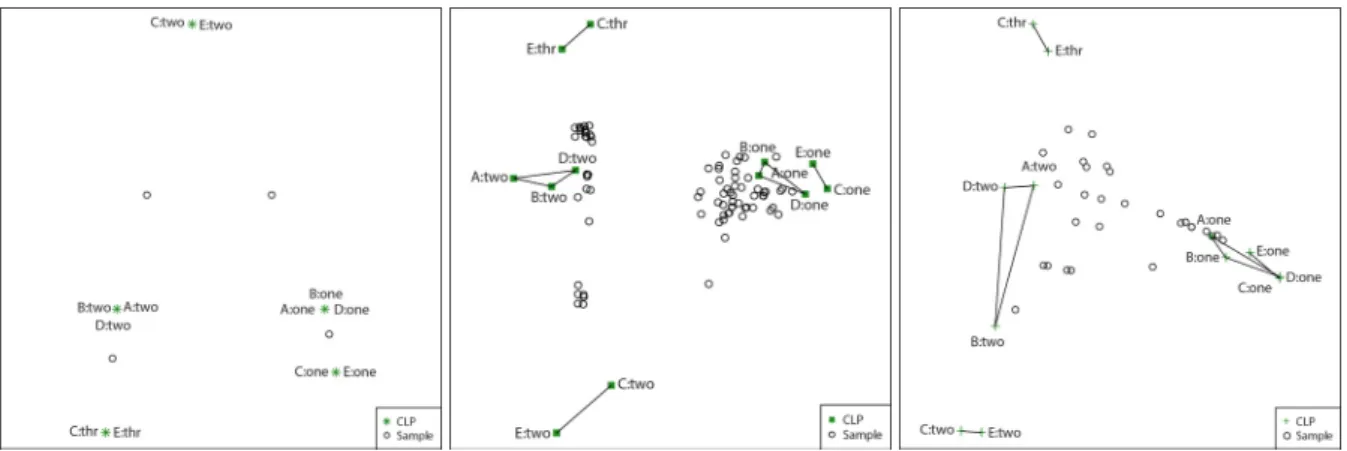
Figure 4.12 The sMCA biplot (observed subset) for the example data set (10% missing values with a MAR MDM with five variables and 1000 samples simulated from a uniform distribution). ... 86 Figure 4.13 Comparison of visualisation approaches for missing data compared to the complete MCA biplot. Left panel: complete MCA biplot (five variables and 1000 samples simulated from
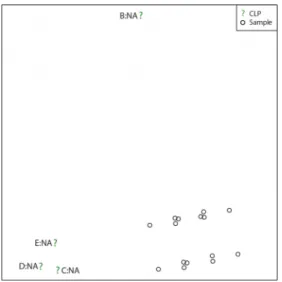
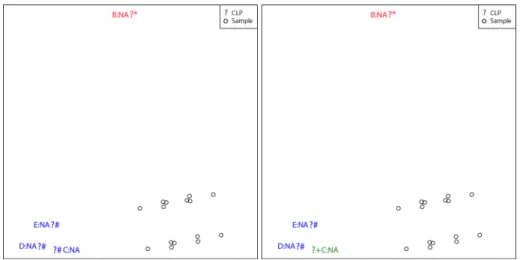
biplot (complete subset) (cf. Figure 4.12). Middle‐ and right panels: 10% missing values with a MAR MDM with five variables and 1000 samples simulated from a uniform distribution. ... 87 Figure 4.14 The CLP plot for the target configuration (CLPs from complete MCA) and testee (CLPs from GPAbin biplot) configuration before OPA. ... 88 Figure 4.15 The OPA steps. Left panel: Reflection and rotation of testee CLPs (GPAbin CLPs). Middle panel: Scaling of updated CLPs (reflected and rotated). Right panel: Target CLPs compared to updated testee CLPs. ... 89 Figure 4.16 Manually constructed convex hulls to mimic groupings in complete biplots. Left panel: complete MCA biplot (five variables and 100 samples simulated from a uniform distribution). Middle panel: GPAbin biplot. Right panel: sMCA biplot (complete subset). Middle‐ and right panels: 50% missing values with a MAR MDM with five variables and 100 samples simulated from a uniform distribution. ... 93 Figure 4.17 The sMCA biplot (missing subset) of the additional example data set (50% missing values with a MAR MDM with five variables and 100 samples simulated from a uniform distribution). ... 96 Figure 4.18 The pam clustering of CLPs in an sMCA biplot (missing subset) of the additional example data set (50% missing values with a MAR MDM with five variables and 100 samples simulated from a uniform distribution). Left panel: 2 → 0.6800. Right panel:
3 → 0.1848. ... 98 Figure 5.1 MCA biplots for Dirichlet simulations Left panel: 100, 5. Middle panel:
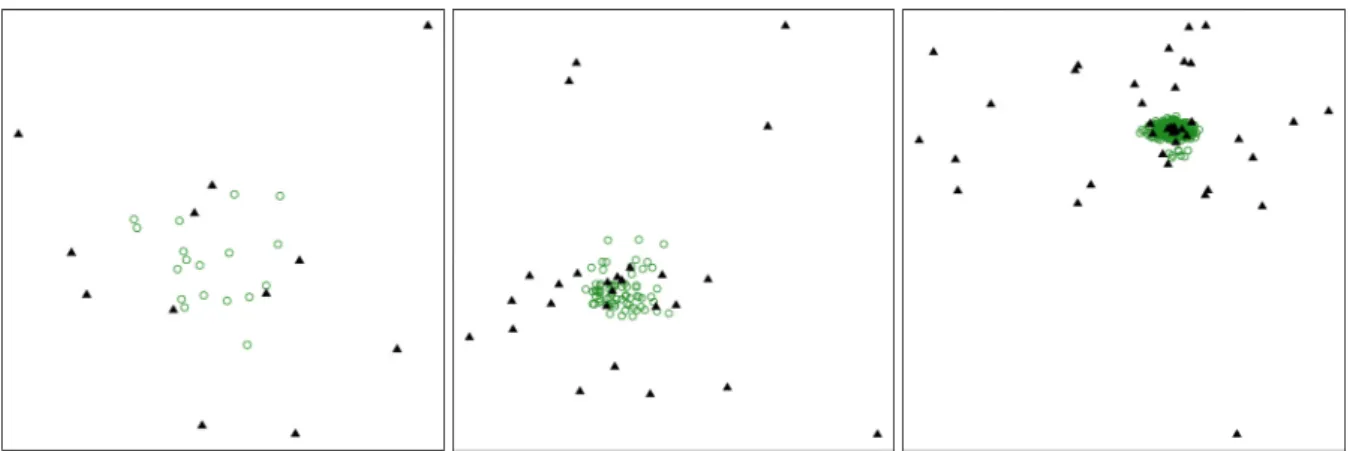
100, 10. Right panel: 3000, 15. Sample points are depicted by green open circles and CLPs by black triangles. ... 101 Figure 5.2 MCA biplots for uniform simulations. Left panel: 100, 5. Middle panel:
100, 10. Right panel: 3000, 15. Sample points are depicted by green open circles and CLPs by black triangles. ... 102 Figure 5.3 MCA biplots for normal simulations. Left panel: 100, 5. Middle panel:
100, 10. Right panel: 3000, 15. Sample points are depicted by green open circles and CLPs by black triangles. ... 102 Figure 5.4 MCA biplot with CLP labels of Figure 5.3 (left panel) ... 103 Figure 5.5 True percentage of missing values for Dirichlet simulations. Left panels: MAR 10% (mean missing values: 9.97%, minimum missing value percentage: 9.2%). Middle panels: MAR 30% (mean missing values: 29.4%, minimum missing value percentage: 20.1%). Right panels: MAR 50% (mean missing values: 38.8%, minimum missing value percentage: 20.1%). The simulations are sorted in the upper panels. ... 106 Figure 5.6 True percentage of missing values for uniform simulations. Left panels: MAR 10% (mean missing values: 9.96%, minimum missing value percentage: 9.3%). Middle panels: MAR 30% (mean missing values: 29.8%, minimum missing value percentage: 21.1%). Right panels: MAR 50% (mean missing values: 42.1%, minimum missing value percentage: 21.1%). The simulations are sorted in the upper panels. ... 107
Figure 5.7 True percentage of missing values for normal simulations. Left panels: MAR 10% (mean missing values: 9.96%, minimum missing value percentage: 9.2%). Middle panels: MAR 30% (mean missing values: 29.8%, minimum missing value percentage: 15.3%). Right panels: MAR 50% (mean missing values: 46.0%, minimum missing value percentage: 15.3%). The simulations are sorted in the upper panels. ... 108 Figure 6.1 Similarity percentages of all simulation scenarios for GPAbin, sMCA and RIMCA. ... 116 Figure 6.2 Density ridge plots to illustrate skewness of measures of comparison. A selection of simulation scenarios are illustrated. ... 127 Figure 6.3 AMB values per simulation scenario over 1000 repetitions (comparison in two dimensions). Left panel: Median AMB values. Right panel: Mean AMB values. ... 130 Figure 6.4 sMCA approach: 50% missing values with a MAR MDM for the three simulation distributions. ... 131 Figure 6.5 MB values per simulation scenario over 1000 repetitions (comparison in two dimensions). Left panel: Median MB values. Right panel: Mean MB values. ... 132 Figure 6.6 Scatterplots of the MB values for the sMCA method (MAR MDM). Left panels: 10% missing values. Middle vertical panels: 30% missing values. Right panels: 50% missing values. Upper panels: Dirichlet distribution. Middle horizontal panels: uniform distribution. Lower panel: normal distribution. ... 133 Figure 6.7 Scatterplots of the MB values for the sMCA method (MCAR MDM). Left panels: 10% missing values. Middle vertical panels: 30% missing values. Right panels: 50% missing values. Upper panels: Dirichlet distribution. Middle horizontal panels: uniform distribution. Lower panel: normal distribution. ... 134 Figure 6.8 RMSB values per simulation scenario over 1000 repetitions (comparison in two dimensions). Left panel: Median RMSB values. Right panel: Mean RMSB values. ... 135 Figure 6.9 PS values per simulation scenario over 1000 repetitions (comparison in two dimensions). Left panel: Median PS values. Right panel: Mean PS values. ... 137 Figure 6.10 Scatterplots of PS values for the GPAbin approach across all simulation scenarios. .... 140 Figure 6.11 Scatterplots of PS values for the RIMCA approach across all simulation scenarios. ... 141 Figure 6.12 Scatterplots of PS values for the sMCA approach across all simulation scenarios. ... 142 Figure 6.13 CC values per simulation scenario over 1000 repetitions (comparison in two dimensions). Left panel: Median CC values. Right panel: Mean CC values. ... 143 Figure 6.14 Scatterplots of normal distribution simulations: 50% missing values and MAR MDMs. Left panel: GPAbin. Middle panel: sMCA. Right panel: RIMCA. ... 144 Figure 6.15 Measures of comparison values per simulation scenario over 1000 repetitions (comparison in maximum dimensions). Left panel: Mean RMSB values. Right panel: Mean AMB values. ... 146 Figure 6.16 Mean PS values per simulation scenario over 1000 repetitions (comparison in maximum dimensions). ... 147
Figure 7.1 Measures of comparison values per simulation scenario over 1000 repetitions (comparison in two dimensions). Left panel: Mean AMB values. Right panel: Mean RMSB values. ... 152 Figure 7.2 Kernel density estimates of AMB values for prediction methods (MCN 30% missing values). ... 153 Figure 7.3 Kernel density estimates of AMB values for prediction methods (MC 50% missing values).
... 154 Figure 7.4 Measures of fit values per simulation scenario over 1000 repetitions (comparison in two dimensions). Left panel: Mean PS values. Right panel: Mean CC values. ... 156 Figure 7.5 PS values: Dirichlet distribution (GPAbin prediction, Majority rule prediction and GPAbin)
... 158 Figure 7.6 PS values: Uniform distribution (GPAbin prediction, Majority rule prediction and GPAbin)
... 159 Figure 7.7 PS values: Normal distribution (GPAbin prediction, Majority rule prediction and GPAbin)
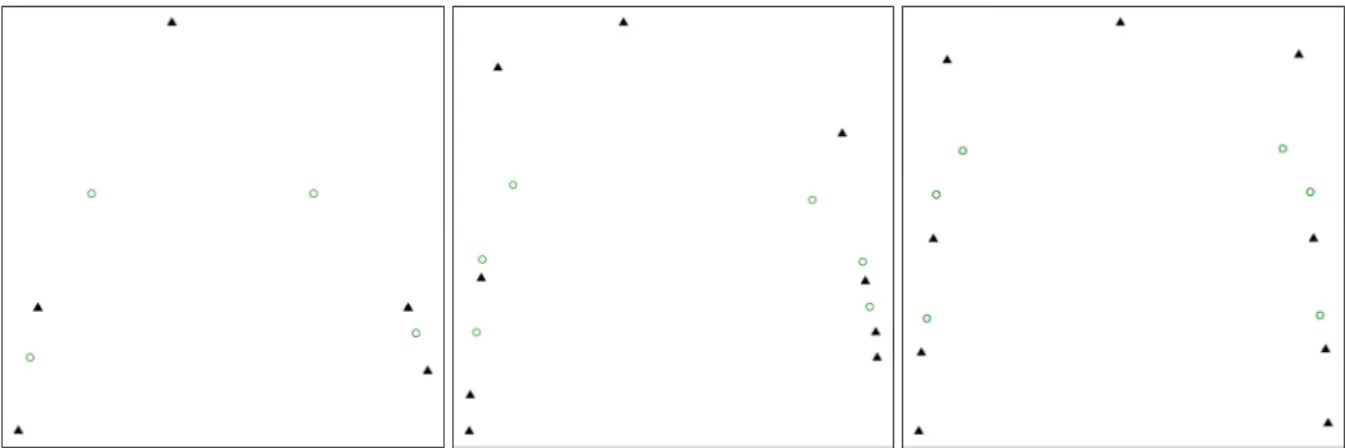
... 160 Figure 8.1 sMCA biplots for the missing subsets of a selected repetition ( 100, 5). Sample points are depicted by green open circles and CLPs by black triangles. Take note that the number of CLPs of the MAR simulations is one less than the number of MCAR CLPs (cf. 5.4). ... 167 Figure 8.2 sMCA biplots for the missing subsets of a selected repetition ( 100, 10). Sample points are depicted by green open circles and CLPs by black triangles. Take note that the number of CLPs of the MAR simulations is one less than the number of MCAR CLPs (cf. 5.4). ... 168 Figure 8.3 sMCA biplots for the missing subsets of a selected repetition ( 100, 15). Sample points are depicted by green open circles and CLPs by black triangles. Take note that the number of CLPs of the MAR simulations is one less than the number of MCAR CLPs (cf. 5.4). ... 169 Figure 8.4 sMCA biplots for the missing subsets of a selected repetition ( 1000, 5). Sample points are depicted by green open circles and CLPs by black triangles. Take note that the number of CLPs of the MAR simulations is one less than the number of MCAR CLPs (cf. 5.4). ... 170 Figure 8.5 sMCA biplots for the missing subsets of a selected repetition ( 1000, 10). Sample points are depicted by green open circles and CLPs by black triangles. Take note that the number of CLPs of the MAR simulations is one less than the number of MCAR CLPs (cf. 5.4). ... 171 Figure 8.6 sMCA biplots for the missing subsets of a selected repetition ( 1000, 15). Sample points are depicted by green open circles and CLPs by black triangles. Take note that the number of CLPs of the MAR simulations is one less than the number of MCAR CLPs (cf. 5.4). ... 172 Figure 8.7 sMCA biplots for the missing subsets of a selected repetition ( 3000, 5). Sample
number of CLPs of the MAR simulations is one less than the number of MCAR CLPs (cf. 5.4). ... 173 Figure 8.8 sMCA biplots for the missing subsets of a selected repetition ( 3000, 10). Sample points are depicted by green open circles and CLPs by black triangles. Take note that the number of CLPs of the MAR simulations is one less than the number of MCAR CLPs (cf. 5.4). ... 174 Figure 8.9 sMCA biplots for the missing subsets of a selected repetition ( 3000, 15). Sample points are depicted by green open circles and CLPs by black triangles. Take note that the number of CLPs of the MAR simulations is one less than the number of MCAR CLPs (cf. 5.4). ... 175 Figure 8.10 Silhouette coefficients of the Dirichlet distribution (10% missingness). Upper panels: MAR MDM. Lower panels: MCAR MDM. Left panels: scatterplots. Right panels: stacked bar plots. ... 177 Figure 8.11 Silhouette coefficients of the uniform distribution (10% missingness). Upper panels: MAR MDM. Lower panels: MCAR MDM. Left panels: scatterplots. Right panels: stacked bar plots. ... 180 Figure 8.12 Silhouette coefficients of the normal distribution (10% missingness). Upper panels: MAR MDM. Lower panels: MCAR MDM. Left panels: scatterplots. Right panels: stacked bar plots. ... 182 Figure 8.13 Silhouette coefficients of the Dirichlet distribution (30% missingness). Upper panels: MAR MDM. Lower panels: MCAR MDM. Left panels: scatterplots. Right panels: stacked bar plots. ... 184 Figure 8.14 Silhouette coefficients of the uniform distribution (30% missingness). Upper panels: MAR MDM. Lower panels: MCAR MDM. Left panels: scatterplots. Right panels: stacked bar plots. ... 185 Figure 8.15 Silhouette coefficients of the normal distribution (30% missingness). Upper panels: MAR MDM. Lower panels: MCAR MDM. Left panels: scatterplots. Right panels: stacked bar plots. ... 186 Figure 8.16 Silhouette coefficients of the Dirichlet distribution (50% missingness). Upper panels: MAR MDM. Lower panels: MCAR MDM. Left panels: scatterplots. Right panels: stacked bar plots. ... 188 Figure 8.17 Silhouette coefficients of the uniform distribution (50% missingness). Upper panels: MAR MDM. Lower panels: MCAR MDM. Left panels: scatterplots. Right panels: stacked bar plots. ... 189 Figure 8.18 Silhouette coefficients of the normal distribution (50% missingness). Upper panels: MAR MDM. Lower panels: MCAR MDM. Left panels: scatterplots. Right panels: stacked bar plots. ... 190 Figure 8.19 Heat map of the percentage of silhouette coefficients above 0.5 for 30% missingness.
Figure 8.21 Heat map of the percentage of silhouette coefficients above 0.6. ... 195 Figure 9.1 Bar graphs of each variable in the adapted survey: 1 – agree, 2 – neutral, 3 – disagree, NA – missing ... 202 Figure 9.2 sMCA biplot: missing subset of real data application. Left panel: standard sMCA biplot display. Right panel: sMCA biplot with samples colour coded according to educational level and represented as convex hulls. ... 203 Figure 9.3 Illustrating allocated clusters for the sMCA biplot (missing subset) of the real data application. Left panel: 2 → 0.7832. Middle panel: 3 → 0.5016. Right panel: 4 → 0.5805. ... 204 Figure 9.4 Illustration of CLPs before and after GPA for ten MIs. Each panel represents the CLPs for a particular MI for the real data application. ... 206 Figure 9.5 Superimposed transformed CLPs from Figure 9.4 for the real data application. ... 207 Figure 9.6 Left panel: Convex hulls of superimposed CLPs after GPA. Right panel: Colour coded convex hulls with increasing colour intensity according to the percentage of missing values ... 208 Figure 9.7 Left panel: GPAbin biplot. Right panel: CLP descriptions of GPAbin biplot. ... 208 Figure 9.8 Left panel: sMCA biplot. Right panel: CLP descriptions of sMCA biplot. ... 209 Figure 9.9 Colour coded CLPs according to the response level. Left panel: GPAbin biplot. Right panel: sMCA biplot. ... 210 Figure 9.10 GPAbin biplots with convex hulls for sample separation based on demographic information. Top panels: Gender (left), Region (middle) and Marital status (right). Lower panels: Education (left) and Age (right). ... 211 Figure 9.11 sMCA biplots with convex hulls for sample separation based on demographic information. Top panels: Gender (left), Region (middle) and Marital status (right). Lower panels: Education (left) and Age (right) ... 212
List of Tables
Table 2.1 Toy data set ... 13 Table 3.1 Toy data set with missing values ... 44 Table 3.2 Adapted toy data set with missing values ... 48 Table 4.1 Measures of comparison for the GPAbin CLPs of the example data set (10% missing values with a MAR MDM with five variables and 1000 samples simulated from a uniform distribution) compared to the CLPs of the complete MCA biplot (five variables and 1000 samples simulated from a uniform distribution). ... 92 Table 4.2 Similarity percentages obtained from GPAbin and sMCA when compared to the complete MCA biplot in two dimensions, respectively. Example data set: 10% missing values with a MAR MDM with five variables and 1000 samples simulated from a uniform distribution ... 95 Table 5.1 Allocating CLs from continuous values ... 101 Table 5.2 The number of cores used for the computations of uniform distribution simulations with 50% missing values inserted with an MCAR MDM... 111 Table 5.3 The RAM (in GB) used for the computations of uniform distribution simulations with 50% missing values inserted with an MCAR MDM. ... 112 Table 5.4 The walltime (in minutes) used for the computations of uniform distribution simulations with 50% missing values inserted with an MCAR MDM. ... 112 Table 6.1 Abbreviations for simulation distributions and MDMs ... 114 Table 6.2 Coefficients of variation of similarity percentages (GPAbin, sMCA and RIMCA) for all simulation scenarios. Values above 3% are indicated in bold font. ... 118 Table 6.3 Similarity percentages of simulation scenarios with 30% missing values with a coefficient of variation greater than 3% between approaches (bold values of Table 6.2). ... 119 Table 6.4 Similarity percentages of simulation scenarios with 50% missing values with a coefficient of variation greater than 3% between approaches (bold values of Table 6.2). ... 120 Table 6.5 Similarity percentages below 75% for simulation scenarios with 10% missing values. Investigating the percentages of Figure 6.1. ... 121 Table 6.6 Similarity percentages below 75% for simulation scenarios with 30% missing values. Investigating the percentages of Figure 6.1. ... 122 Table 6.7 Similarity percentages below 75% for simulation scenarios with 50% missing values. Investigating the percentages of Figure 6.1. ... 123 Table 6.8 Ranges for measures of comparison: missing data approaches ... 128 Table 6.9 Top 10% ranges for measures of comparison: missing data approaches ... 129 Table 7.1 Ranges for measures of comparison: prediction methods. ... 150 Table 7.2 Top 10% ranges for measures of comparison: prediction methods ... 150
Table 9.2 Variable information for demographic questions of ISSP 1994. ... 201 Table 9.3 Measures of comparison: GPAbin and sMCA real application ... 213
List of Abbreviations
Acronyms
CART Classification and regression trees
MAR Missing at random
OPA Orthogonal Procrustes analysis
MIMCA Multiple imputation using multiple correspondence analysis
pam partitioning around medoids
RAM Random‐access memory
RIMCA Regularised iterative multiple correspondence analysis
Initialisms
AMB Absolute mean bias
CA Correspondence analysis
CC Congruence coefficient
CL Category level
CLs Category levels
CLP Category level point
CLPs Category level points
EM Expectation‐Maximisation
FCS Fully conditional specification
GB Gigabyte
GPA Generalised orthogonal Procrustes analysis
GSVD Generalised singular value decomposition
MA Data simulated from a uniform distribution with a missing at random missing
data mechanism
MAD Data simulated from a Dirichlet distribution with a missing at random missing
data mechanism
MAN Data simulated from a normal distribution with a missing at random missing
data mechanism
MB Mean bias
MC Data simulated from a uniform distribution with a missing completely at
random missing data mechanism
MCA Multiple Correspondence analysis
MCD Data simulated from a Dirichlet distribution with a missing completely at
random missing data mechanism
MCN Data simulated from a normal distribution with a missing completely at
random missing data mechanism
MDM Missing data mechanism
MDS Multidimensional scaling
MI Multiple imputation
MIs Multiple imputations
MSEP Mean square error of prediction
PS Procrustes Statistic
RMSB Root mean squared bias
sCA Subset correspondence analysis
SI Single imputation
sMCA Subset multiple correspondence analysis
SVD Singular value decomposition
Combination of acronyms and intialisms
GPAbin Generalised Procrustes analysis and Rubin’s rules
‘GPA’ – initialism and ‘bin’ – acronym
MCAR Missing completely at random
‘M’ – initialism and ‘CAR’ – acronym
MNAR Missing not at random
‘M’ – initialism and ‘NAR’ – acronym
Chapter 1
Rationale
1.1 Introduction
Missing data have become a prevalent problem which is in a sense inseparable from data
collection. Over the past decades, proper missing data handling techniques have been
developed and applied for the imputation of missing data sets (Van Buuren, 2012). Various
imputation techniques are available to substitute missing observations with plausible
response values. Single imputation (SI) is the substitution of a single plausible response for
each missing observation, which is easy to apply but generally results in biased estimation, as
the standard errors are underestimated (Rubin, 1987). Multiple imputation (MI) is the
preferred method that generates several plausible values for each missing value until a
predetermined number of data sets are imputed. This results in unbiased representation of
the missing observations, as it provides a distribution of plausible responses to capture the
uncertainty involved in the task of imputation. Standard analyses for complete data are then
applied to the multiple data sets and the estimates of interest can be combined to formulate
a final inferential statement (Rubin, 1987; Schafer, 1997; Van Buuren, 2012). The study of MI
might be considered somewhat controversial, because the imputations are not applied with
the aim of obtaining a final completed data set, but rather to preserve the population
variation and, most importantly, the relationships between variables (Wayman, 2003).
The importance of both SI and MI is acknowledged and the development of MI should not be
regarded as a replacement for SI, but rather an improvement to handle missing data in more
complex scenarios. In some cases, however, the aim might be to only obtain one completed
data set to be used by field specialists, and therefore SI is still relevant. Nevertheless, from an
analyst’s perspective, there is much to be gained from the unbiased estimation of the
variation when using MI.
The study of data imputation remains a growing topic of interest, but visualisations for
missing data and completed data have not yet been placed on the foreground of statistical
analysis (Eaton, Plaisant & Drizd, 2005; Fernstad, 2019; Templ, Alfons & Filzmoser, 2012).
could lead to biased inference. Therefore, this study focusses on the development of
appropriate exploratory techniques for multivariate categorical missing data and multiple
imputed data sets. In a recent review on missing data protocols the remark was made that
“new research on diagnostics and visualisation may inform analyses with missing values”
(Josse & Reiter, 2018: 141). This is motivation that the developments in this research will
address current missing data issues and contribute to the science of handling missing data.
In this study, three core methodologies will be extended and combined, namely multivariate
categorical data analysis, missing data analysis and biplot visualisation.
1.2 Data
Only nominal scaled multivariate categorical data are considered in this study. Consider a set
of individuals where measurements are made for each individual (referred to as a sample) on
a set of categorical questions (referred to as variables). A nominal scaled measurement on a
categorical variable can only be one of a finite unordered number of qualities, for example
hair colour: red, blonde or brunette. There is no specific order of importance of the qualitative
response options (Agresti, 2007). These qualities are referred to as the category levels (CLs)
of a categorical variable. Typically, the categorical variables are represented as the columns
of a matrix and the samples as its rows. The proposed methodology will be applied to a variety
of simulated data scenarios (cf. Chapter 5) consisting of combinations from different
distributions, dimensions, percentages of missing values and missing data mechanisms
(MDMs). The results obtained from a real application are presented in Chapter 9.
1.3 Visualisations
Multiple correspondence analysis (MCA) is a multivariate categorical technique that enables
the simultaneous exploration of samples and their different qualitative responses measured
for all the categorical variables. The focus of MCA is to obtain an understanding of how the
samples are associated based on their responses to variables. Samples are regarded as similar
if they have a majority of the same responses to variables (i.e. CLs). The main interest is the
Husson, 2012). Even though quantities of association can be calculated, it is only truly
understood when it is visualised (Beh & Lombardo, 2014). Biplots are constructed from MCA
solutions for visual inspections of the categorical data. Biplots are regarded as multivariate
scatterplots approximated in lower dimension, in which multiple variables and samples are
represented in a single configuration. The biplot display enables the immediate grasp of
response patterns and associations between samples based on the distances between
coordinates in the display space. Points in close proximity are regarded as being highly
associated and reflect individuals with similar response profiles. The biplot consists of sample
coordinates, one for each sample, and category level points (CLPs), one for each CL of a
particular variable. Each sample is positioned such that the response CL will be in close
proximity in the approximated two‐dimensional space. Biplots are typically displayed in two
dimensions. However, the prefix, ‘bi’, does not refer to the dimension of the display space,
but refers to the simultaneous representation of both samples and CLPs (Gower & Hand,
1996; Husson et al., 2011). The term ‘configurations’ will refer to MCA biplots throughout the
dissertation.
Computational power and sufficient software have greatly influenced the use and popularity
of exploratory analysis (Unwin, Chen & Härdle, 2008). Because multiple visualisations can be
produced within seconds, the adequate interpretation of the resulting large number of
visualisations can become overwhelming. This is an additional branch of data science and big
data.
There is a need for methodology to provide unbiased combined visual representations of
different variations of the same data. This will allow the evaluation of the subtle differences
between multiple visualisations that could be lost when examining a large number of
individual graphical displays.
1.4 Aim and study objectives
The aim of this research is to develop unbiased visualisations for multivariate categorical
Obtaining an unbiased single visualisation after MI
Determining the applicability of visualisations without prior imputation
Obtaining a single completed categorical data set using predictions from visualisations
Identifying the MDM using visualisation.
The four study objectives can be achieved by formulating novel methodologies by unifying
the concepts of categorical data analysis, missing data analysis and data visualisation.
Simulated data play a vital role in the evaluation of missing data techniques. Simulation
enables the comparison of inferences obtained from complete data and completed data of
the same initial simulated data set. Therefore, an extensive simulation study is called for to
evaluate the methodology of the four study objectives when applied to various missing data
scenarios.
1.4.1 The GPAbin objective
The first objective is to optimally combine the configurations obtained from MIs of
multivariate categorical data with missing data entries into a single biplot display.
A single visualisation for MIs can enhance the exploratory analysis of incomplete data. The
visualisation of combined MIs has not yet been explored to aid in the understanding of the
variation between the imputations. Visualisations of MIs have been projected as
supplementary points onto a reference framework for continuous data using principal
component analysis (PCA) by Josse and Husson (2012). Procrustes analysis was used to align
the imputation visualisations to a reference set individually in order to evaluate the variation
between the imputations. Apart from using confidence ellipses to illustrate the uncertainty
between MIs, no concrete measure was used to evaluate the success of the projection
methods.
Since MCA is a suitable technique to evaluate the relationships between variables and
consistencies among samples for multivariate categorical data, MCA biplots are a fitting
choice for the visualisation (Blasius & Thiessen, 2012; Greenacre, 2010; Josse & Husson,
address the methodology to achieve this study objective, a few known techniques have to be
considered. Two configurations with the same dimensions (number of samples and variables)
can be compared using orthogonal Procrustes analysis (OPA). One configuration is set as a
target to which the testee configuration is transformed using admissible transformations
(Borg & Groenen, 2005; Gower & Dijksterhuis, 2004; Ten Berge, 1977). As we are interested
in the visualisation of MIs, a technique that enables the comparison of more than two
configurations is required. Generalised orthogonal Procrustes analysis (GPA) allows the
comparison of multiple configurations to determine the associations or dissimilarities among
multiple configurations when compared to a chosen target configuration (Gower &
Dijksterhuis, 2004). After the application of GPA, the multiple configurations are optimally
aligned, which improves the visual interpretation thereof. The visualisation of multiple
plausible final data sets allows the interpretation of MIs from a new perspective, unlocking
additional information only available utilising visual aids. The differences between each
imputation can be explored to determine the robustness of the chosen imputation technique.
As MI successfully incorporates variation and uncertainty, it is to be expected that there will
be differences between the MI MCA solutions. However, if substantial differences are
observed between MI visualisations, the validity of the imputation technique should be
investigated for the particular data and missing data problem.
Even though GPA eases visual inspection by aligning the configurations, inspecting a large
number of separate visualisations (one figure for each imputation) could become tedious and
as the number of MIs increases, it becomes impossible to draw accurate inferences from the
separate configurations. A single combined display could allow the instantaneous
interpretations of associations between variables and samples, which would not have been
possible with separate configurations for each imputation. Therefore, a centroid
configuration containing the mean coordinates of the optimally aligned configurations is
proposed to represent the visualisation of the MIs. The centroid configuration resonates with
the application of Rubin’s rules (Rubin, 1987) to combine estimates obtained from MIs.
Now, the aim is not to obtain a final inferential statement, but rather a final descriptive
visualisation for the exploratory analysis as opposed to a confirmatory one. The combined
visualisation technique is defined by the term, ‘GPAbin’, which pays tribute to the
The application of GPA has shown to be successful in obtaining a final loading matrix from
PCA loadings of MIs (Van Ginkel & Kroonenberg, 2014) and has also been proposed to visually
evaluate the between‐imputation variation of MIs in PCA (Josse & Husson, 2012). However,
GPA has not yet been explored to aid as a combination technique for MI visualisations in
incomplete categorical data analysis, which confirms the novelty of this development. All final
configurations are compared to the MCA biplot of the simulated complete data using
measures of comparison within the Procrustes framework. An SI technique is also applied in
order to determine the success of constructing a GPAbin configuration in comparison to a
single configuration from single imputed data.
1.4.2 The subset multiple correspondence analysis objective
The second objective is to determine whether non‐imputed data can be successfully
visualised to preserve the associations between samples and their responses.
The visualisation of incomplete multivariate data without prior imputation is an intriguing
possibility for the non‐technical practitioner. Subset correspondence analysis (sCA) has been
used to explore incomplete categorical data consisting of two‐way contingency tables
(Greenacre, 2017; Hendry, North, Zewotir & Naidoo, 2014). The complete correspondence
analysis (CA) can be restricted using a chosen subset of a data matrix while maintaining the
original column and row masses for the calculation of the distances. Therefore, the total
variation (inertia) is partitioned into components associated with the various subsets and no
interpretable information is lost. This idea is extended to MCA, referred to as subset MCA
(sMCA). The data matrix of a multivariate categorical data set is commonly coded as an
indicator matrix of zeros and ones. The columns of the indicator matrix represent the CLs and
the rows correspond to the samples. A particular response will be represented by a one in the
column corresponding to the chosen CL and zero elsewhere. In the case of multi‐way
contingency tables, sMCA can be applied for the visualisation of the missing observations by
recoding the indicator matrix. New CLs are created for the missing responses, which is an
active handling approach to missing data (cf. 3.4.2.2). The missing CLs can then be separated
from the observed CLs, which allows a focused analysis on either missing or observed subsets.
1.4.3 The prediction objective
The third study objective advances naturally from the MI‐ and GPAbin visualisations. Even
though MI techniques focus on overall inference obtained from multiple plausible completed
data sets, it is an intriguing idea to determine whether a single data set can be successfully
predicted. The distances between coordinates in the visualisations of MIs and the GPAbin
procedure (cf. 1.4.1) can be used to predict possible responses. Two approaches to predict a
final categorical data set are proposed. The distances in the full space (all available
dimensions) between the sample coordinates and CLPs are used to identify the CLP in closest
proximity to a sample coordinate for each variable. The use of distances to predict a response
is similar to nearest‐neighbour imputation (Biemer & Lyberg, 2003; Ohmann, Gregory,
Henderson & Roberts, 2011).
As the focus of this research is visualisation, MCA biplots are also constructed for the
predicted data sets. The success of the prediction methods is determined by comparing the
visualisations of the predicted data sets to the visualisations of the simulated complete data
sets.
1.4.4 The missing data mechanism objective
The fourth study objective is to identify the MDM using the missing CLs obtained from the
sMCA procedure discussed in the second study objective (cf. 1.4.2). It is crucial to understand
the cause of missingness before selecting a missing data handling technique (Buhi, Goodson
& Neilands, 2008; Kowarik & Templ, 2016). Exploring visualisations of missing values expose
structures and patterns that are not perceptible in a data table (Templ et al., 2012). The
occurrence of missing values can be explained as the result of a random process referred to
as the MDM (Van Buuren, 2012). Three mechanisms are defined: missing at random (MAR),
missing completely at random (MCAR) and missing not at random (MNAR). Non‐responses in
categorical data sets commonly occur in questionnaires, which could be due to the deliberate
omission of sensitive questions that in some cases are related to answered questions in the
questionnaire. This is an example of observations that are classified as being MAR, as the
missing values are dependent on the observed values in the data set. Respondents may also
as missing observations are independent of observed and missing observations (García‐
Laencina, Sancho‐Gómez & Figueiras‐Vidal, 2010). Missing observations that are unobserved
due to the MNAR mechanism are dependent on observations that are not captured by the
questionnaire, therefore dependent on other missing values. This occurs when questions in
the questionnaire could be related to information that is not captured or considered by the
particular questionnaire (Schafer & Graham, 2002). There are three assumptions that have to
be satisfied for a proper MI procedure (cf. 3.4.4.2). Only the first assumption is considered for
this study objective, which is the uncertainty of identifying the MDM before selecting an
imputation procedure (Rubin, 2003). Apart from the three MDM descriptions, there are two
main classifications: ignorable and non‐ignorable non‐response. The MNAR MDM is
categorised as non‐ignorable (informative), as the missing data entries are dependent on
information that is not available. This means that standard statistical analyses will not capture
the uncertainty of these particular missing values (Buhi et al., 2008). However, the MAR MDM
and MCAR MDM are in some way related to the missing or observed observations and are
regarded as ignorable (non‐informative) missingness, which allows the application of
standard missing data techniques (Buhi et al., 2008; Schafer & Olsen, 1998).
Only the ignorable MDMs will be explored in this objective. The missing CLPs from the sMCA
solution are configured in a biplot. The dependency of the missing data entries on the
observed entries in the MAR MDM is expected to result in distinguishable patterns and
clusters / groupings. It is expected that no particular pattern will be identified in the sMCA
biplot of the missing CLPs of a MCAR MDM, as all observations have the same probability of
being missing.
The partitioning around medoids (pam) clustering technique (Maechler, Rousseeuw, Struyf,
Hubert & Hornik, 2017) will be used to determine the number of clusters that can be
successfully separated in the incomplete sMCA biplots.