The Complexity of the Application of Balanced Scorecard Method
in Performance Evaluation: Case of Cote D’Ivoire Commercial
Banks
Akadje Jean Roland Edjoukou
School of Accounting , Dongbei University of Finance and Economics, China Diby Francois Kassi
School of Finance , Dongbei University of Finance and Economics, China Guy Roland Assamoi
Dongbei University of Finance and Economics, China Abstract
In the recent past, business relies only on financial indicators as the measures for evaluating performance. There is the requirement to include non-financial and financial measures of performance and determine key performance indicators that connect measurements to strategy and Balanced Scorecard is one of such instrument because it assesses the performance of an organization from various stages, namely financial, customer, internal process and learning and growth. However, it appears that this powerful tool is not implemented yet by plenty of industries in Cote d’Ivoire including commercial banks. This study therefore aimed at evaluating performance of banks in Cote d’Ivoire using balanced scorecard framework. A sample size of three (3) banks was employed out of the population of eighteen (18) commercial banks for the completion of this research. A total of one hundred fifty (150) copies of questionnaire were distributed to the executive staff and customer of the three (3) selected banks out of which one hundred forty four (144) copies were properly filled and given back. A computation of several metrics/measures and the Spearman’s Rank Correlation Coefficient were used as the techniques for data analysis. The survey concluded that BSC framework can be implemented to assess performance of banks in Ivory Coast and also argued that is a relevant measurement tool which can provide additional information on customer satisfaction, internal business processes and learning & growth perspective. Therefore the survey advised companies to carry out the BSC in order to fully take advantages from their investment.
Keywords: Balanced Scorecard, Performance evaluation, Commercial bank, Cote d’Ivoire
1. BACKGROUND OF THE STUDY
The financial environment of any country is composed of five main constituents which are : financial market, money, financial institutions, regulations and rules, and financial instruments. There are many types of financial institutions included building societies, retailers, finance companies, Commercial banks, credit union, stock brokerages firms, insurance companies and asset management firms. Among them, Commercial banks occupy a dominant position and are the central player in the financial system (Berger & Humphrey, 1997).
Commercial banks are companies formed by a capital held by outside shareholders to their customers, as opposed to cooperative banks. They aim to realize business benefits. These banks may be national or regional. To attract customers, they offer various financial and non-financial products: Credits (personal credit, home loan, investment and savings);Insurance (life insurance, auto and home insurance).
Numerous studies found that the performance of financial intermediation has an effect on economic growth whilst others show that banks inefficiencies can cause crises which have unfavorable consequences for the whole economy (Al-Khouri, 2011). Therefore, assessing the overall performance and monitoring the financial health of banks is useful for all parties (depositors, banks managers and regulators). The significance of performance in banking sector is highly fundamental because it has a large impact on the micro and macro level of the economy. Hence the financial system included banks has to perform well in order to rightly allocate economic resources and accomplish their intermediation function. Performance in banking then holds up the ability to put into practice macroeconomic policies resulting in economic growth, well-being, and sustainable development (Aikhathlan and Malik, 2010)
Thus, the performance measurement of financial institutions, especially commercial banks, has been treated with great interest over the past decades (Seiford and Zhu, 1999). This paper deals with a practical study on the commercial banks in Ivory Coast.
As reported by Chien-Ta H.O. (2004) , performance appraisal can be a good way for the management of a given enterprise to understand better the strengths and the weaknesses of their managing strategy. Because of this reason, many writers in the world were concerned by assessing companies performances especially the financial institutions. A review of previous writings found several studies dealing with evaluating the performance of banks
from different countries (Shanmugan,2004; Tsolas,2010; Ram Mohan, 2004), However in some countries, such studies are either limited or non-existent. It’s the case of Cote d’ivoire where specific literatures about commercial banks are still very few.
Furthermore, as the previous discussion proposes, we might require more balanced performance information in order to wholly evaluate an organization’s success. It appears that for all we have studied, we remain stuck in the slough of financial measurements. Tradition is maybe serving as a guide reluctant to yield to the present facts. Traditionally, the measurement of all companies has been financial. Accounting records that are being used to ease financial operations can be traced back thousands of years. At down of the twentieth century, financial measurement improvement was critical to the favorable outcome of the first industrial giants similar to General Motors. The financial measures used at that time were the ideal complement to the management philosophy and machinelike essence of the corporate entities. Competition was determined by economies of scale and scope, with financial measures giving the yardstick of success.
The circumstance is almost the same with what is going on in the banking industry in Ivory Coast today. The industry has failed to develop with variable times and still relies strongly on the use of financial tools in evaluation the improvement of strategies, allocation of resources to business unit and profitability to the detriment of its future profits long-term sustainability. This is consequently a weakening factor to evaluating true performance of banks in Cote d’Ivoire with respect to their goal and strategies. To get over this limitation, the balanced scorecard will be used to provide a balanced and more accurate approach to evaluating performance of banks in Cote d’Ivoire.
As mentioned by Marr and Schiuma (2002), the measurements systems being used by organizations were criticized more and more. Increasing number of companies seemed ‘’re-engineering’’ their systems of measurement, with data proposing that between 1995 and 2000, 30 to 60% of organizations had changed their performance measurement systems (Frigo and Krumwiede, 2000). Evidence suggests, for instance that in 2001 44% of companies worldwide have adopted balanced scorecard (26% in Austria and Germany, 46% in US and 57% in the UK). And more recent data proposes that 85% of firms were going to get performance measurement system initiatives underway by the end of 2004 (William, 2001; Silk, 1998; Rigby, 2001). However, precautionary evidence from three academics of Austria noticed that 8% of 174 firms from German speaking countries chose not to implement a performance measurement system ( and a balanced scorecard in specific) because there were not able to see advantages or ‘’positive effect’’, particularly given the implementation effort needed ( Speckbacher et Al, 2003).
Vasconcellos (1998) and Ketelhohn (1999) noticed that the identification and selection of accurate measures and main performance indicators improve the implementation and approval of business strategy, simultaneously as improving employee comprehension of the business. In addition, Forza and Salvador’s study (2000, 2001) suggests that employee communication focused on feedback from measures enhances collaboration and make easier buy ‘in. Thus, this paper analyzes how the BSC framework can be utilized in giving further information to internal and external actors (stakeholders) concerning performance of banks in Ivory Coast.
The research sought to answer the following research questions
- How can a BSC approach be used (internally and externally) for evaluating performance? (RQ1) - Does BSC provide additional informations regarding the performance of banks in Ivory Coast? (RQ2) - If yes, in what respects? (RQ3)
Then the main objectives of this study are to apply the BSC framework on banks in Cote d’Ivoire 1 and assess
if and in what respect it gives additional information about banks’ performance.
To this end, the remaining part of this paper is arranged as follow. The next section deals with the overview of the literature associated to the research questions, on the precedent research within the field of the balanced scorecard as performance measurement and strategic model. Section three gives a rundown methodology to be used for this study and data collection. In the fourth section, the findings are presented and the discussion about the results is provided while the section five concludes the paper and provides with some limitations about the research.
2. LITERATURE REVIEW
2.1 Balanced Scorecard as a Strategic performance measurement Model
Kaplan and Norton first launched the concept balanced scorecard as a performance measurement system to assist company accomplishes their strategies. It was argued that the BSC will help top management to properly communicate their strategies and vision to every worker of the organization via the common metrics that is well known by all the members in the company. It thus can be considered as an effective strategic communication tool.
1 Cote d’Ivoire and Ivory Coast stand for the same country
Performance measurement can be seen as the procedure of measuring effectiveness, efficiency and ability, of a process or a system or an action, against given target or norm. (Deborah Nightingale, 2005)
Robert & Adams (1993) also suggest that a measurement system should not only make easier the implementation of an organization’s strategy, but also instigate a culture of continuous change.
Smith (1998) argued that the formulation of strategic goals and the supervising of their achievement is a complicated exercise for any firms. For him, the incorporation of qualitative and quantitative measures to give information about the competitiveness remains defiance for management accountant. In spite of the fact that the balanced scorecard is an acceptable means to surmount short-terminism, it still provides no clear information of a weighting system that would allow the four outlooks within the balanced scorecard to be mixed satisfactorily to generate ‘organizational effectiveness’. Smith also states that the question of comparability also stays unclear because different product strategies, competitive environments and market situations will need different scorecard. As reported by Booth (1998), the veritable difficulty is not so much the identification, measurement and classification of intangibles, but rather coming up with the relation between financial performance and intangibles. Balanced Scorecard is narrowly associated to the intellectual capital concept. In fact, the intellectual capital concept not only includes organizational learning and measurement, but even an endeavor to generate value for the long term. Intellectual capital talks about the logic of an economy of innovativeness (Mouritsen, 1999) by enabling individual and structuring processes. By putting acquaintance into information technology, personnel cognizance is provided structural and become able to be used again simultaneously at many places. The metaphors and stories including a vision of the future as crucial as the measurements of intangibles. The latter is almost identical to the view that Scorecard depicts a language used in the conversation between employees and top management (Cepro, 1998). It is a way to stress on the link between the performance of individual and the organization. Actually, as argued by Wurzburg (1998) there is significant work underway in companies attempting to determine how important intellectual capital variables participate to the company’s performance.
Finally, the BSC has stimulated the development and applying of a diversity of models and is a representation of contemporary ‘best practice’ in accounting for strategic positioning (Roslender, 1997). BSC is narrowly associated to the intellectual capital and include not only instruments for the measurement of intangibles resources but also an outlook of constant learning and change to generate value for the future. The Straightforward existence of Balanced Scorecard attests that what finally count are not only financial results, but even long-term relationship with employees and customers. These relationships are hampered or facilitated by suitable or non-suitable organizational structures.
These findings, together with the theoretical considerations discussed above, inspired the first hypothesis to be examined in this paper:
Hypothesis 1. The analyzed banks show only marginally the impact of non-financial perspectives on financial performance.
2.2 Empirical studies on the relevance of BSC as a technique for evaluating performance
The significance of balanced scorecard as a technique for evaluating performance can be seen from several studies. Ittner & Larcker (1998) examined the significance of customer satisfaction measures using business unit, organization level and customer data from 1994*1995 and noticed that the relation between future accounting performance and customer satisfaction measures are in general positive and statistically significant. A study conducted by Hoque and James (2000) on Australian manufacturing companies on their use of non-financial measures basically discovered in the discussion of BSC development. The study findings found that Total Quality Management does not take in consideration employee satisfaction in its search for constant improvement, but the Balanced Scorecard does take in consideration employee satisfaction. Consequently, by adopting a BSC, an organization will enhance employee satisfaction and thereafter organization performance that will in turn enhance organization profitability.
Al Matarney (2011) conducted a study and find the capability of Jordanian industrial firm to carry out the BSC for assessing their global performance . The survey suggests that the Jordanian industrial firms should use the BSC as a technique to rationalize the decisions of managers and lead their attitude and performance assessment and that the Jordanian industrial firms should attract specialists from developed countries to apply the BSC.
Nair & Pareek (2011) analyzed the performance management systems adopted by Indian private sector firms and the types of measures they use to assess the performance using a study method and found that all the firms were using both non-financial and financial performance measure to assess their performance and a great number of managers are pleased with their existing performance management systems. Furthermore, a survey was made by Umar & Olatunde (2011) to assess the performance of consolidated banks in Nigeria by utilizing non-financial measures utilizing a study method and revealed that information technology; service delivery; cost of transaction; quality of service; customer satisfaction; loan application and bank offering are non-financial measures used by consolidated banks in Nigeria.
This discussion motivates the second hypothesis to be tested in this paper:
Hypothesis 2. The balanced Scorecard framework provides with additional information in performance evaluation of banks in Cote d’Ivoire.
3. RESEARCH METHODS
This research used a combination of qualitative, quantitative and personally research approach to investigate the performance measurement of Ivory Coast’s commercial banks. Concerning the quantitative method structured questionnaires 2 and interviews were elaborated to collect data on the strategic purpose of the chosen banks in
order to identify significant measure/metrics being utilized under the four outlooks of the balanced scorecard. The officers of the commercial banks were interrogated by the Chief Finance Officer (CFO), the Head of Human Resources and the Chief Operating Officer (COO). These three sorts of staff were selected because there are directly and squarely in charge of formulating and carrying out policies, guidelines and strategies in relation with the bank’s financial performance, human resource development and, guidelines, operational processes and training. This was followed with an employee and customer investigation of the chosen banks to collect data on selected measure/metrics in order to compute them for the objective of analysis. This was most particularly aimed at collected on metrics under customer
perspective, the internal business processes and, learning and growth perspective Research and theories in the field of the use of BSC and the extent to which this will help banks in
2Copies of questionnaires are available from the authors on request
Ivory Coast is not available, as much, conclusions and analysis will be via empirical evidence utilizing personal reflective research methodology and interviewing of authorities and professionals within, the banking sector in Ivory Coast. In collecting data on BSC for a company, four major key performance indicators (KPI) which are financial perspective, customer perspective, internal business processes and learning & growth perspective should be taken in consideration in addition to the principal strategic purpose of the company and its goals and target for the different perspectives.
Under every KPI, the firm must choose metrics that will arrange business performance to its
strategic vision and purpose. The authors of the model proposed that organizations must maintain these metrics very uncomplicated and that an appropriate number will be about 5-6 metrics under every KPI. The norm KPI are not exhaustive and organization can consequently change or add this KPI to indicate their sole circumstance or situation. Thus throughout this survey a short number of metrics will be regarded in data assembling and analysis. Customer Satisfaction Index (CSI) is computed from a given sample of customer by computing the average of those Customer ‘satisfaction ratings based on a six-point scale ranging from ‘’very dissatisfied’’ to ‘’very satisfied’’.
Customer retention can be deducted from the formula, CUSTOMER LIFE (N) :
(Given rate of Customer Retention) N = 1⁄ 1 − CR
Where CR represents customer retention Based on the above formula,
CUSTOMER retention (CR) : [Given average customer Life] CR = 1 − 1 N⁄
The employee retention metric was computed utilizing stability index which is giving as : Employee Stability Index = ! " #$%& %& ' ' ( " !$)
* % + ' "% $' , "% ' ( - × 100
Spearman’s Rank Correlation Coefficient was computed in Excel 2007 Software for data analysis.
The population size is all the eighteen (18) commercial banks in Ivory Coast and a sample size of three (3) commercial banks was employed for the completion of this paper. The three chosen banks are SGBCI, BICICI and ECOBANK. The reason of choosing these three commercial banks is because SGBCI is the oldest bank in Ivory Coast and it is present for over 49 years in Ivorian banking sector; BICICI provides the best quality service for all the components of the society (individual , professional and business); ECOBANK depicts the new generation of banks in Ivory Coast. A number of 9 senior management staffs of the chosen banks were interviewed. These are officers in the class of executive management that are in charge of the bank’s strategy elaboration and implementation. A number of 30 employees were also interrogated to compute the employee satisfaction index and the stability index for employee retention. I directed an intensive interview which took about 50 minutes each with chosen officials of the selected banks where time allowed associating to the usage of BSC in banks.
Data was gathered both from primary and secondary sources. The data from primary sources came from the chosen banks as noticed above, which was via the answering of questionnaires and interviews that centralized on the internal procedures and learning and growth outlooks. The secondary sources came from the bank scope database and the websites of the selected banks. The general public was interrogated considering a sample size of 105 divided into 35 customers from each bank.
Regarding Learning and growth perspective, the metrics employee retention, employee turnover or employee satisfactions were taken in consideration. A number of 30 employees from the three banks were interrogated.
For facility of presentation and data analysis, the different questions formulated on the questionnaires were depicted by a code. The customer Satisfaction had S1…S7 depicting questions 1 to 6 on the questionnaire. The respondents had R1…R35 where R1 stands for the first respondent and so on. (see Appendix F)
The employee Study were attributed code as W1…W10 and T1…T20; where W1 depicts the first employee who answered to the questionnaire and T1 stands for the first question on the questionnaire.(See Appendix B) 4 FINDINGS AND DISCUSSION
4.1 Balanced Scorecard Measures for Evaluating Performance
The BSC performance management is divided into four angles. The Financial Perspective is about how the firm is revealed to its shareholders. The Customer Perspective concentrates on the way the customers see the firm; under the Internal Business Processes Perspective, the Organization has to identify clearly the appropriate processes to excel at in order to attract and appeal to the target customers and also encounter the shareholders’ requirements about financial returns; the Learning and Growth Perspective examine how the firm can keep improving and generate value.
The cause for examining the banks regarding these lines is because these areas constitute the core of the strategies of most banks. The following sections will deal with the three chosen banks regarding these areas. The first section will introduce the SGBCI, followed BICICI and ECOBANK.
4.2 Balanced Scorecard Measures at SGBCI
SGBCI 3 has presently not carried out the balanced scorecard yet, even though it has works out to do so within a
short time as asserted the financial controller.
Nevertheless, the financial controller still affirms that the various outlooks under the BSC have a significant function in evaluating organizational strategic performance. Since taking in consideration both non-financial and financial perspectives will provide a balanced view and a real organizational performance and long term sustainability.
Below is what he had to reply for each of the perspectives when interviewed to the question if he will take the four measures in consideration in evaluating the bank’s strategic performance:
Concerning Financial Perspective, his answer was: ‘’Yes because it’s important to still exist “”
Regarding Customer Perspective, he replied: ‘’Yes because of its global effect on all other performance metrics’’
Under Internal Processes, he answered: ‘’Yes because to attract and impress customers, you require to assure that internal processes are both efficient and effective’’
3SGBCI : Société Générale des Banques de Cote d’Ivoire - General Society of Banks in Ivory Coast
Regarding Learning and Growth, he replied: ‘’Yes because only the people strategy can make the difference in the service industry’’
Concerning the bank’s strategic purposes for the different Key Performance Indicators (KPIs). This was he replied, ‘’our strategic goal in term of financials is to enhance on returns to all stakeholders: staff, shareholder and the environment within which we do business (Community, employee, and shareholder). Regarding Customer Perspective, we must assure that the bank’s services are easily accessible by all customers. For the Internal Processes, be sure that there is zero-defect in service delivery channels and all processes; and under the perspective of Learning and Growth, it is evident expansion is realized with huge deployment of skill which reveals that Learning becomes an unabridged part of the growth procedure’’
For effective execution of bank’s strategy, strategic purposes are decomposed into measurable parameters and attributed to the different divisions of the banks, which is then cascaded via the whole organizational structure. This was supported by the next statement:
‘’There is a rigorous application metrics at levels of management. For the boss to be successful, the subaltern must be no issue with cascading organizational strategy.’’
As stated by the Head of Human Resources, improving skills of staff is one of the principal purposes of her department. Each staff that is attributed a new function is also given appropriate training to get ready the staff for job. There are yearly training programs made for each employee in order to provide the staff with the divers customer service cultures operational framework and sanction policies for the bank. Such formations are obligatory and the staff is managed to do a written exam after the formation and the staff must get the minimum pass mark.
In analyzing SGBCI context, it can be seen that the four dimensions (financial-customer-Internal Process- Learning & Growth) are linked and they support each other in order to generate value for the customer and enhance profitability.
The entire strategy of the bank is to ameliorate shareholder’s value via penetration of client wallets and customer acquisition and enhance asset quality to make lower losses caused by the booking of bad loans.
Concerning the Learning and Growth Outlook, three areas come out which are information capital, organizational capital and human capital. The framework tries to develop the appropriate strategic alignment
between employee targets and that of the bank so as to develop the accurate synergies to employees provide higher service to the customer. The principal measure here that are significant to SGBCI are employee satisfaction, employee innovation and employee stability index which is conducted by the principal strategic objectives to form and maintain its best or key staff.. SGBCI has a low staff turnover and its staff is authorized through the availability of online access to information across its whole branches that are related to the Head Office.
.The various activities concerning the learning and growth perspective help to reach efficient internal processes that provide services to customer in an appropriate fashion and that accurately encounter the customer’s requirements and enable bank to conform with its social responsibilities while meeting all regulatory needs.
The customer’s perception of the bank’s service distribution culture on its main services and products is also crucial in finding the importance to which the bank is able to access the client’s wallets. If customer is unhappy about the customer service distribution, that customer may surely look for other competitors for similar products and better services. Consequently Customer Satisfaction and retention are significant measures under this outlook. All the above must therefore stoke the financial performance of the bank so that a value can be generated for the stakeholders. The significant measures that ascertain if the bank is generating value for its shareholders are return average on equity and earnings per share. Concerning the dominance within the industry, the significant measure is the bank’s share of the industry’s operating income and return average on asset to ascertain the quality of its assets.
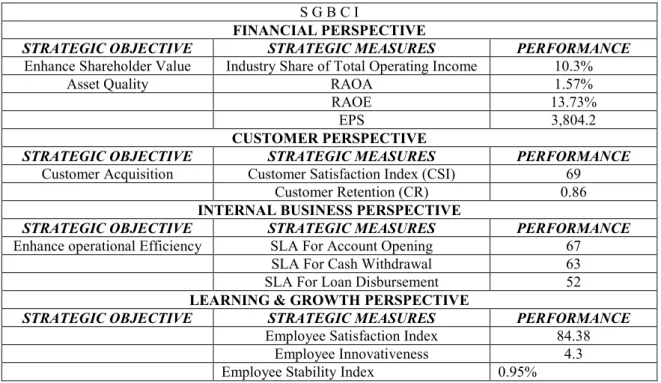
The following Table describes the Balanced Scorecard for SGBCI: Table A.1 Balanced Scorecard for SGBCI
S G B C I
FINANCIAL PERSPECTIVE
STRATEGIC OBJECTIVE STRATEGIC MEASURES PERFORMANCE Enhance Shareholder Value Industry Share of Total Operating Income 10.3%
Asset Quality RAOA 1.57%
RAOE 13.73%
EPS 3,804.2
CUSTOMER PERSPECTIVE
STRATEGIC OBJECTIVE STRATEGIC MEASURES PERFORMANCE Customer Acquisition Customer Satisfaction Index (CSI) 69
Customer Retention (CR) 0.86
INTERNAL BUSINESS PERSPECTIVE
STRATEGIC OBJECTIVE STRATEGIC MEASURES PERFORMANCE
Enhance operational Efficiency SLA For Account Opening 67
SLA For Cash Withdrawal 63
SLA For Loan Disbursement 52
LEARNING & GROWTH PERSPECTIVE
STRATEGIC OBJECTIVE STRATEGIC MEASURES PERFORMANCE
Employee Satisfaction Index 84.38
Employee Innovativeness 4.3
Employee Stability Index 0.95%
4.3 Balanced Scorecard Measures at BICICI
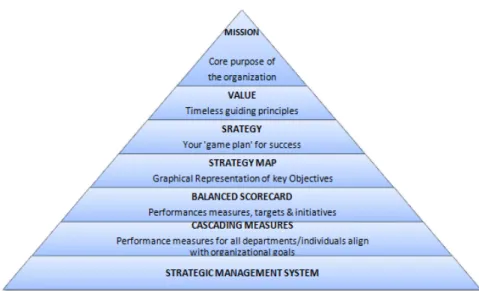
BICICI has freshly incorporated its staff evaluation system and performance management with the parent group which is presently carrying out the balanced scorecard, this consequently is a proof that BICICI has accepted the BSC as its strategic and performance management model. From the Balanced Scorecard Program office at BICICI, the next diagrams were drawn to describe the way that BICICI is carrying out the BSC. This also explicates the way they translated their strategies into measurable items so that they can be able to communicate it to its shareholders and staffs.
First Diagram is denominated the strategic management pyramid by tem and provide with the relationship between their mission, values, vision and their strategies.
Figure A.1 : BICICI Strategic Management Pyramid. Source: BICICI Program Office This was more formulated by the following statement:
‘’Firm performance measures came from the strategic thrust and cascaded down via the directorates, departments and down to the individuals. The system therefore gives to Management a framework to strategically direct and control the performance of the bank.
The present performance management system operating in BICICI is founded on the BSC Methodology that has four outlooks.’’
As mentioned by the financial controller, the bank looks for constantly enhancing its shareholder value, exceed customer expectation with its exceptional customer experience initiative while struggling for excellence at all that it does with its harvest of skilled and dedicated pool of professionals. Its strategy consequently concentrates on long term shareholder value. Excellent internal processes, operational efficiency and attracting and maintaining key skilled staff. The Relationship can be demonstrated utilizing the top-down approach. Having person with appropriate skills and talents (learning and growth) will allow them to implement the critical set of internal processes that will surely generate value to the customer which will involve increased profitability (financial).
For the purpose of this research, we shall restrict the significant measures to be utilized regarding each perspective to following as specified by the balanced scorecard for BICICI below:
Table A.2 Balanced Scorecard for BICICI
B I C I C I
FINANCIAL PERSPECTIVE
STRATEGIC OBJECTIVE STRATEGIC MEASURES PERFORMANCE Industry Share of Total Operating Income 11.4%
RAOA 2.20%
RAOE 20.48%
Enhance shareholder value EPS 4,038.51%
CUSTOMER PERSPECTIVE
STRATEGIC OBJECTIVE STRATEGIC MEASURES PERFORMANCE Ameliorate Customer Satisfaction rating Customer Satisfaction Index (CSI) 83
Enhance customer retention Customer Retention (CR) 0.93
INTERNAL BUSINESS PERSPECTIVE
STRATEGIC OBJECTIVE STRATEGIC MEASURES PERFORMANCE
Operations TATA SLA For Account Opening 89
SLA For Cash Withdrawal 79
Credit Processing TAT SLA For Loan Disbursement 47
LEARNING & GROWTH PERSPECTIVE
STRATEGIC OBJECTIVE STRATEGIC MEASURES PERFORMANCE Maintain and Ameliorate employee skill
set Employee Satisfaction Index 71.2
Employee Innovativeness 4.1
Employee Stability Index 10%
BICICI has indicated strong performance in employee satisfaction, customer satisfaction, innovativeness and internal process excluding loan processing and disbursement. The ulcer with loans could be the describing
indicator that me be impacting the bank’s profitability. This is comprehensible because the bank has taken long times regarding loans that were advanced to its customer. The circumstance went wrong that they had to put nonpermanent support on loans disbursement to its customer.
4.4 Balanced Scorecard Measures at ECOBANK
ECOBANK has adhered to the balanced scorecard as its strategic and performance management model. It thus utilizes the four perspectives of the BSC for assessing the execution and accomplishment of its corporate strategic vision.
The principal strategic purpose as mentioned by the financial controller are to enhance shareholder value, widen customer base (get further customer), operate towards zero defect its internal processes and bringing and maintaining highly qualified and skilled personnel. The principal strategy to enhance shareholders value is to augment revenues via aggressive expansion and acquisition of more customers. Its purpose of rendering suitable, reliable and accessible service to its customers is to generate and provide value to them through efficient processes sustained by well skilled and qualified staff.
Regarding the learning and growth outlook, there are three factors thus, organizational capital, information capital, and human capital. ECOBANK is convinced that its people are its greatest asset, this is justified by the following statement collected from the website:
‘’Ecobank looks for harnessing the strength of its human capital in its function of construction a world class bank to the development of Africa.
We are convinced that our people are our biggest resource and we do invest in attracting, maintaining and building our people…’’
It consequently devotes appropriate resources in training and building its people. The following sustains the all relevant assertion, also found on the website concerning its human capital learning and development:
‘’we devote up to 5% of payroll cost to training and development opportunities. A main strategic intent and factor for development and training is that all staff must benefit at least from an average of 40 hours of coaching and training every year.’’
ECOBANK also consider technology as a core strategic instrument as reported on their corporate website: ‘’Technology underpins the strategy of the group. The ‘’One Bank’’ concept is a principal initiative created to assure that group operates to the identical coherent standards in term of procedures and service delivery anchored on our technology platform. To this end, a Technology Services centre has been constructed in Abidjan, the capital city of Ivory Coast in order to consolidate and standardize middle and back office activities through the group.’’
This signifies that well trained employees are habilitated with online access to corporate information so that they can be able to provide higher service quality to its customers.
From the preceding analysis, the few critical key factors that will concentrate the bank’s resources and energies in reaching its corporate strategy in term of the learning & growth outlook are employee innovativeness, employee stability index, and employee satisfaction. The core foundation of getting empowered, well trained and innovative staffs at the learning and growth level will assure that the bank has the appropriate people to implement the processes at the internal business processes level in order to generate value to the customer. Regarding the internal processes outlook, the significant measures are turn-around-time on the key functions of the bank since it aims to accomplish zero defects in its processes. The consequence to this is the execution of standard procedures and policies, and the leverage on technology to provide high service quality to its customer. By estimating customer feedback on how best they are providing on their main activities, it will yield information of whether they are on track or not about their customer service delivery strategy. Consequently customer satisfaction index and customer retention were the major indicators that were selected under the customer perspective. Since this two have straight support on the perception of quality of service being provided by the personnel implementing the internal processes in place. This thus assists to sustain the strategic measures in the internal business processes, and learning & growth outlooks.
The core to its strategy is to constantly provide higher return on shareholder value. There are major sustainability factors that are designed by the group, but for the objective of this survey, we shall restrict the measures to only the following concerning the financial perspective:
Return on Average Assets (%) Return on Average Equity (%) Earnings per share
Table A.3 Balanced Scorecard for ECOBANK E C O B A N K
FINANCIAL PERSPECTIVE
STRATEGIC OBJECTIVE STRATEGIC MEASURES PERFORMANCE
RAOA 1.53%
RAOE 19.28%
Enhance shareholders value EPS 1,306.49
CUSTOMER PERSPECTIVE
STRATEGIC OBJECTIVE STRATEGIC MEASURES PERFORMANCE Ameliorate Customer satisfaction rating Customer Satisfaction Index (CSI) 66
Increase customer retention Customer Retention (CR) 0.66
INTERNAL BUSINESS PERSPECTIVE
STRATEGIC OBJECTIVE STRATEGIC MEASURES PERFORMANCE Enhance core customer service delivery SLA For Account Opening 86
SLA For Cash Withdrawal 43 SLA For Loan Disbursement 36 LEARNING & GROWTH PERSPECTIVE
STRATEGIC OBJECTIVE STRATEGIC MEASURES PERFORMANCE Attract, build and maintain best talents Employee Satisfaction Index 69.41
Employee Innovativeness 3.8 Employee Stability Index 7%
ECOBANK Ivory Coast has also shown strong performance in all the KPIs under survey. However regarding the internal business perspective the surprising revelation was its poor service in term of Loan processing and disbursement. From this analysis, ECOBANK Ivory Coast may have a concealed trouble which could impact the future performance of the Bank. This is noticeable in its employee satisfaction index and innovativeness concerning the learning and growth stage which is quite low.
4.5 Analysis of the BSC Performance Measures Metrics
The four outlooks of the balanced scorecard and the different metrics and measures culled from data on the three chosen banks in the precedent sections will be examined in the following section in order to ascertain if BSC gives further information with respect to the performance of commercial banks in Ivory Coast.
4.5.1 Analysis of Financial Performance
Under financial perspective, the following metrics/measures were designed for all the three banks: Operating Income (Market Share);
Earning Per Share (EPS);
Return Average On Asset (RAOA); Return Average On Equity (RAOE)
There are relevant factors of the financial health of a company since they estimate how effectively enterprises are using their assets and the value they are giving back to shareholders on their investments.
The preceding metrics/measures were computed and shown in tables 4.1, 4.2 and 4.3. The outcomes are further condensed and shown in the next table :
Table A.4 Financial Performance Measures For SGBCI, BICICI and ECOBANK BANKS Share of Industry Total
Operating Income Return Average On Asset (RAOA) Return Average On Equity (RAOE) Earnings Per Share (EPS) SGBCI 10.3% 1.57% 13.73% 3,804.20 BICICI 11.4% 2.20% 20.48% 4,038.51 ECOBANK 12.8% 1.53% 19.28% 1,306.49
SGBCI’s share of the industry total operating income of 10.3%. BICICI got a share of 11.4% while ECOBANK had a share of 12.8%
Under RAOA; SGBCI presented a figure of 1.57%, BICICI following recorded 2.20% and ECOBANK had 1.53%
Concerning the outcome on RAOE; SGBCI has shown a performance of 13.73% while BICICI and ECOBANK recorded respectively 20.48% and 19.28%.
With reference to EPS; SGBCI again recorded 3,804.20, BICICI presented a figure of 4,038.51 and ECOBANK had 1,306.49 for the period under survey.
4.5.2 Analysis of Customer Perspective
For Commercial banks to keep existing and provide constant high financial performance in the field indicated regarding the financial perspective above, the banks must obtain customers that are very pleased with their services
and products or unless those banks benefit from some monopolies where there are no substitutes for their services or products and the shifting cost is very high too. Excluding such situation, customers not pleased with the products and the services of a given bank will promptly shift to other banks ensuing in lowering deposits with outflows of funds that could furthermore be given out as loans to produce interest income.
Consequently the customer perspective is captured by customer satisfaction index and customer retention rate . The customer satisfaction metric is the most significant because customer satisfaction is straight related to firm profits. Customer retention is how long a company is able to retain and maintain a customer for the objective providing the customer with repeated and constant businesses. The table below is a summary of customer measures for the three selected banks:
Table A.5 Customer Measures For SGBCI, BICICI and ECOBANK
BANKS CUSTOMER SATISFACTION CUSTOMER RETENTION
SGBCI 69 0.86
BICICI 83 0.93
ECOBANK 66 0.66
The outcome described in table 4.5 from the investigation show that SGBCI obtained 69 points on scale of 100 for entire customer satisfaction; BICICI recorded 83 points while ECOBANK got 66 points.
Referring to customer retention, SGBCI had 0.86 point on a scale of 1, BICICI has shown a figure of 0.93 and ECOBANK got 0.66
Customer retention and satisfaction are relevant linkages to profitability and market-based strategy. An organization’s final goal is to attract, please and maintain target customers. If an organization is able to accomplish this in an attractive market, then the business will generate above-average profit.
The customer is a crucial constituent in the profitability equation, but this fact is usually disregarded in any annual reports or financial analysis. Customers constitute and remain a marketing asset that enterprises are yet to quantize in the accounting system, yet the firm that is able to bring in, satisfy and maintain customers over their lifetime of purchasing is in a strong position to provide high level of profitability.
This affirmation is justified from the results of the investigation where BICICI with the greatest customer retention value also appears to be the most profitable followed by SGBCI and then ECOBANK.
To ascertain if customer perspective delivers any further information concerning financial performance of the banks, the Spearman’s Rank Correlation coefficient was computed in Excel 2007 Software for metrics between the customer and financial perspective. Below are shown the findings:
Table A.6 Spearman’s Rank Correlation Between Customer Perspective and Financial Perspective . (** Correlation is significant at the .01 level (2-tailed))
SPEARMAN’S CORRELATION – Between Operating Income and CSI
Operating Income (OI) CSI Rank (OI) Rank (CSI)
10.3 69 2 2
11.4 83 3 3
12.08 66 1 1 N=3
Coefficient Correlation -.5**
SPEARMAN’S CORRELATION – Between Operating Income and CR
Operating Income (OI) CR Rank (OI) Rank (CR)
10.3 0.86 2 2
11.4 0.93 3 3
12.08 0.66 1 1 N=3
Coefficient Correlation -.5 **
p-value .666
From the preceding table, generally speaking, there is some correlation between Financial Performance and Customer Outlook with -.5 as correlation coefficient. The particular negative relationship between Customer Satisfaction and Operating Income and between CR and Operating Income can be seen as a relative sign of the imperfect nature of the market or proof of customer’s reluctance to register in a new bank. This situation could be nonpermanent. The behavior of customer may change over time if they start identifying better products and services from other competing banks. If this research is conducted again 15 years down the trend with service level being as they are currently, the outcomes could be amazingly different.
4.5.3 Analysis of Internal Business Processes
The efficiency of the internal processes of company can impact the manner the firm provide service to their customer. Effectiveness and operational efficiency consequently enable organization to deliver service to its customers at a reduced or minimized cost. It could be an origin of distinguishing indicators by which the firm can generate and produce competitive advantage in its industry. Also, an organization endued with right internal
processes is able to rapidly react to customers requirement, answer to customer queries via new product development with short speed-to-market period frames. Such an organization minimizes the waiting time for delivering services and enhance accessibility of its customers via the usage of the ‘’state of the art’’ technology similar to ecommerce, ATM services, internet banking, SMS banking, etc. The following table describes the internal business processes measures for the three 0chosen banks under the survey:
Table A.7 Internal Business Processes Measures For SGBCI, BICICI and ECOBANK
BANKS Account Opening Counter Service Loan Processing
SGBCI 67 63 52
BICICI 89 79 47
ECOBANK 86 43 36
From this table, it can be seen that there is positive relationship between the performance of an organization and the effectiveness and efficiency of its internal processes as proved from data gathered for this survey. BICICI recorded 47, 79 and 89 customer satisfaction ratings for loan processing, counter service and account opening respectively. SGBCI got 52, 63 and 67 loan processing, counter service and account opening. ECOBANK has shown a figure of 36, 43 and 86 respectively for the same metrics.
Also in evaluating the effect of internal business processes outlook on the customer perspective, it can be deduced from the table below, utilizing again Spearman’s Rank Correlation that, there is some relationships between internal business and customer satisfaction with a correlation of 0.5
Table A.8 Spearman’s Rank Correlation between Internal Business Processes and Customer Perspective (** Correlation is significant at the .01 level (2-tailed))
SPEARMAN’S CORRELATION – Between Account Opening and CSI
Account Opening (AO) CSI Rank (AO) Rank (CSI)
67 69 1 2
89 83 3 3
86 66 2 1 N=3
Coefficient Correlation .5**
SPEARMAN’S CORRELATION – Between Account Opening and CR
Account Opening CR Rank (AO) Rank (CR)
67 0.86 1 2
89 0.93 3 3
86 0.66 2 1 N=3
Coefficient Correlation .5**
p-value .666
This consequently reveals that well structured and organized internal business processes will conduct to greater customer satisfaction rating, which could foster better financial performance. The opposite relationship between customer retention and customer satisfaction could express defective nature of the market or absence of competition where customers have not tendency to demand better and another service and may just be enjoying the mediocre services being offered to them by some of the outdated banks.
4.5.4 Analysis of Learning & Growth
A learning organization is a well-informed organization. An organization that empowers its personnel and provide them adequately with resources will certainly garner the advantages in term of great performance and growth. For most companies that have treated and considered their employees as their most crucial resource, they have usually been recompensed with sustained and greater profits. There is a statement that, ‘’you cannot give what you don’t have’’. Consequently, companies with unpleased employees will frequently discover that, their customer service strategies are always not without troubles. They may have very bright customer service model or framework, however will have acute problem executing it because they have unpleased staffs. Inefficient customer service delivery thus impacts customer satisfaction, which in turn has an effect on customer retention and so lower the ‘’lifetime value of customer’’ as an outcome of premature exit. This script does not apply in the imperfect market or monopoly market where customers are not able to readily get substitutes.
Employee skill development, employee retention, employee satisfaction and the extension of learning management are very crucial to the performance and survival of enterprises. How well these strategies are managed can have an impact on an organization’s growth and profitability. Well motivated and skilled staffs are constantly willing to do extra work to assist in accomplishing Corporate goals and objectives.
Table A.9 Learning and Growth Measures For SGBCI, BICICI and ECOBANK
BANKS Employee Satisfaction Employee Innovativeness Employee Stability Index
SGBCI 78.51 4.3 0.95%
BICICI 71.2 4.1 10%
ECOBANK 69.41 3.8 7%
The table A.9 indicates that BICICI with the highest financial performance (Please see Table A.5 concerning data on financial measures) recorded 10%, 4.1, and 71.2 for employee stability index, employee innovativeness and employee satisfaction respectively.
This was followed by ECOBANK with 7% for employee stability index, 3.8 for employee innovativeness and 69.41 for employee satisfaction.
SGBCI shows an interesting case with an awesome record of 78.51 for employee satisfaction and 4.3 for employee innovativeness. This is explained by the fact that developing skills of staff is one of the key objective of the strategy management of SGBCI as mentioned the Head of Human resources. But at the same time, SGBCI records a surprising figure of 0.95% which is very low. This could be justified by what was found out during the investigation. Indeed, since more than a year, the personnel of SGBCI keep complaining about their salary. The staffs think that there are underpaid compared to their colleagues from other banks. An employee underpaid will be willing to quickly accept an offer from other company which proposes a better wage. Thereby, it can result to lower the employee retention. SGBCI therefore has to solve this salary issue otherwise it may affect the future financial performance because recruiting a new staff requires an extra expense for training. A good work environment and a constant training program can motivate staffs to deliver high quality services to customers but also the salary appears to be one of the key factors to complete employee satisfaction and generate higher employee retention.
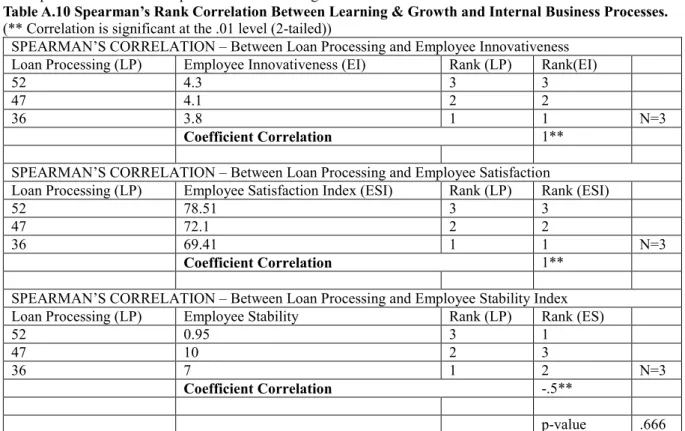
In analyzing the impact of the learning and growth perspective on internal business processes, it is evident regarding the table below that employee innovation and internal business processes are strongly correlated. This consequently reveals that, the bank that builds the convenient environment for innovation to bloom will surely be recompensed with consistent processes that lead to greater customer satisfaction index.
Table A.10 Spearman’s Rank Correlation Between Learning & Growth and Internal Business Processes. (** Correlation is significant at the .01 level (2-tailed))
SPEARMAN’S CORRELATION – Between Loan Processing and Employee Innovativeness Loan Processing (LP) Employee Innovativeness (EI) Rank (LP) Rank(EI)
52 4.3 3 3
47 4.1 2 2
36 3.8 1 1 N=3
Coefficient Correlation 1**
SPEARMAN’S CORRELATION – Between Loan Processing and Employee Satisfaction
Loan Processing (LP) Employee Satisfaction Index (ESI) Rank (LP) Rank (ESI)
52 78.51 3 3
47 72.1 2 2
36 69.41 1 1 N=3
Coefficient Correlation 1**
SPEARMAN’S CORRELATION – Between Loan Processing and Employee Stability Index
Loan Processing (LP) Employee Stability Rank (LP) Rank (ES)
52 0.95 3 1
47 10 2 3
36 7 1 2 N=3
Coefficient Correlation -.5**
p-value .666 From the precedent table, it can be seen that the Learning & Growth perspective has a positive impact on a firm performance. This means that there is a positive correlation between firm’s performance and its learning and growth strategy
5 CONCLUSION AND LIMITATION OF THE STUDY
From the Analysis elaborated so far in the previous section, it can be deduced that utilizing the balanced scorecard to evaluate performance of commercial banks in Cote d’Ivoire will give a further holistic view than utilizing only the financials. From the data provided in the survey (examine table A.1, A.2 and A.3), it is apparent that well
performing banks financially may not automatically be the best banks in the sector when other dimensions or perspectives are considered. The durability of such performance may broadly be reliant to some activities that are not geared towards efficient business processes and customer satisfaction or activities in order to generate superior returns and long term growth depending on lower transaction cost and customer satisfaction.
It is consequently very apparent from the survey that the internal business processes perspectives, learning and growth perspective and customer perspective have an effect on the estimation of the performance of commercial banks to a very broad extension in Ivory Coast. Regarding the types of outcomes that have been culled through this study, any investor who plans to invest, takeover or merge these banks will have a right information with measures in various dimensions in term of learning and growth (leadership and systems development), internal business processes outlook (controls and operational structures), and customer outlook all of which have an impact on the long term performance and survival of the banks than focusing only on financial.
Learning and growth perspective, internal business process perspective and customer perspective consequently play additional roles in evaluating performance of organizations. As argued in the preceding sections, for an enterprise to produce constant profit and growth, that enterprise must be able to truculently attract new customers and maintain them via consistent customer service and service delivery. From the investigation elaborated with the three banks, SGBCI has not carried out the balanced scorecard before and may be taking in consideration executing that in the future and ECOBANK had merely carried out the balanced scorecard. BICICI has effectively executed it for the past two years and they testified that it has truly enhanced their profitability and performance.
Regarding the data culled and the Analysis realized so far, further information on customer displeasure on loan processing functions of BICICI and ECOBANK, poor employee retention for SGBCI, inefficient customer service concerning ECOBANK and SGBCI have been revealed.
These informations can be helpful to both management of the banks and shareholders which can assist them to adjust the implementation of their strategies.
In this study, only few of the metrics were chosen for each of the four major perspectives to demonstrate the strength of the balanced scorecard. In the purpose of more corroborative survey work between academia and organization, the amount of metrics regarding each perspective could be widened. The return on investment on the carrying out of the BSC can be searched closely too and more itemized analysis utilizing intricate statistical models to determine the extension to which non-financial perspective have an effect on financial performances of institutions or companies with a much broader sample size. A further research investigation could be also be realized in other industries area such as merchandizes, non-profit institutions, and retailing to assist driving the implementation and measurement of their strategies.
APENDICES
APPENDIX A: EMPLOYEE SATISFACTION SURVEY
Bank Employee Satisfaction survey Strongly
Disagree
Disagree Neither Agree Nor Disagree
Agree Strongly Agree
1.I understand what is expected of me.z 1 2 3 4 5
2.I am kept informed about matter that affect me. 1 2 3 4 5
3.I have the resources (materials, equipment,supplies,etc) necessary to do my job well.
1 2 3 4 5
4.I am able to do my best every day. 1 2 3 4 5
5.Communication within my division/department/unit is good.
1 2 3 4 5
6.In the last month, I was recognized and praised for doing a good job.
1 2 3 4 5
7.Someone in the court cares about me as a person. 1 2 3 4 5
8. I have the opportunities to express my opinion about how things are done in my division.
1 2 3 4 5
9. The court is respected in the community. 1 2 3 4 5
10.My coworkers work well together. 1 2 3 4 5
11.I am encouraged to try new ways of doing things. 1 2 3 4 5
12. I understand the connection between the work I do and the mission and goals of the bank.
1 2 3 4 5
13. My working conditions and environment enable me to do my job well
1 2 3 4 5
14. I feel valued by my supervisor based on my knowledge and contribution to my department, unit, or division.
1 2 3 4 5
15. I feel free to speak my mind 1 2 3 4 5
16. In the last month, someone in the bank has talked to me about my performance
1 2 3 4 5
17. I enjoy coming to work 1 2 3 4 5
18. My coworkers care about the quality of services and programs we provide.
1 2 3 4 5
19. I am treated with respect 1 2 3 4 5
20. I am proud that I work in the bank 1 2 3 4 5
Source: Available at http://www.ncsconline.org/D_Research/CourTools/Images/courtools_measure9.pdf APPENDIX B: CUSTOMER SURVEY RESULTS
APPENDIX C : EMPLOYEE SURVEY RESULTS SGBCI – Employee Score Survey
W1 W2 W3 W4 W5 W6 W7 W8 W9 W10 Mean Score T1 5 4 4 5 5 5 5 4 4 4 4.5 T2 3 5 4 5 5 5 4 3 5 4 4.3 T3 2 2 3 2 2 4 2 3 3 3 2.6 T4 4 5 3 5 5 5 5 5 4 3 4.4 T5 5 4 5 5 5 4 5 2 3 5 4.3 T6 5 5 5 5 5 4 4 5 3 2 4.3 T7 3 4 5 2 4 5 4 5 5 4 4.1 T8 5 5 4 5 4 4 4 5 5 5 4.6 T9 4 4 5 4 2 5 3 5 5 4 4.1 T10 5 4 3 5 5 5 5 5 4 4 4.5 T11 5 5 3 4 4 5 3 5 4 5 4.3 T12 3 5 4 2 4 3 5 2 5 3 3.8 T13 4 3 4 2 3 2 2 2 3 3.11 T14 5 2 4 4 3 5 5 5 5 5 4.3 T15 4 5 3 2 3 4 5 4 4 5 3.9 T16 3 4 5 3 5 4 4 5 5 4 4.2 T17 3 4 2 3 2 3 2 2 3 4 2.8 T18 5 4 4 5 5 5 2 3 4 5 4.2 T19 4 5 2 4 3 4 5 5 5 4 4.1 T20 2 3 2 3 1 2 1 3 2 2 2.1
SATISFACTION INDEX SCORE 78.51 BICICI – Employee Score Survey
W1 W2 W3 W4 W5 W6 W7 W8 W9 W10 Mean Score T1 1 3 2 5 4 5 3 2 3 2 3 T2 5 4 2 3 4 5 3 4 4 4 3.8 T3 4 5 5 3 4 4 5 3 4 3 4 T4 4 3 3 5 4 4 3 5 5 4 4 T5 3 2 4 5 3 3 4 2 3 3 3.2 T6 3 4 2 4 3 3 5 4 2 3 3.3 T7 5 4 4 5 3 5 4 4 2 5 4.1 T8 4 2 3 3 4 5 2 3 4 5 3.5 T9 3 4 5 4 5 2 3 2 4 3 3.5 T10 5 5 4 4 4 2 2 3 3 3 3.5 T11 4 5 3 4 4 3 5 5 4 4 4.1 T12 5 4 4 5 4 3 4 3 4 5 4.1 T13 3 2 1 5 4 5 3 2 3 2 3 T14 3 4 5 5 4 3 4 4 2 4 3.8 T15 4 4 5 5 2 4 3 2 3 3 3.5 T16 2 3 2 3 5 4 5 2 1 3 3 T17 4 3 5 2 3 2 4 4 3 3 3.3 T18 5 4 3 4 5 4 5 4 3 3 4 T19 5 4 5 3 2 3 2 3 2 1 3 T20 5 4 5 4 3 4 2 2 3 3 3.5
ECOBANK – Employee Score Survey W1 W2 W3 W4 W5 W6 W7 W8 W9 W10 Mean Score T1 4 3 2 4 3 3 2 4 3 3.11 T2 3 4 3 4 3 2 3 3 1 3 2.8 T3 4 2 4 3 4 3 4 2 2 2 3 T4 3 3 4 4 2 5 2 4 3 2 3.2 T5 5 3 3 4 2 3 3 4 4 5 3.6 T6 2 4 3 4 5 2 2 3 3 2 3 T7 5 5 4 4 3 3 2 4 5 5 4 T8 4 3 2 3 2 3 4 5 3 3 3.2 T9 4 1 4 4 3 2 2 3 5 2 3 T10 2 3 2 3 4 4 5 5 3 4 3.2 T11 4 2 5 5 3 4 3 4 4 4 3.8 T12 4 5 5 4 3 3 2 5 3 2 3.6 T13 2 3 4 5 5 2 3 4 5 3 3.6 T14 5 3 3 5 5 4 4 5 5 3 4.2 T15 4 4 4 3 4 3 5 5 4 2 3.8 T16 3 4 3 4 2 3 5 4 4 4 3.6 T17 3 4 5 3 4 5 5 5 3 3 4 T18 5 2 3 4 5 4 3 4 2 2 3.4 T19 2 4 5 3 4 4 3 3 5 3 3.6 T20 4 5 3 3 5 2 4 3 4 4 3.7
SATISFACTION INDEX SCORE 69.41 ACKNOWLEDGEMENTS
It is a great joy to express our gratitude to many people who in various manners have supported us and participated to the procedure of completing this paper. First, we would like to express our thankfulness to the management, the staff and the customers of SGBCI, BICICI and ECOBANK who took off time from their busy schedule to answer our questionnaires and to grant us time to interrogate them, without which we could not have completed this paper. we cannot forget to thank our best friend Gnangoin Yobouet Thierry Bienvenu who helps us a lot in data collection from the different selected banks.
REFERENCES
Al-Khouri, R. (2011). Assessing the Risk and Performance of the GCC Banking Sector, International Journal of Finance and Economics, ISSN 1450-2887, Issue65, 72-8.
Al- Matarneh, G. F. (2011): Performance Evaluation and Adoption of Balanced Scorecard in Jordanian Industrial Companies, European Journal of Economics, Finance and Administrative Sciences, No. 35, pp. 1-10. Aikhatklan, K. & Malik, Syed A. (2010) “Are Saudi Banks Efficient? Evidence Using Data Envelopment Analysis.”
International Journal of Economics and Finance, 2: 53-58
Balanced scorecard report: insight, experience & ideas for strategy-focused Organizations, Lincoln, MA: Harvard Business School Publishing and Balanced Scorecard Collaborative, Inc.
Balanced Scorecard Institute (2007). “What is the Balanced Scorecard?” Balanced Scorecard Institute, A Strategy
Management Group Company. Available from:
http://www.balancedscorecard.org/BSCResources/AbouttheBalancedScorecard/tabid/55/Default.aspx Beiman, I., (2007). Using the Balanced Scorecard for Strategy Execution in China. China Success Stories.
Available from: http://www.chinasuccessstories.com/2007/10/24/bsc-methodology-china/ (accessed 16/05/08)
Berger, A.N and Humphrey, D.B. (1997). Efficiency of financial institutions: International survey and directions for future research. European Journal of Operational Research , 98 (2),175–212.
C.T. Ho and D.S. Zhu. “Performance measurement of Taiwan's commercial banks,” International Journal of Productivity and Performance Management, vol. 53, pp. 425 – 434, 2004.
Nightingale, D. (2005). Metrics and Performance MeasurementSystem for the Lean Enterprise. Massachusetts Institute of Technology. Available from:
http://ocw.mit.edu/NR/rdonlyres/Aeronautics-and-Astronautics/16-852JFall-2005/CB40C420-133B-45E3-BADB-4E7B2C03745E/0/12_metrics.
Forza, C. and Salvador, F. (2000), “Assessing some distinctive dimensions of performance feedback information in high performing plants”, International Journal of Operations & Production Management 20(3), pp. 359-385.
Forza, C. and Salvador, F. (2001), “Information flows for high-performance manufacturing”, International Journal of Production Economics 70(1), pp. 21-36.
Frigo, M., & Krumwiede, K. R. (2000). The balanced scorecard: A winning performance measurement system. Strategic Finance, 81(7),p.50-54.
Hoque, Z. & James, W. (2000): Linking Balanced Scorecard Measures to Size and Market Factors: Impact on Organizational Performance, Journal of Management Accounting Research, Vol. 12, No. 1, pp. 1-17. http://www.societegenerale.com/sites/default/files/pressrelase/B67471E13F5F0E69C125785700327387.pdf http://www.bicici.com/nous-connaitre/la-bicici/
http://www.connectionivoirienne.net/88913/greve-a-la-sgbci-les-agents-exigent-une-augmentation-du-salaire-net-de-100
http://www.real-statistics.com/correlation/spearmans-rank-correlation/spearmans-rank-correlation-detailed/ Ioannis E. Tsolas. 2010. Modeling bank branch profitability and effectiveness by means of DEA. International
Journal of Productivity and Performance Management 59:5, 432-451.
Ittner, C. D. & Larcker, D. F. (1998): Innovations in Performance Measurements: Trends and Research Implications, Journal of Management Accounting Research, Vol. 10, pp. 205-38.
Kaplan. R.S. & Norton, D.P. "The Balanced Scorecard: Measures that Drive Performance.' Harvard Business Review. 70: (Jan-Feb) 1992, pp. 71-79.
McCunn, P. (1998) “The balanced scorecard….the eleventh commandment”. Management Accounting, Vol 76. McKenzie, F. C. and Shilling, M. D. (1998) Avoiding performance measurement traps; Ensuring effective design
and implementation. Compensation and Benefits Review, Vol 30.
Nair, B. & Pareek, A. (2011): A Study of Various Performance Management Systems Adopted by Selected Indian Private Sector Organisations, International Journal of Research in Commerce and Management, Vol. 2, No. 6, pp. 6-10.
Niven, P.R. and Man, S.V.(2003). Introduction to the Balanced Scorecard. Balanced Scorecard: Step-by-Step for Government and Nonprofit Agencies (pp. 4 - 8)
Ram Mohan, T.T and Ray, S.C. (2004, March 20). Comparing Performance of Public and Private Sector Banks – A Revenue Maximization Efficiency Approach. Economic and Political Weekly , pp. 1271-1276.
Rigby, D. (2001). “Management Tools and Techniques: A Survey”, California Management Review, Vol: 2, S.139-160. http://dx.doi.org/10.2307/41166079
Shanmugam, K.R and Das, A. (2004). Efficiency of Commercial Banks during reforms period. Applied Financial Economics , 14, 681-686.
Silk, S. (1998). Automating the Balanced Scorecard. Management Accounting, 79(11), 38-40.
Seiford, L., M and Zhu, J (1999). Profitability and Marketability of the Top 55 U.S. Commercial Banks Management Science 45 (9), pp 1270-1288.
Spechbacher, G., Bischot, J. & Pfeiffer, T. (2003): A Descriptive Analysis on the Implementation of Balanced Scorecards in German-speaking Countries, Management Accounting Research, 14(4), pp. 361-387.
Umar, G. & Olatunde, O. J. (2011): Performance Evaluation of Consolidated Banks in Nigeria by using Non-financial Measures, Interdisciplinary Journal of Research in Business, Vol. 1, No. 9, pp. 72-83.