Lund University STVM01
Department of Political Science Spring term 2009
Master thesis Tutor: Rikard Bengtsson
India in the Doha Development Round
A two-level game analysis of its position on the Special
Safeguard Mechanism issue
Abstract
This thesis attempts to answer the question why there was a breakdown in talks between India and the USA over the issue Special Safeguard Mechanism (SSM), at the WTO Ministerial Conference in Geneva in July 2008. This is done through Robert Putnam’s two-level game framework, which is applied to the interplay between India’s negotiator and India’s domestic politics.
The thesis concludes that the underdeveloped Indian agriulture and the poverty of the farmers, together with the persistence of developed countries’ agricultural subsidies, made further Indian concessions on the mentioned issue impossible. This suggests that the developed world misjudged Indian resolve in the negotiations and has paid too little attention to the situation of Indian farmers. Towards the end it is argued that the developed countries must adress Indian concerns and phase out their agricultural subsidies if a future multilateral free trade agreement is to be reached.
Key words: trade policy, foreign policy, the doha round, India, diplomacy, negotiations, two-level game
Table of contents
1 Introduction ... 1
1.1 Methodology... 2
1.1.1 Question of investigation and purpose... 2
1.1.2 Theory and hypothesis... 3
1.1.3 Thesis outline... 3
2 Theoretical framework... 5
2.1 The two-level game... 5
2.1.1 The three determinants of the win-set... 6
2.1.2 Uncertainty and ”kinky” win-sets...10
3 Empirical background...11
3.1 Economical background...11
3.2 Level I: Indian diplomatic negotiations ...12
3.3 Level II: Domestic politics in India ...14
3.3.1 The agricultural policies and socio-political restraints ...15
3.3.2 Domestic political institutions ...18
4 Analysis ...21
4.1 Overall picture ...21
4.2 Indian preferences and coalitions ...22
4.3 Indian institutions...25
4.4 Indian negotiators’ strategies...27
5 Conclusions and final reflections...31
6 References ...34
1
Introduction
The Doha Development Round of multilateral trade negotiations (DDR) was started in 2001 with the Doha Declaration as its frame work. Its
predecessor, the Uruguay Round (UR), which culminated in the
establishment of the World Trade Organization (WTO) in 1995, had left some developing countries worse off. They agreed to a new round of trade talks only on the condition that development was the centrepiece of the negotiations, hence its middle name. Especially India was reluctant to start a new round (Gallagher 2008:62).
The overdue negotiations broke down after 9 days of negotiations at the Ministerial Conference in Geneva July of 2008, and has not been resumed since (Spero & Hart 2008:283)1. Agricultural issues turned out to be a stumbling block. A considerable amount of the subsequent analysis of the breakdown has focused on the specific issue called Special Safeguard Mechanism (SSM), which would allow developing countries to temporarily raise their import tariffs if there is a flood in their imports of agricultural products. Particularly, India and the USA could not agree as India wanted to set the SSM import trigger rate low and the U.S. wanted to set it high
(Blustein 2008) (Spero & Hart 2008:283) (Economist 2008).
The SSM actually stems from the 1995 Marrakesh Agreement, which also established the WTO and according to which it is acceptable with safeguards if they are temporary or applied when countries experience severe market disruptions from increased imports (Frieden & Lake
2000:300). This is defined in the Agreement on Safeguards, included in the Marrakesh Agreement (Spero & Hart 208:106). The lastest version of SSM, included in the draft before the Geneva Ministerial, was originally proposed
1 Instead, countries have turned their attention to regional and bilateral trade talks, something which have been lamented due to their trade-distoring nature, not least in the context of the current economic crisis (Krugman & Obstfeld 2008:239ff).
by the G-33 of developing countries who coordinates on trade and economic issues (among them India)2.
This thesis is about the reasons for the inability to reach an agreement on that issue. It will be argued that the domestic situation and politics in India put Indian negotiators under restraints that simply didn´t allow for much maneuvering space.
1.1
Methodology
1.1.1
Question of investigation and purpose
This is a hermeneutic, qualitative case study with primarily an idiographic ambition. Its ontological and epistemological foundations are realistic and
objectivistic, respectively. The study centers around one question of investigation:
Why could the Indian government not agree with the USA on the Special Safeguard Mechanism issue at the WTO Ministerial Conference in Geneva in July 2008?
The purpose is to provide a base for a discussion about what can be done to avoid a breakdown the next time around. In this study, the negotiations have been boiled down to stand between the reductions of developing countries’ import tariffs and developed countries’ subsidies, both of agricultural products (see Coughlin, Chrystal & Wood 2000:306f). This simplification has the purpose of making the analysis of such a wide-ranging negotiation as the DDR manageable. Furthermore, the question encompasses three other main delimitations: the focus on the Ministerial Conference in Geneva in July of 2008, the focus on the position
of India and the focus on the particular issue of the set level for the Special Safeguard Mecanism.
1.1.2
Theory and hypothesis
The high number of member countries in the World Trade Organisation WTO (153), the most-favoured-nation principle (MFN) and the fact that most
agreements in the WTO are arrived at by consensus might seem as sufficient explanations of why the negotiations in Geneva 2008 broke down (Frieden & Lake 2000:300) (Ladefoged Mortensen 2006:173f) (WTO website3). However, this institutional perspective is perhaps not best one because, despite these institutional conditions, convergence was actually reached on 18 of 20 issues in the negotiations (Economist 2008). As mentioned, reliable sources suggest that it was the disagreement over the design of the SSM, particularly between India and the USA, that proved to be a critical (Blustein 2008). I have therefore identified the theoretical framework provided in the 1988 Robert Putnam article Diplomacy and Domestic Politics: The Logic of Two-Level Games as the appropriate
operative theory to base my answers to the question of investigation4.
In accordance with this theory, my hypothesis is that the situation and influence of Indian farmers was an important reason for the fact that Indian and U.S. couldn’t agree5. What is important is where India stood relative to the USA, rather than what Indian demands were in absolute terms (since the positions of the countries in relative, and not absolute terms, decide the outcome of negotiations). The USA was chosen as a reference point ahead of other developed countries since reports have singled out the disagreement between India and USA.
1.1.3
Thesis outline
3 WTO website: www.wto.org
4 In the terminology of Esaiasson et al. it is a theory consumptive study (Esaiasson et al. 2007:42) 5 With this hypothesis, I do not disregard of other factors, such as developed countries’ agricultural subsidies.
After presenting the theory in the following chapter, I will provide an
empirical background of the negotiations that took place in Geneva in July 2008. This will consist of two parts: (1) a summary of the most important events and proceedings during the negotiations, supported by extracts from statements made by the Indian chief negotiator during the Ministerial Conference. (2) An empirical survey of the general situation and domestic politics in India with special respect to agriculture, coupled with a specific example of the influence of particularly one Indian interest group. This material has been chosen in accordance with the deductive approach that it was primarily the domestic politics in India that
determined the governments’ position in the negotiations, which in extension also had a significant effect on the outcome. The empirical background will make out the grounds for the subsequent analysis, where I will apply the theory on the specific case. This separation has been done in order to differentiate empirics from analysis. To answer the question of investigation, both a horizontal (between the Indian government and other governments) as well as a vertical (between the Indian government and Indian domestic politics) analysis are needed. The question of investigation is answered in chapter 5, together with some final reflections about how a future agreement could be reached.
2
Theoretical framework
2.1
The two-level game
Basically, international negotiations is ”conceived as a two-level game” between the diplomacy and the domestic politics (Putnam 1988:434). Putnam conceptually categorizes these as two levels: Level I is the chief negotiatior and his team which acts on behalf of the government. Level II is the the domestic politics restraints that are put on the government´s agency. For example, it can be various interest groups that try to impose their will and exert political pressure on the parliament and government (Putnam 1988:432 and 436) (see also Spero & Hart 2008:72). In a democracy like India, such political pressure is more severe than in an authoritarian state.
At Level 1, bargaining between negotiators might or might not lead to a tentative agreement. At Level II, there are negotiations of what the governments’ position should be and of whether or not to ratify the agreement. The fundamental reason for the two-level game is that any Level I negotiation is subject to Level II influence. Thus an important aspect of the theory becomes the win-set of the Level II constituency, which is ”the set of all possible Level 1 agreements that would ´win´- that is, gain the necessary majority among the constituents...”
(Putnam 1988:437). In other words, the win-set are the contours of Level II (Ibíd). The underlying reasons that Level I must relate to Level II win-sets is of course that in the case of an unpopular agreement being reached, it might not be ratified or interest groups might mobilize campaigns against the incumbent and cause
them to lose political support6. Therefore, the government must consider the domestic politics when entering a negotiation. As is evident, all actors are assumed rational in the theory.
Certain caracteristics are important to keep in mind regarding the winset: larger Level II win-sets make Level 1 agreement more likely (ceteris paribus) and the relative size of the respective Level II win-sets will affect the distribution of joint gains from the international bargain. The larger the perceived win-set of a negotiator, the more he can be ”pushed around” by other Level 1 negotiators. On the other hand, a narrow win-set can be an advantage: it can be used to argue that further concessions are impossible: ”I´d like to accept your proposal, but I could never get it accepted at home” (Putnam 1988:437-441).
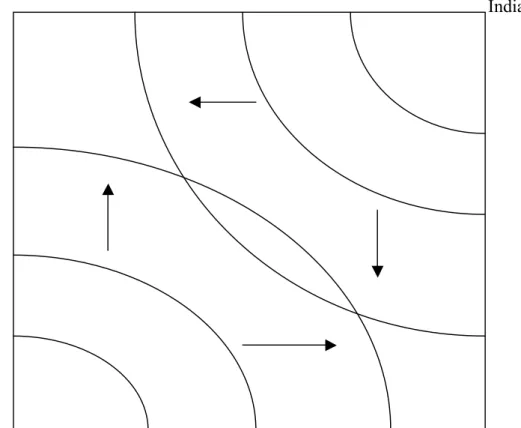
An important part of the theory is why defection occurs. Putnam distinguishes between voluntary and involuntary defection, with the former being a defection by Level I and the latter being a defection by Level II. Other reasons for defection might be that the pace in the negotiations are slowed down due to their complexity or that the alternative cost of of an agreement is too low (see Berridge 2005:56ff). A figure might help to understand the theory and why defection occurs visually:
Figure 1
Xm Ym
Y1 Y2 X1 Y3
Here, there is a zero-sum game between X and Y. Xm and Ym represent the maximum outcomes for X and Y respectively, while X1 and Y1 represent the minimal outcomes that could be ratified. (Replica of Putnam 1988:441).
2.1.1
The three determinants of the win-set
6 If Level I doesn’t relate to Level II, the government might not be reelected. This is a derivative from Rational Choice theory. Actor rationality is assumed in this thesis (see Downs 1957).
The win-set is determined by three principal factors (Putnam 1988:442ff): - Level II preferences and coalitions
- Level II institutions
- Level I negotiators’ strategies
The first factor is perhaps the most intuitive: the preferences and coalitions among Level II constituents affect the size of the win-set. According to Putnam, Level II constituents relate to the cost of ”no-agreement”, which is the status quo or, in some cases, a worsening of the situation. The lower the cost of
”no-agreement”, the smaller the win-set and vice versa (1988:442). Another thing that can be said is that countries that are dependent on international trade generally have larger win-sets than isolated and self-sufficient economies (compare to Rogowski 2000:318ff). Different groups at Level II are likely to exert pressure on Level I negotiators to get such a good deal as possible for themselves (for
example, farmers are likely to want subsidies and import tariffs) (see Alt & Gilligan 200:328).
The government and the chief negotiatior are thus faced with tradeoffs of choosing which interest groups to appease and which to neglect. Here, the aspect of issue linkage can be introduced. Figure 2 below (showing political indifference curves with the ones furthest out yielding most utility) represents two countries, A and B in a two-issue negotiation. Let’s apply this to a hypothetical example: country A, with high agricultural import tariffs and country B, with heavy agricultural subsidies. Suppose Level II in country A might not be so keen on to lower their import tariffs. At the same time, Level II in country B might not be willing to further cut their production and export subsidies. At this point neither is willing to converge on a deal. If however, according to international economic theory (see Krugman & Obstfeld 2008), someone realises that there are mutual gains to be made from further liberalization and free trade, there will be a
temptation to reach such an deal (see Ericson 2005:51). Maybe B will then make an offer of further cutting their subsidies to a level were the win-sets of the two countries intersect. A large enough cut might prompt A to lower their import tariffs, expanding the utility of both countries. The agreement is represented by
the overlap of the indifference curves in Figure II: Putnam’s second theoretical figure (Putnam 1988:447) which shows political indifference curves for two-issue negotiations: Figure 2 A B1 B
Here, two issues are linked to each other. The only way to reach an agreement is to push for concessions on both issues towards the minimal outcomes that could be ratified. The difference between the two figures is first and foremost that the second one is for application on a two-issue negotiation, whereas the first one only shows preferences for one issue. (Near-replica of Putnam 1988:447).
The second factor that determine the win-set are the political institutions at Level II. Intuitively, the greater the majority of legislative delegates required for ratification, the smaller the win-set. Domestic political institutions carry with them implications that might appear somewhat paradoxical: diplomats
representing a dictatorship have limited posibilities to refer to domestic political restraints since the agenda is solely set by the government without any other consideration (remember: ”I’d like to accept your proposal, but…” above). Conversely, diplomats representing and acting on behalf of a pluralistic
democracy have, in this respect at least, an advantage, as they can blame homeland restraints for their inflexible stance. In other words, a narrow win-set and the fear of involuntary defection become a diplomatic asset (Putnam 1988:459).
The third factor that influence the size of the win-set are the strategies of the Level I negotiators. Here the two-level game framework can be deduced to Principal Agent Theory. As Jönsson & Hall points out, diplomats are agents who act on behalf of their principals (Jönsson & Hall 2005). Since it is not possible for the principals to always be pefectly up-to-date on an issue, there is room for some autonomy fo the agent. If the principal tries to control the agent too hard there is a risk that an agreement will not be reached (since it doesn’t allow for flexibility) or that a bad agreement is reached (since the original instructions were too tightly given on old circumstances). On the other hand, if the agent is given more
flexibility, the principal runs the risk of ending up with an agreement that includes too many concessions and that might not correspond to the wishes and that will turn out to be politically costly in the next election.
The chief negotiator relates to the size of the other side’s win-set (which they try to maximize) and their own (whoose size is a two-edged sword: the bigger it is the more likely is a concluded agreement but at the same time it weakens the bargaining position vis-à-vis the other negotiator) (Putnam 1988:450). According to Putnam, the chief negotiators’ motives include enhancing his/her standing in the Level II game by increasing political resources, shifting the balance of power at Level II in favor of domestic politicies that he/she prefers and to pursue his/her own perception of national interest in the international context (1988:457). These three motives are consistent with the fact that negotiations are bargaining
situations, in which there are both cooperative and conflictual elements, at the same time that the decisions often are intertwined and interdependent (see Jönsson & Hall 2005:82). Then, if the negotiators perceive that the negotiations and deal at hand are cooperative (win-win), an agreement should be more likely than if they perceive the negotiations as a competetive (win-lose). The dynamics of
international negotiations and its decisions of course become even more complex and interdependent when they are multilateral, as in the case of the DDR (see Berridge 2005:56 and 151ff).
2.1.2
Uncertainty and ”kinky” win-sets
Relaxing the assumption of perfect information about the size of the win-set has various implications for the theory. As already mentioned, negotiators have an incentive to understate their own win-set and if the opposite side lacks
information, this can be exploited7. Uncertainty regarding the other party’s win-set, on the other hand, increases one’s concern of involuntary defection. Deals can only be struck if each negotiator is convinced that the proposed deal lies within his opposite number’s set for ratification. Therefore, uncertainty about a win-set can be both good and bad.
Also, a utility-maximizing negotiator must convince his opposite number that his own win-set is ”kinky”, which means that the proposed deal is certain to be ratified, but that a slightly more favorable deal to the opponent is unlikely to be ratified (Putnam 1988:453). In other words, that all possiblities of concessions are exhausted. At the same time, negotiators try to expand each others’ win-sets by altering perceptions of the benefits of the proposed agreement and the costs of ”no-agreement” (what Putnam calls reverberation). The negotiator might also try to alter the others’ perceptions of the costs of no-agreement and the benefits of proposed agreements (what Putnam calls restructuring, see 1988:454f).
Now follows an overview of the negotiations that took place in Geneva in 2008. These will therafter be analysed with respect to the theoretical framework. Fundamentally, what I will do is apply Robert Putnams theory on this specific case and identify Indias Level II win-set, which I will argue were irreconcilable with the U.S. Level II win-set.
7 For example, under the right circumstances, the negotiator can falsely claim to oppose a proposal on one issue. When the other party tries to persuade him/her, he can concede to agree under the condition that the other party makes concessions on another issue. By using the political capital created by the (false) concession as leverage, the negotiator has managed to obtain two deals that he/she wanted, making it seem like he/she only got one.
3
Empirical background
3.1
Economical background
Free trade actually has the potential to be the solution to poverty in developing countries. One of its many defenders is nobel prize winner Paul Krugman. Although recently appearing somewhat disillusioned as to its results8, free trade is still generally thought of as a major backbone in development policy. According to Kevin Gallagher, although developing countries as a whole were made better off by the Uruguay Round, this overall gain obscured the fact that some regions actually experienced a net loss. The 48 least developed countries lost 600 million UDS as China captured most of the gains (Gallagher 2008:73). Moreover, the UR also implied a loss of sovereignty of development policies, which Gallagher argues was an important reason for resistance to the DDR. The benefits of potential scenarios of a DDR agreement has also been questioned. In the ”likely” scenario, benefits for all developing countries would actually only be 22 billion USD. The World Bank has estimated that this would lift 6,2 million people from poverty and 2,5 million people from extreme poverty (out of a total number of approximately 3 billion and 1,2 billion, respectively) (see Gallagher 2008:80). Of course, these are not insignificant numbers but when the benefits are divided between many countries it might be hard to discern large improvements on the aggregated level. Gallagher identifies this as a prime reason for why India and other developing countries were reluctant to accept the deal on the table – it was too hard
8 Particularly, Krugman argues that the winners of free trade should compensate the losers. See Columbia University webpage: http://www.columbia.edu/cu/news/media/06/429_copingGlobal/
politically to bring home as the benefits were not large enough to yield sufficient political support9.
At the same time, developed countries subsidies is often blamed for depressing world prices and knocking out farmers in developing countries as a whole (although perhaps not in developing countries that are net importers of farm products, see Charlton & Stiglitz 2006:69). The U.S’ agricultural subsidies have recently amounted to around 8 billion USD a year (Blustein 2008).
3.2
Level I: Indian diplomatic negotiations
As mentioned before (see 1.1.1), the underlying idea of the of the Geneva 2008 Ministerial was to cut trade barriers and farm subsidies (Blustein 2008). Deputies of ministers had pre-negotiated for months and american negotiators had made sure it was understood that the U.S. would never be as eager to close a deal again (Berridge 2005:29ff) (Blustein 2008). The U.S. had offered to cap farm subsidies at 15 billion USD a year, an initiative that had been deemed not good enough since actual spending recently have amounted to 8 billion USD a year. At the same time though, the U.S. had conceded the need of SSM for developing countries, the issue was rather at what level it be set (Berridge 2005:46f). Expectations about a successful outcome were moderate10 (Spero & Hart 2006:115). On the 25th of July, as
negotiatons were underway, Indian Minister of Commerce and Industry and chief negotiator Shri Kamal Nath issued the following statement:
”As far as developing country agriculture is concerned, the challenges are well known. Most of Indian agriculture is subsistence level agriculture. For us,
9 In the ”complete” liberalization scenario, 66 million people would be lifted from poverty. However, if migration liberalization were to be included in the agreement (in the form of allowing for more visas for professional employees and low-skilled workers as proposed by developing countries), it would render the benefits of all other scenarios small in comparison. Gain estimates amount to 150-300 billion USD annually (compared to 22 billion USD in the ”likely” scenario) (Gallagher 2008:80).
agriculture involves the livelihoods of the poorest farmers who number in the hundreds of millions. We cannot have a development Round without an outcome which provides full comfort to livelihood and food security concerns in developing countries. There has been some progress in discussions on SPs and SSM but important gaps still remain. The poor of the world will not forgive us if we compromise on these concerns. These concerns are too vital to be the subject of trade-offs. A successful outcome will require a full addressal of these concerns.
We are not at all happy about the SSM proposal. All manner of objections are being raised to our right to safeguard livelihood concerns of hundreds of millions. Are we expected to standby, see a surge in imports and do nothing? Do we give developed countries the unfettered right to continue subsidizing & then dumping those subsidies on us jeopardizing lives of billions? The position of developed counties is utterly self-righteous: they have enjoyed their SSG11 (and want to continue it) but our SSM must be subject to all sorts of shackles and restraints. This self-righteousness will not do. If it means no deal, so be it” (Taken from a statement by Kamal Nath, published on the Indian government website the 25th of July 200812).
As negotiations went on and seemed to reach a deadlock, WTO Director-General Pascal Lamy worked out a proposal himself for the parties to accept or decline. According to events that has since transpired, he gathered negotiators, only to have Kamal Nath reject everything in the proposal:
”I cannot put the livelihood of hundreds of millions of people at risk”
”If the [Indian] government wants this, they’ll have to find a new minister”
(Blustein 2008).
According to Blustein, the chief ire for Nath was apparently that in Lamy’s proposal, the SSM trigger rate was 140 per cent of normal imports, something the U.S. had allegedly insisted upon. Nath argued that the SSM
10 The Guardian webpage: http://www.guardian.co.uk/business/2008/jul/21/doha.trade
11 SSG: The Special Agricultural Safeguard, negotiated during the Uruguay Round (WTO website: http://www.wto.org/english/tratop_e/agric_e/guide_agric_safeg_e.htm)
couldn’t be implemented properly, because India’s ability to monitor its imports of individual products was so low that by the time the government would detect a 40 per cent import surge, farmers would already be committing suicide en masse (Blustein 2008). In Blusteins interpretation, Nath feared political repercussions at home for agreeing to something which corresponded to Indian concessions and that could be protrayed and perceived as a sellout of the farmers. So he did not divert from his hardline position on the SSM issue. Thus, despite Lamy’s attempt to work out a deal, the Conference ended without an agreement, although this was not entirely down to the SSM issue (see Blustein 2008)13.
3.3
Level II: Domestic politics in India
The two-level game framework underlines two win-set determinants that concern Level II and that will be included in this overview: Level II preferences and coalitions and Level II institutions (Level 1 negotiators strategies, already dealt with).
Since India has a lot of arable land and cheap labour, they should have a comparative advantage in many farm products. Economists have confirmed this (see Gulati et al 1994). Logically, their farm sector should then be advocating a liberal trade policy (Rogowski 2000:318f), but we now know that the country’s position in Geneva 2008 was defensive. In this section I will present empirical indications that the socio-economic reality and institutional reforms in India has influenced the domestic political restraints
12 India’s Department of Commerce webpage:
http://commerce.nic.in/pressrelease/pressrelease_detail.asp?id=2290
13 In the aftermath, USA chief negotiator Susan Schwab mentioned that it was unacceptable with a SSM trigger level that allowed developing countries to raise their tariffs to pre-Doha levels, while mentioning that ”one” country didn’t show flexibility (http://www.guardian.co.uk/world/2008/jul/31/wto.india). India, on the other hand, blamed the U.S. (see
that are put on the government, leading to its protectionist position on the SSM issue at the 2008 WTO Ministerial in Geneva.
Below, empirical examples of direct political influence exerted on the government are included. When choosing what aspects of the domestic politics to include in the survey, it is important to argue why some aspects should be given special attention at the cost of others. In India, trade agreements are not subject to parliamentary ratification (see Gupta 2006:10). This fact makes an analysis of, for example, parliamentary interpellations, redundant. Instead I have choosen to focus on the general situation in India with respect to the farmers there. Surupa Gupta argues that Indian trade policy has been shaped by three domestic features in India: the agricultural policies, the socio-political restraints and the institutions through which the trade policies are made (Gupta 2006:2).
3.3.1
The agricultural policies and socio-political restraints
Back in the 1960’s a food shortage led to a domestic agriculture policy that ever since has been insufficient (Gupta 2006:19) (Ray & Saha 2008:1ff). The levels of investment in agriculture and public infrastructure are not enough and the legal framework regulating the agricultural sector is outdated (see Gupta 2006:20) (Krugman & Obstfeld 2000:263). India is the third largest food producer in the world and 700-840 million people of its population are dependent on rural agriculture that is largely small-scale (Gupta 2008:2) (Ray & Saha 2008:4). Due to their precarious situation, there is a high prevalence of suicides among Indian farmers. Estimates of the number of farmer suicides for the period 2001-2007 ranges between 5.000 to more than 10.000 (Aggarwal 2008:1) and this is contuing at an alarming rate14.
14 See newspaper articles: http://www.belfasttelegraph.co.uk/news/world-news/1500-farmers-commit-mass-suicide-in-india-14268995.html and
http://www.dailymail.co.uk/news/worldnews/article- 1082559/The-GM-genocide-Thousands-Indian-farmers-committing-suicide-using-genetically-modified-crops.html
Such socio-economical features in a democracy like India are bound to have some political repercussions on the civil society. Swadeshi Jagaran Manch is a political movement that advocates economical self-reliance in India15, with over 15 other organizations associated to it. The philosophical idea about economic self-reliance can actually be traced back to Mahatma Gandhi. The spiritual leader of Indian independence movement, Gandhi championed Indian manufactures ahead of imported ones (Copley 1993:50). More specifically, Swadeshi (meaning self-sufficiency in Hindi) Jagaran Manch demands:
Agriculture is not only a source of livelihood for millions of Indian farmers but also a way of life, and therefore it cannot be allowed to be left at whims of the market and subject to international trade agreements. Therefore agriculture should be kept out of WTO negotiations. Under the circumstances when developed world has failed to keep their commitments to reduce agricultural subsidies, government of India should not allow negotiations to go on at WTO. Given the fact that the government no longer enjoys majority support in the parliament, it should refrain from the making any new and important commitment at international forums, especially when it amounts to compromising the interests of farmers, industries, fishermen and country at large (Taken from Swadeshi Jagaran Manch website)16.
Representants from Swadeshi Jagaran Manch were also present at the conference WTO Negotiations: Protecting Livelihoods and Ensuring Food Security, organised by the Forum for Biotechnology and Food Security and the United Nations Conference on Trade and Development (UNCTAD) in New Delhi in June 200817. There, around 30 farmers’ leaders from all over the country met to discuss India’s agricultural trade policy. This resolution was later submitted to Prime Minister Manmohan Singh, the United Progressive Alliance (UPA, the ruling coalition of parties) chairperson Sonia Gandhi and the leader of the opposition Lal Krishna Advani, ahead of
15 http://www.swadeshi.org/index.php?option=com_content&task=view&id=16&Itemid=57 16 http://www.swadeshi.org/index.php?option=com_content&task=view&id=534&Itemid=132 17 http://news.oneindia.in/2008/06/11/farmers-leaders-want-india-to-reject-drafts-come-out-of-wto-1213200217.html. The farm organisations also organised forums in states like Madhya Pradesh, Tamil Nadu, Kerala and Karnataka to spread awareness about the WTO deal and its impact on Indian agriculture and farmers.
the WTO Ministerial Conference in Geneva the following month. It stated that India should come out of WTO and should not sacrifice the livelihood of 800 million people in the countryside:
We, the representatives of farming community, fisher folks, agricultural workers, adivasis, dalits and rural women, civil society organizations, academia, resolve that the latest drafts on Agriculture and Non Agricultural Market Access (NAMA) are the final nails on the coffin of the country’s food security and sovereignty. Both the drafts are an orchestrated attempt to open up the Indian markets for highly subsidized cheaper imports. Importing food is importing unemployment that will destroy livelihoods and the country’s food self-sufficiency.
We, representing the majority India are highly concerned about the dilution of Government’s position in the WTO negotiations which will play havoc with the lives of us millions. What is being offered to us at WTO by way of special products (SP) and Special Safeguard Measures (SSM) is only a smokescreen and offers no real protection to Indian agriculture, fisheries and forestry. We do not see any efforts by rich countries to remove their agriculture subsidies that depress global prices and insulate their transnational corporations against any market volatility.
In this context and given the above concerns, we demand that the Government should reject the two drafts, as they fail to take India’s minimum concerns on-board. Since this has implications on millions of lives and livelihoods of our people, the government should restore import duties to the bound levels and bring back quantitative restrictions18. Given the global food crisis, and the extent of agrarian distress in the country, the SP’s and SSM’s are inadequate to protect livelihoods and food security.
This entire process of negotiations ending up in such one sided deals is a wasted and futile exercise. It is high time the Indian government stands up for its people otherwise the socio, economic and political consequences will be disastrous. Hence, Agriculture should be left out of WTO. (Resolution from the Forum for Biotechnology and Food Security & UNCTAD India, June 11th 200819. See Appendix for signatories).
18 An older form of trade barrier, limiting the number of imported products rather than imposing a fee on each imported item.
This resolution is an example of the strong agricultural and protectonist lobbyism in India, whose existence and activities are confirmed by Ray & Saha (2008:12). It actually dismisses the SSM and calls for a total exclusion of agriculture of the WTO agenda altogether, as well as mentioning the drafts on NAMA20, whose scope is beyond the SSM. Still it must be considered protectionist and an agricultural deal with SSM must surely have been preferable to an agriculture deal without SSM.
From a constructivist perspective it can be added that, according to several analysts, the dominant discourse on the WTO in India signalled a disenchantment with the WTO and its agenda (Gupta 2006:21ff). Ray & Saha argues that it was EU and U.S. stubbornness in not making enough concessions on their agricultural subsidies program that prompted Indian hardline in the DDR right from the start (Ray & Saha 2008:3).
3.3.2
Domestic political institutions
The political landscape in India can briefly be understood as follows: The party Bharatiya Janata Party (BJP) lost the 2004 elections partly through a misguided campaign called India Shining, that unsuccessfully tried to appeal to a feeling of economic well-being and optimism after the success of the IT-boom (Gupta 2004:20). The party Indian National Congress (INC) had, based on their win, a different political discourse that voters found as a more accurate description of the real situation in the country. According to Blustein, then to-be Commerce and Industry Minister Kamal Nath was instrumental in his party’s tranformation in directing its appeal to the nations’ vast rural population (Blustein 2008)21.
The Indian government is headed by a prime minister and are responsible to the parliament, while a rather weak president oversees the whole structure (Shively 2005:325). In other words India has a parliamentary system (with certain aspects borrowed from the presidential
system). Normally, this means that the government is dependent on parliamentary approval. But as pointed out above, the Indian executive enjoys insulation from paliament influence when it comes to trade policy. Nevertheless, they still have to relate to the legislative’s preferences and coalitions to a certain degree if they seek reelection. According to Gupta, 90 per cent of Indian parliament members elected in the 2004 elections came from rural areas, leaving them accountable to the farmers there (Gupta 2004:11)22.
Another institutional factor is the administration reform that led to a new consultative policymaking process in Indian public administration, initiated in the late 90’s. The primary obejctive was to increase the legitimacy through greater inclusion of opinions and as such to the ideal of participatory democracy (Gupta 2006:22ff). Traditionally, the Ministry of Commerce and Industry, its Department of Commerce (DoC) and especially Trade Policy Division (TPD) was charged with WTO negotiations. After the reforms, the Department of Agriculture and Cooperation (DoAC) became much more involved in the policymaking process, after having been virtually left out during the Uruguay Round (Gupta 2006:24). According to Gupta (Ibíd), the DoAC’s primary interest is protecting the interests of the famers and it held various conferences with interest groups linked to this constituency, leading to these interest gropus being internalized in the
policymaking process (see Gupta 2006:40).
Representatives from Indian states were also consulted: India being a federation, its states are responsible for agriculture while the federal level is in charge of trade policy. During the Uruguay Round, the central government negotiated agriculture without consulting the states. This was something that didn´t fall down well as, suffice to say, several states unsuccessfully tried to sue the central government. After the reforms, the new consultative process was put in practice in 2000 in the run-up to the the start of the DDR. The DoAC invited farmer’s organizations, other NGO:s and state governments to participate in
21 This political positioning to appeal to Indian farmers can be derived from Rational Choice theory and the ”catch-all” party (see Downs 1957) (see Erlingsson et al. 2005).
22 Even though the parliament hold no veto over trade agreements, India has a paliamentary system where the prime minister is accountable to his supporting parties and in turn, the people. These two observations can also be derived from Rational Choice theory (Downs 1957).
regional meetings with the DoAC and the DoC, in which special concerns regarding problems facing the countryside were voiced (Gupta 2006:20ff). Liberal lobbyism was largely absent although economists voiced their opinions that more concessions should be demanded from the EU (Ibíd). From now on, draft proposals on agricuture and trade policy were jointly formulated by the DoAC and the DoC (Gupta 2006:26), the conclusion being that Indian agriculture (due to being inefficient and small scale) was not yet internationally competetive and would not be so for some time yet (Gupta 2006:13). This made Indian trade policy in agriculture to centre around the principle of Food Security, which according to the Food and Agriculture Organization of the United Nations ”exists when all people, at all times, have access to sufficient, safe and nutritious food to meet their dietary needs and food preferences for an active and healthy life23”. However, the Indian government chose to define it as the strive that ”agriculture remains a viable source of livelihood to the large percentage of population dependent on it”24 (see also Gupta 2004:4).
23 Fod and Agriculture Organization webpage: http://www.fao.org/spfs/en/
24 Ministry of Commerce and Industry and Ministry of Agriculture, “WTO Agreement on Agriculture: India’s Proposals, http://pib.nic.in/focus/foyr2001/foapr2001/aoa1.html#4
4
Analysis
In this chapter, I use the two-level game framework to analyse the empirical background, arguing that the domestic politics in India restrained the win-set of chief negotiator Shri Kamal Nath and made it irreconcilable with the U.S. win-set (see 3.1). It is important to keep in mind that I am not trying to prove that it was exclusively the circumstances and examples presented here that prompted the position of the Indian government. I am merely pointing at examples and indications of a problable connection, in line with Robert Putnams’ theoretical framework, a connection that of course was influenced by other things as well.
4.1
Overall picture
It is already clear that Indian and U.S. win-sets did not overlap on the SSM issue. Applying the one-issue Figure 1 from chapter 3:
India India1 USA1 USA
Graphically, we see that neither India nor USA were willing to make further concessions; India wanted the SSM trigger level set low and U.S. wanted it set high (140% according to Blustein 2008). Both countries had rather narrow win-sets which made an agreement less likely. In relative terms, both negotiators were faced with equivalent domestic restraints, unabling neither to ”push the other one around” much (Putnam 1988:440). Susan Schwab, the U.S. chief negotiator, was faced with pressure from american
exporters (with ties to Congress) who sought new export markets and could therefore not accept a low SSM trigger rate. U.S. government was also faced with lobbying to not reduce U.S. agricultural subsidies too much (Blustein 2008). In other words, noone could take advantage of the diplomatic asset of having a relatively more narrow win-set than the other. There was no room for compromise nor was neither party able to convince the other one to change its win-set. A first tentative answer to the question of investigation can therefore be that India’s win-set was too narrow to allow for an agreement. Why, then, was India’s win-set so narrow? Recalling chapter 3, the size of the win-set was determined by three factors: Level II preferences and coalitions, Level II institutions and Level I negotiators’ strategies.
4.2
Indian preferences and coalitions
The hundreds of millions of farmers and people dependent on domestic agriculture in India were in chapter 3 stressed as a major determinant in Indian politics. Especially, the many suicides among farmers (that has also been given some media attention in recent years) indicate the level of poverty and vulnerability that they live. Such demographic features are bound to have a significant political impact in a democracy like India. Also, the low levels of investment and the old legal framework have made sure that even though studies have shown potential for comparative advantage in many products, Indian agriculture is underdeveloped and small-scale.
Moreover, Indian protectionism can be deduced back to resistance to British colonial rule and Mahatma Gandhi’s philosophical ideas. With it’s many subsistent famers and historical protectionism, India isn’t too dependent on international trade, which is perhaps why liberal lobbysim was largely absent. Swadesi Jagaran Manch’s political agenda presented in chapter 3 serve as an example of the high level of protectionist sentiments that still exist in today’s Indian domestic politics:
”Agriculture is not only a source of livelihood for millions of Indian farmers but also a way of life, and therefore it cannot be allowed to be left at whims of the market and subject to international trade agreements”.
”Under the circumstances when developed world has failed to keep their commitments to reduce agricultural subsidies, government of India should not allow negotiations to go on at WTO”. (Taken from Swadeshi Jagaran Manch website)25.
Evident in these extracts, there exists a great deal of suspiciousness towards free trade. Interdependence in the form of international trade is seen as something bad, rather than as an opportunity to increase economic growth and reduce poverty.
The same goes for the resolution agreed to and signed by a coaliton of farmers’ organizations, which represent a largre part of the Indian electorate. Relating to the two-level game framework, this resolution corresponds very well to Level II restraints put on Level I, since it was sent to the government. As Putnam points out, what interest groups do is mobilize for or against certain policies, forcing the incumbent government and opposition to consider public opinion if they want to be elected (Putnam 1988:432 and 436):
”Importing food is importing unemployment that will destroy livelihoods and the country’s food self-sufficiency”.
”We, representing the majority India are highly concerned about the dilution of Government’s position in the WTO negotiations which will play havoc with the lives of us millions”.
”We do not see any efforts by rich countries to remove their agriculture subsidies that depress global prices and insulate their transnational corporations against any market volatility”. (Resolution from the Forum for Biotechnology and Food Security & UNCTAD India, June 11th 200826. See Appendix for signatories).
25 http://www.swadeshi.org/index.php?option=com_content&task=view&id=534&Itemid=132
Since the resolution asked for the total elimination of agriculture negotiations in the WTO, Indian government found itself in the crossfire between the domestic and international pressure (after all, it had committed itself to the WTO agenda by being a member country). A compromise was to keep negotiating agricultural issues in the WTO but to remain adamant on the SSM issue. The protectionist position of India in WTO has also been sustained by the United Progressive Alliance (UPA), which is the ruling coalition of parties heading the government in India after the 2004 elections. As economic theory tells us (see Krugman & Obstfeld 2008), normally international trade isn’t a zero-sum game. Nevertheless, since developed countries’ competetiveness is sustained by massive subsidies, something which deviates from the idea of free trade and distorts actual trade patterns (Krugman & Obstfeld 2008:283), there is still a legitimate reason for Indian suspiciousness about the effects of a DDR agreement. The extracts above mention the agricultural subsidies, which shows that Indian free trade and liberalization aversion is linked to their existence. As India started formulating their trade policy in the build-up to the DDR in 2000, protectionism was on the rise on the global scene after the riots in Seattle 1999. The politization of free trade, evident in such mass protests, is a particularly pressing issue in India given the farmers suicides there. It made the government realise that a sequencing of liberalization reforms was the best option27. In economic theory, this can be categorized under the so called Infant Industry Argument, according to which initial tariff protection is justifiable (until competetiveness has been reached) because of the high fixed costs associated with starting up a business in certain sectors and the advantages of foreign firms. This prevents the developing country from entering the market and realizing its potential comparative advantage. However, after competetiveness has been reached, tariff removal is sometimes still resisted (see Coughlin, Chrystal & Wood 2000:312f).
27 This suggests that India viewed the SSM as both a mean to protect farmers, but also to help long-term liberalization (see http://www.wto.org/english/tratop_e/agric_e/guide_agric_safeg_e.htm).
4.3
Indian institutions
When it comes to the second determinant of the win-set size, Putnam mentions parliamentary ratification procedures as an example of domestic institutions (1988:448). Since Indian government enjoys insulation from the parliament on trade policy, as pointed out in chapter 3, it was necessary to look elsewhere to find other institutional factors relevant to the theory.
The new policymaking process, in which the Department of Agriculture and Cooperation (DoAC) became more involved and had a bigger say in trade policy formulation, meant that more emphasis was put on the situation of the farmers. The DoAC’s had a mandate to protect the farmers’ interests and the analysis of the new policymaking process rests on the understanding of the Indian executive as a multifaceted actor, rather than as a unitary one, something also pointed out by Gupta (2006:11). The Indian government’ definition of Food Security, which said that agriculture should be an income for people in India, implies that the domestic agriculture must be protected from foreign competition.
Through its meetings with civil society and farmers’s organizations, the DoAC channelled farm sector input (such as the one mentioned in 4.1) through the bureaucracy and was thus able to influence the trade policy. In other words, the civil society lobbyism analysed in 4.1 was combined with an institutional reform that facilitated the penetration of protectionist policies. Also, during the Geneva 2008 negotiations, Indian chief negotiator Nath was accompanied by ministers from the DoAC28. Their mere presence also suggests that the influence of the DoAC had increased.
State level governments also became increasingly involved in the policymaking process, which to a certain extent can be seen as an increased decentralization of Indian democracy. Resentment was high in many Indian states after being left out during the Uruguay Round, which the attempts to sue the central government indicate. By delegating responsibility and
empowering the states, India’s trade policy probably gained more legitimacy, at least from the outside. Somewhat paradoxically, it could therefore actually be argued that the increased red tape which was the implication of the reform, actually meant a more democratic and representative policymaking process, at least from a participatory perspective29.
The 2004 general elections, which saw the Indian National Congress (INC) and more leftist delegates coming to power, also has to be taken into account in the light of the fact that India has a parliamentary system where the government is subjected to parliamentary approval. The BJP party’s political campaign of Shining India and its projection of economic optmimism and well-being was rejected as a description of the reality by the electorate. Instead focus turned on the precarious situation of the farmers. The INC’s repeated win in 2009 also indicates that the people are happy with the country’s policies in the WTO and the refusal to accept the deal in Geneva 2008. According to Gupta, 90% of parliamentary delegates elected in 2004 came from the countryside. Facing the risk of losing the next elections, they were accountable to this constituency where protectionism in agricultural import tariffs should be most present. The parliamentary system of India was probably not a prime reason for the government to reject the proposed deal by WTO Director-General Pascal Lamy. This is so because the government could act without parliament consent in Geneva, but also because it is hard to find any direct evidence that can point to pressure from the UPA to let the negotiations break down. Instead, pressure came first and foremost from various lobbyist groups, such as the coalition of farmer’s associations mentioned above. However, the party politics of India should not be totally overseen. An agreement in Geneva could have stirred uprise among the rural population in India which could easily have been exploited by the opposition or even memebr parties of the UPA who
29 Although while participatory democracy probably increases the democratic legitimacy for the one’s who can participate in politics, it is still inherently exclusive since everyone does not have that opportunity. Therefore, on the aggregated level, democratic legitimacy comes from representative democracy and its elections since everyone has a vote.
sought to gain public support. This would have weakened the government and its capacity to pass future legislation, while at the same time hurting its credibility as the party that cared for the farmers and chance with it, its chances to be reelected.
4.4
Indian negotiators’ strategies
Neiter should chief negotiator Kamal Nath’s strong personal ties to Indian farmers be left out as a possible explanation for his strategy in Geneva 2008. Apparently, Nath was by then a rather popular man i India, especially among the rural population (Blustein 2008). After having directed his party to appeal to India’s rural masses and being subjected to protectionist pressure from interest groups representing precisely this constituency, it is obvious that Nath’s hands were tied in the negotiations. Nath’s political rationality is in his discourses and actions evident. However, as we shall see next it wasn’t necessarily something that didn’t coincide with his personal convictions.
Evident in his political discourse and actions, India had a win-set that simply didn’t allow for a higher import rate to trigger the SSM. At the same time, it gave Kamal Nath a stronger bargaining position since the other countries had a harder time trying to convince him to change his position. Moreover, the below statements by Nath suggests that possibly his personal convictions might have played a part in the decision-making (see Putnam 1988:457):
”I (emphasis added) cannot put the livelihood of hundreds of millions of people at risk”
”If the [Indian] government wants this, they’ll have to find a new minister”
(Blustein 2008).
Not too much should be read into these words, but an-out-of context analysis of the latter formulation almost seems to suggest that the rest of the
government had instructed Nath to agree to a deal, or at least that the instructions were vague and opened for an ad-hoc approach. Also, he didn’t make any substantial efforts to expand his own win-set.
Given their recurrence and central place in his discourse, two things can be identified as the most important elements; (1) the allusion to the precarious situation of the farmers and their need for livelihood security and (2) the accusations against the developed countries over their agricultural subsidies. When Nath explains that the socio-economic situation of the farmers simply made a compromise on the SSM issue impossible, he’s using his Level II restraints as a bargaining advantage, as predicted by Putnam (1988:440).
”For us, agriculture involves the livelihoods of the poorest farmers who number in the hundreds of millions. We cannot have a development Round without an outcome which provides full comfort to livelihood and food security concerns in developing countries”.
”There has been some progress in discussions on SPs and SSM but important gaps still remain. The poor of the world will not forgive us if we compromise on these concerns. These concerns are too vital to be the subject of trade-offs. A successful outcome will require a full addressal of these concerns”.
The accusations against the developed countries over their agricultural subsidies with the objective to get them reduced, which is the second important element of Nath’s discourse, can be regarded as an attempt of reverberation (international pressure to expand a country’s win-set to facilitate agreement, see Putnam 1988:456). In other words, just as predicted by Putnam, Indian chief negotiator Nath related to Level II restraints both at home and abroad. When he criticises developed countries agricultural subsidies, he is obviously trying to maximize their win-sets (Putnam 1988:450). At the same time, it is also an attempt to change their perceptions of the developing countries’ benefits of the deal (restructuring, see Putnam 1988:454):
are being raised to our right to safeguard livelihood concerns of hundreds of millions. Are we expected to standby, see a surge in imports and do nothing? Do we give developed countries the unfettered right to continue subsidizing & then dumping those subsidies on us jeopardizing lives of billions?”.
Besides mentioning the agricultural subsidies, the next and last extract from Nath’s official statements during the negotiations is a clear indication that his win-set is ”kinky”. When he says ”If it means no deal, so be it” he indicates that he has exhausted possibilities to make concessions. At the same time, it is a statement that signals resolve and a low cost of ”no-agreement”. It is also an indication that Nath had little concern for the risk of involuntary defection from the U.S. (had Susan Schwab, the american chief negotiator, been willing to agree to his demands) and uncertainty therefore didn’t play an important part in Nath’s calculations since it didn’t lead him to pull back on his demands in order to ensure U.S. ratification:
”The position of developed counties is utterly self-righteous: they have enjoyed their SSG (and want to continue it) but our SSM must be subject to all sorts of shackles and restraints. This self-righteousness will not do. If it means no deal, so be it” (Taken from a statement by Kamal Nath, published on the Indian government website30 on the 25th of July 2008).
U.S.’ agricultural subsidies and Kamal Nath’s ties to Indian farmers made India’s position collide with that of the U.S. This casts light on the locked situation: in order to endorse a reduction of U.S. farm subsidies, interest groups in the U.S. have to be placated by new export markets that the lowering of Indian import tariffs would mean. At the same time, statements from both Level I and Level II in India (see chapter 3) have shown that one of the biggest underlying reasons for Indian persistence on the SSM position is developed countries’ farm subsidies. If tariffs are to be lowered, subsidies have to be significantly reduced or fears are they would lead to import surges in India, hurting the farmers there. No country wants
to be the first in making the concessions and risk loosing its capacity to horse-trade.
To resume, insufficient domestic agricultural policies has led to underdeveloped and small scale farming in India, exacerbating the situation of the farmers which was the prime reason for the Indian position on the SSM. The agricultural subsidies of the developed countries was another important reason. The reform of the policymaking process at the executive level meant that these concerns could be voiced and influence the trade policy. Kamal Nath’s domestic entanglements and undertaking with Indian farmers made India’s position further collide with that of the U.S.
5
Conclusions and final reflections
The question of investigation was: Why could the Indian government not agree with the USA on the Special Safeguard Mechanism issue at the WTO Ministerial Conference in Geneva in July 2008?
It has been shown that protectionism in Indian domestic politics, which is spurred by the widespread, deep poverty and high suicide rate among Indian farmers and the fear that increased imports would exacerbate the situation, had a decisive impact on the country’s trade policy in Geneva 2008. Indian protectionism and the idea of self-sufficiency has historical roots and its domestic agricultural policies of regulations had left the farm sector underdeveloped and small-scale, unable to realize its potential comparative advantage on the world market. All this had created a situation were the WTO and the free trade agenda was viewed with suspiciousness, as is evident in the example of Swadeshi Jagaran Manch and the farmers’ organizations who exerted protectionist pressure on the Indian government prior to the Minsterial Conference. This is one probable reason for the chief negotiator’s narrow win-set there. Also, the states and several ministries had been left out of the policymaking process during the Uruguay Round. In a time when protectionism was on the rise and a bureaucratic reform empowered the states and the rural population, Indian government opted for a trade policy which focused on a protectionist understanding of Food Security, from which their position on the SSM issue can be derived. In the 2004 general elections the Indian electorate elected the Indian National Congress party which had positioned itself as the party of the farmers.
During the negotiations, Kamal Nath showed that he cared about the Indian farmers and was determined not to agree to something that he thought could compromise their livelihood security or that could be framed as a sellout of them. Some statements suggests that his personal opinion and
entanglements might have played a part, but a more significant factor was the lobbyism from various interest groups, already mentioned. Moreover, Nath’s statements indicated that India had a low cost of ”no-agreement”. This can be related to the somewhat modest results that a Doha agreement would have yielded, according to economic studies31.
Thus, the hypothesis of this study, that the situation and influence of Indian farmers was an important reason for the fact that Indian and U.S. couldn’t agree, is confirmed. As mentioned previously, India has been blamed for the failure in Geneva 2008 (Spero & Hart 2008:283) (Economist 2008). However, such analysis disregard of the underlying reasons for India’s position on the SSM. Nath’s statements during the negotiations reveal that the agricultural subsidies of the developed countries was a considerable such reason, which he used as a major argument to justify his own protectionist position. Without it, it would have been harder to sustain his position on the SSM. By focusing on India, I have highlighted yet another reason for developed countries to reduce their redundant and detrimental agricultural subsidies: it would facilitate future multilateral free trade agreements. After the U.S. had made its initial offer of a modest reduction of its subsidies that wouldn’t affect its current spending, talks began to centre around the SSM issue and stalled. By now, concessions by India would have implied a loss for them and vice versa. In other words, negotiations appeared competetive and a zero-sum game. In order to make the negotiations appear cooperative, it is necessary to expand them into a multi-issue negotiation. It would therefore have been better to keep negotiating both subsidies and the SSM at the same time:
31 However, I’m not arguing it was solely the factors presented in this study that influenced Indian trade policy. But, the presented evidence are credible examples of the influence of domestic politics in India, without specificating their exact level of influence or disregarding other factors.
Figure 2: Synergistic issue linkage
India
USA
In this simulation of the two-issue negotiation of SSM and agricultural subsidies, USA (which can be seen to represent any developed country) agree to reduce its agricultural subsidies by a substantial percentage (represented by the shift outwards of its political indifference curves). Since this reduces the risk of an import surge in developing countries, India is spurred to agree to a higher trigger level of the SSM (represented by the shift outwards of its political indifference curves), which matches with U.S. demands as the deadlocked is untangled and convergence is reached. Negotiations are perceived as cooperative.
Developed countries have to substantially reduce their agriultural subsidies in order to lure developing countries to reciprocate by cutting their import tariffs as a quid pro quo, rather than expecting the developing countries to take the first step32. Regardsless of whether this is considered reasonable, it
is necessary to show greater understanding of India’s position and adress its concerns oover the livelihood security of its rural population, in order to make a future agreement politically possible.
32 This could be combined with other measures such as foreign aid, agriculture reform and increased liberalization in migration to ensure that Indians are not adversely affected by the increased trade. Of course developed countries also face domestic restraints, but that falls outside the scope of this study.
6
References
Aggarwal, Neil. 2008. ”Editorial: Farmer Suicides in India: The Role of Psychiatry and Anthropology”. International journal of social psychiatry, volume: 54, issue: 4, pages 291-292.
Alt, James E. and Gilligan, Michael. 2000. The Political Economy of Trading States: Factor Specificity, Collective Action Problems and Domestic Political Institutions in Frieden, Jeffry A. & Lake, David A. (editors) 2000.
International Political Economy. Boston: Routledge.
Berridge, G.R. 2005. Diplomacy. Theory and Practice. Palgrave Macmillan. Blustein, P., 2008. “The Nine-Day Misadventure of the Most Favored Nations
How the WTO's Doha Round Negotiations Went Awry in July 2008”. Global Economy and Development, the Brookings Institution.
Charlton, Andrew & Stiglitz, Joseph E. 2006. Free Trade For All. How Trade Can Promote Development. Oxford University Press.
Copley, Antony. 1993. Gandhi: Against the Tide. Oxford University Press. Coughlin, Cletus C., Chrystal, Alec K., and Wood, Geoffrey E. 2000. Protectionist
Trade Policies : A Survey of Theory, Evidence and Ratinale in Frieden, Jeffry A. & Lake, David A. (editors) 2000. International Political Economy. Boston: Routledge.
Downs, Anthony. 1997. An Economic Theory of Democracy. Addison Wesley Longman.
Economist (newspaper), 2008. ”So near and yet so far”. Leader July 31st 2008. Ericson, Magnus. Liberalism in Gustavsson, Jakob och Tallberg, Jonas (editors).
2005. Internationella relationer. Lund: Studentlitteratur.
Erlingsson, Ó. Gissur – Håkansson, Anders – Johansson, Karl-Magnus and Mattson, Ingvar. 2005. Politiska partier. Lund: Studentlitteratur.
Esaiasson, Peter – Gilljam, Mikael – Oscarsson, Henrik. 2007. Metodpraktikan: Konsten att studear samhälle, individ och marknad. Norstedts Juridik.