Software Reliability Prediction Using
Neural Network
Thesis submitted in partial fulfillment of
the requirements for the degree of
Bachelor of Technology in Computer Science and Engineering
by
Rosalin Maharana
Roll No-110CS0303
under the guidance of
Dr. Durga Prasad Mohapatra
Department of Computer Science and Engineering National Institute of Technology Rourkela
Rourkela-769008, Odisha, India May 2014
Certificate
This is to certify that the work in the thesis entitled “Software Reliability Prediction
Using Neural Network” by Rosalin Maharana is a record of an original research work carried out under my supervision and guidance in partial fulfillment of the requirements for the award of the degree of Bachelor of Technology in Computer Science. The thesis fulfills all requirements as per the regulations of this Institute and has reached the standard needed for submission. Neither this thesis nor any part of it has been submitted for any degree or academic award elsewhere.
Dr. Durga Prasad Mohapatra
Department of Computer Science and Engineering National Institute of Technology RourkelaDepartment of Computer Science and Engineering
National Institute of Technology Rourkela
Acknowledgement
On the submission of the Thesis report, we would like to extend our gratitude and sincere thanks to our supervisor Dr. D. P. Mohapatra, for his constant motivation and support during the course of this work in the last one year. We truly appreciate and value his esteemed guidance and encouragement from the beginning to the end of this thesis. He has been our source of inspiration throughout the thesis work and without his invaluable advice and assistance it would not have been possible for us to complete this thesis.
We would also like to give our most sincere thanks to Dr. S. K. Rath, Head of the Department of Computer Science and Engineering for his support during our work. A special acknowledgement goes to Mr Manmath Kumar Bhuyan, a PhD scholar for his guidance throughout the thesis. We would also like to express our thanks to all who extended their unlimited help to us during our project work and its subsequent documentation.
Last but not least we would like to thank all professors and members of the department of Computer Science and Engineering, NIT Rourkela for their generous help in various ways in completion of this thesis.Furthermore, we would like to take the name of our parents and God who directly or indirectly encouraged and motivated us during this dissertation.
Declaration
I hereby declare that all the work contained in this report is my own work
unless otherwise acknowledged. Also, all of my work has not been previously
submitted for any academic degree. All sources of quoted information have
been acknowledged by means of appropriate references.
Rosalin Maharana
NIT Rourkela
Abstract
Software engineering is incomplete without Software reliability prediction. For characterising any software product quality quantitatively during phase of testing, the most important factor is software reliability assessment. Many analytical models were being proposed over the years for assessing the reliability of a software system and for modeling the growth trends of software reliability with different capabilities of prediction at different testing phases. But it is needed for developing such a single model which can be applicable for a relatively better prediction in all conditions and situations. For this the Neural Network (NN) model approach is introduced. In this thesis report the applicability of the models based on NN for better reliability prediction in a real environment is described and a method of assessment of growth of software reliability using NN model is presented. Mainly two types of NNs are used here. One is feed forward neural network and another is recurrent neural network. For modeling both networks, back propagation learning algorithm is implemented and the related network architecture issues, data representation methods and some unreal assumptions associated with software reliability models are discussed. Different datasets containing software failures are applied to the proposed models. These datasets are obtained from several software projects. Then it is observed that the results obtained indicate a significant improvement in performance by using neural network models over conventional statistical models based on non homogeneous Poisson process.
i
Contents
Chapter 1 ... 1
Introduction ... 1
1.1 Motivation of Our Work ... 2
1.2 Objective of Our Work ... 3
1.3 Organisation of The Thesis ... 4
1.4 Literature Review ... 4
Chapter 2 ... 7
Background ... 7
2.1 Software Reliability... 7
2.2 Artificial Neural Network ... 8
2.3 Neural Network Modeling ... 8
2.4 Transfer Function ... 9
Chapter 3 ... 11
Work Details ... 11
3.1 Back Propagation Learning Algorithm ... 11
3.2 Approach for Feed Forward Neural Network ... 12
3.3 Approach for Recurrent Neural Network ... 14
Chapter 4 ... 16
Implementation & Results ... 16
4.1 Implementation setup ... 16
4.2 Different Performance Measures... 18
4.3 Prediction Types ... 18
4.4 Results and Discussion ... 20
4.5 Graphs and Screenshots ... 22
Chapter 5 ... 33
Conclusion and Future Work ... 33
5.1 Conclusion ... 33
5.2 Future Work ... 34
References ... 35
Appendix A ... 38
ii
List of Figures
Figure 2.1: A simple model of artificial neuron---9
Figure 3.1: Flowchart for back propagation algorithm---12
Figure 3.2: A sample feed forward network---13
Figure 3.3: A sample recurrent neural network---15
Figure 4.1: Performance of FFNN for Dataset1---22
Figure 4.2: Snapshot of performance of FFNN for Dataset1---23
Figure 4.3: Performance of FFNN for Dataset2--- 24
Figure 4.4: Snapshot of performance of FFNN for Dataset2---25
Figure 4.5: Performance of FFNN for Dataset3---26
Figure 4.6: Snapshot of performance of FFNN for Dataset3---27
Figure 4.7: Performance of FFNN for Dataset4---28
Figure 4.8: Snapshot of performance of FFNN for Dataset4---29
Figure 4.9: Performance of RNN for Dataset1---30
Figure 4.10: Performance of RNN for Dataset2---31
Figure 4.11: Performance of RNN for Dataset6---32
List of Tables
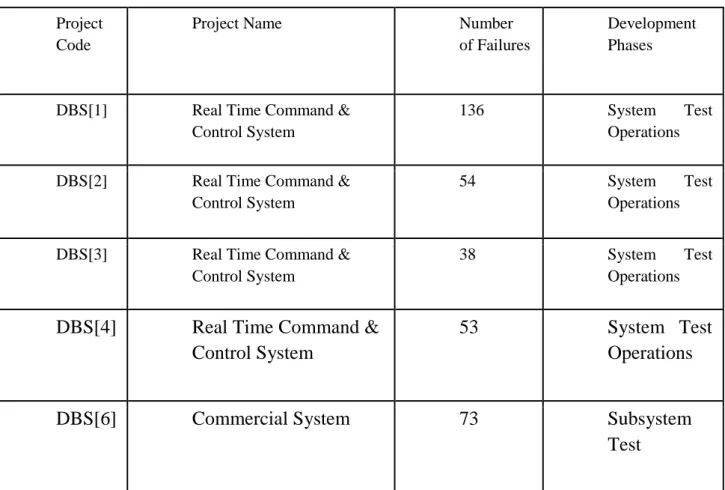
Table 4.1: Table of different software failure datasets used---17Table 4.2: Feed forward neural network model results ---20
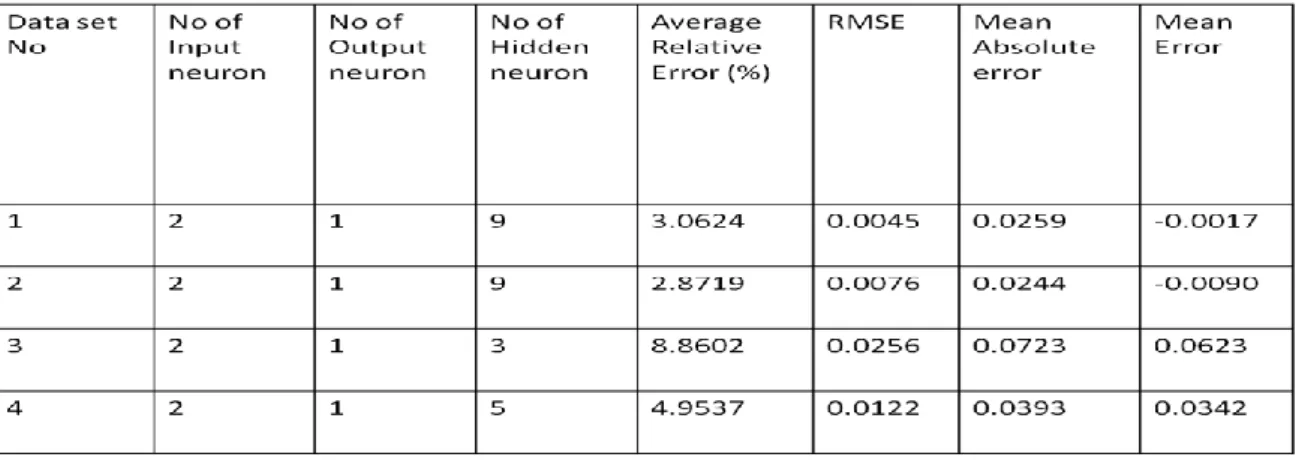
Table 4.3: Recurrent neural network model results---20
Table 4.4: Comparison with analytical models---21
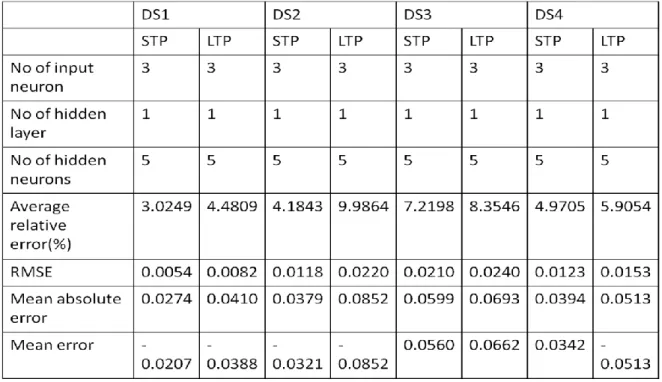
Table 4.5: Comparison between LTP and STP for feed forward neural network---21
1
Chapter 1
Introduction
Software is playing an ever-increasing role in our real time systems. Therefore there has been a gradual growth of concern over quality of software products and reliability has become a main concern from both software user’s point of view and software developers’ point of view. Also the rapid growth of software products in size and complexity has drawn the attention of researchers to be more focused on quality assessment by the estimation of the time of software testing period quantitatively to avoid any unwanted and unforeseen situation during operational phase. In this thesis report the applicability of neural network models for better reliability prediction in real environment are explored empirically and an assessment method of growth of software reliability using artificial neural network (ANN) mode is presented.
Artificial neural networks are generally known as “Neural Networks” and act in a way similar to the human brain. Non linearity and complexity of the brain is very high and behaves like a parallel computer. It has the ability for organizing its structural constituents known as neurons; hence it performs certain computation very quickly than the fastest computer present on earth. The brain structure is very intense and it builds up its own rules through experiences. Experiences are built up over time with the development of the human brain through many stages. A developing neuron is as similar as a plastic brain. To adapt with the surrounding environment the developing nervous system has the property of plasticity. Plasticity appears to be essential to the functioning of neurons as information processing units in the human brain. Similarly this same thing happens with neural networks made up of artificial neurons. A neural network is a machine that is designed to model the way in which the brain performs a particular task. To achieve good performance, neural networks should have a massive interconnection of simple computing cells referred to as
2
“neurons” or “processing units”. Neural networks perform essential computations through a process of learning.
Thus a neural network consists of simple processing units and big parallel distributed processors. The ability of storing experiential data and making it available for use comes naturally to it. Artificial neural network do not approach the complexity of the brain. It is similar to brain in two ways: 1.A learning process is used to acquire knowledge from its surrounding by the network. 2. The acquired knowledge is stored by the interneuron connection strengths known as synaptic weights. The procedure used to perform the process of learning is called learning algorithm. Function of learning algorithm is to modify the synaptic weights of the networks in an orderly manner in order to attain a desired design objective.
1.1
Motivation of Our Work
The software market is very competitive in this dynamic world. Software industries attempt to release software to grab the market as soon as it is ready. Now it is a challenge for software developers to rapidly design, implement, test, and maintain complex hardware or software systems as per the demands of the users. Also it is a challenge for software companies to deliver good quality and error free software in right time. The impact of the failures produces severe consequences such as environmental impact, inconvenience, economical losses, loss of human life etc. Needless to say, the reliability of computer systems has become a major concern for our society. Software reliability is an important facet of software quality characteristic. Many researchers have used neural networks to predict software reliability. Different neural networks with different learning methods also have been modelled. It is also observed that connectionist models perform better than the previous parametric models. Prediction of software reliability using computational intelligence (CI) can be very accurate and significant compared to traditional statistical methods. CI can offer promising approaches to software reliability prediction and modeling.
3
With this motivation, we implemented different neural network models with different learning algorithms and compared their performance results for software reliability prediction with the statistical methods and observed that neural networks perform better than the analytical models. The details of the work are described in the next chapter.
1.2
Objective of Our Work
The main objective of this research work is to implement different connectionist models with different learning regimes. Different datasets containing software failures are applied to the proposed models. These datasets are obtained from several software projects. Then different issues related to method of data representation, some unrealistic assumptions incorporated with software reliability models, and network architecture are discussed.
We have tried to implement the feed forward neural network architecture first with back propagation learning method for reliability prediction. As no work is done regarding the implementation of recurrent neural network with back propagation algorithm till now, so mainly our objective is to implement recurrent neural network architecture with back propagation learning algorithm. Followings are the key points of our implementation.
Feed Forward Neural Network with one hidden layer and multiple hidden layer along with back propagation learning method
Recurrent Neural Network with back propagation learning method
Long term predictability and Short term predictability of feed forward neural networks
Evaluation of effectiveness of the above proposed models by using different performance parameters
4
1.3
Organisation of The Thesis
The rest of this thesis report is organised into chapters as follows.
Chapter 2 describes about the related work done and gives an overall literature review.
Chapter 3 provides the background concepts used in the remaining part of the thesis. Some theoretical concepts regarding software reliability measures, artificial neural network and back propagation learning algorithm are described. Some basic concepts of feed forward and recurrent neural network are presented.
Chapter 4 provides a brief review and implementation details of the project work.
Chapter 5 describes the experimental results of the implemented network models and their performance results.
Chapter 6 concludes the thesis report with a summary and possible future extension of this work.
1.4
Literature Review
Artificial Neural Network (ANN) is a powerful technique for Software Reliability Prediction.
Werbos [9] proposed back-propagation learning as an alternative to regression technique to identify sources of forecast in uncertainty in a recent gas market model. Thus it can be concluded that neural network models are very useful for regression techniques of forecasting in uncertainty of any data.
Shadmehr et al. [10] estimated model parameters of pharmacokinetics system using feed forward multilayered network and predicted the noise resides in the measured data sample. The authors compared the results with that of the optimal
5
Bayesian estimator and found the performance was better than the maximum likelihood estimator [11].
The ANN tools and feed forward network using back propagation algorithm are applied for reliability and software quality prediction [12–14]. The authors developed a connectionist model and took failure data set as input to produce reliability as output. These papers describe network architecture, method of data representation and some unrealistic assumptions associated with software reliability models.
Karunanithi et al. [15] predicted software reliability using feed forward network and recurrent network. The authors compared the result with 14 different literature representative data sets and suggested that neural network produced better predictive accuracy compared to analytical models at end-point predictions.
Sitte [16] analyzed two methods for software reliability prediction: 1) neural networks and 2) parametric recalibration models. These approaches differentiate the neural networks and parametric recalibration models in the context of software reliability prediction and conclude that neural networks are much simpler and better predictors.
Tian et al. [7] predicted software reliability using recurrent neural network. Bayesian regularization is applied to train the network. The authors commented that their proposed approach produced less average relative prediction error than well known prediction techniques.
RajKiran et al. [17] implemented the use of wavelet neural networks (WNN) to predict software reliability. In this paper, the authors employed two kinds of wavelets i.e. Morlet wavelet and Gaussian wavelet as transfer functions. They made a comparison on test data with multiple linear regression (MLR), multivariate adaptive regression splines (MARS), back-propagation trained neural network (BPNN) and threshold accepting trained neural network (TANN), pi-sigma network (PSN), general regression neural network (GRNN) and found that its performance is better than others.
6
Lo [18] designed a model for software reliability prediction using artificial neural networks. This approach examines several conventional software reliability growth models without assuming some unrealistic things.
Fuzzy Wavelet Neural Network (FWNN) is used for phase space reconstruction technology and for software reliability prediction [19]. In this work, the network architecture is designed easily by taking the failure data as input.
7
Chapter 2
Background
2.1
Software Reliability
The probability that a software will perform a required function under stated conditions for a specified period of time is known as software reliability. Software reliability assessment is a very vital factor to characterise the quality of any software product quantitatively during testing phase.
Software Reliability Measures
Failure Rate: It is the rate of occurrence of failures. It also represents number of failures in specified period of time.
Mean Time Between Failures (MTBF): It is the average time between failures. No of hours taken to pass before a failure occurs is the MTBF. It is the inverse of failure rate.
Reliability: The probability that an item will perform a required function without failure under the stated conditions for a specified period of time is called reliability. It takes into account the mission time.
Availability: The probability that an item is in operable state at any time is called availability. It accounts for repairs and down time.
Software Reliability Growth Models
It includes two types of models Parametric models
Nonparametric models
Parametric models are based on non homogeneous Poisson process. Neural network is non parametric model and based on statistical failure data. Nonparametric models are more flexible.
8
Different Reliability Metrics
Failure rate
Next time to failure
Time between failures
Cumulative failures detected
2.2
Artificial Neural Network
It is can be defined as a system where data can be processed through a number of nodes similar to neurons in brain.
Each node is assigned with a function and it determines the node output with the help of some parameters available locally to it for a set of given input.
By adjusting weight of these parameters the node function can be altered as intended.
2.3
Neural Network Modeling
Like a brain, a neural network also performs in similar fashion. It has some learning mechanism designed within it for modelling the reliability.
A number of neurons constitute NN which are simple processing elements. These neurons are connected to each other directly through communications links associated with some weight.
Supervised learning method is used to train the NN with a series of sample input and to compare the responses overall for the pre specified period of time with the expected sample output.
The training procedure is carried out until expected and convincing responses are provided by the network. The neurons are arranged layer by layer and the connection patterns within and in-between layers make the network architecture.
The network can be either single-layered or multi-layered; layers of interconnected links between the neuron slabs determine it.
9
2.4
Transfer Function
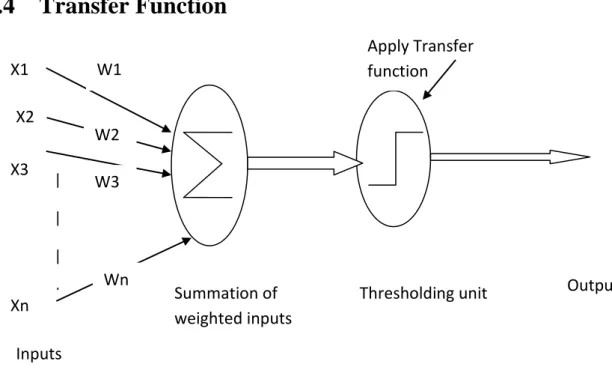
Figure 2.1: A simple model of artificial neuron
Let I=input to the neural network
Where Then Y=F (I)
where Y is the output of the neural network and F is the transfer function.
Hyperbolic Tangent Transfer Function
Y=F ( I)=
-
--
Y varies between -1 and +1.
| | | | X2 X1 X3 W1 W2 Wn W3 Summation of weighted inputs Thresholding unit Xn Inputs Output Apply Transfer function
10
Log Sigmoid Transfer Function
Y=F ( I)=
Y varies between 0 and +1.
Both log sigmoid and hyperbolic tangent functions are continuous. In this thesis report we have used log sigmoid as transfer function.
11
Chapter 3
Work Details
We have implemented feed forward neural network and recurrent neural network with back propagation learning algorithm.
3.1
Back Propagation Learning Algorithm
Algorithm:
1. Initialize the weights 2. Repeat
3. For each training pattern 4. Train on that pattern
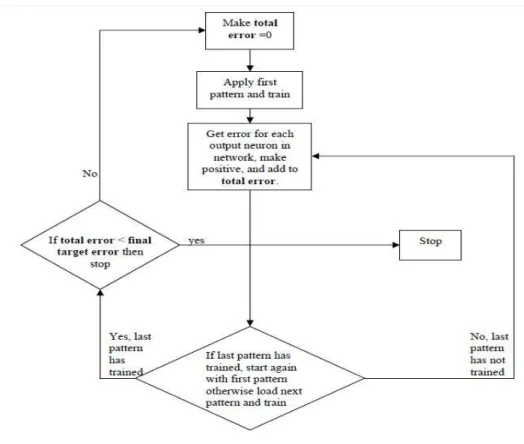
5. Find error for each pattern and mean square error for total no of patterns
6. Update the connecting weights by calculating errors layer by layer backward
7. End
12
Figure 3.4: Flowchart for back propagation algorithm
3.2
Approach for Feed Forward Neural Network
• Here Back Propagation Learning rule is applied to a feed forward network.
• The basic feed forward neural network architecture comprises in two steps.
– 1) feed forward NN
– 2) back propagation
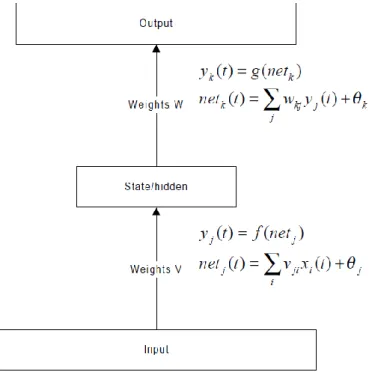
• Here the input vector is propagated through a weight layer. It is combined with the previous state activation as it depicted in next Figure 3.2.
• The conventional feed-forward neural network consists of two-layered network. The network comprises of two steps mapping.
y(t) = G(F(x(t)) ………...(1)
• The back-propagation learning techniques are used in the above equation 1 to update the weights of the network (F and G) for training the feed forward back propagation network. The operation is restricted in this paper to (“hidden/state” layer and “output” layer).
13
• The input vector ’x’ is propagated with a layer associated with weight V as depicted in equation 3.
yj(t) = f(netj)(t) ---(2)
n
netj(t) = Σ (vji)(xi(t) )+ θi---(3) i
where n is the number of inputs nodes, θi is a bias and f is an activation function.
• The output of the network is calculated by state and weight W associated with that output layer.
yk(t) = g(netk(t))--- (4) m
g(netk(t)) =Σ yj(t)wkj + θk--- (5) j
where m is the number of states or ‘hidden’ nodes, θk is a bias and g is an activation function.
Here sigmoid function is taken as activation function.
14
3.3
Approach for Recurrent Neural Network
• Here Back Propagation Learning rule is applied to a recurrent network.
• The basic recurrent neural network architecture comprise in two steps.
– 1) feed forward NN
– 2) back propagation with recurrent.
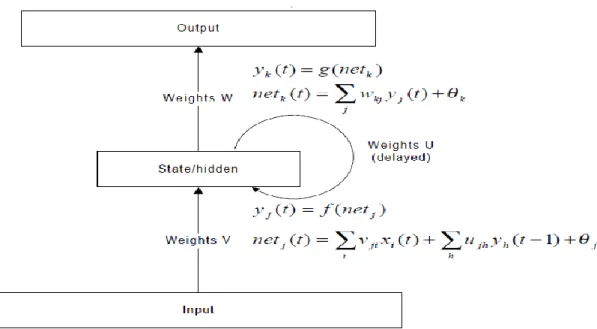
• Here the input vector is propagated through a weight layer. It is combined with the previous state activation through an additional recurrent weight layer, R as it depicted in next Figure 3.3.
• The conventional feed-forward neural network consists of two-layered network. The network comprises of two steps mapping
y(t) = G(F(x(t)) ………..(1)
• The back-propagation learning techniques are used in the above equation 1 to update the weights of the network (F and G) for training the Recurrent Back Propagation Network. The operation is restricted in this paper to (“hidden/state” layer and “output” layer).
• The input vector ’x’ is propagated with a layer associated with weight V and combined with previous state activation associated with recurrent weight U as depicted in equation 3.
yj(t) = f(netj)(t) ---(2) n m
netj(t) = Σ (vji)(xi(t) )+Σ (ujh)(yh(t − 1) )+ θi---(3)
i h
where n is the number of inputs nodes, θi is a bias, m is the number of states or ‘hidden’ nodes, and f is an activation function.
• The output of the network is calculated by state and weight W associated with that output layer.
yk(t) = g(netk(t))--- (4)
m
g(netk(t)) =Σ yj(t)wkj + θk--- (5)
j
15
Here sigmoid function is taken as activation function.
16
Chapter 4
Implementation & Results
4.1
Implementation setup
The FFNN and RNN with back propagation learning algorithm is implemented using MATLAB 7.10.0.499.
In our prediction experiment, failure data during system testing phase of various projects collected at Bell Tele-phone Laboratories, Cyber Security and Information Systems In-formation Analysis Centre(CSIAC) by John D. Musa are considered.
CSIAC provides software failure datasets in order to support the project manager to monitor testing, estimating the project schedule, and helping the researchers to evaluate the reliability model.
The data set consists of
o Failure Number
o Failure Interval Lengths/Time Between Failures (TBF) in CPU secs
o Day of Failure of software project
We have taken 5 numbers of application software testing data set for demonstration of predictive performance and prediction accuracy as shown in Figure 5.1.
70% of each dataset is used for training the model and the rest failure data is used for validating the model.
17
Table 4.1: Table of different software failure datasets used
Project Code
Project Name Number
of Failures
Development Phases
DBS[1] Real Time Command &
Control System
136 System Test
Operations
DBS[2] Real Time Command &
Control System
54 System Test
Operations
DBS[3] Real Time Command &
Control System
38 System Test
Operations
DBS[4] Real Time Command & Control System
53 System Test Operations
DBS[6] Commercial System 73 Subsystem Test
• For FFNN proposed model,
– Cumulative Execution time is taken as input
– No of Cumulative Failures is taken as output
– Both cumulative execution time and no of cumulative failures are normalized in the range 0 to 1.
– Graph is plotted with cumulative execution time in X-axis and no of cumulative failures in y-axis.
• For RNN proposed model
– Cumulative execution time for nth failure is taken as input
18
– Graph is plotted with no of failure taken in X-axis and cumulative execution time in y-axis.
– Cumulative execution time is normalized in the range 0 to 1.
4.2
Different Performance Measures
• The following performance measures are being used to validate the proposed models:
– Relative Error(%): REi = ( | (Pi-Ai ) / Ai | ) * 100
n
– Average Relative Error(%): 1/n ∑ REi
n 2
– Root Mean Squared Error: RMSE = √ [ ( ∑ (Pi-Ai) ) / n ] n
– Mean Absolute Error: [ ∑ | Pi-Ai | ] / n
n – Mean Error: [ ∑ (Pi-Ai) ] / n where Pi=Predicted Value Ai=Actual Value n=total no of observations/patterns
4.3
Prediction Types
• Neural Networks can predict software reliability in two ways:
– Long Term Prediction
19
Short term prediction (STP)
Suppose we have a software failure dataset having the following format. Cumulative
execution time No of failures
t1 x1 t2 x2 t3 x3 | | tk xk t(k+1) x(k+1) | | tn xn t(n+1) x(n+1)
We can interpret no of failures as a function of cumulative execution time . Suppose y is the function, then y can be written as y(t)=x
• Then a neural network can be modeled by with 3 layers taking k input neurons in input layer, 1 output neuron in output layer and a hidden layer.
• Taking y(t1),y(t2),y(t3)…y(tk) as inputs to the neural network and Predicting y’(t(k+1)) as output(where y(t(k+1)) is taken as target value) is known as short term prediction or 1-step ahead prediction .
Long term prediction(LTP)
Considering the neural network model as explained in previous section,
y(t1),y(t2),y(t3)…y(tk) are taken as inputs to the neural network and y’(t(k+1)) is predicted as output(where y(t(k+1)) is taken as target value).
Then y(t2),y(t3),y(t4)…y’(t(k+1)) are taken as inputs to the neural network and y’(t(k+2)) is predicted as output(where y(t(k+2)) is taken as target value).
Continuing like this up to nth pattern is known as long term prediction or n-step ahead prediction.
20
4.4
Results and Discussion
Different dataset are taken and results are shown in the following tables and
figures.
Table 4.2: Feed forward neural network model results
21
Table 4.4: Comparison with analytical models
22
4.5
Graphs and Screenshots
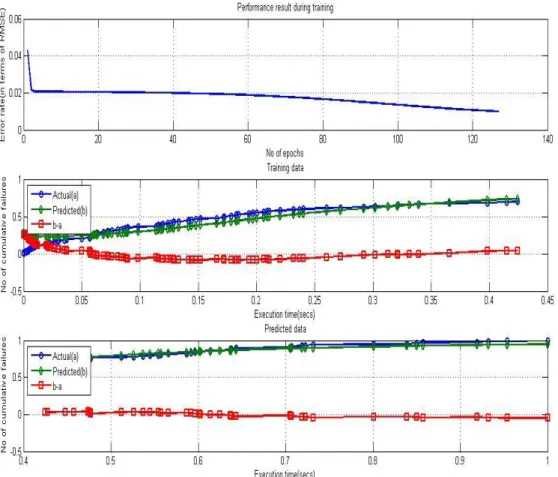
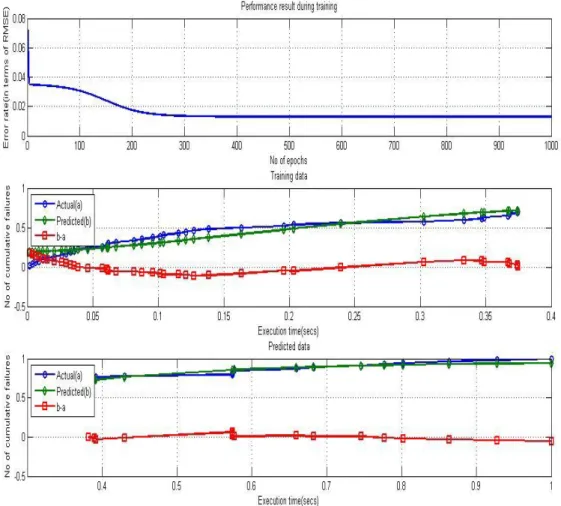
Figure 4.1: Performance of FFNN for Dataset1
In the above figure, plots for feed forward neural networks are shown. The first graph is the plot between number of epochs vs. error rate in terms of RMSE during training. It shows how the error rate gradually decreases with the no of epochs by the use of back propagation learning. The second and third graph is the plot between cumulative execution time vs. no of cumulative failures for Dataset1. Second graph is plotted for the training period and third graph is plotted for the prediction period. In both second and third graph blue colour line represents actual data, green colour line represents predicted data and red colour line represents difference between predicted data and actual data.
23
Figure 4.2: Snapshot of performance of FFNN for Dataset 1
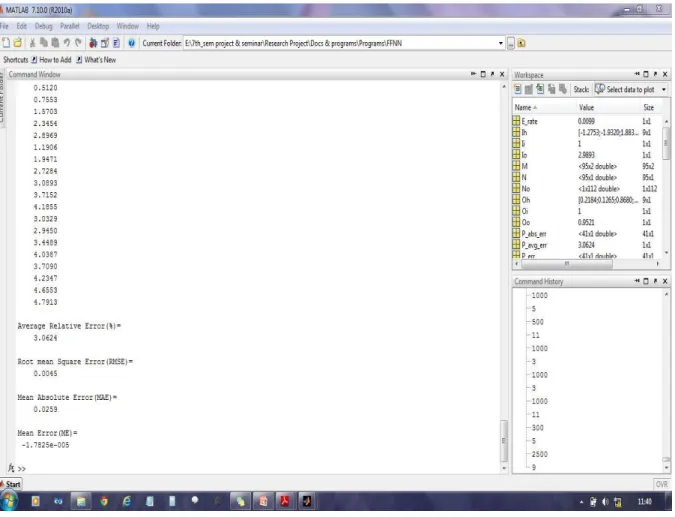
In the above figure, the snapshot of different performance measure values using FFNN for Dataset1 is shown.
24
Figure 4.3: Performance of FFNN for Dataset2
In the above figure, plots for feed forward neural networks are shown. The first graph is the plot between number of epochs vs. error rate in terms of RMSE during training. It shows how the error rate gradually decreases with the no of epochs by the use of back propagation learning. The second and third graph is the plot between cumulative execution time vs. no of cumulative failures for Dataset2. Second graph is plotted for the training period and third graph is plotted for the prediction period. In both second and third graph blue colour line represents actual data, green colour line represents predicted data and red colour line represents difference between predicted data and actual data.
25
Figure 4.4: Snapshot of performance of FFNN for Dataset2
In the above figure, the snapshot of different performance measure values using FFNN for Dataset2 is shown.
26
Figure 4.5: Performance of FFNN for Dataset3
In the above figure, plots for feed forward neural networks are shown. The first graph is the plot between number of epochs vs. error rate in terms of RMSE during training. It shows how the error rate gradually decreases with the no of epochs by the use of back propagation learning. The second and third graph is the plot between cumulative execution time vs. no of cumulative failures for Dataset3. Second graph is plotted for the training period and third graph is plotted for the prediction period. In both second and third graph blue colour line represents actual data, green colour line represents predicted data and red colour line represents difference between predicted data and actual data.
27
Figure 4.6: Snapshot of performance of FFNN for Dataset3
In the above figure, the snapshot of different performance measure values using FFNN for Dataset3 is shown.
28
Figure 4.7: Performance of FFNN for Dataset4
In the above figure, plots for feed forward neural networks are shown. The first graph is the plot between number of epochs vs. error rate in terms of RMSE during training. It shows how the error rate gradually decreases with the no of epochs by the use of back propagation learning. The second and third graph is the plot between cumulative execution time vs. no of cumulative failures for Dataset4. Second graph is plotted for the training period and third graph is plotted for the prediction period. In both second and third graph blue colour line represents actual data, green colour line represents predicted data and red colour line represents difference between predicted data and actual data.
29
Figure 4.8: Snapshot of performance of FFNN for Dataset4
In the above figure, the snapshot of different performance measure values using FFNN for Dataset4 is shown.
30
Figure 4.9: Performance of RNN for Dataset1
In the above figure, plots for recurrent neural networks are shown. The upper two graphs are the plot between no of cumulative failures vs. cumulative execution time for Dataset1. Upper left graph is plotted for the training period and upper right graph is plotted for the prediction period. In both upper graphs red colour line represents actual data; blue colour line represents predicted data. In the lower two graphs red colour line represents difference between predicted data and actual data.
31
Figure 4.10: Performance of RNN for Dataset2
In the above figure, plots for recurrent neural networks are shown. The upper two graphs are the plot between no of cumulative failures vs. cumulative execution time for Dataset2. Upper left graph is plotted for the training period and upper right graph is plotted for the prediction period. In both upper graphs red colour line represents actual data; blue colour line represents predicted data. In the lower two graphs red colour line represents difference between predicted data and actual data.
32
Figure 4.11: Performance of RNN for Dataset6
In the above figure, plots for recurrent neural networks are shown. The upper two graphs are the plot between no of cumulative failures vs. cumulative execution time for Dataset3. Upper left graph is plotted for the training period and upper right graph is plotted for the prediction period. In both upper graphs red colour line represents actual data; blue colour line represents predicted data. In the lower two graphs red colour line represents difference between predicted data and actual data.
33
Chapter 5
Conclusion and Future Work
5.1
Conclusion
We have successfully implemented the feed forward and recurrent neural network with back propagation learning algorithm. The observations conclude that neural network model performs better in terms of less error in prediction as compared to existing analytical models and hence it is a better alternative to do software reliability test using neural network. However it can be seen from the figures that the NN method proposed in this paper using back propagation algorithm provides a good fit than analytical models.As the connection weights are randomly initialized, thus the neural network gives different results for the same datasets and thus the performance of the network varies. The usefulness of a Neural Network method is dependent on the nature of dataset up to a greater extent. In most cases STP gives better result than LTP. Neural Network model gives better result for larger datasets than smaller datasets.These models are easily compatible with different smooth trend data set and projects. We have implemented the program in MATLAB. But the programs can be implemented in other languages such as Java, Python etc.
34
5.2
Future Work
Software reliability can be predicted using hybrid intelligent system. In addition to neural network model genetic programming can be applied further. Novel recurrent architectures for Genetic Programming (GP) and Group Method of Data Handling (GMDH) to predict software reliability can be proposed.
Further, research can be extended by developing GP and GMDH based ensemble models to predict software reliability. In the ensemble models, GP and GMDH are considered as constituent models.
35
References
[1] J. D. Musa, “Software Reliability Data,” Data & Analysis Centre for Software, January 1980.
[2] R. Iyer and I. Lee, “Measurement-based analysis of software reliability,” Handbook of Software Reliability Engineering, McGraw-Hill, pp. 303 – 358, 1996.
[3] J. D. Musa and K. Okumoto, “A Logarithmic Poisson Execution Time Model for Software Reliability Measurement,” in ICSE, EEE Press Piscataway. NJ, USA: Proceedings of the 7th International Conference on software Engineering, pp. 230–238, 1984.
[4] T. R. Benala, S. Dehuri, and R. Mall, “Computational Intelligence in Software Cost Estimation: An Emerging Paradigm,” ACM SIGSOFT Software Engineering, vol. 37, no. 3, pp. 1–7, May 2012.
[5] IEEE, “Standard glossary of software engineering terminology,” Standards Coordinating Committee of the IEEE Computer Society, 1991.
[6] Simon Haykin, “Neural Networks A Comprehensive Foundation”, Pearson Prentice Hall, 2nd Edition, 2001.
[7] L. Tian and A. Noore, “Software Reliability Prediction Using Recurrent Neural Network with Bayesian Regularization,” International Journal of Neural Systems, vol. 14, no. 3, pp. 165–174, June 2004.
[8] A. L. Goel, “Software reliability models: Assumptions, limitations, and applicability,” IEEE Transaction on Software Engineering, vol. 11, no. 12, pp. 1411–1423, December 1985.
[9] P. Werbos, “Generalization of Back propagation with Application to Recurrent Gas Market Model,” Neural Network, vol. 1, pp. 339–356, 1988.
[10] R. Shadmehr and D. Z. DSArgenio, “A Comparison of a Neural Network Based Estimator and Two Statistical Estimators in a Sparse and Noisy Data Environment,” in IJCNN, vol. 1, Washington D.C, pp. 289–292, June 1990.
36
[11] N. Karunanithi, Y. Malaiya, and D. Whitley, “Prediction of Software Reliability Using Neural Networks,” in Proceedings IEEE International Symposium on Software Reliability Engineering. Austin, TX: IEEE, pp. 124– 130, May 1991.
[12] T. M. Khoshgoftaar, A. S. Pandya and H. More, “A Neural Network Approach For Predicting Software Development Faults.” Research Triangle Park, NC: Proceedings of Third International Symposium on Software Reliability Engineering, pp. 83–89, October 1992.
[13] Y. Singh and P. Kumar, “Prediction of Software Reliability Using Feed Forward Neural Networks,” in Computational Intelligence and Software Engineering (CiSE), I. Conference, Ed. IEEE, pp. 1–5, 2010.
[14] M. M. T. Thwin and T. S. Quah, Eds., Application of Neural Network for Predicting Software Development Faults using Object-Oriented Design Metrics, vol. 5. Proceedings of the 9th International Conference on Neural Information Processing (ICONIP’02), November 2002.
[15] N. Karunanithi and D. Whitley, “Prediction of Software Reliability Using Feed forward and Recurrent Neural Nets,” in Neural Networks, 1992. IJCNN, vol. 1. Baltimore, MD: IEEE, pp. 800–805, June 1992.
[16] R. Sitte, “Comparison of software-reliability-growth predictions: neural networks vs. parametric-recalibration,” Reliability, IEEE Transactions, vol. 48, no. 3, pp. 285–291, September 1999.
[17] N. RajKiran and V. Ravi, “Software Reliability Prediction using Wavelet Neural Networks,” in International Conference on Computational Intelligence and Multimedia Applications, vol. 1. Sivakasi, Tamil Nadu: IEEE, pp. 195 – 199, December 2007.
[18] J. H. Lo, “The Implementation of Artificial Neural Networks Applying to Software Reliability Modeling,” Control and Decision Conference, 2009. CCDC '09, Chinese, pp. 4349 – 4354, June 2009.
[19] L. Zhao, J. pei Zhang, J. Yang, and Y. Chu, “Software reliability growth model based on fuzzy wavelet neural network,” in 2nd International Conference on Future Computer and Communication (ICFCC), vol. 1. Wuhan: IEEE, pp. 664– 668, May 2010.
37
[20] R. Mohanty, V. Ravi, and M. R. Patra, “Hybrid Intelligent Systems for Predicting Software Reliability,” Applied Soft Computing, vol. 13, no. 1, pp. 189–200, August 2013.
38
Appendix A
Datasets
Cyber Security and Information Systems In-formation Analysis
Centre(CSIAC) Software project failure datasets:
Dataset1:
Failure Number
Failure Interval
Length(in cpu secs)
Day of Failure
1
3
1
2
30
2
3
113
9
4
81
10
5
115
11
6
9
11
7
2
17
8
91
20
9
112
20
10
15
20
11
138
20
12
50
20
13
77
20
14
24
20
15
108
20
16
88
20
17
670
30
18
120
30
19
26
30
20
114
30
21
325
30
22
55
30
23
242
31
24
68
31
25
422
31
26
180
32
27
10
32
28
1146
33
39
29
600
34
30
15
42
31
36
42
32
4
46
33
0
46
34
8
46
35
227
46
36
65
46
37
176
46
38
58
46
39
457
47
40
300
47
41
97
47
42
263
47
43
452
53
44
255
53
45
197
54
46
193
54
47
6
54
48
79
54
49
816
56
50
1351
56
51
148
56
52
21
57
53
233
57
54
134
57
55
357
57
56
193
59
57
236
59
58
31
59
59
369
59
60
748
59
61
0
59
62
232
59
63
330
59
64
365
61
65
1222
62
66
543
63
67
10
63
40
68
16
63
69
529
64
70
379
64
71
44
64
72
129
64
73
810
64
74
290
64
75
300
64
76
529
65
77
281
65
78
160
65
79
828
66
80
1011
66
81
445
66
82
296
66
83
1755
67
84
1064
67
85
1783
68
86
860
68
87
983
68
88
707
69
89
33
69
90
868
69
91
724
69
92
2323
70
93
2930
71
94
1461
72
95
843
72
96
12
72
97
261
72
98
1800
73
99
865
73
100
1435
74
101
30
74
102
143
74
103
108
74
104
0
74
105
3110
75
106
1247
76
41
107
943
76
108
700
76
109
875
77
110
245
77
111
729
77
112
1897
78
113
447
79
114
386
79
115
446
79
116
122
79
117
990
79
118
948
80
119
1082
80
120
22
80
121
75
80
122
482
80
123
5509
81
124
100
81
125
10
81
126
1071
82
127
371
83
128
790
83
129
6150
83
130
3321
83
131
1045
84
132
648
84
133
5485
87
134
1160
87
135
1864
88
136
4116
92
Dataset2:
Failure Number
Failure Interval
Length(in cpu secs)
Day of Failure
1
191
1
2
222
2
3
280
11
42
5
290
14
6
385
23
7
570
23
8
610
23
9
365
23
10
390
23
11
275
23
12
360
27
13
800
27
14
1210
28
15
407
29
16
50
29
17
660
29
18
1507
31
19
625
31
20
912
32
21
638
32
22
293
32
23
1212
33
24
612
33
25
675
33
26
1215
33
27
2715
37
28
3551
37
29
800
38
30
3910
38
31
6900
38
32
3300
38
33
1510
41
34
195
42
35
1956
42
36
135
43
37
661
43
38
50
43
39
729
43
40
900
46
41
180
46
42
4225
46
43
15600
53
43
44
0
53
45
0
53
46
300
53
47
9021
57
48
2519
64
49
6890
64
50
3348
67
51
2750
69
52
6675
71
53
6945
71
54
7899
72
Dataset3:
Failure Number
Failure Interval
Length(in cpu secs)
Day of Failure
1
115
1
2
0
1
3
83
3
4
178
3
5
194
3
6
136
3
7
1077
3
8
15
3
9
15
3
10
92
3
11
50
3
12
71
3
13
606
6
14
1189
8
15
40
8
16
788
18
17
222
18
18
72
18
19
615
18
20
589
26
21
15
26
22
390
26
23
1863
27
44
24
1337
30
25
4508
36
26
834
38
27
3400
40
28
6
40
29
4561
42
30
3186
44
31
10571
47
32
563
47
33
2770
47
34
652
48
35
5593
50
36
11696
54
37
6724
54
38
2546
55
Dataset4:
Failure Number
Failure Interval
Length(in cpu secs)
Day of Failure
1
5
1
2
73
1
3
141
1
4
491
5
5
5
5
6
5
5
7
28
5
8
138
5
9
478
9
10
325
9
11
147
10
12
198
10
13
22
10
14
56
10
15
424
20
16
92
20
17
520
20
18
1424
26
19
0
26
45
20
92
26
21
183
26
22
10
26
23
115
27
24
17
27
25
284
27
26
296
27
27
215
27
28
116
27
29
283
31
30
50
31
31
308
31
32
279
31
33
140
32
34
678
32
35
183
32
36
2462
41
37
104
41
38
2178
42
39
285
43
40
171
44
41
0
44
42
643
46
43
887
46
44
149
48
45
469
48
46
716
48
47
604
48
48
0
48
49
774
50
50
256
50
51
14637
58
52
18740
70
53
1526
71
46
Dataset6:
Failure Number
Failure Interval
Length(in cpu secs)
Day of Failure
1
3
1
2
14
1
3
59
1
4
32
2
5
8
2
6
52
2
7
2
2
8
25
2
9
2
2
10
3
5
11
4
6
12
1
6
13
30
6
14
21
7
15
196
12
16
265
12
17
6
12
18
3
12
19
8
12
20
1
12
21
12
12
22
36
13
23
38
13
24
1
13
25
74
14
26
43
14
27
236
14
28
121
15
29
18
16
30
9
16
31
23
16
32
1
16
33
672
24
34
189
24
35
83
26
36
52
26
47