SAMSØ – A 2.0 PERSPECTIVE 1
From
the
Renewable
Energy
Island
to
the
Fossil
Fuel
Free
Island
By
Tomas
Ramse
Andersen,
Mimosa
S.
Burr,
Sæmundur
K.
Finnbogason,
Markus
Johannesson,
and
Sara
Libera
Zanetti
Introduction
The island of Samsø, stretching 26 km long, 7 km wide, and covering a total land area of 114 square kilometres is home to just over 4 000 Samsingers (local resi-dents). It is located just off the Jutland peninsula in Denmark. The main economic activities on the island have traditionally been farming and tourism, with roughly 350 000 overnight stays every year [8]. In-creasingly, renewable energy production is becoming ever more important in the Is-land’s economy [4].
In 1997, Samsø won a Danish national competition for the most realistic and achievable plan for the transition to 100% self-sufficient energy production. By the end of 2005, the renewable energy target was met in full [8]. With the help of the Samsø Energy Academy and local residents a plan was formulated to continue the shift away from fossil fuel use on the island. The Samsø 2.0 plan was born, which includes seven distinct objectives.
The aim of this report is to aid and support the Samsø Energy Academy (henceforth “the Academy”) in reaching objective 3 as
well as objective 1 of the Samsø 2.0 plan (see table 1). These two objectives address phasing out fossil fuels. Our report focuses on this transition in the transport sector. We identify the main stakeholders and ac-tors, and examine potential barriers and opportunities to the implementation of the transition towards fossil fuel free transport. The report is organised into the following sections; background information of Samsø and the Samsø Energy Academy; scope and purpose of our project; our findings; our analysis; and future developments.
Background
The Renewable Island
Samsø’s status and community identity as a renewable island started in 1997 with a national competition. The Ministry of En-vironment was inspired by a report that recommended increasing the share of re-newables in Denmark's energy consump-tion to 35% by 2030. The Ministry of Envi-ronment designed the competition to high-light the feasibility of achieving such a goal using existing technologies, engaging the local community, and without depending
2 SAMSØ – A 2.0 PERSPECTIVE
heavily on government grants or subsidies. Five communities applied for the competi-tion, explaining how they could apply tech-nical, organisational, and financial re-sources to achieve near complete energy self-sufficiency over a ten-year span. The competition focused on island communi-ties because they can monitor energy im-ports and exim-ports more easily than land-locked communities. Samsø won the com-petition, earning funding for developing a master plan to implement the transition to renewable energy, and the right to brand itself as Denmark’s Renewable Energy Is-land. The competition and Samsø’s master plan focused on three sectors of energy consumption: electricity, heating, and transportation. Implementation started in 1998, when 6-13% of the island’s energy came from renewable sources [3,7].
Renewable electricity production was pri-marily addressed by the installation of wind turbines. In 2000, eleven 1-MW wind turbines were installed to cover the island’s annual electricity consumption of approx-imately 29 000 MWh. The electricity con-sumption rate remained fairly constant from 1997 to 2005, suggesting that these 11 wind turbines continue to meet the elec-tricity needs on the island. The option of local ownership of the wind turbines facili-tated community acceptance of the plan. Nine of the turbines are owned by local farmers. Two are owned by a cooperative of 450 residents. Each wind turbine cost 6 million DKK (800 000 EUR). Electricity production prices were regulated by na-tional law and set at a 10-year guaranteed
minimum of 0.6 DKK/kWh
(0.08 EUR/kWh). Some businesses and residences have photovoltaics (PV) as sup-plemental electricity production. Adoption of PVs was lower than planned, likely for
economic reasons [3,7].
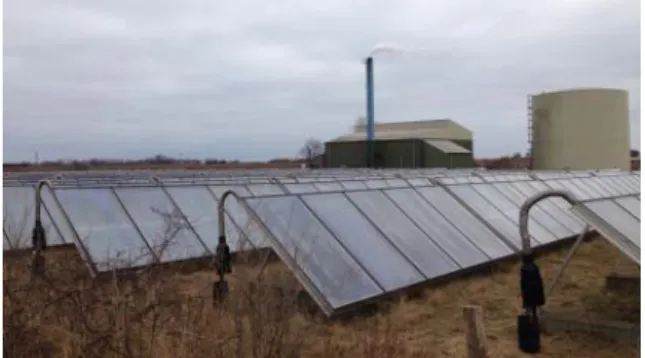
Samsø’s master plan aimed to cover heat-ing needs with district heatheat-ing in densely populated areas and with renewable energy systems in remote residences. Tranebjerg, the largest village on the island, already had a district heating plant serving 25% of the island’s heating needs. Local engage-ment was critical in the design and adop-tion of the district heating plants. Three new district heating facilities came online during the project, bringing district heating coverage up to 43%, short of the goal of 65%. The district heating plants use renew-able sources of energy such as solar energy and biomass. One is owned and operated by NRGi, an Århus-based energy company. Its users own one, and the last is owned by a local investor.
External consultants were hired to assist remote residents to identify methods for energy conservation and renewable heating in their homes. In 2002, the Danish na-tional government offered financial incen-tives for heat pumps, solar collectors, and biomass-based heating systems, and thus eased the adoption of renewable energy heating in remote homes.
Transportation fuels were indirectly ac-counted for in the project. Because of a lack of available technical solutions at the time, the community did not directly address transportation fuels. Instead, the
SAMSØ – A 2.0 PERSPECTIVE 3
nity agreed to offset fossil fuel consump-tion in the transportaconsump-tion sector by produc-ing extra wind electricity and exportproduc-ing it to the mainland. An offshore wind farm with ten 2.3-MW wind turbines was thus established. One is owned by a local coop-erative. Four are owned by individual in-vestors. Five are owned by the municipali-ty, which reinvests profits from the wind turbines into new renewable energy pro-jects [3,7].
The Samsø Energy Academy
The Academy opened in 2007 around the culmination of the renewable energy pro-ject. It serves as a centre for research, edu-cation, and community discourse on re-newable energies. The Academy is a cata-lyst for engagement. They invite citizens to participate in discussing, planning, and implementing the 2.0 plan. The Academy is jointly funded by the Samsø Municipali-ty, European Regional Development Fund, amongst other sources.
Samsø 2.0
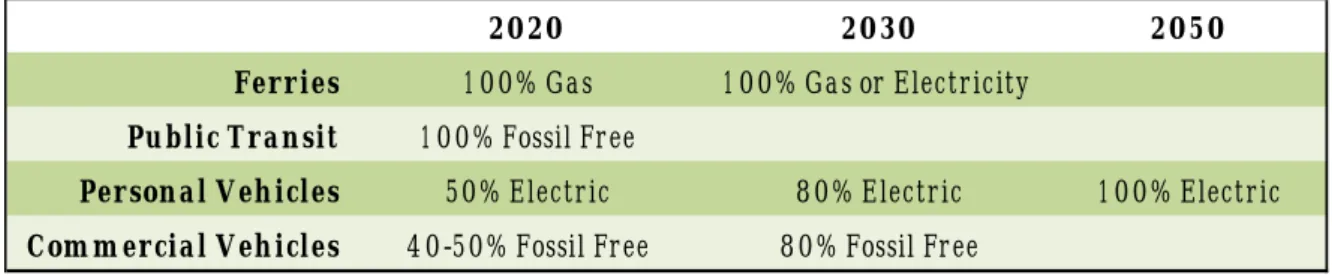
Samsø is currently in a second phase of greening energy production and consump-tion on the island. The community refers to this master plan as “Samsø 2.0”. The Acad-emy coordinates the community dialogue and initiatives. One of the objectives of the plan addresses the challenge of transporta-tion on the island as well as to and from the mainland. Today, fossil fuels dominate in the transportation sector. The current vi-sion is to gradually phase out the fossil fuels for mobility purposes and to substi-tute them with renewable energy sources. The specific targets are outlined in table 2.
The goals include switching to electric ve-hicles (EVs) for personal transport and bio-fuels or other fossil free fuel for commer-cial vehicles, such as tractors and trailers [8].
Demographics
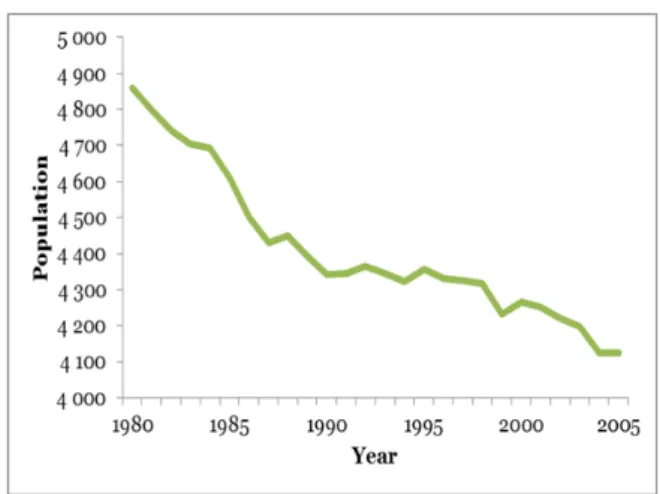
Amidst the transition to renewable energy production, and during the current transi-tion to fossil fuel free transportatransi-tion, the island is struggling with unsustainable population trends. The population has been declining for decades as shown in fig-ure 3.
Education is available on the island until students are approximately 15 years old, at which point they often move to the main-land to continue education. Many do not return to the island after finishing their education [8]. Furthermore, the age distri-bution on the island differs greatly from the Danish average. The population is pre-dominantly over 50 years old [9]. Plans for the future of the island include encourag-ing and attractencourag-ing young families to move to Samsø. The island’s on-going develop-ment of the ferry connections to the island could contribute to this.
Figure 3: Samsø Population Trend
Objective 1 Phase out use of fossil fuels on the island.
Objective 3 Use renewable energy for transportation on the island as well as to and from the mainland.
4 SAMSØ – A 2.0 PERSPECTIVE
Our Project
Purpose and Focus
The Academy is early in the implementa-tion process of the Samsø 2.0 plan. The purpose of our study was to provide aid and support for the Samsø 2.0 plan with a focus on objective 3 and inherently objec-tive 1. Initially, we considered covering both private and public transportation on the island in our assessment. During the course of the project our focus shifted to the challenge of transforming the private and commercial car fleets into EVs or other fossil free options and how the community perceives this transition. The reason be-hind this shift was due to the fact that the island has already developed commuter improvements. In addition, we conducted a preliminary study of the island’s capacity to produce biodiesel fuels for personal and commercial transport.
Interviews were carried out to gauge differ-ent stakeholders’ views and detect if their views were aligned with the 2.0 plan. Ulti-mately, we wanted to identify potential barriers and opportunities related to the shift from fossil fuels to renewable electric-ity and biofuels.
Methodology
Preliminary research was conducted within the context of the island’s objectives. Prior to arriving on Samsø we met with the Man-ager of the Samsø Energy Academy, Mi-chael Larsen, to gain further background information and to scope the study. Next,
a proposal for our project and scope was sent to and approved by the Academy. After assessing what objectives 1 and 3 en-tail, we identified a list of the main stake-holders to approach: the tourism industry, the farming community, the municipality, financial institutions, private investors, an energy provider, and island residents. Open-ended interviews and discussions with representatives from each stakeholder group were conducted.
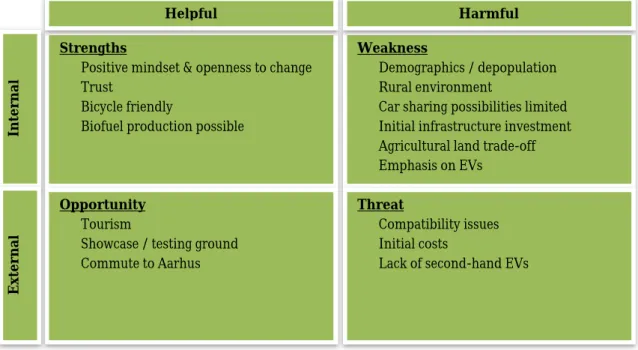
To simplify and get a better overview of our findings a SWOT analysis was used. The analysis is a framework that structures the internal and external factors that may in-fluence a business or organisation in a simple manner and provides a foundation for the development of a strategy or goal. The information collected is categorised into internal Strengths and Weaknesses, and external Opportunities and Threats. It is suggested that the framework should not be viewed as a static tool, but rather a con-tinuous part of a management process [7]. We conducted the analysis as a snapshot within and as a part of a dynamic process of technological and social change on the island within the context of our scope.
Findings
All interviewees showed a high level of awareness of the Samsø 2.0 project and of the key role that the Academy plays in its development and implementation. They shared a positive view of the fossil free community project. Samsingers seem
en-Table 2: Timeline of the Targets for Samsø 2.0’s Objective 3
2020 2030 2050
Ferries 1 00% Gas 1 00% Gas or Electricity
Public Transit 1 00% Fossil Free
Personal Vehicles 50% Electric 80% Electric 1 00% Electric
SAMSØ – A 2.0 PERSPECTIVE 5
gaged in the development of the communi-ty. For example, residents volunteer to par-ticipate in citizen working groups focusing on the project’s different aspects, such as transportation. The groups research and discuss different ways to approach and reach the goals.
Personal Transportation
The goal of shifting to EVs for personal transport affects the majority of house-holds on the island. Car ownership is fairly common with approximately 2/3 of fami-lies owning a car and less than 1/10 having two cars [2].
According to the Academy wind energy produced on the island could fuel electric-powered transportation on the island. Samsø exports to the mainland two thirds of wind energy produced on the island. Interviewees noted that EVs are appropri-ate for personal mobility on the island. Travel distances on the island for personal transport tend to be within the range of current EVs. EV owners could simply charge their EVs overnight without need-ing to modify the electrical infrastructure in their homes. However, when asked about their personal willingness to buy an EV, interviewees raised a number of practi-cal concerns. For example, the lack of EVs designed for off-road use has discouraged some from switching to EVs.
Compatibility with the mainland is a hur-dle. A shortage of charging stations on the mainland, in practice, limits Samsingers’ use of EVs to the island. Uncertainty re-garding future infrastructure on the main-land discourages Samsingers from pur-chasing EVs. Some EV owners mentioned keeping a conventional car for travel on the mainland. The Academy is including
near-by coastal municipalities in discussions to address this compatibility issue.
The cost of EVs is another hurdle. Inter-viewees noted that Samsingers typically opt for second hand cars. The absence of a reliable second-hand market for EVs means that Samsingers would be purchas-ing EVs first hand, at a much higher price than they would pay for a second-hand conventional car. Financial institutions on the island are open and ready to finance the purchase of EVs.
A widespread shift to EVs on the island could require infrastructure changes. Many interviewees expressed concern about the initial investment costs and who should carry the financial burden of the transfor-mation. It is worth mentioning that the is-land needs to be connected to the main grid due to intermittency and other securi-ty factors in order guarantee stabilisecuri-ty.
Additionally, interviewees implied that they want to see EV technology work in practise before making the transition. This implies that there might be a technological leap that needs to be bridged; not only in the physical sense, but also from a social and psychological point of view. It seems that these barriers may hold back stake-holders’ willingness to try out EVs. The Academy is coordinating an EV day sched-uled for May of this year.
The plan of a fossil fuel free mobility in-volves mainly the residents on the island, leaving the tourists that yearly visit Samsø out of the scope of the 2.0 project. Several of the contacted stakeholders stressed the crucial role that tourism plays in the econ-omy of the island and for this reason public authorities will not force tourists to leave their conventional cars outside of Samsø.
6 SAMSØ – A 2.0 PERSPECTIVE
The tourist office claimed they do not in-tend to challenge or question tourists’ use of conventional cars on the island. Rather, the office wants to offer tourists the oppor-tunity to use bicycles or vehicles fuelled by renewable energy. For example, tourists could be offered EV rentals at each ferry landing. The tourist office also communi-cates the favourable conditions for bicycles on the island and is hoping to expand this mode of travel.
Public Transportation
Interviews revealed that the community of Samsø has limited influence over the fquency and times of bus departures. A re-gional bus company provides and manages the bus service for the island. The bus schedule does not fully meet the needs of the residents. For example, it is not synched with the ferry schedule. The com-munity and the municipality have made numerous attempts to address the schedul-ing issues and improve public transporta-tion on the island. However, there seems to be little opportunity to modify the current situation. The municipality is now investi-gating the feasibility of replacing the public transit busses with an electric minibus. Use of the current busses may be reduced to school commuting hours.
Regarding transportation to the island, al-ternative solutions have already been planned. At the moment, Samsø is con-nected to the mainland through two fer-ries; one connects the island to the penin-sula of Jutland, and the other one to Zea-land. Changes to both connections are on the agenda. The Zealand ferry route will be changed to shorten the travel distance by about 30%. The Jutland ferry will be re-placed with liquefied natural gas (LNG) ferry. The new ferry, which is scheduled for use in October 2014, will have a capacity of
600 passengers and 160 cars. The munici-pality foresees around 1 million DKK (134 000 EUR) savings in fuel consump-tion [1]. Moreover, there are plans for an additional commuter ferry to Jutland. The new ferry will connect Mårup to the centre of Århus in just 40 minutes, attracting visi-tors and possibly enabling improved com-muting between Samsø and Århus. The municipality aims for new homes to be built near Mårup harbour to attract fami-lies with parents who will commute to År-hus.
Commercial Transportation
The goal for commercial vehicles is that 80% will use a fossil fuel free propellant by 2030. No particular renewable energy technology is specified. Some small com-mercial vehicles could be replaced with EVs. In fact, Mr. Kjær, an electrician on the island, noted that he plans to replace three of his company’s trucks with electric ones. Some interviewees did mention concerns over EVs, such as the limited range. The EVs in the municipal car fleet are not per-forming up to the range promised by the manufacturer. In the winter, the EVs had a range of approximately 60 km/day. This range is limiting considering the daily driv-ing needs of a commercial or municipal vehicle on the island can easily reach 60 km. Additionally, EVs may not meet the needs of certain commercial vehicles such as freight delivery and off-road driving in the agricultural sector.
Biodiesel may be a desirable fuel for the commercial sector. Farmers expressed hes-itance to any need to invest in technology changes such as biogas tractors. Tractors and delivery trucks on the island common-ly run on diesel. A switch from diesel to biodiesel should not require adjustments to the tractors or trucks.
SAMSØ – A 2.0 PERSPECTIVE 7
Samsø is an agricultural area and could grow the fuel crops directly on the island. To gauge the feasibility of substituting die-sel with locally-grown biodiedie-sel, we calcu-lated how much agricultural land would need to be converted to fuel crops. We as-sumed that demand for diesel would be similar to that in 2005: 47.3 TJ/year for commercial vehicles alone or 63.8 TJ/year, if diesel-run personal vehicles are included. [8] For our calculations, we included the diesel-run personal vehicles. Considering the amount of dirt roads on the island, some residents may prefer to use biodiesel cars to EVs for private use. We based our calculations assuming use of rapeseed
crop, as it is already grown on the island. We found that substituting diesel with lo-cally-grown rapeseed-based biodiesel would require rapeseed production on ap-proximately 20% of the island’s agricultur-al land. That would be twice as much land as the island currently commits to pota-toes, the island’s signature crop.
The by-products of the rapeseed crop, the rapeseed straw and cake, also have signifi-cant energy content. Figure 6 shows that if all the straw was harvested for heat pro-duction, it would provide more heat than the island consumed via district heating in 2005 [8]. The rapeseed cake, the material
leftover after extracting oil from the seed, could be used as fodder for livestock or as a substrate for biogas production. The rape-seed cake could feed annually an equiva-lent of 4 000 cattle - more than exist on the island. If used as a biogas substrate, it could produce between 50 and 70 TJ of biogas.
The municipality is exploring the possibil-ity of building a biogas facilpossibil-ity that would use livestock manure and agricultural waste, e.g. rapeseed cake. The intention is to produce biogas to replace the LNG fuel for the new ferry. As shown in figure 7, the biogas from the rapeseed cake would
pro-Figure 4: Percentage of Samsø’s agricultural land needed to produce locally-grown, rapeseed-based biodiesel and replace diesel fuel.
Figure 5: Energy Content of Rapeseed Straw grown on approximately
Figure 6: Energy Content of Biogas derived from Rapeseed Cake
8 SAMSØ – A 2.0 PERSPECTIVE
duce more than half of the energy con-sumed in 2005 by the island’s two ferry routes. This comparison suggests that bio-gas from rapeseed cake could fulfil the fuel needs for the LNG ferry.
Analysis
A SWOT analysis was conducted to gain a broader perspective of the issue at hand (table 3). The information gathered and presented in the analysis is a momentary picture of the current possibilities and ob-stacles that Samsø and the Academy might face in phasing out fossil fuels in transpor-tation.
Strengths
Intervening in the area of mobility can be a sensitive issue because it could require res-idents to make concessions and behaviour-al changes. In the case of introducing EVs, research shows that social and psychologi-cal issues related to perceived high costs and change in transportation behaviours can pose certain restraints on the trans-formation process [6].
One of the key elements we encountered on our on-site time on Samsø was the
mind-set of the people we spoke to. This positive attitude towards change and openness in discussing ways to convert the transporta-tion sector is crucial in achieving the goals. The respect and trust the Academy has gained in previous projects on the island is definitely an asset to be utilized while em-barking on the transformational challenges within the Samsø 2.0 plan.
The short distances between the different urban areas, the flat landscape and the well-developed biking infrastructure, make Samsø very suitable for cycling, allowing tourists and local residents to rely less on cars.
Local agricultural capacity and know how could be used to develop local biofuel pro-duction. Our estimations show that Samsø could substitute its diesel consumption for private, commercial, and agricultural use with locally-produced biodiesel. In addi-tion, a by-product of this production could possibly provide enough biogas to fuel one of the ferries. Local production of the bio-fuels would involve converting about 20% of agricultural land from food to fuel crop. The economic costs and benefits of this
Strengths
Positive mindset & openness to change
Trust
Bicycle friendly
Biofuel production possible
Weakness
Demographics / depopulation
Rural environment
Car sharing possibilities limited
Initial infrastructure investment
Agricultural land trade-off
Emphasis on EVs Opportunity
Tourism
Showcase / testing ground
Commute to Aarhus
Threat
Compatibility issues
Initial costs
Lack of second-hand EVs
Inter n a l Externa l
SAMSØ – A 2.0 PERSPECTIVE 9
change were not included in the scope of the study.
Weaknesses
The demographics of the island pose a cer-tain difficulty for the Academy’s objectives as these circumstances (depopulation and aging residents) may not be ideal for the needed societal changes. In addition, Sam-sø is rural, and—even though distances are short—this environment could potentially hinder the setup of realistic car sharing schemes.
Responsibilities, both financial and legal, regarding the initial infrastructure costs are not yet agreed upon. This could delay development and implementation of the project.
The pronounced focus on EVs for personal transport in objective 3 could be seen as a hindrance in reaching the goals of the phasing out of fossil fuels on the island. An alternative, or even a parallel, approach could emphasize the reduction of absolute fossil fuel consumption figures, regardless of the technology used.
Opportunities
Tourism is a substantial part of the island’s economy. Tourists could, in effect, subsi-dise an EV car sharing program. Private individuals could invest in and establish a car sharing network, which rents the EVs to tourists during summer at a fairly high rate. With the costs of the car sharing sys-tem mostly covered during the summer months, the cooperative members could have significantly reduced rental rates dur-ing the off-season. Additionally, a success-ful transition to fossil free transportation could increase tourism by attracting envi-ronmentally conscious visitors. Further development of eco-tourism aspects, e.g.
eco-labelled hotels and restaurants, would enable tourist agencies to offer green holi-day packages.
With the newly planned express ferry con-nection between Mårup and Århus, Mårup could host a car-sharing site. The ferry will accommodate people and bikes, but not cars. Availability of EVs at the ferry termi-nal will extend the range of tourists and commuters alike.
Samsø can become a testing and demon-stration ground for fossil free transporta-tion solutransporta-tions. Companies interested in fa-cilitating fossil free transportation could develop and test their ideas on Samsø. The island already is a showcase for renewable energy with the Academy serving as an outreach platform. Academic and govern-ment visitors from all over the world visit the Academy to learn about the story of Samsø’s success and to share ideas. The Academy can extend its outreach to cover fossil free transportation.
Threats
Our findings show that stakeholders per-ceive the initial price of EVs to be high. Ex-ternal factors such as increasing electricity prices, uncertain EV technology, and the absence of a second hand EV market con-tribute to local hesitance to purchasing EVs and investing in infrastructure [5].
There is a need to synchronize transporta-tion infrastructure planning with the main-land. The design of integrated and compat-ible transportation systems requires col-laboration between a large number of ac-tors and stakeholders with different agen-das.
10 SAMSØ – A 2.0 PERSPECTIVE
Future developments
The Samsø 2.0 plan faces technical, finan-cial, and socio-economic challenges. The community’s commitment and engagement are crucial in overcoming these barriers. The community’s follow-through requires the implementation plan to align with their cost and convenience concerns. Social solu-tions such as car sharing and carpooling could facilitate overcoming some of these concerns. Uncertainty about the infrastruc-ture, convenience, technology, and person-al costs implies a need to conduct and ex-pand pilot projects that can demonstrate the functionality of EV transportation on the island in a real world setting. A close collaboration with the mainland is essen-tial to ensure compatibility between transport solutions on and off the island. Samsø can replace its diesel and LNG con-sumption with biofuels produced on the island. Samsø has the agricultural land ca-pacity and skill sets to grow the fuel crops. The equipment needed for converting the crops to biodiesel and biogas is common technology. A cost-benefit analysis is need-ed to assess the economic implications of converting some land from food to fuel crop.
The approach to achieving fossil free transportation could be redesigned to focus on fossil fuel consumption rather than promotion of specific technologies. The islanders do share a vision of and commit-ment to a fossil free island. However, advo-cating a specific technology, e.g. EVs for personal transport, could limit participa-tion in meeting the objectives. Reframing the objective could diversify options and increase feasibility of achieving the goal. For example, second hand biogas, bio-diesel, and hybrid cars could be more
fi-nancially accessible than EVs. Similarly, car sharing and improved public transit options could meet mobility needs while reducing car usage.
The island of Samsø and its residents are in a unique setting to implement the transi-tion to a fossil free transportatransi-tion system. With continued local collaborations and empowerment, it is plausible to achieve the Samsø 2.0 goals.
References
[1] Bindesboll, A. (2013, April 21). DR.DK. Retrieved April 19, 2013, from P4 Ostjylland: http://www.dr.dk/P4/Aarhus/Nyheder/Samsoe/201 3/03/21/123430.htm
[2] Blyth, P.-L. (2011, June 9). Electric Cars on the 100% Renewable Energy Island of Samsø. Aalborg: Aalborg University, Department of Development and Planning.
[3] Danish Energy Authority. (2003). Renewable Energy – Danish Solutions. Copenhagen, DK: Dan-ish Energy Authority.
[4] Dansk Arkitektur Center. (2012, November 26). DAC & CITIES: sustainable cities. Retrieved April 20, 2013, from Samsoe: A role model in self-suffiency: http://www.dac.dk/en/dac- cities/sustainable-cities-2/all-cases/energy/samsoe-a-role-model-in-self-sufficiency/?bbredirect=true [5] Eurostat. (2013, February 26). Eurostat. Re-trieved April 20, 2013, From Electricity Prices for Household Consum-ers:http://epp.eurostat.ec.europa.eu/tgm/tale.do?ta b=table&init=1&language=en&pcode=ten00115&plu gin=1
[6] Faber, J., Schroten, A., Bles, M., & Sevenster, M. (2012). Behavioural Climate Change Mitigation Op-tions and Their Appropriate Inclusion in Quantita-tive Longer Term Policy Scenarios . Delft: CE Delft. [7] Pickton, D. W., & Wright, S. (1998). What's Swot in Strategic Analysis. Strategic Change, 101-109. [8] PlanEnergi & Samsø Energy Academy. (2007). Samsø - a Renewable Energy Island. Samsø: Chronografisk.
[9] Samsø Development Office. (2007). Samsø Development Stategy. Samsø: Samsø Municipality.
SAMSØ – A 2.0 PERSPECTIVE 11
List of people interviewed
[I] Jacques Rahr Knudsen, PR Samsø Tourist Office, April 12, 2013.
[II] Irene Juul Sørensen, Farming and Samsø Ferie (local tourism business), April 12, 2013.
[III] Soren Stensgard, Samsø Municipality, Manager of Environmental and Technical Department, April 12, 2013.
[IV] Jens Christian Larsen, Jyske Bank, Branch Di-rector, April 12, 2013.
[V] Lena Skafte Bestmann, Samsø Energy Academy, Project Assistant, April 12, 2013.
[VI] Brian Kjær, Resident, electrician, and business owner, April 12, 2013
[VII] Inger Kristine Vestergaard, Owner of Samsoe Bryghus and farmer, April 14, 2013
[VIII] Jorgen Tranberg, Farmer and wind electricity producer, April 15, 2013.
[IX] Jesper Langvad, Project Manager NRGi, April 16, 2003.