1
Institutional logics, blended and suspended: Contestation in codifying UK corporate governance
Abstract: This paper examines how a new institution, a code of conduct, arises and develops over time. It shows how the process of debate airs competing logics, questions and fails to question assumptions taken for granted, and yet achieves a large degree of legitimacy without having resolved certain core issues. The UK code of corporate governance has been emulated around the world as a model of good practice. By examining in detail one aspect of the debate – the issue over unitary or two-tier boards – the paper shows how the contest of logics leads not just to new, blended or hybrid logics, but also to suspended logics. The process of consultation brings together actors from differing organizational fields and institutional orders, offering an opportunity to create a new field in a different order, with specific lessons for the practice of corporate governance and general lessons for institution-building.
Keywords: Corporate governance, institutional theory, institutional logics, board effectiveness, codes of conduct
INTRODUCTION
Recurrent crises in corporate governance have focused attention in public policy, regulation and academic inquiry on seeking good and even best practices for corporate boards. Much of the work has a normative character, yet empirical studies show at best ambiguous results from the structures and mechanisms arising from such measures (cf. Carapeto, Lasfer, & Machera, 2005; Dahya & Travlos, 2000). Indeed, scholars and practitioners alike differ as to the aims of such mechanisms, whether they should seek to enhance financial performance, prevent catastrophic loss, curb the power of executives or rein in the power of the corporation in society.
Without agreement over aims but with an urgency caused by repeated corporate failings and failures, attention in much of the world has turned to creation of new institutions of corporate governance. Some countries, notably the United States, have taken a
legislative-2
regulatory path, but many others have followed the lead of the UK in adopting codes of conduct to guide boards towards greater effectiveness (Aguilera & Cuervo-Cazurra, 2004, 2009).
While many scholars, notably those of Pye and her colleagues (2000, 2002; Pye, Kaczmarek, & Kimino, 2012), have examined how board practice has changed under the influence of codes, few have examined the processes that brought the codes into being. A notable recent contribution, by Spira and Slinn (2013), gives a historical account of the creation of the seminal Cadbury Code, but few if any has analysed the process as a case of institution-building.
This study takes a step in that direction, examining in detail how UK industry, investors and advisors grappled with one particular issue that arose in a politically charged atmosphere and then somewhat surprisingly persisted as unsettled business over time: the shape of the corporate board of directors. The issue of board design shows the tension between its roles in service and control and thus the logic of corporate governance the code embodies. This paper recounts how participants bring competing logics to the discussions. It argues that the processes of codification leave issues unsettled and open, and that the openness itself helps legitimize the institution. Moreover, it suggests that engagement in the process may have created a new common understanding, a logic of its own.
This paper looks first at institutional theory and the concept of institutional logics. Then it examines the background to concerns over corporate governance, focusing on the UK but drawing links to policy developments elsewhere. It then sketches the development of the UK code from its inception in 1992 to the major revision in 2010. After a discussion of methodology, the paper then conducts a detailed analysis of the contributions to the debates that led to the writing of the three major versions of the code, in 1992, 2003 and 2010, when cases of corporate malfeasance made the need for a policy response acute. The discussion
3
then suggests how the contestation of logics was not so much resolved as suspended, and considers how process develops its own logic, embracing all participants without settling the disputes.
CODES, INSTITUTIONS AND LOGICS
Codes of conduct have become a core element of the corporate governance landscape worldwide (Aguilera & Cuervo-Cazurra, 2004, 2009). In the two decades since the Cadbury Code set the basis for voluntary yet binding norms for corporate boards, these codes have gained acceptance and legitimacy in the eyes of many actors in the field; they confer legitimacy on the companies that adhere to them. They have, in a word, become institutionalized.
Institutions are a potent social force because they shape the actions of those who accept their prescriptions. Institutional theorists argue that as individual or organizational actors adopt the set of routines and rituals that an institution embodies, they come to take for granted the institution’s view of the social world (DiMaggio & Powell, 1983; Meyer & Rowan, 1977; Zucker, 1977). Institutions thus clear the path for particular decisions, while constraining alternatives that deviate from it (Ocasio, 1999). In so doing, institutions create the basis for their own persistence. They create rules of the game, often unspoken but based on a common understanding of the way things work. These rules embody a logic, often taken for granted, that gives the institution its legitimacy. Following the insights in political and social theory of Alford and Friedland (1985), attention in organizational studies has increasingly focused on what has come to be called the institutional logics perspective (Thornton, Ocasio, & Lounsbury, 2012).
4
Principles and logics
In an analysis of a theme related to this paper, Puxty et al. (1987) show how three “organizing principles” shaped the regulation and governance of the accountancy profession. Drawing on a framework from Streeck and Schmitter (1985), they discuss how different principles arise from the domains of the state, markets and community. Rather than seeing these arenas as discrete, as Streeck and Schmitter did, Puxty et al. suggest the interplay between them helps to explain the differing regulatory arrangements that arose in four countries. For Puxty et al. (1987), principles of the state (hierarchical control) and markets (dispersed competition) dominate, with the community principle – in the formulation of Streeck and Schmitter (1985) “spontaneous solidarity” of individuals, groups and organizations – more subdued. For Puxty et al. (1987) the professional norms and self-regulation in accountancy reside within the community principle and moderate how state- and market-led ones work in practice.
This argument echoes the notion of institutional logics introduced by Alford and Friedland (1985) and anticipates the concept of institutional orders. The three domains in Streeck and Schmitter expand to five orders in Friedland and Alford (1991) and then to six in Thornton (2004) as categories of religion, the family and the profession articulate the ideas embodied in “community”, and the “corporation”, with its emphasis on hierarchies, separates from the transaction-oriented “markets”.
Of particular relevance to this study are the orders of the corporation, the market and the profession. Following the elaborations in Thornton et al. (2012, pp. 73, 108), the order of the corporation is marked by its emphasis on the internal corporate hierarchy, the board and top management at the peak of that hierarchy, the market position of the firm and a focus on managerial prerogatives. The profession order is marked by a focus on relationships, expertise, reputation and personal prerogatives. Markets are characterized by a focus on the
5
transaction, shareholder rights and activism, self-interest and the acceptance of the superiority of the market itself.
The state is also a component of any policy arena involving regulatory decisions, but a feature of UK corporate governance is how the state, over successive governments of different persuasions, has done little in formal legislative or regulatory requirements, resting instead on the mechanisms of a voluntary code of conduct.1 In the institutional logics perspective, states focus on redistribution of wealth, gain legitimacy through democracy, stress citizenship and engage in welfare. Of some interest as well for this study is the community order, with its focus on common understandings, reciprocity, commitment to ideals and cooperation rather than prerogatives. By contrast, the order Thornton et al. (2012) call religion focuses on faith in others and in a higher power, membership, a calling, while the family order involves patriarchy, family rather than personal reputation and family rather than external welfare.
These orders each give rise to logics that, like the organizing principles in Puxty et al. (1987), structure social relations. Where and when domains/orders intersect those taken-for-granted assumptions can conflict and the resulting contest of ideas may give rise to new institutional arrangements with new, blended or hybrid logics (Glynn & Lounsbury, 2005; Lounsbury, 2007; Purdy & Gray, 2009). Such contestation can even configure new fields of social action (Lampel & Meyer, 2008). As these new arrangements and their logics become embedded, they confer power on certain actors while others either adjust or vacate the field. The rapidly developing literature on institutional logics (summarized in Thornton et al., 2012) has begun to explore how such changes may take place.
Mathematically inclined philosophers think of logic in terms of syllogisms: if a) and b), then c). QED. Institutional theory uses the term as a metaphor for processes that invoke in actors something like deductive certainty or inductive probability, but with more symbolic
6
meaning. Because institutional logics are among the taken-for-granted elements of the institution, the justification or argument supporting them is suppressed (S. E. Green, Jr., Li, & Nohria, 2009). Over time, however, the original justification may no longer apply. Yet the practices related to it persist, reinforced by the symbolic meaning they have acquired.
In the present case, the processes of consultation and debate open those taken-for-granted logics to scrutiny, licensing dissident voices to speak and permitting other logics to be heard. And as Puxty et al. (1987) found with accountancy regulation, differing configurations and balances of power have been observed within the same field or seemingly similar fields. The next section provides background to the field in which this inquiry is based.
Institutions in corporate governance
Corporate governance is a field without clear boundaries (Ahrens, Filatotchev, & Thomsen, 2011). The organizational actors include not just corporations and institutional investors, but also, as Coffee (2006) explains, intermediaries (including investment banks), gatekeepers (including stock exchanges and professional firms) and watchdogs (including news organizations and non-governmental organizations). The state is a key actor as well, setting the legal basis for the functioning of the corporation and the regulatory frameworks under which actors operate. The increasingly cross-border nature of commerce and investment has brought actors from other states and multilateral bodies into the national discussions.
In recent years, corporate governance scholars have drawn on institutional theory in efforts to link the differing and divergent perspectives in agency, stakeholder and stewardship theories. For example, Westphal and his colleagues (McDonald & Westphal, 2003; Westphal & Graebner, 2010; Zajac & Westphal, 2004) cast agency theory in institutional terms, and describe the emergence of an “agency logic” to encapsulate its assumptions about reducing the complexity by focusing on a narrow set of controls.
7
In a study related to the present one, Lok (2010) identifies three competing logics in corporate governance. The first, “managerialism”, arises from the separation of ownership and control (Berle & Means, 1932/1991), seeing managers in charge of corporations and largely without oversight. This logic has normative links to stewardship theory (Davis, Schoorman, & Donaldson, 1997). The second, “shareholder value maximization” (Rappaport, 1986), comes from concern about excessive managerialism, which subverted stewardship, in the 1970s and 1980s. The shareholder value logic develops recipes based on agency theory (Eisenhardt, 1989; Fama, 1980; Fama & Jensen, 1983). This view, which assumes shareholder primacy, has prompted a particularly heated debate (Armour, Deakin, & Konzelmann, 2003; Rebérioux, 2007; Stout, 2011). His third logic, “enlightened shareholder value”, arises from the incorporation of stakeholder theory (Freeman & Evan, 1990) into shareholder value. The concept is also seen in Jensen, who, having helped establish agency theory, then expanded it to what he termed “enlightened value maximization” (2001, p. 9).
Lok thus captures several but not all the theoretical approaches corporate governance. Although not arguing in institutional terms, Roberts, McNulty and Stiles (2005) share with Westphal the view that agency theory gives a limited view. They suggest instead that a multifaceted principle of accountability (Roberts, 1991, 2001) lies at the heart of corporate governance, which Nordberg and McNulty (2013) have described as constituting an overarching institutional logic in board effectiveness.
Given the variety of actors involved in corporate governance and the differing jurisdictions involved in increasingly global investment markets, it seems unlikely that these depictions have captured all the logics that can come into play. Institutional investors are often identified as having interests represented by the agency logic; senior executives with managerialism, and other stakeholders with enlightened shareholder value. The literature on corporate social responsibility includes a normative stream that rejects enlightened
8
shareholder value in favour of a rights-based approach sometimes called a strong form of stakeholder theory (for a discussion, see Nordberg, 2008), which would seem to entail different assumptions. State actors, including regulators, might operate under a logic of board performance based on assumptions of financial or economic stability at odds with all of these.
These logics can be seen as arising from the institutional order of the main actors associated with them (Thornton et al., 2012). State-centred logics will embody different assumptions to those arising from a corporate mentality, which in turn will differ from those based on markets as the organizing principle. Within the corporate sector, actors from family firms and social enterprises might employ different logics from those in large corporations with dispersed ownership.
It lies beyond the scope of this paper to articulate fully the range of possible logics; its focus is on examining the logics in use in creating and subsequently developing an institution. But the paper will show how some logics interact and suggest how the range of logics and their contestation in code-writing give rise to certain common if differentially interpreted understandings.
The debate over the UK code involved several significant issues in board effectiveness, among them the separation of roles of chairman and CEO, the nature of compliance, and the ethos of the boardroom. The code also developed and then separated out recommendations about relations with shareholders. Owing to constraints of space, the analysis presented below concerns a single but emblematic aspect of the debate: the structure of the board. It recurred during development of the UK codes of corporate governance even though embedded practices on the central issue – unitary or two-tier boards – persisted without the explicit change some actors sought.
9
INSTITUTIONALIZING UK CODES OF CORPORATE GOVERNANCE
In response to crises of legitimacy, in 1992, 2003 and 2009-10, the logic of corporate governance was opened up for discussion, and taken-for-granted meanings of key terms and tenets of board practice were opened to question. While the events were specific to the UK, the significance is wider. The first UK code sparked concern about corporate governance around the world. In so doing it created a discourse with its own key elements of language, valourizing terms like “independent non-executive directors”, demonizing ones like “unfettered powers” and granting moral legitimacy to ones like “unitary boards”, if only after considerable and persistent debate.
Though a small handful of codes for boards pre-date the UK effort, publication of the UK’s Cadbury Code (1992) marked a turning point. Cadbury set in motion similar efforts in France, in a variety of Commonwealth countries, and gradually in other European countries, Asia and Latin America. In the US, elements of UK practice were reflected post-Enron listing rules for the New York Stock Exchange and Nasdaq.
Following the collapse of several large listed companies, Cadbury sought to re-establish legitimacy for accountancy and audit as well as corporations. It was an industry-led initiative, but it worked closely with the Bank of England, giving a loose but valuable connection to the state (Spira & Slinn, 2013). The drafting committee had explicit backing from the London Stock Exchange, at the time a mutual organization of financiers with self-regulatory powers, and from the accountancy profession through its self-regulator, the Financial Reporting Council. Regulatory involvement offered possibilities of enforcement and sanction. Cadbury’s recommendations involved a series of structural reforms, including creation of board committees, the separation of roles of chairman and CEO, and a minimum number of outside, “non-executive” directors. Crucially for the current analysis, these issues prompted concerns from many corporations that the code would drive a wedge between these directors
10
and the executives serving on the board, creating a continental European-style two-tier board through the back door. The outcome of the consultations maintained most of Cadbury’s reform. On board design, the code specified minimum numbers of non-executive directors and placed some emphasis on their independence. It also established committees for audit, nominations and remuneration, and gave the non-executives prominent roles on them. But Cadbury stopped short of recommending a leader of the non-executives.
The work of the Cadbury Committee was followed by two other inquiries: Greenbury (1995), looking into executive pay, and Hampel (1998), concentrating on relations with shareholders. The three reports formed the basis of the Combined Code in 1998, which reorganized the text without altering the substance of Cadbury’s thinking about board structure and effectiveness.
In the early 2000s, with the collapse of Enron and other companies in the US, continental Europe and elsewhere, came a second wave of codification of corporate governance. In Germany, for example, the Cromme Commission created what it called a “Corporate Governance Kodex” in 2002 and then soon revised it in light of a second major inquiry into the work of UK boards: the Higgs Review (2003) and a revised Combined Code (Financial Reporting Council, 2003). This was a government-orchestrated effort. Higgs worked on a mandate from the Department of Trade and Industry to study the effectiveness of non-executive directors. The FRC was involved as custodian of the code and its formal author, but it was now a government-led regulator. The UK Listing Authority remained involved in enforcement, but it was no longer part of the London Stock Exchange, but rather the recently created super-regulator, the Financial Services Authority. Again, as we shall see in detail below, corporations worried that Higgs wanted to institutionalize, de facto if perhaps not de jure, a two-tier board. The outcome of the consultation kept most of Higgs’s recommendations in place. On board design, it put in place Higgs’s idea that independent
11
non-executives should occupy at least half the positions on the board, recommended meetings of non-executives without the executives or chairman present, and recommended independent non-executives control of all three committees and have exclusive membership on the audit committee. Importantly, it also incorporated the idea of a senior non-executive who would intervene if issues arose with the chairman and who would play a prominent role with investors. It introduced what came to be called the “nine-year rule”, limiting the tenure during which a non-executive could be deemed independent of management, and sharply narrowed the role such non-executives could take without provoking a need for a public explanation.
The 2003 Combined Code underwent minor revisions in 2006 and 2008, in particular reinforcing the leading role for the chairman with respect to board committees. But the collapse and resulting nationalization of the bank Northern Rock in 2007 and state-led rescues of two other, larger banks exposed weaknesses in the protection against malfeasance the code was supposed to bring. As a result, the Financial Reporting Council reopened the code for debate a year earlier than it had planned, in a three-stage consultation over 18 months.
The resulting revision in 2010 enhanced the accountability to shareholders through a recommendation that larger listed companies have all their directors stand for election every year. But the bigger changes were in the language in which the code was phrased, and its explicit reference to that change of “tone”, which encouraged boards to work collegially and not just to challenge the work of the executives. In short, it encouraged directors, in quite forceful terms, to explain how they enacted corporate governance, rather than merely to comply with the code (Nordberg & McNulty, 2013). On board design, it left in place most of the Higgs-inspired structural reforms, but the shift in tone urged boards not to stick so slavishly to them. Moreover, it questioned the need for formal definitions of independence
12
and even whether the structures the code had imposed were universally appropriate. Yet through the debate, board design emerged as a contentious issue, if in a different way.
The codes from 1992, 2003 and 2010 are of particular interest because these versions a) dealt with the substance of board effectiveness, and b) were provoked and informed by fresh crises in corporate administration. Each code arose through more (2010) or less (1992) formal processes of consultation, details of which are provided in Appendix 1. With that context in mind and after an explanation of methodology, we examine the debates over the code took place.
METHODOLOGY
The consultations analysed for this study were 1) the formal submissions following the Cadbury draft in May 1992; 2) the “fatal flaws only” consultation after the Higgs Review in 2003; and 3) the three phases of the 2009-10 consultation. Each case involved more than just formal submissions. Interviews, informal gatherings and public meetings of interested parties took place. No systematic record of these exists, however; but it seems reasonable to assume that those involved in drafting the code itself would have paid close attention to written evidence. In the case of Cadbury Report, the archive gives evidence of that, as the discussion below describes. However, notes by Sir Adrian indicate that one non-submission is of particular interest, and it has been included for this study: An opinion column in the Financial Times by Sir Owen Green (1992) clearly affected the committee’s thinking; it was noted in internal papers of the Cadbury committee and cited with approval by several important external contributors.
Each instance this paper examines – one each for Cadbury and the post-Higgs consultation and the three phases in 2009-10 – involved more than 100 submissions. Analysis of them involved an initial reading of the all available texts, which ranged from one to 35
13
pages, followed by iterative reading of a sample selected on two theoretical grounds. First, the study applied a criterion of salience (R. K. Mitchell, Agle, & Wood, 1997). This led to identification of texts using stronger rhetoric, the ones more likely, that is, to impress the codes’ authors. Second, texts were selected from actors in different parts of the investment supply chain. It also examined contributions from peripheral actors, who might offer different or dissonant voices, following the views of Greenwood and Suddaby (2006) that powerful, central actors were likely agents of institutional change, but also of Rao and Giorgi (2006) that peripheral players might effect change through importing ideas from adjacent fields.
With assistance of Nvivo software, initial coding tracked texts for terms commonplace in corporate governance, including in the literature on agency theory, stewardship, stakeholder and resource dependency, and for first-level concepts like boards and investors. It also coded for less tangible concepts, including board structure, independence and behaviour that figure prominently in the code texts themselves as well as in the literature. Axial coding followed, showing links between concepts (e.g. structure enhances accountability, or structure constrains strategic choice).
What follows is a portion of that analysis dealing with an issue that surfaced repeatedly – and rather surprisingly – through the two decades under review. The issue concerned a structure deeply embedded in practice that seemed to stand little chance of being changed. But because of its political significance it did surface – and resurfaced – seeming to encapsulate the heart of the argument about corporate governance and the role of boards.
SHAPE OF THE BOARD
The unitary board has long been a feature of British corporate governance. Nonetheless, a debate emerged in all three periods: Should the UK retain its unitary boards or move towards a two-tier board favoured by the European Commission and arising in a particular form in
14
Germany? That country’s superior economic performance lent cognitive legitimacy (Greenwood, Suddaby, & Hinings, 2002) to the logic that two-tier boards are a “better” instrument of corporate governance. The argument for a two-tier approach was that supervisory boards increase independence; the resulting challenge to the power of the executives might prevent the next shock.2 The argument against, often subtextual in this debate, concerns Germany’s use of Mitbestimmung, or co-determination, a legal mechanism to involve labour unions in determining corporate policy.3 The German system is often viewed as the principal contrast to Anglo-American practice (Charkham, 1994, 2005; Franks, Mayer, & Rossi, 2005; Goergen, Manjon, & Renneboog, 2008; Lane, 2003). On a theoretical level, this contest pits the agency logic in Anglo-American corporate governance against a stakeholder-focused approach in Germany. Moreover, unitary boards unite one set of individuals in both boundary-spanning “service” function of directors emphasized in stewardship theory, and performance-monitoring “control” function in agency theory; dual boards tend to emphasize the “control” aspects of the upper or supervisory board.
Board design in the 1992 Cadbury debate
One reason for the sensitivity on this issue was a longstanding dispute over the European Commission’s campaign for a Fifth Company Law Directive. The fight lasted for nearly two decades and was resolved only by a decision not to decide (Winter, 2002). The third attempt to pass it, starting in 1988, was opposed strongly by UK business people and the Conservative Party government of Margaret Thatcher (Montgomery, 1989). The Directive sought two politically charged measures: a) the use of two-tier corporate boards, and b) some degree of worker co-determination.
A general election was due by the spring of 1992, however, and the opposition Labour party might well have taken a different stance. In a meeting with Sir Adrian Cadbury in September 1991, Marjorie Mowlam, the opposition Labour Party’s spokesman on “City”
15
affairs, made clear her party’s intention to legislate unless the Cadbury Committee made substantive changes, though Sir Adrian’s notes of the meeting did not mention directly the issue of board design (CAD-01239).4 Other Labour party members, however, saw value in two-tier boards in submissions to the committee’s early deliberations (01145, CAD-01148) and reflected in related articles in academic journals (Cousins & Sikka, 1993; A. Mitchell & Sikka, 1993).
Even after the election in April 1992 had unexpectedly given the Conservatives another term in power, the Liberal Democrats’ response to the draft code (CAD-02443) urged two-tier boards with employee representation on the lower two-tier. It also suggested that worker votes be counted alongside shareholder votes at the annual meeting.
That was an extreme position from a peripheral voice, a party with little realistic chance of coming to power soon. But the papers in the Cadbury archive suggest there was some sympathy for the topic within the committee. Jonathan Charkham, the Bank of England adviser attached to the committee, wrote to Cadbury during comment period on the draft assessing a proposal5 to give specific powers to non-executives as “three-quarters of the way to a two-tier board”. He continued:
There is much logic in what they propose but I have no doubt that it would arouse the fiercest wrath among our critics who can see only too clearly this kind of development coming and are thoroughly scared of real
accountability (CAD-01073).
This note shows an important voice arguing that radical change of some sort was needed. (Indeed, two years after the code was published, when the committee was conducting its first planned review, Sir Adrian sought legal clarification from the Department of Trade and Industry, an indication he considered the issue important. Nigel Peace, the DTI official who had been secretary to the Cadbury Committee, responded that company law did not prohibit two-tier boards (CAD-01363).)
16
The Cadbury Committee and Sir Adrian personally conducted a wide-ranging series of interviews and received written suggestions from even more people in what was by current practice a rather informal consultation. After publishing a draft code in May 1992, the committee undertook a more formal consultation to guide the final language, published in December. Because the draft crystallized elicited responses from a wide spectrum of people and organizations affected, the rest of this discussion will concentrate on the more formal, second phase.
In its review of those responses, the Cadbury Committee took special note of three categories of respondents from companies, investors and the accountancy profession, an analytic device followed here. They were summarized for committee members in CAD-02255, CAC-02257, CAD-02259, respectively.
Investor reactions: Fund management organizations wrote mainly dispassionately but expressed concern over steps that might split corporate boards into opposing camps of executives and non-executives. One contributor sees something “dangerous” in the draft, but “in one or two places”; another says draft makes “too great a distinction” but adds director interests are only “somehow opposed”; a comment on the “different roles but equal responsibilities” accepts division even as it affirms unity; changes “may bring a distinction” between classes of directors; the report “undermines” the concept of the unitary board, but only “to some extent”. (For the fuller context of these remarks, see Table 1.)
--- Place Table 1 about here ---
An important voice in the debate was that of the Association of British Insurers, whose membership invested in assets including about 25 per cent of the value of the stock market at the time. Many were themselves listed companies, and so had interests straddling the
17
investor/corporation divide. The ABI eschewed emotive language on this issue, with the exception of the ambiguously placed word “disappointing” in the following passage:
It is perhaps disappointing that there are some who clearly feel that the recommendations undermine the concept of the unitary board, and it might be helpful if the final report emphasised rather more forcefully the support for the unitary board (ABI, CAD-02467).
At first its disappointment seems to be with the “some” who criticize the draft report, suggested by the proximity of the two words. But the ABI is not in substance disappointed with those who defend the unitary boards. It is disappointed, rather, with the Cadbury Committee for not being more firmly in favour of them, though that point comes clear only after the friendly offer of something “helpful”. The word order and diction thus seek to accommodate sensitivities to criticism on this point. That this voice needed to be accommodated becomes clear from the committee’s own minutes (e.g. CAD-01303).
The Pensions Investment Research Consultants, a proxy voting advisory firm representing mainly local authority pension plans, took a stronger line than mainstream fund managers in favour of unitary boards, but with a different aim:
At present many companies insulate some or all of the executive directors from the need to retire and seek election by shareholders. We think this is a serious infringement of shareholder rights and reduces directors’
accountability. It also strikes at the heart of the unitary board in which all directors are equally accountable under law (PIRC6).
As these sentences make clear, PIRC is concerned about increasing accountability through elections. It wants to ensure that executive directors face re-election to the board just as often as non-executives. This seeks a different type of board unity than other respondents had in mind, one seeking stronger control over executives, not greater cooperation in the boardroom.
Accountancy reactions: Generally though not entirely, the accountants’ contributions on board design objected to the draft and defended the corporate status quo. The first two of the responses in Table 2 ameliorate the critique with phrases like “tends to imply” and
18
“understand and accept”. But the more forceful language of the third quote (“unrealistic”, “inimical”) suggests that feelings were strong. In a handwritten note (CAD-02475), Sir Adrian commented that he was “a bit shaken by the Ernst & Young demolition job”.7
--- Place Table 2 about here ---
The Institute of Chartered Accountants in England and Wales, an important professional association whose members included many company chairmen and finance directors, responded to the draft more gently than the accountancy firms themselves:
Many have commented, too, that the report appears to recommend
structures and systems which bring about the existence of something close to a two-tier board, in everything but name. The recommendation in favour of a leader for the independent element on the board, where the chairman and chief executive role is combined, and for the use of outside advisers by non-executives are examples in support of this perception. We believe that the truth or otherwise of this assessment should be more fully addressed in the final report and that it would be valuable if a discussion of the
comparative merits of unitary and two-tier boards in the UK environment could be included, additionally. We do not, incidentally, favour the appointment of a leader for the non-executive directors (ICAEW, CAD-02181).
The mild phrasing of “it would be valuable” can be read as a quiet taunt to the Cadbury Committee to justify its position; the word “incidentally” undermines with irony the neutral reference earlier in the passage to the idea of a leader of the non-executives (cf. Economist, 2011, on euphemisms in British speech).
Corporate reactions: Corporate critiques were unequivocal in advocating a unitary board and opposing European approaches, including two highlighted in the summary document circulated to the full committee (CAD-02255):
This risks appearing to encourage a two tier board system, and detracts from the fundamental concept of collective board responsibility. Any change in this approach should be statutory. Assuming the Committee supports the UK’s unitary system, it should explicitly state this, and the reasons why it prefers this system (Sir Patrick Sheehy, chairman of BAT8).
19
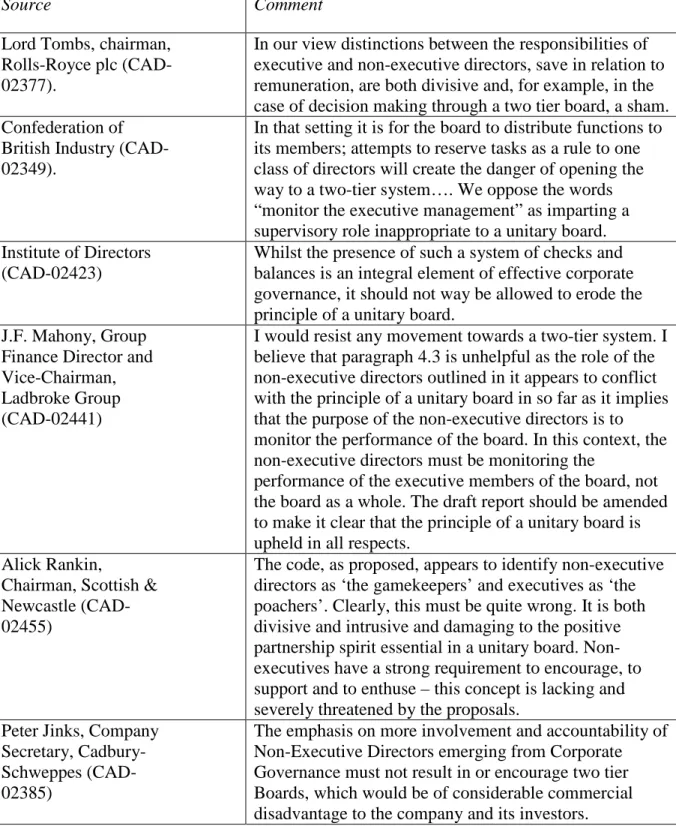
The whole thrust of the report is to retain the unitary board but to attempt to engraft a two-tier structure on to it. This is not a workable arrangement (The General Electric Co. plc; also in CAD-02115).
That summary did not, however, record some of the stronger sentiments received from the corporate side, excluding ones using the emotive words “danger”, “resist”, “erode”, “poachers” and “sham”, nor an appeal to more rationalist considerations (from Sir Adrian’s old family chocolate company) concerning possible loss of “commercial advantage”. These remarks are summarized in Table 3:
--- Place Table 3 about here ---
Perhaps the most forceful statement came not from a submission to the committee, but instead an opinion column published in the Financial Times newspaper, written by Sir Owen Green, chairman of BTR and an emblematic executive of the era.9 The article was provocatively titled “Why Cadbury leaves a bitter taste”. He criticized many aspects of the draft report, including the idea of a “leader” of the non-executives, and asserted that
A more divisive aspect … is the way it strikes at the heart of the unitary board. It begins by restating the legal position that all directors are equally responsible for the board’s decisions. But the committee immediately reveals its view of the real purpose of non-executive directors. They are there to monitor the performance of the board (including themselves?) and that of the chief executive (O. Green, 1992).
The phrase “reveals its real purpose” signals a conspiracy exposed, while “divisive” warns of adverse consequences and “strikes at the heart” points metaphorically at murderous intent towards the British way of organizing boards. The forcefulness of its sentiment and the impact of its argument is indicated by how Green’s column was quoted in the committee’s summary of contributions, in notes between committee staff, and by various letters that favourably cited Green’s remarks.
Support for two-tier boards: Only a few voices supported the idea of two-tier boards, none with the fervour of the Liberal Democrats. The accountancy firm Arthur Andersen, in a
20
detailed and closely argued analysis, said the committee had paid insufficient attention to what it termed the three roles of boards: supervision, control and management:
We believe the Report should be more forthright with respect to the supervisory function of the board. It should clarify the objectives and procedures that fall within the supervisory function and recommend that in all circumstances, the supervisory role should be led by a specific non-executive director.
The Report is predicated on the view that the unitary system is appropriate and the unitary board is itself capable of fulfilling the supervisory function. While we accept that the recommendations in the Report will facilitate supervision, it is disappointing that the Report does not discuss the advantages and disadvantages of alternative forms of governance and encourage experimentation (Arthur Andersen, CAD-02361).
While emphasizing “supervision”, the term used for the upper board in a two-tier system, this language falls short of advocacy of European-style boards. The phrase “predicated on the view” embeds less critique than other expressions of similar content might. But scepticism echoes in the use of “itself”, an otherwise redundant reflexive, as well as in the “disappointing” choice not to “encourage experimentation”. That Arthur Andersen would encourage such experiments suggests a position more nearly aligned with concerns of peripheral players about the need for radical change in board design than with actors at the core of the debate or some other intermediaries.10 The committee’s summary (CAD-02259) quoted the Arthur Andersen view at far greater length than those from other accountancy firms. Sir Adrian made the notation “experimentation” alongside “unitary board” in his handwritten aide memoire concerning possible revisions to the draft (CAD-01267), suggesting he took these comments seriously.
Most of these texts involve assertions of unspecified virtues of unitary boards and warnings of unspecified dangers in two-tier boards. A subtext came to the surface, however, in several contributions. Richard Lloyd, chairman of Vickers, argued that UK board practice was “more genuinely unitary in its nature” than what happened in the United States or Canada (CAD-01357). J.B.H. Jackson, a self-described “professional chairman”, also worried
21
about importing US practice. Sir Owen Green (1992) was more scathing, attacking the idea of an audit committee entirely composed of non-executives as the “least meritorious” in the draft, “notwithstanding the practice in the US”. He then added venom: “The arrogance of this imported proposal is communicated through the committee’s own words” as the draft proposes limits to auditors’ responsibility while it “blandly describes the unlimited liability of the board”.
The foreignness of this element of board design perceived in the Cadbury draft came in complaints from several others about “continental” or “German” practices, as well as some oblique and occasionally direct references to European legislation (e.g. CBI, CAD-02349). Ernst & Young linked the two themes in warning that the “failure to implement a more effective regulatory regime in the UK now may well deprive the UK of the ability to influence future proposals which, we believe, will emerge from the European Commission for a European Securities and Exchange Commission” (CAD-02447), a contribution noted in the committee summary as well (CAD-02259).
The “precipitating jolt” (Greenwood et al., 2002) the UK system had received from the failures of Polly Peck, Colorall and especially the Maxwell companies11 forced a debate over the appropriateness of an aspect of corporate governance that industry had long defended. Opposition was based on economic and political considerations but in particularly on the social aspects of board dynamics. The voices from the twin centres of the debate – corporations and investors – as well as much of the intermediaries argued with varying degrees of force against foreign encroachment in the issue of board design, even though the Cadbury draft report did not explicitly advocate either a German-style supervisory board or an American-style board overwhelmingly populated with outside directors. The strength of opposition is evident in the language of these contributions. Several complained that the
22
changes the draft report sought would demand much effort from companies already well governed, and fail to address the rogues. Green’s column in the FT put it this way:
The report’s subliminal message is of the need for total integrity and a healthy objectivity in company affairs. This is strongly to be supported. But the need for a code in addition to existing rules and regulations is doubtful – as is its likely effectiveness in reducing the relatively few instances of misbehaviour (O. Green, 1992).
His use of “subliminal message” evokes symbolically the spectre of manipulative advertising techniques, which had entered public discourse over in previous decades through critiques of technologies to project images interstitially in television signals. Although he endorses the message, he opposes the medium of its delivery.
In his briefing to the committee about feedback on the draft, Sir Adrian worried about the tone: “We are said to be ‘long on accountability and short on drive and efficiency’ and to take a negative view of governance”; the code risked “dividing the board”. The first part of these comments highlights the draft’s emphasis on control, rather than service, as the function of corporate governance; dividing the board would divide those functions. He then added remarks that imply the code could damage the unity of a board with a weak chairman:
Do we stay with these? Minor changes … are no problem. I accept that there is a fundamental issue here and that there could come a point when logic would point to a two-tier board. I do not believe we are at that point yet, (although those who advocate distinct legal duties for ned’s12 would pass it), and that the unity of boards need not be undermined by our
proposals, given a competent chairman (Sir Adrian Cadbury, CAD-01265).
The tone of the code changed as a result of the comments and criticism, but these notes from the Cadbury archive suggest the issue was still alive under the surface, even after the final version’s support for the unitary board. That Sir Adrian thought “there could come a point when logic would point to a two-tier board” suggests that the issue was still open, even though hostility had closed it, for now.
23
Board design in the 2003, post-Higgs debate
In the covering letter to his report, Derek Higgs wrote: “The brittleness and rigidity of legislation cannot dictate the behaviour, or foster the trust, I believe is fundamental to the effective unitary board and to superior corporate performance” (Higgs, 2003, p. 3). Moreover, he expressed the view that the “architecture” of corporate governance, defined as structure and processes inside companies, “in itself does not deliver good outcomes” (Higgs, 2003, Paragraph 1.3). Yet his 53 recommendations, summarized at the beginning of the document, dealt overwhelmingly with “architecture”, that is, externally verifiable procedures and structures. These proposals revived concerns about two-tier boards and dominated the consultation the Financial Reporting Council held to translate those recommendations into the text of a new Combined Code (2003).
The passage from Higgs quoted above considers a unitary board to be an implicit good, and in one of the introductory paragraphs he elaborates that view:
Some have argued that the increasing complexity of business life – whether globalisation or fast changing product and capital markets – is such that the whole structure of the board needs to be re-considered. But the majority view, which I share, sees considerable benefits continuing to flow from the unitary approach (Higgs, 2003, Paragraph 1.7)
As if to emphasize that point, he later adds:
Increasing the effectiveness of non-executive directors, while preserving the benefits of the unitary board, is a principal objective of the Review…. In contrast, the European system of corporate governance typically separates legal responsibility for running the company between a management and a supervisory board. In the US, the board is composed largely of
non-executive (“outside”) directors with only a few non-executives. Evidence collected during the Review has not convinced me of the merits of moving away from the unitary board structure in the UK (Higgs, 2003, Paragraph 4.2, 4.3).
This language shows, however, that the debate over board design was not over. The uses of “unitary” here are defensive: the “whole structure” needs to be reviewed; that he is “not convinced” about two-tier boards leaves this issue open in general, just closed for the
24
moment. That he shares the “majority” view acknowledges the legitimacy of the minority. He has considered other systems (“European” and US) but concludes that the evidence in their favour is not convincing, but its subtext further legitimates those views. Evidence in favour of the UK system is not mentioned, an indication that he and the respondents to his consultation and research study took those advantages as understood, but the word “unitary” does not appear in Higgs’s proposed text of a revised Combined Code. Whether intended or not, taken together these uses and omissions seemed to give respondents reasons to think Higgs had taken a position somewhat short of a ringing endorsement of the unitary boards.
The FRC used the Higgs Review and its proposed code changes as the basis for a light-touch, “fatal flaws only” consultation. The response was rather stronger than it expected (Nicholson, 2008). The Association of British Insurers, a mainstream investor voice, saw a “potential danger to the unitary board” if the code had a “formal requirement” that non-executive directors meet periodically without the non-executives or the chairman present (April 2003).13 In a literal sense, this is arguing against a case Higgs did not make. Higgs did not require such a move in what is a voluntary code; the text of his draft was that of recommendation: “should meet regularly as a group without the executives present and at least once a year without the chairman present” (Higgs, 2003, Provision A.1.5), where “should” also sits underneath the code’s “comply-or-explain” principle.
The Confederation of British Industry, representing the interests of large corporations, used more forceful language to make a similar point. It expressed “deep reservations” about provisions that “concern or affect the chairman”, whose role is “pivotal in the UK’s tried and tested unitary board system”. The choice of “pivotal” here echoes with irony Higgs’s own language (2003, Paragraph 5.1), seeking to reverse its inferred intent. The CBI’s next sentence elaborates this concern relating it to separate meetings of non-executives, suggesting the provision “could be misunderstood and could lead to a two-tier board in practice” (16
25
April 2003). The use of “could be misunderstood” is an example of language aimed at repairing unintended damage in drafting to maintain the core values of the code. The word might also be seen as a diplomatic way of disrupting a feared change in direction. As in the ABI submission, the value in a unitary board does not receive, or seem to require, explanation or articulation; neither does the “danger” or “risk” in a two-tier board.
Sentiment on this point was even stronger among company chairmen. For example, Sir Brian Moffat, chairman of the steelmaker Corus, wrote (20 March 2003) in his capacity as senior independent director of the banking group HSBC not to the FRC, but to its perceived political master: Secretary of State for Trade and Industry Patricia Hewitt. He began by stating discomfort about writing separately from the rest of the board, lest it be viewed “undermining the unitary board principle or the Chairman’s position”. Such was the “strength of feeling and support in the Board” that he needed to add his voice to that of the HSBC chairman, Sir John Bond, who also wrote to Hewitt on this point (17 March 2003), and later to the FRC (11 April 2003). Moffat wrote under Corus letterhead, making a symbolic claim of legitimacy in his identity as a company chairman, as well.
Board design in the post-financial crisis debate
The issue of overall board structure came up again in the debate leading up to the 2010 code. In the initial consultation in early 2009, with its open invitation to raise matters of interest, several mainstream investors and companies alike chose to emphasize the need for a unitary board.
We consider that the unitary board model still represents the most appropriate way forward in the UK context. We also fully support the continued separation of the roles of chairman and chief executive, and an appropriately balanced board (ABI, May 2009, p. 2).
In assessing the merits of these various proposals we have been mindful of the need to … [p]reserve unitary board structures, with both executive and non-executive directors contributing effectively to the operation of the board (CBI, May 2009, p. 2).
26
Sentiments like these might have appeared to be boilerplate, language dusted off and reused from a previous consultation paper and not of import, except that the issue was still alive among other actors in the field. Some of them were fringe actors, but others, like the Association of Chartered Certified Accountants, were closer to the centre. A professional body with longstanding engagement in corporate governance and many of its accountant-members working in corporations, the ACCA would not normally be seen as peripheral to the field, but its first submission stated:
As a first step, the FRC should consider the implications of introducing as an option a two-tier board structure and should consider the changes to the Code that would need to be articulated (ACCA, May 2009, p. 3).
Its argument was that the financial crisis demonstrated that current arrangements had failed. It laid the blame on the failure of non-executive directors to control managers, and on the custodians of the code for permitting an “untimely” (p. 2) relaxation in 2008 of the constraints on board chairmen and audit committee membership. Boards needed greater independence, not less:
To draw attention to the failure of independent directors is not to say that less reliance should be placed upon them in the future. But consideration needs to be given to addressing the causes of their ineffectiveness. While two-tier board structures have not always been notably successful, they can contribute to ensuring that the supervisory board directs and oversees, while the management board manages. In practice, much depends on the composition and powers of the two boards in a two-tier structure (ACCA, May 2009, p. 2).
The early mention in (albeit limited) support for two-tier boards through the debate signals that the idea has legitimacy among at least some actors in the field, even though it remains a largely alien concept.
Contributors on the other side, however, affirm the counter-argument but leave it largely unarticulated. The CBI, for example, states that its members, “including investor members, strongly uphold the UK’s unitary board system”; it later states: “there is also a need to avoid
27
proposals that tend towards two tier boards” (CBI, October 2009). Use of the passive voice here sweeps away any actor, as if the reader – that is, the authors of the code – needed no explanation. The argument was suppressed because its logic was taken for granted (S. E. Green, Jr. et al., 2009).
DISCUSSION
This analysis shows that actors in the centre of the field lost more arguments than they won, and lost in 2003 some they had won in 1992, on measures that might introduce a two-tier board through the back door, but they retained affirmation of the value of a unitary board. Indeed, the change in tone in 2010 reinforced the ethos of a unitary board even as it left in place the structures weighing against it. Peripheral actors seeking institutional change won the substance of theirs, if not in the form they might have liked. Those urging experimentation lost in 1992 and 2003 but won in 2010, assuming companies embrace the spirit rather than the letter of the code.
The issue of board design is emblematic of the purpose of the board and thus to the logic of corporate governance it entails. It shows participants bringing competing logics to the discussions and demonstrates how actors have translated terms across them. Moreover, this study shows how the contestation of logics was not so much resolved over time but instead suspended. And it demonstrates how participation seems to develop its own logic, embracing a wide range of opinions without entirely settling the disputes.
Translating corporate governance
Throughout these consultations, actors sought to win their arguments and appeals to these logics, which had been legitimated to a greater or lesser extent in other organizational fields. In the debates some actors attempt to import competing logics from Europe or the US to the
28
UK. That the arguments they entail often remain suppressed suggests that other actors already accept, at one level or another, the legitimacy of these solutions.
For example, in 1992 Charkham (CAD-01073) called for “real accountability” without definition, inviting Cadbury to discover his own meaning, translating from practices elsewhere whether that was hierarchical to shareholders, mutual among directors in the boardroom or both. In 2003, the language used by company chairman in urging changes in the text invited the FRC to interpret their calls either as signs of their stewardship and a logic based in the order of the corporation, or as a signal of the legitimacy of shareholder value maximization and a market order. In 2009-10, the ACCA’s call for German-style boards with worker co-determination rests explicitly on a logic embracing shareholder value maximization but imports with it an implicit and unstated acceptance of the legitimacy of co-determination and with it a logic based in a community order. That the latter is unstated leaves other actors in the field free to translate the call to suit their understanding and see in it heightened monitoring and control.
These expressions of ambiguity and the suppression of arguments, assumed and taken for granted, suggest that actors have and want room to interpret the logic as they see fit and blend it with others as circumstances require (Zattoni & Cuomo, 2008). This view is, therefore, in keeping with another central principle in UK corporate governance: companies may choose not to comply, as long as they explain.
Arguments against, assertions for
Over the course of the three periods, many of those supporting unitary boards came from the core actors occupying the central ground in the field. Companies and their collective associations (in particular the CBI) made strongly worded statements but rarely reasoned arguments. Their incumbent position in the centre of the field did not need a defence; rather, the code – a voluntary, not statutory institution – required their assent. Theirs was an
29
assertion that current arrangements were not just appropriate, but superior to the alien concepts of European, German or indeed American practice. This attitude is in line with assumptions associated with a logic of managerialism linked to stewardship theory, and taken for granted, self-evident, and not needing justification even in the face of the cases of corporate malfeasance that led to the code and the revisions under study here. Unsurprisingly, their views arise with few exceptions from the institutional order of the corporation, with its assumption of the value of internal hierarchy (especially the centrality of the chairman) and implicit recognition of power owing to size and market share.
Mainstream institutional investors and their associations (most prominently the ABI) supported this view; many such actors were themselves listed companies and sat on both sides of corporate-investor divide. The advantages of incumbent institutional arrangements were taken for granted, so much so they scarcely needed argumentation. Investors in general did not make their cases on the basis of what agency theory would lead us to think was their interest, that is, to enhance the monitoring and control function through board structure. Their logic might reasonably arise from the institutional order of markets, with its focus on the transaction, shareholder primacy and narrow self-interest. The listed insurance companies that managed equity investments might reasonably be assumed to have faced contesting, even contradictory logics. What we see, however, is something rather different: the absence of conflict on this point, even when the investors were not listed companies or the individuals responding were not in positions to represent the corporate rather than functional (fund management) imperatives. Theirs was in the main a hybrid logic, claiming shareholder primacy but accepting the risk of managerialism in that non-executive directors might be captured by the executives for the sake of strong performance through collegiality and the “service” function of directors.
30
The advisors, and especially the accountancy firms, echoed the sentiments of corporations and investors on this point, though not universally and not with the degree of assumption that the incumbent position needed no defence. Their logic might be assumed to arise from the professional order, with its association with expertise, relationships and reputation as the basis for authority. These assumptions are evidence in the length and argumentative nature of the contributions. But the profession was undergoing its own institutional change at the time, with a contest between professional and commercial logics (Hinings, Brown, & Greenwood, 1991; Suddaby & Greenwood, 2005), perhaps making them more sensitive to corporate interests and values.
Those supporting two-tier boards and therefore institutional change came, with important exceptions, from more peripheral positions in the field. Their arguments draw upon a language of high performance, secure investments and long-term orientation, characteristics of German corporate performance. Their texts, mainly tacitly though from the most peripheral actors explicitly, invoke employee rights, stakeholder theory and the associated curbs on behaviour seen as rapacious Anglo-American capitalism. These are sentiments associated more with the collectivism of a community order, with its ideas of shared commitment. That these associations are not always explicit in many of the texts does not mean they are not there. They featured prominently in the discourse in news media at the time.14
Those actors straddling the debate were an eclectic bunch, in part peripheral, in part more central to the field. Some suggested novel approaches (e.g. the Liberal Democrats in 1992); others endorsed experimentation (Arthur Andersen in 1992 and, it seems, Sir Adrian Cadbury himself). They were the institutional entrepreneurs (DiMaggio, 1988), agitating for change of less specific character to address evident failings in current institutional arrangements. Their
31
arguments embody assumptions associated with different institutional orders or show the willingness to cross boundaries.
Resolution and suspension
Emerging from the discussion as a whole are three elements that may have significance for institution-building in general. First is the willingness of the disenfranchised to suspend their arguments and live with the code and the new arrangements it entails, while holding those views in abeyance, rather than acquiescing. The logic of the code is institutionalized, granted moral legitimacy without complete cognitive legitimacy. These are not blended or hybrid logics, nor are the new meanings created in the code taken for granted and suppressed. A somewhat uneasy equilibrium has arisen, however, as actors give the code time to work, or not, and wait for the next revision.
Second is the idea that actors may find elements of logics imported from orders other than their own sufficiently fungible that they accept trade-offs and suspend judgement. While this analysis has focused on board structure, other approaches to board effectiveness came under discussion at the same time. New institutional arrangements collectively may suffice, and if not there will be a chance again to renew the process.
The third is a subtler effect, and one that needs further research at the individual level rather than of groups or at the organizational level of this analysis. The suggestion here is that participation in the process creates its own logic; individual participants become committed to the process, identifying not just with the interests of their organizations and seeing corporate governance as more than as a system of inter-institutional logics contesting for power. Rather it becomes a community of corporate governance people, more committed to the internal logic of governance rather than the logics arising from markets, the corporation or the profession.
32
In the face of ambiguous evidence about the effectiveness of mechanisms of corporate governance and the inability of codes of corporate governance to prevent recurrent crises, one might be tempted to see this logic pertaining more to the institutional order of religion rather than community. It embodies a faith that thoughtful people, working in thoughtful groups – whether in the public sphere of a consultation process or in private realms of the boardroom – will set policy in a better way than the strictures of a tight code with strong compliance. That was the danger Sir Adrian Cadbury sought to forestall by urging explanation as a form of compliance. It was what Derek Higgs and many of the respondents to his version of the code feared in warning of box-ticking. It was what the 2010 code explicitly sought to avoid with its emphasis on a change of tone and command that the code is “not a rigid set of rules” (Section entitled "Comply or Explain," Paragraph 2). Research in this area, focusing on identity theory, might also help to explain how some individuals seem to migrate around the enlarged field of corporate governance, rather than residing in the orders of the corporation, the profession or the market where their initial, functional expertise lies.
The history recounted here holds the seeds of new issues, too, notably in the absence from the debate of important and emerging actors. The state was a largely absent player, an indication perhaps of a general UK organizing principle of liberalism based in a markets domain (Puxty et al., 1987). The same might not apply in countries with less political commitment to markets.
Importantly for the UK itself as well as other countries, is the lack of engagement from the new actors on the scene. In consultations about the code over two decades the same organizational voices, indeed in many instances the same individual voices can be heard in the process. But during this time major shifts occurred in the investment landscape: the growth of hedge funds and sovereign wealth funds, the growing internationalization of investment, and the rise in the expatriate stock market listings. These actors arise in different
33
orders, with different assumptions and logics. The relative decline in importance of UK-domiciled companies and traditional asset managers in domestic mutual, pension and insurance funds was not mirrored in the contributions to the debate over the code. What does that portend for the continued legitimacy of the code?
CONCLUSIONS
This study has examined how the UK code of corporate governance was created and how it developed over time. By looking in detail at one issue, the design of the board, it gives insights about how codes of conduct emerge and institutionalize without stamping out alternative understandings that might hold value in other ways and perhaps at another time.
Moreover, it suggests that by engaging in the process of code-writing, actors may be creating a new logic, arising more from a collective stance rather than the narrower interests and logics of the institutional orders to which their organizations adhere. It thus affirms the view in Puxty et al. (1987) that the changes in structure of social relations happen at the interaction of domains, where new principles and logics develop. It also suggests that those principles and logics can gain legitimacy without full acceptance if the values they embody include openness and thoughtfulness.
Table 1 - Responses of investors to Cadbury draft on board design
Source Comment
Postel Investment Management15 (CAD-02195)
… the report in one or two places comes dangerously close to undermining the concept of the unitary board.
Institutional Fund Managers
Association (CAD-02397)
The Report draws too great a distinction between the responsibilities of executive and non-executive directors and could be taken to imply that their interests are somehow opposed. We believe that the Code should place greater emphasis on the need for each director to recognise his responsibility for corporate governance, however the Board is constituted, and for the Board as a whole to recognise its responsibility and that of each of its members.