ETSI GS ISI 003
V1.1.2
(2014-06)
Information Security Indicators (ISI);
Key Performance Security Indicators (KPSI)
to evaluate the maturity of security event detection
Disclaimer
This document has been produced and approved by the Information Security Indicators (ISI) ETSI Industry Specification Group (ISG) and represents the views of those members who participated in this ISG.
It does not necessarily represent the views of the entire ETSI membership.
Group Specification
Reference
RGS/ISI-006
Keywords
ICT, security
ETSI
650 Route des Lucioles
F-06921 Sophia Antipolis Cedex - FRANCE Tel.: +33 4 92 94 42 00 Fax: +33 4 93 65 47 16
Siret N° 348 623 562 00017 - NAF 742 C Association à but non lucratif enregistrée à la
Sous-Préfecture de Grasse (06) N° 7803/88
Important notice
The present document can be downloaded from:
http://www.etsi.org
The present document may be made available in electronic versions and/or in print. The content of any electronic and/or print versions of the present document shall not be modified without the prior written authorization of ETSI. In case of any
existing or perceived difference in contents between such versions and/or in print, the only prevailing document is the print of the Portable Document Format (PDF) version kept on a specific network drive within ETSI Secretariat. Users of the present document should be aware that the document may be subject to revision or change of status.
Information on the current status of this and other ETSI documents is available at
http://portal.etsi.org/tb/status/status.asp
If you find errors in the present document, please send your comment to one of the following services:
http://portal.etsi.org/chaircor/ETSI_support.asp Copyright Notification
No part may be reproduced or utilized in any form or by any means, electronic or mechanical, including photocopying and microfilm except as authorized by written permission of ETSI.
The content of the PDF version shall not be modified without the written authorization of ETSI. The copyright and the foregoing restriction extend to reproduction in all media.
© European Telecommunications Standards Institute 2014. All rights reserved.
DECTTM, PLUGTESTSTM, UMTSTM and the ETSI logo are Trade Marks of ETSI registered for the benefit of its Members.
3GPPTM and LTE™ are Trade Marks of ETSI registered for the benefit of its Members and of the 3GPP Organizational Partners.
Contents
Intellectual Property Rights ... 4
Foreword ... 4
Introduction ... 5
1 Scope
... 6
2 References
... 6
2.1 Normative references ... 6 2.2 Informative references ... 73 Definitions,
symbols and abbreviations ... 7
3.1 Definitions ... 7
3.2 Symbols ... 7
3.3 Abbreviations ... 7
4 Background
... 7
4.1 Key Performance Indicators ... 7
4.2 Key Performance Security Indicators ... 7
4.3 SANS CAG ... 8
5
Key Performance Security Indicators ... 9
5.1 How to use KPSIs to assess the organisation's overall maturity level in security event detection and response posture ... 9
5.2 How to use KPSIs as a first step to evaluate the detection levels of security events ... 10
5.3 KPSIs description table ... 10
5.4 Description of the relevant KPSIs ... 11
Annex A (normative):
Recap of available KPSIs ... 15
Annex B (informative):
Authors & contributors ... 17
Intellectual Property Rights
IPRs essential or potentially essential to the present document may have been declared to ETSI. The information pertaining to these essential IPRs, if any, is publicly available for ETSI members and non-members, and can be found in ETSI SR 000 314: "Intellectual Property Rights (IPRs); Essential, or potentially Essential, IPRs notified to ETSI in respect of ETSI standards", which is available from the ETSI Secretariat. Latest updates are available on the ETSI Web server (http://ipr.etsi.org).
Pursuant to the ETSI IPR Policy, no investigation, including IPR searches, has been carried out by ETSI. No guarantee can be given as to the existence of other IPRs not referenced in ETSI SR 000 314 (or the updates on the ETSI Web server) which are, or may be, or may become, essential to the present document.
Foreword
This Group Specification (GS) has been produced by ETSI Industry Specification Group (ISG) Information Security Indicators (ISI).
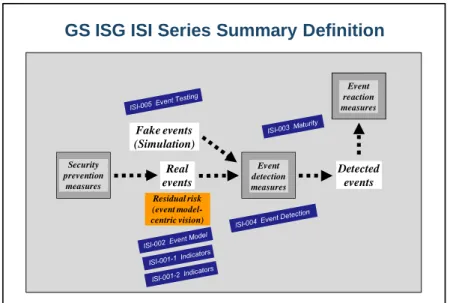
The present document is included in a series of 6 ISI specifications. These 6 specifications are the following (see figure 1 summarizing the various concepts involved in event detection and interactions between all specifications):
GS ISI 001-1 [1]: addressing (together with its associated guide GS ISI 001-2 [2]) information security indicators, meant to measure application and effectiveness of preventative measures.
GS ISI 002 [3]: addressing the underlying event classification model and the associated taxonomy.
GS ISI 003: addressing the key issue of assessing an organisation's maturity level regarding overall event detection (technology/process/ people) and to evaluate event detection results.
GS ISI 004 [4]: addressing demonstration through examples how to produce indicators and how to detect the related events with various means and methods (with a classification of the main categories of use cases/symptoms).
GS ISI 005 [i.1]: addressing ways to produce security events and to test the effectiveness of existing detection means within an organization. More detailed and more a case by case approach than the present document and therefore complementary.
Figure 1 summarizes the various concepts involved in event detection and the interactions between the specifications.
GS ISG ISI Series Summary Definition
Real events Security prevention measures Event detection measures Fake events (Simulation) Event reaction measures Detected events Residual risk (event model-centric vision)
Introduction
The present document addresses the event detection aspects of the information security processes in an organization. The maturity level assessed during event detection can be considered as a good approximation of the overall Cyber Defence and SIEM maturity level of an organization.
1 Scope
The present document defines and describes a set of Key Performance Security Indicators (KPSI) to be used for the evaluation of the performance, the maturity levels of the detection tools and processes used within organizations for security assurance. The response is not included in the scope of the present document.
In particular, the purpose of the present document is to enable organizations to:
• assess the overall maturity level of the security event detection;
• provide a reckoning formula to assess detection levels of major security events as summarized in GS ISI 001-1 [1];
• evaluate the results of measurements. This work is mainly based on the US SANS CAG [5].
The target groups of the present document are Head of detection, reaction teams, Cyber defence team and head of security governance.
2 References
References are either specific (identified by date of publication and/or edition number or version number) or
non-specific. For specific references, only the cited version applies. For non-specific references, the latest version of the referenced document (including any amendments) applies.
Referenced documents which are not found to be publicly available in the expected location might be found at http://docbox.etsi.org/Reference.
NOTE: While any hyperlinks included in this clause were valid at the time of publication, ETSI cannot guarantee their long term validity.
2.1 Normative
references
[1] ETSI GS ISI 001-1: "Information Security Indicators (ISI); Indicators (INC); Part 1: A full set of operational indicators for organizations to use to benchmark their security posture".
[2] ETSI GS ISI 001-2: "Information Security Indicators (ISI); Indicators (INC); Part 2: Guide to select operational indicators based on the full set given in part 1".
[3] ETSI GS ISI 002: "Information Security Indicators (ISI); Event Model A security event classification model and taxonomy".
[4] ETSI GS ISI 004: "Information Security Indicators (ISI); Guidelines for event detection implementation".
[5] SANS Consensus Audit Guidelines V4.0: "20 Critical Security Controls for Effective Cyber Defence".
[6] The Capability Maturity Model Integration (Software Engineering Institute, 2001). [7] Portfolio, Programme and Project Management Maturity Model (OGC, 2008). NOTE: See http://www.sans.org/critical-security-controls/ for an up-to-date version.
2.2 Informative
references
The following referenced documents are not necessary for the application of the present document but they assist the user with regard to a particular subject area.
[i.1] ETSI GS ISI 005: "Information Security Indicators (ISI); Event Testing; Part 5: Event Testing".
3
Definitions, symbols and abbreviations
3.1 Definitions
For the purposes of the present document, the terms and definitions given in GS ISI 001-2 [2] apply.
3.2 Symbols
For the purposes of the present document, the symbols given in GS ISI 001-2 [2] apply.
3.3 Abbreviations
For the purposes of the present document, the abbreviations given in GS ISI 001-2 [2] and the following apply:
CAG Consensus Audit Guidelines
CC Critical Control
CMMI Capability Maturity Model Integration CSIRT Computer Security Incident Response Team KPI Key Performance Indicators
KPSI Key Performance Security Indicators MSSP Managed security service provider SOC Security Operation Centre
4 Background
4.1
Key Performance Indicators
Key Performance Indicators (KPIs) are quantifiable variables which can measure the performance of an organization, evaluate the success of specific activities and support decision making processes. KPIs are metrics that allow to measure progress and deficiency. The metrics have to be well-defined and quantifiable to be useful.
KPIs can be used to assess the performance of IT services. Examples of IT KPIs are the availability of IT systems and services, the Service Level Agreements (SLAs), the Mean Time Between Failures (MTBF) and the Mean Time To Recover (MTTR), and Mean-Time-Between-System-Incidents (MTBSI).
The usage of KPI in the field of Information Assurance is at its early stage. Defining KPIs for the Security Assurance processes is difficult because of the complexity of regulations, certifications, technical and organizational issues, and budget constraints. Hence it is a complex task to quantify clear Security Assurance objectives and performance in terms of KPIs.
4.2
Key Performance Security Indicators
Key Performance Security Indicators (KPSIs) can measure the maturity level of the information security processes (detection and detection-related processes).
A Maturity Model to measure the performance in the Security Assurance field can be based on the five level maturity framework adapted from The Capability Maturity Model Integration (Software Engineering Institute, 2001) [6] and Portfolio, Programme and Project Management Maturity Model (OGC, 2008) [7]. Organizations using these models, can assess the maturity level of their performance management practices in the five dimensions of the model:
1) Initial: Processes are managed ad hoc. No measure of the performance is requested.
2) Managed: Processes characterized for projects and are often reactive.
3) Defined: Processes are tailored for the organization and are proactive.
4) Quantitatively Managed: Processes are measured and controlled.
5) Optimizing: Continuous Process Improvement.
To adapt these models to security event detection and detection-related reactions, a simplified 3-level scale is proposed:
• The present document, level 1 corresponding to CMMI levels 1 and 2;
• The present document, level 2 corresponding to CMMI levels 3 and 4;
• The present document, level 3 corresponding to CMMI level 5. The three levels can be defined as follows:
3 maturity levels in Cyber
Defense and SIEM approaches
- Infrastructure monitoring - Technical focus (log collection and retention)
- Plain incident response - Merged operations (Security/IT)
1 – Regulatory compliance enfor-ced and forensics enabled
2 – Cyber Defense capabilities (against major known attacks)
3 – Whole organisation’s IT security mobili-zation with enterprise risks focus
- Full detection capabilities (all kinds of sec events – int./ext.) - Comprehensive list of use cases - Detailed reaction processes - Dedic. SOC (& possibly CSIRT)
- Critical apps security monitoring - Users/managers/executives full awareness
- Strong gouvernance (indicators & accurate benchmarking) - Link with business risks
Idem 1
Idem 2
Figure 2: 3 majority levels in Cyber Defence and SIEM approaches
4.3 SANS
CAG
The SANS Consensus Audit Guidelines [5] is a compliance standard that specifies 20 "control points" that have been identified through a consensus of security professionals from the federal and private industry. The aim is to begin the process of establishing a prioritized baseline of information security measures and controls that can be applied across organizations to help improving their defences.
The 20 Critical Controls subject to collection, measurement, and validation currently defined are: 1) Inventory of Authorized and Unauthorized Devices
3) Secure Configurations for Hardware and Software on Laptops, Workstations, and Servers 4) Continuous Vulnerability Assessment and Remediation
5) Malware Defenses
6) Application Software Security 7) Wireless Device Control
8) Data Recovery Capability (validated manually)
9) Security Skills Assessment and Appropriate Training to Fill Gaps (validated manually) 10) Secure Configurations for Network Devices such as Firewalls, Routers, and Switches 11) Limitation and Control of Network Ports, Protocols, and Services
12) Controlled Use of Administrative Privileges 13) Boundary Defense
14) Maintenance, Monitoring, and Analysis of Security Audit Logs 15) Controlled Access Based on the Need to Know
16) Account Monitoring and Control 17) Data Loss Prevention
18) Incident Response Capability (validated manually) 19) Secure Network Engineering (validated manually)
20) Penetration Tests and Red Team Exercises (validated manually)
Each Critical Control (CC) is described in detail, is subject to continuous monitoring and checking and has gained a broad consensus as regards their relevancy and effectiveness.
The KPSIs defined within the present document are based on the CC list concerning detection, with adaptation and extension whenever needed to cover the scope of the ETSI ISG ISI series.
5
Key Performance Security Indicators
This clause describes the Key Performance Security Indicators (KPSI) defined for the detection mechanisms.
5.1
How to use KPSIs to assess the organisation's overall
maturity level in security event detection and response
posture
The first purpose of KPSIs is to assess the organisation's overall maturity level of security event detection and response posture. The way to do it is to reckon the average of all KPSIs in order to get the unique level for the whole
5.2
How to use KPSIs as a first step to evaluate the detection
levels of security events
The second purpose of KPSIs is to enable an organization to assess the actual detection levels of security events as summarized in ISI 001-1 information security indicators [1] and to evaluate the results of the measurements.
The formula to reckon the actual detection level of events is by making an indicator from the following: state-of-the-art detection level (see GS ISI 001-1 [1]) x organization KPSI/state-of-the-art KPSI.
To apply this formula, it is of course required to know which KPSI(s) is(are) applicable to the given indicator. This requirement is met below in clause 5.4 for each indicator (see the row "Core ISI 001 mapping" [1] for a minimal indicators mapping, and "Additional ISI 001 mapping" [1] for a full mapping of the indicators over the KPSIs). When an indicator has several KPSIs assigned, it is proposed to take the average of all of them to get a unique and finalized KPSI.
All data necessary to use the formula are given for each KPSI in clause 5.4 with a recap in annex A.
5.3
KPSIs description table
The table 1 skeleton defines the KPSIs covering major detection issues. Each KPSI has been described by using that table.
Table 1
Name Full title/name of the KPSI
KPSI Index Index number of the KPSI within this GS CAG Critical Control(s) References to the CAG Critical Control(s) [5]
Description/rationale Extended description of the KPSI and/or rationale for this KPSI (Core) ISI 001 [1] Indicator
mapping
Core mapping to the ISI 001 security indicators [1] and [3]. Minimal set of indicators to be mapped to this specific KPSI
Additional ISI 001 [1] Indicator mapping
Additional mapping to the ISI 001 indicators [1] and [3]. Full set of indicators to be mapped to this specific KPSI
State of the Art figure This field gives the state-of-the-art figure (which level for the best ones within the security community) related to this specific KPSI. The figures have been
estimated by ETSI ISG ISI and the European network of R2GS clubs experts.
Level 0 Level 1 (see note) Level 2 (see note) Level 3 (see note)
This box contains the description of the organization's maturity level about detection mechanisms (tools, people, processes) corresponding to level 0, which corresponds to no processes, tools, people dedicated to detection.
This box contains the description of the organization's maturity level about detection mechanisms (tools, people, processes) corresponding to level 1, which is "basic and just
compliance-oriented".
This box contains the description of the organization's maturity level about detection mechanisms (tools, people, processes) corresponding to level 2, which is "mature and
integrated".
This box contains the description of the organization's maturity level about detection mechanisms (tools, people, processes) corresponding to level 3, which is "advanced and
business integrated".
5.4
Description of the relevant KPSIs
The list of relevant KPSIs has been identified amongst the list of the 20 CAG critical controls, which concerns detection and response issues.
Table 2
Name Inventory of software or devices
KPSI Index 1
CAG Critical Control(s) 1, 2
Description/rationale This KPSI reflects the concept that asset inventory is at the basis of every ISMS. 70 % of all incidents are not registered or not managed devices.
Core ISI 001 [1] mapping IWH_UNA.1, VTC_NRG.1 Additional ISI 001 [1]
mapping
IWH_VNP.1 to 3, IWH_VCN.1, IWH_UNA.1, VTC_WFI.1, VTC_NRG.1 State of the Art figure 2
Level 0 Level 1 Level 2 Level 3
No policy, no process, no tools
Processes characterized for the organization but often reactive (reset after incidents). No tools
Processes systematically implemented. Tools usage
Processes continuously checked with the level of application and
effectiveness evaluated (indicators, with well-defined periodic reporting processes toward upper levels)
Table 3
Name Configuration monitoring and remediation
KPSI Index 2
CAG Critical Control(s) 3,10
Description/rationale The less tackled issue regarding all kinds of vulnerabilities (regarding mobile devices, laptops, workstations and servers). More mature IT security issue regarding network devices (such as firewalls, routers and switches). 30 % of all security incidents are made possible by exploitation of configuration vulnerability. Core ISI 001 mapping [1] VOR_VNR.1, VCF_FWR.1, VCF_ARN.1, VCF_TRF.1, VBH_WTI.1 to 6,
VBH_PSW.1 to 3, VBH_PRC.5, IWH_VCN.1 Additional ISI 001
mapping [1]
IWH_VCN.1, VOR_VNR.1, all VCF indicators, VBH_PRC.1 to 6, VBH_IAC.2, VBH_FTR.1 to 3, VBH_WTI.1 to 6, VBH_PSW.1 to 3, VBH_RGH.1, IWH_VCN.1, VTC_IDS.1, VTC_MOF.1, VTC_NRG.1, VTC_PHY.1
State of the Art figure 2
Level 0 Level 1 Level 2 Level 3
No process, no tools Processes characterized for the organization but often reactive (reset after incidents). No tools
Processes systematically implemented. Tools used (to identify all deviations from technical policies)
Processes continuously checked with level of application and effectiveness evaluated (indicators, with well-defined periodic reporting processes toward upper levels)
Table 4
Name Continuous software vulnerability assessment and remediation
KPSI Index 3
Critical Control(s) 4
Description/rationale Another mandatory issue in detection and response, complementary to the previous KPSI (20 to 30 % of all security incidents are made possible by exploitation of software vulnerability).
Core ISI 001 [1] mapping IEX_MLW.3 to 4, IWH_VNP.1 to 3, VSW_WSR.1, VSW_OSW.1, VSW_WBR.1, VOR_VNP.1 to 2
Additional ISI 001 [1] mapping
IEX_MLW.3 to 4, IWH_VNP.1 to 3, all VSW indicators, VOR_VNP.1 to 2 State of the Art figure 2
Level 0 Level 1 Level 2 Level 3
No policy, no process, no tools
Processes characterized for the organization but often reactive (reset after incidents). No tools. Possible external watch and alerts collection
Processes systematically implemented. Tools used (vulnerability scanning, risk ranking, patch management, workaround application)
Processes continuously checked with level of application and effectiveness evaluated (indicators, with well-defined periodic reporting processes toward upper levels)
Table 5
Name User access and account monitoring
KPSI Index 4
Critical Control(s) 12,16
Description/rationale As regards administrative privileges, their unwanted use is one of the most frequent paths to critical incidents.
Core ISI 001 mapping [1] IEX_MLW.1 to 4, IDB_UID.1, IDB_RGH.1 to 7, IDB_IDB.1, IDB_MIS.1, IDB_LOG.1, VBH_PRC.1, VCF_UAC.1 to 5, VTC_RAP.1
Additional ISI 001 mapping [1]
IEX_MLW.1 to 4, all IDB indicators, VBH_PRC.1, VBH_RGH.1, VCF_UAC.1 to 5, VTC_RAP.1
State of the Art figure 2
Level 0 Level 1 Level 2 Level 3
No policy, no charter, no process, no tools
Processes characterized for the organization but often reactive (reset after incidents)
Processes systematically implemented. Tools used (to identify all deviations from technical policies and deviant behaviours - especially for administrators)
Processes continuously checked with level of application and effectiveness evaluated (indicators, with well-defined periodic reporting processes toward upper levels)
Table 6
Name Log collection, analysis and archiving
KPSI Index 5
Critical Control(s) 14
Description/rationale This issue is one of the main pieces at the heart of SIEM approaches. Core ISI 001 mapping [1] IEX_INT.2, IEX_MLW.3 to 4, IMF_TRF.1 to 3, IDB_UID.1, IDB_IAC.1,
IDB_LOG.1, VBH_PRC.1 to 6, VBH_IAC.1 to 2, VBH_FTR.1 to 3, VBH_WTI.3 Additional ISI 001
mapping [1]
IEX_INT.2, IEX_MIS.1, IEX_DOS.1, IEX_MLW.3 to 4, IMF_TRF.1 to 3, IDB_UID.1, IDB_IAC.1, IDB_LOG.1, VBH_PRC.1 to 6, VBH_IAC.1 to 2, VBH_FTR.1 to 3, VBH_WTI.3, VCF_ARN.1, VCF_UAC.3, VCF_UAC.5 State of the Art figure 3
Level 0 Level 1 Level 2 Level 3
No policy (log tracking, collection and analysis), no charter, no process, no tools
Processes characterized for some IT areas only. SIEM tools used with technical focus (log collection only). Log collection and
centralization tools used. Well-defined whole organization structure for monitoring checking and archiving (Possible dedicated SOC or MSSP detection service) Processes systematically implemented (organization-wide and continuous monitoring). Knowledge sharing on security incident
monitoring best practices. Tools used (SIEM solutions with Use Cases development through dedicated correlation rules - Cf. genuine threat intelligence). Tools capacity/performance monitoring. Always dedicated SOC (more rarely MSSP)
Processes continuously checked with level of application and effectiveness evaluated (indicators, with well-defined periodic reporting processes toward upper levels)
Table 7
Name Security Skills Assessment and Appropriate Training
KPSI Index 6
Critical Control(s) 9
Description/rationale Security skills assessment and training are especially important in SOC and CSIRT to detect security incidents through technical symptoms that often need to be qualified by seasoned teams. This requirement also applies to incident response.
Core ISI-001 [1] mapping All IEX indicators, all IDB indicators, all VBH indicators, all VCF indicators Additional ISI-001 [1]
mapping
All IEX indicators, IMF_LOM.1, IMF_TRF.1 to 3, all IDB indicators, IWH_VNP.1 to 3, IWH_VCN.1, IWH_UKN.1. all VBH indicators, all VSW indicators, all VCF indicators, VTC_PHY.1
State of the Art figure 2
Level 0 Level 1 Level 2 Level 3
No policy, no process Processes characterized for the organization but often reactive (reset after incidents and poor incident management)
Processes systematically implemented (Skills assessment during employment, periodic and/or relevant training)
Processes continuously checked with level of application evaluated (indicators, with well-defined periodic reporting processes toward upper levels)
Table 8
Name Cyber stress drills
KPSI Index 7
Critical Control(s) 20
Description/rationale This issue complements the previous KPSI and is important to get effective operational security teams.
Core ISI 001 [1] mapping All IEX indicators, all IDB indicators, all VBH indicators, all VCF indicators Additional ISI 001 [1]
mapping
All IEX indicators, all IDB indicators, IWH_UKN.1, all VBH indicators, all VCF indicators
State of the Art figure 2
Level 0 Level 1 Level 2 Level 3
No policy, no process Processes characterized for some IT areas only
Processes systematically implemented (Periodic and/or relevant drills)
Processes continuously checked with level of application evaluated (indicators, with well-defined periodic reporting processes toward upper levels)
Table 9
Name Data loss prevention (real-time part, excluding initial implementation)
KPSI Index 8
Critical Control(s) 17
Description/rationale In this document, the relevant issue is the real-time and detection part of data loss prevention.
Core ISI 001 [1] mapping IEX_INT.2, IEX_MLW.1 to 4, IMF_LOM.1, IDB_UID.1, IDB_RGH.1 to 7, IDB_IDB.1
Additional ISI 001 [1] mapping
IEX_INT.2, IEX_MLW.1 to 4, IMF_LOM.1, IDB_UID.1, IDB_RGH.1 to 7, IDB_IDB.1, VBH_PRC.1 to 6
State of the Art figure 2
Level 0 Level 1 Level 2 Level 3
No policy, no process Processes characterized for the organization but often reactive (reset after incidents). No tools
Processes systematically implemented. Tools used (to detect all critical leaks)
Processes continuously checked with level of application and effectiveness evaluated (indicators, with well-defined periodic reporting processes toward upper levels)
Annex A (normative):
Recap of available KPSIs
Table A.1
KPSI index Name CAG CC
references
Core ISI 001 Indicator mapping Additional ISI 001 Indicator mapping State-of-the-art 1 Inventory of software or devices 1,2 IWH_UNA.1, VTC_NRG.1 IWH_VNP.1 to 3, IWH_VCN.1, IWH_UNA.1, VTC_WFI.1, VTC_NRG.1 2 2 Configuration monitoring and remediation 3,10 VOR_VNR.1, VCF_FWR.1, VCF_ARN.1, VCF_TRF.1, VBH_WTI.1 to 6, VBH_PSW.1 to 3, VBH_PRC.5, IWH_VCN.1 IWH_VCN.1, VOR_VNR.1, all VCF indicators, VBH_PRC.1 to 6, VBH_IAC.2, VBH_FTR.1 to 3, VBH_WTI.1 to 6, VBH_PSW.1 to 3, VBH_RGH.1, IWH_VCN.1, VTC_IDS.1, VTC_MOF.1, VTC_NRG.1, VTC_PHY.1 2 3 Continuous software vulnerability assessment and remediation 4 IEX_MLW.3 to 4, IWH_VNP.1 to 3, VSW_WSR.1, VSW_OSW.1, VSW_WBR.1, VOR_VNP.1 to 2 IEX_MLW.3 to 4, IWH_VNP.1 to 3, all VSW indicators, VOR_VNP.1 to 2 2
4 User access and
account monitoring 12,16 IEX_MLW.1 to 4, IDB_UID.1, IDB_RGH.1 to 7, IDB_IDB.1, IDB_MIS.1, IDB_LOG.1, VBH_PRC.1, VCF_UAC.1 to 5, VTC_RAP.1 IEX_MLW.1 to 4, all IDB indicators, VBH_PRC.1, VBH_RGH.1, VCF_UAC.1 to 5, VTC_RAP.1 2 5 Log collection, analysis and archiving 14 IEX_INT.2, IEX_MLW.3 to 4, IMF_TRF.1 to 3, IDB_UID.1, IDB_IAC.1, IDB_LOG.1, VBH_PRC.1 to 6, VBH_IAC.1 to 2, VBH_FTR.1 to 3, VBH_WTI.3 IEX_INT.2, IEX_MIS.1, IEX_DOS.1, IEX_MLW.3 to 4, IMF_TRF.1 to 3, IDB_UID.1, IDB_IAC.1, IDB_LOG.1, VBH_PRC.1 to 6, VBH_IAC.1 to 2, VBH_FTR.1 to 3, VBH_WTI.3, VCF_ARN.1, VCF_UAC.3, VCF_UAC.5 3
KPSI index Name CAG CC references
Core ISI 001 Indicator mapping Additional ISI 001 Indicator mapping State-of-the-art 6 Security Skills Assessment and Appropriate Training
9 All IEX indicators, all IDB indicators, all VBH indicators, all VCF indicators
All IEX indicators, IMF_LOM.1, IMF_TRF.1 to 3, all IDB indicators, IWH_VNP.1 to 3, IWH_VCN.1, IWH_UKN.1. all VBH indicators, all VSW indicators, all VCF indicators, VTC_PHY.1 2
7 Cyber stress drills 20 All IEX indicators, all
IDB indicators, all VBH indicators, all VCF indicators
All IEX indicators, all IDB indicators, IWH_UKN.1, all VBH indicators, all VCF indicators
2
8 Data loss prevention
(real-time part, excluding initial implementation) 17 IEX_INT.2, IEX_MLW.1 to 4, IMF_LOM.1, IDB_UID.1, IDB_RGH.1 to 7, IDB_IDB.1 IEX_INT.2, IEX_MLW.1 to 4, IMF_LOM.1, IDB_UID.1, IDB_RGH.1 to 7, IDB_IDB.1, VBH_PRC.1 to 6 2
Annex B (informative):
Authors & contributors
The following people have contributed to the present document:
Rapporteur:
Paolo De Lutiis, Telecom Italia
Other contributors:
Gerard Gaudin, G²C, Chairman of ISG ISI
Herve Debar, Institut Telecom, Vice-Chairman of ISG ISI
Frederic Martinez, Alcatel-Lucent (Bell Labs), Secretary of ISG ISI And in alphabetical order:
Christophe Blad, Oppida
Eric Caprioli, Caprioli & Associés Stephane Lu, BNP Paribas
Jean-François Duchas, Bouygues Telecom François Gratiolet, Qualys Inc.
Stephane Lemée, Cassidian (an EADS company) Jean-Michel Perrin, Groupe La Poste
History
Document history
V1.1.1 May 2014 Publication